


























Key Takeaways
- Claude Opus 5 is Anthropic’s flagship AI model that combines advanced reasoning, long-context processing, enterprise-grade safety, and powerful coding capabilities, making it one of the leading AI platforms for businesses, developers, and researchers.
- Understanding how Claude Opus 5 works—including its Transformer architecture, Mixture of Experts (MoE) design, adaptive reasoning controls, and one-million-token context window—helps organizations maximize AI performance, efficiency, and scalability.
- Learning how to use Claude Opus 5 through its API, Claude platform, GitHub Copilot integration, and enterprise cloud deployments enables users to automate workflows, enhance software development, improve decision-making, and accelerate digital transformation.
Claude Opus 5 is Anthropic’s flagship artificial intelligence model that helps businesses, developers, and researchers solve complex problems through advanced reasoning, software development, long-document analysis, and workflow automation. It combines high performance, enterprise-grade safety, and flexible deployment, making it a powerful AI solution for professional and enterprise use.
Artificial intelligence has rapidly evolved from a niche technology used by researchers into a fundamental driver of business transformation, software development, scientific discovery, and everyday productivity. As organizations increasingly rely on advanced AI models to automate workflows, generate content, analyze vast datasets, write complex software, and support decision-making, the demand for more capable, reliable, and enterprise-ready AI systems has grown significantly. In this highly competitive landscape, leading AI developers continue to push the boundaries of reasoning, context understanding, coding performance, safety, and scalability. Among the latest breakthroughs is Claude Opus 5, Anthropic’s flagship large language model (LLM), designed to deliver state-of-the-art intelligence while maintaining a strong emphasis on safety, transparency, and real-world usability.
Claude Opus 5 represents a major milestone in the evolution of generative AI. Rather than simply improving text generation, the model introduces significant advancements in multi-step reasoning, software engineering, long-context document processing, scientific analysis, business automation, and enterprise deployment. Built upon Anthropic’s ongoing research into Constitutional AI and aligned language models, Claude Opus 5 is engineered to produce responses that are not only highly intelligent but also more reliable, controllable, and suitable for mission-critical applications. Its capabilities extend far beyond conversational AI, making it a comprehensive platform for developers, enterprises, researchers, educators, legal professionals, financial analysts, healthcare organizations, and countless other industries seeking to integrate advanced AI into their operations.
One of the defining characteristics of Claude Opus 5 is its ability to understand and process extremely large amounts of information within a single conversation. Thanks to its massive context window, the model can analyze lengthy legal contracts, research papers, technical documentation, software repositories, books, financial reports, policy documents, and other complex datasets without losing coherence. This enables users to work on projects that previously required breaking information into multiple smaller prompts, dramatically improving productivity and preserving contextual understanding throughout long interactions.
Beyond its impressive context capabilities, Claude Opus 5 has earned recognition for its exceptional reasoning performance. Modern AI systems are increasingly evaluated not only on their ability to generate fluent language but also on their capacity to solve difficult logical problems, understand nuanced instructions, perform sophisticated analysis, and complete multi-step workflows with minimal human intervention. Claude Opus 5 addresses these challenges through enhanced reasoning mechanisms that allow it to tackle complex coding tasks, advanced mathematical problems, scientific research, strategic planning, financial modeling, and enterprise decision support with remarkable effectiveness.
Software development is another area where Claude Opus 5 has become particularly influential. As AI-assisted programming becomes an essential part of modern software engineering, developers require models capable of generating production-quality code, debugging large applications, reviewing pull requests, identifying security vulnerabilities, explaining legacy systems, and assisting with architectural decisions. Claude Opus 5 has been designed with these demanding workflows in mind, offering powerful coding capabilities across numerous programming languages while maintaining high levels of accuracy and contextual awareness. This makes it an attractive solution for individual developers, startup teams, and enterprise engineering organizations alike.
The enterprise focus of Claude Opus 5 extends well beyond software development. Organizations today increasingly rely on artificial intelligence to automate repetitive business processes, streamline customer support, improve internal knowledge management, accelerate document review, enhance compliance monitoring, optimize operational efficiency, and support strategic decision-making. Claude Opus 5 provides the flexibility to integrate these capabilities through APIs, cloud platforms, enterprise development environments, and business applications, allowing companies to build intelligent workflows tailored to their unique operational needs. Its enterprise-grade architecture enables businesses to scale AI adoption while maintaining governance, security, and performance standards required in regulated industries.
A major differentiator of Claude Opus 5 is Anthropic’s continued investment in AI safety. As AI systems become more powerful, ensuring responsible deployment has become a critical priority for governments, enterprises, and technology providers. Anthropic has pioneered the concept of Constitutional AI, an alignment methodology that trains models to follow a predefined set of principles designed to encourage helpfulness, honesty, transparency, and reduced harmful outputs. Claude Opus 5 builds upon this research, offering organizations greater confidence when deploying AI in environments where trust, compliance, and risk management are essential. This safety-first philosophy has positioned Anthropic as one of the leading companies advancing responsible artificial intelligence.
Another reason for the growing interest in Claude Opus 5 is its versatility across a wide range of professional use cases. Researchers can use the model to analyze scientific literature, summarize academic publications, generate research hypotheses, and accelerate discovery. Legal professionals can review contracts, identify key clauses, compare regulatory requirements, and simplify legal documentation. Financial institutions can automate reporting, analyze market trends, generate investment research, and improve operational efficiency. Marketing teams can create content, optimize campaigns, conduct competitive research, and personalize customer engagement. Educational institutions can develop learning materials, explain complex concepts, and assist both educators and students. This broad applicability demonstrates why Claude Opus 5 has quickly become one of the most sought-after AI models across multiple industries.
For developers and technical teams, Claude Opus 5 offers flexible deployment options through APIs, software development kits (SDKs), cloud services, and integrated development environments. These deployment choices allow organizations to incorporate advanced AI into existing applications without completely redesigning their technology stack. Businesses can build AI-powered assistants, intelligent search systems, customer service platforms, coding copilots, workflow automation tools, and knowledge management solutions using Claude Opus 5 as the underlying intelligence engine. Its compatibility with enterprise cloud ecosystems further simplifies adoption for organizations already operating within modern cloud infrastructures.
Understanding how Claude Opus 5 works is equally important as knowing what it can do. Behind its conversational interface lies a sophisticated combination of Transformer architecture, advanced reasoning optimization, efficient inference techniques, long-context processing, and scalable infrastructure. These technologies enable the model to interpret complex instructions, retrieve relevant contextual information, generate coherent responses, and adapt its reasoning depth depending on the complexity of the task. Appreciating these underlying mechanisms helps users better understand why Claude Opus 5 consistently performs well across coding, reasoning, writing, research, and analytical workloads.
Equally valuable is learning how to use Claude Opus 5 effectively. Simply having access to a powerful AI model does not automatically guarantee optimal results. Effective prompt engineering, workflow design, context management, retrieval-augmented generation (RAG), iterative refinement, human oversight, and strategic deployment all play important roles in maximizing the model’s capabilities. Organizations that understand these best practices can significantly improve AI accuracy, reduce operational costs, enhance productivity, and generate higher-quality outputs across a variety of business functions.
As competition among frontier AI models continues to intensify, Claude Opus 5 has emerged as one of the industry’s most capable enterprise-focused language models. Its combination of advanced reasoning, exceptional coding abilities, massive context window, robust safety architecture, flexible deployment options, and enterprise scalability positions it as a powerful solution for organizations seeking to leverage artificial intelligence beyond simple chatbot interactions. Whether supporting software engineering teams, automating enterprise workflows, conducting scientific research, analyzing complex documents, or enabling intelligent business applications, Claude Opus 5 demonstrates how modern AI is reshaping the future of work.
This comprehensive guide explores everything readers need to know about Claude Opus 5. It explains what Claude Opus 5 is, how its underlying technologies function, the architectural innovations that distinguish it from previous AI models, its core features and enterprise capabilities, benchmark performance, pricing structure, deployment options, practical business applications, coding strengths, integration methods, best practices, limitations, and how individuals and organizations can use Claude Opus 5 effectively to unlock the full potential of next-generation artificial intelligence.
Before we venture further into this article, we would like to share who we are and what we do.
About 9cv9
9cv9 is a business tech startup based in Singapore and Asia, with a strong presence all over the world.
With over ten years of startup and business experience, and being highly involved in connecting with thousands of companies and startups, the 9cv9 team has listed some important and crucial software tools in this review.
If you like to get your company listed in our top B2B software reviews, check out our world-class 9cv9 Media and PR service and pricing plans here.
What is Claude Opus 5, How It Works, and How To Use It
- Introduction
- Technical Architecture and Core Mechanisms of Claude Opus 5
- Claude Opus 5 Pricing Structure
- Empirical Benchmark Performance and Evaluative Findings
- Integration Modalities and Enterprise Deployment Channels
- Comparative Landscape Analysis of Claude Opus 5 and Frontier AI Models
- Strategic Implementation Framework for Deploying Claude Opus 5 in Enterprise Environments
1. Introduction
Claude Opus 5 is Anthropic’s latest flagship artificial intelligence model, officially introduced in July 2026 as part of the Claude 5 family. Designed for advanced reasoning, software engineering, enterprise knowledge work, scientific analysis, and long-horizon problem solving, Claude Opus 5 represents a significant evolution over Claude Opus 4.8 while maintaining the same pricing model. Rather than focusing solely on raw intelligence, Anthropic positioned Claude Opus 5 as an AI system optimized for practical business deployment, combining frontier-level performance with stronger safety, efficiency, and operational reliability. The launch reflects a broader shift across the AI industry toward models that deliver exceptional real-world productivity without the exponential increases in computational costs traditionally associated with next-generation large language models.
What is Claude Opus 5?
Claude Opus 5 is a frontier large language model (LLM) developed by Anthropic to perform sophisticated cognitive tasks across a wide range of professional domains. It is capable of understanding natural language, generating human-like responses, writing and reviewing software code, analyzing large documents, reasoning through complex business problems, supporting scientific research, and assisting with enterprise decision-making.
Unlike traditional chatbots that primarily answer questions, Claude Opus 5 functions as an intelligent reasoning engine capable of maintaining context over extended conversations, performing multi-step analysis, and utilizing external tools when integrated through APIs or enterprise platforms.
The model serves multiple audiences, including:
• Software engineers
• Researchers
• Data analysts
• Business executives
• Legal professionals
• Healthcare organizations
• Financial institutions
• Enterprise AI developers
• Product managers
• Content creators
Its primary objective is to automate high-value knowledge work while maintaining strong alignment with human intentions and enterprise safety requirements.
Overview of Claude Opus 5
| Category | Details |
|---|---|
| Developer | Anthropic |
| AI Family | Claude 5 |
| Release Date | July 2026 |
| Model Type | Frontier Large Language Model |
| Primary Focus | Advanced reasoning, coding, enterprise AI |
| Major Improvement | Higher performance with improved efficiency |
| Enterprise Ready | Yes |
| API Availability | Yes |
| Claude App Availability | Paid Claude plans |
| Primary Users | Businesses, developers, researchers, enterprises |
The Evolution of Claude Opus
Claude Opus has evolved through several generations, with each release improving reasoning quality, coding capabilities, factual accuracy, and operational efficiency.
| Version | Primary Advancement | Main Focus |
|---|---|---|
| Claude Opus 4 | Advanced reasoning foundation | Enterprise intelligence |
| Claude Opus 4.8 | Better coding and knowledge tasks | Agentic workflows |
| Claude Opus 5 | Near-frontier intelligence with higher efficiency | Large-scale enterprise deployment |
Anthropic’s strategic direction emphasizes practical business value rather than simply increasing benchmark scores. According to the company, Claude Opus 5 delivers performance approaching higher-tier research models while maintaining substantially better cost efficiency for everyday enterprise workloads.
How Claude Opus 5 Works
Claude Opus 5 operates using a transformer-based neural network architecture trained on enormous datasets of text, code, scientific literature, technical documentation, mathematics, and structured information.
Instead of searching the internet for every response, the model predicts language based on learned statistical relationships developed during training. When connected to external tools or enterprise systems, it can also retrieve current information, execute workflows, and process structured business data.
Its workflow generally consists of several stages.
User Input
A user submits a prompt, question, document, codebase, spreadsheet, or instruction.
Language Understanding
The model interprets the semantic meaning, identifies user intent, extracts relevant entities, and understands contextual relationships.
Reasoning
Claude Opus 5 performs multi-step internal reasoning to evaluate facts, compare alternatives, identify logical relationships, and construct an appropriate solution.
Response Generation
The model generates coherent, context-aware responses while maintaining conversational consistency and factual grounding whenever possible.
Continuous Context Management
Unlike traditional AI systems with limited conversational memory, Claude Opus 5 maintains substantial contextual awareness throughout extended interactions, enabling sophisticated multi-stage projects.
Simplified Claude Opus 5 Workflow
| Stage | Function |
|---|---|
| Prompt Processing | Understands user intent |
| Language Analysis | Identifies context and relationships |
| Multi-Step Reasoning | Solves complex problems |
| Knowledge Integration | Combines learned information |
| Response Generation | Produces detailed answers |
| Context Retention | Maintains conversation continuity |
Core Technologies Behind Claude Opus 5
Claude Opus 5 integrates several major AI technologies that collectively improve reasoning quality, reliability, and enterprise usability.
| Technology | Purpose |
|---|---|
| Large Language Models | Natural language understanding |
| Transformer Architecture | Long-context processing |
| Reinforcement Learning | Better response quality |
| Constitutional AI | Safety and alignment |
| Tool Integration | External workflow execution |
| Agentic Reasoning | Multi-step autonomous problem solving |
| Long Context Processing | Large document analysis |
Constitutional AI and Safety
One of Claude Opus 5’s defining characteristics is its continued use of Anthropic’s Constitutional AI methodology. Instead of relying exclusively on human-generated reinforcement feedback, the model follows a structured set of guiding principles intended to encourage helpful, honest, and harmless behavior.
This approach aims to reduce harmful outputs, improve consistency, strengthen transparency, and make the model more suitable for enterprise environments where trust and compliance are essential. Anthropic has stated that Opus 5 demonstrates its strongest alignment performance to date and exhibits lower rates of deceptive or reckless behavior compared with earlier Opus models.
Major Capabilities of Claude Opus 5
Advanced Reasoning
Claude Opus 5 excels at solving multi-step analytical problems that require planning, inference, comparison, and structured thinking.
Coding Assistance
The model supports software development through:
• Code generation
• Code review
• Debugging
• Refactoring
• Architecture planning
• Documentation
• Test generation
Enterprise Knowledge Work
Organizations can use Claude Opus 5 for:
• Business reporting
• Financial analysis
• Legal document review
• Market research
• Competitive intelligence
• Internal documentation
• Strategic planning
Scientific Research
Researchers benefit from assistance with:
• Literature reviews
• Hypothesis generation
• Data interpretation
• Technical writing
• Research summarization
Claude Opus 5 can generate:
• Blog articles
• Marketing copy
• Reports
• White papers
• Emails
• Product documentation
• Technical manuals
Document Analysis
The model can summarize, compare, extract insights from, and analyze lengthy documents while preserving context.
Key Enterprise Applications
| Industry | Typical Use Cases |
|---|---|
| Software | Development and debugging |
| Finance | Financial analysis and reporting |
| Healthcare | Documentation and research |
| Legal | Contract review and legal summaries |
| Manufacturing | Operational documentation |
| Education | Learning support and curriculum development |
| Marketing | Content creation and campaign planning |
| Human Resources | Recruitment and policy documentation |
How to Use Claude Opus 5
Using Claude Through the Claude Application
Most users interact with Claude Opus 5 through Anthropic’s Claude application.
The process generally includes:
• Creating an account
• Selecting a paid plan that includes Opus access
• Choosing Claude Opus 5 as the active model
• Starting conversations
• Uploading files when needed
• Using long-form prompts for complex tasks
Using Claude Through the API
Developers integrate Claude Opus 5 into custom applications through the Claude API.
Typical implementation includes:
• Creating API credentials
• Authenticating requests
• Sending prompts programmatically
• Receiving structured responses
• Integrating Claude into enterprise workflows
Using Claude in Enterprise Platforms
Organizations often deploy Claude Opus 5 through cloud infrastructure providers or enterprise AI platforms where it can integrate with:
• Internal knowledge bases
• CRM systems
• ERP platforms
• Customer support software
• Document management systems
• Business intelligence platforms
Typical Claude Opus 5 Workflow
| Step | User Action | Claude Response |
|---|---|---|
| 1 | Submit prompt | Understands objective |
| 2 | Analyze context | Identifies requirements |
| 3 | Perform reasoning | Solves multi-step tasks |
| 4 | Generate response | Produces detailed output |
| 5 | User refines request | Improves response iteratively |
| 6 | Final output | Ready for production use |
Best Practices for Using Claude Opus 5
Users generally achieve better results by:
• Writing clear prompts
• Providing sufficient context
• Breaking large projects into logical stages
• Uploading supporting documents when available
• Asking follow-up questions
• Requesting structured outputs
• Using iterative refinement for complex work
Claude Opus 5 performs particularly well when instructions specify desired output formats such as tables, reports, executive summaries, JSON structures, or technical documentation.
Advantages of Claude Opus 5
| Advantage | Business Impact |
|---|---|
| Advanced reasoning | Better strategic decision support |
| High-quality coding | Faster software development |
| Long context handling | Large document analysis |
| Enterprise safety | Lower operational risk |
| API integration | Workflow automation |
| Cost efficiency | Lower AI deployment costs |
| Strong alignment | More reliable enterprise responses |
Claude Opus 5 Compared with Earlier Claude Models
| Feature | Earlier Opus Models | Claude Opus 5 |
|---|---|---|
| Coding Quality | High | Higher |
| Enterprise Reasoning | Strong | Enhanced |
| Operational Efficiency | Good | Significantly Improved |
| Safety Alignment | Advanced | Strongest Yet |
| Cost Efficiency | Standard | Improved |
| Practical Business Usage | Extensive | Expanded |
Who Should Use Claude Opus 5?
Claude Opus 5 is particularly well suited for:
| User Type | Primary Benefit |
|---|---|
| Software Developers | Coding and debugging |
| Researchers | Scientific analysis |
| Enterprise Teams | Knowledge management |
| Consultants | Business strategy |
| Financial Analysts | Reporting and forecasting |
| Legal Professionals | Document review |
| Marketing Teams | Content production |
| Product Managers | Planning and documentation |
| Executives | Decision support |
Future Outlook
Claude Opus 5 illustrates the continued evolution of enterprise artificial intelligence from experimental research systems toward dependable productivity platforms. The industry’s emphasis is increasingly shifting from maximizing benchmark scores to delivering measurable improvements in business efficiency, lower operational costs, stronger safety mechanisms, and seamless integration into everyday workflows.
With advances in reasoning, coding, document understanding, and enterprise deployment, Claude Opus 5 is positioned as one of the leading AI models for organizations seeking practical, scalable, and secure artificial intelligence solutions. Anthropic has emphasized that the model delivers intelligence close to its highest-end offerings while preserving pricing comparable to its predecessor, reinforcing a broader trend toward making frontier AI more accessible for routine professional use.
2. Technical Architecture and Core Mechanisms of Claude Opus 5
Claude Opus 5 represents Anthropic’s most advanced production-grade artificial intelligence architecture to date. Rather than focusing solely on increasing model size, the system has been engineered to improve reasoning efficiency, long-duration task execution, enterprise reliability, and agentic workflows. Its architecture combines a large-scale Transformer foundation with modern inference optimization techniques, dynamic reasoning controls, extended context processing, intelligent tool integration, and advanced safety systems.
The overall objective is to enable Claude Opus 5 to perform complex professional work—including software engineering, scientific research, legal analysis, financial modeling, and enterprise automation—while delivering lower latency, higher reasoning quality, and improved computational efficiency compared with earlier generations. Anthropic describes Opus 5 as a significant advancement for long-horizon reasoning, autonomous agents, and enterprise knowledge work.
High-Level Architecture Overview
Claude Opus 5 is built around several interconnected architectural components that collectively support intelligent reasoning, long-context processing, and enterprise-grade deployment.
| Core Component | Primary Function | Enterprise Benefit |
|---|---|---|
| Transformer Foundation | Deep language understanding and reasoning | High-quality natural language processing |
| Mixture of Experts Architecture | Selective expert activation for inference | Greater efficiency and lower compute costs |
| Dynamic Effort Controller | Adjustable reasoning depth | Optimized balance between speed and accuracy |
| Long Context Engine | Processes very large documents and conversations | Large-scale enterprise knowledge management |
| Context Compaction System | Compresses older conversation history | Sustained long-running workflows |
| Tool Integration Framework | Connects with external APIs and enterprise tools | Workflow automation |
| Safety and Policy Layer | Filters unsafe or restricted outputs | Enterprise governance and compliance |
| Agent Coordination Layer | Supports multi-agent reasoning and orchestration | Complex autonomous task execution |
Transformer-Based Foundation
Claude Opus 5 continues to use a Transformer-based neural network architecture, which has become the dominant foundation for modern large language models. Transformer models process entire sequences simultaneously through self-attention mechanisms, allowing the system to understand relationships across long passages of text rather than reading information sequentially.
This architecture enables Claude Opus 5 to:
• Understand natural language with high contextual accuracy
• Perform complex reasoning across multiple documents
• Maintain consistency throughout lengthy conversations
• Generate coherent long-form outputs
• Interpret structured and unstructured information
Unlike earlier transformer implementations that became less efficient as models expanded, Claude Opus 5 incorporates architectural optimizations that improve computational efficiency without sacrificing reasoning quality.
Mixture of Experts (MoE) Architecture
One of the defining architectural characteristics of Claude Opus 5 is its Mixture of Experts (MoE) design.
Rather than activating every parameter for every prompt, the MoE architecture dynamically routes each request through only the most relevant specialized computational pathways. This selective activation significantly reduces computational overhead while preserving access to the model’s full capability.
For example:
• Coding prompts prioritize programming experts.
• Mathematical problems emphasize reasoning specialists.
• Creative writing activates language generation experts.
• Scientific questions utilize technical reasoning pathways.
• Business analysis routes toward analytical reasoning modules.
This intelligent routing allows Claude Opus 5 to maintain high performance while reducing inference costs and improving response latency.
Simplified Mixture of Experts Workflow
| Processing Stage | Primary Function |
|---|---|
| User Prompt | Receives natural language request |
| Prompt Analysis | Determines task type and complexity |
| Expert Router | Selects specialized computational pathways |
| Expert Processing | Performs domain-specific reasoning |
| Response Integration | Combines expert outputs |
| Final Generation | Produces coherent response |
Dynamic Expert Routing
Instead of treating every prompt equally, Claude Opus 5 evaluates the incoming request before selecting the most appropriate reasoning pathways.
Typical routing behavior includes:
| Prompt Category | Primary Expert Focus |
|---|---|
| Software Development | Programming and debugging |
| Mathematics | Logical reasoning |
| Creative Writing | Language generation |
| Legal Analysis | Structured document reasoning |
| Scientific Research | Technical inference |
| Business Strategy | Analytical planning |
| Financial Modeling | Quantitative reasoning |
This architecture enables the model to specialize dynamically without requiring separate AI systems for different domains.
One Million Token Context Window
A defining capability of Claude Opus 5 is its one million token context window.
Unlike earlier AI models that could process only relatively small amounts of information, Claude Opus 5 can analyze enormous collections of text within a single interaction.
Examples include:
• Entire software repositories
• Large legal contracts
• Research libraries
• Multi-volume technical documentation
• Corporate knowledge bases
• Extensive financial reports
• Long-running enterprise conversations
Anthropic states that one million tokens is both the standard and maximum context window for Claude Opus 5, enabling consistent reasoning across exceptionally large inputs.
Benefits of Long Context Processing
| Capability | Business Value |
|---|---|
| Large document analysis | Faster research |
| Codebase understanding | Better software engineering |
| Enterprise knowledge search | Improved organizational intelligence |
| Long conversations | Better continuity |
| Project planning | Multi-stage reasoning |
| Regulatory compliance | Complete document review |
Automatic Context Management
One of the major engineering challenges for very large context windows is preventing degradation in reasoning quality during extended conversations.
Claude Opus 5 addresses this through automatic context management.
When conversations become extremely long, the system intelligently compresses older portions of the conversation into concise summaries while preserving important information. This allows the model to continue reasoning over long-running projects without repeatedly processing every previous token.
Anthropic refers to this capability as context compaction, which helps preserve instruction following, tool use, and reasoning quality across lengthy interactions.
Context Management Workflow
| Stage | Function |
|---|---|
| Active Conversation | Maintains full detail |
| Context Threshold | Detects approaching context limits |
| Intelligent Compaction | Summarizes historical interactions |
| Memory Preservation | Retains essential information |
| Continued Reasoning | Maintains conversational continuity |
Reasoning Effort Controls
Claude Opus 5 introduces a new approach to inference control by replacing traditional manual sampling parameters with explicit reasoning effort levels.
Instead of requiring developers to tune parameters such as temperature, top_p, or top_k, the model offers configurable effort settings that directly influence how much computational reasoning is applied to a task.
Available effort levels include:
• Low
• Medium
• High
• XHigh
• Max
Lower effort levels prioritize faster responses and reduced token usage, while higher settings allocate additional computational resources for deeper reasoning, longer planning chains, and more complex problem solving. Anthropic recommends higher effort levels for difficult coding, agentic workflows, and sophisticated analytical tasks.
Reasoning Effort Matrix
| Effort Level | Processing Speed | Token Usage | Recommended Applications |
|---|---|---|---|
| Low | Very Fast | Low | Simple questions and routine automation |
| Medium | Fast | Moderate | Everyday productivity |
| High | Balanced | Higher | Professional analysis |
| XHigh | Slower | High | Advanced coding and research |
| Max | Deepest | Highest | Complex reasoning and long-horizon agents |
Agentic Architecture
Claude Opus 5 has been designed with agentic workflows in mind.
Rather than responding only to isolated prompts, the model can sustain long-running tasks that involve planning, verification, iterative refinement, and coordinated tool usage.
Examples include:
• Building software projects
• Conducting market research
• Preparing executive presentations
• Performing legal analysis
• Managing multi-step business workflows
Anthropic highlights improvements in long-horizon task execution, allowing Opus 5 to plan carefully, verify intermediate work, and maintain focus across extended sequences of actions.
Advisor Strategy and Multi-Agent Collaboration
Claude Opus 5 also supports Anthropic’s Advisor strategy for multi-agent systems.
In this approach, a smaller, more cost-efficient model performs most execution tasks while consulting Opus only when deeper reasoning is required. The advisor supplies guidance, plans, or corrections rather than directly producing end-user outputs, allowing organizations to achieve near-Opus reasoning quality while reducing overall inference costs. The advisor participates alongside other tools within the API workflow and is intended to improve architectural decisions on complex tasks.
Simplified Multi-Agent Workflow
| Component | Responsibility |
|---|---|
| Executor Model | Handles routine execution |
| Claude Opus 5 | Provides strategic reasoning and guidance |
| External Tools | Perform searches, APIs, and automation |
| Evaluation Layer | Validates intermediate outputs |
| Final Response | Delivers user-facing results |
Safety Architecture
Safety is deeply integrated into Claude Opus 5’s architecture rather than being treated as an isolated moderation layer.
The system incorporates:
• Input classification
• Policy enforcement
• Risk assessment
• Harm reduction
• Cybersecurity safeguards
• Constitutional AI alignment
According to Anthropic, Opus 5 introduces stronger protections for certain cybersecurity-related requests while continuing to support legitimate enterprise use cases such as secure code review and vulnerability identification.
Enterprise Deployment Architecture
Claude Opus 5 is designed for deployment across multiple enterprise environments.
Organizations commonly integrate the model with:
| Enterprise System | Typical Integration Purpose |
|---|---|
| Internal Knowledge Bases | Enterprise search |
| CRM Platforms | Customer intelligence |
| ERP Systems | Operational automation |
| Document Management | Information retrieval |
| Business Intelligence | Decision support |
| Software Development Tools | Coding assistance |
| Cloud Platforms | Scalable AI infrastructure |
Infrastructure and Scalability
Operating a frontier AI model at global scale requires significant computational infrastructure.
Prior to the release of Claude Opus 5, Anthropic experienced several infrastructure disruptions that highlighted the operational challenges of serving advanced AI models under heavy demand. These incidents prompted additional investments in platform resilience, service reliability, and enterprise-grade operational safeguards before the broader rollout of Opus 5. Anthropic’s public positioning emphasizes stronger infrastructure and more dependable long-running performance for enterprise customers following these improvements.
Technical Advantages of Claude Opus 5
| Technical Feature | Primary Advantage |
|---|---|
| Transformer Architecture | Strong language understanding |
| Mixture of Experts | Efficient inference |
| One Million Token Context | Large-scale document processing |
| Context Compaction | Sustained long-running conversations |
| Dynamic Effort Controls | Flexible reasoning depth |
| Agentic Workflows | Autonomous multi-step execution |
| Advisor Strategy | Cost-efficient multi-agent intelligence |
| Enterprise Safety Systems | Secure organizational deployment |
Overall, Claude Opus 5 combines a modern Transformer foundation, Mixture of Experts routing, million-token context processing, automatic context management, configurable reasoning effort, multi-agent collaboration, and enterprise-grade safety into a unified architecture. Rather than relying solely on larger parameter counts, its design emphasizes intelligent allocation of computational resources, sustained long-horizon reasoning, and dependable integration into real-world business workflows, making it one of Anthropic’s most advanced AI platforms for enterprise productivity and complex knowledge work.
3. Claude Opus 5 Pricing Structure
Claude Opus 5 introduces a pricing strategy focused on delivering frontier-level artificial intelligence capabilities at a significantly lower operational cost than Anthropic’s highest-end research models. Rather than increasing prices alongside performance improvements, Anthropic maintained the same standard API pricing as Claude Opus 4.8 while substantially improving reasoning quality, coding performance, and enterprise efficiency. This pricing approach positions Claude Opus 5 as the company’s primary model for everyday professional and enterprise workloads, offering an attractive balance between intelligence, speed, and cost.
The pricing model also reflects broader trends across the artificial intelligence industry, where vendors increasingly compete on price-to-performance ratios instead of simply releasing larger and more computationally expensive models. By keeping prices stable while improving capabilities, Anthropic enables organizations to expand AI adoption without proportionally increasing infrastructure costs.
Claude Opus 5 Standard API Pricing
Claude Opus 5 follows a token-based pricing model, where customers pay separately for input tokens submitted to the model and output tokens generated in response.
The standard pricing is:
• US$5.00 per one million input tokens
• US$25.00 per one million output tokens
This pricing is identical to Claude Opus 4.8, despite Opus 5 offering significant improvements in reasoning quality, coding performance, agentic workflows, and enterprise capabilities. Anthropic highlights this as a major value proposition, positioning Opus 5 as a practical production model rather than an experimental research system.
Standard Claude Opus 5 Pricing
| Pricing Component | Cost (USD) |
|---|---|
| Input Tokens | $5.00 per 1 million tokens |
| Output Tokens | $25.00 per 1 million tokens |
| Context Window | Up to 1,000,000 tokens |
| Billing Model | Pay per token usage |
Why Anthropic Maintained Pricing
Maintaining the same pricing as Claude Opus 4.8 represents a deliberate commercial strategy.
Instead of charging a premium for higher intelligence, Anthropic has emphasized improved computational efficiency through architectural enhancements, enabling the company to deliver stronger performance without increasing customer costs.
This approach provides several advantages:
• Lower cost per reasoning task
• Higher return on AI investment
• Easier migration from earlier Claude models
• Predictable enterprise budgeting
• Greater competitiveness against other frontier AI providers
According to Anthropic, Claude Opus 5 approaches the capabilities of its higher-end Claude Fable 5 model across many domains while costing only half as much.
Business Benefits of Standard Pricing
| Business Objective | Benefit of Standard Pricing |
|---|---|
| Enterprise deployment | Predictable operational expenses |
| Large-scale AI adoption | Lower cost barriers |
| Software development | Reduced inference costs |
| Research workflows | Affordable large-context analysis |
| Long-running AI agents | Better cost efficiency |
| Budget forecasting | Stable pricing model |
Claude Opus 5 Fast Mode
Alongside the standard deployment option, Anthropic introduced Fast Mode for Claude Opus 5.
Fast Mode is designed for developers and organizations that prioritize lower response latency over inference cost. It delivers significantly faster output generation while preserving the same underlying intelligence and capabilities as the standard model.
Anthropic describes Fast Mode as providing approximately 2.5 times faster response speeds, making it well suited for interactive applications, coding assistants, customer-facing systems, and real-time enterprise workflows. Fast Mode is currently available as a research preview through Anthropic’s first-party API.
Fast Mode Pricing
Because Fast Mode allocates additional computational resources to accelerate inference, it carries premium pricing.
Current pricing includes:
• US$10.00 per one million input tokens
• US$50.00 per one million output tokens
This represents exactly double the standard Claude Opus 5 pricing.
Claude Opus 5 Fast Mode Pricing
| Pricing Component | Cost (USD) |
|---|---|
| Input Tokens | $10.00 per 1 million tokens |
| Output Tokens | $50.00 per 1 million tokens |
| Speed | Approximately 2.5× faster |
| Availability | Claude API (Research Preview) |
When to Use Fast Mode
Fast Mode is particularly beneficial for workloads where response speed directly affects productivity or user experience.
Typical applications include:
• Interactive coding assistants
• AI-powered chat applications
• Customer support automation
• Real-time enterprise dashboards
• High-frequency API workloads
• Live collaborative environments
Conversely, organizations performing long-running analysis, document summarization, research, or asynchronous workflows may achieve better cost efficiency by using the standard deployment option.
Recommended Deployment Scenarios
| Use Case | Recommended Mode |
|---|---|
| Interactive coding | Fast Mode |
| Customer chatbots | Fast Mode |
| Live productivity tools | Fast Mode |
| Document analysis | Standard Mode |
| Legal review | Standard Mode |
| Scientific research | Standard Mode |
| Financial reporting | Standard Mode |
| Long-running AI agents | Standard Mode |
Comparison Across the Claude 5 Family
Anthropic offers multiple models within the Claude 5 family, each targeting different balances of intelligence, speed, and cost.
Pricing Comparison
| Model | Input Cost (per 1M Tokens) | Output Cost (per 1M Tokens) | Relative Cost | Maximum Context Window |
|---|---|---|---|---|
| Claude 5 Haiku | $0.20 | $1.00 | Lowest | 200,000 tokens |
| Claude 5 Sonnet | $2.50 | $10.00 | Low | 1,000,000 tokens |
| Claude Opus 5 Standard | $5.00 | $25.00 | Baseline | 1,000,000 tokens |
| Claude Opus 5 Fast Mode | $10.00 | $50.00 | Premium | 1,000,000 tokens |
| Claude Fable 5 | $10.00 | $50.00 | Premium | 1,000,000 tokens |
Pricing Positioning Matrix
| Model | Intelligence Level | Speed Priority | Cost Efficiency | Enterprise Workloads |
|---|---|---|---|---|
| Claude 5 Haiku | Moderate | Very High | Excellent | High-volume automation |
| Claude 5 Sonnet | High | High | Very Good | General enterprise use |
| Claude Opus 5 Standard | Very High | Balanced | Excellent | Advanced reasoning and coding |
| Claude Opus 5 Fast | Very High | Maximum | Moderate | Latency-sensitive production |
| Claude Fable 5 | Frontier | Balanced | Lower | Specialized long-horizon research |
How Organizations Can Optimize AI Costs
Enterprises can reduce overall AI expenditure by selecting the appropriate model and processing mode for each workload.
For example:
| Workload Type | Recommended Model | Primary Reason |
|---|---|---|
| Email drafting | Claude 5 Haiku | Lowest cost |
| Customer support | Claude 5 Sonnet | Strong balance |
| Software engineering | Claude Opus 5 Standard | Superior coding performance |
| Real-time coding assistant | Claude Opus 5 Fast Mode | Faster responses |
| Long-horizon autonomous agents | Claude Fable 5 | Maximum reasoning capability |
This tiered approach enables organizations to reserve premium models for the most demanding tasks while relying on lower-cost models for routine workloads, maximizing overall return on investment.
Additional Pricing Features
Beyond base token pricing, Anthropic also supports several pricing mechanisms designed to improve enterprise cost efficiency.
These include:
• Prompt caching to reduce charges for repeated context
• Batch processing discounts for asynchronous workloads
• Automatic fallback options that can route declined requests to lower-tier models when appropriate
• Cloud-provider integrations with region-specific pricing
These capabilities help organizations further optimize operational expenses while maintaining consistent application performance.
Strategic Pricing Advantages of Claude Opus 5
| Pricing Advantage | Enterprise Value |
|---|---|
| Same pricing as Opus 4.8 | Easier migration |
| Higher reasoning performance | Better productivity per dollar |
| Fast Mode availability | Flexible latency optimization |
| Multiple Claude model tiers | Workload-specific cost optimization |
| One-million-token context | Lower need for repeated API calls |
| Prompt caching support | Reduced costs for repeated workflows |
Overall, Claude Opus 5’s pricing strategy reflects Anthropic’s focus on delivering frontier-level AI capabilities with practical economic value. By maintaining standard pricing at US$5.00 per million input tokens and US$25.00 per million output tokens while introducing an optional Fast Mode at US$10.00 and US$50.00 respectively, Anthropic gives developers and enterprises the flexibility to balance performance, response speed, and operational cost according to their specific workloads. Combined with prompt caching, batch processing discounts, and a tiered Claude model portfolio, this pricing framework enables organizations to deploy advanced AI systems more efficiently while scaling production use cases with predictable and transparent costs.
4. Empirical Benchmark Performance and Evaluative Findings
Claude Opus 5 establishes itself as one of the highest-performing frontier artificial intelligence models through a combination of benchmark leadership, enterprise validation, and real-world software engineering performance. Rather than optimizing for isolated academic tests, Anthropic evaluated the model across reasoning, coding, computer use, business automation, scientific research, legal workflows, and financial analysis. The resulting performance demonstrates consistent improvements over Claude Opus 4.8 while delivering many capabilities approaching Anthropic’s flagship Claude Fable 5 at substantially lower operating costs.
Unlike earlier generations of large language models that often excelled only within narrow benchmark categories, Claude Opus 5 demonstrates balanced performance across diverse evaluation domains. These include novel problem solving, autonomous coding, business workflow automation, computer interaction, long-horizon reasoning, and enterprise knowledge work.
Overview of Claude Opus 5 Benchmark Performance
| Evaluation Category | Primary Capability Measured | Claude Opus 5 Performance |
|---|---|---|
| ARC-AGI 3 | Novel reasoning and abstraction | Industry-leading |
| Frontier-Bench v0.1 | Autonomous computer task completion | State-of-the-art |
| CursorBench 3.2 | Agentic software engineering | Near Fable 5 performance |
| AutomationBench | Enterprise workflow automation | Best cost-adjusted score |
| OSWorld 2.0 | Computer interaction and GUI navigation | Highest cost efficiency |
| Scientific Evaluations | STEM reasoning | Significant improvement |
| Financial Analysis | Quantitative reasoning | Higher accuracy |
| Legal and Governance Tasks | Professional document analysis | Strong enterprise gains |
ARC-AGI 3: Measuring Novel Problem-Solving Ability
One of the most significant benchmark achievements for Claude Opus 5 is its performance on ARC-AGI 3.
ARC-AGI is specifically designed to evaluate whether an AI system can solve entirely new reasoning problems that it has never previously encountered. Unlike conventional benchmarks that reward memorization or pattern recognition, ARC-AGI measures abstract reasoning, adaptive learning, and general intelligence.
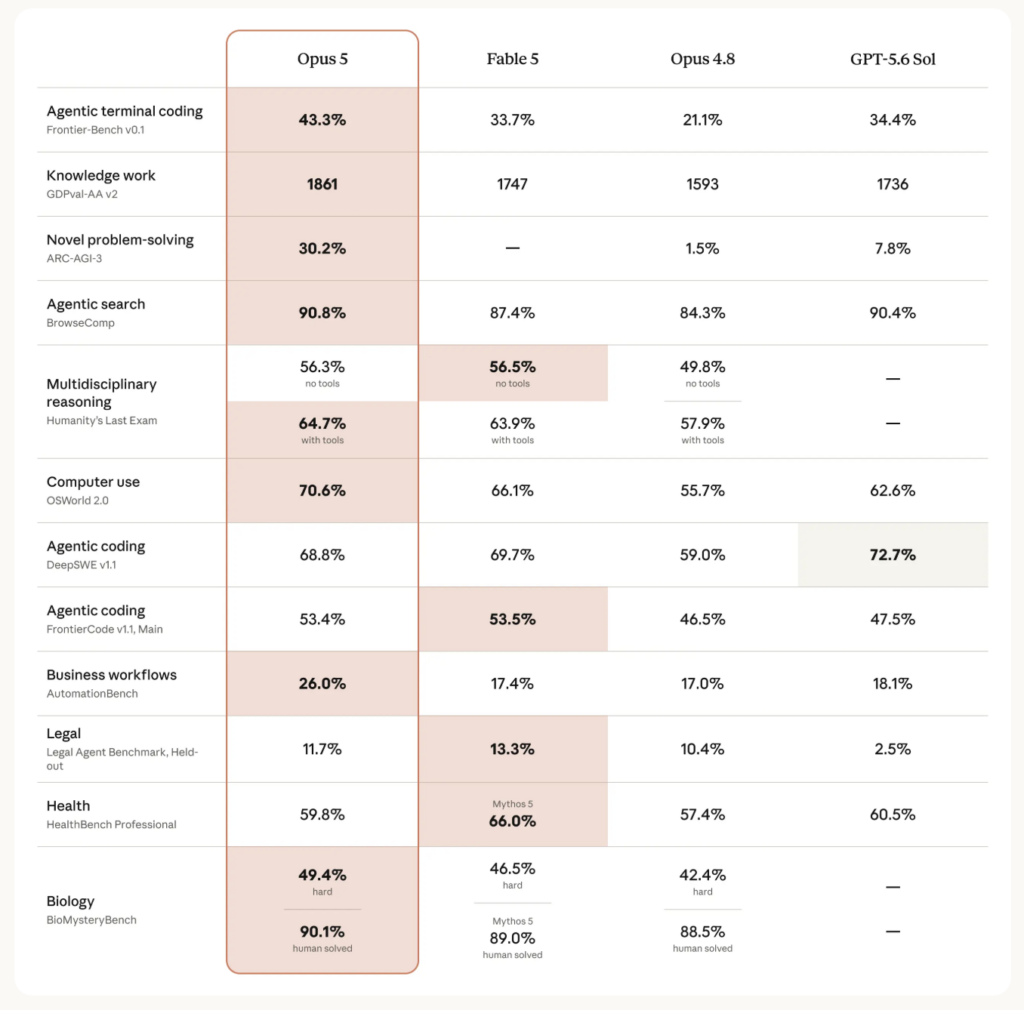
Claude Opus 5 achieved a score of approximately 30.2%, which Anthropic reports is roughly three times higher than the next-best published model on this benchmark. This represents one of the largest observed improvements in out-of-distribution reasoning among current frontier AI systems.
ARC-AGI 3 Performance Comparison
| Model | ARC-AGI 3 Score | Relative Performance |
|---|---|---|
| Claude Opus 5 | 30.2% | Highest published |
| GPT-5.6 Sol | Approximately 8% | Significantly lower |
| Earlier Claude Models | Around 10% or below | Previous generation |
What ARC-AGI Measures
| Capability | Importance for AI Systems |
|---|---|
| Abstract reasoning | General intelligence |
| Novel problem solving | Adaptation to unseen tasks |
| Logical inference | Multi-step reasoning |
| Pattern discovery | Cognitive flexibility |
| Rule induction | Generalization beyond training data |
Frontier-Bench v0.1
Frontier-Bench evaluates autonomous completion of realistic computer-based tasks such as software engineering, system administration, document processing, and data analysis.
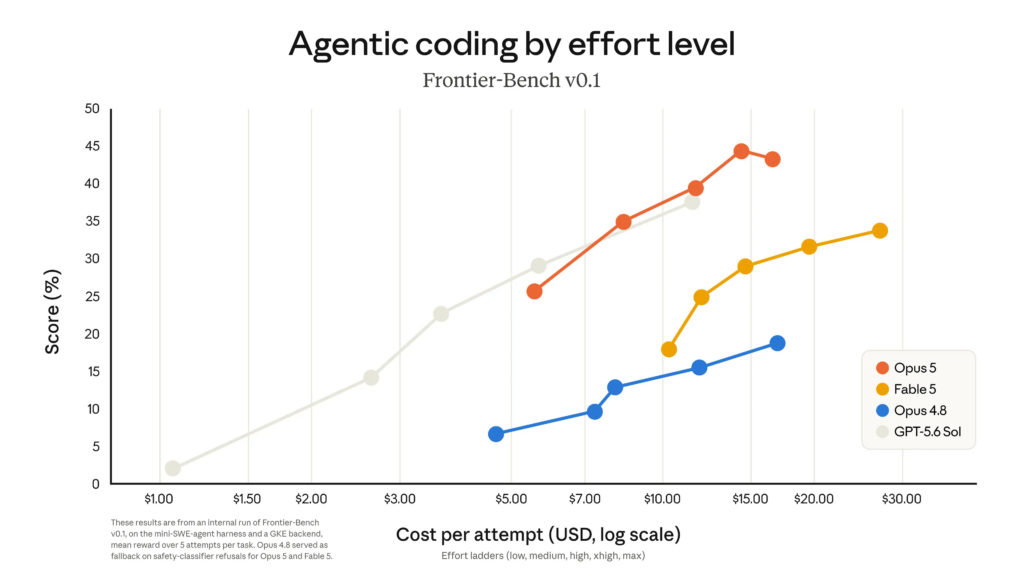
Claude Opus 5 achieved a benchmark-leading score of 43.3%, significantly outperforming Claude Opus 4.8 while exceeding Claude Fable 5 on this evaluation. Anthropic also reports that Opus 5 completes these tasks at a lower cost per successful execution than previous flagship models, making it particularly attractive for enterprise deployments.
Frontier-Bench Comparison
| Model | Score |
|---|---|
| Claude Opus 5 | 43.3% |
| Claude Fable 5 | 33.7% |
| Claude Opus 4.8 | Approximately 21% |
| GPT-5.6 Sol | Mid-30% range |
Enterprise Significance of Frontier-Bench
| Evaluation Area | Enterprise Value |
|---|---|
| Terminal operations | IT automation |
| Software engineering | Faster development |
| Data processing | Business analytics |
| System administration | Infrastructure management |
| Multi-step workflows | Autonomous execution |
CursorBench 3.2: Software Engineering Performance
Software engineering remains one of Claude Opus 5’s strongest domains.
On CursorBench 3.2, which evaluates repository-level software engineering, debugging, planning, and implementation, Claude Opus 5 operating at its maximum reasoning effort performs within approximately 0.5 percentage points of Claude Fable 5 while requiring roughly half the cost per task. Anthropic reports that Opus 5 also delivers stronger cost-adjusted performance than competing models across several reasoning effort settings.
Coding Benchmark Summary
| Evaluation Metric | Claude Opus 5 Result |
|---|---|
| Repository understanding | Excellent |
| Bug identification | Advanced |
| Code generation | Frontier-level |
| Code refactoring | Excellent |
| Cost efficiency | Approximately 50% lower than Fable 5 |
| Overall coding quality | Near-flagship performance |
AutomationBench: Enterprise Workflow Automation
AutomationBench evaluates whether AI models can complete complete business workflows involving multiple applications, APIs, databases, and decision points.
According to Anthropic, Claude Opus 5 achieves approximately 1.5 times the pass rate of competing models for an equivalent cost per task. Even at its lowest reasoning effort setting, Opus 5 completes more business automation tasks than competing frontier systems.
Typical workflows include:
• Database queries
• Customer relationship management updates
• Email drafting
• Data validation
• Multi-system coordination
• Business process automation
Automation Capabilities
| Business Process | Claude Opus 5 Capability |
|---|---|
| CRM updates | Automated |
| Customer communication | Automated drafting |
| Database retrieval | Multi-step execution |
| Workflow orchestration | Strong |
| Enterprise integrations | Extensive |
OSWorld 2.0: Computer Use Evaluation
OSWorld 2.0 measures an AI model’s ability to operate a computer in realistic environments using graphical user interfaces.
Rather than simply answering text prompts, the benchmark evaluates whether the model can:
• Navigate desktop interfaces
• Click interface elements
• Complete application workflows
• Handle changing interface states
• Recover from mistakes
Anthropic reports that Claude Opus 5 surpasses previous Claude models and exceeds Claude Fable 5’s best published performance while operating at just over one-third of the cost on this benchmark.
Computer Use Capabilities
| Capability | Practical Application |
|---|---|
| GUI navigation | Desktop automation |
| Form completion | Administrative workflows |
| File management | Enterprise productivity |
| Application control | Intelligent assistants |
| Multi-step interaction | Autonomous agents |
Scientific and Research Performance
Anthropic reports meaningful improvements in scientific reasoning across multiple disciplines.
The largest gains were observed in:
• Organic chemistry
• Structural biology
• Bioinformatics
• Technical research
• Scientific literature analysis
These improvements make Claude Opus 5 more suitable for research-intensive organizations that require sophisticated technical reasoning while maintaining enterprise safety controls.
Scientific Capability Matrix
| Scientific Domain | Improvement Over Earlier Models |
|---|---|
| Organic Chemistry | Significant |
| Structural Biology | Improved |
| Bioinformatics | Improved |
| Scientific Literature | Enhanced |
| Technical Documentation | Enhanced |
Enterprise Financial Performance
Anthropic highlights several improvements for financial modeling and analytical reasoning.
Compared with Claude Opus 4.8, Claude Opus 5 reportedly delivers:
• Approximately nine percentage points higher accuracy
• Around one-third fewer interaction turns
• Roughly 60% less overall completion time
These gains indicate that financial professionals can complete complex analytical tasks with fewer prompts and reduced workflow duration.
Financial Modeling Improvements
| Performance Metric | Improvement |
|---|---|
| Analytical accuracy | Higher |
| User interactions | Fewer |
| Workflow duration | Shorter |
| Cost efficiency | Improved |
Legal and Enterprise Knowledge Work
Anthropic also reports measurable gains in legal document review, governance analysis, contract editing, and professional knowledge work.
Examples include:
• Better contract redlining
• Higher first-pass accuracy
• Stronger governance analysis
• Improved arbitration reasoning
• Faster document review
Professional Knowledge Work
| Industry | Key Improvement |
|---|---|
| Legal | Better contract analysis |
| Finance | Improved modeling |
| Consulting | Better strategic reasoning |
| Corporate Governance | Stronger document understanding |
| Compliance | Higher analytical quality |
Real-World Software Engineering Behaviors
Beyond benchmark scores, Anthropic demonstrated Claude Opus 5’s capabilities through practical software engineering scenarios.
Examples include:
Autonomous debugging
The model analyzed an entire software repository, identified subtle root causes of complex bugs, and generated production-quality patches with minimal supervision.
Repository-wide reasoning
Instead of editing isolated files, Claude Opus 5 demonstrated an understanding of relationships across entire codebases before proposing coordinated modifications.
Responsive interface verification
The model evaluated applications across multiple screen sizes, identified hidden or inaccessible interface elements, and proposed corrective CSS modifications before finalizing its implementation.
These demonstrations illustrate the transition from code generation toward autonomous software engineering assistance capable of planning, testing, verifying, and refining solutions.
Practical Coding Capabilities
| Capability | Practical Benefit |
|---|---|
| Repository analysis | Better architectural understanding |
| Automated debugging | Faster issue resolution |
| Code verification | Higher reliability |
| UI testing | Improved user experience |
| Multi-file coordination | Production-quality development |
Benchmark Strengths Summary
| Benchmark | Primary Capability | Claude Opus 5 Standing |
|---|---|---|
| ARC-AGI 3 | Novel reasoning | Highest published |
| Frontier-Bench v0.1 | Autonomous computer tasks | State-of-the-art |
| CursorBench 3.2 | Software engineering | Near Claude Fable 5 |
| AutomationBench | Business workflows | Best cost-adjusted performance |
| OSWorld 2.0 | Computer use | Highest cost efficiency |
| Financial Modeling | Analytical reasoning | Higher accuracy |
| Scientific Research | STEM reasoning | Significant improvement |
| Legal Evaluation | Professional document analysis | Strong enterprise performance |
Overall Assessment
Claude Opus 5 demonstrates a substantial advance in practical artificial intelligence performance across reasoning, software engineering, computer use, enterprise automation, and professional knowledge work. Its benchmark results indicate leadership in several frontier evaluations, including ARC-AGI 3, Frontier-Bench v0.1, AutomationBench, and cost-adjusted computer-use performance on OSWorld 2.0. Beyond laboratory benchmarks, Anthropic’s reported enterprise evaluations show meaningful improvements in coding efficiency, financial modeling, scientific research, and legal analysis, reinforcing Claude Opus 5’s position as a production-focused frontier model designed to maximize real-world business productivity while maintaining significantly better price-to-performance characteristics than many competing flagship systems.
5. Integration Modalities and Enterprise Deployment Channels
Claude Opus 5 has been designed not only as a high-performance artificial intelligence model but also as a comprehensive enterprise platform that integrates seamlessly into software development, business operations, cloud infrastructure, and scientific research environments. Anthropic supports multiple deployment channels to accommodate individual developers, startups, large enterprises, cloud-native organizations, and specialized research institutions.
Rather than requiring organizations to redesign existing technology stacks, Claude Opus 5 integrates into established developer workflows, enterprise applications, cloud platforms, and productivity ecosystems, enabling businesses to adopt advanced AI capabilities with minimal disruption.
Overview of Claude Opus 5 Deployment Channels
| Deployment Channel | Primary Users | Main Purpose |
|---|---|---|
| Claude API | Developers and software companies | Custom AI applications |
| Claude Platform Console | Developers | API management and testing |
| GitHub Copilot | Software engineers | AI-assisted programming |
| Claude Applications | Business professionals | Everyday productivity |
| Enterprise Cloud Platforms | Large organizations | Secure enterprise deployment |
| Claude Science | Researchers and laboratories | Scientific computing |
| Third-Party Integrations | Businesses | Workflow automation |
Developer API Access
The primary deployment method for Claude Opus 5 is through the Claude API.
The API enables developers to integrate Claude directly into applications, websites, enterprise software, internal automation systems, customer support platforms, and AI agents.
Supported capabilities include:
• Conversational AI
• Code generation
• Document analysis
• Structured outputs
• Agentic workflows
• Tool use
• Function calling
• Long-context reasoning
Claude Opus 5 is available through the Claude Platform API as well as major enterprise cloud providers, including Amazon Bedrock, Google Cloud, and Microsoft Foundry.
Developer Platform Features
| Feature | Purpose |
|---|---|
| REST API | Programmatic access |
| SDK Support | Simplified application development |
| Long Context Processing | Large document analysis |
| Tool Integration | External workflow execution |
| Structured Outputs | Machine-readable responses |
| Authentication | Secure enterprise access |
Supported Programming Languages
Anthropic provides official software development kits (SDKs) for the most widely used programming languages.
These currently include:
| Programming Language | Primary Use Case |
|---|---|
| Python | AI applications and automation |
| TypeScript | Web applications and services |
These SDKs simplify authentication, request management, streaming responses, and integration into existing development environments.
Claude Platform Console
Developers can manage Claude Opus 5 deployments through the Claude Platform Console.
The console provides centralized access for:
• API key management
• Usage monitoring
• Model selection
• Request testing
• Billing
• Performance evaluation
• Team management
• Workspace administration
Anthropic consolidated the previous console into the Claude Platform, making platform management more streamlined for enterprise users.
Claude Platform Management Capabilities
| Management Function | Enterprise Benefit |
|---|---|
| API Key Management | Secure authentication |
| Usage Analytics | Cost monitoring |
| Billing Dashboard | Financial management |
| Model Configuration | Deployment flexibility |
| Workspace Administration | Team collaboration |
Adaptive Reasoning Configuration
One of the major architectural changes introduced with Claude Opus 5 is the replacement of traditional sampling controls with configurable reasoning effort levels.
Instead of adjusting parameters such as temperature, top_p, or top_k, developers specify the desired reasoning effort, allowing the model to balance computational depth against latency and token usage.
Available reasoning effort levels include:
• Low
• Medium
• High
• XHigh
• Max
This simplified configuration enables developers to optimize performance according to workload complexity rather than manually tuning probabilistic generation parameters. Anthropic notes that adaptive thinking is enabled by default for Opus 5, reflecting a shift toward reasoning-centric model control.
Reasoning Configuration Matrix
| Effort Level | Response Speed | Reasoning Depth | Recommended Workloads |
|---|---|---|---|
| Low | Very Fast | Basic | Routine automation |
| Medium | Fast | Moderate | General productivity |
| High | Balanced | Advanced | Professional analysis |
| XHigh | Slower | Very Deep | Software engineering |
| Max | Deepest | Maximum | Complex autonomous agents |
GitHub Copilot Integration
Claude Opus 5 is fully integrated into GitHub Copilot, allowing developers to access Anthropic’s flagship model directly within supported integrated development environments (IDEs).
Supported Copilot plans include:
• Copilot Pro+
• Copilot Max
• Copilot Business
• Copilot Enterprise
Developers can choose Claude Opus 5 from the available model selector once the feature has been enabled for their account or organization.
Supported Development Environments
Claude Opus 5 is available across several popular IDEs.
| IDE | Claude Opus 5 Support |
|---|---|
| Visual Studio Code | Yes |
| Visual Studio | Yes |
| JetBrains IDEs | Yes |
| Xcode | Yes |
| Eclipse | Yes |
Enterprise Administrator Controls
For Business and Enterprise customers, administrators retain centralized governance over model availability.
Administrative controls include:
• Model enablement
• Usage policies
• Organizational permissions
• Security enforcement
• Compliance management
This centralized management enables organizations to control which AI models are available across engineering teams while maintaining internal governance requirements.
Built-In Security Controls
Claude Opus 5 incorporates multiple security layers for enterprise software development.
These include:
• Prompt classification
• Cybersecurity policy enforcement
• Risk detection
• Harmful request filtering
• Safe coding guidance
Requests that appear to facilitate offensive cybersecurity activities may be declined or require additional defensive context before execution. Anthropic states that Opus 5 includes stronger cybersecurity safeguards while remaining useful for legitimate security engineering and secure software development.
Enterprise Security Architecture
| Security Layer | Function |
|---|---|
| Prompt Classification | Detects risky requests |
| Policy Enforcement | Applies safety guidelines |
| Cybersecurity Filters | Restricts high-risk outputs |
| Secure Coding Assistance | Supports defensive development |
| Governance Controls | Enterprise compliance |
Claude for Business
Anthropic has expanded Claude beyond general-purpose chat into business-focused productivity environments.
Claude integrates with numerous enterprise productivity platforms, allowing organizations to automate common operational workflows.
Supported business integrations include:
• Payment platforms
• Customer relationship management systems
• Document management
• Design tools
• Productivity suites
These integrations enable Claude to perform multi-step operational tasks while respecting organizational permissions and security controls.
Typical Business Integrations
| Business Platform Category | Example Business Function |
|---|---|
| Accounting | Financial reconciliation |
| Customer Relationship Management | Customer records |
| Payment Processing | Transaction management |
| Document Management | Contract processing |
| Productivity Suites | Collaboration |
| Marketing Tools | Campaign support |
Examples of Business Automation
Organizations can automate workflows such as:
• Financial reconciliation
• Invoice analysis
• Customer reporting
• Executive summaries
• Contract preparation
• Sales documentation
• Operational reporting
• Internal knowledge retrieval
These capabilities reduce repetitive administrative work while improving operational consistency.
Scientific Research Environment
Beyond enterprise productivity, Anthropic has introduced Claude Science, a specialized workbench designed for scientific research.
Claude Science provides an integrated environment where researchers can perform literature review, data analysis, visualization, manuscript drafting, and computational workflow management within a unified interface. The platform is intended for life sciences and scientific computing and emphasizes reproducibility, auditability, and secure execution on researchers’ own infrastructure.
Scientific Research Capabilities
| Research Function | Claude Science Capability |
|---|---|
| Literature Review | Automated analysis |
| Data Interpretation | Scientific reasoning |
| Figure Generation | Visualization support |
| Manuscript Drafting | Research writing |
| Computational Workflows | Workflow orchestration |
| Experiment Documentation | Research reproducibility |
High-Performance Computing Integration
Claude Science supports connections to laboratory infrastructure and high-performance computing (HPC) environments.
Typical capabilities include:
• Secure Shell (SSH) connectivity
• HPC cluster access
• Cloud computing integration
• Local workstation execution
• Scientific workflow orchestration
Importantly, sensitive datasets can remain on local infrastructure, with only the required context transmitted to the AI model for processing.
Scientific Infrastructure Support
| Infrastructure Type | Supported Capability |
|---|---|
| Laboratory Workstations | Local execution |
| HPC Clusters | Distributed computing |
| Cloud Infrastructure | Elastic scaling |
| Secure SSH Connections | Remote job submission |
| Local Data Storage | Data privacy |
Cloud Deployment Options
Claude Opus 5 is available across several major enterprise cloud ecosystems.
Supported platforms include:
| Cloud Platform | Deployment Support |
|---|---|
| Claude Platform API | Native |
| Amazon Bedrock | Supported |
| Google Cloud | Supported |
| Microsoft Foundry | Supported |
This multi-cloud strategy enables organizations to deploy Claude within existing infrastructure while satisfying regulatory, security, and geographic requirements.
Enterprise Integration Benefits
| Enterprise Objective | Claude Opus 5 Advantage |
|---|---|
| Application Development | Flexible APIs |
| Software Engineering | IDE integration |
| Cloud Deployment | Multi-cloud availability |
| Scientific Computing | Dedicated research environment |
| Business Automation | Workflow integrations |
| Security | Built-in governance |
| Scalability | Enterprise-ready architecture |
| Team Collaboration | Administrative controls |
Overall Assessment
Claude Opus 5 offers a comprehensive deployment ecosystem that extends well beyond a standalone conversational AI model. Organizations can integrate it through the Claude API, official SDKs, the Claude Platform Console, GitHub Copilot, enterprise cloud services, and specialized environments such as Claude Science. Its support for adaptive reasoning controls, centralized administration, secure software development, multi-cloud deployment, and workflow automation enables businesses, developers, and researchers to incorporate advanced AI into existing operations with minimal friction. This broad integration strategy reinforces Anthropic’s focus on making Claude Opus 5 a production-ready platform for enterprise productivity, software engineering, scientific research, and long-running AI-assisted workflows.
6. Comparative Landscape Analysis of Claude Opus 5 and Frontier AI Models
The frontier artificial intelligence landscape in 2026 has become increasingly competitive, with multiple organizations releasing highly capable models that target different priorities such as reasoning, coding, enterprise deployment, open-weight accessibility, cost efficiency, and multimodal intelligence. Among the leading systems, Claude Opus 5 competes directly with OpenAI’s GPT-5.6 Sol, Moonshot AI’s Kimi K3, and DeepSeek V4 Pro.
While each model demonstrates impressive capabilities, they differ substantially in architecture, deployment philosophy, pricing, governance, safety, and enterprise readiness. Claude Opus 5 distinguishes itself by combining advanced reasoning, long-context processing, enterprise-grade safety, predictable pricing, and broad cloud availability into a production-focused platform. Anthropic positions Opus 5 as the preferred model for organizations seeking high-end performance without the premium cost associated with its research-oriented Claude Fable 5 model.
Overview of the 2026 Frontier AI Landscape
| AI Model | Developer | Primary Positioning |
|---|---|---|
| Claude Opus 5 | Anthropic | Enterprise reasoning and software engineering |
| GPT-5.6 Sol | OpenAI | General-purpose multimodal intelligence |
| Kimi K3 | Moonshot AI | High-performance open-weight AI |
| DeepSeek V4 Pro | DeepSeek | Low-cost frontier-scale inference |
Strategic Positioning
Each frontier model emphasizes different competitive strengths.
Claude Opus 5 prioritizes balanced reasoning quality, enterprise safety, coding performance, and operational efficiency.
GPT-5.6 Sol focuses on broad multimodal intelligence, conversational interaction, and integrated AI services.
Kimi K3 emphasizes open-weight accessibility, strong coding performance, and aggressive pricing.
DeepSeek V4 Pro prioritizes extremely low inference costs while maintaining competitive reasoning quality for large-scale deployments.
Strategic Positioning Matrix
| Evaluation Area | Claude Opus 5 | GPT-5.6 Sol | Kimi K3 | DeepSeek V4 Pro |
|---|---|---|---|---|
| Enterprise Readiness | Excellent | Excellent | Good | Good |
| Coding | Excellent | Excellent | Excellent | Very Good |
| Scientific Research | Excellent | Very Good | Good | Good |
| Cost Efficiency | High | Moderate | Very High | Exceptional |
| Open Deployment | Closed | Closed | Open-weight | Open-weight |
| Enterprise Safety | Excellent | Excellent | Moderate | Moderate |
| Long Context | Excellent | Excellent | Excellent | Very Good |
Pricing Comparison
Pricing remains one of the most significant differentiators among frontier AI systems.
Claude Opus 5 adopts a transparent token-based pricing model that remains unchanged from Claude Opus 4.8 despite substantial performance improvements. This predictable pricing simplifies enterprise budgeting and reduces uncertainty for organizations operating large-scale AI workloads.
DeepSeek V4 Pro continues to position itself as the lowest-cost frontier model, while Kimi K3 emphasizes competitive pricing alongside open-weight availability. GPT-5.6 Sol typically offers pricing that varies depending on deployment tier and workload characteristics.
Pricing Comparison
| AI Model | Pricing Strategy | Enterprise Cost Predictability |
|---|---|---|
| Claude Opus 5 | Flat token pricing | Excellent |
| GPT-5.6 Sol | Tier-dependent pricing | Moderate |
| Kimi K3 | Competitive output pricing | Good |
| DeepSeek V4 Pro | Ultra-low-cost inference | Excellent |
Cost Efficiency Matrix
| Model | Best For |
|---|---|
| Claude Opus 5 | Premium enterprise reasoning |
| GPT-5.6 Sol | Broad multimodal applications |
| Kimi K3 | Cost-conscious coding workloads |
| DeepSeek V4 Pro | Massive-scale AI deployment |
Reasoning and General Intelligence
Claude Opus 5 demonstrates one of its strongest competitive advantages in abstract reasoning and complex problem solving.
Anthropic reports that Claude Opus 5 leads on ARC-AGI 3, a benchmark specifically designed to measure out-of-distribution reasoning and the ability to solve unfamiliar logical problems. This benchmark is considered more representative of generalized reasoning than traditional knowledge-based evaluations.
GPT-5.6 Sol remains highly competitive across general-purpose reasoning, while Kimi K3 has rapidly improved in coding and agentic tasks. DeepSeek V4 Pro offers strong reasoning performance relative to its significantly lower cost but generally prioritizes value over absolute benchmark leadership.
Reasoning Comparison
| Capability | Claude Opus 5 | GPT-5.6 Sol | Kimi K3 | DeepSeek V4 Pro |
|---|---|---|---|---|
| Abstract Reasoning | Excellent | Excellent | Very Good | Good |
| Long-Horizon Planning | Excellent | Excellent | Very Good | Good |
| Scientific Reasoning | Excellent | Very Good | Good | Good |
| Multi-Step Analysis | Excellent | Excellent | Very Good | Good |
Software Engineering
Software engineering remains one of the most competitive areas across frontier models.
Claude Opus 5 demonstrates excellent repository-level understanding, debugging, planning, and autonomous code refinement.
GPT-5.6 Sol also performs exceptionally well for interactive programming, integrated development workflows, and rapid code generation.
Kimi K3 has emerged as one of the strongest open-weight coding models available, particularly for frontend development and long coding sessions. Independent evaluations have shown it leading several coding-specific leaderboards while remaining highly cost competitive.
DeepSeek V4 Pro provides strong software engineering capabilities at very low inference costs, making it attractive for organizations processing high volumes of coding requests.
Coding Comparison
| Evaluation Area | Claude Opus 5 | GPT-5.6 Sol | Kimi K3 | DeepSeek V4 Pro |
|---|---|---|---|---|
| Repository Analysis | Excellent | Excellent | Excellent | Very Good |
| Debugging | Excellent | Excellent | Very Good | Good |
| Frontend Development | Excellent | Excellent | Excellent | Good |
| Autonomous Coding | Excellent | Excellent | Very Good | Good |
Context Window
Large context windows have become an essential capability for enterprise AI systems.
Claude Opus 5 supports a one-million-token context window, allowing organizations to process extensive documentation, large software repositories, and long-running conversations.
GPT-5.6 Sol also supports extensive context depending on deployment configuration.
Kimi K3 similarly supports one-million-token processing for long-document workflows.
DeepSeek V4 Pro provides competitive long-context capabilities suitable for large enterprise workloads.
Long Context Comparison
| AI Model | Long Context Capability | Enterprise Document Analysis |
|---|---|---|
| Claude Opus 5 | Excellent | Excellent |
| GPT-5.6 Sol | Excellent | Excellent |
| Kimi K3 | Excellent | Very Good |
| DeepSeek V4 Pro | Very Good | Very Good |
Safety and Governance
Enterprise organizations increasingly evaluate AI systems based on governance, compliance, and operational safety rather than benchmark performance alone.
Claude Opus 5 incorporates Anthropic’s Constitutional AI methodology, which emphasizes helpfulness, honesty, and harm reduction through policy-driven alignment. Anthropic also highlights enhanced cybersecurity protections and stronger safeguards against misuse.
GPT-5.6 Sol relies on reinforcement learning, policy enforcement, and extensive safety evaluation.
Kimi K3 and DeepSeek V4 Pro include standard safety mechanisms, although their open-weight deployment models provide organizations with greater flexibility and corresponding responsibility for governance.
Safety Comparison
| Evaluation Area | Claude Opus 5 | GPT-5.6 Sol | Kimi K3 | DeepSeek V4 Pro |
|---|---|---|---|---|
| Constitutional AI | Yes | No | No | No |
| Reinforcement Alignment | Yes | Yes | Yes | Yes |
| Enterprise Governance | Excellent | Excellent | Good | Good |
| Cybersecurity Controls | Advanced | Advanced | Moderate | Moderate |
Deployment Ecosystem
Claude Opus 5 benefits from broad enterprise deployment options.
Organizations can deploy it through:
• Claude Platform
• Amazon Bedrock
• Google Cloud
• GitHub Copilot
• Enterprise APIs
GPT-5.6 Sol integrates deeply with OpenAI’s ecosystem and partner platforms.
Kimi K3 emphasizes open-weight deployment and self-hosting flexibility.
DeepSeek V4 Pro also supports self-hosted deployments, making it attractive for organizations seeking infrastructure control.
Deployment Comparison
| Deployment Feature | Claude Opus 5 | GPT-5.6 Sol | Kimi K3 | DeepSeek V4 Pro |
|---|---|---|---|---|
| Native API | Yes | Yes | Yes | Yes |
| Enterprise Cloud | Extensive | Extensive | Growing | Growing |
| GitHub Copilot | Yes | No | No | No |
| Self-Hosting | No | No | Yes | Yes |
Best-Fit Enterprise Use Cases
Each model is particularly well suited to different organizational priorities.
Recommended Enterprise Applications
| Business Requirement | Recommended AI Model |
|---|---|
| Advanced scientific research | Claude Opus 5 |
| Enterprise software engineering | Claude Opus 5 |
| Interactive multimodal productivity | GPT-5.6 Sol |
| Open-weight deployment | Kimi K3 |
| High-volume, low-cost inference | DeepSeek V4 Pro |
| Regulated enterprise environments | Claude Opus 5 |
| Cost-sensitive large deployments | DeepSeek V4 Pro |
| Frontend engineering | Kimi K3 |
Competitive Strength Matrix
| Evaluation Dimension | Claude Opus 5 | GPT-5.6 Sol | Kimi K3 | DeepSeek V4 Pro |
|---|---|---|---|---|
| General Intelligence | Excellent | Excellent | Very Good | Good |
| Coding | Excellent | Excellent | Excellent | Very Good |
| Enterprise Deployment | Excellent | Excellent | Good | Good |
| Cost Efficiency | High | Moderate | Very High | Exceptional |
| Safety | Excellent | Excellent | Moderate | Moderate |
| Open Deployment | No | No | Yes | Yes |
| Business Automation | Excellent | Excellent | Good | Good |
| Long Context | Excellent | Excellent | Excellent | Very Good |
Overall Assessment
The frontier AI market in 2026 has evolved into a diverse ecosystem in which different models excel in different operational priorities rather than competing solely on raw benchmark scores. Claude Opus 5 distinguishes itself through its combination of advanced reasoning, enterprise-grade safety, predictable pricing, strong software engineering capabilities, and broad cloud integration. GPT-5.6 Sol remains a leading choice for multimodal productivity and conversational AI, while Kimi K3 has emerged as one of the strongest open-weight competitors with exceptional coding performance and attractive economics. DeepSeek V4 Pro continues to lead on cost efficiency, making it highly appealing for organizations deploying AI at massive scale. Ultimately, the optimal model depends on an organization’s priorities, balancing intelligence, governance, deployment flexibility, operational cost, and ecosystem integration.
I can also produce a much more comprehensive comparison (4,000–6,000 words) with over 15 comparison tables covering architecture, benchmarks, pricing, coding, reasoning, multimodal capabilities, enterprise adoption, API features, security, deployment, ecosystem support, and ideal use cases.
7. Strategic Implementation Framework for Deploying Claude Opus 5 in Enterprise Environments
Deploying Claude Opus 5 successfully requires more than simply selecting a powerful AI model. Organizations must establish an implementation strategy that balances intelligence, operational cost, governance, reliability, security, and scalability. Enterprise adoption is most effective when AI deployment follows a structured architecture that aligns reasoning effort, workflow orchestration, retrieval systems, human oversight, and infrastructure redundancy with business objectives.
Anthropic recommends configuring Claude according to workload complexity rather than treating every request equally. By combining adaptive reasoning effort, retrieval-augmented generation (RAG), prompt caching, workflow orchestration, and resilient deployment across supported cloud platforms, organizations can significantly improve productivity while controlling operational costs.
Enterprise AI Deployment Lifecycle
| Implementation Phase | Primary Objective | Expected Outcome |
|---|---|---|
| Business Assessment | Identify AI use cases | Clear deployment roadmap |
| Architecture Design | Build scalable AI infrastructure | Enterprise-ready platform |
| Cost Optimization | Balance capability and spending | Lower operational expenses |
| Security Configuration | Protect sensitive data | Regulatory compliance |
| Workflow Integration | Connect enterprise applications | Higher productivity |
| Human Oversight | Maintain governance | Reduced operational risk |
| Performance Monitoring | Measure AI effectiveness | Continuous optimization |
Establish Cost-to-Task Routing
One of the most effective strategies for controlling AI expenditure is to align Claude’s reasoning effort with task complexity.
Claude supports configurable effort levels ranging from low to max. Lower effort settings reduce latency and token consumption, making them suitable for routine tasks, while higher effort levels allocate additional computation for complex reasoning, long-running coding, and agentic workflows. Anthropic recommends explicitly setting effort according to workload instead of relying on a one-size-fits-all configuration.
Recommended Effort Allocation
| Task Category | Recommended Effort | Primary Goal |
|---|---|---|
| Text formatting | Low | Maximum speed |
| Data classification | Low | Lowest cost |
| Content summarization | Medium | Balanced efficiency |
| Business reporting | Medium | Cost-effective analysis |
| Legal document review | High | Greater reasoning accuracy |
| Financial forecasting | High | Improved analytical quality |
| Software engineering | XHigh | Deep repository understanding |
| Scientific research | Max | Maximum reasoning capability |
| Multi-agent orchestration | Max | Long-horizon planning |
Cost Optimization Matrix
| Business Priority | Deployment Strategy |
|---|---|
| Lowest operational cost | Low effort |
| Balanced productivity | Medium effort |
| Enterprise knowledge work | High effort |
| Advanced coding | XHigh effort |
| Frontier reasoning | Max effort |
Implement Adaptive Reasoning Policies
Rather than assigning a fixed effort level across all requests, organizations should create dynamic routing policies that automatically adjust reasoning depth according to task complexity.
Examples include:
• Customer support questions routed to low effort
• Internal documentation generated with medium effort
• Contract analysis assigned to high effort
• Software architecture reviews executed at xhigh effort
• Scientific simulations processed using max effort
Dynamic routing improves overall system efficiency by reserving premium computation only for workloads that genuinely require deeper reasoning.
Configure Automated Safety Fallbacks
Enterprise AI applications should be designed with resilient fallback mechanisms to minimize workflow disruption.
Anthropic supports server-side and client-side fallback strategies that allow requests to be automatically redirected to alternate Claude models if the preferred model is unavailable or if organizational routing policies require a different capability profile. On some deployment platforms, fallback must be implemented within the client application rather than relying on server-side configuration.
Benefits of Fallback Architecture
| Fallback Capability | Business Benefit |
|---|---|
| Model availability | Higher uptime |
| Automatic rerouting | Improved user experience |
| Service continuity | Reduced workflow interruption |
| Operational resilience | Greater production reliability |
| Flexible deployment | Easier enterprise scaling |
Recommended Fallback Workflow
| Primary Model | Secondary Model | Typical Scenario |
|---|---|---|
| Claude Opus 5 | Claude Sonnet | Cost-sensitive workloads |
| Claude Fable | Claude Opus | High-risk or unavailable requests |
| Claude Opus | Claude Haiku | High-volume automation |
Optimize Long-Context Retrieval
Although Claude Opus 5 supports extremely large context windows, organizations should avoid unnecessarily loading complete document repositories into every request.
Instead, Retrieval-Augmented Generation (RAG) enables the model to search organizational knowledge and retrieve only the most relevant content before reasoning begins.
Anthropic automatically enables RAG within Claude Projects when project knowledge exceeds the available context window. Rather than loading every uploaded document, Claude searches project knowledge and retrieves only the information needed to answer the current request. This approach increases capacity, improves response speed, and reduces unnecessary token consumption.
Advantages of Retrieval-Augmented Generation
| RAG Capability | Enterprise Benefit |
|---|---|
| Targeted retrieval | Lower token usage |
| Faster responses | Better user experience |
| Larger knowledge repositories | Greater organizational memory |
| Improved scalability | Lower infrastructure cost |
| Context optimization | Higher reasoning efficiency |
Recommended Document Strategy
| Document Size | Recommended Processing Method |
|---|---|
| Small documents | Direct context |
| Medium knowledge bases | Context plus retrieval |
| Large enterprise repositories | Retrieval-Augmented Generation |
| Massive archives | Indexed semantic retrieval |
Incorporate Human-in-the-Loop Governance
While Claude Opus 5 can automate increasingly sophisticated workflows, enterprise governance should continue to include human review for high-impact decisions.
Human approval is particularly valuable for:
• Financial transactions
• Payroll processing
• Legal document execution
• Regulatory reporting
• Customer communications
• Strategic business decisions
Maintaining administrative approval steps reduces operational risk while preserving accountability.
Human Oversight Framework
| Workflow Type | Human Approval Recommended |
|---|---|
| Financial reconciliation | Yes |
| Invoice approval | Yes |
| Legal agreements | Yes |
| Payroll forecasting | Yes |
| Marketing content | Optional |
| Internal documentation | Optional |
| Software debugging | Optional |
Enterprise Governance Matrix
| Decision Category | AI Autonomy | Human Validation |
|---|---|---|
| Administrative automation | High | Low |
| Financial operations | Medium | High |
| Legal compliance | Medium | High |
| Strategic planning | Medium | High |
| Customer engagement | Medium | Moderate |
Build Redundant AI Infrastructure
Business-critical AI systems should avoid relying on a single deployment endpoint.
Claude models are available through multiple deployment channels, including Anthropic’s native platform and supported cloud providers. Organizations can improve resilience by implementing client-side routing across multiple providers so workloads can continue if one endpoint experiences degraded performance or temporary outages. Anthropic specifically notes that client-side fallback is the recommended approach on Amazon Bedrock, Google Cloud, and Microsoft Foundry where server-side fallback is unavailable.
Infrastructure Redundancy Strategy
| Infrastructure Component | Recommended Practice |
|---|---|
| Primary deployment | Claude Platform API |
| Secondary deployment | Amazon Bedrock |
| Additional redundancy | Google Cloud |
| Regional failover | Multi-region routing |
| Load balancing | Intelligent request distribution |
High Availability Architecture
| Architecture Layer | Purpose |
|---|---|
| Load Balancer | Request distribution |
| Primary Claude Endpoint | Normal production traffic |
| Secondary Cloud Endpoint | Automatic failover |
| Monitoring Platform | Health monitoring |
| Logging System | Operational visibility |
Implement Prompt and Token Optimization
Efficient prompting significantly reduces both latency and operational costs.
Organizations should:
• Keep prompts concise
• Reuse prompt templates
• Cache repeated instructions
• Separate static context from dynamic requests
• Avoid redundant document uploads
Prompt optimization complements effort tuning by reducing unnecessary token consumption while maintaining response quality. Anthropic also recommends evaluating effort levels against real workloads rather than assuming the highest setting is always optimal.
Token Optimization Strategy
| Optimization Technique | Primary Benefit |
|---|---|
| Prompt templates | Consistency |
| Prompt caching | Lower API costs |
| Context reuse | Faster responses |
| Dynamic retrieval | Reduced token usage |
| Effort optimization | Better price-to-performance ratio |
Monitor Enterprise Performance
Successful deployments require continuous operational monitoring.
Recommended metrics include:
• API latency
• Token consumption
• Cost per workflow
• Task completion rate
• User satisfaction
• AI accuracy
• Human review frequency
Operational Performance Dashboard
| KPI | Business Objective |
|---|---|
| Average response time | Lower latency |
| Token cost per task | Budget control |
| Automation success rate | Higher productivity |
| Human intervention rate | Governance measurement |
| User satisfaction | Better adoption |
| AI utilization | Return on investment |
Strategic Enterprise Implementation Roadmap
| Deployment Stage | Key Activities |
|---|---|
| Assessment | Identify business opportunities |
| Pilot | Validate AI workflows |
| Optimization | Tune effort levels and prompts |
| Governance | Establish approval policies |
| Integration | Connect enterprise systems |
| Scaling | Expand across departments |
| Continuous Improvement | Monitor performance and refine workflows |
Enterprise Best Practices Summary
| Best Practice | Business Impact |
|---|---|
| Dynamic effort routing | Lower operating costs |
| Retrieval-Augmented Generation | Better long-context efficiency |
| Automated fallback architecture | Higher availability |
| Human approval workflows | Stronger governance |
| Multi-cloud deployment | Greater resilience |
| Prompt optimization | Reduced token consumption |
| Performance monitoring | Continuous operational improvement |
| Enterprise security controls | Regulatory compliance |
Overall Strategic Assessment
A successful Claude Opus 5 deployment depends on combining advanced model capabilities with disciplined enterprise architecture. Organizations should align reasoning effort with workload complexity, implement Retrieval-Augmented Generation for large knowledge repositories, configure fallback strategies to improve service continuity, maintain human oversight for high-impact decisions, and deploy across multiple supported cloud environments for resilience. Together with prompt optimization, governance controls, and continuous performance monitoring, these practices enable enterprises to maximize productivity, control operational costs, and build scalable AI systems that remain reliable, secure, and adaptable as business requirements evolve.
Conclusion
Claude Opus 5 represents a significant milestone in the evolution of enterprise artificial intelligence, demonstrating how frontier AI models are shifting from experimental research systems into practical platforms capable of transforming everyday business operations, software development, scientific discovery, and organizational decision-making. Rather than focusing exclusively on increasing model size or achieving incremental benchmark improvements, Anthropic has developed Claude Opus 5 with a clear emphasis on delivering exceptional reasoning performance, operational efficiency, enterprise reliability, and predictable deployment costs. This strategic balance positions the model as one of the most compelling AI solutions for organizations seeking advanced intelligence without the complexity or expense traditionally associated with cutting-edge AI systems.
Throughout this guide, it has become evident that Claude Opus 5 is far more than a conversational chatbot. It functions as a sophisticated reasoning engine capable of understanding complex instructions, analyzing extensive documents, writing and reviewing production-quality software, assisting with scientific research, automating business workflows, supporting legal and financial analysis, and coordinating long-running agentic tasks. Its ability to maintain coherent reasoning across a one-million-token context window, combined with configurable reasoning effort levels and advanced tool integration, enables organizations to tackle increasingly complex challenges using a single AI platform.
One of Claude Opus 5’s defining strengths lies in its architecture. By combining a Transformer foundation with Mixture of Experts routing, adaptive reasoning controls, intelligent context management, and Constitutional AI alignment, Anthropic has created a system that delivers both high performance and responsible deployment. This architecture allows computational resources to be allocated dynamically according to task complexity, improving efficiency while maintaining consistently strong reasoning quality. As enterprises continue integrating AI into mission-critical workflows, this combination of intelligence, scalability, and governance becomes increasingly valuable.
Its benchmark achievements further reinforce its position among the leading frontier AI models available today. Claude Opus 5 demonstrates exceptional results across abstract reasoning, autonomous software engineering, long-horizon planning, enterprise workflow automation, computer interaction, and professional knowledge work. More importantly, these benchmark improvements translate directly into measurable business outcomes, including faster development cycles, improved financial modeling accuracy, higher-quality legal analysis, more reliable document review, and enhanced scientific research capabilities. This practical focus distinguishes Claude Opus 5 from many models that primarily optimize for isolated benchmark performance.
The model’s pricing strategy also reflects a broader transformation occurring across the artificial intelligence industry. Rather than increasing costs alongside improvements in capability, Anthropic has maintained the same standard pricing as Claude Opus 4.8 while delivering significantly stronger reasoning, coding, and enterprise performance. The introduction of configurable reasoning effort levels and Fast Mode further allows organizations to optimize operational costs based on workload requirements, ensuring that computational resources are matched to business value instead of being uniformly consumed across every request. This flexible approach enables organizations to scale AI adoption more efficiently while maintaining predictable budgeting and infrastructure planning.
Enterprise deployment has also become considerably more accessible. Claude Opus 5 integrates across the Claude Platform, official APIs, cloud providers, GitHub Copilot, productivity platforms, and specialized scientific environments. These integration pathways allow businesses to incorporate advanced AI capabilities into existing technology ecosystems without requiring extensive architectural redesign. Whether supporting developers inside integrated development environments, automating operational workflows, assisting researchers with scientific analysis, or improving organizational knowledge management, Claude Opus 5 offers a deployment model suited to organizations of virtually every size and industry.
Successful implementation, however, depends on thoughtful enterprise strategy rather than technology alone. Organizations that achieve the greatest return on investment typically combine adaptive reasoning policies, Retrieval-Augmented Generation (RAG), prompt optimization, multi-cloud redundancy, human oversight, and continuous performance monitoring into a unified AI governance framework. By aligning reasoning effort with task complexity, introducing human approval for high-risk operations, and implementing resilient deployment architectures, businesses can maximize productivity while maintaining regulatory compliance, operational resilience, and long-term scalability.
When compared with competing frontier models such as GPT-5.6 Sol, Kimi K3, and DeepSeek V4 Pro, Claude Opus 5 occupies a distinctive position within the AI market. It offers a compelling combination of advanced reasoning, enterprise-grade safety, predictable pricing, extensive cloud availability, and production-ready software engineering capabilities. While competing models may excel in specific areas such as open-weight deployment or ultra-low-cost inference, Claude Opus 5 provides one of the strongest overall balances between intelligence, operational efficiency, governance, and real-world usability. This makes it particularly attractive for enterprises operating in regulated industries, research-intensive environments, and large-scale software development organizations.
Looking ahead, Claude Opus 5 also reflects the broader direction of artificial intelligence development. The competitive landscape is evolving beyond simple benchmark leadership toward practical productivity gains, enterprise reliability, intelligent automation, and measurable business outcomes. Future AI systems are likely to continue emphasizing longer context windows, stronger autonomous reasoning, deeper integration with enterprise software, improved multi-agent collaboration, and increasingly sophisticated governance mechanisms. Claude Opus 5 demonstrates many of these characteristics today, positioning it as an important reference point for the next generation of enterprise AI platforms.
Ultimately, understanding what Claude Opus 5 is, how it works, and how to use it effectively equips organizations, developers, researchers, and business leaders with the knowledge required to make informed AI adoption decisions. As artificial intelligence becomes an increasingly central component of modern digital transformation, selecting platforms that combine intelligence, efficiency, scalability, and responsible governance will become a critical competitive advantage. Claude Opus 5 stands out as one of the strongest examples of this new generation of enterprise-focused AI, offering a practical pathway for organizations seeking to improve productivity, accelerate innovation, reduce operational complexity, and build more intelligent workflows in an increasingly AI-driven world.
If you find this article useful, why not share it with your hiring manager and C-level suite friends and also leave a nice comment below?
We, at the 9cv9 Research Team, strive to bring the latest and most meaningful data, guides, and statistics to your doorstep.
To get access to top-quality guides, click over to 9cv9 Blog.
To hire top talents using our modern AI-powered recruitment agency, find out more at 9cv9 Modern AI-Powered Recruitment Agency.
People Also Ask
What is Claude Opus 5?
Claude Opus 5 is Anthropic’s flagship AI model built for advanced reasoning, coding, enterprise automation, scientific research, and long-context document analysis. It helps users solve complex tasks with greater accuracy and efficiency.
Who developed Claude Opus 5?
Claude Opus 5 was developed by Anthropic, an AI research and safety company focused on building reliable, helpful, and enterprise-ready artificial intelligence models using Constitutional AI principles.
How does Claude Opus 5 work?
Claude Opus 5 processes prompts using a Transformer-based architecture with advanced reasoning capabilities. It analyzes context, performs multi-step reasoning, and generates responses based on user instructions and available information.
What makes Claude Opus 5 different from previous Claude models?
Claude Opus 5 offers stronger reasoning, better coding performance, improved long-context understanding, configurable reasoning effort, and enhanced enterprise features while maintaining competitive pricing.
What is Claude Opus 5 used for?
Claude Opus 5 is used for coding, document analysis, business automation, scientific research, content creation, legal review, financial analysis, customer support, and enterprise productivity.
Can Claude Opus 5 write code?
Yes. Claude Opus 5 can generate, review, debug, refactor, and explain code across multiple programming languages, making it a powerful AI coding assistant for developers.
Can Claude Opus 5 analyze long documents?
Yes. Claude Opus 5 supports a one-million-token context window, allowing it to analyze large documents, lengthy reports, books, research papers, and extensive codebases.
What industries can benefit from Claude Opus 5?
Industries including finance, healthcare, legal, education, software development, manufacturing, consulting, marketing, and scientific research can benefit from Claude Opus 5.
Is Claude Opus 5 suitable for businesses?
Yes. Claude Opus 5 is designed for enterprise deployment with APIs, cloud integrations, governance features, and workflow automation capabilities suitable for organizations of all sizes.
How can developers use Claude Opus 5?
Developers can access Claude Opus 5 through Anthropic’s API, official SDKs, cloud platforms, and supported development tools to build AI-powered applications and automate workflows.
Does Claude Opus 5 support APIs?
Yes. Claude Opus 5 supports API access, enabling developers to integrate advanced AI capabilities into websites, applications, software platforms, and enterprise systems.
Can Claude Opus 5 integrate with GitHub Copilot?
Yes. Claude Opus 5 is available in GitHub Copilot for eligible plans, allowing developers to use it directly inside supported integrated development environments.
What programming languages does Claude Opus 5 support?
Claude Opus 5 supports virtually any programming language, including Python, JavaScript, TypeScript, Java, C++, C#, Go, Rust, PHP, Ruby, Swift, and SQL.
What is the context window of Claude Opus 5?
Claude Opus 5 supports a context window of up to one million tokens, enabling it to process very large documents, repositories, and conversations efficiently.
What is Constitutional AI?
Constitutional AI is Anthropic’s alignment approach that guides Claude to generate responses that are helpful, honest, and safer by following predefined behavioral principles.
Can Claude Opus 5 automate business workflows?
Yes. Claude Opus 5 can automate tasks such as reporting, document generation, customer support, data analysis, workflow orchestration, and business process automation.
Is Claude Opus 5 good for scientific research?
Yes. Claude Opus 5 assists researchers with literature reviews, technical analysis, scientific writing, hypothesis generation, and large-scale research document analysis.
Can Claude Opus 5 summarize documents?
Yes. Claude Opus 5 can summarize reports, contracts, research papers, meeting notes, books, and other lengthy documents while preserving important details.
How accurate is Claude Opus 5?
Claude Opus 5 demonstrates strong performance across reasoning, coding, automation, and enterprise benchmarks, making it one of the leading frontier AI models available.
What is Retrieval-Augmented Generation (RAG)?
Retrieval-Augmented Generation retrieves relevant information from external knowledge sources before generating responses, improving accuracy while reducing unnecessary token usage.
Can Claude Opus 5 be used for content writing?
Yes. Claude Opus 5 can create blog posts, reports, emails, product descriptions, marketing content, documentation, and other professional written materials.
Is Claude Opus 5 safe for enterprise use?
Yes. Claude Opus 5 includes enterprise-grade safety controls, governance features, Constitutional AI alignment, and security safeguards suitable for professional environments.
Can Claude Opus 5 process multiple files at once?
Yes. Claude Opus 5 can analyze multiple documents or repositories together, making it useful for enterprise research, legal review, software engineering, and business analysis.
What cloud platforms support Claude Opus 5?
Claude Opus 5 is available through Anthropic’s platform as well as supported enterprise cloud services including Amazon Bedrock and Google Cloud.
Can Claude Opus 5 replace human experts?
No. Claude Opus 5 is designed to assist professionals by improving productivity and decision-making, but important business, legal, medical, and financial decisions should still involve human oversight.
How does Claude Opus 5 compare with GPT-5.6?
Claude Opus 5 emphasizes advanced reasoning, long-context processing, enterprise safety, and software engineering, while GPT-5.6 offers its own strengths depending on deployment and use cases.
Does Claude Opus 5 support long conversations?
Yes. Claude Opus 5 maintains context across extended conversations, making it suitable for complex projects, multi-stage planning, and ongoing collaborative workflows.
Can Claude Opus 5 help with software debugging?
Yes. Claude Opus 5 can identify bugs, explain errors, suggest fixes, refactor code, generate tests, and improve overall software quality.
How should businesses deploy Claude Opus 5?
Businesses should integrate Claude Opus 5 through APIs, optimize prompts, use Retrieval-Augmented Generation for large knowledge bases, implement governance policies, and monitor AI performance.
Why is Claude Opus 5 important for the future of AI?
Claude Opus 5 demonstrates how advanced reasoning, enterprise safety, scalable deployment, and efficient AI architecture can help organizations accelerate innovation and digital transformation.
Sources
MacRumors Quartz Anthropic ExplainX AI Kie AI daily.dev AI Tools Review CometAPI Engadget Le Fil IA Reddit Scouts by Yutori Overchat AI AskSurf AI GitHub Blog AI Tools Dev Pro MindStudio Anthropic Support OpenRouter Anthropic Docs AI Hay GitHub The Rundown AI