

























Key Takeaways
- Leading silicon-based anode battery manufacturers in 2026 are scaling silicon-carbon, silicon nanowire, silicon oxide, and silicon-dominant technologies to improve energy density, fast charging, and battery performance.
- Sila Nanotechnologies, Group14 Technologies, Amprius, Enovix, Daejoo, Nexeon, StoreDot, Enevate, OneD Battery Sciences, and BTR are among the key companies advancing commercial silicon anode batteries worldwide.
- Electric vehicles, consumer electronics, aerospace, defense, and energy storage are driving silicon anode adoption as manufacturers move from pilot production toward large-scale commercial manufacturing.
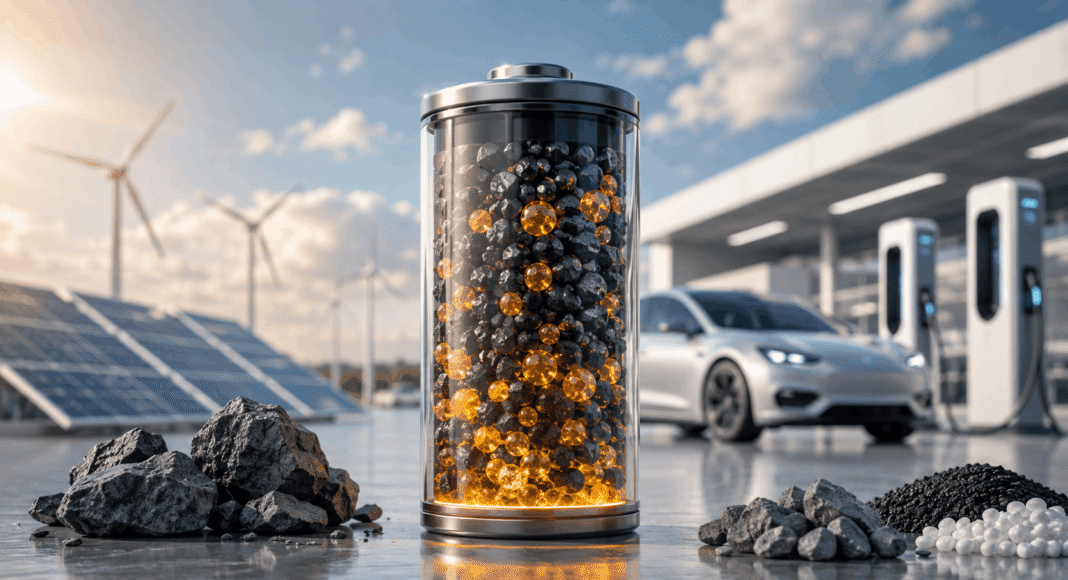
Sila Nanotechnologies leads the silicon-based anode battery market in 2026 through its Titan Silicon technology, which targets higher energy density, faster charging, and reduced dependence on conventional graphite. The wider market is expanding rapidly as silicon anodes move into electric vehicles, consumer electronics, aerospace, defense, and other high-performance battery applications.
The global battery industry is entering a decisive phase in 2026 as silicon-based anodes move from years of laboratory development and pilot testing toward increasingly meaningful commercial deployment. Conventional lithium-ion batteries remain the foundation of electric vehicles, smartphones, laptops, drones, energy storage systems, robotics, and countless other electronic products, but manufacturers are approaching the practical performance limits of traditional graphite anodes. Silicon has emerged as one of the most important technologies for pushing those limits higher.
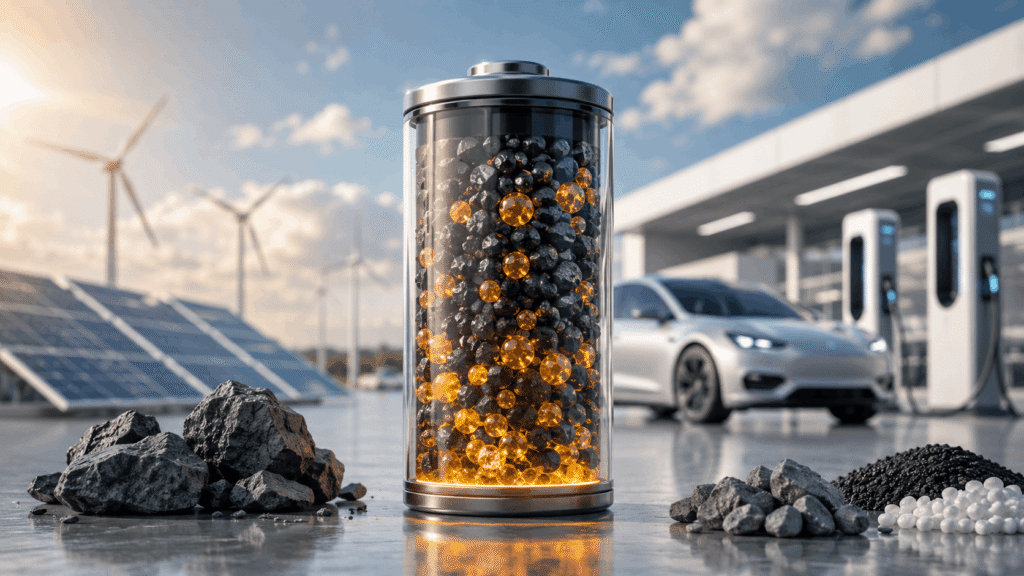
The reason is fundamentally about energy storage.
Conventional graphite has a theoretical specific capacity of approximately 372 mAh/g. Silicon has a theoretical capacity of roughly 3,579 mAh/g when considered through commonly cited room-temperature lithiation limits, giving it close to ten times the theoretical gravimetric capacity of graphite at the active-material level. That enormous difference explains why silicon has attracted substantial investment from battery manufacturers, automakers, materials companies, governments, and venture investors.
The opportunity, however, is considerably more complicated than replacing graphite with silicon.
Silicon can undergo dramatic volume changes as lithium enters and leaves the material during charging and discharging. Repeated expansion and contraction can fracture particles, disrupt electrical pathways, destabilize the solid-electrolyte interphase, consume lithium and electrolyte, and accelerate capacity loss. A silicon anode with extraordinary laboratory capacity is therefore commercially valuable only if manufacturers can control swelling while maintaining cycle life, charging performance, safety, manufacturing yield, and competitive cost.
That engineering challenge has created one of the most dynamic competitive fields in next-generation battery technology.
The Top 10 Silicon-Based Anode Battery Manufacturers in the world in 2026 represent several fundamentally different approaches to solving the silicon problem. Sila Nanotechnologies and Group14 Technologies are scaling sophisticated silicon-carbon materials. Amprius Technologies is commercializing high-energy silicon-anode cells through silicon nanowire and silicon-carbon platforms. Enovix combines high-silicon anodes with a redesigned three-dimensional cell architecture. Daejoo Electronic Materials has established a significant position in silicon oxide materials.
Nexeon is developing silicon-based materials intended for integration into established manufacturing processes. StoreDot places silicon-dominant chemistry at the center of its extreme-fast-charging strategy. Enevate develops and licenses silicon-dominant battery technology. OneD Battery Sciences grows silicon nanowires directly onto graphite through its SINANODE platform. BTR New Material Group brings enormous conventional anode manufacturing scale into the emerging silicon market.
Together, these companies illustrate why the silicon-anode industry should not be understood as a competition around one chemistry. It is an increasingly diverse industrial ecosystem spanning silicon-carbon composites, silicon oxide, silicon nanowires, silicon-dominant electrodes, graphite-silicon hybrids, novel cell architectures, advanced electrolytes, specialized binders, and new manufacturing processes.
| Silicon Anode Approach | Core Objective | Commercial Advantage | Main Technical Challenge |
|---|---|---|---|
| Silicon-Graphite Blend | Add silicon to established graphite electrodes | Relatively straightforward adoption | Limited silicon loading |
| Silicon Oxide | Increase capacity while moderating expansion | Commercially established pathway | First-cycle efficiency |
| Silicon-Carbon Composite | Confine silicon within carbon structures | Higher capacity and manufacturing compatibility | Material complexity |
| Silicon Nanowires | Create expansion-tolerant silicon structures | Very high specific energy potential | Manufacturing scale and cost |
| Silicon-Dominant Anode | Replace much of conventional graphite | Major performance improvement | Expansion and cycle durability |
| Modified Graphite | Integrate silicon directly with existing graphite | Gigafactory compatibility | Controlling silicon loading |
| Constrained High-Silicon Cell | Mechanically manage expansion at cell level | High volumetric energy density | Cell architecture complexity |
Why Silicon-Based Anode Batteries Matter in 2026
The silicon-anode opportunity is closely connected to a larger problem confronting the global battery industry: demand for battery performance is increasing faster than conventional lithium-ion technology can comfortably improve.
Electric vehicle buyers want greater driving range without heavier and more expensive battery packs.
Automakers want to reduce battery cost while improving vehicle efficiency.
Smartphone manufacturers want larger batteries without producing thicker devices.
Drone operators want longer flight times.
Electric aviation developers require dramatically greater energy per kilogram.
Robotics companies need machines capable of operating longer between charges.
AI-enabled devices increasingly combine powerful processors, sensors, cameras, connectivity, and local inference capabilities, increasing energy requirements inside products where physical space remains constrained.
Silicon potentially addresses several of these requirements simultaneously.
Higher-capacity anodes can allow battery designers to store more energy within the same cell volume or reduce the amount of anode material required for a given capacity. Depending on the complete cell architecture, this can contribute to improvements in gravimetric energy density, volumetric energy density, charging performance, system weight, and packaging efficiency.
This is why silicon has become one of the most closely watched advanced anode materials in the battery industry.
The Silicon Anode Battery Market Is Moving Toward Commercial Scale
The commercial opportunity surrounding silicon-based anodes has attracted increasingly large market forecasts.
Industry research published around 2025 and 2026 generally points toward strong long-term growth, although individual forecasts differ significantly because researchers define the silicon-anode market differently. Some measure complete silicon-anode batteries, others focus on silicon anode materials, while others include different silicon concentrations and application categories.
The direction of travel is nevertheless consistent: silicon-containing anodes are expected to represent a growing part of the lithium-ion ecosystem.
Several forces are supporting that transition.
Electric vehicle production continues to increase globally.
Battery manufacturers are investing in higher-energy cell architectures.
Premium consumer electronics are adopting higher-capacity battery technologies.
Automakers are seeking faster charging.
Governments are supporting domestic advanced-battery manufacturing.
Aerospace and defense customers are willing to pay premiums for batteries delivering exceptional energy per kilogram.
Perhaps most importantly, silicon-anode manufacturing itself is becoming industrialized.
Companies are no longer discussing commercialization exclusively through laboratory prototypes. New production facilities are being developed in locations such as Washington State, California, South Korea, Malaysia, China, Indonesia, and Morocco, while qualification programs increasingly involve major global cell manufacturers and automotive companies.
From Battery Science to Manufacturing Competition
The competitive landscape in 2026 is fundamentally different from the silicon-anode landscape of a decade earlier.
Historically, much of the discussion centered on whether silicon could be stabilized sufficiently for practical lithium-ion batteries.
Today, the question is increasingly whether silicon can be manufactured economically and consistently at enormous scale.
This distinction matters.
A material can demonstrate outstanding electrochemical performance in a coin cell and still fail commercially.
Mass production requires tight control over particle characteristics, surface chemistry, electrode thickness, porosity, binder interaction, electrolyte compatibility, moisture, contamination, formation protocols, manufacturing yield, and numerous other variables.
Automotive production introduces an additional layer of difficulty because millions of cells must behave predictably for years.
| Development Phase | Core Question |
|---|---|
| Material Research | Can silicon store substantially more lithium? |
| Laboratory Validation | Can expansion and degradation be controlled? |
| Prototype Cells | Can silicon improve complete-cell performance? |
| Pilot Manufacturing | Can the technology be manufactured repeatedly? |
| Customer Sampling | Can independent customers reproduce performance? |
| Qualification | Can the battery meet application-specific durability and safety requirements? |
| Commercial Production | Can thousands of tons or millions of cells be manufactured economically? |
| Mass-Market Adoption | Can performance, supply, cost and reliability remain competitive at global scale? |
This commercialization challenge helps explain why the leading silicon-anode companies in 2026 have very different profiles.
Some are highly specialized technology developers.
Others manufacture complete cells.
Some sell active anode materials.
Others license manufacturing intellectual property.
Still others are enormous incumbent battery-material suppliers adding silicon technologies to established graphite businesses.
The silicon-anode race is consequently becoming both a technology competition and a manufacturing competition.
The Top Silicon-Based Anode Battery Manufacturers Represent Different Commercial Models
The ten companies covered in this analysis demonstrate the diversity of the market.
| Company | Primary Silicon Strategy | Major Target Markets | Commercial Position |
|---|---|---|---|
| Sila Nanotechnologies | Engineered silicon anode material | EVs, electronics, aerospace, defense | Scaling commercial production |
| Group14 Technologies | Silicon-carbon composite | EVs, electronics, advanced batteries | Commercial manufacturing expansion |
| Amprius Technologies | Silicon nanowire and silicon-carbon cells | Aerospace, defense, mobility | Commercial high-performance cells |
| Enovix | High-silicon 3D cell architecture | Smartphones, wearables, computing | High-volume manufacturing ramp |
| Daejoo Electronic Materials | Silicon oxide materials | EVs and lithium-ion batteries | Established commercial supplier |
| Nexeon | Silicon-based drop-in materials | EVs and lithium-ion batteries | Commercial production expansion |
| StoreDot | Silicon-dominant XFC cells | Electric vehicles | OEM validation and commercialization |
| Enevate | Silicon-dominant battery technology | EVs and mobility | Licensing-led commercialization |
| OneD Battery Sciences | Silicon nanowires on graphite | Mass-market electric vehicles | Qualification and production scaling |
| BTR New Material Group | Silicon-carbon and silicon-based materials | EVs, electronics and energy storage | Large-scale industrial supplier |
These differences are important when comparing companies.
A business producing finished lithium-ion cells should not be evaluated using exactly the same criteria as an active-material supplier.
Likewise, an asset-light licensing company has a fundamentally different scaling strategy from a company investing hundreds of millions of dollars in dedicated material factories.
The most meaningful comparison therefore examines technology, manufacturing readiness, customers, production scale, applications, and commercialization strategy together.
Sila Nanotechnologies and the Push Toward Automotive-Scale Silicon
Sila Nanotechnologies has become one of the most recognizable names in advanced silicon anodes.
Its Titan Silicon platform is designed to replace part or potentially much more of the graphite used in conventional lithium-ion anodes while increasing energy storage capability.
Sila’s significance extends beyond laboratory performance because the company is investing in commercial-scale U.S. manufacturing and has established relationships with major automotive and battery-sector participants.
Its Moses Lake manufacturing strategy is particularly important.
The transition toward large-volume production represents the critical step that separates advanced materials research from genuine automotive commercialization.
For the broader silicon-anode industry, Sila therefore serves as one of the clearest tests of whether sophisticated silicon materials can transition into high-volume vehicle programs.
Group14 Technologies Is Building Silicon-Carbon Manufacturing Scale
Group14 Technologies has emerged as another major U.S. silicon-material competitor through SCC55, its silicon-carbon composite technology.
Its approach centers on creating an engineered carbon structure capable of hosting silicon while mitigating some of the mechanical and electrochemical problems associated with silicon expansion.
The company’s strategy is notable for its manufacturing ambition.
Group14 has developed production operations in Washington State and expanded internationally through South Korea. Its partnerships and customer-validation programs place it within a broad battery ecosystem covering electric vehicles, electronics, and emerging high-performance applications.
The company is also important because silicon-carbon composites are increasingly viewed as one of the most commercially practical pathways toward substantially higher silicon content without abandoning the lithium-ion manufacturing infrastructure already operating globally.
Amprius Technologies Pushes Silicon Toward Extreme Energy Density
Amprius Technologies occupies a distinctive position because it develops complete high-performance lithium-ion cells rather than focusing exclusively on active material.
Its silicon-anode platforms include SiMaxx and SiCore.
SiMaxx is particularly associated with silicon nanowire technology and exceptionally high specific-energy targets.
That makes Amprius highly relevant to aerospace, defense, drones, high-altitude aircraft, and other applications where every kilogram of battery mass matters.
In such markets, the economics differ considerably from mass-market passenger vehicles.
A battery offering exceptional watt-hours per kilogram can justify a significant price premium when the resulting weight reduction increases aircraft endurance, payload capacity, operational range, or mission capability.
Amprius therefore demonstrates how silicon technology can commercialize first in high-value markets before potentially expanding toward broader transportation applications.
Enovix Targets the Volumetric Energy Density Problem
Enovix approaches silicon through a combination of electrode chemistry and structural cell engineering.
Its architecture is designed to manage silicon expansion mechanically while maximizing the quantity of energy that can fit into a constrained physical volume.
This makes the technology particularly relevant to consumer electronics.
Smartphones illustrate why volumetric energy density matters.
Manufacturers continuously add faster processors, larger camera modules, cooling systems, AI accelerators, antennas, sensors, and other components while consumers simultaneously expect longer battery life and thinner devices.
Physical space is therefore extremely valuable.
A battery capable of storing substantially more energy within a similar volume can create immediate commercial benefits even when the improvement is less dramatic at the complete-device level than silicon’s theoretical material capacity might suggest.
Enovix’s manufacturing ramp in Malaysia consequently represents an important commercialization milestone for silicon-based batteries in premium electronics.
Daejoo Electronic Materials Demonstrates That Silicon Is Already Commercial
Silicon anodes are sometimes discussed as though commercialization remains entirely in the future.
Daejoo Electronic Materials illustrates why that interpretation is increasingly outdated.
The South Korean materials manufacturer has developed silicon oxide products designed for integration with conventional battery electrodes. Rather than requiring complete replacement of graphite, silicon oxide can be blended into established anode formulations.
This incremental approach has significant commercial advantages.
Battery manufacturers can increase capacity while limiting the technical risk associated with very high silicon concentrations.
It also demonstrates an important principle likely to shape the industry through the remainder of the decade: silicon adoption does not need to occur all at once.
A gradual progression from graphite toward increasingly silicon-rich anodes may ultimately represent the largest commercial pathway.
Nexeon Emphasizes Drop-In Compatibility
Nexeon has similarly positioned manufacturing compatibility as a central component of its strategy.
The company’s silicon-based materials are designed to increase electrode capacity without forcing battery manufacturers to completely rebuild established production processes.
This concept is commercially powerful.
Gigafactories are enormously expensive.
A battery material that can deliver meaningful performance improvements while fitting existing slurry preparation, coating, drying, calendaring, formation, and cell assembly processes can substantially reduce the cost and risk of adoption.
Nexeon’s commercial production development in South Korea and relationship with Panasonic Energy therefore place the company among the most important silicon-anode manufacturers to watch in 2026.
StoreDot Makes Charging Speed the Product
StoreDot illustrates another major reason silicon matters: charging performance.
The company’s Extreme Fast Charging strategy is built around reducing the time required to add meaningful driving range to an electric vehicle.
This addresses one of the most persistent barriers to EV adoption.
Consumers do not necessarily need batteries that recharge from completely empty to completely full in several minutes. What matters more in many real-world scenarios is how quickly a vehicle can recover enough range to continue a journey.
StoreDot’s demonstration work with Polestar has helped make this distinction tangible.
If silicon-dominant batteries can sustain very high charging rates while maintaining acceptable cycle life, thermal behavior, and safety, charging speed could become one of the strongest competitive differentiators in the EV market.
Enevate Pursues Silicon Through a Licensing Model
Enevate provides another contrasting commercialization strategy.
Rather than relying exclusively on building enormous owned battery factories, the company has developed silicon-dominant technologies intended for licensing and integration with manufacturing partners.
This approach can potentially reduce the capital intensity associated with global expansion.
Battery gigafactories require billions of dollars.
A technology provider capable of transferring intellectual property, cell designs, electrode processes, electrolyte formulations, and manufacturing expertise to established producers may scale differently from a vertically integrated cell manufacturer.
The challenge is ensuring that licensed production reproduces the technology’s performance reliably across different manufacturing environments.
OneD Battery Sciences Builds Silicon Onto Graphite
OneD Battery Sciences offers one of the industry’s most interesting approaches to manufacturing compatibility.
Its SINANODE platform integrates silicon nanowires directly onto existing graphite particles.
This strategy effectively treats graphite not as a material that must immediately disappear, but as an established industrial platform that can be upgraded.
That distinction is important.
The global battery supply chain already produces enormous quantities of natural and synthetic graphite. Cell manufacturers have extensive expertise processing graphite electrodes.
If silicon can be integrated directly with this existing material ecosystem, battery companies may be able to increase anode capacity without introducing an entirely unfamiliar manufacturing architecture.
OneD’s work with General Motors highlights the potential relevance of this approach to mass-market electric vehicles.
BTR New Material Group Brings Industrial Scale to Silicon
BTR New Material Group represents the incumbent-materials side of the silicon revolution.
Unlike startups created specifically around silicon technology, BTR entered the market with an enormous existing anode-material business.
The company manufactures natural graphite, synthetic graphite, and advanced silicon-containing materials and serves major battery manufacturers.
This creates a unique strategic position.
If global battery anodes transition gradually from graphite toward silicon-enhanced graphite and ultimately higher-silicon materials, BTR can participate across multiple stages of that transition.
Its international expansion also demonstrates how advanced anode manufacturing is becoming increasingly global.
Production investments outside mainland China can improve geographic diversification and position materials closer to major international battery and automotive manufacturing centers.
Energy Density Will Remain the Headline Performance Metric
Energy density is likely to remain the most frequently discussed silicon battery metric.
However, readers should distinguish between several different measurements.
Specific capacity measures how much electrical charge an active material can store per unit mass.
Gravimetric energy density measures the energy stored per unit mass of a complete cell.
Volumetric energy density measures energy stored per unit volume.
These metrics are related but not interchangeable.
| Metric | Typical Unit | What It Measures | Why It Matters |
|---|---|---|---|
| Specific Capacity | mAh/g | Charge stored by active material | Material-level performance |
| Gravimetric Energy Density | Wh/kg | Cell energy relative to weight | EVs, aviation and drones |
| Volumetric Energy Density | Wh/L | Cell energy relative to volume | Smartphones, wearables and EV packaging |
| Cycle Life | Cycles | Repeated usable charging life | Durability and lifetime economics |
| Charge Rate | C-rate or charging time | Speed of energy replenishment | EV usability |
| Initial Coulombic Efficiency | Percentage | First-cycle lithium efficiency | Practical cell design |
| Capacity Retention | Percentage | Remaining capacity after aging | Long-term performance |
A silicon company claiming extremely high material capacity does not automatically produce the world’s highest-energy commercial battery.
Complete-cell engineering ultimately determines the usable result.
Fast Charging and Cycle Life Must Advance Together
Charging a battery quickly is relatively easy if longevity is ignored.
The difficult task is charging rapidly hundreds or thousands of times without unacceptable degradation.
This is why silicon-anode companies increasingly report charging performance alongside cycle life and capacity retention.
For electric vehicles, these metrics cannot be separated.
A battery capable of ten-minute charging but requiring replacement after a relatively small number of cycles would create poor economics.
Conversely, an extremely durable battery that charges too slowly may provide an inferior consumer experience.
The strongest technologies will need to optimize both simultaneously.
The Silicon Expansion Problem Remains Central
Despite substantial progress, silicon’s volume change remains one of the defining engineering problems of the sector.
During lithiation, silicon can expand dramatically.
This expansion can create mechanical stress inside the electrode.
Repeated cycling can damage particles, break conductive pathways, expose fresh silicon surfaces to electrolyte, and continually reform portions of the solid-electrolyte interphase.
Manufacturers therefore attack the problem from multiple directions.
| Engineering Strategy | Purpose |
|---|---|
| Porous Carbon Structures | Provide internal space for silicon expansion |
| Nanowires | Allow silicon to expand without conventional particle fracture |
| Silicon Oxide | Moderate expansion relative to high-purity silicon |
| Elastic Binders | Maintain electrode integrity during cycling |
| Specialized Electrolytes | Stabilize the silicon-electrolyte interface |
| Carbon Coatings | Improve conductivity and surface stability |
| Mechanical Constraint | Physically limit cell swelling |
| Controlled Silicon Loading | Balance capacity against durability |
The diversity of these approaches helps explain why the Top 10 Silicon-Based Anode Battery Manufacturers have developed such different technology platforms.
Manufacturing Cost Could Matter More Than Maximum Capacity
Silicon’s theoretical capacity makes impressive headlines, but mass-market battery economics will ultimately determine adoption.
Automakers operate in an intensely competitive industry.
Adding an advanced material makes commercial sense only when the performance improvement creates sufficient system-level value.
A more expensive silicon anode could still reduce total vehicle cost if it allows the battery pack to become smaller.
Higher energy density could reduce the number of cells required.
Lower pack weight could improve vehicle efficiency.
Faster charging could allow different battery sizing strategies.
Higher-capacity smartphones can command premium pricing.
Aerospace operators may assign enormous value to weight reduction.
The economically relevant metric is therefore not simply the price of silicon per kilogram.
It is the value created across the complete battery system.
Electric Vehicles Could Become the Largest Silicon-Anode Opportunity
The automotive industry represents the most obvious long-term volume opportunity.
Global EV production requires enormous quantities of battery material, meaning even modest increases in average silicon content could generate substantial demand.
Silicon could also influence how electric vehicles are designed.
Today, long driving range is often achieved by installing larger battery packs.
That solution adds weight.
Additional weight requires more structural material and increases energy consumption, creating a partially self-reinforcing cycle.
Higher-energy cells could help break this relationship.
Automakers could use silicon to increase range, reduce battery size, or combine both strategies.
Silicon Could Transform Electric Aviation
Aviation may be smaller by battery volume but considerably more demanding technologically.
Aircraft cannot simply compensate for low battery energy density by installing much larger packs.
Every additional kilogram directly influences payload and flight performance.
For this reason, gravimetric energy density is particularly important.
High-energy silicon-anode batteries from companies such as Amprius could therefore play an outsized role in electric aircraft, high-altitude platforms, drones, defense systems, and emerging advanced-air-mobility applications.
These sectors may also tolerate higher battery prices than mass-market passenger vehicles, creating attractive early markets for cutting-edge silicon technologies.
Smartphones and AI Devices Are Creating Another Demand Driver
The rapid expansion of on-device artificial intelligence could create additional pressure for higher-density batteries.
Modern smartphones increasingly perform computationally demanding workloads involving generative AI, photography, video processing, translation, gaming, augmented reality, and continuous connectivity.
At the same time, manufacturers want thinner devices.
This creates a difficult engineering equation.
Processing requirements rise while available battery volume remains constrained.
Higher-volumetric-energy silicon batteries provide one potential solution.
This helps explain why consumer electronics remain an important commercialization market for silicon technologies rather than merely a secondary application behind electric vehicles.
Supply-Chain Geography Is Becoming Part of Battery Competition
Battery technology is increasingly influenced by industrial policy.
Governments now treat battery materials as strategically important supply-chain assets.
The location of anode production can affect tariffs, subsidies, sourcing eligibility, transportation costs, carbon footprint, and geopolitical exposure.
The emerging silicon-anode manufacturing map therefore matters.
| Region | Silicon-Anode Strategic Role in 2026 |
|---|---|
| United States | Major startup innovation and expanding domestic manufacturing |
| South Korea | Established battery-material ecosystem and commercial silicon production |
| China | Enormous battery supply chain and advanced anode manufacturing |
| Malaysia | Growing advanced cell manufacturing footprint |
| Indonesia | Expanding international anode production and battery ecosystem |
| Morocco | Emerging Europe-facing battery-material manufacturing hub |
| United Kingdom | Important silicon-anode R&D and technology development base |
| Israel | Extreme-fast-charging and advanced battery innovation |
This geographic diversification could become one of the defining developments of the silicon-anode market through 2030.
How the Leading Silicon Anode Manufacturers Can Be Compared
Selecting the Top 10 Silicon-Based Anode Battery Manufacturers in the world in 2026 requires more than comparing laboratory specifications.
A meaningful evaluation should consider technological differentiation, commercialization progress, manufacturing capacity, customer relationships, financing, supply-chain positioning, application diversity, and the ability to scale.
| Evaluation Factor | Why It Matters |
|---|---|
| Silicon Technology | Determines fundamental performance potential |
| Energy Density | Measures practical battery improvement |
| Cycle Life | Determines commercial durability |
| Fast Charging | Influences EV and device usability |
| Manufacturing Scale | Determines ability to serve mass markets |
| Customer Validation | Provides independent commercial evidence |
| Automotive Partnerships | Indicates EV qualification progress |
| Production Geography | Influences supply-chain resilience |
| Gigafactory Compatibility | Determines adoption cost and speed |
| Capital Availability | Supports expensive manufacturing expansion |
| Cost Potential | Determines mass-market competitiveness |
| Commercial Shipments | Distinguishes production from laboratory development |
This broader framework is especially important because silicon-anode manufacturers are at different stages of development.
A company with the highest-performing prototype may not become the largest supplier.
A manufacturer with slightly lower theoretical performance but dramatically better manufacturing economics could ultimately capture a much larger market.
2026 Could Be a Turning Point for Silicon-Based Anode Batteries
The significance of 2026 lies less in a single breakthrough than in the convergence of several trends.
Silicon technologies are improving.
Commercial production capacity is expanding.
Major battery manufacturers are conducting qualification programs.
Automotive partnerships are becoming more concrete.
Consumer electronics are demonstrating the value of higher-density batteries.
Fast-charging demonstrations are becoming increasingly sophisticated.
Governments are supporting advanced battery supply chains.
Manufacturing infrastructure is spreading geographically.
These developments suggest that silicon is moving deeper into the commercial battery ecosystem.
The transition will not happen instantly, and graphite will remain critically important for years. However, the direction is increasingly toward anodes containing more silicon as manufacturers learn to control its disadvantages.
What to Expect From the Top 10 Silicon-Based Anode Battery Manufacturers in 2026
The Top 10 Silicon-Based Anode Battery Manufacturers in the world in 2026 are ultimately competing over more than battery capacity.
They are competing over how quickly advanced lithium-ion technology can evolve beyond the constraints imposed by graphite.
Sila Nanotechnologies, Group14 Technologies, Amprius Technologies, Enovix, Daejoo Electronic Materials, Nexeon, StoreDot, Enevate, OneD Battery Sciences, and BTR New Material Group represent ten different positions within this transformation.
Some prioritize maximum energy density.
Others emphasize extreme fast charging.
Some are building enormous material factories.
Others seek compatibility with existing gigafactories.
Some target mass-market electric vehicles, while others initially focus on premium smartphones, drones, aviation, defense, or specialized mobility.
This diversity makes the silicon-anode market particularly important to watch in 2026.
The ultimate winners are unlikely to be determined by a single laboratory specification. Leadership will depend on whether manufacturers can deliver higher energy density and faster charging while simultaneously controlling expansion, maintaining long cycle life, achieving competitive manufacturing yields, securing reliable raw materials, reducing cost, and satisfying demanding customer qualification standards.
Silicon’s enormous theoretical capacity established the scientific opportunity.
The challenge in 2026 is industrial execution.
As manufacturing scales and silicon-containing cells move into more commercial products, the battery industry is beginning to discover which technologies can convert that scientific potential into practical economic value. The manufacturers that successfully combine advanced silicon chemistry with reliable mass production could become some of the most strategically important companies in the next generation of electric mobility, consumer electronics, aerospace, robotics, defense, and energy-storage technology.
Before we venture further into this article, we would like to share who we are and what we do.
About 9cv9
9cv9 is a business tech startup based in Singapore and Asia, with a strong presence all over the world.
With over ten years of startup and business experience, and being highly involved in connecting with thousands of companies and startups, the 9cv9 team has listed some important and crucial software tools in this review.
If you like to get your company listed in our top B2B software reviews, check out our world-class 9cv9 Media and PR service and pricing plans here.
Top 10 Silicon-Based Anode Battery Manufacturers in 2026
- Sila Nanotechnologies Inc.
- Group14 Technologies Inc.
- Amprius Technologies Inc.
- Enovix Corporation
- Daejoo Electronic Materials Co., Ltd.
- Nexeon Ltd.
- StoreDot Ltd.
- Enevate Corporation
- OneD Battery Sciences
- BTR New Material Group Co., Ltd.
1. Sila Nanotechnologies Inc.
Company Overview
Sila Nanotechnologies is one of the most commercially advanced silicon-anode battery materials companies in the world in 2026 and a significant participant in the broader transition away from conventional graphite-dominant lithium-ion anodes. Headquartered in Alameda, California, the company develops silicon-carbon anode materials intended to increase the amount of energy that lithium-ion batteries can store without requiring battery manufacturers to completely redesign their existing cell production infrastructure.
Its core commercial technology, Titan Silicon, is an engineered silicon-carbon anode material designed to replace some or potentially all of the graphite traditionally used in lithium-ion battery anodes. Rather than treating silicon as a small additive to conventional graphite electrodes, Sila has developed an architecture intended to enable substantially higher silicon utilization while addressing one of the material’s fundamental engineering problems: physical expansion during lithiation.
This approach places Sila among the most important manufacturers to watch in the global silicon-based anode battery market in 2026. Its significance comes not only from laboratory performance claims, but increasingly from commercial manufacturing capacity, automotive supply agreements, consumer-device deployment, United States manufacturing expansion and growing relevance to defense, aerospace, artificial intelligence infrastructure, drones and other energy-intensive applications.
| Company Attribute | Sila Nanotechnologies Position in 2026 | Strategic Significance | |
|---|---|---|---|
| Headquarters | Alameda, California, United States | Major United States battery technology hub | |
| Core Technology | Silicon-carbon anode material | Alternative to conventional graphite-dominant anodes | |
| Commercial Product | Titan Silicon | High-performance silicon-carbon anode material | |
| Primary Manufacturing Base | Moses Lake, Washington | Automotive-scale domestic production | |
| Secondary Facility | Alameda, California | Research, development and commercial production | |
| Commercial Market Presence | Shipping commercial material since 2021 | Demonstrates technology beyond laboratory development | |
| Major Target Markets | EVs, electronics, drones, defense, aerospace and AI-related applications | Diversifies demand beyond passenger electric vehicles | |
| Automotive Relationships | Mercedes-Benz and Panasonic Energy | Provides routes into large-scale EV battery programs | |
| Manufacturing Expansion | Moses Lake Phase 2 planned | Supports significantly larger future production | |
| 2026 Private Funding | $300 million | Supports accelerated United States manufacturing expansion | |
| Long-Term Site Potential | Up to 150 GWh following planned expansions | Positions Sila for gigascale anode-material manufacturing |
Why Sila Nanotechnologies Is Important to the Silicon-Based Anode Battery Market
The importance of Sila Nanotechnologies within the Top 10 Silicon-Based Anode Battery Manufacturers in the world in 2026 is closely connected to the limitations of graphite.
Graphite has served as the dominant commercial lithium-ion battery anode material for decades because it offers relatively predictable cycling behavior, mature manufacturing processes and an established supply chain. However, its theoretical storage capacity constrains how much additional energy battery manufacturers can obtain from incremental improvements to traditional graphite-based cell architectures.
Silicon presents a fundamentally different opportunity. It can accommodate considerably more lithium than graphite on a mass basis, creating the potential for batteries with greater energy density. Higher anode capacity can subsequently contribute to longer electric-vehicle driving ranges, smaller battery packs, lighter electronics, longer-lasting wearable devices and improved endurance for drones and aerospace systems.
The difficulty is that silicon can expand dramatically as lithium enters the material during charging. Repeated expansion and contraction can fracture conventional silicon structures, disrupt electrical pathways and continuously expose fresh surfaces to the electrolyte. These mechanisms can accelerate degradation and shorten battery life.
Consequently, the commercial silicon-anode race is not simply about identifying a material with high theoretical capacity. Manufacturers must engineer silicon structures that can tolerate repeated cycling while remaining compatible with practical electrode production, cell manufacturing, safety requirements, charging speeds and automotive-quality standards.
Sila’s technology has been designed around this commercialization challenge.
| Anode Technology Factor | Conventional Graphite | Advanced Silicon-Carbon Approach | Commercial Importance | |
|---|---|---|---|---|
| Lithium Storage Potential | Mature but fundamentally constrained | Significantly higher potential | Enables higher-energy cells | |
| Expansion During Charging | Relatively limited | Considerably more challenging | Requires engineered material structures | |
| Energy Density Upside | Incremental | Potentially substantial | Supports longer range or smaller packs | |
| Manufacturing Maturity | Extremely high | Rapidly developing | Determines commercialization speed | |
| Fast-Charging Potential | Established | Potentially strong with optimized designs | Important for EV and mobility applications | |
| Cycle-Life Challenge | Well understood | Historically one of silicon’s largest obstacles | Critical for automotive adoption | |
| Supply-Chain Diversification | Concentrated processing exposure | Potential alternative to graphite dependence | Increasingly important strategically | |
| 2026 Commercialization Focus | Mass-market incumbent | Scaling from specialized uses toward mass manufacturing | Defines the emerging competitive landscape |
Titan Silicon Technology
Titan Silicon is the foundation of Sila’s competitive position.
The material is engineered as a silicon-carbon anode solution that can be incorporated into lithium-ion battery architectures while retaining much of the existing cell-manufacturing ecosystem. This is commercially important because battery manufacturers have invested billions of dollars in existing lithium-ion factories.
A next-generation chemistry that requires an entirely new production process faces an enormous commercialization barrier. By contrast, a high-performance anode material that can be integrated into established pouch, cylindrical and prismatic cell manufacturing processes has a potentially shorter route toward high-volume deployment.
Sila states that Titan Silicon can operate across pouch, cylindrical and prismatic cell formats and can be integrated into existing cell-assembly processes. This “drop-in” characteristic represents an important component of its commercialization strategy.
The company reports that replacing graphite with Titan Silicon can produce approximately 20% higher energy density compared with leading conventional cells while maintaining competitive cycle life and safety characteristics.
The material has also demonstrated more than 2,000 cycles in certain configurations, according to company performance disclosures. Sila further reports the potential for charging in less than 10 minutes, depending on the specific cell design and application.
These figures should be interpreted as technology capabilities rather than universal specifications for every commercial battery containing Titan Silicon. Final battery performance depends on cathode chemistry, electrode loading, electrolyte formulation, cell geometry, silicon content, thermal management, charging protocols and other engineering variables.
| Titan Silicon Performance Area | Reported or Targeted Capability | Potential Application Benefit | |
|---|---|---|---|
| Energy Density | Approximately 20% improvement in applicable designs | Longer EV range or smaller battery packs | |
| Fast Charging | Less than 10 minutes in optimized configurations | Reduced charging time | |
| Cycle Life | More than 2,000 cycles demonstrated | Greater suitability for long-life applications | |
| Power | Up to approximately 2x in power-oriented designs | Higher-performance mobility and industrial systems | |
| Cell Swelling | Designed to remain comparable with graphite cells | Improved mechanical stability | |
| Cell Format Compatibility | Pouch, cylindrical and prismatic | Broader integration flexibility | |
| Manufacturing Compatibility | Designed for existing cell-production environments | Lower adoption barriers for battery manufacturers | |
| Commercial Production | Commercial shipments since 2021 | Evidence of progression beyond laboratory development |
Solving the Silicon Expansion Problem
The silicon expansion problem remains one of the defining technical challenges facing the global silicon-anode industry.
During lithiation, silicon experiences substantial volume changes. If those changes are not controlled, particles can crack, electrical connections can deteriorate and the solid-electrolyte interphase can repeatedly reform. These processes consume active lithium and electrolyte, reducing battery capacity over repeated cycles.
Sila’s approach involves engineering the internal material architecture so that much of the physical expansion can be accommodated within the particle structure rather than being translated directly into excessive macroscopic electrode or cell swelling.
This distinction is critical.
A silicon material can demonstrate exceptionally high initial capacity and still have limited commercial value if the battery degrades too quickly. For EV manufacturers in particular, cycle life, safety, manufacturability and predictable aging can be as important as headline energy density.
Sila therefore competes not simply on silicon content, but on the ability to transform silicon’s theoretical capacity advantage into commercially useful battery performance.
| Silicon-Anode Challenge | Engineering Requirement | Sila’s Commercialization Objective | |
|---|---|---|---|
| Silicon expansion | Accommodate repeated volume changes | Maintain controlled cell-level swelling | |
| Particle degradation | Preserve structural integrity | Improve long-term cycling performance | |
| Electrical disconnection | Maintain conductive pathways | Preserve usable capacity | |
| Interphase instability | Limit continuous surface regeneration | Improve efficiency and lifetime | |
| High-energy degradation | Balance capacity with durability | Preserve energy-density gains across practical cycles | |
| Manufacturing complexity | Integrate material into industrial processes | Reduce barriers to gigafactory adoption | |
| Automotive qualification | Achieve repeatable material quality | Support large global automotive programs |
Moses Lake Automotive-Scale Silicon Anode Manufacturing
One of the strongest reasons Sila stands out among silicon-based anode battery manufacturers in 2026 is its manufacturing progress.
The company’s Moses Lake, Washington facility represents its principal automotive-scale manufacturing platform. Operations began in 2025, marking the transition from smaller-scale commercialization toward significantly larger industrial production.
The facility spans more than 600,000 square feet on a site of approximately 160 acres. According to Sila, its production infrastructure was designed for expansion from the beginning rather than functioning solely as a demonstration plant.
This manufacturing strategy matters because silicon-anode technology faces a major “scale-up gap.” Producing kilograms or limited tons of advanced material under carefully controlled conditions is substantially different from manufacturing consistent material at automotive volumes.
Battery manufacturers require extremely tight control over particle characteristics, purity, electrochemical behavior, batch consistency and quality. Small variations can influence electrode coating, formation behavior, cycle life and safety.
Sila’s investment in automotive-scale production therefore represents an attempt to solve both the material-science challenge and the industrial manufacturing challenge simultaneously.
| Manufacturing Metric | Sila Position | Strategic Meaning | |
|---|---|---|---|
| Primary Scale-Up Location | Moses Lake, Washington | United States automotive manufacturing base | |
| Facility Size | More than 600,000 square feet | Supports industrial-scale production | |
| Site Area | Approximately 160 acres | Provides substantial expansion potential | |
| Operations Commenced | 2025 | Manufacturing scale-up underway by 2026 | |
| Long-Term Capacity Potential | Up to 150 GWh after planned expansions | Potential gigascale supply position | |
| Full-Site EV Potential | Material for up to approximately 3 million EVs | Illustrates long-term production ambition | |
| Production Objective | Automotive-quality silicon-carbon anode material | Targets demanding OEM qualification requirements | |
| Expansion Strategy | Modular additional manufacturing capacity | Enables production growth alongside customer demand |
Alameda Manufacturing and Research Operations
Sila’s manufacturing footprint is not limited to Moses Lake.
Its Alameda operation continues to serve as an important research, development, validation and commercial production center. The facility has been commercially supplying material since 2021 and provides capacity equivalent to more than 10 million devices annually, according to the company.
The two-site structure gives Sila an important strategic configuration.
Alameda functions as an innovation and commercialization platform where material formulations can be developed, validated and supplied to customers, while Moses Lake provides the scale required for automotive and other high-volume applications.
This creates a progression from materials research through customer validation and ultimately into mass manufacturing.
| Facility Role | Alameda | Moses Lake | |
|---|---|---|---|
| Primary Function | R&D, validation and commercial manufacturing | Automotive-scale manufacturing | |
| Commercial History | Shipping since 2021 | Operations commenced in 2025 | |
| Scale | More than 10 million devices annually | Gigascale expansion pathway | |
| Customer Role | Development and commercial delivery | Large-volume customer programs | |
| Strategic Importance | Innovation and qualification | Industrial commercialization | |
| Quality Focus | End-to-end testing and commercial quality | Automotive-quality production |
Mercedes-Benz Relationship
Sila’s relationship with Mercedes-Benz has been one of the company’s most strategically important automotive developments.
The partnership provides Sila with a route for introducing high-silicon anode technology into premium electric mobility applications, where improvements in energy density can generate substantial vehicle-level advantages.
Premium EVs are particularly attractive early markets for advanced battery materials because manufacturers may be more willing to absorb higher initial material costs when the resulting technology provides meaningful improvements in driving range, battery weight, packaging efficiency or charging performance.
For silicon-anode suppliers, automotive relationships also provide more than sales volume. Qualification by a major global vehicle manufacturer can act as an important credibility signal because automotive battery materials face demanding validation requirements covering safety, lifetime, temperature performance, manufacturing consistency and reliability.
Panasonic Energy Supply Agreement
Sila’s commercial agreement with Panasonic Energy substantially expands its relevance beyond a single automotive OEM relationship.
Panasonic Energy agreed to procure Titan Silicon for its next-generation lithium-ion battery program, with the material intended to be produced from Sila’s Moses Lake facility.
This relationship is strategically important because it places Sila within the supply chain of a major global automotive battery manufacturer rather than limiting the company to direct relationships with individual vehicle brands.
Silicon-anode adoption can accelerate when major cell manufacturers qualify advanced materials because a single battery producer may ultimately supply multiple vehicle platforms and OEM customers.
| Strategic Partner | Relationship Area | Importance to Sila | |
|---|---|---|---|
| Mercedes-Benz | Automotive battery integration | Direct route toward premium EV applications | |
| Panasonic Energy | Next-generation lithium-ion batteries | Access to major global cell-manufacturing ecosystem | |
| Consumer Device Customers | Existing commercial applications | Demonstrates real-world material deployment | |
| Defense and Aerospace Market | High-performance specialty batteries | Creates additional premium-market opportunities |
Sila’s Expanding Role Beyond Electric Vehicles
Although electric vehicles represent one of the largest potential markets for silicon anodes, Sila’s 2026 strategy increasingly extends into several high-performance battery segments.
Drones are particularly important.
For unmanned aerial systems, battery weight has a direct relationship with flight endurance and payload capacity. Increasing energy stored per kilogram can allow a drone to fly farther, remain airborne longer or carry more sensors, communications equipment or other payloads.
Similar economics apply to aerospace and satellite applications, where reducing mass can have disproportionate system-level value.
Consumer electronics provide another attractive market because manufacturers constantly compete to improve battery life without increasing device thickness or weight.
Artificial intelligence infrastructure also creates emerging opportunities. Growth in AI computing is increasing demand for sophisticated power-management and backup-energy systems, while edge AI devices, robotics and autonomous platforms require batteries capable of combining energy density with high power.
| Application Market | Why Silicon Anodes Matter | Potential Sila Opportunity | |
|---|---|---|---|
| Electric Vehicles | Longer range and potentially smaller battery packs | High-volume automotive market | |
| Drones | Longer endurance and greater payload capability | Defense and commercial UAV systems | |
| Aerospace | High value assigned to weight reduction | Satellites and specialized aerospace platforms | |
| Consumer Electronics | Longer runtime within limited device volume | Wearables and portable electronics | |
| Robotics | Longer operating time and higher power requirements | Industrial and autonomous systems | |
| Defense | Domestic supply plus performance requirements | Strategic United States battery programs | |
| AI Infrastructure | Growing requirements for resilient energy systems | Emerging high-performance power applications |
Major 2026 Funding and Manufacturing Expansion
Sila entered another significant capital-expansion phase in 2026.
In July 2026, the company announced a $300 million private funding round led by Atreides Management and Sutter Hill Ventures, with participation from several existing and new investors.
The capital is intended to accelerate United States production of Titan Silicon and support the planned Phase 2 expansion of the Moses Lake facility.
This financing is particularly notable because advanced battery materials manufacturing is highly capital intensive. Commercial success requires far more than developing a high-performing laboratory material. Companies must build processing equipment, quality systems, production lines, raw-material supply arrangements and customer qualification infrastructure before achieving automotive-scale revenue.
The 2026 investment therefore strengthens Sila’s ability to move further into mass manufacturing.
At the same time, Sila’s strategic importance to the United States battery supply chain has increased substantially. In August 2026, the United States government announced a conditional $1.4 billion Defense Department loan commitment associated with Sila as part of a broader effort to expand domestic battery and critical-material production.
The development highlights how silicon-carbon anodes are increasingly being viewed not merely as an EV technology but as part of the strategic industrial infrastructure required for drones, defense equipment, aerospace systems, advanced electronics and AI-related power applications.
| Funding and Expansion Area | 2026 Development | Expected Strategic Impact | |
|---|---|---|---|
| Private Capital | $300 million funding round | Accelerates manufacturing expansion | |
| Moses Lake | Phase 2 expansion planned | Increases Titan Silicon production | |
| Government Support | $1.4 billion conditional defense loan | Potentially expands domestic strategic capacity | |
| Target Industries | Defense, space, AI, electronics and EVs | Reduces dependence on a single end market | |
| Manufacturing Strategy | United States production | Strengthens domestic battery supply chains | |
| Long-Term Capacity | Up to 150 GWh potential after expansions | Supports gigascale commercialization |
Domestic Battery Supply Chain Position
Sila’s geographic position is becoming another important competitive differentiator.
The global battery industry has historically relied heavily on Asian supply chains for anode materials and particularly for graphite processing. Governments and manufacturers in the United States and Europe are consequently investing heavily in localized battery-material production.
Silicon-carbon materials offer a potential pathway to reduce the quantity of conventional graphite required per battery while simultaneously improving cell performance.
Sila has positioned Moses Lake as a Western alternative within this supply-chain restructuring.
The company has also developed relationships with United States-based suppliers for important production inputs, strengthening its domestic manufacturing proposition.
For automakers, defense contractors and battery manufacturers, localization can provide several advantages beyond geopolitical considerations. Domestic production can potentially reduce logistics exposure, improve supply visibility, simplify certain sourcing requirements and provide access to applicable manufacturing incentives.
Commercialization Position in 2026
Sila’s position within the silicon-based anode battery industry is best understood through the combination of four factors: technology performance, commercial deployment, manufacturing scale and customer validation.
Many silicon-anode technologies can demonstrate impressive laboratory capacity. Fewer have progressed to commercial products. Fewer still have built automotive-scale manufacturing facilities and established relationships with globally recognized battery and automotive manufacturers.
That distinction is increasingly important as the silicon-anode sector transitions from research competition toward manufacturing competition.
| Commercialization Criterion | Sila Status in 2026 | Competitive Interpretation | |
|---|---|---|---|
| Laboratory Technology | Established | Core material science substantially developed | |
| Commercial Product | Titan Silicon | Clearly defined market offering | |
| Commercial Shipments | Active since 2021 | Technology already deployed commercially | |
| Automotive-Scale Plant | Operating in Moses Lake | Major commercialization milestone | |
| Automotive Customers | Major relationships established | Strong external validation | |
| Cell Manufacturer Agreement | Panasonic Energy | Important pathway toward broader deployment | |
| Manufacturing Expansion | Phase 2 planned | Indicates transition toward larger volumes | |
| Government Strategic Support | Significant | Strengthens domestic industrial position | |
| Market Diversification | EV, electronics, defense, drones, aerospace | Reduces dependence on one application category |
Competitive Strengths
Sila’s strongest competitive advantage in the global silicon-based anode battery market is arguably the integration of materials science with an increasingly credible manufacturing strategy.
Titan Silicon is not being positioned solely as an experimental chemistry. Sila is attempting to make the material compatible with existing lithium-ion cell architectures and established battery production processes.
This approach can reduce one of the largest barriers facing next-generation battery technologies: factory replacement.
A completely new battery architecture can require new manufacturing equipment, new suppliers, new quality-control systems and extensive vehicle requalification. An advanced anode material capable of fitting more readily into established manufacturing environments potentially offers a less disruptive path to adoption.
Sila also benefits from commercial operating experience dating back to 2021, a growing United States manufacturing footprint, major customer relationships and substantial private and public-sector financial backing.
Key Risks and Challenges
Despite its strong position, Sila still operates within an emerging industry facing significant technical and commercial risks.
The first challenge is manufacturing economics. Silicon-carbon anodes must eventually compete not only on performance but also on cost per usable kilowatt-hour. Graphite benefits from decades of manufacturing optimization and enormous global production scale.
The second challenge is qualification time. Automotive materials can require years of testing before high-volume deployment. A successful technical evaluation does not immediately translate into millions of vehicles.
The third challenge involves competition. Numerous companies are developing silicon-rich anodes, silicon-carbon composites, silicon nanowires, silicon oxide materials and other advanced anode architectures.
Finally, improvements elsewhere in lithium-ion technology continue. Better cathodes, electrolytes, graphite materials, lithium-metal batteries and solid-state technologies are all competing for investment and future battery platforms.
| Risk Category | Industry Challenge | Strategic Implication for Sila | |
|---|---|---|---|
| Production Cost | Graphite has enormous incumbent scale | Silicon must demonstrate system-level economic value | |
| Manufacturing Ramp | New materials are difficult to scale uniformly | Quality consistency becomes critical | |
| Automotive Qualification | Validation cycles can be lengthy | Revenue growth may lag production investment | |
| Competitive Technology | Multiple silicon approaches are emerging | Continuous innovation remains necessary | |
| Alternative Battery Chemistry | Lithium metal and solid-state technologies grow | Long-term technology competition remains significant | |
| Customer Concentration | Large automotive programs carry execution risk | Market diversification becomes important | |
| Capital Requirements | Gigascale materials production is expensive | Continued financial discipline is necessary |
Sila Nanotechnologies Outlook for 2026 and Beyond
Sila Nanotechnologies occupies an increasingly important position among the world’s leading silicon-based anode battery manufacturers in 2026 because it has moved beyond the stage where silicon-anode companies are judged primarily by laboratory capacity figures.
The competitive question is increasingly whether manufacturers can produce advanced silicon materials consistently, economically and at sufficient scale to satisfy automotive, electronics, aerospace and defense customers.
Sila’s commercial shipments, Titan Silicon platform, Alameda operations, automotive-scale Moses Lake facility, Panasonic Energy agreement, Mercedes-Benz relationship, $300 million 2026 financing and expanding United States strategic support collectively place the company among the most advanced participants in this commercialization race.
Its long-term Moses Lake expansion plan is particularly important. Sila states that planned expansions could eventually provide up to approximately 150 GWh of capacity, with a fully developed site potentially supplying enough anode material for roughly three million electric vehicles.
If those expansion plans are executed successfully, Sila could evolve from a specialized advanced-materials manufacturer into a major component supplier for the global lithium-ion battery industry.
The broader significance extends beyond one company. Silicon-carbon anodes represent one of the most practical pathways for improving conventional lithium-ion batteries without waiting for an entirely new battery architecture to reach mass production. Rather than replacing lithium-ion manufacturing, technologies such as Titan Silicon seek to upgrade it.
For this reason, Sila Nanotechnologies remains a notable company within any assessment of the Top 10 Silicon-Based Anode Battery Manufacturers in the world in 2026. Its combination of commercial technology, existing shipments, automotive-scale manufacturing, major industry partnerships and rapidly expanding domestic production capacity makes it an important benchmark for measuring how quickly silicon anodes are progressing from advanced battery research into global industrial production.
2. Group14 Technologies Inc.
Company Overview
Group14 Technologies is one of the world’s most commercially advanced silicon battery materials manufacturers in 2026, occupying a prominent position in the transition from conventional graphite anodes toward higher-capacity silicon-carbon architectures. Founded in 2015 and headquartered in Woodinville, Washington, the company develops and manufactures advanced silicon-carbon materials intended to substantially increase lithium-ion battery performance without requiring the battery industry to abandon its existing manufacturing ecosystem.
At the center of Group14’s technology platform is SCC55, a proprietary silicon-carbon composite engineered to replace conventional graphite partially or entirely within lithium-ion battery anodes. The company’s strategy addresses one of the fundamental constraints facing modern batteries: graphite is reliable and inexpensive, but its relatively limited lithium-storage capacity restricts further improvements in energy density.
Group14 has progressed substantially beyond laboratory-scale silicon research. By 2026, the company operates commercial manufacturing infrastructure in Washington State and South Korea, has supplied SCC55 to more than 100 customers, and has developed relationships across electric vehicles, consumer electronics, aviation, energy storage and other high-performance battery applications. Its customer base includes battery manufacturers responsible for more than 95% of worldwide lithium-ion battery production, according to company disclosures.
The company’s financial position has also strengthened considerably. Group14 completed a $463 million Series D financing round in 2025, bringing total equity capital raised to more than $1 billion. Investors have included SK, Porsche Investments, ATL, OMERS, Decarbonization Partners, Lightrock Climate Impact Fund and Microsoft Climate Innovation Fund.
| Company Attribute | Group14 Technologies Position in 2026 | Strategic Significance | |
|---|---|---|---|
| Founded | 2015 | More than a decade of silicon-battery development | |
| Headquarters | Woodinville, Washington, United States | Located within an expanding U.S. battery manufacturing hub | |
| Core Product | SCC55 | Advanced silicon-carbon battery material | |
| Primary Technology | Silicon-carbon composite | Designed to replace conventional graphite | |
| Initial Commercial Factory | BAM-1, Woodinville | Established commercial manufacturing capability | |
| Major U.S. Expansion | BAM-2, Moses Lake | Large-scale domestic silicon material production | |
| Asian Manufacturing Facility | BAM-3, South Korea | EV-scale Asian production and regional supply | |
| Global Customers | More than 100 | Broad battery-industry qualification base | |
| Customer Market Coverage | More than 95% of global lithium-ion production represented | Significant exposure to major cell manufacturers | |
| Total Equity Raised | More than $1 billion | Supports continued commercialization and manufacturing scale | |
| Major Strategic Investors | SK, Porsche, Microsoft-linked fund and others | Strong industrial and financial validation |
Why Group14 Technologies Is Important to Silicon-Based Batteries
Group14’s importance within the Top 10 Silicon-Based Anode Battery Manufacturers in the world in 2026 is closely connected to the enormous performance opportunity created by replacing graphite.
Conventional graphite has a theoretical specific capacity of approximately 372 mAh/g. Silicon can theoretically store substantially more lithium per unit of mass, making it one of the most promising materials for increasing lithium-ion battery energy density.
However, silicon’s extraordinary theoretical capacity comes with an equally significant engineering challenge. Silicon undergoes substantial physical expansion during lithiation. Repeated expansion and contraction can fracture particles, destabilize electrode structures, continuously regenerate the solid-electrolyte interphase and consume active lithium.
The result can be rapid battery degradation unless the silicon is carefully engineered.
Group14’s solution is therefore not simply to add more silicon to an electrode. SCC55 uses an engineered carbon architecture intended to provide silicon with the physical environment necessary to store lithium while mitigating the mechanical and electrochemical problems associated with repeated expansion.
This distinction places Group14 within an important category of next-generation battery manufacturers: companies attempting to deliver silicon’s theoretical performance advantage using materials that can realistically be manufactured at industrial scale.
SCC55 Silicon-Carbon Technology
SCC55 is Group14’s flagship silicon-carbon composite and the technological foundation of its commercial strategy.
Rather than relying on a conventional graphite structure with relatively small amounts of silicon added to it, SCC55 is designed around a porous carbon scaffold capable of hosting silicon internally.
This engineered architecture helps address silicon expansion while providing an electrically conductive structure for electrochemical operation.
The technology is designed as a drop-in material for lithium-ion manufacturing, which could significantly reduce commercialization barriers compared with entirely new battery chemistries.
This compatibility is strategically important. The global battery industry has already invested enormous amounts of capital into electrode manufacturing, cell assembly and gigafactory infrastructure. A material capable of delivering significant improvements while remaining compatible with existing processes may therefore achieve commercial adoption more quickly than technologies requiring completely redesigned production lines.
| Technology Characteristic | SCC55 Approach | Potential Commercial Advantage | |
|---|---|---|---|
| Active Material | Silicon-carbon composite | Higher lithium-storage potential than graphite | |
| Structural Architecture | Engineered porous carbon framework | Helps manage silicon expansion | |
| Silicon Integration | Silicon contained within engineered structure | Improves mechanical stability | |
| Graphite Replacement | Partial or potentially complete | Enables substantial anode capacity improvement | |
| Manufacturing Compatibility | Designed for lithium-ion production processes | Reduces gigafactory conversion requirements | |
| Application Flexibility | Multiple lithium-ion battery configurations | Broadens potential addressable market | |
| Commercial Manufacturing | Already operating | Differentiates SCC55 from laboratory-only materials |
Energy Density Advantages
One of SCC55’s principal commercial propositions is increasing battery energy density.
Greater energy density means that manufacturers can potentially store more energy inside a battery of approximately the same size or achieve comparable energy storage with a smaller and lighter battery.
The implications extend across numerous industries.
For an electric vehicle, higher energy density can increase driving range without proportionally increasing battery-pack weight.
For smartphones and wearable electronics, it can increase runtime while maintaining compact dimensions.
For electric aviation and eVTOL aircraft, higher gravimetric energy density can directly improve usable range and payload capability.
For drones, higher energy density can translate into longer flight duration, greater sensor payloads or increased operating radius.
For AI-enabled edge devices and autonomous machines, increased battery capacity can extend operating periods between charges.
| Application | Energy Density Advantage | Potential Product-Level Effect | |
|---|---|---|---|
| Electric Vehicles | More energy per battery mass | Longer range or smaller battery packs | |
| Smartphones | Greater capacity within constrained dimensions | Longer runtime | |
| Wearables | Higher energy in compact cells | Smaller devices or longer operating periods | |
| Drones | Reduced battery mass per unit of energy | Greater range, payload or endurance | |
| eVTOL Aircraft | Improved gravimetric performance | Greater aviation mission capability | |
| Robotics | Longer operating duration | Reduced charging downtime | |
| AI Edge Devices | Greater portable energy availability | Longer autonomous operation | |
| Grid Applications | Higher-density storage configurations | Potential footprint and performance improvements |
Fast-Charging Potential
Fast charging represents another important part of Group14’s silicon battery proposition.
The company positions SCC55 as an enabling material for batteries capable of dramatically faster charging than many conventional graphite-based designs.
The significance is particularly clear in electric transportation.
EV adoption is influenced not only by maximum driving range but also by how quickly that range can be restored. A vehicle capable of recovering substantial range in approximately the time required for a conventional fuel stop could materially improve the practical experience of electric mobility.
Silicon-rich battery architectures potentially offer advantages in this area because silicon can support different lithium-storage kinetics compared with conventional graphite.
However, charging performance must always be evaluated at the cell and system level. The final charging rate depends on cathode chemistry, electrolyte, electrode design, temperature, cell construction, cooling system, battery-management software and charging infrastructure.
SCC55 should therefore be viewed as an enabling material rather than a guarantee that every battery containing it will achieve identical charging performance.
Compatibility Across Battery Chemistries
Another important characteristic of Group14’s strategy is chemistry flexibility.
The company is not attempting to build its commercial future around one specific cathode platform. Silicon-carbon anodes can potentially be paired with several existing and emerging cathode chemistries.
This provides an important strategic advantage because the battery market is becoming increasingly segmented.
High-nickel NMC chemistries remain important where maximum energy density is required. LFP batteries have grown rapidly because of their cost, safety and durability characteristics. LMFP is emerging as a potential evolution of LFP capable of delivering higher voltage and energy density.
Silicon-based anodes may also have applications within certain solid-state battery architectures.
| Battery Platform | Potential SCC55 Role | Market Relevance | |
|---|---|---|---|
| NMC | Higher-capacity anode | Premium EVs and high-energy applications | |
| LFP | Potential energy-density enhancement | Mass-market EV and stationary storage | |
| LMFP | Complementary higher-capacity anode | Emerging mid-market battery platforms | |
| Consumer Lithium-Ion | Increased capacity and charging performance | Smartphones, wearables and electronics | |
| High-Power Cells | Combination of energy and power characteristics | Drones, robotics and performance applications | |
| Solid-State Architectures | Potential advanced-anode integration | Longer-term next-generation batteries |
BAM-1 Commercial Manufacturing in Woodinville
Group14’s commercialization began with BAM-1 in Woodinville, Washington.
The facility became operational in 2021 and established the company’s ability to manufacture SCC55 at commercial rather than purely pilot scale.
BAM-1 has played an important role in supplying material for qualification and commercial applications. Group14 has stated that SCC55 produced at this facility has already been deployed in millions of smartphones, providing a particularly important form of technology validation: actual consumer use.
Commercial electronics can provide an attractive entry market for advanced battery technologies because production volumes can become substantial while product cycles generally move faster than automotive qualification cycles.
This allowed Group14 to establish manufacturing experience while preparing for considerably larger automotive and energy-storage opportunities.
BAM-2 Moses Lake Expansion
BAM-2 in Moses Lake, Washington represents one of Group14’s most important industrial projects and a central component of its 2026 growth strategy.
The company describes BAM-2 as being developed into the world’s largest advanced silicon battery materials factory.
Current company guidance indicates that production is expected to begin in 2026. Each initial manufacturing module is designed for approximately 2,000 metric tons of SCC55 annual output, corresponding to roughly 10 GWh of battery material capacity.
The Moses Lake site has been designed to accommodate as many as six manufacturing modules over time. This modular strategy provides Group14 with the ability to increase production progressively as customer qualification programs transition toward larger commercial orders.
| BAM-2 Metric | Current 2026 Position | Strategic Importance | |
|---|---|---|---|
| Location | Moses Lake, Washington | Expands U.S. domestic battery-material production | |
| Production Start | Expected in 2026 | Major commercialization milestone | |
| Capacity Per Module | Approximately 2,000 metric tons annually | Equivalent to roughly 10 GWh | |
| Planned Site Configuration | Up to six modules | Provides substantial long-term expansion potential | |
| Product | SCC55 | Advanced silicon-carbon battery material | |
| Primary Markets | EVs, electronics, aviation and grid systems | Supports diversified demand | |
| Manufacturing Architecture | Modular | Allows phased production expansion |
BAM-3 and the South Korean Manufacturing Strategy
Group14’s Asian manufacturing strategy underwent an important change in 2025.
The company originally established a joint venture with SK to build a commercial-scale SCC55 factory in South Korea. The plant provided approximately 2,000 metric tons of annual capacity, equivalent to around 10 GWh of battery capacity.
However, Group14 subsequently acquired SK’s remaining 75% ownership interest in the joint venture.
As a result, the South Korean facility is now fully owned by Group14 and operates as BAM-3 rather than simply remaining a jointly controlled manufacturing operation.
This is an important distinction when evaluating Group14 in 2026. The company now directly controls commercial silicon battery material manufacturing across the United States and South Korea.
The acquisition was announced alongside the company’s $463 million Series D financing and strengthened Group14’s ability to manage manufacturing, customer supply and regional battery-material logistics directly.
| Manufacturing Facility | Location | Role in Group14 Network | |
|---|---|---|---|
| BAM-1 | Woodinville, Washington | Initial commercial production | |
| BAM-2 | Moses Lake, Washington | Large-scale U.S. expansion | |
| BAM-3 | South Korea | EV-scale Asian production | |
| BAM-1 Market Function | Commercialization and supply | Supports customers and established applications | |
| BAM-2 Market Function | High-volume expansion | Targets large future battery programs | |
| BAM-3 Market Function | Asian regional manufacturing | Supports global customers and supply diversification |
A Global Customer Base Covering Most Battery Production
One of the strongest indicators of Group14’s industry position is the breadth of companies evaluating or purchasing SCC55.
Group14 has reported supplying more than 100 customers globally. Importantly, the battery manufacturers receiving material collectively represent more than 95% of worldwide battery production.
This does not mean SCC55 is incorporated into 95% of batteries manufactured globally. Rather, it means Group14 has supplied or engaged battery manufacturers whose combined manufacturing footprints account for the overwhelming majority of global lithium-ion output.
That distinction is important.
Nevertheless, such extensive industry exposure provides Group14 with numerous potential pathways to commercialization. Battery-material adoption often begins with laboratory validation, progresses into pilot cells, moves through qualification programs and eventually reaches high-volume manufacturing.
Having material under evaluation across a broad customer base increases the probability that multiple programs can progress toward commercialization simultaneously.
Porsche Strategic Relationship
Porsche has been one of Group14’s most prominent strategic investors and automotive partners.
Porsche participated heavily in Group14’s earlier financing, including the company’s $614 million Series C round. Porsche Investments also participated in the subsequent $463 million Series D financing.
The relationship is strategically significant because high-performance electric vehicles are natural early markets for advanced silicon battery materials.
Sports cars place unusually demanding requirements on batteries. They require high power, substantial energy storage, rapid charging, weight optimization and strong thermal performance.
Consequently, silicon-carbon technology has potential value beyond simply extending driving range. Reducing battery mass while preserving usable energy can improve acceleration, handling, packaging and overall vehicle performance.
Porsche’s continuing investment therefore provides both financial support and significant automotive-industry validation for Group14.
Strategic Investors and Industrial Validation
Group14’s investor base provides another indication of its strategic positioning.
The company has attracted investment from organizations connected to automobiles, battery manufacturing, industrial materials, technology and institutional capital.
Its $614 million Series C financing was followed by the $463 million Series D financing announced in 2025.
The latter brought Group14’s total equity raised to more than $1 billion, substantially higher than the $650 million figure sometimes cited in older company profiles.
| Investor or Strategic Participant | Strategic Area | Relevance to Group14 | |
|---|---|---|---|
| SK | Materials and battery ecosystem | Manufacturing and strategic investment | |
| Porsche Investments | Automotive | Premium EV commercialization pathway | |
| ATL | Battery manufacturing | Cell-industry validation | |
| Microsoft Climate Innovation Fund | Technology and climate investment | Strategic capital | |
| OMERS | Institutional investment | Large-scale growth capital | |
| Decarbonization Partners | Climate technology | Energy-transition investment | |
| Lightrock Climate Impact Fund | Climate investment | Expansion capital |
Commercial Deployment in Consumer Electronics
Consumer electronics represent an important but sometimes overlooked part of Group14’s commercialization story.
SCC55 produced at BAM-1 has already been incorporated into millions of smartphones.
This distinguishes Group14 from silicon-anode companies whose technologies remain primarily in qualification programs.
Commercial smartphone deployment provides evidence that SCC55 can progress through actual battery manufacturing, integration and consumer-device production.
Consumer electronics also represent a strategically attractive market for silicon because battery capacity is one of the most visible constraints on modern devices.
Smartphones have become more computationally demanding as manufacturers add larger displays, advanced cameras, AI processing, high-performance processors and constant connectivity. At the same time, consumers generally resist substantially thicker and heavier devices.
Increasing energy density therefore provides manufacturers with another route for balancing performance, battery life and device dimensions.
Silicon Batteries for Artificial Intelligence Devices
The rapid expansion of artificial intelligence creates an additional emerging opportunity for Group14.
AI is increasing computational requirements across smartphones, laptops, wearable electronics, robots, drones and autonomous edge devices. Greater computational intensity generally translates into greater energy consumption.
Battery innovation can therefore become an important enabling technology for mobile AI.
Group14 explicitly identifies AI-enabled devices among the products its expanding BAM-2 manufacturing infrastructure is intended to support.
| AI-Related Application | Battery Requirement | Potential Silicon Advantage | |
|---|---|---|---|
| AI Smartphones | Longer runtime under intensive processing | Greater energy within existing device dimensions | |
| AI Laptops | High computing power and mobility | Longer unplugged operating periods | |
| Autonomous Robots | Continuous computation and movement | Increased operating endurance | |
| Industrial Robots | High-power autonomous operation | Reduced charging downtime | |
| AI Drones | Processing plus propulsion | Greater flight endurance | |
| Edge AI Systems | Independent computing | Higher portable energy availability | |
| Wearable AI | Extreme space constraints | Higher energy density in compact cells |
Electric Aviation and eVTOL Opportunities
Electric aviation represents another potentially important market for SCC55.
Unlike passenger automobiles, where battery weight can sometimes be offset by using a larger vehicle platform, aviation is extraordinarily sensitive to mass.
Every additional kilogram influences range, payload and aircraft performance.
This makes improvements in gravimetric energy density disproportionately valuable for drones, eVTOL aircraft and other electric aviation systems.
Group14 specifically identifies eVTOL applications among the markets its Moses Lake manufacturing expansion can support.
Silicon-carbon batteries may therefore become an important bridge technology between conventional lithium-ion batteries and more speculative next-generation aviation chemistries.
Manufacturing Scale as a Competitive Advantage
The silicon-anode market is increasingly transitioning from a technology-development competition into a manufacturing competition.
Laboratory performance remains important, but automotive and electronics manufacturers ultimately require thousands of tons of highly consistent material.
Producing advanced nanostructured battery material at that scale introduces major challenges involving raw materials, particle consistency, contamination control, equipment uptime, energy consumption, quality assurance and cost.
Group14’s BAM manufacturing architecture is intended to address this problem through modular production.
Instead of relying on one enormous monolithic production line, manufacturing modules can theoretically be replicated as demand grows.
| Commercialization Stage | Group14 Position in 2026 | Industry Significance | |
|---|---|---|---|
| Materials Research | Completed through multiple generations | Technology established | |
| Pilot Manufacturing | Completed | Scale-up knowledge accumulated | |
| Commercial Production | Active | Material already sold commercially | |
| Consumer Deployment | Active | Millions of devices demonstrate market adoption | |
| Asian EV-Scale Manufacturing | Active | Provides international commercial capacity | |
| Large U.S. Expansion | BAM-2 progressing toward production | Creates additional domestic scale | |
| Global Customer Qualification | More than 100 customers | Broad commercialization pipeline | |
| Future Capacity Expansion | Modular | Allows manufacturing to follow demand |
United States Battery Supply Chain Importance
Group14 is also increasingly important from an industrial-policy perspective.
The United States has historically depended heavily on imported battery materials and particularly on Asian graphite supply chains. Advanced silicon-carbon materials create an opportunity to diversify the anode supply chain while simultaneously improving battery performance.
Group14’s Washington manufacturing footprint consequently has strategic importance extending beyond EV commercialization.
The company has received substantial support from the U.S. Department of Energy, including a $100 million grant associated with BAM-2 development. It has also entered award negotiations for up to $200 million associated with domestic silane manufacturing, an important upstream input for silicon battery materials.
This vertical supply-chain development is significant because large-scale silicon-anode manufacturing requires reliable access to specialized precursor materials.
Building domestic silicon-material production without securing upstream feedstocks would simply shift supply-chain dependence from one imported battery material to another.
Group14 Technologies Competitive Position in 2026
Group14’s competitive strength comes from the combination of intellectual property, commercial deployment, customer relationships, manufacturing capacity and capital.
Numerous companies around the world are developing silicon-based anodes. However, considerably fewer have achieved commercial production, deployed material into millions of consumer products, established EV-scale manufacturing and raised more than $1 billion of equity capital.
Group14 therefore occupies an advanced position on the silicon battery commercialization curve.
| Competitive Factor | Group14 Position | Relative Strategic Strength | |
|---|---|---|---|
| Proprietary Silicon Technology | SCC55 | Strong | |
| Commercial Manufacturing | Active | Strong | |
| Consumer Deployment | Millions of devices | Strong | |
| Automotive Relationships | Established | Strong | |
| Global Customer Pipeline | More than 100 customers | Very strong | |
| Geographic Manufacturing | United States and South Korea | Strong | |
| Capital Raised | More than $1 billion | Very strong | |
| Manufacturing Scalability | Modular BAM architecture | Strong | |
| U.S. Supply-Chain Position | Expanding | Strong | |
| Chemistry Flexibility | Broad lithium-ion applicability | Strong |
Key Risks and Challenges
Despite Group14’s advanced commercialization position, substantial challenges remain.
Manufacturing cost will be one of the most important. Graphite benefits from enormous existing production capacity, established processing infrastructure and decades of manufacturing optimization.
Silicon-carbon materials must therefore create enough additional economic value to justify their potentially higher material costs.
Qualification represents another challenge. Battery manufacturers and automakers conduct lengthy testing programs before introducing new active materials into high-volume cells.
Competition is also intensifying. Sila Nanotechnologies, Amprius Technologies and numerous other companies are pursuing alternative silicon architectures, while battery manufacturers continue improving graphite-rich anodes.
Longer-term competition may also come from lithium-metal and solid-state batteries.
| Risk Area | Industry Challenge | Implication for Group14 | |
|---|---|---|---|
| Manufacturing Cost | Graphite remains highly economical | SCC55 must demonstrate system-level value | |
| Automotive Qualification | Testing cycles can take years | Revenue can lag manufacturing investment | |
| Manufacturing Ramp | Advanced materials require high consistency | Scale-up execution remains critical | |
| Silicon Competition | Multiple architectures are emerging | Continuous innovation required | |
| Graphite Improvement | Incumbent materials continue advancing | Raises performance threshold for substitution | |
| Solid-State Batteries | Alternative anodes could emerge | Creates longer-term technology competition | |
| Capital Intensity | Gigascale factories require substantial capital | Financial execution remains important | |
| Customer Conversion | Evaluation does not guarantee mass adoption | Qualification pipeline must become purchase volume |
Group14 Technologies Outlook for 2026 and Beyond
Group14 Technologies stands out among the Top 10 Silicon-Based Anode Battery Manufacturers in the world in 2026 because it has crossed several commercialization milestones that remain difficult for emerging battery-material companies to achieve simultaneously.
It has developed a proprietary silicon-carbon material, established commercial manufacturing, supplied more than 100 customers, deployed its technology into millions of consumer devices, created EV-scale production capacity in Asia and secured more than $1 billion in equity financing.
Its manufacturing footprint is also evolving rapidly.
BAM-1 established the company’s initial commercial manufacturing platform. The former South Korean joint venture is now fully controlled by Group14 as BAM-3, strengthening the company’s Asian production position. BAM-2 in Moses Lake represents the next major expansion, with production expected to begin in 2026 and each planned module capable of approximately 2,000 metric tons of annual SCC55 output, equivalent to roughly 10 GWh. The site has ultimately been designed to accommodate six modules.
The company’s commercial positioning has therefore shifted substantially. Group14 should no longer be viewed simply as a promising silicon-anode startup. It is increasingly becoming an industrial-scale advanced battery-material manufacturer competing for positions inside future EV, consumer electronics, AI-device, aviation and energy-storage supply chains.
The distinction will become increasingly important as the silicon-anode market matures. The next stage of competition is unlikely to be determined solely by which company reports the highest laboratory capacity. Success will increasingly depend on manufacturing cost, production consistency, qualification speed, customer adoption and the ability to supply thousands of tons of material reliably.
Group14’s combination of SCC55 technology, commercial deployments, more than 100 customer relationships, strategic automotive backing, three-factory manufacturing network and substantial capital base gives it a credible position in that transition.
For these reasons, Group14 Technologies remains a major manufacturer to watch in the global silicon-based anode battery industry in 2026, particularly as the market moves from promising materials science toward large-scale industrial adoption.
3. Amprius Technologies Inc.
Company Overview
Amprius Technologies is one of the most technically differentiated silicon-anode battery manufacturers in the world in 2026, with a particular focus on ultra-high-energy and high-power lithium-ion cells for aviation, drones, defense systems and other applications where battery weight can directly determine mission capability.
Headquartered in Fremont, California and publicly traded under the ticker AMPX, Amprius has developed its business around advanced silicon-anode technologies capable of delivering substantially higher specific energy than conventional graphite-based lithium-ion batteries.
Its portfolio has historically centered on two complementary silicon battery platforms: SiMaxx, based on the company’s proprietary silicon nanowire architecture, and SiCore, a more manufacturing-scalable silicon-anode platform introduced commercially in 2024. By 2026, however, Amprius’ manufacturing and commercialization strategy is increasingly centered on SiCore and global contract manufacturing, representing an important evolution from earlier plans that emphasized large-scale domestic SiMaxx production.
That distinction is important when evaluating Amprius among the Top 10 Silicon-Based Anode Battery Manufacturers in the world in 2026. Earlier descriptions of the company frequently reference its planned 5 GWh Brighton, Colorado factory. Those plans are no longer current. Amprius decided to terminate the Brighton lease after determining that global contract manufacturing offered a faster and more capital-efficient path to scaling SiCore production.
| Company Attribute | Amprius Technologies Position in 2026 | Strategic Significance | |
|---|---|---|---|
| Headquarters | Fremont, California, United States | Core R&D and advanced battery development center | |
| Public Listing | NYSE: AMPX | Provides public-market access to capital | |
| Primary Battery Focus | High-energy silicon-anode lithium-ion cells | Targets performance-sensitive applications | |
| Technology Platforms | SiCore and historically SiMaxx | Combines scalable and ultra-high-performance approaches | |
| SiMaxx Architecture | Silicon nanowire anode | Historically differentiated proprietary technology | |
| SiCore Architecture | Silicon-anode material system | Increasingly central to commercial scaling | |
| Primary 2026 Markets | Aviation, drones, defense and electric mobility | Markets where battery weight commands premium value | |
| Fremont Manufacturing | Pilot-scale production and development | Supports rapid prototyping and qualification | |
| Contract Manufacturing | More than 2 GWh annual access by end-2025 | Provides capital-efficient commercial scale | |
| Former Colorado Strategy | Brighton factory plan terminated in January 2026 | Marks major shift toward outsourced production | |
| EV Development | USABC-supported development programs | Provides pathway toward future automotive applications |
Why Amprius Technologies Is Important to the Silicon-Anode Battery Industry
Amprius occupies a distinctive position within the silicon battery industry because it has historically pursued one of the most aggressive approaches to replacing graphite: an anode based on silicon nanowires.
The attraction of silicon is straightforward. Conventional graphite is an exceptionally mature lithium-ion anode material, but its theoretical storage capacity limits how much additional energy can be extracted from conventional cell architectures.
Silicon has substantially greater theoretical lithium-storage capacity.
The problem is expansion.
Silicon undergoes dramatic dimensional changes as lithium enters and leaves the material. Conventional silicon particles can crack, lose electrical contact and repeatedly expose fresh surfaces to electrolyte. This can accelerate degradation and consume active lithium.
Amprius developed its SiMaxx nanowire architecture to address this fundamental limitation through structural engineering rather than simply blending a small quantity of silicon into conventional graphite.
The resulting technology has demonstrated some of the highest independently validated energy-density figures reported for rechargeable lithium-ion cells.
| Silicon-Anode Challenge | Conventional Difficulty | Amprius Technology Objective | |
|---|---|---|---|
| Silicon expansion | Large volume changes during charging | Provide physical accommodation for expansion | |
| Particle fracture | Repeated cycling damages conventional particles | Reduce mechanically induced degradation | |
| Electrical connectivity | Fractured material can become isolated | Maintain effective electron pathways | |
| Energy density | Graphite constrains further improvement | Increase usable energy per kilogram | |
| Fast charging | High charging rates can accelerate degradation | Combine high energy with high-rate capability | |
| Battery weight | Heavy packs restrict aviation applications | Maximize energy per unit mass | |
| Manufacturing scale | Advanced nanostructures can be difficult to mass produce | Develop scalable commercialization pathways |
SiMaxx Silicon Nanowire Technology
SiMaxx represents Amprius’ original and most technically distinctive silicon-anode platform.
Instead of using conventional graphite particles mixed with silicon additives, the technology uses silicon nanowire structures engineered directly onto the current collector.
This architecture gives silicon additional freedom to accommodate dimensional changes during lithiation and delithiation while maintaining electrical connectivity.
The approach helped Amprius demonstrate exceptional cell-level specific energy.
Amprius’ commercially available SiMaxx products historically reached approximately 450 Wh/kg and 1,150 Wh/L. Separately, a prototype SiMaxx-class cell achieved third-party-validated performance exceeding 500 Wh/kg and 1,300 Wh/L at 25 degrees Celsius. However, the company’s 2026 annual filing makes an important distinction: the greater-than-500 Wh/kg cell remained a development-stage product as of the end of 2025 rather than representing the standard specification of every commercially available SiMaxx battery.
That distinction matters for an accurate comparison of the world’s leading silicon battery manufacturers.
| SiMaxx Performance Category | Reported Capability | Interpretation | |
|---|---|---|---|
| Commercial Specific Energy | Up to approximately 450 Wh/kg | Exceptional commercial lithium-ion performance | |
| Commercial Volumetric Energy | Up to approximately 1,150 Wh/L | Strong performance for space-constrained systems | |
| Validated Prototype Energy | Greater than 500 Wh/kg | Demonstrates future technology potential | |
| Validated Prototype Density | Greater than 1,300 Wh/L | Extremely high volumetric performance | |
| Anode Architecture | Silicon nanowire | Differentiates platform from conventional Si-C | |
| Primary Advantage | Extremely high specific energy | Particularly attractive for aviation | |
| Commercialization Challenge | Specialized manufacturing | More difficult to scale than conventional processes |
The Importance of 500 Wh/kg-Class Batteries
The significance of Amprius achieving third-party validation beyond 500 Wh/kg is particularly clear when examined from the perspective of electric aviation.
For road vehicles, manufacturers can sometimes increase range by installing a larger battery pack. This increases weight and cost, but a passenger vehicle can tolerate substantial battery mass.
Aircraft face a much harsher weight constraint.
Every kilogram allocated to batteries competes with passengers, cargo, sensors, communications equipment or other payload. Additional battery mass can itself require additional energy to remain airborne.
This makes specific energy, measured in watt-hours per kilogram, an especially important performance metric for aviation batteries.
A transition from conventional approximately 250-300 Wh/kg lithium-ion cells toward 400-500 Wh/kg-class systems could therefore have disproportionately large implications for high-altitude aircraft, electric aviation, drones and certain defense systems.
| Application | Importance of Specific Energy | Potential Benefit of Amprius Technology | |
|---|---|---|---|
| High-Altitude Aircraft | Extremely high | Longer endurance | |
| Military Drones | Extremely high | Greater range or payload | |
| eVTOL Aircraft | Extremely high | Improved range and payload economics | |
| Loitering Systems | Very high | Longer mission duration | |
| Electric Aircraft | Extremely high | Reduced battery mass | |
| Robotics | Moderate to high | Longer autonomous operation | |
| Electric Vehicles | High | Longer range or smaller packs | |
| Consumer Electronics | High | Longer runtime within compact devices |
SiCore: Amprius’ Increasingly Important Commercial Platform
SiCore substantially broadened Amprius’ commercialization strategy when it was introduced in 2024.
Rather than depending entirely on the specialized manufacturing requirements associated with SiMaxx nanowires, SiCore provides Amprius with access to a silicon-anode platform that can be produced through external manufacturing partners at much larger volumes.
This has become increasingly important to the company’s 2026 strategy.
Amprius states that SiCore chemistry can deliver specific energy as high as 450 Wh/kg. However, different SiCore designs deliberately prioritize different combinations of energy, power and cycle life rather than maximizing one specification simultaneously.
For example, the company’s highest-energy SiCore design can reach approximately 450 Wh/kg and 950 Wh/L, but at that extreme specification its stated cycle life is substantially lower than lower-energy variants.
Other configurations sacrifice some energy density in exchange for dramatically longer cycle life or greater power.
This makes SiCore better understood as a configurable product family rather than a single battery specification.
| SiCore Design Priority | Performance Objective | Ideal Application Type | |
|---|---|---|---|
| Maximum Energy | Up to approximately 450 Wh/kg | Long-endurance aviation | |
| High Power | Very high discharge capability | Performance drones and mobility | |
| Balanced Energy and Power | Compromise across multiple metrics | Broader electric mobility | |
| Long Cycle Life | Lower peak energy for greater durability | Applications requiring repeated cycling | |
| Contract-Manufactured Format | Large-volume production | Rapid commercial scaling |
Understanding Amprius’ Cycle-Life Claims
Cycle-life figures require careful interpretation when comparing silicon-anode manufacturers.
It is misleading to combine the maximum energy density, maximum power, maximum charging speed and maximum cycle life of different cells and present them as the specifications of one battery.
Amprius’ current product portfolio illustrates why.
Its 2026 annual filing states that the SiCore chemistry platform can support cycle life as long as approximately 1,400 cycles. Yet its maximum-energy configuration reaching 450 Wh/kg is rated for considerably fewer full-depth-of-discharge cycles.
Different cells are optimized for different applications.
A high-altitude aircraft may prioritize maximum specific energy because reducing battery weight creates enormous system-level benefits. A frequently cycled industrial system may instead prioritize longevity. A defense drone may prioritize discharge power.
This configurable approach gives Amprius access to multiple specialized markets rather than requiring one cell to satisfy every performance objective.
Fast-Charging and High-Power Performance
High specific energy is only one part of Amprius’ technological proposition.
The company’s silicon-anode battery portfolio also includes cells optimized for extremely high power.
A SiCore product announced in 2025 delivers approximately 360 Wh/kg while exceeding 3,000 W/kg. Amprius reports discharge capability of up to 10C without active cooling and as high as 15C with active cooling.
This energy-power combination is particularly relevant to drones and electric aviation.
High energy determines how long an aircraft can operate. High power determines whether the battery can satisfy demanding events such as takeoff, acceleration, climbing or rapid maneuvering.
| Battery Requirement | Aviation Importance | Amprius Strategic Relevance | |
|---|---|---|---|
| High Specific Energy | Extends range and endurance | Core competitive advantage | |
| High Power | Supports takeoff and maneuvering | SiCore power variants address this requirement | |
| Low Battery Weight | Increases payload | Particularly valuable for aircraft | |
| Fast Charging | Improves operational turnaround | Useful for high-utilization fleets | |
| Thermal Performance | Critical under heavy discharge | High-power configurations designed accordingly | |
| Cycle Durability | Determines lifetime economics | Tunable through different SiCore designs |
A Major Manufacturing Strategy Change in 2026
One of the most important updates when assessing Amprius in 2026 concerns its manufacturing strategy.
Earlier company plans called for development of a large domestic factory in Brighton, Colorado.
Amprius leased approximately 774,000 square feet there in 2023 and originally envisioned a gigawatt-hour-scale manufacturing operation that could eventually reach several gigawatt-hours of annual capacity.
Those plans changed.
By December 2025, Amprius had concluded that access to global contract manufacturing provided a faster and more capital-efficient way to address growing SiCore demand.
The company consequently recorded approximately $19.1 million in impairment charges associated with the Brighton facility and, on January 30, 2026, entered into an agreement to terminate the lease for a one-time payment of $20 million.
Therefore, describing Brighton as Amprius’ active future 5 GWh manufacturing hub would be outdated in a 2026 analysis.
| Manufacturing Strategy | Earlier Plan | 2026 Position | |
|---|---|---|---|
| Brighton, Colorado | Gigawatt-hour-scale domestic factory | Lease terminated | |
| Initial Proposed Capacity | Approximately 500 MWh | No longer current manufacturing strategy | |
| Long-Term Colorado Potential | Up to approximately 5 GWh | Expansion plan discontinued | |
| Fremont | R&D and SiMaxx manufacturing | Being expanded for development capabilities | |
| SiCore Production | Combination of internal and future capacity | Increasingly contract-manufacturing based | |
| Global Manufacturing Access | Initially more limited | More than 2 GWh annual capacity by end-2025 |
Fremont Research and Manufacturing Operations
Amprius continues to maintain its corporate headquarters, research operations and manufacturing capabilities in Fremont, California.
During 2025, SiMaxx batteries continued to be manufactured at Fremont.
Amprius also began expanding the facility to increase pilot-line capacity to approximately 10 MWh and improve its ability to produce rapid-turnaround SiCore customer prototypes during 2026.
This represents a logical division between product development and volume manufacturing.
Fremont can serve as a center for research, prototyping, qualification and advanced development, while contract manufacturers handle much larger commercial SiCore production volumes.
| Fremont Function | Role in 2026 | Strategic Importance | |
|---|---|---|---|
| Corporate Headquarters | Management and technology center | Central company operations | |
| Research and Development | Advanced battery development | Supports next-generation products | |
| Prototype Manufacturing | Customer qualification cells | Accelerates design and testing cycles | |
| Pilot Capacity | Expansion toward approximately 10 MWh | Improves rapid prototype capability | |
| Silicon-Anode Expertise | Specialized internal development | Protects technological differentiation |
More Than 2 GWh of Contract Manufacturing Access
The shift toward contract manufacturing significantly changes Amprius’ commercial scaling profile.
In 2024, the company initially announced manufacturing agreements providing more than 500 MWh of production capacity for SiCore cells.
By December 31, 2025, that figure had increased substantially.
Amprius reported access through global manufacturing supply agreements to annual SiCore production exceeding 2 GWh across pouch, cylindrical and prismatic formats.
This is a significant development because it allows Amprius to expand production without assuming the full capital burden and execution risk of constructing multiple gigafactories.
| Manufacturing Metric | Earlier Position | Position Entering 2026 | |
|---|---|---|---|
| Contract Capacity | More than 500 MWh | More than 2 GWh annually | |
| Primary Platform | SiCore | SiCore | |
| Cell Formats | Multiple | Pouch, cylindrical and prismatic | |
| Capital Strategy | Significant planned internal expansion | Greater use of external manufacturers | |
| Scaling Model | Factory construction plus partnerships | Increasingly asset-light global production |
Aviation as Amprius’ Core Commercial Market
Amprius’ strongest near-term competitive positioning is arguably not conventional passenger EVs but aviation.
This is because aviation places an unusually high economic value on battery weight.
A battery that costs more but substantially reduces aircraft mass may create considerably greater economic value than the same battery installed in a mass-market passenger vehicle.
Higher specific energy can translate directly into longer endurance, additional payload capacity or expanded operating range.
This gives Amprius an attractive commercialization pathway where its technology’s strongest characteristic can command a premium.
High-Altitude Platform Applications
Amprius batteries have gained particular recognition through high-altitude aviation applications.
The company’s batteries have been associated with the Zephyr High Altitude Platform Station developed within the Airbus ecosystem and subsequently operated through AALTO.
High-altitude solar aircraft represent an exceptionally demanding battery application.
The aircraft collects solar energy during daylight hours while the battery must store sufficient energy to maintain operation through nighttime periods. Every additional kilogram of battery reduces the mass available for communications equipment, sensors or other payload.
Ultra-high-specific-energy batteries therefore provide direct mission-level value.
This type of application illustrates why Amprius has initially concentrated on markets where performance can be more economically important than minimizing battery cost.
Defense and Unmanned Systems
Defense represents another important addressable market for Amprius.
Military battery systems frequently prioritize endurance, power and weight over the lowest possible cost per kilowatt-hour.
This makes high-energy silicon-anode batteries particularly relevant to unmanned aerial vehicles, loitering systems, reconnaissance platforms and other battery-powered defense equipment.
| Defense Application | Battery Requirement | Potential Silicon-Anode Benefit | |
|---|---|---|---|
| Reconnaissance UAVs | Long endurance | Longer surveillance missions | |
| Tactical Drones | High energy and power | Increased range and maneuverability | |
| Loitering Systems | Maximum airborne duration | Longer mission windows | |
| Communications Platforms | Extended operating time | Reduced battery mass | |
| Portable Military Systems | High energy at minimum weight | Reduced soldier or system load | |
| Autonomous Platforms | Endurance plus computational power | Longer independent operation |
Electric Vehicle Development with USABC
Although aviation and defense represent Amprius’ strongest current commercial opportunities, the company continues developing batteries for electric vehicles.
Its relationship with the United States Advanced Battery Consortium is particularly important.
Amprius has been sampling batteries with USABC since 2017. The company reports that independent testing has demonstrated achievement or exceedance of the majority of USABC’s 2025 EV performance objectives across metrics including usable energy density, specific energy, power density and charging time.
In November 2024, Amprius shipped SiMaxx A-sample EV cells to USABC.
Company testing showed approximately 360 Wh/kg at beginning of life and approximately 1,200 W/kg power density. The 360 Wh/kg figure exceeded USABC’s stated end-of-life specific-energy target of 275 Wh/kg.
However, Amprius itself acknowledges that EV commercialization presents substantial barriers.
Passenger EVs require high manufacturing volume, low cell cost and long cycle life simultaneously. The company states that it must continue improving cycle life, production volume and cost before it can compete effectively in mainstream EV markets.
That transparency is important when positioning Amprius within the 2026 silicon-anode landscape.
Amprius Market Position by Application
| Target Market | Technology Fit | 2026 Commercial Attractiveness | |
|---|---|---|---|
| High-Altitude Aircraft | Extremely high | Very Strong | |
| Military UAVs | Extremely high | Very Strong | |
| Commercial Drones | Very high | Strong | |
| Electric Aviation | Extremely high | Strong and emerging | |
| Defense Systems | Very high | Strong | |
| High-Performance Mobility | High | Growing | |
| Passenger EVs | Technically promising | Longer-term opportunity | |
| Consumer Electronics | Technically attractive | Possible expansion market | |
| Robotics | High-performance potential | Emerging |
SiMaxx Versus SiCore
The existence of two different technology platforms has historically allowed Amprius to pursue different commercialization strategies.
SiMaxx represents the company’s most technically differentiated architecture and has demonstrated extraordinary energy density.
SiCore provides greater flexibility for outsourced manufacturing and substantially larger production volumes.
In 2026, the commercial balance has shifted increasingly toward SiCore.
| Attribute | SiMaxx | SiCore | |
|---|---|---|---|
| Core Architecture | Silicon nanowire | Silicon-anode material system | |
| Main Strength | Maximum specific energy | Manufacturing scalability | |
| Historical Commercial Energy | Up to approximately 450 Wh/kg | Up to approximately 450 Wh/kg depending on design | |
| Prototype Performance | Greater than 500 Wh/kg demonstrated | Multiple energy-power configurations | |
| Manufacturing Model | Specialized internal manufacturing | Global contract manufacturing | |
| Scale Potential | More constrained | More immediately scalable | |
| Primary Market Fit | Extreme-performance applications | Broader aviation and mobility applications | |
| Strategic Role in 2026 | Technology heritage and specialized performance | Increasing commercial growth platform |
Competitive Advantages
Amprius’ greatest competitive advantage is its ability to demonstrate unusually high cell-level specific energy rather than simply reporting theoretical anode-material capacity.
Battery-industry comparisons sometimes become distorted because companies report performance at different levels.
A silicon powder may have an impressive capacity per gram, but that does not necessarily translate into an equally impressive finished battery after adding the cathode, separator, electrolyte, current collectors, packaging and other inactive components.
Amprius’ headline figures are particularly noteworthy because many refer to complete cells.
Its third-party-validated greater-than-500 Wh/kg and greater-than-1,300 Wh/L prototype represents an important technical benchmark, even though the company correctly distinguishes it from its mainstream commercially available products.
| Competitive Factor | Amprius Position | Strategic Assessment | |
|---|---|---|---|
| Cell-Level Energy Density | Industry-leading range | Very Strong | |
| Silicon Nanowire IP | Highly differentiated | Very Strong | |
| Aviation Market Position | Established | Very Strong | |
| Defense Relevance | High | Strong | |
| High-Power Capability | Up to 10C-15C in selected SiCore designs | Very Strong | |
| Contract Manufacturing Scale | More than 2 GWh access | Strong | |
| EV Readiness | Development stage | Moderate | |
| Manufacturing Flexibility | Multiple cell formats | Strong | |
| Mass-Market Automotive Scale | Not yet established | Developing |
Key Risks and Challenges
Amprius also faces several important commercialization risks.
The first is cost. Extremely high-energy silicon batteries can command premium pricing in aviation and defense, but mainstream automotive markets are considerably more cost sensitive.
The second is cycle life. Maximizing specific energy often requires trade-offs with durability, and Amprius’ own product portfolio demonstrates this relationship.
The third is manufacturing strategy. Contract manufacturing reduces capital expenditure, but it can create greater dependence on external production partners for quality, capacity and supply-chain execution.
The fourth is technology transition. The company’s increasing emphasis on SiCore means investors and customers should distinguish between the extraordinary performance associated historically with SiMaxx and the specifications of SiCore products being scaled through external manufacturers.
| Risk Category | Challenge | Commercial Implication | |
|---|---|---|---|
| Cost | Advanced silicon cells can be expensive | Limits immediate mass-market penetration | |
| Cycle Life | High energy can require durability trade-offs | Important for automotive qualification | |
| Contract Manufacturing | Greater reliance on external suppliers | Requires strict quality management | |
| Automotive Scale | EVs require enormous production volumes | Longer commercialization pathway | |
| Competitive Market | Multiple silicon-anode companies are scaling | Continued innovation required | |
| Platform Transition | Increasing commercial emphasis on SiCore | Product claims must be differentiated carefully | |
| Capital Requirements | Battery development remains expensive | Financial execution remains important |
Amprius Technologies Outlook for 2026 and Beyond
Amprius Technologies remains one of the most important companies in any assessment of the Top 10 Silicon-Based Anode Battery Manufacturers in the world in 2026, but its competitive position is somewhat different from materials-focused companies such as Sila Nanotechnologies and Group14 Technologies.
Sila and Group14 primarily commercialize advanced anode materials that battery manufacturers can integrate into cells. Amprius primarily competes further downstream by developing and supplying finished high-performance battery cells based on silicon-anode technologies.
That difference makes direct comparisons of manufacturing tonnage or anode capacity potentially misleading.
Amprius’ strongest advantage lies in demonstrated cell-level performance. Its SiMaxx technology has achieved third-party-validated prototype performance exceeding 500 Wh/kg and 1,300 Wh/L, while commercially available products have historically reached approximately 450 Wh/kg and 1,150 Wh/L. Its expanding SiCore portfolio adds a more scalable route toward high-volume manufacturing.
The company’s manufacturing strategy has also changed significantly entering 2026. Instead of proceeding with the previously proposed Brighton, Colorado gigafactory, Amprius terminated that lease and shifted greater emphasis toward global contract production. By the end of 2025, the company reported access to more than 2 GWh of annual SiCore manufacturing capacity across pouch, cylindrical and prismatic cell formats. Meanwhile, Fremont is being expanded toward approximately 10 MWh of pilot capacity for rapid development and customer prototypes.
This strategy potentially allows Amprius to scale with substantially lower capital expenditure than building a wholly owned multi-gigawatt-hour factory.
Its commercial opportunity is especially compelling in aerospace and defense, where energy density can create enormous system-level value. For an electric aircraft or drone, reducing battery weight can increase flight duration, range or payload. This creates markets where customers may be willing to pay significantly more for performance than conventional passenger-EV manufacturers.
The longer-term opportunity is considerably larger if Amprius can translate its silicon-anode performance into automotive economics. Its work with USABC demonstrates progress, but the company’s own disclosures recognize that mainstream EV batteries require further improvements in cycle life, production scale and cost.
For 2026, Amprius is therefore best characterized as an advanced silicon battery cell manufacturer with particularly strong positioning in applications where specific energy and power are more important than achieving the lowest possible battery cost.
Its combination of silicon-anode intellectual property, greater-than-500 Wh/kg validated prototype performance, commercially available high-energy cells, more than 2 GWh of contracted SiCore manufacturing access and established exposure to aviation and defense makes Amprius Technologies one of the most technologically significant companies shaping the commercialization of silicon-based lithium-ion batteries in 2026.
4. Enovix Corporation
Company Overview
Enovix Corporation is one of the most distinctive silicon-anode battery manufacturers in the world in 2026 because its technology strategy goes beyond replacing graphite with a higher-capacity anode material. Instead, Enovix redesigns the physical architecture of the lithium-ion cell itself to accommodate the mechanical challenges created by high-silicon anodes.
Headquartered in Fremont, California and publicly traded under the ticker ENVX, Enovix develops high-energy-density lithium-ion batteries primarily for smartphones, mixed-reality devices, smart glasses, Internet of Things products and other electronics where manufacturers need substantially more battery capacity without increasing device dimensions.
The company’s core differentiator is its 3D cell architecture combined with a 100% active silicon anode. Conventional lithium-ion batteries generally use graphite-dominant anodes because graphite is mechanically stable during cycling. Silicon can store substantially more lithium, but it expands considerably during charging. Enovix addresses this problem through mechanical constraint engineered directly into the cell.
The company’s commercial strategy has also evolved considerably. Its early manufacturing activities were centered in Fremont, but Enovix relocated its Fab1 production equipment to Malaysia and formally opened Fab2 in Penang in August 2024. By 2026, Fab2 has become the central manufacturing platform for the company’s smartphone battery commercialization strategy.
| Company Attribute | Enovix Position in 2026 | Strategic Significance | |
|---|---|---|---|
| Headquarters | Fremont, California | Silicon Valley technology and corporate base | |
| Public Listing | NASDAQ: ENVX | Publicly traded advanced battery manufacturer | |
| Core Technology | 3D silicon-anode lithium-ion architecture | Redesigns cell structure around high-silicon chemistry | |
| Anode Strategy | 100% active silicon | Targets significantly greater capacity than graphite | |
| Primary Commercial Market | Smartphones and advanced consumer electronics | Large addressable premium battery market | |
| Major Manufacturing Hub | Fab2, Penang, Malaysia | High-volume manufacturing platform | |
| Initial U.S. Manufacturing | Fremont, California | Technology development and early production | |
| Smartphone Platforms | EX-1M, EX-2M and subsequent generations | Multi-generation mobile battery roadmap | |
| Manufacturing Technology | Agility and Gen2 high-volume manufacturing lines | Supports transition toward mass production | |
| Target Applications | Smartphones, AI devices, XR, wearables and IoT | Focuses on space-constrained electronics |
Why Enovix Is Important to the Silicon-Anode Battery Market
Enovix occupies an unusual position within the Top 10 Silicon-Based Anode Battery Manufacturers in the world in 2026 because it tackles silicon expansion at the cell-architecture level.
This differentiates it from silicon-carbon material manufacturers that engineer silicon inside carbon matrices and then supply those materials to conventional battery manufacturers.
Silicon offers an enormous theoretical advantage over graphite because considerably more lithium can be stored within silicon-based active material. The problem is that silicon can undergo substantial dimensional changes during lithiation and delithiation.
Repeated expansion can damage conventional electrodes.
Particles can fracture, electrical connectivity can deteriorate, electrode structures can deform and fresh silicon surfaces can continuously react with electrolyte. These effects can cause rapid capacity degradation.
Enovix’s strategy is to engineer the battery around those forces rather than simply minimizing the amount of silicon used.
| Silicon Battery Problem | Conventional Consequence | Enovix Engineering Strategy | |
|---|---|---|---|
| Silicon expansion | Electrode deformation | Mechanical constraint within cell architecture | |
| Particle degradation | Capacity loss | Controlled physical environment | |
| Graphite capacity limitations | Restricted energy-density improvement | 100% active silicon anode | |
| Device-space constraints | Larger battery required for more capacity | Increase energy stored in existing volume | |
| Heat generation | Performance and lifetime limitations | Integrated thermal and safety engineering | |
| Manufacturing complexity | Difficult silicon commercialization | Purpose-built high-volume manufacturing system |
The Enovix 3D Cell Architecture
The company’s 3D architecture represents the foundation of its battery technology.
Traditional lithium-ion manufacturing frequently relies on long electrode sheets that are wound or stacked into relatively conventional configurations. Enovix instead developed an architecture that allows its electrode structure and mechanical constraint system to work together.
This becomes especially important when using anodes with very high silicon content.
A graphite electrode undergoes comparatively modest dimensional changes during cycling. A high-silicon electrode creates much larger mechanical forces.
Rather than expecting the electrode material alone to manage these forces, Enovix incorporates mechanical management into the overall battery structure.
This architecture is one of the reasons Enovix should be distinguished from companies such as Sila Nanotechnologies and Group14 Technologies. Those businesses primarily manufacture silicon-anode materials intended for integration into battery cells. Enovix manufactures cells around a proprietary structural architecture.
100% Active Silicon Anode Strategy
One of Enovix’s most important technological characteristics is its use of a 100% active silicon anode.
Many commercial silicon-enhanced lithium-ion batteries remain fundamentally graphite batteries containing relatively modest quantities of silicon.
This approach offers incremental energy-density improvements while limiting the severity of silicon expansion.
Enovix has pursued a more aggressive strategy.
Its architecture is intended to enable anodes in which the active material is silicon rather than conventional graphite. The objective is to capture considerably more of silicon’s theoretical capacity advantage while managing expansion through the physical cell design.
Enovix explicitly identifies its EX-1M and EX-2M smartphone platforms as batteries designed around 100% active silicon anodes.
| Anode Approach | Typical Silicon Content Strategy | Performance Objective | |
|---|---|---|---|
| Conventional Graphite | Predominantly graphite | Mature cost and cycle performance | |
| Silicon-Doped Graphite | Small silicon addition | Incremental capacity improvement | |
| Silicon-Carbon Composite | Higher engineered silicon content | Larger capacity improvement | |
| Enovix Architecture | 100% active silicon anode | Maximize silicon’s capacity advantage |
Energy Density and Smartphone Capacity
The commercial value of Enovix technology becomes particularly apparent in smartphones.
Modern smartphones face a difficult engineering conflict.
Consumers want larger displays, brighter screens, more powerful processors, faster connectivity, advanced cameras and increasingly sophisticated artificial intelligence functionality. All of these features consume energy.
At the same time, consumers generally do not want substantially thicker or heavier phones.
This means smartphone manufacturers cannot indefinitely solve rising power requirements simply by installing physically larger batteries.
Higher volumetric energy density becomes extremely valuable.
Enovix is attempting to provide substantially greater battery capacity within approximately the same physical space available to conventional smartphone batteries.
The company has stated that its technology roadmap is intended to deliver material energy-density improvements compared with conventional graphite-based batteries. EX-2M samples manufactured at Fab2 demonstrated approximately 10% higher energy density than the preceding EX-1M generation, while later technology generations are designed to extend this advantage further.
| Smartphone Design Pressure | Industry Challenge | Potential Enovix Benefit | |
|---|---|---|---|
| Generative AI | Increased processing energy | Greater available battery capacity | |
| Larger Displays | Higher power consumption | More energy within constrained space | |
| High Refresh Rates | Increased display demand | Longer usable battery life | |
| Advanced Cameras | Greater computational workload | Additional energy availability | |
| 5G Connectivity | Higher radio power requirements | Greater device endurance | |
| Thin Device Design | Limits physical battery size | Higher volumetric energy density | |
| On-Device AI | Sustained processor and accelerator usage | Supports heavier mobile workloads |
Enovix as an AI Smartphone Battery Company
Artificial intelligence has become increasingly relevant to Enovix’s commercial proposition.
Smartphone manufacturers are shifting more AI workloads directly onto devices. Instead of sending every request to remote cloud infrastructure, phones increasingly perform image processing, language processing, transcription, translation, generative functions and other computational tasks locally.
On-device processing improves latency, privacy and offline functionality, but it also increases energy consumption.
Enovix therefore sits at an important intersection between semiconductor performance and battery technology.
More powerful mobile processors cannot deliver their full practical benefit if battery capacity fails to increase alongside computing demand.
The company explicitly connected EX-1M development with the growing energy requirements associated with AI-enabled smartphones when customer sampling began.
EX-1M Smartphone Battery Platform
EX-1M represented Enovix’s first major smartphone-oriented battery generation using its 100% active silicon-anode architecture.
Initial EX-1M samples were produced and tested at Fremont before manufacturing activities transitioned toward Fab2 in Malaysia.
The platform was specifically engineered around the demanding requirements of leading smartphone manufacturers, including energy density, cycle life, charging performance and safety.
Enovix has stated that its smartphone battery development targets approximately 1,000 full charge-and-discharge cycles alongside fast-charging capability, although actual commercial performance ultimately depends on the customer-specific battery configuration.
The significance of EX-1M extends beyond its individual specifications. It provided Enovix with a bridge between technology development and smartphone qualification.
EX-2M: The Next Generation
EX-2M represents the next stage of Enovix’s smartphone roadmap.
In December 2024, the company announced that it had shipped its first EX-2M samples manufactured at Fab2 to mobile-phone customers.
According to Enovix, those samples demonstrated approximately 10% higher energy density than EX-1M products.
The company initially targeted EX-2M for a 2026 launch, making it especially relevant to an assessment of the global silicon battery industry in 2026.
| Product Generation | Development Role | Strategic Importance | |
|---|---|---|---|
| EX-1M | First major smartphone-oriented platform | Establishes commercial qualification baseline | |
| EX-2M | Higher-energy successor | Approximately 10% improvement over EX-1M samples | |
| EX-3M | Subsequent technology generation | Extends long-term energy-density roadmap | |
| Future Generations | Continuing silicon architecture optimization | Maintains competitive performance trajectory |
EX-3M and the Multi-Generation Battery Roadmap
Enovix is not treating silicon-anode commercialization as a one-generation product launch.
Its development strategy is based on successive technology nodes.
By late 2024, Enovix had already begun the design process for EX-3M while continuing EX-1M qualification and EX-2M development. The company indicated that feedback from leading OEM customers was being incorporated into subsequent battery generations.
This development model resembles the semiconductor industry’s technology-node strategy.
Instead of waiting for a completely new chemistry before improving performance, Enovix can theoretically optimize cathodes, electrolytes, electrode designs, silicon architecture and manufacturing processes across successive generations.
That roadmap becomes particularly valuable in consumer electronics, where smartphone product cycles move rapidly.
Fab2 in Penang, Malaysia
Fab2 is central to Enovix’s transformation from an advanced battery developer into a potential high-volume silicon battery manufacturer.
The company formally opened Fab2 in Penang, Malaysia in August 2024 after deciding to concentrate its high-volume manufacturing strategy there.
Malaysia provides Enovix with access to a substantial electronics manufacturing ecosystem, experienced technical labor and proximity to major Asian consumer-electronics supply chains.
Enovix relocated its Fab1 manufacturing equipment from Fremont to Malaysia during 2024 and began shipping cells from Fab2’s Agility Line in October of that year.
By the end of 2024, site acceptance testing had been completed for both the Agility Line and the second-generation high-volume manufacturing line.
During 2025, Fab2 passed an ISO 9001 audit and completed initial customer audits, while Enovix continued qualification and manufacturing-readiness activities.
| Fab2 Manufacturing Metric | Position Entering 2026 | Strategic Importance | |
|---|---|---|---|
| Location | Penang, Malaysia | Major Asian electronics manufacturing hub | |
| Formal Opening | August 2024 | Established Enovix’s new volume-production base | |
| Agility Line | Operational | Customer sampling and process development | |
| Gen2 HVM Line | Installed and under production ramp | Designed for higher-volume manufacturing | |
| EX-1M Sampling | Completed through customer programs | Supports smartphone qualification | |
| EX-2M Sampling | Began from Fab2 in late 2024 | Supports 2026-generation products | |
| Quality Certification | ISO 9001 audit passed during 2025 | Important for commercial customer confidence | |
| Customer Audits | Initial audits completed | Supports progression toward qualified production |
Why Manufacturing in Malaysia Matters
The relocation toward Malaysia represents more than a cost-reduction decision.
Consumer electronics supply chains are highly concentrated in Asia. Smartphone components frequently move through complex networks of semiconductor manufacturers, display producers, battery suppliers, electronics assemblers and final-device factories.
Locating high-volume battery manufacturing in Malaysia brings Enovix closer to this ecosystem.
It also allows Fremont to remain focused on technology development while Fab2 becomes increasingly responsible for industrial manufacturing.
| Strategic Factor | Fremont | Penang Fab2 | |
|---|---|---|---|
| Primary Function | Technology development and corporate activity | High-volume manufacturing | |
| Historical Role | Original manufacturing location | Successor volume-production platform | |
| Customer Function | Development and engineering | Sampling, qualification and commercial production | |
| Supply-Chain Position | U.S. technology ecosystem | Asian electronics manufacturing ecosystem | |
| Long-Term Importance | Innovation center | Commercial scaling center |
The Agility Line and High-Volume Manufacturing Line
Enovix uses two important manufacturing concepts at Fab2.
The Agility Line provides the flexibility required for customer sampling, process refinement and product development.
This matters because smartphone batteries are not necessarily identical across customers. Device manufacturers can require custom dimensions, capacities, electrical characteristics and safety specifications.
The high-volume manufacturing line serves a different purpose.
Once a customer-specific design has progressed through qualification, manufacturing must move from smaller sampling volumes toward repeatable mass production.
The combination gives Enovix a manufacturing pathway from engineering sample to potentially millions of consumer devices.
Customer Qualification Is the Critical 2026 Milestone
For Enovix, the most important transition in 2026 is not simply producing more batteries.
It is converting customer development programs into qualified commercial products.
This distinction is crucial when evaluating emerging battery manufacturers.
A company can successfully manufacture impressive prototype cells without achieving smartphone-scale commercialization. Consumer technology companies impose demanding requirements for safety, reliability, swelling, cycle life, dimensional consistency, production yield and cost.
Enovix had already entered development agreements with major smartphone manufacturers before the Fab2 ramp. One agreement announced in 2024 involved a smartphone OEM ranked among the world’s five largest by unit volume, with high-volume production designated for Fab2.
Therefore, customer qualification and manufacturing yield remain just as important as headline energy-density figures.
Smartphones as the Primary Commercial Opportunity
Smartphones represent an unusually attractive market for Enovix.
The global smartphone market ships enormous unit volumes, while premium devices command prices that can support advanced components.
Battery performance is also highly visible to consumers.
A silicon battery that allows an OEM to advertise substantially longer battery life without making the phone noticeably larger could become a meaningful competitive differentiator.
This creates a potentially favorable commercialization environment compared with markets such as mass-market EVs, where batteries must compete intensely on cost per kilowatt-hour.
| Market Characteristic | Premium Smartphone Market | Strategic Benefit for Enovix | |
|---|---|---|---|
| Battery Space | Extremely constrained | Rewards high volumetric energy density | |
| Product Price | Relatively high | Supports premium component technology | |
| AI Energy Requirements | Increasing rapidly | Strengthens demand for greater capacity | |
| Product Refresh Cycles | Relatively short | Can accelerate technology adoption | |
| Battery Life Visibility | High consumer importance | Creates clear marketing advantage | |
| Unit Volumes | Extremely large | Provides substantial revenue potential |
Mixed Reality and Smart Glasses
Mixed-reality devices represent another compelling market for Enovix.
AR and VR headsets combine displays, cameras, processors, wireless connectivity and multiple sensors in a device that must remain sufficiently light to be worn comfortably.
This creates an acute battery-design problem.
Installing a larger conventional battery increases weight, potentially making the headset uncomfortable. Reducing battery size improves ergonomics but limits operating time.
Higher-energy-density silicon batteries offer another option: increasing stored energy without proportionally increasing device volume.
The same logic applies even more strongly to smart glasses, where battery space is extraordinarily limited.
Enovix has been pursuing customers within immersive computing and wearable technology, making this an important potential commercialization channel alongside smartphones.
Wearables and IoT Devices
Wearables and IoT products represent additional markets where volumetric energy density can be especially valuable.
Smartwatches, health-monitoring devices, industrial sensors and compact connected products have very limited space available for batteries.
A relatively small increase in battery capacity can significantly extend operating life.
| Device Category | Primary Battery Constraint | Silicon Battery Opportunity | |
|---|---|---|---|
| Smartphones | Runtime versus thickness | More capacity in existing battery volume | |
| Smartwatches | Extremely limited internal space | Longer operating periods | |
| Smart Glasses | Severe weight and volume restrictions | Enables more practical all-day operation | |
| AR/VR Headsets | Weight and thermal constraints | Greater runtime without excessive mass | |
| IoT Sensors | Long unattended operation | Reduced charging or replacement frequency | |
| AI Edge Devices | Increasing computational requirements | Greater energy available for local processing | |
| Premium Laptops | Runtime versus chassis thickness | Potential battery-capacity improvement |
Safety as a Commercialization Requirement
Energy density alone cannot determine whether a new battery technology succeeds.
As batteries store more energy within a smaller volume, safety becomes increasingly important.
Smartphone batteries must survive mechanical abuse, charging errors, temperature variation and years of daily use.
Enovix has therefore incorporated safety engineering into its cell architecture and qualification strategy.
The company reported completing safety testing for EX-1M and stated that EX-2M had outperformed conventional graphite-based cells in selected crush and impact tests during its development program.
These results are particularly important because smartphone OEMs will not sacrifice safety merely to obtain additional capacity.
Enovix Versus Silicon-Anode Material Manufacturers
Enovix should not be evaluated in exactly the same way as companies such as Group14 Technologies or Sila Nanotechnologies.
Those companies primarily sell advanced anode materials.
Enovix sells battery cells.
| Company Type | Silicon-Anode Material Supplier | Enovix | |
|---|---|---|---|
| Primary Product | Anode active material | Finished lithium-ion battery cell | |
| Customer | Cell manufacturers | Device OEMs and system manufacturers | |
| Core Differentiation | Silicon material chemistry | Silicon chemistry plus cell architecture | |
| Manufacturing Challenge | Produce consistent anode powder | Manufacture complete high-performance cells | |
| Revenue Opportunity | Material supplied per battery | Finished-cell value | |
| Integration Responsibility | Battery manufacturer | Enovix | |
| Expansion Management | Primarily material architecture | Mechanical constraint within cell |
Commercialization Position in 2026
Enovix occupies an intermediate but potentially important position on the commercialization curve.
Its technology has moved well beyond laboratory research. Fab2 is operational, customer samples have been produced there, smartphone qualification programs are active and the company has installed dedicated high-volume manufacturing infrastructure.
However, the transition from qualification into sustained mass production remains the critical execution challenge.
That distinction should be preserved when ranking Enovix among the world’s leading silicon-anode battery manufacturers.
| Commercialization Stage | Enovix Position Entering 2026 | Assessment | |
|---|---|---|---|
| Fundamental R&D | Advanced | Completed major architecture development | |
| Prototype Cells | Established | Extensive customer sampling history | |
| Commercial Products | Existing across selected applications | Commercial foundation established | |
| Smartphone Samples | Active | EX-1M and EX-2M supplied to customers | |
| Volume Factory | Fab2 operational | Manufacturing infrastructure established | |
| Customer Qualification | Active | Critical commercialization phase | |
| Smartphone Mass Production | Ramp dependent on qualification and execution | Major near-term objective | |
| Next-Generation Roadmap | Active | EX-2M and subsequent generations |
Competitive Strengths
Enovix’s most important competitive advantage is that its architecture provides a fundamentally different solution to silicon expansion.
Rather than relying exclusively on material-level engineering, the company combines high-silicon chemistry with mechanical cell design.
Its second major advantage is market selection.
Premium smartphones, mixed-reality devices and wearables place unusually high value on volumetric energy density. Manufacturers in these categories may be willing to pay more for batteries that provide meaningful capacity improvements because battery space is one of the most difficult constraints in device design.
Its third advantage is the multi-generation product roadmap.
EX-1M, EX-2M and subsequent technology nodes provide Enovix with a framework for continually improving performance instead of relying on one static battery design.
Its fourth advantage is Fab2. Having dedicated high-volume manufacturing infrastructure in Malaysia places Enovix close to the global consumer-electronics manufacturing ecosystem.
Key Risks and Challenges
Enovix also faces substantial risks.
Manufacturing yield is one of the most important. Its architecture is more structurally complex than conventional lithium-ion cell designs, which means successful mass production requires highly repeatable precision manufacturing.
Customer qualification represents another challenge. Smartphone OEMs typically impose extensive validation requirements before adopting a new battery technology.
Cost will also matter. Enovix must demonstrate that additional battery capacity creates enough device-level value to justify potentially higher manufacturing costs.
Finally, competition is accelerating. Conventional battery manufacturers are increasing silicon content in graphite anodes, while companies such as Group14 and Sila are enabling higher-silicon batteries through alternative material architectures.
| Risk Category | Challenge | Strategic Implication | |
|---|---|---|---|
| Manufacturing Yield | Complex architecture requires precision | Determines commercial economics | |
| Customer Qualification | Smartphone validation is demanding | Can delay volume production | |
| Production Cost | Advanced manufacturing can be expensive | Must be justified by greater capacity | |
| OEM Concentration | Large customers have substantial negotiating power | Diversified customer base becomes valuable | |
| Silicon-Carbon Competition | Alternative technologies continue improving | Performance advantage must be maintained | |
| Conventional Battery Progress | Graphite-plus-silicon cells keep advancing | Raises competitive benchmark | |
| Product Timing | Smartphone cycles move quickly | Qualification delays can miss device generations | |
| Scaling Execution | Samples must become millions of cells | Central 2026 commercialization challenge |
Enovix Competitive Position Among Silicon Battery Manufacturers
| Competitive Dimension | Enovix Position | Relative Strength | |
|---|---|---|---|
| Silicon Content | 100% active silicon anode | Very Strong | |
| Cell Architecture | Proprietary 3D constrained design | Very Strong | |
| Volumetric Energy Focus | Core technological objective | Very Strong | |
| Smartphone Market Position | Major strategic focus | Strong | |
| AI Device Exposure | High | Strong | |
| Manufacturing Infrastructure | Fab2 established in Malaysia | Strong | |
| Customer Qualification | Multiple active programs | Strong but execution dependent | |
| High-Volume Commercialization | Transition underway | Developing | |
| EV Market Exposure | Secondary relative to electronics | Moderate | |
| Product Roadmap | Multiple technology generations | Strong |
Enovix Outlook for 2026 and Beyond
Enovix Corporation deserves a prominent position among the Top 10 Silicon-Based Anode Battery Manufacturers in the world in 2026 because it represents a fundamentally different route toward commercializing high-silicon lithium-ion batteries.
Instead of primarily developing a silicon powder that can be substituted for graphite, Enovix has redesigned the physical battery architecture around the mechanical requirements of a 100% active silicon anode.
This approach gives the company an opportunity to capture substantially more of silicon’s theoretical capacity advantage while addressing expansion through structural constraint.
Its target market strategy is equally important.
Enovix is concentrating heavily on smartphones, mixed-reality products, smart glasses, IoT devices and other compact electronics where every cubic millimeter of battery space matters. The growth of on-device artificial intelligence strengthens this proposition because increasingly sophisticated processors and AI accelerators are placing additional pressure on mobile battery capacity. Enovix itself linked EX-1M development to the rising energy requirements created by AI-enabled devices.
Fab2 in Penang represents the company’s most important industrial asset in this strategy. Enovix formally opened the Malaysian facility in 2024, transferred Fab1 manufacturing equipment there, began shipping batteries from the Agility Line and installed its second-generation high-volume manufacturing equipment. During 2025, Fab2 passed an ISO 9001 audit and progressed through customer audits and manufacturing-readiness programs.
Its product roadmap provides another potential advantage. EX-1M established the initial smartphone platform, while EX-2M samples demonstrated approximately 10% greater energy density and were scheduled as a 2026-generation technology. Subsequent generations provide a pathway for further improvements.
Nevertheless, Enovix’s 2026 story is fundamentally one of manufacturing execution.
Producing impressive engineering samples is different from manufacturing millions of batteries with consistent quality, competitive yields and predictable economics. Customer qualification, manufacturing yield, production cost and conversion of development agreements into sustained purchase volumes will determine whether Enovix’s technological advantages translate into large-scale commercial success.
If Fab2 successfully moves through this transition, Enovix could become an important supplier of next-generation batteries for AI smartphones and other space-constrained electronic devices.
For this reason, Enovix is one of the most strategically significant companies to monitor within the global silicon-anode battery industry in 2026. Its combination of a 100% active silicon anode, proprietary 3D cell architecture, multi-generation smartphone roadmap, major OEM qualification programs and dedicated Malaysian manufacturing infrastructure makes it a differentiated contender in the race to move silicon batteries from specialized technology into mass-market consumer electronics.
5. Daejoo Electronic Materials Co., Ltd.
Company Overview
Daejoo Electronic Materials is one of the world’s most commercially important silicon-anode material manufacturers in 2026 and represents a distinctly different commercialization pathway from newer United States-based silicon battery companies. Rather than attempting to replace graphite completely with a pure-silicon architecture, the South Korean manufacturer has established a large-scale business around silicon oxide-based anode materials that can be blended with conventional graphite.
Headquartered in Siheung, Gyeonggi Province, South Korea and publicly traded on KOSDAQ under ticker 078600, Daejoo Electronic Materials has decades of experience manufacturing specialty electronic materials. Its battery business has become increasingly important as electric-vehicle manufacturers seek higher energy density and faster charging without abandoning mature lithium-ion manufacturing processes.
Daejoo is particularly significant because it was among the earliest companies to successfully commercialize silicon-based anode material for production electric-vehicle batteries. South Korea’s Saemangeum Development and Investment Agency identifies Daejoo as having commercially produced silicon-based secondary-battery anode materials since 2019.
Its early commercialization has translated into substantial market presence. Benchmark Mineral Intelligence identified Daejoo as the world’s largest individual silicon-anode producer in 2024, forecasting that the company would represent approximately 22% of global silicon-anode production that year.
| Company Attribute | Daejoo Electronic Materials Position in 2026 | Strategic Significance | |
|---|---|---|---|
| Headquarters | Siheung, Gyeonggi Province, South Korea | Located within a major global battery ecosystem | |
| Public Listing | KOSDAQ: 078600 | Established publicly traded materials manufacturer | |
| Core Battery Product | Silicon oxide-based anode material | Commercial alternative to graphite-only anodes | |
| Primary Technology | Engineered silicon oxide material | Balances capacity improvement with cycle stability | |
| Commercial Production | Since 2019 | Among the industry’s earliest commercial deployments | |
| Primary Application | Lithium-ion batteries | Particularly relevant to electric vehicles | |
| Manufacturing Base | South Korea | Close to major Korean battery manufacturers | |
| Major Expansion Location | Saemangeum National Industrial Complex | Supports large future production expansion | |
| 2024 Production Position | World’s largest producer by Benchmark forecast | Approximately 22% of global silicon-anode production | |
| Technology Strategy | Silicon blended with conventional graphite | Reduces barriers to mass-market adoption |
Why Daejoo Electronic Materials Is Important to Silicon Anode Batteries
Daejoo’s significance within the Top 10 Silicon-Based Anode Battery Manufacturers in the world in 2026 stems primarily from commercialization rather than the pursuit of the most extreme laboratory performance.
Silicon can theoretically store substantially more lithium than conventional graphite. Graphite’s theoretical capacity is approximately 372 mAh/g, whereas silicon-based materials can deliver considerably greater capacity.
However, replacing graphite entirely with silicon introduces substantial engineering challenges.
Silicon expands dramatically during lithiation. As lithium enters the material, dimensional changes can fracture particles, damage electrode structures and destabilize the interface between the electrode and electrolyte.
Daejoo’s silicon oxide approach provides a more evolutionary route.
Instead of attempting to immediately replace all graphite within an automotive battery, silicon oxide can be blended into a predominantly graphite-based electrode. Even relatively small silicon concentrations can increase overall anode capacity.
This is one reason silicon-graphite blends have become an important bridge between traditional lithium-ion batteries and future high-silicon architectures.
Benchmark Mineral Intelligence notes that silicon has already been blended into conventional graphite anodes at approximately 3% to 8% by weight for several years. Higher silicon concentrations can provide additional performance improvements, but managing expansion becomes increasingly difficult.
| Anode Strategy | Silicon Content Approach | Commercial Characteristics | |
|---|---|---|---|
| Conventional Graphite | Essentially graphite dominant | Mature, inexpensive and highly scalable | |
| Low-Silicon Graphite Blend | Small percentage of silicon | Incremental capacity improvement | |
| Daejoo SiOx Approach | Engineered silicon oxide blended with graphite | Balances capacity, durability and manufacturability | |
| High-Silicon Composite | Substantially greater silicon content | Higher performance with greater engineering demands | |
| Pure-Silicon Architecture | Silicon replaces most or all graphite | Maximum theoretical upside but greater complexity |
Understanding Daejoo’s Silicon Oxide Technology
Daejoo specializes in silicon oxide, commonly represented as SiOx, rather than simply supplying conventional elemental silicon particles.
This distinction is important.
Silicon oxide materials provide a way of incorporating high-capacity silicon into lithium-ion electrodes while moderating some of the structural instability associated with pure silicon.
The material can be engineered so that nanoscale silicon-rich regions exist within an oxide-based matrix. The surrounding structure can help manage mechanical stresses as silicon expands and contracts during repeated charging cycles.
The resulting powder can then be blended with graphite and processed into electrodes using lithium-ion manufacturing infrastructure.
This evolutionary compatibility is one of Daejoo’s strongest commercial advantages.
A battery manufacturer does not necessarily need to redesign the entire cell architecture to obtain a capacity improvement. Instead, a controlled quantity of silicon oxide can be incorporated into an existing graphite-anode formulation.
| Technology Factor | Daejoo SiOx Strategy | Commercial Benefit | |
|---|---|---|---|
| Silicon Form | Silicon oxide-based material | More manageable than unstructured pure silicon | |
| Electrode Integration | Blended with graphite | Compatible with established battery platforms | |
| Capacity | Significantly above conventional graphite | Improves overall anode capacity | |
| Expansion Management | Engineered material structure | Helps moderate silicon’s mechanical challenges | |
| Manufacturing Transition | Evolutionary rather than complete redesign | Reduces adoption barriers | |
| Automotive Suitability | Already commercially demonstrated | Important first-mover advantage |
Why SiOx Has Become Important to Commercial EV Batteries
The commercial silicon-anode market is not necessarily moving directly from graphite to 100% silicon.
Instead, adoption is occurring along a spectrum.
At one end are conventional graphite electrodes. Manufacturers then introduce progressively larger quantities of silicon-based material as performance, cycle life, manufacturing yield and economics improve.
Silicon oxide occupies an important position along this transition.
It allows battery manufacturers to capture part of silicon’s substantial capacity advantage without immediately assuming all of the challenges associated with high-silicon electrodes.
This is particularly attractive to the automotive industry.
EV manufacturers require batteries capable of surviving many years of operation across thousands of charging events, wide temperature ranges and demanding driving conditions. Reliability therefore matters just as much as laboratory energy density.
Daejoo’s commercial success demonstrates the importance of this incremental approach.
The Global Importance of SiO/C Materials
Silicon oxide-carbon technologies have already become one of the dominant commercial categories within the silicon-anode market.
Market research covering battery silicon-anode materials estimates that SiO/C represented approximately 83% of the market by product category, while automotive applications accounted for approximately 85% of end-use demand.
These figures help explain Daejoo’s strong early-market position.
| Silicon-Anode Market Indicator | Reported Market Position | Significance for Daejoo | |
|---|---|---|---|
| Largest Product Category | SiO/C | Closely aligned with Daejoo’s core technology | |
| Estimated SiO/C Share | Approximately 83% | Shows current commercial preference | |
| Largest Application | Automotive | Matches Daejoo’s major growth market | |
| Automotive Share | Approximately 85% | EV adoption drives silicon demand | |
| Major Producing Regions | China, Japan and South Korea | Daejoo sits within leading Asian supply ecosystem | |
| Leading Suppliers | Includes Daejoo, BTR and Shin-Etsu Chemical | Demonstrates concentrated competitive landscape |
Silicon Oxide Versus Pure Silicon
Daejoo’s position becomes clearer when its strategy is compared with pure-silicon approaches.
Pure silicon offers greater theoretical capacity, but maximizing theoretical capacity does not automatically produce the best commercial battery.
Battery manufacturers must balance energy density, initial Coulombic efficiency, swelling, cycle life, charging performance, production yield and cost.
Silicon oxide sacrifices some theoretical capacity compared with pure silicon in exchange for characteristics that can make integration into existing lithium-ion systems more practical.
| Performance Dimension | Silicon Oxide Approach | High or Pure-Silicon Approach | |
|---|---|---|---|
| Maximum Capacity Potential | High | Extremely high | |
| Volume Expansion Challenge | Significant but more manageable | Extremely significant | |
| Graphite Blending | Well suited | Depends on architecture | |
| Manufacturing Integration | Relatively evolutionary | Can require greater process changes | |
| Automotive History | Already commercially deployed | Increasing commercialization | |
| Near-Term Scalability | Strong | Rapidly improving | |
| Technology Risk | Comparatively mature | Generally higher |
Daejoo’s First-Mover Advantage in Electric Vehicles
One of the most important characteristics separating Daejoo from many silicon-anode startups is its early entry into commercial automotive batteries.
South Korean authorities describe the company as commercially producing silicon-based battery anode material since 2019.
This timing matters because automotive battery qualification is exceptionally demanding.
An advanced material can perform well in laboratory coin cells yet still require years of testing before an automaker approves it for production vehicles.
Battery materials must demonstrate consistency across large production volumes and must survive repeated fast charging, cold starts, hot climates, storage periods and thousands of real-world driving cycles.
Commercial experience therefore creates valuable manufacturing knowledge that cannot be replicated simply through theoretical material performance.
The Porsche Taycan and Early Silicon-Anode Commercialization
Daejoo became closely associated with one of the earliest high-profile commercial deployments of silicon-enhanced EV battery technology through cells used for the Porsche Taycan.
The importance of this application goes beyond a single premium electric vehicle.
High-performance vehicles represent logical early adopters of silicon-enhanced batteries because additional power and energy density can create considerable vehicle-level value.
The Taycan also demonstrated that silicon-containing anodes were no longer restricted to laboratory prototypes.
They had entered production automotive batteries.
This milestone helped establish Daejoo as one of the pioneers of commercial silicon-anode manufacturing.
Why Premium EVs Adopt Silicon Earlier
Premium electric vehicles provide particularly favorable economics for advanced battery materials.
A mass-market EV manufacturer may prioritize the lowest possible battery cost. Premium and performance manufacturers can assign greater value to characteristics such as power, charging performance, energy density and battery-pack compactness.
| Vehicle Segment | Battery Priority | Silicon-Anode Opportunity | |
|---|---|---|---|
| Entry-Level EV | Cost and durability | Gradual adoption | |
| Mass-Market EV | Balanced cost, range and life | Increasing silicon blending | |
| Premium EV | Range, power and charging | Strong adoption opportunity | |
| Performance EV | Power, charging and compact packaging | Particularly attractive | |
| Electric Sports Car | Maximum performance per unit mass and volume | High-value early market |
LG Energy Solution Relationship
Daejoo’s position within South Korea’s battery ecosystem is another important competitive advantage.
South Korea is home to several of the world’s largest battery manufacturers and an extensive network of cathode, anode, separator, electrolyte and specialty-material suppliers.
Daejoo’s commercial history has been closely associated with supplying silicon-anode materials into this ecosystem, particularly batteries manufactured by LG Energy Solution.
The strategic value of a major battery-manufacturer relationship can be enormous.
Once a material is qualified by a global cell producer, the supplier potentially gains exposure to multiple vehicle programs because major battery manufacturers supply numerous automakers.
This differs significantly from a startup attempting to qualify its material independently with each automotive company.
Daejoo’s Manufacturing Expansion Strategy
Manufacturing scale is increasingly becoming one of the defining competitive variables within the global silicon-anode industry.
Benchmark Mineral Intelligence expected global silicon-anode production capacity to approximately triple during 2024, demonstrating how rapidly the industry has been moving from specialized production toward mass manufacturing.
Daejoo has been participating aggressively in this transition.
Its expansion strategy includes substantial investment in South Korea’s Saemangeum National Industrial Complex.
The Saemangeum Development and Investment Agency announced that Daejoo planned approximately KRW 204.5 billion of investment through 2026 to construct a new plant covering approximately 187,000 square meters. The project was expected to create 191 jobs, with much of its production intended for export to Europe and North America.
| Saemangeum Expansion Metric | Announced Position | Strategic Importance | |
|---|---|---|---|
| Location | Saemangeum National Industrial Complex | Major South Korean battery-material cluster | |
| Planned Investment | Approximately KRW 204.5 billion | Major capacity-expansion commitment | |
| Investment Horizon | Through 2026 | Supports medium-term silicon demand growth | |
| Site Area | Approximately 187,000 square meters | Provides substantial industrial footprint | |
| Expected Employment | Approximately 191 positions | Indicates meaningful manufacturing operation | |
| Export Markets | Europe and North America | Expands international automotive exposure | |
| Strategic Purpose | Increase silicon-anode supply | Responds to rising global EV demand |
Global Market Leadership
Daejoo’s 2024 production position provides one of the clearest indicators of its importance.
Benchmark Mineral Intelligence forecast Daejoo to represent approximately 22% of global silicon-anode production in 2024, making it the largest individual producer in Benchmark’s assessment.
South Korea overall was forecast to produce almost one-quarter of worldwide silicon-anode supply, while China accounted for nearly 70%.
Daejoo therefore represented a remarkably large proportion of the non-Chinese commercial market.
| 2024 Silicon-Anode Production Indicator | Approximate Position | Market Interpretation | |
|---|---|---|---|
| China | Nearly 70% | Dominant global production region | |
| South Korea | Nearly 25% | Second-largest producing country | |
| Daejoo Electronic Materials | Approximately 22% | Benchmark’s largest individual producer | |
| BTR | Approximately 10% | Major Chinese producer | |
| Gotion High-Tech | Approximately 9.6% | Major Chinese producer |
These figures are especially significant because Daejoo alone accounted for a share approaching South Korea’s overall position, illustrating how central the company was to the country’s silicon-anode industry at that stage.
The Strategic Importance of South Korean Manufacturing
Daejoo’s South Korean production base provides several competitive advantages.
The country already possesses one of the world’s most sophisticated lithium-ion battery ecosystems.
Battery manufacturers, materials suppliers, equipment manufacturers, automakers and research institutions operate within a relatively concentrated industrial network.
This can shorten development cycles and facilitate joint qualification programs.
South Korean production also provides automakers seeking supply-chain diversification with an alternative to the heavily China-concentrated anode-material market.
| Geographic Factor | South Korean Advantage | Benefit to Daejoo | |
|---|---|---|---|
| Major Cell Manufacturers | Large domestic battery industry | Close customer relationships | |
| Materials Ecosystem | Extensive cathode and anode supply chains | Easier industrial collaboration | |
| Automotive Exports | Strong international customer relationships | Global commercialization channels | |
| Battery Expertise | Highly developed engineering workforce | Supports manufacturing quality | |
| Non-Chinese Supply | Increasing strategic importance | Attractive to diversified supply chains | |
| Saemangeum Cluster | Growing battery-material manufacturing center | Provides expansion infrastructure |
Daejoo Versus Next-Generation Silicon Startups
Daejoo should not be compared solely on maximum theoretical capacity with companies developing pure-silicon or silicon-nanowire architectures.
Its competitive advantage is different.
Daejoo represents the incremental commercialization model: use enough silicon to create meaningful battery improvements while retaining much of the proven graphite-based manufacturing ecosystem.
Companies such as Amprius, Enovix, Sila and Group14 are pursuing different positions along the silicon-content and architectural spectrum.
Daejoo’s success demonstrates that the global transition toward silicon batteries does not require an immediate leap to graphite-free anodes.
| Competitive Approach | Primary Objective | Commercialization Strategy | |
|---|---|---|---|
| Daejoo SiOx | Improve existing graphite batteries | Incremental, automotive-proven integration | |
| Silicon-Carbon Composite | Replace larger quantities of graphite | Higher-performance drop-in material | |
| Silicon Nanowire | Maximize silicon performance | Specialized high-energy architecture | |
| 100% Silicon Cell | Capture maximum silicon advantage | Redesign battery around silicon | |
| Lithium Metal | Eliminate conventional intercalation anode | Longer-term next-generation architecture |
Daejoo’s Competitive Advantages
Daejoo’s strongest advantage is commercial maturity.
While numerous silicon-anode manufacturers are attempting to qualify materials for future EV programs, Daejoo has already participated in commercial automotive supply chains.
Its second advantage is manufacturing scale.
Being identified by Benchmark as the world’s largest silicon-anode producer in 2024 demonstrates a level of industrial scale that differentiates the company from laboratory-stage developers.
Its third advantage is integration with the South Korean battery ecosystem.
Its fourth advantage is the relatively pragmatic nature of SiOx technology. Battery manufacturers can introduce silicon progressively rather than redesigning the entire battery around a new anode architecture.
Its fifth advantage is continued capacity expansion, particularly through the Saemangeum investment program running through 2026.
Competitive Position Matrix
| Competitive Dimension | Daejoo Position | Relative Strength | |
|---|---|---|---|
| Commercial Maturity | Automotive production history | Very Strong | |
| Silicon-Anode Market Share | Benchmark’s largest producer in 2024 | Very Strong | |
| Manufacturing Scale | Large and expanding | Very Strong | |
| Automotive Validation | Established | Very Strong | |
| Battery-Maker Integration | Strong South Korean ecosystem exposure | Very Strong | |
| Maximum Silicon Content | Lower than pure-silicon architectures | Moderate | |
| Manufacturing Compatibility | Strong | Very Strong | |
| Expansion Management | More manageable than pure silicon | Strong | |
| Energy-Density Upside | Meaningful but incremental | Strong | |
| Supply-Chain Geography | South Korea | Strong |
Key Risks and Challenges
Daejoo’s relatively mature SiOx technology does not eliminate commercial risk.
The first challenge is competition from higher-silicon materials.
If silicon-carbon composites eventually deliver significantly greater energy density while matching SiOx on cycle life, manufacturing cost and reliability, battery manufacturers could increase adoption of those alternatives.
The second challenge comes from Chinese competitors.
China already dominates global silicon-anode manufacturing, accounting for nearly 70% of 2024 production in Benchmark’s assessment.
The third challenge is rapid capacity expansion. Silicon-anode demand is expected to grow dramatically, but excessive industry capacity could place downward pressure on prices.
The fourth challenge involves the inherent limitations of SiOx. Silicon oxide can suffer from lower initial Coulombic efficiency because some lithium is consumed during initial reactions. Battery designers must compensate for this through cell engineering and material optimization.
| Risk Category | Industry Challenge | Implication for Daejoo | |
|---|---|---|---|
| Higher-Silicon Competition | New technologies offer greater capacity | Requires continued product development | |
| Chinese Competition | China dominates global production | Creates pricing and scale pressure | |
| Initial Efficiency | SiOx can consume lithium during formation | Requires optimized cell design | |
| Capacity Expansion | Industry production is growing rapidly | Potential oversupply risk | |
| Automotive Dependence | EV demand remains cyclical | Market diversification may become valuable | |
| Customer Qualification | Automotive standards remain demanding | Continuous quality control required | |
| Raw-Material Economics | Advanced processing affects material costs | Cost reduction remains important | |
| Pure-Silicon Development | Future technologies could leapfrog SiOx | Long-term innovation required |
Daejoo’s Role in the Evolution of Silicon Content
One useful way to understand Daejoo’s long-term importance is to view silicon adoption as a progression rather than a binary switch.
The lithium-ion industry is gradually moving from graphite toward higher-silicon architectures.
Daejoo helped commercialize one of the earliest stages of this transition.
| Silicon-Anode Evolution | Typical Architecture | Commercial Status | |
|---|---|---|---|
| Stage One | Conventional graphite | Fully mature | |
| Stage Two | Graphite plus small SiOx content | Commercial automotive deployment | |
| Stage Three | Higher SiOx or silicon-carbon content | Rapidly expanding | |
| Stage Four | Silicon-dominant composite anodes | Commercialization accelerating | |
| Stage Five | Near-100% silicon architectures | Emerging specialized commercialization | |
| Stage Six | Advanced silicon or lithium-metal systems | Longer-term development |
Daejoo’s strategic challenge is therefore to remain relevant as customers move from Stage Two toward Stages Three and Four.
The Broader Silicon-Anode Market Opportunity
Daejoo is operating within a market expected to expand dramatically as silicon content rises.
One industry forecast estimated the global battery silicon-anode material market at approximately $433 million in 2023 and projected it could exceed $4.25 billion by 2030, representing a compound annual growth rate of approximately 41.9%.
Although individual market forecasts vary considerably, the underlying direction is consistent: silicon content per battery is expected to rise.
Importantly, market growth can occur even without equivalent growth in battery unit production.
If an automaker increases the silicon content of its anodes from 5% to 10%, silicon-material demand can rise substantially even if the number of battery cells produced remains unchanged.
| Market Growth Driver | Effect on Silicon-Anode Demand | Relevance to Daejoo | |
|---|---|---|---|
| Global EV Production | More batteries manufactured | Expands total addressable market | |
| Higher Silicon Loading | More silicon required per battery | Potentially accelerates demand faster than EV sales | |
| Fast-Charging Requirements | Encourages advanced anode development | Supports premium material adoption | |
| Longer EV Range | Increases demand for energy density | Strengthens silicon value proposition | |
| Battery Downsizing | More energy required per unit volume | Favors high-capacity materials | |
| Supply Diversification | OEMs seek non-Chinese sources | Benefits South Korean manufacturing |
Daejoo Electronic Materials Outlook for 2026 and Beyond
Daejoo Electronic Materials deserves a prominent position among the Top 10 Silicon-Based Anode Battery Manufacturers in the world in 2026 because it represents one of the clearest examples of silicon-anode technology successfully progressing from materials research into actual automotive commercialization.
Its strategic importance differs from companies pursuing dramatically higher silicon concentrations.
Daejoo’s competitive proposition is based on practicality: engineer silicon oxide materials that can be incorporated into graphite-dominant electrodes, obtain meaningful improvements in battery performance, qualify the material with major battery manufacturers and manufacture it at industrial scale.
That strategy has already produced significant results.
South Korean authorities identify Daejoo as commercially manufacturing silicon-based anode materials since 2019, while Benchmark Mineral Intelligence identified the company as the world’s largest individual silicon-anode producer in 2024, forecasting approximately 22% of worldwide production.
The company’s position is also supported by the structure of the broader market. SiO/C materials have represented the dominant commercial silicon-anode category, while automotive batteries account for the overwhelming majority of demand in several industry estimates.
Manufacturing expansion remains central to Daejoo’s future. Its Saemangeum project involves approximately KRW 204.5 billion of investment through 2026 and a roughly 187,000-square-meter site designed to strengthen silicon-anode production, including supply intended for European and North American markets.
For investors, automakers, battery manufacturers and supply-chain analysts, Daejoo also demonstrates an important point about the silicon battery revolution: the transition does not have to occur through an immediate replacement of graphite with pure silicon.
Incremental silicon loading can already produce commercially valuable improvements.
This approach may remain particularly important throughout the second half of the 2020s. Battery manufacturers can progressively increase silicon content as materials improve, production costs fall and electrolyte and binder technologies become more sophisticated.
Daejoo’s greatest long-term challenge will be maintaining its leadership as the market moves toward higher-silicon architectures. Companies developing silicon-carbon composites, nanoparticle systems and near-pure-silicon anodes promise significantly greater theoretical performance.
However, Daejoo enters that competition with advantages many newer companies still need to establish: years of commercial manufacturing experience, automotive validation, major battery-industry relationships, substantial production scale and a rapidly expanding South Korean manufacturing footprint.
For these reasons, Daejoo Electronic Materials remains one of the most commercially significant silicon-based anode manufacturers in the world in 2026. Rather than representing a distant next-generation battery concept, its technology illustrates that the silicon transition has already begun inside production lithium-ion batteries.
6. Nexeon Ltd.
Company Overview
Nexeon is one of the most established European developers of advanced silicon-anode materials and an increasingly important participant in the global silicon-based battery supply chain in 2026. Founded in 2006 as a spin-out from Imperial College London, the company has spent approximately two decades developing silicon materials designed to overcome one of lithium-ion technology’s most persistent limitations: the relatively low capacity of conventional graphite anodes.
Based in Oxfordshire in the United Kingdom, Nexeon is transitioning from technology development toward large-volume industrial production. Its commercial strategy centers on silicon-based materials that can replace portions of graphite within conventional lithium-ion battery anodes without requiring battery manufacturers to completely rebuild their production lines.
The company’s two principal technology families are NSP1 and NSP2. NSP1 represents an earlier-generation silicon material intended for relatively low silicon loading, while NSP2 is Nexeon’s higher-performance Generation 2 technology designed to enable substantially greater graphite replacement.
Nexeon’s position strengthened substantially after securing a binding long-term supply agreement with Panasonic Energy and beginning construction of its first commercial-scale manufacturing facility in Gunsan, South Korea. The plant is being developed adjacent to OCI’s industrial operations, allowing monosilane, a critical production feedstock, to be supplied directly through dedicated pipelines.
| Company Attribute | Nexeon Position in 2026 | Strategic Significance | |
|---|---|---|---|
| Founded | 2006 | Approximately two decades of silicon-anode development | |
| Origins | Imperial College London spin-out | Strong university-derived materials science foundation | |
| Headquarters | Oxfordshire, United Kingdom | Important European advanced-battery technology company | |
| Core Technology | Silicon-based anode materials | Alternative to graphite-dominant lithium-ion anodes | |
| First-Generation Platform | NSP1 | Silicon-graphite hybrid applications | |
| Second-Generation Platform | NSP2 | Higher silicon loading and greater energy-density potential | |
| Major Manufacturing Location | Gunsan, South Korea | First commercial-volume NSP2 manufacturing base | |
| Initial Gunsan Capacity | Approximately 1,500 metric tons annually | Establishes industrial-scale commercial supply | |
| Key Raw Material Partner | OCI | Provides direct monosilane supply | |
| Major Battery Customer | Panasonic Energy | Provides major EV battery commercialization pathway | |
| Primary Target Markets | EVs and advanced lithium-ion applications | Large addressable battery-material market |
Why Nexeon Is Important to the Silicon-Anode Battery Market
Nexeon deserves a position among the Top 10 Silicon-Based Anode Battery Manufacturers in the world in 2026 because it combines a relatively mature intellectual-property portfolio with an increasingly credible path toward industrial-scale manufacturing.
The fundamental opportunity comes from silicon’s substantially greater lithium-storage capacity compared with graphite.
Graphite has served as the dominant lithium-ion anode material for decades because it offers good cycle life, relatively predictable electrochemical behavior and mature manufacturing economics. However, graphite’s theoretical capacity of approximately 372 mAh/g places a fundamental ceiling on further improvements.
Silicon can store substantially more lithium.
The challenge is that silicon can undergo enormous dimensional changes during charging. Repeated expansion and contraction can fracture conventional silicon particles, disrupt electrical pathways and accelerate degradation.
Nexeon’s technology is engineered around controlling this behavior while retaining compatibility with conventional lithium-ion battery manufacturing.
| Battery Challenge | Conventional Limitation | Nexeon Strategy | |
|---|---|---|---|
| Graphite capacity | Approximately 372 mAh/g theoretical capacity | Introduce substantially higher-capacity silicon | |
| Silicon expansion | Can cause electrode degradation | Engineer structures that accommodate expansion | |
| Manufacturing conversion | New architectures can require expensive CapEx | Develop drop-in silicon materials | |
| Battery size | More energy generally requires more cells | Increase energy stored within existing volume | |
| Vehicle weight | Larger battery packs increase mass | Increase energy density to reduce pack requirements | |
| Charging performance | Graphite can constrain aggressive charging | Improve charging capability through silicon | |
| Cycle durability | Silicon expansion accelerates degradation | Preserve structure over repeated cycling |
NSP1 Silicon-Anode Technology
NSP1 represents Nexeon’s first-generation silicon-anode technology.
The material is intended for silicon-graphite hybrid electrodes containing relatively modest quantities of silicon. Nexeon states that NSP1 can be incorporated at concentrations of up to approximately 10% by weight within silicon-graphite hybrid electrodes.
This represents an evolutionary approach to improving lithium-ion batteries.
Instead of attempting to remove graphite completely, manufacturers can replace a relatively small fraction with higher-capacity silicon material.
Even this limited substitution can increase overall electrode capacity.
The strategy is attractive because battery manufacturers can obtain improved performance while retaining much of the manufacturing knowledge, equipment and chemistry associated with graphite-based electrodes.
| NSP1 Characteristic | Technology Position | Commercial Importance | |
|---|---|---|---|
| Technology Generation | First generation | Earlier Nexeon commercial platform | |
| Silicon Loading | Up to approximately 10% by weight | Moderate silicon integration | |
| Electrode Architecture | Silicon-graphite hybrid | Maintains substantial graphite content | |
| Primary Objective | Incremental capacity improvement | Lower-risk transition from graphite | |
| Expansion Strategy | Silicon contained within engineered structure | Improves cycle stability | |
| Manufacturing Impact | Relatively limited | Facilitates integration |
NSP2 Generation 2 Silicon Technology
NSP2 represents a substantially more ambitious technology platform.
Nexeon describes NSP2 as its Generation 2 silicon-anode material, engineered to enable much greater replacement of graphite while controlling the expansion characteristics of silicon.
The proprietary anode structure provides internal accommodation for silicon expansion. This allows the material to exploit considerably more of silicon’s specific-capacity advantage while maintaining useful battery cycle life.
Importantly, Nexeon designed NSP2 as a drop-in material.
Battery manufacturers can integrate it into existing lithium-ion production operations without the extensive capital investment that might be required for fundamentally different battery architectures.
| Technology Dimension | NSP1 | NSP2 | |
|---|---|---|---|
| Generation | Generation 1 | Generation 2 | |
| Silicon Utilization | Relatively limited | Significantly higher | |
| Graphite Replacement | Small fraction | Much greater proportion | |
| Expansion Management | Engineered silicon structure | Advanced internal structural containment | |
| Energy-Density Potential | Incremental improvement | Major improvement | |
| Manufacturing Compatibility | Strong | Designed as drop-in technology | |
| Primary Market Role | Transition from graphite | High-performance commercial silicon anodes |
Up to 50% Higher Energy Density
One of the most important claims associated with NSP2 is its potential to increase battery energy density by approximately 50%.
Nexeon states that its silicon-anode materials can enable approximately 50% greater battery energy density on a volumetric basis compared with conventional graphite materials.
The company also states that NSP2 requires only approximately half the anode-material volume to provide equivalent performance to graphite.
These characteristics create multiple battery-design possibilities.
Manufacturers could maintain approximately the same battery-pack dimensions while increasing stored energy.
Alternatively, they could reduce battery size while maintaining similar capacity.
For EV manufacturers, these design choices can translate into longer range, lower battery mass, reduced material requirements or potentially lower overall pack costs.
| Design Strategy | Conventional Graphite Battery | Potential NSP2 Configuration | |
|---|---|---|---|
| Same Battery Volume | Baseline energy | Greater stored energy | |
| Same Vehicle Range | Larger conventional battery | Potentially smaller battery | |
| Same Pack Capacity | Higher graphite volume | Lower anode-material volume | |
| Vehicle Weight | Baseline | Potential battery-mass reduction | |
| Driving Range | Baseline | Potential increase | |
| Pack Material Requirement | Baseline | Potentially fewer cells or smaller pack |
Potential 20% to 40% EV Range Improvement
Nexeon’s commercial proposition becomes particularly clear when translated from electrode performance into vehicle-level benefits.
The company estimates that using NSP2 within an EV battery could potentially increase driving range by approximately 20% to 40% if manufacturers use the available battery-pack space to maximize energy capacity.
Alternatively, manufacturers could potentially achieve comparable vehicle range using a smaller and lighter battery pack.
Nexeon’s own modeling indicates the possibility of approximately 20% battery-pack cost savings in certain configurations alongside up to approximately 40% additional vehicle range. These figures are based on internal calculations and should therefore be treated as modeled system-level potential rather than universal guarantees for every vehicle.
Why Battery Pack Downsizing Matters
Increasing battery energy density does not necessarily mean that every future EV needs an even larger battery capacity.
Higher-density batteries can instead allow manufacturers to use fewer cells.
This possibility has significant economic implications.
The battery is one of the most expensive components in an electric vehicle. Reducing the number of cells can lower requirements for cathode materials, separators, electrolyte, current collectors, cell housings, electrical connections and battery-pack structural components.
A smaller battery can also weigh less.
Reducing battery mass can improve vehicle efficiency, which can further reduce the amount of energy required to achieve a particular driving range.
This creates a potentially beneficial feedback loop.
| Higher Energy Density Benefit | Direct Effect | Secondary Vehicle Effect | |
|---|---|---|---|
| Fewer Cells | Smaller battery | Lower pack complexity | |
| Lower Battery Mass | Reduced vehicle weight | Improved efficiency | |
| More Energy per Cell | Greater pack capacity | Longer driving range | |
| Smaller Pack | More packaging flexibility | Greater vehicle design freedom | |
| Reduced Materials | Fewer battery components | Potential cost reduction | |
| Faster Charging Potential | Reduced charging inconvenience | Improved EV usability |
Format-Agnostic Battery Compatibility
Nexeon’s technology is not restricted to one cell format.
The company states that its materials are compatible with cylindrical, prismatic and pouch lithium-ion cells.
This characteristic significantly expands its addressable market.
Different battery manufacturers and automakers have adopted different cell architectures.
Tesla and several emerging manufacturers use cylindrical formats extensively. Many European and Asian EV manufacturers use prismatic cells, while pouch batteries remain important across automotive and consumer electronics applications.
A silicon-anode material that can function across all three architectures is therefore considerably easier to commercialize globally.
| Cell Format | Typical Characteristics | NSP2 Compatibility | |
|---|---|---|---|
| Cylindrical | Highly standardized and mechanically robust | Compatible | |
| Prismatic | Efficient pack-level packaging | Compatible | |
| Pouch | Lightweight and flexible dimensions | Compatible | |
| EV Applications | Uses all major formats | Broad potential | |
| Consumer Electronics | Pouch and other compact formats | Potentially applicable |
Fast-Charging Potential
Nexeon also identifies fast charging as an important benefit of its silicon-anode materials.
The ability to charge an EV rapidly is increasingly important because charging time remains one of the largest practical differences between electric and combustion-powered vehicles.
Silicon-based anodes can potentially improve charging kinetics relative to conventional graphite architectures when properly engineered.
However, charging performance should always be interpreted at the complete-cell level.
Anode material alone does not determine charging time. Cathode chemistry, electrolyte composition, thermal management, electrode thickness, battery-management software, charger power and cell design all influence real-world charging rates.
Nexeon’s technology should therefore be viewed as an enabling material for faster charging rather than a guarantee of one universal charging time.
Gunsan Commercial Manufacturing Facility
The transition from laboratory materials to industrial manufacturing represents one of the most important milestones in Nexeon’s history.
Construction of its first commercial-scale silicon-anode manufacturing facility officially began in Gunsan, South Korea in March 2024.
The initial facility was designed for approximately 1,500 metric tons of NSP2 production annually.
This plant represents Nexeon’s bridge from development-scale production toward industrial supply for major global battery manufacturers.
| Gunsan Manufacturing Metric | Initial Commercial Configuration | Strategic Importance | |
|---|---|---|---|
| Location | Gunsan, South Korea | Major Asian battery manufacturing region | |
| Construction Start | 2024 | Transition toward commercial manufacturing | |
| Product | NSP2 | Generation 2 silicon-anode material | |
| Initial Annual Capacity | Approximately 1,500 metric tons | Establishes meaningful commercial scale | |
| Raw Material | Monosilane | Critical silicon-production feedstock | |
| Raw Material Supplier | OCI | Major chemical and advanced-material company | |
| Supply Method | Dedicated pipeline | Eliminates complex silane transportation | |
| Long-Term Potential | Tens of thousands of tons annually | Provides major expansion pathway |
The OCI Partnership
The relationship between Nexeon and OCI is one of the most strategically interesting aspects of the company’s manufacturing model.
Silane is an important precursor for producing Nexeon’s Generation 2 silicon-anode material.
Transporting gases such as monosilane can be complex and expensive because specialized equipment and stringent safety procedures are required.
Nexeon’s Gunsan plant is being constructed adjacent to OCI’s operations.
OCI can therefore supply monosilane directly to Nexeon through dedicated pipelines.
This “fence-line” arrangement reduces logistics complexity and potentially lowers manufacturing costs and associated emissions. Nexeon states that OCI’s production infrastructure can expand alongside Nexeon’s requirements, supporting eventual silicon-anode output measured in tens of thousands of tons annually.
| Conventional Supply Model | Nexeon-OCI Fence-Line Model | Potential Advantage | |
|---|---|---|---|
| Gas transported between sites | Direct pipeline | Lower logistics complexity | |
| Specialized transport needed | Minimal external transport | Potential cost reduction | |
| Storage infrastructure | Greater requirement | Potentially reduced storage burden | |
| Transportation emissions | Additional logistics emissions | Reduced transport footprint | |
| Supply expansion | Requires external logistics scaling | OCI can add supply lines alongside Nexeon growth |
Panasonic Energy Supply Agreement
Nexeon’s binding long-term supply agreement with Panasonic Energy represents one of the strongest commercial validations of its technology.
The agreement was announced before construction of the Gunsan plant, giving Nexeon a major anchor customer for its first large-scale production facility.
Commercial material from Gunsan was initially intended to fulfill the Panasonic agreement.
The importance of this relationship extends beyond the immediate sales opportunity.
Panasonic Energy is one of the world’s major lithium-ion battery manufacturers and supplies cells into demanding automotive applications. Qualification by such a company provides substantial external validation of Nexeon’s technology, manufacturing process and long-term commercialization prospects.
| Partnership Dimension | Nexeon-Panasonic Relationship | Strategic Value | |
|---|---|---|---|
| Agreement Type | Binding long-term supply agreement | Stronger than exploratory collaboration | |
| Material | Silicon-based anode material | Direct commercialization of Nexeon technology | |
| Manufacturing Source | Gunsan facility | Provides anchor demand for new plant | |
| End Market | Advanced lithium-ion batteries | Access to major battery programs | |
| Strategic Validation | Major global cell manufacturer | Significant commercial credibility |
Panasonic’s Kansas Battery Expansion
The Nexeon-Panasonic relationship is particularly relevant because Panasonic Energy has been expanding its North American battery manufacturing footprint.
Panasonic’s large Kansas battery factory represents a major expansion of domestic U.S. lithium-ion production and creates potential demand for increasingly advanced battery materials.
Nexeon’s silicon technology fits the broader industry objective of improving the energy density of future EV batteries without requiring a complete departure from established lithium-ion manufacturing.
This provides Nexeon with a potentially important position connecting European materials technology, South Korean production and North American EV battery manufacturing.
Manufacturing Geography as a Competitive Advantage
Nexeon’s supply chain illustrates the increasingly global nature of next-generation battery manufacturing.
Its technology and corporate roots are British.
Its first major commercial manufacturing facility is in South Korea.
Its critical silane precursor comes directly from a major Korean chemical producer.
Its anchor battery customer is Panasonic Energy, headquartered in Japan.
The resulting batteries can ultimately support automotive manufacturing in North America and other global markets.
| Supply-Chain Stage | Geography | Strategic Function | |
|---|---|---|---|
| Technology Development | United Kingdom | Silicon materials research and IP | |
| Commercial Manufacturing | South Korea | High-volume NSP2 production | |
| Silane Supply | South Korea | Critical raw material | |
| Anchor Battery Customer | Japan-based global manufacturer | Cell manufacturing | |
| Automotive Demand | North America, Asia and other markets | End-market commercialization |
Capital and Strategic Investors
Nexeon’s expansion has required substantial external capital.
In 2022, the company announced an $80 million investment involving SKC, SJL Partners, BNW Investment and Kiwoom Private Equity.
Later that year, Nexeon completed the second close of the financing program, resulting in approximately $170 million of investment from the fundraising round. The company also announced an additional $50 million of commercial investment associated with its technologies.
Investors and strategic partners have included major organizations from the advanced-materials, chemical, financial and battery ecosystems.
This institutional support is important because commercializing advanced battery materials requires substantial investment before high-volume revenue is generated.
| Investor or Partner | Industry Position | Strategic Relevance | |
|---|---|---|---|
| SKC | Advanced materials | Manufacturing and battery-industry expertise | |
| SJL Partners | Private equity | Growth capital | |
| Ingevity | Specialty materials | Industrial materials expertise | |
| BNW Investment | Investment | Expansion capital | |
| Kiwoom Private Equity | Private equity | Growth funding | |
| Daishin Private Equity | Investment | Additional capital | |
| Shinhan Investments | Financial investment | Financing support | |
| OCI | Chemicals and advanced materials | Critical silane supply |
Strong Intellectual Property Position
Nexeon’s long development history has allowed the company to accumulate a substantial silicon-anode intellectual-property portfolio.
Its current technology materials indicate more than 200 granted patents and more than 40 pending patents, covering major battery markets including the United States, Europe, China, South Korea and Japan.
This matters because silicon-anode architecture is a highly competitive field.
Manufacturers must develop ways of managing particle expansion, maintaining electrical connectivity, stabilizing interfaces and manufacturing complex materials economically.
Strong patent protection can provide an important competitive barrier if Nexeon’s technology moves into very large automotive programs.
Nexeon Versus Conventional SiOx
Nexeon’s NSP2 platform is particularly interesting when compared with first-generation silicon oxide materials.
Commercial SiOx materials have successfully introduced silicon into automotive batteries, but silicon content has historically remained relatively limited because increasing loading creates progressively more difficult expansion and cycle-life problems.
Nexeon positions NSP2 as a Generation 2 alternative capable of allowing much greater silicon replacement without requiring major modifications to conventional cell manufacturing.
| Technology Factor | Conventional SiOx | Nexeon NSP2 | |
|---|---|---|---|
| Technology Generation | First-generation commercial silicon | Generation 2 silicon architecture | |
| Silicon Loading | Generally relatively modest | Designed for significantly greater replacement | |
| Energy-Density Improvement | Incremental | Potentially substantially larger | |
| Manufacturing Compatibility | Strong | Designed as drop-in | |
| Expansion Management | Material chemistry | Proprietary engineered structure | |
| Commercial Maturity | Highly established | Scaling into volume production | |
| Performance Upside | Moderate | High |
Nexeon Versus Pure-Silicon Architectures
Nexeon also occupies a different position from companies pursuing 100% active silicon anodes.
Pure-silicon architectures potentially offer even greater performance, but they can require more specialized material or cell engineering.
Nexeon’s approach seeks a middle ground: capture a much larger portion of silicon’s capacity advantage while maintaining compatibility with existing lithium-ion manufacturing.
| Competitive Dimension | NSP2 Approach | 100% Silicon Approach | |
|---|---|---|---|
| Silicon Utilization | High | Maximum | |
| Energy-Density Potential | Very high | Potentially extremely high | |
| Manufacturing Disruption | Designed to be relatively low | Can be substantially greater | |
| Existing Factory Compatibility | Strong | Architecture dependent | |
| Expansion Challenge | Engineered internally | Extremely demanding | |
| Commercial Scaling Strategy | Drop-in material | Often specialized cells or materials | |
| Near-Term Automotive Fit | Potentially strong | Emerging |
Nexeon’s Competitive Position in 2026
Nexeon’s strongest competitive advantage is the combination of advanced silicon content with manufacturing compatibility.
Battery manufacturers have already invested billions of dollars in lithium-ion gigafactories.
A technology that requires those factories to replace large portions of their electrode-processing equipment faces a significant economic obstacle.
A material that can be incorporated into existing processes has a substantially easier path toward commercialization.
This makes the “drop-in” characteristic of NSP2 strategically important.
| Competitive Factor | Nexeon Position | Relative Strength | |
|---|---|---|---|
| Silicon Technology Experience | Approximately two decades | Very Strong | |
| Intellectual Property | More than 200 granted patents | Very Strong | |
| Energy-Density Potential | Up to approximately 50% improvement | Very Strong | |
| Manufacturing Compatibility | Drop-in architecture | Very Strong | |
| Automotive Customer | Panasonic Energy agreement | Very Strong | |
| Commercial Manufacturing | Gunsan scale-up | Strong and developing | |
| Raw-Material Integration | Direct OCI pipeline | Very Strong | |
| Cell-Format Compatibility | Cylindrical, pouch and prismatic | Very Strong | |
| Production Scale | Initial 1,500-ton facility with expansion path | Developing | |
| Global Commercial Reach | Europe, Asia and North America | Strong |
Key Risks and Challenges
Despite its strong technological and commercial position, Nexeon faces several important risks.
The first is manufacturing execution.
Producing silicon material consistently at commercial scale is significantly more difficult than manufacturing laboratory samples. Particle characteristics, purity, structure and electrochemical performance must remain consistent across large production volumes.
The second challenge is cost.
Graphite benefits from enormous global manufacturing scale. Advanced silicon materials must therefore generate sufficient battery-level benefits to justify potentially higher material costs.
The third challenge is competitive intensity.
Group14 Technologies, Sila Nanotechnologies, Daejoo Electronic Materials and numerous Asian manufacturers are pursuing different approaches to increasing silicon content.
The fourth challenge is customer concentration during initial commercialization. Panasonic provides powerful validation and anchor demand, but broader customer diversification will ultimately be important.
| Risk Category | Challenge | Strategic Implication | |
|---|---|---|---|
| Production Ramp | Scaling advanced materials is difficult | Gunsan execution is critical | |
| Manufacturing Yield | Consistency determines economics | Requires stringent process control | |
| Graphite Cost | Incumbent material remains inexpensive | Silicon must demonstrate system-level savings | |
| Competitive Technologies | Multiple silicon architectures are scaling | Continued R&D remains essential | |
| Customer Concentration | Initial volume tied heavily to major customer | Diversification will strengthen resilience | |
| Automotive Qualification | Long validation cycles | Revenue can lag technical success | |
| Capacity Timing | Demand must align with expansion | Overbuilding creates financial risk | |
| Technology Evolution | Silicon technologies continue advancing rapidly | NSP2 must remain competitive |
Nexeon’s Commercialization Position
| Development Stage | Nexeon Position in 2026 | Industry Interpretation | |
|---|---|---|---|
| Fundamental Research | Mature | Long development history | |
| Intellectual Property | Extensive | Strong technological foundation | |
| Customer Validation | Advanced | Tier 1 and OEM engagement | |
| Binding Supply Contract | Secured | Major commercialization milestone | |
| Raw-Material Supply | Secured through OCI | Reduces supply-chain uncertainty | |
| Commercial Factory | Gunsan | Transition toward volume production | |
| Initial Capacity | Approximately 1,500 tons annually | Meaningful first industrial scale | |
| Long-Term Expansion | Tens of thousands of tons | Significant future potential | |
| Global Automotive Scale | Developing | Next major commercialization phase |
Nexeon Outlook for 2026 and Beyond
Nexeon deserves a prominent position among the Top 10 Silicon-Based Anode Battery Manufacturers in the world in 2026 because it combines nearly two decades of silicon materials development with an increasingly concrete commercialization strategy.
The company is no longer simply developing promising laboratory materials.
Its NSP1 technology provides a pathway for lower-concentration silicon integration, while NSP2 represents a considerably more ambitious Generation 2 platform capable of replacing much larger quantities of graphite.
Nexeon states that its technology can enable approximately 50% higher volumetric energy density, while NSP2 can deliver equivalent performance using approximately half the anode-material volume required by graphite. Its vehicle-level modeling suggests that manufacturers could use those improvements either to reduce battery size and cost or increase EV range by approximately 20% to 40%.
Its manufacturing strategy is equally significant.
The Gunsan facility represents Nexeon’s first commercial-volume NSP2 plant, beginning with approximately 1,500 metric tons of annual capacity. More importantly, the site’s co-location with OCI creates a highly integrated supply chain in which monosilane can flow directly from OCI into Nexeon’s manufacturing operations through dedicated pipelines. OCI and Nexeon have designed the infrastructure so that raw-material supply can expand as Nexeon’s production progresses toward tens of thousands of tons annually.
The Panasonic Energy agreement provides the other critical component: anchor demand.
Securing a binding long-term supply agreement with a major global battery manufacturer before completing the first volume factory significantly reduces one of the largest commercialization uncertainties facing emerging battery-material companies.
Nexeon’s competitive proposition is therefore not based solely on achieving the highest possible theoretical silicon capacity.
Instead, it is attempting to solve a more commercially important equation: substantially increase silicon content, control expansion, preserve cycle life, remain compatible with existing battery factories, secure low-cost raw materials and manufacture the resulting material at automotive scale.
If Nexeon successfully executes that strategy, NSP2 could occupy an important middle ground between the low-silicon SiOx materials already used in commercial EVs and the more radical near-pure-silicon architectures being developed elsewhere in the industry.
For this reason, Nexeon remains one of the most important silicon-anode manufacturers to monitor in 2026. Its combination of NSP2 technology, approximately 50% potential energy-density improvement, Panasonic Energy supply agreement, integrated OCI raw-material partnership, extensive patent portfolio and expanding South Korean manufacturing footprint gives the company a credible path toward becoming a major supplier in the next generation of higher-energy-density lithium-ion batteries.
7. StoreDot Ltd.
Company Overview
StoreDot is one of the most distinctive silicon-dominant battery technology companies in the world in 2026 because its development strategy focuses not only on increasing battery energy density, but on solving one of the electric vehicle industry’s most persistent usability challenges: charging time.
Founded in 2012 and headquartered in Herzliya, Israel, StoreDot develops Extreme Fast Charging, or XFC, lithium-ion battery technology built around proprietary silicon-dominant anode chemistry and specially engineered organic and inorganic compounds. Rather than positioning silicon exclusively as a means of maximizing watt-hours per kilogram, StoreDot uses silicon-dominant materials as part of a broader cell architecture designed to accept extremely high charging rates while maintaining useful energy density and cycle life.
This makes StoreDot strategically different from silicon-anode material manufacturers such as Daejoo Electronic Materials, Group14 Technologies and Nexeon. StoreDot develops complete battery-cell technologies rather than primarily supplying anode powders to third-party cell manufacturers.
The company’s commercialization model is also relatively asset-light. Instead of relying exclusively on wholly owned gigafactories, StoreDot has developed manufacturing partnerships, particularly with EVE Energy, under which its XFC cells can be manufactured using established lithium-ion production infrastructure.
By 2026, StoreDot’s technology roadmap has advanced beyond its original 100in5 objective toward 100 miles of additional driving range in approximately four minutes, with the company continuing to target 100 miles in three minutes by 2028.
| Company Attribute | StoreDot Position in 2026 | Strategic Significance | |
|---|---|---|---|
| Founded | 2012 | More than a decade of XFC battery development | |
| Headquarters | Herzliya, Israel | Advanced battery technology development base | |
| Core Technology | Silicon-dominant lithium-ion batteries | Designed around extreme fast charging | |
| Primary Differentiator | Extreme Fast Charging | Targets EV charging and range anxiety | |
| Technology Roadmap | 100inX | Progressive reduction in range-replenishment time | |
| 2024 Milestone | 100in5 | 100 miles of range in approximately five minutes | |
| 2026 Roadmap Target | 100in4 | 100 miles of range in approximately four minutes | |
| 2028 Roadmap Target | 100in3 | 100 miles of range in approximately three minutes | |
| Major Manufacturing Partner | EVE Energy | Provides pathway toward large-scale production | |
| Major Vehicle Demonstration | Polestar 5 prototype | Demonstrated XFC technology in a driveable EV | |
| Strategic Automotive Backers | Multiple global automakers | Provides extensive automotive validation network |
Why StoreDot Is Important to Silicon-Based Batteries
StoreDot deserves a position among the Top 10 Silicon-Based Anode Battery Manufacturers in the world in 2026 because it approaches silicon commercialization from a different direction than companies primarily attempting to maximize energy density.
The company is fundamentally trying to change how quickly energy can move into an electric vehicle.
Conventional graphite has several characteristics that make it highly suitable for lithium-ion batteries, but aggressive charging creates significant electrochemical limitations. Under sufficiently demanding charging conditions, lithium can deposit on the anode surface instead of being safely incorporated into the electrode structure.
This phenomenon, known as lithium plating, can accelerate battery degradation and create safety concerns.
StoreDot’s silicon-dominant XFC technology is engineered specifically around rapid lithium-ion transport and high-current charging.
Its objective is therefore not simply to replace graphite because silicon stores more lithium. StoreDot is attempting to engineer an entire battery system capable of accepting extremely high charging power repeatedly.
| EV Battery Challenge | Conventional Limitation | StoreDot Technology Objective | |
|---|---|---|---|
| Charging Time | EV charging remains slower than refueling | Reduce charging toward single-digit minutes | |
| Lithium Plating | Aggressive charging can damage graphite anodes | Optimize silicon-dominant chemistry for XFC | |
| Energy Density | High-power cells can sacrifice stored energy | Combine high energy with high charging power | |
| Battery Degradation | Fast charging can accelerate aging | Maintain useful cycle life under repeated XFC | |
| Range Anxiety | Drivers fear insufficient usable range | Rapidly replenish driving range | |
| Charging Infrastructure | Long sessions reduce charger throughput | Shorter sessions improve station utilization | |
| EV Convenience | Charging experience differs from gasoline | Move closer to conventional refueling times |
The 100inX Technology Roadmap
StoreDot communicates its battery development strategy through its 100inX roadmap.
The concept measures charging performance in terms consumers can understand: how quickly a battery can recover approximately 100 miles of driving range.
The original major commercialization milestone was 100in5, representing approximately 100 miles added in five minutes.
StoreDot subsequently targeted 100in4 for 2026 and 100in3 for 2028.
This approach is important because conventional battery metrics such as C-rate, watt-hours per kilogram and internal resistance can be difficult for consumers to translate into real-world EV usability.
| StoreDot Roadmap Stage | Target Capability | Strategic Meaning | |
|---|---|---|---|
| 100in5 | 100 miles in approximately 5 minutes | Initial XFC commercialization benchmark | |
| 100in4 | 100 miles in approximately 4 minutes | 2026 roadmap target | |
| 100in3 | 100 miles in approximately 3 minutes | 2028 technology target | |
| Longer-Term Development | Continued XFC and energy-density improvements | Moves EV charging closer to refueling experience |
Silicon-Dominant Anode Architecture
Silicon plays a central role in StoreDot’s ability to pursue extreme charging rates.
Graphite stores lithium through intercalation between carbon layers. This mechanism works extremely well under normal operating conditions, but increasingly aggressive charging rates can create transport limitations.
StoreDot has instead developed silicon-dominant anodes based on proprietary synthesized materials.
The company’s technology combines silicon with engineered organic and inorganic compounds intended to control electrochemical reactions, mechanical expansion and lithium-ion movement.
The significance of the “silicon-dominant” description should also be understood carefully.
StoreDot is not simply adding a small percentage of silicon oxide to an otherwise conventional graphite electrode. Its architecture places silicon much closer to the center of the anode’s electrochemical performance proposition.
| Anode Approach | Primary Objective | Commercial Position | |
|---|---|---|---|
| Conventional Graphite | Cost, reliability and mature manufacturing | Current industry standard | |
| Graphite plus SiOx | Incremental energy-density improvement | Commercially established | |
| Silicon-Carbon Composite | Larger graphite replacement | Rapid commercialization | |
| StoreDot Silicon-Dominant | Extreme charging plus high energy | Advanced automotive commercialization | |
| Pure-Silicon Architectures | Maximum silicon utilization | Emerging specialized applications |
Energy Density Without Sacrificing Fast Charging
Historically, battery designers have faced a significant trade-off between energy and power.
A cell optimized to store enormous quantities of energy may not necessarily accept or release that energy extremely quickly.
Conversely, a high-power cell may sacrifice energy density.
StoreDot argues that its silicon-dominant architecture can substantially reduce this trade-off.
In 2024, the company reported XFC cells exceeding 320 Wh/kg while simultaneously supporting repeated extreme-fast-charging operation. StoreDot also reported more than 2,000 consecutive 10% to 80% fast-charging cycles in its mature technology configuration.
These figures are more current than earlier descriptions of StoreDot’s technology as approximately 300 Wh/kg.
| Performance Metric | StoreDot Reported Capability | Commercial Significance | |
|---|---|---|---|
| Specific Energy | Greater than 320 Wh/kg in reported XFC cells | Competitive with high-energy EV batteries | |
| Fast-Charging Objective | Single-digit-minute range replenishment | Addresses EV charging inconvenience | |
| Repeated XFC Testing | More than 2,000 consecutive 10%-80% cycles | Addresses fast-charging durability concerns | |
| Cell Formats | Large pouch and prismatic development | Suitable for automotive applications | |
| Silicon Strategy | Silicon-dominant | Supports energy and charging performance |
The Polestar 5 Extreme Fast-Charging Demonstration
The most important public validation of StoreDot’s XFC technology occurred through its collaboration with Polestar.
Rather than demonstrating fast charging only on a laboratory cell, StoreDot and Polestar installed an experimental 77 kWh StoreDot battery pack into a fully driveable Polestar 5 prototype.
In April 2024, the vehicle charged from approximately 10% to 80% state of charge in approximately 10 minutes.
Charging power began above 310 kW and increased beyond 370 kW during the demonstration rather than falling sharply as the battery approached higher states of charge.
The demonstration added roughly 200 miles of driving range during the approximately 10-minute charging session.
StoreDot subsequently described the test as the world’s first demonstration of a silicon-dominant battery charging a driveable EV at this rate.
| Polestar Demonstration Metric | Result | Importance | |
|---|---|---|---|
| Vehicle | Driveable Polestar 5 prototype | Demonstrated technology beyond laboratory cells | |
| Battery Capacity | Approximately 77 kWh | Full automotive-scale battery pack | |
| Charging Window | Approximately 10% to 80% | Relevant real-world fast-charging range | |
| Charging Duration | Approximately 10 minutes | Major XFC milestone | |
| Initial Charging Power | More than 310 kW | Extremely high sustained charging | |
| Peak Charging Power | More than 370 kW | Demonstrated high-power acceptance | |
| Range Added | Approximately 200 miles | Consumer-relevant charging improvement |
Why the Polestar Demonstration Matters
The distinction between laboratory charging and vehicle-level charging is extremely important.
A small battery cell can often achieve exceptional performance under carefully controlled laboratory conditions.
A full EV battery pack introduces numerous additional challenges.
Thousands of cells must operate together. Heat must be controlled. Charging current must be distributed safely. The battery-management system must monitor voltage and temperature. Cables, connectors and cooling systems must handle extremely high power.
Demonstrating XFC technology inside a driveable vehicle therefore provided significantly stronger evidence of system-level feasibility than a laboratory cell test alone.
However, the Polestar demonstration should not be confused with confirmation that production Polestar 5 vehicles universally use StoreDot batteries. It was a technology demonstration using a prototype vehicle and experimental battery pack.
The Importance of Sustained Charging Power
One particularly important aspect of the Polestar demonstration was the charging curve.
Headline peak charging power can sometimes exaggerate EV charging performance.
A battery may briefly reach an extremely high peak but rapidly reduce charging power as temperature or state of charge rises.
Average charging power across the useful charging window is generally more important.
StoreDot’s demonstration was notable because charging power remained above approximately 310 kW and increased beyond 370 kW during the session.
| Charging Metric | Why It Matters | StoreDot Demonstration | |
|---|---|---|---|
| Peak Power | Shows maximum charging capability | Greater than 370 kW | |
| Minimum Demonstrated Power | Shows charging-curve strength | Greater than approximately 310 kW | |
| 10%-80% Duration | Consumer-relevant metric | Approximately 10 minutes | |
| Range Recovery | Direct driver benefit | Approximately 200 miles | |
| Vehicle-Level Validation | Tests system rather than isolated cell | Demonstrated in driveable prototype |
Why Extreme Fast Charging Could Change EV Design
StoreDot’s technology could have implications extending beyond charging convenience.
Current EV manufacturers often install very large battery packs partly because consumers want enough stored range to avoid frequent charging.
If drivers could reliably add 100 to 200 miles in only a few minutes, the need for extremely large battery packs could potentially decline.
Smaller packs could reduce vehicle weight, battery material requirements and vehicle cost.
| XFC Effect | Potential Vehicle-Level Consequence | Broader Industry Impact | |
|---|---|---|---|
| Faster Range Recovery | Less charging inconvenience | Reduced range anxiety | |
| Smaller Required Battery | Lower vehicle mass | Improved efficiency | |
| Fewer Battery Cells | Reduced raw-material demand | Potential lower pack cost | |
| Shorter Charger Occupancy | More vehicles per charger | Better charging-station economics | |
| Faster Fleet Turnaround | Higher vehicle utilization | Valuable for commercial fleets | |
| Refueling-Like Experience | Easier transition from combustion vehicles | Potentially accelerates EV adoption |
EVE Energy Manufacturing Partnership
StoreDot’s manufacturing strategy differs considerably from companies building their own multi-billion-dollar gigafactories.
EVE Energy has been a long-term manufacturing and strategic partner.
In March 2024, StoreDot announced a formal strategic manufacturing agreement giving the company access to EVE Energy manufacturing capacity for 100in5 XFC cells.
Under the agreement, EVE can manufacture StoreDot cells for delivery to automotive customers, while StoreDot licenses its technology to EVE.
The companies had already worked together since 2017.
| Manufacturing Dimension | StoreDot-EVE Model | Strategic Advantage | |
|---|---|---|---|
| Factory Ownership | Primarily partner manufacturing | Reduces capital burden | |
| Manufacturing Partner | EVE Energy | Established global cell producer | |
| Relationship Established | 2017 | Long development history | |
| Formal Manufacturing Deal | 2024 | Strengthened commercialization pathway | |
| Technology Licensing | Included | Enables manufacturing scale | |
| Customer Delivery | Global automotive manufacturers | Direct commercial pathway | |
| Expansion Strategy | Additional partnerships possible | Supports geographically diversified production |
An Asset-Light Approach to Battery Manufacturing
StoreDot’s manufacturing model can provide substantial financial advantages.
Building a battery gigafactory can require billions of dollars.
Facilities must include electrode coating equipment, formation systems, dry rooms, cell assembly lines, testing infrastructure and extensive quality-control systems.
Instead of funding all of this capacity independently, StoreDot can leverage manufacturing infrastructure belonging to established battery companies.
This allows capital to remain concentrated on chemistry development, intellectual property, customer integration and next-generation technology.
The trade-off is that StoreDot becomes more dependent on manufacturing partners for production quality, timing, capacity allocation and economics.
Cell-Format Flexibility
StoreDot’s commercialization program has included multiple automotive cell formats.
Earlier development included large pouch cells, while the company also worked on cylindrical configurations including 2170 and 4680 formats with EVE Energy.
More recent StoreDot technology communications emphasize large automotive pouch and prismatic configurations.
This flexibility is important because the global automotive battery industry has not standardized around one physical format.
| Cell Format | Automotive Role | StoreDot Development Relevance | |
|---|---|---|---|
| Pouch | Widely used in EV battery packs | Major XFC development format | |
| Prismatic | Increasingly important globally | Included in current technology development | |
| 2170 Cylindrical | Established automotive format | Previously developed with manufacturing partners | |
| 4680 Cylindrical | Emerging large cylindrical format | Part of StoreDot development activities |
Strategic Automotive Investors
StoreDot has assembled one of the more notable strategic investor groups within the advanced battery sector.
Its automotive and industrial relationships have included Daimler, Volvo Cars, Polestar, VinFast, Ola Electric, BP, Samsung, TDK and EVE Energy.
This investor composition matters because advanced battery commercialization requires close collaboration with vehicle manufacturers.
Automakers need to understand how cells behave inside complete battery packs, how they interact with thermal-management systems and how charging architectures should be designed around them.
| Strategic Participant | Industry Position | Potential Value to StoreDot | |
|---|---|---|---|
| Daimler | Global automotive manufacturer | Automotive validation | |
| Volvo Cars | Global EV manufacturer | Vehicle integration and strategic investment | |
| Polestar | Performance EV manufacturer | Vehicle-level XFC demonstration | |
| VinFast | EV manufacturer | Global automotive commercialization exposure | |
| Ola Electric | Electric mobility manufacturer | High-volume electric mobility exposure | |
| BP | Energy and charging ecosystem | Energy infrastructure perspective | |
| Samsung | Technology ecosystem | Advanced technology validation | |
| TDK | Electronic materials and components | Battery and electronics expertise | |
| EVE Energy | Global battery manufacturer | Commercial cell manufacturing |
Automotive OEM Validation
StoreDot’s relationships extend beyond financial investment.
The company has shipped automotive-sized XFC cells to numerous strategic partners and prospective customers for real-world testing.
In 2022, StoreDot reported shipping 30 Ah silicon-dominant pouch cells to more than a dozen strategic partners and potential automotive OEM customers worldwide.
This broad qualification pipeline is important.
Automotive battery adoption typically progresses through several stages.
| Commercialization Stage | Typical Activity | StoreDot Position | |
|---|---|---|---|
| Laboratory Validation | Chemistry testing | Completed across multiple technology generations | |
| Large Cell Development | Automotive-format cells | Established | |
| OEM Sampling | Cells delivered for customer testing | Extensive | |
| Vehicle Demonstration | Battery installed in functional EV | Demonstrated with Polestar | |
| Manufacturing Agreement | Production capacity secured | Established with EVE Energy | |
| OEM Qualification | Customer-specific validation | Ongoing across automotive programs | |
| High-Volume Vehicle Production | Cells deployed across mass-production vehicles | Key commercialization objective |
StoreDot Versus Energy-Density-Focused Silicon Batteries
StoreDot’s position within the silicon battery industry becomes clearer when compared with companies prioritizing maximum energy density.
Amprius, for example, has demonstrated exceptionally high cell-level specific energy for aviation applications.
StoreDot targets a different optimization point.
Its primary objective is to combine competitive EV energy density with exceptional charging speed.
| Technology Priority | Maximum-Energy Silicon Battery | StoreDot XFC Battery | |
|---|---|---|---|
| Primary Objective | Maximum Wh/kg | Extreme charging plus competitive Wh/kg | |
| Target Application | Aviation and weight-sensitive systems | Electric vehicles | |
| Energy Density | Extremely high | High | |
| Charging Priority | Application dependent | Extremely high | |
| Vehicle Integration | Specialized | Mainstream automotive focus | |
| Key Consumer Benefit | Range and weight | Charging convenience and range recovery |
StoreDot Versus Silicon-Anode Material Suppliers
StoreDot also differs fundamentally from companies such as Group14, Sila and Nexeon.
Those companies primarily manufacture anode materials that cell producers can incorporate into their batteries.
StoreDot develops the complete cell chemistry and battery technology.
| Business Model | Silicon Material Supplier | StoreDot | |
|---|---|---|---|
| Primary Product | Silicon anode powder | XFC battery-cell technology | |
| Primary Customer | Battery cell manufacturer | Automotive OEM and manufacturing partners | |
| Technology Scope | Primarily anode material | Anode, electrolyte and complete cell optimization | |
| Manufacturing Model | Materials plants | Partner cell manufacturing | |
| Key Performance Metric | Capacity and cycle stability | Charging speed, energy density and cycle life | |
| Vehicle Integration | Indirect | Direct automotive collaboration |
The Economics of Extreme Fast Charging
StoreDot’s potential value proposition extends beyond the battery itself.
If XFC substantially reduces average charging-session duration, charging stations could serve more vehicles each day.
Consider a simplified example.
If an existing fast charger supports four 30-minute sessions during a two-hour period, reducing average sessions toward approximately 10 minutes could theoretically increase throughput substantially, assuming adequate electrical capacity and compatible vehicles.
For fleet operators, this becomes even more important.
Electric taxis, delivery vehicles and ride-hailing cars generate revenue when moving rather than charging. Reducing charging downtime can improve asset utilization.
XFC and Smaller EV Batteries
Another potentially transformative implication is battery downsizing.
Modern EVs sometimes carry 80, 100 or more kilowatt-hours partly because consumers demand substantial driving range between charging stops.
Extreme fast charging could change that equation.
If 100 miles can reliably be restored within approximately three to five minutes, manufacturers could potentially offer vehicles with smaller packs without creating the same level of range anxiety.
| Large-Battery Strategy | XFC-Oriented Strategy | Potential Difference | |
|---|---|---|---|
| Maximum stored range | Rapidly replenished range | Different approach to mobility | |
| Heavy battery pack | Potentially smaller pack | Lower vehicle weight | |
| More raw materials | Potentially fewer cells | Lower material requirements | |
| Higher vehicle cost | Potential pack savings | Better EV affordability | |
| Long charging sessions | Shorter sessions | Greater infrastructure throughput |
StoreDot’s Competitive Strengths
StoreDot’s greatest competitive advantage is specialization.
Many battery manufacturers are attempting to improve charging speed. StoreDot has designed its company, chemistry and product roadmap specifically around extreme fast charging.
Its second major strength is vehicle-level validation.
The Polestar demonstration showed that XFC technology can operate at automotive pack scale rather than only inside small laboratory cells.
Its third advantage is its automotive network.
Relationships with numerous global automakers give StoreDot access to vehicle engineers, qualification programs and potential future customers.
Its fourth advantage is the EVE Energy manufacturing relationship.
Rather than waiting to finance and construct a proprietary global manufacturing network, StoreDot can leverage existing battery-production infrastructure.
Competitive Position Matrix
| Competitive Dimension | StoreDot Position | Relative Strength | |
|---|---|---|---|
| Extreme Fast Charging | Core company specialization | Very Strong | |
| Silicon-Dominant Chemistry | Mature development program | Very Strong | |
| Energy Density | Greater than 320 Wh/kg reported | Strong | |
| Vehicle-Level Demonstration | Polestar 5 prototype | Very Strong | |
| Automotive Relationships | Multiple global OEMs | Very Strong | |
| Manufacturing Partnership | EVE Energy | Strong | |
| Gigafactory Ownership | Limited relative to major cell manufacturers | Moderate | |
| Technology Licensing | Integral to scaling strategy | Strong | |
| Commercial Mass Deployment | Commercialization and qualification phase | Developing | |
| Charging Roadmap | 100in5 to 100in4 to 100in3 | Very Strong |
Key Risks and Challenges
StoreDot’s technology still faces important commercialization challenges.
The first is infrastructure.
A battery capable of accepting 350 kW or more cannot achieve its maximum charging potential if the charging station, grid connection, cable or thermal system cannot supply that power.
The second challenge is manufacturing.
Laboratory and pilot-scale XFC performance must be reproduced across millions of cells with consistent quality.
The third is cost. StoreDot’s silicon-dominant chemistry must eventually demonstrate competitive economics against increasingly capable conventional lithium-ion batteries.
The fourth is cycle-life validation across real-world automotive conditions.
Although StoreDot has reported extensive repeated XFC cycling, automotive batteries must operate across cold winters, hot climates, long storage periods, irregular charging patterns and years of use.
| Risk Category | Challenge | Strategic Implication | |
|---|---|---|---|
| Charging Infrastructure | XFC requires extremely high power | Vehicle capability alone is insufficient | |
| Grid Capacity | Multiple simultaneous XFC sessions are demanding | Infrastructure investment may be required | |
| Manufacturing Scale | Millions of cells must perform consistently | EVE partnership becomes critical | |
| Battery Cost | Advanced materials can increase cell cost | Must create sufficient system-level value | |
| Cycle Durability | Repeated XFC creates demanding conditions | Long-term validation remains important | |
| Automotive Qualification | OEM programs require lengthy validation | Commercial adoption can take years | |
| Competitive Charging Systems | Conventional batteries continue improving | XFC advantage must remain substantial | |
| Partner Dependence | Manufacturing relies heavily on external capacity | Requires strong supply relationships |
Commercialization Position in 2026
StoreDot has progressed well beyond basic battery research but should still be distinguished from companies already supplying millions of cells into mass-production passenger vehicles.
Its technology has reached automotive-size cells, extensive OEM sampling, full-vehicle demonstrations and formal manufacturing agreements.
The remaining challenge is converting those milestones into sustained high-volume production programs.
| Commercialization Stage | StoreDot Position in 2026 | Assessment | |
|---|---|---|---|
| Fundamental Materials Research | Advanced | Mature technology foundation | |
| Automotive Cell Development | Advanced | Large-format cells demonstrated | |
| OEM Sampling | Extensive | Multiple automakers involved | |
| Vehicle-Level Testing | Demonstrated | Major milestone achieved | |
| Manufacturing Partner | Secured | EVE Energy agreement | |
| Technology Licensing | Active commercialization strategy | Supports scale | |
| High-Volume OEM Deployment | Qualification and commercialization pathway | Key next milestone | |
| Next-Generation Development | 100in4 and 100in3 roadmap | Continues rapid technology progression |
StoreDot Outlook for 2026 and Beyond
StoreDot deserves a prominent position among the Top 10 Silicon-Based Anode Battery Manufacturers in the world in 2026 because it demonstrates that silicon’s commercial importance extends beyond simply increasing battery energy density.
Its central proposition is speed.
The company is attempting to make electric-vehicle charging behave increasingly like conventional refueling by combining silicon-dominant anodes, proprietary electrolyte and cell chemistry, high energy density and extreme charging capability.
The Polestar 5 prototype demonstration remains one of the clearest illustrations of this strategy. StoreDot’s approximately 77 kWh experimental battery pack charged from roughly 10% to 80% in approximately 10 minutes, maintained more than 310 kW of charging power and exceeded 370 kW while adding approximately 200 miles of driving range.
StoreDot has also demonstrated that XFC does not necessarily require sacrificing competitive energy density. Its reported technology has surpassed 320 Wh/kg while achieving more than 2,000 consecutive 10%-80% extreme-fast-charging cycles under its testing program.
Its manufacturing model could prove equally important. The strategic agreement with EVE Energy gives StoreDot access to established global battery-production infrastructure rather than requiring the company to finance an entire gigafactory network independently. EVE will manufacture StoreDot XFC cells while licensing arrangements provide another route for technology expansion.
The company’s strategic automotive ecosystem further strengthens its position. StoreDot’s investors and partners have included Daimler, Volvo Cars, Polestar, VinFast, Ola Electric, BP, Samsung, TDK and EVE Energy, while automotive-sized cells have been distributed extensively for OEM testing.
For 2026 specifically, StoreDot’s roadmap has advanced beyond 100in5. The company has targeted approximately 100 miles of range in four minutes during 2026, followed by 100 miles in three minutes by 2028.
The larger significance is that successful XFC technology could alter the economics of the entire EV system.
If drivers can recover meaningful range within several minutes, automakers may eventually require less emphasis on extremely large battery packs. Smaller packs could reduce vehicle mass and material consumption, while shorter charging sessions could increase public charger utilization.
StoreDot therefore represents a different branch of the silicon-anode revolution. Companies such as Sila, Group14 and Nexeon are primarily attempting to transform how much energy an anode can store. StoreDot is attempting to transform how quickly that energy can be replenished.
For this reason, StoreDot remains one of the most strategically important silicon-dominant battery developers to monitor in 2026. Its combination of extreme-fast-charging specialization, greater-than-320 Wh/kg reported cell performance, successful Polestar vehicle demonstration, EVE Energy manufacturing partnership, extensive automotive relationships and ambitious 100inX roadmap gives it a differentiated position within the rapidly expanding global silicon battery industry.
8. Enevate Corporation
Company Overview
Enevate Corporation is one of the longest-running developers of silicon-dominant lithium-ion battery technology and remains an important company within the global silicon-based anode battery landscape in 2026. Founded in 2005 in Irvine, California, Enevate has spent approximately two decades developing technologies intended to overcome several of the most important limitations of conventional graphite-based electric vehicle batteries: charging speed, energy density, low-temperature performance and manufacturing sustainability.
Unlike companies that primarily manufacture silicon-carbon powders for sale to battery-cell producers, Enevate operates predominantly as a battery technology development and licensing company. Its intellectual property extends beyond the silicon anode itself into electrolytes, cathodes, separators, formation processes, cell designs and manufacturing architecture. The objective is to allow established battery manufacturers to adopt Enevate technology while continuing to use much of their existing lithium-ion production infrastructure.
The company’s principal platform, XFC-Energy technology, combines a silicon-dominant anode with complete-cell engineering optimized for extreme fast charging. Enevate has consistently positioned five-minute charging as a central performance target, alongside high energy density and operation in cold climates.
| Company Attribute | Enevate Position in 2026 | Strategic Significance | |
|---|---|---|---|
| Founded | 2005 | Approximately two decades of battery development | |
| Headquarters | Irvine, California | U.S.-based battery technology development | |
| Core Technology | Silicon-dominant lithium-ion batteries | Alternative to conventional graphite anodes | |
| Principal Platform | XFC-Energy | Extreme-fast-charging battery technology | |
| Primary Business Model | Technology licensing and transfer | Avoids dependence on owning global gigafactories | |
| Primary Target Market | Electric vehicles | Large potential commercialization opportunity | |
| Charging Objective | Approximately five-minute extreme fast charging | Addresses a major EV adoption barrier | |
| Manufacturing Strategy | Existing lithium-ion infrastructure | Reduces customer capital requirements | |
| Sustainability Benefit | Up to 26% lower manufacturing emissions reported | Potentially lowers battery production footprint | |
| Strategic Investors | Automotive, battery and financial companies | Broad industrial validation |
Why Enevate Is Important to Silicon-Based Batteries
Enevate deserves consideration among the Top 10 Silicon-Based Anode Battery Manufacturers in the world in 2026 because it was pursuing silicon-dominant anodes long before silicon became one of the battery industry’s most heavily funded technology categories.
The company’s development history extends back to 2005, with its strategic emphasis shifting strongly toward electric-vehicle batteries around 2016.
Enevate’s proposition is broader than increasing energy capacity.
Its silicon-dominant platform is intended to simultaneously improve charging speed, specific and volumetric energy density, low-temperature operation and manufacturing sustainability.
This multi-variable optimization is important because the commercially successful EV battery is rarely the battery that leads on only one laboratory metric.
| EV Battery Requirement | Conventional Challenge | Enevate Technology Objective | |
|---|---|---|---|
| Charging Speed | Graphite can constrain aggressive charging | Approximately five-minute XFC | |
| Energy Density | Graphite limits anode capacity | Increase energy stored per unit mass and volume | |
| Cold-Weather Operation | Charging and power deteriorate at low temperature | Improve low-temperature performance | |
| Lithium Plating | Aggressive charging can damage conventional cells | Silicon-dominant architecture targets safer XFC | |
| Manufacturing Cost | New battery architectures require large CapEx | Utilize existing production equipment | |
| Battery Emissions | Cell production has significant carbon footprint | Reduce cradle-to-gate manufacturing emissions | |
| Commercial Scaling | Building gigafactories requires billions | License technology to established manufacturers |
Understanding Enevate’s Silicon-Dominant Anode
The defining element of Enevate’s technology is its silicon-dominant anode.
Traditional lithium-ion batteries generally use graphite as the primary anode active material. Graphite has excellent cycle stability and a mature global manufacturing ecosystem, but its theoretical capacity of approximately 372 mAh/g places a fundamental constraint on further improvements.
Silicon offers substantially greater theoretical lithium-storage capacity.
The problem is mechanical stability.
Silicon undergoes dramatic volume changes as lithium enters and leaves the material. In poorly engineered electrodes, repeated expansion and contraction can fracture particles, destroy electrical connections and continuously expose fresh surfaces to the electrolyte.
Enevate’s approach uses an engineered silicon-dominant electrode structure rather than relying on a conventional graphite-dominant powder electrode.
| Technology Characteristic | Conventional Graphite | Enevate Silicon-Dominant Approach | |
|---|---|---|---|
| Primary Anode Material | Graphite | Silicon-dominant | |
| Lithium Storage Capacity | Comparatively limited | Significantly greater theoretical potential | |
| Fast-Charging Potential | Increasingly constrained at extreme rates | Central technology objective | |
| Silicon Expansion | Not applicable | Requires engineered accommodation | |
| Energy-Density Potential | Mature performance ceiling | Higher potential | |
| Manufacturing Strategy | Industry standard | Designed for integration with existing equipment |
XFC-Energy Technology
XFC stands for Extreme Fast Charge and captures the central commercial objective behind Enevate’s battery platform.
The company envisions EV batteries that can charge within approximately the same amount of time drivers spend refueling conventional vehicles.
Enevate describes its silicon-dominant battery technology as providing five-minute extreme fast charging together with high energy density, cold-weather performance and safety advantages.
This distinguishes Enevate from silicon technology companies whose principal performance target is maximum energy density.
| Silicon Battery Strategy | Primary Optimization Target | Typical Commercial Value | |
|---|---|---|---|
| Low-Silicon Graphite | Incremental capacity | Low-risk battery improvement | |
| Silicon-Carbon Composite | Higher energy density | Greater range or smaller battery | |
| Silicon Nanowire | Maximum specific energy | Aviation and high-performance systems | |
| Enevate XFC-Energy | Fast charging plus energy density | Mainstream EV usability | |
| Solid-State Silicon | Energy density and safety | Longer-term next-generation systems |
Extreme Fast Charging as a Commercial Differentiator
Charging time remains one of the strongest arguments for technologies such as Enevate’s.
An internal-combustion vehicle can recover hundreds of miles of driving range in several minutes. EV charging has historically taken considerably longer.
Increasing charging speed therefore changes more than a technical battery specification.
It changes vehicle usability.
For consumers, faster charging can reduce long-distance travel inconvenience. For commercial fleets, it can reduce vehicle downtime. For charging operators, shorter sessions can potentially increase the number of vehicles served by each charger.
| Stakeholder | Potential Benefit from XFC | Commercial Importance | |
|---|---|---|---|
| EV Driver | Shorter charging stops | Greater convenience | |
| Automaker | Improved vehicle value proposition | Stronger EV competitiveness | |
| Fleet Operator | Reduced vehicle downtime | Higher asset utilization | |
| Charging Operator | Greater charger throughput | Potentially improved economics | |
| Battery Manufacturer | Premium cell differentiation | Higher-value product portfolio | |
| Vehicle Designer | Potential battery downsizing | Lower weight and materials |
High Energy Density and Fast Charging
One of the fundamental challenges in battery design is balancing energy density with power.
A cell optimized exclusively for maximum energy storage does not automatically deliver exceptional fast-charging performance.
Enevate attempts to combine both.
Its historical development programs have targeted EV-class energy density alongside five-minute charging. This positioning is particularly important because next-generation EVs need more than impressive charging demonstrations; they must also store sufficient energy to deliver competitive driving range.
The complete-cell performance ultimately depends on cathode chemistry, electrode loading, electrolyte, thermal management and cell design, so headline figures should be evaluated within the specific configuration being tested.
Five-Minute Charging and EV Range Recovery
The practical implication of Enevate’s technology can be expressed through range recovery.
If a high-capacity EV battery can accept a substantial percentage of its usable energy in approximately five minutes, a driver could theoretically recover hundreds of miles of range during a short stop.
This can fundamentally change how automakers think about battery capacity.
Instead of installing the largest possible battery to minimize charging frequency, manufacturers could potentially install smaller batteries that can be replenished extremely quickly.
| Battery Strategy | Large Conventional Battery | Smaller XFC-Oriented Battery | |
|---|---|---|---|
| Primary Objective | Maximum range between stops | Rapidly replenish range | |
| Pack Size | Large | Potentially smaller | |
| Vehicle Weight | Higher | Potentially lower | |
| Raw Material Requirement | Greater | Potentially reduced | |
| Charging Frequency | Lower | Potentially higher | |
| Charging Duration | Longer | Much shorter | |
| Infrastructure Requirement | Moderate-to-high power | Extremely high charging power |
Cold-Weather Performance
Low-temperature operation is another important component of Enevate’s technology proposition.
Cold temperatures create significant problems for conventional lithium-ion batteries.
Ion mobility decreases, internal resistance rises and charging becomes increasingly difficult. Attempting to charge graphite aggressively under cold conditions can increase the risk of lithium plating.
Enevate has historically promoted its silicon-dominant technology as capable of operating at very low temperatures, which could be particularly important for EV adoption in northern Europe, Canada, northern regions of the United States and other cold climates.
Cold-weather regenerative braking represents another potentially valuable application because the battery must be capable of rapidly accepting energy generated as the vehicle decelerates.
Why Low-Temperature Regenerative Braking Matters
Regenerative braking converts vehicle kinetic energy back into electricity.
When a conventional battery is extremely cold, however, its ability to accept that power can be limited.
The vehicle may therefore rely more heavily on mechanical brakes and recover less energy.
A battery capable of accepting greater charging power at low temperatures could improve cold-weather efficiency.
| Cold-Weather Issue | Conventional EV Effect | Potential XFC-Energy Benefit | |
|---|---|---|---|
| Higher Internal Resistance | Lower efficiency | Improved low-temperature performance | |
| Restricted Charging | Longer charging sessions | Greater charging capability | |
| Lithium-Plating Risk | Charging power must be reduced | Silicon-dominant architecture targets XFC | |
| Limited Regeneration | Energy wasted through friction braking | Greater regenerative energy capture | |
| Reduced Winter Range | Lower usable vehicle efficiency | Potential system-level improvement |
Reduced Battery Manufacturing Emissions
Enevate’s sustainability proposition extends beyond EV operation.
The company commissioned lifecycle analysis of its XFC-Energy technology and reported substantially lower cradle-to-gate carbon dioxide emissions during battery manufacturing.
According to Enevate, its technology can reduce manufacturing emissions by approximately 21% for NCA-based cells and approximately 26% for NMC-based cells compared with conventional lithium-ion cells using conventional anodes.
These figures are particularly relevant because battery manufacturing represents a significant component of an electric vehicle’s embedded emissions before the vehicle is driven.
| Cell Configuration | Reported Manufacturing CO2 Reduction | Assessment Basis | |
|---|---|---|---|
| NCA with Enevate Technology | Approximately 21% | Cradle-to-gate per kWh of cell capacity | |
| NMC with Enevate Technology | Approximately 26% | Cradle-to-gate per kWh of cell capacity | |
| Conventional Lithium-Ion | Baseline | Conventional anode architecture |
Why Silicon Can Reduce Manufacturing Emissions
Higher energy density can reduce environmental impact because manufacturers need less material and potentially fewer cells to provide a given amount of usable energy.
Enevate also uses an ultra-thin multilayer design in its large-format EV cells, contributing to its lifecycle manufacturing proposition.
If the same 80 kWh vehicle battery can eventually be manufactured using fewer active materials, thinner electrodes or fewer overall components, embodied emissions can potentially decline.
This illustrates why advanced anode technologies can contribute to sustainability even before considering the operational emissions benefits of electric vehicles.
Enevate’s Licensing Business Model
Enevate’s commercialization strategy is fundamentally different from companies such as CATL, LG Energy Solution or Panasonic Energy.
It does not primarily seek to manufacture every commercial battery itself.
Instead, Enevate develops technology and transfers or licenses that technology to battery manufacturers.
The company explicitly describes technology development and licensing as its primary business model.
This includes intellectual property covering multiple elements of the battery.
| Licensing Component | Enevate Capability | Customer Benefit | |
|---|---|---|---|
| Silicon Anode | Proprietary electrode technology | Higher-performance anode | |
| Electrolyte | Optimized formulations | Supports XFC performance | |
| Cell Architecture | Complete-cell engineering | Reduces customer development burden | |
| Manufacturing Process | Production methods | Facilitates industrial transfer | |
| Formation | Cell conditioning intellectual property | Supports repeatable battery performance | |
| Cathode Integration | Compatible battery designs | Broadens chemistry flexibility | |
| Technology Transfer | Engineering and manufacturing knowledge | Accelerates commercialization |
Why Licensing Could Accelerate Global Scale
Battery factories are extremely expensive.
Building one gigafactory can require billions of dollars in capital investment and several years of development.
A licensing model potentially allows Enevate to bypass this constraint.
Instead of constructing a factory for every region, it can theoretically license XFC-Energy technology to established manufacturers that already possess electrode lines, cell assembly equipment, formation systems and quality-control infrastructure.
Enevate specifically states that its technology-transfer and IP-licensing model allows battery manufacturers to leverage existing infrastructure with minimal additional investment.
| Business Model | Vertically Integrated Manufacturer | Enevate Licensing Model | |
|---|---|---|---|
| Factory Ownership | Company builds gigafactories | Manufacturing partners own factories | |
| Capital Requirements | Extremely high | Comparatively asset-light | |
| Geographic Expansion | Requires new plants | Potentially achieved through licensees | |
| Manufacturing Control | Very high | Shared with partners | |
| Scaling Speed | Constrained by factory construction | Potentially faster | |
| Revenue Model | Cell sales | Licensing and technology transfer | |
| Execution Risk | Factory ramp | Partner adoption and technology transfer |
Existing Lithium-Ion Factory Compatibility
One of the most commercially important claims behind Enevate’s strategy is compatibility with existing lithium-ion manufacturing infrastructure.
The company states that its battery technology can be manufactured using existing production lines and capital equipment.
This is strategically important because battery manufacturers have already invested enormous amounts of capital into existing plants.
A revolutionary chemistry requiring an entirely new gigafactory may be technically attractive but economically difficult to adopt.
A technology capable of integrating with existing infrastructure can potentially reach commercial scale much faster.
Production Licensing Agreements
Enevate has already demonstrated its licensing model through production agreements.
In 2021, the company announced a production license agreement with South Korea’s EnerTech International for commercialization of its silicon-dominant XFC-Energy battery technology.
Enevate subsequently announced a production license agreement with CustomCells, providing another commercialization route for its battery technology in Europe and other markets.
These agreements are strategically important because they demonstrate that Enevate’s licensing concept progressed beyond theoretical business planning.
| Commercial Partner | Partnership Role | Strategic Importance | |
|---|---|---|---|
| EnerTech International | Production license | Asian manufacturing commercialization | |
| CustomCells | Production license | European and international commercialization | |
| Automotive OEM Programs | Technology evaluation and integration | Vehicle-market validation | |
| Battery Manufacturers | Potential licensees | Provides global scaling pathway |
The 2021 Funding Round
Commercializing advanced battery technology requires substantial capital even when the company does not build gigafactories itself.
In 2021, Enevate raised $81 million in Series E financing led by Fidelity Management & Research Company.
The investment was intended to accelerate commercialization of its silicon-dominant fast-charging battery technology.
Strategic investors included major participants from automotive, battery, electronics and industrial sectors.
This combination of financial and corporate investors gives Enevate more than capital. It creates relationships with companies that potentially manufacture, integrate or commercialize advanced battery technologies.
Strategic Investor Ecosystem
Enevate’s investor network has included Alliance Ventures, LG Chem, Samsung Venture Investment, Fidelity Management & Research Company, Presidio Ventures, Lenovo and other strategic investors.
Alliance Ventures is particularly relevant because it represents the Renault-Nissan-Mitsubishi automotive alliance.
LG and Samsung relationships provide exposure to two of the world’s most sophisticated battery and electronics ecosystems.
| Investor Category | Representative Participants | Strategic Value | |
|---|---|---|---|
| Automotive | Renault-Nissan-Mitsubishi Alliance | Vehicle integration expertise | |
| Battery | LG-related investment | Cell manufacturing knowledge | |
| Electronics | Samsung Venture Investment | Battery and electronics expertise | |
| Financial | Fidelity Management & Research | Large-scale growth capital | |
| Industrial | Sumitomo-related Presidio Ventures | Global industrial relationships | |
| Technology | Lenovo | Advanced electronics ecosystem |
Intellectual Property as a Core Asset
Because Enevate follows a licensing model, intellectual property is particularly important.
Its patents are effectively part of the product.
By 2023, Enevate reported a portfolio of 649 issued and pending patents covering silicon-dominant anodes and broader lithium-ion cell technology.
The portfolio extends beyond one electrode material into cell architecture, electrolytes, cathodes, separators, formation and manufacturing technologies.
This breadth can be strategically valuable because successful extreme-fast-charging batteries require optimization across the entire cell rather than improvement of one isolated component.
| IP Category | Strategic Function | Licensing Importance | |
|---|---|---|---|
| Silicon Anode | Core energy-storage technology | Central | |
| Electrolyte | Controls interfaces and charging behavior | Very High | |
| Cathode Integration | Enables complete-cell optimization | High | |
| Separator | Supports safety and cell performance | High | |
| Formation | Influences lifetime and interface stability | High | |
| Cell Architecture | Integrates components | Very High | |
| Manufacturing Process | Enables industrial reproduction | Critical for licensing |
Enevate Versus Silicon-Anode Material Suppliers
Enevate should not be evaluated exactly like Group14, Daejoo or Nexeon.
Those businesses primarily commercialize advanced anode materials.
Enevate commercializes battery technology and intellectual property.
| Business Dimension | Silicon Material Supplier | Enevate | |
|---|---|---|---|
| Primary Product | Silicon-based powder | Battery technology and IP | |
| Revenue Model | Material sales | Licensing and technology transfer | |
| Manufacturing Responsibility | Supplier manufactures material | Licensee manufactures batteries | |
| Technology Scope | Primarily anode | Anode plus complete-cell technologies | |
| Factory Expansion | Requires new material plants | Leverages partner factories | |
| Primary Customer | Battery manufacturers | Battery manufacturers and automotive ecosystem | |
| Geographic Scaling | Build regional manufacturing | Add licensing and production partners |
Enevate Versus StoreDot
Enevate and StoreDot are particularly interesting competitors because both have centered their commercial propositions around extreme fast charging and silicon-dominant anodes.
However, their commercialization strategies differ.
| Competitive Dimension | Enevate | StoreDot | |
|---|---|---|---|
| Core Objective | Extreme fast charging | Extreme fast charging | |
| Anode Strategy | Silicon-dominant | Silicon-dominant | |
| Business Model | Technology licensing | Technology development plus manufacturing partners | |
| Manufacturing Strategy | License to cell manufacturers | Partnerships including established cell producers | |
| Key Charging Message | Approximately five-minute charging | 100inX range-replenishment roadmap | |
| Automotive Focus | Strong | Strong | |
| Intellectual Property Emphasis | Extremely strong | Strong | |
| Gigafactory Ownership | Not central | Not central |
Competitive Advantages
Enevate’s first major advantage is development maturity.
The company has worked on silicon-dominant lithium-ion technology since the 2000s.
Its second advantage is intellectual-property breadth.
Hundreds of issued and pending patents provide a substantial technological foundation for a licensing-driven business model.
Its third advantage is extreme-fast-charging specialization.
Its fourth advantage is manufacturing compatibility. Technologies that can be transferred into existing battery infrastructure face fewer capital barriers than architectures requiring completely new factories.
Its fifth advantage is environmental performance. The independently assessed manufacturing analysis reported potential reductions of approximately 21% to 26% in cradle-to-gate carbon dioxide emissions, depending on cathode chemistry.
Competitive Position Matrix
| Competitive Dimension | Enevate Position | Relative Strength | |
|---|---|---|---|
| Silicon Technology Experience | Approximately two decades | Very Strong | |
| Extreme Fast Charging | Core specialization | Very Strong | |
| Intellectual Property | Hundreds of patents issued and pending | Very Strong | |
| Licensing Model | Core commercialization strategy | Very Strong | |
| Manufacturing Compatibility | Designed around existing infrastructure | Very Strong | |
| Low-Temperature Performance | Major technology objective | Strong | |
| Manufacturing CO2 Reduction | Up to approximately 26% reported | Strong | |
| Strategic Investor Network | Extensive | Strong | |
| Production Licensing | Agreements established | Strong | |
| Direct Gigafactory Scale | Not core strategy | Limited by design | |
| Mass-Market EV Deployment | Commercialization dependent on licensees | Developing |
Key Risks and Challenges
Enevate’s licensing strategy provides substantial advantages but also creates specific risks.
The company does not completely control the commercialization timetable once technology is transferred to manufacturing partners.
Licensees must successfully integrate processes, achieve acceptable manufacturing yields, qualify cells and secure end customers.
Competition is another major challenge.
The silicon-anode sector has become considerably more crowded since Enevate began developing its technology. Silicon-carbon materials, silicon nanowires, silicon oxide, lithium-metal batteries and increasingly sophisticated graphite-silicon blends are all competing for automotive adoption.
Conventional lithium-ion batteries are also improving rapidly.
| Risk Category | Challenge | Strategic Implication | |
|---|---|---|---|
| Licensee Execution | Manufacturing controlled by partners | Commercial success depends on third parties | |
| Technology Transfer | Processes must reproduce consistently | Requires extensive engineering support | |
| Competition | Numerous silicon companies now scaling | Differentiation becomes more difficult | |
| Conventional Battery Progress | Graphite-based cells continue improving | Performance benchmark keeps rising | |
| Fast-Charging Infrastructure | Five-minute charging requires very high power | Infrastructure can constrain benefits | |
| Automotive Qualification | Vehicle programs require lengthy validation | Revenue timing can be delayed | |
| Manufacturing Economics | Advanced silicon must remain cost competitive | Technology advantage must translate into economics | |
| Partner Concentration | Licensees control production decisions | Diversification becomes important |
Commercialization Position in 2026
Enevate should be characterized as a mature battery technology developer with established licensing pathways rather than as a conventional vertically integrated gigafactory operator.
That distinction is important when ranking the world’s leading silicon-based battery companies.
| Commercialization Stage | Enevate Position in 2026 | Assessment | |
|---|---|---|---|
| Fundamental Research | Mature | Approximately two decades of development | |
| Silicon-Dominant Technology | Established | Core technology platform | |
| Extreme Fast Charging | Extensively developed | Central differentiation | |
| Intellectual Property | Extensive | Major commercial asset | |
| Production Licensing | Established | Agreements with battery manufacturers | |
| Existing Factory Compatibility | Central design objective | Supports capital-efficient adoption | |
| Automotive Relationships | Extensive strategic ecosystem | Strong industry validation | |
| Direct Gigafactory Production | Not primary model | Licensing used instead | |
| Mass-Market Deployment | Dependent on licensees and customer programs | Principal scaling challenge |
Why Enevate’s Business Model Matters
Enevate represents an important experiment in how advanced battery technology can reach global scale.
One approach is vertical integration.
A battery innovator raises billions of dollars, constructs factories, buys production equipment and directly manufactures cells.
Another approach is materials supply.
A company develops silicon powder and sells it to existing battery manufacturers.
Enevate represents a third model: intellectual-property licensing and technology transfer.
If successful, this model could potentially scale across multiple manufacturers and geographic regions without requiring Enevate itself to finance every factory.
The analogy is closer to a technology-platform company than a conventional commodity-material supplier.
Enevate Outlook for 2026 and Beyond
Enevate Corporation deserves recognition among the Top 10 Silicon-Based Anode Battery Manufacturers and technology developers in the world in 2026 because it combines approximately two decades of silicon-dominant battery research with a commercialization strategy fundamentally different from most of its competitors.
Its central objective is straightforward but technically demanding: make an electric vehicle charge more like a gasoline vehicle refuels.
Enevate’s XFC-Energy technology combines silicon-dominant anodes with complete-cell engineering designed around approximately five-minute extreme fast charging, high energy density, low-temperature operation and manufacturing compatibility. The company has also developed intellectual property across anodes, electrolytes, cathodes, separators, cell architecture, formation and manufacturing processes.
Its sustainability proposition provides another differentiator. Lifecycle analysis reported by Enevate indicates approximately 21% lower cradle-to-gate manufacturing carbon dioxide emissions for NCA configurations and approximately 26% for NMC configurations compared with conventional lithium-ion battery manufacturing.
However, Enevate’s most important differentiator may ultimately be its commercialization model.
Rather than attempting to build an independent global network of gigafactories, the company licenses its technology to existing battery manufacturers. Production agreements with EnerTech International and CustomCells illustrate this strategy, while Enevate states that its technologies can utilize existing lithium-ion production equipment with comparatively limited additional investment.
That model creates both opportunity and risk.
It could allow Enevate technology to scale faster and with dramatically less capital than a vertically integrated battery startup. At the same time, commercial success becomes dependent on licensees successfully transferring the processes, achieving competitive yields, securing automotive qualifications and winning production programs.
For the broader silicon-anode industry, Enevate demonstrates that commercialization does not necessarily require selling silicon powder or building proprietary gigafactories.
Advanced battery intellectual property itself can become the product.
If Enevate’s licensees can successfully translate its silicon-dominant architecture into competitive high-volume cells, the company could influence battery production far beyond the capacity of any factory it might have built independently.
For this reason, Enevate remains a strategically important participant in the global silicon-anode battery industry in 2026. Its combination of extreme-fast-charging specialization, silicon-dominant chemistry, extensive intellectual property, low-temperature capabilities, reported manufacturing-emissions reductions and capital-efficient licensing model gives it a differentiated position as the automotive industry searches for batteries that are not merely higher in energy density, but materially faster and easier to use.
9. OneD Battery Sciences
Company Overview
OneD Battery Sciences is an advanced silicon-anode technology company focused on making higher-silicon lithium-ion batteries economically practical for mass-market electric vehicles. Based in Palo Alto, California, the company has developed the SINANODE platform, a manufacturing technology that adds silicon nanowires directly to commercially available graphite rather than requiring battery manufacturers to abandon graphite altogether.
This distinction is central to OneD’s competitive strategy.
Instead of developing an entirely new anode powder that must replace established graphite products, SINANODE modifies existing natural or synthetic graphite by permanently integrating silicon nanowires into the graphite particles. The resulting silicon-enhanced graphite can then move through much of the conventional lithium-ion electrode manufacturing process.
OneD states that SINANODE can triple the energy capacity of the anode compared with graphite alone while providing faster charging, greater power, reduced graphite consumption, lower cost per kilowatt-hour and a reduced carbon footprint. Its current pilot manufacturing operation in Moses Lake, Washington can produce approximately 100,000 kilograms of SINANODE material with anode capacities ranging from approximately 450 to 1,300 mAh/g for customer qualification programs.
| Company Attribute | OneD Battery Sciences Position | Strategic Significance | |
|---|---|---|---|
| Headquarters | Palo Alto, California | U.S.-based advanced battery technology company | |
| Core Technology | SINANODE | Silicon nanowires integrated with EV-grade graphite | |
| Primary Anode Strategy | Silicon-enhanced graphite | Preserves established graphite supply chain | |
| Manufacturing Method | Silicon nanowire deposition | Adds silicon directly onto graphite | |
| Target Market | Electric vehicles | Focused on mass-market battery economics | |
| Pilot Manufacturing | Moses Lake, Washington | Supports automotive qualification | |
| Pilot Capacity | Approximately 100,000 kg | Commercial-scale customer sampling | |
| Reported Anode Capacity Range | Approximately 450 to 1,300 mAh/g | Significantly above conventional graphite | |
| Strategic Automotive Partner | General Motors | Major automotive validation relationship | |
| Commercialization Model | Pilot qualification plus licensing | Designed for geographically scalable production | |
| Additional Scale Partner | Putailai | Supports future high-volume silicon-graphite production |
Why OneD Battery Sciences Is Important to Silicon Anode Batteries
OneD deserves consideration among the Top 10 Silicon-Based Anode Battery Manufacturers in the world in 2026 because it addresses one of the most difficult commercial questions surrounding silicon batteries: how can manufacturers introduce substantially more silicon without disrupting the enormous existing graphite and lithium-ion manufacturing ecosystem?
Silicon itself is not the fundamental discovery.
Battery researchers have understood for years that silicon can store far more lithium than graphite. General Motors notes that silicon can theoretically store approximately ten times more energy than graphite at the active-material level.
The challenge is incorporating enough silicon into an electrode while maintaining cycle stability, manufacturing yield, cost competitiveness and compatibility with automotive-scale production.
OneD’s answer is not to eliminate graphite.
It modifies graphite.
That apparently simple distinction creates a potentially important economic advantage.
| Silicon-Anode Challenge | Conventional Problem | OneD SINANODE Strategy | |
|---|---|---|---|
| Graphite capacity limit | Restricts anode energy storage | Add high-capacity silicon nanowires | |
| Silicon expansion | Can damage conventional silicon particles | Use nanoscale silicon architecture | |
| Existing graphite supply chain | Replacement creates industrial disruption | Modify commercial graphite instead | |
| Gigafactory conversion | New materials can require major CapEx | Maintain conventional electrode processes | |
| Silicon cost | Nanomaterials can be expensive | Deposit only required silicon onto graphite | |
| Fast charging | Graphite can limit aggressive lithium insertion | Increase silicon contribution and transport | |
| EV affordability | High-energy technologies can increase costs | Target lower cost per kWh |
Understanding SINANODE Technology
SINANODE is OneD’s proprietary silicon-anode technology platform.
The underlying concept is to integrate silicon nanowires with EV-grade graphite particles.
Instead of manufacturing an entirely independent silicon particle and mixing it with graphite later, OneD’s process fuses silicon nanowires into the graphite itself. General Motors describes the process as adding more silicon to anode battery cells by fusing silicon nanowires into EV-grade graphite.
This creates a composite active material in which silicon and graphite operate together.
OneD reports that the infused silicon is evenly distributed and permanently embedded within the graphite. The company reports approximately 3,250 mAh/g reversible capacity for the silicon nanowires themselves, while its commercial pilot can manufacture finished SINANODE materials across approximately 450 to 1,300 mAh/g depending on the desired product configuration.
| Material Level | Conventional Graphite | SINANODE-Enhanced Graphite | |
|---|---|---|---|
| Primary Structure | Graphitic carbon | Graphite infused with silicon nanowires | |
| Silicon Integration | None or separately blended silicon | Silicon directly attached to graphite | |
| Capacity | Approximately 372 mAh/g theoretical | Approximately 450 to 1,300 mAh/g product range | |
| Graphite Requirement | High | Reduced | |
| Electrode Manufacturing | Established industrial process | Designed around established processes | |
| Charging Potential | Mature but constrained | Designed for faster charging | |
| Cost Objective | Industry baseline | Lower cost per kWh |
Why Silicon Nanowires Matter
Silicon’s theoretical capacity is extraordinary, but bulk silicon presents severe mechanical challenges.
As silicon absorbs lithium, it expands substantially. Repeated expansion and contraction can fracture conventional silicon particles, interrupt electrical pathways and expose new surfaces to the electrolyte.
Nanowires offer another way to structure silicon.
Their extremely small dimensions provide greater ability to accommodate mechanical strain than large bulk particles. Attaching them directly to graphite can also help maintain electrical connectivity.
OneD’s architecture therefore attempts to combine two materials with complementary characteristics.
Graphite contributes a mature structural and manufacturing foundation.
Silicon contributes substantially greater lithium-storage capacity.
The objective is not to maximize silicon for its own sake, but to add enough silicon to materially improve battery performance without destroying the economics and durability required for mass-market EVs.
SINANODE Versus Conventional Silicon Blending
The difference between attaching silicon to graphite and simply mixing separate silicon particles into a graphite slurry is commercially significant.
In a conventional blended electrode, silicon particles and graphite particles remain physically separate components.
SINANODE integrates silicon directly into the graphite material before electrode manufacturing.
| Architecture | Conventional Silicon-Graphite Blend | SINANODE | |
|---|---|---|---|
| Silicon Position | Separate particles | Nanowires integrated with graphite | |
| Graphite Function | Independent active material | Structural host plus active material | |
| Silicon Distribution | Determined partly during slurry mixing | Engineered during SINANODE processing | |
| Electrical Connectivity | Depends on electrode network | Silicon directly associated with graphite | |
| Manufacturing Philosophy | Blend additional material | Upgrade existing graphite | |
| Supply-Chain Strategy | Introduce separate silicon product | Enhance established graphite products |
Anode Capacity Improvement
OneD’s current technical materials state that SINANODE can triple the energy capacity of the anode.
This is more aggressive than simply doubling conventional graphite capacity and reflects the flexibility of SINANODE formulations.
The company’s Moses Lake pilot program produces materials ranging from approximately 450 mAh/g at relatively modest silicon additions to approximately 1,300 mAh/g for higher-capacity formulations.
This tunability could become commercially important because not every EV requires the same optimization.
An inexpensive urban EV might prioritize cost and cycle life.
A premium long-range vehicle might prioritize energy density.
A performance vehicle could prioritize charging and power.
OneD can theoretically adjust silicon loading to target different points along this spectrum.
| SINANODE Configuration Goal | Likely Priority | Potential Automotive Application | |
|---|---|---|---|
| Lower Silicon Addition | Cost and durability | Mass-market EV | |
| Moderate Silicon Addition | Balanced range, cost and charging | Mainstream long-range EV | |
| Higher Silicon Addition | Maximum energy density | Premium EV | |
| Power-Oriented Configuration | Charging and discharge performance | Performance EV | |
| Resource-Optimized Design | Reduced graphite consumption | Supply-chain-focused platforms |
Why Graphite Compatibility Is Strategically Important
Graphite remains deeply embedded in the global lithium-ion supply chain.
Gigafactories have been designed around specific slurry formulations, mixing equipment, coating lines, drying systems, calendaring processes and formation procedures.
Changing the anode technology can therefore create significant manufacturing costs.
OneD’s strategy attempts to minimize this disruption.
SINANODE transforms graphite upstream before it reaches the battery electrode manufacturing line.
The resulting material can then enter established electrode-production workflows.
This creates an important distinction between a revolutionary battery chemistry and an evolutionary materials upgrade.
Wet and Dry Electrode Compatibility
OneD states that SINANODE technology can support both wet and dry electrode coating.
This is particularly relevant to the industry’s longer-term manufacturing roadmap.
Traditional lithium-ion electrodes are generally manufactured through wet slurry processes. Active materials, conductive additives and binders are mixed with liquids, coated onto metal current collectors and then dried.
Dry electrode manufacturing eliminates or reduces solvent requirements and can potentially reduce factory energy consumption, equipment footprint and manufacturing cost.
Compatibility with both approaches gives SINANODE flexibility across existing and future gigafactory designs.
| Electrode Process | Wet Manufacturing | Dry Manufacturing | |
|---|---|---|---|
| Industry Maturity | Highly established | Emerging | |
| Solvent Requirement | Yes | Reduced or eliminated | |
| Drying Equipment | Significant | Potentially reduced | |
| Factory Energy Demand | Higher | Potentially lower | |
| SINANODE Compatibility | Yes | Yes | |
| Strategic Importance | Supports today’s factories | Supports next-generation factories |
Cell-Format Flexibility
OneD states that SINANODE can be incorporated into cylindrical, pouch and prismatic cells.
This makes the platform largely independent of the ongoing debate over optimal EV cell geometry.
Different automakers have adopted very different battery strategies.
Some favor cylindrical cells for manufacturing consistency and structural integration.
Others use large prismatic cells to simplify battery packs.
Pouch cells remain important because of their packaging efficiency and design flexibility.
| Battery Format | Typical Automotive Strength | SINANODE Position | |
|---|---|---|---|
| Cylindrical | Standardization and structural strength | Compatible | |
| Pouch | Lightweight and packaging flexibility | Compatible | |
| Prismatic | High pack-level space efficiency | Compatible | |
| Wet Electrode | Existing manufacturing standard | Compatible | |
| Dry Electrode | Emerging lower-cost production method | Compatible |
The Cost-per-kWh Strategy
OneD’s commercial proposition is particularly noteworthy because it explicitly targets lower battery cost per kilowatt-hour.
Advanced battery materials frequently create a difficult economic problem.
A material might increase battery performance by 20%, but if it costs several times more than graphite, the resulting cell may be commercially unattractive for mass-market vehicles.
OneD is attempting to solve this by adding silicon directly to relatively inexpensive commercial graphite rather than replacing the entire anode supply chain.
The company states that SINANODE can deliver lower cost per kilowatt-hour than graphite alone.
This could occur through several mechanisms.
Higher-capacity anodes can reduce the quantity of active material required for a given battery capacity. Increased cell energy density can reduce the number of cells required in a battery pack. Reduced graphite requirements can lower exposure to graphite supply-chain costs.
| Cost Driver | Conventional Battery | SINANODE Objective | |
|---|---|---|---|
| Graphite Consumption | High | Reduced | |
| Energy per Cell | Baseline | Increased | |
| Cells per Pack | Baseline | Potentially fewer | |
| Anode Capacity | Limited by graphite | Significantly increased | |
| Factory Conversion | Not applicable | Minimized | |
| Battery Cost per kWh | Industry baseline | Target reduction | |
| Pack-Level Materials | Baseline | Potentially reduced |
The Moses Lake SINANODE Manufacturing Plant
One of the most important milestones in OneD’s commercialization journey was the completion of its SINANODE pilot manufacturing plant in Moses Lake, Washington.
The project moved quickly from construction into operation.
Groundbreaking occurred in October 2023.
Equipment installation followed in April 2024.
Startup and commissioning occurred in July 2024.
OneD publicly announced successful completion and commissioning of the facility in August 2024.
The facility gives OneD the ability to produce consistent silicon-anode materials in quantities large enough for automotive battery qualification.
| Moses Lake Milestone | Timing | Commercial Significance | |
|---|---|---|---|
| Groundbreaking | October 2023 | Construction began | |
| Equipment Installation | April 2024 | Production infrastructure installed | |
| Startup | July 2024 | Initial operation | |
| Commissioning | July 2024 | Production line validated | |
| Public Completion Announcement | August 2024 | Pilot facility formally completed | |
| Production Capacity | Approximately 100,000 kg | Supports automotive qualification | |
| Product Capacity Range | Approximately 450 to 1,300 mAh/g | Supports multiple customer formulations |
Why Moses Lake Matters
Moses Lake has become one of the most strategically important locations in the emerging U.S. silicon-anode industry.
For OneD, the pilot facility serves a different function from a conventional gigafactory.
Its primary role is customer qualification and pre-production.
Automotive companies cannot qualify an advanced battery material based on a few laboratory samples.
They need consistent batches large enough to manufacture substantial numbers of cells, perform coating runs, build modules and conduct extensive performance, safety and lifetime testing.
OneD describes the Moses Lake plant as supporting consistent manufacturing of silicon-anode material for high-volume cell-coating runs and battery qualification.
Approximately 100,000 Kilograms of Pilot Capacity
The pilot plant’s approximately 100,000-kilogram capacity provides meaningful material volumes for qualification without requiring OneD to immediately construct a multi-billion-dollar gigafactory.
Reports surrounding the facility indicated that full production would represent enough SINANODE processing for roughly 10,000 EV battery packs annually.
This illustrates the purpose of the facility.
OneD does not need to manufacture enough material for millions of vehicles at Moses Lake.
It needs enough material to demonstrate manufacturing consistency and allow prospective licensees, battery manufacturers and automakers to complete qualification.
The General Motors Partnership
General Motors is OneD’s most important publicly disclosed automotive development partner.
In September 2022, GM and OneD announced a joint research and development agreement investigating SINANODE technology for future GM battery cells.
The objective was explicit: increase energy density to enable longer driving range while reducing battery cost.
GM Ventures also participated in OneD’s $25 million Series C financing round alongside Volta Energy Technologies.
| GM-OneD Partnership Element | Description | Strategic Importance | |
|---|---|---|---|
| Agreement | Joint research and development | Direct automotive collaboration | |
| Announced | September 2022 | Multi-year development pathway | |
| Technology | SINANODE | Silicon nanowire-enhanced graphite | |
| Initial Battery Context | GM Ultium cells | Large-scale EV platform relevance | |
| Performance Objective | Higher energy density | Longer EV range | |
| Economic Objective | Lower battery cost | Supports mass-market EV affordability | |
| Strategic Investment | GM Ventures participated | Financial and technical alignment | |
| Series C | $25 million | Supported continued commercialization |
Why General Motors Is an Important Validation Partner
The GM relationship is strategically important because OneD is not merely targeting premium electronics or specialized aerospace batteries.
It is targeting mass-market automotive manufacturing.
This imposes a very different economic standard.
An EV material may need to be produced for hundreds of thousands or millions of vehicles annually.
Automotive cells also require long operating lives, strong safety performance, predictable behavior across extreme temperatures and exceptionally consistent manufacturing.
General Motors explicitly described the collaboration as focused on potentially using SINANODE to increase battery energy density, enabling smaller, lighter and more efficient packs capable of achieving longer driving range at lower cost.
The Putailai Partnership and the Next Phase of Scaling
An important development for OneD’s commercialization strategy occurred in November 2025 when OneD and Shanghai Putailai New Energy Technology entered a joint development agreement.
The collaboration is intended to finalize product designs and scale production of next-generation silicon-graphite anode materials based on SINANODE technology.
This partnership materially strengthens the industrial case for OneD.
Putailai is an established battery-material supplier. Rather than requiring OneD to independently construct every commercial-scale manufacturing operation, SINANODE materials could potentially reach battery manufacturers through an existing high-volume anode-material supply network.
| Scaling Stage | OneD Approach | Strategic Function | |
|---|---|---|---|
| Laboratory | Silicon nanowire development | Establish technology | |
| Pilot Manufacturing | Moses Lake | Automotive qualification | |
| Customer Development | GM and other battery ecosystem partners | Validate applications | |
| Material-Supplier Integration | Putailai collaboration | Prepare higher-volume production | |
| Licensing | Regional industrial partners | Scale without owning every plant | |
| Mass Production | Partner-operated processing plants | EV-scale commercialization |
OneD’s Licensing Business Model
OneD’s long-term business model has similarities to Enevate’s capital-efficient licensing strategy, although the underlying technologies are very different.
OneD operates the pilot manufacturing infrastructure necessary to develop, refine and qualify SINANODE.
For mass production, however, the company intends to license its technology.
Its large-scale licensing program is designed to allow customers and industrial partners to build and operate SINANODE processing facilities at EV scale.
This could substantially reduce OneD’s capital requirements.
| Business Model Dimension | Vertically Integrated Supplier | OneD Model | |
|---|---|---|---|
| Pilot Manufacturing | Company owned | Company operated | |
| Mass Manufacturing | Company builds factories | Licensees and industrial partners | |
| Capital Requirements | Extremely high | Potentially substantially lower | |
| Geographic Expansion | Build regional factories | Establish regional licensing partners | |
| Technology Control | Direct manufacturing control | Protected through process IP and licensing | |
| Scaling Speed | Factory construction dependent | Can leverage established suppliers | |
| Primary Asset | Factory capacity | SINANODE technology and manufacturing IP |
OneD Versus Silicon-Carbon Composite Suppliers
OneD competes indirectly with companies such as Group14 Technologies, Sila Nanotechnologies and Nexeon, but its approach is structurally different.
Those companies generally produce specialized silicon-containing active materials.
OneD’s core proposition is to transform conventional graphite itself.
| Competitive Dimension | Conventional Silicon-Carbon Material | OneD SINANODE | |
|---|---|---|---|
| Starting Material | Proprietary engineered composite | Commercial EV-grade graphite | |
| Silicon Architecture | Silicon contained within composite | Nanowires fused into graphite | |
| Graphite Supply Chain | Can partially replace graphite | Intentionally preserves graphite | |
| Customer Transition | Introduces new active material | Upgrades familiar graphite | |
| Manufacturing Strategy | Dedicated material factories | Pilot plus licensed processing | |
| Silicon Loading | Product dependent | Tunable | |
| Core Economic Objective | Higher energy density | Higher capacity plus lower cost per kWh |
OneD Versus Pure-Silicon Technologies
OneD also represents a different philosophy from companies developing near-100% silicon anodes.
Pure-silicon technologies attempt to maximize the theoretical performance advantage of silicon.
SINANODE instead asks how much additional silicon can be incorporated economically while retaining graphite and conventional manufacturing.
| Competitive Dimension | SINANODE | Near-Pure-Silicon Architecture | |
|---|---|---|---|
| Graphite | Retained | Significantly reduced or eliminated | |
| Silicon Content | Tunable | Extremely high | |
| Maximum Energy Potential | High | Potentially higher | |
| Existing Supply Compatibility | Very strong | Architecture dependent | |
| Manufacturing Disruption | Designed to be limited | Potentially substantial | |
| Mass-Market EV Focus | Central | Increasing | |
| Cost Optimization | Core design objective | Depends heavily on architecture |
Why OneD Is Focused on Mass-Market EVs
OneD’s technology strategy makes the most sense when viewed through the economics of mass-market electric vehicles.
High-end vehicles can absorb expensive battery innovations more easily.
A mass-market EV cannot.
Battery improvements must therefore deliver more range, faster charging or lower weight without substantially increasing vehicle cost.
OneD explicitly positions SINANODE around both performance and economics.
Higher anode capacity can theoretically allow manufacturers to produce smaller, lighter battery packs.
Reduced graphite consumption could lower material requirements.
Compatibility with existing factories could avoid large capital investments.
The combination is intended to lower battery cost per kilowatt-hour rather than simply deliver an impressive laboratory energy-density number.
Supply-Chain Advantages
The ability to use both natural and synthetic graphite provides additional strategic flexibility.
Graphite supply has become an increasingly important geopolitical issue for the battery industry.
SINANODE does not eliminate graphite dependence, but higher-capacity silicon-enhanced material could reduce the quantity of graphite required for each kilowatt-hour of battery capacity.
| Supply-Chain Variable | Conventional Graphite Battery | SINANODE Potential | |
|---|---|---|---|
| Graphite per kWh | Baseline | Reduced | |
| Natural Graphite | Widely used | Can be enhanced | |
| Synthetic Graphite | Widely used | Can be enhanced | |
| Silicon Requirement | Low | Increased | |
| Factory Conversion | None | Designed to remain limited | |
| Geographic Flexibility | Graphite-supply dependent | Multiple graphite sources plus licensed processing |
Competitive Strengths
OneD’s first major advantage is technological compatibility.
Rather than demanding that the battery industry abandon graphite, it enhances a material the industry already understands.
Its second advantage is tunability. The Moses Lake pilot can produce SINANODE materials across a broad capacity range, allowing formulations to be optimized for different customer requirements.
Its third advantage is cost orientation. OneD explicitly targets lower cost per kilowatt-hour alongside greater energy capacity.
Its fourth advantage is automotive validation through General Motors.
Its fifth advantage is manufacturing scalability through licensing and partnerships such as the 2025 Putailai joint development agreement.
Competitive Position Matrix
| Competitive Dimension | OneD Position | Relative Strength | |
|---|---|---|---|
| Silicon Nanowire Technology | Core SINANODE architecture | Very Strong | |
| Graphite Compatibility | Fundamental design principle | Very Strong | |
| Existing Factory Compatibility | High | Very Strong | |
| Wet Electrode Compatibility | Supported | Very Strong | |
| Dry Electrode Compatibility | Supported | Strong | |
| Anode Capacity | Up to approximately 1,300 mAh/g in pilot range | Very Strong | |
| Cost-per-kWh Focus | Central commercial objective | Very Strong | |
| Automotive Partnership | General Motors | Very Strong | |
| Pilot Manufacturing | Moses Lake operational | Strong | |
| High-Volume Partner Network | Putailai and licensing model | Developing to Strong | |
| Direct Gigafactory Ownership | Not central to model | Limited by design |
Key Risks and Challenges
OneD still faces substantial commercialization risks.
The first is manufacturing scale.
Its Moses Lake plant is a pilot and qualification facility rather than a multi-gigawatt-hour production operation.
The next challenge is successfully transferring SINANODE manufacturing to industrial partners while maintaining product consistency.
Automotive qualification is another major hurdle.
Battery materials must survive years of testing covering cycle life, calendar aging, fast charging, temperature variation, safety and manufacturing consistency.
Cost is equally important. OneD’s fundamental proposition depends on silicon nanowire deposition remaining economical at extremely large volumes.
| Risk Category | Challenge | Strategic Implication | |
|---|---|---|---|
| Scale-Up | Pilot process must reach automotive volumes | Licensing execution is critical | |
| Process Consistency | Nanowire deposition must remain uniform | Determines cell quality | |
| Automotive Qualification | Testing cycles are lengthy | Commercial adoption can take years | |
| Manufacturing Economics | Silicon nanotechnology must remain inexpensive | Central to mass-market proposition | |
| Technology Transfer | Partners must reproduce SINANODE consistently | Requires strong process control | |
| Silicon Competition | Multiple advanced approaches are scaling | Performance advantage must continue | |
| Graphite Improvements | Conventional anodes continue advancing | Competitive benchmark rises | |
| Partner Dependence | Large-scale manufacturing relies on partners | Reduces direct production control |
Commercialization Position in 2026
OneD should be classified as an advanced silicon-anode technology developer transitioning from pilot manufacturing and automotive qualification toward industrial-scale commercialization.
It is significantly beyond laboratory-stage development.
The Moses Lake facility is operational, General Motors has participated in joint R&D and investment, automotive qualification material can be manufactured at meaningful scale, and the Putailai agreement adds a potential route into established high-volume anode-material manufacturing.
| Commercialization Stage | OneD Position in 2026 | Assessment | |
|---|---|---|---|
| Fundamental R&D | Mature | Long-term nanowire development | |
| SINANODE Platform | Established | Core commercial technology | |
| Pilot Manufacturing | Operational | Moses Lake facility commissioned | |
| Customer Qualification | Active | Automotive-scale material available | |
| Major Automotive Partnership | General Motors | Strong external validation | |
| Material-Supplier Partnership | Putailai | Strengthens scale-up pathway | |
| Licensing Model | Established commercialization strategy | Enables capital-efficient expansion | |
| High-Volume Production | Scaling pathway under development | Critical next stage | |
| Mass-Market EV Deployment | Future commercialization objective | Not yet equivalent to mature graphite supply |
OneD Battery Sciences Outlook for 2026 and Beyond
OneD Battery Sciences deserves a prominent position among the Top 10 Silicon-Based Anode Battery Manufacturers and technology developers in the world in 2026 because its strategy addresses both sides of the silicon battery commercialization problem: performance and economics.
The fundamental innovation behind SINANODE is not simply the use of silicon.
It is the decision to add silicon nanowires directly to the graphite supply chain that already serves the global lithium-ion battery industry.
This approach allows OneD to exploit silicon’s enormous lithium-storage potential without requiring battery manufacturers to completely abandon graphite. General Motors has highlighted the same principle in describing SINANODE as silicon nanowires fused into EV-grade graphite, with the collaboration targeting greater energy density, longer range and reduced battery cost.
OneD’s current technical data indicate that SINANODE can triple anode energy capacity, while its Moses Lake pilot can produce customer-specific materials spanning approximately 450 to 1,300 mAh/g. The company also reports faster charging, greater power, reduced graphite requirements and lower cost per kilowatt-hour as core platform advantages.
Manufacturing progress strengthens the commercialization case.
The Moses Lake pilot facility progressed from groundbreaking in October 2023 to equipment installation in April 2024 and commissioning in July 2024. It now provides the consistent production volumes required for automotive cell-coating runs and battery qualification rather than merely laboratory testing.
The company’s commercialization strategy has also evolved beyond pilot production. Its licensing model is designed to allow industrial partners to establish EV-scale SINANODE processing plants, while the November 2025 joint development agreement with Putailai provides a pathway for combining OneD’s silicon technology with the manufacturing capabilities and customer access of an established anode-material supplier.
The General Motors relationship remains particularly important. GM and OneD’s joint development program explicitly targets higher energy density, longer driving range and reduced cost in future EV batteries, while GM Ventures participated in OneD’s $25 million Series C financing.
OneD therefore occupies an interesting middle position within the silicon-anode industry.
It is more ambitious than simply adding a small percentage of conventional silicon oxide to graphite, but less disruptive than replacing graphite entirely with a pure-silicon architecture.
That middle ground could prove commercially valuable.
Battery manufacturers have invested enormous sums in graphite supply chains, electrode plants and gigafactories. A technology that can materially increase anode capacity while preserving much of that infrastructure potentially faces a lower adoption barrier than an architecture requiring complete manufacturing redesign.
For mass-market EVs, this distinction is particularly important. The winning battery technology may not necessarily be the chemistry producing the highest laboratory energy density. It may instead be the technology that delivers sufficient improvement in range and charging performance at the lowest total system cost.
OneD has designed SINANODE around precisely that equation.
Its combination of silicon nanowire-infused graphite, approximately 450 to 1,300 mAh/g pilot product range, compatibility with conventional battery manufacturing, wet and dry electrode flexibility, General Motors collaboration, operational Moses Lake pilot plant, Putailai scale-up partnership and licensing-oriented business model makes OneD Battery Sciences one of the more differentiated silicon-anode companies to monitor in 2026.
10. BTR New Material Group Co., Ltd.
Company Overview
BTR New Material Group is one of the most industrially significant companies in the global lithium-ion anode supply chain and an important manufacturer to include among the Top 10 Silicon-Based Anode Battery Manufacturers in the world in 2026.
Founded in 2000 and headquartered in Shenzhen, China, BTR develops and manufactures both anode and cathode materials for lithium-ion batteries. Its anode portfolio spans natural graphite, synthetic graphite and next-generation silicon-based materials, giving the company a substantially broader production base than many silicon-focused battery startups. BTR states that its lithium-ion anode material shipments have ranked first globally since 2010 and that it is also a leading participant in silicon-based anodes.
This scale is strategically important. The transition from graphite toward silicon-enhanced anodes is unlikely to occur overnight. Most high-volume battery manufacturers are expected to progressively increase silicon content while continuing to use graphite in many applications. BTR is positioned across both sides of this transition because it already supplies enormous quantities of conventional anode materials while developing silicon-carbon and other silicon-based alternatives.
By 2026, BTR’s competitive position is therefore based not only on silicon chemistry performance but also on manufacturing scale, supply-chain integration, international production and longstanding relationships with major battery manufacturers.
| Company Attribute | BTR Position in 2026 | Strategic Significance | |
|---|---|---|---|
| Founded | 2000 | More than two decades of battery-material experience | |
| Headquarters | Shenzhen, China | Located within the world’s largest battery manufacturing ecosystem | |
| Core Business | Lithium-ion anode and cathode materials | Diversified battery-material platform | |
| Anode Portfolio | Natural graphite, synthetic graphite and silicon-based materials | Covers conventional and next-generation technologies | |
| Silicon Strategy | Silicon-carbon and other silicon-based anodes | Targets higher-capacity lithium-ion batteries | |
| Global Anode Position | Leading global supplier | Significant manufacturing and customer scale | |
| China Manufacturing | Multiple large production bases | Supports high-volume battery customers | |
| Indonesia Expansion | Up to 160,000 tons of total anode capacity planned across phases | Major international manufacturing platform | |
| Morocco Expansion | 60,000-ton annual anode project | Positions production closer to Europe and North America | |
| Major Customers | Panasonic, Samsung SDI, LG Energy Solution, SK On, CATL and BYD | Extensive Tier-1 customer exposure |
Why BTR Is Important to the Silicon Anode Battery Industry
BTR represents a fundamentally different type of competitor from Silicon Valley battery startups such as Sila Nanotechnologies, Group14 Technologies, Amprius or OneD Battery Sciences.
Many emerging silicon-anode companies began with a specific breakthrough technology and subsequently faced the challenge of building manufacturing capacity around it.
BTR approached the market from the opposite direction.
It already possessed one of the world’s largest anode-material manufacturing businesses, an extensive graphite supply chain, established customer qualification relationships and large-scale industrial infrastructure before silicon became a major commercial battery trend.
That gives BTR a potentially powerful commercialization advantage.
| Commercial Requirement | Silicon Startup Challenge | BTR Advantage | |
|---|---|---|---|
| Material R&D | Must establish new laboratories and expertise | Existing battery-material research infrastructure | |
| Customer Qualification | Must build OEM and cell-maker relationships | Existing global battery customers | |
| Graphite Integration | Must source compatible graphite | Major graphite producer itself | |
| Production Scale | Must construct new factories | Existing industrial manufacturing network | |
| Quality Control | Must develop automotive-scale processes | Long history of mass production | |
| Global Logistics | Must establish distribution network | Existing international customer base | |
| Capital Requirements | Frequently dependent on venture financing | Established operating business | |
| Silicon Adoption | Must persuade customers to switch suppliers | Can migrate existing customers toward new products |
BTR’s Silicon-Based Anode Strategy
BTR’s silicon strategy should be understood within its broader anode-material portfolio.
Conventional graphite remains the dominant commercial anode material for lithium-ion batteries because it combines relatively low cost, strong cycle durability, mature manufacturing and predictable electrochemical performance.
Its fundamental weakness is capacity.
Graphite has a theoretical specific capacity of approximately 372 mAh/g. Silicon can store substantially more lithium, creating an opportunity to increase battery energy density without completely redesigning the lithium-ion cell.
However, silicon expands dramatically during lithiation. Uncontrolled expansion can fracture active material, disrupt electrical connections and continually expose new surfaces to the electrolyte.
BTR addresses this challenge through engineered silicon-containing materials designed to combine greater lithium-storage capacity with the structural and manufacturing advantages of carbon-based materials.
| Anode Material | Approximate Capacity Potential | Commercial Maturity | Primary Advantage | |
|---|---|---|---|---|
| Natural Graphite | Around 350-372 mAh/g | Very High | Cost and established supply chain | |
| Synthetic Graphite | Around 350-372 mAh/g | Very High | Consistency and fast-charge optimization | |
| Silicon Oxide Composite | Higher than graphite | High and growing | Incremental silicon adoption | |
| Silicon-Carbon Composite | Potentially substantially higher | Rapidly expanding | Higher energy density | |
| High-Silicon Anode | Very high | Emerging | Maximum capacity improvement |
Why Silicon-Carbon Composites Matter
Silicon-carbon composites represent one of the most commercially practical routes toward higher-silicon lithium-ion batteries.
The carbon structure can help provide electrical conductivity and mechanical stability while silicon increases lithium-storage capacity.
This is particularly important because pure silicon creates enormous mechanical challenges.
Rather than forcing battery manufacturers to move directly from graphite to extremely high silicon concentrations, silicon-carbon composites allow the transition to occur progressively.
A manufacturer can select a silicon-containing material based on the desired balance among capacity, swelling, first-cycle efficiency, fast charging, cycle life and cost.
This incremental strategy aligns well with BTR’s position as an established supplier to major cell manufacturers.
Silicon Oxide Versus Silicon-Carbon Anodes
BTR’s involvement across multiple silicon-based material families is strategically valuable because different battery customers require different performance characteristics.
| Characteristic | Silicon Oxide Approach | Silicon-Carbon Approach | |
|---|---|---|---|
| Commercial Maturity | Relatively established | Rapidly expanding | |
| Capacity Improvement | Moderate to high | Potentially higher | |
| Expansion Management | Better than untreated silicon | Highly architecture dependent | |
| Initial Efficiency | Requires careful optimization | Can potentially achieve higher efficiency | |
| Graphite Blending | Common | Common | |
| High-Silicon Potential | Moderate | High | |
| EV Application | Established and growing | Rapidly developing | |
| Consumer Electronics | Established | Increasing rapidly |
The Importance of Initial Coulombic Efficiency
One of the less visible but extremely important metrics for silicon anodes is Initial Coulombic Efficiency.
When a lithium-ion battery is charged for the first time, some lithium is permanently consumed through reactions that form the solid-electrolyte interphase and through other irreversible mechanisms.
Silicon-containing materials can consume more lithium during this initial cycle than graphite.
This matters because lithium permanently lost during formation cannot contribute to the battery’s usable energy.
As a result, silicon manufacturers are not competing only on headline mAh/g capacity. They must simultaneously increase initial efficiency.
| Silicon Material Metric | Why It Matters | Commercial Objective | |
|---|---|---|---|
| Specific Capacity | Determines anode energy potential | Increase substantially above graphite | |
| Initial Coulombic Efficiency | Determines first-cycle lithium loss | Maximize toward commercial graphite levels | |
| Expansion | Affects mechanical stability | Minimize | |
| Cycle Retention | Determines useful battery life | Maintain automotive durability | |
| Fast-Charge Capability | Determines charging performance | Increase without lithium plating | |
| Particle Consistency | Determines manufacturing yield | Maintain at industrial scale | |
| Cost per kWh | Determines commercial viability | Reduce total battery cost |
BTR’s Most Important Competitive Advantage: Scale
BTR’s defining competitive advantage is scale.
Many advanced silicon companies can demonstrate impressive material performance in laboratories or pilot plants.
Producing thousands or tens of thousands of tons with consistent particle characteristics, impurity levels, coating properties and electrochemical performance is a completely different industrial challenge.
BTR already operates at enormous scale in the broader anode industry.
Its Indonesian expansion illustrates the magnitude of its manufacturing capabilities. The first phase of its Indonesian anode facility entered production in August 2024 following an investment of approximately $478 million and provides 80,000 tons of annual capacity. A second phase was planned to increase total capacity to approximately 160,000 tons.
These figures cover BTR’s broader anode portfolio rather than silicon material alone, but they demonstrate the industrial platform available to support future silicon adoption.
Indonesia Manufacturing Expansion
Indonesia has become strategically important to BTR’s international expansion.
The company’s new facility in Kendal represents a major step beyond China-based production.
BTR describes the facility as the largest anode-material production site outside China.
| Indonesia Project Metric | Phase One | Expanded Project | |
|---|---|---|---|
| Location | Kendal, Indonesia | Kendal, Indonesia | |
| Initial Investment | Approximately $478 million | Additional investment planned | |
| Annual Capacity | 80,000 tons | 160,000 tons total planned | |
| Production Start | August 2024 | Expansion thereafter | |
| Product Scope | Lithium-ion anode materials | Expanded anode production | |
| Target Applications | EV, consumer and energy storage batteries | Global battery markets |
Why Indonesia Matters
Indonesia is becoming one of the world’s most important battery supply-chain locations because of its enormous nickel resources and rapidly expanding battery-material ecosystem.
Although nickel primarily affects the cathode side of high-nickel lithium-ion batteries rather than silicon anodes, locating anode production within a broader battery-manufacturing cluster can provide important logistical and strategic benefits.
BTR’s Indonesian expansion also diversifies production outside mainland China.
For multinational battery manufacturers, geographic diversification has become increasingly important as governments introduce local-content rules, tax incentives, tariff structures and supply-chain security requirements.
BTR’s Morocco Expansion
Morocco represents another strategically important pillar of BTR’s globalization.
BTR announced plans for an integrated 60,000-ton-per-year lithium-ion anode-material facility in Tangier Technology City, with investment of up to approximately $366 million.
By May 2026, reports from Morocco indicated that BTR’s anode and cathode projects were progressing toward production commencement during 2026.
This development is particularly significant because Morocco provides geographic proximity to Europe while maintaining strong trade relationships with major Western markets.
| International Production Base | Planned or Operating Capacity | Strategic Market Role | |
|---|---|---|---|
| China | Large established network | Domestic and global battery customers | |
| Indonesia | Up to 160,000 tons of broader anode capacity across phases | Southeast Asian battery ecosystem | |
| Morocco | 60,000 tons of planned anode capacity | European and international customers |
Why Morocco Is Strategically Important
Morocco is rapidly developing into a major bridge between the Asian battery supply chain and European automotive manufacturing.
The country already hosts a substantial automotive manufacturing industry and is attracting cathode, anode and complete battery investments.
For BTR, Morocco could reduce logistical distance between anode production and European battery plants.
It also provides supply-chain diversification at a time when battery manufacturers increasingly consider geopolitical exposure alongside material performance and price.
A Globalization Strategy Beyond China
BTR’s expansion illustrates an important structural change in the global battery-material industry.
Chinese companies remain dominant in many upstream and midstream battery segments, but customers increasingly want geographically diversified production.
BTR is responding by creating an international manufacturing network.
| Strategic Objective | China | Indonesia | Morocco | |
|---|---|---|---|---|
| Existing Industrial Scale | Very High | Growing | Developing | |
| Asian Customer Access | Very High | Very High | Moderate | |
| European Customer Access | Moderate | Moderate | Very High | |
| Supply-Chain Diversification | Low | High | High | |
| Battery Cluster Potential | Very High | Very High | High | |
| International Expansion Role | Manufacturing foundation | ASEAN hub | Europe-facing hub |
Tier-1 Battery Customer Network
Another major BTR advantage is its customer portfolio.
BTR states that it serves major lithium-ion battery manufacturers including Panasonic, Samsung SDI, LG Energy Solution, SK On, CATL and BYD.
This customer base places BTR inside the supply chains of companies representing a substantial portion of global lithium-ion cell manufacturing.
That does not mean every one of these companies necessarily purchases every BTR silicon product.
However, existing commercial relationships can materially reduce the barriers associated with introducing new materials.
| Battery Manufacturer | Global Market Position | Strategic Value to BTR | |
|---|---|---|---|
| CATL | Leading EV battery manufacturer | Massive automotive production exposure | |
| BYD | Major battery and EV manufacturer | Large-scale vertically integrated demand | |
| LG Energy Solution | Major global battery manufacturer | North American, European and Asian exposure | |
| Samsung SDI | Premium battery manufacturer | High-performance EV and electronics exposure | |
| SK On | Major EV battery producer | Automotive customer access | |
| Panasonic Energy | Major cylindrical-cell manufacturer | Premium EV and cylindrical battery exposure |
Why Existing Customer Relationships Matter
Automotive battery materials cannot simply be substituted overnight.
Qualification can require extensive testing involving particle characteristics, electrode processing, formation, cycle life, fast charging, thermal stability and safety.
A new silicon startup therefore faces two challenges simultaneously.
It must prove the technology.
It must also establish itself as a credible supplier.
BTR already has long-term commercial relationships with major cell producers.
Consequently, the company can potentially introduce silicon-enhanced materials into existing customer development programs rather than building every relationship from the beginning.
BTR’s Vertical Integration Advantage
BTR’s existing graphite business creates another important strategic advantage.
Silicon-carbon batteries still rely heavily on carbon.
A company already producing natural and synthetic graphite can potentially optimize silicon materials alongside the graphite products into which they will ultimately be incorporated.
This can improve product-development flexibility.
| Supply-Chain Layer | Specialized Silicon Startup | BTR | |
|---|---|---|---|
| Natural Graphite | External supplier | Internal portfolio | |
| Synthetic Graphite | External supplier | Internal portfolio | |
| Silicon Materials | Core technology | Internal portfolio | |
| Carbon Coating | Developed internally or outsourced | Existing expertise | |
| Customer Qualification | Must establish relationships | Existing relationships | |
| High-Volume Manufacturing | Must build capacity | Established industrial network | |
| Overseas Production | Usually limited initially | Indonesia and Morocco expansion |
BTR Versus Silicon-Focused Startups
BTR and emerging U.S. silicon companies represent very different commercialization models.
| Competitive Dimension | BTR | Silicon-Focused Startup | |
|---|---|---|---|
| Company Heritage | Large battery-material manufacturer | Advanced technology developer | |
| Graphite Production | Major existing business | Usually external sourcing | |
| Silicon Development | Part of broad anode portfolio | Primary business | |
| Production Scale | Very large | Pilot to emerging commercial scale | |
| Customer Network | Established Tier-1 manufacturers | Growing qualification pipeline | |
| Technology Specialization | Broad | Extremely focused | |
| Manufacturing Agility | Industrial scale | Potentially faster R&D iteration | |
| Capital Model | Established operating business | Venture or strategic financing | |
| Geographic Footprint | China plus international expansion | Usually fewer facilities | |
| Commercial Risk | Lower manufacturing risk | Higher scale-up risk |
BTR Versus Group14 Technologies
Group14 is particularly interesting as a comparison because both companies target silicon-carbon anodes, yet their backgrounds differ dramatically.
| Competitive Dimension | BTR | Group14 Technologies | |
|---|---|---|---|
| Core Heritage | Large-scale anode manufacturing | Silicon-carbon technology | |
| Main Silicon Approach | Multiple silicon-based material platforms | Engineered silicon-carbon composite | |
| Graphite Business | Major global supplier | Not central | |
| Customer Integration | Existing battery supply chain | New silicon-material qualification | |
| Production Strategy | Integrate silicon with enormous anode footprint | Dedicated silicon-material factories | |
| Geographic Strategy | China, Indonesia, Morocco | United States and South Korea ecosystem | |
| Primary Strength | Manufacturing scale | Specialized silicon architecture | |
| Key Commercial Question | Speed of high-silicon portfolio adoption | Speed of gigascale production ramp |
BTR Versus Daejoo Electronic Materials
Daejoo represents another important Asian competitor.
Daejoo has achieved a strong position in commercially deployed silicon oxide, while BTR possesses a substantially broader overall anode-material platform.
| Competitive Dimension | BTR | Daejoo Electronic Materials | |
|---|---|---|---|
| Broader Anode Scale | Extremely large | More specialized | |
| Graphite Portfolio | Extensive | Limited relative to BTR | |
| Silicon Oxide | Yes | Core commercial strength | |
| Silicon-Carbon | Major development area | Expanding | |
| Global Customer Network | Extensive | Strong | |
| Overseas Manufacturing | Rapidly expanding | More concentrated | |
| Primary Competitive Strength | Scale and integration | Silicon commercialization experience |
Consumer Electronics as a Silicon-Carbon Growth Engine
The commercial importance of silicon-carbon batteries extends beyond electric vehicles.
By 2025 and 2026, silicon-carbon technology had become increasingly visible in premium smartphones, particularly among Chinese manufacturers.
The advantage is straightforward.
Smartphone manufacturers have extremely limited internal space. Increasing battery capacity without making the device substantially thicker creates considerable product value.
Silicon-carbon anodes allow more lithium to be stored within a similar physical battery volume.
This creates an important early commercialization market for suppliers such as BTR because consumer electronics typically have shorter qualification and product cycles than automobiles.
| Application | Primary Silicon-Anode Benefit | Adoption Driver | |
|---|---|---|---|
| Smartphones | More capacity in same volume | Longer battery life | |
| Foldable Phones | High capacity in constrained space | Thin-device architecture | |
| Tablets | Higher usable energy | Longer operation | |
| Laptops | Higher energy density | Mobility and runtime | |
| EVs | Greater range or smaller battery | Vehicle efficiency | |
| Premium EVs | Energy and charging performance | Performance differentiation | |
| Energy Storage | Potential system optimization | Energy-density requirements |
Silicon-Carbon and the 4680 Battery Opportunity
Large cylindrical cells represent another potentially important silicon market.
Formats such as 4680 cells are designed to improve manufacturing economics and pack integration while delivering substantial energy capacity.
Higher silicon concentrations could further improve their energy density.
However, larger cells create significant thermal, mechanical and manufacturing challenges.
Silicon expansion must therefore be tightly controlled.
BTR’s experience producing materials for major cylindrical battery manufacturers could become strategically important as silicon loading gradually increases across these formats.
Why BTR’s Scale Matters for EV Adoption
Mass-market electric vehicles require enormous quantities of battery materials.
A material requiring 5 kilograms per vehicle translates into 5,000 metric tons for every one million vehicles.
At 20 kilograms per vehicle, the requirement becomes 20,000 tons.
Consequently, laboratory performance alone cannot determine the winner of the silicon-anode market.
| Qualification Dimension | Laboratory Requirement | Mass-Market EV Requirement | |
|---|---|---|---|
| Material Quantity | Grams or kilograms | Thousands of tons | |
| Consistency | Small batches | Millions of cells | |
| Quality Control | Laboratory characterization | Continuous industrial monitoring | |
| Supply Security | Limited concern | Multi-year guaranteed supply | |
| Cost | Secondary during research | Critical | |
| Logistics | Simple | Global | |
| Customer Support | Research collaboration | Gigafactory integration | |
| Production Yield | Experimental | Commercially critical |
International Supply-Chain Positioning
BTR’s international investments are particularly relevant in 2026 because battery supply chains are becoming increasingly regionalized.
Automakers and governments want battery materials produced closer to vehicle manufacturing.
The United States and Europe have introduced incentives and regulatory structures encouraging diversified battery supply chains.
BTR’s Indonesia and Morocco strategy therefore represents more than simple capacity expansion.
It is an attempt to evolve from a China-centered supplier into a geographically diversified global battery-material company.
Competitive Strengths
BTR’s strongest competitive advantage is its industrial scale.
Its second advantage is vertical integration across graphite and silicon-based anode technologies.
Its third advantage is its customer base. The company already supplies major manufacturers including Panasonic, Samsung SDI, LG Energy Solution, SK On, CATL and BYD.
Its fourth advantage is geographic expansion. Indonesia provides a major Southeast Asian manufacturing base, while the planned 60,000-ton Morocco anode project creates a strategic platform closer to European customers.
Its fifth advantage is technological diversification. BTR does not need to predict a single winning anode chemistry because its portfolio spans conventional graphite and emerging silicon-based materials.
Competitive Position Matrix
| Competitive Dimension | BTR Position in 2026 | Relative Strength | |
|---|---|---|---|
| Overall Anode Scale | Global leader | Very Strong | |
| Graphite Manufacturing | Major global producer | Very Strong | |
| Silicon-Based Materials | Established and expanding | Very Strong | |
| Silicon-Carbon Development | Major strategic area | Very Strong | |
| Silicon Oxide Capability | Established | Strong | |
| Tier-1 Customer Network | Extensive | Very Strong | |
| China Manufacturing | Extensive | Very Strong | |
| International Manufacturing | Indonesia operational; Morocco expanding | Very Strong | |
| Supply-Chain Integration | Extensive | Very Strong | |
| Automotive Qualification Experience | Extensive | Very Strong | |
| Consumer Electronics Exposure | Extensive | Very Strong | |
| Geographic Diversification | Rapidly improving | Strong |
Key Risks and Challenges
BTR’s scale does not eliminate risk.
The first challenge is technological competition.
Highly specialized companies are developing sophisticated silicon-carbon structures, nanowires, porous silicon and other architectures specifically optimized around silicon’s expansion problem.
BTR must therefore demonstrate that manufacturing scale does not come at the expense of performance leadership.
Geopolitical exposure represents another challenge.
Although BTR is expanding outside China, its corporate and manufacturing roots remain strongly connected to the Chinese battery ecosystem.
Trade regulations, tariffs, sourcing restrictions and localization rules could influence which international customers can use BTR materials.
| Risk Category | Challenge | Strategic Implication | |
|---|---|---|---|
| Technology Competition | Specialized silicon companies are innovating rapidly | Requires continuous R&D | |
| Silicon Expansion | Higher silicon loading increases mechanical challenges | Limits practical loading | |
| First-Cycle Efficiency | Silicon consumes lithium initially | Requires material and cell optimization | |
| Cycle Life | High silicon can accelerate degradation | Automotive qualification remains demanding | |
| Geopolitics | Battery supply chains are becoming regionalized | Overseas production becomes important | |
| Trade Restrictions | Chinese-origin materials face policy uncertainty | Could affect Western market access | |
| Overseas Execution | New plants require successful ramp-up | International expansion adds complexity | |
| Cost Competition | Graphite remains inexpensive and mature | Silicon must justify higher material costs |
Commercialization Position in 2026
Unlike many companies in the silicon-anode sector, BTR should not be described as a startup transitioning from pilot production toward commercialization.
It is already an enormous commercial battery-material producer.
The relevant question is instead how quickly silicon-based materials will become a larger percentage of its overall anode business.
| Commercialization Stage | BTR Position | Assessment | |
|---|---|---|---|
| Fundamental Anode R&D | Mature | More than two decades of development | |
| Graphite Commercialization | Fully mature | Global-scale production | |
| Silicon Material Development | Advanced | Multiple product families | |
| Silicon Commercial Production | Established and scaling | Industrial production capability | |
| Tier-1 Qualification | Extensive customer relationships | Major strategic advantage | |
| China Manufacturing | Fully industrialized | Major global footprint | |
| Indonesia Manufacturing | Operational | 80,000-ton first phase | |
| Morocco Manufacturing | Moving toward production | 60,000-ton anode project | |
| Global Expansion | Accelerating | Key strategic priority | |
| Mass-Market Silicon Adoption | Growing | Dependent on industry silicon penetration |
Why BTR Represents a Different Silicon-Anode Investment Thesis
Companies such as Amprius, Group14, Sila and OneD represent technology-led bets on specific architectures.
BTR represents a scale-led thesis.
Its success does not necessarily require one proprietary silicon technology to completely replace graphite.
BTR can benefit from gradual silicon adoption.
If average silicon content in global anodes rises from a few percent toward progressively higher levels, an established supplier capable of producing graphite, silicon oxide, silicon-carbon composites and other advanced anode materials can participate throughout the transition.
This makes BTR strategically important even if the global battery industry never converges on a single silicon-anode architecture.
BTR Outlook for 2026 and Beyond
BTR New Material Group deserves a prominent position among the Top 10 Silicon-Based Anode Battery Manufacturers in the world in 2026 because it combines next-generation silicon technology with something many advanced battery startups are still attempting to build: enormous industrial scale.
BTR has been producing lithium-ion battery materials since 2000, and its anode shipments have ranked first globally since 2010 according to the company. Its portfolio now extends from natural and synthetic graphite into silicon-based anodes, positioning BTR to participate in both today’s graphite-dominated battery market and the transition toward increasingly silicon-rich electrodes.
Its customer network reinforces this position. BTR identifies Panasonic, Samsung SDI, LG Energy Solution, SK On, CATL and BYD among the major battery manufacturers it serves. These relationships give the company access to a substantial portion of the global lithium-ion manufacturing ecosystem.
Its international manufacturing strategy is equally important.
BTR’s Indonesian facility entered production with approximately 80,000 tons of annual anode-material capacity, with expansion designed to bring total capacity to approximately 160,000 tons. The project represents one of the most significant overseas expansions undertaken by a Chinese anode-material company.
Meanwhile, BTR’s planned Moroccan anode project adds another 60,000 tons of annual capacity and places production significantly closer to Europe’s automotive and battery-manufacturing ecosystem. By May 2026, the company’s Moroccan anode and cathode projects were reported to be progressing toward production during 2026.
The strategic significance is broader than the individual factory numbers.
Silicon-anode commercialization is moving from a competition over laboratory performance toward a competition over industrial execution.
Future winners must manufacture silicon materials at enormous volumes, control particle consistency, manage costs, integrate materials into established gigafactory processes and reliably supply multinational battery companies for years.
BTR already possesses much of that industrial infrastructure.
Its primary challenge is therefore different from that faced by many silicon startups. BTR does not need to prove that it can become a large battery-material manufacturer. It needs to demonstrate that its silicon-based portfolio can remain technologically competitive as specialized rivals push silicon content, energy density, charging performance and cycle life higher.
That distinction makes BTR one of the most important companies to watch as silicon adoption accelerates.
In a global silicon-anode market increasingly divided between highly specialized technology innovators and enormous incumbent materials manufacturers, BTR occupies the latter category. Its combination of graphite leadership, silicon-based material development, established Tier-1 customers, large-scale Chinese manufacturing, an operational Indonesian expansion and a strategically positioned Moroccan production project gives BTR a formidable platform for competing in the silicon-enhanced battery market through 2026 and beyond.
Conclusion
The global silicon-based anode battery industry is entering one of the most consequential stages of its commercial development in 2026. For more than a decade, silicon has been viewed as one of the most promising materials for overcoming the performance limitations of conventional graphite anodes. The fundamental attraction is clear: silicon has dramatically greater theoretical lithium-storage capacity than graphite, creating the potential for batteries with higher energy density, faster charging, smaller physical footprints, lower weight, and ultimately better economics at the vehicle or device level.
What is changing in 2026 is the nature of the competition.
The silicon-anode industry is increasingly moving beyond laboratory demonstrations and pilot-scale performance claims toward a much more difficult question: which companies can manufacture advanced silicon materials and silicon-based batteries consistently, economically, and at the scale required by global automotive, consumer electronics, aerospace, defense, and energy-storage customers?
The Top 10 Silicon-Based Anode Battery Manufacturers in the world in 2026 illustrate how many different technological and commercial strategies are competing to answer that question.
Sila Nanotechnologies is advancing engineered silicon-carbon materials through its Titan Silicon platform and building domestic U.S. manufacturing capacity. Group14 Technologies is scaling its SCC55 silicon-carbon composite technology through a modular manufacturing strategy and international partnerships. Amprius Technologies is pursuing exceptionally high specific energy through silicon nanowire batteries while expanding into high-performance aviation, defense, mobility, and other applications.
Enovix is taking a different approach by combining high-silicon anodes with a redesigned three-dimensional battery architecture and mechanical constraint system. Daejoo Electronic Materials represents the increasingly important Asian silicon-material manufacturing ecosystem, with commercially established silicon oxide technologies and substantial production expansion.
Nexeon is advancing drop-in silicon-based anode materials while developing commercial production capacity and working with major battery manufacturers. StoreDot has positioned silicon-dominant chemistry at the center of its Extreme Fast Charging strategy, emphasizing the possibility of dramatically reducing the time required to replenish electric vehicle range.
Enevate has developed silicon-dominant battery technology around extreme fast charging while pursuing an asset-light licensing and technology-transfer model. OneD Battery Sciences is integrating silicon nanowires directly into commercial graphite through its SINANODE technology, attempting to increase anode capacity without forcing battery manufacturers to abandon the established graphite production ecosystem.
BTR New Material Group represents yet another model: industrial scale. Its extensive position in conventional graphite and broader lithium-ion battery materials gives the company an opportunity to participate in the transition toward silicon from within an already massive global anode-material supply chain.
Together, these manufacturers demonstrate that there is no single definition of a “silicon battery” in 2026.
| Manufacturer | Core Silicon Strategy | Primary Competitive Focus |
|---|---|---|
| Sila Nanotechnologies | Engineered silicon-carbon anode material | Automotive-scale energy-density improvement |
| Group14 Technologies | Silicon-carbon composite | High energy density and scalable manufacturing |
| Amprius Technologies | Silicon nanowire batteries | Ultra-high specific energy and power |
| Enovix | High-silicon 3D cell architecture | Volumetric energy density for compact devices |
| Daejoo Electronic Materials | Silicon oxide anode materials | Commercial scale and established battery integration |
| Nexeon | Silicon-based drop-in anode materials | Manufacturing compatibility and EV scaling |
| StoreDot | Silicon-dominant XFC batteries | Extreme fast charging |
| Enevate | Silicon-dominant battery technology | Fast charging and technology licensing |
| OneD Battery Sciences | Silicon nanowires integrated with graphite | Mass-market EV economics and compatibility |
| BTR New Material Group | Silicon-carbon and silicon-based materials | Industrial scale and global supply-chain integration |
Silicon Is Becoming a Platform Rather Than a Single Battery Technology
One of the most important conclusions from examining the leading silicon-based anode battery manufacturers is that silicon should not be treated as a single battery chemistry.
Silicon can be incorporated into lithium-ion batteries through many architectures.
Manufacturers can add relatively small quantities of silicon oxide to graphite. They can develop silicon-carbon composites containing substantially higher silicon concentrations. Silicon nanowires can be grown on or integrated with other materials. Silicon-dominant electrodes can substantially reduce the amount of graphite required. More radical architectures can attempt to use extremely high concentrations of active silicon.
Each strategy produces a different combination of benefits and compromises.
| Silicon Anode Strategy | Main Advantage | Primary Challenge | Likely Commercial Role |
|---|---|---|---|
| Silicon-Graphite Blend | Easy incremental adoption | Limited performance improvement | High-volume mainstream batteries |
| Silicon Oxide | Established commercialization pathway | First-cycle efficiency and expansion | EVs and electronics |
| Silicon-Carbon Composite | Higher capacity potential | Manufacturing complexity | Next-generation EVs |
| Silicon Nanowire | High capacity and power potential | Manufacturing cost and scale | Premium mobility, aerospace and EVs |
| Silicon-Dominant Anode | Major performance improvement | Expansion and cycle stability | Advanced EV batteries |
| Near-Pure Silicon | Maximum silicon utilization | Mechanical and manufacturing complexity | Specialized high-performance applications |
The future battery market could therefore support several silicon architectures simultaneously rather than converging around a single universal technology.
Mass-market electric vehicles may prioritize cost, durability, manufacturability, and supply security.
Premium EVs may accept greater material costs in exchange for longer range or faster charging.
Electric aviation places enormous importance on gravimetric energy density.
Smartphones and wearables prioritize volumetric energy density.
Defense systems may prioritize power, temperature performance, weight, and domestic sourcing.
Different silicon technologies can consequently succeed within different parts of the global battery market.
The Transition Beyond Graphite Has Started, but Graphite Is Not Disappearing
Silicon is frequently described as a replacement for graphite, but the industry’s actual development trajectory is considerably more nuanced.
Graphite remains one of the most commercially successful battery materials ever developed. It is relatively inexpensive, well understood, highly manufacturable, and capable of delivering long cycle life.
Its principal weakness is that its lithium-storage capacity is approaching fundamental material limits.
Silicon provides a way to move beyond those limits.
However, the transition is likely to occur progressively.
The earliest commercially successful silicon batteries generally use silicon as an enhancement to graphite rather than eliminating graphite entirely. This strategy allows battery manufacturers to capture part of silicon’s capacity advantage while limiting expansion, cycle-life, and manufacturing risks.
That creates a spectrum rather than a binary transition.
Graphite-only anodes occupy one end.
Graphite with small silicon additions follows.
Higher-silicon composites occupy the middle.
Silicon-dominant and potentially near-pure-silicon architectures sit toward the other end.
The companies examined in this ranking are positioned at different points across this technological spectrum.
Energy Density Remains the Fundamental Silicon Advantage
The central economic argument for silicon remains energy density.
Graphite’s theoretical specific capacity is approximately 372 mAh/g, whereas silicon’s theoretical lithium-storage capacity is many times higher.
Translating that enormous material-level advantage into a complete commercial battery is considerably more difficult because the anode represents only one component of the cell. Cathode capacity, electrolyte quantity, separator thickness, current collectors, packaging, thermal management, and safety structures all influence final energy density.
Nevertheless, a substantially higher-capacity anode can create meaningful improvements at the cell and system levels.
For an electric vehicle, greater energy density can be used in several ways.
An automaker could maintain the same battery weight while increasing driving range.
Alternatively, it could maintain the same range while reducing battery size.
A smaller battery could reduce vehicle weight, raw-material consumption, and potentially manufacturing cost.
The manufacturer could also pursue a combination of these benefits.
| Silicon Battery Improvement | Potential EV-Level Impact |
|---|---|
| Higher gravimetric energy density | Longer range for similar battery weight |
| Higher volumetric energy density | More capacity within existing pack dimensions |
| Smaller battery for equal range | Lower vehicle weight |
| Reduced battery material requirement | Potentially lower manufacturing cost |
| Improved fast charging | Reduced charging downtime |
| Higher power capability | Better performance and regenerative braking |
| Improved cold-weather charging | Greater usability in low temperatures |
This system-level perspective is essential when assessing silicon-anode companies.
The commercially important metric is not simply the capacity of a silicon powder measured in a laboratory.
The real question is how much value that material ultimately creates in a finished battery pack and the product powered by it.
Fast Charging Could Become as Important as Energy Density
Another major theme among the leading silicon battery manufacturers in 2026 is extreme fast charging.
StoreDot and Enevate have built much of their commercial identities around charging speed. Group14, Sila, OneD, Amprius, and other companies are also developing technologies intended to improve charging performance.
This matters because battery capacity alone does not determine the consumer experience of an electric vehicle.
A vehicle capable of traveling 500 miles but requiring a lengthy charging stop may be less convenient for some drivers than a 350-mile vehicle capable of recovering substantial range in several minutes.
The next phase of EV competition could therefore shift from maximum range toward a combination of range, charging speed, efficiency, cost, and battery longevity.
This creates a potentially transformative role for silicon.
If silicon-based batteries eventually enable five-to-ten-minute charging without unacceptable degradation, the psychological and practical gap between EV charging and conventional refueling could narrow substantially.
Manufacturing Scale Is Becoming the New Competitive Battlefield
The silicon-anode industry has no shortage of impressive laboratory results.
The greater challenge is industrialization.
Producing grams of advanced silicon material under controlled laboratory conditions is fundamentally different from manufacturing thousands of metric tons annually with automotive-grade consistency.
Battery manufacturers require extraordinarily tight tolerances.
Small variations in particle size, silicon distribution, surface chemistry, moisture, impurities, porosity, coatings, or electrode processing can influence cell performance.
A silicon technology must therefore survive a long commercialization chain.
| Development Stage | Primary Question |
|---|---|
| Laboratory Research | Does the chemistry work? |
| Prototype Cell | Can the chemistry improve battery performance? |
| Pilot Manufacturing | Can the material be produced consistently? |
| Customer Sampling | Can external manufacturers reproduce the results? |
| Automotive Qualification | Can the technology survive demanding lifetime and safety testing? |
| Commercial Production | Can thousands of tons be manufactured economically? |
| Gigafactory Integration | Can production yields remain competitive? |
| Mass-Market Deployment | Can millions of batteries perform consistently? |
This is why manufacturing investments by Sila, Group14, Daejoo, Nexeon, BTR, OneD, Enovix, and others are so important.
The competitive question is shifting from “Who has the best silicon technology?” toward “Who can manufacture an economically competitive silicon technology reliably at global scale?”
Existing Gigafactory Compatibility Could Determine the Winners
One of the strongest patterns across the leading silicon-anode companies is an emphasis on compatibility with existing lithium-ion manufacturing.
This is not accidental.
The global battery industry has already invested hundreds of billions of dollars in mines, refining facilities, active-material plants, electrode lines, cell factories, module assembly, pack production, and recycling infrastructure.
A new material that requires complete replacement of this infrastructure faces an enormous economic disadvantage.
For this reason, drop-in or near-drop-in compatibility has become a major commercial selling point.
Nexeon emphasizes drop-in silicon materials.
OneD modifies established graphite through SINANODE.
BTR can integrate silicon technologies into an enormous existing anode-material business.
Group14 has designed silicon-carbon materials for integration into multiple lithium-ion chemistries.
Enevate’s licensing model similarly emphasizes manufacturing transfer.
The winning silicon technology may therefore not necessarily be the architecture with the greatest theoretical performance.
It may be the technology offering the best combination of performance improvement and manufacturing compatibility.
Silicon Anodes Are Not Dependent on One Cathode Chemistry
Another important advantage is that silicon development is largely an anode-side innovation.
This means silicon-based technologies can potentially be paired with multiple cathode chemistries.
Silicon-enhanced anodes could therefore participate in high-nickel NMC batteries, other nickel-based chemistries, LFP platforms, emerging manganese-rich batteries, and potentially future solid-state architectures.
This gives silicon a broad addressable market.
| Battery Chemistry or Architecture | Potential Role for Silicon Anodes |
|---|---|
| NMC | Higher energy-density EV batteries |
| High-Nickel Cathodes | Premium long-range and performance vehicles |
| LFP | Potential energy-density enhancement |
| LMFP | Higher-energy lower-cost battery platforms |
| Cylindrical Cells | High-performance EV and mobility applications |
| Pouch Cells | Automotive, aviation and electronics |
| Prismatic Cells | Mass-market EV and energy storage |
| Solid-State Batteries | Potential next-generation high-energy architecture |
This chemistry flexibility strengthens the long-term investment thesis surrounding silicon.
The industry does not necessarily need one cathode chemistry to dominate for silicon adoption to continue.
Automotive Partnerships Are Becoming Critical Validation Signals
The partnerships surrounding the Top 10 Silicon-Based Anode Battery Manufacturers provide an important indication of where the industry may be heading.
Mercedes-Benz has worked with Sila.
Porsche has invested in and collaborated with Group14.
General Motors has worked with OneD.
Panasonic Energy has entered into a supply relationship with Nexeon.
StoreDot has built relationships across a wide automotive ecosystem.
Enevate has attracted automotive and battery-sector strategic investors.
Daejoo has participated in commercial automotive battery supply chains.
These relationships matter because automotive qualification is exceptionally demanding.
Automakers are not simply searching for the highest laboratory capacity.
They require predictable performance after hundreds or thousands of cycles, acceptable calendar aging, safety across extreme operating conditions, manufacturing consistency, competitive cost, and supply availability over long vehicle-program lifecycles.
Consequently, strategic automotive relationships are among the strongest indicators separating promising research from potential industrial adoption.
Consumer Electronics Could Accelerate Silicon Commercialization
Electric vehicles may represent the largest long-term opportunity, but consumer electronics can play an important role in accelerating silicon commercialization.
Smartphones, laptops, wearables, augmented-reality devices, AI-enabled mobile hardware, and other compact electronics face severe space constraints.
A modest improvement in volumetric energy density can therefore create significant product value.
A smartphone manufacturer can use higher-density batteries to extend battery life without increasing device thickness.
Alternatively, engineers can maintain battery life while allocating more internal volume to processors, cameras, cooling systems, sensors, or other components.
Enovix is particularly focused on this market, while silicon-carbon technologies are increasingly relevant across premium mobile devices.
Consumer electronics also operate on shorter product cycles than automotive programs, potentially allowing emerging battery technologies to reach commercial products faster.
Aerospace and Defense Are Important High-Value Early Markets
Amprius demonstrates another path to commercialization.
Aviation, drones, high-altitude aircraft, defense systems, robotics, and other weight-sensitive applications can assign much greater economic value to every additional watt-hour per kilogram than a conventional passenger vehicle.
For an electric aircraft or drone, battery weight directly affects payload, endurance, altitude, and mission capability.
This means customers may accept substantially higher battery costs in exchange for extreme energy density.
Such markets can become valuable early commercialization opportunities for technologies that are technologically mature but not yet inexpensive enough for mass-market vehicles.
The silicon battery market is therefore likely to develop across several economic tiers rather than through one uniform adoption curve.
The Supply Chain Is Becoming Geopolitically Strategic
Battery anodes are no longer merely a technical component.
They are becoming a strategic industrial resource.
Graphite processing has historically been geographically concentrated, creating supply-chain concerns among the United States, Europe, and other major automotive economies.
Silicon-based anodes could partially alter this structure.
The development of new production capacity in the United States, South Korea, Indonesia, Morocco, and other locations is creating a more geographically diverse advanced-anode ecosystem.
Sila and Group14 are expanding U.S. production.
OneD operates in Washington State.
Nexeon is scaling through South Korea.
BTR is expanding internationally through Indonesia and Morocco.
Daejoo is increasing Korean production.
This geographic diversification is likely to become increasingly important as automakers evaluate not only battery performance but also sourcing eligibility, trade exposure, supply security, carbon footprint, and geopolitical risk.
Cost Will Ultimately Determine Mass-Market Adoption
Silicon can deliver exceptional technical performance, but cost will ultimately determine whether it becomes a mainstream battery material.
The battery industry is intensely cost-sensitive.
A technology delivering 20% more energy density but increasing cell costs by 50% may succeed in aerospace but struggle in entry-level electric vehicles.
The strongest silicon-anode business models therefore increasingly focus on cost per usable kilowatt-hour rather than material performance alone.
Higher energy density can itself reduce system costs.
A higher-capacity cell can potentially reduce the number of cells required.
A smaller battery pack may require less casing, cooling hardware, wiring, structural material, and manufacturing labor.
Lower battery weight can improve vehicle efficiency.
Reduced graphite requirements can also change raw-material economics.
The relevant calculation therefore extends far beyond the price per kilogram of silicon material.
| Economic Metric | Why It Matters |
|---|---|
| Material Cost per Kilogram | Determines direct anode-material expense |
| Capacity per Gram | Determines material efficiency |
| Cost per kWh | Better measure of usable battery economics |
| Manufacturing Yield | Determines real factory cost |
| Cycle Life | Determines lifetime energy delivered |
| Charging Speed | Influences vehicle and infrastructure economics |
| Pack Weight | Influences efficiency and vehicle design |
| Pack Volume | Influences vehicle packaging |
| Factory CapEx | Determines adoption cost |
| Supply Security | Influences long-term commercial risk |
There May Be Multiple Winners
Perhaps the most important conclusion is that the silicon-anode market does not need to produce one universal winner.
The global battery market is enormous and highly segmented.
A technology optimized for electric aviation does not need to defeat a silicon-carbon material optimized for smartphones.
A material designed for inexpensive mass-market LFP electric vehicles does not necessarily compete directly with a near-pure-silicon battery targeting high-altitude drones.
BTR can win through industrial scale.
Amprius can succeed through extreme specific energy.
StoreDot can differentiate through charging speed.
Enovix can target volumetric energy density.
OneD can succeed through graphite compatibility.
Enevate can scale through licensing.
Sila, Group14, Nexeon, and Daejoo can capture different portions of the rapidly expanding silicon-material supply chain.
The competitive landscape is therefore likely to resemble an ecosystem rather than a winner-takes-all market.
What Will Separate the Silicon Battery Leaders After 2026?
The next several years should provide considerably more clarity regarding which silicon-anode technologies can move from qualification into sustained mass production.
Investors, automakers, battery manufacturers, suppliers, and technology buyers should monitor several indicators.
| Indicator to Watch | Why It Matters |
|---|---|
| Commercial Production Volume | Demonstrates actual industrial scale |
| Automotive Supply Contracts | Indicates progression beyond testing |
| Customer Qualification | Demonstrates third-party validation |
| Cycle-Life Performance | Determines practical commercial durability |
| Silicon Loading | Shows how aggressively graphite can be displaced |
| Initial Coulombic Efficiency | Critical for practical cell energy |
| Fast-Charging Retention | Shows whether charging claims remain durable |
| Manufacturing Yield | Determines real-world economics |
| Cost per kWh | Determines mass-market competitiveness |
| Gigafactory Compatibility | Influences adoption speed |
| International Factory Expansion | Demonstrates supply-chain readiness |
| OEM Vehicle Launches | Provides the strongest evidence of commercialization |
Companies that perform well across all of these dimensions will have a much stronger position than companies relying on a single exceptional laboratory metric.
Final Outlook for the Top Silicon-Based Anode Battery Manufacturers in 2026
The Top 10 Silicon-Based Anode Battery Manufacturers in the world in 2026 represent an industry transitioning from scientific promise toward industrial reality.
Sila Nanotechnologies, Group14 Technologies, Amprius Technologies, Enovix, Daejoo Electronic Materials, Nexeon, StoreDot, Enevate, OneD Battery Sciences, and BTR New Material Group are pursuing different solutions to the same fundamental challenge: increasing the amount of energy that lithium-ion batteries can store while maintaining acceptable durability, safety, charging performance, manufacturability, and cost.
Their strategies range from silicon-carbon composites and silicon oxide to silicon nanowires, silicon-dominant electrodes, three-dimensional constrained cell structures, graphite modification, technology licensing, and enormous industrial-scale materials production.
This technological diversity is a sign of a market that has not yet reached its final form.
The companies that ultimately lead the global silicon-anode battery market are unlikely to be determined by theoretical capacity alone. Success will depend on the ability to balance energy density, volumetric expansion, cycle life, first-cycle efficiency, fast charging, temperature performance, manufacturing yield, cost, supply-chain security, and gigafactory compatibility.
Scale will be equally decisive.
As silicon technology progresses from kilograms of qualification material toward thousands and eventually tens of thousands of metric tons, manufacturing consistency becomes as important as chemistry. Automotive customers require materials that perform predictably not across a handful of laboratory cells, but across millions of cells produced on high-speed industrial equipment.
This is where the competition becomes particularly interesting.
Technology-focused companies such as Sila, Group14, Amprius, Enovix, Nexeon, StoreDot, Enevate, and OneD are attempting to translate differentiated intellectual property into commercial scale. Established Asian materials manufacturers such as Daejoo and BTR bring a different advantage: existing industrial infrastructure, supply-chain experience, customer relationships, and large-scale manufacturing expertise.
Both approaches can succeed.
The broader direction of the market is nevertheless becoming increasingly clear. Conventional graphite is unlikely to disappear suddenly, but its dominance is being challenged by the need for greater battery performance. Silicon offers one of the most practical pathways for pushing lithium-ion technology beyond graphite’s capacity limitations while retaining much of the enormous manufacturing ecosystem already built around lithium-ion batteries.
For electric vehicles, this could translate into longer driving ranges, smaller battery packs, reduced vehicle weight, and substantially faster charging. For smartphones and wearables, it could mean greater battery capacity without thicker devices. For aviation and defense, higher specific energy could enable longer endurance and greater payload capability. For robotics, drones, and emerging AI-powered hardware, silicon batteries could provide more energy within increasingly constrained physical designs.
The commercial opportunity therefore extends far beyond one industry.
Silicon-based anodes have the potential to become a foundational technology across the next generation of rechargeable batteries.
The most important development to watch after 2026 will consequently not be whether silicon can outperform graphite. That scientific case has already been established. The decisive question is how quickly manufacturers can translate silicon’s theoretical advantages into affordable, durable, high-volume commercial batteries.
If the leading manufacturers succeed, the impact could extend throughout the global energy and mobility economy. Electric vehicles could recharge in timeframes increasingly comparable with conventional refueling. Battery packs could become lighter without sacrificing range. Mobile devices could operate longer between charges. Electric aircraft and drones could remain airborne for longer periods. Manufacturers could reduce the quantity of graphite and other materials required for each unit of stored energy.
For these reasons, the Top 10 Silicon-Based Anode Battery Manufacturers in the world in 2026 are not merely competing for a niche segment of the battery-material market. They are competing to influence the architecture, economics, manufacturing supply chain, and performance standards of the next generation of lithium-ion batteries.
The companies that successfully combine silicon innovation with manufacturing scale, competitive cost, strong cycle life, rapid charging, established customer relationships, and reliable global supply will be best positioned to define the silicon-anode battery market through the remainder of the decade and into the 2030s.
If you find this article useful, why not share it with your hiring manager and C-level suite friends and also leave a nice comment below?
We, at the 9cv9 Research Team, strive to bring the latest and most meaningful data, guides, and statistics to your doorstep.
To get access to top-quality guides, click over to 9cv9 Blog.
To hire top talents using our modern AI-powered recruitment agency, find out more at 9cv9 Modern AI-Powered Recruitment Agency.
People Also Ask
Who are the top silicon-based anode battery manufacturers in 2026?
Leading companies include Sila Nanotechnologies, Group14 Technologies, Amprius Technologies, Enovix, Daejoo Electronic Materials, Nexeon, StoreDot, Enevate, OneD Battery Sciences, and BTR New Material Group.
What is a silicon-based anode battery?
A silicon-based anode battery is a lithium-ion battery that uses silicon, silicon-carbon, silicon oxide, or silicon-enhanced graphite in the anode to increase energy storage compared with conventional graphite-only anodes.
Why are silicon anodes important for lithium-ion batteries?
Silicon can store substantially more lithium than graphite at the material level. This creates opportunities for higher energy density, longer EV range, smaller battery packs, lighter devices, and faster charging.
Which company is leading silicon anode battery technology in 2026?
Sila Nanotechnologies is a major silicon-anode leader in 2026, particularly through its Titan Silicon platform and automotive commercialization strategy. Group14, Amprius, Enovix, and major Asian suppliers are also significant competitors.
What is Sila Nanotechnologies known for?
Sila Nanotechnologies develops Titan Silicon, an engineered silicon-based anode material designed to improve lithium-ion battery energy density while addressing silicon expansion and supporting commercial battery manufacturing.
What is Group14 Technologies known for?
Group14 Technologies develops SCC55, an engineered silicon-carbon battery material designed to increase lithium-ion cell energy density while supporting fast charging and integration across multiple battery chemistries.
What makes Amprius Technologies different from other silicon battery companies?
Amprius specializes in high-energy silicon-anode batteries, including its SiMaxx silicon nanowire platform. Its cells target applications where low weight, high specific energy, fast charging, and high power are especially valuable.
What is Enovix silicon battery technology?
Enovix combines high-silicon anodes with a proprietary 3D cell architecture and mechanical constraint system. Its strategy targets high volumetric energy density for smartphones, wearables, computing devices, and other electronics.
What does Daejoo Electronic Materials manufacture?
Daejoo Electronic Materials produces silicon-based anode materials, including silicon oxide products that can be blended with graphite to increase lithium-ion battery capacity while maintaining commercially practical performance.
What silicon anode technology does Nexeon develop?
Nexeon develops silicon-based anode materials, including its NSP product family. Its technologies are designed to increase battery energy density while remaining compatible with established lithium-ion manufacturing processes.
What is StoreDot’s silicon-dominant battery technology?
StoreDot develops silicon-dominant batteries centered on extreme fast charging. Its technology roadmap aims to enable electric vehicles to recover substantial driving range within only a few minutes of charging.
What is Enevate’s XFC-Energy battery technology?
Enevate’s XFC-Energy platform combines silicon-dominant anodes with complete-cell engineering designed around extreme fast charging, high energy density, cold-temperature operation, and compatibility with lithium-ion manufacturing.
What is OneD Battery Sciences’ SINANODE technology?
SINANODE integrates silicon nanowires directly with commercial graphite. OneD’s strategy aims to increase anode capacity while preserving established graphite supply chains and conventional battery manufacturing processes.
What silicon anode materials does BTR New Material Group produce?
BTR develops multiple advanced anode materials, including silicon-based and silicon-carbon products, alongside its large natural and synthetic graphite businesses for lithium-ion battery manufacturers.
Which silicon anode companies are focused on electric vehicles?
Sila, Group14, Daejoo, Nexeon, StoreDot, Enevate, OneD, BTR, and other advanced battery companies are targeting EV applications through higher energy density, faster charging, lower weight, or improved battery economics.
Which silicon battery manufacturer focuses on aerospace applications?
Amprius Technologies has a particularly strong aerospace and defense focus. Its high-specific-energy silicon-anode cells are attractive for aircraft, drones, high-altitude platforms, and other applications where battery weight is critical.
Are silicon anode batteries better than graphite batteries?
Silicon anodes can provide substantially greater lithium-storage capacity than graphite. However, manufacturers must manage expansion, cycle degradation, initial efficiency, manufacturing complexity, and cost before realizing those advantages.
How much more energy can silicon store than graphite?
At the active-material level, silicon has a theoretical lithium-storage capacity roughly ten times greater than graphite. Actual commercial cell improvements are much smaller because complete batteries contain many additional materials and components.
Why does silicon expand inside lithium-ion batteries?
Silicon absorbs large quantities of lithium during charging, causing significant volume expansion. Repeated expansion and contraction can damage the electrode, making expansion management one of the central challenges of silicon-anode engineering.
How do silicon anode manufacturers control battery swelling?
Manufacturers use strategies such as silicon-carbon structures, nanowires, porous frameworks, silicon oxide, engineered binders, particle coatings, mechanical constraint systems, and optimized electrolytes to manage expansion.
Can silicon anodes make electric vehicles charge faster?
Yes. Properly engineered silicon-based anodes can support faster lithium transport and high charging rates. Companies such as StoreDot and Enevate have made extreme fast charging central to their battery development strategies.
Can silicon anode batteries increase EV driving range?
Higher-energy silicon batteries can potentially increase EV range without proportionally increasing battery size. Automakers could also use the technology to maintain range while reducing battery weight, volume, or material requirements.
Are silicon anode batteries commercially available in 2026?
Yes. Silicon-containing anodes are already used commercially, while higher-silicon technologies are progressing through consumer electronics, automotive qualification, specialized mobility, aerospace, and expanding commercial production.
What is the difference between silicon-carbon and silicon oxide anodes?
Silicon-carbon combines silicon with engineered carbon structures, while silicon oxide uses silicon-containing oxide materials. Both seek greater capacity than graphite while controlling silicon expansion, efficiency loss, and degradation.
What industries use silicon-based anode batteries?
Major applications include electric vehicles, smartphones, laptops, wearables, drones, aerospace, defense, robotics, high-altitude aircraft, IoT devices, premium electronics, and other energy-dense battery systems.
Which automakers are investing in silicon anode battery technology?
Automakers and automotive investors linked to silicon battery development include Mercedes-Benz, Porsche, General Motors, BMW, Volvo Cars, Polestar, and other global vehicle manufacturers evaluating next-generation battery technologies.
What are the biggest challenges facing silicon anode batteries?
Key challenges include silicon expansion, cycle degradation, first-cycle lithium loss, manufacturing consistency, material cost, electrode stability, automotive qualification, high-volume production, and gigafactory integration.
Will silicon completely replace graphite in EV batteries?
A complete replacement is unlikely in the near term. Many manufacturers are progressively adding silicon to graphite, while others are developing silicon-dominant architectures. Different combinations may coexist across battery applications.
What should investors watch in silicon anode battery companies?
Important indicators include production capacity, customer qualifications, automotive supply agreements, cycle life, energy density, charging performance, manufacturing yield, cost per kWh, factory expansion, and commercial deployment.
What is the outlook for silicon-based anode battery manufacturers after 2026?
Silicon-anode manufacturers could benefit from growing demand for higher-energy and faster-charging batteries. Commercial leaders will likely be those that combine strong performance with long cycle life, competitive costs, manufacturing scale, and secure supply chains.
Sources
Fortune Business Insights SNS Insider Grand View Research Precedence Research Persistence Market Research Business Research Insights Porsche Engineering Unmanned Systems Technology LG Energy Solution Amprius Technologies Benchmark Mineral Intelligence New Atlas Nexeon Group14 Technologies Battery-Tech Network Daejoo Electronic Materials BASF OCI Patsnap Eureka Battery Technology U.S. Securities and Exchange Commission Market Intelo PR Newswire Sila Nanotechnologies Defense Advancement ET Auto E-Mobility Engineering Motley Fool Community Enovix Korea JoongAng Daily Maeil Business Newspaper Porsche Newsroom Boyd & Moore Executive Search IP Group StoreDot Business Wire Polestar Via Ritzau Enevate Lightning Motorcycles VentureBeat Financial Post OneD Battery Sciences