




























Key Takeaways
- The global forestry software market is projected to reach $1.72 billion in 2026, driven by growing demand for digital forest management, cloud platforms, and operational automation.
- AI, precision forestry, LiDAR, satellite imagery, and remote sensing are transforming forest inventory management, wildfire detection, deforestation monitoring, and timber production efficiency.
- Sustainability regulations, FSC and PEFC certification, carbon markets, and EUDR traceability requirements are accelerating demand for forestry software that supports transparency and responsible forest management.
Forestry software helps organizations manage forest resources, optimize timber production, monitor deforestation, and improve sustainability through digital technologies. In 2026, AI, precision forestry, LiDAR, satellite imagery, and cloud-based platforms drive the industry’s digital transformation, supporting more efficient, accurate, and sustainable forest management worldwide.
The forestry industry is undergoing a significant digital transformation in 2026 as forest operators, timber producers, conservation organizations, government agencies, and environmental stakeholders increasingly adopt advanced software to improve forest management, optimize timber production, monitor deforestation, and strengthen sustainability practices. Forestry software has evolved beyond traditional forest mapping and inventory management into an integrated technology ecosystem encompassing Geographic Information Systems (GIS), artificial intelligence (AI), satellite imagery, LiDAR, remote sensing, precision forestry, cloud computing, asset tracking, and digital supply chain management. As environmental regulations become more demanding and climate-related risks intensify, forestry organizations are investing in digital solutions that provide greater visibility into forest resources, improve operational efficiency, and support data-driven environmental decision-making.
Also, read our article on the Top 10 Best Forestry Software To Know.
The global forestry software market is projected to grow from approximately $1.48 billion in 2025 to $1.72 billion in 2026, representing a compound annual growth rate (CAGR) of 16%. Further projections indicate that the market could reach $3.09 billion by 2030, demonstrating the increasing importance of digital technologies in modern forestry operations. Other industry estimates also forecast substantial expansion, although market valuations and growth rates vary depending on research methodology and market segmentation. This growth is supported by increasing demand for automated forest inventory systems, cloud-based forestry management platforms, intelligent harvest planning, sustainable forest certification, and AI-powered analytics.
Precision forestry is another major development influencing the forestry software landscape in 2026. Organizations are increasingly using GPS, GIS, drones, LiDAR scanners, satellite imagery, and connected sensors to collect accurate information about forest conditions, tree density, timber volumes, biodiversity, and vegetation health. The global precision forestry market was valued at approximately $6.48 billion in 2024 and is projected to reach $15.16 billion by 2033, representing a CAGR of 9.9%. These technologies allow forestry professionals to improve resource allocation, optimize harvesting schedules, reduce unnecessary operational costs, and make more informed decisions about forest conservation. LiDAR and remote sensing technologies are particularly important because they provide detailed three-dimensional information about forest structures, canopy coverage, biomass distribution, and terrain conditions.
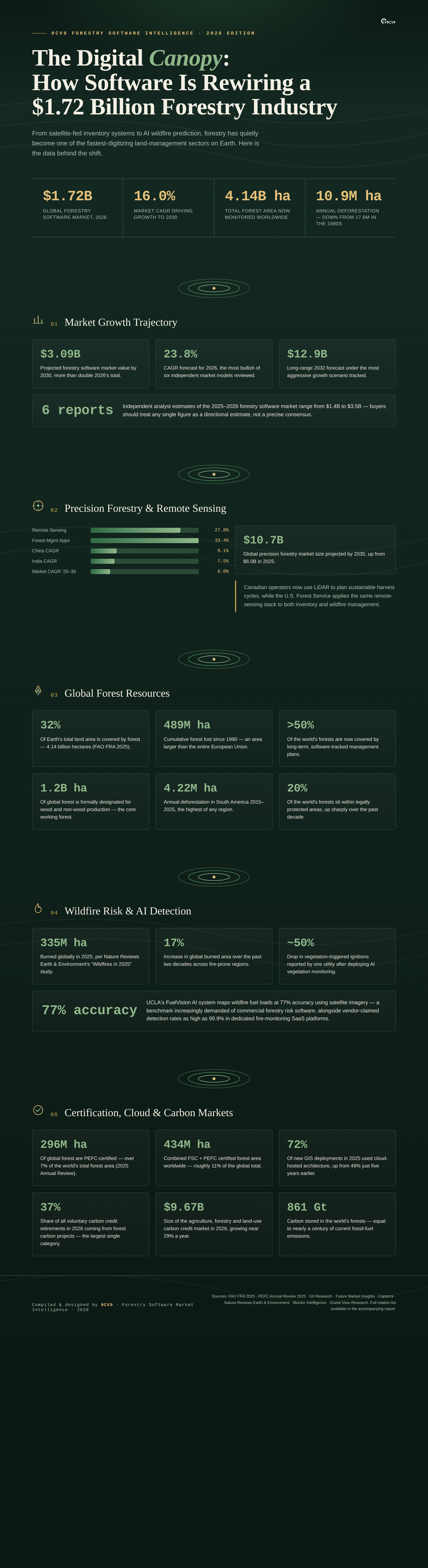
Global deforestation and forest degradation are also increasing the importance of digital forestry management systems. The world contains approximately 4.14 billion hectares of forest, covering around 32% of Earth’s land surface. However, global gross deforestation averaged approximately 10.9 million hectares annually between 2015 and 2025. In 2024, global tree cover loss reached approximately 30 million hectares, while tropical primary forest loss reached 6.7 million hectares. These figures demonstrate the growing need for reliable forest monitoring, early-warning systems, satellite-based surveillance, and digital environmental reporting. Forestry software increasingly enables governments, conservation organizations, and commercial forest operators to identify changes in forest coverage, monitor wildfire activity, track illegal logging risks, and evaluate the environmental impact of land-use activities.
Artificial intelligence and wildfire detection technologies are further transforming forest monitoring and risk management. AI-powered computer vision, thermal imaging, satellite monitoring, and edge computing are helping organizations identify potential wildfire threats and monitor changing environmental conditions. The forest wildfire detection system market was valued at approximately $1.2 billion in 2024 and is forecast to reach $2.8 billion by 2033. Meanwhile, the AI wildfire detection system market is projected to expand from $350 million in 2024 to $1.2 billion by 2033. These developments highlight the growing role of predictive analytics and automated monitoring in reducing environmental risks, improving emergency response capabilities, and protecting valuable forest resources.
Sustainable forest certification, carbon markets, and regulatory compliance are also creating new opportunities for forestry software providers. Certification frameworks such as the Forest Stewardship Council (FSC) and the Programme for the Endorsement of Forest Certification (PEFC) are encouraging organizations to maintain transparent records of forest management practices, timber sourcing, and supply chain activities. More than 296 million hectares of forests are PEFC-certified, while FSC has certified approximately 143 million hectares across 81 countries. At the same time, forest-based carbon projects are attracting growing attention as businesses and governments seek to measure carbon sequestration, verify environmental outcomes, and participate in voluntary carbon markets. Digital forestry platforms are becoming increasingly important for managing forest carbon inventories, monitoring project performance, maintaining audit trails, and supporting credible sustainability reporting.
Regulatory developments are adding another layer of urgency to forestry technology adoption. The European Union Deforestation Regulation (EUDR) introduces digital due diligence and geolocation requirements for relevant commodities, including wood and wood products. Businesses must manage detailed supplier information, geographic coordinates, product traceability records, and due diligence documentation. These requirements are increasing demand for forestry software that integrates GIS mapping, supply chain tracking, document management, and regulatory reporting. For companies operating across international timber markets, digital traceability is becoming an increasingly important part of risk management and market access.
Cloud computing is also changing how forestry organizations manage operational data. Cloud-based forestry management platforms allow users to access inventory records, equipment information, harvest plans, field observations, and environmental reports across multiple locations. However, adoption still faces challenges, particularly among smaller forest operators dealing with high implementation costs, limited digital skills, remote connectivity constraints, and complex customization requirements. Consequently, forestry software providers are increasingly focusing on accessible interfaces, offline field capabilities, mobile data collection, interoperability, and scalable subscription-based solutions.
For forestry businesses, technology providers, investors, researchers, environmental organizations, and industry professionals, understanding these developments is essential to evaluating the future of digital forest management. The statistics also reveal how forestry software is becoming closely connected to broader developments in climate technology, environmental intelligence, sustainable supply chains, and resource optimization.
This comprehensive collection of Top 113 Forestry Software Statistics, Data & Trends in 2026 explores the latest available figures and industry developments across forestry software market size and growth, smart and precision forestry, forest inventory management, LiDAR and remote sensing, global deforestation, forest certification, carbon markets, AI-powered wildfire detection, regulatory compliance, cloud adoption, and operational challenges. By examining these statistics and trends, readers can better understand the technologies driving the forestry industry’s digital transformation, the opportunities emerging for forestry software providers, and the challenges organizations must address to build more efficient, transparent, and sustainable forest management operations.
Before we venture further into this article, we would like to share who we are and what we do.
About 9cv9
9cv9 is a business tech startup based in Singapore and Asia, with a strong presence all over the world.
With over ten years of startup and business experience, and being highly involved in connecting with thousands of companies and startups, the 9cv9 team has listed some of the top and best companies/tools in this review.
If you like to get your company listed in our top B2B software reviews, check out our world-class 9cv9 Media and PR service and pricing plans here.
Top 113 Forestry Software Statistics, Data & Trends in 2026
Market Size & Growth
- The global forestry software market is projected to grow from $1.48 billion in 2025 to $1.72 billion in 2026, at a CAGR of 16.0%. This steady double-digit growth signals accelerating enterprise confidence in digital forest management tools heading into 2026.
- The forestry software market is forecast to reach $3.09 billion by 2030 at a 15.8% CAGR. Sustained growth through the decade reflects long-term structural demand for inventory, compliance, and analytics tools in forestry operations.
- Growth in the historic forestry software market period is attributed to increasing digitization of forest management operations and rising demand for inventory optimization tools. Digitization continues to be the single biggest catalyst reshaping how forestry organizations plan and track operations.
- The forecast period growth is linked to increasing focus on sustainable forest certification and AI-driven forest analytics. Sustainability compliance and AI adoption are becoming intertwined growth drivers for the sector.
- An alternate market estimate places the global forestry software market at $2.93 billion by 2029, growing at 17.8%. Divergent analyst estimates still converge on the same conclusion: forestry software is one of the faster-growing agri-tech-adjacent verticals.
- The forestry software market was valued at $1.43 billion in 2024 and is set to reach $3.43 billion by 2033 at a 10.2% CAGR. Even conservative forecasts show the market roughly two-and-a-half times its 2024 size within a decade.
- On-premises forestry software adoption is expanding, especially where data security and offline reliability in remote forest regions matter most. Remote operating environments continue to justify hybrid or fully on-premises deployment models for many operators.
- Trimble’s Land Resource Manager (LRM) 6.2.0 update in July 2024 expanded on-premise support for Oracle and ArcGIS platforms. Vendor investment in enterprise-grade infrastructure integration underscores growing demand for customizable, secure forestry data systems.
- One market forecast places the forestry software market at $2.89 billion in 2025, growing to $3.49 billion in 2026 at a 23.78% CAGR, reaching $12.88 billion by 2032. This more aggressive projection reflects how forestry software is increasingly bundling GIS, ERP, and traceability into unified platforms.
- Modern forestry software platforms are evolving beyond standalone mapping tools into integrated systems connecting remote sensing, GIS analytics, and supply chain orchestration. This convergence is redefining forestry software as an operational backbone rather than a niche mapping utility.
- Procurement decisions in forestry software are increasingly shaped by interoperability, data fidelity, and the ability to translate sensor outputs into operational decisions. Buyers are prioritizing platforms that connect field data collection directly to actionable forestry decisions.
- A separate report values the global forestry software market at $1.4 billion in 2024, projected to reach $1.8 billion by 2030 at a 4.2% CAGR. Even the most conservative estimate confirms consistent upward momentum for the category through the decade.
- Remsoft, a Canadian intelligent-planning solutions provider, helps optimize forest-to-mill decision-making for clients like Forico. Optimization software vendors are becoming essential partners in end-to-end harvest and wood-flow planning.
- The forestry software market was forecast to grow by $519.49 million between 2023 and 2028 at a 6.51% CAGR, driven by cloud adoption. Cloud-based delivery models remain a persistent tailwind across nearly every forestry software growth forecast.
- Open-source forestry software availability is expanding, offering more affordable options for small and medium-sized forestry businesses. Lower-cost open-source tools are helping close the digital divide for smaller forest operators.
Smart & Precision Forestry Technology
- The smart forestry market is projected to grow from $5.49 billion in 2025 to $6.09 billion in 2026, a 10.9% CAGR. Smart forestry — combining sensors, GPS, and analytics — is scaling rapidly as a distinct technology category.
- The smart forestry market is expected to reach $9.12 billion by 2030 at a 10.6% CAGR. Continued double-digit growth confirms smart forestry’s transition from pilot projects to mainstream infrastructure investment.
- An independent estimate places the smart forestry market at $6.09 billion in 2026, expanding to $15.1 billion by 2035 at a 10.6% CAGR. The long-range forecast suggests smart forestry technology could more than double market size within a decade.
- Major smart forestry trends for the forecast period include rising integration of GIS and GPS systems and expanding precision forestry practices. Positioning and mapping technologies remain the technical foundation of smart forestry adoption.
- Tariffs have raised the costs of sensors, drones, and mapping equipment used in smart forestry deployments. Trade policy is becoming a tangible cost variable that forestry technology buyers must now factor into procurement planning.
- The global precision forestry market was valued at $6.48 billion in 2024 and is projected to reach $15.16 billion by 2033 at a 9.9% CAGR. Precision forestry is on pace to more than double in size within under a decade.
- A separate precision forestry estimate values the market at $3,540.3 million in 2025, reaching $4,701.07 million by 2030 at a 5.8% CAGR. Estimates vary by scope, but all confirm precision forestry as a resilient, growing market segment.
- Precision forestry was worth $6.0 billion in 2025 and is predicted to reach $10.7 billion by 2035 at a 6.0% CAGR. The market is expected to nearly double over the coming decade as adoption matures from pilot to enterprise scale.
- Precision forestry is projected to grow by $9.82 billion at a 9.64% CAGR by 2030 under one industry estimate. High single-digit to double-digit CAGRs are the consistent pattern across nearly every precision forestry forecast.
- The precision forestry market could surpass $11.55 Billion by 2032, growing at over 9.1% CAGR from 2025. Sustained near-double-digit growth reinforces precision forestry’s status as a core forestry technology investment area.
- The precision forestry market was valued at $6.58 billion in 2025 and will reach $12.66 billion by 2034 at a 7.57% CAGR. Nearly doubling within a decade, precision forestry adoption is becoming a default rather than an optional upgrade.
- Almost 50% of forestry operations report improved biodiversity protection outcomes from precision forestry methods. Environmental stewardship benefits are becoming a measurable, quantifiable outcome of precision forestry adoption.
- More than 60% of industry participants are now adopting precision forestry solutions to cut costs and address climate risk. A clear majority of the industry has now crossed the threshold from early adoption to mainstream deployment.
- Around 52% of precision forestry adopters report measurable cost savings and improved resource utilization. Efficiency gains, not just sustainability, are proving to be a primary business case for precision forestry investment.
- Nearly 48% of forestry operations report improved biodiversity protection and reduced ecological impact through precision methods. Precision forestry is increasingly positioned at the intersection of profitability and conservation.
- The precision forestry market recorded USD 6,657.73 million in 2025, projected to reach USD 12,327.78 million by 2032 at a 9.2% CAGR. Consistent near-double-digit growth across independent analyst estimates strengthens confidence in this trajectory.
- Non-profit organizations are expected to see the highest CAGR in precision forestry adoption, driven by carbon sequestration and conservation funding. Environmental and philanthropic funding streams are becoming meaningful demand drivers for forestry technology vendors.
- The fastest-growing precision forestry application area is forest management and planning, driven by biodiversity conservation demand. Planning and management tools are pulling ahead of hardware as the primary value driver in precision forestry.
- A significant precision forestry market challenge is the high initial investment required for LiDAR, GIS, and drone technologies. Upfront capital cost remains the single biggest barrier limiting small and medium forest owner adoption.
Forest Inventory, LiDAR & Remote Sensing
- Forestry software’s forest inventory management category is segmented into drone-based, ground survey, LiDAR-based, and satellite-based inventory methods. The diversification of inventory capture methods reflects growing sophistication in how forestry data is gathered.
- The global LiDAR market was valued at $2.89 billion in 2025 and is projected to reach $17.80 billion by 2035 at a 19.94% CAGR. LiDAR technology, core to precision forest inventory, is set to grow more than sixfold within a decade.
- The forestry and agriculture segment of the LiDAR market is expected to expand at an 8.3% CAGR. LiDAR-driven forest inventory and canopy analysis is becoming an established growth pocket within the broader LiDAR industry.
- The precision forestry LiDAR platform market reached $1.42 billion in 2024 and is expected to hit $4.12 billion by 2033 at a 13.7% CAGR. Dedicated LiDAR platforms for forestry are nearly tripling in size, reflecting rising demand for 3D canopy and biomass mapping.
- LiDAR provides high-resolution, 3D mapping capabilities enabling detailed forest inventory, canopy structure analysis, and biomass estimation. These capabilities are becoming standard requirements for accurate, defensible forest carbon and timber volume reporting.
- Canadian forestry operations use LiDAR for planning sustainable harvest cycles and monitoring reforestation. Regional case studies confirm LiDAR’s practical value beyond theoretical market projections.
- The global remote sensing software market was valued at $2.01 billion in 2025 and is projected to grow to $2.32 billion in 2026, reaching $7.34 billion by 2034 at a 15.46% CAGR. Remote sensing software is on track to more than triple in size over the coming decade.
- Forestry is one of the core application categories for remote sensing software, alongside geology, urban planning, and disaster management. Cross-sector remote sensing investment is indirectly strengthening the tools available to forestry-specific software vendors.
- The web-based segment of the remote sensing software market is expected to grow at a 12% CAGR, the largest share of the market. Browser-accessible remote sensing tools are lowering the technical barrier to entry for forest monitoring.
- The active sensors segment holds nearly 54% of the remote sensing services market, driven by radar and LiDAR technologies. Active sensing technologies dominate because they function reliably in all weather and lighting conditions critical to forest monitoring.
- The satellite segment dominates the remote sensing services market with nearly 41% share. Satellite-based monitoring remains the backbone of large-scale, continuous forest surveillance.
- The airborne segment accounts for approximately 32% of the remote sensing services market, driven by drone and aircraft flexibility. Airborne platforms fill the critical gap between satellite-scale coverage and ground-level precision.
- By 2022, over 3,000 satellites orbited Earth, with this number projected to potentially triple by 2030. The rapid expansion of satellite infrastructure is directly increasing the volume and frequency of forest monitoring data available to software platforms.
- Global Forest Watch Fires now delivers near-real-time fire alerts based on detailed NASA satellite data. Publicly available near-real-time satellite data is democratizing wildfire and forest health monitoring beyond well-funded institutions.
Deforestation & Global Forest Area
- The world’s forest area totals approximately 4.14 billion hectares, covering about 32% of Earth’s land surface. This baseline figure anchors nearly every forestry software market sizing and impact model published in 2026.
- Global gross deforestation averaged 10.9 million hectares per year between 2015 and 2025, per the FAO’s Global Forest Resources Assessment 2025. This marks a meaningful decline from earlier decades, though the pace still falls short of international targets.
- Annual forest loss fell from 17.6 million hectares during 1990–2000 to 13.6 million hectares during 2000–2015, and further to 10.9 million hectares during 2015–2025. The three-decade downward trend demonstrates gradual but real progress in reducing gross deforestation.
- An estimated 489 million hectares of forest were lost to deforestation between 1990 and 2025. This cumulative figure illustrates the scale of forest loss even amid a slowing annual rate.
- South America recorded the highest regional deforestation rate at 4.22 million hectares per year between 2015 and 2025. South America’s outsized contribution to global deforestation keeps the region a central focus for forestry monitoring software vendors.
- Africa followed with 3.45 million hectares of annual deforestation between 2015 and 2025. Africa’s deforestation footprint highlights growing demand for affordable forest monitoring tools across the continent.
- Europe was the only region where annual forest loss increased since 1990, rising from 126,000 hectares to 145,000 hectares per year. Europe’s unique upward trend challenges the broader global narrative of declining deforestation.
- In 2024, the world lost approximately 30 million hectares of tree cover, the largest area since 2001. This record-setting year underscores the urgency behind global forest monitoring and early-warning software investment.
- Wildfires were the leading driver of global tree cover loss in 2024, accounting for nearly 14 million hectares. Fire-driven loss overtaking agricultural conversion as the top cause marks a structural shift in deforestation drivers.
- Russia and Canada experienced the largest fire-related tree cover losses in 2024, each exceeding five million hectares. Boreal forest fire activity is becoming a dominant factor shaping global forest-loss statistics.
- Brazil accounted for 54.7% of total tropical primary forest loss in 2024, with 954,126 hectares cleared. Brazil’s outsized share keeps it the single most closely monitored country in global deforestation tracking software.
- Tropical primary forest loss hit 6.7 million hectares in 2024, the highest annual total on record. This record confirms that despite gross deforestation slowing, primary (irreplaceable) forest loss remains a critical concern.
- 2024 tropical deforestation rates were 63% higher than the trajectory needed to meet the 2030 zero-deforestation pledge. This gap illustrates why regulatory and software-driven traceability tools are becoming urgent business priorities.
- Bolivia’s primary forest loss surged 200% year-over-year in 2024, reaching 1.5 million hectares. This dramatic spike has made Bolivia the second-largest source of tropical deforestation globally.
- Brazil’s PRODES system recorded 5,796 km² of Amazon deforestation in 2024–25, an 11% year-over-year drop. Brazil’s monitoring infrastructure demonstrates how government-backed forest tracking technology can produce measurable results.
- As of February 2026, Brazil is on pace for its lowest PRODES-recorded deforestation year, with only 1,325 km² detected in the first six months. Early 2026 data suggests continued improvement in Brazil’s deforestation trajectory.
- Fire-driven primary forest loss in the Amazon biome surged 110% in 2024, with 60% of all loss attributed to fire. Fire has overtaken clear-cutting as the primary threat vector in the Amazon, reshaping monitoring priorities.
- Nicaragua lost 4.7% of its primary forest in 2024, the highest proportional loss of any country, with 78% occurring in the Bosawas Biosphere Reserve. This concentrated loss highlights how even small nations can face outsized deforestation pressure in protected zones.
- Only about 20% of global forest area (813 million hectares) is protected under national parks, conservation areas, and game reserves. The relatively low share of protected forest underscores continued vulnerability across most of the world’s forest estate.
- The world has roughly 0.5 hectares of forest per person globally. This per-capita figure offers a tangible way to communicate the scale of the world’s shared forest resource.
Forest Certification (FSC & PEFC)
- More than 296 million hectares of global forests — over 7% of the world’s 4.14 billion hectares — are PEFC-certified as of 2026. PEFC’s global footprint demonstrates the scale sustainable forestry certification has achieved worldwide.
- PEFC’s certified forest estate spans 46 countries, with the Republic of the Congo recording the largest single-year increase at 2.2 million hectares. Certification expansion in the Congo signals growing sustainable forestry momentum in Central Africa.
- PEFC’s Chain of Custody certificate base grew to 13,977 certificates covering more than 33,000 companies worldwide. The scale of Chain of Custody certification reflects how deeply sustainability tracking has penetrated global supply chains.
- Nearly 300 million hectares of forest area are managed in compliance with PEFC’s Sustainability Benchmarks — an area roughly the size of Egypt, South Africa, and Turkey combined. This comparison helps convey the true magnitude of PEFC-certified forest globally.
- Approximately 63 million hectares of global forest area were double-certified under both PEFC and FSC as of mid-2024. Double certification reflects overlapping market demands that still burden forest owners with duplicate compliance costs.
- FSC has certified 143 million hectares of forest across 81 countries. FSC’s certification footprint, while smaller than PEFC’s by area, spans a broader number of individual countries.
- FSC and PEFC together certify around 434 million hectares, roughly 11% of total global forest area. Combined certification coverage remains a modest fraction of the world’s total forest, leaving significant room for expansion.
- About 85% of the world’s certified forests are located in the temperate and boreal regions of Europe and North America. This concentration highlights a persistent geographic imbalance despite certification’s original tropical forest protection goals.
- Asia accounts for just 6% of the global certified forest area, with Latin America at 4%, Oceania at 3%, and Africa at 2%. These low shares represent the biggest untapped growth opportunity for forest certification and compliance software providers.
- PEFC certification is a standard of choice for public timber procurement policies in the UK, Germany, and Japan. Government procurement mandates are a powerful lever accelerating global certification adoption.
- PEFC certification demonstrates compliance with the EU Timber Regulation, the U.S. Lacey Act, and Australia’s Illegal Logging Prohibition Regulation. Multi-jurisdictional regulatory alignment makes certification software increasingly valuable for exporters.
- PEFC is the world’s largest forest certification system by area, with over 330 million certified hectares globally. PEFC’s scale advantage over FSC by land area makes it the dominant compliance benchmark for many institutional buyers.
Carbon Markets & Forest-Based Offsets
- The carbon credit market for agriculture, forestry, and land use is projected to grow from $7.51 billion in 2025 to $9.67 billion in 2026, a 28.8% CAGR. Forestry-linked carbon credits are among the fastest-growing segments of the broader carbon market.
- This forestry and land use carbon credit segment is expected to reach $26.35 billion by 2030 at a 28.5% CAGR. The segment is projected to nearly triple within four years, reflecting surging corporate demand for nature-based offsets.
- The broader global carbon credit market was valued at $114.3 billion in 2025 and is expected to grow at a 15.9% CAGR through 2035. Forestry offsets sit within a rapidly expanding overall carbon market ecosystem.
- The top five carbon credit market players — Verra, South Pole, Climate Impact Partners, EcoAct, and 3Degrees — held a combined 35% market share in 2025. Market concentration among a handful of verifiers has direct implications for forestry carbon project developers.
- Forestry projects comprised 52% of voluntary carbon market issuances in 2022, including 46% via REDD+ methodologies. Forestry remains the single largest project category within the voluntary carbon market.
- Verra has issued 1.299 billion voluntary carbon units cumulatively, with 110 million issued in 2023 alone. The scale of Verra’s issuance underscores how central credible forest carbon verification has become to climate finance.
- Improved forest management projects account for approximately 12% of active U.S. carbon credit projects. This niche but growing category reflects rising demand for sustainable, revenue-generating forest management practices.
- Tropical forests cover around 15% of the world’s land surface yet contain approximately 25% of the planet’s surface carbon. This disproportionate carbon density explains why tropical forest protection remains a top climate policy priority.
- Forest loss and degradation account for an estimated 15% to 20% of global carbon emissions. This figure firmly establishes forestry as a frontline climate mitigation sector, not just an environmental one.
AI, Wildfire Detection & Monitoring Technology
- The forest wildfire detection system market was valued at $1.2 billion in 2024 and is forecast to reach $2.8 billion by 2033 at a 10.2% CAGR. Rising wildfire frequency worldwide is directly translating into sustained investment in detection technology.
- The AI wildfire detection system market alone was valued at $350 million in 2024, projected to reach $1.2 billion by 2033 at a 15.4% CAGR. AI-specific detection systems are growing faster than the broader wildfire detection market overall.
- Insight Robotics deployed 500 new AI-powered thermal imaging cameras in 2024 for wildfire monitoring. This large-scale hardware rollout illustrates the operational scale AI wildfire detection has reached in commercial deployment.
- OroraTech is building a constellation of 10 dedicated wildfire detection satellites, targeted for completion by 2025. Dedicated satellite constellations mark a new frontier in continuous, space-based wildfire surveillance.
- Modern computer vision and edge AI systems can detect smoke plumes within 5–10 minutes while reducing false alarms below 2% and achieving 95–98% accuracy. These performance benchmarks demonstrate how far AI-based fire detection has advanced from earlier sensor-only systems.
- The wildfire detection technology market as a whole is projected to reach about $6.9 billion by 2034 at a 16.1% CAGR. This broader technology market figure reflects the full ecosystem of sensors, software, and analytics surrounding wildfire response.
- The U.S. National Interagency Fire Center reported more than 58,000 wildfires in a single year, consuming over 10 million acres. This scale of incident volume illustrates why automated, software-driven detection has become operationally essential.
EUDR, Traceability & Regulatory Compliance
- Large and medium companies must comply with the EU Deforestation Regulation (EUDR) by December 30, 2026. This compliance deadline is a primary driver pushing timber and forest product companies toward digital traceability platforms in 2026.
- Micro and small enterprises have an extended EUDR compliance deadline of June 30, 2027. The staggered timeline gives smaller forestry businesses additional runway to adopt compliant traceability software.
- EUDR requires operators to submit high-precision geolocation coordinates linking wood products to specific plots of land. Plot-level geolocation requirements are driving demand for GIS-integrated compliance and due diligence software.
- As of May 2026, the EU’s Environmental Crime Directive makes knowingly placing illegally harvested timber on the market a criminal offense with personal liability for executives. This regulatory escalation raises the stakes for forestry companies lacking robust digital traceability systems.
- EUDR compliance now requires organizations to manage thousands, or even hundreds of thousands, of geolocation records, supplier documents, and due diligence statements. The sheer data volume involved makes manual, spreadsheet-based compliance increasingly untenable.
- The EU Deforestation Regulation Information System launched on December 5, 2024, enabling operators to register and submit due diligence statements. This centralized digital infrastructure represents one of the largest government-built forestry compliance systems to date.
Cloud Adoption & Operational Trends
- More than 41% of global forestry operations have adopted digital software, a significant rise over the past three years. Digital adoption has now crossed a meaningful tipping point across the global forestry sector.
- Satellite imagery integration in forestry operations expanded by 28%, enabling monitoring across more than 50 million hectares. This expansion reflects how satellite-software integration is scaling to cover an increasing share of the world’s working forests.
- AI-enabled yield prediction adoption in forestry increased by 31%, enabling cutting-cycle calculations with 90–95% accuracy. Predictive AI is measurably improving the precision of harvest planning across adopting organizations.
- More than 240 commercial forestry companies now use cloud-based asset-tracking tools to monitor vehicles, equipment, and timber logistics. Cloud-based fleet and logistics tracking has moved from novelty to standard operational practice.
- Global timber production surpasses 2.2 billion cubic meters annually. This production volume underscores the massive operational scale forestry software platforms must support.
- Around 33% of small forest operators cite high upfront licensing and deployment costs as a key adoption barrier. Cost remains the most commonly cited obstacle preventing smaller operators from adopting forestry software.
- Software customization can increase forestry technology deployment costs by 15–22%, depending on forest size and complexity. Customization overhead is an important budgeting consideration often underestimated by first-time software buyers.
- Workforce digital skill shortages affect nearly 29% of forestry companies, delaying software adoption. Talent and training gaps are proving just as significant a barrier to adoption as cost.
- Rural forest areas lacking stable internet connectivity impact cloud software usage for approximately 17% of operators. Connectivity infrastructure gaps continue to limit full cloud adoption in the most remote forestry regions.
- Training time for new forestry software ranges from 40 to 160 hours depending on module complexity. This wide range highlights how implementation timelines vary significantly based on platform sophistication.
- Small and medium-sized enterprises and conservation organizations are more likely to adopt cloud-based forestry solutions due to lower total cost of ownership. Cloud delivery is emerging as the default choice for smaller, budget-conscious forestry organizations.
Conclusion
The forestry industry is entering a new era of digital transformation in 2026, with forestry software becoming an increasingly important tool for improving forest management, optimizing timber production, strengthening environmental protection, and supporting sustainable resource utilization. The statistics and industry trends examined throughout this report demonstrate that digital forestry is no longer limited to basic inventory management or geographic mapping. Instead, it is evolving into an integrated technology ecosystem involving artificial intelligence, precision forestry, LiDAR, satellite imagery, remote sensing, cloud computing, digital traceability, and predictive analytics.
The global forestry software market is projected to grow from approximately $1.48 billion in 2025 to $1.72 billion in 2026, representing a 16% CAGR, with further growth expected to reach $3.09 billion by 2030. Meanwhile, the precision forestry market is experiencing substantial expansion, supported by increasing investments in GPS-enabled equipment, GIS platforms, drones, and advanced forest inventory technologies. These developments highlight the growing commercial importance of forestry management software and the opportunities available to technology providers serving timber companies, forest owners, government agencies, and conservation organizations.
Environmental challenges will remain among the strongest drivers of forestry software adoption. With global gross deforestation averaging approximately 10.9 million hectares annually between 2015 and 2025, and tropical primary forest loss reaching 6.7 million hectares in 2024, organizations need more effective ways to monitor forest conditions and identify environmental risks. Satellite-based surveillance, AI-powered wildfire detection, remote sensing, and automated forest monitoring systems are becoming increasingly valuable for identifying threats, improving response times, and supporting evidence-based conservation decisions.
Sustainability and regulatory compliance will also shape the future of forestry technology. FSC and PEFC certification frameworks, forest-based carbon projects, and the European Union Deforestation Regulation are increasing the importance of transparent forest management records and reliable supply chain traceability. Forestry software that can manage geospatial information, supplier documentation, certification records, carbon measurements, and regulatory reporting will become increasingly relevant to organizations operating in international timber and forest product markets.
At the same time, forestry software providers must address several barriers to wider adoption. High initial investment requirements, customization expenses, workforce digital skill shortages, and limited internet connectivity in remote forest areas continue to create challenges, particularly for small and medium-sized operators. Vendors that offer affordable subscription models, offline functionality, mobile field applications, flexible integrations, and user-friendly interfaces will be better positioned to serve organizations with different operational requirements and technology budgets.
Looking ahead, the forestry software market is likely to become increasingly interconnected with climate technology, artificial intelligence, geospatial intelligence, and sustainable supply chain management. Businesses that successfully combine accurate forest inventory data, predictive analytics, automated monitoring, and digital compliance capabilities will have greater opportunities to improve productivity while supporting responsible forest management. For investors and technology companies, these developments represent opportunities in a market where operational efficiency and environmental accountability are becoming increasingly interconnected.
Ultimately, the Top 113 Forestry Software Statistics, Data & Trends in 2026 demonstrate that the future of forestry will depend increasingly on the ability to transform environmental and operational data into actionable intelligence. Whether the objective is improving timber harvesting efficiency, monitoring deforestation, preventing wildfires, managing certified forests, measuring carbon sequestration, or maintaining regulatory compliance, forestry software will remain an essential component of the industry’s modernization. Organizations that invest in scalable, interoperable, and data-driven forestry technologies will be better equipped to navigate changing market conditions, meet sustainability expectations, and build more efficient and resilient forest management operations.
If you find this article useful, why not share it with your hiring manager and C-level suite friends and also leave a nice comment below?
We, at the 9cv9 Research Team, strive to bring the latest and most meaningful data, guides, and statistics to your doorstep.
To get access to top-quality guides, click over to 9cv9 Blog.
To hire top talents using our modern AI-powered recruitment agency, find out more at 9cv9 Modern AI-Powered Recruitment Agency.
People Also Ask
What is forestry software?
Forestry software is a digital solution that helps organizations manage forest resources, track timber production, monitor forest conditions, and optimize forestry operations.
How big is the global forestry software market in 2026?
The global forestry software market is projected to reach approximately $1.72 billion in 2026, growing from $1.48 billion in 2025.
What is the projected growth rate of the forestry software market?
The forestry software market is forecast to grow at a CAGR of approximately 16% between 2025 and 2026, with further expansion expected through 2030.
What are the main types of forestry software?
Common categories include forest inventory management, GIS mapping, timber management, harvest planning, forest monitoring, asset tracking, supply chain management, and environmental compliance software.
What are the benefits of using forestry management software?
Forestry management software improves operational efficiency, inventory accuracy, harvest planning, resource utilization, environmental monitoring, and regulatory compliance while reducing manual administrative work.
What is precision forestry?
Precision forestry uses GPS, GIS, drones, LiDAR, sensors, and analytics to collect detailed forest data and improve decisions involving timber harvesting, conservation, and resource management.
How big is the precision forestry market?
One industry estimate values the global precision forestry market at $6.48 billion in 2024, with projections reaching $15.16 billion by 2033 at a 9.9% CAGR.
How is artificial intelligence transforming forestry software?
AI helps forestry organizations analyze satellite imagery, predict timber yields, detect forest changes, identify wildfire threats, and automate forest inventory and resource planning.
How is LiDAR technology used in forestry?
LiDAR creates detailed three-dimensional forest maps, helping professionals measure tree height, canopy structure, biomass, terrain characteristics, and timber volumes.
What is the role of GIS in forestry management?
GIS helps forestry professionals visualize forest boundaries, map tree inventories, monitor land use, analyze environmental conditions, and plan harvesting activities using geographic data.
How does satellite imagery help monitor deforestation?
Satellite imagery enables continuous observation of forest coverage, vegetation changes, illegal clearing, and wildfire damage across large geographical areas.
How much forest does the world have in 2026?
The world has approximately 4.14 billion hectares of forest, covering around 32% of Earth’s land surface.
How many hectares of forest are lost annually worldwide?
Global gross deforestation averaged approximately 10.9 million hectares annually between 2015 and 2025, according to the statistics presented in this report.
What were the global tree cover loss statistics for 2024?
Approximately 30 million hectares of tree cover were lost globally in 2024, representing the largest annual area since 2001.
How does forestry software help prevent wildfires?
Forestry software combines satellite monitoring, thermal cameras, sensors, and AI analytics to identify potential wildfire threats, generate alerts, and support faster emergency responses.
How big is the AI wildfire detection market?
The AI wildfire detection system market was valued at approximately $350 million in 2024 and is projected to reach $1.2 billion by 2033.
What is forest inventory management software?
Forest inventory management software records and analyzes information about tree species, tree density, forest area, timber volume, growth rates, and harvesting conditions.
What are the main challenges of adopting forestry software?
Major challenges include high initial investment, software customization costs, limited internet connectivity, workforce digital skill shortages, and implementation complexity.
How does cloud computing benefit forestry management?
Cloud-based forestry software allows organizations to access forest inventory records, operational data, equipment information, and management reports across multiple locations.
What percentage of forestry operations have adopted digital software?
The supplied industry statistics indicate that more than 41% of global forestry operations have adopted digital software.
What is forest certification software?
Forest certification software helps organizations maintain records, document sustainable management practices, track certified timber, and demonstrate compliance with certification requirements.
What are FSC and PEFC certifications in forestry?
FSC and PEFC are international forest certification systems that promote responsible forest management and provide frameworks for verifying sustainable forestry practices and supply chains.
How much forest area is certified by FSC and PEFC?
The supplied statistics report approximately 143 million hectares of FSC-certified forest and more than 296 million hectares of PEFC-certified forest, although some areas hold both certifications.
How does forestry software support carbon credit projects?
Forestry software helps carbon project developers monitor forest conditions, estimate carbon sequestration, maintain project documentation, track environmental outcomes, and support carbon credit verification.
What is the EU Deforestation Regulation (EUDR)?
The EUDR is European Union legislation designed to prevent products associated with deforestation and forest degradation from entering or leaving the EU market.
Why is forestry software important for EUDR compliance?
Forestry software helps businesses manage geolocation coordinates, supplier documentation, timber traceability, due diligence records, and regulatory reporting required for EUDR compliance.
How does forestry software improve timber production?
Forestry software improves timber production through better inventory management, harvest scheduling, equipment tracking, transportation planning, and timber volume forecasting.
What is the difference between traditional forestry management and precision forestry?
Traditional forestry relies more heavily on conventional surveys and manual planning, while precision forestry uses GPS, GIS, drones, LiDAR, and analytics for more detailed, data-driven decisions.
What are the future trends in forestry software for 2026 and beyond?
Major trends include AI-powered forest analytics, satellite monitoring, precision forestry, cloud-based platforms, automated wildfire detection, digital timber traceability, and sustainability reporting.
How can businesses choose the best forestry management software?
Businesses should evaluate inventory capabilities, GIS integration, cloud and offline access, AI analytics, scalability, equipment tracking, regulatory compliance, implementation costs, and customer support.
Sources
- GII Research
- The Business Research Company
- SkyQuest Technology
- Research and Markets
- Verified Market Reports
- Technavio
- MarkWide Research
- MarketsandMarkets
- Future Market Insights
- 360iResearch
- Custom Market Insights
- Reanin
- Straits Research
- Fortune Business Insights
- Econ Market Research
- World Animal Foundation
- Market.us
- Carbon Brief
- Continuuiti
- Katadata
- Statista
- GlobeNewswire
- Farmonaut
- Market Research Future
- Innovation News Network
- Credence Research
- Astute Analytica
- Global Market Insights
- InsightAce Analytic
- Polaris Market Research
- WorldMetrics
- Precedence Research
- DataIntelo
- Wood Central
- PEFC
- FSC
- ScienceDirect
- Food and Agriculture Organization (FAO)
- Sustainability Today
- TraceX Technologies
- ResourceWise
- IntegrityNext
- PSQR
- Coolset
- Global Traceability
- DigiProdPass
- Growth Market Reports
- Market Report Analytics
- 360 Research Reports