



























Key Takeaways
- The global form builder software market is experiencing strong growth, driven by cloud adoption, no-code development, and increasing demand for digital data collection solutions.
- AI-powered form generation, workflow automation, and mobile-first design are transforming form builder software, improving productivity, accessibility, and user experiences.
- Form conversion optimization, data privacy, digital signatures, and regulatory compliance are becoming critical priorities for businesses adopting online form builder platforms.
Form builder software helps businesses create digital forms, automate data collection, and streamline workflows without extensive coding. In 2026, AI-powered form generation, cloud adoption, no-code development, and mobile-first experiences are driving market growth and transforming how organizations collect, manage, and process information.
Form builder software has become an essential part of modern business operations, enabling organizations to collect information, automate workflows, generate leads, manage registrations, process applications, and streamline customer interactions without relying on extensive software development. As businesses accelerate their digital transformation initiatives in 2026, online form builders are evolving beyond traditional drag-and-drop form creation tools into sophisticated platforms powered by artificial intelligence (AI), workflow automation, cloud computing, conversational interfaces, and advanced data integrations. From simple contact forms and customer feedback surveys to complex healthcare intake documents, employee onboarding applications, payment collection forms, and enterprise data management workflows, form builder software is increasingly central to how organizations capture, process, and act on information.
Also, read our article on the Top 10 Best Form Builder Software To Try.

The global form builder software market is experiencing sustained growth as businesses move away from manual paperwork and fragmented data collection processes. Market estimates included in this report place the global form builder software market at approximately USD 1.2 billion in 2024, with projections indicating potential growth to USD 3.1 billion by 2033 at a compound annual growth rate (CAGR) of 12.5%. Other market assessments estimate the online form builder software market at approximately USD 764.5 million in 2026, potentially reaching USD 1.77 billion by 2035. These differing valuations reflect variations in market definitions, product categories, and research methodologies. Nevertheless, they demonstrate the growing commercial importance of digital form creation, online data collection, and automated business workflows.
Regional adoption patterns also reveal important opportunities for software vendors and businesses investing in digital infrastructure. North America remains a leading market, accounting for approximately 40% of global form builder software revenue in 2026 under one market assessment. Asia Pacific follows with an estimated 30% share and a projected annual growth rate of approximately 15%, positioning the region as an important growth market. Europe represents approximately 20% of the market, while Latin America and the Middle East and Africa collectively account for the remaining 10%. Cloud-based deployment continues to dominate the category, supported by demand for scalability, accessibility, integration capabilities, and reduced infrastructure requirements. At the same time, AI-enabled form creation is becoming increasingly important, with approximately 47% of online form builder platforms now incorporating AI-related features.
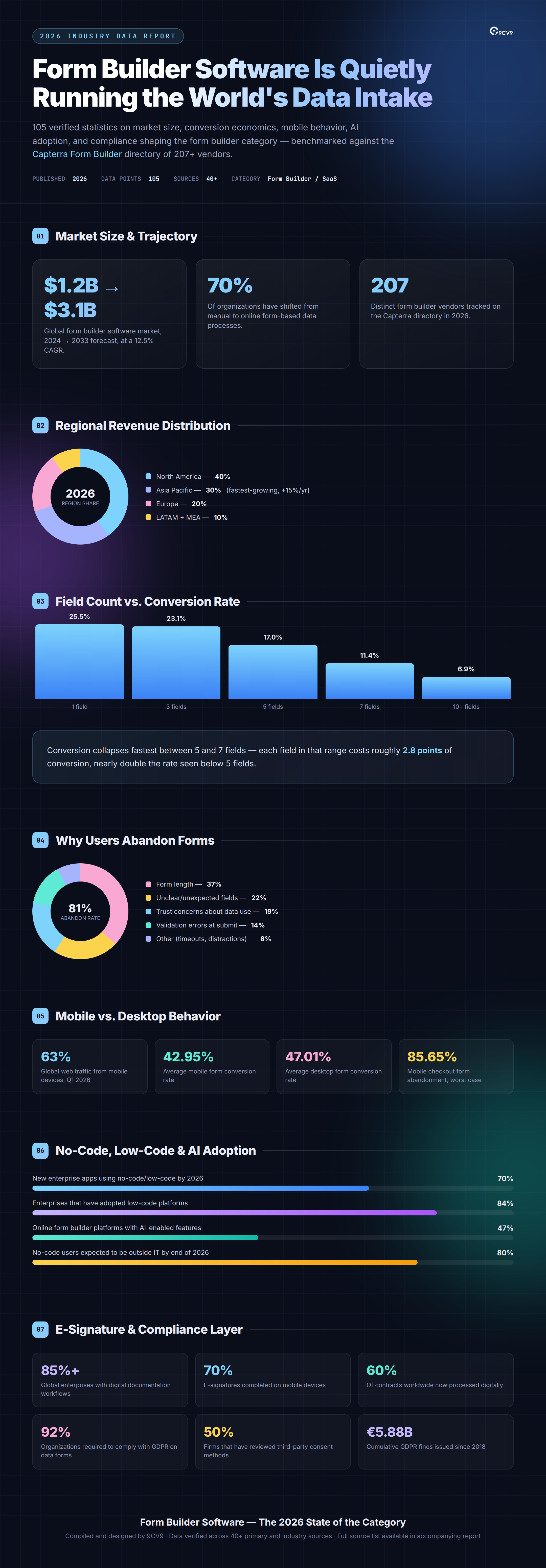
Artificial intelligence and no-code development are fundamentally changing how organizations design and deploy digital forms. Businesses can increasingly generate complete forms using natural-language descriptions, automatically configure fields, establish conditional logic, and streamline repetitive data-processing activities. The broader no-code and low-code ecosystem is expanding rapidly, with approximately 84% of enterprise businesses reportedly adopting low-code platforms to reduce IT workloads and accelerate digital transformation. Gartner’s forecast that 70% of new enterprise applications would use low-code or no-code technologies by 2026 further highlights the growing importance of accessible software development tools. These developments are particularly relevant to form builder platforms because they allow marketing teams, HR departments, educators, healthcare professionals, and operational managers to create customized data collection workflows without depending entirely on software engineering teams.
Form conversion rates and user experience optimization remain equally important considerations for businesses selecting and implementing form builder software. Research figures featured in this report indicate that the cross-industry median form completion rate for qualified visitors is approximately 17.3%, although performance varies considerably depending on the form’s purpose, length, complexity, and audience. Newsletter signup forms can achieve conversion rates of approximately 32.1%, while lengthy demo request forms containing ten fields may convert at only 6.9%. Excessive form fields, unclear questions, security concerns, complicated validation processes, and poor mobile experiences can all contribute to abandonment. Multi-step forms, progress indicators, browser autofill, autocomplete inputs, and straightforward field labels offer opportunities to improve completion rates and reduce friction throughout the submission process.
Mobile-first design has also become a critical competitive requirement for form builder software providers. With mobile devices accounting for a substantial share of global internet traffic and digital interactions, organizations must ensure that forms remain accessible, responsive, and easy to complete across smartphones, tablets, and desktop computers. Mobile users frequently encounter additional friction from small touch targets, lengthy input requirements, difficult dropdown menus, and complicated navigation. Form builders that support responsive layouts, mobile-friendly input fields, automatic field completion, and simplified submission experiences are therefore better positioned to serve increasingly mobile-dependent audiences.
Another important development is the integration of digital signatures, payment processing, and automated document workflows into form builder platforms. Businesses increasingly expect form software to support complete operational processes rather than simply collect submitted information. Digital signatures enable organizations to streamline contracts, consent documents, onboarding paperwork, and approval processes, while integrated payment capabilities allow businesses to collect fees, deposits, registrations, and service payments directly through online forms. Healthcare providers, educational institutions, financial services companies, real estate businesses, and professional service organizations are among the industries benefiting from these expanded capabilities.
Data privacy, information security, and regulatory compliance are also becoming increasingly important as organizations collect greater volumes of personal and commercially sensitive information. Form builder software must support appropriate consent management, secure data transmission, access controls, retention policies, and compliance requirements across different jurisdictions. Regulations and frameworks such as the General Data Protection Regulation (GDPR), Health Insurance Portability and Accountability Act (HIPAA), and Payment Card Industry Data Security Standard (PCI DSS) influence how businesses design and manage digital data collection processes. Vendors that provide stronger security controls, transparent privacy policies, and compliance-oriented functionality can help organizations reduce operational risks while building greater confidence among customers, employees, and business partners.
This comprehensive collection of the Top 105 Form Builder Software Statistics, Data & Trends in 2026 examines the market’s development, competitive landscape, adoption patterns, conversion benchmarks, technological innovations, and emerging business applications. It explores market size and growth forecasts, leading form builder platforms, Jotform adoption figures, no-code and low-code development trends, form completion and abandonment rates, mobile usage patterns, AI-powered form generation, digital signature adoption, lead generation performance, data privacy requirements, and industry-specific use cases. These statistics provide businesses, software developers, marketers, IT decision-makers, and digital transformation professionals with a broader understanding of how form builder technologies are evolving and where the greatest opportunities for innovation and operational improvement may emerge.
Whether an organization is evaluating the best form builder software, comparing online form creation platforms, improving website conversion rates, automating customer onboarding, or investing in AI-powered data collection solutions, understanding these statistics can support more informed technology decisions. As form builder software continues to converge with artificial intelligence, cloud computing, digital payments, and workflow automation, its role is expanding from a basic data collection utility into a strategic component of modern business infrastructure.
Before we venture further into this article, we would like to share who we are and what we do.
About 9cv9
9cv9 is a business tech startup based in Singapore and Asia, with a strong presence all over the world.
With over ten years of startup and business experience, and being highly involved in connecting with thousands of companies and startups, the 9cv9 team has listed some of the top and best companies/tools in this review.
If you like to get your company listed in our top B2B software reviews, check out our world-class 9cv9 Media and PR service and pricing plans here.
Top 105 Form Builder Software Statistics, Data & Trends in 2026
Market Size & Growth
1. The global form builder software market stood at approximately USD 1.2 billion in 2024, forecast to reach USD 3.1 billion by 2033 at a 12.5% CAGR — a trajectory that signals sustained enterprise appetite for no-code data collection tools well into the next decade.
2. North America led the form builder software market in 2026, contributing 40% of total global revenue, underscoring the region’s continued dominance in SaaS adoption for digital forms and workflow automation.
3. Asia Pacific followed as the second-largest region with 30% of form builder software revenue in 2026, while also posting the fastest projected annual growth rate of 15%, making it the category’s most dynamic growth frontier.
4. Europe accounted for 20% of the global form builder software market in 2026, with Latin America and the Middle East & Africa together contributing the remaining 10%, reflecting a still-maturing adoption curve outside core Western markets.
5. Cloud-based deployment held the largest share of the form builder software market at 60% in 2026, confirming that scalability and ease of use continue to outweigh the appeal of traditional on-premise or purely web-based alternatives.
6. Web-based form solutions, while trailing cloud-based deployment with 40% of the market, are expanding at roughly 20% annually, the fastest pace of any deployment type, driven by demand for accessible, customizable online tools.
7. The broader online form builder software market was valued around USD 764.5 million in 2026, on track to climb toward USD 1.77 billion by 2035 at a 9.8% CAGR, according to industry forecasts.
8. Separate market analysis places the online form builder software category at USD 2.53 billion in 2024, projected to nearly double to USD 5.51 billion by the early 2030s, illustrating how widely valuation estimates vary depending on scope and methodology.
9. Roughly 70% of organizations have shifted from manual to online form-based processes as automation and digital workflow adoption accelerate across industries in 2026.
10. Nearly 65% of businesses now prioritize scalable digital tools when selecting form and data-collection software, reinforcing steady category-wide expansion.
11. Cloud deployment accounts for approximately 72% of the online form builder software market’s technology mix in 2026, ahead of mobile-form usage at 68% and integration-focused tooling at 64%.
12. AI-enabled features are now present in about 47% of online form builder platforms, marking a rapid mainstreaming of artificial intelligence within a category historically defined by static drag-and-drop design.
13. In terms of regional split for the online form builder market, North America holds 35% share, Europe 28%, Asia-Pacific 27%, and the Middle East & Africa the remaining 10%.
14. More than half of all global web traffic in 2026 comes from mobile devices, a structural shift that is pushing form builder vendors to prioritize mobile-first design as a baseline requirement rather than an add-on feature.
15. Large enterprises historically accounted for the largest share of the form builder software market, at 62.95% in earlier analysis, with SME adoption growing steadily as pricing models become more accessible.
Category Leaders & Capterra/Review Ecosystem
16. The Capterra Form Builder directory tracks 207 distinct products as of 2026, reflecting an intensely fragmented and competitive vendor landscape spanning startups to enterprise-grade platforms.
17. Capterra reports that 85% of professionals prefer trying a 30-day free trial before committing to a software purchase, a buying behavior that has pushed nearly every major form builder vendor to offer free trial tiers.
18. Typeform holds an overall Capterra rating of 4.7 out of 5 based on 971 verified user reviews, with particularly strong marks for ease of use (4.7) and features (4.6).
19. Typeform’s starting price on Capterra is listed at $39 per month on a flat-rate basis, positioning it toward the premium end of the form builder pricing spectrum.
20. Microsoft Forms carries a Capterra overall rating of 4.5 based on 326 user reviews, with a strong 96% of reviewers reporting positive sentiment about the tool.
21. forms.app has achieved a 4.6 out of 5 “Excellent” rating on Trustpilot and secured placement on the 2025 Capterra Shortlist for Form Builder software, alongside recognition from G2, GetApp, and Crozdesk.
22. JotForm ranks as the top competitor to Google Forms in the survey and forms category, with Google Forms commanding an estimated 48.26% market share versus JotForm’s smaller but significant footprint.
23. Typeform reviewers cite “modern, engaging form aesthetics” and an “intuitive and clean interface” as leading pros, while “high cost for features” and “key features behind paywall” are the most common cons on Capterra.
24. Capterra’s Shortlist recognition system, which charts the highest-rated and most popular form builder products, awarded multiple 2026 badges across the Forms Automation, Survey, and Form Builder subcategories.
JotForm Platform Data
25. JotForm surpassed 35 million registered users worldwide by early 2026, cementing its position as one of the most widely adopted form builder platforms globally.
26. JotForm added 10 million new users in 2025 alone, marking the fastest single-year growth period in the company’s 20-year history.
27. JotForm users have collectively created over 50 million forms as of 2024, a milestone that highlights the sheer scale of no-code form creation activity on a single platform.
28. JotForm reported approximately $144.9 million in annual revenue in 2024, achieved entirely without venture capital funding, demonstrating the profitability potential of the form builder business model.
29. JotForm serves more than 500,000 paying customers who process an estimated $2 billion in payments annually through forms, underscoring how deeply form builders have become embedded in commercial transaction workflows.
30. JotForm holds roughly a 17.75% market share within the SaaS survey and forms segment, according to 6sense technology tracking data, placing it well ahead of many direct competitors.
31. JotForm’s AI Agents feature, launched in 2025, can automate tasks across 16 different communication channels, reflecting the category-wide pivot toward conversational and AI-assisted data collection.
32. In the education sector alone, over 1,338 companies use JotForm for survey purposes, making education the single largest vertical among JotForm’s survey customer base.
No-Code & Low-Code Adoption
33. Approximately 84% of enterprise businesses have adopted low-code platforms to reduce IT workloads and accelerate digital transformation, a category that directly overlaps with modern form builder tooling.
34. Gartner projects that 70% of new enterprise applications will be built using no-code or low-code technologies by 2026, up sharply from less than 25% in 2020.
35. Roughly 77% of organizations report using or planning to use low-code and no-code solutions, signaling that citizen development has moved from experimental to mainstream practice.
36. About 46% of no-code projects, including form and workflow builds, are now initiated by business departments rather than IT teams, reflecting the democratization of digital tool creation.
37. Financial services leads no-code and low-code adoption among industries at 82%, driven largely by regulatory compliance automation and customer-facing form requirements.
38. Companies with more than 5,000 employees use an average of 6.8 no-code and low-code tools, nearly double the average tool count reported by small and medium-sized businesses.
39. Roughly 87% of IT leaders say no-code and low-code tools directly help address developer talent shortages within their organizations.
40. No-code solutions are estimated to use 70% fewer development resources compared to conventional custom application development approaches.
41. By the end of 2026, developers outside traditional IT departments are expected to represent roughly 80% of all no-code platform users, according to industry forecasts.
42. The broader no-code and low-code technology market is projected to reach approximately $52 billion in 2026, nearly four times its size in 2020.
Form Conversion & Field Optimization
43. The cross-industry median form completion rate for qualified visitors sits at 17.3% in 2026, a figure that varies enormously depending on form type and length.
44. A newsletter signup form converts at roughly 32.1% on average, compared to just 6.9% for a 10-field demo request form, illustrating the outsized impact of field count on completion rates.
45. Form conversion rates decline sharply between five and seven fields — dropping from about 17.0% at five fields to just 11.4% at seven fields — making this range a critical threshold for form designers to avoid crossing unnecessarily.
46. Self-reported reasons for form abandonment cluster around four causes: excessive form length (37%), unclear or unexpected fields (22%), trust concerns about data use (19%), and validation errors at submission (14%).
47. As many as 81% of users who begin filling out a form abandon it before completion, with 67% of those who abandon never returning to finish.
48. The top two drivers of form abandonment are security concerns, cited by 29% of users, and excessive form length, cited by 27%, both of which are directly addressable through better form design.
49. A single-field form collecting only an email address converts at approximately 25.5%, while three-field forms convert at a nearly identical 25%, showing minimal conversion loss up to that threshold.
50. Password fields cause an immediate 10.5% drop-off rate on forms, making them one of the single costliest individual fields a form can include.
51. Required phone number fields cause a 5% to 15% drop in form completion, while combined company size and revenue fields together cause a 6% to 12% drop.
52. Multi-step forms with visible progress bars reduce abandonment by as much as 86% compared to long single-step forms containing the same number of fields.
53. Well-optimized multi-step forms can lift overall conversions by up to 300% compared to traditional single-page form layouts, according to conversion-rate-optimization research.
54. A Hotjar analysis of 11.2 million individual field interactions found that dropdown menus produce a 58.3% mid-field abandonment rate, the highest of any input type tested.
55. Autocomplete text inputs, by contrast, produce only an 18.4% to 22.1% mid-field abandonment rate, making them a substantially more user-friendly alternative to dropdown menus.
56. For users who rely on browser autofill, overall form completion reaches 71%, compared to just 59% for users who fill out fields manually.
57. Every additional field beyond three reduces form completion by roughly 5% to 10%, reinforcing the widely cited “three-to-five field rule” among conversion specialists.
58. A/B testing form design can yield up to a 35% relative improvement in completion rates, though even substantial optimization rarely eliminates abandonment entirely.
Mobile & Device Behavior
59. Average online form completion across U.S. small and medium businesses sits at approximately 51.7% to 54%, with desktop outperforming mobile by 8 to 11 percentage points.
60. For mobile devices specifically, the average form conversion rate stands at 42.95%, compared to 47.01% on desktop platforms and 41.13% on tablets.
61. Mobile form abandonment runs 27% to 34% higher than desktop abandonment, and can reach as high as 85.65% for mobile checkout forms specifically.
62. Roughly 73% of all digital interactions now occur on mobile devices, making mobile-optimized form design a baseline requirement rather than a competitive differentiator.
63. Global web traffic originating from smartphones and tablets reached 63% as of Q1 2026, compared to just 33% from desktop PCs, a complete reversal from patterns seen a decade earlier.
64. Each additional form field reduces mobile completion rates by an estimated 5% to 7%, a steeper penalty than the equivalent field-count impact on desktop.
65. Apple’s recommended touch target size of 44×44 points helps form designers avoid the sharp 67% jump in mobile error rates observed when tap targets fall below 40 pixels.
66. Asia-Pacific leads all regions in mobile traffic share at approximately 72%, compared to 61% in North America and 59% in Europe.
AI in Form Building
67. Roughly 78% of companies had adopted AI in at least one business function by 2025, a trend directly reflected in the rapid rollout of AI-assisted form generation tools.
68. AI-powered form builders now allow users to generate a complete form — including fields, logic, and layout — from a simple plain-language description, compressing form creation time from hours to minutes.
69. Forms written with simple, plain language convert at 11.1%, roughly 56% higher than forms using complex or jargon-heavy copy.
70. The gap between median form performance (4.7%) and top-quartile performance (11.2%+) represents a 138% improvement opportunity that AI-driven optimization tools are increasingly designed to close.
71. AI-crawled websites generate 270% more form submissions than non-crawled sites, according to 2026 web platform data, highlighting the growing intersection of AI search visibility and form-driven lead capture.
72. More than 50% of new users on major website-building platforms are now using AI tools as part of the page and form creation process.
Digital Signature & Form-Adjacent Workflow
73. The global digital signature market was estimated at USD 6.98 billion to USD 13.70 billion in 2025-2026 depending on methodology, with several forecasts projecting growth beyond USD 120 billion by the early 2030s.
74. North America accounted for roughly 32% to 40% of the global digital signature market share in 2025, driven by strong regulatory frameworks such as the U.S. ESIGN Act.
75. Asia Pacific is projected to be the fastest-growing digital signature market region, with a CAGR estimated between 39% and 46% through the early 2030s, fueled by expanding e-commerce and digital infrastructure investment.
76. More than 85% of global enterprises had adopted digital documentation workflows by 2024, with over 70% integrating electronic signature capabilities directly into core business processes such as forms and contracts.
77. Approximately 60% of contracts worldwide are now processed digitally rather than through traditional paper-based approval chains.
78. Around 70% of e-signatures are now completed on mobile devices, reinforcing the importance of mobile-first design across the broader forms and document ecosystem.
79. Roughly 78% of U.S. law firms have adopted e-signature software, while 65% of real estate transactions in the U.S. now use digital signing as standard practice.
80. Healthcare is the fastest-growing vertical for e-signature adoption, posting approximately 40% year-over-year growth as medical intake and consent forms shift to digital formats.
Lead Generation & Marketing Forms
81. Approximately 84% of marketers say they rely on form submissions as a primary conversion mechanism for capturing and qualifying leads.
82. High-converting lead generation forms typically use between three and five fields at most, since each additional field beyond that range reduces conversion by roughly 5% to 10%.
83. HubSpot research shows that three-field forms convert at approximately 25%, while six-field forms convert at only 15%, with each additional field cutting completion by roughly 11%.
84. One documented case saw a homepage lead generation form’s conversion rate jump from 11% to 46% overnight after switching from a single long form to a multi-step format.
85. Only about 20% of fresh marketing leads actually result in a completed sale, underscoring the importance of nurturing workflows that typically begin with a well-optimized form submission.
86. Roughly 61% of marketing professionals cite driving traffic and obtaining leads as their single most significant challenge, according to HubSpot’s State of Marketing research.
87. Companies publishing 16 or more blog posts per month generate roughly 3.5 times more leads than those publishing four or fewer, with forms serving as the primary conversion point for that additional traffic.
Data Privacy, GDPR & Compliance
88. More than 91% of U.S. businesses legally required to comply with GDPR were found to be underprepared to meet its privacy requirements, largely due to reliance on manual, error-prone consent-tracking processes.
89. Only about 50% of firms have formally reviewed their methods for obtaining consent from third parties, leaving a substantial share of organizations exposed to non-compliance risk on data-collection forms.
90. GDPR-related breach notifications now average roughly 400 to 443 per day across Europe, a scale that has made timely, form-integrated consent management a board-level priority rather than a purely technical concern.
91. Cumulative GDPR fines have reached approximately €5.88 billion since the regulation took effect in 2018, spread across more than 2,245 recorded enforcement actions.
92. Around 92% of organizations surveyed in 2025 reported needing to comply with GDPR specifically, while 58% must also satisfy PCI DSS and 41% HIPAA requirements — often through the very same data-collection and form channels.
93. Approximately 82% of internet users report being concerned about how their personal data is collected, a sentiment that directly shapes expectations for transparent, well-designed data-collection forms.
94. Roughly 52% of small and medium businesses in Europe consider GDPR compliance “challenging” or “very challenging,” reflecting a persistent compliance gap among smaller form-builder users.
Industry Verticals & Use Cases
95. Form builder software is now used extensively across healthcare, education, and e-commerce, three verticals cited most frequently for the technology’s ease of customization and integration with existing business systems.
96. Application-type forms report the highest completion rates of any category, with roughly 75% of users who begin an application ultimately completing it.
97. E-commerce forms report a 51% start-to-complete rate and a 31% view-to-complete rate, with the average completion taking approximately 163 seconds.
98. Financial services forms report a notably higher 60% start-to-complete rate and 47% view-to-complete rate compared to the e-commerce and general-purpose form averages.
99. New customers convert on e-commerce forms at a slightly higher rate (51.5%) than returning customers (50.3%), a counterintuitive pattern attributed to first-purchase motivation and promotional incentives.
100. Professional services forms report the highest form conversion rate among fourteen industries studied at 4.6%, while B2B e-commerce forms report the lowest at just 1.8%.
101. The average form conversion rate across all industries combined sits at approximately 1.7%, a baseline figure that highlights just how much room most organizations have to improve through field reduction and UX optimization.
102. Conversational, AI-guided form formats achieve 40% higher completion rates compared to traditional static forms, according to comparative research published in 2026.
103. Longer, more complex data-collection tasks see completion rate improvements of 30% to 50% when delivered through conversational rather than traditional form interfaces.
104. Placing form field labels above the input box, rather than beside it, consistently produces higher completion rates than side-by-side label placement, a small design choice with outsized conversion impact.
105. Every one percentage point of improvement in form abandonment rate can increase associated e-commerce revenue by approximately 10%, illustrating the direct financial stakes of form optimization investment.
Conclusion
The form builder software industry is undergoing significant transformation in 2026 as organizations increasingly prioritize digital data collection, workflow automation, artificial intelligence, and seamless customer experiences. The 105 statistics and data points examined in this report highlight how form builder platforms have evolved from basic online form creation utilities into essential business applications supporting lead generation, customer onboarding, employee management, payments, registrations, surveys, compliance, and enterprise operations. With the global form builder software market estimated at approximately USD 1.2 billion in 2024 and projected to reach USD 3.1 billion by 2033 at a CAGR of 12.5%, the industry demonstrates considerable long-term growth potential.
Cloud adoption, no-code development, and artificial intelligence are among the most influential forces shaping the market. Cloud-based deployment accounts for approximately 60% of the form builder software market in one assessment, while AI-enabled functionality is now present in approximately 47% of online form builder platforms. These developments reflect increasing demand for accessible, scalable, and intelligent form creation solutions. As businesses seek to reduce development costs and accelerate digital transformation, form builders with AI-assisted generation, conditional logic, automated workflows, third-party integrations, and advanced data processing capabilities are becoming increasingly valuable.
The statistics also demonstrate that user experience and conversion optimization remain fundamental to successful form implementation. With the median form completion rate for qualified visitors estimated at 17.3%, organizations have significant opportunities to improve performance through shorter forms, clearer questions, mobile-responsive layouts, browser autofill, and multi-step submission processes. Form abandonment remains a persistent challenge, particularly when users encounter excessive fields, security concerns, complicated dropdown menus, or unclear data collection requirements. Businesses that prioritize intuitive form design and continuously test their conversion experiences can improve submission rates while generating higher-quality leads and more reliable customer information.
Mobile accessibility and AI-powered interactions will continue to influence the competitive direction of the form builder software market. As mobile devices account for a substantial proportion of global digital activity, responsive form experiences are becoming essential rather than optional. Meanwhile, conversational forms and AI-guided data collection are creating new opportunities to simplify complex submissions, personalize user interactions, and reduce administrative workloads. The growing integration of digital signatures, payment processing, and document automation is also expanding the role of form builder software across healthcare, education, financial services, e-commerce, professional services, and other industries.
Data privacy and regulatory compliance will remain equally important considerations for organizations adopting online form builder platforms. Businesses must evaluate whether their chosen solutions provide appropriate security controls, consent management, access permissions, data retention capabilities, and support for relevant regulatory requirements, including GDPR, HIPAA, and PCI DSS. As digital forms increasingly handle sensitive personal, financial, and commercial information, selecting a platform with reliable security and compliance capabilities will be critical to maintaining customer confidence and minimizing operational risks.
Looking ahead, the most competitive form builder software platforms will likely be those that combine ease of use with intelligent automation, flexible integrations, advanced analytics, enterprise security, and comprehensive workflow capabilities. Businesses should evaluate potential solutions based not only on subscription pricing and template availability but also on scalability, customization, mobile performance, integration ecosystems, data ownership, security, and the ability to support increasingly complex operational requirements.
Ultimately, the Top 105 Form Builder Software Statistics, Data & Trends in 2026 demonstrate that digital form technology is becoming an increasingly important component of modern business infrastructure. Whether organizations are comparing the best online form builders, implementing no-code solutions, optimizing lead generation forms, automating internal processes, or exploring AI-powered data collection, understanding these industry statistics provides a valuable foundation for informed decision-making. As artificial intelligence, cloud computing, and workflow automation continue to reshape the category, form builder software will play an increasingly strategic role in helping businesses collect better data, improve operational efficiency, enhance customer experiences, and accelerate digital growth.
If you find this article useful, why not share it with your hiring manager and C-level suite friends and also leave a nice comment below?
We, at the 9cv9 Research Team, strive to bring the latest and most meaningful data, guides, and statistics to your doorstep.
To get access to top-quality guides, click over to 9cv9 Blog.
To hire top talents using our modern AI-powered recruitment agency, find out more at 9cv9 Modern AI-Powered Recruitment Agency.
People Also Ask
What is form builder software?
Form builder software allows users to create digital forms for collecting information, processing registrations, generating leads, conducting surveys, and automating business workflows without extensive coding.
How big is the global form builder software market in 2026?
The global form builder software market is estimated at approximately USD 1.2 billion in 2024, with projections reaching USD 3.1 billion by 2033 at a CAGR of 12.5%.
What is the projected growth rate of the form builder software market?
The global form builder software market is projected to grow at approximately 12.5% CAGR through 2033, driven by cloud adoption, automation, and increasing demand for digital data collection.
Which region dominates the form builder software market?
North America leads the form builder software market, accounting for approximately 40% of global revenue in 2026 under one market assessment.
Which region has the fastest-growing form builder software market?
Asia Pacific is among the fastest-growing markets, with an estimated 30% market share and a projected annual growth rate of approximately 15%.
What percentage of form builder software uses cloud deployment?
Cloud-based deployment accounts for approximately 60% of the form builder software market in one 2026 assessment, reflecting demand for scalability and accessibility.
How many form builder software products are available in 2026?
Capterra’s Form Builder directory tracks 207 distinct products in 2026, highlighting the competitive and fragmented nature of the software market.
What are the most popular form builder software platforms?
Popular form builder platforms include Jotform, Typeform, Microsoft Forms, and Google Forms, which support different requirements for surveys, registrations, lead generation, and business data collection.
How many users does Jotform have in 2026?
Jotform surpassed 35 million registered users worldwide by early 2026, adding approximately 10 million new users during 2025.
How many forms have been created using Jotform?
Jotform users have collectively created more than 50 million forms, demonstrating the platform’s extensive adoption for online data collection.
What percentage of businesses use no-code or low-code platforms?
Approximately 84% of enterprise businesses have adopted low-code platforms to reduce IT workloads and accelerate digital transformation.
What is the projected adoption of low-code and no-code development in 2026?
Gartner projects that 70% of new enterprise applications will be built using low-code or no-code technologies by 2026.
What is the average form completion rate in 2026?
The cross-industry median form completion rate for qualified visitors is approximately 17.3%, although actual performance varies by form type, length, and complexity.
How does the number of form fields affect conversion rates?
Form conversion rates decline as additional fields are introduced. Research indicates that conversion can fall from approximately 17% with five fields to 11.4% with seven fields.
What are the main reasons users abandon online forms?
Common reasons include excessive form length, unclear questions, privacy concerns, security worries, and submission errors. These issues create friction and discourage users from completing forms.
What percentage of users abandon online forms?
Research cited in this report indicates that as many as 81% of users who begin filling out a form abandon it before completion.
Do multi-step forms improve conversion rates?
Yes. Multi-step forms with visible progress indicators can reduce abandonment by as much as 86% compared with lengthy single-step forms containing the same number of fields.
How much can form optimization improve conversion rates?
A/B testing form designs can produce up to a 35% relative improvement in completion rates, depending on the audience, form structure, and optimization strategy.
What is the average mobile form conversion rate?
The average mobile form conversion rate is approximately 42.95%, compared with 47.01% on desktop and 41.13% on tablets.
Why is mobile optimization important for form builder software?
Mobile optimization improves accessibility and usability across smartphones and tablets. Responsive layouts, larger touch targets, autofill, and simplified input fields help reduce mobile form abandonment.
How is artificial intelligence changing form builder software?
AI enables users to generate forms from natural-language instructions, configure fields, automate workflows, and improve data collection. Approximately 47% of online form builder platforms now include AI-enabled features.
What are AI-powered form builders?
AI-powered form builders use artificial intelligence to generate questions, recommend form structures, configure conditional logic, and simplify form creation through natural-language instructions.
What industries use form builder software the most?
Healthcare, education, e-commerce, financial services, and professional services are major users of form builder software for applications, registrations, customer information, surveys, and operational workflows.
How does form builder software support lead generation?
Form builder software helps businesses capture prospect information, qualify potential customers, collect inquiries, and integrate submissions with marketing automation and customer relationship management systems.
What is the ideal number of fields for a lead generation form?
High-converting lead generation forms typically contain three to five fields. Keeping forms concise reduces submission friction and encourages more prospects to complete them.
How does digital signature integration benefit form builder software?
Digital signature integration allows businesses to collect legally recognized electronic approvals, streamline contracts, manage consent documents, and accelerate onboarding and administrative workflows.
Why is GDPR compliance important for form builder software?
GDPR compliance helps organizations manage personal information responsibly through transparent consent collection, appropriate data handling, access controls, and secure information processing.
What security features should form builder software provide?
Important security features include data encryption, access controls, secure submissions, consent management, audit trails, and appropriate compliance support for regulations such as GDPR, HIPAA, and PCI DSS.
What factors should businesses consider when choosing form builder software?
Businesses should evaluate pricing, customization, templates, AI capabilities, integrations, mobile responsiveness, automation, analytics, security, compliance, and scalability.
What are the biggest form builder software trends in 2026?
Major trends include AI-powered form generation, cloud deployment, no-code development, conversational forms, mobile-first experiences, workflow automation, digital signatures, and stronger data privacy capabilities.
Sources
- Verified Market Reports
- Global Growth Insights
- Verified Market Research
- Guideflow
- Capterra
- forms.app
- Jotform
- TechnologyChecker
- 6sense
- Digital Applied
- Foundry CRO
- Amra and Elma
- Gnosari
- Genesys Growth
- pdfFiller
- Fluent Forms
- Feathery
- Celerart
- ToolJet
- Integrate.io
- Caspio
- Kissflow
- CMARIX
- UserGuiding
- this+that
- Hostinger
- PlatoForms
- Poplitu
- yacss
- Grand View Research
- Fortune Business Insights
- WifiTalents
- WeSignature
- Hublead
- Growthlist
- Venture Harbour
- LeadsuiteNow
- G2 Learn
- PrivacyEngine
- Kiteworks
- StationX
- Searchlab