


























Key Takeaways
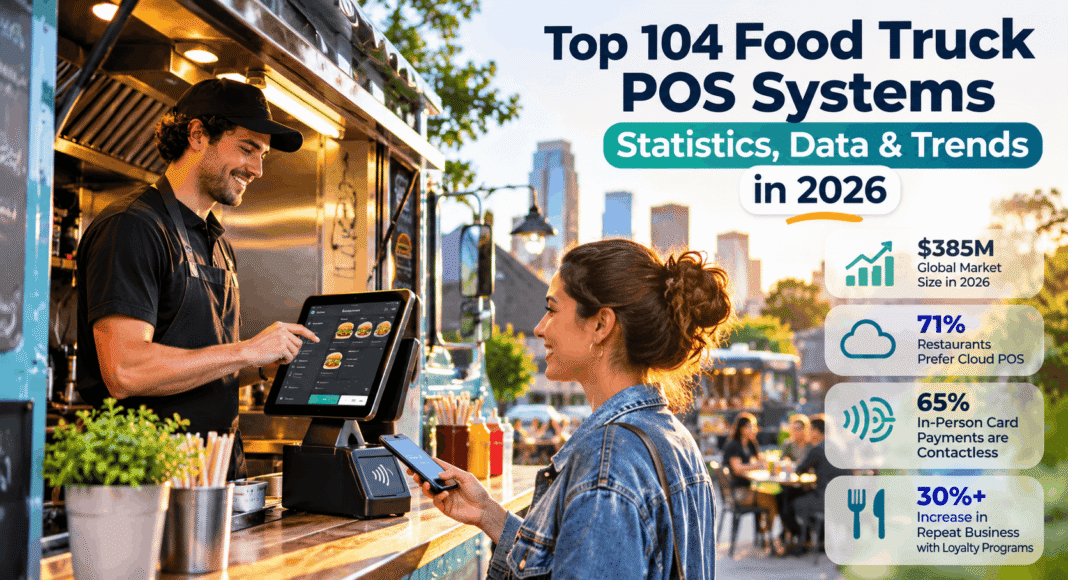
- Food Truck POS Market Growth: The global food truck POS systems market is estimated at $385 million in 2026 and projected to reach $772 million by 2034, growing at a 9.2% CAGR.
- Cloud POS and Digital Payment Adoption: Cloud-based POS systems, mobile ordering, and contactless payments are transforming food truck operations, improving transaction speed, flexibility, and customer convenience.
- Inventory Management and Profitability: Food truck POS software can help reduce food waste by up to 25%, while integrated inventory tracking, AI-powered analytics, and loyalty programs support cost savings, customer retention, and business growth.
Food truck POS systems in 2026 are transforming mobile food businesses through cloud technology, contactless payments, and inventory management. The global market is valued at approximately $385 million and is projected to reach $772 million by 2034. Explore 104 key statistics covering market growth, digital payments, operational efficiency, customer loyalty, and emerging technology trends.
The food truck industry is undergoing a significant digital transformation in 2026, driven by the growing adoption of cloud-based point-of-sale (POS) systems, contactless payments, mobile ordering, and automated inventory management. As food truck operators face rising operating costs, changing consumer expectations, and increasing competition, modern food truck POS systems have become essential tools for improving operational efficiency, managing transactions, and maximizing profitability.
Also, read our article on the Top 10 Best Food Truck POS Systems To Use.
According to industry market estimates, the global food truck POS systems market is valued at approximately $385 million in 2026 and is projected to reach $772 million by 2034, representing a compound annual growth rate (CAGR) of 9.2%. This expansion reflects the increasing demand for affordable, mobile-friendly POS solutions that help food truck businesses streamline payment processing, monitor sales performance, and manage daily operations. Meanwhile, the broader global cloud POS market is projected to grow from $6.9 billion in 2025 to $38.6 billion by 2035, highlighting the accelerating transition toward cloud-based business management technology.
The United States remains a major market for food truck technology adoption. Industry data indicates that the number of U.S. food truck businesses reached approximately 92,257 in 2025, representing a 16.9% increase from the previous year. With average annual food truck revenue estimated at $346,000 and profit margins around 6.2%, operators increasingly recognize the importance of efficient POS software for controlling expenses, reducing food waste, and improving customer service. Furthermore, approximately 71% of restaurant operators prioritize cloud-based POS functionality when purchasing new systems, demonstrating the growing importance of remote accessibility, real-time reporting, and integrated business management.
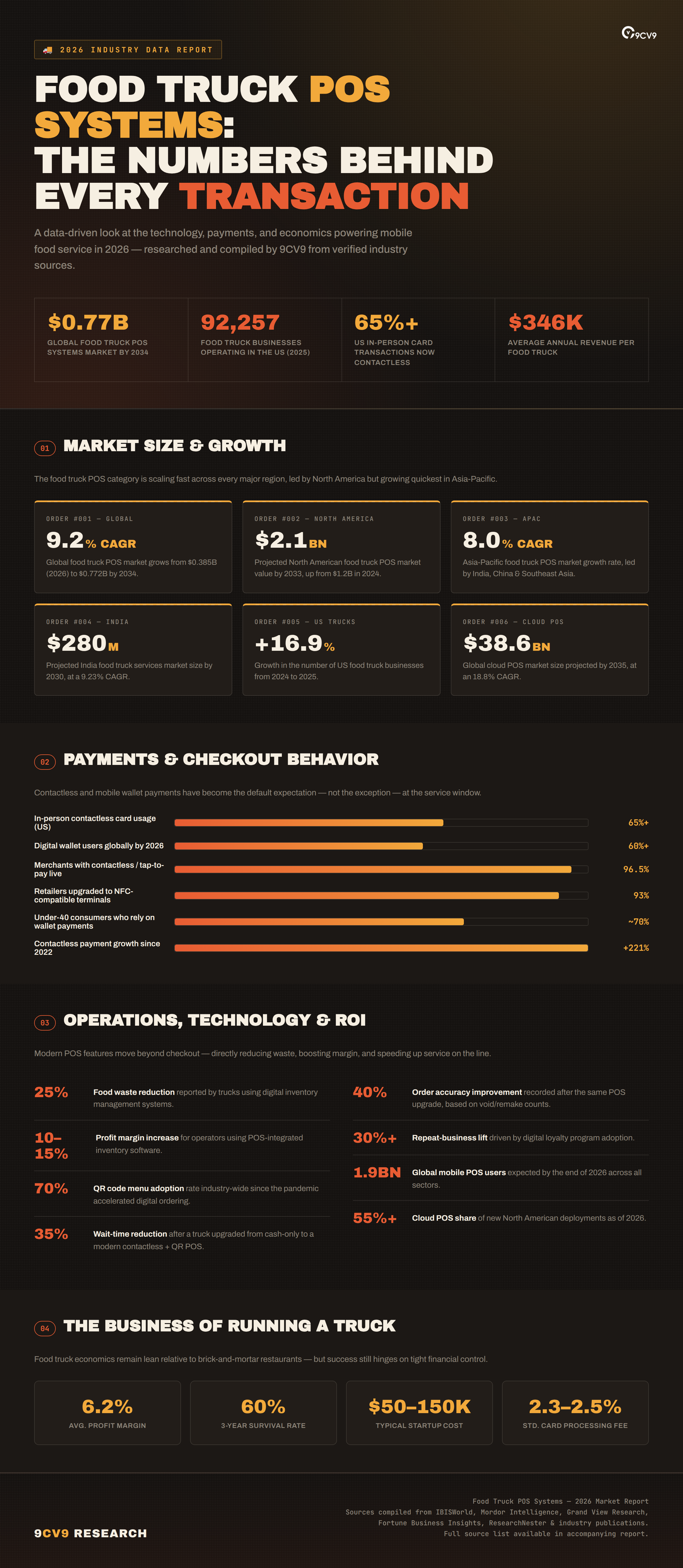
Consumer payment preferences are also reshaping the food truck POS software landscape. In 2026, more than 65% of in-person card transactions in the United States reportedly use contactless payment technology, while global digital wallet adoption is expected to exceed 5.2 billion users. These developments are encouraging food truck businesses to adopt POS systems supporting credit cards, debit cards, Apple Pay, Google Pay, and other digital payment methods. Mobile ordering, QR code menus, and integrated loyalty programs are becoming increasingly important for delivering faster checkout experiences and encouraging repeat purchases.
Beyond payment processing, food truck POS technology is evolving into a comprehensive business management solution. Industry estimates suggest that digital inventory management systems can reduce food waste by up to 25%, while inventory software users have reported profit margin improvements of 10% to 15%. Digital loyalty programs have also been associated with increases in repeat business of 30% or more. Although these outcomes vary depending on implementation and business conditions, they illustrate the potential financial benefits of integrating sales, inventory, customer engagement, and operational analytics into a single platform.
Emerging technologies such as artificial intelligence, predictive analytics, automated menu optimization, and self-service ordering are expected to further influence the food truck POS systems market. At the same time, operators must evaluate software subscription costs, payment processing fees, hardware requirements, offline functionality, and integration capabilities to identify solutions that deliver sustainable long-term value.
This article examines the top 104 food truck POS systems statistics, data, and trends in 2026, covering global and regional market growth, U.S. food truck industry performance, cloud and mobile POS adoption, contactless payment trends, inventory management, POS pricing, customer behavior, digital ordering, and loyalty programs. These statistics provide valuable insights for food truck owners, restaurant operators, POS software providers, technology investors, and entrepreneurs seeking to understand the evolving food truck technology landscape and make informed business decisions in 2026 and beyond.
Before we venture further into this article, we would like to share who we are and what we do.
About 9cv9
9cv9 is a business tech startup based in Singapore and Asia, with a strong presence all over the world.
With over ten years of startup and business experience, and being highly involved in connecting with thousands of companies and startups, the 9cv9 team has listed some of the top and best companies/tools in this review.
If you like to get your company listed in our top B2B software reviews, check out our world-class 9cv9 Media and PR service and pricing plans here.
Top 104 Food Truck POS Systems Statistics, Data & Trends in 2026
Global and Regional Food Truck POS Market Size Statistics
1. Global Food Truck POS Systems Market to Reach $772 Million by 2034
The global food truck POS systems market is estimated to be worth approximately $385 million in 2026 and is projected to reach $772 million by 2034, representing a compound annual growth rate (CAGR) of 9.2%. This growth reflects increasing investment in digital payment processing, cloud-based POS platforms, and integrated business management solutions among mobile food vendors.
2. North America Remains a Major Food Truck POS Market
The North American food truck POS systems market was estimated at $1.2 billion in 2024 and is projected to reach $2.1 billion by 2033, expanding at approximately 6.2% annually. Strong demand for digital payments, mobile ordering, and automated business management supports the region’s POS technology market.
3. Asia-Pacific Food Truck POS Market Projected to Reach $1.2 Billion
The Asia-Pacific food truck POS systems market was valued at approximately $600 million in 2024, with projections indicating growth to $660 million in 2025 and $1.2 billion by 2033. An estimated CAGR of 8% reflects expanding mobile food businesses and increasing digital payment adoption across the region.
4. India and Southeast Asia Experience Growing Mobile POS Adoption
India, Australia, and Southeast Asian countries are experiencing increasing demand for mobile food vendor technology. Expanding smartphone usage, digital payment infrastructure, and street food businesses are encouraging operators to adopt portable POS systems with integrated ordering, payment processing, and inventory management capabilities.
5. India’s Food Truck Services Market Expected to Reach $280.45 Million by 2030
India’s food truck services market was valued at approximately $165.12 million in 2024 and is projected to reach $280.45 million by 2030, growing at a CAGR of 9.23%. This expansion creates opportunities for localized food truck POS software supporting digital payments, GST-compliant billing, and mobile business operations.
6. India’s E-Commerce Market Projected to Reach $163 Billion in 2026
India’s e-commerce industry is projected to grow at a CAGR of 27%, reaching approximately $163 billion in 2026. The expansion of digital commerce is influencing customer payment expectations and encouraging food truck businesses to implement mobile payment solutions and integrated POS technology.
7. Food Truck POS Market Features a Diverse Competitive Landscape
The food truck POS technology market includes providers such as PayPal, Toast POS, Epos Now, POSist, Deputy, talech, Flipdish, and LS Retail. Competition among software providers is expanding the availability of mobile payment processing, inventory tracking, delivery integration, and business analytics solutions.
8. Food Truck POS Software Emerges as a Distinct Technology Market
Market research increasingly recognizes food truck POS systems as a dedicated software category, with industry analysis covering the 2018–2031 period. Market segmentation by deployment type, application, and geography demonstrates growing demand for specialized POS solutions designed for mobile food service operations.
9. Cloud-Based POS Market Expected to Experience Strong Growth
Cloud-based POS technology is projected to account for 21.3% of the broader global POS market in 2026, with an estimated CAGR of 19.5%. Increasing adoption of subscription-based software, remote business monitoring, and integrated payment processing supports the shift toward cloud-enabled food truck POS systems.
10. Android POS Systems Projected to Grow at 17.1% Annually
Windows- and Linux-based POS systems are projected to hold approximately 56.81% of the broader POS market in 2026, while Android-based systems are expected to grow at a CAGR of 17.1%. Affordable Android tablets and portable payment terminals offer practical advantages for food trucks operating in limited spaces.
United States Food Truck Industry Statistics
11. United States Food Truck Business Count Reaches 92,257
The number of food truck businesses in the United States reached approximately 92,257 in 2025, representing a 16.9% increase from 2024. Industry data also indicates average annual business-count growth of 23.7% between 2020 and 2025, highlighting the expanding potential customer base for food truck POS software providers.
12. U.S. Food Truck Business Numbers Have Increased Dramatically
Historical estimates of approximately 4,000 food trucks are substantially lower than more recent industry counts exceeding 92,000 businesses. This difference illustrates the scale of the industry’s reported expansion, although historical and current figures may use different business-counting methodologies.
13. Average Food Truck Annual Revenue Estimated at $346,000
The average food truck generates approximately $346,000 in annual revenue, according to industry estimates. This revenue potential highlights the importance of reliable POS systems that help operators monitor daily sales, analyze customer spending, optimize menu pricing, and identify opportunities to improve profitability.
14. Average Food Truck Profit Margin Estimated at 6.2%
Food truck businesses operate with estimated profit margins of approximately 6.2%. Managing ingredient expenses, labor costs, payment processing fees, and food waste is essential for protecting profitability. POS systems with integrated inventory tracking and financial reporting can support more informed operational decisions.
15. Approximately 91% of Food Trucks Operate Independently
Around 91% of food trucks operate as independent businesses rather than as part of larger chains. This ownership structure creates strong demand for affordable, user-friendly POS systems that provide essential payment processing, inventory management, and sales reporting without unnecessary enterprise-level complexity.
16. U.S. Food Truck Industry Market Size Estimated at $2.8 Billion
The U.S. food truck industry reached an estimated market value of approximately $2.8 billion in 2025 under one industry research methodology. Continued expansion in mobile food services supports demand for POS technology, digital ordering platforms, and operational management software.
17. Broader U.S. Food Truck Sales Estimates Reach $14 Billion to $20 Billion
Some industry estimates place the U.S. food truck economy between $14 billion and $20 billion in 2026, with more than 100,000 trucks operating nationwide. These estimates reflect broader gross-sales calculations and should be distinguished from narrower industry market-size measurements.
18. Evening Hours Account for Peak Business Activity for 63.6% of Food Trucks
Approximately 63.6% of surveyed food truck operators identify 5 PM to 8 PM as their busiest operating period. POS systems with hourly sales reporting, transaction analytics, and workforce management capabilities can help businesses prepare for peak evening demand.
19. Food Trucks Offer Competitive Corporate Catering Costs
Traditional catering services can cost approximately $70 to $120 per person, creating opportunities for food trucks to compete through flexible and potentially more affordable event catering packages. POS systems supporting event bookings, invoicing, and catering payments can help operators manage this revenue stream.
20. Mexican Street Food Remains a Leading Food Truck Cuisine
Mexican street food, particularly tacos, is among the most common food categories offered by U.S. food trucks. POS systems supporting customizable menu items, ingredient modifiers, meal combinations, and recipe costing are especially valuable for operators serving this cuisine.
21. Burgers Rank Among the Most Profitable Food Truck Menu Items
Burgers are identified as a particularly profitable food truck menu category because of relatively manageable ingredient costs, efficient preparation, and broad consumer demand. POS software with recipe costing and menu profitability analysis helps operators identify high-margin products.
22. Millennials Account for 38.3% of Food Truck Customers
Millennials represent approximately 38.3% of food truck customers, while more than 60% of millennials reportedly purchased food from a food truck within the previous year. This demographic’s familiarity with mobile technology supports demand for digital ordering, contactless payments, and customer loyalty applications.
23. Average Food Truck Employs 1.8 Full-Time Workers
The average food truck employed approximately 1.8 full-time workers in 2026, reflecting the industry’s lean staffing model. Fast POS interfaces, automated payment processing, and integrated kitchen order management can help small teams handle customer demand more efficiently.
24. Food Truck Operating Costs Have Increased by 7.9%
Industry estimates indicate that average food truck operating costs increased by approximately 7.9% between 2020 and 2026. Rising ingredient, fuel, labor, and equipment expenses make real-time cost monitoring and inventory management increasingly important.
25. Average Food Truck Customer Wait Time Reaches 12 Minutes
Food truck customers reportedly expect an average waiting time of seven minutes, while actual waiting times average approximately 12 minutes. This five-minute difference highlights opportunities for POS-integrated kitchen displays, mobile ordering, and automated order processing to improve service efficiency.
26. Average Food Truck Customer Spending Reaches $12.76
Average customer spending at food trucks is estimated at $12.76 per transaction in 2026. POS systems featuring upselling recommendations, meal bundles, and customer purchase analytics can help businesses identify opportunities to increase average order values.
27. Convenience Influences 92% of Food Truck Customers
Approximately 92% of food truck customers identify convenience and quick service as major reasons for choosing mobile food vendors. Efficient checkout, contactless payments, and streamlined ordering processes are therefore important elements of the food truck customer experience.
28. Festivals Account for 47% of Food Truck Customer Discovery
Industry estimates suggest that 47% of customers discover food trucks at festivals, followed by business districts at 34% and college campuses at 19%. Reliable mobile POS systems with offline functionality can support transactions at temporary venues where internet connectivity may be inconsistent.
29. Positive Customer Experiences Encourage 60% of Repeat Visits
Approximately 60% of food truck customers report returning to the same vendor after a positive experience. Accurate order processing, efficient payment transactions, and POS-integrated loyalty programs can help operators strengthen customer satisfaction and retention.
30. Only 9% of Food Truck Owners Operate Multiple Locations
Approximately 9% of surveyed food truck owners operate more than one truck or have expanded into a physical restaurant location. This finding reinforces the importance of affordable POS systems designed for independent operators while offering scalability for future expansion.
Food Truck Startup Costs, Financing and Failure Rate Statistics
31. Food Truck Startup Costs Range from $50,000 to Over $150,000
Buying or building a food truck typically costs between $50,000 and $150,000 or more before accounting for permits, insurance, commissary expenses, initial inventory, and working capital. Cloud-based POS software offers an affordable way to introduce digital payment processing and business management without significantly increasing startup expenses.
32. Total Food Truck Startup Investments Can Reach $249,000
Industry financing estimates suggest that successful food truck businesses invest between $67,000 and $249,000 during startup. Insufficient funding is frequently identified as a major contributor to early business failure. Subscription-based POS systems can help operators limit upfront technology expenses.
33. Approximately 60% of Food Trucks Survive Their First Three Years
Industry estimates indicate that approximately 60% of food truck businesses survive their first three years, implying a failure rate of around 40%. Effective financial management, inventory control, and sales monitoring can help operators identify financial risks and improve business sustainability.
34. Undercapitalization Is a Leading Cause of Food Truck Failure
Insufficient startup capital is frequently cited as a primary reason food truck businesses fail during their early operating years. Financial planning should account for vehicle purchases, equipment, permits, inventory, and at least 90 days of working capital. POS-generated financial reports can help operators monitor cash flow.
35. Food Truck Regulatory Compliance Costs Average $28,000
Food truck operators reportedly spend approximately $28,000 on regulatory requirements, including permits, licensing, and compliance-related expenses. Digital recordkeeping and integrated POS reporting can help businesses organize operational information and reduce administrative complexity.
36. Food Truck Kitchen Equipment Costs Range from $10,000 to $45,000
Kitchen equipment expenses typically range from $10,000 to $45,000, depending on menu complexity and operational requirements. Compact tablet-based POS systems help food truck owners preserve valuable counter space while maintaining efficient ordering and payment processing capabilities.
37. Food Truck Rentals Can Start at Approximately $1,800 Per Month
Renting a ready-to-operate food truck can cost approximately $1,800 per month, offering entrepreneurs a lower-commitment alternative to purchasing a vehicle. Flexible POS subscriptions can complement this approach by reducing initial technology investments and allowing operators to test business concepts.
38. Winter Months Present Higher Food Truck Business Failure Risks
Industry estimates suggest that food truck failure rates during December through February can be three times higher because of unfavorable weather conditions and seasonal spending patterns. POS sales analytics can help operators identify seasonal revenue fluctuations and prepare appropriate financial reserves.
39. Food Truck Financing Strategies Emphasize a 20% Emergency Reserve
One recommended financing approach allocates 50% of startup funding to equipment financing, 30% to savings or investor contributions, and 20% to emergency reserves. Maintaining adequate financial flexibility can help operators manage unexpected expenses and seasonal revenue changes.
40. Food Trucks Can Benefit from Lower Overhead Than Traditional Restaurants
Food trucks may achieve stronger survival prospects than traditional restaurants because of lower fixed operating costs and the flexibility to relocate. POS systems with location-specific sales analytics help operators identify profitable locations and adjust operating strategies.
41. Food Truck Operators May Need $24,000 to $60,000 in Cash Reserves
Some industry guidance recommends maintaining at least three months of operating expenses, estimated at approximately $24,000 to $60,000, before launching a food truck. POS-generated revenue reports and expense tracking can support cash flow planning and reserve management.
42. Location-Based Profitability Tracking Supports Food Truck Success
Successful food truck operators monitor revenue and profitability across different locations, events, and catering opportunities. POS software with location-based reporting helps businesses identify high-performing venues, reduce unprofitable operating hours, and allocate resources more efficiently.
Cloud and Mobile Food Truck POS Technology Statistics
43. Cloud POS Adoption Exceeds 55% of New North American Deployments
Cloud-based POS systems account for more than 55% of new deployments in North America and approximately 45% in Western Europe. Growing demand for subscription-based software, integrated payments, and real-time business analytics is accelerating cloud POS adoption across the food service industry.
44. Mobile and Tablet POS Systems Grow at 12% to 18% Annually
Mobile and tablet-based POS hardware represents one of the fastest-growing segments of the POS market, with estimated annual growth rates between 12% and 18%. Food trucks benefit from portable terminals, lower hardware costs, and flexible installation requirements.
45. Global Cloud POS Market Projected to Reach $38.6 Billion by 2035
The global cloud POS market was valued at approximately $6.9 billion in 2025 and is projected to reach $38.6 billion by 2035, growing at a CAGR of 18.8%. Increasing demand for remote management, automated reporting, and integrated payment processing supports this expansion.
46. Integrated Payments Expected to Represent 79.3% of Cloud POS Market
Integrated payment solutions are projected to account for approximately 79.3% of the cloud POS market by 2035. Combining payment processing with POS software allows food truck operators to simplify checkout, reduce hardware requirements, and centralize transaction reporting.
47. Software Accounts for 59.4% of the Cloud POS Market
Software represented approximately 59.4% of the cloud point-of-sale market in 2025, while POS-related services are forecast to grow at a CAGR of 20.95%. This shift reflects increasing demand for subscription-based analytics, inventory management, customer engagement, and business automation tools.
48. Mobile POS Hardware Holds 57.2% of Cloud POS Market Share
Mobile POS hardware accounts for approximately 57.2% of the cloud POS market by POS type. Portable terminals and tablet-based systems are particularly suitable for food trucks because they require limited installation space and support flexible payment processing.
49. Approximately 71% of Restaurants Prioritize Cloud POS Functionality
Around 71% of restaurants prioritize cloud-based capabilities when selecting POS systems, while more than 60% of recent POS purchases reportedly involve cloud-based solutions. Remote accessibility, centralized reporting, and automated updates are increasingly important purchasing considerations.
50. Mobile POS Transaction Value Projected to Reach $5.63 Trillion by 2027
The broader global mobile POS market is projected to reach approximately $5.63 trillion in transaction value by 2027, with an estimated 1.9 billion users worldwide by 2026. Growing mobile payment adoption creates opportunities for food truck operators to serve digitally connected consumers.
51. Global POS Software Market Expected to Reach $74.7 Billion by 2032
The global POS software market is projected to reach approximately $74.7 billion by 2032. Continued investment in payment processing, cloud infrastructure, inventory automation, and business intelligence is expected to support innovation in food truck POS technology.
52. U.S. Mobile POS Market Projected to Reach $19.23 Billion by 2035
The United States mobile POS market was valued at approximately $7.86 billion in 2025 and is expected to reach $19.23 billion by 2035, representing a CAGR of 9.36% between 2026 and 2035. Increasing mobile payment adoption supports demand for portable checkout technology.
53. More Than 72% of Businesses Use Analytics for Fraud Prevention
Industry estimates suggest that more than 72% of businesses use data mining and analytics to identify and prevent fraudulent activities. Modern POS systems can incorporate transaction monitoring, reporting, and security features to help food truck operators manage payment-related risks.
54. Square Holds an Estimated 27% Share of the POS Software Market
Square reportedly accounts for approximately 27% of the broader POS software market, with Toast also identified as a major competitor. Strong market positions among established POS providers influence the availability of integrated payments, mobile ordering, and inventory management features.
55. Asia-Pacific Cloud POS Market Projected to Grow at 14.5% Annually
The Asia-Pacific cloud POS market is projected to grow at a CAGR of approximately 14.5% between 2026 and 2035. Expanding digital payment infrastructure, growing small-business adoption, and mobile-first consumer behavior are expected to support regional market development.
Contactless Payments, Digital Wallets and Payment Technology Statistics
56. More Than 65% of U.S. In-Person Card Transactions Use Contactless Payments
Industry estimates suggest that contactless technology accounts for more than 65% of in-person card transactions in the United States in 2026. Food truck POS systems supporting tap-to-pay cards and mobile wallets can provide faster, more convenient checkout experiences.
57. Global Digital Wallet Users Expected to Exceed 5.2 Billion in 2026
More than 5.2 billion people worldwide are projected to use digital wallets in 2026, representing over 60% of the global population. Increasing consumer adoption of mobile payment applications reinforces the importance of digital wallet compatibility for food truck POS systems.
58. Digital Wallets Account for 32% of Global POS Transactions
Digital wallets reportedly represent approximately 83% of global digital payment volume and 32% of global point-of-sale transactions. These figures highlight the growing importance of wallet-enabled payment infrastructure for businesses serving customers who prefer cashless transactions.
59. Approximately 70% of Consumers Under 40 Use Digital Wallets
Industry estimates indicate that roughly 70% of consumers younger than 40 use digital wallets for purchases. This trend is particularly relevant to food trucks, which attract substantial numbers of millennial customers and increasingly rely on convenient mobile payment experiences.
60. Contactless Payment Volume Has Increased by 221% Since 2022
Contactless payment volume has reportedly increased by approximately 221% compared with 2022 levels. Growing adoption of NFC-enabled cards, smartphones, and digital wallets demonstrates the increasing importance of tap-to-pay functionality across food service businesses.
61. Approximately 95% of Small Business Owners Are Open to Tap-to-Mobile Payments
Around 95% of small and medium-sized business owners express willingness to adopt tap-to-mobile payment technology. Approximately 92% of businesses currently operating on a cash-only basis also report openness to adopting mobile payment solutions.
62. Approximately 96.5% of Merchants Accept Contactless Payments
Merchant survey data indicates that approximately 96.5% of businesses offer contactless or tap-to-pay payment options, while 90% accept chip, inserted-card, or swipe transactions. These findings demonstrate widespread merchant adoption of electronic payment technology.
63. More Than 50% of Merchants Report Growth in Contactless Payments
Over half of surveyed merchants reported increased contactless payment usage during the preceding 12 months. Continued growth suggests that digital payment acceptance is becoming an important operational requirement for food trucks and other small businesses.
64. Cash Acceptance Remains High at 95.5% of Merchants
Approximately 95.5% of surveyed merchants continue accepting cash despite increasing digital payment adoption. Food truck POS systems that support both cash and electronic transactions can accommodate a wider range of customer preferences.
65. Buy Now, Pay Later Acceptance Stands at 3% Among Surveyed Merchants
Merchant survey findings indicate that approximately 3% accept buy now, pay later payment arrangements, while 2.5% accept QR code payments. These figures suggest that certain alternative payment methods remain less widely adopted within the surveyed merchant population.
66. NFC-Compatible POS Terminal Adoption Expected to Exceed 93%
More than three-quarters of retailers worldwide have reportedly upgraded to NFC-compatible payment terminals, with adoption projected to exceed 93% by 2026. This expansion supports broader acceptance of contactless cards and smartphone-based payments.
67. NFC Technology Powers More Than 95% of Contactless Transactions
Near-field communication technology reportedly supports over 95% of contactless transactions worldwide. NFC-compatible POS terminals allow food truck businesses to accept tap-enabled payment cards and supported digital wallets through a single payment device.
68. European Contactless Payment Adoption Approaches 85%
Industry estimates suggest that approximately 85% of European retail transactions use contactless payment methods, with adoption expected to approach 90% around 2025–2026. Comparable U.S. estimates range from 58% to 65% of in-store digital transactions, depending on methodology.
69. NFC-Based Contactless Payment Revenue Projected to Exceed $41.1 Billion
Global revenue associated with NFC-based contactless payment hardware, solutions, and services is projected to exceed approximately $41.1 billion by 2026. Expanding investment in contactless infrastructure supports continued development of payment technology for small businesses.
70. Nearly Half of Americans Report Spending More With Digital Wallets
Consumer research suggests that nearly half of Americans spend more when using digital wallets. This purchasing behavior may create opportunities for food truck businesses to increase average transaction values through convenient digital payment options.
Food Truck POS Features, Inventory Management and Online Ordering Statistics
71. QR Code Menu Adoption Reaches Approximately 70%
Industry estimates suggest that QR code menu adoption reached approximately 70% in the post-pandemic food service environment. Digital menus allow customers to access product information through smartphones, potentially reducing ordering congestion and improving service convenience.
72. Digital Inventory Management Can Reduce Food Waste by Up to 25%
Digital inventory management systems have been associated with food waste reductions of up to 25%. Automated stock tracking, ingredient monitoring, and demand forecasting can help food truck operators reduce unnecessary purchases and improve inventory efficiency.
73. Inventory Software Users Report Profit Margin Improvements of 10% to 15%
Businesses using inventory management software have reported profit margin improvements ranging from 10% to 15%. Better ingredient tracking, reduced waste, and more accurate cost monitoring can support profitability, although actual financial results vary by business.
74. Digital Loyalty Programs Can Increase Repeat Business by 30% or More
Industry estimates suggest that digital loyalty programs can increase repeat customer activity by 30% or more. Food truck POS systems with integrated rewards, purchase tracking, and customer engagement tools can encourage repeat visits and strengthen customer relationships.
75. Digital Feedback Tools Associated With 20% Higher Customer Satisfaction
Food truck operators using digital customer feedback tools have reported improvements of approximately 20% in customer satisfaction scores. Integrated feedback systems can help businesses identify service problems, monitor customer experiences, and implement improvements.
76. AI-Powered Menu Recommendations Linked to 15% Revenue Growth
Early adopters of AI-powered menu recommendations and dynamic pricing tools have reported revenue improvements of approximately 15%. These technologies can help food truck operators analyze purchasing patterns, optimize menu offerings, and identify potential upselling opportunities.
77. Modern Food Truck POS Platforms Combine Multiple Business Functions
Food truck management software increasingly integrates payment processing, inventory tracking, menu management, customer relationship management, and order processing into centralized platforms. These capabilities help operators reduce dependence on separate applications and simplify daily business operations.
78. Real-Time Inventory Deduction Improves Food Truck Stock Management
Modern POS systems can automatically deduct ingredient quantities when menu items are sold and generate alerts when inventory reaches predefined thresholds. This functionality helps food truck businesses identify shortages, reduce manual tracking errors, and maintain product availability.
79. Offline POS Functionality Supports Food Truck Operations During Connectivity Interruptions
Offline-capable POS systems allow food truck operators to continue supported business activities when internet connections become unreliable. Cloud synchronization can restore centralized reporting when connectivity returns, although offline payment capabilities vary between providers.
80. Multiple Payment Methods Are Becoming Standard POS Requirements
Food truck customers increasingly expect payment options including cash, credit cards, debit cards, contactless payments, Apple Pay, Google Pay, and supported QR payment methods. POS systems offering flexible payment acceptance can help businesses accommodate different customer preferences.
81. QR Code and Mobile Ordering Can Improve Food Truck Service Speed
Mobile ordering and QR code-enabled POS systems allow customers to browse menus and submit orders using smartphones. These features can reduce service-window congestion and improve ordering efficiency during festivals, corporate events, and peak dining periods.
82. Modern POS Upgrade Reduced Food Truck Wait Times by 35% in One Case
A reported food truck case study found that average customer waiting times decreased by 35% after the business transitioned from cash-only operations to a modern POS system. Order accuracy also improved by 40%, based on reductions in voided orders and remakes.
83. Self-Service Ordering Kiosks Are Expanding Into Food Truck Operations
Compact, weather-resistant self-service kiosks are emerging as an ordering option for food trucks. These systems allow customers to browse menus and submit orders independently, potentially reducing queues and improving service efficiency during high-demand periods.
84. Recipe-Based Inventory Management Supports More Accurate Food Costing
Specialized food truck POS systems increasingly support recipe-based inventory tracking, allowing operators to connect ingredients with specific menu items. This functionality helps businesses monitor ingredient consumption, calculate product costs, and identify food waste.
Food Truck POS Processing Fees and Hardware Cost Statistics
85. U.S. In-Person Credit Card Processing Fees Typically Range From 2.3% to 2.5%
Standard in-person credit card processing rates for U.S. small businesses commonly range from 2.3% to 2.5%, according to industry estimates. Actual transaction costs depend on payment providers, card types, pricing structures, and additional processing fees.
86. Food Truck POS Hardware Typically Requires a Compact Setup
Most food truck POS installations require relatively limited hardware, commonly consisting of one primary terminal, a card reader, and potentially a handheld ordering device. Compact configurations help operators reduce equipment expenses and preserve kitchen workspace.
87. Flat-Rate Food Truck Payment Processing Commonly Uses Mid-2% Fees
Flat-rate in-person payment processing commonly charges fees around the mid-2% range, often with an additional fixed charge per transaction. This pricing model is popular among new food truck businesses because of its straightforward setup and predictable fee structure.
88. Free POS Software Can Generate $250 to $390 in Monthly Processing Fees
Some POS providers offer entry-level software without monthly subscription charges while collecting payment processing fees of approximately 2.49% to 2.6%. For food trucks processing $10,000 to $15,000 in monthly card sales, percentage-based fees alone could total roughly $250 to $390.
89. Interchange-Plus Pricing May Reduce High-Volume Processing Costs
One restaurant payment processing example estimates monthly fees of approximately $2,112 on $80,000 in card transactions under a flat-rate structure, compared with $1,720 using interchange-plus pricing. The example illustrates potential savings of approximately $392 per month, depending on transaction characteristics.
90. Credit Card Surcharges May Reach 3% Where Permitted
In many U.S. jurisdictions, qualifying businesses may apply credit card surcharges of up to 3%, subject to applicable laws and payment network requirements. Debit card surcharges are generally prohibited, while certain states impose additional restrictions.
91. Additional Payment Processing Fees Can Increase Food Truck Operating Costs
Payment processors may charge monthly PCI compliance fees of $10 to $30, batch processing fees of $0.10 to $0.25, and statement fees of $5 to $15 per month. Food truck operators should evaluate total processing expenses rather than comparing headline transaction rates alone.
Food Truck Marketing, Social Media and Customer Discovery Statistics
92. More Than 74% of Diners Discover Food Trucks Through Social Media
Industry estimates suggest that over 74% of diners discover new food trucks through social media platforms. Digital marketing, location announcements, menu promotions, and customer engagement are increasingly important for attracting customers to mobile food businesses.
93. Instagram Accounts for 50% of Reported Food Truck Discovery
Approximately 50% of diners reportedly discover food trucks through Instagram. Visual food content, short-form videos, location updates, and promotional posts can help operators attract customers and communicate daily operating locations.
94. Facebook Is Used by 86.9% of Food Truck Operators
Approximately 86.9% of food truck operators reportedly use Facebook to promote their businesses. The platform supports local customer engagement through community groups, event announcements, promotional campaigns, and daily location updates.
95. AI-Enabled POS Systems Are Improving Food Truck Order Accuracy
Artificial intelligence is increasingly being incorporated into POS systems to support order processing, sales forecasting, and operational analytics. These capabilities can help food truck businesses reduce ordering errors, improve service speed, and identify opportunities for operational improvement.
Food Truck Customer Behavior, Loyalty and Online Ordering Statistics
96. Mobile Ordering Encourages 45% of Customers to Order More Frequently
Approximately 45% of customers agree that mobile ordering options encourage them to purchase food more frequently. Convenient digital ordering, simplified checkout, and integrated loyalty rewards can help food truck businesses encourage repeat purchases.
97. Approximately 34% of Online Food Customers Spend at Least $50 Per Order
Consumer research indicates that 34% of people ordering food online spend at least $50 per transaction. This purchasing behavior highlights opportunities for food truck businesses offering catering packages, group orders, and digital ordering services.
98. Half of Restaurant Operators Report Increased Takeout and Delivery Sales Share
Approximately 50% of restaurant operators report that takeout and delivery represent a larger proportion of total sales than before the COVID-19 pandemic in 2019. This shift supports demand for POS systems integrating online ordering, delivery management, and payment processing.
99. Approximately 59% of Restaurant Operators Identify Repeat Guests as Their Most Profitable Customers
Around 59% of restaurant operators consider repeat guests their most profitable customer segment, while 62% report that direct customers generate greater profitability than third-party delivery customers. POS-integrated loyalty programs can help strengthen direct customer relationships.
100. Approximately 47.4% of Restaurant Customers Participate in Loyalty Programs
Industry estimates indicate that 47.4% of restaurant customers belong to at least one loyalty program. Digital rewards, personalized offers, and POS-integrated purchase tracking can help food truck operators encourage repeat visits and improve customer engagement.
101. Loyalty Program Members Spend Approximately 20% More Than Non-Members
Loyalty program participants reportedly spend around 20% more than customers who do not participate in rewards programs. Integrated POS loyalty features can help food truck businesses encourage repeat purchases, improve customer retention, and increase customer lifetime value.
102. Repeat Customers Generate 79% of Delivery Orders
Approximately 79% of restaurant delivery orders reportedly come from customers who have previously ordered from the same business. This finding highlights the importance of customer retention, consistent service quality, and loyalty programs for businesses offering delivery services.
103. Restaurant Loyalty Program Satisfaction Reaches 89%
Approximately 89% of restaurants report satisfaction with their loyalty programs, compared with a global average of 83% across industries. These findings suggest that loyalty technology can be a valuable component of restaurant and food truck customer retention strategies.
104. Customer Ordering Technology Is a Priority for 37% of Restaurant Operators
Approximately 37% of restaurant operators identify customer ordering as their most important area for technology development. This prioritization reflects continued interest in mobile ordering, self-service systems, integrated POS platforms, and digital customer experiences.
Conclusion
The top 104 food truck POS systems statistics, data, and trends in 2026 highlight the growing importance of digital technology in transforming the global food truck industry. As mobile food businesses expand, consumer payment preferences evolve, and operational costs continue to rise, modern point-of-sale systems are becoming essential for improving efficiency, enhancing customer experiences, and maintaining profitability in an increasingly competitive market.
With the global food truck POS systems market estimated at $385 million in 2026 and projected to reach $772 million by 2034, the industry presents significant growth opportunities for POS software providers, payment technology companies, and food truck operators. The expansion of cloud-based POS platforms, mobile payment solutions, and integrated business management tools reflects a broader shift toward flexible, data-driven operations that support the unique requirements of mobile food businesses.
One of the most significant food truck POS trends in 2026 is the accelerating adoption of cloud-based and mobile-first technology. Industry estimates indicate that cloud-based POS systems account for more than 55% of new deployments in North America, while mobile and tablet-based POS hardware is expanding at an estimated annual growth rate of 12% to 18%. These developments demonstrate the increasing preference for portable, affordable, and scalable solutions that allow food truck owners to monitor sales, manage inventory, and access business insights from virtually anywhere.
Contactless payments, digital wallets, and mobile ordering are also reshaping customer expectations. With more than 65% of in-person card transactions in the United States reportedly using contactless technology in 2026, food truck businesses must prioritize convenient and secure payment experiences. POS systems supporting Apple Pay, Google Pay, QR code ordering, and integrated payment processing can help operators reduce checkout friction, improve order accuracy, and serve customers more efficiently during busy periods.
Beyond transaction processing, food truck POS software is increasingly influencing operational profitability. Industry estimates suggest that digital inventory management can reduce food waste by up to 25%, while businesses using inventory software have reported profit margin improvements of 10% to 15%. Similarly, digital loyalty programs have been associated with increases in repeat business of 30% or more. Although individual results depend on business conditions and implementation, these findings highlight the potential value of integrated inventory tracking, customer relationship management, and real-time sales analytics.
The growing adoption of artificial intelligence, automated menu recommendations, predictive analytics, and self-service ordering technologies is expected to create additional opportunities for innovation. Food truck operators that effectively leverage these capabilities may be better positioned to optimize menu pricing, anticipate customer demand, manage ingredient costs, and improve service speed. However, selecting the right POS system also requires careful consideration of payment processing fees, software subscriptions, hardware expenses, offline functionality, and long-term scalability.
For food truck owners and entrepreneurs, the key takeaway from these 2026 statistics is that investing in the right food truck POS system is no longer simply about accepting payments; it is about building a more efficient, profitable, and customer-focused business. Solutions that combine reliable payment processing, cloud accessibility, inventory management, digital ordering, and customer loyalty features can provide meaningful competitive advantages in an industry where operational efficiency and customer satisfaction directly influence financial performance.
Looking ahead to 2027 and beyond, the food truck POS systems market is expected to benefit from continued digital payment adoption, advances in cloud technology, and growing demand for intelligent business management software. As competition intensifies, food truck businesses that embrace cost-effective, adaptable, and data-driven POS solutions will be better equipped to respond to changing market conditions, strengthen customer relationships, and pursue sustainable growth.
Ultimately, the 104 food truck POS systems statistics and trends for 2026 demonstrate that digital transformation is becoming a central driver of success in the mobile food service industry. Whether operating a single food truck, managing a growing fleet, or developing POS technology for the food service sector, understanding these market developments can support better technology investments, more informed operational decisions, and stronger long-term business performance.
If you find this article useful, why not share it with your hiring manager and C-level suite friends and also leave a nice comment below?
We, at the 9cv9 Research Team, strive to bring the latest and most meaningful data, guides, and statistics to your doorstep.
To get access to top-quality guides, click over to 9cv9 Blog.
To hire top talents using our modern AI-powered recruitment agency, find out more at 9cv9 Modern AI-Powered Recruitment Agency.
People Also Ask
What is the global food truck POS systems market size in 2026?
The global food truck POS systems market is estimated at $385 million in 2026 and is projected to reach $772 million by 2034, growing at a compound annual growth rate (CAGR) of 9.2%.
What are the latest food truck POS systems trends in 2026?
Major trends include cloud-based POS adoption, contactless payments, mobile ordering, AI-powered analytics, automated inventory management, digital loyalty programs, and integrated payment processing.
How fast is the food truck POS systems market growing?
The global food truck POS systems market is projected to grow at a CAGR of 9.2% between 2026 and 2034, driven by digital payment adoption and increasing demand for mobile business management solutions.
What is a food truck POS system?
A food truck POS system is software and hardware that manages customer orders, payments, inventory, sales reporting, and business operations. Modern systems often support cloud access, mobile devices, and digital payments.
Why do food trucks need POS systems in 2026?
Food trucks need POS systems to process payments efficiently, reduce ordering errors, monitor inventory, track sales, and improve customer experiences while managing rising operating costs.
What percentage of restaurants prefer cloud-based POS systems?
Approximately 71% of restaurants prioritize cloud-based POS functionality when purchasing new systems, reflecting growing demand for remote management, real-time reporting, and integrated operations.
How popular are mobile POS systems in 2026?
Mobile and tablet-based POS systems are among the fastest-growing hardware segments, with estimated annual growth rates of 12% to 18%, driven by portability, affordability, and ease of deployment.
What are the benefits of cloud-based POS systems for food trucks?
Cloud-based POS systems provide remote sales monitoring, inventory tracking, automated reporting, software updates, and centralized business management, making them particularly useful for mobile food businesses.
How many food truck businesses operate in the United States?
According to industry data, approximately 92,257 food truck businesses operated in the United States in 2025, representing a 16.9% increase from 2024.
What is the average annual revenue of a food truck?
Industry estimates place average annual food truck revenue at approximately $346,000. Actual earnings vary depending on location, menu pricing, operating expenses, customer demand, and business management.
What is the average profit margin for food trucks?
Food truck profit margins are estimated at approximately 6.2%. Effective inventory management, optimized menu pricing, and efficient payment processing can help operators protect profitability.
How much does a food truck POS system cost?
Food truck POS costs depend on software subscriptions, hardware, payment processing fees, and additional features. Some providers offer free basic software but charge transaction fees and optional service costs.
What are typical credit card processing fees for food trucks?
Standard in-person credit card processing rates commonly range from 2.3% to 2.5%, although actual fees depend on the payment provider, transaction volume, pricing model, and additional charges.
What percentage of payments are contactless in 2026?
Industry estimates suggest that more than 65% of in-person card transactions in the United States use contactless technology in 2026, including tap-to-pay cards and digital wallets.
How many people use digital wallets worldwide in 2026?
Global digital wallet adoption is projected to exceed 5.2 billion users in 2026, highlighting the growing importance of mobile payment acceptance for food trucks and other small businesses.
Can food truck POS systems accept Apple Pay and Google Pay?
Yes. Many modern food truck POS systems support Apple Pay, Google Pay, contactless cards, and other digital payment methods through compatible NFC-enabled payment terminals.
How do food truck POS systems improve inventory management?
Food truck POS systems automatically track ingredient usage, update stock levels, identify popular products, and generate low-stock alerts, helping operators reduce waste and avoid inventory shortages.
How much can inventory software reduce food waste?
Industry estimates suggest that digital inventory management systems can reduce food waste by up to 25% through improved stock tracking, demand forecasting, and ingredient management.
Can food truck POS software increase profit margins?
Industry reports suggest that businesses using inventory management software have experienced profit margin improvements of 10% to 15%, although actual results depend on operational efficiency and implementation.
What are the best POS features for food trucks in 2026?
Important features include mobile payments, offline functionality, inventory tracking, menu management, sales analytics, QR code ordering, customer loyalty programs, and affordable hardware integration.
Do food truck POS systems work without internet access?
Some food truck POS systems offer offline functionality that allows operators to continue recording sales during connectivity interruptions. Payment processing capabilities and synchronization vary by provider.
How does QR code ordering benefit food trucks?
QR code ordering allows customers to browse menus and place orders using smartphones, potentially reducing queues, improving order accuracy, and accelerating service during busy periods.
What is the adoption rate of QR code menus?
Industry estimates cited in food truck POS research suggest that QR code menu adoption reached approximately 70% in the post-pandemic food service environment.
How does AI improve food truck POS systems?
AI-powered POS systems can analyze purchasing patterns, recommend menu adjustments, forecast inventory requirements, support dynamic pricing, and identify opportunities to improve sales performance.
Can POS systems help food trucks increase customer loyalty?
Yes. POS-integrated loyalty programs can track customer purchases, offer rewards, and encourage repeat visits. Industry estimates suggest digital loyalty programs can increase repeat business by 30% or more.
What percentage of food truck customers discover businesses through social media?
Industry estimates indicate that more than 74% of diners discover new food trucks through social media, making platforms such as Instagram and Facebook important marketing channels.
How does mobile ordering affect customer retention?
Approximately 45% of customers agree that mobile ordering options encourage them to order more frequently, highlighting the potential benefits of convenient digital ordering and integrated loyalty programs.
What is the average customer spending at food trucks in 2026?
The average customer spend at a food truck is estimated at $12.76 in 2026. POS systems with upselling prompts, combo recommendations, and digital menus can help operators increase average transaction values.
How do food truck POS systems improve customer service speed?
Modern POS systems streamline order entry, payment processing, and kitchen communication. One reported food truck case recorded a 35% reduction in average wait times after upgrading its POS technology.
What is the future of food truck POS systems beyond 2026?
Food truck POS systems are expected to increasingly incorporate cloud technology, AI-powered analytics, automated inventory management, mobile ordering, contactless payments, and personalized customer loyalty features.
Sources
- Verified Market Reports
- Toast POS
- HubPlate Blog
- IBISWorld
- PartsFE
- Mordor Intelligence
- B2B Reviews
- GoFoodService
- Food Truck Profit
- National Street Food Vendors Association
- PitStop
- Grand View Research
- Fortune Business Insights
- SNS Insider
- Yahoo Finance
- IndexBox
- Research Nester
- SQ Magazine
- Epos Now
- Andersen
- Sleft Payments
- BonApp
- Quantic
- LithosPOS
- Homebase
- United Bancard of TN
- Research and Markets
- Restroworks
- Dimension Funding
- Sterling Foodservice
- Food Truck Lease
- Mobi Munch
- Expert Market
- POS USA
- AGMS
- KORONA POS
- Payment USA
- Timeline Digi
- Restolabs
- FoodShot AI
- DoorDash Merchant Blog
- Antavo
- Chowly