

Key Takeaways
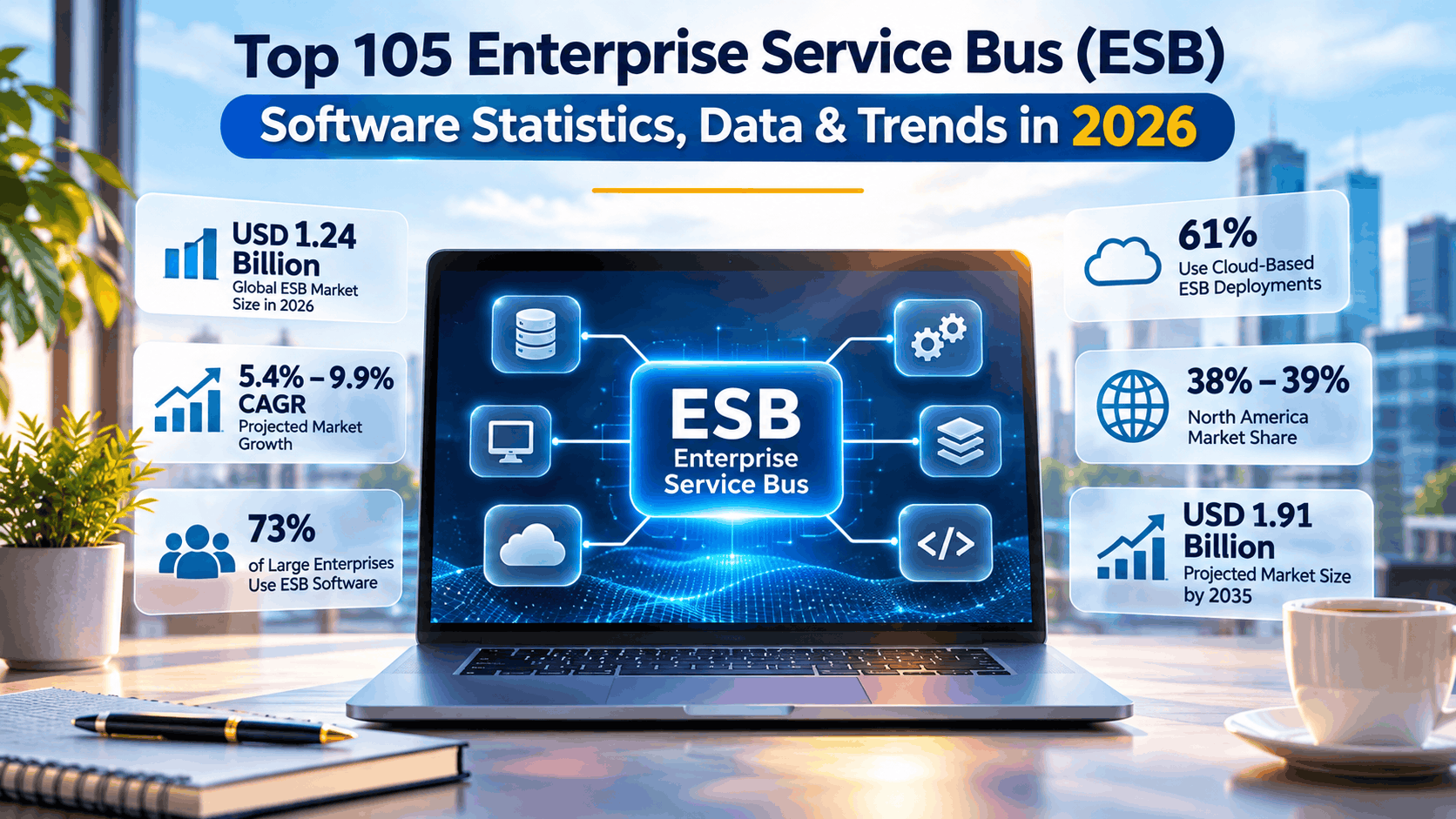
- ESB Software Market Growth: The global Enterprise Service Bus (ESB) software market is estimated to reach USD 1.24 billion in 2026, with projected CAGR estimates ranging from 5.4% to 9.9%, reflecting sustained demand for enterprise integration solutions.
- Enterprise ESB Adoption and Cloud Integration: Industry estimates suggest that 73% of large organizations use ESB platforms, while cloud-based deployments, API management, and hybrid integration architectures continue to drive enterprise digital transformation.
- Emerging ESB Software Trends in 2026: Artificial intelligence, machine learning, microservices, event-driven architectures, and iPaaS are reshaping enterprise middleware, enabling smarter data integration, workflow automation, and scalable application connectivity.
Enterprise Service Bus (ESB) software enables businesses to connect applications, automate workflows, and exchange data across complex IT systems. In 2026, the global ESB software market is estimated at USD 1.24 billion, with growing demand for cloud integration, API management, and hybrid architectures. These 105 statistics highlight market growth, adoption rates, and emerging technology trends.
Enterprise Service Bus (ESB) software continues to play a critical role in modern enterprise IT infrastructure, enabling organizations to integrate applications, automate workflows, exchange data, and connect legacy systems with cloud-based technologies. As businesses accelerate digital transformation, adopt hybrid cloud environments, and embrace microservices architectures, demand for reliable enterprise integration solutions is steadily increasing. Understanding the latest Enterprise Service Bus (ESB) software statistics, data, and trends in 2026 is essential for IT leaders, software developers, enterprise architects, and business decision-makers seeking to optimize their integration strategies.
Also, read our article on the Top 10 Enterprise Service Bus (ESB) Software To Know.
The global Enterprise Service Bus software market is estimated to reach USD 1.24 billion in 2026, up from USD 1.12 billion in 2024, with projections indicating continued expansion over the coming decade. According to various industry research estimates, the ESB market is expected to grow at compound annual growth rates (CAGR) ranging from approximately 5.4% to 9.9%, depending on market definitions and forecast periods. Meanwhile, the broader ESB middleware market is projected to reach USD 9.32 billion by 2034, highlighting the growing importance of enterprise connectivity, API management, real-time data integration, and cloud-native middleware solutions.
Enterprise adoption patterns further demonstrate the significance of ESB technology. Industry estimates suggest that approximately 73% of large organizations use ESB platforms, while 61% of enterprises utilize cloud-based ESB deployments to improve scalability and operational flexibility. Large enterprises account for an estimated 69% of ESB market demand, reflecting their complex integration requirements and substantial IT infrastructure investments. Industries such as banking, financial services, insurance, healthcare, telecommunications, manufacturing, and retail remain important drivers of ESB software adoption.
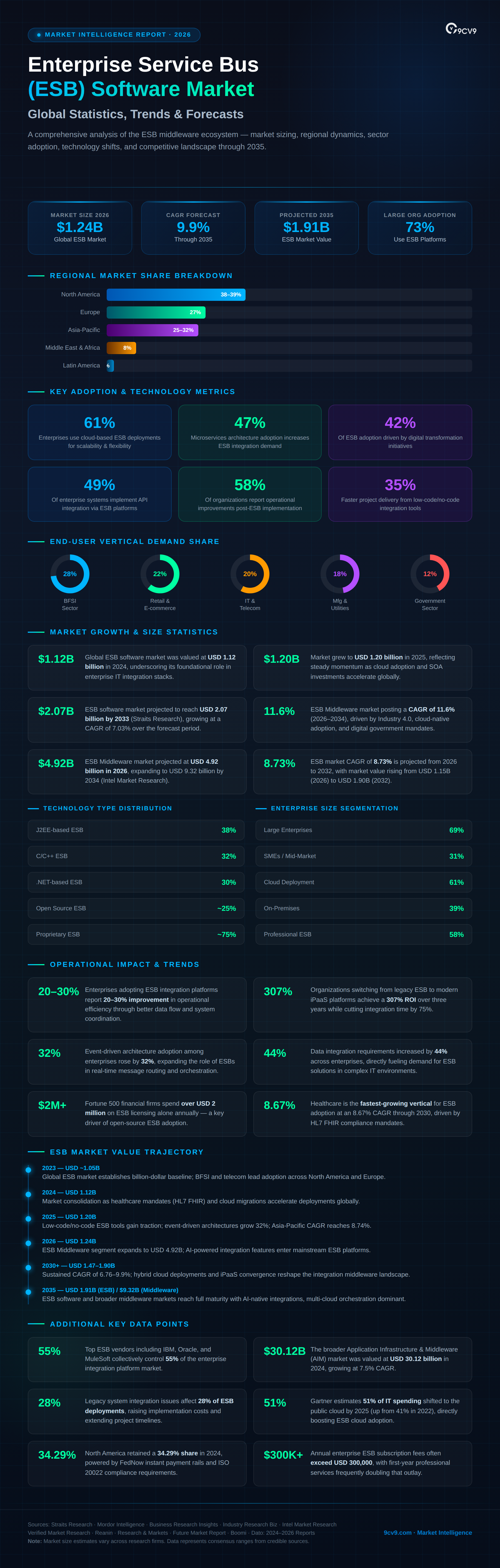
Technological advancements are also reshaping the enterprise integration landscape in 2026. The growing adoption of artificial intelligence, machine learning, event-driven architectures, low-code integration tools, and Integration Platform as a Service (iPaaS) is influencing how organizations design and manage their integration ecosystems. Modern ESB solutions increasingly support intelligent message routing, automated data transformation, API governance, and seamless communication between on-premises applications and cloud services. At the same time, organizations face challenges involving implementation complexity, licensing costs, legacy system compatibility, cybersecurity, and integration performance.
Regional market developments reveal additional opportunities. North America remains a leading ESB software market, accounting for an estimated 38%–39% of global demand, while Asia-Pacific is emerging as one of the fastest-growing regions, supported by enterprise cloud adoption, government digitalization initiatives, and expanding technology investments. These developments demonstrate how enterprise integration software is evolving from traditional middleware infrastructure into a strategic component of digital business operations.
This comprehensive guide explores the Top 105 Enterprise Service Bus (ESB) Software Statistics, Data & Trends in 2026, covering global market size, revenue forecasts, growth rates, regional market shares, enterprise adoption, deployment models, pricing, return on investment, industry applications, competitive dynamics, and emerging technologies. By examining these statistics and industry projections, businesses and technology professionals can better understand the evolving ESB software landscape, identify integration opportunities, evaluate enterprise middleware investments, and make more informed technology decisions in 2026 and beyond.
Before we venture further into this article, we would like to share who we are and what we do.
About 9cv9
9cv9 is a business tech startup based in Singapore and Asia, with a strong presence all over the world.
With over ten years of startup and business experience, and being highly involved in connecting with thousands of companies and startups, the 9cv9 team has listed some of the top and best companies/tools in this review.
If you like to get your company listed in our top B2B software reviews, check out our world-class 9cv9 Media and PR service and pricing plans here.
Top 105 Enterprise Service Bus (ESB) Software Statistics, Data & Trends in 2026
📊 MARKET SIZE & VALUATION
1. USD 1.12 Billion (2024 Global Market)
The global ESB software market was valued at USD 1.12 billion in 2024, firmly establishing the category as a critical pillar of enterprise middleware and integration infrastructure.
2. USD 1.20 Billion (2025)
ESB market revenue grew to USD 1.20 billion in 2025, reflecting sustained investment as enterprises accelerate cloud migration and multi-system connectivity initiatives.
3. USD 1.24 Billion (2026)
The global ESB market is estimated at USD 1.24 billion in 2026, marking continued steady growth as hybrid integration frameworks and API-centric architectures become mainstream.
4. USD 1.91 Billion (2035 ESB Market Projection)
The ESB software market is projected to reach USD 1.91 billion by 2035, nearly doubling its 2024 valuation, driven by cloud adoption and digital transformation acceleration.
5. USD 2.07 Billion (2033 per Straits Research)
Straits Research projects the ESB software market to reach USD 2.07 billion by 2033, growing at a CAGR of 7.03%, underscoring long-term demand resilience.
6. USD 4.23 Billion (2032 per Verified Market Research)
One broader estimate values the ESB software market at USD 4.23 billion by 2032 (growing at a 9.1% CAGR), reflecting variations in market boundary definitions including adjacent middleware segments.
7. USD 4.92 Billion (2026 ESB Middleware)
The broader ESB Middleware market is projected at USD 4.92 billion in 2026 (Intel Market Research), expanding to USD 9.32 billion by 2034 — reflecting a much larger ecosystem including message brokers and integration runtimes.
8. USD 9.32 Billion (2034 ESB Middleware)
ESB Middleware is the fastest-expanding layer of enterprise integration infrastructure, expected to reach USD 9.32 billion by 2034, driven by Industry 4.0, smart city projects, and cloud-native API demands.
9. USD 3.5 Billion (ESB Market by 2033, Strategic Revenue Insights)
Strategic Revenue Insights projects the global ESB market reaching USD 3.5 billion by 2033 at a CAGR of 7.2%, with BFSI contributing the most significant vertical demand.
10. USD 1.15 Billion (2026 per Research & Markets)
Research & Markets values the ESB market at USD 1.15 billion in 2026, growing to USD 1.90 billion by 2032 at an 8.73% CAGR — underscoring consistent analyst consensus on growth direction.
📈 CAGR & GROWTH RATES
11. 9.9% CAGR (2026–2035)
The ESB software market is projected to expand at a CAGR of 9.9% from 2026 to 2035, one of the higher estimates across research firms, fueled by integrated AI and event-streaming capabilities.
12. 7.03% CAGR (2025–2033, Straits Research)
Straits Research pegs the ESB software CAGR at 7.03% for 2025–2033 — a conservative but credible estimate reflecting the market’s stable, demand-driven trajectory.
13. 7.05% CAGR (2025–2030, Mordor Intelligence)
Mordor Intelligence projects a 7.05% CAGR for the ESB software market through 2030, driven by growing IoT connectivity, hybrid cloud deployments, and API governance needs.
14. 8.73% CAGR (2026–2032, Research & Markets)
Research & Markets records one of the mid-range CAGR estimates at 8.73%, reflecting the growing enterprise appetite for resilient, event-driven integration architectures.
15. 9.1% CAGR (2026–2032, Verified Market Research)
Verified Market Research’s 9.1% CAGR estimate signals above-average growth for the ESB category, especially when including healthcare compliance and cloud-native workloads.
16. 11.6% CAGR (ESB Middleware, 2026–2034)
The broader ESB Middleware market is growing at an 11.6% CAGR from 2026 to 2034, the highest-growth segment, driven by real-time orchestration and Industry 4.0 integration mandates.
17. 5.4% CAGR (Conservative Estimate, Business Research Insights)
Business Research Insights offers a conservative 5.4% CAGR estimate (2026–2035) for the ESB market, reflecting baseline growth without premium middleware expansion.
18. 6.76% CAGR (2025–2030, Mordor Intelligence ESB Software)
The ESB software market is forecast to grow at 6.76% from 2025 to 2030, reaching USD 1.47 billion — reflecting slower but durable growth from legacy modernization programs.
19. 8.5% CAGR (2025–2032, Future Market Report)
Future Market Report estimates an 8.5% CAGR for ESB software through 2032, projecting expansion from USD 13.5 billion to USD 26.5 billion when broader enterprise integration layers are included.
20. 7.2% CAGR (2024–2031, Reanin)
Reanin’s ESB software market analysis forecasts a 7.2% CAGR from 2024 to 2031, with market value rising from USD 1,126.92 million to USD 1,833.39 million.
🌍 REGIONAL MARKET DYNAMICS
21. North America: 38–39% Global Market Share
North America holds the largest regional share of the ESB market at 38–39%, driven by high digital maturity, large enterprise density, and strong regulatory compliance requirements.
22. USA Contributes ~35% of Global ESB Demand
The United States alone accounts for approximately 35% of global ESB software demand, cementing its role as the world’s single largest national market for enterprise integration middleware.
23. Europe: 22–27% Market Share
Europe represents 22–27% of the global ESB market, with GDPR compliance and cross-border ERP integration driving adoption across Germany, the UK, and France.
24. Asia-Pacific: 25–32% Share, Fastest Growing at 8.74% CAGR
Asia-Pacific holds 25–32% of the ESB market and is the fastest-growing region with a CAGR of 8.74% through 2030, fueled by government digital mandates and cloud migration.
25. Middle East & Africa: 8% Market Share, 33% Adoption Increase
The MEA region holds 8% of the global ESB market but is growing rapidly, with adoption increasing 33%, propelled by Saudi Vision 2030, UAE smart city initiatives, and telco modernization.
26. China Earmarks USD 1.4 Trillion for Cloud Migration
China has designated USD 1.4 trillion for cloud migration of state-owned enterprises, compressing ESB adoption cycle times and adding significant volume to the Asia-Pacific pipeline.
27. India’s UPI Crossed 11 Billion Transactions in December 2024
India’s Unified Payments Interface crossed 11 billion transactions in December 2024, enabled by ESB nodes federating over 400 banks under uniform APIs — a landmark for ESB-powered financial infrastructure.
28. India’s GST Network Uses ESB to Unify 36 State Tax Systems
India’s GST network integrates 36 state tax systems through ESB mediation, processing billions of invoices monthly and representing one of the world’s largest government ESB deployments.
29. North America ESB CAGR: Moderate at 6–7%
Despite holding the largest market share, North America’s ESB growth rate is moderate at 6–7%, reflecting a mature base and steady renewal cycles rather than explosive new adoption.
30. Asia-Pacific Digital Transformation Market: USD 306.96 Billion by 2035
Asia-Pacific’s digital transformation market is projected at USD 306.96 billion by 2035 (CAGR 8.7%), creating a massive demand tailwind for ESB middleware investment across the region.
🏢 ADOPTION & ENTERPRISE USAGE
31. 73% of Large Organizations Use ESB Platforms
Approximately 73% of large organizations use ESB platforms to manage application integration and data exchange across multiple systems, making it a near-universal enterprise infrastructure component.
32. 61% of Enterprises Use Cloud-Based ESB Deployments
Cloud-based ESB deployments are used in 61% of enterprises, improving scalability and flexibility — a sharp increase from approximately 42% usage just three years prior.
33. 58% of Enterprises Report Operational Improvements
More than 58% of organizations report measurable operational improvements and simplified system architecture after ESB implementation, validating ESB’s ROI for large-scale integration projects.
34. 55% of New ESB Adopters Choose Cloud Tools
More than 55% of enterprises have adopted ESB software to simplify integration and enhance system responsiveness, with cloud tools dominating new deployments due to lower maintenance costs.
35. 48% of New Users Choose Cloud-Based ESB
Nearly 48% of new ESB users select cloud-based tools for their flexibility, scalability, and lower maintenance overhead compared to on-premises deployments.
36. 69% Large Enterprise Share vs. 31% SME Share
Large enterprises dominate the ESB market with a 69% demand share due to higher IT complexity and investment budgets, while SMEs account for the remaining 31% — a share that is growing.
37. 42% of ESB Adoption Driven by Digital Transformation
Digital transformation initiatives account for nearly 42% of ESB adoption, as enterprises modernize IT systems and prioritize hybrid integration across on-premises and cloud environments.
38. 44% Increase in Data Integration Requirements
Data integration requirements have increased by 44% across enterprises, directly fueling demand for ESB solutions capable of managing complex, multi-source data exchange scenarios.
39. 47% Microservices Adoption Rate Drives ESB Demand
Microservices architecture adoption has reached 47% among enterprises, significantly increasing the need for ESB integration platforms to manage communication between distributed services.
40. 39% of Enterprises Leverage ESB for Workflow Automation
Automation and workflow streamlining now account for 39% of ESB platform use cases, as enterprises seek to reduce manual intervention in cross-system data routing and transformation.
💰 PRICING & COST METRICS
41. Annual ESB Subscriptions Often Exceed USD 300,000
Annual enterprise ESB subscription fees often start above USD 300,000, with first-year professional services frequently doubling that outlay — making total cost of ownership a key procurement consideration.
42. Fortune 500 Firms Spend USD 2M+ on ESB Licensing Alone
Fortune 500 financial services companies routinely spend over USD 2 million annually on ESB licensing alone — not including implementation or consulting — driving interest in open-source alternatives.
43. 307% ROI Over 3 Years with Modern iPaaS Migration
Organizations migrating from legacy ESB to modern iPaaS platforms report a 307% ROI over three years, according to Boomi, alongside a 75% reduction in integration development time.
44. 20–30% Operational Efficiency Gain from ESB Integration
Studies indicate that enterprises deploying ESB platforms achieve 20–30% improvement in operational efficiency through better data flow and coordinated system management.
45. 3–5x Faster Project Delivery with Modern Integration Platforms
Companies using modern integration platforms (vs. legacy ESBs) achieve 3–5x faster project delivery and up to 300% productivity increases, according to open-source ESB vendor benchmarks.
🔧 TECHNOLOGY TRENDS
46. J2EE-Based ESB: 38% Technology Type Share
J2EE-based ESB solutions hold the largest technology type share at 38%, reflecting the longstanding dominance of Java-based enterprise integration frameworks in mission-critical environments.
47. C/C++-Based ESB: 32% Share
C/C++-based ESBs account for 32% of deployments, commonly used in high-performance, latency-sensitive environments such as financial trading and industrial automation.
48. .NET-Based ESB: 30% Share
.NET-based ESB platforms hold 30% of the technology segment, predominantly adopted by organizations operating within Microsoft-centric technology ecosystems.
49. Event-Driven Architecture Adoption Rose 32%
Event-driven architecture (EDA) adoption increased by 32% among enterprises, expanding the role of ESBs in real-time message routing, streaming, and asynchronous orchestration scenarios.
50. Low-Code/No-Code Integration Tools Improved Delivery Speed by 35%
Low-code/no-code integration tools embedded in modern ESB platforms improved project delivery speed by 35%, democratizing enterprise integration for non-technical business users.
51. API Integration Implemented in 49% of Enterprise Systems
API integration is implemented in 49% of enterprise systems via ESB platforms, enhancing interoperability by 36% and enabling seamless communication between cloud and on-premises applications.
52. 42% of Enterprises Prefer ESB with Encrypted API Governance
About 42% of enterprises now prefer ESB software that supports encrypted communication and built-in API governance, reflecting escalating data security and regulatory compliance priorities.
53. AI-Powered ESB Features Enter Mainstream Platforms in 2026
The integration of AI and machine learning into ESB platforms is accelerating in 2026, enabling intelligent message routing, anomaly detection, and automated schema mapping at enterprise scale.
54. 32% of ESBs Now Support Event-Driven Architectures Natively
Approximately 32% of modern ESB platforms provide native support for event-driven architectures, bridging the gap between legacy SOA deployments and modern streaming integration needs.
55. 90% Reduction in Development Effort via ML-Powered Connector Mapping
Machine learning-powered connector mapping in modern ESBs reduces integration development effort by up to 90% while maintaining enterprise-grade security guardrails, per iPaaS vendor benchmarks.
🏦 SECTOR-SPECIFIC STATISTICS
56. BFSI: 28% of Global ESB Demand
The BFSI sector generates 28% of global ESB demand, driven by the need for secure real-time transaction processing, regulatory compliance reporting, and open-banking API orchestration.
57. IT & Telecom: 20–28% of ESB Demand
IT and telecom sectors generate 20–28% of ESB market demand, leveraging ESBs to orchestrate complex service workflows and synchronize 5G core event data with cloud platforms.
58. Healthcare: 18% of ESB Demand, 8.67% Sector CAGR
Healthcare accounts for 18% of ESB demand and is the fastest-growing vertical at an 8.67% CAGR through 2030, accelerated by HL7 FHIR mandates and EHR interoperability requirements.
59. Retail & E-Commerce: 22% Sector Share
The retail sector accounts for 22% of ESB demand, using integration platforms to unify point-of-sale, inventory management, e-commerce platforms, and customer loyalty systems.
60. Manufacturing & Utilities: 18% Sector Share
Manufacturing and utilities collectively hold 18% of ESB demand, driven by Industry 4.0 initiatives requiring seamless OPC UA shop-floor data integration with cloud-based ERP systems.
61. Government Sector: 12% Demand Share
Government and public sector organizations account for 12% of ESB demand, with smart city programs and cross-agency data-sharing mandates creating long-term pipeline for integration middleware.
62. BFSI Sector CAGR: 28.48% Largest ESB Vertical in 2024
Banking, Financial Services, and Insurance remained the largest ESB vertical at 28.48% of sector demand during 2024, sustained by payment modernization, fraud detection, and compliance workloads.
63. Healthcare ESB Demand: HL7 FHIR Driving Multi-Million-Dollar Penalties Risk
U.S. healthcare providers must expose electronic health records over HL7 FHIR APIs or risk multi-million-dollar penalties — a regulatory forcing function accelerating healthcare ESB adoption.
64. iPaaS BFSI Vertical Captured 21.60% Market Share in 2025
In the adjacent iPaaS market, BFSI captured 21.60% market share in 2025, reinforcing the financial services sector’s position as the primary buyer of enterprise integration middleware.
65. iPaaS Healthcare CAGR: 29.95% (Fastest-Growing iPaaS Vertical)
Healthcare and Life Sciences recorded the steepest iPaaS CAGR at 29.95%, driven by EHR interoperability, telehealth infrastructure upgrades, and AI diagnostic data integration pipelines.
🏁 COMPETITIVE LANDSCAPE
66. Top ESB Players Control 55% of the Market
The top ESB vendors — including IBM, Oracle, MuleSoft, Software AG, and Microsoft — collectively control approximately 55% of the enterprise integration platform market.
67. IBM, Oracle & MuleSoft Collectively Hold 33% Market Share
IBM, Oracle, and MuleSoft together hold approximately 33% of the ESB market, driven by strong enterprise adoption, R&D investment, and global professional services networks.
68. 12+ Active ESB Vendors with Global Footprint
Active ESB vendors with significant global footprints include Apache, Azure Service Bus, Cleo, IBM, MuleSoft, Neuron ESB, Oracle, Peregrine Connect, Software AG, Talend, TIBCO, and WSO2.
69. MuleSoft Annual Document Throughput via Einstein: Trillions of Flows
MuleSoft’s AI-powered platform (Einstein) enables AI-assisted flow generation, with SnapLogic’s SnapGPT handling 4.7 trillion document flows monthly in 2024 — signaling the scale of modern ESB workloads.
70. WSO2 Offers 150+ Pre-Built Connectors
WSO2’s open-source ESB provides 150+ pre-built connectors for popular SaaS platforms including Salesforce, Amazon S3, and Twitter — reducing integration development time significantly.
71. IBM Integration Bus (App Connect) Remains Gold Standard for Mainframe
IBM App Connect Enterprise remains the preferred choice for organizations dealing with decades-old mainframe infrastructure and high-stakes financial data, commanding premium licensing fees.
72. Red Hat Fuse Adopted by Westech for Cloud-Native ESB (2022)
Red Hat’s OpenShift Dedicated Solution was adopted by Westech in October 2022, demonstrating the growing enterprise preference for cloud-native ESB solutions in high-traffic environments.
73. SAP, Microsoft, and Salesforce Among Top 5 ESB Providers
In addition to IBM and Oracle, SAP SE, Microsoft Corporation (Azure Service Bus), and Salesforce (MuleSoft) rank among the top five enterprise-grade ESB platform providers globally.
74. Integration Services Segment Dominates at 42.7% Share
The Integration Services segment dominates the broader ESB market with a 42.7% share, attributed to its reliability, cost-effectiveness, and wide applicability across industry verticals.
75. M&A Activity Moderate: Larger Players Acquiring Niche ESB Firms
The ESB market sees moderate M&A activity, with larger players periodically acquiring smaller firms to expand portfolios in API management, event streaming, and edge computing capabilities.
🧩 DEPLOYMENT & ARCHITECTURE
76. Professional ESB Solutions: 58% of Deployments
Professional ESB solutions account for 58% of all deployments due to advanced integration capabilities, centralized governance, and enterprise-grade SLA support requirements.
77. Standard ESB Solutions: 42% of Deployments
Standard or simplified ESB configurations account for 42% of deployments, commonly favored by mid-market organizations seeking cost-effective point-to-point integration alternatives.
78. Cloud-Based ESB Improves Operational Efficiency by 38%
Cloud-based ESB platforms improve operational efficiency by up to 38% compared to on-premises counterparts, per market reports, by enabling auto-scaling and reducing infrastructure overhead.
79. 28% of ESB Deployments Affected by Legacy System Integration Issues
Legacy system integration challenges affect approximately 28% of ESB deployments, raising costs, extending implementation timelines, and requiring custom adapters or workaround middleware layers.
80. ESB Deployments Requiring Custom Adapters: Common in 40%+ Cases
More than 40% of enterprise ESB implementations require custom adapters or special middleware to bridge legacy systems with modern cloud-native applications, increasing project complexity.
81. SME Cloud ESB Usage: 41% of SME Deployments
Among small and medium enterprises, 41% of ESB deployments are cloud-based, driven by the appeal of lower upfront capital expenditure and managed service models.
82. 51% of IT Spending Shifted to Public Cloud by 2025 (Gartner)
Gartner estimates that 51% of IT spending has shifted from traditional solutions to the public cloud by 2025 (up from 41% in 2022), directly boosting cloud ESB adoption and demand.
83. 20.4% Increase in Global Cloud Spending in 2024 (Gartner)
Global end-user expenditure on public cloud services increased by 20.4% in 2024 to USD 678.8 billion (Gartner), creating a proportional uplift in cloud-hosted ESB platform deployments.
84. ESB Hybrid Architecture: Dominant Strategy for 2026 Enterprises
The prevailing 2026 enterprise integration strategy is a hybrid ESB/microservices architecture — using ESB for legacy system connectivity and lightweight APIs/iPaaS for new cloud services.
85. ESB Supports HTTP, HTTPS, SOAP, REST, XML, JSON, JMS, and FTP
Modern ESB platforms support a wide array of protocols and data formats including HTTP, HTTPS, SOAP, REST, XML, JSON, JMS, and FTP, enabling universal connectivity across heterogeneous environments.
🌐 MARKET DRIVERS & CONSTRAINTS
86. Integration Demand Drives 73% of ESB Adoption
Enterprise application integration requirements affect 73% of organizations, making seamless system interoperability the single most important driver of ESB platform procurement decisions.
87. Cloud Adoption Contributes 61% of New ESB Demand
Cloud adoption reaching 61% penetration increases the demand for scalable ESB integration platforms that can connect on-premises systems with cloud-native applications and SaaS services.
88. Microservices Adoption (47%) Increases ESB Need
As microservices architecture adoption reaches 47% across enterprises, the need for ESBs to manage distributed service communication, message routing, and transformation grows proportionally.
89. Regulatory Compliance Influences 38% of European ESB Adoption
In Europe, regulatory compliance requirements — including GDPR and sector-specific data sovereignty laws — influence approximately 38% of ESB adoption decisions, making governance features essential.
90. Cost and Complexity Are Top Market Restraints
The top ESB market restraints are cost (38%), implementation complexity (34%), integration challenges (31%), legacy system limitations (29%), and adoption barriers related to skills gaps (27%).
91. Asia-Pacific Enterprise IT Expansion of 41% Drives ESB Demand
Asia-Pacific enterprise IT expansion of 41% — driven by cloud migration, government digitization, and 5G infrastructure — directly fuels demand for ESB middleware across the region.
92. China’s ESB Demand: 29% of Asia-Pacific Share
China contributes approximately 29% of Asia-Pacific ESB demand, driven by state-directed cloud migration of government enterprises and mandates for API-first digital service delivery.
93. IoT Device Proliferation Creates Complex ESB Messaging Challenges
The increasing proliferation of IoT-connected devices presents numerous integration and messaging challenges for enterprises, making ESBs essential for managing multi-protocol device communication.
94. Latin American ESB Growth Constrained by Currency Fluctuations
ESB adoption in Latin America is constrained by currency fluctuations that magnify USD-denominated licensing costs, particularly affecting organizations with fewer than 5,000 employees.
95. FedNow’s Sub-2-Second Settlement Requirements Drive US ESB Adoption
The US Federal Reserve’s FedNow service enforces sub-2-second settlement windows and ISO 20022 message formats, driving ESB adoption among US financial institutions for payment rail compliance.
📦 BROADER MIDDLEWARE ECOSYSTEM
96. Application Infrastructure & Middleware Market: USD 30.12 Billion (2024)
The broader Application Infrastructure and Middleware (AIM) software market was valued at USD 30.12 billion in 2024 and is expected to reach USD 56.78 billion by 2033 at a 7.5% CAGR.
97. iPaaS Market Growing from USD 7.85 Billion (2025) to USD 20.93 Billion (2031)
The Integration Platform-as-a-Service (iPaaS) market — a close ESB competitor and complement — is forecast to grow from USD 7.85 billion in 2025 to USD 20.93 billion by 2031 at a 17.75% CAGR.
98. iPaaS North America Commands 45.40% Share in 2025
North America commanded 45.40% of the iPaaS market in 2025, with Asia-Pacific set to grow fastest at a 23.20% CAGR through 2031 — signaling the long-term trajectory for integration middleware.
99. 80% of Digital Solutions to Be Built by Non-Technical Users by 2025 (Analyst Projection)
Analyst projections indicate non-technical users will craft 80% of digital integration solutions by 2025, accelerating the shift toward visual, low-code ESB and iPaaS flow builders.
100. Global Digital Transformation Market Reached USD 2,105.59 Billion in 2025
The global digital transformation market reached USD 2,105.59 billion in 2025, growing at a CAGR of 20.8% — providing an enormous macro tailwind for ESB software investment across all verticals.
101. Asia-Pacific Digital Transformation Market: 31.2% CAGR (2025–2030)
The Asia-Pacific digital transformation market is expected to grow at a CAGR of 31.2% from 2025 to 2030, reaching USD 1,242,183 million — making it the world’s most dynamic ESB demand generator.
102. Enterprise Application Integration (EAI) Market CAGR: ~8.5%
The broader Enterprise Application Integration (EAI) platform market is growing at approximately 8.5% CAGR, with ESB as a core technology component alongside microservices, SOA, and API management.
103. Companies Switching to Open-Source ESB Report Deployment Times Falling from Weeks to Days
Organizations migrating from proprietary ESBs to open-source platforms like Zato or WSO2 report integration deployment times falling from weeks to days, reflecting significant architectural modernization gains.
104. Saudi Vision 2030 Mandates API Exposure for All Government Agencies by 2025
Saudi Arabia’s Vision 2030 digital transformation program mandates that every government agency expose data services via APIs by 2025, creating a policy-driven ESB adoption wave in the Gulf region.
105. APAC ESB CAGR Adding 0.9 Percentage Points to Global Growth
Government digital programs in Asia-Pacific — including India’s UPI, Japan’s Digital Agency mandates, and China’s cloud migration — collectively add 0.9 percentage points to the worldwide ESB CAGR.
Conclusion
The Top 105 Enterprise Service Bus (ESB) Software Statistics, Data & Trends in 2026 highlight the continued importance of enterprise integration technologies in an increasingly interconnected digital economy. As organizations modernize legacy infrastructure, adopt hybrid cloud environments, and implement sophisticated application architectures, Enterprise Service Bus software remains an important component of enterprise IT strategies. The growing demand for seamless data exchange, automated workflows, API connectivity, and real-time system integration continues to support the evolution of the global ESB software market.
Industry estimates indicate that the global Enterprise Service Bus software market could reach USD 1.24 billion in 2026, with long-term growth projections varying considerably across research providers. Some forecasts anticipate compound annual growth rates of approximately 5.4% to 9.9%, while the broader ESB middleware market is projected to reach USD 9.32 billion by 2034. These figures suggest sustained investment in enterprise integration infrastructure, although differences in market definitions and research methodologies should be considered when comparing forecasts.
Enterprise adoption statistics further emphasize the importance of ESB platforms in supporting complex business operations. Estimates suggesting that 73% of large organizations utilize ESB technologies and that 61% of enterprises use cloud-based ESB deployments illustrate the growing role of integration software in modern IT environments. Large enterprises remain significant contributors to market demand, while small and medium-sized businesses increasingly explore cloud-based integration solutions to improve operational efficiency, reduce infrastructure complexity, and support digital transformation initiatives.
The future of Enterprise Service Bus software in 2026 and beyond will also be influenced by artificial intelligence, machine learning, microservices, event-driven architectures, low-code development platforms, and Integration Platform as a Service (iPaaS). These technologies are reshaping traditional enterprise integration approaches by enabling more flexible application connectivity, intelligent data routing, automated transformations, and scalable integration workflows. Rather than relying exclusively on centralized middleware architectures, many organizations are adopting hybrid integration strategies that combine established ESB capabilities with modern API management and cloud-native integration platforms.
From an industry perspective, banking, financial services, insurance, healthcare, telecommunications, manufacturing, retail, and government organizations remain important markets for ESB software. Meanwhile, North America continues to represent a substantial share of global demand, and Asia-Pacific offers significant growth opportunities through cloud migration, digital infrastructure investment, and government-led modernization programs.
However, organizations evaluating ESB software must also consider challenges such as high licensing costs, implementation complexity, cybersecurity requirements, legacy system compatibility, and ongoing maintenance expenses. Selecting the right enterprise integration platform requires balancing functionality, scalability, interoperability, deployment flexibility, and total cost of ownership against long-term business objectives.
Ultimately, the Enterprise Service Bus software statistics and trends for 2026 demonstrate that enterprise integration remains a strategic technology priority, even as traditional ESB architectures evolve alongside newer integration approaches. Businesses that invest in adaptable, secure, and scalable integration infrastructure will be better positioned to streamline operations, improve data accessibility, accelerate digital innovation, and respond to changing market requirements.
As enterprise technology ecosystems become increasingly distributed and data-driven, understanding these 105 ESB software statistics, market insights, and emerging trends can help IT leaders, enterprise architects, technology providers, and business decision-makers make informed investment decisions and develop more resilient integration strategies for 2026 and beyond.
If you find this article useful, why not share it with your hiring manager and C-level suite friends and also leave a nice comment below?
We, at the 9cv9 Research Team, strive to bring the latest and most meaningful data, guides, and statistics to your doorstep.
To get access to top-quality guides, click over to 9cv9 Blog.
To hire top talents using our modern AI-powered recruitment agency, find out more at 9cv9 Modern AI-Powered Recruitment Agency.
People Also Ask
What is Enterprise Service Bus (ESB) software?
Enterprise Service Bus (ESB) software is middleware that connects applications, systems, and databases. It enables seamless data exchange, message routing, workflow automation, and integration across enterprise IT environments.
What is the global Enterprise Service Bus software market size in 2026?
The global Enterprise Service Bus software market is estimated at USD 1.24 billion in 2026, reflecting continued investment in enterprise integration, cloud migration, and digital transformation initiatives.
How fast is the ESB software market growing in 2026?
ESB software market growth forecasts range from approximately 5.4% to 9.9% CAGR across different research providers and forecast periods, reflecting varying market definitions and sustained demand for integration technologies.
What is the projected Enterprise Service Bus market size by 2035?
One industry forecast projects the global ESB software market to reach USD 1.91 billion by 2035, supported by enterprise cloud adoption, application modernization, and increasing demand for connected IT systems.
What are the biggest Enterprise Service Bus software trends in 2026?
Major ESB software trends in 2026 include cloud-native integration, artificial intelligence, API management, microservices, event-driven architectures, low-code development, and hybrid integration platforms.
What percentage of large enterprises use ESB software?
Industry estimates cited in the research suggest that approximately 73% of large organizations use ESB platforms to manage application integration, data exchange, and communication between enterprise systems.
What percentage of enterprises use cloud-based ESB software?
The research estimates that 61% of enterprises utilize cloud-based ESB deployments, reflecting growing demand for scalable, flexible, and cost-effective enterprise integration infrastructure.
Which region dominates the global Enterprise Service Bus software market?
North America leads the global ESB software market, accounting for an estimated 38%–39% of market share, supported by advanced IT infrastructure, enterprise digitalization, and regulatory compliance requirements.
Which region has the fastest-growing ESB software market?
Asia-Pacific is identified as one of the fastest-growing ESB software markets, with an estimated CAGR of 8.74% through 2030, driven by cloud migration, government digitalization, and enterprise technology investments.
Which industries use Enterprise Service Bus software the most?
Banking, financial services, insurance, healthcare, telecommunications, manufacturing, retail, and government are major ESB software users due to their complex integration and data management requirements.
What is the difference between ESB software and iPaaS?
ESB software traditionally manages enterprise application integration through middleware, while Integration Platform as a Service (iPaaS) provides cloud-based integration capabilities for connecting SaaS applications, APIs, and hybrid systems.
Is Enterprise Service Bus software still relevant in 2026?
Yes. ESB software remains relevant in 2026, particularly for organizations integrating legacy applications, managing complex data flows, and connecting on-premises infrastructure with modern cloud services.
How does Enterprise Service Bus software support digital transformation?
ESB software supports digital transformation by connecting disconnected systems, automating business processes, improving data accessibility, and enabling communication between legacy infrastructure and modern applications.
What are the benefits of cloud-based ESB software?
Cloud-based ESB software offers scalability, flexible deployment, reduced infrastructure management, improved application connectivity, and easier integration between cloud services and on-premises systems.
How much does Enterprise Service Bus software cost?
Enterprise ESB software costs vary by vendor, deployment size, licensing model, and integration complexity. The research cites large-scale enterprise subscriptions exceeding USD 300,000 annually, excluding additional implementation expenses.
What is the return on investment of Enterprise Service Bus software?
ESB software can improve operational efficiency and reduce manual integration work. The research cites potential efficiency improvements of 20%–30%, although actual ROI depends on implementation costs, system complexity, and business requirements.
How does artificial intelligence improve ESB software?
Artificial intelligence enhances ESB software through intelligent message routing, anomaly detection, automated schema mapping, predictive monitoring, and more efficient integration workflow management.
What role does API management play in Enterprise Service Bus software?
API management enables ESB platforms to securely expose, govern, monitor, and connect application services. It improves interoperability between enterprise applications, cloud platforms, and external business systems.
How does ESB software support microservices architecture?
ESB software can connect microservices with legacy applications through message transformation, routing, and protocol mediation. Modern architectures often combine ESB capabilities with lightweight APIs and event-driven messaging.
What is the difference between ESB and enterprise application integration?
Enterprise Application Integration (EAI) is the broader practice of connecting business applications, while ESB is a middleware architecture used to implement integration through messaging, routing, and data transformation.
Who are the leading Enterprise Service Bus software vendors in 2026?
Major ESB software vendors and technology providers identified in the research include IBM, Oracle, MuleSoft, Software AG, Microsoft, WSO2, TIBCO, Apache, and SAP.
What is the market share of large enterprises in the ESB software industry?
Large enterprises account for an estimated 69% of ESB software market demand, while small and medium-sized enterprises represent approximately 31%, according to the industry estimates included in the research.
How is ESB software used in banking and financial services?
Banks and financial institutions use ESB software for payment processing, transaction routing, core banking integration, regulatory reporting, fraud detection workflows, and secure communication between financial systems.
Why is Enterprise Service Bus software important in healthcare?
ESB software helps healthcare organizations connect electronic health records, laboratory systems, medical applications, and administrative platforms while supporting interoperability and secure healthcare data exchange.
What are the biggest challenges of implementing ESB software?
Common ESB implementation challenges include high licensing costs, complex system integration, legacy application compatibility, cybersecurity requirements, specialized technical skills, and ongoing maintenance expenses.
What is the difference between ESB and message brokers?
ESB platforms typically provide message routing, transformation, orchestration, and integration services. Message brokers primarily facilitate message delivery between applications, often through queues or publish-subscribe messaging.
How does event-driven architecture affect ESB software adoption?
Event-driven architecture increases demand for asynchronous communication and real-time data processing. Modern ESB platforms increasingly incorporate event-driven capabilities to support distributed enterprise applications.
Can small businesses benefit from Enterprise Service Bus software?
Yes. Small and medium-sized businesses can benefit from ESB software when managing multiple applications and complex workflows. Cloud-based and lightweight integration solutions may offer more affordable deployment options.
What is the future of Enterprise Service Bus software beyond 2026?
The future of ESB software will likely involve greater integration with AI, cloud-native platforms, API ecosystems, microservices, and event-driven architectures, alongside continued modernization of legacy enterprise systems.
How should businesses choose the best Enterprise Service Bus software in 2026?
Businesses should evaluate ESB software based on integration capabilities, scalability, security, API support, cloud compatibility, vendor reliability, implementation complexity, and total cost of ownership. The best solution depends on existing IT infrastructure and business needs.
Sources
Straits Research
Mordor Intelligence
Business Research Insights
Industry Research Biz
Verified Market Research
Verified Market Reports
Intel Market Research
Research & Markets
Reanin
Future Market Report
DataIntelo
Strategic Revenue Insights
DataInsightsMarket
Boomi
Startup Stash
Zato
DreamFactory
Grand View Research
Market Research Future
The Business Research Company
Federal Reserve
Gartner



 software statistics, market trends, growth forecasts, adoption rates, and insights for 2026.)