





























Key Takeaways
- Field Sales Software Market Growth: The global field sales software market is estimated at USD 3–7 billion in 2026, driven by increasing adoption of AI-powered sales automation, mobile CRM, and cloud-based sales management solutions.
- Sales Productivity and Route Optimization: Sales representatives spend only 40% of their working time actively selling, while route optimization software can increase daily customer visits by 25–40% and reduce fuel costs by up to 30%.
- AI and Mobile CRM Adoption: Approximately 54% of sellers have used AI agents, while 65% of sales representatives with mobile CRM access achieve their annual sales quotas, highlighting the growing importance of intelligent, mobile-first field sales technology.
Field sales software is transforming sales operations in 2026 through AI automation, mobile CRM, and route optimization. Global market estimates range from USD 3 billion to USD 7 billion, while optimized routes can increase daily customer visits by 25–40%. Explore 103 key statistics covering market growth, sales productivity, technology adoption, and emerging industry trends.
The field sales software industry is undergoing a significant transformation in 2026 as businesses increasingly adopt artificial intelligence (AI), mobile customer relationship management (CRM) systems, route optimization technologies, and sales automation tools to improve productivity and accelerate revenue growth. With organizations facing rising operational costs, increasingly complex customer expectations, and growing pressure to maximize sales performance, field sales software has become an essential investment for companies managing geographically dispersed sales teams.
Also, read our article on the Top 10 Field Sales Software To Try.

According to industry market estimates, the global field sales software market is valued at approximately USD 3 billion to USD 7 billion in 2026, depending on the market definition and research methodology. Some forecasts project the industry will exceed USD 8 billion by 2033, supported by increasing demand for mobile-first sales solutions, AI-powered analytics, automated territory management, and real-time sales performance monitoring. North America continues to dominate the market, while Asia-Pacific is emerging as a major growth region as businesses accelerate their digital transformation initiatives.
One of the most compelling drivers behind field sales software adoption is the persistent challenge of sales productivity. Research indicates that sales representatives spend only around 40% of their working time actively selling, with the remaining 60% consumed by administrative responsibilities, data entry, prospect research, and other non-selling activities. Meanwhile, sales professionals use an average of eight different tools to close a single deal, highlighting the growing need for integrated field sales management platforms that simplify workflows and reduce operational inefficiencies.
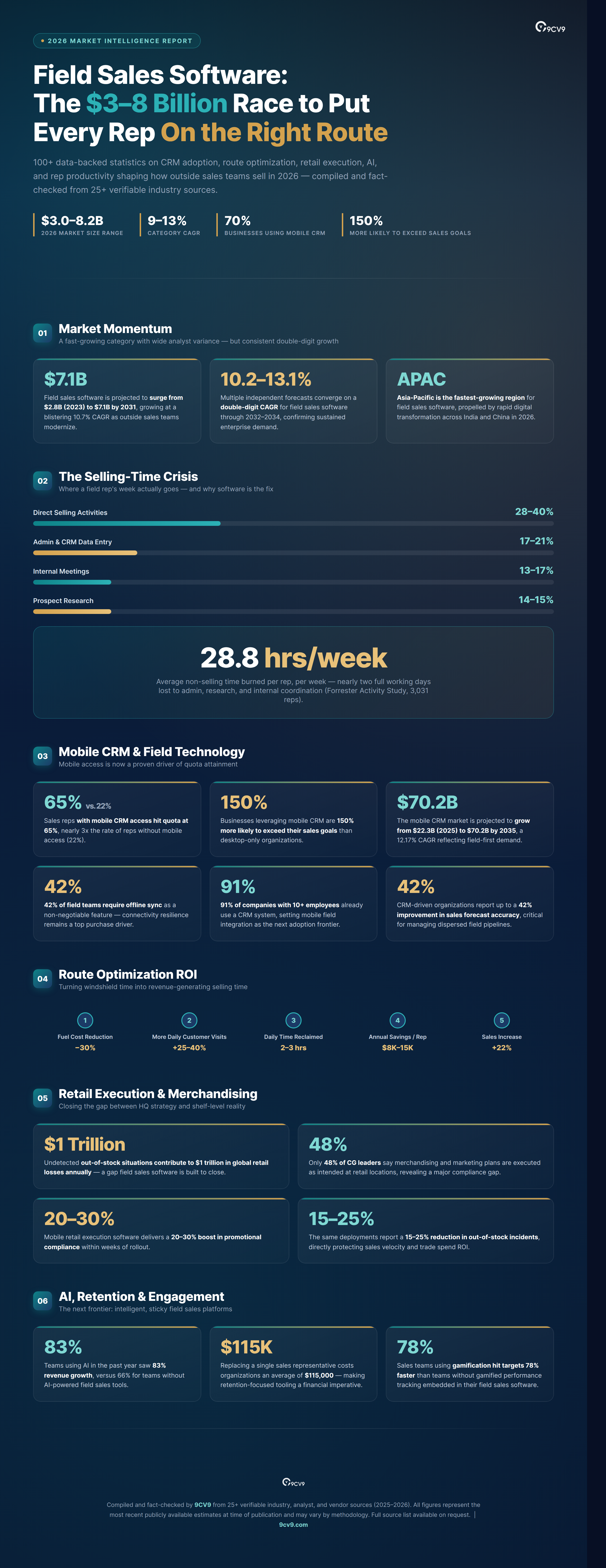
Mobile CRM adoption is also reshaping how outside sales teams operate. Industry findings suggest that 65% of sales representatives with mobile CRM access achieve their annual sales quotas, compared with just 22% of representatives without mobile access. Furthermore, mobile CRM solutions have been associated with productivity improvements of approximately 14.6%, demonstrating the potential benefits of providing sales professionals with immediate access to customer information, sales pipelines, and reporting capabilities while working in the field.
Beyond CRM capabilities, route optimization and territory management technologies are delivering measurable operational benefits. Field sales teams implementing intelligent route planning have reported increases of 25% to 40% in daily customer visits, alongside potential fuel cost reductions of up to 30%. These improvements enable sales representatives to spend less time traveling between appointments and more time building customer relationships, identifying sales opportunities, and closing deals.
Artificial intelligence represents another major trend shaping the field sales software landscape in 2026. AI-powered sales assistants, predictive analytics, automated prospecting, intelligent lead scoring, and personalized customer engagement tools are becoming increasingly important capabilities. Industry research indicates that 54% of sellers have already used AI agents in their workflows, while nearly nine in ten expect to adopt them by 2027. As AI capabilities become more sophisticated, businesses are increasingly evaluating field sales software based on its ability to automate repetitive activities, improve decision-making, and deliver actionable sales intelligence.
However, the rapid expansion of field sales technology also introduces challenges related to software integration, employee adoption, implementation costs, and return on investment. Research suggests that CRM implementation outcomes vary considerably, with some studies estimating that 20% to 70% of implementations fail to meet their original objectives. Consequently, selecting the right field sales software requires businesses to evaluate not only features and pricing but also usability, scalability, integration capabilities, and long-term organizational requirements.
This comprehensive guide explores the top 103 field sales software statistics, data, and trends in 2026, covering global market size, industry growth forecasts, sales representative productivity, mobile CRM adoption, route optimization, retail execution, AI-powered sales automation, employee retention, sales gamification, and evolving B2B buyer behavior.
Whether businesses are evaluating the best field sales software, optimizing existing outside sales operations, developing sales technology strategies, or researching emerging sales management trends, these statistics provide valuable insights into the technologies, challenges, and opportunities shaping the future of field sales management in 2026 and beyond.
Before we venture further into this article, we would like to share who we are and what we do.
About 9cv9
9cv9 is a business tech startup based in Singapore and Asia, with a strong presence all over the world.
With over ten years of startup and business experience, and being highly involved in connecting with thousands of companies and startups, the 9cv9 team has listed some of the top and best companies/tools in this review.
If you like to get your company listed in our top B2B software reviews, check out our world-class 9cv9 Media and PR service and pricing plans here.
Top 103 Field Sales Software Statistics, Data & Trends in 2026
Market Size & Growth
- The global field sales software market is estimated to range between USD 3.0 billion and USD 7.0 billion by 2026, reflecting the wide variance in analyst methodologies covering this category. Field sales software continues to be a critical investment priority for organizations seeking to modernize their outside sales operations in 2026.
- One market analysis values the field sales software sector at USD 2.5 billion in 2024, forecasting growth to USD 5.1 billion by 2033 at a 9.2% CAGR. This steady, sustained growth trajectory underscores the long-term relevance of field sales technology for enterprises worldwide.
- Another report pegs the 2024 field sales software market at USD 3.5 billion, projecting an increase to USD 8.2 billion by 2033 at a 10.3% CAGR. Businesses evaluating field sales software in 2026 can expect a competitive and rapidly expanding vendor landscape.
- A separate forecast estimates the market reaching USD 8.1 billion by 2032 from a 2024 base of USD 3.5 billion, growing at approximately 10.2% CAGR. This growth is driven largely by AI/ML integration for predictive analytics and route optimization.
- Field sales software specifically (distinct from broader field service) is projected to surge from USD 2.8 billion in 2023 to USD 7.1 billion by 2031, at a blistering 10.7% CAGR. Companies that delay modernizing field operations risk falling behind faster-moving competitors.
- The global field sales software market was estimated at USD 1.79 billion in 2025 and is anticipated to reach nearly USD 5.43 billion by 2034, at a CAGR of around 13.12%. This figure represents one of the more conservative baseline estimates in the category.
- North America remains the largest regional market for field sales software due to advanced IT infrastructure and high software adoption rates, while Asia-Pacific is emerging as the fastest-growing region, propelled by digital transformation in India and China. This regional split highlights where vendors are concentrating expansion efforts in 2026.
- Industries such as agriculture, FMCG, healthcare, and retail are the leading adopters leveraging field sales software to enhance efficiency and drive revenue growth in 2026. This cross-industry demand signals broad applicability beyond traditional B2B sales use cases.
Sales Rep Time & Productivity
- Sales reps spend only 40% of their time actively selling, according to Salesforce’s 2026 State of Sales report, meaning 60% goes to non-selling tasks like admin and data entry. This productivity gap is a primary driver behind field sales software adoption in 2026.
- Field reps specifically report a slightly higher 43% selling-time figure, but 21% of the working week — roughly 8 hours per rep — is consumed by administrative tasks alone. Field sales software that automates data capture directly targets this administrative burden.
- Forrester’s Activity Study tracked 3,031 sales reps and found the average rep burns nearly two full days every week on administrative work alone. This finding reinforces why automation features rank as a top purchase criterion for field sales buyers.
- Top-performing sales reps spend 34% of their time selling, compared to 23% for bottom performers — an 11-point productivity gap tied directly to quota attainment. Field sales software helps close this gap by reducing non-revenue-generating busywork.
- A rep spending time on CRM data entry accounts for roughly 17% of the weekly work schedule even under best-in-class enablement programs. This persistent overhead is precisely what mobile, automated field sales tools aim to eliminate.
- According to Salesforce’s 2026 State of Sales report, sellers using AI agents expect a 34% reduction in prospect research time and a 36% reduction in email drafting time. AI-embedded field sales platforms are increasingly marketed around these exact efficiency gains.
- 54% of sellers have already used AI agents in their workflow, and nearly 9 in 10 plan to by 2027. This rapid adoption curve suggests AI capability will soon be a baseline expectation for field sales software buyers.
- Teams that used AI in the past year saw 83% revenue growth, versus 66% for teams that did not use AI. This performance gap is prompting many field sales software vendors to accelerate AI feature rollouts throughout 2026.
- Sellers use an average of 8 different tools to close a single deal, contributing significantly to workflow complexity and reduced productivity. Field sales software that consolidates CRM, routing, and reporting into a single platform directly addresses this tool sprawl.
- 42% of sales reps report feeling overwhelmed by too many tools, and overwhelmed sellers are 45% less likely to attain quota. This statistic strongly supports the business case for all-in-one field sales platforms over fragmented point solutions.
- 84% of sales teams without an all-in-one platform plan to consolidate their technology stack. Field sales software vendors offering unified CRM-plus-routing-plus-reporting suites are well positioned to capture this consolidation wave in 2026.
- Top performers who protect 60%+ of their selling time for high-fit, high-signal accounts generate 2-3x more pipeline than reps who spread their effort evenly. Territory prioritization features within field sales software directly support this tiered selling approach.
Mobile CRM & Field Sales Technology Adoption
- 70% of businesses use mobile CRM systems, and mobile CRM usage can improve productivity by 14.6%. This widespread adoption reflects the mobile-first reality of modern field sales operations.
- Businesses leveraging mobile CRM are 150% more likely to exceed their sales goals compared to those relying on desktop-only systems. This dramatic performance gap makes mobile capability a non-negotiable feature for field sales software in 2026.
- 65% of sales reps with mobile access to their CRM system achieved their annual sales quota, compared to just 22% of those without mobile access. This statistic alone justifies the premium many organizations place on mobile-first field sales tools.
- The mobile CRM market was valued at USD 22.27 billion in 2025 and is projected to reach USD 70.22 billion by 2035, growing at a CAGR of 12.17%. This robust growth trajectory signals continued vendor investment in mobile field sales capabilities.
- 91% of teams with 11 or more employees already use a CRM system, and nearly half of all sales reps now use mobile-first CRM apps to update opportunities on the go. Field sales software increasingly needs to integrate seamlessly with this near-universal CRM baseline.
- 42% of field teams require offline sync as a non-negotiable feature when evaluating mobile CRM and field sales tools. Reliable offline functionality remains a critical differentiator for vendors serving reps in low-connectivity territories.
- 31% of buyers list offline sync specifically as a purchase criterion when selecting field sales software. This underscores connectivity resilience as a top-tier evaluation factor alongside pricing and integrations.
- 49% of new mobile CRM implementations now include AI-powered suggestion engines, reflecting the rapid mainstreaming of AI-assisted field sales workflows. Buyers evaluating field sales software in 2026 should expect AI features as a standard inclusion rather than a premium add-on.
- Integration complexity is cited by 38% of respondents as the second most common barrier to successful mobile CRM and field sales software adoption. Vendors offering pre-built integrations with popular CRMs hold a competitive advantage in reducing this friction.
- The global CRM market is projected to reach approximately USD 126.17 billion in 2026, growing toward USD 321 billion by 2034 at roughly a 12% CAGR. Field sales software represents a fast-growing, mobile-centric subsegment within this expanding overall CRM ecosystem.
- 91% of businesses say CRM implementation reduced their customer acquisition costs (CAC), with 49% reporting an 11–20% decrease. Field sales-specific CRM extensions that streamline lead capture in the field contribute directly to this CAC reduction.
- CRM adoption improves sales forecast accuracy by up to 42%, a critical benefit for field sales organizations managing dispersed, hard-to-track outside sales pipelines. Real-time field data capture is central to achieving this forecasting improvement.
- Businesses implementing CRM see an average 29% increase in sales and a 34% improvement in sales productivity. These gains are frequently cited by field sales software vendors as core value propositions in their marketing materials.
- CRM delivers an average ROI of $8.71 for every dollar spent, according to widely cited (though aging) Nucleus Research benchmarks; more recent analysis suggests a more conservative $3.10 return per dollar as the market matures. Buyers should treat ROI claims as a range rather than a single fixed figure.
- 87% of CRM systems today are cloud-based, reflecting the industry-wide shift toward remote access and scalability that underpins modern field sales software delivery. Cloud architecture is now considered baseline infrastructure rather than a differentiating feature.
- Only 50% of businesses with fewer than 10 employees use a CRM system, compared to 91% of companies with 10+ employees. This adoption gap represents a significant untapped opportunity for field sales software vendors targeting small sales teams.
- The average CRM user adoption rate among sales professionals sits at 72%, meaning 28% of reps with CRM access still aren’t using it consistently. Field sales software with intuitive mobile interfaces aims to close this persistent adoption gap.
- 32% of sales reps spend more than 1 hour daily on manual data entry within their CRM — equating to more than 250 hours per year per rep that could otherwise be spent selling. Automated data capture is among the most valuable features field sales software can offer.
- 20–70% of CRM implementations fail to meet their planned objectives, with poor user adoption cited as the leading cause, followed by lack of integration (17%) and complexity of use (7%). This wide failure range highlights the importance of choosing user-friendly, field-tested software.
- 45% of CRM buyers rank automation capabilities as their most important feature requirement, while 36% prioritize integration with other tools. These two criteria consistently top evaluation checklists for field sales software buyers in 2026.
- 20% of CRM buyers specifically require mobile CRM access as a purchase criterion, reflecting the fundamental expectation that field sales tools work seamlessly on smartphones and tablets. This baseline expectation shapes nearly every modern field sales software roadmap.
Route Optimization, Territory & Travel Efficiency
- Route optimization software typically delivers a 30% reduction in fuel costs for field sales teams through smarter, algorithm-driven scheduling. This is among the most commonly cited hard-dollar savings associated with adopting field sales software.
- Field sales teams using route optimization report a 25–40% increase in daily customer visits through the time savings generated by efficient scheduling. More visits per day directly translate into greater revenue-generating opportunities for outside sales teams.
- Route optimization software delivers 2–3 hours of daily time savings per representative, freeing up substantial capacity for higher-value selling activities. This reclaimed time represents one of the clearest ROI drivers for route-planning features in field sales software.
- Teams averaging 500 miles per week per representative can save approximately $8,400 annually per person on fuel alone through optimized routing, with total transportation cost reductions exceeding $15,000 per representative when combined with other efficiency gains.
- Unoptimized manual routes increase travel time by 28–35% and reduce customer face-time by 28% compared to algorithmically optimized routes. This stark contrast illustrates the tangible cost of relying on manual route planning in 2026.
- Customer satisfaction scores increase by 22% on average when field sales teams implement consistent, optimized visit schedules with accurate arrival time communications. Reliability built through route optimization directly strengthens customer relationships.
- Field service and field sales operations moving from manual, dispatcher-built routes to automated route optimization typically see drive time fall 15% to 30%. This drive-time reduction is one of the most measurable operational improvements field sales software delivers.
- Fuel consumption tracks closely with drive-time reductions, with reported savings of 10% to 25% depending on territory geometry and stop density. Sparse rural territories tend to see the largest proportional fuel savings from route optimization.
- Sales route optimization software has been shown to increase sales by up to 22% by enabling reps to fit more meetings into each working day. This direct revenue linkage makes route optimization one of the highest-ROI features within field sales software suites.
- HubSpot-integrated route optimization tools have saved customers up to 8 hours a week and cut drive time by 20%, granting sales reps significantly more time to work leads and convert customers. CRM-integrated routing continues to be a top differentiator among leading field sales platforms.
- Optimized routing eliminates up to 25% of harsh stop-and-go driving patterns, reducing vehicle wear, maintenance costs, and driver fatigue for field sales teams operating company or personal vehicles. Fleet-adjacent savings compound the direct fuel benefits of route optimization.
Retail Execution, Merchandising & In-Store Compliance
- Only 48% of consumer goods (CG) leaders say their merchandising and marketing plans are executed as intended at retail locations, revealing a substantial gap between headquarters strategy and shelf-level reality. Field sales and retail execution software is specifically designed to close this compliance gap.
- Undetected out-of-stock situations contribute to an estimated $1 trillion in global retail losses annually. Field sales software with real-time inventory visibility features directly targets this massive, largely preventable revenue leakage.
- Brands using mobile retail execution software see a 20–30% boost in promotional compliance, ensuring campaigns are actually implemented as planned at the shelf level. This compliance uplift is among the most cited benefits of field-sales-integrated retail execution tools.
- The same mobile retail execution deployments report a 15–25% reduction in out-of-stock incidents, directly protecting sales velocity and trade spend ROI for CPG and distribution brands. These gains are often measurable within just a few weeks of rollout.
- 39% of retailers say they are actively investing in improving the tools and technologies employees use for day-to-day fieldwork, reflecting growing recognition that better software drives faster, more consistent execution. This investment trend supports continued field sales software market expansion.
- Approximately 64% of retailers now prioritize digital store monitoring tools, while 58% focus specifically on real-time merchandising analytics. These priorities align closely with the core capabilities offered by modern field sales and retail execution platforms.
- Around 52% of organizations emphasize field workforce productivity improvement through advanced retail execution and field sales software solutions. Workforce productivity remains a top strategic priority driving software investment decisions in 2026.
- Nearly 69% of U.S. retail enterprises deploy retail execution software to enhance store compliance monitoring and promotional execution. This high domestic adoption rate reflects the maturity of the retail execution segment within field sales software.
- Around 63% of consumer goods companies rely on retail analytics platforms to improve shelf visibility and merchandising accuracy. Analytics-driven decision-making is becoming a baseline expectation rather than a premium capability.
- 57% of retail organizations report higher operational efficiency after adopting mobile-based retail execution tools, while 49% of field sales teams use automated store reporting features to evaluate performance. Automation continues to be the primary efficiency lever across retail execution deployments.
- The retail execution software market itself was valued at USD 304.08 million in 2025, projected to reach USD 589.84 million by 2035 at a 6.85% CAGR — a distinct but closely related category to broader field sales software. This steady growth trajectory reflects sustained enterprise demand.
- Large enterprises account for approximately 62–65% of total retail execution software revenue share in 2026, driven by the complexity of managing vast, multi-regional retail networks. SMB-focused vendors, however, are increasingly targeting this underserved segment with simplified offerings.
AI Adoption in Field Sales
- Gartner predicts that B2B sales organizations using embedded generative AI will cut prospecting and meeting-prep time by more than 50% by 2026. Field sales software increasingly embeds these AI capabilities directly into mobile rep workflows.
- AI-powered CRM suggestions are increasingly used to guide field reps toward next-best-action recommendations during store or client visits. This real-time guidance capability is rapidly becoming a differentiating feature among premium field sales platforms.
- Predictive AI within CRM and field sales platforms can identify at-risk or churn-prone accounts with up to 90% accuracy, enabling proactive retention efforts by outside sales teams. This predictive capability represents a significant leap beyond traditional reactive account management.
- 83% of companies are already using AI features within their CRM for automation and personalized customer interactions, with the broader AI-in-CRM market projected to reach USD 48.4 billion by 2033. Field sales software vendors are racing to integrate comparable AI capabilities into mobile applications.
- 81% of sales leaders believe AI can help reduce time spent on manual tasks, while 84% of salespeople who currently use AI say it has helped boost sales through improved and accelerated customer interactions. This broad sentiment underpins accelerating AI feature adoption within field sales tools.
- AI-assisted sales teams see 30% productivity gains and 68% shorter deal cycles compared to teams without AI assistance, according to recent industry analysis. These substantial gains are prompting field sales software buyers to prioritize AI roadmaps during vendor evaluation.
- Sellers who partner effectively with AI tools are 3.7x more likely to meet quota than those who do not, reinforcing the direct link between AI-enabled field sales software and individual rep performance. This statistic is increasingly cited in field sales software sales enablement materials.
- Gartner’s November 2025 forecast predicts that by 2028, AI agents will outnumber human sellers 10:1, though fewer than 40% of sellers currently report those agents meaningfully improving their productivity. This gap between deployment and measured impact highlights the importance of thoughtful AI integration design.
Sales Team Turnover, Retention & Cost
- The average annual turnover rate for sales positions is approximately 35%, nearly three times higher than the average 13% turnover rate seen across all industries. Field sales software that improves rep productivity and job satisfaction can play a meaningful role in reducing this elevated churn.
- Replacing a sales representative costs organizations an average of $115,000 when accounting for recruitment, training, and lost sales opportunities during the transition period. This substantial cost makes retention-focused tooling, including field sales software, a strategic financial priority.
- 45% of B2B sales organizations experience turnover rates exceeding 30% annually, according to recent industry research. This widespread churn underscores the operational disruption field sales teams face without adequate support systems.
- Losing 25% or more of a sales team’s sellers per quarter is common, and just a 5% increase in attrition can raise overall selling costs by 4–6%. Field sales software that reduces rep frustration through better tools can meaningfully offset this cost escalation.
- New sales hires typically take an average of 7 months to reach full productivity, representing nearly 210 days of onboarding, training, and shadowing investment before consistently hitting quota. Intuitive field sales software can shorten this ramp period considerably.
- Average sales rep tenure sits at approximately 18 months, meaning organizations often begin recovering their ramp-up investment just before reps depart. This tight window increases the value of tools that accelerate time-to-productivity for new field reps.
- 33% of sales reps who intend to leave their position cite a lack of access to the tools and technology needed to do their jobs successfully as a contributing factor. This statistic directly links field sales software quality to organizational retention outcomes.
- Onboarding data suggests it takes 3 months of training before a new sales rep can meaningfully interact with buyers, 9 months to reach baseline competency, and a full 15 months to become a top performer. Field sales software with built-in coaching and guided workflows can help compress this extended ramp timeline.
Sales Gamification & Rep Engagement
- The global gamification market was valued at USD 19.42 billion in 2025 and is projected to reach USD 92.5 billion by 2030, growing at approximately 26% CAGR. Gamified performance tracking is increasingly embedded within field sales software as a rep engagement tool.
- More than 70% of Global 2000 companies already deploy gamified solutions across training, sales, and customer engagement functions. This high enterprise adoption rate signals gamification’s transition from novelty to standard sales management practice.
- US sales teams report a 40% productivity increase through gamified workflows integrated into their sales technology stack. Leaderboards, streaks, and milestone tracking embedded in field sales software directly support this measurable productivity uplift.
- Sales teams using gamification hit performance targets 78% faster than teams without gamified tracking mechanisms, according to recent market research. This acceleration effect makes gamification a compelling add-on feature within field sales software platforms.
- 89% of employees report that gamification makes them more productive at work, reinforcing the psychological effectiveness of points, badges, and leaderboard mechanics within daily field sales workflows. Rep engagement remains a top concern for sales leaders managing dispersed outside teams.
- A well-known hotel chain achieved a 712% uplift in sales through human-focused gamification design, illustrating the outsized potential impact when gamification is implemented thoughtfully rather than superficially. Field sales software vendors increasingly cite similar case studies to support gamification feature investment.
Sales Software Reviews & Buyer Behavior (Capterra & Peer Platforms)
- Capterra has verified over 2.5 million reviews across its software directory, giving field sales software buyers an extensive, authenticated base of peer feedback to inform purchase decisions in 2026. Verified review volume continues to be a key trust signal for enterprise software buyers.
- Leading field sales software platforms on Capterra and G2 regularly achieve review scores in the 4.3 to 5.0 range out of 5, reflecting strong overall user satisfaction across the category. High review consistency across multiple platforms is often used by buyers as a shortlist filter.
- Field sales software buyers researching on Capterra place strong emphasis on route optimization, CRM integration, mobile accessibility, and territory management as core evaluation criteria before shortlisting vendors. These four capabilities consistently appear as decisive purchase factors.
- Bolt-on field sales tools that integrate with an existing CRM (such as mapping and canvassing add-ons) remain popular among organizations already invested in platforms like Salesforce, while all-in-one field sales CRMs are favored by teams seeking a single unified system. This split reflects two distinct buyer personas within the category.
- Software providers on Capterra pay for sponsored placement, but the platform lists all qualifying field sales software vendors regardless of payment status, helping ensure buyers see a comprehensive, unbiased set of options. Transparency in listing methodology remains an important trust factor for enterprise software researchers.
Additional Field Sales & Buyer Behavior Trends
- 9 out of 10 companies plan to maintain hybrid sales models that combine field visits with virtual engagement, according to McKinsey research. Field sales software increasingly needs to support seamless handoffs between in-person and remote selling activities.
- Companies running hybrid sales models see up to 50% higher revenue growth than single-channel teams relying exclusively on either in-person or remote selling. This finding reinforces the strategic value of field sales software that supports omnichannel selling workflows.
- 75% of European and 74% of North American sales teams say virtual meetings achieve the same customer satisfaction as in-person meetings for standard accounts. This shift in buyer preference is prompting field sales software vendors to add virtual meeting and video capabilities.
- 75% of B2B buyers say they now take longer to make purchase decisions than they did two years ago, pushing outside sales teams toward more frequent, better-coordinated touchpoints. Field sales software with automated follow-up reminders helps reps manage these extended sales cycles.
- 22 stakeholders are now involved in the average B2B buying group, a dramatic increase from prior estimates of 7–10 stakeholders. This expanded buying committee complexity increases the need for organized, CRM-backed relationship tracking within field sales software.
- 80% of sales require 5 or more follow-ups after initial contact, yet 44% of reps quit after just one attempt, and only 2% of sales close on the first touch. Automated follow-up sequencing within field sales software directly addresses this persistence gap.
- 42% of sales reps cite poor lead quality as a top complaint, while only 5% rate inbound leads as very high quality. Field sales software with integrated lead scoring helps reps prioritize higher-probability accounts during territory planning.
- Personalized outreach generates a 32% higher response rate than generic communications, reinforcing the value of CRM-stored customer context that field sales software makes accessible to reps in real time. Contextual, data-backed outreach continues to outperform generic scripts.
- 69% of B2B buyers still accepted a cold call from a new provider in the past year, demonstrating that traditional field and phone-based outreach remains viable when properly targeted. Field sales software that combines call logging with account intelligence supports this continued outbound relevance.
- The cost to dispatch a field representative ranges from $250 in urban environments to as much as $2,500 for rural or multi-day territories, according to Service Council research. Route and territory optimization within field sales software directly targets reducing this dispatch cost variance.
- A 5% increase in overall route efficiency can yield a mid-sized field sales fleet more than $400,000 per year in combined savings, according to American Trucking Association-adjacent research applied to field operations. This substantial figure illustrates the compounding financial impact of even modest routing improvements.
- Field sales software adoption is increasingly concentrated among manufacturing, pharmaceuticals, medical devices, financial services, and wholesale distribution industries — sectors reliant on direct, face-to-face interaction for complex, high-value sales. These verticals represent the core buyer base driving category growth in 2026.
Conclusion
The top 103 field sales software statistics, data, and trends in 2026 highlight an industry experiencing rapid technological advancement, increasing digital adoption, and growing demand for intelligent sales management solutions. As businesses prioritize operational efficiency, customer engagement, and revenue growth, field sales software is evolving from a basic sales tracking tool into a comprehensive platform for managing outside sales operations, optimizing territories, automating workflows, and improving sales team performance.
With global field sales software market estimates ranging from USD 3 billion to USD 7 billion in 2026 and some industry forecasts projecting market values exceeding USD 8 billion by 2033, the sector presents significant opportunities for software providers, enterprises, and growing sales organizations. Increasing investments in mobile CRM systems, artificial intelligence, predictive analytics, and cloud-based sales management platforms are expected to support continued market expansion across North America, Asia-Pacific, Europe, and other emerging markets.
One of the most important findings from the field sales software statistics is the substantial opportunity to improve sales representative productivity. Research indicates that sales professionals spend approximately 40% of their working time actively selling, leaving considerable room for improvement through automation and streamlined administrative processes. By implementing modern field sales management software, businesses can reduce repetitive tasks, simplify customer data management, and enable representatives to dedicate more time to building relationships and generating revenue.
Mobile CRM adoption and route optimization are particularly important drivers of field sales efficiency. Industry data suggests that 65% of sales representatives with mobile CRM access achieve their annual sales quotas, compared with 22% of those without mobile access. Meanwhile, route optimization technologies have been associated with increases of 25% to 40% in daily customer visits and potential fuel cost reductions of up to 30%. Although actual results depend on implementation quality and operational conditions, these findings demonstrate the potential value of integrating mobile accessibility, intelligent scheduling, and territory management into everyday sales workflows.
Artificial intelligence is also becoming a defining feature of the field sales software market. With 54% of sellers already reporting experience using AI agents and nearly nine in ten planning to adopt them by 2027, AI-powered sales automation is moving toward mainstream adoption. Technologies such as predictive lead scoring, automated customer follow-ups, intelligent sales forecasting, and personalized recommendations are creating opportunities for organizations to improve decision-making and strengthen customer relationships. However, successful AI adoption requires reliable data, effective integration, and clear performance measurement rather than simply adding more software features.
Beyond productivity and automation, the statistics reveal the growing importance of employee engagement, sales team retention, and technology usability. High sales employee turnover, lengthy onboarding periods, and inconsistent CRM adoption continue to create challenges for organizations managing distributed salesforces. Field sales software platforms that incorporate intuitive mobile interfaces, automated reporting, guided workflows, performance analytics, and gamification features may help businesses address these challenges while supporting more consistent sales execution.
Nevertheless, investing in field sales software does not automatically guarantee stronger sales performance or a positive return on investment. Research indicating that 20% to 70% of CRM implementations fail to meet their planned objectives emphasizes the importance of careful software selection, employee training, system integration, and ongoing performance evaluation. Organizations should assess field sales software based on their specific operational requirements, industry characteristics, workforce size, customer distribution, and long-term business objectives.
Looking ahead, the future of field sales software will increasingly revolve around AI-driven automation, mobile-first CRM platforms, real-time sales intelligence, intelligent route optimization, and integrated customer engagement technologies. Businesses that successfully combine these capabilities with effective sales strategies and strong organizational adoption will be better positioned to reduce operational costs, improve sales productivity, strengthen customer relationships, and respond to changing market conditions.
Ultimately, the 103 field sales software statistics and trends for 2026 demonstrate that digital transformation is becoming an increasingly important competitive factor in modern field sales management. Whether organizations operate in manufacturing, pharmaceuticals, retail, consumer goods, financial services, or wholesale distribution, investing in appropriate field sales technologies can help create more efficient, data-driven, and scalable sales operations.
As the industry continues to evolve, businesses that prioritize practical automation, seamless technology integration, employee enablement, and measurable business outcomes will be better equipped to capitalize on emerging opportunities and build sustainable competitive advantages in 2026 and beyond.
If you find this article useful, why not share it with your hiring manager and C-level suite friends and also leave a nice comment below?
We, at the 9cv9 Research Team, strive to bring the latest and most meaningful data, guides, and statistics to your doorstep.
To get access to top-quality guides, click over to 9cv9 Blog.
To hire top talents using our modern AI-powered recruitment agency, find out more at 9cv9 Modern AI-Powered Recruitment Agency.
People Also Ask
What is field sales software?
Field sales software is a digital platform that helps businesses manage outside sales teams, customer visits, sales territories, route planning, and performance tracking. It typically includes mobile CRM, sales automation, reporting, and analytics capabilities.
What is the global field sales software market size in 2026?
The global field sales software market is estimated to be worth USD 3 billion to USD 7 billion in 2026, depending on research methodologies and market definitions. Industry forecasts indicate continued growth through 2033 and beyond.
What is the projected growth rate of the field sales software market?
Industry forecasts estimate compound annual growth rates ranging from approximately 9.2% to 13.12%. Growth is supported by increasing adoption of mobile CRM, AI-powered sales automation, cloud technology, and route optimization.
What are the biggest field sales software trends in 2026?
Major trends include AI-powered sales assistants, mobile-first CRM platforms, automated route optimization, predictive sales analytics, real-time performance monitoring, territory management, and integrated sales automation solutions.
How does field sales software improve sales productivity?
Field sales software improves productivity by automating administrative tasks, simplifying customer data management, optimizing travel routes, and providing real-time sales information. These capabilities allow representatives to dedicate more time to selling.
How much time do sales representatives spend actively selling?
Industry research indicates that sales representatives spend approximately 40% of their working time actively selling. The remaining 60% involves administrative responsibilities, prospect research, data entry, meetings, and other non-selling activities.
What percentage of sales teams use mobile CRM software?
Industry estimates suggest that approximately 70% of businesses use mobile CRM systems. Mobile accessibility allows sales representatives to update customer records, manage opportunities, and access important information while working outside the office.
How does mobile CRM software affect sales quota attainment?
Research indicates that 65% of sales representatives with mobile CRM access achieve their annual sales quotas, compared with 22% of representatives without mobile access. This association highlights the potential importance of mobile sales technology.
What is the mobile CRM software market forecast for 2035?
The global mobile CRM market is projected to increase from USD 22.27 billion in 2025 to approximately USD 70.22 billion by 2035, representing a compound annual growth rate of 12.17%.
How does route optimization software benefit field sales teams?
Route optimization software helps sales representatives plan efficient customer visits, reduce unnecessary travel, and improve territory coverage. Reported benefits include lower transportation expenses, additional customer appointments, and improved scheduling.
How much can route optimization software reduce fuel costs?
Industry estimates suggest that route optimization software can reduce fuel costs by up to 30%. Actual savings depend on territory size, travel distances, customer locations, vehicle efficiency, and existing route planning practices.
How many additional customer visits can field sales software generate?
Field sales teams implementing route optimization have reported increases of 25% to 40% in daily customer visits. Improved scheduling and reduced travel time allow representatives to accommodate additional appointments.
How much time can sales representatives save through route optimization?
Route optimization software can potentially save field sales representatives two to three hours daily by reducing unnecessary travel and improving appointment scheduling. Actual savings vary by territory and workload.
How is artificial intelligence transforming field sales software in 2026?
Artificial intelligence is transforming field sales software through predictive lead scoring, automated prospect research, personalized recommendations, intelligent forecasting, and AI-powered customer engagement tools.
What percentage of sales professionals use AI agents in 2026?
Salesforce research cited in the industry data indicates that 54% of sellers have used AI agents in their workflows. Nearly nine in ten sellers plan to adopt AI agents by 2027, suggesting growing interest in AI-powered sales automation.
Can AI-powered field sales software increase revenue?
AI-powered field sales software can support revenue growth through improved lead prioritization, automated follow-ups, and faster decision-making. Research associates AI adoption with stronger sales outcomes, although results vary across organizations.
What are the most important features of field sales software?
Important features include mobile CRM, route optimization, territory management, customer visit tracking, sales automation, offline accessibility, GPS integration, performance dashboards, reporting, and AI-powered analytics.
Why is offline functionality important in field sales software?
Offline functionality allows sales representatives to access customer information, record visits, and update sales activities without reliable internet connectivity. Data can synchronize when connectivity returns, supporting uninterrupted field operations.
What percentage of field sales teams require offline CRM functionality?
Industry findings suggest that 42% of field teams consider offline synchronization essential when evaluating mobile CRM solutions. Another reported statistic indicates that 31% of buyers specifically identify offline access as a purchasing criterion.
How does field sales software improve territory management?
Field sales software improves territory management through geographic customer mapping, intelligent route planning, account prioritization, workload distribution, and real-time performance tracking across assigned sales regions.
What industries use field sales management software the most?
Major users include manufacturing, pharmaceuticals, healthcare, medical devices, retail, consumer goods, agriculture, financial services, and wholesale distribution. These industries frequently depend on geographically distributed sales representatives.
How does field sales software support retail execution?
Field sales software supports retail execution through store visit tracking, inventory monitoring, merchandising audits, promotional compliance reporting, and real-time performance analytics. These features help brands improve consistency across retail locations.
Can field sales software reduce out-of-stock incidents?
Industry data suggests that mobile retail execution software can reduce out-of-stock incidents by approximately 15% to 25%. Inventory visibility, automated reporting, and timely store inspections help identify availability problems earlier.
What is the average ROI of CRM and field sales software?
A widely cited historical CRM benchmark estimates a return of USD 8.71 for every dollar invested, while another analysis suggests approximately USD 3.10. These figures are general CRM benchmarks, not guaranteed field sales software returns.
What are the biggest challenges of implementing field sales software?
Common challenges include software integration complexity, employee resistance, inconsistent CRM adoption, implementation costs, insufficient training, poor data quality, and difficulty demonstrating measurable return on investment.
What percentage of CRM implementations fail to meet their objectives?
Industry estimates suggest that 20% to 70% of CRM implementations fail to achieve their planned objectives. Poor user adoption, integration difficulties, and software complexity are frequently identified as contributing factors.
How does field sales software help reduce employee turnover?
Field sales software may improve employee satisfaction by reducing administrative workloads, simplifying daily activities, and providing better performance visibility. These improvements can help address workplace frustrations associated with sales turnover.
What is sales gamification in field sales software?
Sales gamification introduces leaderboards, performance milestones, points, badges, and achievement tracking into sales workflows. These features encourage engagement, recognize accomplishments, and motivate representatives toward performance goals.
How does field sales software support hybrid B2B sales models?
Field sales software supports hybrid selling by combining in-person customer visits with virtual meetings, digital communication, CRM tracking, and automated follow-ups. This helps sales teams coordinate customer engagement across multiple channels.
What is the future of field sales software beyond 2026?
The future of field sales software will likely emphasize AI agents, predictive analytics, intelligent territory planning, mobile-first CRM, automated customer engagement, and integrated sales platforms that improve efficiency and support data-driven decisions.
Sources
- Salesforce
- Forrester
- SPOTIO
- Salesmotion
- HDIN Research
- Business Research Insights
- Verified Market Reports
- Market Research Intellect
- Verified Market Research
- Finances Online
- CRM.org
- SLTCreative
- Wave Connect
- Danetsoft
- Precedence Research
- Upper Route Planner
- Verizon Connect
- Timefold
- HubSpot
- Axonify
- SimplyDepo
- Global Growth Insights
- Repsly
- Storeforce
- Gartner
- McKinsey
- Everstage
- Prospeo
- LSA Global
- Nucleus Research
- Capterra
- G2
- Service Council