

























Key Takeaways
- Festival Management Software Market Growth: The global festival management software market is projected to reach USD 982.69 million in 2026 and USD 2.14 billion by 2032, growing at a CAGR of 13.69%, driven by increasing digital transformation and cloud-based solutions.
- AI, Digital Ticketing, and RFID Adoption: Over 68% of global ticket purchases occur through mobile channels, while RFID cashless payment systems can increase attendee spending by 15–30%. AI-powered automation is also transforming festival planning, operations, and attendee engagement.
- Emerging Festival Technology Trends: Sustainability, cybersecurity, mobile event apps, and real-time analytics are shaping the future of festival management software in 2026, helping organizers improve operational efficiency, enhance attendee experiences, and maximize revenue opportunities.
Festival management software helps organizers manage ticketing, payments, attendee engagement, and event operations. In 2026, the global market is valued at approximately USD 982.69 million and is projected to reach USD 2.14 billion by 2032, growing at a 13.69% CAGR, driven by AI adoption, RFID technology, mobile ticketing, and cloud-based solutions.
The global festival industry is undergoing a significant digital transformation as event organizers increasingly adopt advanced technologies to streamline operations, enhance attendee experiences, and maximize revenue. From AI-powered event planning and cloud-based ticketing platforms to RFID cashless payments and real-time crowd management, festival management software has become an essential component of organizing successful music festivals, cultural celebrations, and large-scale entertainment events in 2026.
Also, read our article on the Top 10 Festival Management Software To Know.
The growing demand for integrated festival technology solutions is reflected in the industry’s impressive market performance. According to industry research, the global festival management software market is estimated to reach USD 982.69 million in 2026, with projections indicating growth to approximately USD 2.14 billion by 2032, representing a compound annual growth rate (CAGR) of 13.69%. Meanwhile, the broader event management software market was valued at approximately USD 8.40 billion in 2024, highlighting the substantial opportunities available to technology providers, festival organizers, and event management companies.
One of the most significant festival management software trends in 2026 is the rapid adoption of digital ticketing, mobile applications, and contactless payment technologies. Industry data suggests that more than 68% of global ticket purchases occur through mobile channels, while 86% of ticket buyers prefer digital ticket delivery through mobile applications or QR codes. Furthermore, festivals implementing RFID and NFC cashless payment systems have reported increases of 15% to 30% in average attendee spending, demonstrating how technology can improve operational efficiency while creating additional revenue opportunities.
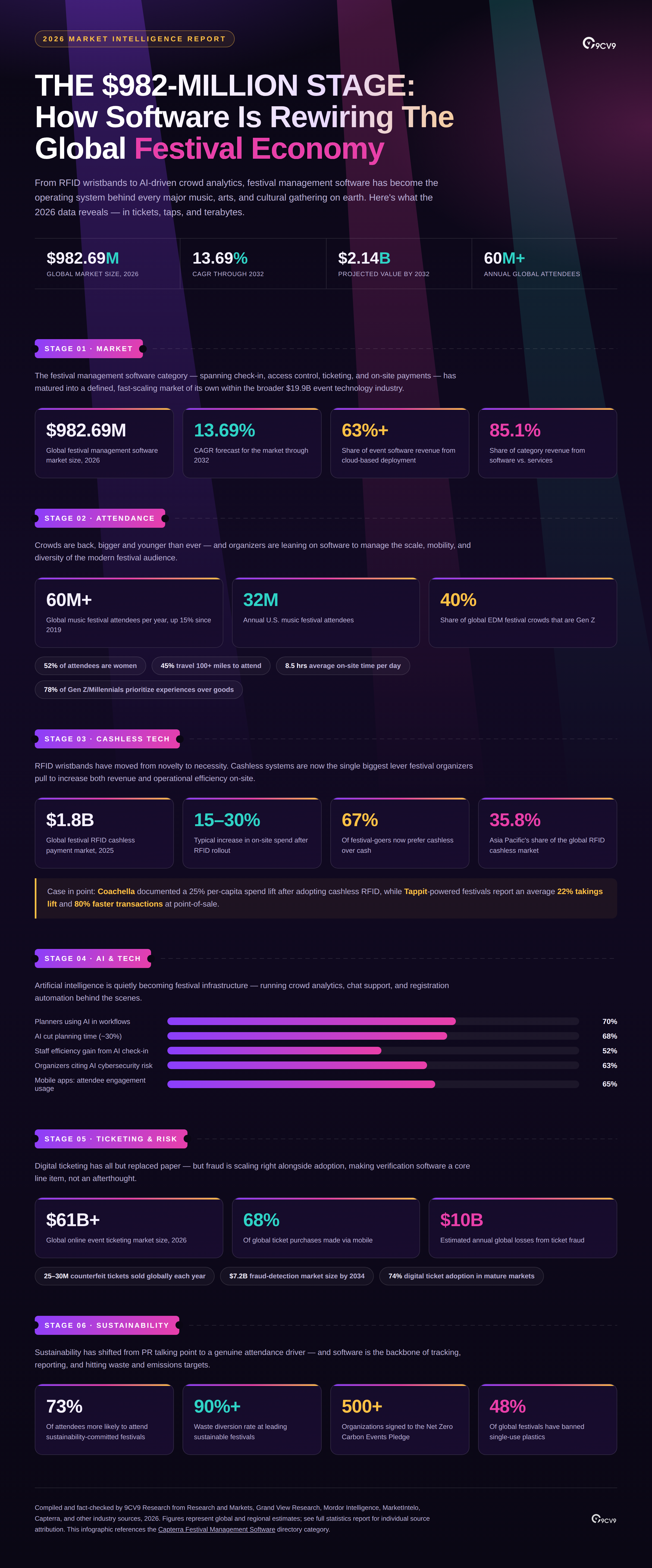
Artificial intelligence is also reshaping how festivals are planned, marketed, and managed. Approximately 70% of meetings and events professionals report using AI tools in their planning workflows, with applications ranging from automated customer support and predictive attendance analytics to personalized event recommendations and logistics optimization. As festival organizers face increasing pressure to deliver seamless experiences while controlling operational expenses, AI-driven festival management platforms are becoming increasingly relevant to their technology strategies.
Beyond automation and revenue optimization, sustainability, cybersecurity, and attendee engagement are emerging as critical priorities. Research indicates that 73% of event attendees are more likely to attend festivals organized by companies demonstrating visible sustainability commitments. At the same time, growing concerns about ticket fraud, data protection, and digital infrastructure security are encouraging organizers to invest in secure ticketing platforms, identity verification systems, and integrated event management solutions.
Regional developments are further accelerating the evolution of the festival software industry. North America remains a major market for event management technologies, while Asia Pacific is positioned for substantial growth as festival attendance, digital payment adoption, and demand for technology-enabled entertainment experiences continue to expand. Cloud-based festival management software is also gaining traction, offering organizers greater flexibility, scalability, and access to real-time operational insights.
For festival organizers, event management professionals, software developers, technology vendors, and investors, understanding the latest festival management software statistics, market size, growth forecasts, adoption rates, and industry trends is essential for making informed business decisions and identifying emerging opportunities.
This comprehensive guide explores the top 105 festival management software statistics, data, and trends in 2026, covering market growth, online ticketing, RFID technology, cashless payments, festival attendance, artificial intelligence, sustainability initiatives, mobile attendee engagement, cybersecurity, software adoption, and regional market developments.
By examining these key statistics and industry insights, businesses can better understand how festival management technology is evolving, which innovations are influencing purchasing decisions, and what opportunities may shape the future of the global festival management software market in 2026 and beyond.
Before we venture further into this article, we would like to share who we are and what we do.
About 9cv9
9cv9 is a business tech startup based in Singapore and Asia, with a strong presence all over the world.
With over ten years of startup and business experience, and being highly involved in connecting with thousands of companies and startups, the 9cv9 team has listed some of the top and best companies/tools in this review.
If you like to get your company listed in our top B2B software reviews, check out our world-class 9cv9 Media and PR service and pricing plans here.
Top 105 Festival Management Software Statistics, Data & Trends in 2026
Market Size & Growth
1. The global festival management software market is valued at USD 982.69 million in 2026, underscoring how digitized crowd, ticketing, and access-control tools have become a defined technology category in their own right.
2. Analysts project the festival management software market will reach USD 2.14 billion by 2032, reflecting sustained investor confidence in event-tech infrastructure over the next six years.
3. The festival management software market is expanding at a 13.69% CAGR through 2032, a pace that outstrips many broader enterprise software categories.
4. The wider event management software market was estimated at USD 8.40 billion in 2024, showing the scale of the parent category that festival tools sit within.
5. That broader event software market is forecast to hit USD 17.33 billion by 2030 at an 11.6% European CAGR from 2025–2030, signaling especially strong momentum in the EU festival circuit.
6. North America commands the largest single share of the global event management software market at over 45% in 2024, driven by dense festival, concert, and conference calendars.
7. Cloud-based deployment already holds over 63% share of the event management software market, confirming that on-premises festival systems are now the exception rather than the rule.
8. Large enterprise organizers account for over 53% of total event software demand, showing that big festival brands are the earliest and heaviest technology adopters.
9. One 2026-focused forecast puts the global event management software market at USD 19.9 billion in 2026, growing to USD 96.5 billion by 2036 at a 17.1% CAGR — among the most bullish outlooks in the sector.
10. Cloud-based applications are expected to hold a dominant 55.2% share of event software deployment in 2026, reinforcing SaaS as the default model for festival organizers.
11. The event management software segment tied to registration, ticketing, and check-in tools sees software itself capture 85.1% of total 2026 market share, versus services.
12. Analytics and reporting modules are the fastest-growing software category in event tech, posting a 10.22% CAGR through 2031 as festivals chase measurable ROI.
Ticketing & Digital Payments
13. The global online event ticketing market is valued at USD 61.08–88.38 billion in 2026, depending on methodology, making ticketing the single largest revenue pool tied to festival software.
14. Over 68% of global ticket purchases now happen via mobile channels, cementing mobile-first checkout as a baseline requirement for festival ticketing platforms.
15. Music concerts and festivals control roughly 36% of total online ticketing revenue, the largest slice of any event category tracked.
16. Mobile devices account for 58.95% of ticketing transactions, with continued growth expected as 5G expands reach into emerging festival markets.
17. 86% of ticket buyers say they prefer mobile delivery (apps or QR codes) over printed tickets for festival entry.
18. 58% of venues and festival sites already use QR-code-based entry systems for faster, contactless gate access.
19. Digital ticket adoption has surpassed 74% in mature markets, nearly completing the shift away from paper stubs at large festivals.
20. QR-code ticketing technology leads the digital ticketing market with a 46% share, prized for speed and validation accuracy at high-volume gates.
21. About 70% of consumers say they prefer buying festival and event tickets directly through their smartphones.
22. Total global ticketing transaction value reached USD 1.47 trillion in 2025 and is projected to hit USD 3.37 trillion by 2030, a 128.6% five-year expansion.
23. Software solutions make up 71% of the digital ticketing offering mix, versus hardware and services, showing where festival organizers are directing technology budgets.
24. Entertainment and events represent 45.2% of all digital ticketing demand, the single largest end-use vertical for the technology.
RFID, Cashless & On-Site Payment Technology
25. Festivals that switch to RFID/NFC cashless payment systems commonly report 15–30% higher per-attendee on-site spending.
26. An Eventbrite survey cited by RFID vendor Intellitix found 66% of attendees spend more at festivals offering cashless payment options.
27. Coachella documented a 25% per-capita spend lift after rolling out cashless RFID wristbands.
28. Tappit-powered festival deployments report a 22% takings lift and 80% faster transactions after adopting closed-loop RFID payments.
29. Tomorrowland’s proprietary “Tuents” RFID currency, run with a banking partner, has processed more than €100 million in festival transactions.
30. Tomorrowland’s access-control RFID system recorded 28 entries per second and an 81% reduction in peak-hour wait times in a recent edition.
31. Dynamic-encryption RFID access checks at Tomorrowland flagged over 1,200 attempted wristband duplications in a single event cycle, highlighting the anti-fraud value of RFID over paper credentials.
32. The global festival-specific RFID cashless payment market was valued at USD 1.8 billion in 2025, projected to reach USD 4.7 billion by 2034 at a 13.2% CAGR.
33. Asia Pacific commands 35.8% of the global festival RFID cashless payment market, valued at over USD 645 million in 2025 alone.
34. 67% of festival-goers now say they prefer cashless payment methods over carrying cash at events.
35. China’s festival economy now hosts over 800 major music festivals annually, up from roughly 150 a decade ago, fueling regional RFID infrastructure demand.
36. South Korea has reached 94% digital payment adoption at consumer and festival venues, setting a regional benchmark for cashless festival infrastructure.
37. RFID cashless deployment costs for regional festivals (10,000–50,000 attendees) typically run USD 65,000–285,000, while events over 250,000 attendees can cost USD 850,000–2.1 million.
38. Return-on-investment timelines for festival RFID systems typically fall between 1.2 and 2.8 years, driven by ancillary-spend gains and lower cash-handling losses.
39. Operational cost reductions from RFID cashless systems average USD 1.20–1.80 per attendee, mainly from eliminated cash handling and shorter vendor queues.
40. Bonnaroo’s cashless rollout integrated 80,000 RFID wristbands with a centralized access and payment back-end.
41. RFID anti-collision protocols used at large festivals can process simultaneous reads of 200+ tags within 1 meter, removing queue bottlenecks at high-traffic vendor zones.
Attendance & Demographics
42. Global music festival attendance is estimated to have reached 60 million people annually by 2023, up 15% from 2019.
43. Worldwide live music events, including festivals, drew approximately 142 million attendees in 2022.
44. Live Nation reported global festival and concert attendance up 14% year-over-year to 44 million fans in a recent quarter, alongside over 130 million tickets sold.
45. 32 million people attend music festivals in the United States annually.
46. Women represented 52% of festival attendees in recent North American and UK surveys, indicating gender-balanced audience composition.
47. Gen Z attendees (under 24) make up 40% of global EDM festival crowds, the highest concentration of any music-festival subgenre.
48. 45% of festival-goers travel more than 100 miles to attend an event, underscoring the tourism and logistics complexity festival software must manage.
49. 35% of US festival attendees come from households earning over $100,000 annually, showing the premium demographic festivals increasingly court.
50. Attendees spend an average of 8.5 hours on-site per day at multi-day festivals, a duration that drives demand for scheduling, wayfinding, and F&B management tools.
51. 50% of festival-goers attend 2–3 events per year, while another 20% attend 5–6 festivals annually, showing a meaningful “super-fan” repeat-attendance segment.
52. 78% of millennials and Gen Z consumers say they prioritize live-event experiences like festivals over spending on material goods.
53. 62% of festival attendees travel outside their home city specifically to attend an event.
AI & Emerging Technology Adoption
54. 70% of global meetings and events professionals report using AI tools somewhere in their planning workflow.
55. 63% of event planners use AI specifically for content creation, logistics forecasting, or attendee analytics.
56. AI adoption in event registration and check-in workflows has been linked to a 52% jump in staff efficiency, according to recent event-industry surveys.
57. 68% of event professionals say AI tools have cut event-planning time by roughly 30%, translating into an estimated 22% cost savings.
58. The AI-in-events technology market is projected to grow at a 28% CAGR toward USD 10 billion by 2030.
59. 42% of festival on-site tech budgets in North America now include AI-driven chatbots for real-time attendee support.
60. 31% of festivals globally reported using AI-assisted tools for music curation or programming support during a recent festival season.
61. 60% of enterprises are expected to prioritize preemptive cybersecurity and data-provenance tooling in their event tech stacks by 2026, per Gartner-cited industry forecasts.
62. Digital-badge and paperless check-in solutions have been adopted by 72% of event organizers to cut costs and waste.
Sustainability & Environmental Practices
63. 73% of event attendees say they are more likely to attend festivals hosted by organizations with visible sustainability commitments.
64. Over 60% of festival-goers say a festival’s environmental impact influences their decision to attend.
65. Some leading festivals now divert over 90% of on-site waste from landfill through recycling and composting programs enabled by better tracking software.
66. More than 500 organizations have signed the Net Zero Carbon Events Pledge, committing to net-zero emissions across the live-events sector by 2050.
67. 53% of festivals globally report integrating at least one formal sustainability practice into operations, with 37% specifically reducing plastic waste.
68. 29% of festivals have adopted renewable-energy solutions on-site, such as solar generators, as part of sustainability programming.
69. 48% of global festivals have implemented eco-friendly measures such as single-use plastic bans.
70. 38% of festival organizers report sustainability as a stated operational focus area, alongside cost and safety priorities.
Mobile Apps & Attendee Engagement
71. 56% of festival participants engage with a dedicated event app for schedules, maps, or alerts.
72. Core festival-app features — schedules, maps, and push alerts — see 60–70% active attendee usage when designed simply, versus far lower adoption for gimmick features like AR mini-games.
73. Non-essential app features such as built-in social networks or AR games have seen usage rates fall below 5% in real festival deployments, reinforcing that utility beats novelty.
74. 78% of festivals now use social media integration to drive real-time attendee engagement during the event.
75. 70% of attendees say social media content directly influences which festivals they decide to attend.
76. Shuttle-tracking, a “minor” mobile-app add-on, has repeatedly emerged as a breakout-hit feature in 2026 festival app usage data, outperforming flashier tech investments.
77. 91% of event planners report seeing positive ROI from mobile event apps.
78. 65% of total ticket sales for festivals and events now flow through mobile ticketing channels specifically.
Security, Fraud & Risk Management
79. Ticket fraud costs the global events industry an estimated USD 10 billion annually in losses.
80. Roughly 25–30 million counterfeit tickets are sold across global markets each year, a key driver of fraud-detection software adoption.
81. The global ticket fraud detection software market was valued at USD 2.8 billion in 2025, projected to reach USD 7.2 billion by 2034 at a 12.4% CAGR.
82. North America accounts for 34% of global ticket fraud detection software revenue, reflecting the concentration of major ticketed festivals and sports events in the region.
83. 72% of tickets in developed markets are now sold through fully digital channels, expanding both convenience and the fraud-detection attack surface software vendors must cover.
84. Scam-related complaints in event ticketing rose 2.4x year-over-year, pushing organizers toward stronger identity-verification tooling.
85. 24% of consumers cite fraud concerns as a key barrier holding back full adoption of online event ticketing platforms.
86. Identity-verification controls have been credited by event organizers with measurably reducing fraud and scalping attempts in ticketing flows.
87. 9.2% of online ticket buyers report encountering resale prices more than double face value, a persistent pain point fueling demand for verified-resale tooling.
88. 63% of event organizers identify cybersecurity risk from new technology integrations (including AI) as a top-of-mind operational concern.
Software Features, Deployment & Buyer Behavior
89. Registration management is rated critical or highly important by 87% of event software reviewers, the single most valued feature category in the space.
90. Event scheduling and venue-reservation tracking is rated critical by 86% of reviewers evaluating event management software.
91. Attendee management — contact data, preferences, VIP status — is rated critical by 85% of software reviewers.
92. The average large multi-day festival or conference uses 8 to 10 different software modules, spanning registration, mobile apps, matchmaking, and analytics.
93. Over 30,000 organizations in the US alone use full-suite event/festival management platforms for conventions and large gatherings.
94. By 2023, more than 75,000 event technology platforms were reportedly in active global use.
95. API-first architecture now enables event platforms to support 200+ third-party integrations, spanning payments, CRM, and marketing automation.
96. Cvent, one of the category’s largest platforms, serves around 30,000 customers across 175 countries.
97. Enterprise buyers of event and festival software increasingly demand role-based access, deep integrations, and enterprise-grade analytics as baseline requirements, not premium add-ons.
98. The services segment of event software (implementation, training, support) is growing at the highest CAGR of any offering type, reflecting the complexity of modern festival tech stacks.
Regional Trends & Revenue Composition
99. Asia Pacific is projected to post the fastest event-software growth of any region, at an 11.01% CAGR through 2031.
100. Europe holds roughly 25% of global event management software deployment, with strong emphasis on GDPR compliance and multi-language support.
101. A single major German trade fair uses event software to coordinate over 20,000 exhibitors and 300,000 visitors, illustrating the scale festival-adjacent platforms must support.
102. Cloud deployment secured 71.29% of 2025 event ticketing and management software revenue, reinforcing SaaS dominance across regions.
103. Analytics and reporting tools are the fastest-expanding software category in the sector, growing at 10.22% CAGR through 2031 as festivals push for measurable sponsorship and marketing ROI.
104. Sponsorship revenue represents close to 35% of total festival revenue in current market models, alongside ticketing and merchandising.
105. Merchandise and on-site retail spending is engaged by 45% of festival attendees, a growing ancillary-revenue stream tracked increasingly through integrated POS/RFID software.
Conclusion
The top 105 festival management software statistics, data, and trends in 2026 highlight an industry undergoing rapid digital transformation, driven by growing demand for automation, seamless attendee experiences, operational efficiency, and data-driven decision-making. As music festivals, cultural events, and large-scale entertainment gatherings become increasingly complex, festival management software is evolving from a convenient administrative tool into an essential technology investment for event organizers worldwide.
The global festival management software market is estimated to reach USD 982.69 million in 2026, with projections suggesting growth to approximately USD 2.14 billion by 2032 at a CAGR of 13.69%. These figures demonstrate the expanding commercial opportunities for festival technology providers, software developers, event organizers, and investors seeking to capitalize on the industry’s digital evolution.
One of the most important developments shaping the festival management software industry is the widespread adoption of mobile ticketing, RFID technology, and cashless payment solutions. With more than 68% of global ticket purchases occurring through mobile channels and 86% of ticket buyers expressing a preference for digital ticket delivery, mobile-first solutions have become increasingly important. Additionally, festivals implementing RFID and NFC cashless payment systems have reported increases of 15% to 30% in attendee spending, illustrating the potential financial benefits of integrated festival technology.
Artificial intelligence and automation are also emerging as major drivers of festival software innovation. With approximately 70% of meetings and events professionals incorporating AI tools into their workflows, technologies such as predictive analytics, automated customer support, intelligent scheduling, and personalized attendee recommendations are becoming more relevant. These capabilities can help festival organizers reduce administrative workloads, improve resource allocation, and deliver more engaging experiences.
Beyond revenue generation and operational efficiency, the statistics reveal the growing importance of sustainability, cybersecurity, and attendee engagement. As 73% of event attendees indicate a greater willingness to attend festivals with visible sustainability commitments, organizers face increasing incentives to adopt environmentally responsible practices supported by digital tracking and reporting tools. Meanwhile, concerns surrounding ticket fraud, data security, and unauthorized access are strengthening demand for secure ticketing platforms, identity verification systems, and advanced access-control technologies.
Regional market developments further demonstrate the global opportunities within the festival management software sector. North America continues to represent a substantial share of event management software demand, while Asia Pacific is expected to experience strong growth as digital payment infrastructure, entertainment spending, and festival technology adoption expand. The continued transition toward cloud-based festival management platforms is also enabling organizers of different sizes to access scalable solutions without maintaining extensive on-premises infrastructure.
Looking ahead, the future of festival management software beyond 2026 is likely to be shaped by several interconnected developments, including AI-powered event automation, integrated ticketing and payment ecosystems, real-time attendee analytics, mobile-first engagement platforms, stronger cybersecurity measures, and sustainability-focused event operations.
For festival organizers and event management companies, selecting the right software will increasingly require evaluating more than basic ticketing and registration capabilities. Important considerations include platform scalability, integration flexibility, payment processing, attendee data management, security, reporting functionality, and the ability to deliver measurable returns on technology investments.
For software vendors and technology providers, the expanding market presents opportunities to develop innovative solutions that address operational challenges while improving accessibility, affordability, and user experience. Businesses that successfully combine automation, reliable infrastructure, actionable analytics, and intuitive interfaces may be better positioned to compete in an increasingly sophisticated festival technology market.
Ultimately, the 105 festival management software statistics and trends for 2026 demonstrate that digital innovation is reshaping nearly every aspect of the festival industry, from initial event planning and ticket sales to on-site operations, audience engagement, and post-event performance analysis.
As competition intensifies and attendee expectations continue to evolve, festival organizers that strategically invest in integrated, secure, and scalable management technologies will be better equipped to improve operational performance, strengthen customer satisfaction, maximize revenue opportunities, and build sustainable long-term growth.
Festival management software is no longer simply about organizing events efficiently. It is increasingly about creating smarter, safer, more profitable, and more engaging festival experiences in an interconnected digital economy.
If you find this article useful, why not share it with your hiring manager and C-level suite friends and also leave a nice comment below?
We, at the 9cv9 Research Team, strive to bring the latest and most meaningful data, guides, and statistics to your doorstep.
To get access to top-quality guides, click over to 9cv9 Blog.
To hire top talents using our modern AI-powered recruitment agency, find out more at 9cv9 Modern AI-Powered Recruitment Agency.
People Also Ask
What is festival management software?
Festival management software is a digital platform that helps organizers manage ticketing, attendee registration, event scheduling, payments, vendor coordination, and analytics. It simplifies festival operations and improves the overall attendee experience.
What is the global festival management software market size in 2026?
The global festival management software market is estimated to reach USD 982.69 million in 2026, reflecting increasing demand for digital ticketing, cloud-based event management platforms, and automated festival operations.
How fast is the festival management software market growing?
The global festival management software market is projected to grow at a compound annual growth rate (CAGR) of 13.69% through 2032, reaching approximately USD 2.14 billion as organizers invest in advanced event technologies.
What are the biggest festival management software trends in 2026?
Major trends include AI-powered event planning, mobile ticketing, RFID cashless payments, cloud-based management platforms, real-time attendee analytics, cybersecurity, and sustainability-focused event operations.
How much is the global event management software market worth?
The global event management software market was valued at approximately USD 8.40 billion in 2024 and is projected to reach USD 17.33 billion by 2030, driven by digital transformation across festivals, conferences, and entertainment events.
What are the benefits of using festival management software?
Festival management software improves operational efficiency, automates administrative tasks, simplifies ticketing, strengthens attendee engagement, supports cashless payments, and provides valuable insights for revenue optimization.
How does AI improve festival management software?
AI helps festival organizers automate customer support, forecast attendance, optimize event schedules, analyze attendee behavior, and personalize recommendations. Approximately 70% of event professionals report using AI in their planning workflows.
What percentage of event planners use artificial intelligence in 2026?
Approximately 70% of global meetings and events professionals report using AI tools in their workflows, while 63% use AI for activities such as content creation, logistics forecasting, and attendee analytics.
How popular is mobile ticketing at festivals in 2026?
Mobile ticketing is increasingly popular, with more than 68% of global ticket purchases occurring through mobile channels. Additionally, 86% of ticket buyers prefer digital ticket delivery through mobile applications or QR codes.
What is RFID technology in festival management?
Radio Frequency Identification (RFID) technology uses electronic wristbands, cards, or tags to support contactless payments, attendee identification, access control, and ticket validation at festivals and large entertainment events.
How much can RFID cashless payments increase festival revenue?
Festivals implementing RFID and NFC cashless payment systems commonly report increases of 15% to 30% in average attendee spending, helping organizers generate additional revenue from food, beverages, merchandise, and other purchases.
What percentage of festival attendees prefer cashless payments?
Approximately 67% of festival attendees prefer cashless payment methods over carrying physical cash, highlighting growing demand for RFID wristbands, mobile wallets, and contactless payment solutions.
What is the global festival RFID cashless payment market size?
The global festival RFID cashless payment market was valued at approximately USD 1.8 billion in 2025 and is projected to reach USD 4.7 billion by 2034, growing at a CAGR of 13.2%.
How does festival management software improve attendee engagement?
Festival management software improves engagement through personalized schedules, interactive maps, push notifications, social media integration, and real-time updates. Approximately 56% of festival participants use dedicated event applications.
What percentage of festival attendees use mobile event apps?
Approximately 56% of festival participants engage with dedicated event applications for schedules, maps, notifications, and event information. Essential app features can achieve active usage rates of 60% to 70%.
What are the most important features of festival management software?
Important features include online ticketing, attendee registration, event scheduling, vendor management, RFID payments, access control, mobile applications, real-time analytics, security monitoring, and third-party integrations.
How does cloud-based festival management software work?
Cloud-based festival management software stores event information on remote servers, allowing organizers to manage ticketing, registrations, payments, schedules, and attendee data through internet-connected devices.
What percentage of event management software is cloud-based?
Cloud-based deployment accounted for more than 63% of the global event management software market in one industry estimate, reflecting strong demand for scalable, accessible, and flexible software solutions.
Which region leads the festival management software market?
North America leads the broader event management software market, accounting for more than 45% of global market share in 2024. Its position reflects strong demand from major festivals, concerts, conferences, and entertainment events.
Which region has the fastest-growing event management software market?
Asia Pacific is projected to experience the fastest regional growth in event management software, with an estimated CAGR of 11.01% through 2031, supported by expanding digital infrastructure and event technology adoption.
How many people attend music festivals worldwide?
Global music festival attendance was estimated at approximately 60 million people annually by 2023, representing a 15% increase from 2019. Growing attendance creates demand for scalable ticketing and crowd management technologies.
How many Americans attend music festivals each year?
Approximately 32 million people attend music festivals in the United States annually, creating substantial demand for festival ticketing software, attendee management platforms, digital payments, and event analytics.
How does festival management software help prevent ticket fraud?
Festival management software helps prevent ticket fraud through encrypted QR codes, RFID wristbands, identity verification, real-time ticket validation, and secure digital ticketing systems that reduce unauthorized duplication and entry.
How much does ticket fraud cost the global events industry?
Industry estimates place annual global event ticket fraud losses at approximately USD 10 billion, highlighting the importance of secure ticketing systems, fraud detection software, and verified resale platforms.
How does festival management software support sustainability?
Festival management software supports sustainability through digital ticketing, paperless registration, waste tracking, resource monitoring, and environmental reporting, helping organizers reduce operational waste and improve sustainability performance.
What percentage of festival attendees care about sustainability?
Approximately 73% of event attendees say they are more likely to attend festivals organized by companies with visible sustainability commitments, demonstrating the growing importance of environmentally responsible event management.
How much does RFID festival management technology cost?
RFID cashless systems for festivals with 10,000 to 50,000 attendees can cost approximately USD 65,000 to USD 285,000, while deployments for events exceeding 250,000 attendees may range from USD 850,000 to USD 2.1 million.
How can festival organizers measure software ROI?
Festival organizers can measure software ROI by tracking ticket sales, attendee spending, transaction speeds, operational costs, engagement rates, staff productivity, and revenue growth through integrated analytics and reporting dashboards.
What should organizers consider when choosing festival management software?
Organizers should evaluate ticketing capabilities, pricing, scalability, ease of use, RFID integration, payment security, attendee engagement tools, analytics, customer support, and compatibility with existing event technology systems.
What is the future of festival management software beyond 2026?
The future of festival management software will likely focus on AI automation, predictive analytics, mobile-first ticketing, RFID payments, cloud-based platforms, stronger cybersecurity, and sustainable event operations to improve efficiency and attendee experiences.
Sources
Research and Markets
Grand View Research
Fortune Business Insights
Mordor Intelligence
Future Market Insights
Coherent Market Insights
IMARC Group
Industry Research Biz
MarketsandMarkets
Billfold
MarketIntelo
Proud Tek
GoDreamcast
Ticket Fairy
RFIDHY
RFIDTag
Checkpoint Systems
WifiTalents
Easol
Gitnux
Business Research Insights
Global Growth Insights
The Business Research Company
Technavio
Softjourn
Market.us
Straits Research
Time.ly
EventPlanner.net
Hopskip
Remo
Capterra