





























Key Takeaways
- Rapid FSM Market Growth: The global field service management software market is valued at approximately USD 6.21 billion in 2026, driven by cloud adoption, digital transformation, and increasing demand for automated service operations.
- AI and Automation Boost Productivity: Approximately 93% of service organizations have adopted AI, while intelligent scheduling solutions can improve technician utilization by 20–30%, enhancing efficiency and first-time fix rates.
- Cost Savings and Customer Experience Drive Adoption: Field service management software delivers an average reported ROI of 153%, with businesses achieving 14–18% operational cost reductions and improved customer satisfaction through digital workforce management.
Field service management software is transforming service operations in 2026 through AI, automation, and mobile workforce technology. The global market is valued at approximately USD 6.21 billion, with businesses reporting improved technician productivity, lower operational costs, and higher customer satisfaction. Explore 104 key statistics covering market growth, software adoption, and emerging industry trends.
The field service management (FSM) software industry is experiencing significant transformation in 2026 as businesses increasingly adopt artificial intelligence (AI), automation, cloud-based platforms, and mobile workforce technologies to improve operational efficiency, reduce costs, and deliver better customer experiences. From intelligent scheduling and predictive maintenance to real-time technician tracking and automated dispatching, field service management software has become an essential technology for organizations seeking to remain competitive in an increasingly digital and service-driven economy.
Also, read our article on the Top 10 Field Service Management Software To Know.
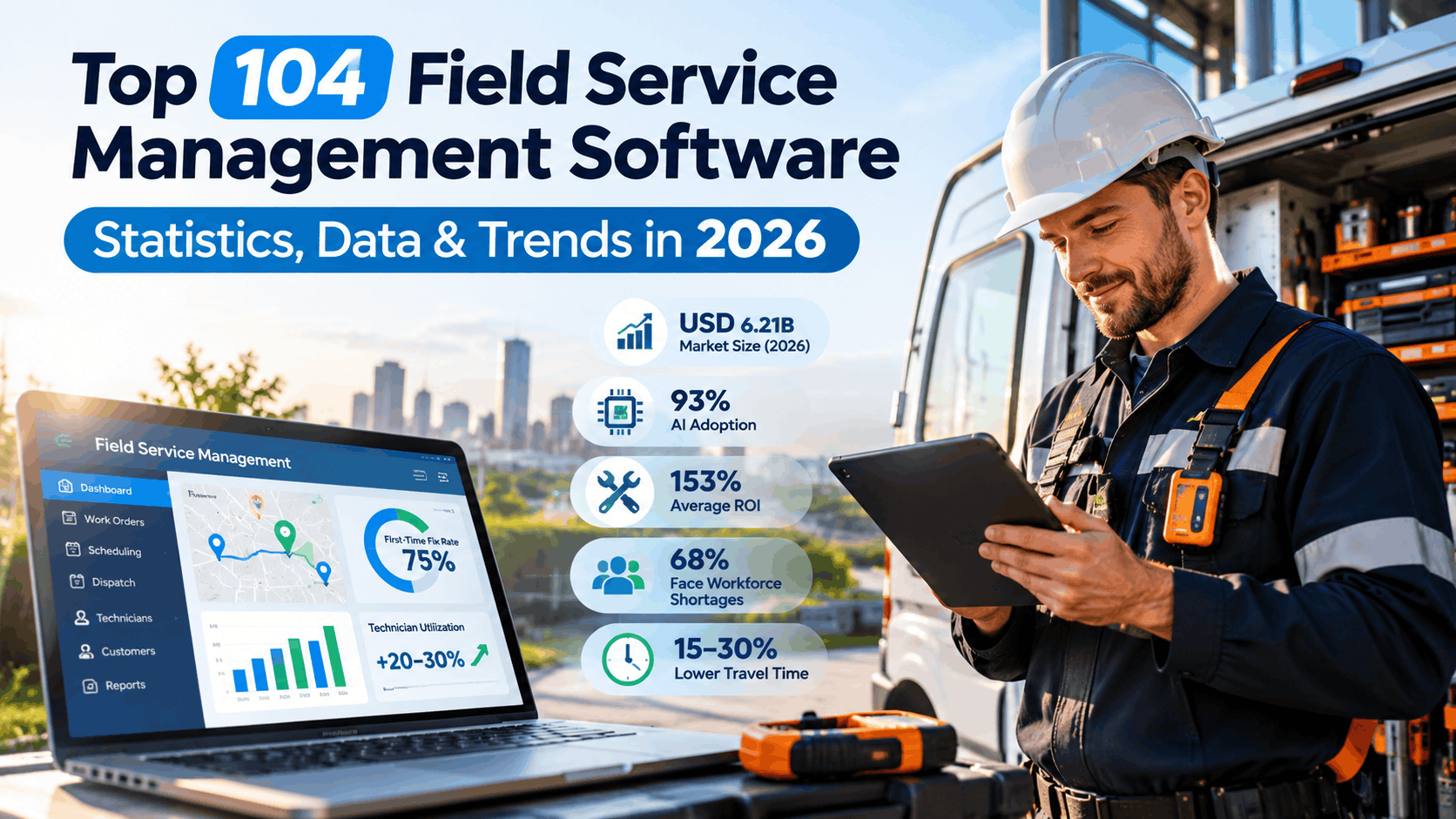
The latest field service management software statistics for 2026 highlight a rapidly expanding global market. Industry estimates place the worldwide FSM market at approximately USD 6.21 billion in 2026, with various research forecasts projecting continued double-digit annual growth over the coming years. Some projections suggest the market could exceed USD 13 billion by 2034, while broader estimates indicate even greater long-term expansion. This growth reflects increasing demand across industries such as manufacturing, telecommunications, utilities, healthcare, construction, and home services, where efficient workforce coordination and equipment maintenance are critical to business success.
One of the most influential field service management trends in 2026 is the growing integration of artificial intelligence and automation into everyday service operations. According to industry research compiled in this report, approximately 93% of service organizations have implemented AI in some capacity, while nearly 75% of field service companies report improvements in first-time fix rates through AI adoption. Intelligent scheduling solutions are also associated with technician utilization improvements of 20% to 30%, demonstrating the potential for technology to increase productivity without proportionally expanding workforce headcount.
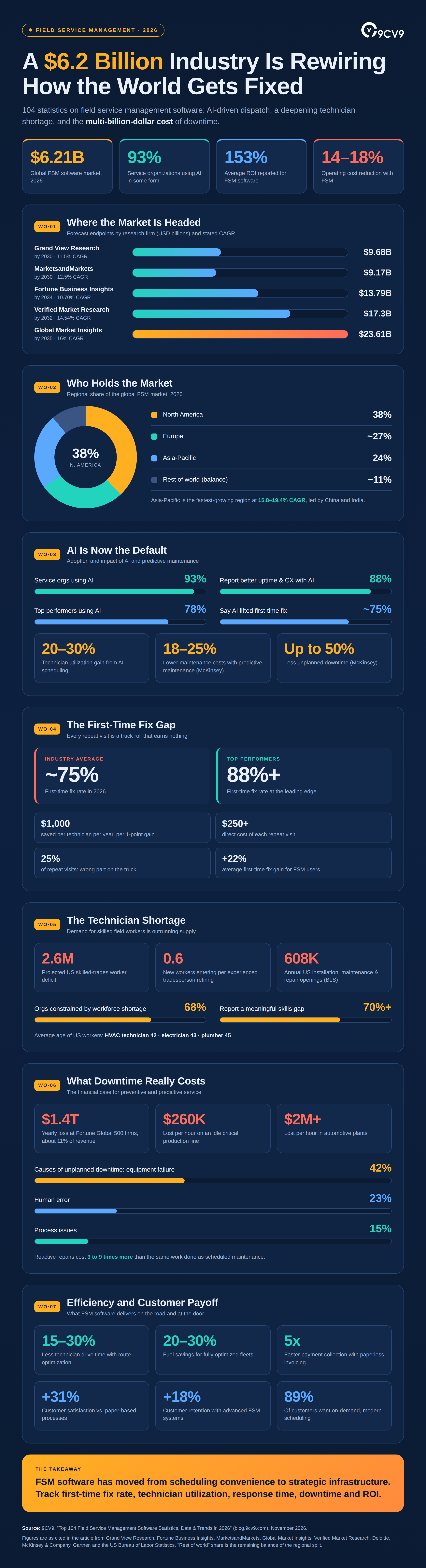
Beyond AI, field service management software adoption statistics reveal the growing importance of mobile workforce management, predictive maintenance, route optimization, and customer experience technologies. Research indicates that approximately 84% of organizations surveyed by Deloitte report high or very high returns on their FSM software investments, with an average reported return on investment of 153%. Meanwhile, businesses implementing route optimization solutions report reductions in technician travel time of 15% to 30%, potentially improving daily service capacity while reducing fuel consumption and operating expenses.
However, the field service industry continues to face substantial challenges, particularly in workforce availability, technician skills development, and rising customer expectations. Labor shortages reportedly constrain operations at approximately 68% of field service organizations, while more than 70% of companies identify meaningful skills gaps within their technician workforce. These pressures are accelerating demand for digital tools that help businesses maximize technician productivity, streamline administrative processes, improve first-time fix rates, and maintain consistent service quality despite limited labor resources.
Customer experience is another major factor shaping the field service management software market in 2026. Organizations using FSM platforms report customer satisfaction scores approximately 31% higher than businesses relying on manual, paper-based workflows. Advanced field service technologies also enable automated appointment scheduling, real-time service updates, digital invoicing, and proactive maintenance notifications, helping companies build stronger customer relationships and improve retention.
As field service operations become increasingly complex, understanding the latest market statistics, technology adoption rates, workforce challenges, and operational performance benchmarks is essential for making informed business decisions. Software vendors, business owners, operations managers, IT leaders, investors, and service professionals can use these insights to evaluate emerging opportunities, benchmark performance, and identify technologies capable of delivering measurable operational improvements.
This comprehensive guide explores the top 104 field service management software statistics, data, and trends in 2026, covering global market size and growth forecasts, AI and automation adoption, first-time fix rates, technician productivity, workforce shortages, mobile technology, customer satisfaction, route optimization, equipment downtime, software vendor performance, and industry-specific developments.
By examining these important field service management industry statistics, businesses can gain a clearer understanding of how the FSM software landscape is evolving, which technologies are driving operational transformation, and what emerging trends are likely to influence the future of field service management in 2027 and beyond.
Before we venture further into this article, we would like to share who we are and what we do.
About 9cv9
9cv9 is a business tech startup based in Singapore and Asia, with a strong presence all over the world.
With over ten years of startup and business experience, and being highly involved in connecting with thousands of companies and startups, the 9cv9 team has listed some of the top and best companies/tools in this review.
If you like to get your company listed in our top B2B software reviews, check out our world-class 9cv9 Media and PR service and pricing plans here.
Top 104 Field Service Management Software Statistics, Data & Trends in 2026
Market Size & Growth
- The global field service management software market is valued at approximately USD 6.21 billion in 2026, reflecting the sector’s continued acceleration as more organizations digitize dispatch and technician coordination.
- Grand View Research projects the FSM market will grow from roughly USD 6.26 billion in 2026 to USD 9.68 billion by 2030, at an 11.5% CAGR, signaling sustained double-digit expansion through the decade.
- Fortune Business Insights forecasts the global field service management market climbing from USD 6.14 billion in 2026 to USD 13.79 billion by 2034, at a 10.70% CAGR, underscoring long-term investor confidence in the category.
- MarketsandMarkets estimates the field service management market will expand from USD 5.10 billion in 2025 to USD 9.17 billion by 2030, a 12.5% CAGR, driven largely by SME adoption of affordable cloud-based FSM tools.
- Technavio projects FSM software market growth of USD 2,497.1 million between 2026 and 2030, at a 14.8% CAGR, one of the more aggressive forecasts among major analyst firms.
- Global Market Insights values the broader field service management market at USD 6.21 billion in 2026, projecting growth to USD 23.61 billion by 2035 at a striking 16% CAGR.
- Verified Market Research pegs the FSM software market at USD 4.90 billion in 2024, projecting it to reach USD 17.3 billion by 2032 at a 14.54% CAGR, fueled by AI, IoT, and the shift to servitization.
- The US field service management software market alone is worth an estimated USD 3.1 billion in 2026, having grown 7.5% year-over-year according to IBISWorld.
- The US FSM software market has compounded at a 7.7% CAGR between 2021 and 2026, reflecting steady, sustained domestic demand rather than a short-lived spike.
- North America is projected to contribute approximately 32.9% of global FSM market growth during the current forecast period, retaining its position as the technology’s most mature regional market.
- North America holds an estimated 38% share of the global FSM software market in 2026, with Europe close behind at roughly 27% and Asia-Pacific at 24%.
- Asia-Pacific is forecast to be the fastest-growing FSM region, with CAGR estimates ranging from 15.8% to 19.4% through the late 2020s, driven by rapid industrialization in China and India.
- Europe’s field service management market is projected to reach approximately USD 1.5 billion in 2026, representing continued expansion in automation adoption among UK, German, and French service organizations.
- China’s FSM software market is projected to reach USD 0.34 billion in 2026, while India’s market is projected at USD 0.26 billion, both reflecting expanding telecom and manufacturing service demand.
- The solutions segment (as opposed to services) accounts for roughly 62–68% of the global FSM market in 2026, underscoring buyer preference for integrated software platforms over standalone consulting services.
- Large enterprises are projected to hold more than 56–57% of FSM market share in 2026, owing to their complex, high-volume service operations and greater budget for advanced platforms.
- Small and medium-sized enterprises (SMEs) are forecast to grow FSM adoption at a faster CAGR of roughly 16.7%, as low-cost cloud FSM tools become increasingly accessible to smaller service teams.
- The customer management segment of the FSM market is projected to grow at a 15.8% CAGR, reflecting rising demand for tools that unify service delivery with customer experience management.
- The predictive maintenance market underpinning many FSM use cases is projected to jump from USD 10.6 billion in 2024 to USD 47.8 billion by 2029, nearly a fivefold increase in five years.
- The customer self-service solutions market, closely tied to FSM customer portals, is forecast to expand from USD 12.9 billion in 2022 to USD 34.35 billion by 2027.
AI & Automation Adoption
- Around 93% of service organizations have implemented AI in some form as of 2026, making artificial intelligence a mainstream operational capability rather than an experimental pilot.
- Approximately 88% of organizations using AI in field service report improved equipment uptime and better customer experiences as a direct result.
- Nearly 75% of field service companies say AI has improved their first-time fix rates, directly tying automation investment to measurable service quality gains.
- Gartner predicts that 40% of enterprise applications will include task-specific AI agents by the end of 2026, up sharply from less than 5% in 2025.
- About 78% of top-performing field service organizations are already using AI, revealing a strong correlation between AI adoption and operational excellence.
- Nearly 3 in 5 organizations currently use field service management software, while roughly one-third of non-users plan to invest in it during 2026, according to Deloitte Digital.
- Approximately 84% of organizations surveyed by Deloitte report high or very high ROI from FSM software, with an average reported ROI of 153%.
- Companies implementing intelligent AI-based scheduling report 20–30% improvements in technician utilization, roughly equivalent to adding two to three extra technicians without new hires on a 10-person team.
- AI-driven smart scheduling and dispatch tools that once required enterprise budgets of $500+ per seat are now available starting around $49 per month, democratizing access for small service businesses.
- Predictive maintenance powered by AI and IoT sensors can reduce required inventory levels for mobile assets by 10–30% and fixed assets by 10–20%, according to Deloitte research.
- Deloitte research also finds predictive maintenance can reduce overall fixed and mobile asset maintenance costs by 5–10% while increasing labor productivity in fixed assets by 5–20%.
- Organizations combining predictive maintenance, smart scheduling, and AI-assisted technician support report 25–40% improvements in technician productivity, according to industry research aggregations.
- McKinsey research indicates that predictive maintenance implementations can reduce maintenance costs by 18–25% while cutting unplanned downtime by up to 50%.
- Deloitte’s more mature predictive maintenance case studies report 35–45% reductions in downtime and 70–75% elimination of unexpected equipment breakdowns.
- Analysts forecast predictive maintenance technology will help prevent up to 80% of equipment breakdowns by 2030, a dramatic shift from reactive to proactive service models.
- Nearly 60% of service companies now use IoT-based asset monitoring, feeding continuous sensor data into machine learning models for early failure detection.
- By Gartner’s estimate, nearly 50% of all service management deployments will incorporate augmented reality (AR) tools by 2026, guiding technicians through complex repairs in real time.
- Augmented reality guidance and remote expert assistance are reported to improve first-time fix rates by more than 20% in field service applications where they’ve been deployed.
First-Time Fix Rate & Service Quality
- The industry average first-time fix rate sits at approximately 75% in 2026, while top-performing field service organizations achieve 88% or higher.
- Every 1-percentage-point improvement in first-time fix rate is estimated to save roughly $1,000 per technician annually, making it one of the most financially material FSM metrics.
- A 15-person field service team improving first-time fix rate from 75% to 85% could realize approximately $150,000 in annual savings purely from eliminated return visits.
- Approximately 25% of repeat technician visits occur because the technician did not have the correct part on hand, highlighting the importance of FSM-integrated inventory visibility.
- Some organizations report a 20% improvement in first-time fix rates through preventative work order automation combined with AI-assisted insights, per Technavio’s market analysis.
- Organizations using FSM software report a first-time fix rate increase averaging 22% compared to pre-implementation baselines.
- Each repeat visit costs a field service company a minimum of roughly $250 in direct truck-roll costs, not including technician time or potential SLA penalties.
- Improving first-time fix rate from 65% to 80% across 10,000 annual service calls could eliminate approximately 1,500 repeat visits, generating an estimated $375,000 in direct annual savings.
- Top-performing technicians who consistently achieve higher first-time fix rates could, if replicated industry-wide, reduce overall service costs by as much as 23%, according to Aquant AI research.
Labor Shortage & Workforce
- The US skilled trades sector faces a projected 2.6 million worker deficit, according to Bureau of Labor Statistics-derived analysis, one of the starkest labor gaps in the broader economy.
- For every experienced tradesperson retiring from the field service workforce, only an estimated 0.6 new workers enter the pipeline to replace them.
- Approximately 584,000 annual job openings exist in installation, maintenance, and repair occupations in the US, with a large share going unfilled each year.
- The US Bureau of Labor Statistics projects roughly 608,100 annual openings for installation, maintenance, and repair occupations nationwide.
- The average age of a US HVAC technician is 42, an electrician is 43, and a plumber is 45, reflecting an aging field service workforce nearing retirement.
- Roughly two-thirds of mobile field workers report experiencing burnout on a monthly basis, according to industry workforce surveys.
- Workforce shortages constrain operations at approximately 68% of field service organizations as of mid-2026, according to Field Nation research.
- Over 70% of field service companies report they are currently experiencing a meaningful skills shortage gap in their technician workforce.
- The Associated General Contractors of America estimates the broader construction and skilled trades ecosystem needs more than 500,000 additional workers annually to meet demand.
- The Associated Builders and Contractors estimates the construction industry alone needs to attract 349,000 net new workers in 2026, rising to 456,000 in 2027.
- Electrician positions are projected to grow 9.5% through 2034, more than triple the average growth rate for all US occupations.
- About 29% of small business owners in field service reported job openings they could not fill as of May 2026.
- Roughly 60% of Gen Z respondents say they plan to pursue careers in skilled trades in 2026, a potentially encouraging signal for long-term workforce replenishment.
Mobile Workforce & Technology Adoption
- Approximately 75% of field service companies using mobility technologies report increased employee productivity and customer satisfaction as a direct result.
- About 49% of the field service workforce now relies primarily on mobile devices for two-way communication between technicians and dispatch.
- Mobile workforce optimization tools deliver an estimated 20–30% productivity gain, allowing technicians to complete more service calls within the same working day.
- Approximately 82% of strategic service organizations rely on mobile field workers to identify upsell and cross-sell opportunities during on-site customer visits.
- FSM software adoption reaches 84% among large enterprises with over 500 field technicians, compared with just 52% adoption among small businesses with fewer than 50 technicians.
- Approximately 42% of field service companies have implemented Internet of Things (IoT) technology as part of their operations, according to Mordor Intelligence data.
- Roughly 74% of mobile field workers say customers now expect higher service standards and faster response times than in previous years.
- About 74% of mobile field workers also report increasing workloads year-over-year, reflecting rising demand pressure on existing technician headcounts.
Customer Experience & Retention
- Organizations utilizing FSM software report a 31% higher customer satisfaction score compared to those still relying on manual, paper-based processes.
- Customer retention rates run approximately 18% higher for companies using advanced FSM systems compared to those without, translating into meaningfully higher customer lifetime value.
- About 90% of customers say the quality of field service they receive plays a major role in determining whether they continue doing business with a company.
- Roughly 89% of customers say they want on-demand, modern scheduling technology, and many are willing to pay a premium for it.
- About 66% of customers want businesses to proactively recognize their specific needs and expectations rather than treating every service call generically.
- Nearly 3 in 4 consumers say they will spend more with businesses that provide a good customer experience, reinforcing the commercial case for FSM-enabled service quality.
- Businesses implementing FSM solutions report average operational cost reductions of 14–18%, with most savings coming from reduced administrative overhead and fewer redundant truck rolls.
Route Optimization, Fleet & Fuel Efficiency
- Businesses using route optimization software report 15–30% less technician drive time, often translating into one or two additional billable jobs per technician per week.
- Fully optimized field service fleets can achieve 20–30% fuel savings through smarter routing, improved driver behavior, and regular vehicle performance tracking.
- A 10-truck field service fleet spending roughly $3,000 monthly on fuel could save an estimated $600–$900 per month through optimized routing, or $7,200–$10,800 annually.
- A 200-technician field service operation could see annual fuel savings of $150,000–$250,000+ from a 15–25% reduction in fuel usage through route optimization, based on national average fuel pricing.
- Paperless field service operations report payment collection speeds up to 5x faster than traditional paper-based invoicing workflows.
Equipment Downtime & Financial Impact
- Fortune Global 500 companies collectively lose an estimated $1.4 trillion annually to unplanned equipment downtime, representing roughly 11% of their combined total revenues.
- Unplanned downtime in US manufacturing alone is estimated to cost approximately $50 billion annually, according to Aberdeen Research.
- The average large manufacturing operation loses roughly $260,000 for every hour a critical production line sits idle due to unplanned downtime.
- Automotive manufacturing plants can lose in excess of $2 million per hour during unplanned downtime events, among the highest downtime costs of any industry vertical.
- Equipment failure is the leading cause of unplanned downtime incidents, responsible for approximately 42% of cases, ahead of human error (23%) and process issues (15%).
- Preventive maintenance programs save an estimated 12–18% on total maintenance costs compared to purely reactive maintenance approaches, according to the US Department of Energy.
- Reactive equipment repairs cost 3 to 9 times more than the same work performed proactively as scheduled maintenance, due to expedited parts, overtime labor, and secondary damage.
- Small and medium enterprises report average unplanned downtime costs of $1,000–$5,000 per day, with 82% of affected SMEs saying the financial impact is significant enough to justify dedicated prevention investment.
Vendor Landscape & Software Reviews
- Jobber reports over 300,000 users across more than 50 industries, with entry-level plans starting around $29 per month, positioning it as one of the most accessible FSM platforms for small teams.
- Capterra hosts reviews for more than 700 distinct field service management software options, reflecting an unusually fragmented and competitive vendor landscape.
- Housecall Pro holds a 4.7 out of 5 rating on Capterra based on more than 2,800 verified reviews, among the highest-rated platforms in the small-business FSM segment.
- ServiceTitan holds a 4.4 out of 5 rating across Capterra, GetApp, and Software Advice based on over 306 combined reviews, with particular strength in enterprise-grade reporting and dispatch depth.
- Jobber maintains a combined rating of approximately 4.6 out of 5 across G2 and Capterra review platforms, reflecting consistently strong small-business satisfaction.
- IFS was named the sole Gartner Peer Insights Customers’ Choice for field service management in both 2024 and 2025, reflecting sustained enterprise-buyer confidence.
- Organizations modernizing field service operations with platforms like IFS report roughly 40% lower administrative time and up to 20% lower operating costs following implementation.
- ServiceTitan pricing can run 5–10 times higher than smaller competitors, reflecting the premium enterprise positioning of full-stack FSM platforms for large, complex operations.
- Around 36% of the FSM market’s revenue is controlled by the top five vendors, while emerging SaaS startups account for approximately 21% of market share.
Vertical Industry Trends
- The manufacturing sector is projected to account for more than 22% of FSM software market value in 2026, driven by the need to minimize unplanned downtime on complex production machinery.
- The IT and telecommunications segment of the FSM market was valued at approximately $683.1 million in 2024, propelled by ongoing 5G infrastructure rollout requiring extensive field installation work.
- On-premises deployment continues to hold a meaningful share of the FSM market in heavily regulated verticals such as utilities, manufacturing, and defense, where data control requirements limit cloud migration.
- ATM-related field service work is up approximately 15% year-over-year on major field service marketplaces, driven by bank branch technology modernization initiatives.
- Nearly 11,900 urgent care healthcare locations are active across the US, each requiring ongoing field service support for medical and facility equipment.
- More than 1,118 new retail store openings are planned in the current year alone, each generating installation and field service demand for networking, security, and POS equipment.
- Regulatory compliance management software—an increasingly common FSM integration point—is projected to reach a $12.46 billion market in 2026, up from $11.18 billion in 2024.
Conclusion
The top 104 field service management software statistics, data, and trends in 2026 demonstrate how rapidly the field service industry is evolving as businesses embrace digital transformation, artificial intelligence, automation, and data-driven workforce management. What was once primarily a system for scheduling technicians and managing service appointments has developed into a comprehensive technology ecosystem capable of improving operational efficiency, reducing costs, enhancing customer satisfaction, and supporting long-term business growth.
With the global field service management software market valued at approximately USD 6.21 billion in 2026, the industry is positioned for substantial expansion. Market forecasts indicate continued double-digit growth, with some projections estimating that the sector could exceed USD 13 billion by 2034. This momentum reflects increasing investment in cloud-based field service management platforms, intelligent dispatching solutions, predictive maintenance technologies, and mobile workforce optimization tools across manufacturing, telecommunications, utilities, healthcare, construction, and other service-intensive industries.
One of the most significant findings from the 2026 field service management software statistics is the growing influence of artificial intelligence on service delivery and operational performance. Industry research indicates that approximately 93% of service organizations have adopted AI in some form, while nearly 75% of field service companies report improvements in first-time fix rates through AI implementation. Furthermore, intelligent scheduling technologies are associated with technician utilization improvements of 20% to 30%, highlighting the potential for automation to increase service capacity without requiring proportional increases in staffing.
These developments are particularly important as the field service industry continues to experience workforce shortages and skills gaps. With approximately 68% of field service organizations reporting operational constraints caused by labor shortages, businesses are increasingly turning to digital solutions to maximize the productivity of existing technicians. AI-powered scheduling, remote assistance, mobile workforce applications, and automated work order management are becoming essential capabilities for organizations seeking to maintain service quality while addressing recruitment and retention challenges.
The financial benefits of field service management software adoption also reinforce the business case for continued technology investment. Research compiled in this report indicates that approximately 84% of surveyed organizations report high or very high returns on their FSM software investments, with an average reported ROI of 153%. Additionally, businesses implementing FSM solutions report operational cost reductions of 14% to 18%, while route optimization technologies are associated with reductions in technician travel time of 15% to 30%.
Customer experience remains another critical factor influencing the future of field service management. As customers increasingly expect faster response times, transparent communication, convenient appointment scheduling, and reliable service delivery, organizations must adopt technologies that support more responsive and personalized interactions. The statistics indicate that businesses using FSM software report customer satisfaction scores approximately 31% higher than organizations relying on manual processes, demonstrating the potential relationship between digital service management and improved customer outcomes.
Looking ahead to 2027 and beyond, several emerging technologies are expected to shape the next phase of field service management software development. Artificial intelligence, predictive analytics, Internet of Things (IoT) connectivity, augmented reality, automated customer communications, and cloud-based workforce management platforms are likely to become increasingly important components of modern field service operations.
Predictive maintenance represents a particularly significant growth opportunity. With the predictive maintenance market projected to expand from USD 10.6 billion in 2024 to USD 47.8 billion by 2029, businesses are recognizing the value of identifying equipment problems before they result in costly failures. By combining real-time equipment monitoring with intelligent maintenance scheduling, organizations can potentially reduce unplanned downtime, extend asset lifespans, and improve service reliability.
However, successful field service digital transformation requires more than simply purchasing new software. Organizations must carefully evaluate their operational requirements, integration capabilities, workforce readiness, implementation costs, and long-term business objectives. Choosing the right field service management platform involves balancing essential capabilities such as scheduling, dispatching, mobile access, inventory management, reporting, customer communication, and automation against organizational size, industry requirements, and available resources.
For small and medium-sized businesses, affordable cloud-based FSM solutions provide opportunities to compete more effectively with larger service providers. For enterprises managing extensive technician networks and complex service operations, advanced analytics, AI-driven optimization, and integrated asset management technologies can support greater operational visibility and scalability.
Ultimately, the field service management software trends and statistics for 2026 point toward an industry increasingly defined by intelligent automation, connected technologies, proactive maintenance, and customer-centric service delivery. Organizations that successfully combine these capabilities with effective workforce management and continuous performance improvement will be better positioned to respond to changing customer expectations, address labor shortages, and maintain competitive advantages.
As the global FSM software market continues to expand, businesses should regularly monitor key performance indicators such as first-time fix rates, technician utilization, service response times, customer satisfaction, equipment downtime, operational costs, and return on technology investments.
The insights presented in these 104 field service management software statistics provide a valuable foundation for understanding current industry developments, evaluating technology investments, and preparing for future changes.
The central takeaway is clear: field service management software is becoming a strategic business investment rather than simply an operational convenience. Businesses that prioritize intelligent scheduling, predictive maintenance, workforce productivity, and exceptional customer experiences will be better equipped to build efficient, resilient, and scalable field service operations in 2026, 2027, and the years ahead.
If you find this article useful, why not share it with your hiring manager and C-level suite friends and also leave a nice comment below?
We, at the 9cv9 Research Team, strive to bring the latest and most meaningful data, guides, and statistics to your doorstep.
To get access to top-quality guides, click over to 9cv9 Blog.
To hire top talents using our modern AI-powered recruitment agency, find out more at 9cv9 Modern AI-Powered Recruitment Agency.
People Also Ask
What is field service management software?
Field service management (FSM) software helps businesses manage technicians, schedule appointments, dispatch workers, track equipment, optimize routes, and automate service operations. It improves productivity, reduces costs, and enhances customer satisfaction.
What is the global field service management software market size in 2026?
The global field service management software market is valued at approximately USD 6.21 billion in 2026. Growth is driven by increasing adoption of cloud-based platforms, artificial intelligence, automation, and mobile workforce management solutions.
How fast is the field service management software market growing?
The FSM software market is experiencing strong growth, with industry forecasts estimating compound annual growth rates between 10% and 16%. Increasing demand for AI-powered scheduling, predictive maintenance, and digital service management supports this expansion.
What is the projected field service management software market size by 2030?
Grand View Research projects the global field service management market will reach approximately USD 9.68 billion by 2030, reflecting an estimated compound annual growth rate of 11.5% from 2026.
What are the biggest field service management software trends in 2026?
Major FSM software trends in 2026 include AI-powered scheduling, predictive maintenance, mobile workforce optimization, cloud-based platforms, IoT integration, augmented reality assistance, automated dispatching, and customer self-service technologies.
How is artificial intelligence transforming field service management?
Artificial intelligence improves field service operations through intelligent scheduling, predictive maintenance, automated dispatching, and technician assistance. Industry statistics indicate approximately 93% of service organizations have implemented AI in some capacity.
What percentage of field service companies use AI in 2026?
Approximately 93% of service organizations have adopted AI in some form, according to industry research cited in the 2026 statistics. AI applications include predictive maintenance, workforce scheduling, customer support, and service optimization.
How does field service management software improve technician productivity?
FSM software improves technician productivity through automated scheduling, route optimization, mobile access, and real-time job updates. Intelligent scheduling solutions are associated with technician utilization improvements of approximately 20% to 30%.
What is the average ROI of field service management software?
Research cited in the report indicates that 84% of surveyed organizations report high or very high returns from FSM software investments, with an average reported return on investment of approximately 153%.
How much can businesses save using field service management software?
Businesses implementing FSM software report operational cost reductions of approximately 14% to 18%. Savings come from reduced administrative work, improved technician scheduling, fewer repeat visits, and more efficient resource allocation.
What is the average first-time fix rate in field service management?
The reported industry average first-time fix rate is approximately 75% in 2026, while top-performing field service organizations achieve rates of 88% or higher. Higher first-time fix rates help reduce repeat visits and improve customer satisfaction.
How does AI improve first-time fix rates in field service operations?
AI improves first-time fix rates by providing technicians with equipment histories, diagnostic recommendations, inventory information, and repair guidance. Nearly 75% of field service companies report improvements in first-time fix performance through AI adoption.
What are the benefits of predictive maintenance in field service management?
Predictive maintenance helps businesses identify equipment problems before failures occur. Research indicates it can reduce maintenance costs by 18% to 25% and decrease unplanned downtime by up to 50%, depending on implementation.
How large is the predictive maintenance market in 2026?
The predictive maintenance market is projected to expand from USD 10.6 billion in 2024 to USD 47.8 billion by 2029. This growth reflects increasing investment in AI, IoT sensors, equipment monitoring, and proactive maintenance technologies.
How does field service management software reduce equipment downtime?
FSM software reduces downtime through preventive maintenance scheduling, real-time equipment monitoring, automated alerts, and technician coordination. Predictive maintenance implementations can reduce unplanned downtime by up to 50%.
What percentage of field service companies use mobile workforce technology?
Approximately 49% of field service workers primarily rely on mobile devices for communication with dispatch teams. Mobile workforce technologies support real-time updates, digital work orders, navigation, and remote access to service information.
How does mobile field service management software benefit technicians?
Mobile FSM software gives technicians access to job details, customer records, equipment histories, and scheduling updates. Mobile workforce optimization tools are associated with productivity improvements of approximately 20% to 30%.
What are the biggest challenges facing field service companies in 2026?
Major challenges include technician shortages, skills gaps, rising operating costs, increasing customer expectations, equipment downtime, and scheduling complexity. Approximately 68% of field service organizations report operational constraints caused by workforce shortages.
How serious is the technician shortage in the field service industry?
Workforce shortages remain a major challenge, with more than 70% of field service companies reporting meaningful technician skills gaps. These shortages increase demand for automation, technician training, and workforce optimization software.
How does field service management software improve customer satisfaction?
FSM software improves customer satisfaction through faster response times, accurate scheduling, real-time service updates, and fewer repeat visits. Organizations using FSM platforms report customer satisfaction scores approximately 31% higher than those using manual processes.
What percentage of customers expect modern field service scheduling?
Approximately 89% of customers reportedly want modern, on-demand scheduling technology. Businesses can address these expectations through online booking, automated appointment reminders, real-time technician tracking, and customer self-service portals.
How does route optimization software improve field service efficiency?
Route optimization software helps businesses reduce technician travel time, fuel consumption, and scheduling inefficiencies. Companies using route optimization solutions report approximately 15% to 30% less technician driving time.
How much fuel can field service companies save through route optimization?
Optimized field service fleets can achieve fuel savings of approximately 20% to 30% through smarter routing, improved driver behavior, and vehicle monitoring. Actual savings depend on fleet size, travel distances, and operating conditions.
What industries use field service management software the most?
FSM software is widely used in manufacturing, telecommunications, utilities, healthcare, construction, HVAC, plumbing, and equipment maintenance. Manufacturing is projected to account for more than 22% of FSM software market value in 2026.
Which region dominates the field service management software market?
North America holds an estimated 38% share of the global FSM software market in 2026, followed by Europe at approximately 27% and Asia-Pacific at 24%. Strong enterprise adoption supports North America’s leading position.
Which region has the fastest-growing field service management software market?
Asia-Pacific is projected to be the fastest-growing FSM software market, with estimated annual growth rates ranging from 15.8% to 19.4%. Industrial expansion and technology adoption in China and India are important growth drivers.
What is the difference between cloud-based and on-premises field service management software?
Cloud-based FSM software provides remote access, subscription pricing, and easier deployment. On-premises solutions offer greater infrastructure control and remain relevant for organizations with strict security, compliance, or data management requirements.
What are the most popular field service management software platforms in 2026?
Prominent FSM software platforms include ServiceTitan, Jobber, Housecall Pro, and IFS. These solutions support scheduling, dispatching, customer management, reporting, and automation, with different capabilities for small businesses and enterprises.
How does IoT technology improve field service management?
Internet of Things (IoT) technology connects equipment and sensors to field service platforms, enabling real-time monitoring, predictive maintenance, and automated alerts. Approximately 42% of field service companies reportedly use IoT technology.
What is the future of field service management software beyond 2026?
The future of FSM software will increasingly involve AI agents, predictive analytics, IoT connectivity, augmented reality, and intelligent automation. These technologies are expected to improve technician productivity, reduce downtime, and support more proactive service delivery.
Sources
- Grand View Research
- Fortune Business Insights
- MarketsandMarkets
- Technavio
- Global Market Insights
- Verified Market Research
- IBISWorld
- Business Research Insights
- Persistence Market Research
- Deloitte Digital
- Deloitte
- McKinsey & Company
- Gartner
- Gartner Peer Insights
- Fieldworkhq
- Brocoders
- Scanalitix
- Aquant AI
- FieldCamp
- FieldServiceSoftware
- Service Council
- TechRev
- US Bureau of Labor Statistics
- Associated Builders and Contractors
- Associated General Contractors of America
- Field Nation
- ServicePower
- Programming Insider
- IFS
- Capterra
- G2
- Market Reports World
- Siemens
- Aberdeen Research
- MapTrack