



























Key Takeaways
- Recruitment agency fees in Hong Kong in 2026 typically range from 15%–25% of first-year compensation for permanent placements, with higher fees for specialist and executive searches.
- Hong Kong recruitment costs vary by hiring model, including contingency recruitment, retained executive search, contract staffing, and Recruitment Process Outsourcing (RPO).
- Employers can reduce recruitment costs by negotiating compensation definitions, volume discounts, replacement guarantees, SLAs, and the right recruitment model for each hiring need.
Recruitment agencies in Hong Kong typically charge employers around 15% to 25% of a successful candidate’s first-year compensation in 2026. Hong Kong recruitment agencies price specialist and executive searches higher, while contract staffing and RPO use different fee structures. Employers should compare total hiring costs, guarantees, and service levels before selecting an agency.
Understanding how much recruitment agencies charge in Hong Kong in 2026 is essential for employers seeking to control hiring costs while competing for skilled professionals in one of Asia’s major business and financial centres. Recruitment fees can vary significantly depending on the seniority of the position, scarcity of talent, industry specialisation, compensation package, hiring volume, and recruitment model selected.
Also, read our article on the Top 10 Best Recruitment Agencies in Hong Kong.

For permanent hiring, recruitment agencies in Hong Kong commonly operate on a contingency model, where employers pay a percentage of the successful candidate’s first-year compensation. Typical fees for professional recruitment generally range from approximately 15% to 25%, while specialist, hard-to-fill, and senior appointments can attract higher rates. Retained executive search for C-suite, board-level, managing director, and other strategic leadership positions can typically command around 25% to 33% of first-year compensation.
However, the headline percentage tells only part of the story. The definition of “first-year compensation” can materially affect the final recruitment invoice. Some agency contracts calculate fees using basic annual salary, while others may include guaranteed bonuses, commissions, allowances, sign-on payments, or broader remuneration components. As a result, two agencies quoting the same percentage can produce substantially different final hiring costs.
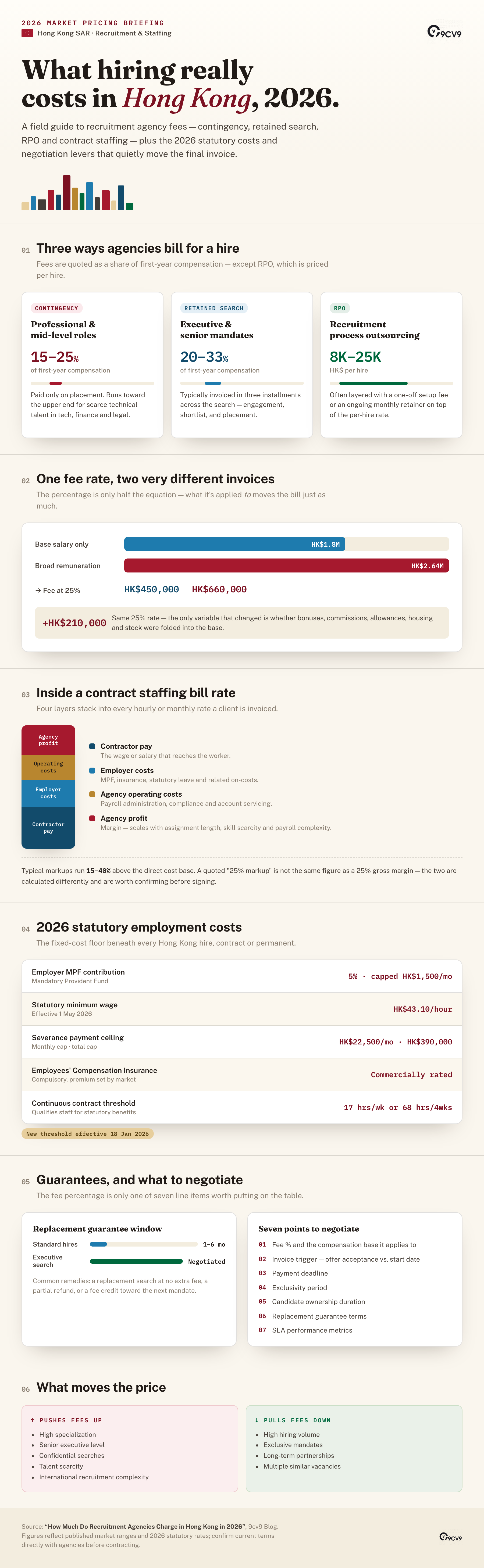
Employers also have several alternatives to traditional permanent recruitment. Contract staffing typically uses an all-inclusive bill rate incorporating worker compensation, applicable statutory employment costs, administration, and agency margin. Recruitment Process Outsourcing, or RPO, can provide a more scalable commercial model for organisations with recurring or high-volume hiring requirements through monthly management fees, cost-per-hire pricing, dedicated recruiter charges, or hybrid arrangements.
Hong Kong’s employment framework adds another layer to recruitment cost planning in 2026. Employers and staffing providers must consider Mandatory Provident Fund contributions, employees’ compensation requirements, statutory employment benefits, and recent regulatory changes affecting flexible workers and longer-term employment liabilities.
| Recruitment Model | Typical Pricing Approach | Common Use Case |
|---|---|---|
| Contingency Recruitment | Around 15%–25% of first-year compensation | Professional and mid-senior hiring |
| Specialist Recruitment | Typically toward the upper end of contingency pricing | Scarce and technical talent |
| Retained Executive Search | Around 25%–33% of first-year compensation | C-suite, board and leadership hiring |
| Contract Staffing | Worker cost + statutory costs + agency margin | Temporary and flexible workforce |
| RPO | Management fee, cost-per-hire or hybrid pricing | Recurring and high-volume recruitment |
The commercial terms surrounding these fees are equally important. Replacement guarantees, payment schedules, candidate ownership clauses, exclusivity periods, fee calculation definitions, Service Level Agreements, and recruitment performance metrics can significantly influence the overall value of an agency relationship.
This guide examines how much recruitment agencies charge in Hong Kong in 2026, covering permanent placement fees, executive search pricing, contract staffing economics, RPO models, statutory employment costs, compensation-base calculations, replacement guarantees, and agency SLAs. It also explores how employers can negotiate recruitment contracts more effectively and select the most cost-efficient hiring model for different workforce requirements.
Before we venture further into this article, we would like to share who we are and what we do.
About 9cv9
9cv9 is a business tech startup based in Singapore and Asia, with a strong presence all over the world.
With over ten years of startup and business experience, and being highly involved in connecting with thousands of companies and startups, the 9cv9 team has listed some of the top and best companies/tools in this review.
If you like to get your company listed in our top B2B software reviews, check out our world-class 9cv9 Media and PR service and pricing plans here.
How Much Do Recruitment Agencies Charge in Hong Kong in 2026?
- Percentage Pricing Breakdown Across Seniority and Functional Sectors
- Compensation Base Definitions and Financial Impact
- Contract Staffing, Flexible Workforce Economics, and Regulatory Overhead
- Statutory Overhead and the 2026 Hong Kong Compliance Framework
- RPO Commercial Models and Fee Architectures
- Service Level Agreements, Delivery Milestones, and Contract Governance
- Strategic Recommendations for Corporate Buyers
1. Percentage Pricing Breakdown Across Seniority and Functional Sectors
Hong Kong’s recruitment agency market in 2026 uses several commercial structures depending on hiring volume, role seniority, candidate scarcity, confidentiality, and the amount of search work required. Permanent contingency recruitment remains common for professional and mid-to-senior positions, while retained executive search is generally reserved for C-suite, board-level, confidential, and strategically important appointments.
Current market benchmarks indicate that contingency recruitment commonly costs approximately 15% to 25% of a candidate’s first-year compensation. Retained executive search generally ranges from approximately 20% to 33%, while Recruitment Process Outsourcing, or RPO, typically uses monthly retainers, implementation charges, per-hire pricing, or combinations of these structures.
| Commercial Model | Typical Role Profile | Indicative 2026 Fee Structure | Payment Basis | Typical Exclusivity |
|---|---|---|---|---|
| Standard Contingency | Professional and mid-level positions | 15%–25% of first-year compensation | Success-based | Usually non-exclusive |
| Specialist Contingency | Technology, finance, legal and scarce-skill positions | Often toward the upper end of contingency pricing | Success-based | Non-exclusive or negotiated |
| Exclusive Contingency | Mid-to-senior and difficult-to-fill positions | Negotiated percentage of annual compensation | Success-based | Temporary exclusivity |
| Retained Executive Search | C-suite, board and senior leadership | Approximately 20%–33% of first-year compensation | Staged payments | Normally exclusive |
| RPO | Recurring and high-volume recruitment | Monthly retainer, setup fee and/or per-hire charge | Contract-based | Usually embedded partnership |
| Interim Recruitment | Interim executives and project specialists | Daily or weekly charge incorporating agency margin | Time-based | Depends on agreement |
Percentage-Based Permanent Recruitment Fees
Percentage-based pricing remains one of the most recognisable recruitment agency fee structures in Hong Kong. Under this model, the employer pays an agreed percentage of the successful candidate’s first-year compensation.
For mainstream professional recruitment, a broad 15% to 25% range is representative of the 2026 market. However, the precise percentage can vary considerably according to the role and the agency agreement.
Highly specialised positions in technology, financial services, quantitative disciplines, cybersecurity, artificial intelligence, legal services and other talent-constrained functions are more likely to be priced toward the higher end of the range.
| Hiring Category | Indicative Fee Position | Main Pricing Drivers |
|---|---|---|
| General Corporate Roles | Lower to middle end of 15%–25% | Larger candidate pools and relatively standard sourcing |
| Professional Specialists | Middle of market range | Experience requirements and sector knowledge |
| Senior Management | Middle to upper end | Smaller candidate pool and greater assessment requirements |
| Technology and Digital Specialists | Upper end or individually negotiated | Skills shortages and passive candidate sourcing |
| Finance and Financial Services Specialists | Upper end or individually negotiated | Specialist knowledge and competitive talent market |
| C-Suite and Board Roles | Approximately 20%–33% under retained search | Confidentiality, research intensity and leadership assessment |
What Counts as Compensation?
Employers comparing recruitment agency fees in Hong Kong should examine more than the headline percentage. The definition of compensation used to calculate the fee can materially change the final recruitment cost.
Some agreements calculate fees using base salary, while others use guaranteed cash compensation or broader first-year remuneration that may include guaranteed bonuses, allowances or other fixed payments.
For example, a 20% fee calculated on HK$1 million of base salary produces a HK$200,000 recruitment fee. If the contractual fee base becomes HK$1.2 million after guaranteed compensation is included, the same 20% rate produces a HK$240,000 fee.
| Fee Calculation Base | Potential Components | Employer Consideration |
|---|---|---|
| Base Salary | Fixed annual salary | Simplest cost benchmark |
| Guaranteed Cash | Salary plus guaranteed cash payments | Can increase final placement fee |
| Total Cash Compensation | Salary, allowances and qualifying bonuses | Requires precise contractual definition |
| Total First-Year Compensation | Broader guaranteed remuneration package | Potentially produces the highest fee base |
Standard Contingency Recruitment
Contingency recruitment operates primarily on a success-fee basis. The recruitment agency generally earns its placement fee when an introduced candidate is successfully hired.
This structure reduces the employer’s upfront financial commitment and is therefore particularly suitable for professional and mid-level recruitment where several agencies may be competing to fill the same vacancy.
The trade-off is that a non-exclusive agency may allocate resources according to the probability of successfully completing the placement.
| Contingency Feature | Typical Structure |
|---|---|
| Upfront Retainer | Usually none |
| Placement Fee | Approximately 15%–25% |
| Payment Trigger | Successful placement or agreed employment milestone |
| Exclusivity | Usually none |
| Search Depth | Varies by agency and mandate |
| Employer Risk | Relatively low before placement |
| Best Suited For | Professional and mid-to-senior recruitment |
Specialist and Exclusive Contingency Recruitment
Employers recruiting scarce professionals may negotiate exclusive or semi-exclusive contingency arrangements. These provide the recruitment agency with greater confidence that its sourcing investment will result in a fee if the mandate is completed successfully.
In return, employers may receive deeper market mapping, greater consultant attention, targeted passive-candidate outreach and more structured reporting.
Exclusivity can also become a commercial bargaining tool. Employers offering multiple vacancies, repeat business or a defined exclusive search period may be able to negotiate preferential fee arrangements.
| Factor | Standard Contingency | Exclusive Contingency |
|---|---|---|
| Agency Competition | Multiple agencies possible | One preferred agency for agreed period |
| Upfront Fee | Usually none | Usually none unless hybrid structure applies |
| Search Commitment | Standard | Potentially higher |
| Candidate Mapping | Variable | Often more extensive |
| Employer Flexibility | High | Moderate during exclusivity |
| Fee Negotiability | Standard | Potential volume or exclusivity discount |
Retained Executive Search Fees in Hong Kong
Retained executive search represents the premium end of Hong Kong’s recruitment market. It is generally used for CEOs, CFOs, managing directors, board appointments, functional leaders, regulated positions and confidential replacement searches.
Indicative 2026 retained-search fees generally sit around 20% to 33% of first-year compensation, with approximately 25% to 33% commonly associated with dedicated executive search mandates.
Unlike contingency recruitment, retained search fees are normally paid progressively as the assignment advances.
| Executive Search Stage | Illustrative Payment Structure | Typical Deliverable |
|---|---|---|
| Engagement | Approximately one-third | Search launch, research strategy and market mapping |
| Shortlist | Approximately one-third | Qualified executive shortlist |
| Completion | Remaining balance | Appointment, acceptance or another agreed completion milestone |
The exact payment trigger should be specified in the engagement agreement. Employers may negotiate whether the final instalment becomes payable upon offer acceptance, contract signing or the candidate’s commencement date.
RPO and Volume Recruitment Models
Recruitment Process Outsourcing provides an alternative for organisations hiring at scale. Rather than paying a substantial percentage of salary for every vacancy, employers can outsource part or all of their recruitment operation under a longer-term commercial arrangement.
Indicative Hong Kong market pricing for mid-volume professional RPO can be structured around approximately HK$8,000 to HK$25,000 per hire, often alongside setup costs or monthly retainers.
| Hiring Requirement | Potentially Suitable Model |
|---|---|
| Occasional Professional Hiring | Contingency recruitment |
| Scarce Specialist Hiring | Specialist or exclusive contingency |
| C-Suite Recruitment | Retained executive search |
| Confidential Leadership Replacement | Retained executive search |
| Recurring High-Volume Hiring | RPO |
| Temporary Project Leadership | Interim recruitment |
Payment Terms and Invoice Triggers
Payment terms vary significantly between Hong Kong recruitment agencies. Published agency fee schedules demonstrate that some firms invoice when the candidate reports for duty and require payment within relatively short periods, while other commercial agreements provide longer settlement windows.
Consequently, employers should compare the invoice trigger and payment deadline rather than focusing exclusively on the percentage fee.
| Commercial Element | Points Employers Should Clarify |
|---|---|
| Invoice Trigger | Offer acceptance, contract signing or start date |
| Payment Period | Number of days permitted for settlement |
| Fee Base | Base salary, guaranteed cash or total compensation |
| Taxes and Charges | Whether additional charges apply |
| Late Payment | Interest, penalties or loss of guarantee |
| Replacement Eligibility | Whether invoices must be fully settled to activate protection |
Replacement Guarantees and Refund Structures
Replacement guarantees represent an important component of recruitment agency service agreements in Hong Kong.
Market practices vary considerably. Some agencies publish one-to-three-month guarantees for permanent placements, while broader professional recruitment agreements can provide approximately three to six months. Executive search arrangements may negotiate longer protection.
The remedy also differs. An agency might provide a replacement search, partial credit or partial refund rather than returning the entire recruitment fee.
| SLA Component | Common Market Approach |
|---|---|
| Guarantee Period | Frequently 1–6 months depending on service and seniority |
| Executive Guarantee | Potentially longer and individually negotiated |
| Primary Remedy | One replacement search without another placement fee |
| Alternative Remedy | Partial refund or fee credit |
| Payment Condition | Original invoice normally must be settled |
| Replacement Role | Usually same or substantially similar position |
| Exclusions | Redundancy, restructuring or material changes to employment terms may be excluded |
Recruitment Agency Service Level Agreements in Hong Kong
A well-designed recruitment SLA should extend beyond pricing. It establishes measurable expectations covering candidate delivery, communication, screening, reporting, replacement obligations and confidentiality.
Rather than selecting a recruitment partner purely according to the lowest placement percentage, employers can compare agencies using a balanced SLA scorecard.
| SLA Area | Illustrative Performance Measure |
|---|---|
| Vacancy Acknowledgement | Confirmation within agreed business hours |
| Search Launch | Search begins within agreed timeframe |
| Initial Candidate Delivery | First qualified profiles within agreed number of working days |
| Candidate Screening | Agreed screening and qualification completed |
| Interview Coordination | Prompt scheduling and candidate communication |
| Status Reporting | Weekly or agreed reporting cadence |
| Candidate Feedback | Feedback exchanged within agreed timeframe |
| Replacement Support | Defined guarantee and replacement process |
| Confidentiality | Documented candidate and employer data controls |
| Escalation | Named consultant and management escalation route |
Exclusivity and Candidate Ownership
Exclusivity can materially affect the relationship between an employer and recruitment agency. Retained executive search is normally exclusive because substantial research resources are committed to the assignment.
Contingency recruitment is more commonly non-exclusive, although employers may grant a temporary exclusive period for difficult vacancies.
Candidate ownership provisions also deserve close attention. Recruitment agreements commonly specify how long an agency introduction remains attributable to that agency and what happens when the employer already knew or had contacted the candidate.
| Contract Clause | Employer Review Priority |
|---|---|
| Exclusivity Duration | Ensure the period is clearly defined |
| Candidate Ownership | Establish how long introductions remain protected |
| Prior Candidate Knowledge | Define treatment of candidates already in the employer’s database |
| Group Company Hiring | Clarify whether fees apply across related companies |
| Re-Introduction | Establish rules where several agencies submit the same candidate |
| Termination | Define outstanding obligations when the agreement ends |
Regulatory Considerations for Hong Kong Recruitment Agencies
Commercial negotiations should also account for Hong Kong’s employment agency regulatory framework. Employment agencies undertaking job placement activities are generally required to hold an employment agency licence or applicable Certificate of Exemption issued under Hong Kong’s regulatory system.
Employers should therefore verify an agency’s licensing status before entering a recruitment arrangement.
Hong Kong also restricts the amount employment agencies can collect from job seekers. The prescribed commission is limited to 10% of the job seeker’s first month’s wages following successful placement. This is distinct from the commercial recruitment fee negotiated between an agency and an employer.
Key Factors That Influence Recruitment Agency Fees
Recruitment agency pricing in Hong Kong should ultimately be viewed as a function of search difficulty rather than as a fixed market tariff.
| Pricing Factor | Likely Effect on Agency Fee |
|---|---|
| High Hiring Volume | May support volume discounts |
| Exclusive Mandate | May improve negotiability |
| Highly Specialised Skills | Pushes pricing upward |
| Senior Executive Role | Pushes pricing upward |
| Confidential Search | Pushes pricing upward |
| International Candidate Search | May increase search complexity |
| Multiple Similar Vacancies | Can reduce effective cost per hire |
| Long-Term Agency Partnership | May support preferred pricing |
| Extensive Assessment Requirements | Can increase overall search cost |
Commercial Model Selection Matrix
For employers hiring in Hong Kong in 2026, the most appropriate recruitment arrangement depends on the strategic importance and complexity of the vacancy.
| Hiring Situation | Recommended Commercial Model | Relative Cost | Search Commitment |
|---|---|---|---|
| Routine Professional Vacancy | Contingency | Medium | Medium |
| Multiple Similar Vacancies | Volume Contingency or RPO | Low to Medium | High |
| Scarce Technical Specialist | Specialist or Exclusive Contingency | Medium to High | High |
| Functional Head | Exclusive Contingency or Retained Search | High | High |
| C-Suite Appointment | Retained Executive Search | High | Very High |
| Confidential Replacement | Retained Executive Search | High | Very High |
| Large Continuous Hiring Programme | RPO | Predictable at scale | Very High |
What Employers Should Negotiate in 2026
Hong Kong employers should evaluate the total commercial package rather than negotiating solely around the recruitment percentage. A slightly higher fee may provide better value where it includes stronger candidate assessment, market mapping, replacement protection, specialist consultants and measurable service commitments.
The most important contractual areas include the fee percentage, definition of compensation, invoice trigger, payment deadline, exclusivity period, candidate ownership period, replacement guarantee, refund or credit provisions, termination rights and agreed recruitment KPIs.
For 2026 hiring budgets, a practical benchmark is approximately 15% to 25% of first-year compensation for mainstream contingency recruitment and approximately 20% to 33% for retained executive search. These figures should be treated as market indicators rather than mandatory rates, since actual recruitment agency fees in Hong Kong remain commercially negotiable and can vary significantly according to the mandate.
2. Compensation Base Definitions and Financial Impact
One of the most commercially significant provisions in a Hong Kong recruitment agency agreement is the definition of the candidate’s first-year compensation. The agreed recruitment percentage alone does not determine the employer’s final cost; the compensation base to which that percentage is applied can be equally important.
Hong Kong recruitment agreements do not follow a single mandatory definition. Market evidence shows substantial variation. Some arrangements calculate fees using basic salary, while others include guaranteed bonuses, commissions, allowances, joining incentives, housing benefits, stock options and other financial benefits. Hong Kong case law has also considered disputes over whether recruitment fees should be calculated using basic salary or a broader aggregate cash compensation definition.
For employers, this means that a seemingly competitive 20% or 25% recruitment rate can become considerably more expensive when the contractual compensation definition is broad.
Compensation Base Models Used in Hong Kong
The three most useful commercial categories are Base Salary, Guaranteed Cash Compensation and Broad or Total Remuneration. These should be treated as negotiation frameworks rather than legally standardised industry definitions.
| Compensation Base | Typical Components Included | Components Usually Negotiated | Relative Employer Cost |
|---|---|---|---|
| Base Salary | Fixed annual basic salary | Bonuses, commissions and allowances excluded | Lowest |
| Guaranteed Cash | Base salary plus guaranteed cash payments | Sign-on bonus and guaranteed bonus | Moderate |
| Broad Annual Remuneration | Salary, bonuses, commissions, allowances and other financial benefits | Equity, variable bonuses and benefits | Highest |
| Fixed Placement Fee | Predetermined monetary amount | Compensation definition largely irrelevant | Predictable |
Published Hong Kong recruitment terms demonstrate how widely these definitions can differ. One Hong Kong agency calculates fees using basic monthly salary, while another published set of terms defines annual remuneration much more broadly to include salary, benefits, guaranteed bonuses, commissions, stock options, profit sharing, joining inducements, housing allowances and expatriate benefits.
Base Salary Model
Under the Base Salary Model, the recruitment fee is calculated exclusively against the candidate’s fixed annual basic salary.
This represents the narrowest and most predictable calculation method for employers because variable compensation and benefits do not increase the recruitment invoice.
| Component | Included in Fee Base? |
|---|---|
| Annual Base Salary | Yes |
| Guaranteed Bonus | No |
| Performance Bonus | No |
| Sales Commission | No |
| Housing Allowance | No |
| Sign-On Bonus | No |
| Stock Options | No |
| Long-Term Incentives | No |
Employers seeking cost certainty may therefore negotiate wording that explicitly defines the fee base as 12 months of basic salary and excludes other remuneration.
However, this should not be presented as a universal Hong Kong standard. Published market guidance and agency agreements show both base-salary and broader compensation approaches.
Guaranteed Cash Compensation Model
A broader approach calculates the recruitment fee against fixed salary plus cash compensation that the candidate is contractually guaranteed to receive.
This can include guaranteed bonuses and joining payments. A Hong Kong legal dispute concerning recruitment fees found that contractual language covering first-year aggregate cash compensation included annual basic salary, sign-on bonuses and guaranteed bonuses, while discretionary bonuses were excluded.
| Compensation Component | Typical Treatment |
|---|---|
| Base Salary | Included |
| Guaranteed Bonus | Included |
| Guaranteed Sign-On Payment | Often included |
| Discretionary Bonus | Normally excluded under a guaranteed-cash definition |
| Target Performance Bonus | Negotiable |
| Equity | Normally excluded unless specifically defined |
| Allowances | Depends on contractual wording |
This structure provides agencies with a fee based on the candidate’s guaranteed economic package while giving employers greater predictability than a broad total-remuneration calculation.
Broad Annual Remuneration Model
The broadest agency-favourable contracts can extend the calculation substantially beyond guaranteed salary.
Published Hong Kong recruitment terms provide a clear example. One major recruitment firm’s terms define the remuneration package to include gross salary, benefits, guaranteed bonuses, commissions, stock options, profit sharing, joining inducements, housing allowances and expatriate benefits. Its terms even provide for non-guaranteed bonuses to enter the calculation using the highest bonus amount quoted by the client.
Another Hong Kong recruitment agreement defines monthly salary to include regular benefits such as housing, transport, dependent, travel, meal and education allowances, while excluding certain unfixed allowances and discretionary performance bonuses.
| Component | Narrow Base Salary Model | Guaranteed Cash Model | Broad Remuneration Model |
|---|---|---|---|
| Base Salary | Included | Included | Included |
| Guaranteed Bonus | Excluded | Included | Included |
| Sign-On Bonus | Excluded | Usually included | Included |
| Target Variable Bonus | Excluded | Usually excluded | May be included |
| Commission | Excluded | If guaranteed | Often included |
| Housing Allowance | Excluded | Negotiable | Often included |
| Other Cash Allowances | Excluded | Negotiable | Often included |
| Stock Options | Excluded | Usually excluded | May be included |
| Profit Sharing | Excluded | Usually excluded | May be included |
Illustrative Financial Impact of Different Compensation Definitions
Consider a Senior Vice President appointment in Hong Kong with the following remuneration package:
| Compensation Component | Annual Value |
|---|---|
| Base Salary | HK$1,800,000 |
| Guaranteed Additional Payment | HK$150,000 |
| Target Variable Bonus | HK$450,000 |
| Housing or Rental Allowance | HK$240,000 |
| Total Target Cash Package | HK$2,640,000 |
Assuming an agreed recruitment fee of 25%, the definition of compensation materially changes the final agency invoice.
| Fee Calculation Method | Compensation Base | 25% Recruitment Fee | Difference vs. Base Salary |
|---|---|---|---|
| Base Salary | HK$1,800,000 | HK$450,000 | HK$0 |
| Guaranteed Cash | HK$1,950,000 | HK$487,500 | HK$37,500 |
| Total Target Cash | HK$2,640,000 | HK$660,000 | HK$210,000 |
Under this example, moving from a base-salary calculation to total target cash increases the recruitment fee from HK$450,000 to HK$660,000.
That represents an additional HK$210,000 in recruitment expenditure, or approximately 46.7% more than the base-salary fee, even though the agency’s headline percentage remains unchanged at 25%.
Why Headline Recruitment Percentages Can Be Misleading
This difference illustrates why employers comparing recruitment agencies in Hong Kong should not evaluate quotations solely according to headline percentages.
For example:
| Agency | Quoted Rate | Compensation Base | Example Fee |
|---|---|---|---|
| Agency A | 25% | HK$1,800,000 Base Salary | HK$450,000 |
| Agency B | 23% | HK$1,950,000 Guaranteed Cash | HK$448,500 |
| Agency C | 20% | HK$2,640,000 Total Target Cash | HK$528,000 |
Agency C appears cheapest based purely on its 20% headline rate. However, under the illustrative compensation package, its broader calculation base produces the highest recruitment fee.
The effective recruitment cost should therefore be compared using both the percentage and the contractual fee base.
Key Compensation Clauses for Employers to Negotiate
Hong Kong employers should establish exactly which remuneration components enter the recruitment fee calculation before signing an engagement agreement. Current Hong Kong recruitment market guidance specifically identifies the treatment of bonuses, sign-on payments and long-term incentives as negotiable commercial terms.
| Contract Provision | Employer-Favourable Position |
|---|---|
| Base Salary | Clearly defined and included |
| Guaranteed Bonus | Include only where commercially agreed |
| Discretionary Bonus | Explicitly exclude |
| Target Bonus | Explicitly exclude or cap |
| Sales Commission | Define treatment clearly |
| Housing Allowance | Exclude or establish agreed monetary value |
| Sign-On Bonus | Negotiate inclusion or exclusion |
| Stock Options | Explicitly exclude where possible |
| Long-Term Incentive Plans | Explicitly exclude where possible |
| Unquantifiable Benefits | Exclude from calculation |
| Fee Cap | Consider for exceptionally highly compensated hires |
Commercial Implications for Recruitment Procurement in 2026
For Hong Kong employers, the compensation-base definition should be treated as a major procurement variable alongside the agency percentage, payment terms, replacement guarantee and exclusivity provisions.
The market does not impose one standard employer-side calculation method. Hong Kong recruitment fees can be based on basic salary, annual income, guaranteed cash compensation or substantially broader remuneration packages depending on the agency and negotiated contract.
As a result, procurement teams comparing recruitment agencies in Hong Kong in 2026 should calculate the expected invoice under the actual compensation package rather than comparing percentage rates in isolation. For highly compensated executives, sales professionals and financial-services employees, negotiating the compensation definition can produce savings equal to or greater than negotiating several percentage points off the agency’s headline recruitment fee.
3. Contract Staffing, Flexible Workforce Economics, and Regulatory Overhead
Contract staffing has become an increasingly important component of Hong Kong’s recruitment market in 2026, particularly across financial services, banking operations, technology, transformation, governance, risk, compliance and project-based professional functions.
The trend is supported by employers seeking greater workforce flexibility without committing permanently to additional headcount. Recent Hong Kong market evidence indicates that organisations continue to use contractors to access specialist expertise, manage project workloads and maintain greater cost flexibility. Contract hiring has become particularly relevant in financial services, where project-experienced professionals are being deployed across regulatory, operational and technology initiatives.
The broader recruitment industry also demonstrates the commercial importance of temporary staffing. For example, temporary placements represented 62% of global net fees for Hays in its financial year ending June 2025, compared with 38% from permanent placements. This global figure should not, however, be interpreted as Hong Kong’s contract-placement market share.
How Contract Staffing Works
Under an agency-employed contract staffing arrangement, the staffing provider recruits and employs the worker before assigning that individual to perform services for the client organisation.
The staffing provider can consequently assume responsibilities such as payroll administration, employment documentation, MPF administration where applicable, statutory employment obligations and other workforce administration. The client pays the staffing company an agreed bill rate rather than paying only the contractor’s underlying salary.
| Contract Staffing Participant | Primary Commercial Role |
|---|---|
| Client Company | Receives the contractor’s services and pays the agency |
| Staffing Agency | Employs or engages the worker and administers the assignment |
| Contractor | Performs the agreed work for the client |
| MPF Provider | Receives applicable mandatory retirement contributions |
| Recruitment Consultant | Sources, screens and manages contractor placement |
Contract Staffing Financial Mechanics
Contract staffing economics differ fundamentally from permanent recruitment.
Permanent recruitment typically produces a one-time placement fee. Contract staffing instead generates recurring revenue throughout the duration of the assignment.
A simplified financial structure can be represented as:
Client Bill Rate = Contractor Pay + Employer Costs + Agency Operating Costs + Agency Gross Profit
The precise components depend on whether the worker is legally an employee of the staffing provider, genuinely self-employed, engaged through another entity or supplied under another contractual arrangement.
| Cost Component | Description |
|---|---|
| Contractor Pay | Salary, daily rate or hourly compensation |
| MPF | Employer contribution where legally applicable |
| Employment Costs | Applicable statutory employment obligations |
| Payroll Administration | Payroll processing and workforce administration |
| Recruitment Cost | Sourcing, screening and placement activities |
| Compliance Cost | Employment documentation and regulatory administration |
| Agency Margin | Commercial return earned by the staffing provider |
| Client Bill Rate | Total amount invoiced to the client |
Markup Versus Gross Margin
Markup and gross margin are frequently confused when evaluating contract staffing quotations, but they measure different things.
Markup measures the commercial uplift relative to the underlying cost base.
Markup Percentage = (Bill Rate − Cost Base) ÷ Cost Base × 100%
Gross margin measures the remaining amount relative to the client bill rate.
Gross Margin Percentage = (Bill Rate − Direct Costs) ÷ Bill Rate × 100%
This distinction becomes important when comparing recruitment agencies.
| Example | Amount |
|---|---|
| Contractor and Direct Cost Base | HK$8,000 per day |
| Client Bill Rate | HK$10,000 per day |
| Difference | HK$2,000 |
| Markup on Cost Base | 25.0% |
| Gross Margin on Bill Rate | 20.0% |
A stated 25% markup therefore does not represent a 25% gross margin.
Illustrative Contractor Cost Model
Consider a professional contractor whose underlying cost to the staffing provider is HK$6,000 per working day.
| Illustrative Markup | Client Bill Rate | Difference per Day |
|---|---|---|
| 15% | HK$6,900 | HK$900 |
| 20% | HK$7,200 | HK$1,200 |
| 25% | HK$7,500 | HK$1,500 |
| 30% | HK$7,800 | HK$1,800 |
| 35% | HK$8,100 | HK$2,100 |
| 40% | HK$8,400 | HK$2,400 |
These percentages illustrate the financial mechanics rather than verified universal Hong Kong market rates. Staffing markups are commercially negotiated and can vary according to assignment length, contractor scarcity, payroll obligations, employment risk, insurance, volume and the services bundled into the bill rate.
What Determines a Contract Staffing Markup?
The underlying worker rate is only one component of contract staffing economics. Agencies may need to recover recruitment costs and ongoing employment administration throughout the assignment.
| Pricing Driver | Likely Effect on Agency Pricing |
|---|---|
| High-Volume Contract Programme | Potentially lower unit margin |
| Long Assignment Duration | Greater scope for negotiated pricing |
| Scarce Technical Skills | Higher pricing pressure |
| Executive Interim Appointment | Higher pricing pressure |
| Payroll-Only Arrangement | Generally lower service requirement |
| Full Recruitment and Payroll | Higher service requirement |
| Urgent Deployment | Potential premium |
| Extensive Screening | Additional cost |
| Complex Compliance Requirements | Additional administrative cost |
| Short Assignment | Higher effective cost may be required |
MPF as a Statutory Employment Cost
Where the staffing company is legally the employer and the worker qualifies for Mandatory Provident Fund coverage, MPF becomes part of the staffing provider’s employment-cost structure.
For qualifying employees, employers generally make mandatory contributions equal to 5% of relevant income, subject to the applicable minimum and maximum relevant-income rules. The employer is responsible for accurate calculations, enrolment, contributions and associated records.
Importantly, MPF coverage is not determined simply by whether someone is described commercially as a “contractor.”
Hong Kong’s MPF authority states that employees aged 18 to 64 who have been employed continuously for 60 days or more are generally covered unless exempt. Part-time employees can also qualify regardless of hours worked.
| Worker Situation | General MPF Consideration |
|---|---|
| Regular Employee for 60+ Days | Generally requires MPF enrolment |
| Part-Time Employee for 60+ Days | Generally requires MPF enrolment |
| Genuine Self-Employed Person | Different MPF obligations apply |
| Employment Visa Holder | Exemptions can apply under specified circumstances |
| Short Contract Repeated Artificially | Cannot automatically be used to avoid MPF obligations |
Employee Versus Independent Contractor Classification
One of the most important regulatory considerations in flexible staffing is whether the individual is genuinely an independent contractor or is legally an employee.
The contractual label alone does not determine the relationship. Hong Kong’s Labour Department explicitly distinguishes employees from contractors and self-employed persons because their statutory protections differ.
The MPF authority similarly warns that employers cannot simply convert employees into self-employed persons through contractual wording to avoid MPF obligations.
| Classification | Employment Ordinance Protection | MPF Treatment | Agency Risk |
|---|---|---|---|
| Agency Employee | Applicable statutory employee protections | Employer MPF duties generally apply when eligible | Higher administrative responsibility |
| Genuine Independent Contractor | Employee protections generally do not apply in the same manner | Self-employed rules may apply | Classification must be defensible |
| Misclassified Contractor | Potential compliance exposure | Potential unpaid contribution exposure | High |
Employment Ordinance Obligations
Temporary and contract workers who are legally employees are not automatically excluded from Hong Kong employment protections.
The Labour Department states that the Employment Ordinance does not distinguish between temporary, part-time, substituted, permanent and full-time employees for basic statutory protections. Employees can therefore receive statutory rights regardless of the commercial label attached to their assignment.
Hong Kong also changed its continuous-contract threshold from 18 January 2026. The revised framework uses a four-week period and a 68-hour aggregate threshold where the applicable conditions are satisfied, replacing the previous four-weeks-at-18-hours-per-week approach for determining certain additional employment benefits.
This makes correct payroll and employment-status administration particularly relevant for staffing providers operating in 2026.
Regulatory Overhead for Staffing Agencies
Contract staffing consequently involves more operational responsibility than simply finding a candidate and charging a recruitment margin.
| Operational Area | Typical Staffing Provider Responsibility |
|---|---|
| Candidate Sourcing | Identify and screen contractors |
| Employment Documentation | Prepare applicable employment agreements |
| Payroll | Calculate and process remuneration |
| MPF | Enrol eligible employees and administer contributions |
| Employment Records | Maintain applicable payroll and employment records |
| Statutory Entitlements | Administer relevant employee rights |
| Assignment Management | Handle extensions, changes and termination |
| Client Billing | Produce recurring invoices |
| Contractor Support | Address payroll and assignment enquiries |
| Compliance | Maintain applicable employment-agency and labour compliance |
Hong Kong also maintains a regulated employment-agency regime. The Labour Department regulates agencies through licensing, inspections, complaint investigations and enforcement, supported by a revised Code of Practice for Employment Agencies.
Permanent Recruitment Versus Contract Staffing Economics
The financial profiles of permanent and contract recruitment are therefore substantially different.
| Dimension | Permanent Recruitment | Contract Staffing |
|---|---|---|
| Agency Revenue | Primarily one-time fee | Recurring during assignment |
| Pricing Basis | Percentage of annual compensation | Bill rate, markup or margin |
| Payroll Administration | Usually client responsibility | Often agency responsibility |
| MPF Administration | Client after employment begins | Agency where agency is employer |
| Employment Administration | Client | Often agency |
| Revenue Duration | Placement event | Assignment duration |
| Employer Flexibility | Lower | Higher |
| Workforce Scalability | Moderate | High |
| Agency Administrative Burden | Lower after placement | Continuous |
Flexible Workforce Economics in Hong Kong for 2026
The attraction of contract staffing is not necessarily that every contractor costs less than a permanent employee on a day-for-day basis. The economic advantage comes from converting part of the workforce into a more flexible cost structure.
Employers can increase specialist capacity for transformations, IPO activity, regulatory projects, technology implementations or temporary workload increases without automatically adding equivalent permanent headcount. This dynamic is visible in Hong Kong financial services: in 2026, Morgan Stanley reportedly used contract staff for an IPO transaction-support team as deal activity increased, allowing additional capacity while maintaining greater cost flexibility.
For recruitment agencies, contract staffing creates recurring revenue but also transfers greater administrative and compliance responsibility to the staffing provider. For clients, the relevant procurement question is therefore not simply the agency’s markup percentage, but what that markup actually covers.
A comprehensive 2026 contract staffing comparison should evaluate the contractor pay rate, statutory employer costs, agency markup, payroll administration, employment compliance, insurance where applicable, replacement support, termination provisions and the final all-inclusive bill rate.
4. Statutory Overhead and the 2026 Hong Kong Compliance Framework
Hong Kong retains a relatively straightforward statutory employment-cost framework, but recruitment agencies and contract staffing providers must account for several important regulatory changes when calculating contractor bill rates in 2026.
The most significant considerations include Mandatory Provident Fund contributions, the abolition of MPF offsetting for severance and long service payments, the revised continuous-contract rules effective from January 2026, the higher statutory minimum wage effective from May 2026, and compulsory employees’ compensation insurance.
For staffing agencies acting as the legal employer of temporary or contract employees, these obligations can directly affect payroll costs, reserves, administration and ultimately the bill rate charged to clients.
Mandatory Provident Fund Contribution Structure
For regular monthly-paid employees covered by the MPF system, both employers and employees generally contribute 5% of relevant income, subject to statutory minimum and maximum income thresholds.
As of 2026, the monthly minimum relevant-income level is HK$7,100 and the maximum is HK$30,000. Employer contributions continue below the minimum threshold, while employees earning below HK$7,100 are generally not required to make their own mandatory contribution.
| Monthly Relevant Income | Employer Mandatory Contribution | Employee Mandatory Contribution |
|---|---|---|
| Below HK$7,100 | 5% of relevant income | No mandatory contribution |
| HK$7,100–HK$30,000 | 5% of relevant income | 5% of relevant income |
| Above HK$30,000 | HK$1,500 per month | HK$1,500 per month |
This cap is particularly relevant to professional contract staffing because many technology, finance, legal and management contractors earn substantially more than HK$30,000 per month.
Effective MPF Burden Declines for Higher-Paid Contractors
Although the employer contribution reaches 5% at the statutory threshold, the HK$1,500 monthly cap means the effective MPF cost as a percentage of salary decreases as compensation increases.
| Monthly Salary | Employer MPF | Effective Employer MPF Rate |
|---|---|---|
| HK$10,000 | HK$500 | 5.00% |
| HK$20,000 | HK$1,000 | 5.00% |
| HK$30,000 | HK$1,500 | 5.00% |
| HK$50,000 | HK$1,500 | 3.00% |
| HK$75,000 | HK$1,500 | 2.00% |
| HK$100,000 | HK$1,500 | 1.50% |
| HK$150,000 | HK$1,500 | 1.00% |
For example:
Effective MPF Burden at HK$30,000 = HK$1,500 ÷ HK$30,000 = 5.00%
Effective MPF Burden at HK$100,000 = HK$1,500 ÷ HK$100,000 = 1.50%
This creates an important feature of Hong Kong contract staffing economics: employer MPF is a relatively modest incremental cost for highly compensated professional contractors once the statutory maximum has been reached.
Abolition of MPF Offsetting for Severance and Long Service Payments
Another major change affecting employment-cost planning took effect on 1 May 2025.
Employers can no longer use accrued benefits derived from mandatory employer MPF contributions to offset severance payments or long service payments attributable to employment from the transition date onward. Employer voluntary MPF contributions and qualifying gratuities can, however, continue to be used for offsetting under applicable circumstances.
For employees whose employment began before 1 May 2025, transitional arrangements divide qualifying severance or long service payments into pre-transition and post-transition portions.
Severance and Long Service Payment Calculations
For a monthly-paid employee, the statutory calculation broadly follows:
Severance or Long Service Payment = Two-thirds of the relevant monthly wage × Reckonable Years of Service
However, the wage used for each year is subject to a statutory ceiling of HK$22,500, meaning the maximum amount attributable to a year of service is HK$15,000. Total statutory severance or long service payment remains capped at HK$390,000.
| SP/LSP Component | 2026 Position |
|---|---|
| Basic Formula | Two-thirds of relevant monthly wages × years of service |
| Monthly Wage Ceiling | HK$22,500 |
| Maximum Amount per Year | HK$15,000 |
| Overall SP/LSP Maximum | HK$390,000 |
| MPF Mandatory Contribution Offsetting | Not permitted for post-transition service |
| Transition Date | 1 May 2025 |
Government Subsidy Reduces the Initial Employer Impact
The Hong Kong Government introduced a 25-year subsidy programme alongside the abolition of MPF offsetting. The programme shares employers’ expenses for the post-transition portion of eligible severance and long service payments.
The subsidy is deliberately more generous during the early years. For qualifying cases within the scheme’s HK$500,000 annual threshold, capped employer amounts apply during the initial nine years, with the cap as low as HK$3,000 per case during the first three years.
For recruitment and staffing companies managing large contractor populations, the reform makes long-term SP/LSP exposure more important to workforce-cost modelling.
However, a specific 1%–2.5% payroll reserve should not be treated as a statutory Hong Kong requirement or universal market benchmark. Agencies may establish internal provisions for future liabilities, but the appropriate reserve depends on workforce tenure, turnover, compensation and accounting assumptions.
The New Continuous Contract Requirement in 2026
A particularly important regulatory development for temporary and flexible staffing took effect on 18 January 2026.
The previous continuous-contract requirement generally required employment by the same employer for at least four weeks with at least 18 hours worked in each week. The amended Employment Ordinance lowers the weekly threshold and introduces an alternative aggregate-hours test.
An employee employed continuously by the same employer for four weeks or more now satisfies the working-hours element where either:
The employee works at least 17 hours in each week; or
Where the employee works fewer than 17 hours in a week, the employee has worked at least 68 hours over the relevant four-week period comprising that week and the preceding three weeks.
Previous Versus 2026 Continuous Contract Framework
| Requirement | Previous Framework | From 18 January 2026 |
|---|---|---|
| Minimum Employment Period | 4 weeks | 4 weeks |
| Weekly Hours Test | At least 18 hours every week | At least 17 hours every week |
| Alternative Aggregate Test | No equivalent 68-hour alternative | 68+ hours over relevant 4-week period |
| Flexibility for Irregular Hours | Lower | Higher |
| Impact on Part-Time Workers | Narrower coverage | Potentially broader coverage |
| Effective Date | Before 18 January 2026 | From 18 January 2026 |
Importantly, describing the amendment simply as “68 hours across any four consecutive weeks” can be misleading. The legislation retains the four-week continuous-employment requirement and provides both the 17-hours-per-week route and the alternative 68-hour test.
Impact on Temporary and Contract Staffing Agencies
The revised test is particularly relevant for staffing agencies employing part-time, irregular-hours and flexible workers.
Employees satisfying the continuous-contract requirement can become eligible for additional statutory benefits when the separate eligibility requirements for those benefits are also satisfied. The regulatory change does not automatically grant every benefit immediately upon reaching 68 hours. Existing qualification requirements for individual statutory benefits continue to apply.
| Employment Cost Area | Potential Staffing Impact |
|---|---|
| Paid Annual Leave | More flexible workers may ultimately qualify |
| Holiday Pay | Broader continuous-contract coverage where other conditions are met |
| Sickness Allowance | Greater benefit-administration exposure |
| Rest Days | Additional workforce scheduling considerations |
| Severance Payment | Potential liability where qualifying conditions are eventually met |
| Long Service Payment | Potential long-term liability |
| Payroll Administration | More working-hours monitoring required |
| Workforce Records | Greater importance of accurate hour tracking |
The Government estimated during the legislative process that the revised continuous-contract requirement would increase aggregate annual labour costs across Hong Kong enterprises by approximately HK$150 million, equivalent to around 0.02% of total payroll.
Hong Kong Statutory Minimum Wage in 2026
The original HK$40-per-hour figure is no longer applicable for 2026 workforce budgeting.
Hong Kong’s statutory minimum wage was HK$42.10 per hour from 1 May 2025 through 30 April 2026. It increased to HK$43.10 per hour with effect from 1 May 2026.
| Period | Statutory Minimum Wage |
|---|---|
| 1 May 2023–30 April 2025 | HK$40.00 per hour |
| 1 May 2025–30 April 2026 | HK$42.10 per hour |
| From 1 May 2026 | HK$43.10 per hour |
The change has limited direct impact on highly paid professional contractors but is more significant for recruitment agencies supplying junior temporary, administrative, hospitality, retail and other lower-paid workers.
Employees’ Compensation Insurance
Employees’ compensation insurance represents another compulsory cost for staffing companies acting as employers.
Hong Kong law requires employers to maintain valid insurance covering their liabilities for workplace injuries in respect of employees regardless of whether they work full-time or part-time, permanently or temporarily, and regardless of the duration of their employment or working hours.
| Number of Employees | Minimum Insurance Cover per Event |
|---|---|
| 200 or fewer | HK$100 million |
| More than 200 | HK$200 million |
The employer must bear the insurance cost and cannot deduct the premium from employee earnings.
Unlike MPF, however, employees’ compensation insurance does not have a universal statutory payroll percentage such as 0.5% or 1.5%. Insurance premiums are commercially determined and can vary according to payroll, occupation, risk exposure, claims history and insurer underwriting. A percentage estimate can therefore be useful for internal budgeting but should not be presented as a statutory Hong Kong rate.
2026 Statutory Overhead Matrix for Recruitment and Staffing Agencies
| Statutory Overhead Component | 2026 Legal Position | Cap or Threshold | Potential Pricing Impact |
|---|---|---|---|
| Employer MPF | 5% of relevant income | HK$1,500/month maximum for monthly-paid employee | Direct payroll overhead |
| Employee MPF | Generally 5% where applicable | HK$1,500/month maximum | Employee deduction rather than agency margin |
| Minimum Wage | HK$43.10/hour from 1 May 2026 | Statutory wage floor | Raises minimum viable bill rate for lower-paid staffing |
| SP/LSP | Two-thirds of relevant monthly wage × service | HK$22,500 wage ceiling; HK$390,000 total maximum | Long-term employment liability |
| MPF Offsetting | Mandatory employer MPF cannot offset post-transition SP/LSP | Applies from 1 May 2025 | Greater potential employer liability |
| Continuous Contract | 17 hours/week or alternative 68-hour four-week test | Effective 18 January 2026 | Potentially expands benefit coverage |
| Employees’ Compensation Insurance | Compulsory for employees | Minimum HK$100m or HK$200m coverage depending on workforce size | Insurance premium added to employment cost |
| Payroll and Compliance | Administrative requirement rather than fixed statutory percentage | No universal rate | Embedded within agency markup |
Illustrative Professional Contractor Cost Stack
For higher-paid professional contractors, the MPF cap means statutory retirement contributions may represent only a small proportion of payroll. Other employment liabilities and agency operating costs nevertheless remain relevant.
Consider an illustrative contractor earning HK$100,000 per month:
| Cost Component | Illustrative Monthly Amount |
|---|---|
| Gross Contractor Salary | HK$100,000 |
| Employer MPF | HK$1,500 |
| Salary + Employer MPF | HK$101,500 |
| Employees’ Compensation Insurance | Commercially determined |
| Statutory Benefit Provision | Depends on eligibility and workforce profile |
| SP/LSP Exposure | Depends on service and termination circumstances |
| Payroll and HR Administration | Agency-dependent |
| Recruitment and Account Management | Agency-dependent |
| Agency Margin | Commercially negotiated |
| Final Client Bill Rate | Determined by total cost structure |
This illustrates why an agency’s markup should not automatically be interpreted as pure profit. A staffing provider acting as the employer may use part of the spread between worker compensation and the client bill rate to cover statutory employment costs, insurance, payroll administration, recruitment expenses, compliance, employee benefits and operational risk.
Commercial Impact of Hong Kong’s 2026 Compliance Framework
For recruitment agencies and employers using contract staffing in Hong Kong in 2026, statutory overhead remains comparatively transparent, particularly because employer MPF contributions are capped at HK$1,500 per month for higher-paid monthly employees.
The more important change is the cumulative effect of recent employment reforms. The abolition of mandatory MPF offsetting from May 2025 increases potential severance and long-service liabilities, while the revised continuous-contract rules from January 2026 potentially bring more irregular-hours workers within the framework for additional employment benefits. The statutory minimum wage increase to HK$43.10 from May 2026 further raises the cost floor for lower-paid temporary staffing.
Consequently, recruitment agency pricing in Hong Kong should be evaluated using the complete employment-cost stack rather than contractor salary plus a headline markup alone. For procurement teams, the most useful comparison is the all-inclusive bill rate together with a clear explanation of which statutory costs, insurance expenses, benefit provisions, payroll services and agency services are incorporated into that rate.
5. RPO Commercial Models and Fee Architectures
Recruitment Process Outsourcing has become an important alternative to traditional recruitment agency hiring for Hong Kong organisations with sustained or high-volume talent requirements.
Rather than paying a conventional contingency fee for every individual placement, an RPO arrangement transfers some or all recruitment activities to an external provider that operates as an extension of the employer’s internal talent acquisition function. The provider may supply dedicated recruiters, sourcing infrastructure, recruitment technology, reporting, talent-pipeline management and recruitment operations.
RPO is particularly relevant to financial institutions, technology companies, multinational corporations, shared-service operations and organisations establishing or expanding regional teams in Hong Kong.
Current Hong Kong market guidance places indicative RPO costs for mid-volume professional recruitment at approximately HK$8,000 to HK$25,000 per hire, commonly accompanied by setup charges, monthly retainers or other programme fees. By comparison, conventional contingency recruitment commonly costs approximately 15% to 25% of first-year compensation.
How Enterprise RPO Works
Under a full or partially outsourced RPO structure, responsibility for recruitment moves beyond simple candidate introduction.
The RPO team can operate within the employer’s recruitment processes, use the employer’s brand and systems, and manage candidates across multiple stages of the hiring lifecycle.
| Recruitment Function | Traditional Agency | Enterprise RPO |
|---|---|---|
| Workforce Planning Support | Limited | Frequently integrated |
| Candidate Sourcing | Yes | Yes |
| Candidate Screening | Yes | Yes |
| Talent Pool Development | Agency-owned database | Client-focused pipeline |
| Interview Coordination | Usually supported | Frequently managed |
| ATS Administration | Limited | Can be integrated |
| Employer Branding | Limited | Can be incorporated |
| Recruitment Analytics | Placement focused | Programme-level reporting |
| Onboarding Support | Limited | Can be included |
| Third-Party Agency Management | No | Can be included |
| Recruitment Governance | Limited | Formal KPIs and SLAs |
| Dedicated Recruiters | Not necessarily | Common in embedded RPO |
RPO therefore changes the commercial relationship from purchasing individual candidate introductions to purchasing recruitment capacity, processes and outcomes.
Core RPO Commercial Models
RPO contracts do not follow one universal pricing structure. Established RPO frameworks identify cost-per-hire, cost-per-resource, hybrid and transaction-based pricing among the principal approaches. Pricing is influenced by hiring volumes, fluctuations in demand, locations, role requirements, service scope and the resources required to deliver the programme.
| RPO Commercial Model | Pricing Mechanism | Best Application | Cost Predictability | Volume Flexibility |
|---|---|---|---|---|
| Monthly Management Fee | Fixed recurring programme or recruiter charge | Continuous hiring | High | Moderate |
| Cost-Per-Hire | Fixed charge for each completed hire | Variable volume recruitment | Medium | High |
| Hybrid | Base management fee plus reduced per-hire charge | Enterprise programmes | High | High |
| Cost-Per-Resource | Fixed monthly charge for dedicated resources | Embedded recruiting teams | High | Moderate |
| Transactional | Charge for individual recruitment activities | Modular recruitment outsourcing | Medium | High |
| Project RPO | Fixed programme or milestone pricing | Expansion or hiring surge | High | Limited to project scope |
Fixed Monthly Management Fee Model
A management-fee structure provides dedicated recruitment capacity for a recurring monthly charge.
The fee typically reflects the people, technology and infrastructure required to operate the programme. RPO cost structures can incorporate recruiter salaries and employment costs, account management, sourcing technologies, job boards, reporting, employer marketing, programme governance and corporate overhead.
| Usually Included | Potential Additional Cost |
|---|---|
| Dedicated Recruitment Resources | External Agency Fees |
| Programme Management | Background Checks |
| Standard Reporting | Premium Advertising |
| Sourcing Infrastructure | Specialist Assessments |
| Recruitment Governance | Additional Technology Integration |
| Talent Pool Management | Out-of-Scope Executive Searches |
This model is particularly attractive where recruitment demand is relatively stable because employers can forecast talent acquisition expenditure without calculating a separate percentage-based fee for every hire.
Cost-Per-Hire Model
Under cost-per-hire pricing, the employer pays an agreed amount whenever the RPO programme completes a successful hire.
The model creates a direct relationship between recruitment expenditure and hiring output. It can therefore accommodate fluctuating recruitment demand more effectively than a large fixed-cost arrangement.
Hong Kong market guidance for 2026 indicates approximately HK$8,000 to HK$25,000 per hire for mid-volume professional RPO programmes, although actual prices depend heavily on scale, seniority and scope.
| Hiring Complexity | Expected RPO Pricing Position |
|---|---|
| Repetitive Volume Roles | Lower cost per hire |
| General Professional Hiring | Low-to-middle range |
| Experienced Professional Roles | Middle-to-upper range |
| Scarce Specialists | Higher or separately negotiated |
| Senior Executives | Often moved outside standard RPO scope |
A specific HK$12,000 to HK$35,000 range should therefore not be treated as a universal Hong Kong market standard. Available 2026 Hong Kong evidence supports a narrower HK$8,000 to HK$25,000 indicative benchmark for mid-volume professional roles.
Hybrid RPO Pricing
Hybrid pricing combines a recurring management fee with a smaller performance-linked fee for completed hires.
This structure addresses one of the fundamental challenges of RPO economics. The fixed component helps finance the permanent recruitment infrastructure required to support the client, while the variable component connects part of the provider’s revenue to actual recruitment output.
| Hybrid Fee Component | Commercial Purpose |
|---|---|
| Monthly Base Fee | Funds core recruitment capacity |
| Per-Hire Fee | Rewards successful hiring output |
| Implementation Fee | Covers programme mobilisation |
| Technology Fee | Covers integrations where separately priced |
| Pass-Through Expenses | Covers agreed third-party services |
| Performance Incentive | Can reward achievement of specified KPIs |
Hybrid pricing can therefore provide a practical balance between predictable operating expenditure and performance incentives. Industry RPO guidance recognises hybrid arrangements combining resource-based and cost-per-hire pricing as a standard commercial architecture.
Cost-Per-Resource and Embedded Recruitment
Cost-per-resource pricing is particularly suitable where the employer wants recruiters effectively embedded within its internal talent acquisition operation.
Each dedicated recruitment resource is charged at an agreed monthly amount. Recruiters can work on-site, remotely or through a blended delivery structure while remaining aligned specifically to the client account.
This creates a commercial model resembling an expandable external talent acquisition department.
| Characteristic | Embedded RPO Structure |
|---|---|
| Recruiter Allocation | Dedicated or substantially dedicated |
| Client Branding | Recruiters may operate under client employer brand |
| Systems | Client ATS and recruitment workflows can be used |
| Management | Shared provider-client governance |
| Pricing | Usually monthly resource or hybrid pricing |
| Scaling | Recruiter capacity can be adjusted |
| Reporting | Programme-level KPIs |
| Talent Ownership | Pipeline developed primarily for client requirements |
Project and Modular RPO
Not every Hong Kong employer requires a multi-year enterprise outsourcing programme.
Project RPO allows an organisation to outsource recruitment for a defined hiring event, such as establishing a regional office, building a new technology team, launching a business unit or completing a large recruitment campaign.
Modular RPO goes further by outsourcing specific components rather than the complete recruitment lifecycle.
| Requirement | Suitable RPO Approach |
|---|---|
| New Hong Kong Office | Project RPO |
| Technology Team Expansion | Project or Hybrid RPO |
| Permanent Recruitment Function | Enterprise RPO |
| Additional Sourcing Capacity | Modular RPO |
| Candidate Screening Only | Transactional RPO |
| Dedicated Recruiters | Embedded RPO |
| Sudden Hiring Surge | Project RPO |
| Continuous High-Volume Recruitment | Enterprise or Hybrid RPO |
RPO Versus Contingency Recruitment Economics
The strongest financial argument for RPO emerges when an organisation hires repeatedly.
Consider an employee with HK$750,000 in first-year compensation. A contingency agency charging 20% would generate a recruitment fee of HK$150,000 for that placement.
Using an illustrative HK$20,000 RPO cost per hire produces a substantial difference.
| Recruitment Model | Illustrative Cost Per Hire |
|---|---|
| 15% Contingency Fee | HK$112,500 |
| 20% Contingency Fee | HK$150,000 |
| 25% Contingency Fee | HK$187,500 |
| RPO at HK$20,000 per Hire | HK$20,000 |
The comparison is intentionally simplified. RPO programmes can also carry implementation fees, management retainers, technology expenses and pass-through costs. Consequently, employers should compare total annual programme expenditure rather than comparing an RPO placement charge directly with an agency percentage.
Illustrative Annual Hiring Economics
The economic difference becomes more pronounced as hiring volume increases.
Assume 50 hires annually at an average first-year compensation of HK$750,000.
| Model | Illustrative Calculation | Annual Recruitment Cost |
|---|---|---|
| 15% Contingency | 50 × HK$112,500 | HK$5,625,000 |
| 20% Contingency | 50 × HK$150,000 | HK$7,500,000 |
| 25% Contingency | 50 × HK$187,500 | HK$9,375,000 |
| RPO Per-Hire Component at HK$20,000 | 50 × HK$20,000 | HK$1,000,000 |
The RPO figure does not include any management, implementation, technology or pass-through charges. Nevertheless, it demonstrates why percentage-based contingency recruitment can become economically inefficient when applied repeatedly across large hiring programmes.
Evidence of Recruitment Spend Reduction
The potential savings are not purely theoretical.
A documented global financial-services RPO programme spanning markets including Hong Kong reported a 63% reduction in recruitment spend. The reported savings were associated with centralised governance, increased direct sourcing and reduced dependence on external recruitment agencies.
This 63% figure should be treated as a specific case-study outcome rather than a guaranteed RPO saving for Hong Kong employers.
Actual financial performance depends on the employer’s existing agency expenditure, recruitment volume, internal recruiter costs, direct-sourcing capability, role mix and programme design.
Direct Sourcing as the Primary RPO Cost Lever
One of RPO’s strongest economic advantages is the ability to replace repeated external agency fees with employer-owned sourcing channels.
Instead of purchasing the same recruiting capability separately for each vacancy, the RPO provider develops reusable candidate pipelines and recruitment infrastructure.
| Cost Driver | Agency-Led Recruitment | RPO-Led Recruitment |
|---|---|---|
| Candidate Acquisition | Purchased repeatedly | Increasingly direct |
| Talent Pools | Primarily agency controlled | Developed for employer |
| Agency Fees | High where repeatedly used | Reduced through direct sourcing |
| Recruitment Technology | Fragmented | Consolidated |
| Employer Brand | Secondary | Integrated |
| Hiring Data | Distributed across suppliers | Centralised |
| Recruitment Reporting | Vacancy-level | Programme-level |
| Cost Per Hire | High for repeated percentage fees | Can decline with scale |
Tiered Agency Architecture
Enterprise RPO does not necessarily eliminate traditional recruitment agencies.
A mature talent acquisition structure can use RPO for high-volume and repeatable hiring while maintaining specialist agencies for difficult vacancies and retained search firms for critical executive appointments.
Current Hong Kong market guidance supports precisely this type of segmented approach: RPO for volume recruitment, contingency agencies for specialist positions and retained search for senior leadership mandates.
| Recruitment Tier | Hiring Requirement | Preferred Model |
|---|---|---|
| Tier 1 | High-volume and repeatable hiring | RPO |
| Tier 2 | Professional specialist recruitment | RPO or preferred contingency agency |
| Tier 3 | Scarce niche expertise | Specialist recruitment agency |
| Tier 4 | Executive and confidential appointments | Retained executive search |
This model prevents expensive specialist agencies from being used unnecessarily for roles that an embedded recruitment operation can source directly.
RPO Service Level Agreements and KPIs
Because RPO involves continuing operational responsibility, enterprise contracts normally require more sophisticated service measurement than individual agency placements.
Useful RPO scorecards include cost per hire, time to fill, direct-sourcing percentage, external agency expenditure, offer acceptance and quality-of-hire measures.
| RPO KPI | Measurement Purpose |
|---|---|
| Cost Per Hire | Measures recruitment efficiency |
| Time to Shortlist | Measures sourcing responsiveness |
| Time to Fill | Measures overall recruitment speed |
| Direct Sourcing Rate | Measures reduced agency dependency |
| Agency Spend | Measures external supplier expenditure |
| Offer Acceptance Rate | Measures candidate conversion |
| Hiring Manager Satisfaction | Measures service quality |
| Candidate Experience | Measures recruitment experience |
| Recruiter Productivity | Measures team capacity |
| Quality of Hire | Measures longer-term recruitment effectiveness |
Visa and Immigration Support Within RPO
Hong Kong employers recruiting internationally may also incorporate immigration coordination into an RPO programme.
However, visa processing should be described as an optional service scope rather than an inherent feature of every RPO agreement. Depending on the provider and engagement, an RPO team may coordinate documentation and onboarding for candidates applying through relevant Hong Kong immigration pathways, while specialist immigration professionals or the employer retain responsibility for formal immigration processes.
Similarly, MPF enrolment and tax administration are not automatically RPO responsibilities. These depend on whether the provider is delivering recruitment alone, broader HR outsourcing, payroll services or an employer-of-record arrangement.
Enterprise RPO Versus Traditional Recruitment Agency Matrix
| Dimension | Contingency Agency | Enterprise RPO |
|---|---|---|
| Commercial Structure | Percentage success fee | Management fee, per-hire or hybrid |
| Hong Kong 2026 Benchmark | 15%–25% of compensation | Around HK$8,000–HK$25,000 per hire for mid-volume professional RPO |
| Recruiter Allocation | Shared across clients | Dedicated or embedded |
| Candidate Sourcing | Agency database and search | Direct sourcing and employer talent pools |
| Employer Branding | Limited | Integrated |
| ATS Integration | Limited | Common |
| Recruitment Analytics | Placement focused | Programme focused |
| Scalability | Good for individual vacancies | Strong for sustained volume |
| Cost Predictability | Variable | Generally stronger |
| Specialist Hiring | Strong | Depends on programme scope |
| Executive Search | Strong through specialist search firms | Usually separated from core RPO |
| Agency Management | Not applicable | Can be incorporated |
| Talent Pipeline Ownership | Primarily agency-based | Greater employer control |
When RPO Becomes Economically Attractive
There is no universal Hong Kong threshold at which an employer should automatically move from contingency recruitment to RPO.
The decision depends on annual hiring volume, average salaries, role complexity, existing internal recruiter capacity and the percentage of vacancies currently filled through agencies.
| Employer Situation | Commercially Suitable Approach |
|---|---|
| Occasional Hiring | Contingency Agency |
| Several Specialist Roles | Preferred Agency Panel |
| Predictable Recurring Hiring | Embedded or Hybrid RPO |
| Major Expansion Programme | Project RPO |
| Large Continuous Hiring Volume | Enterprise RPO |
| Highly Variable Hiring Demand | Cost-Per-Hire or Hybrid RPO |
| Senior Executive Hiring | Retained Search |
| Mixed Enterprise Recruitment | RPO + Specialist Agency Panel + Executive Search |
Commercial Considerations for Hong Kong Employers in 2026
For enterprise employers, the principal advantage of RPO is not simply obtaining a cheaper recruitment fee. Its economic value comes from replacing repeated transactional recruitment expenditure with a scalable talent acquisition infrastructure.
Hong Kong organisations considering RPO should therefore evaluate total annual recruitment expenditure, expected hiring volume, implementation costs, technology integration, dedicated recruiter capacity, external agency expenditure, direct-sourcing targets, cost per hire and measurable service-level commitments.
The strongest model for many larger organisations is ultimately a blended talent acquisition architecture: RPO handles repeatable and high-volume recruitment, specialist agencies address genuinely difficult positions, and retained executive search is reserved for strategically important leadership appointments.
This approach allows employers to apply the lowest-cost recruitment channel capable of delivering the required talent rather than paying premium percentage-based agency fees uniformly across every vacancy.
6. Service Level Agreements, Delivery Milestones, and Contract Governance
Service Level Agreements are an increasingly important component of recruitment agency contracts in Hong Kong, particularly for exclusive searches, retained executive recruitment and enterprise RPO programmes.
Rather than relying solely on a recruitment fee and broad promise to source candidates, sophisticated employers can establish measurable expectations covering shortlist delivery, search reporting, candidate quality, interview coordination, placement timelines and post-placement guarantees.
However, there is no statutory Hong Kong recruitment SLA requiring every agency to meet a fixed time-to-shortlist or time-to-fill. These are commercial terms negotiated between the employer and recruitment provider. Published 2026 Hong Kong market guidance recommends agreeing KPIs and timelines before commencing a search.
Core Recruitment SLA Framework
A practical SLA should connect each stage of the recruitment process with a measurable deliverable.
| Recruitment Stage | Illustrative SLA Measure | Governance Objective |
|---|---|---|
| Brief Confirmation | Scope and requirements agreed before search launch | Prevent mandate ambiguity |
| Search Launch | Search activated within agreed period | Ensure rapid mobilisation |
| Initial Market Mapping | Pipeline or longlist progress reported | Demonstrate search activity |
| Candidate Submission | Qualified profiles delivered against agreed timeline | Measure sourcing performance |
| Shortlist | Agreed number of assessed candidates presented | Measure candidate quality |
| Weekly Reporting | Written pipeline update | Maintain transparency |
| Interview Coordination | Interviews arranged within agreed turnaround | Reduce process delays |
| Offer Management | Compensation and notice-period negotiations supported | Improve conversion |
| Placement | Candidate accepts and commences employment | Complete mandate |
| Post-Placement | Scheduled candidate and employer follow-up | Improve retention |
| Guarantee | Replacement procedure activated where applicable | Protect employer investment |
Time-to-Shortlist Benchmarks
The original 14-to-21-day benchmark is reasonable for specialist permanent recruitment but should not be presented as a universal Hong Kong SLA.
Current Hong Kong recruitment guidance indicates that specialist permanent recruitment can produce a shortlist within approximately two to three weeks. Executive search is typically slower: an initial longlist may be available within two to three weeks, while a fully assessed executive shortlist can require approximately six to eight weeks.
| Recruitment Model | Indicative Candidate-Delivery Timeline | Appropriate SLA Measure |
|---|---|---|
| Standard Professional Recruitment | Negotiated by role | First qualified profiles |
| Specialist Permanent Search | Around 2–3 weeks | Assessed shortlist |
| Retained Executive Search | Longlist around 2–3 weeks | Market-mapped longlist |
| Retained Executive Search | Final shortlist around 6–8 weeks | 3–5 assessed candidates |
| Interim Management | Potentially 24–48 hours for shortlist | Immediately available candidates |
| RPO | Programme-specific | Profiles, shortlist or requisition ageing |
For executive recruitment, the quality of the shortlist is generally more meaningful than raw submission volume. Current Hong Kong guidance suggests approximately three to five thoroughly assessed candidates for an executive shortlist.
Time-to-Fill and Search Completion
Time-to-fill should be distinguished from time-to-shortlist.
A recruitment agency can deliver candidates quickly while the overall hiring process remains delayed by interview scheduling, internal approvals, compensation negotiations, notice periods or relocation requirements.
For retained executive search in Hong Kong, current market guidance suggests approximately six to twelve weeks from brief to final shortlist, while the complete process through offer and onboarding can extend to approximately three to five months.
| Measurement | Starting Point | End Point | Primary Purpose |
|---|---|---|---|
| Time-to-First-Profile | Approved brief | First qualified profile | Measures sourcing speed |
| Time-to-Longlist | Approved brief | Longlist delivery | Measures research progress |
| Time-to-Shortlist | Approved brief | Final assessed shortlist | Measures search execution |
| Time-to-Offer | Approved brief | Offer issued | Measures hiring-cycle efficiency |
| Time-to-Acceptance | Approved brief | Signed acceptance | Measures conversion |
| Time-to-Start | Approved brief | Candidate commencement | Measures complete hiring cycle |
Employers should therefore define precisely which milestone is being measured rather than using “time-to-fill” generically.
Weekly Search Reporting
For retained and exclusive searches, regular reporting provides an important governance mechanism.
Current Hong Kong executive-search guidance recommends written weekly updates covering candidates approached, candidates engaged, declined candidates and reasons for rejection, together with relevant market intelligence collected during the search.
| Weekly Search Report | Recommended Information |
|---|---|
| Candidates Identified | Size of mapped talent market |
| Candidates Approached | Outreach activity |
| Candidates Engaged | Positive candidate responses |
| Candidates Declined | Reasons for declining |
| Candidates Assessed | Screening progress |
| Candidates Shortlisted | Qualified pipeline |
| Compensation Feedback | Market salary expectations |
| Candidate Concerns | Employer-brand or role objections |
| Search Risks | Talent scarcity or specification problems |
| Required Client Actions | Interviews, feedback or specification decisions |
Replacement Guarantees
Replacement guarantees are among the most commercially important protections in Hong Kong recruitment agreements.
Current Hong Kong market guidance indicates that permanent recruitment guarantees commonly range from approximately three to six months, while executive-search arrangements can provide longer protection depending on the negotiated engagement.
Actual agency terms can differ substantially. For example, published Hong Kong terms from one major recruiter provide a 13-week guarantee period and a further three-month replacement-search period, subject to specified conditions. The terms provide a replacement search rather than a cash rebate.
Another Hong Kong recruitment provider publishes a complimentary replacement process followed by a 50% refund where a suitable replacement cannot be found.
| Guarantee Structure | Employer Protection | Agency Obligation |
|---|---|---|
| Free Replacement | Replacement search without another professional fee | Re-run agreed search |
| Fee Credit | Credit toward replacement or future assignment | Financial credit |
| Partial Refund | Portion of original fee returned | Cash reimbursement |
| Sliding Refund | Refund declines according to candidate tenure | Contract-specific |
| Extended Executive Guarantee | Longer protection for strategic appointments | Replacement or agreed remedy |
Conditions That Can Invalidate a Guarantee
A replacement guarantee is rarely unconditional.
Published Hong Kong agency terms demonstrate that eligibility can depend on the original invoice having been paid on time, the replacement position remaining substantially unchanged and the candidate leaving under qualifying circumstances. Redundancy or significant changes to employment conditions can be excluded.
| Guarantee Condition | Why It Matters |
|---|---|
| Invoice Paid on Time | Late payment can invalidate protection |
| Departure Within Guarantee Period | Determines eligibility |
| Agency Notified Promptly | Notice deadlines can apply |
| Same Replacement Position | Material role changes may invalidate guarantee |
| No Redundancy | Employer restructuring may be excluded |
| No Material Compensation Reduction | Changed employment terms may remove protection |
| Qualifying Departure | Voluntary departure and dismissal may be treated differently |
Refund Versus Replacement Protection
Employers should not assume that a “three-month guarantee” means the recruitment fee will automatically be refunded.
A replacement guarantee, fee credit and cash refund are materially different commercial remedies.
| Remedy | Employer Cash Recovery | Replacement Search | Employer Protection |
|---|---|---|---|
| Free Replacement | None initially | Yes | Moderate to High |
| Fee Credit | Indirect | Usually | Moderate |
| Partial Refund | Partial | Depends on contract | Moderate |
| Full Refund | Full | Usually no further obligation | High |
| Sliding Refund | Declines over time | Depends on agreement | Variable |
Procurement teams should therefore negotiate the remedy itself rather than only the duration of the guarantee.
Sliding-Scale Refunds
A sliding-scale refund can provide an alternative to a replacement-only guarantee, particularly where the employer does not want the agency to conduct another search.
An illustrative structure might operate as follows:
| Candidate Departure | Illustrative Refund or Credit |
|---|---|
| Days 1–30 | 100% |
| Days 31–60 | 60% |
| Days 61–90 | 30% |
| After Day 90 | No refund |
This is an illustrative negotiation structure rather than a universal Hong Kong industry standard. Actual agency agreements vary considerably, and some major firms expressly provide no fee rebate while offering replacement-search protection instead.
Exclusivity and Milestone Governance
Exclusivity can encourage a recruitment firm to dedicate more research capacity to a difficult assignment because the agency is not competing against multiple recruiters for the same success fee.
Current Hong Kong guidance indicates that exclusive or preferred-supplier arrangements can be particularly appropriate for senior recruitment.
The strongest commercial structure connects exclusivity with measurable delivery obligations.
| Exclusivity Provision | Employer-Protective Approach |
|---|---|
| Exclusive Period | Clearly defined duration |
| Search Commencement | Fixed launch date |
| Longlist Milestone | Defined delivery date |
| Shortlist Milestone | Defined candidate number and quality criteria |
| Reporting | Weekly written updates |
| Missed Milestone | Escalation or remediation period |
| Persistent Underperformance | Right to release exclusivity |
| Search Termination | Clearly defined outstanding fee obligations |
Rather than granting unrestricted exclusivity for an extended period, an employer can negotiate milestone-based exclusivity that continues only while the agency meets agreed delivery obligations.
Milestone-Based Retained Search Payments
Retained executive search provides another opportunity to connect financial payments with measurable outputs.
Hong Kong market guidance describes the conventional retained-search structure as approximately one-third upon engagement, one-third around shortlist delivery and one-third around candidate acceptance. It also recommends tying the second instalment to an actual shortlist deliverable rather than simply allowing payment to become due on a calendar date.
| Payment Stage | Traditional Trigger | Stronger Governance Trigger |
|---|---|---|
| First Instalment | Engagement | Signed brief and search commencement |
| Second Instalment | Calendar milestone or shortlist | Agreed qualified shortlist delivered |
| Final Instalment | Candidate acceptance | Acceptance or commencement, as negotiated |
This structure creates greater alignment between agency compensation and tangible search progress.
Payment Terms and Invoice Governance
Payment conditions vary considerably across Hong Kong recruitment providers and should not be assumed to follow a universal NET 14 or NET 30 standard.
For retained search, current market guidance recommends negotiating NET 30 payment terms and attempting to link the final payment to candidate commencement rather than acceptance. Agencies may resist the latter because substantial search work has already been completed before the employee starts.
| Payment Provision | Employer Negotiation Objective |
|---|---|
| Invoice Trigger | Tie to measurable contractual milestone |
| Payment Period | Establish explicit number of days |
| Final Search Instalment | Consider candidate start rather than acceptance |
| Expenses | Require pre-approval |
| Advertising Costs | Specify whether included |
| Late Payment | Understand effect on guarantee |
| Candidate Withdrawal | Define financial consequences |
| Search Cancellation | Establish outstanding fee obligations |
Off-Limits and Non-Poach Governance
Off-limits provisions are particularly important in executive search because an employer does not want the search firm simultaneously recruiting employees out of the organisation it has been paid to support.
The precise scope and duration should be negotiated rather than assumed to follow a universal Hong Kong standard.
There is evidence of Hong Kong organisations imposing non-solicitation restrictions on recruitment agents. For example, published recruitment-agent terms from a Hong Kong employer prohibit an agency that successfully submits a candidate from directly approaching the employer’s staff for six months.
Accordingly, the proposed 12-to-24-month agency-wide restriction is better characterised as an enterprise procurement objective than a universal Hong Kong market standard.
| Off-Limits Dimension | Narrow Protection | Broader Enterprise Protection |
|---|---|---|
| Duration | Several months | Negotiated extended period |
| Coverage | Placed candidate’s team | Wider business unit |
| Geography | Hong Kong entity | Regional entities |
| Agency Coverage | Individual consultant | Entire search firm |
| Employee Coverage | Specific team | Wider employee population |
| Affiliates | Excluded | Potentially included |
| Subcontractors | Excluded | Potentially included |
Candidate Ownership and Duplicate Representation
Candidate ownership is another important governance issue.
Published Hong Kong agency terms demonstrate that candidate-introduction rights can survive termination of the agreement and may continue for 12 months. The same terms require employers to notify the agency within five working days where a candidate was already in the client’s database or had been received from another source.
| Candidate Ownership Issue | Recommended Contract Clarification |
|---|---|
| Ownership Period | Define duration after introduction |
| Duplicate Submission | Establish which agency receives recognition |
| Existing Database Candidate | Define evidence required |
| Previous Direct Applicant | Establish whether agency fee applies |
| Candidate Consent | Require authority to represent candidate |
| Different Vacancy | Clarify whether introduction rights transfer |
| Affiliate Hiring | Define whether group companies are covered |
First-Year Retention as a Quality KPI
Retention can be useful for measuring recruitment quality, but the proposed 90% top-tier benchmark and 60%–70% general-industry benchmark should not be presented as established Hong Kong recruitment standards without supporting data.
A better SLA approach is for employers to establish their own retention target and compare agencies consistently.
| Quality KPI | Measurement |
|---|---|
| 90-Day Retention | Percentage remaining after three months |
| 6-Month Retention | Percentage remaining after six months |
| 12-Month Retention | Percentage remaining after one year |
| Hiring Manager Satisfaction | Post-placement score |
| Candidate Satisfaction | Candidate experience score |
| Probation Completion | Percentage completing probation |
| Quality of Hire | Employer-defined performance measure |
| Replacement Rate | Percentage requiring guarantee activation |
Governance Matrix for Hong Kong Recruitment Contracts
| Governance Provision | Observed / Negotiated Market Position | Enterprise Procurement Objective | Critical Negotiation Point |
|---|---|---|---|
| Payment Terms | Contract-specific; NET 30 can be negotiated | NET 30 or commercially appropriate term | Link invoices to measurable milestones |
| Replacement Guarantee | Commonly around 3–6 months; longer executive protection possible | 6–12 months for strategic appointments | Define replacement, credit or refund remedy |
| Shortlist Delivery | Specialist shortlist around 2–3 weeks; executive final shortlist can take 6–8 weeks | Role-specific SLA | Define candidate quality as well as quantity |
| Search Reporting | Weekly written updates recommended for retained search | Weekly structured report | Include pipeline and market intelligence |
| Exclusivity | Negotiated | Milestone-linked exclusivity | Right to release agency after material SLA failure |
| Off-Limits | Scope and duration vary | Wider protection for strategic accounts | Define entities, employees, geography and duration |
| Candidate Ownership | Can extend 12 months under published agency terms | Short, clearly defined attribution period | Address duplicate submissions |
| Fee Capping | Negotiated rather than standard | Cap unusually large executive fees | Define maximum absolute fee |
| Retention KPI | Client-specific | 6- and 12-month measurement | Separate agency quality from employer-caused turnover |
Recommended Enterprise SLA Scorecard
A sophisticated employer can consolidate the major service requirements into one recruitment-agency scorecard.
| KPI Category | Example Measurement | Review Frequency |
|---|---|---|
| Responsiveness | Time from requisition to search launch | Per assignment |
| Candidate Delivery | Time to first qualified candidates | Per assignment |
| Shortlist Quality | Interview-to-submission ratio | Monthly |
| Search Speed | Time to shortlist | Per assignment |
| Hiring Speed | Time to acceptance | Per assignment |
| Offer Conversion | Offer acceptance percentage | Quarterly |
| Retention | 90-day, 6-month and 12-month retention | Quarterly |
| Replacement Rate | Placements requiring replacement | Quarterly |
| Candidate Experience | Candidate satisfaction | Quarterly |
| Hiring Manager Experience | Manager satisfaction | Quarterly |
| Reporting Compliance | SLA reports delivered on time | Monthly |
| Diversity of Pipeline | Agreed representation metric where applicable | Per assignment |
| Agency Dependency | External agency usage within RPO | Quarterly |
Contract Governance Priorities for 2026
For Hong Kong employers, a well-negotiated recruitment contract should establish more than the agency’s percentage fee. It should define what successful delivery actually means.
The strongest agreements connect commercial obligations to measurable outcomes: clearly defined shortlist milestones, structured weekly reporting, transparent invoice triggers, replacement protection, candidate-ownership rules, exclusivity conditions and appropriate off-limits provisions.
Current Hong Kong evidence supports specialist shortlist delivery around two to three weeks, while retained executive search generally requires longer, with an initial longlist around two to three weeks and a final assessed shortlist around six to eight weeks. Replacement guarantees commonly cover approximately three to six months, although actual contractual remedies range from replacement searches to credits or refunds.
For enterprise procurement teams in 2026, the objective should therefore be to convert recruitment agency engagement letters from simple fee agreements into measurable performance frameworks. This makes agency cost, delivery quality, search speed and post-placement risk substantially easier to manage.
7. Strategic Recommendations for Corporate Buyers
Corporate buyers in Hong Kong can achieve better recruitment economics by matching each hiring requirement to the appropriate commercial model rather than relying on one agency structure across every vacancy.
Current 2026 market benchmarks place contingency recruitment at approximately 15% to 25% of first-year compensation, retained executive search at approximately 25% to 33% of first-year guaranteed cash compensation, and RPO at roughly HK$8,000 to HK$25,000 per hire for mid-volume professional recruitment, generally alongside programme or monthly fees.
The procurement objective should therefore extend beyond negotiating the lowest percentage. Employers can generate larger savings through compensation-base controls, volume commitments, appropriate use of RPO, stronger SLAs and transparent contractor cost structures.
Adopt a Segmented Recruitment Procurement Model
A mature recruitment strategy separates hiring according to volume, seniority and scarcity.
| Hiring Requirement | Recommended Commercial Model | Primary Procurement Objective |
|---|---|---|
| Routine Professional Hiring | Contingency or preferred supplier | Competitive success fee |
| Multiple Similar Vacancies | Volume agreement | Reduced fee through committed volume |
| Mid-Senior Specialist Hiring | Specialist contingency | Candidate access and speed |
| High-Volume Recurring Hiring | RPO | Lower cost per hire |
| Major Expansion Programme | Project or Hybrid RPO | Scalable recruiting capacity |
| C-Suite and Board Hiring | Retained executive search | Search quality and market coverage |
| Confidential Replacement | Retained executive search | Confidentiality and controlled outreach |
| Contract Workforce | Staffing provider | Transparent bill-rate economics |
Current Hong Kong guidance similarly supports RPO for repeatable volume recruitment, traditional agencies for specialist hiring and retained search for senior or confidential appointments.
Standardise Recruitment Fee Calculation Definitions
One of the highest-value procurement controls is standardising what constitutes compensation for recruitment-fee purposes.
Hong Kong agency agreements can calculate fees against different remuneration definitions. Current market guidance specifically identifies base salary, bonuses, sign-on payments and long-term incentives as negotiable components of the calculation.
Corporate buyers can therefore establish a standard Master Service Agreement definition before negotiating individual vacancies.
| Compensation Component | Procurement Position | Commercial Rationale |
|---|---|---|
| Fixed Base Salary | Include | Core guaranteed remuneration |
| Guaranteed Cash Bonus | Include only if negotiated | Genuine guaranteed compensation |
| Discretionary Bonus | Exclude | Not guaranteed |
| Target Performance Bonus | Prefer exclusion | Actual payment uncertain |
| Equity Awards | Exclude | Variable and potentially difficult to value |
| Long-Term Incentives | Exclude or negotiate separately | Can materially inflate fee base |
| Non-Cash Benefits | Exclude | Not fixed cash compensation |
| Sign-On Bonus | Negotiate | One-time payment rather than recurring salary |
For highly compensated executives, controlling the fee calculation base can sometimes produce greater savings than negotiating one or two percentage points from the headline agency rate.
Use Volume Commitments as a Negotiation Lever
Recruitment agencies incur substantial sourcing and consultant costs before knowing whether a contingency assignment will generate revenue. Corporate buyers can improve their negotiating position by offering something economically valuable in return for lower pricing.
Current Hong Kong market guidance identifies multi-role and repeat engagements, including committed pipelines of three or more roles, as situations where fee reductions or volume discounts may be negotiable.
| Buyer Commitment | Potential Agency Concession |
|---|---|
| Multiple Vacancies | Volume discount |
| Preferred Supplier Status | Reduced placement percentage |
| Repeat Annual Hiring | Tiered fee structure |
| Exclusive Search | Improved commercial terms |
| Faster Interview Feedback | Better delivery prioritisation |
| Consolidated Hiring Forecast | Improved resource allocation |
| Prompt Payment | Potential commercial concession |
Trade Exclusivity for Performance, Not Simply Lower Fees
Limited exclusivity can be useful for specialist positions because it gives an agency greater confidence that investment in market mapping and candidate outreach can generate a return.
However, a fixed 15%–18% exclusive rate should not be treated as a guaranteed Hong Kong market benchmark. Current evidence places normal contingency recruitment broadly around 15%–25%, with actual reductions dependent on volume, repeat business and negotiated terms.
A stronger procurement strategy is to exchange exclusivity for both pricing concessions and measurable performance.
| Exclusivity Provision | Recommended Buyer Approach |
|---|---|
| Exclusive Period | Keep clearly defined and time-limited |
| Search Launch | Establish agreed commencement date |
| Candidate Delivery | Define first-profile milestone |
| Shortlist | Establish quality and delivery target |
| Reporting | Require structured weekly updates |
| SLA Failure | Permit escalation and remediation |
| Continued Failure | Allow release from exclusivity |
| Fee | Negotiate alongside exclusivity commitment |
This prevents an employer from becoming locked into an underperforming supplier merely because exclusivity was granted at the beginning of the assignment.
Move Predictable Volume Hiring Toward RPO
RPO becomes increasingly compelling where hiring demand is repeated and predictable.
Current Hong Kong guidance suggests traditional agencies for fewer than approximately 10 similar hires annually, RPO where requirements exceed roughly 30 similar hires, and hybrid approaches for organisations between these levels. These figures are useful decision indicators rather than mandatory thresholds.
| Annual Hiring Pattern | Potential Procurement Strategy |
|---|---|
| Fewer than 10 Similar Hires | Traditional recruitment |
| 10–30 Similar Hires | Hybrid or preferred-supplier model |
| 30+ Similar Hires | Evaluate RPO |
| Large Temporary Hiring Surge | Project RPO |
| Continuous Enterprise Hiring | Embedded RPO |
| Mixed Volume + Executive Hiring | RPO plus retained search |
For mid-volume professional hiring, indicative 2026 Hong Kong RPO pricing is approximately HK$8,000–HK$25,000 per hire, usually combined with setup or recurring programme charges.
Compare Total Recruitment Spend, Not Individual Fees
Procurement teams should calculate recruitment expenditure across the entire hiring portfolio.
For example, an organisation making 40 placements with average first-year compensation of HK$800,000 would incur HK$6.4 million in placement fees if every vacancy were filled at a 20% contingency rate.
That does not mean an RPO programme would automatically save a predetermined 40%–63%. Such savings figures should be treated as programme-specific outcomes rather than universal Hong Kong benchmarks.
The correct financial comparison is:
| Cost Category | Agency Model | RPO Model |
|---|---|---|
| Placement Fees | High where percentage-based | Reduced |
| Monthly Management Fees | Usually none | Common |
| Implementation Costs | Usually none | Possible |
| Internal Recruiter Costs | Remain | May be partially displaced |
| Recruitment Technology | Employer + agency | May be consolidated |
| Job Advertising | Employer or agency | Programme dependent |
| External Agency Spend | Potentially high | Typically controlled |
| Executive Search | Separate | Usually remains separate |
| Total Cost Per Hire | Role dependent | Generally improves with sufficient scale |
Audit Contractor Bill Rates and Statutory Costs
Contract staffing procurement requires a different approach from permanent recruitment.
Buyers should request sufficient commercial transparency to understand the relationship between contractor compensation, statutory employer costs, agency operating costs and the final client bill rate.
MPF is particularly important. For monthly-paid employees, the employer mandatory contribution is 5% of relevant income up to HK$30,000, with the contribution capped at HK$1,500 per month above that threshold.
| Contractor Monthly Relevant Income | Employer MPF |
|---|---|
| HK$20,000 | HK$1,000 |
| HK$30,000 | HK$1,500 |
| HK$50,000 | HK$1,500 |
| HK$100,000 | HK$1,500 |
| HK$150,000 | HK$1,500 |
Consequently, buyers should question any staffing quotation that describes employer MPF as an uncapped 5% statutory charge on a high-earning monthly-paid employee.
The agency may legitimately charge additional margin or employment costs, but these should not be mischaracterised as the statutory MPF contribution.
Account for the 2026 Continuous Contract Rules
Contract staffing agreements should also reflect Hong Kong’s revised continuous-contract framework, effective from 18 January 2026.
An employee employed continuously by the same employer for at least four weeks can satisfy the working-hours requirement by working at least 17 hours each week or, where the weekly threshold is not met, at least 68 hours over the relevant four-week period.
The reform can increase the number of flexible and irregular-hours workers satisfying the continuous-contract definition, making accurate time recording and statutory-benefit administration increasingly important.
| Contractor Governance Area | Buyer Requirement |
|---|---|
| Working Hours | Accurate records |
| Employment Classification | Clearly documented |
| Continuous Contract Status | Regular assessment |
| Statutory Benefits | Correct eligibility administration |
| MPF | Correct calculation and contribution |
| Payroll | Transparent records |
| Employment Insurance | Appropriate coverage |
| Agency Liability | Clearly allocated in contract |
Strengthen Replacement Guarantees
Replacement guarantees should be treated as an economic protection rather than a minor contractual clause.
Current Hong Kong guidance indicates that permanent recruitment guarantees commonly cover approximately three to six months, although individual agency terms and remedies vary.
| Guarantee Provision | Procurement Objective |
|---|---|
| Guarantee Duration | Seek commercially appropriate 3–6 month protection |
| Candidate Resignation | Clearly covered |
| Termination | Define qualifying circumstances |
| Replacement Search | Specify whether free |
| Replacement Deadline | Establish reasonable completion period |
| Failed Replacement | Negotiate credit or refund mechanism |
| Invoice Condition | Understand effect of late payment |
| Role Changes | Define circumstances invalidating guarantee |
A six-month guarantee may be especially valuable for expensive senior placements, but employers should avoid assuming that every agency will accept a 180-day guarantee or cash refund.
Negotiate Off-Limits Provisions According to Business Risk
Corporate buyers should protect themselves from paying an agency to recruit talent while another part of the same recruitment organisation simultaneously approaches employees from the client.
However, an 18-to-24-month agency-wide off-limits clause should be considered an enterprise negotiation objective rather than a universal Hong Kong market standard.
| Off-Limits Element | Strong Enterprise Position |
|---|---|
| Duration | Negotiated according to strategic importance |
| Coverage | Relevant employees or business units |
| Agency Scope | Prefer firm-wide protection where commercially achievable |
| Regional Scope | Include relevant Hong Kong and regional entities |
| Affiliates | Define explicitly |
| Subcontractors | Include where appropriate |
| Exceptions | Document unsolicited candidate approaches and pre-existing relationships |
Build Performance-Based Agency Scorecards
Procurement teams should move beyond measuring agencies solely by placement count.
Current Hong Kong buyer guidance recommends establishing KPIs before engagement and assessing candidate quality, recruitment timelines and reporting performance.
| KPI | Procurement Purpose |
|---|---|
| Time to First Qualified Profile | Measures responsiveness |
| Time to Shortlist | Measures sourcing effectiveness |
| Interview-to-Submission Ratio | Measures candidate quality |
| Offer Acceptance Rate | Measures candidate engagement |
| Time to Fill | Measures recruitment efficiency |
| 90-Day Retention | Identifies early placement failures |
| 6-Month Retention | Measures placement stability |
| 12-Month Retention | Measures longer-term quality |
| Replacement Rate | Measures unsuccessful placements |
| Hiring Manager Satisfaction | Measures service quality |
| Candidate Experience | Measures employer-brand representation |
| SLA Compliance | Measures contractual delivery |
Create a Preferred Recruitment Supplier Architecture
Large Hong Kong employers can further improve recruitment economics by consolidating suppliers into defined tiers.
| Supplier Tier | Primary Purpose | Commercial Model |
|---|---|---|
| Tier 1 | Repeatable volume hiring | RPO |
| Tier 2 | Professional and specialist vacancies | Preferred contingency agencies |
| Tier 3 | Scarce technical and functional specialists | Specialist search firms |
| Tier 4 | C-Suite, board and confidential appointments | Retained executive search |
| Flexible Workforce Tier | Contractors and temporary staff | Contract staffing framework |
This approach allows procurement teams to direct each vacancy toward the lowest-cost channel capable of delivering the required talent rather than using premium recruitment services indiscriminately.
Strategic Procurement Matrix for Hong Kong Employers
| Procurement Area | Weak Commercial Approach | Stronger 2026 Approach |
|---|---|---|
| Recruitment Fees | Negotiate percentage only | Negotiate percentage + compensation base |
| Agency Selection | Use many agencies simultaneously | Build preferred supplier tiers |
| Specialist Search | Open contingency across many firms | Consider controlled exclusivity |
| Volume Hiring | Pay percentage fees repeatedly | Evaluate RPO |
| Executive Hiring | Use generalist contingency | Retained specialist search where justified |
| Contractor Pricing | Accept all-inclusive markup | Audit cost components |
| MPF | Assume 5% at every salary level | Apply statutory contribution caps correctly |
| Guarantees | Accept generic replacement wording | Define duration and remedy |
| Agency Performance | Measure placements only | Use SLA scorecards |
| Candidate Ownership | Accept broad clauses | Define attribution period |
| Off-Limits | Leave undefined | Negotiate explicit protection |
| Recruitment Data | Fragmented across suppliers | Consolidate reporting and analytics |
Strategic Priorities for Corporate Buyers in 2026
The strongest recruitment procurement strategy in Hong Kong is not simply to push every recruitment agency toward the lowest possible percentage. Excessive fee compression can reduce the resources an agency is willing or able to allocate to a search, while choosing an unsuitable recruitment model can create greater costs through vacancies, failed searches and poor-quality hires.
Instead, corporate buyers should optimise the complete recruitment architecture.
Permanent recruitment fees should use clearly defined compensation bases. Repeat hiring should be consolidated to create negotiating leverage. Limited exclusivity should be exchanged for measurable service commitments. Predictable volume recruitment should be evaluated for RPO once sufficient scale exists. Contract staffing invoices should distinguish statutory employment costs from commercial agency margins, particularly given the HK$1,500 monthly employer MPF cap for higher-paid monthly employees.
Finally, Hong Kong’s revised continuous-contract requirements mean that flexible workforce governance deserves increased attention in 2026. Employers and staffing providers should ensure that working hours, employee classification and statutory entitlements are accurately administered rather than relying on outdated assumptions from the previous continuous-contract framework.
For larger organisations, the most commercially efficient structure is increasingly a blended model: RPO for repeatable volume recruitment, preferred contingency suppliers for specialist positions, retained executive search for strategic leadership appointments, and separately governed contract staffing arrangements for flexible workforce requirements. This creates a recruitment portfolio in which cost, service level and search methodology are aligned with the actual difficulty and strategic value of each hire.
Conclusion
Understanding how much recruitment agencies charge in Hong Kong in 2026 requires looking beyond a single headline percentage. Recruitment costs vary substantially according to the hiring model, candidate seniority, talent scarcity, compensation structure, search complexity, recruitment volume, exclusivity arrangements, and the level of service provided by the agency.
For permanent recruitment, contingency agency fees generally fall within approximately 15% to 25% of the successful candidate’s first-year compensation, with specialist and difficult-to-fill positions potentially attracting higher commercial terms. Retained executive search typically commands approximately 25% to 33% for senior leadership, C-suite, board-level, and confidential appointments. Contract staffing operates differently, with agencies earning recurring margins through the difference between contractor employment costs and the final client bill rate. Meanwhile, RPO can provide a more scalable alternative for organisations with sustained or high-volume recruitment requirements.
| Recruitment Model | Typical 2026 Cost Structure | Best Suited For |
|---|---|---|
| Contingency Recruitment | Approximately 15%–25% of first-year compensation | Professional and mid-senior hiring |
| Specialist Recruitment | Often toward the upper end of contingency pricing | Scarce technical and functional talent |
| Retained Executive Search | Approximately 25%–33% of first-year compensation | C-suite, board and confidential searches |
| Contract Staffing | Contractor cost + statutory costs + agency margin | Flexible and project-based workforce |
| RPO | Management fee, cost-per-hire or hybrid pricing | Recurring and high-volume recruitment |
| Project RPO | Fixed, resource-based or milestone pricing | Expansion projects and hiring surges |
One of the most important lessons for employers is that the recruitment fee percentage alone does not determine the true cost of hiring. A 20% fee calculated against total target compensation can ultimately cost more than a 25% fee calculated only against fixed base salary. Employers should therefore scrutinise how annual compensation is defined and negotiate the treatment of guaranteed bonuses, commissions, allowances, sign-on payments, equity awards, and long-term incentives.
Contract staffing requires similar attention. Hong Kong’s statutory framework means staffing providers may need to account for MPF contributions, employees’ compensation insurance, employment benefits, payroll administration, and potential severance or long-service liabilities. Regulatory changes introduced in 2025 and 2026, including the abolition of MPF offsetting for post-transition severance and long service payments and the revised continuous-contract framework, make transparent contractor pricing increasingly important.
For organisations hiring at scale, repeatedly paying percentage-based contingency fees may also become economically inefficient. RPO, embedded recruitment, preferred-supplier arrangements, and hybrid recruitment models can provide more predictable recruitment expenditure while developing dedicated sourcing capabilities and reusable talent pipelines.
Employers should ultimately evaluate recruitment agencies in Hong Kong based on total value rather than the lowest quoted fee. Replacement guarantees, time-to-shortlist commitments, candidate quality, retention, reporting standards, market expertise, candidate ownership clauses, payment terms, and off-limits protections can all materially affect the commercial outcome of an engagement.
The most effective recruitment strategy for Hong Kong employers in 2026 is therefore likely to be a blended one: contingency recruitment for individual professional vacancies, specialist agencies for scarce talent, retained search for strategic leadership appointments, contract staffing for flexible workforce requirements, and RPO for sustained hiring at scale.
By matching each vacancy to the appropriate recruitment model and negotiating transparent fee definitions, measurable SLAs, statutory cost treatment, and meaningful post-placement protections, employers can control recruitment costs without sacrificing access to high-quality talent. In a competitive Hong Kong employment market, the key question is no longer simply “How much does a recruitment agency charge?” but rather “Which recruitment model delivers the strongest hiring outcome for the total cost incurred?”
If you find this article useful, why not share it with your hiring manager and C-level suite friends and also leave a nice comment below?
We, at the 9cv9 Research Team, strive to bring the latest and most meaningful data, guides, and statistics to your doorstep.
To get access to top-quality guides, click over to 9cv9 Blog.
To hire top talents using our modern AI-powered recruitment agency, find out more at 9cv9 Modern AI-Powered Recruitment Agency.
People Also Ask
How much do recruitment agencies charge in Hong Kong in 2026?
Recruitment agencies in Hong Kong typically charge around 15%–25% of a successful candidate’s first-year compensation for permanent placements. Specialist and executive searches may cost more.
What is the average recruitment agency fee in Hong Kong?
For permanent professional recruitment, employers can generally expect fees of approximately 15%–25% of first-year compensation, depending on seniority, specialisation, and search complexity.
How are recruitment agency fees calculated in Hong Kong?
Most permanent recruitment fees are calculated by multiplying an agreed percentage by the candidate’s first-year salary or compensation package, as defined in the agency contract.
Do recruitment agencies charge job seekers in Hong Kong?
Hong Kong employment agencies are generally restricted to charging job seekers no more than 10% of their first month’s wages following successful placement, subject to applicable employment agency regulations.
Who pays recruitment agency fees in Hong Kong?
For most professional recruitment assignments, the hiring employer pays the recruitment agency. The fee becomes payable according to contractual terms, typically following a successful placement.
What is a contingency recruitment fee in Hong Kong?
A contingency fee is generally payable only when the recruitment agency successfully places a candidate. Typical permanent placement fees range around 15%–25% of first-year compensation.
How much does executive search cost in Hong Kong?
Retained executive search commonly costs approximately 25%–33% of first-year compensation for C-suite, board, managing director, and other senior leadership appointments.
Are recruitment agency fees negotiable in Hong Kong?
Yes. Employers may negotiate recruitment fees based on hiring volume, exclusivity, repeat business, role difficulty, payment terms, and the overall relationship with the recruitment agency.
Can employers negotiate lower recruitment fees for multiple hires?
Yes. Employers offering multiple vacancies or predictable hiring volumes may negotiate volume discounts, tiered fees, preferred-supplier pricing, or an RPO arrangement.
What is included in first-year compensation for recruitment fees?
It depends on the contract. The calculation may include only base salary or extend to guaranteed bonuses, commissions, allowances, sign-on payments, and other compensation.
Are bonuses included when calculating Hong Kong recruitment fees?
They can be. Guaranteed bonuses are more likely to be included, while discretionary or target bonuses depend on contractual terms. Employers should define the compensation base clearly.
Are stock options included in recruitment agency fees?
Some broadly drafted agency agreements may include equity-related benefits. Employers can negotiate to exclude stock options, long-term incentives, and other variable compensation from the fee calculation.
What is the difference between contingency and retained recruitment?
Contingency agencies are generally paid after a successful placement. Retained search firms receive staged payments to conduct dedicated research, assessment, and executive headhunting.
When should a company use retained executive search in Hong Kong?
Retained search is most appropriate for C-suite, board-level, confidential, highly specialised, or strategically important appointments requiring extensive market mapping.
How do retained search firms charge in Hong Kong?
Retained search fees are commonly calculated as a percentage of first-year compensation and paid in stages, such as engagement, shortlist delivery, and successful completion.
How much does contract staffing cost in Hong Kong?
Contract staffing generally uses an all-inclusive client bill rate covering worker compensation, applicable statutory costs, administration, and the staffing agency’s commercial margin.
What is a staffing agency markup in Hong Kong?
A staffing markup is the amount added to the underlying contractor cost to determine the client bill rate. It can cover recruitment, payroll, compliance, administration, statutory costs, and agency profit.
Does MPF increase contract staffing costs in Hong Kong?
Yes. Where applicable, employers generally contribute 5% of relevant income to MPF, subject to statutory thresholds and a maximum mandatory employer contribution of HK$1,500 per month.
What is RPO recruitment in Hong Kong?
Recruitment Process Outsourcing involves transferring part or all of an employer’s recruitment function to an external provider using dedicated recruiters, processes, technology, and sourcing infrastructure.
How much does RPO cost in Hong Kong?
RPO pricing may use monthly management fees, cost-per-hire charges, dedicated-resource pricing, or hybrid models. Costs depend heavily on hiring volume, role complexity, and service scope.
Is RPO cheaper than recruitment agencies in Hong Kong?
RPO can reduce cost per hire for employers with sustained recruitment volumes because it replaces repeated percentage-based agency fees with a scalable recruitment infrastructure.
When should a Hong Kong company consider RPO?
RPO is worth considering when an organisation has predictable, recurring, or high-volume hiring requirements that make repeated contingency recruitment fees economically inefficient.
What is a recruitment agency replacement guarantee?
A replacement guarantee provides agreed protection if a successfully placed candidate leaves within a specified period. The remedy may involve a free replacement search, credit, or refund.
How long are recruitment agency guarantees in Hong Kong?
Permanent recruitment guarantees commonly range around three to six months, although the duration and remedy depend on the agency, candidate seniority, and negotiated contract.
What happens if a candidate resigns shortly after being hired?
If the departure meets the agency’s guarantee conditions, the employer may receive a replacement search, fee credit, partial refund, or another remedy specified in the recruitment agreement.
What are typical recruitment agency payment terms in Hong Kong?
Payment terms vary by agency. Contracts should specify the invoice trigger, payment deadline, late-payment provisions, and whether payment timing affects eligibility for replacement guarantees.
What does an exclusive recruitment agreement mean?
An exclusive agreement gives one recruitment agency responsibility for filling a vacancy for an agreed period. Employers may negotiate better pricing or deeper search resources in return.
What is a recruitment agency SLA in Hong Kong?
A recruitment SLA defines measurable service expectations such as candidate delivery, shortlist timelines, reporting frequency, interview coordination, replacement support, and other performance standards.
How can employers reduce recruitment agency costs in Hong Kong?
Employers can negotiate volume discounts, narrower compensation definitions, preferred-supplier agreements, limited exclusivity, fee caps, stronger guarantees, and RPO for recurring hiring.
How should employers choose a recruitment agency in Hong Kong in 2026?
Employers should compare fees alongside sector expertise, candidate quality, time to shortlist, replacement guarantees, recruitment SLAs, market coverage, transparency, and successful placement performance.
Sources
9cv9 Career Blog Alliance Recruitment Agency SearchX Recruitment AirTA VVR International Morgan Philips YourLegalLadder Kittelson and Carpo Consulting Reddit Slasify BGC Hong Kong Staffing Industry Analysts Second Talent Unique System Skills easyCorp Deel Playroll Multiplier ADP LevelUP HCS SPECTRAFORCE Out2China Faruse