

























Key Takeaways
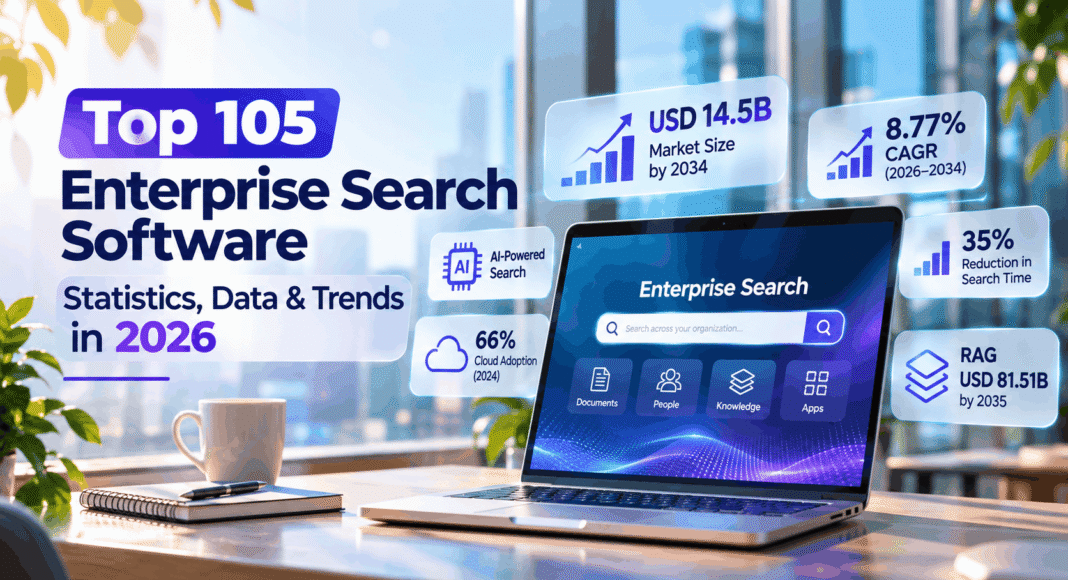
- Enterprise Search Software Market Growth: The global enterprise search market is projected to grow from USD 6.7 billion in 2025 to USD 14.5 billion by 2034, driven by digital transformation, cloud adoption, and intelligent information retrieval.
- AI-Powered Enterprise Search and RAG Adoption: Generative AI, semantic search, natural language processing (NLP), and retrieval-augmented generation (RAG) are transforming enterprise search, with the RAG market projected to reach USD 81.51 billion by 2035.
- Employee Productivity and Enterprise Search Trends: Knowledge workers spend approximately 1.8–2.5 hours daily searching for information, while effective enterprise search and knowledge management solutions can reduce search time by up to 35%, improving efficiency and collaboration.
Enterprise search software is transforming how businesses access and manage information in 2026. The global enterprise search market is projected to reach USD 14.5 billion by 2034, driven by AI-powered search, cloud adoption, and knowledge management demands. Explore 105 enterprise search software statistics covering market growth, productivity, AI adoption, and emerging industry trends.
Enterprise search software is transforming how businesses discover, access, and manage information across increasingly complex digital environments. As organizations generate enormous volumes of structured and unstructured data, traditional keyword-based search tools are giving way to AI-powered enterprise search solutions that leverage artificial intelligence, natural language processing (NLP), semantic search, and retrieval-augmented generation (RAG). In 2026, enterprise search technology has become an increasingly important component of digital transformation, knowledge management, employee productivity, and enterprise AI adoption.
Also, read our article on the Top 10 Enterprise Search Software To Use.
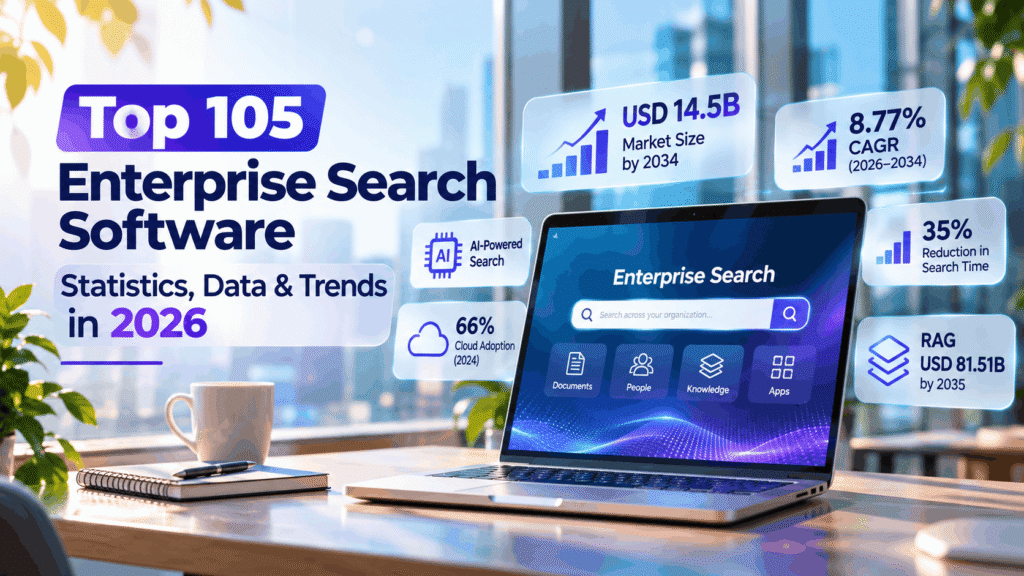
The global enterprise search market is experiencing significant growth, reflecting rising demand for intelligent information retrieval and knowledge discovery. According to industry research, the enterprise search market was valued at approximately USD 6.7 billion in 2025 and is projected to reach USD 14.5 billion by 2034, representing a compound annual growth rate (CAGR) of 8.77%. Meanwhile, alternative market forecasts estimate that the industry could expand from USD 5.83 billion in 2026 to USD 12.71 billion by 2035. Although market estimates vary depending on research methodologies and software category definitions, they consistently indicate sustained investment in enterprise search platforms.
One of the most influential enterprise search software trends in 2026 is the rapid integration of generative AI and retrieval-augmented generation. The global RAG market is projected to grow from USD 3.33 billion in 2026 to USD 81.51 billion by 2035, highlighting the increasing importance of AI systems that retrieve relevant organizational information before generating contextual responses. Businesses are adopting hybrid search architectures that combine keyword matching, semantic understanding, vector databases, and conversational AI to improve search accuracy, accelerate knowledge discovery, and support AI-powered assistants and autonomous agents.

Employee productivity is another major driver of enterprise search software adoption. Research cited in the industry indicates that knowledge workers can spend approximately 1.8 to 2.5 hours daily searching for information, while effective knowledge management and search capabilities have been associated with reductions in information retrieval time of up to 35%. For enterprises managing thousands of employees, improving access to internal documents, policies, customer records, technical documentation, and institutional knowledge can translate into substantial operational efficiencies and reduced administrative workloads.
Enterprise search adoption is also evolving across industries and geographic markets. North America remains a leading market, while Asia-Pacific is emerging as one of the fastest-growing regions. Large enterprises account for a substantial share of enterprise search spending, although small and medium-sized businesses are increasingly adopting cloud-based solutions as subscription pricing and managed AI services make advanced search technology more accessible. At the same time, organizations in banking, healthcare, government, manufacturing, and technology are prioritizing secure, permission-aware search capabilities to meet regulatory requirements and protect sensitive information.
Looking ahead, the convergence of enterprise search, knowledge graphs, generative AI, and agentic AI is expected to redefine how organizations interact with business information. Leading enterprise search software providers, including Glean, Elastic, Coveo, Sinequa, Microsoft, and OpenText, are advancing capabilities such as conversational search, intelligent recommendations, federated data retrieval, and enterprise-wide knowledge integration. However, data governance, integration complexity, information security, and search relevance remain important considerations for businesses evaluating these platforms.
This comprehensive guide to the Top 105 Enterprise Search Software Statistics, Data & Trends in 2026 examines the latest market size estimates, growth forecasts, AI adoption trends, deployment models, productivity benchmarks, industry applications, regional developments, and emerging technologies shaping the enterprise search software market. These statistics provide business leaders, CIOs, IT professionals, software vendors, investors, and digital transformation teams with valuable insights into the opportunities, challenges, and future direction of enterprise search technology in 2026 and beyond.
Before we venture further into this article, we would like to share who we are and what we do.
About 9cv9
9cv9 is a business tech startup based in Singapore and Asia, with a strong presence all over the world.
With over ten years of startup and business experience, and being highly involved in connecting with thousands of companies and startups, the 9cv9 team has listed some of the top and best companies/tools in this review.
If you like to get your company listed in our top B2B software reviews, check out our world-class 9cv9 Media and PR service and pricing plans here.
Top 105 Enterprise Search Software Statistics, Data & Trends in 2026
🌐 Market Size & Growth
1. The global enterprise search market was valued at USD 6.7 billion in 2025, reflecting surging organizational demand for AI-driven data retrieval solutions across industries.
→ As enterprise data volumes grow exponentially, businesses that invest in enterprise search software early gain a measurable competitive edge in knowledge accessibility and decision speed.
2. The enterprise search market is projected to reach USD 14.5 billion by 2034, expanding at a CAGR of 8.77% from 2026 to 2034.
→ This decade-long growth trajectory confirms that enterprise search software is transitioning from a productivity tool to a strategic infrastructure investment.
3. Market Research Future (MRFR) estimates the enterprise search software market at USD 5.79 billion in 2024, growing to USD 12.86 billion by 2035 at a 7.52% CAGR.
→ Organizations evaluating enterprise search in 2026 are entering a market that will more than double in value over the next decade, making platform selection a long-term strategic decision.
4. Precedence Research calculated the global enterprise search market at USD 5.34 billion in 2025, reaching USD 5.83 billion in 2026 and growing to USD 12.71 billion by 2035 at 9.05% CAGR.
→ The consistency across multiple analyst forecasts underscores the reliability of enterprise search as a growth category, making it a compelling investment priority for CIOs and CDOs.
5. Enterprise Search Platform market size stood at USD 5.2 billion in 2024 and is forecast to reach USD 12.3 billion by 2033, registering a 10.3% CAGR from 2026 to 2033.
→ Double-digit CAGR signals that enterprises are moving beyond passive search to active, AI-powered knowledge discovery as a core operational capability.
6. MarkNtel Advisors valued the global enterprise search market at USD 4.98 billion in 2024, expected to reach USD 7.87 billion by 2030 at a ~7.92% CAGR.
→ Even conservative estimates from multiple research firms agree on sustained multi-year growth, validating enterprise search as a mature yet rapidly evolving software category.
7. The enterprise search software segment (narrower definition) was valued at USD 877.13 million in 2026 and is projected to reach USD 2.29 billion by 2035 at a 9% CAGR.
→ Even in its narrower software-only definition, the market nearly triples in value over 10 years — making it one of the more reliable investment areas in the broader knowledge management landscape.
8. Global Growth Insights estimated the enterprise search software market at USD 804.71 million in 2024, growing to USD 877.12 million in 2025 and USD 1.75 billion by 2033 at 9.0% CAGR.
→ This segment represents a high-growth niche within the broader knowledge management ecosystem, presenting opportunities for both vendors and enterprise technology buyers.
9. Business Research Insights valued the enterprise search software market at USD 0.68 billion in 2023, growing from USD 0.74 billion in 2024 to USD 1.49 billion by 2032 at a 12.8% CAGR.
→ The accelerating CAGR signals that adoption is reaching an inflection point as AI capabilities embedded in search platforms begin delivering measurable, quantifiable ROI.
10. The enterprise search marketing software market is valued at approximately USD 0.54 billion in 2026, projected to reach USD 1.37 billion by 2035 at ~11% CAGR.
→ The blending of search intelligence with marketing automation is creating a new hybrid category that enables personalized, search-driven customer acquisition at enterprise scale.
☁️ Deployment Mode
11. Cloud-based deployment commanded 66% of the enterprise search market share in 2024 and is expected to grow at a 19.9% CAGR through 2030.
→ Cloud-first enterprise search is no longer optional — it is the default choice for organizations that need elastic scalability, AI compute access, and seamless SaaS integration without capital expenditure.
12. Cloud-based enterprise search solutions account for 60% of the overall market in 2024, driven by flexibility, scalability, and cost-effectiveness.
→ For HR, IT, and legal teams increasingly operating in hybrid work environments, cloud-based enterprise search ensures consistent, permission-aware access to organizational knowledge anywhere.
13. The on-premises segment still holds a notable 30–34% market share (2026–2035), driven by BFSI, government, and healthcare organizations requiring data sovereignty.
→ Regulated industries such as banking and defense will continue to anchor on-premises enterprise search deployments, creating a durable revenue base for hybrid-capable vendors like Sinequa.
14. Amazon OpenSearch Service users report 65% lower operational overhead with auto-scaling and built-in ML compared to traditional on-premises search infrastructure.
→ The total cost of ownership advantage of cloud-native enterprise search is now quantified — making it exceptionally difficult for on-premises solutions to compete on cost efficiency alone.
15. Hybrid deployment models are emerging as a popular choice, combining cloud agility with on-premises data control for organizations with mixed regulatory requirements.
→ The rise of hybrid enterprise search architectures reflects the reality of most large organizations: some data can move to the cloud, while sensitive records require on-site governance.
🔍 Search Technology & Types
16. Keyword-based search held 41.6% of enterprise search revenue share in 2024, remaining the dominant search paradigm despite rapid disruption from AI.
→ While keyword search still generates the largest revenue share, its declining growth rate signals a generational shift — enterprises that delay migrating to semantic search risk falling behind in knowledge accessibility.
17. Conversational and NLP-based enterprise search is growing at a 21.2% CAGR through 2030, making it the single fastest-growing search technology segment.
→ The explosive growth of NLP search reflects a workforce that increasingly expects to query organizational knowledge in plain language, the same way they interact with consumer AI assistants.
18. Voice search accounted for over 50% of all searches in 2024, underscoring the rapid normalization of multimodal enterprise search capabilities.
→ Enterprise search platforms that support voice queries are eliminating the friction of manual document retrieval — a particularly transformative capability for field workers and hands-free operational environments.
19. Semantic and vector search holds approximately 22% of search technology revenue and is growing rapidly, enabling concept-based rather than keyword-based retrieval.
→ Semantic enterprise search can surface a document titled “2024 Employee Handbook” when an employee searches “annual leave policy” — closing the critical relevance gap that kills user adoption.
20. Federated search accounts for roughly 12% of the enterprise search market, enabling simultaneous querying across multiple disconnected data repositories.
→ Federated enterprise search is the connective tissue for organizations with fragmented IT estates, allowing employees to search across CRM, ERP, email, and document systems with a single query.
21. Multimodal search (text, voice, image, and video) currently holds approximately 6.4% revenue share but is projected to grow at a 25% CAGR through 2030.
→ As enterprises unlock dormant audio, video, and image archives through multimodal AI search, entire new categories of institutional knowledge become searchable and operationally valuable.
22. Hybrid search stacks — combining keyword, semantic, and vector retrieval in one pipeline — are becoming the de facto architecture for enterprise AI search in 2026.
→ Gartner explicitly notes that hybrid search enables “a deeper understanding of user intent and semantic relationships,” making it the minimum viable architecture for competitive enterprise search deployments.
🤖 AI & RAG
23. The global Retrieval-Augmented Generation (RAG) market was valued at USD 2.33 billion in 2025, expected to reach USD 3.33 billion by 2026 and USD 81.51 billion by 2035 at a 42.7% CAGR.
→ RAG is the fastest-growing component of the enterprise search ecosystem, transforming static document retrieval into dynamic, AI-generated answers grounded in verified organizational knowledge.
24. The RAG market is projected to expand from USD 1.94 billion in 2025 to USD 9.86 billion by 2030, at a 38.4% CAGR according to MarketsandMarkets.
→ Enterprises that adopt RAG-powered search today are building a durable AI advantage — these systems improve continuously as they index more organizational data and learn from user interactions.
25. 80.5% of enterprise RAG implementations rely on standard retrieval frameworks such as FAISS or Elasticsearch, cementing these as the backbone of production enterprise search.
→ Elasticsearch’s dominance as the enterprise RAG retrieval layer means that investments in Elastic infrastructure directly enable next-generation AI search capabilities without rearchitecting from scratch.
26. 63.6% of enterprise RAG deployments utilize GPT-based models as the underlying language model, reflecting OpenAI’s early-mover advantage in enterprise AI infrastructure.
→ While GPT dominates today, enterprises building search infrastructure should architect for model-agnosticism to leverage future improvements in open-source and specialized enterprise LLMs.
27. Organizations implementing RAG report 25–30% reductions in operational costs and 40% faster information discovery alongside improvements in decision-making quality.
→ These are not theoretical projections — RAG’s ROI is measurable at the task level, making it one of the easiest enterprise AI investments to justify to CFOs and boards.
28. By 2028, 60% of organizations will have more than six enterprise AI search platforms deployed across the business, according to Gartner’s Market Guide for Enterprise AI Search (September 2025).
→ Platform sprawl is both a challenge and an opportunity — organizations that consolidate around a unified enterprise search architecture will outperform those managing fragmented point solutions.
29. Gartner identifies enterprise AI search as “a key technology for developing AI assistants and AI agents that scale to enterprise needs using RAG,” marking it as critical infrastructure for the agentic AI era.
→ Enterprise search is no longer a standalone productivity tool — it is the cognitive infrastructure that enables AI agents to reason, retrieve, and act with accuracy across organizational knowledge.
30. Microsoft introduced CoRAG (Chain-of-Retrieval Augmented Generation) in February 2025, enabling iterative multi-step retrieval and reasoning rather than a single retrieval step for complex queries.
→ Iterative retrieval architectures represent a significant leap in enterprise search quality, enabling systems to refine their understanding of complex organizational queries through multiple retrieval cycles.
31. Google launched the general availability of Vertex AI RAG Engine in January 2025, providing enterprises with a fully managed service to deploy RAG pipelines at scale.
→ Hyperscaler-managed RAG services are dramatically lowering the barrier to enterprise AI search adoption, allowing organizations without specialized ML teams to deploy production-grade search intelligence.
32. OpenAI released new Tools for Building Agents with query optimization and reranking in its Responses API in March 2025, enabling powerful RAG pipelines without additional tuning overhead.
→ The commoditization of RAG pipeline tooling means the competitive differentiator for enterprise search is increasingly data quality and governance, not raw AI capability.
33. By 2028, over 1.3 billion AI agents will be operating globally in enterprises, according to Microsoft — all requiring robust enterprise search infrastructure to function accurately and safely.
→ Every AI agent deployed without reliable enterprise search access is a potential hallucination risk; organizations must treat search infrastructure as foundational safety infrastructure for agentic AI.
34. As of 2025–2026, RAG has moved into a Modular and Agentic phase where systems are iterative and self-correcting, with Self-RAG and Corrective RAG (CRAG) models now in production.
→ The shift from static to self-correcting RAG represents a qualitative leap in enterprise search reliability, significantly reducing the hallucination risks that previously limited AI adoption in high-stakes workflows.
35. Gartner states that “current RAG-based AI assistants often underperform when scaled across diverse enterprise information, primarily due to issues with data source quality and retrieval relevancy mechanisms.”
→ This finding is a critical warning for enterprise search buyers: AI search quality is only as good as the underlying data governance — organizations must invest in data quality alongside search infrastructure.
📈 Productivity & ROI
36. According to IDC, knowledge workers spend approximately 2.5 hours per day — 30% of the workday — on information retrieval activities including searching, requesting, waiting, and verifying.
→ At even modest hourly rates, 2.5 hours of daily search friction per knowledge worker represents tens of thousands of dollars in annual productivity loss per employee — making enterprise search ROI highly quantifiable.
37. Interact Research found that 19.8% of business time — the equivalent of one full working day per week — is wasted by employees searching for information they need to do their jobs.
→ This “fifth employee” problem — where one in five employees effectively does nothing but search for answers — is the single most compelling business case for enterprise search investment.
38. McKinsey found that organizations with strong knowledge management and enterprise search systems can reduce search time by up to 35% and boost organizational productivity by 20–25%.
→ A 20–25% productivity improvement equates to recovering approximately one full working day per employee per week — an ROI that dwarfs the cost of even the most sophisticated enterprise search platform.
39. Knowledge workers still spend 1.8 hours every day searching for information, according to McKinsey — a persistent productivity drain that AI-powered enterprise search is purpose-built to address.
→ Despite decades of investment in knowledge management tools, the search problem remains largely unsolved for most enterprises, creating a massive and still-addressable market opportunity.
40. A Slite survey of 100+ global knowledge workers found that teams lose an entire month of productive time every year to fragmented information search across disconnected tools.
→ The lost-month metric is a powerful executive-level framing for enterprise search ROI — for a 1,000-person organization, that’s 1,000 person-months of recoverable productivity per year.
41. 73% of organizations surveyed by Slite do not have a dedicated enterprise search tool, relying instead on fragmented manual search across Slack, Drive, and knowledge bases.
→ The vast majority of enterprises are still operating without purpose-built search — which means the market penetration opportunity for enterprise search vendors is still enormous heading into 2026.
42. Enterprise search can reduce time spent searching by up to 30% and is associated with approximately a 20% lift in productivity across measured deployments, according to Coworker AI analysis.
→ These benchmarks give IT and HR teams concrete KPIs to propose when building the business case for enterprise search procurement and implementation.
43. Over 70% of organizations report improved productivity after implementing enterprise search solutions, though those gains rarely sustain without ongoing relevance measurement and governance.
→ Deployment is the beginning, not the end — enterprises that treat enterprise search as a product requiring continuous investment consistently outperform those that treat it as a one-time implementation.
44. 51% of organizations say they would benefit from a visual diagram and search capability to better deliver information across their enterprise, per KMWorld Survey.
→ Visual enterprise search — combining graphical knowledge maps with text retrieval — is an emerging frontier that addresses how people actually think about and navigate complex organizational information.
45. 58% of organizations say their training processes could be accelerated from a visual diagram or search capability embedded in their knowledge management workflows.
→ Enterprise search integrated directly into learning and development workflows has the potential to cut onboarding time dramatically, particularly in complex technical and regulated industries.
46. 48% of executives and managers agree that employees take critical procedural knowledge with them when they leave the company, highlighting the urgency of enterprise search for knowledge continuity.
→ Knowledge continuity risk is a board-level concern — enterprise search that systematically captures, indexes, and surfaces institutional knowledge is a strategic hedge against employee turnover.
🏭 Industry Verticals
47. BFSI captured 18.5% of enterprise search market revenue in 2024, as banks and insurers use search to mine logs for risk signals, fraud detection, and compliance reporting.
→ In financial services, where milliseconds and regulatory precision matter, enterprise search that can instantly surface compliance-relevant documents across millions of records is a non-negotiable capability.
48. Healthcare and Life Sciences is the fastest-growing vertical at 19.6% CAGR through 2030, with AI search shortening drug development cycles and surfacing hidden patient insights.
→ Enterprise search in pharma and clinical research is directly accelerating innovation timelines — the ability to instantly cross-reference trial data, literature, and regulatory history creates measurable R&D advantages.
49. IT & Telecom holds approximately 16% of enterprise search market revenue, growing at a 16.5% CAGR driven by complex multi-system environments requiring intelligent code and documentation search.
→ Engineering teams that deploy AI-powered code and documentation search report dramatic reductions in ramp-up time for new developers and significant cuts in duplicate work across distributed teams.
50. Retail and E-Commerce accounts for approximately 10.5% of enterprise search market revenue, growing at 15% CAGR as brands leverage search intelligence to improve both internal operations and customer experiences.
→ Enterprise search in retail bridges the gap between internal product knowledge and customer-facing search, enabling merchandising teams to optimize search relevance based on real-time behavioral data.
51. Government is estimated at 9.5% of enterprise search market share, with FedRAMP and ISO 27017 certifications growing at a 22% annual rate as agencies modernize classified and public document retrieval.
→ Government adoption of AI-powered enterprise search remains constrained by procurement cycles and security certification requirements, but once cleared, deployments tend to be large, long-term, and high-value.
52. Manufacturing accounts for approximately 8.5% of market revenue and is growing at 13.5% CAGR, with enterprise search enabling faster access to maintenance manuals, engineering specs, and supply chain data.
→ In manufacturing, where equipment downtime costs can reach thousands of dollars per minute, enterprise search that instantly surfaces relevant repair documentation and supplier contacts delivers direct financial value.
🌍 Regional Analysis
53. North America dominated with 37.5% of enterprise search market revenue in 2024, driven by advanced IT infrastructure, high cloud adoption, and the presence of major search technology companies.
→ North America’s market leadership reflects decades of enterprise software innovation, but the real growth story heading into 2030 is the catching-up of Asia-Pacific and emerging markets.
54. The North America enterprise search market was USD 2.08 billion in 2025, projected to reach USD 5.02 billion by 2035 at a 9.21% CAGR.
→ Even in the most mature market globally, enterprise search is nearly tripling in value over the next decade — a testament to how much unmet demand still exists within North American enterprises.
55. Asia-Pacific is the fastest-growing regional market at 16.4% CAGR (2026–2035), fuelled by accelerating digital transformation, expanding data infrastructure, and demand for localized AI search.
→ For enterprise search vendors, APAC represents the highest-growth expansion opportunity of the next decade — particularly for platforms that support multilingual retrieval across diverse Asian languages.
56. Europe accounts for approximately 27–30% of global enterprise search market revenue, driven by GDPR compliance requirements that make secure, governed enterprise search a regulatory necessity.
→ European enterprise search adoption is uniquely compliance-driven — organizations that can demonstrate GDPR-aligned data governance and auditability have a structural advantage in winning European deployments.
57. Middle East & Africa holds approximately 5% of enterprise search market revenue but is experiencing steady growth, particularly as Gulf state governments invest in digital transformation initiatives.
→ MEA’s enterprise search market is early-stage but strategic — organizations that establish search infrastructure now will be well-positioned as AI adoption accelerates across the region.
58. Latin America represents approximately 8% of market share, with growing demand from financial services and retail sectors seeking to manage rapidly expanding data volumes.
→ Latin America’s enterprise search market is being driven by a handful of high-data-volume industries, creating concentrated but high-value opportunities for vendors with regional language and compliance capabilities.
🏢 Enterprise Size Segmentation
59. Large enterprises held 70.3% of enterprise search market revenue in 2024 (some estimates: 70.9% in 2025), driven by greater data complexity and larger IT budgets.
→ Large enterprise dominance is structural — complex, multi-system data environments create an acute need for intelligent search that smaller organizations can still avoid through manual workarounds.
60. SMEs are the fastest-growing enterprise segment at 16.4% CAGR through 2030, enabled by cloud-based, pay-as-you-use pricing that eliminates the need for in-house ML teams.
→ The democratization of enterprise-grade AI search through SaaS pricing models is one of the most important structural shifts in the market — SMEs that adopt early will close the knowledge management gap with larger competitors.
61. OECD research shows 57% of SMEs see AI’s upside, but only 26% currently use AI — suggesting significant runway for enterprise search adoption among the SME segment.
→ The AI awareness-to-adoption gap among SMEs represents the largest untapped growth pool in enterprise search — vendors with intuitive, low-friction onboarding experiences will capture this market.
62. Enterprise search deployment costs for professional services engagements typically range from USD 0.5 million to USD 5 million, covering design, rollout, and continuous improvement.
→ The wide service cost range reflects the heterogeneity of enterprise environments — organizations with modern, well-documented data architectures will deploy faster and cheaper than those managing legacy debt.
63. Many CRM and content management systems lack modern APIs, stretching enterprise search deployment timelines to 6–18 months and significantly raising professional services costs.
→ Legacy system integration is the most common cause of enterprise search project delays — organizations that invest in API modernization before search deployment dramatically compress time-to-value.
📊 Data & Knowledge Management Context
64. Organizations generate 2.5 quintillion bytes of data each day, with an estimated 80% unstructured — spanning documents, email, audio, and video — all requiring intelligent indexing.
→ The scale of daily data generation makes manual knowledge management physically impossible — AI-powered enterprise search is the only scalable solution to the structured/unstructured data retrieval challenge.
65. IDC predicts that by 2025, unstructured data will account for 80% of all enterprise knowledge, creating both a massive challenge and a primary growth driver for enterprise search.
→ With four-fifths of organizational knowledge locked in unstructured formats, enterprises that deploy AI-powered enterprise search gain access to a largely untapped competitive intelligence resource.
66. Search time still consumes 20–30% of employee hours despite decades of knowledge management investment, according to Microsoft’s analysis of enterprise data usage patterns.
→ Even in organizations with mature knowledge management systems, one-quarter of employee time is consumed by search — quantifying both the scale of the problem and the size of the prize for effective enterprise search.
67. The global knowledge management software market was valued at USD 23.2 billion in 2025 and is projected to reach USD 74.22 billion by 2034, growing at a 13.8% CAGR.
→ Enterprise search is the discovery layer of the knowledge management stack — as KM investment surges, demand for intelligent search interfaces to navigate those knowledge repositories will grow in parallel.
68. A McKinsey study found that organizations with effective KM can reduce time lost to information search by up to 35% and achieve a 20–25% productivity boost — the equivalent of gaining a full productive day per employee weekly.
→ Framed differently, a 1,000-person organization that achieves a 20% productivity gain through enterprise search effectively operates with the output of 1,200 people without adding headcount.
69. Research indicates that over 70% of large enterprises have already implemented at least one knowledge management system, but adoption does not equal effectiveness without strong search layers.
→ The gap between having a KM system and having an effective one is primarily a search quality problem — organizations with extensive KM investments but weak search see minimal productivity returns.
70. Gartner reports that 80% of data and analytics innovations now use graph technologies, up from just 10% a few years ago — with knowledge graphs powering the next generation of contextual enterprise search.
→ Knowledge graph adoption is a leading indicator of enterprise search maturity — organizations building graph-based search architectures are laying the foundation for AI-powered knowledge retrieval at scale.
71. Between 60% and 73% of all data within corporations is never analyzed for insights or trends, while 52% of stored information is of unknown value, per Forrester and Veritas research.
→ Enterprise search that can classify, surface, and make sense of “dark data” — the majority of organizational data that is never accessed — represents one of the highest-ROI opportunities in enterprise software.
72. 93% of enterprises report storing data in more than one location, making unified enterprise search a critical tool for navigating fragmented, multi-cloud data environments.
→ Multi-cloud data fragmentation is not going away — enterprise search platforms that federate across cloud storage, on-premises systems, and SaaS applications will win the consolidation market.
🛡️ Security, Compliance & Governance
73. Approximately 15% of organizations cite data privacy concerns as a significant challenge in enterprise search deployment, particularly in BFSI and healthcare sectors.
→ Privacy-preserving enterprise search — with granular permission controls, audit trails, and GDPR/HIPAA compliance — is not a differentiator but a mandatory requirement for adoption in regulated industries.
74. 82% of enterprises identify compliance management as one of the top three priorities in their overall cloud strategy, directly impacting enterprise search platform selection.
→ Enterprise search platforms that can demonstrate regulatory alignment — including data residency controls, access logging, and compliance reporting — will have a structural advantage in the majority of enterprise sales.
75. Enterprises integrating compliance and security analytics into a unified platform experience 30% fewer regulatory violations, per cloud compliance research.
→ The compliance dividend from integrated enterprise search and governance platforms is quantifiable — and a powerful argument for replacing siloed point solutions with unified search-and-compliance architectures.
76. The global cloud compliance market is projected to reach USD 73 billion by 2030 at a 17% CAGR, with enterprise search compliance capabilities becoming a standard procurement criterion.
→ As cloud compliance spending surges, enterprise search vendors that embed compliance features natively — rather than requiring third-party integration — will command premium pricing and customer loyalty.
77. 71% of organizations had a data governance program in place in 2024, up from 60% in 2023 — and 62% cite data governance as one of the top challenges when deploying AI in their knowledge systems.
→ Data governance maturity is the single biggest predictor of enterprise AI search success — organizations that have invested in governance before deploying AI search deploy faster and achieve better relevance outcomes.
78. Average breach penalties under GDPR enforcement increased by 18% year-over-year in 2025, creating strong regulatory tailwinds for secure, compliant enterprise search solutions.
→ The escalating cost of GDPR non-compliance is effectively subsidizing investment in compliant enterprise search — organizations that fail to implement governed search infrastructure face significant regulatory exposure.
79. Sovereign cloud solution adoption increased by 33% in 2025, particularly in Europe and the Middle East, where data residency requirements are reshaping enterprise search architecture decisions.
→ Sovereign cloud requirements are fragmenting the global enterprise search market in ways that favor vendors with flexible, regionally deployable architectures over cloud-only solutions.
80. Financial institutions report the highest compliance maturity, with 84% achieving full regulatory alignment across cloud workloads — driving early adoption of sophisticated enterprise search compliance features.
→ The financial services sector is the de facto proving ground for enterprise search compliance capabilities — platforms that win BFSI deals have effectively certified their security and governance for all regulated industries.
🤝 Workforce & Cultural Impact
81. 91% of businesses reported using AI in at least one capacity in 2026, up from 78% in 2024 and 55% in 2023, creating surging demand for AI-powered enterprise search to manage expanding AI outputs.
→ As organizations deploy more AI, they generate more AI-created content that requires intelligent indexing — making enterprise search the infrastructure backbone of the entire enterprise AI ecosystem.
82. Worker access to AI rose by 50% in 2025, with Deloitte’s survey of 3,235 global leaders confirming a step-change in AI tool availability across enterprise workforces.
→ Rapid AI democratization is creating a growing expectation among knowledge workers that enterprise search should be as intuitive and accurate as consumer AI assistants like ChatGPT or Perplexity.
83. Enterprise AI users report saving 40–60 minutes per day, with AI-powered search enabling completion of new technical tasks like data analysis and coding that previously required specialist skills.
→ The daily time savings from AI-powered enterprise search compound dramatically at scale — for a 10,000-person enterprise, 50 minutes per employee per day represents 125,000 hours of recovered capacity monthly.
84. 66% of organizations report gaining productivity and efficiency benefits from enterprise AI adoption, per Deloitte’s 2025 State of AI report — with enterprise search as a primary driver of those gains.
→ The productivity dividend from AI is now widely recognized, but the organizations achieving the highest gains consistently combine AI tools with strong enterprise search infrastructure for reliable knowledge retrieval.
85. 56% of US employees now use generative AI tools for work tasks, with 31% using AI regularly, creating a demand-pull from the workforce for enterprise-grade AI search capabilities.
→ Bottom-up AI adoption is forcing enterprise IT teams to respond — organizations that fail to provide sanctioned, secure enterprise search risk employees relying on consumer AI tools to fill the gap.
86. Companies that redesign work processes with AI are twice as likely to exceed revenue goals, according to Gartner’s 2025 survey of 1,973 managers — with enterprise search infrastructure enabling that redesign.
→ Enterprise search is not just a productivity tool — it is increasingly a strategic enabler for the AI-driven business process redesign that separates market leaders from market followers.
87. Regular AI usage jumped 13% to reach 45% of workers in 2026 per ManpowerGroup’s Global Talent Barometer, confirming that AI-assisted search is becoming a standard workplace behaviour.
→ With nearly half of all workers regularly using AI tools, enterprises that fail to provide governed, AI-powered search solutions will find employees relying on unauthorized tools with significant data governance risks.
88. Only 34% of organizations are truly reimagining their business through AI according to Deloitte, while the majority focus narrowly on efficiency — highlighting missed value from advanced enterprise search.
→ Organizations that deploy enterprise search as a strategic capability — enabling AI agent workflows, knowledge graph construction, and institutional memory — capture significantly more value than those using it merely for document retrieval.
🏆 Competitive Landscape
89. There are more than 3 million enterprise search tools available globally, including Glean, Coveo, Algolia, Elastic, Sinequa, Guru, and Microsoft Copilot — reflecting a highly fragmented but rapidly consolidating market.
→ Market fragmentation creates significant evaluation complexity for enterprise buyers — organizations that invest in rigorous vendor assessment based on connector depth, AI maturity, and security certifications will make far more durable decisions.
90. Glean’s Enterprise Graph connects over 100+ business applications with AI-generated answers, personalization, and real-time indexed results — making it the benchmark for pure enterprise workplace search.
→ Glean’s graph-based approach represents a fundamental architectural shift from document-centric to relationship-centric enterprise search, enabling discovery of information connections that keyword search entirely misses.
91. Sinequa supports 200+ connectors and advanced NLP across 22+ languages, with HIPAA, SOC 2, and GDPR certifications — making it the specialist platform for regulated, multilingual enterprise environments.
→ For global enterprises in life sciences, defense, and financial services, Sinequa’s combination of regulatory certifications and multilingual depth is a decisive differentiator that cloud-only competitors cannot easily replicate.
92. OpenText’s USD 5.8 billion FY2024 revenue reflects the scale of middleware and connector demand as enterprises struggle to integrate legacy content management systems with modern search platforms.
→ OpenText’s massive revenue is a proxy for the enormous integration costs enterprises face when modernizing their content architecture — a strong signal of the total addressable market for enterprise search middleware.
93. Coveo excels in AI-driven personalized search for customer service portals, intranets, and e-commerce — using ML to anticipate queries based on historical user behaviour.
→ Coveo’s behavioural ML approach demonstrates that enterprise search can learn and adapt continuously, improving relevance without requiring manual relevance tuning from administrators.
94. Elastic (Elasticsearch) powers 80.5% of production RAG retrieval frameworks, cementing its position as the default infrastructure layer for enterprise AI search pipelines worldwide.
→ Elasticsearch’s dominance in RAG pipelines is a significant competitive moat — organizations that have already deployed it for search get RAG capabilities as a natural extension of existing infrastructure investment.
95. The knowledge management software market is projected to grow from USD 22.9 billion in 2025 to USD 81.9 billion by 2035 — enterprise search being the primary discovery interface for that expanding knowledge base.
→ Enterprise search vendors are positioned to capture a meaningful share of the KM market expansion as the discovery layer becomes the most strategically valuable component of any knowledge management stack.
96. Enterprise search adoption is projected to grow at a CAGR of 12% from 2020 to 2025 according to Coworker AI, reflecting accelerating enterprise digital transformation investment.
→ The sustained double-digit growth rate over a multi-year period confirms that enterprise search is not a cyclical technology trend but a structural shift in how organizations manage and access institutional knowledge.
🚀 Agentic AI & Future Trends
97. Gartner predicts that by 2028, 33% of enterprise software will include agentic AI — digital agents that handle complex tasks and make decisions — up from less than 1% in 2024.
→ The emergence of agentic AI makes enterprise search infrastructure mission-critical: agents that cannot reliably retrieve accurate organizational knowledge will make costly errors at machine speed.
98. 23% of organizations are actively scaling agentic AI systems across their enterprise, with an additional 39% experimenting with AI agents, per McKinsey’s 2025 State of AI report.
→ The rapid scaling of agentic AI without commensurate investment in enterprise search quality is one of the most significant operational risks facing enterprises in 2026 — agents are only as reliable as their knowledge retrieval.
99. Chief AI Officer (CAIO) roles are now present in 61% of enterprises, reflecting AI strategy moving from IT experimentation to board-level priority — and driving formal enterprise search procurement.
→ The institutionalization of the CAIO role means enterprise search is increasingly evaluated at the C-suite level as part of the organization’s overarching AI infrastructure strategy, not as a departmental IT tool.
100. 38% of knowledge management teams already use AI to recommend content or knowledge assets, per APQC, with enterprise search increasingly serving as the delivery mechanism for AI-driven knowledge recommendations.
→ AI-powered knowledge recommendation embedded in enterprise search is transforming passive document retrieval into proactive knowledge delivery — surfacing insights employees didn’t know they needed.
101. The RAG market’s 42.7% CAGR from 2026 to 2035 makes it the fastest-growing technology layer in the enterprise search stack — vendors that natively integrate RAG capabilities will dominate the next decade.
→ Enterprise search buyers evaluating platforms in 2026 should prioritize native RAG integration over bolt-on AI capabilities — the architectural difference between the two will define search quality for the next five to ten years.
102. Forrester Cognitive Search Wave (2025) positions cognitive search platforms as “the brains of accurate agentic AI,” reflecting a fundamental repositioning of enterprise search from utility to AI infrastructure.
→ Organizations that understand enterprise search as cognitive AI infrastructure — rather than simply a document finder — will make more strategic investments that yield compounding returns as their agentic AI footprints expand.
103. In Japan, Sega Sammy cut search error rates below 2% across 6,000 employees by pairing semantic embeddings with prompt engineering — demonstrating that conversational enterprise search is production-ready at scale.
→ Real-world case studies like Sega Sammy’s deployment prove that enterprise-grade conversational search accuracy is achievable today, removing the “not ready for production” objection from procurement conversations.
104. Enterprises using Amazon OpenSearch report 65% lower operational overhead, demonstrating the measurable infrastructure cost advantages of cloud-native enterprise search over on-premises alternatives.
→ The operational cost savings from cloud-native search infrastructure create a compelling quantitative argument for migration even for organizations with established on-premises search deployments.
105. Moveworks launched its Enterprise Search in October 2024, using generative AI and RAG to enable employees to locate essential information without interrupting their primary workflows.
→ The entry of employee experience platforms like Moveworks into enterprise search reflects the market’s convergence around “search as the universal interface” for all organizational knowledge access.
Conclusion
The Top 105 Enterprise Search Software Statistics, Data & Trends in 2026 highlight the growing importance of intelligent information retrieval, AI-powered knowledge management, and enterprise-wide data accessibility in today’s digital business environment. As organizations manage increasingly large volumes of structured and unstructured information, enterprise search software is evolving from a traditional document retrieval tool into a strategic technology that supports employee productivity, operational efficiency, data-driven decision-making, and artificial intelligence adoption.
The enterprise search software market is positioned for sustained expansion, with industry estimates valuing the global market at approximately USD 6.7 billion in 2025 and projecting growth to USD 14.5 billion by 2034, representing a compound annual growth rate (CAGR) of 8.77%. This growth reflects increasing enterprise investment in cloud-based search platforms, semantic search engines, natural language processing, and AI-driven knowledge discovery. While market forecasts vary across research providers, the overall outlook indicates continued demand for solutions that help businesses locate, organize, and utilize information more effectively.
One of the most significant enterprise search trends in 2026 is the integration of generative AI, retrieval-augmented generation (RAG), vector search, and conversational AI into enterprise search platforms. With the global RAG market projected to reach USD 81.51 billion by 2035, AI-powered information retrieval is becoming an important foundation for enterprise AI assistants and autonomous agents. These technologies enable organizations to move beyond traditional keyword searches toward context-aware responses, intelligent recommendations, and more sophisticated knowledge discovery capabilities.
The productivity benefits of enterprise search software also present a compelling business case for adoption. Research indicates that knowledge workers can spend between 1.8 and 2.5 hours per day searching for information, while effective knowledge management systems have been associated with reductions in search time of up to 35%. By improving access to internal documents, employee knowledge bases, customer information, technical resources, and organizational records, enterprise search solutions can help businesses reduce information silos, minimize repetitive tasks, and improve collaboration across departments.
At the same time, enterprise search adoption is expanding across industries and regions. North America continues to lead in market share, while Asia-Pacific represents a significant growth opportunity as businesses accelerate digital transformation initiatives. Industries such as banking, financial services, healthcare, government, manufacturing, and IT are increasingly recognizing the value of secure, scalable, and permission-aware enterprise search systems. Cloud-based deployment models are gaining traction, although hybrid and on-premises solutions remain important for organizations with strict data sovereignty, security, and regulatory compliance requirements.
Despite these opportunities, successful enterprise search implementation requires more than deploying advanced AI technology. Organizations must address challenges involving data quality, information governance, system integration, search relevance, cybersecurity, and user adoption. As enterprise data environments become more fragmented, businesses need search platforms capable of connecting multiple repositories while maintaining accurate results and appropriate access controls. Measuring search effectiveness, employee engagement, and return on investment will remain essential for maximizing long-term business value.
Looking toward 2027 and beyond, the convergence of enterprise search software with agentic AI, knowledge graphs, multimodal search, and automated business workflows is expected to create new opportunities for organizational intelligence. Enterprise search platforms will increasingly serve as the knowledge retrieval foundation for AI systems that can interpret complex questions, access relevant business information, and support decision-making across departments.
Ultimately, the 105 enterprise search software statistics and trends for 2026 demonstrate that intelligent search is becoming an increasingly important component of modern enterprise technology infrastructure. Businesses that prioritize scalable search architectures, strong data governance, AI integration, and measurable productivity improvements will be better positioned to unlock the value of their organizational knowledge.
As competition intensifies and enterprise data continues to expand, investing in effective enterprise search capabilities will be an important consideration for organizations seeking to improve operational performance, support digital transformation, and build a more intelligent, connected, and productive workforce.
If you find this article useful, why not share it with your hiring manager and C-level suite friends and also leave a nice comment below?
We, at the 9cv9 Research Team, strive to bring the latest and most meaningful data, guides, and statistics to your doorstep.
To get access to top-quality guides, click over to 9cv9 Blog.
To hire top talents using our modern AI-powered recruitment agency, find out more at 9cv9 Modern AI-Powered Recruitment Agency.
People Also Ask
What is enterprise search software?
Enterprise search software is a technology solution that helps organizations find, retrieve, and manage information across internal databases, documents, cloud applications, and knowledge repositories through a centralized search interface.
What is the global enterprise search software market size in 2026?
The global enterprise search market is estimated at approximately USD 5.83 billion in 2026, according to Precedence Research. Other market research firms report different estimates depending on their market definitions and methodologies.
How fast is the enterprise search software market growing?
The enterprise search market is projected to grow at a CAGR of 8.77% from 2026 to 2034, reaching approximately USD 14.5 billion by 2034. Growth is driven by AI adoption, cloud computing, and enterprise data management requirements.
What are the biggest enterprise search software trends in 2026?
Major enterprise search trends in 2026 include AI-powered search, retrieval-augmented generation (RAG), semantic search, vector databases, conversational AI, hybrid search architectures, and cloud-based knowledge management solutions.
How does AI improve enterprise search software?
Artificial intelligence improves enterprise search by understanding natural language queries, identifying contextual relationships, ranking relevant information, and generating answers based on organizational knowledge.
What is retrieval-augmented generation (RAG) in enterprise search?
Retrieval-augmented generation combines information retrieval with generative AI to produce responses grounded in relevant documents and data. RAG helps enterprise search platforms deliver contextual answers while reducing unsupported AI-generated information.
What is the projected RAG market size in 2026?
The global retrieval-augmented generation market is projected to reach approximately USD 3.33 billion in 2026 and USD 81.51 billion by 2035, reflecting increasing enterprise demand for AI-powered knowledge retrieval.
What is semantic search in enterprise search software?
Semantic search uses artificial intelligence and natural language processing to understand the meaning and context of search queries rather than relying exclusively on exact keyword matches.
What is the difference between enterprise search and traditional search?
Traditional search primarily matches keywords within individual systems. Enterprise search connects multiple business applications and data repositories, enabling employees to discover relevant information through centralized, permission-aware search capabilities.
How much time do employees spend searching for information?
Research cited in enterprise knowledge management studies suggests that knowledge workers spend approximately 1.8 to 2.5 hours daily searching for information, highlighting the productivity challenges associated with fragmented organizational data.
How does enterprise search software improve employee productivity?
Enterprise search software improves productivity by reducing information retrieval time, minimizing repetitive searches, and improving access to organizational knowledge. Effective knowledge management systems have been associated with search time reductions of up to 35%.
What are the benefits of enterprise search software for businesses?
Key benefits include faster information retrieval, improved employee collaboration, reduced knowledge silos, better decision-making, stronger information governance, and more efficient access to business-critical documents and data.
What percentage of enterprise search software is cloud-based?
Cloud-based enterprise search solutions accounted for approximately 60% to 66% of the market in 2024, according to estimates cited in industry research. Cloud adoption is supported by scalability, flexibility, and integration capabilities.
What is cloud-based enterprise search software?
Cloud-based enterprise search software enables organizations to index, search, and retrieve business information through cloud infrastructure without maintaining extensive on-premises search systems.
What is hybrid enterprise search?
Hybrid enterprise search combines cloud-based and on-premises search infrastructure, allowing organizations to access information across different environments while maintaining data security, regulatory compliance, and operational flexibility.
Which industries use enterprise search software the most?
Banking, financial services, insurance, healthcare, IT, telecommunications, retail, manufacturing, and government are major enterprise search users. Financial services accounted for approximately 18.5% of market revenue in 2024.
Which region dominates the enterprise search software market?
North America leads the global enterprise search market, accounting for approximately 37.5% of market revenue in 2024. Its leadership reflects advanced IT infrastructure, enterprise software adoption, and significant investment in AI technologies.
Which region has the fastest-growing enterprise search market?
Asia-Pacific is identified as one of the fastest-growing enterprise search markets, with a projected CAGR of approximately 16.4% from 2026 to 2035, supported by digital transformation and expanding enterprise technology investments.
What percentage of enterprise search revenue comes from large enterprises?
Large enterprises accounted for approximately 70.3% of global enterprise search market revenue in 2024, reflecting their complex information environments, substantial IT budgets, and demand for centralized knowledge management.
Are small businesses adopting enterprise search software?
Yes. Small and medium-sized enterprises are increasingly adopting cloud-based enterprise search solutions. The SME segment is projected to grow at approximately 16.4% annually through 2030 as accessible SaaS platforms reduce implementation barriers.
What are the best enterprise search software platforms in 2026?
Notable enterprise search platforms include Glean, Elastic, Coveo, Sinequa, Microsoft, OpenText, Algolia, and Guru. The most suitable solution depends on organizational requirements, AI capabilities, integrations, security, and deployment preferences.
How does enterprise search software support knowledge management?
Enterprise search supports knowledge management by indexing organizational documents, connecting information repositories, improving knowledge discovery, and helping employees access institutional expertise across departments.
What is federated search in enterprise software?
Federated search enables users to search multiple independent databases, applications, and information repositories through a single interface without necessarily consolidating all information into one centralized database.
What is vector search in enterprise AI search?
Vector search uses mathematical representations called embeddings to identify information based on semantic similarity. It helps enterprise AI search platforms retrieve contextually relevant documents even when search queries use different terminology.
How does enterprise search software support generative AI?
Enterprise search provides generative AI systems with access to relevant organizational information. Through RAG and semantic retrieval, AI assistants can generate more contextual responses based on business documents and knowledge repositories.
What are the biggest challenges in implementing enterprise search software?
Major implementation challenges include fragmented data sources, legacy system integration, data privacy, access permissions, search relevance, information governance, employee adoption, and ongoing maintenance costs.
How much does enterprise search software implementation cost?
Enterprise search implementation costs vary by organization size and technical complexity. The source data identifies professional services engagements ranging from approximately USD 500,000 to USD 5 million for complex enterprise deployments.
How does enterprise search software improve data security and compliance?
Enterprise search platforms support security and compliance through role-based access controls, permission-aware retrieval, audit logging, data governance policies, and deployment options designed for regulated business environments.
What role will agentic AI play in enterprise search software?
Agentic AI will increasingly rely on enterprise search to retrieve organizational knowledge, interpret complex requests, and support automated workflows. Gartner predicts that 33% of enterprise software will include agentic AI by 2028.
What is the future of enterprise search software beyond 2026?
Enterprise search is expected to evolve through generative AI, agentic AI, multimodal retrieval, knowledge graphs, and advanced semantic search. Future platforms will increasingly support intelligent knowledge discovery and automated business processes.
Sources
IMARC Group
Precedence Research
Market Research Future
Mordor Intelligence
Verified Market Reports
Global Growth Insights
Business Research Insights
Global Market Statistics
MarkNtel Advisors
Next Move Strategy Consulting
MarketsandMarkets
MDPI Applied Sciences
Glean
Gartner
GoSearch
Slite
Speakwise
livepro
Deloitte
OpenAI
AutoFaceless
Fullview
Federal Reserve
DataStack Hub
Coworker AI
Viewpoint Analysis
ChapsVision
Sinequa
Kore.ai
RAGFlow
Amazon Web Services
WebinarCare
Moveworks
DataIntelo
Yahoo Finance