



























Key Takeaways
- Salaries in Myanmar in 2026 are rising in nominal terms, but inflation and kyat depreciation mean real purchasing power for workers continues to decline.
- High-demand sectors such as IT, finance, and NGOs offer significantly higher salaries, while manufacturing, agriculture, and retail remain close to minimum wage levels.
- Skills, professional certifications, and regional benchmarking are critical for career growth, as talent migration and ASEAN wage gaps reshape Myanmar’s labor market.
Myanmar’s labor market in 2026 stands at a pivotal moment. For employers, professionals, investors, and policymakers, understanding salary trends in Myanmar is no longer just a matter of comparing job titles and pay scales. Instead, compensation has become deeply intertwined with economic stability, inflation, migration, infrastructure challenges, and global labor mobility. Any complete guide to salaries in Myanmar for 2026 must therefore go beyond simple wage figures and explore the broader forces shaping how people earn, spend, and build careers in the country.

Over the past decade, Myanmar’s salary landscape has undergone dramatic transformation. Nominal wages have risen across multiple sectors, minimum wage regulations have been adjusted several times, and professional salaries have expanded in areas such as technology, finance, and international development. However, these increases tell only part of the story. At the same time, the country has experienced significant inflation, currency depreciation, and economic disruptions that have eroded the real purchasing power of wages. As a result, the relationship between salaries and the cost of living has become increasingly complex.
For workers in Myanmar, the critical question is no longer simply “How much does a job pay?” but rather “What is the real value of that salary in today’s economy?” In many cases, workers earning higher nominal wages may still face declining living standards as essential costs such as housing, transportation, and food continue to rise. This gap between salary growth and purchasing power has become one of the defining economic realities of the Myanmar labor market in 2026.
At the same time, the country’s employment environment has become more segmented. Some sectors are experiencing strong demand for skilled professionals and offering competitive salaries, while others remain constrained by low productivity and minimum wage structures. The information technology industry, for example, has become one of the highest-paying sectors in Myanmar due to the growing need for digital infrastructure and the limited supply of experienced developers. Similarly, finance and compliance roles are increasingly valuable as organizations navigate complex regulatory and economic conditions.
In contrast, labor-intensive industries such as agriculture, garment manufacturing, and retail continue to operate close to the national minimum wage threshold. These sectors employ a large portion of the workforce, but salary growth remains limited. For many workers in these industries, rising costs of living have made it increasingly difficult to achieve financial stability.
Geography also plays a major role in shaping salary expectations across Myanmar. Yangon remains the country’s financial and commercial hub, offering the highest salary levels but also the highest living costs. Mandalay serves as a secondary economic center with slightly lower salaries and expenses, while Naypyidaw’s labor market is largely dominated by public sector employment and government-linked projects. Beyond these major cities, much of the workforce relies on agriculture, small businesses, and informal employment where wages are significantly lower.
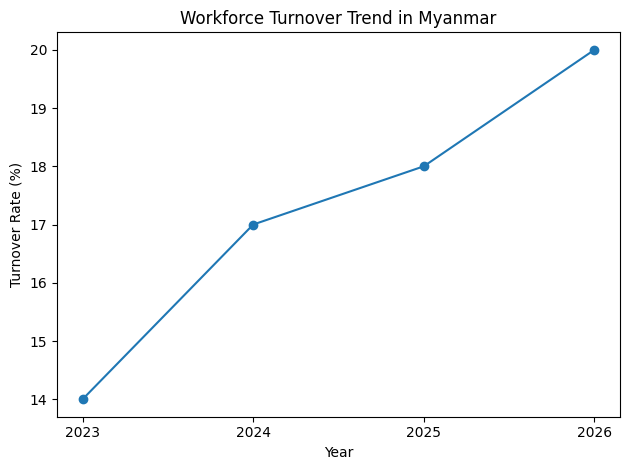
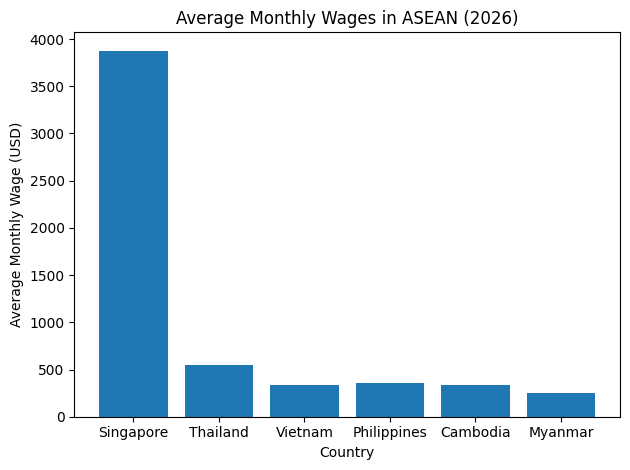
The influence of regional labor markets adds another layer of complexity. Myanmar now has one of the lowest average wage levels in Southeast Asia, which has historically helped attract labor-intensive investment. However, this wage gap has increasingly encouraged workers to migrate abroad in search of better opportunities. Skilled professionals in fields such as technology, healthcare, and engineering are often able to earn significantly higher salaries in neighboring countries such as Thailand, Malaysia, and Vietnam.
This migration trend has created a growing challenge for employers inside Myanmar. Companies across multiple industries report difficulty recruiting and retaining qualified professionals, particularly in mid-level management and technical roles. As a result, organizations are adopting new strategies such as skill-based hiring, flexible work arrangements, and compensation packages that include additional benefits beyond base salaries.
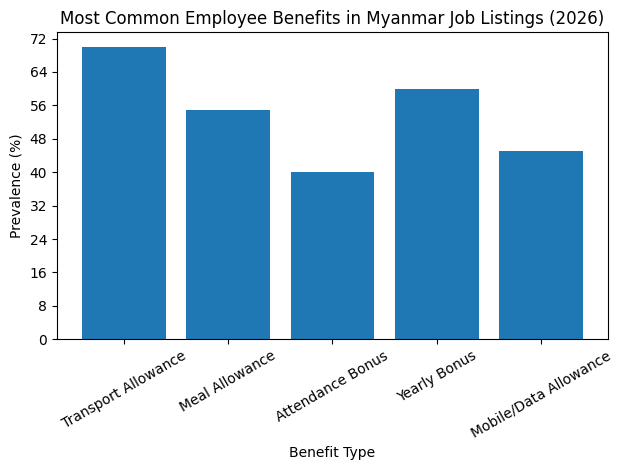
The concept of total rewards has therefore become increasingly important in the Myanmar job market. Instead of focusing solely on base pay, many employers now offer benefits designed to offset the rising cost of living. Transportation allowances, meal support, healthcare insurance, and communication stipends are commonly included in job offers to improve employee retention and financial wellbeing.
Education and professional credentials have also become powerful drivers of salary growth. Certifications such as CPA, ACCA, and technology credentials often command substantial salary premiums. Likewise, advanced degrees such as the MBA are increasingly viewed as indicators of management capability and leadership potential. Professionals who invest in these qualifications often gain access to higher-paying roles and better career mobility.
For individuals entering the workforce or considering career changes, understanding these dynamics is essential. Salary levels are influenced not only by industry and experience but also by factors such as education, location, certifications, and international demand for specific skills. Navigating the Myanmar labor market therefore requires both strategic career planning and awareness of broader economic trends.
This comprehensive salary guide for Myanmar in 2026 is designed to provide that broader perspective. It examines wage benchmarks across industries, the structure of minimum wage regulations, the impact of inflation and currency changes, regional salary differences, and the growing role of benefits and certifications in shaping compensation packages. It also explores how Myanmar’s salary levels compare with other countries in Southeast Asia and what these comparisons mean for workforce mobility and talent retention.
For employers, this guide offers insights into how compensation strategies are evolving and what companies must do to remain competitive in attracting talent. For professionals, it provides a clear overview of salary expectations, career opportunities, and the skills most likely to drive long-term income growth.
Understanding the salary landscape in Myanmar today requires more than looking at numbers on a paycheck. It requires examining the broader economic environment, the structure of the labor market, and the forces shaping the future of work in the country. By exploring these factors in depth, this guide aims to provide a clear and practical roadmap for anyone seeking to understand salaries in Myanmar in 2026 and beyond.
Before we venture further into this article, we would like to share who we are and what we do.
About 9cv9
9cv9 is a business tech startup based in Singapore and Asia, with a strong presence all over the world.
With over nine years of startup and business experience, and being highly involved in connecting with thousands of companies and startups, the 9cv9 team has listed some important learning points in this overview of A Complete Guide to Salaries in Myanmar for 2026.
If your company needs recruitment and headhunting services to hire top-quality employees, you can use 9cv9 headhunting and recruitment services to hire top talents and candidates. Find out more here, or send over an email to hello@9cv9.com.
Or just post 1 free job posting here at 9cv9 Hiring Portal in under 10 minutes.
A Complete Guide to Salaries in Myanmar for 2026
- Macroeconomic Foundations of the 2026 Labor Market
- The Statutory Framework: Minimum Wage and Mandatory Allowances
- Sectoral Salary Benchmarking: Winners and Losers in 2026
- Regional Analysis: The Cost of Commercial Life
- Experience, Education, and the Demographic Divide
- The Role of Professional Certifications and the “MBA Premium”
- Total Rewards: Beyond the Base Salary in 2026
- Historical Wage Trends: A Multi-Year Comparison
- Human Capital Flight and Recruitment Challenges in 2026
- International Benchmarking: Myanmar in the ASEAN Context
- Future Outlook: 2027 and Beyond
- Strategic Recommendations
1. Macroeconomic Foundations of the 2026 Labor Market
Understanding salary levels in Myanmar in 2026 requires careful examination of the country’s broader economic environment. Compensation trends across industries are not determined solely by corporate policies or labor supply, but are heavily shaped by macroeconomic pressures, political realities, and structural disruptions affecting the national economy. A complete guide to salaries in Myanmar must therefore begin with an overview of the economic foundations influencing wage policies, purchasing power, and labor market dynamics.
The economic conditions entering 2026 represent one of the most challenging environments Myanmar’s labor market has experienced in recent decades. Employers across sectors are navigating a landscape marked by economic contraction, inflationary pressure, currency volatility, and widespread infrastructure disruptions. These factors collectively limit companies’ ability to increase wages while simultaneously raising the cost of living for employees.
Economic Contraction and Post-Disaster Recovery
Myanmar’s economic trajectory in the period leading into 2026 has been significantly influenced by a major natural disaster that occurred in March 2025. A devastating earthquake caused widespread destruction across multiple regions of the country, damaging infrastructure, disrupting transportation networks, and placing enormous strain on public resources.
Economic losses from the disaster have been estimated at approximately 10.97 billion US dollars, representing roughly fourteen percent of the country’s total gross domestic product. This scale of damage has created a substantial recovery burden for both the government and private sector.
As a result of these shocks, Myanmar’s economy has entered a prolonged contractionary phase. Real GDP is projected to decline by approximately 2.5 percent during the 2025–2026 fiscal year. This decline follows a previous year of negative economic growth, marking two consecutive years of economic contraction.
For employers, shrinking economic output translates directly into reduced profitability, tighter operating budgets, and more cautious compensation strategies. Salary growth across most sectors is therefore expected to remain constrained despite rising living costs.
Table: Myanmar Macroeconomic Indicators Affecting Salaries (2024–2026)
| Economic Indicator | 2024 Actual Estimate | 2025–2026 Projection | Impact on Salary Planning |
|---|---|---|---|
| Real GDP Growth | -1.0% to -1.8% | -2.5% to -3.0% | Reduced corporate earnings and limited wage expansion |
| Consumer Price Index (Inflation) | 27.4% | 22.1% – 31.0% | Continuous pressure to increase wages or provide allowances |
| Poverty Rate | 26% | 31% | Greater vulnerability among low-income workers |
| Informal Exchange Rate (MMK per USD) | ~3,500 | 4,000 – 4,500 | Salary benchmarking distorted by currency depreciation |
| Displaced Population | 2.7 million | 3.5 million | Labor market disruptions and relocation challenges |
Structural Economic Disruptions Affecting the Labor Market
Beyond the immediate effects of the earthquake, several structural challenges continue to influence Myanmar’s labor market environment in 2026. Infrastructure instability remains a major constraint for businesses operating across the country.
Power outages are widespread, forcing many companies to rely on expensive backup generators. Logistics networks are also under significant strain, with transportation bottlenecks affecting supply chains and operational costs.
Another critical factor affecting the labor market is the ongoing displacement of large segments of the population. By the end of 2025, approximately 3.5 million individuals had been displaced due to conflict, economic hardship, and natural disasters. This displacement alters regional labor availability, disrupts workforce continuity, and increases recruitment challenges for employers.
The combined effect of these structural issues is a labor market characterized by uncertainty, uneven employment distribution, and rising operational costs for businesses.
Inflation as the Dominant Driver of Salary Adjustments
Among all macroeconomic variables influencing compensation in Myanmar, inflation stands out as the most significant factor affecting salary structures in 2026. Consumer prices have risen sharply in recent years, and projections indicate that inflation will remain elevated throughout the coming year.
Estimates suggest that the Consumer Price Index may increase by between 22.1 percent and 31.0 percent during 2026. Such levels of inflation create substantial pressure on both employees and employers.
For workers, rising prices translate into declining purchasing power. Even when salaries increase in nominal terms, real income often continues to decline as the cost of essential goods such as food, transportation, fuel, and housing rises at a faster pace.
For employers, inflation creates complex compensation challenges. Many organizations that previously implemented annual salary increments now find these adjustments insufficient to maintain employee purchasing power. In response, some companies are adopting alternative compensation strategies such as cost-of-living allowances, transport stipends, food subsidies, and more frequent salary reviews.
Table: Impact of Inflation on Employee Purchasing Power
| Salary Adjustment Scenario | Annual Salary Increase | Inflation Rate | Real Purchasing Power Change |
|---|---|---|---|
| Standard Increment | 8% | 25% | -17% |
| Moderate Adjustment | 15% | 25% | -10% |
| Aggressive Adjustment | 25% | 25% | 0% |
| Cost-of-Living Adjustment | 30% | 25% | +5% |
This dynamic illustrates why many organizations operating in Myanmar are shifting toward more flexible compensation frameworks rather than relying solely on fixed salary increments.
Currency Depreciation and Its Effect on Professional Salaries
Currency instability represents another major factor influencing salary structures in Myanmar’s professional and corporate sectors. The Myanmar Kyat has experienced steady depreciation against major foreign currencies over recent years.
By 2026, the informal market exchange rate is expected to fluctuate between approximately 4,000 and 4,500 kyat per US dollar. This depreciation significantly affects salary benchmarking, particularly for companies that operate across international markets or rely on foreign investment.
For professionals working in sectors connected to international organizations, foreign companies, or development agencies, exchange rate volatility has created substantial disparities between local salaries and internationally benchmarked compensation.
Table: Currency Depreciation Impact on Local Salary Value
| Salary Level (MMK) | Value at 3,500 MMK/USD | Value at 4,500 MMK/USD | Real Dollar Income Decline |
|---|---|---|---|
| 1,500,000 MMK | 429 USD | 333 USD | -22% |
| 2,500,000 MMK | 714 USD | 556 USD | -22% |
| 4,000,000 MMK | 1,143 USD | 889 USD | -22% |
This depreciation significantly reduces the international purchasing power of local salaries, making talent retention more difficult for organizations competing for skilled professionals.
Adaptation Strategies Used by Employers
In response to currency volatility and inflationary pressures, many multinational corporations and international non-governmental organizations operating in Myanmar have implemented alternative salary management strategies.
Some organizations have introduced internal exchange rate benchmarks that protect employee income from sudden currency fluctuations. Others have moved toward partial foreign currency compensation or offshore salary payments for senior professionals and specialized roles.
These strategies help stabilize income levels for employees and provide employers with stronger retention tools in an increasingly competitive labor market.
Matrix: Compensation Stabilization Approaches Used by Employers
| Compensation Strategy | Description | Commonly Used By | Primary Objective |
|---|---|---|---|
| Internal Exchange Rate Peg | Fixed internal rate used for salary calculations | Multinational corporations | Reduce currency volatility risk |
| Foreign Currency Payment | Partial salary paid in USD or other stable currency | International NGOs and development groups | Preserve real income value |
| Cost-of-Living Allowances | Additional monthly payments tied to inflation | Large domestic companies | Offset rising living expenses |
| Quarterly Salary Reviews | Frequent salary adjustments rather than annual reviews | High-growth sectors | Maintain employee purchasing power |
| Non-Cash Benefits Expansion | Transport, housing, and food benefits | Manufacturing and service sectors | Reduce pressure on base salary |
These compensation adaptations highlight the increasingly complex salary environment in Myanmar as organizations attempt to balance economic constraints with workforce retention needs.
Implications for Salary Trends in 2026
Taken together, economic contraction, high inflation, infrastructure disruption, and currency depreciation create a uniquely challenging compensation landscape in Myanmar for 2026. Employers are forced to navigate tight financial conditions while employees face steadily rising living costs.
As a result, salary growth patterns across industries are expected to remain uneven. While some sectors tied to international funding may offer more competitive compensation packages, many domestic industries will continue to struggle to maintain real wage levels.
Understanding these macroeconomic foundations is essential for interpreting salary benchmarks, negotiating compensation packages, and forecasting labor market trends across Myanmar’s evolving economic environment.
2. The Statutory Framework: Minimum Wage and Mandatory Allowances
A comprehensive understanding of salaries in Myanmar in 2026 must include a detailed examination of the statutory wage framework that governs compensation across the formal labor market. The national minimum wage system represents one of the most important regulatory mechanisms influencing entry-level salaries, wage negotiations, and labor standards across industries.
Myanmar’s wage regulation framework has undergone several incremental adjustments in recent years, primarily through the introduction of additional allowances layered on top of the original base wage established in earlier policy cycles. These adjustments are designed to provide partial income relief for workers facing rising living costs, while also attempting to balance the financial realities faced by employers operating in a fragile economic environment.
Structure of the Minimum Wage System
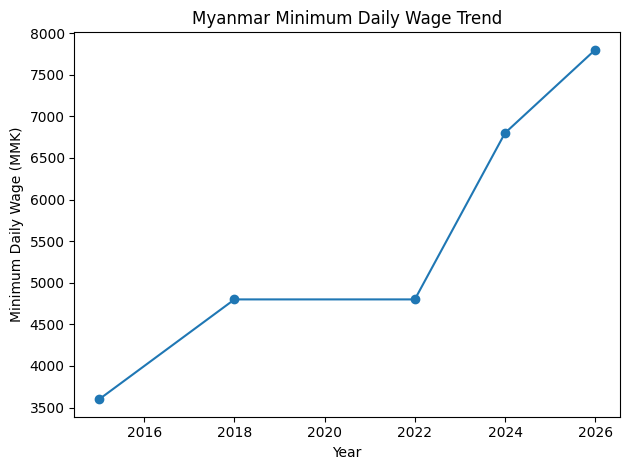
As of 2026, the official minimum daily wage for workers in the private sector is set at 7,800 Myanmar Kyat for businesses employing ten or more workers. This amount represents the cumulative result of multiple policy interventions implemented between 2018 and 2025.
The minimum wage system currently consists of two distinct components:
• A base wage established under earlier wage legislation
• A series of additional government-mandated allowances introduced over time
The base wage, which remains fixed at 4,800 MMK per day, was originally established in May 2018 and has not been formally revised since its introduction. In response to escalating inflation and growing pressure from labor groups, policymakers introduced a series of incremental allowances beginning in 2023. Each allowance added 1,000 MMK to the total daily compensation received by workers.
Although these allowances increase workers’ total take-home income, they do not modify the legally defined base wage used in several labor calculations, particularly overtime compensation.
Table: Evolution of Myanmar’s Minimum Wage Structure (2018–2026)
| Effective Date | Base Wage (MMK) | Total Allowances (MMK) | Total Daily Wage (MMK) | Monthly Equivalent (26 Working Days) |
|---|---|---|---|---|
| May 2018 | 4,800 | 0 | 4,800 | 124,800 |
| October 2023 | 4,800 | 1,000 | 5,800 | 150,800 |
| August 2024 | 4,800 | 2,000 | 6,800 | 176,800 |
| October 2025 | 4,800 | 3,000 | 7,800 | 202,800 |
This layered structure represents a compromise policy approach. Rather than formally increasing the base wage, authorities opted to introduce supplemental allowances that can be adjusted more flexibly without rewriting the underlying wage legislation.
Legal Distinction Between Base Wage and Allowances
One of the most important aspects of Myanmar’s minimum wage system lies in the legal distinction between base wages and allowances. While workers receive the combined total of these components as their daily pay, certain employment calculations are legally tied only to the base wage component.
Overtime compensation is the most notable example of this distinction. Under existing labor regulations, overtime pay is calculated solely on the base wage rate of 4,800 MMK per day. When translated into hourly terms, this base wage corresponds to approximately 600 MMK per hour.
Because the overtime calculation excludes the allowances, employees working additional hours do not receive proportional increases in overtime pay relative to their total daily earnings.
Table: Overtime Calculation Under the Current Wage System
| Wage Component | Amount (MMK) |
|---|---|
| Base Daily Wage | 4,800 |
| Base Hourly Wage | 600 |
| Standard Overtime Rate (2x) | 1,200/hour |
| Allowances Included in Overtime Calculation | No |
This regulatory design effectively caps overtime compensation growth, even as total daily wages rise through additional allowances. For workers who rely heavily on overtime hours, the gap between actual earnings and expected wage growth becomes increasingly significant.
Coverage of Minimum Wage Regulations
The statutory minimum wage does not apply universally across Myanmar’s entire labor force. The law is designed primarily to regulate employment within the formal private sector and therefore excludes several categories of workers.
Businesses employing fewer than ten workers are not legally required to comply with the minimum wage regulation. This exclusion has significant implications for Myanmar’s labor market because a large share of economic activity occurs within small enterprises, family-owned businesses, and microenterprises.
In addition to company size exemptions, several occupational sectors operate outside the standard minimum wage framework.
Table: Coverage of Myanmar’s Minimum Wage Regulation
| Worker Category | Covered by Minimum Wage | Notes on Application |
|---|---|---|
| Private companies with 10+ workers | Yes | Full statutory wage applies |
| Small businesses under 10 workers | No | Exempt from mandatory wage floor |
| Family-owned enterprises | No | Common in rural areas and informal sectors |
| Seasonal agricultural labor | Often exempt | Wage arrangements vary by region |
| Domestic household workers | Frequently excluded | Limited legal protections |
| Informal sector employment | Generally not regulated | Wages determined by local market conditions |
These exclusions significantly influence the broader salary landscape in Myanmar. The informal sector remains large, particularly in rural regions, where workers often receive wages well below the statutory minimum due to weak enforcement mechanisms and limited regulatory oversight.
Public Sector Compensation Adjustments
While minimum wage policies primarily target private-sector employers, the government has also implemented parallel adjustments within the public sector to address rising living costs.
Government employees, including civil servants and military personnel, receive additional monthly allowances intended to offset inflation and stabilize public sector income levels. By 2026, these supplementary payments amount to approximately 90,000 MMK per month for eligible personnel.
This allowance system mirrors the structure used in the private sector, where wage supplements are layered on top of existing salary frameworks rather than restructuring the base pay scale.
Table: Public Sector Allowance Adjustments
| Compensation Component | Monthly Amount (MMK) |
|---|---|
| Base Public Sector Salary | Varies by rank |
| Additional Cost-of-Living Allowance | 90,000 |
| Total Monthly Compensation | Base salary plus allowance |
These adjustments aim to maintain stability within the public administration system while minimizing large-scale structural changes to government salary scales.
Implications for Salary Benchmarks in 2026
The statutory minimum wage serves as an important reference point for compensation across many sectors in Myanmar. Entry-level wages in manufacturing, retail, hospitality, and service industries are often closely aligned with the legal minimum threshold.
However, the presence of exemptions and the dominance of the informal sector mean that the minimum wage does not fully define the broader salary landscape. Instead, it functions as a baseline indicator for formal employment conditions while many workers continue to operate outside the regulatory framework.
Matrix: Influence of Minimum Wage Policy on the Labor Market
| Labor Market Segment | Influence of Minimum Wage | Typical Salary Behavior |
|---|---|---|
| Large manufacturing firms | Strong regulatory influence | Salaries often slightly above statutory minimum |
| Multinational companies | Moderate influence | Salaries significantly above minimum benchmarks |
| Small enterprises | Limited influence | Wage levels vary widely |
| Informal sector | Minimal influence | Wages determined by local supply and demand |
| Public sector employment | Indirect influence | Adjustments made through allowances |
The structure of Myanmar’s wage regulations therefore reflects a hybrid system in which formal labor policies coexist with a large informal economy. For analysts examining salary trends in 2026, understanding these regulatory boundaries is essential when interpreting wage data and evaluating compensation levels across different industries and employment categories.
3. Sectoral Salary Benchmarking: Winners and Losers in 2026
a. Information Technology and Digital Transformation
An accurate assessment of salary levels in Myanmar in 2026 requires detailed sectoral benchmarking. While the broader economy continues to experience contraction and instability, the salary landscape varies significantly between industries. Some sectors are experiencing moderate wage growth due to talent shortages and strategic importance, while others remain stagnant due to structural constraints, weak demand, or reliance on low-skilled labor.
The salary data emerging from 2026 reveals an increasingly polarized labor market. High-skilled sectors such as information technology, finance, and digital infrastructure are maintaining relatively competitive salary levels, even as the wider economy struggles. At the same time, labor-intensive sectors such as manufacturing, retail, and traditional services continue to operate close to the statutory wage floor.
This divergence reflects deeper structural changes in Myanmar’s workforce, including the outflow of skilled professionals, growing digitalization needs, and the uneven impact of economic disruptions across industries.
Overview of Sectoral Salary Dynamics
The salary structure across industries in Myanmar can broadly be divided into three categories based on demand for talent, business resilience, and exposure to international markets.
Table: Sector Classification by Salary Competitiveness in 2026
| Sector Category | Typical Salary Competitiveness | Key Drivers |
|---|---|---|
| High-demand professional sectors | High | Talent shortages, international market exposure |
| Mid-tier service sectors | Moderate | Domestic demand and operational stability |
| Labor-intensive sectors | Low | High labor supply and minimum wage dependency |
High-demand sectors have been forced to raise salaries despite the economic downturn, primarily to retain experienced professionals who might otherwise relocate abroad. In contrast, industries that depend heavily on manual labor continue to operate under tight wage constraints.
Information Technology and Digital Transformation
Among all sectors operating in Myanmar, the information technology industry remains the highest-paying domain for domestic professionals in 2026. The sector’s salary competitiveness stems largely from a severe shortage of skilled technical workers.
Over the past several years, a substantial number of Myanmar’s software developers, network engineers, and system architects have migrated to regional technology hubs such as Thailand, Singapore, and Vietnam. This phenomenon, commonly referred to as brain drain, has reduced the availability of experienced professionals within the domestic labor market.
As a result, companies operating in Myanmar must compete aggressively to retain skilled technical staff. This is particularly true for organizations that depend on stable digital infrastructure, including banks, fintech firms, logistics companies, and telecommunications providers.
These organizations rely on experienced engineers to maintain digital systems that must operate under difficult conditions, including frequent power outages, unstable internet connectivity, and limited infrastructure redundancy.
Table: Average IT Salaries in Myanmar (2026)
| IT Role | Experience Level | Average Monthly Salary (MMK) | Estimated Monthly Salary (USD Equivalent) |
|---|---|---|---|
| Cloud Architect | Senior (8+ years) | 4,000,000 | 880 – 1,100 |
| IT Project Manager | Senior (8+ years) | 2,248,060 | 500 – 650 |
| Software Engineer | Mid-Level (3–7 years) | 2,087,476 | 460 – 590 |
| IT Manager | Management Level | 1,717,726 | 380 – 490 |
| Software Engineer | Entry-Level (0–2 years) | 510,000 | 110 – 145 |
These figures highlight a pronounced wage hierarchy within the technology sector. Entry-level developers typically earn modest salaries relative to international benchmarks, while senior technical specialists command significantly higher compensation packages.
Salary Gap Between Entry-Level and Senior Technology Roles
One of the most notable salary trends in 2026 is the expanding gap between junior and senior professionals within the IT sector. Strategic leadership roles such as IT Directors, System Architects, and Cloud Infrastructure Specialists are particularly valuable because they are responsible for ensuring operational continuity in an unstable technological environment.
Companies increasingly depend on senior professionals capable of designing resilient infrastructure systems, managing distributed teams, and maintaining cybersecurity protocols.
Table: Salary Progression Across IT Career Levels
| Career Stage | Typical Experience Range | Average Monthly Salary Range (MMK) |
|---|---|---|
| Entry-Level | 0 – 2 years | 450,000 – 600,000 |
| Junior Professional | 2 – 4 years | 700,000 – 1,200,000 |
| Mid-Level Specialist | 3 – 7 years | 1,500,000 – 2,200,000 |
| Senior Specialist | 8 – 12 years | 2,500,000 – 4,000,000 |
| Executive Leadership | 12+ years | 4,000,000 – 6,000,000+ |
This salary progression demonstrates how rapidly compensation increases for professionals who develop advanced technical expertise or leadership capabilities.
Drivers of High IT Salaries
Several factors contribute to the relatively strong compensation levels observed within the technology sector.
Matrix: Key Drivers Behind IT Salary Premiums
| Factor | Description | Impact on Salary Levels |
|---|---|---|
| Skilled Talent Shortage | Limited availability of experienced developers and architects | Salaries rise to attract scarce talent |
| Brain Drain to Regional Markets | Skilled professionals relocate to neighboring countries | Domestic companies offer retention incentives |
| Digital Infrastructure Needs | Businesses require stable IT systems to maintain operations | Increased value placed on technical specialists |
| Cybersecurity Requirements | Growing demand for secure digital systems | Higher compensation for security experts |
| Financial Sector Digitalization | Banks and fintech firms expanding online services | Strong demand for developers and project managers |
These structural factors suggest that the technology sector will likely remain one of the most resilient segments of Myanmar’s labor market despite broader economic challenges.
Comparison Between Technology and Traditional Sectors
The strength of IT salaries becomes even more evident when compared with traditional sectors of the economy. Manufacturing, agriculture, and retail sectors often offer wages that remain relatively close to the statutory minimum wage levels.
Table: Illustrative Cross-Sector Salary Comparison (2026)
| Sector | Typical Entry-Level Monthly Salary (MMK) | Typical Senior-Level Monthly Salary (MMK) |
|---|---|---|
| Information Technology | 450,000 – 600,000 | 3,000,000 – 5,000,000 |
| Banking and Finance | 400,000 – 700,000 | 2,000,000 – 3,500,000 |
| Manufacturing | 202,800 – 350,000 | 800,000 – 1,200,000 |
| Retail and Hospitality | 202,800 – 300,000 | 600,000 – 900,000 |
| Agriculture | 150,000 – 250,000 | 400,000 – 600,000 |
The gap between high-skill and low-skill sectors has widened significantly in recent years. Professionals working in digital and knowledge-based industries often earn several multiples of the minimum wage, while many workers in traditional industries remain near the legal wage floor.
Implications for Workforce Mobility
These sectoral disparities are influencing career choices among young professionals entering the labor market. Many university graduates are increasingly pursuing careers in technology, data analytics, and financial services rather than traditional sectors.
This shift reflects both salary potential and perceived long-term career stability in technology-driven industries.
Table: Emerging Career Preferences Among Young Professionals
| Career Field | Attractiveness Level | Key Motivating Factors |
|---|---|---|
| Information Technology | Very High | High salaries and international opportunities |
| Financial Technology | High | Rapid industry growth |
| Telecommunications | Moderate to High | Infrastructure development |
| Manufacturing | Moderate | Stable but limited salary growth |
| Agriculture | Low | Lower wage potential |
The growing concentration of talent in technology-related fields may continue to reshape Myanmar’s labor market structure in the coming years.
Overall Sectoral Outlook for 2026
Despite macroeconomic instability, the technology sector remains a critical pillar of Myanmar’s modern workforce. Companies operating in digitally dependent industries are increasingly willing to pay salary premiums to retain skilled professionals.
However, the broader labor market remains uneven. While high-skilled sectors demonstrate resilience and wage growth, labor-intensive industries continue to struggle under the combined pressures of economic contraction, inflation, and structural disruptions.
For employers, employees, and policymakers alike, understanding these sectoral salary differences is essential for navigating the evolving compensation landscape in Myanmar in 2026.
b. Finance, Accountancy, and Regulatory Compliance
Within Myanmar’s evolving salary landscape for 2026, the finance and accountancy sector continues to stand out as one of the most stable and strategically important components of the formal economy. Even as many industries struggle with economic contraction, financial services and regulatory compliance functions maintain relatively strong demand for skilled professionals.
This resilience is largely driven by the increasing complexity of financial oversight, heightened regulatory scrutiny, and the need for strict auditing standards in a volatile economic environment. Companies operating across banking, insurance, trading, manufacturing, and multinational investment sectors require experienced financial professionals to manage risk, maintain regulatory compliance, and safeguard financial reporting accuracy.
As a result, salary levels within finance-related roles remain competitive compared to many other industries in Myanmar.
The Strategic Importance of Finance Professionals
In 2026, organizations across Myanmar are placing increased emphasis on financial governance and internal controls. The combination of currency volatility, inflationary pressure, and shifting regulatory frameworks has made financial management a central pillar of corporate risk management.
Finance departments now play a crucial role not only in accounting operations but also in strategic planning, regulatory reporting, and financial transparency. Companies rely heavily on experienced professionals to navigate complex regulatory environments while maintaining accurate financial records and ensuring compliance with national tax and reporting requirements.
This growing reliance on financial expertise has contributed to sustained demand for qualified accountants, finance managers, and financial controllers.
Table: Key Drivers of Demand for Finance Professionals in 2026
| Demand Driver | Description | Impact on Salary Levels |
|---|---|---|
| Regulatory Compliance | Increased scrutiny on financial reporting and tax compliance | Higher demand for experienced accountants |
| Currency Volatility | Fluctuating exchange rates require stronger financial oversight | Firms prioritize skilled finance managers |
| Corporate Risk Management | Companies require strong financial controls during economic instability | Senior finance roles command higher compensation |
| Financial Transparency Requirements | Businesses must maintain accurate financial records for investors and regulators | Greater demand for certified professionals |
| International Business Operations | Firms with foreign partners require internationally recognized accounting standards | Salary premiums for internationally certified accountants |
These factors have elevated the importance of finance professionals within corporate structures, particularly those capable of managing complex financial systems and regulatory obligations.
Salary Premium for Professional Certifications
One of the defining features of the finance sector in Myanmar is the strong salary premium attached to internationally recognized professional certifications. Credentials such as Certified Public Accountant (CPA) and the Association of Chartered Certified Accountants (ACCA) significantly enhance a candidate’s earning potential.
Professionals holding these certifications often command salaries that are substantially higher than those of non-certified employees performing similar functions. In many organizations, certified accountants are considered essential for maintaining compliance with international financial reporting standards.
On average, mid-level professionals with CPA or ACCA credentials can earn between twenty-five and forty percent more than peers without these qualifications.
Table: Impact of Professional Certifications on Finance Salaries
| Qualification Status | Typical Salary Increase | Market Demand Level |
|---|---|---|
| No Professional Certification | Baseline salary level | Moderate |
| Partial Certification (ACCA Part Qualified) | 10% – 20% increase | High |
| Fully Certified CPA or ACCA | 25% – 40% increase | Very High |
| International Accounting Experience | 40%+ premium possible | Extremely High |
Employers often prioritize certification when hiring for senior finance roles, as it signals both technical competency and adherence to global accounting standards.
Salary Benchmarks Across Finance Roles
Compensation levels within the finance sector vary widely depending on experience level, professional qualifications, and organizational size. Senior leadership roles responsible for financial governance and corporate strategy command significantly higher salaries than operational accounting positions.
Table: Finance and Accounting Salary Benchmarks in Myanmar (2026)
| Finance Role | Experience Level | Monthly Salary Range (MMK) | Typical Benefits |
|---|---|---|---|
| Finance Controller | Senior (10+ years) | 5,000,000 – 6,000,000 | Performance bonus, housing allowance |
| Finance Manager | Mid-Level (5–8 years) | Around 2,269,437 | Medical coverage, travel allowance |
| Chief Accountant | Senior (8+ years) | 2,000,000 – 3,500,000 | Profit sharing, retirement pension |
| Senior Accountant | Mid-Level (3–5 years) | Around 1,085,000 | Transportation support, attendance bonus |
| Junior Accountant | Entry-Level (0–2 years) | Around 500,000 | Training programs, overtime pay |
These salary ranges highlight the hierarchical structure typical within finance departments. Entry-level professionals begin with modest compensation but can experience significant salary growth as they gain experience and professional certifications.
Geographic Concentration of High Finance Salaries
Although finance roles exist throughout Myanmar, the highest salaries are heavily concentrated in Yangon, which remains the country’s primary financial and commercial hub. Large corporations, multinational companies, banks, and financial institutions are predominantly headquartered in this city.
This concentration of economic activity results in a salary distribution that is skewed toward higher earnings in urban centers. Finance professionals working in regional cities or smaller firms typically earn lower salaries than those employed in major financial institutions or multinational organizations.
Table: Illustrative Salary Variation by Location
| Location | Average Monthly Finance Salary (MMK) | Key Market Characteristics |
|---|---|---|
| Yangon | 900,000 – 2,500,000 | Largest financial center with multinational presence |
| Mandalay | 600,000 – 1,500,000 | Regional commercial hub |
| Secondary Cities | 400,000 – 900,000 | Smaller domestic businesses |
| Rural Areas | 300,000 – 600,000 | Limited corporate finance roles |
Because many high-level financial roles are concentrated in Yangon, national salary averages may appear lower when compared with salaries in the capital’s corporate environment.
Sector Average Salary Distribution
Across the finance sector as a whole, the estimated average monthly salary for finance-related roles in Myanmar in 2026 is approximately 860,529 MMK. However, this figure can be misleading because it is heavily influenced by the high earnings of senior managers and executives.
Entry-level employees and junior accountants often earn significantly less than this average, while experienced finance controllers and chief financial officers earn several times more.
Table: Estimated Salary Distribution Across Finance Career Levels
| Career Stage | Typical Salary Range (MMK) | Role Characteristics |
|---|---|---|
| Entry-Level | 400,000 – 600,000 | Junior accountants and finance assistants |
| Early Career | 700,000 – 1,200,000 | Accountants with several years of experience |
| Mid-Level Management | 1,500,000 – 2,500,000 | Finance managers and senior specialists |
| Senior Leadership | 3,000,000 – 6,000,000+ | Controllers, CFOs, and financial directors |
This distribution demonstrates the substantial income growth potential available to professionals who advance within the finance career path.
Retention Challenges and Salary Adjustments
Many companies operating in Myanmar view the retention of experienced finance professionals as a critical operational priority. The departure of a skilled finance manager or senior accountant can significantly disrupt financial operations, regulatory reporting, and internal audit processes.
To mitigate this risk, organizations frequently implement aggressive salary adjustments and retention incentives. In many cases, annual salary increases for mid-level finance professionals exceed fifteen to twenty percent in nominal terms.
Matrix: Employer Strategies for Retaining Finance Talent
| Retention Strategy | Description | Impact on Employee Retention |
|---|---|---|
| Competitive Salary Increases | Annual salary adjustments exceeding inflation levels | Reduces turnover among experienced professionals |
| Professional Development Support | Funding for CPA or ACCA certification | Encourages long-term career growth |
| Performance-Based Bonuses | Financial incentives linked to company performance | Motivates high productivity |
| Expanded Benefits Packages | Health coverage, housing, travel allowances | Enhances overall compensation value |
| Leadership Opportunities | Promotion pathways within finance departments | Strengthens organizational loyalty |
These strategies highlight the strategic importance placed on finance professionals within Myanmar’s corporate environment.
Outlook for Finance Salaries in Myanmar
Despite broader economic uncertainties, the finance sector remains one of the most resilient areas of Myanmar’s labor market. The need for financial oversight, regulatory compliance, and risk management ensures that experienced professionals will continue to command competitive salaries.
For individuals considering career paths in accounting and finance, professional certifications and managerial experience remain the most powerful drivers of salary growth. As the economic environment continues to evolve, organizations are expected to maintain strong demand for skilled financial experts capable of navigating increasingly complex financial and regulatory landscapes.
c. The Humanitarian and NGO Sector
Within Myanmar’s complex salary environment in 2026, the humanitarian and non-governmental organization sector represents one of the most distinctive compensation ecosystems. Unlike most domestic industries that pay salaries in Myanmar Kyat, many international humanitarian agencies operate using foreign currency-denominated salary structures. This practice creates a markedly different wage environment compared with the local private sector.
International organizations, development agencies, and humanitarian NGOs rely heavily on global funding streams, allowing them to offer compensation packages that are partially or fully benchmarked against international standards. As a result, professionals working within this sector often experience significantly higher purchasing power than employees in many domestic industries.
This phenomenon has contributed to the development of what analysts increasingly describe as a dual labor market within Myanmar. One segment of the workforce operates within the domestic economy, earning salaries denominated in local currency, while another segment works for international organizations where compensation may be tied to foreign currencies or international salary scales.
Structural Differences Between NGO Compensation and Domestic Salaries
The NGO sector’s compensation system differs from domestic industries in several key ways. These differences affect not only salary levels but also the overall structure of employment benefits and contractual arrangements.
Matrix: Structural Characteristics of NGO Compensation Systems
| Compensation Element | NGO Sector Characteristics | Domestic Private Sector Characteristics |
|---|---|---|
| Currency Denomination | Often USD or EUR-based | Primarily Myanmar Kyat |
| Contract Type | International or local professional contracts | Standard local employment contracts |
| Benefits Structure | Extensive benefits including insurance and allowances | Limited benefits packages |
| Salary Benchmarking | International salary frameworks | Domestic labor market benchmarking |
| Job Security | Project-based but often stable through donor funding | Highly dependent on business performance |
These structural differences significantly influence both income stability and real purchasing power for employees.
Dual Labor Market Dynamics
The existence of internationally funded organizations within Myanmar has created two parallel employment markets. Professionals employed by NGOs or international agencies often receive salaries that are substantially higher than those offered in local companies.
For skilled professionals, particularly those with experience in project management, development finance, monitoring and evaluation, and humanitarian operations, employment in the NGO sector is often viewed as one of the most desirable career paths.
Foreign currency compensation also provides protection against local currency depreciation. Because the Myanmar Kyat has experienced significant volatility in recent years, employees earning salaries in US dollars or euros often maintain stronger purchasing power compared with workers paid solely in local currency.
Table: Illustrative Salary Comparison Between NGO and Domestic Roles
| Role Category | NGO Sector Salary Range | Local Private Sector Salary Range |
|---|---|---|
| Senior Finance Professional | 2,500,000 – 4,500,000 MMK equivalent or foreign currency | 1,800,000 – 3,000,000 MMK |
| Program Management Roles | 2,000,000 – 4,000,000 MMK equivalent | 1,200,000 – 2,000,000 MMK |
| Entry-Level Professional Roles | 900,000 – 1,500,000 MMK equivalent | 400,000 – 700,000 MMK |
This disparity illustrates why international development organizations attract large numbers of qualified candidates from the domestic workforce.
Salary Benchmarks in the NGO Sector
Compensation levels within the humanitarian sector vary significantly depending on the employee’s contract classification. Most organizations distinguish between international staff and locally hired professionals.
International staff members, often referred to as expatriate personnel, typically receive compensation packages denominated in foreign currencies and structured according to international salary frameworks.
Table: NGO Salary Benchmarks in Myanmar (2026)
| NGO Position | Contract Type | Monthly Gross Salary | Typical Additional Allowances |
|---|---|---|---|
| Finance Coordinator | International (Expatriate) | EUR 2,860 | USD 600 per diem allowance |
| Program Specialist | United Nations P-3 Level | USD 8,300 – USD 10,800 | Post adjustment allowance approximately 33.5% |
| Senior Associate | Local Professional | 1,500,000 – 2,800,000 MMK | Health insurance, transportation support |
| Finance Analyst | Local Professional | USD 500 – USD 3,000 | Varies based on experience and project funding |
These compensation levels demonstrate the wide range of salary structures within the sector, reflecting differences in role seniority, international responsibilities, and funding sources.
Expatriate Compensation Packages
International staff working for humanitarian organizations typically receive comprehensive employment packages designed to support relocation and address operational risks associated with working in challenging environments.
These packages often include multiple supplementary benefits beyond base salary.
Table: Common Benefits for Expatriate NGO Staff
| Benefit Category | Description |
|---|---|
| Housing Allowance | Fully subsidized accommodation or housing stipend |
| Hazard Insurance | Specialized insurance coverage for security risks |
| Per Diem Allowances | Daily living allowances for operational expenses |
| Travel Support | International travel coverage and relocation assistance |
| Rest and Recuperation Leave | Scheduled breaks for recovery from field assignments |
In many cases, international staff members are also eligible for structured leave arrangements that provide periodic rest periods outside the country.
One common arrangement involves a rotational break system in which employees receive approximately seven days of leave every three months, allowing them to temporarily exit high-stress environments and maintain work-life balance.
Compensation for Local Professional Staff
While expatriate employees often receive the highest compensation packages, local professionals employed by international organizations also benefit from relatively competitive salaries.
Many local staff members receive wages that significantly exceed domestic market averages, particularly when their salaries are partially indexed to foreign currencies.
Table: Typical Salary Structure for Local NGO Staff
| Career Level | Monthly Salary Range (MMK Equivalent) | Typical Benefits |
|---|---|---|
| Entry-Level Program Assistant | 900,000 – 1,200,000 | Health coverage, training |
| Mid-Level Specialist | 1,200,000 – 2,000,000 | Insurance, transport support |
| Senior Associate | 1,500,000 – 2,800,000 | Comprehensive health insurance, allowances |
| Technical Advisor | 2,000,000 – 3,500,000+ | Housing support, project bonuses |
For many skilled professionals in Myanmar, NGO employment represents one of the most stable and financially attractive career options available.
The combination of higher salaries, international work environments, and structured benefits packages contributes to strong competition for these roles.
Impact of Currency Stability on Career Choices
The instability of the Myanmar Kyat has further amplified the attractiveness of NGO employment. Professionals receiving income in foreign currency are better protected against domestic inflation and exchange rate fluctuations.
Matrix: Advantages of NGO Employment for Local Professionals
| Advantage | Explanation | Impact on Employee Welfare |
|---|---|---|
| Currency Protection | Salaries partially linked to USD or EUR | Greater purchasing power stability |
| International Work Environment | Exposure to global development standards | Enhanced career mobility |
| Structured Benefits | Comprehensive insurance and allowances | Higher overall compensation value |
| Professional Development | Training and international project exposure | Long-term career advancement |
| Organizational Stability | Funding from international donors | Greater employment security |
These advantages explain why many experienced professionals transition from private sector roles into development organizations.
Workforce Competition and Talent Migration
The strong compensation packages offered by humanitarian organizations have created competition between NGOs and domestic industries for skilled talent. Professionals with expertise in finance, logistics, data analysis, and project management are particularly sought after.
Some domestic companies report difficulty retaining experienced employees who leave for NGO positions offering higher salaries and greater income stability.
This competition further reinforces the dual labor market dynamic present within Myanmar’s employment environment.
Outlook for NGO Sector Salaries
Looking ahead, the humanitarian and development sector is expected to remain one of the most attractive employment domains in Myanmar’s labor market. As long as international organizations continue to operate large-scale programs in the country, demand for skilled local professionals will remain strong.
For individuals seeking stable income, international exposure, and competitive compensation, employment within the NGO sector is likely to remain one of the most sought-after career paths in Myanmar throughout 2026 and beyond.
d. Agriculture and Industrial Production
The salary structure within Myanmar’s agriculture and industrial production sectors in 2026 reflects broader structural changes occurring across the national economy. While these sectors have historically served as the backbone of Myanmar’s economic activity, recent data indicates a notable shift in employment patterns, wage stability, and labor productivity.
In recent years, Myanmar has experienced what economists describe as a structural reversal in labor allocation. Rather than transitioning toward higher-productivity sectors such as manufacturing and modern services, many workers are moving back into agriculture and low-productivity industrial activities. This reversal has significant implications for wage levels, employment quality, and long-term economic development.
Several factors are contributing to this shift, including ongoing infrastructure disruptions, electricity shortages affecting industrial zones, international sanctions pressure on export-oriented industries, and limited investment in manufacturing capacity.
Structural Reversal in the Labor Market
Under normal economic development patterns, countries gradually transition their labor force from agriculture into higher-value sectors such as manufacturing and services. However, Myanmar’s economic challenges have temporarily reversed this process.
Urban industrial zones that previously employed large numbers of factory workers have faced significant operational difficulties due to power outages, supply chain disruptions, and reduced international demand. As a result, displaced workers are increasingly returning to rural areas or accepting employment in agriculture-related occupations.
This trend is reflected in workforce data showing that even individuals with university degrees are entering agricultural roles that historically required lower levels of formal education.
Matrix: Drivers Behind Labor Migration Back to Agriculture
| Economic Driver | Description | Labor Market Impact |
|---|---|---|
| Industrial Power Shortages | Frequent electricity outages affecting factory operations | Reduced industrial employment opportunities |
| International Trade Constraints | Sanctions pressure and export challenges | Declining manufacturing output |
| Rural Employment Availability | Agricultural work remains accessible in many regions | Workers shift back to farming-related roles |
| Urban Cost of Living | Rising costs in cities such as Yangon | Workers relocate to lower-cost rural areas |
| Limited Industrial Investment | Slower growth in industrial infrastructure | Reduced job creation in manufacturing |
This reversal has contributed to a workforce distribution that is increasingly concentrated in lower productivity sectors.
Salary Benchmarks in Agriculture and Industrial Occupations
Compensation levels in agriculture and industrial production vary widely depending on job specialization, technical expertise, and management responsibility. While skilled technical roles within these sectors can command moderate salaries, most agricultural and factory-based positions remain close to the national minimum wage threshold.
Table: Agriculture and Industrial Production Salary Benchmarks (2026)
| Role | Monthly Salary Range (MMK) | Average Monthly Salary (MMK) |
|---|---|---|
| Agricultural Engineer | 358,720 – 827,658 | 593,189 |
| Agricultural Technician | 341,870 – 796,926 | 569,398 |
| Plant Manager | Up to 1,698,390 | Around 850,000 |
| Machine Fitter | 367,529 – 763,833 | 565,681 |
| Fabric Cutter (Garment Industry) | Around 390,250 | 390,250 |
These salary levels demonstrate that technical specialists within agriculture and industrial maintenance can earn significantly more than entry-level factory workers. However, even skilled positions remain far below salary levels found in sectors such as information technology, finance, or international development.
Wage Conditions in the Garment Manufacturing Sector
Myanmar’s garment industry continues to employ a large share of the country’s industrial workforce, particularly in urban manufacturing zones around Yangon and other export-oriented regions. However, wage growth within this sector has remained limited despite rising living costs.
Garment factory workers typically earn salaries that remain close to the statutory minimum wage threshold. Even with the legally mandated daily wage of 7,800 MMK introduced in late 2025, many workers struggle to maintain basic living standards.
Table: Typical Garment Industry Wage Structure (2026)
| Compensation Element | Typical Amount |
|---|---|
| Minimum Daily Wage | 7,800 MMK |
| Monthly Salary (26 Working Days) | Approximately 202,800 MMK |
| Average Fabric Cutter Salary | Around 390,250 MMK |
| Overtime Pay Rate | Calculated on base wage rate |
Although some workers supplement their income through overtime shifts, overtime pay calculations are tied to the base wage rate rather than the full wage including allowances. This limits the potential income growth available through additional working hours.
Cost of Living Versus Minimum Wage
Labor rights organizations and economic analysts have highlighted a growing gap between statutory wage levels and the actual cost of living in major cities such as Yangon.
Estimates suggest that a single worker in Yangon requires between 12,000 and 17,000 MMK per day to maintain a basic standard of living that covers essential expenses such as food, transportation, and housing.
Table: Comparison Between Minimum Wage and Estimated Living Wage
| Wage Category | Estimated Daily Income (MMK) | Description |
|---|---|---|
| Statutory Minimum Wage | 7,800 | Legal minimum for formal sector workers |
| Lower Living Wage Estimate | 12,000 | Basic survival-level income |
| Upper Living Wage Estimate | 17,000 | Income required for modest urban living |
This gap illustrates the financial pressures faced by workers in labor-intensive industries.
Decline in the Real Value of Wages
Although nominal wages have increased through additional allowances over recent years, the real purchasing power of wages has declined significantly due to high inflation and rising living costs.
Economists often measure this decline by comparing current wages against historical benchmarks adjusted for inflation. Using 2018 as the baseline year with an index value of 100, the real value of wages in Myanmar has dropped considerably by 2026.
Table: Real Wage Value Index
| Year | Real Wage Index (2018 = 100) | Interpretation |
|---|---|---|
| 2018 | 100 | Baseline purchasing power |
| 2022 | 82 | Moderate erosion due to inflation |
| 2024 | 66 | Accelerating decline in real wages |
| Late 2025 / Early 2026 | 58 | Significant reduction in purchasing power |
This decline means that even though workers may receive higher nominal wages than they did in earlier years, the amount of goods and services they can purchase with those wages has decreased substantially.
Industrial Management and Technical Roles
Within industrial production environments, certain technical and supervisory roles continue to command higher salaries than basic factory positions. Professionals responsible for machinery maintenance, plant operations, and production management are essential for maintaining operational continuity in factories facing infrastructure challenges.
Table: Salary Progression in Industrial Production Careers
| Career Level | Typical Monthly Salary Range (MMK) | Role Description |
|---|---|---|
| Entry-Level Production Worker | 202,800 – 350,000 | Basic factory labor roles |
| Skilled Machine Operator | 350,000 – 600,000 | Technical machine operation |
| Industrial Technician | 500,000 – 750,000 | Maintenance and repair of industrial equipment |
| Plant Supervisor | 700,000 – 1,200,000 | Production oversight and workforce coordination |
| Plant Manager | 850,000 – 1,698,000+ | Strategic management of industrial operations |
These roles often require technical training or engineering backgrounds, allowing qualified professionals to earn higher wages within the manufacturing sector.
Regional Variations in Agricultural Earnings
Agricultural incomes vary significantly depending on geographic location, crop type, and seasonal labor demand. Some regions specializing in high-value crops or export-oriented agriculture offer relatively higher incomes compared with subsistence farming regions.
However, most agricultural employment remains characterized by irregular income patterns and seasonal wage fluctuations.
Matrix: Factors Influencing Agricultural Income Levels
| Factor | Influence on Income |
|---|---|
| Crop Type | High-value crops generate higher income |
| Land Ownership | Landowners earn more than seasonal laborers |
| Seasonal Demand | Harvest periods increase wage rates |
| Mechanization Level | Mechanized farms require skilled technicians |
| Regional Market Access | Proximity to markets improves farm profitability |
Because of these factors, agricultural wage levels can vary widely across different regions of the country.
Outlook for Agriculture and Industrial Wages
The outlook for salaries in agriculture and industrial production remains closely tied to broader economic recovery. Improvements in electricity infrastructure, export market access, and industrial investment would likely support wage growth within manufacturing sectors.
However, as long as structural constraints persist, many workers in these sectors will continue to face relatively low wage levels and limited income mobility.
For policymakers and employers alike, addressing productivity challenges within agriculture and manufacturing will be essential for improving wage conditions and restoring balanced economic growth across Myanmar’s labor market.
4. Regional Analysis: The Cost of Commercial Life
a. Yangon vs. Mandalay: A Cost-Benefit Analysis
Geography plays a critical role in determining salary levels and employment opportunities across Myanmar in 2026. While national wage benchmarks provide a general overview of compensation trends, the real earning power of employees varies significantly depending on where they live and work. The country’s labor market is strongly shaped by a pronounced urban–rural divide, with major commercial centers offering higher salaries but also imposing substantially higher living costs.
Among Myanmar’s major cities, Yangon continues to dominate as the country’s primary financial and commercial hub. The city hosts the majority of multinational corporations, financial institutions, international organizations, and large domestic enterprises. As a result, Yangon offers the highest salary levels in the country. However, this advantage is offset by the fact that it is also the most expensive city in Myanmar.
In contrast, cities such as Mandalay offer a lower cost of living and more affordable housing, although salaries tend to be lower and employment opportunities in specialized sectors are more limited.
Urban–Rural Salary Divide
Myanmar’s economic geography produces a substantial disparity between urban and rural income levels. Urban areas benefit from greater economic activity, better infrastructure, and a concentration of professional employment opportunities. Rural regions, on the other hand, remain largely dependent on agriculture and small-scale commerce.
Table: Urban vs. Rural Employment Characteristics
| Category | Urban Areas (Yangon, Mandalay) | Rural Areas |
|---|---|---|
| Dominant Industries | Finance, IT, manufacturing, trade | Agriculture, small retail, local services |
| Salary Levels | Higher average wages | Lower average wages |
| Employment Stability | More formal employment contracts | Higher levels of informal employment |
| Infrastructure | Advanced telecommunications and transportation | Limited infrastructure |
| Cost of Living | High | Significantly lower |
These differences create strong incentives for workers to migrate toward urban centers in search of higher wages and better employment opportunities.
Yangon as the Economic Center
Yangon remains the economic powerhouse of Myanmar’s labor market in 2026. The city hosts the headquarters of major banks, international development organizations, logistics companies, telecommunications firms, and manufacturing exporters.
This concentration of economic activity creates a high demand for skilled professionals across industries such as finance, information technology, legal services, and corporate management.
However, living in Yangon comes with a significantly higher cost of living compared with other major cities. Housing costs in particular have increased substantially over the past decade, making accommodation one of the largest expenses for professionals working in the city.
Mandalay as a Secondary Commercial Hub
Mandalay functions as Myanmar’s second-largest commercial center and plays an important role in regional trade, logistics, and agricultural commerce. The city has a vibrant domestic business environment and lower living expenses compared with Yangon.
While Mandalay offers fewer multinational job opportunities, it provides a more affordable lifestyle for many professionals. This affordability makes it attractive for small business owners, regional trading companies, and individuals seeking lower living costs.
However, high-level corporate roles and international employment opportunities remain concentrated primarily in Yangon.
Comparative Cost of Living Between Yangon and Mandalay
Living expenses vary substantially between the two cities. Housing, utilities, food prices, and transportation costs are generally higher in Yangon due to greater demand and infrastructure pressures.
Economic estimates for 2026 suggest that living in Yangon can be approximately twenty to thirty-five percent more expensive than living in Mandalay.
Table: Estimated Monthly Cost of Living for a Single Professional (2026)
| Expense Category | Yangon | Mandalay |
|---|---|---|
| Rent (One-Bedroom Modern Apartment) | USD 350 – USD 600 | USD 180 – USD 350 |
| Utilities Including Generator Costs | USD 60 – USD 80 | USD 45 – USD 60 |
| Food and Groceries | USD 250 | USD 180 |
| Internet and Mobile Data | USD 35 – USD 60 | USD 25 – USD 50 |
| Estimated Monthly Budget | Approximately USD 1,020 | Approximately USD 630 |
These figures illustrate how dramatically living costs differ between Myanmar’s two largest cities.
Impact of Cost Differences on Salary Expectations
The higher cost of living in Yangon creates significant pressure on employers to offer competitive salaries, particularly for entry-level professionals relocating from other parts of the country.
Employers must balance rising living costs with their own operational constraints when designing salary packages.
Table: Typical Entry-Level Salary Offers by Location
| City | Entry-Level Monthly Salary Range (USD Equivalent) | Typical Industry Roles |
|---|---|---|
| Yangon | USD 200 – USD 400 | Administrative staff, junior accountants, customer support |
| Mandalay | USD 180 – USD 350 | Sales staff, junior office roles, local business support |
While the difference between these ranges may appear modest, the higher cost of housing and utilities in Yangon significantly reduces disposable income for employees earning at the lower end of the salary scale.
Housing Costs as the Primary Expense Driver
Accommodation represents the largest monthly expense for professionals living in Yangon. The supply of modern apartments remains limited relative to demand, especially in neighborhoods popular with expatriates and professionals working in international organizations.
In Mandalay, housing prices are generally more affordable and space availability is greater, allowing residents to allocate a smaller portion of their income to rent.
Table: Housing Cost Comparison
| Housing Type | Yangon Monthly Rent | Mandalay Monthly Rent |
|---|---|---|
| Modern One-Bedroom Apartment | USD 350 – USD 600 | USD 180 – USD 350 |
| Shared Apartment | USD 150 – USD 300 | USD 100 – USD 200 |
| Traditional Housing | USD 100 – USD 250 | USD 70 – USD 150 |
Because housing costs account for such a large share of living expenses, salary expectations in Yangon tend to be higher across nearly all professional sectors.
Income Thresholds for Comfortable Living
Professionals earning higher salaries often prefer Yangon despite its higher living costs due to the city’s superior infrastructure and lifestyle amenities.
Individuals earning more than USD 1,500 per month typically find Yangon to be the most practical location, particularly if they require access to specialized services such as international schools, advanced healthcare facilities, or global corporate networks.
Table: Income Levels and Lifestyle Viability
| Monthly Income Level (USD Equivalent) | Living Conditions in Mandalay | Living Conditions in Yangon |
|---|---|---|
| Below USD 400 | Basic living standard | Financially challenging |
| USD 400 – USD 800 | Comfortable lifestyle | Moderate living standard |
| USD 800 – USD 1,500 | High comfort level | Comfortable lifestyle |
| Above USD 1,500 | Very comfortable | Access to premium services and infrastructure |
These thresholds help illustrate how salary expectations and cost-of-living pressures shape career decisions for professionals across Myanmar.
Infrastructure and Professional Opportunities
Yangon’s role as the country’s commercial capital provides several advantages that continue to attract professionals despite higher living expenses.
Matrix: Advantages of Working in Yangon
| Advantage | Description | Impact on Career Opportunities |
|---|---|---|
| Corporate Headquarters | Many large companies operate from Yangon | Greater access to senior-level positions |
| International Organizations | Presence of NGOs and development agencies | Higher-paying professional roles |
| Financial Services Hub | Major banks and fintech firms located in Yangon | Expanded finance sector employment |
| Advanced Healthcare | Better hospitals and medical facilities | Improved quality of life |
| International Education | Access to international schools and training centers | Attracts expatriate and executive staff |
These factors reinforce Yangon’s position as the most important employment center in the country.
Regional Salary Outlook
Looking ahead, regional salary differences are likely to remain a defining characteristic of Myanmar’s labor market. As long as economic activity remains concentrated in Yangon, professionals seeking higher-paying roles will continue to migrate toward the city despite its higher living costs.
However, improvements in infrastructure, digital connectivity, and regional economic development could gradually strengthen secondary cities such as Mandalay, potentially narrowing the urban salary gap over time.
For employers designing compensation packages in 2026, understanding these regional dynamics is essential for attracting talent, managing employee expectations, and maintaining competitive salary structures across Myanmar’s diverse economic landscape.
b. Naypyidaw and Regional Hubs
While Yangon and Mandalay dominate discussions of salary benchmarks in Myanmar, the country’s administrative capital and other regional hubs present a different employment landscape. Compensation levels, industry presence, and job opportunities in these areas are shaped primarily by government institutions, public sector projects, and localized economic activity.
In 2026, Naypyidaw continues to operate as the administrative center of the country, with a workforce largely composed of civil servants, military personnel, and contractors connected to government operations. Outside of the three major cities, the labor market becomes increasingly informal, with many workers relying on agriculture or small-scale local businesses.
Understanding these regional differences is essential for accurately interpreting salary levels and employment opportunities across Myanmar.
Employment Structure in Naypyidaw
Naypyidaw’s labor market differs significantly from that of Yangon and Mandalay because the city functions primarily as a political and administrative center rather than a commercial or industrial hub. Most employment opportunities in the capital are tied to government ministries, public agencies, and state-affiliated projects.
As a result, the salary structure in Naypyidaw is heavily influenced by standardized public sector pay scales and government allowances rather than private-sector market competition.
Table: Major Employment Sectors in Naypyidaw
| Sector | Workforce Characteristics | Salary Benchmarking |
|---|---|---|
| Government Ministries | Civil servants across administrative functions | Standardized public pay scales |
| Military Administration | Defense personnel and administrative staff | Government salary structures |
| Government Contractors | Construction firms and infrastructure providers | Project-based compensation |
| Public Services | Education, healthcare, and public administration | State-funded employment |
| Limited Private Sector | Retail, hospitality, and local service businesses | Smaller local salary market |
Because the city was designed primarily to house government operations, private sector growth remains relatively limited compared with Yangon.
Cost of Living in Naypyidaw
One of the notable advantages of living in Naypyidaw is its relatively lower cost of living compared with Myanmar’s commercial capital. Housing costs tend to be more affordable, and infrastructure services such as electricity and water are often more stable due to government prioritization of the capital’s utilities.
However, the city also offers fewer commercial amenities, entertainment options, and private-sector career opportunities.
Table: Estimated Monthly Living Costs in Naypyidaw
| Expense Category | Estimated Monthly Cost (USD Equivalent) |
|---|---|
| Rent (One-Bedroom Apartment) | USD 200 – USD 350 |
| Utilities | USD 40 – USD 60 |
| Food and Groceries | USD 180 – USD 220 |
| Internet and Mobile Data | USD 25 – USD 45 |
| Estimated Total Monthly Budget | Approximately USD 600 – USD 750 |
Compared with Yangon, living expenses in Naypyidaw can be significantly lower, making the city financially manageable for government employees whose salaries follow standardized pay scales.
Salary Structure in the Public Sector
Government employees represent the largest formal workforce segment in Naypyidaw. Public sector compensation is typically structured through fixed salary grades combined with government-issued allowances designed to offset inflation and rising living costs.
In 2026, civil servants and military personnel benefit from additional monthly allowances that supplement their base salary. These allowances help maintain income stability for public employees despite economic fluctuations.
Table: Illustrative Public Sector Salary Components
| Compensation Component | Description |
|---|---|
| Base Salary | Determined by government pay grade |
| Monthly Allowance | Approximately 90,000 MMK cost-of-living support |
| Housing Support | Available for certain ranks and positions |
| Transportation Benefits | Government-provided or subsidized travel |
| Pension Contributions | Long-term retirement security |
Although public sector salaries may appear modest compared with private-sector executive roles, they often provide greater job stability and long-term security.
Private Sector Activity in Naypyidaw
The private sector in Naypyidaw remains relatively small and concentrated primarily in industries that support government operations. Construction companies, infrastructure contractors, hospitality businesses, and local service providers make up the majority of private employment opportunities.
However, the absence of large financial institutions, multinational corporations, and technology companies limits the range of high-paying professional roles available in the city.
Table: Typical Private Sector Salaries in Naypyidaw
| Role Category | Estimated Monthly Salary Range (MMK) |
|---|---|
| Administrative Assistant | 350,000 – 500,000 |
| Hospitality Staff | 250,000 – 400,000 |
| Construction Supervisor | 600,000 – 900,000 |
| Government Project Engineer | 800,000 – 1,500,000 |
| Local Retail Manager | 500,000 – 800,000 |
While these salaries may be lower than those offered in Yangon, the reduced cost of living in Naypyidaw can partially offset the difference.
Employment Conditions in Regional Areas
Outside of the three largest urban centers—Yangon, Mandalay, and Naypyidaw—the structure of Myanmar’s labor market changes significantly. Many regional towns and rural areas have limited access to formal employment opportunities.
In these regions, economic activity is dominated by agriculture, small retail trade, and informal service businesses. Formal salaried employment is relatively rare, and many workers earn wages that remain close to the statutory minimum.
Table: Regional Employment Characteristics Outside Major Cities
| Employment Category | Typical Income Source | Salary Characteristics |
|---|---|---|
| Agricultural Labor | Seasonal farming work | Irregular income patterns |
| Small Retail Businesses | Family-run shops and markets | Informal earnings |
| Local Services | Transport, repairs, food vendors | Daily wage-based income |
| Construction Labor | Short-term building projects | Temporary employment |
Because of these conditions, many workers in regional areas rely on multiple income sources to maintain household stability.
Minimum Wage Dependence in Regional Economies
A large portion of the workforce in smaller cities and rural areas earns wages close to the legal base wage. Some workers receive the official minimum wage package of 7,800 MMK per day, while others earn only the historical base wage rate of 4,800 MMK per day due to informal employment arrangements.
Table: Typical Daily Wage Levels in Regional Areas
| Worker Category | Daily Wage Estimate (MMK) |
|---|---|
| Informal Agricultural Labor | 4,800 – 6,000 |
| Small Construction Worker | 5,000 – 8,000 |
| Local Retail Assistant | 4,800 – 7,000 |
| Formal Minimum Wage Worker | 7,800 |
These wage levels highlight the economic challenges faced by workers outside Myanmar’s major economic centers.
Reliance on Subsistence Agriculture
In many rural communities, formal wage employment is limited, and households rely heavily on subsistence agriculture to meet basic needs. Instead of earning fixed salaries, families often depend on crop production, livestock raising, and local trade to generate income.
Matrix: Characteristics of Rural Household Economies
| Economic Activity | Income Stability | Key Characteristics |
|---|---|---|
| Subsistence Farming | Low to moderate | Food production primarily for household consumption |
| Small Livestock Farming | Moderate | Supplemental income through livestock sales |
| Seasonal Agricultural Labor | Variable | Income fluctuates based on harvest seasons |
| Local Trading | Moderate | Small-scale buying and selling of goods |
These economic patterns contribute to lower average incomes compared with urban areas.
Regional Salary Outlook
The employment environment in Naypyidaw and regional hubs is expected to remain relatively stable but limited in diversity compared with Yangon. Government employment will likely continue to dominate Naypyidaw’s salary structure, while rural economies remain centered around agriculture and small-scale commerce.
For professionals seeking higher salaries and diverse career opportunities, urban centers will continue to offer the most attractive employment prospects. However, lower living costs and more stable utilities in cities such as Naypyidaw may appeal to individuals prioritizing affordability and job security.
Understanding these regional dynamics provides important context for interpreting salary benchmarks across Myanmar in 2026 and highlights the significant geographic disparities that shape the country’s labor market.
5. Experience, Education, and the Demographic Divide
a. Seniority and Age-Based Compensation
Beyond industry and geography, salary levels in Myanmar’s labor market in 2026 are also heavily shaped by professional experience, education, and demographic factors. The country’s current economic environment has created a situation in which senior professionals command disproportionately higher salaries compared with entry-level workers.
This pattern reflects structural changes within the workforce, including the migration of skilled professionals to overseas markets, the shrinking pool of experienced middle managers, and the growing importance of leadership roles capable of managing complex organizational challenges.
As a result, the 2026 labor market rewards experience and specialized expertise more strongly than in previous years.
The Experience Premium in the Current Labor Market
One of the most visible features of Myanmar’s salary distribution is the widening gap between early-career workers and experienced professionals. Employers across multiple industries report difficulties in recruiting mid-level managers with the technical and leadership skills required to oversee operations in a challenging economic environment.
The departure of many professionals to neighboring countries has reduced the availability of experienced talent, creating a shortage of middle managers and technical leaders within domestic companies.
Because of this scarcity, organizations are increasingly offering higher salaries and benefits to retain experienced employees who remain in the country.
Matrix: Factors Driving the Experience Premium
| Factor | Description | Impact on Salaries |
|---|---|---|
| Talent Migration | Skilled professionals relocating to regional markets | Reduced supply of experienced workers |
| Leadership Skill Shortage | Limited number of mid-level managers with operational expertise | Higher salaries for experienced staff |
| Business Complexity | Companies require leaders capable of managing operational disruptions | Increased value placed on senior employees |
| Training Costs | Developing new managers internally requires time and investment | Firms prefer to retain experienced professionals |
These dynamics have created a labor market in which senior professionals often receive significant salary premiums compared with younger workers entering the workforce.
Salary Distribution by Age Group
Age-based salary data reveals a clear pattern of increasing earnings through early and mid-career stages, followed by a gradual stabilization or slight decline in later years. The peak earning period typically occurs between the ages of 35 and 44.
Professionals within this age range often occupy technical leadership roles, departmental management positions, or specialized expert roles that command higher salaries.
Table: Average Salary by Age Bracket in Myanmar (2026)
| Age Bracket | Average Monthly Salary (MMK) | Median Monthly Salary (MMK) |
|---|---|---|
| Under 24 Years | 544,000 | 495,000 |
| 25 – 34 Years | 768,000 | 699,000 |
| 35 – 44 Years | 827,000 | 753,000 |
| 45 – 54 Years | 811,000 | 709,000 |
| 55 Years and Above | 703,000 | 628,000 |
The data indicates that earnings rise steadily during the early stages of a professional career, reaching their highest levels during the mid-career period.
After the mid-forties, salary growth tends to stabilize or decline slightly as some professionals transition into advisory roles or retire from demanding operational positions.
Challenges Faced by Entry-Level Workers
Workers entering the labor market face significantly lower salary levels compared with experienced professionals. Entry-level employees under the age of twenty-four are particularly vulnerable to lower wages, often receiving compensation that remains close to the statutory minimum wage.
This is partly due to limited work experience, lower bargaining power, and a high supply of young job seekers entering the workforce each year.
Table: Income Distribution Among Entry-Level Workers
| Salary Category | Monthly Salary Range (MMK) | Estimated Share of Workers |
|---|---|---|
| Below Minimum Wage Equivalent | Below 362,000 | Approximately 25 percent |
| Near Minimum Wage Level | 362,000 – 450,000 | Approximately 35 percent |
| Moderate Entry-Level Salary | 450,000 – 650,000 | Approximately 30 percent |
| High Entry-Level Salary | Above 650,000 | Approximately 10 percent |
This distribution demonstrates that a large proportion of young workers begin their careers with relatively modest income levels.
High Earnings Among Experienced Professionals
While entry-level salaries remain relatively modest, experienced professionals can achieve significantly higher income levels once they accumulate technical expertise and managerial experience.
Within the 35–44 age group, the highest-performing professionals—particularly those in management, finance, technology, and specialized consulting roles—can earn substantially more than the national average.
Table: Earnings Distribution in the 35–44 Age Group
| Salary Tier | Monthly Salary Range (MMK) | Workforce Segment |
|---|---|---|
| Lower Range | 600,000 – 750,000 | Operational professionals |
| Mid-Level Range | 750,000 – 1,000,000 | Technical specialists |
| Upper Range | 1,000,000 – 1,300,000 | Department managers |
| Top 10 Percent | Above 1,300,000 | Senior leadership and experts |
This distribution highlights the substantial earning potential available to professionals who develop specialized skills and accumulate managerial experience.
Education and Professional Qualifications
Educational attainment plays an increasingly important role in determining salary levels within Myanmar’s professional sectors. University graduates, particularly those with degrees in finance, engineering, information technology, or business administration, often experience faster career progression compared with workers without formal higher education.
Professional certifications further enhance earning potential, particularly in technical and regulatory fields.
Table: Education and Salary Correlation
| Education Level | Typical Monthly Salary Range (MMK) | Career Path Characteristics |
|---|---|---|
| Secondary School Education | 200,000 – 450,000 | Manual labor, retail, service work |
| Vocational Training | 350,000 – 700,000 | Technical roles and skilled trades |
| Bachelor’s Degree | 500,000 – 1,200,000 | Professional and administrative roles |
| Advanced Degrees or Certifications | 900,000 – 2,000,000+ | Specialized leadership and expert roles |
Professionals with advanced qualifications are therefore more likely to reach higher salary brackets earlier in their careers.
Generational Workforce Dynamics
Myanmar’s workforce in 2026 is characterized by distinct generational groups, each facing different employment opportunities and salary trajectories.
Matrix: Workforce Characteristics by Age Group
| Age Group | Career Stage | Employment Characteristics |
|---|---|---|
| Under 24 | Early Career | Entry-level roles, internships, training positions |
| 25 – 34 | Career Development | Professional roles with increasing responsibility |
| 35 – 44 | Leadership Phase | Management and technical leadership roles |
| 45 – 54 | Senior Expertise | Strategic leadership and advisory positions |
| 55+ | Transition Phase | Senior advisory roles or retirement planning |
This generational structure shapes how salaries evolve across different stages of professional life.
Implications for Employers and Workforce Planning
For employers operating in Myanmar, these demographic trends have important implications for workforce management and compensation planning. Companies must balance the need to attract young talent while also retaining experienced professionals whose leadership skills are increasingly scarce.
Many organizations are investing in internal training programs to develop the next generation of middle managers, while also offering retention incentives for senior staff.
Matrix: Employer Strategies to Address the Experience Gap
| Strategy | Objective | Implementation Approach |
|---|---|---|
| Leadership Development Programs | Build future middle managers | Internal training and mentorship |
| Competitive Salary Adjustments | Retain experienced professionals | Performance-based compensation increases |
| Professional Certification Support | Enhance employee skill levels | Funding for CPA, ACCA, IT certifications |
| Graduate Recruitment Programs | Attract young talent | Internship and trainee initiatives |
These initiatives aim to address the growing experience gap within Myanmar’s workforce.
Outlook for Experience-Based Salary Trends
The experience premium observed in the 2026 labor market is likely to persist in the coming years. As long as the supply of experienced managers remains limited, companies will continue to compete for skilled professionals capable of managing complex operations.
For individuals planning long-term careers in Myanmar, accumulating specialized skills, gaining leadership experience, and pursuing advanced education remain the most reliable pathways to higher income levels and professional advancement within the country’s evolving labor market.
b. The Gender Wage Gap in 2026
Gender-based income disparities remain a notable characteristic of Myanmar’s labor market in 2026. Despite the significant participation of women across many professional fields, a measurable wage gap continues to exist between male and female workers. While the difference in average salaries may appear modest at first glance, deeper analysis reveals that disparities become significantly more pronounced at senior leadership levels and within certain high-paying industries.
The persistence of these differences reflects structural factors within the workforce, including occupational segregation, leadership representation imbalances, and variations in career progression opportunities.
Overview of Gender-Based Salary Differences
Statistical analysis of salary data across industries shows that male employees earn slightly higher average monthly wages than female employees. In 2026, the average monthly income for men is estimated at approximately 742,297 Myanmar Kyat, compared with an average monthly income of about 714,452 Myanmar Kyat for women.
Although the numerical difference between these averages may appear relatively small, it represents a consistent pattern that becomes more pronounced in senior management and executive roles.
Table: Average Monthly Salary by Gender in Myanmar (2026)
| Gender | Average Monthly Salary (MMK) | Median Monthly Salary (MMK) |
|---|---|---|
| Male Workers | 742,297 | 701,000 |
| Female Workers | 714,452 | 673,000 |
This difference reflects the broader structural conditions influencing career advancement and compensation within Myanmar’s labor market.
Sectoral Participation of Women
Women play an important role across several major professional sectors in Myanmar. Female participation rates are particularly high in industries such as education, healthcare, finance, and administrative services.
These sectors traditionally employ a large number of female professionals and offer relatively stable employment opportunities. However, many of these roles tend to fall within mid-level professional categories rather than senior leadership positions.
Table: Female Workforce Participation by Sector
| Sector | Female Participation Level | Typical Roles |
|---|---|---|
| Education | Very High | Teachers, academic administrators |
| Healthcare | High | Nurses, medical technicians, health administrators |
| Finance and Banking | Moderate to High | Accountants, finance officers, analysts |
| Public Administration | Moderate | Civil servants, policy staff |
| Technology | Moderate | Software developers, data analysts |
Although women are well represented in these sectors, leadership roles within many organizations remain disproportionately occupied by male professionals.
Leadership Representation and Executive Pay
The gender wage gap becomes most visible when examining executive and senior management positions. Men are more likely to occupy top leadership roles such as Chief Executive Officer, Country Director, Managing Director, or Chief Financial Officer.
These positions often include extensive compensation packages that extend beyond base salaries. Executive-level benefits frequently include housing allowances, international schooling support, transportation benefits, performance bonuses, and other expatriate-style benefits.
Table: Executive Compensation Components
| Compensation Component | Description |
|---|---|
| Base Salary | Primary monthly salary |
| Performance Bonus | Annual incentive tied to organizational results |
| Housing Allowance | Subsidized accommodation or housing stipend |
| International Schooling | Education support for dependents |
| Transport and Driver | Company-provided vehicle or travel allowance |
| Insurance Coverage | Comprehensive medical and life insurance |
Because male professionals hold a larger share of these high-ranking roles, they benefit more frequently from these expanded compensation packages, contributing to the overall wage gap.
Career Advancement Patterns
Career progression patterns also influence gender-based salary differences. Women often experience slower advancement into senior leadership positions due to several structural factors, including workplace cultural norms, family responsibilities, and limited access to executive mentorship opportunities.
Matrix: Factors Contributing to Gender Wage Disparities
| Factor | Explanation | Impact on Salary Gap |
|---|---|---|
| Leadership Representation | Men hold a larger share of executive positions | Higher compensation among male executives |
| Career Interruptions | Family caregiving responsibilities may affect career continuity | Slower promotion timelines |
| Industry Segmentation | Women more concentrated in lower-paying sectors | Reduced average salary levels |
| Networking and Mentorship | Fewer women in senior mentorship networks | Limited leadership advancement opportunities |
| Organizational Bias | Cultural perceptions of leadership roles | Unequal promotion opportunities |
These factors collectively contribute to persistent income differences across the workforce.
Salary Distribution Across Management Levels
When salary data is analyzed by management level, the wage gap tends to widen as job seniority increases. Entry-level positions often show smaller differences in compensation, while executive roles demonstrate significantly larger disparities.
Table: Salary Comparison by Management Level
| Management Level | Average Male Salary (MMK) | Average Female Salary (MMK) |
|---|---|---|
| Entry-Level Professional | 520,000 | 510,000 |
| Mid-Level Manager | 1,200,000 | 1,120,000 |
| Senior Manager | 2,200,000 | 2,000,000 |
| Executive Leadership | 4,500,000+ | 3,800,000+ |
These differences illustrate how leadership representation influences overall salary statistics.
Educational Attainment and Gender Balance
Myanmar’s educational landscape shows relatively balanced participation between men and women at the university level. Women frequently pursue degrees in business administration, finance, medicine, and education.
However, technical fields such as engineering and information technology remain more heavily dominated by male professionals, and these fields often offer higher salary potential.
Table: Gender Distribution by Field of Study
| Field of Study | Male Participation | Female Participation |
|---|---|---|
| Business Administration | Moderate | High |
| Healthcare and Medicine | Moderate | High |
| Education | Low | Very High |
| Engineering | High | Moderate |
| Information Technology | High | Moderate |
Because higher-paying sectors such as engineering and technology have greater male representation, overall salary averages tend to favor male employees.
Efforts to Reduce Gender Wage Inequality
Some organizations operating in Myanmar are actively implementing policies aimed at reducing gender-based wage disparities and promoting equal career advancement opportunities.
Matrix: Organizational Strategies for Promoting Gender Pay Equity
| Strategy | Implementation Approach | Expected Impact |
|---|---|---|
| Transparent Salary Structures | Standardized pay scales for similar roles | Reduced wage discrimination |
| Leadership Development Programs | Training programs targeting female professionals | Increased representation in management |
| Flexible Work Policies | Remote work and flexible scheduling options | Improved career continuity |
| Mentorship Networks | Senior leaders mentoring female employees | Stronger leadership pipelines |
| Equal Opportunity Hiring | Diversity-focused recruitment strategies | Balanced workforce representation |
These initiatives aim to foster more inclusive workplaces and encourage equal participation across all levels of leadership.
Outlook for Gender Wage Equality
Although the gender wage gap in Myanmar remains relatively moderate compared with some global benchmarks, disparities persist, particularly within executive leadership roles and high-paying industries. Continued progress toward wage equality will depend on expanding leadership opportunities for women, promoting gender-inclusive workplace policies, and encouraging greater participation of women in technical and high-growth sectors.
As Myanmar’s labor market continues to evolve, organizations that prioritize inclusive hiring practices and equitable compensation frameworks may gain a competitive advantage in attracting and retaining talented professionals from across the workforce.
6. The Role of Professional Certifications and the “MBA Premium”
a. The CPA and Financial Certifications
As Myanmar’s labor market continues to evolve under economic pressure and regulatory complexity, professional certifications have become one of the most powerful drivers of salary growth in 2026. Employers increasingly prioritize candidates who possess verified technical expertise, formal professional credentials, and internationally recognized qualifications.
This trend reflects a broader shift toward competency-based hiring. Companies operating in Myanmar—particularly those connected to international markets, financial systems, or regulatory oversight—are placing greater emphasis on measurable professional qualifications. Certifications provide employers with assurance that employees possess the necessary skills to manage compliance, financial reporting, technology systems, and operational risks.
As a result, credentials such as Certified Public Accountant (CPA), Association of Chartered Certified Accountants (ACCA), Chartered Financial Analyst (CFA), and Master of Business Administration (MBA) degrees now command substantial salary premiums.
The Rising Importance of Professional Credentials
The increasing complexity of Myanmar’s business environment has made specialized expertise more valuable than ever before. Companies face a range of operational challenges, including currency volatility, financial reporting requirements, cybersecurity risks, and supply chain disruptions.
Professional certifications help organizations address these challenges by ensuring that employees possess standardized technical knowledge and internationally recognized competencies.
Matrix: Drivers Behind the Certification Salary Premium
| Driver | Explanation | Impact on Hiring and Compensation |
|---|---|---|
| Regulatory Complexity | Companies must comply with evolving financial regulations | Certified professionals preferred for compliance roles |
| International Business Standards | Multinational companies require standardized accounting practices | Global certifications gain higher value |
| Talent Shortages | Limited number of highly trained professionals in the domestic market | Employers offer higher salaries to attract qualified candidates |
| Risk Management Needs | Businesses require specialists capable of managing financial and operational risk | Certified experts become strategic hires |
| Employer Credibility | Firms benefit from employing certified professionals when dealing with investors or partners | Certifications increase employee value |
These factors have collectively elevated the role of professional qualifications in determining salary levels.
The CPA and Financial Certification Advantage
Among finance-related certifications, the Certified Public Accountant credential remains one of the most valuable qualifications in Myanmar’s professional job market in 2026. The CPA designation signals mastery of accounting standards, financial auditing practices, and regulatory compliance frameworks.
Demand for certified accountants has grown significantly, particularly among multinational corporations, international development organizations, banks, and large domestic firms that must maintain transparent financial reporting systems.
Professionals holding CPA credentials consistently earn significantly more than their non-certified counterparts performing similar roles.
Table: Salary Premium for CPA Certification
| Qualification Status | Typical Salary Difference | Market Demand |
|---|---|---|
| Non-Certified Accountant | Baseline salary | Moderate |
| Partially Certified (CPA Track) | 10 – 20 percent higher | High |
| Fully Certified CPA | 25 – 40 percent higher | Very High |
This salary premium reflects the growing importance of financial transparency and regulatory compliance in Myanmar’s business environment.
Entry-Level Salary Advantages for CPA Candidates
One of the most striking aspects of the certification premium is that it appears even at the earliest stages of a professional career. Graduates who begin their careers while pursuing CPA certification often start with significantly higher salaries compared with other entry-level accounting professionals.
Table: Entry-Level Accounting Salary Comparison
| Entry-Level Candidate Type | Typical Monthly Salary Range (MMK) |
|---|---|
| General Accounting Graduate | 400,000 – 600,000 |
| Accounting Graduate in CPA Track | 700,000 – 1,200,000 |
| Certified Junior Accountant | 900,000 – 1,500,000 |
These salary differences illustrate how early investment in professional certification can significantly accelerate income growth.
Demand from Multinational Corporations
Multinational corporations operating in Myanmar often require financial teams capable of meeting international accounting standards. As global organizations maintain strict compliance frameworks, certified accountants play a crucial role in financial reporting and risk management.
Table: Industries with Highest Demand for CPA Professionals
| Industry | Demand Level | Typical Roles |
|---|---|---|
| Banking and Financial Services | Very High | Finance managers, auditors |
| Multinational Corporations | Very High | Financial controllers, reporting specialists |
| International NGOs | High | Finance coordinators and compliance officers |
| Large Manufacturing Firms | Moderate to High | Cost accountants and financial analysts |
| Government-Linked Enterprises | Moderate | Internal auditors and regulatory specialists |
These sectors often provide the most competitive salary packages for certified professionals.
The Growing Value of the MBA Degree
In addition to technical certifications, postgraduate business education is also gaining importance in Myanmar’s salary landscape. An MBA degree, particularly from a reputable regional or international institution, is widely viewed as a credential that signals strategic thinking, leadership ability, and management expertise.
Many companies view MBA graduates as strong candidates for leadership pipelines and mid-management roles. As organizations increasingly seek leaders capable of navigating uncertain economic conditions, MBA holders are often recruited into strategic roles involving business planning, operational management, and corporate governance.
Table: Salary Impact of an MBA Qualification
| Qualification Level | Typical Salary Range (MMK) | Career Opportunities |
|---|---|---|
| Bachelor’s Degree Only | 500,000 – 1,000,000 | Operational professional roles |
| Bachelor’s with Professional Experience | 800,000 – 1,500,000 | Supervisory roles |
| MBA Graduate | 1,200,000 – 2,500,000 | Management and strategic roles |
| MBA with Senior Experience | 2,500,000 – 4,000,000+ | Executive leadership |
The MBA premium becomes especially visible in industries such as consulting, banking, technology, and international development.
Combining Certifications with Leadership Experience
The highest salary levels in Myanmar’s labor market are typically achieved by professionals who combine advanced academic qualifications with specialized professional certifications and extensive managerial experience.
Table: Career Progression with Certifications and Advanced Degrees
| Career Stage | Typical Qualifications | Average Monthly Salary Range (MMK) |
|---|---|---|
| Entry-Level Professional | Bachelor’s Degree | 400,000 – 700,000 |
| Early Career Specialist | Bachelor’s + Certification Track | 700,000 – 1,200,000 |
| Mid-Level Manager | CPA / ACCA / MBA | 1,200,000 – 2,500,000 |
| Senior Leadership | MBA + Professional Certification | 2,500,000 – 5,000,000+ |
This combination of credentials and experience significantly enhances earning potential and career mobility.
Employer Investment in Professional Development
Recognizing the value of certifications, many organizations now actively support employees pursuing professional qualifications. Companies often provide financial support, study leave, or examination fee reimbursements to encourage employees to obtain recognized credentials.
Matrix: Employer Strategies Supporting Certification Development
| Strategy | Description | Benefit to Organization |
|---|---|---|
| Certification Sponsorship | Companies fund exam and training costs | Builds internal expertise |
| Study Leave Programs | Employees receive time off for exam preparation | Improves certification completion rates |
| Career Advancement Pathways | Promotions linked to certification completion | Strengthens leadership pipeline |
| Salary Adjustments | Salary increases upon certification achievement | Encourages skill development |
These initiatives reflect a broader recognition that certified professionals contribute significantly to organizational performance.
Future Outlook for Certification-Based Salary Growth
The strong salary premium associated with professional certifications is expected to continue in the coming years. As Myanmar’s economy becomes increasingly integrated with global markets, companies will require professionals capable of meeting international standards in finance, technology, and management.
For individuals seeking long-term career advancement and higher income levels, investing in recognized professional certifications and postgraduate education remains one of the most effective strategies for improving earning potential within Myanmar’s competitive labor market.
b. The Strategic Value of the MBA
In Myanmar’s 2026 professional labor market, postgraduate business education has emerged as an increasingly influential factor in determining career progression and salary growth. Among advanced academic credentials, the Master of Business Administration has gained particular importance for professionals seeking advancement into leadership, strategic management, and executive decision-making roles.
While undergraduate degrees remain the baseline qualification for many professional careers, companies across several industries now view an MBA as a strong indicator of managerial capability, strategic thinking, and international-standard business knowledge. For many organizations operating in complex and uncertain economic conditions, the presence of an MBA qualification signals that a candidate possesses the analytical and leadership skills required to manage operations, navigate market volatility, and drive long-term growth.
As a result, the MBA has become both a credential for career advancement and a salary differentiator within Myanmar’s evolving employment landscape.
Why Employers Value the MBA Qualification
The growing emphasis on MBA qualifications is closely tied to the increasing complexity of modern business operations. Companies operating in sectors such as consumer goods, logistics, finance, and international trade require managers who can oversee supply chains, manage financial risk, and implement strategic planning in unstable market environments.
An MBA program typically provides training in leadership, financial analysis, operations management, marketing strategy, and organizational development. Employers often view these competencies as essential for senior management roles.
Matrix: Key Competencies Associated with MBA Graduates
| Competency | Description | Employer Value |
|---|---|---|
| Strategic Planning | Ability to analyze market conditions and design long-term business strategies | Critical for executive decision-making |
| Financial Management | Knowledge of budgeting, financial modeling, and corporate finance | Essential for profit optimization |
| Operations Management | Skills in supply chain coordination and process efficiency | Improves operational performance |
| Leadership and Team Management | Training in organizational leadership and employee motivation | Strengthens management capability |
| International Business Knowledge | Exposure to global markets and cross-border operations | Important for multinational firms |
These competencies help explain why employers increasingly prioritize MBA graduates when recruiting for management positions.
Industries Driving Demand for MBA Graduates
Although MBA qualifications are valuable across many industries, several sectors in Myanmar demonstrate particularly strong demand for business school graduates.
Fast-moving consumer goods companies and logistics providers are among the largest employers seeking MBA-qualified professionals. These sectors operate complex distribution networks and require managers capable of coordinating large operational teams while responding to changing market conditions.
Table: Industries with Strong Demand for MBA Graduates
| Industry | Typical Management Roles | Reason for MBA Preference |
|---|---|---|
| Fast-Moving Consumer Goods (FMCG) | Brand managers, operations managers | High competition and complex supply chains |
| Logistics and Supply Chain | Distribution managers, operations directors | Need for efficient transportation and inventory systems |
| Banking and Financial Services | Relationship managers, strategic planners | Financial decision-making expertise |
| Telecommunications | Business development managers | Rapid technological transformation |
| International Development Organizations | Program managers, policy advisors | Strategic program planning and management |
In these sectors, MBA qualifications often serve as a key differentiator among candidates competing for leadership roles.
MBA as a Signal of International Management Standards
In addition to the knowledge gained through business school programs, employers often interpret an MBA degree as a signal of professional readiness for leadership responsibilities. Degrees obtained from recognized regional or international institutions are particularly valued because they indicate exposure to global business practices.
Companies working with international partners, investors, or development agencies frequently prefer candidates who understand global management frameworks and international regulatory environments.
Matrix: Signaling Value of an MBA Degree
| Signal to Employers | Explanation | Impact on Hiring Decisions |
|---|---|---|
| Advanced Business Knowledge | Demonstrates mastery of management disciplines | Increases eligibility for management roles |
| Leadership Capability | Indicates training in organizational leadership | Supports promotion into supervisory positions |
| Global Business Exposure | Suggests familiarity with international markets | Preferred by multinational companies |
| Analytical Decision-Making | Shows ability to evaluate complex business problems | Improves strategic planning capacity |
These signaling effects contribute significantly to the salary advantages associated with MBA qualifications.
Salary Premium Associated with MBA Degrees
Professionals holding MBA degrees typically receive higher compensation compared with peers who possess only undergraduate degrees. In Myanmar’s 2026 labor market, the salary premium associated with an MBA qualification is estimated to range between twenty and thirty percent.
This premium varies depending on factors such as industry sector, years of professional experience, and the reputation of the institution awarding the degree.
Table: Salary Comparison by Education Level
| Education Level | Typical Monthly Salary Range (MMK) | Salary Premium Compared with Bachelor’s Degree |
|---|---|---|
| Bachelor’s Degree | 600,000 – 1,200,000 | Baseline |
| Bachelor’s with Extensive Experience | 1,000,000 – 1,800,000 | Moderate increase |
| MBA Graduate | 1,200,000 – 2,500,000 | Approximately 20–30 percent higher |
| MBA with Senior Leadership Experience | 2,500,000 – 4,500,000+ | Significant executive-level compensation |
These salary differences demonstrate how postgraduate education can accelerate career advancement.
Career Progression Pathways for MBA Graduates
Professionals who obtain MBA degrees often transition from technical or operational roles into strategic management positions. The degree serves as a bridge between specialist expertise and executive leadership responsibilities.
Table: Typical Career Progression After Completing an MBA
| Career Stage | Typical Role | Salary Range (MMK) |
|---|---|---|
| Early Post-MBA Career | Business analyst, management trainee | 1,200,000 – 1,800,000 |
| Mid-Level Management | Operations manager, brand manager | 1,800,000 – 3,000,000 |
| Senior Management | Business unit director, strategy head | 3,000,000 – 4,500,000 |
| Executive Leadership | Chief operating officer, managing director | 4,500,000+ |
These roles require strong leadership skills and the ability to coordinate complex business operations across departments.
Regional Versus International MBA Programs
Not all MBA programs deliver the same salary benefits. Graduates from internationally recognized universities or respected regional business schools often experience stronger career advancement opportunities.
Employers frequently consider factors such as institutional reputation, curriculum quality, and exposure to international markets when evaluating MBA credentials.
Table: MBA Program Types and Market Perception
| MBA Program Type | Employer Perception | Typical Salary Impact |
|---|---|---|
| Local University MBA | Moderate recognition | Moderate salary increase |
| Regional Business School MBA | Strong recognition | Higher salary premium |
| International MBA | Very high recognition | Significant salary advantage |
This distinction explains why many professionals pursue MBA programs in neighboring countries with established business schools.
Organizational Support for MBA Education
Recognizing the value of managerial expertise, some organizations support employees who wish to pursue MBA programs. Corporate sponsorship programs, tuition assistance, and part-time executive MBA arrangements are increasingly common in larger companies.
Matrix: Employer Support Programs for MBA Education
| Support Program | Description | Organizational Benefit |
|---|---|---|
| Tuition Sponsorship | Partial or full reimbursement of MBA tuition | Development of future leaders |
| Executive MBA Programs | Flexible programs designed for working professionals | Minimal disruption to work responsibilities |
| Leadership Development Tracks | Promotion pathways linked to MBA completion | Strengthened management pipeline |
| Study Leave Policies | Time allocated for coursework and exams | Higher program completion rates |
These programs help organizations cultivate leadership talent internally while improving employee retention.
Future Outlook for the MBA Premium
The strategic value of the MBA qualification is expected to remain strong in Myanmar’s labor market as companies continue to seek leaders capable of navigating economic uncertainty and operational complexity.
For professionals aspiring to senior management roles, the MBA will likely remain one of the most influential educational credentials. When combined with relevant industry experience and specialized technical knowledge, it provides a powerful platform for career advancement and long-term salary growth within Myanmar’s evolving professional economy.
7. Total Rewards: Beyond the Base Salary in 2026
a. Essential Allowances and Financial Benefits
In Myanmar’s rapidly evolving employment environment in 2026, base salary alone no longer defines the competitiveness of a job offer. As inflation continues to erode the purchasing power of the Myanmar Kyat, employers have increasingly shifted their compensation strategies toward broader “Total Rewards” frameworks.
Total rewards refer to the combination of salary, allowances, bonuses, benefits, and non-monetary incentives provided to employees. In the current economic climate, these additional benefits often play a decisive role in talent attraction and employee retention.
Companies are therefore redesigning compensation packages to include allowances that directly address employees’ day-to-day living costs, such as transportation, meals, communication expenses, and healthcare support.
The Strategic Importance of Total Rewards
Inflation has had a particularly strong impact on essential living costs, including food prices, transportation expenses, and energy consumption. As a result, employers are introducing targeted allowances designed to offset these rising costs.
Rather than increasing base salaries—which can permanently raise long-term payroll obligations—many organizations prefer to provide flexible benefits that can be adjusted according to economic conditions.
Matrix: Strategic Goals of Total Rewards Programs
| Objective | Description | Impact on Workforce Stability |
|---|---|---|
| Cost-of-Living Support | Provide financial assistance for essential expenses | Helps employees maintain purchasing power |
| Talent Attraction | Offer competitive benefits packages beyond base salary | Increases job offer acceptance rates |
| Employee Retention | Introduce bonuses and allowances tied to performance or tenure | Reduces employee turnover |
| Workforce Productivity | Provide benefits that improve employee wellbeing | Enhances operational efficiency |
| Compensation Flexibility | Adjust benefits in response to economic conditions | Maintains financial sustainability for employers |
This strategic approach allows companies to remain competitive in hiring while managing financial risks associated with long-term salary commitments.
Prevalence of Non-Salary Benefits in Job Offers
Employment data collected from major job recruitment platforms in Myanmar shows that non-salary benefits have become an essential component of compensation packages. In many industries, job listings now highlight benefits and allowances as prominently as the base salary.
Among these benefits, transportation support and meal allowances are the most frequently offered, reflecting the impact of rising fuel and food costs on employees’ daily budgets.
Table: Most Common Employee Benefits in Myanmar Job Listings (2026)
| Benefit Type | Prevalence in Job Listings | Strategic Importance |
|---|---|---|
| Ferry or Transport Allowance | 70 percent | Helps employees manage increasing transportation costs |
| Meal Allowance or Lunch Provided | 55 percent | Addresses rising food prices |
| Yearly or Bi-Annual Bonus | 60 percent | Encourages long-term employee retention |
| Mobile Phone or Data Allowance | 45 percent | Supports communication needs for sales and management roles |
| Attendance Bonus | 40 percent | Encourages reliability and productivity in operational roles |
These benefits reflect the shifting priorities of both employers and employees in an environment where everyday expenses continue to rise.
Transportation Support as a Critical Benefit
Transportation allowances have become the most widespread employee benefit in Myanmar’s labor market. With fuel prices rising and public transportation infrastructure facing reliability challenges, commuting costs represent a significant financial burden for many workers.
Employers increasingly offer transportation support in several forms, including company-operated ferry buses, monthly transport stipends, or fuel allowances.
Table: Transportation Benefit Structures
| Transport Benefit Type | Typical Implementation | Industries Where Common |
|---|---|---|
| Company Ferry Bus | Employer-provided staff transportation | Manufacturing, industrial zones |
| Monthly Transport Allowance | Fixed cash stipend for commuting | Corporate offices and service sectors |
| Fuel Subsidy | Partial reimbursement for fuel costs | Sales teams and field staff |
| Shuttle Services | Dedicated transport routes between residential areas and offices | Large corporations |
These programs not only reduce employee expenses but also help ensure punctual attendance and operational continuity.
Meal Allowances and Food Support
Food prices have risen significantly in recent years, placing pressure on employees’ daily budgets. In response, many companies now provide meal allowances or directly supply lunch within the workplace.
Meal programs are particularly common in manufacturing facilities, large corporate offices, and development organizations.
Table: Meal Benefit Options
| Benefit Type | Description | Typical Beneficiaries |
|---|---|---|
| Company Lunch Program | Employer provides daily lunch | Factory workers and office employees |
| Meal Allowance | Monthly stipend for food expenses | Corporate staff |
| Cafeteria Subsidy | Reduced-price meals in workplace cafeterias | Large organizations |
These programs help reduce the cost burden on employees while also supporting workforce health and productivity.
Attendance Bonuses and Productivity Incentives
Attendance bonuses are especially common in manufacturing and production environments where workforce reliability directly affects operational output.
Employees who maintain consistent attendance over a given period may receive additional compensation beyond their regular wages.
Table: Attendance Bonus Structures
| Bonus Type | Typical Payment Frequency | Purpose |
|---|---|---|
| Monthly Attendance Bonus | Paid for perfect monthly attendance | Encourages reliability |
| Quarterly Productivity Bonus | Linked to production targets | Improves operational efficiency |
| Safety Incentive Bonus | Awarded for accident-free operations | Promotes workplace safety |
These bonuses are particularly important in sectors such as garment manufacturing, where maintaining consistent production schedules is critical.
Performance and Retention Bonuses
Annual or bi-annual bonuses remain one of the most powerful retention tools used by employers in Myanmar. These bonuses often represent a significant portion of an employee’s total annual income.
Companies frequently link bonus payments to individual performance, company profitability, or length of service.
Table: Common Bonus Structures
| Bonus Type | Typical Timing | Strategic Objective |
|---|---|---|
| Annual Performance Bonus | End of fiscal year | Reward high-performing employees |
| Bi-Annual Retention Bonus | Mid-year and year-end | Encourage long-term employment |
| Profit-Sharing Bonus | Based on company financial performance | Align employee incentives with business success |
Because base salary increases may be limited during economic downturns, bonuses provide employers with a flexible mechanism for rewarding employees.
Communication and Technology Allowances
Mobile phone and internet allowances have also become common benefits, particularly for employees working in management, sales, or field-based roles.
Reliable communication tools are essential for coordinating business operations, especially in environments where infrastructure challenges may disrupt normal workflows.
Table: Communication Benefits
| Benefit Type | Typical Monthly Support | Applicable Roles |
|---|---|---|
| Mobile Phone Allowance | Device reimbursement or stipend | Managers and executives |
| Data Allowance | Monthly mobile data coverage | Sales teams and field staff |
| Laptop Provision | Employer-issued work devices | Office and technical employees |
These allowances ensure that employees remain connected and productive even in environments where personal technology costs may otherwise become burdensome.
The Expanding Definition of Employee Compensation
The shift toward total rewards reflects a broader transformation in how compensation is structured across Myanmar’s labor market. Instead of focusing solely on base salary increases, organizations now design comprehensive benefits packages tailored to the economic realities faced by employees.
Matrix: Components of a Modern Total Rewards Package
| Component | Description | Employee Benefit |
|---|---|---|
| Base Salary | Fixed monthly income | Financial stability |
| Cost-of-Living Allowances | Transport and meal support | Reduced daily expenses |
| Bonuses and Incentives | Performance-based compensation | Motivation and retention |
| Communication Support | Mobile and internet allowances | Enhanced productivity |
| Health and Insurance Benefits | Medical coverage and wellness programs | Improved wellbeing |
This broader approach allows companies to deliver meaningful financial support to employees without placing excessive strain on fixed payroll budgets.
Outlook for Total Rewards Strategies
Looking ahead, total rewards strategies are likely to remain central to compensation planning in Myanmar. As inflation and economic uncertainty continue to influence employee purchasing power, organizations will need to maintain flexible benefits programs that directly address living cost pressures.
Employers that design comprehensive compensation packages combining salary, allowances, bonuses, and wellbeing benefits are expected to gain a competitive advantage in attracting and retaining talent within Myanmar’s challenging labor market environment in 2026.
b. Healthcare and Wellness
In Myanmar’s employment landscape in 2026, healthcare and wellness benefits have become one of the most valued components of total compensation packages. As public healthcare infrastructure continues to face capacity challenges, many workers increasingly rely on employer-provided medical benefits to access reliable healthcare services.
For employers competing to attract and retain skilled professionals, healthcare coverage is no longer considered an optional benefit. Instead, it has become a central pillar of total rewards strategies, particularly in industries where companies compete for experienced talent.
The Growing Importance of Employer-Sponsored Healthcare
The growing demand for private medical coverage is closely linked to the limitations faced by the public healthcare system. Hospitals and public clinics in many regions struggle with resource constraints, limited specialized services, and long waiting times.
As a result, employees place significant value on companies that provide access to private healthcare providers, specialized clinics, and comprehensive medical insurance plans.
In response to these needs, a growing number of employers are expanding their healthcare benefits as part of their employee compensation packages.
Table: Prevalence of Healthcare Benefits in Job Listings (2026)
| Benefit Type | Estimated Prevalence in Professional Job Listings | Strategic Importance |
|---|---|---|
| Basic Medical Insurance | 45 percent | Provides access to private healthcare providers |
| Comprehensive Health Insurance | 25 percent | Covers hospitalization, specialist visits, and diagnostics |
| Health and Life Insurance Package | 20 percent | Provides financial protection for employees and families |
| Wellness Programs | 10 percent | Supports long-term employee health and productivity |
These figures demonstrate that healthcare benefits are becoming a standard feature in many professional employment offers.
Types of Medical Coverage Offered by Employers
Healthcare benefits vary widely depending on the size of the employer, industry sector, and financial capacity of the organization. Large corporations and multinational companies often provide comprehensive insurance packages that cover a wide range of medical services.
Smaller organizations may offer more limited health plans that focus primarily on emergency hospitalization or outpatient services.
Table: Common Healthcare Coverage Components
| Coverage Category | Description |
|---|---|
| Outpatient Care | Doctor consultations, prescriptions, and basic medical services |
| Hospitalization | Coverage for hospital stays, surgery, and major medical procedures |
| Diagnostic Testing | Laboratory tests, imaging, and medical examinations |
| Specialist Care | Access to specialists such as cardiologists and surgeons |
| Emergency Treatment | Immediate care for accidents or medical emergencies |
The availability of these services significantly enhances the financial security of employees and reduces personal healthcare expenses.
Life Insurance and Family Protection Benefits
In addition to medical coverage, many companies also include life insurance policies as part of their benefits packages. These policies provide financial protection for employees’ families in the event of unforeseen circumstances.
Top-tier employers frequently extend these benefits beyond the employee to include coverage for spouses and children.
Table: Life Insurance Benefit Structures
| Insurance Type | Typical Coverage |
|---|---|
| Basic Life Insurance | Lump-sum payment to beneficiaries in case of death |
| Accidental Death Coverage | Additional financial protection for workplace accidents |
| Dependent Coverage | Insurance benefits extended to immediate family members |
| Disability Insurance | Income protection in the event of long-term disability |
These benefits provide an additional layer of security that many employees consider highly valuable when evaluating job offers.
Healthcare Benefits by Industry
The likelihood of receiving healthcare benefits often depends on the industry in which an employee works. Certain sectors are more likely to offer comprehensive insurance packages due to competitive labor markets and the need to attract highly skilled professionals.
Table: Healthcare Benefit Availability by Sector
| Industry | Availability of Health Insurance | Typical Coverage Level |
|---|---|---|
| Multinational Corporations | Very High | Comprehensive employee and dependent coverage |
| International NGOs | Very High | Global-standard medical insurance |
| Banking and Financial Services | High | Health and life insurance packages |
| Technology and Telecommunications | High | Private medical insurance and wellness programs |
| Manufacturing | Moderate | Basic hospitalization coverage |
| Small Domestic Businesses | Low | Limited or no formal medical benefits |
Employees working in multinational organizations or international development agencies typically receive the most extensive healthcare coverage.
Employee Preferences for Healthcare Benefits
Employee surveys and job platform data indicate that healthcare coverage has become one of the most influential factors when professionals evaluate employment offers.
Workers increasingly prioritize job security and access to reliable medical care, particularly in environments where public healthcare services may not fully meet their needs.
Matrix: Reasons Employees Value Healthcare Benefits
| Employee Concern | Role of Employer-Provided Healthcare |
|---|---|
| Rising Medical Costs | Insurance reduces out-of-pocket expenses |
| Limited Public Healthcare Capacity | Private insurance improves access to quality care |
| Family Health Security | Coverage protects dependents and family members |
| Financial Stability | Prevents large medical expenses from affecting savings |
| Workplace Wellbeing | Healthy employees maintain higher productivity |
These factors contribute to the growing importance of healthcare benefits in recruitment and retention strategies.
Wellness Programs and Preventive Care
In addition to insurance coverage, some organizations are introducing wellness initiatives designed to improve employee health and reduce long-term healthcare costs.
Wellness programs may include health screenings, fitness subsidies, mental health support, and workplace wellness education.
Table: Examples of Corporate Wellness Programs
| Program Type | Purpose |
|---|---|
| Annual Health Checkups | Early detection of medical conditions |
| Mental Health Support | Counseling and stress management services |
| Fitness Allowances | Subsidies for gym memberships or physical activity |
| Workplace Health Education | Programs promoting healthy lifestyles |
| Vaccination Programs | Preventive care against common illnesses |
Although still relatively limited in Myanmar compared with global standards, these programs are gradually becoming more common in large organizations.
Healthcare Benefits as a Talent Retention Tool
As competition for skilled professionals intensifies, healthcare benefits increasingly serve as a strategic retention mechanism. Employees are less likely to leave organizations that provide comprehensive insurance coverage and support for family healthcare needs.
Matrix: Employer Advantages of Providing Healthcare Benefits
| Benefit to Employer | Description |
|---|---|
| Improved Employee Retention | Workers remain longer with companies offering healthcare security |
| Higher Productivity | Healthy employees perform more consistently |
| Reduced Absenteeism | Access to medical care improves recovery times |
| Employer Brand Strength | Strong benefits packages enhance company reputation |
| Talent Attraction | Competitive benefits attract high-quality candidates |
These advantages encourage employers to view healthcare benefits as an investment rather than a cost.
Outlook for Healthcare Benefits in the Myanmar Labor Market
The role of healthcare and wellness benefits is expected to grow further in the coming years as employees increasingly prioritize financial security and personal wellbeing. As the healthcare system continues to evolve, private medical coverage will likely remain one of the most valued components of total rewards packages.
Companies that invest in comprehensive health benefits, family coverage, and preventive wellness programs will likely strengthen their ability to recruit and retain skilled professionals in Myanmar’s competitive labor market in 2026 and beyond.
c. Work-Life Balance and Non-Monetary Value
As Myanmar’s workforce evolves, the definition of employee value has expanded beyond financial compensation alone. In 2026, non-monetary benefits such as flexible work arrangements, professional development opportunities, and workplace culture are becoming increasingly important components of employment decisions. This shift is particularly visible among younger professionals in urban centers, especially members of the millennial and Generation Z workforce.
For many employees in cities such as Yangon and Mandalay, work-life balance now plays a significant role in job satisfaction and career choices. Companies that provide flexibility and supportive workplace policies are increasingly able to attract skilled talent even when salary increases remain limited due to economic constraints.
Changing Workforce Expectations
The new generation of professionals entering Myanmar’s labor market tends to prioritize flexibility, autonomy, and personal wellbeing alongside traditional financial compensation. Many younger workers seek roles that allow them to balance professional responsibilities with personal commitments and lifestyle preferences.
This shift reflects broader global trends in workplace expectations, where employees increasingly value environments that support mental health, personal development, and work-life integration.
Matrix: Workforce Priorities by Generation
| Workforce Generation | Key Career Priorities | Impact on Employer Policies |
|---|---|---|
| Generation Z | Flexible work arrangements, digital work environments, career mobility | Increased demand for hybrid and remote work |
| Millennials | Work-life balance, career development, meaningful work | Focus on flexible schedules and professional growth |
| Generation X | Stability, leadership opportunities, long-term benefits | Emphasis on job security and compensation |
| Baby Boomers | Retirement planning, healthcare benefits | Focus on pension and healthcare support |
The growing presence of younger professionals in urban employment markets has accelerated the adoption of more flexible workplace policies.
Adoption of Hybrid and Remote Work Models
One of the most notable workplace trends in 2026 is the gradual adoption of hybrid and remote work models. While fully remote employment remains relatively limited across most industries, a number of companies have introduced flexible work arrangements for roles that can be performed digitally.
Approximately sixteen percent of firms operating in urban areas have implemented hybrid work policies, particularly for information technology, administrative, and corporate support functions.
Table: Adoption of Flexible Work Models in Myanmar (2026)
| Work Arrangement | Estimated Adoption Rate | Common Industries |
|---|---|---|
| Fully Office-Based Work | Approximately 70 percent | Manufacturing, retail, banking |
| Hybrid Work Model | Approximately 16 percent | Technology, corporate services |
| Fully Remote Work | Approximately 5 percent | Digital services, international consulting |
| Flexible Scheduling | Approximately 9 percent | Startups, small technology firms |
These flexible arrangements represent a gradual but meaningful shift in workplace culture.
Economic Drivers of Flexible Work
While employee preference is one reason behind the adoption of flexible work policies, economic and operational factors also play an important role. Hybrid work arrangements can reduce operational costs for employers while addressing some of the infrastructure challenges affecting urban workplaces.
Several economic factors have accelerated the adoption of remote or hybrid work models.
Matrix: Drivers of Flexible Work Adoption
| Driver | Explanation | Organizational Benefit |
|---|---|---|
| Transportation Costs | Rising fuel prices increase commuting expenses for employees | Reduces employee financial burden |
| Urban Traffic Congestion | Long commute times affect productivity and employee wellbeing | Improves work efficiency |
| Power Supply Challenges | Power shortages can disrupt office operations | Flexible work reduces dependency on centralized offices |
| Office Overhead Costs | Companies seek to reduce rental and operational expenses | Lower fixed infrastructure costs |
| Talent Attraction | Flexible work policies attract younger professionals | Expands recruitment pool |
These factors have encouraged many organizations to experiment with alternative workplace models.
Impact on Employee Financial Wellbeing
Flexible work arrangements provide several indirect financial benefits for employees, even when base salaries remain unchanged. Working remotely or in hybrid formats reduces daily commuting expenses, which can represent a substantial portion of monthly household spending.
Employees may also save money on meals, transportation, and professional attire when working from home.
Table: Estimated Monthly Cost Savings from Hybrid Work
| Expense Category | Office-Based Work | Hybrid Work | Estimated Savings |
|---|---|---|---|
| Transportation | High daily commute costs | Reduced commuting days | Moderate savings |
| Meals | Frequent outside meals | More home-prepared meals | Moderate savings |
| Work Attire | Formal clothing requirements | Casual home environment | Minor savings |
| Time Costs | Long commuting hours | Reduced travel time | Improved work-life balance |
Although these savings vary depending on individual circumstances, many employees report improved financial flexibility under hybrid work arrangements.
Workplace Culture and Employee Satisfaction
Beyond financial considerations, non-monetary workplace factors increasingly influence employee satisfaction and retention. Companies that prioritize supportive workplace cultures, employee engagement, and professional development often experience lower staff turnover.
Younger professionals particularly value workplaces that emphasize collaboration, innovation, and personal growth.
Matrix: Non-Monetary Workplace Factors Influencing Employee Retention
| Factor | Description | Impact on Employee Experience |
|---|---|---|
| Flexible Scheduling | Ability to adjust working hours | Improves work-life balance |
| Remote Work Options | Ability to work from home | Reduces commuting stress |
| Professional Development | Access to training and career growth | Enhances long-term career prospects |
| Positive Workplace Culture | Supportive and collaborative environment | Improves job satisfaction |
| Recognition Programs | Rewards for employee contributions | Encourages engagement |
Organizations that incorporate these factors into their workplace strategies often develop stronger employer reputations within competitive labor markets.
Challenges in Implementing Flexible Work
Despite the growing popularity of hybrid work arrangements, several challenges still limit their widespread adoption across Myanmar’s economy. Infrastructure limitations, including unstable electricity supply and inconsistent internet connectivity, can complicate remote work arrangements.
In addition, certain industries require physical presence for operational reasons.
Table: Barriers to Remote Work Adoption
| Barrier | Description |
|---|---|
| Internet Connectivity Limitations | Reliable broadband access not available in all areas |
| Power Supply Instability | Frequent electricity disruptions affect remote productivity |
| Operational Requirements | Many jobs require physical presence at work sites |
| Organizational Culture | Some employers prefer traditional office-based supervision |
These challenges explain why hybrid work models remain more common than fully remote arrangements.
The Future of Work-Life Balance in Myanmar
Although flexible work policies are still emerging within Myanmar’s labor market, their adoption is expected to grow gradually as companies adapt to changing workforce expectations and technological advancements.
Employers that embrace flexible work arrangements may gain a competitive advantage in attracting young professionals who prioritize lifestyle flexibility and modern workplace environments.
As Myanmar’s economy continues to evolve, non-monetary benefits such as work-life balance, flexible work options, and supportive workplace cultures will likely play an increasingly important role in shaping employment decisions across the country’s professional workforce.
8. Historical Wage Trends: A Multi-Year Comparison
To fully understand salary conditions in Myanmar in 2026, it is necessary to examine the longer-term trajectory of wages and purchasing power. Over the past decade, official wage levels have increased substantially in nominal Myanmar Kyat terms. However, these increases have not translated into improved real income for workers. Instead, the value of wages measured against international purchasing power and the cost of imported goods has declined.
This divergence between nominal wage growth and real purchasing power has become one of the defining characteristics of Myanmar’s labor market. Although minimum wages have more than doubled since the mid-2010s, currency depreciation and inflation have reduced the actual economic value of these earnings.
The Evolution of the Minimum Wage
Myanmar introduced a formal national minimum wage system in 2015 as part of broader labor market reforms. The initial daily wage was set at 3,600 MMK, representing an attempt to establish a baseline standard for worker compensation across the formal sector.
In subsequent years, the minimum wage was adjusted upward through a combination of base wage revisions and supplementary allowances. By 2026, the official minimum daily wage had reached 7,800 MMK.
Table: Historical Minimum Wage and Exchange Rate Comparison
| Year | Minimum Daily Wage (MMK) | Estimated Market Exchange Rate (MMK per USD) | Real Daily Value (USD Equivalent) |
|---|---|---|---|
| 2015 | 3,600 | Approximately 1,250 | 2.88 USD |
| 2018 | 4,800 | Approximately 1,400 | 3.42 USD |
| 2022 | 4,800 | Approximately 2,500 | 1.92 USD |
| 2024 | 6,800 | Approximately 3,500 | 1.94 USD |
| 2026 | 7,800 | Approximately 4,200 | 1.85 USD |
The data illustrates a striking contrast between rising nominal wages and declining real wage value when measured in international currency terms.
Understanding the “Nominal Wage Trap”
Economists often describe Myanmar’s current wage dynamic as a “nominal wage trap.” In this situation, wages increase in local currency terms but fail to keep pace with inflation and currency depreciation. As a result, workers experience declining purchasing power even though their salaries appear to be rising.
This phenomenon occurs when several economic forces interact simultaneously.
Matrix: Factors Contributing to the Nominal Wage Trap
| Economic Factor | Description | Impact on Real Wages |
|---|---|---|
| Currency Depreciation | The Myanmar Kyat loses value against major global currencies | Reduces international purchasing power |
| Import Price Inflation | Essential goods such as fuel and cooking oil become more expensive | Increases household living costs |
| Limited Productivity Growth | Wage increases are not matched by economic productivity gains | Limits sustainable wage growth |
| High Domestic Inflation | Rising prices for food, transport, and utilities | Erodes real income |
These factors combine to create a situation where nominal wage increases fail to translate into genuine improvements in living standards.
Impact on Household Purchasing Power
The decline in real wages has particularly strong implications for the cost of essential goods. Myanmar relies heavily on imported products such as fuel, machinery, cooking oil, and certain food commodities. As the currency weakens, the domestic cost of these goods rises significantly.
For workers earning wages in Myanmar Kyat, this means that everyday necessities consume a larger share of household income.
Table: Illustrative Impact of Currency Depreciation on Imported Goods
| Imported Item | Price Sensitivity to Exchange Rate | Household Impact |
|---|---|---|
| Fuel | Highly sensitive to global prices and exchange rates | Higher transportation costs |
| Cooking Oil | Often imported or dependent on imported inputs | Increased food expenditure |
| Machinery and Equipment | Priced in foreign currency | Higher production costs passed to consumers |
| Electronic Devices | Imported from regional markets | Reduced affordability |
As these costs rise, workers must allocate a greater portion of their income to essential consumption.
The Relationship Between Wages and Migration
One of the most visible consequences of declining real wage value is the increasing migration of workers to neighboring countries. Many Myanmar citizens seek employment opportunities in regional labor markets where wages are higher and currencies are more stable.
Countries such as Thailand and Malaysia attract a large number of migrant workers because earnings in these markets can be significantly higher in real terms.
Table: Comparative Earnings Potential in Regional Labor Markets
| Employment Location | Typical Monthly Earnings (USD Equivalent) | Relative Purchasing Power |
|---|---|---|
| Myanmar | 150 – 400 USD | Limited purchasing power |
| Thailand | 500 – 800 USD | Higher real income |
| Malaysia | 600 – 900 USD | Greater economic stability |
Even low-skilled labor jobs in neighboring countries may offer two to four times the real income available within Myanmar’s domestic labor market.
Brain Drain and Talent Migration
The decline in real wage value has contributed to a phenomenon widely described as “brain drain.” Skilled professionals—including engineers, software developers, healthcare workers, and financial specialists—are increasingly seeking employment abroad where their expertise commands higher compensation.
This migration trend affects both high-skilled and low-skilled segments of the workforce.
Matrix: Drivers of Workforce Migration
| Migration Driver | Description | Labor Market Impact |
|---|---|---|
| Higher Foreign Wages | Neighboring countries offer significantly higher salaries | Skilled professionals relocate abroad |
| Currency Stability | Earnings in stronger currencies retain purchasing power | Workers prefer foreign employment |
| Career Opportunities | International markets provide broader professional growth | Domestic industries lose experienced talent |
| Economic Uncertainty | Local economic instability reduces job security | Migration becomes an attractive alternative |
The outflow of skilled professionals further tightens the domestic labor market, increasing competition for qualified workers within Myanmar.
Long-Term Implications for Wage Policy
The historical wage data highlights the challenge facing policymakers and employers: maintaining wage growth that genuinely improves living standards. Simply increasing nominal wages without addressing currency stability, productivity growth, and inflation will not resolve the underlying purchasing power problem.
Table: Key Policy Considerations for Wage Stability
| Policy Focus Area | Objective |
|---|---|
| Currency Stabilization | Protect the value of domestic wages |
| Productivity Improvements | Support sustainable wage growth |
| Industrial Development | Create higher-value employment opportunities |
| Inflation Management | Maintain affordability of essential goods |
Addressing these structural issues will be essential for improving long-term wage conditions.
Outlook for Real Wages Beyond 2026
The long-term trajectory of wages in Myanmar will depend on a combination of economic recovery, industrial investment, and macroeconomic stability. Without improvements in productivity and currency strength, nominal wage increases may continue to mask underlying declines in purchasing power.
For both workers and employers, understanding the difference between nominal salary growth and real economic value remains critical. The experience of the past decade demonstrates that sustainable wage improvements require broader economic stability alongside formal wage adjustments.
This historical perspective provides essential context for interpreting salary levels in Myanmar’s 2026 labor market and highlights the structural challenges shaping compensation trends across the country.
9. Human Capital Flight and Recruitment Challenges in 2026
One of the most serious structural challenges facing Myanmar’s labor market in 2026 is the rapid outflow of skilled professionals. The country is experiencing a sustained depletion of human capital as workers migrate abroad in search of higher wages, greater stability, and better career opportunities. This phenomenon, often referred to as human capital flight or brain drain, has significantly reshaped recruitment dynamics across industries.
Organizations operating within Myanmar increasingly face difficulties filling critical roles, particularly in areas that require technical expertise, professional certifications, or leadership experience. The combined pressures of migration, economic uncertainty, and workforce disruptions have created an environment in which hiring and talent retention have become major operational challenges for employers.
Scale of Workforce Migration
Migration has become a defining feature of Myanmar’s labor market landscape. Surveys conducted among professionals and skilled workers indicate that a substantial portion of the workforce is actively seeking employment opportunities abroad.
Approximately thirty-eight percent of the skilled workforce is estimated to have either initiated migration plans or already relocated to foreign labor markets by 2026. These migration patterns are particularly pronounced among professionals in sectors such as technology, engineering, healthcare, and finance.
Table: Estimated Migration Intentions Among Skilled Workers
| Workforce Category | Estimated Migration Intentions |
|---|---|
| Skilled Professionals | Approximately 38 percent actively planning or pursuing migration |
| Technical Specialists | High migration interest due to international demand |
| Healthcare Professionals | Significant relocation to regional healthcare systems |
| Technology Workers | Strong demand from regional technology markets |
This trend significantly reduces the pool of experienced professionals available within the domestic labor market.
Recruitment Challenges for Employers
As a result of workforce migration, companies across multiple sectors report increasing difficulty in recruiting qualified candidates. The shortage of experienced professionals is particularly acute in mid-level management roles and specialized technical positions.
Business surveys conducted toward the end of 2025 revealed that more than three-quarters of firms experienced severe recruitment challenges when attempting to fill key positions.
Table: Employer Recruitment Challenges (Late 2025 – 2026)
| Recruitment Indicator | Estimated Level |
|---|---|
| Firms Reporting Severe Hiring Difficulty | Over 75 percent |
| Positions Most Difficult to Fill | Mid-level management, technical specialists |
| Average Recruitment Time for Skilled Roles | Significantly longer than previous years |
| Dependence on External Recruitment Agencies | Increasing |
These recruitment constraints slow organizational growth and place additional pressure on existing employees.
Rising Workforce Turnover
In addition to migration, employee turnover has increased significantly as workers pursue better employment opportunities both domestically and internationally. Higher turnover rates create operational disruptions and increase recruitment and training costs for companies.
Table: Workforce Turnover Trends
| Year | Estimated Workforce Turnover Rate |
|---|---|
| 2023 | 14 percent |
| 2024 | 17 percent |
| 2025 | 18 percent |
| 2026 (Projected) | Approximately 20 percent |
The rising turnover rate forces organizations to constantly recruit and train new staff, which can reduce productivity and slow business operations.
Impact on Organizational Performance
Frequent employee turnover can disrupt institutional knowledge, weaken management continuity, and increase operational risk. Companies often lose experienced staff who possess valuable organizational knowledge and industry expertise.
Matrix: Operational Impacts of High Workforce Turnover
| Impact Area | Description | Organizational Consequences |
|---|---|---|
| Knowledge Loss | Departure of experienced staff removes institutional knowledge | Reduced operational efficiency |
| Training Costs | Companies must invest in onboarding and training new employees | Increased HR expenses |
| Project Disruption | Leadership transitions delay project timelines | Reduced productivity |
| Employee Morale | Remaining staff face increased workloads | Risk of additional turnover |
These factors create a cycle in which talent shortages and employee burnout reinforce each other.
Shift Toward Skill-Based Hiring
In response to limited availability of qualified candidates, many organizations are adapting their recruitment strategies. Instead of relying strictly on formal academic qualifications, companies are increasingly adopting skill-based hiring models.
Under this approach, employers focus on practical abilities, technical competencies, and demonstrated work experience rather than requiring specific degrees or academic credentials.
Table: Comparison of Hiring Approaches
| Hiring Model | Key Characteristics | Advantages |
|---|---|---|
| Degree-Based Hiring | Emphasis on formal academic qualifications | Traditional recruitment model |
| Skill-Based Hiring | Focus on demonstrable technical and practical skills | Expands candidate pool |
| Hybrid Hiring Approach | Combination of academic qualifications and technical skills | Balanced evaluation of candidates |
This approach allows companies to identify capable workers who may not possess traditional academic credentials but have developed relevant skills through practical experience.
Expansion of Remote and Global Mobility Employment Models
Another adaptation strategy emerging in response to human capital flight is the use of flexible employment arrangements that allow professionals to work remotely from other countries while remaining employed by Myanmar-based organizations.
Companies increasingly offer contracts that allow employees who relocate abroad to continue supporting local operations through digital collaboration tools.
Table: Emerging Workforce Mobility Strategies
| Strategy | Description | Organizational Benefit |
|---|---|---|
| Remote-from-Home Contracts | Employees work remotely from foreign locations | Retains skilled workers who relocate |
| Regional Hub Employment | Staff relocate to regional cities while maintaining Myanmar operations | Access to broader talent pool |
| Global Mobility Programs | Employees rotate between international offices | Strengthens cross-border collaboration |
| Freelance and Contract Roles | Short-term specialized expertise hired remotely | Flexibility in workforce planning |
These arrangements allow companies to maintain access to skilled professionals even when those individuals no longer reside within Myanmar.
Industries Most Affected by Talent Shortages
The impact of human capital flight varies across industries, with certain sectors experiencing particularly severe recruitment challenges.
Table: Industries Experiencing Severe Talent Shortages
| Industry | Nature of Talent Shortage | Most Affected Roles |
|---|---|---|
| Information Technology | Migration of software engineers and developers | Systems architects, cloud engineers |
| Healthcare | Emigration of doctors and nurses | Medical specialists |
| Finance and Accounting | Demand for certified financial professionals | Finance managers, auditors |
| Engineering | Limited availability of experienced engineers | Project engineers and plant managers |
| Education | Migration of qualified instructors | University lecturers and trainers |
The shortage of specialized professionals within these sectors has long-term implications for economic development.
Strategies for Talent Retention
Employers across Myanmar are experimenting with various strategies to retain employees and reduce workforce turnover. Competitive salary adjustments, flexible work policies, professional development programs, and improved benefits packages are among the most common approaches.
Matrix: Employer Talent Retention Strategies
| Strategy | Implementation Approach | Intended Outcome |
|---|---|---|
| Competitive Compensation | Salary increases and retention bonuses | Reduce migration incentives |
| Career Development Programs | Training and certification support | Build long-term employee loyalty |
| Flexible Work Arrangements | Hybrid and remote work options | Improve work-life balance |
| Enhanced Benefits Packages | Healthcare and family support benefits | Strengthen employee satisfaction |
Companies that successfully implement these strategies may gain a competitive advantage in retaining scarce talent.
Long-Term Implications for Myanmar’s Labor Market
Human capital flight represents one of the most critical structural challenges facing Myanmar’s economy in 2026. The departure of skilled professionals not only reduces the domestic talent pool but also slows innovation, productivity growth, and organizational development.
Unless conditions improve sufficiently to retain skilled workers, the country’s labor market may continue to experience shortages of experienced professionals in key sectors.
Addressing these challenges will require coordinated efforts from employers, educational institutions, and policymakers to strengthen workforce development, improve working conditions, and create career opportunities capable of retaining Myanmar’s highly skilled professionals within the domestic economy.
10. International Benchmarking: Myanmar in the ASEAN Context
A broader regional comparison provides essential context for understanding Myanmar’s salary environment in 2026. When benchmarked against neighboring economies in Southeast Asia, Myanmar currently stands as the lowest-wage jurisdiction within the ASEAN region. While historically this position provided certain advantages in attracting labor-intensive investment, recent trends indicate that the wage gap has become a growing challenge for the country’s labor market.
Lower salary levels combined with currency depreciation have weakened Myanmar’s competitiveness in retaining skilled professionals. Many workers now view neighboring economies as significantly more attractive employment destinations due to higher wages, stronger currencies, and broader career opportunities.
Regional Wage Comparison Across ASEAN Economies
Across Southeast Asia, salary levels vary widely depending on economic development, productivity levels, and industrial structure. High-income economies such as Singapore offer substantially higher wages due to advanced financial and technological sectors, while emerging economies maintain lower labor costs.
Myanmar, however, now occupies the lowest position among its regional peers in terms of average monthly wages within the formal sector.
Table: Average Monthly Wage Comparison in Southeast Asia (2026)
| Country | Average Monthly Wage (USD) | Estimated Wage Growth Projection for 2026 |
|---|---|---|
| Singapore | 3,877 | 4.0 percent – 4.3 percent |
| Thailand | 500 – 600 | Approximately 3.8 percent |
| Vietnam | 336 | Approximately 7.1 percent |
| Philippines | 358 | Approximately 6.0 percent |
| Cambodia | 336 | Approximately 5.0 percent |
| Myanmar | 200 – 300 (Formal Sector) | Stagnant or declining in real terms |
This comparison highlights the substantial gap between Myanmar and other ASEAN economies, particularly when measured against countries with similar economic development levels.
Myanmar’s Wage Position in the Regional Economy
In previous decades, Myanmar’s lower wage levels were often considered a competitive advantage for attracting foreign direct investment in labor-intensive manufacturing sectors. International companies seeking lower production costs could benefit from Myanmar’s inexpensive workforce.
However, the situation has changed in recent years. The widening wage gap between Myanmar and neighboring countries has created strong incentives for workers to seek employment abroad, especially in industries where transferable skills are in demand.
Matrix: Advantages and Disadvantages of Myanmar’s Low Wage Structure
| Economic Factor | Traditional Advantage | Current Challenge |
|---|---|---|
| Low Labor Costs | Attracts labor-intensive manufacturing investment | Encourages workforce migration |
| Competitive Production Costs | Supports export-oriented industries | Reduced worker purchasing power |
| Foreign Investment Appeal | Lower operational expenses for investors | Political and economic uncertainty offset advantages |
| Workforce Supply | Large labor pool for industrial employment | Skilled professionals leaving the country |
These dynamics illustrate how the same wage structure that once attracted investment now contributes to labor shortages.
Technical Sector Wage Disparities
The wage gap becomes even more pronounced in high-skill sectors such as technology and engineering. Skilled professionals in neighboring countries often earn several times more than their counterparts in Myanmar.
For example, software engineers in Vietnam’s rapidly expanding technology sector earn significantly higher salaries compared with similar roles in Myanmar.
Table: Software Engineer Salary Comparison in Southeast Asia
| Country | Average Monthly Salary for Software Engineers (USD) |
|---|---|
| Singapore | 4,000 – 6,000 |
| Thailand | 1,500 – 2,500 |
| Vietnam | 1,500 – 2,500 |
| Philippines | 1,200 – 2,000 |
| Myanmar | 500 – 1,100 |
These salary differences contribute directly to the migration of technical professionals toward more competitive regional job markets.
Impact on Talent Retention
The large disparity in earnings potential between Myanmar and its neighbors has accelerated the migration of both skilled and semi-skilled workers. Professionals in fields such as information technology, finance, engineering, and healthcare increasingly seek opportunities in countries where their expertise commands higher wages.
Table: Comparative Earning Potential for Skilled Workers
| Profession | Average Monthly Salary in Myanmar (USD) | Average Salary in Regional Markets (USD) |
|---|---|---|
| Software Engineer | 500 – 1,100 | 1,500 – 2,500 |
| Finance Manager | 800 – 2,000 | 2,000 – 3,500 |
| Mechanical Engineer | 600 – 1,500 | 1,800 – 3,000 |
| Medical Doctor | 700 – 1,800 | 2,500 – 4,000 |
These disparities illustrate why many professionals pursue opportunities abroad even when they already hold stable positions within Myanmar.
Influence on Foreign Direct Investment
Myanmar’s low wage environment still holds some appeal for labor-intensive manufacturing sectors such as garment production and basic assembly operations. However, other countries in the region have become more attractive investment destinations due to stronger infrastructure, political stability, and improving productivity levels.
Table: Factors Influencing FDI Location Decisions
| Investment Factor | Myanmar | Regional Competitors |
|---|---|---|
| Labor Costs | Very Low | Low to Moderate |
| Infrastructure Quality | Developing | More advanced in many countries |
| Political Stability | Variable | Generally stronger in regional markets |
| Skilled Workforce Availability | Limited due to migration | More stable workforce supply |
| Market Access | Growing but constrained | Stronger regional integration |
As investors evaluate long-term operational risks, wage levels alone are no longer sufficient to attract large-scale investment.
Regional Wage Growth Trends
While Myanmar’s real wages have stagnated or declined in recent years, several neighboring countries continue to experience steady wage growth driven by economic expansion and industrial development.
Vietnam and the Philippines, in particular, have experienced strong wage growth due to rapid expansion in technology, manufacturing, and service sectors.
Table: Regional Wage Growth Drivers
| Country | Key Growth Drivers |
|---|---|
| Singapore | Advanced financial and technology industries |
| Thailand | Manufacturing and tourism recovery |
| Vietnam | Technology sector expansion and export manufacturing |
| Philippines | Business process outsourcing and service industries |
| Cambodia | Garment exports and construction growth |
| Myanmar | Limited growth due to economic challenges |
These differing growth trajectories further widen the wage gap between Myanmar and other ASEAN economies.
Implications for Myanmar’s Future Competitiveness
The widening wage gap presents both challenges and opportunities for Myanmar’s economic development. On one hand, low wages may still attract certain types of labor-intensive investment. On the other hand, persistent wage disparities risk accelerating the loss of skilled professionals.
Matrix: Strategic Challenges for Myanmar’s Labor Market
| Challenge | Potential Impact |
|---|---|
| Skilled Workforce Migration | Reduced availability of technical expertise |
| Slower Industrial Development | Limited growth in high-value industries |
| Declining Productivity | Reduced competitiveness in global markets |
| Investment Uncertainty | Hesitation among foreign investors |
Addressing these issues will require improvements in productivity, infrastructure development, and workforce training.
Future Outlook in the ASEAN Labor Market
Myanmar’s long-term position within the ASEAN labor market will depend on its ability to stabilize economic conditions and create higher-value employment opportunities. Expanding industrial capacity, strengthening education systems, and developing technology sectors could help narrow the wage gap with neighboring countries.
However, without sustained economic improvements, the disparity in wages between Myanmar and other Southeast Asian economies is likely to remain a major driver of workforce migration and talent shortages.
Understanding Myanmar’s position within the broader ASEAN salary landscape is therefore essential for interpreting the challenges facing the country’s labor market in 2026 and beyond.
11. Future Outlook: 2027 and Beyond
The trajectory of salaries in Myanmar beyond 2026 will largely depend on a combination of economic, political, and infrastructure-related developments. While the labor market has experienced significant disruption over recent years, the direction of future wage growth will be shaped by whether structural stabilization occurs or whether the current economic pressures persist.
For policymakers, employers, and workers alike, the coming years present two contrasting scenarios. On one hand, improvements in political stability and infrastructure could support economic recovery and gradual wage growth. On the other hand, persistent inflation and weak economic expansion may lock the country into a prolonged period of slow growth and declining real wages.
Potential Economic Recovery Scenario
In a more optimistic outlook, improvements in national infrastructure and political stability could stimulate economic recovery in several key sectors. Restoring consistent electricity supply across major industrial zones would significantly improve productivity in manufacturing and export-oriented industries.
Manufacturing plants, logistics networks, and service sector companies depend heavily on stable energy infrastructure. If the national power grid stabilizes, businesses could expand operations and rehire workers, potentially generating higher demand for skilled labor.
Table: Key Recovery Drivers for Wage Growth
| Economic Factor | Potential Impact on Salaries |
|---|---|
| Power Grid Stabilization | Increased industrial production and job creation |
| Political Stabilization | Improved investor confidence and foreign direct investment |
| Export Market Recovery | Expansion of manufacturing employment |
| Infrastructure Development | Growth in logistics and construction sectors |
| Financial Sector Reform | Improved capital flow to businesses |
Under this scenario, Myanmar could gradually rebuild its manufacturing and services sectors, leading to a more sustainable wage growth cycle.
However, such improvements would require coordinated progress across multiple areas of the economy.
The Risk of a Low-Growth, High-Inflation Environment
Current economic indicators suggest that Myanmar may continue to face a prolonged period characterized by slow economic expansion combined with persistent inflation. This condition is commonly described as a “low-growth, high-inflation” environment.
Economic projections indicate that real GDP growth may remain modest in the coming years, with expected growth rates of approximately 2.4 to 2.5 percent in both 2027 and 2028.
Table: Economic Growth Projections
| Year | Projected Real GDP Growth |
|---|---|
| 2026 | Approximately 2.3 percent |
| 2027 | Approximately 2.4 – 2.5 percent |
| 2028 | Approximately 2.4 – 2.5 percent |
While positive growth rates may appear encouraging, they remain relatively low compared with the levels required to significantly improve employment conditions or raise real wages.
In economies experiencing high inflation, such modest growth may not be sufficient to improve living standards.
Impact on Household Income and Poverty Levels
Slow economic growth combined with inflation can have serious consequences for household income. When prices rise faster than wages, workers experience declining purchasing power, and middle-income households may gradually fall into lower income brackets.
Table: Potential Social Impacts of Low Wage Growth
| Economic Indicator | Possible Outcome |
|---|---|
| Real Wage Stagnation | Reduced purchasing power for workers |
| Rising Living Costs | Increased financial pressure on households |
| Middle Class Contraction | Decline in disposable income and savings |
| Poverty Rate Increase | More households falling below the poverty line |
If these trends continue, the erosion of the middle class may become one of the most significant economic challenges facing Myanmar’s labor market.
Employer Compensation Strategies for 2027
Faced with ongoing economic uncertainty, companies are expected to adapt their compensation strategies to remain competitive while controlling operational costs. Many employers are already experimenting with alternative approaches to salary structures and employee benefits.
One emerging strategy is the partial “dollarization” of salaries for highly skilled staff. In this approach, a portion of an employee’s income may be indexed to foreign currencies such as the US dollar to protect against currency depreciation.
Table: Emerging Employer Compensation Strategies
| Strategy | Description | Intended Benefit |
|---|---|---|
| Partial Dollarization | Salary components linked to foreign currencies | Protect employee purchasing power |
| Flexible Allowances | Additional benefits tied to living costs | Adaptable compensation structure |
| Performance-Based Bonuses | Bonuses tied to productivity or profitability | Motivates employee performance |
| Remote Work Arrangements | Allowing employees to work outside major cities | Reduces operational costs |
These strategies aim to balance the need for employee retention with the financial limitations faced by businesses operating in uncertain economic conditions.
Expansion of Welfare-Focused Benefits
Another trend expected to grow beyond 2026 is the expansion of welfare-oriented benefits designed to improve employee wellbeing. Rather than relying solely on salary increases, companies are increasingly offering benefits that address everyday living challenges.
Matrix: Welfare-Focused Employee Benefits
| Benefit Category | Purpose | Impact on Employees |
|---|---|---|
| Healthcare Coverage | Access to private medical services | Financial security for families |
| Transport Support | Assistance with commuting expenses | Reduced daily costs |
| Meal Programs | Food allowances or workplace meals | Improved affordability of basic needs |
| Housing Assistance | Subsidized accommodation or rent support | Lower living expenses |
| Education Benefits | Training or educational allowances | Long-term career development |
These benefits provide meaningful support to employees while allowing companies to maintain manageable salary structures.
Technology and Remote Work Opportunities
The future of Myanmar’s labor market may also be influenced by the expansion of digital employment opportunities. As global companies increasingly adopt remote work models, skilled professionals in Myanmar may be able to access international job markets without relocating abroad.
This trend could partially offset the loss of talent by enabling professionals to work remotely for foreign employers while remaining in the country.
Table: Potential Growth Areas for Remote Employment
| Sector | Remote Work Potential |
|---|---|
| Software Development | High potential for international remote contracts |
| Digital Marketing | Remote service delivery for global clients |
| Data Analysis | Cross-border data services and consulting |
| Online Education | Remote teaching and training platforms |
| Financial Consulting | Remote advisory services |
If digital infrastructure improves, these opportunities could play a role in stabilizing income levels for skilled professionals.
Long-Term Structural Reforms
Achieving sustainable wage growth will ultimately require deeper structural reforms aimed at improving productivity, investment conditions, and workforce development.
Table: Long-Term Priorities for Wage Growth
| Reform Area | Strategic Objective |
|---|---|
| Infrastructure Development | Improve power supply and transportation networks |
| Education and Training | Expand technical and vocational skill development |
| Industrial Diversification | Encourage higher-value manufacturing sectors |
| Investment Climate Improvement | Attract foreign and domestic investment |
| Financial Stability | Strengthen currency and monetary systems |
These reforms would help create the economic conditions necessary for sustainable salary growth.
Long-Term Outlook for Myanmar’s Labor Market
The salary outlook for Myanmar beyond 2026 remains uncertain and will depend heavily on broader economic developments. If structural improvements occur, wage growth could gradually resume alongside industrial expansion and increased investment.
However, if current conditions persist, the labor market may continue to experience slow growth, rising living costs, and ongoing workforce migration.
For employers and professionals alike, navigating this uncertain environment will require adaptability, strategic planning, and an increased emphasis on flexible compensation models that address both financial and non-monetary aspects of employment.
12. Strategic Recommendations
Myanmar’s compensation environment in 2026 reflects a profound structural challenge: wages are rising in nominal terms while real living standards continue to decline. Inflation, currency depreciation, and economic instability have weakened the purchasing power of the average salary, creating a disconnect between headline wage figures and actual financial wellbeing.
In this environment, both employers and professionals must adopt more strategic approaches to compensation, career planning, and workforce development. Organizations must rethink how they structure salary packages to retain scarce talent, while employees must focus on skills and credentials that preserve their long-term earning potential.
The following strategic recommendations outline practical responses for employers and professionals operating in Myanmar’s challenging labor market.
Strategic Priorities for Employers
Organizations operating in Myanmar face intense competition for a shrinking pool of skilled professionals. Rather than implementing uniform salary adjustments across entire workforces, companies increasingly need targeted compensation strategies designed to retain key personnel and protect critical operational capabilities.
Targeted Compensation Adjustments for Critical Roles
Across-the-board salary increases are often financially unsustainable in a high-inflation environment. Instead, many companies are shifting toward highly targeted compensation adjustments focused on roles that are strategically essential to business operations.
These roles often include professionals responsible for digital infrastructure, financial governance, operational leadership, and strategic planning.
Table: Roles Most Vulnerable to Talent Poaching
| Strategic Role Category | Typical Positions | Retention Priority |
|---|---|---|
| Information Technology | Cloud architects, systems engineers | Very High |
| Finance and Compliance | Finance managers, certified accountants | Very High |
| Senior Management | Department heads, operations managers | High |
| Technical Specialists | Engineers and data analysts | High |
By concentrating compensation increases on these roles, organizations can minimize talent loss while maintaining financial sustainability.
Inflation-Resilient Benefits and Cost-of-Living Support
In a high-inflation economy, certain benefits may deliver greater value to employees than simple salary increases. Allowances that directly reduce essential living costs often provide more immediate financial relief for workers.
Employers increasingly prioritize benefits that address transportation expenses, food costs, healthcare access, and communication needs.
Table: Benefits with Highest Employee Impact in High-Inflation Environments
| Benefit Category | Practical Impact for Employees |
|---|---|
| Company Transportation or Ferry Services | Reduces commuting expenses |
| Meal Programs or Lunch Allowances | Offsets rising food costs |
| Medical Insurance | Protects against healthcare expenses |
| Housing Support | Reduces accommodation costs in urban centers |
| Communication Allowances | Covers mobile and internet costs |
These benefits improve employee wellbeing while allowing employers to manage compensation budgets more effectively.
Investment in Employee Credentials and Professional Development
Another highly effective retention strategy involves supporting employees in obtaining internationally recognized certifications. Professional credentials not only enhance workforce capability but also increase employee loyalty when organizations invest in their professional growth.
Certifications such as CPA, ACCA, MBA degrees, and specialized technical credentials have become highly valued in Myanmar’s job market.
Table: High-Value Professional Credentials
| Certification Type | Industry Relevance | Estimated Salary Premium |
|---|---|---|
| Certified Public Accountant (CPA) | Finance and accounting | 25 – 40 percent |
| ACCA Certification | International accounting | 20 – 35 percent |
| MBA Degree | Management and leadership | 20 – 30 percent |
| Cloud Computing Certifications | Information technology | 30 percent or higher |
Organizations that fund employee certification programs often benefit from improved staff retention and stronger institutional expertise.
Strategic Career Planning for Professionals
For individuals navigating Myanmar’s labor market, long-term career resilience depends on the ability to adapt to shifting economic conditions and regional wage disparities. Professionals must focus on building portable skills and credentials that provide flexibility across both domestic and international employment markets.
Developing High-Demand Technical Skills
Certain technical competencies remain in high demand both within Myanmar and across regional labor markets. Professionals who develop expertise in emerging digital technologies and financial systems often gain stronger salary leverage.
Table: High-Demand Skills for Career Growth
| Skill Area | Key Applications | Regional Demand Level |
|---|---|---|
| Cloud Architecture | Digital infrastructure management | Very High |
| Data Analytics | Business intelligence and decision support | High |
| Financial Technology | Digital banking and payment systems | High |
| Cybersecurity | Protection of digital assets and networks | High |
| Supply Chain Management | Logistics and operational efficiency | Moderate to High |
Developing expertise in these areas can significantly enhance career mobility and earning potential.
Pursuing International Certifications
In an environment where many employers struggle to maintain competitive salary levels, internationally recognized certifications provide professionals with a powerful signal of quality and capability.
These credentials are particularly valued by multinational corporations, development organizations, and international NGOs that operate within Myanmar.
Matrix: Benefits of International Certifications
| Benefit | Career Advantage |
|---|---|
| Global Recognition | Credentials recognized across international markets |
| Higher Salary Potential | Certified professionals command salary premiums |
| Career Mobility | Easier transition to regional employment opportunities |
| Employer Credibility | Demonstrates verified professional competence |
For professionals aiming to maintain competitive career prospects, certification programs often represent a strategic investment.
Evaluating Salary Offers Through Regional Benchmarking
Professionals should also evaluate salary offers carefully by considering the broader economic context. In Myanmar’s current environment, salary figures expressed in local currency may not fully reflect real income value due to exchange rate fluctuations and inflation.
Workers should assess compensation packages by considering both currency value and cost-of-living factors.
Table: Key Factors When Evaluating Salary Offers
| Evaluation Factor | Why It Matters |
|---|---|
| Informal Exchange Rate | Determines real value of Kyat-denominated salaries |
| Local Cost of Living | Urban centers such as Yangon have significantly higher expenses |
| Benefit Packages | Non-salary benefits may substantially increase total compensation |
| Career Development Opportunities | Long-term career growth potential |
This broader perspective helps professionals avoid the “Myanmar wage trap,” where nominal salaries appear higher but real purchasing power remains limited.
Balancing Domestic and Regional Opportunities
In many cases, professionals must consider how domestic salary offers compare with opportunities in neighboring countries. Regional wage differences can be substantial, particularly in sectors such as technology, engineering, and finance.
Table: Illustrative Regional Salary Comparison
| Profession | Average Salary in Myanmar (USD Equivalent) | Regional Salary Range (USD) |
|---|---|---|
| Software Engineer | 500 – 1,100 | 1,500 – 2,500 |
| Finance Manager | 800 – 2,000 | 2,000 – 3,500 |
| Mechanical Engineer | 600 – 1,500 | 1,800 – 3,000 |
Understanding these differences allows professionals to make more informed career decisions.
The Strategic Outlook for Myanmar’s Labor Market
Myanmar’s 2026 salary environment reflects a labor market under significant pressure. Rising inflation, currency depreciation, and workforce migration have created a situation in which compensation strategies must evolve rapidly.
For employers, success depends on adopting targeted compensation policies that protect critical talent while maintaining financial stability. For professionals, long-term career resilience will depend on continuous skill development, internationally recognized credentials, and careful evaluation of compensation packages.
Ultimately, navigating Myanmar’s salary landscape requires a sophisticated understanding of how statutory wage regulations, economic realities, and human capital dynamics interact. In an environment defined by uncertainty, both organizations and individuals must adopt flexible and forward-looking strategies to succeed.
Conclusion
The salary landscape in Myanmar in 2026 represents one of the most complex and rapidly evolving labor market environments in Southeast Asia. Any complete guide to salaries in Myanmar must go beyond simple wage tables and salary averages to fully capture the deeper structural forces shaping compensation, employment opportunities, and workforce mobility across the country.
Over the past decade, Myanmar’s wage structure has undergone dramatic changes. While nominal salaries have increased significantly in Myanmar Kyat terms, the real value of those wages has declined due to inflation, currency depreciation, and rising living costs. This divergence has produced a labor market in which salary growth does not necessarily translate into improved living standards for workers.
For employees and employers alike, understanding this disconnect between nominal wages and real purchasing power is essential for navigating the employment environment in 2026.
The Decoupling of Salaries from the Cost of Living
One of the most important insights emerging from the 2026 salary data is the widening gap between income levels and the cost of living. The minimum wage has increased several times through a system of allowances layered on top of the base wage, yet inflation has eroded the value of these increases.
Urban workers, particularly those living in Yangon, face rising costs for housing, transportation, food, and utilities. These expenses consume a growing share of household income, making it increasingly difficult for many workers to maintain the same standard of living that was achievable only a few years ago.
This trend highlights a fundamental challenge within the Myanmar labor market: wages may rise on paper, but unless economic stability and productivity growth improve, real incomes may continue to decline.
Sectoral Inequality in Salary Opportunities
Another defining feature of Myanmar’s salary landscape in 2026 is the growing disparity between high-skilled and low-skilled sectors. While labor-intensive industries such as agriculture, garment manufacturing, and retail remain close to the statutory minimum wage levels, professional sectors tied to technology, finance, and international development continue to offer significantly higher compensation.
The information technology sector stands out as one of the most resilient and well-paying fields, driven by the urgent need for digital infrastructure and the shortage of skilled technical professionals. Similarly, finance, regulatory compliance, and international development roles offer strong salary potential due to the growing demand for specialized expertise.
These disparities illustrate how access to education, technical skills, and professional certifications increasingly determines income levels in Myanmar’s workforce.
Regional Differences and the Urban Wage Premium
Geography also plays a major role in shaping salary outcomes. Yangon remains the dominant economic center, offering the highest wages but also imposing the highest cost of living. Mandalay provides a lower-cost alternative with fewer high-paying corporate roles, while Naypyidaw’s employment environment is largely defined by public sector salary structures.
Beyond these urban hubs, the availability of formal employment decreases sharply. In many regional areas, workers rely heavily on agriculture, seasonal labor, or informal economic activities. This regional divide reinforces the migration of workers toward major cities in search of higher-paying opportunities.
However, the higher cost of urban living means that even relatively competitive salaries may not guarantee financial stability.
The Rise of Total Rewards and Non-Salary Compensation
As inflation continues to affect household purchasing power, employers are increasingly shifting toward broader total rewards strategies. Instead of relying solely on base salary increases, companies are expanding benefit packages that directly address the daily expenses faced by employees.
Transportation allowances, meal programs, healthcare insurance, housing support, and communication stipends are now common components of compensation packages. These benefits provide tangible financial relief for employees while allowing companies to maintain flexibility in their compensation structures.
Healthcare coverage in particular has become a highly valued benefit, reflecting the growing importance of private medical access in an environment where public healthcare resources are under strain.
The Value of Skills, Education, and Certifications
In Myanmar’s evolving labor market, education and professional qualifications are among the most powerful drivers of salary growth. Certifications such as CPA, ACCA, and advanced degrees like the MBA have become key differentiators for professionals seeking higher-paying roles.
Employers increasingly prioritize candidates who possess verified expertise, especially in fields such as financial compliance, digital technology, and operational management. These credentials signal competence, reliability, and the ability to operate within international standards.
For professionals seeking to advance their careers, investing in skill development and internationally recognized certifications can significantly improve earning potential.
Human Capital Flight and the Talent Shortage
Perhaps the most serious structural challenge affecting Myanmar’s labor market is the ongoing migration of skilled workers. The significant wage gap between Myanmar and neighboring countries such as Thailand, Vietnam, and Malaysia has encouraged many professionals to seek employment abroad.
This migration trend has reduced the availability of experienced middle managers, engineers, healthcare professionals, and technical specialists within the domestic labor market. As a result, companies face increasing difficulty recruiting qualified candidates for critical roles.
In response, many organizations are adopting alternative hiring strategies, including skill-based recruitment, flexible employment arrangements, and remote work models that allow employees to support Myanmar-based operations while living abroad.
Myanmar’s Position in the ASEAN Wage Landscape
When compared with other Southeast Asian economies, Myanmar now ranks among the lowest-wage countries in the region. Although this position once helped attract foreign investment in labor-intensive industries, it now presents new challenges.
Workers increasingly compare their earnings potential with opportunities in neighboring countries where salaries are significantly higher. In technical sectors, professionals may earn two to four times more in regional markets than they can domestically.
This disparity reinforces migration trends and complicates efforts to retain skilled workers within Myanmar.
The Future of Salaries in Myanmar
Looking beyond 2026, the trajectory of Myanmar’s salary landscape will depend heavily on broader economic developments. Improvements in infrastructure, political stability, and investment conditions could support gradual wage growth and job creation.
However, current projections suggest that economic growth may remain modest in the short term. If inflation continues to outpace wage increases, the pressure on household incomes may persist.
For employers, maintaining competitive compensation strategies will require a careful balance between financial sustainability and talent retention. For workers, long-term career success will depend on adaptability, skill development, and strategic career planning.
Final Thoughts on Myanmar’s Salary Environment in 2026
A complete guide to salaries in Myanmar for 2026 ultimately reveals a labor market undergoing profound transformation. Rising wages, declining purchasing power, regional migration, and shifting employer strategies all contribute to a complex and dynamic employment environment.
Understanding these trends requires looking beyond headline salary figures and examining the broader economic forces that shape income levels, workforce mobility, and career opportunities.
For employers, success in this environment depends on strategic compensation planning, investment in employee development, and innovative talent retention strategies. For professionals, building competitive skills, obtaining recognized certifications, and carefully evaluating employment opportunities will be essential for navigating Myanmar’s challenging but evolving labor market.
As the country moves toward the next phase of economic development, the relationship between wages, productivity, and workforce stability will remain one of the most important factors shaping Myanmar’s future employment landscape.
If you find this article useful, why not share it with your hiring manager and C-level suite friends and also leave a nice comment below?
We, at the 9cv9 Research Team, strive to bring the latest and most meaningful data, guides, and statistics to your doorstep.
To get access to top-quality guides, click over to 9cv9 Blog.
To hire top talents using our modern AI-powered recruitment agency, find out more at 9cv9 Modern AI-Powered Recruitment Agency.
People Also Ask
What is the average salary in Myanmar in 2026?
The average monthly salary in Myanmar in 2026 ranges between 700,000 MMK and 900,000 MMK in the formal sector. However, earnings vary widely by industry, experience, and location, with urban professionals typically earning more than workers in rural areas.
What is the minimum wage in Myanmar for 2026?
The minimum daily wage in Myanmar in 2026 is 7,800 MMK for businesses with ten or more employees. This includes a base wage of 4,800 MMK and additional allowances introduced between 2023 and 2025.
How much do entry-level workers earn in Myanmar in 2026?
Entry-level workers typically earn between 400,000 MMK and 600,000 MMK per month depending on industry and education level. Many workers starting their careers earn close to the statutory minimum wage.
Which industries offer the highest salaries in Myanmar in 2026?
Information technology, finance, international NGOs, and telecommunications offer the highest salaries in Myanmar. These sectors require specialized skills and often compete for limited professional talent.
How much do software engineers earn in Myanmar in 2026?
Software engineers in Myanmar earn between 500 USD and 1,100 USD per month depending on experience. Senior developers and cloud specialists may earn significantly more in multinational companies.
How much do accountants earn in Myanmar in 2026?
Accountants typically earn between 500,000 MMK and 2,000,000 MMK monthly depending on experience and certification. Certified professionals such as CPAs often earn 25–40 percent more than non-certified accountants.
What is the salary difference between Yangon and Mandalay?
Salaries in Yangon are generally 20–30 percent higher than in Mandalay due to the concentration of multinational companies and financial institutions. However, the cost of living in Yangon is also significantly higher.
How does inflation affect salaries in Myanmar in 2026?
Inflation reduces the real value of wages even when salaries increase in MMK terms. Rising prices for food, transport, and utilities mean that workers often experience declining purchasing power.
What benefits are commonly included in Myanmar salary packages?
Common benefits include transportation allowances, meal support, annual bonuses, mobile data allowances, and medical insurance. These benefits help offset rising living costs for employees.
Do companies in Myanmar offer health insurance?
Yes, around 45 percent of professional job listings in Myanmar include private medical insurance. Larger companies often provide coverage for employees and sometimes their dependents.
What is the cost of living in Yangon in 2026?
A single professional in Yangon typically spends around 1,000 USD per month on living expenses including rent, food, utilities, and transportation, making it the most expensive city in Myanmar.
Why are salaries in Myanmar lower than other ASEAN countries?
Myanmar salaries remain lower due to slower economic growth, currency depreciation, and limited industrial productivity. Neighboring countries offer stronger economies and higher wage levels.
How much can professionals earn in the NGO sector in Myanmar?
Local NGO professionals may earn between 1,500,000 MMK and 2,800,000 MMK monthly. International positions can pay significantly more and are often denominated in foreign currencies.
What salary can a finance manager earn in Myanmar?
Finance managers typically earn around 2,000,000 MMK to 3,000,000 MMK per month depending on experience, company size, and professional certifications such as CPA or ACCA.
How does experience affect salary levels in Myanmar?
Salaries increase significantly with experience. Professionals aged 35 to 44 often earn the highest salaries because they hold mid-management or technical leadership roles.
Is there a gender wage gap in Myanmar in 2026?
Yes, men earn slightly higher salaries on average than women. The gap becomes more noticeable in senior leadership roles where men are more likely to hold executive positions.
What role do professional certifications play in salary growth?
Certifications such as CPA, ACCA, or technology credentials can increase salaries by 20–40 percent. Employers value these qualifications because they demonstrate verified expertise.
Is an MBA valuable for careers in Myanmar?
Yes, an MBA often leads to higher salaries and management opportunities. Professionals with MBA degrees can earn 20–30 percent more than those with only undergraduate qualifications.
Why are skilled workers leaving Myanmar for other countries?
Many skilled workers migrate due to higher wages abroad, stronger currencies, and better career opportunities in countries like Thailand, Malaysia, and Singapore.
What is the average salary for factory workers in Myanmar?
Factory workers usually earn around 200,000 MMK to 350,000 MMK monthly, which is close to the national minimum wage level in many manufacturing sectors.
How much do agricultural workers earn in Myanmar?
Agricultural workers often earn between 4,800 MMK and 7,800 MMK per day depending on the type of work and season, with many relying on informal or seasonal income.
What is the average salary for managers in Myanmar?
Mid-level managers typically earn between 1,500,000 MMK and 3,000,000 MMK monthly depending on industry, experience, and company size.
Do companies in Myanmar offer remote work options?
Yes, about 16 percent of firms offer hybrid or remote work options, mainly for IT and administrative roles, to reduce commuting costs and manage office expenses.
What is the average salary for IT professionals in Myanmar?
IT professionals typically earn between 700,000 MMK and 2,500,000 MMK monthly depending on specialization and experience level.
How does the exchange rate affect Myanmar salaries?
The depreciation of the Myanmar Kyat reduces the international value of salaries. Even when wages increase in local currency, their USD equivalent may decline.
Which city in Myanmar offers the highest salaries?
Yangon offers the highest salaries because it hosts most multinational companies, banks, and international organizations operating in Myanmar.
How do Myanmar salaries compare to Thailand and Vietnam?
Salaries in Myanmar are significantly lower. Workers in Thailand or Vietnam often earn two to four times more for similar roles, especially in technical fields.
What skills are most in demand in Myanmar in 2026?
High-demand skills include cloud computing, data analytics, financial compliance, cybersecurity, and digital marketing.
What is the future outlook for salaries in Myanmar?
Salary growth is expected to remain slow due to economic challenges. However, skilled professionals in technology, finance, and international sectors may continue to see higher pay.
How can professionals increase their salary in Myanmar?
Professionals can increase their salary by gaining experience, earning professional certifications, developing technical skills, and working in high-demand industries such as technology or finance.
Sources
World Bank
- Myanmar MPO – The World Bank
- Myanmar
- 9cv9 Career Blog
- International Monetary Fund
- ReliefWeb
- Tilleke & Gibbins
- Labor Law Plus
- Allen & Gledhill
- ILAWASIA
- Wage
- Remote People
- Paylab
- Zell Education
- Lakshya Commerce
- CCI France Myanmar
- UN Talent
- TimeCamp Statistics
- Miles Education
- JobNet
- Playroll
- Wikipedia
- Trading Economics
- WTW