



























Key Takeaways
- Vietnam’s recruitment market remains highly competitive in 2026, with unemployment around 2.0–2.5%, rising salaries and strong hiring demand across major industries.
- Technology and AI talent shortages are intensifying, with Vietnam facing an annual shortage of 150,000–200,000 IT professionals and AI-related job postings growing 58% in 2025.
- Manufacturing, FDI and digital transformation are driving Vietnam’s employment growth, while skills gaps, upskilling, flexible work and stronger employee expectations reshape recruitment strategies.
Vietnam shows a competitive recruitment market in 2026, shaped by low unemployment, rising salaries, strong FDI, technology growth and persistent skills shortages. Hiring demand remains particularly strong across manufacturing, IT, AI, logistics and financial services, while employers increasingly compete for skilled workers through better pay, career development and flexible work.
Vietnam’s recruitment landscape in 2026 is being reshaped by rapid economic expansion, rising salaries, foreign investment, digital transformation, persistent skills shortages, and changing employee expectations. With a labor force exceeding 52 million people and unemployment hovering at historically low levels, employers are competing for talent in an increasingly candidate-driven market. At the same time, Vietnam’s growing importance as a manufacturing, technology, and regional business hub is creating new hiring opportunities across almost every major sector.
Also, read some of our top articles here:
Top 10 Best Recruitment Agencies in Vietnam
The State of Recruitment and Hiring in Vietnam

The numbers reveal the scale of this transformation. Vietnam’s GDP surpassed US$500 billion in 2025, while average monthly income reached VND 8.4 million in Q3 2025, increasing by VND 748,000 year on year. Salary growth is expected to continue in 2026, particularly in technology, manufacturing, AI, data, cloud computing, engineering, finance, and other skills-intensive occupations.
Hiring demand remains substantial. Ho Chi Minh City enterprises registered nearly 314,000 vacancies in 2025, compared with approximately 192,000 registered job seekers. Meanwhile, 57% of Vietnamese businesses planned to recruit new employees in Q2 2025, and job opportunities increased 20% year on year during the same quarter. These figures highlight the growing challenge employers face in sourcing, attracting, and retaining qualified workers.
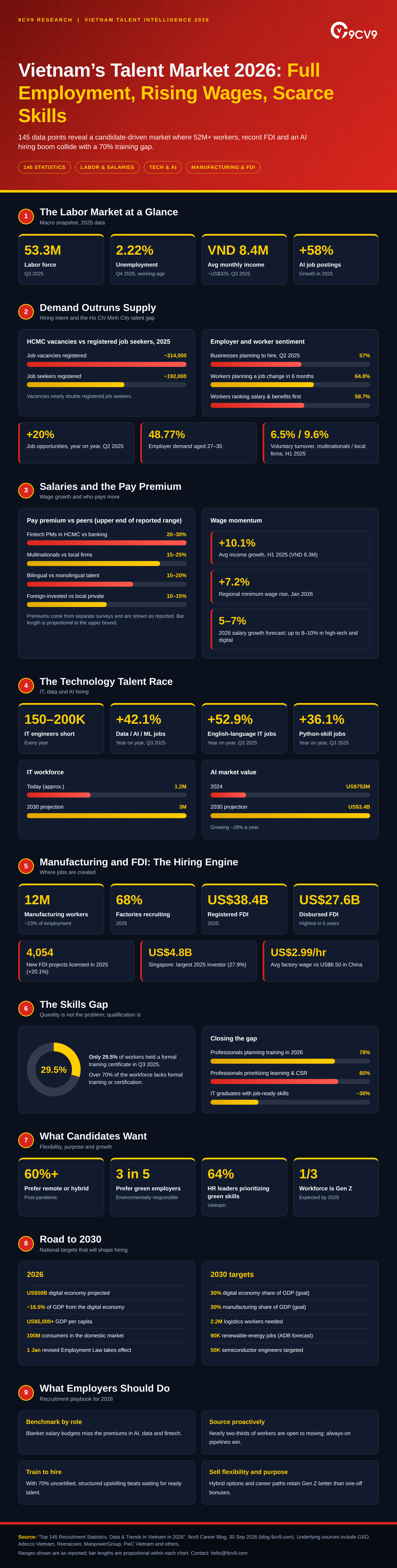
Manufacturing remains one of the foundations of Vietnam’s employment market. Around 12 million people work in manufacturing, representing roughly 23% of total employment, while 68% of manufacturing companies were actively recruiting in 2025. Foreign direct investment continues to reinforce this demand: Vietnam attracted US$38.4 billion in registered FDI in 2025, with manufacturing and processing accounting for a significant share of new and realized investment.
Technology is another major recruitment battleground. Vietnam faces an annual shortage of approximately 150,000 to 200,000 IT programmers and engineers, while AI-related job postings grew 58% in 2025. Data, AI and machine learning jobs increased 42.1% year on year in Q3 2025, and jobs requiring Python skills rose 36.1%. With Vietnam’s IT workforce projected to expand from around 1.2 million to 3 million by 2030, competition for experienced digital talent is likely to intensify further.
Yet Vietnam’s recruitment opportunity comes with a significant skills challenge. More than 70% of the workforce lacks formal training or professional certification, and only around 30% of IT graduates possess the practical skills employers require. At the same time, 78% of Vietnamese professionals plan to pursue additional training in 2026, demonstrating strong demand for career development and upskilling.
Employee expectations are evolving as well. Salary and benefits remain critical, but Vietnamese professionals increasingly value career development, purpose, flexible working arrangements, employer responsibility, and access to modern technology. Gen Z already represents a major share of the workforce, while hybrid and remote work have become important considerations for professional talent.
These Top 145 Recruitment Statistics, Data & Trends in Vietnam in 2026 provide a detailed picture of where the Vietnamese labor market is heading. From salaries, recruitment demand and workforce demographics to FDI, manufacturing, technology, AI, green jobs, skills shortages and flexible work, the data offers employers, recruiters, HR professionals and job seekers a practical benchmark for understanding one of Southeast Asia’s most dynamic talent markets.
Before we venture further into this article, we would like to share who we are and what we do.
About 9cv9
9cv9 is a business tech startup based in Singapore and in Asia, with a strong presence all over the world.
With over ten years of startup and business experience, and being highly involved in connecting with thousands of companies and startups, the 9cv9 team has access to some of the best talents in the world.
If your company needs recruitment and headhunting services to hire top-quality employees, you can use 9cv9 headhunting and recruitment services to hire top talents and candidates. Email us at hello@9cv9.com.
Top 145 Recruitment Statistics, Data & Trends in Vietnam in 2026
SECTION 1: MACROECONOMIC & LABOR FORCE OVERVIEW
- Vietnam’s total labor force reached 53.3 million in Q3 2025 — Vietnam’s working-age population continues its steady expansion, reflecting demographic momentum that makes the country one of Southeast Asia’s most attractive destinations for labor-intensive investment.
- Total employed persons reached 52.3 million in Q3 2025, up 1.12% year-on-year — Employment growth in Vietnam remains consistent and broad-based, signaling a healthy absorption rate across industries despite global economic headwinds.
- The unemployment rate for working-age individuals in Q4 2025 was 2.22% — Vietnam’s near-full-employment conditions create a competitive hiring environment where employers must differentiate through compensation, culture, and career development to attract talent.
- The underemployment rate fell to 1.50% in Q3 2025 — Declining underemployment signals that more Vietnamese workers are securing jobs that match their skills and hours preferences, though wage gaps and skill mismatches remain structural challenges.
- Approximately 1.05 million unemployed working-age individuals in H1 2025, down 13,800 year-on-year — While Vietnam’s absolute unemployment figure remains low, the pool of actively job-seeking talent is shrinking, increasing pressure on recruiters to move faster in sourcing and closing candidates.
- Labor force participation rate stood at 68.2% in H1 2025 (women: 62.5%, men: 74%) — The persistent gender gap in Vietnam’s labor participation rate highlights both a social equity challenge and an untapped talent opportunity for employers willing to invest in inclusive hiring practices.
- Unemployment rate fell to 2.22% in the first six months of 2025 — Vietnam’s consistently low unemployment rate underscores a seller’s market for skilled workers, where job seekers — particularly in tech and manufacturing — hold increasing negotiating power.
- Urban unemployment rate was 2.44%; rural rate was 2.08% in H1 2025 — The slightly higher urban unemployment rate reflects greater churn and career mobility in city markets, where workers frequently switch roles rather than remain structurally jobless.
- Vietnam’s GDP surpassed US$500 billion in 2025 — Crossing the half-trillion GDP milestone marks a pivotal moment for Vietnam’s labor market, as it accelerates the transition from low-cost assembly work toward higher-value manufacturing and services employment.
- GDP per capita reached approximately US$5,026 in 2025 — Rising per capita income is gradually reshaping Vietnamese workers’ career expectations, increasing demand for professional development, better benefits, and white-collar job opportunities.
- About 58% of Vietnam’s workforce of 51.6 million is under 35 years of age — Vietnam’s young workforce demographic is a compelling asset for employers building agile, digitally-native teams, though it also demands investment in mentorship and structured career pathing.
- Only 29.5% of workers in Q3 2025 held formal training certificates — With fewer than one in three Vietnamese workers formally credentialed, employers face significant upskilling costs — but also the opportunity to build loyalty by investing in workforce development.
- 71.4% of Vietnamese workers are untrained and lack professional certifications — This structural skills deficit remains one of the biggest constraints on Vietnam’s economic upgrading, making employer-led training programs and vocational partnerships increasingly strategic.
- Labor underutilization rate in Q3 2025 was 3.4%, equivalent to about 1.83 million persons — Beyond headline unemployment, 1.83 million underutilized workers represent a reserve talent pool that targeted recruitment, reskilling, and regional outreach can meaningfully tap.
- Urban employment increased by 831,200, reaching 19.9 million in 2024 — Sustained urban job creation reflects continued rural-to-urban migration and service-sector expansion, making city-based employers the primary engine of formal employment growth.
SECTION 2: SALARIES & COMPENSATION
- Average monthly income in Q3 2025 was VND 8.4 million (~US$325), up VND 748,000 year-on-year — While average wages in Vietnam remain competitive by regional standards, the near 10% year-on-year growth signals that the era of ultra-cheap Vietnamese labor is gradually ending.
- Average monthly income for H1 2025 was VND 8.3 million, a 10.1% year-on-year increase — Double-digit wage growth reflects both tightening labor supply in skilled segments and inflationary pressures, giving employees a stronger foundation for salary negotiations.
- Wages have grown at approximately 8–10% annually, from VND 7.1 million in 2023 to VND 7.7 million in 2024 — Consistent annual wage inflation reinforces the need for companies operating in Vietnam to build dynamic compensation review cycles rather than relying on static salary bands.
- Male workers earn on average 1.32 times more than female workers (~US$364 vs. US$274) — Vietnam’s persistent gender pay gap is not only a social equity issue but increasingly a talent risk, as younger female professionals are more likely to self-select toward employers with transparent, equitable pay structures.
- Urban workers earned 1.38 times more than rural counterparts in 2025 — The urban-rural salary divide continues to drive labor migration into industrial parks and city centers, presenting both a talent supply opportunity and a regional development challenge.
- The Red River Delta had the highest average monthly salary at VND 9.8 million (~US$374) — Hanoi and its surrounding industrial corridor command a salary premium reflecting high FDI concentration, tech cluster density, and stronger living cost pressures in the capital region.
- The Southeast region (including HCMC) recorded average wages of VND 9.7 million (~US$370) — Ho Chi Minh City’s marginally lower average salary than Hanoi masks wide sectoral variation, with finance, tech, and logistics workers in the south often surpassing their northern peers.
- Average salaries in Vietnam are expected to rise 8–10% in 2026, with fastest growth in high-tech and digital sectors — Employers planning Vietnam headcount growth in 2026 should budget for meaningful salary escalation, particularly in AI, cloud computing, and data engineering roles where demand far exceeds domestic supply.
- Vietnam salaries forecast to rise 5–7% in 2026, led by manufacturing and IT roles (AON survey) — The AON and NIC Global forecasts bracket 2026 salary growth between 5–10%, reflecting divergent outlooks by sector — a range that demands role-specific benchmarking rather than blanket budget assumptions.
- FIEs in Vietnam typically offer wages 10–15% higher than local private companies — Foreign-invested enterprises’ salary premium remains a consistent competitive advantage in talent attraction, though local champions are increasingly narrowing this gap in tech and finance.
- Multinational firms often offer 15–25% higher packages than local enterprises — Multinationals’ compensation edge continues to position them as preferred employers for Vietnam’s top graduates, creating a tiered talent market that local firms must actively address through total rewards redesign.
- Regional minimum wage increased by 7.2% effective January 1, 2026 under Decree No. 293/2025/ND-CP — The above-inflation minimum wage hike for 2026 reflects the government’s commitment to real wage growth, while also raising baseline labor costs for manufacturers and retailers employing large frontline workforces.
- Minimum wage as of January 2026 ranges from VND 3.25 million to VND 4.68 million/month by region — Vietnam’s four-tier regional minimum wage structure ensures cost differentiation across provinces, allowing manufacturers to balance wage competitiveness with proximity to ports, suppliers, and skilled labor pools.
- Performance bonuses (KPI-based) make up 20–25% of annual income for mid- and senior-level professionals in 2026 — The growing variable pay component in Vietnamese professional compensation reflects a maturing market where companies increasingly tie rewards to measurable business outcomes.
- Bilingual and cross-border talent earn 10–20% more than monolingual peers — Vietnamese professionals who combine strong English skills with technical expertise command a significant market premium, highlighting language investment as one of the highest-ROI career moves available.
- The voluntary turnover rate in H1 2025 was just 6.5% at multinationals and 9.6% at local firms — a record low — Historically low voluntary turnover in 2025 suggests that economic uncertainty and competitive job markets prompted workers to stay put, but employers should not mistake this caution for loyalty.
- The salary gap between lowest and highest earners within the same industry can reach 7–12 times — Vietnam’s wide intra-industry salary dispersion reflects a bifurcated labor market where basic production roles and highly skilled positions coexist, creating both cost flexibility and equity challenges for compensation teams.
- CTO/CIO/VPoE positions lead Vietnam’s IT compensation with a median of VND 101.25 million/month — Executive-level technology compensation in Vietnam has reached genuinely global-competitive levels, reshaping perceptions of the country as a viable location for senior tech leadership, not just outsourced development.
- Tech Leads earn a median of VND 51.8 million/month; IT Managers VND 50.25 million/month — Mid-senior technology management roles in Vietnam now command salaries equivalent to US$2,000+/month, representing strong value for international firms hiring locally for regional responsibilities.
- Data Engineers reach VND 56.9 million/month at the 3–4 year experience level — Surpassing even many IT managers in compensation, Data Engineers with just three to four years of experience highlight the acute premium Vietnam’s market places on data infrastructure and analytics expertise.
- Back-end Developers grow from VND 12.4 million/month at entry to VND 54.9 million/month at high seniority — The more than fourfold salary progression for back-end developers across seniority levels reflects both career growth opportunity and the steep competition for proven engineering talent in Vietnam.
- AI engineers in Vietnam earn between US$1,100 and US$2,060 per month, with 10–50% premium over other IT roles — AI engineering compensation in Vietnam varies widely based on specialization depth and industry, but consistently commands a premium that is reshaping salary band structures at technology companies.
- Average IT salaries range from US$415–510/month for fresh graduates — Entry-level IT salaries in Vietnam are modest by global standards, but the rapid progression curve and high demand create a compelling long-term earnings trajectory for technically strong new graduates.
- 35% of businesses in Vietnam planned to hire more staff in 2025, while nearly half chose to maintain headcount — The cautious hiring posture of nearly half of Vietnamese businesses in 2025 reflects a market in measured optimism rather than unconstrained expansion — a signal for candidates to prioritize role quality over quantity of options.
SECTION 3: HIRING DEMAND & RECRUITMENT ACTIVITY
- 57% of Vietnamese businesses planned to hire new employees in Q2 2025 — A majority of Vietnamese businesses maintained expansion-oriented hiring plans into mid-2025, confirming that demand-side momentum in the labor market remained intact despite external economic pressures.
- Total job opportunities increased 3% from Q1 and 20% year-on-year in Q2 2025 (Adecco Vietnam) — A 20% year-on-year surge in job opportunities reflects accelerating economic activity and growing business confidence, making Q2 2025 one of the strongest quarters for job seekers in recent memory.
- Ho Chi Minh City enterprises registered nearly 314,000 job vacancies in 2025 — HCMC’s vast vacancy volume cements its position as Vietnam’s undisputed commercial hiring engine, with demand outpacing supply across industries from logistics to financial services.
- Nearly 192,000 job seekers registered with employment service centers in HCMC in 2025 — With vacancies nearly doubling the number of registered job seekers in HCMC, the city’s talent gap is measurable and growing, adding urgency to employer branding and proactive sourcing efforts.
- HCMC expected to recruit 79,000–84,000 workers in Q1 2025 alone — The sheer scale of Q1 hiring demand in HCMC — driven by post-Tet business resumption and FDI ramp-ups — underscores the city’s structural need for year-round talent pipeline development.
- Post-Tet 2025 recruitment demand included 50,400–55,500 job vacancies in HCMC — The annual post-Tet hiring surge remains one of Vietnam’s most predictable recruitment patterns, offering employers a defined window to capture returning workers and seasonal career-movers.
- Hanoi’s plan aims to create 169,000 jobs and reduce urban unemployment below 3% in 2025 — Hanoi’s government-backed employment targets reflect a coordinated effort to attract investment, retain talent, and position the capital as a complement — not just a counterpart — to HCMC’s commercial dominance.
- Vietnam enterprises needed approximately 100,000–120,000 workers in Q1 2025 — The six-figure quarterly workforce demand nationwide confirms that Vietnam’s recruitment market operates at industrial scale, where digital platforms, mass hiring strategies, and regional sourcing networks are essential tools.
- Trade and services sectors saw hiring increase by about 20% in Q1 2025 — Consumer-facing sectors experienced robust early-year hiring momentum, driven by Tet-related retail spending and the sustained recovery of Vietnam’s domestic services economy.
- Hiring demand in banking, fintech, compliance, and corporate finance projected to grow 8–12% year-on-year in 2026 — Vietnam’s financial sector is entering a period of regulatory modernization and digital transformation that will sustain above-average hiring demand for risk, compliance, and technology-finance hybrid professionals.
- Primary age group targeted by employers: 27–35 (48.77% of demand) — Vietnamese employers’ strong preference for mid-career professionals aged 27–35 reflects the premium placed on experience with minimal seniority cost, creating a competitive but well-defined target demographic for most corporate hiring strategies.
- Industrial Sales & Marketing recorded a 14% increase in job orders in Q2 2025 — The rise in industrial sales and marketing hiring reflects maturing go-to-market demands from Vietnam’s rapidly expanding manufacturing base, as companies seek professionals who can bridge technical products and commercial growth.
- 64.8% of Vietnamese workers planned to change jobs within the next six months (2024 Reeracoen survey) — Nearly two-thirds of the Vietnamese workforce was actively or latently open to job changes, creating a large addressable candidate market for proactive employers running always-on recruitment strategies.
- 58.7% of Vietnamese workers prioritize salary and benefits as the top driver for job decisions — Competitive compensation remains the single most decisive factor in Vietnamese workers’ career choices, reinforcing that while culture and purpose matter, base pay benchmarking is non-negotiable in talent attraction.
SECTION 4: MANUFACTURING HIRING
- 68% of manufacturing companies in Vietnam are actively recruiting in 2025 — Manufacturing’s dominant role in Vietnam’s hiring landscape reflects both its FDI-driven expansion and its transition toward higher-value production that demands a broader mix of technical and supervisory skills.
- Manufacturing contributes roughly 25% of Vietnam’s GDP and accounts for 61% of inward FDI stock — The sector’s disproportionate share of foreign investment relative to its GDP contribution signals continued hiring pressure as new factories ramp up and existing operations scale.
- Vietnam’s manufacturing workforce reached 12 million people, accounting for about 23% of total employment — With nearly one in four Vietnamese workers employed in manufacturing, the sector’s talent health has direct macroeconomic consequences — making workforce development a national competitiveness priority.
- Average factory worker in Vietnam earns ~US$2.99/hour, compared to US$6.50/hour in China — Vietnam’s labour cost advantage over China remains substantial, but rapid wage growth means manufacturers cannot rely indefinitely on cost arbitrage and must increasingly invest in automation and workforce productivity.
- Production and processing manufacturing rose 8.80% year-on-year in 2025 — Manufacturing’s sustained growth well above GDP-average reinforces its position as Vietnam’s most employment-intensive growth engine heading into 2026.
- Samsung alone employs around 112,000 workers in Vietnam and accounts for about one-fifth of total exports — Samsung’s outsized presence in Vietnam’s labor market illustrates the concentration risk of anchoring national employment to a small number of mega-investors, even as it demonstrates Vietnam’s capacity to host world-class industrial operations.
- Foreign-owned firms’ share of Vietnam’s formal workforce grew at 5.6% annually between 1995 and 2019, reaching 35% — Three decades of steady foreign-firm expansion in Vietnam’s formal employment market have fundamentally reshaped its wage norms, skills expectations, and corporate culture landscape.
- About half of Vietnam’s employment depends directly or indirectly on exports — The export dependency of Vietnam’s labor market creates systemic vulnerability to global trade disruptions — a structural challenge that policymakers and HR leaders must factor into workforce resilience planning.
- Manufacturing wages in Vietnam almost tripled to nearly US$5/hour over 2010–2022 — The near-tripling of manufacturing wages over a decade represents both a success story for Vietnamese workers and a wake-up call for cost-focused manufacturers who must rethink productivity-led competitiveness.
- Government target: manufacturing to contribute 30% of GDP by 2030 — Vietnam’s industrial policy ambitions will sustain above-average manufacturing hiring demand through 2030, with growing emphasis on automation-compatible roles, quality engineering, and industrial management.
- Production workers account for about 85% of employees in Vietnam’s export sector — The still-dominant share of production workers in export manufacturing signals limited progress in skills upgrading within the sector, and a substantial upskilling opportunity for companies investing in worker advancement programs.
SECTION 5: FDI AND ITS IMPACT ON HIRING
- Vietnam attracted US$38.4 billion in registered FDI in 2025; disbursed FDI reached US$27.6 billion — highest in five years — Record FDI disbursement directly translates into job creation on the ground, as capital flowing into factories, data centers, and industrial parks requires human workforces to operationalize.
- Manufacturing and processing attracted US$9.8 billion — 56.5% of total newly registered FDI capital in 2025 — Manufacturing’s continued dominance of Vietnam’s FDI inflows ensures that factory-floor and industrial engineering hiring will remain a priority sector for workforce planners and talent agencies alike.
- Manufacturing attracted US$22.88 billion in realized FDI in 2025, accounting for 82.8% of total realized FDI — The overwhelming concentration of realized investment in manufacturing confirms that Vietnam’s most tangible job-creation engine remains physical production, not yet services or digital industries.
- Singapore was the largest FDI investor in Vietnam in 2025 with over US$4.8 billion (27.9% of newly registered capital) — Singapore-headquartered companies bring with them regional management structures and talent frameworks that elevate compensation norms and recruitment sophistication in the markets they enter.
- 4,054 new FDI projects were licensed in Vietnam in 2025, a 20.1% increase in number — A 20% surge in new foreign project licenses signals accelerating investor confidence in Vietnam’s business environment, each project representing new hiring mandates at establishment and ramp-up phases.
- China registered about US$4.73 billion of FDI in Vietnam in 2024, launching 955 new projects — Chinese FDI concentration in manufacturing and electronics creates high-volume, entry-to-mid-level hiring demand, while also shaping industrial cluster development in provinces like Binh Duong and Bac Ninh.
- Japan’s cumulative FDI footprint in Vietnam reached US$74 billion — Japan’s decades-long investment history in Vietnam has created a distinctive corporate culture layer in the labor market, where Japanese management practices, language skills, and quality standards command professional premiums.
- In the first 7 months of 2025, 61% of US$24.1 billion FDI went to manufacturing — Manufacturing’s persistent dominance of mid-year FDI data confirms that Vietnam’s growth story remains grounded in production economy fundamentals, even as the services and digital sectors accelerate.
- Vietnam has more than 300 special economic zones, most focused on manufacturing — The density of Vietnam’s industrial zone network creates geographically distributed hiring markets where local talent competition, commute patterns, and housing availability shape recruitment strategies as much as industry trends.
- Korean FDI, led by Samsung and LG, dominates electronics manufacturing and drives approximately 30% of Vietnam’s total exports — Korean-invested factories are among Vietnam’s largest single employers, creating massive demand for production engineers, quality controllers, and bilingual Korean-Vietnamese coordinators.
SECTION 6: IT & TECHNOLOGY SECTOR HIRING
- Vietnam’s IT sector requires approximately 700,000 new personnel by 2025 but can supply only 500,000 — a 200,000 shortfall — The structural mismatch between Vietnam’s IT talent supply and employer demand is one of the most consequential workforce gaps in Southeast Asia, with real implications for the country’s digital economy ambitions.
- Vietnam faces an annual shortage of 150,000–200,000 IT programmers and engineers — The chronic annual deficit of tech talent in Vietnam drives up IT salaries, extends time-to-hire for engineering roles, and pushes companies toward offshore sourcing, bootcamp partnerships, and aggressive internal development programs.
- Vietnam’s digital economy is projected to reach US$50 billion by 2026 — The rapid scaling of Vietnam’s digital economy creates compounding hiring demand across software development, data analytics, cybersecurity, and digital product management roles.
- Approximately 74,000 IT enterprises in Vietnam employ over 1.2 million workers — Vietnam’s large and growing pool of IT businesses creates a competitive internal talent market where employer branding, office environment, and project quality are differentiators beyond salary.
- More than 80,000 digital businesses are in operation in Vietnam in 2026 — The proliferation of digital businesses means that technology talent is now sought not just by IT firms but by banks, retailers, manufacturers, and logistics companies undergoing digital transformation.
- The ICT sector contributes about US$41.4 billion to Vietnam’s GDP (~8% of total GDP) in 2025, up 26% — ICT’s double-digit contribution growth to Vietnam’s GDP is outpacing nearly all other sectors, making technology talent strategy a board-level concern for companies of every industry.
- Total revenue of Vietnam’s ICT industry estimated at US$198 billion in 2025, 16% above target — Exceeding national ICT revenue targets by 16% validates Vietnam’s emergence as a serious technology production hub, reinforcing investor confidence and talent attraction for the sector.
- Vietnam’s AI market value hit US$753.40 million in 2024, growing at 28.36% annually — With AI market revenues expanding at nearly 30% per year, demand for AI practitioners, ML engineers, and prompt architects in Vietnam is accelerating well ahead of the broader technology market.
- AI-related job postings in Vietnam grew 58% in 2025, one of the fastest rates in ASEAN — Vietnam’s AI hiring acceleration positions it as ASEAN’s most dynamic AI talent market, but the gap between posting volume and qualified candidate availability remains a persistent recruitment challenge.
- Jobs related to Data/AI/ML in Vietnam’s IT sector increased 42.1% year-on-year in Q3 2025 — The 42% year-on-year surge in data and AI job postings reflects a fundamental shift in Vietnam’s tech economy, where data-driven decision-making is becoming an organizational baseline expectation.
- Jobs requiring Python skills increased 36.1% year-on-year; English-language jobs increased 52.9% in Q3 2025 — The disproportionate growth in English-language IT job postings signals Vietnam’s expanding role in global technology delivery, where bilingual engineers are increasingly preferred over monolingual peers.
- Overall IT job postings in Q3 2025 increased 2.7% year-on-year — Moderate aggregate IT hiring growth in Q3 2025 masks wide dispersion — with AI and data roles surging while legacy development roles plateau — reflecting quality-over-quantity hiring maturity.
- About 30% of IT graduates in Vietnam possess practical skills required by employers — The large gap between IT graduates’ classroom training and workplace readiness is a systemic quality challenge, pushing leading employers to run their own technical assessments and structured developer academies.
- 56% of Vietnamese tech professionals are between 20–29 years old — Vietnam’s overwhelmingly young IT workforce is a double-edged reality: abundant in energy and adaptability, but thin on the senior engineering experience that complex technical roles increasingly demand.
- Vietnam’s AI market is projected to hit US$3.4 billion by 2030, growing at 28.63% yearly — AI’s decade-long growth trajectory in Vietnam will generate compounding hiring demand that outpaces any single institution’s ability to train talent at scale — making corporate learning ecosystems an urgent strategic investment.
- Government’s National Semiconductor Strategy aims to create 50,000 skilled engineers by 2030 — Vietnam’s semiconductor ambitions represent one of the most significant planned talent-creation initiatives in Southeast Asia, with implications for university curriculum redesign, industry-academia partnerships, and salary benchmarks in chip design.
- AI could contribute an estimated US$79.3 billion to Vietnam’s economy by 2030 — nearly 12% of its GDP — The scale of AI’s projected economic contribution makes AI talent development not merely an HR priority but a national growth imperative with direct consequences for Vietnam’s per capita income trajectory.
- Vietnam’s software development rates are 30–40% lower than India and China, and up to 70% lower than Singapore or the U.S. — Vietnam’s software development cost advantage over more established outsourcing markets remains a powerful commercial argument for international firms building or expanding engineering teams in the country.
- Blockchain developer demand globally shot up 517% year-over-year; Vietnam aims to train 50,000 blockchain engineers by 2030 — Vietnam’s proactive blockchain talent development agenda positions it to capture a disproportionate share of global demand for a skill set where supply remains critically constrained worldwide.
- More than 75% of technology companies in Vietnam expect growth in IT — Near-universal growth expectations among Vietnam’s tech companies translate into sustained competition for the same talent pool, making speed-to-offer and holistic employer value propositions critical competitive differentiators.
- Vietnam’s fintech industry grew 15% in 2025, fueled by mobile payments, e-wallets, and blockchain lending — Fintech’s accelerating growth is generating demand for a distinctive blend of skills — combining financial regulation knowledge, product management, and software engineering — that Vietnam’s current talent pool struggles to fully satisfy.
- Vietnam’s fintech market expected to double from US$9 billion (2023) to US$18 billion by 2025 — The expected doubling of Vietnam’s fintech market within two years is one of the most compelling sector-specific talent investment signals in ASEAN, warranting sustained pipeline development in financial technology roles.
SECTION 7: SKILLS GAPS & WORKFORCE QUALITY
- 76% of employers in Asia-Pacific struggle to find skilled workers (ManpowerGroup APAC) — Vietnam sits within a broader APAC talent shortage context, where the regional skills deficit makes it simultaneously challenging to recruit locally and attractive as a destination for global companies building distributed teams.
- Over 70% of Vietnam’s workforce lacks formal training or certification — The training deficit affecting more than two-thirds of Vietnam’s workforce is a recurring structural constraint — creating both a long-term productivity risk and an opportunity for employers who invest in on-the-job skill development as a talent differentiator.
- Only 28% of Vietnam’s workers have received formal training — With fewer than three in ten workers formally trained, companies operating in Vietnam must build internal capability development infrastructure rather than rely on the general labor market to deliver job-ready professionals.
- Approximately 38 million Vietnamese workers were untrained at end-2024 — The sheer numerical scale of Vietnam’s untrained workforce — nearly 38 million people — makes vocational education partnerships and government-supported training schemes essential complements to corporate hiring strategies.
- By 2030, Vietnam’s four most critical skill sets will be AI and Big Data, Cybersecurity, Talent Management, and Agile Thinking — Employers who align their training investments with Vietnam’s projected 2030 skill priorities will build competitive workforce advantages that compound as the country’s economy sophisticates.
- Four key industrial sectors require 65,100–69,300 workers annually — The quantified annual workforce demand from Vietnam’s core industrial sectors provides HR planners with a baseline for strategic workforce supply agreements with vocational colleges and technical institutes.
- Service sectors will require 170,500–181,500 workers annually — 55% of total job demand by 2025–2030 — Services sector dominance of Vietnam’s projected job demand through 2030 signals a structural economic transition that employers, educators, and recruiters must anticipate with services-oriented skill development programs.
- Vietnam logistics sector requires about 2.2 million workers by 2030, growing 15–20% annually — Logistics’ 15–20% annual workforce growth requirement is among the most demanding in any sector, yet Vietnam’s logistics talent pipeline remains underdeveloped relative to the sector’s strategic importance.
- 78% of Vietnamese professionals plan to pursue further training in 2026 — highest among surveyed APAC countries — Vietnam’s standout commitment to self-directed professional development reflects a culture of educational ambition that employers can leverage through sponsored learning as a cost-effective retention tool.
- 80% of Vietnamese professionals prioritized learning and CSR over salary alone in 2025 — The emergence of purpose and development as primary retention drivers among Vietnamese professionals challenges traditional compensation-centric talent strategies and demands a more holistic employee value proposition.
- 2025 brought a return to long-term, permanent hiring in manufacturing, energy, and IT — The shift back toward permanent over project-based hiring in 2025 signals employer confidence in sustained growth across Vietnam’s key sectors, creating more stable career pathways for workers and more predictable workforce planning horizons.
SECTION 8: GREEN ECONOMY & RENEWABLE ENERGY HIRING
- Vietnam’s renewable energy sector could generate 90,000 new jobs by 2030 (ADB forecast) — The Asian Development Bank’s 90,000-job projection for renewables makes Vietnam’s energy transition one of the most significant talent opportunity areas of the late 2020s, requiring proactive engineering and technical curriculum development now.
- By 2030, Vietnam’s green economy could contribute over 10% to GDP — Green economy growth at the pace needed to reach 10% of GDP will necessitate a multi-sector talent transformation, touching everything from manufacturing process engineering to green finance and sustainable supply chain management.
- 64% of HR leaders now prioritize green skills training in Vietnam — The majority of Vietnam’s HR leaders have embedded green skills into their training agendas, reflecting both regulatory pressure and growing conviction that sustainability competence is a core business capability, not a peripheral initiative.
- 3 in 5 Vietnamese professionals prefer to work for environmentally responsible employers — ESG employer branding is increasingly actionable in Vietnam’s talent market, where environmental responsibility influences the career decisions of the majority of working professionals — not just the most idealistic minority.
- 49% of Vietnamese workers are considering a career change, many interested in sustainable development roles — Nearly half of Vietnam’s workforce is in active career reconsideration mode, with green and sustainable sectors emerging as aspirational destinations that forward-thinking employers can position around.
- 70% of companies worldwide plan to hire a green workforce, yet only 9% in APAC have the needed skills — The vast green skills gap in APAC, including Vietnam, means that first-mover companies that invest in sustainability talent development will enjoy substantial competitive advantages in the coming recruitment landscape.
- 43% of companies in Vietnam upgraded technological tools in Q4 2024 to attract and retain labor — The link between workplace technology investment and talent retention is increasingly evident in Vietnam, where younger workers especially select employers based on the digital sophistication of their work environment.
- The World Bank estimates Vietnam could attract US$370 billion in green investments by 2040 — The World Bank’s staggering green investment projection for Vietnam dwarfs current FDI levels and would — if realized — transform the country’s hiring landscape, creating demand for an entirely new generation of sustainability-literate engineers and project managers.
- FDI inflows into Vietnam’s logistics real estate rose 28% year-on-year in 2025 — The logistics real estate boom driven by FDI is fueling parallel demand for warehouse operations managers, supply chain engineers, and last-mile delivery specialists at a pace that outstrips current talent supply.
SECTION 9: WORKFORCE DEMOGRAPHICS & TALENT MOBILITY
- Vietnam’s labor force remains above 52 million with unemployment stabilizing at 2.0–2.5% — Vietnam’s stable, large labor force combined with near-full employment represents an optimal conditions balance for growth-oriented companies — enough workers to scale, scarce enough to motivate competitive compensation.
- Vietnam’s population exceeded 100 million citizens — Crossing the 100 million population threshold reinforces Vietnam’s long-term demographic dividend, providing a sustained pipeline of young workers that will continue to fuel labor market expansion well into the 2040s.
- Gen Z expected to represent a third of Vietnam’s workforce by 2025 — With Gen Z already comprising roughly one-third of the workforce, employers who fail to redesign their recruitment processes, workplace culture, and career development frameworks for this cohort face an accelerating talent risk.
- 99% of Vietnamese employees seek purpose in their careers; 85% consider a company’s social responsibility — The near-universal demand for purpose-driven work among Vietnamese employees is a transformative signal for recruitment marketing, suggesting that employer branding must move beyond perks and salary to articulate genuine social impact.
- 40% of Vietnam’s current IT jobs could be automated by 2030 — The prospect of automating four in ten current IT roles underscores an urgent need for continuous reskilling within Vietnam’s tech workforce — and creates new demand categories in AI oversight, model training, and human-AI workflow design.
- Retail sector turnover rate in Vietnam can reach up to 25% — A quarter-annual retail turnover rate imposes substantial training and recruitment cost cycles on consumer-facing businesses, making retention strategy — not just hiring efficiency — a critical operational lever in the sector.
- For employees earning VND 10 million or lower, turnover reached 29% — High turnover among Vietnam’s lowest-wage workers reflects the rational economic response to a competitive labor market where small wage differentials can drive meaningful switches, underscoring the importance of non-monetary retention tools at this income level.
- Vietnam adds hundreds of thousands of university graduates annually, with growing emphasis on STEM — The growing STEM orientation of Vietnam’s university output is gradually improving the technical talent pipeline, though alignment with specific industry needs remains a persistent work in progress between academia and employers.
- Vietnam’s GDP grew an estimated 5.9% in Q1 2025 — Above-trend GDP growth in early 2025 provided the macroeconomic foundation for the year’s hiring confidence, validating expansion-mode talent strategies across manufacturing, services, and technology.
SECTION 10: FLEXIBLE WORK, REMOTE WORK & EMPLOYER BRANDING
- Over 60% of Vietnamese respondents prefer partial or full remote setups post-pandemic — Majority preference for remote or hybrid work in Vietnam is no longer a pandemic-era exception but a structural expectation that recruiters must address transparently in job descriptions and offer conversations.
- By 2025, hybrid work has become the dominant work structure in many sectors in Vietnam — Hybrid work’s normalization across Vietnam’s professional economy has permanently altered what constitutes a competitive employment offer, with scheduling flexibility now weighting alongside salary in candidate evaluation.
- Demand for flexible workspaces/coworking surged over 40% year-on-year between 2023 and 2025 — The coworking boom reflects the practical infrastructure of hybrid work adoption in Vietnam, where decentralized office solutions are enabling companies to recruit talent beyond traditional HCMC and Hanoi headquarters.
- 80% of Gen Z professionals in Vietnam believe they can be effective during remote work (PwC survey) — Gen Z’s strong self-reported remote effectiveness challenges assumptions that junior workers require constant in-office supervision, and supports more flexible onboarding and mentorship approaches that don’t require full physical attendance.
- Younger Vietnamese employees increasingly favor hybrid work models and digital-first tools — The digital-first work preference of Vietnam’s younger workforce makes investments in collaboration platforms, async communication tools, and virtual performance management systems direct talent acquisition enablers.
- Vietnam’s Employment Law was revised in June 2025, effective January 1, 2026, covering digital skills and labor market governance — The revised Employment Law signals that Vietnam’s regulatory framework is catching up with workforce realities, with implications for hiring platforms, skills certification, and unemployment insurance design.
- Real Estate sector had 61% of companies maintaining or cutting headcount in Q2 2025 — The real estate sector’s cautious headcount posture reflects continued market liquidity challenges and signals that talent displaced from property development is adding supply to adjacent sectors such as construction management and project finance.
- 30% increase in IT job demand observed in Q2 2025, driven by AI, ML, Cloud, and Cybersecurity hiring (Adecco) — Technology’s 30% demand surge in a single quarter confirms that the digital transformation investment cycle in Vietnam is translating directly into job creation, particularly for cloud-native and AI-adjacent skill sets.
- Companies offering structured career paths and upskilling see higher talent retention among Gen Z — The evidence from Vietnam’s Gen Z workforce is unambiguous: career architecture and learning investment are more effective long-term retention tools than signing bonuses or short-term compensation spikes.
- Recruitment budgets are concentrated in Sales & Marketing, IT & Telecoms, and Engineering & Science — The concentration of Vietnamese companies’ recruitment spending in these three domains reflects the skill sets most directly tied to revenue generation and digital competitive advantage in today’s market.
SECTION 11: REGIONAL & OUTLOOK DATA FOR 2026
- Most manufacturing hiring is concentrated in Ho Chi Minh City, Binh Duong, and Dong Nai — Southern Vietnam’s industrial triangle continues to function as the country’s manufacturing employment center of gravity, creating intense local talent competition and driving industrial zone development further into adjacent provinces.
- FDI logistics real estate investment rose 28% year-on-year, driving demand for warehouse engineers and transport planners — The logistics infrastructure investment surge is creating a highly specific skills demand in Vietnam that spans civil engineering, warehouse automation, and supply chain digital systems — a niche with limited trained domestic supply.
- Fintech product managers in HCMC command monthly packages 20–30% higher than traditional banking peers — The fintech premium in HCMC signals a talent market bifurcation within financial services, where digital-product fluency is already commanding a compensation tier above traditional banking credentials.
- Vietnam’s consumer base reached 100 million people with GDP per capita exceeding US$5,000 in 2026 — Crossing the US$5,000 per capita income threshold is a pivotal milestone that historically accelerates consumption-driven hiring in retail, healthcare, education, and financial services.
- Average salary growth forecast at 5–7% in 2026 broadly, with technology and manufacturing leading — While 5–7% headline salary growth is relatively moderate by Vietnam’s recent historical standards, technology and manufacturing premiums mean that role-specific growth will significantly exceed the average for in-demand skill sets.
- Vietnam’s digital economy contribution to GDP estimated at approximately 16.5% in 2026 — With digital’s GDP share already approaching 17%, Vietnam has moved beyond the digital economy as an emerging story and into a phase where digital skills are baseline requirements across virtually every professional sector.
- National Digital Transformation Strategy targets digital economy at up to 30% of GDP by 2030 — Vietnam’s digital economy targets imply a near-doubling of current digital GDP share within four years — an ambition that will require training, attracting, and retaining technology talent at a scale without precedent in the country’s economic history.
- Vietnam’s IT workforce projected to expand from 1.2 million today to 3 million by 2030 — The projected 2.5x expansion of Vietnam’s IT workforce over five years represents one of the most ambitious technology talent scaling objectives in ASEAN, demanding coordinated government, university, and employer action.
- Vietnam offers 20–40% lower compensation than more mature ASEAN markets for comparable skill sets — Vietnam’s persistent salary discount versus Singapore, Malaysia, and Thailand for equivalent roles makes it one of the most cost-effective high-quality hiring destinations in the region — a fact that continues to attract regional headquarters looking to build quality teams efficiently.
- Government aims to align vocational training with labor market demands, including IT skills, under the National Digital Transformation Strategy — Policy-level recognition of the vocational-market alignment gap is a constructive signal for employers, suggesting that government training investments will gradually reduce the chronic skills mismatch that has inflated time-to-hire and onboarding costs across industries.
Conclusion
Vietnam’s recruitment market in 2026 is defined by strong hiring demand, rising compensation, persistent skills shortages and rapid economic transformation. With a labor force exceeding 52 million, unemployment remaining around 2.0–2.5%, and continued investment across manufacturing, technology, logistics and financial services, competition for qualified workers is becoming increasingly intense.
Salary pressure is likely to remain a defining recruitment trend. Average salary growth is forecast at around 5–7% in 2026, with technology and manufacturing among the leading sectors. Professionals with specialized capabilities in AI, data, cloud computing, cybersecurity, engineering and bilingual or cross-border roles can command considerably stronger compensation premiums. Employers therefore need increasingly precise salary benchmarking rather than relying on broad national averages.
Technology represents one of Vietnam’s biggest recruitment opportunities and challenges. The country continues to face an annual shortage of approximately 150,000–200,000 IT programmers and engineers, while AI-related job postings grew 58% in 2025. Vietnam’s IT workforce is projected to expand from around 1.2 million to 3 million by 2030, illustrating the enormous scale of talent development required to support the country’s digital ambitions.
Manufacturing will remain equally important. Around 12 million people already work in the sector, while substantial foreign direct investment continues to generate demand for production workers, engineers, supervisors, quality specialists and industrial management professionals. Vietnam’s US$38.4 billion in registered FDI in 2025 further demonstrates why international investment will remain closely connected to employment growth.
However, expanding the workforce alone will not solve Vietnam’s recruitment challenges. More than 70% of workers lack formal training or certification, creating a structural skills gap between available labor and increasingly sophisticated employer requirements. Companies that invest in vocational partnerships, internal training, structured career development and continuous upskilling will be better positioned to build sustainable talent pipelines.
Candidate expectations are also changing. Competitive salaries remain essential, but career progression, learning opportunities, flexible working arrangements, purpose and employer responsibility increasingly influence employment decisions. With younger workers becoming a larger part of the workforce, employers will need to combine competitive compensation with stronger employee value propositions and modern workplace practices.
Ultimately, these 145 recruitment statistics, data and trends in Vietnam highlight a labor market moving toward higher skills, higher wages and greater competition for talent. For employers, recruiters and HR leaders, success in Vietnam in 2026 will increasingly depend on faster recruitment, accurate compensation benchmarking, proactive sourcing, workforce development and long-term retention. For job seekers, the same transformation is creating significant opportunities to develop specialized skills and participate in Vietnam’s rapidly evolving manufacturing, digital and services economy.
If you find this article useful, why not share it with your hiring manager and C-level suite friends and also leave a nice comment below?
We, at the 9cv9 Research Team, strive to bring the latest and most meaningful data, guides, and statistics to your doorstep.
To get access to top-quality guides, click over to 9cv9 Blog.
To hire top talents using our modern AI-powered recruitment agency, find out more at 9cv9 Modern AI-Powered Recruitment Agency.
People Also Ask
What are the key recruitment trends in Vietnam in 2026?
Vietnam’s recruitment market in 2026 is shaped by low unemployment, rising salaries, strong FDI, skills shortages, digital transformation and growing demand across manufacturing, technology, logistics and financial services.
What is Vietnam’s unemployment rate in 2026?
Vietnam’s unemployment rate is expected to remain relatively low, with the labor market outlook indicating unemployment stabilizing at around 2.0–2.5%.
How large is Vietnam’s workforce?
Vietnam has a labor force of more than 52 million people. The labor force reached 53.3 million in Q3 2025, providing employers with one of Southeast Asia’s largest workforce pools.
What is the average salary in Vietnam?
Average monthly income reached VND 8.4 million in Q3 2025, increasing by VND 748,000 year on year. Salaries vary considerably by industry, location, skills and seniority.
How much will salaries increase in Vietnam in 2026?
Average salary growth is forecast at around 5–7% in 2026, with technology and manufacturing expected to lead. Some forecasts indicate increases of up to 8–10% in high-tech and digital sectors.
Which industries are hiring the most in Vietnam in 2026?
Manufacturing, IT, AI, logistics, fintech, banking, engineering and other digital industries are important areas of hiring demand, supported by FDI, industrial expansion and digital transformation.
Is Vietnam experiencing a skills shortage?
Yes. More than 70% of Vietnam’s workforce lacks formal training or certification, creating significant challenges for employers seeking workers with specialized technical and professional skills.
How severe is Vietnam’s IT talent shortage?
Vietnam faces an annual shortage of approximately 150,000–200,000 IT programmers and engineers, making technology recruitment one of the country’s most competitive talent markets.
Are AI jobs growing in Vietnam?
Yes. AI-related job postings in Vietnam grew 58% in 2025, while Data, AI and ML jobs increased 42.1% year on year in Q3 2025.
What technology skills are in demand in Vietnam?
Demand is particularly strong for AI, machine learning, data, Python, cloud computing and cybersecurity skills. Jobs requiring Python increased 36.1% year on year in Q3 2025.
How important is manufacturing to recruitment in Vietnam?
Manufacturing employs around 12 million people, or approximately 23% of total employment. About 68% of manufacturing companies were actively recruiting in 2025.
How does FDI affect recruitment in Vietnam?
FDI creates substantial hiring demand, particularly in manufacturing. Vietnam attracted US$38.4 billion in registered FDI in 2025, while disbursed FDI reached US$27.6 billion.
Which Vietnamese cities have the strongest hiring demand?
Ho Chi Minh City is a major recruitment hub, while Hanoi also generates significant employment demand. Manufacturing hiring is especially concentrated around Ho Chi Minh City, Binh Duong and Dong Nai.
How many job vacancies are available in Ho Chi Minh City?
Ho Chi Minh City enterprises registered nearly 314,000 job vacancies in 2025, compared with nearly 192,000 job seekers registered with employment service centers.
What age group is most in demand among Vietnamese employers?
Workers aged 27–35 represent a major recruitment target, accounting for 48.77% of employer demand in the dataset.
What do Vietnamese employees value most when choosing jobs?
Salary and benefits remain highly influential. About 58.7% of Vietnamese workers identified salary and benefits as their top driver when making employment decisions.
Are Vietnamese workers planning to change jobs?
A Reeracoen survey found that 64.8% of Vietnamese workers planned to change jobs within six months, highlighting a substantial pool of active and potentially mobile candidates.
What is the outlook for IT recruitment in Vietnam?
IT recruitment should remain strategically important as Vietnam’s digital economy expands. The country’s IT workforce is projected to grow from about 1.2 million workers to 3 million by 2030.
How large is Vietnam’s digital economy?
Vietnam’s digital economy is projected to reach US$50 billion by 2026, while its contribution to GDP is estimated at approximately 16.5% in 2026.
How many IT companies operate in Vietnam?
Approximately 74,000 IT enterprises employ more than 1.2 million workers, while more than 80,000 digital businesses are reported to be operating in Vietnam in 2026.
What percentage of Vietnamese workers have formal training?
Only around 28–29.5% of Vietnamese workers have formal training or professional certificates, leaving more than 70% without formal qualifications.
Are Vietnamese professionals interested in upskilling?
Yes. About 78% of Vietnamese professionals plan to pursue further training in 2026, demonstrating strong demand for professional development and new skills.
Is remote work popular in Vietnam?
Yes. More than 60% of Vietnamese respondents prefer partially or fully remote working arrangements, while hybrid work has become common across many professional sectors.
How important is Gen Z to Vietnam’s workforce?
Gen Z was expected to represent around one-third of Vietnam’s workforce by 2025, making younger employees increasingly influential in recruitment, workplace technology and career-development strategies.
What is the outlook for green jobs in Vietnam?
Vietnam’s renewable energy sector could generate 90,000 new jobs by 2030, while broader green investment is expected to increase demand for sustainability, engineering and green-economy skills.
How fast is logistics employment growing in Vietnam?
Vietnam’s logistics sector requires approximately 2.2 million workers by 2030, with workforce requirements growing at an estimated 15–20% annually.
What is Vietnam’s minimum wage in 2026?
Vietnam’s regional minimum wage ranges from approximately VND 3.25 million to VND 4.68 million per month from January 2026, depending on the applicable region.
Do multinational companies pay more in Vietnam?
Yes. Multinational companies can offer compensation packages around 15–25% higher than local enterprises, while foreign-invested enterprises typically pay about 10–15% more than local private companies.
Are bilingual workers paid more in Vietnam?
Yes. Bilingual and cross-border professionals can earn approximately 10–20% more than monolingual peers, particularly when language capabilities are combined with technical expertise.
What is the recruitment outlook for Vietnam in 2026?
Vietnam’s recruitment outlook remains competitive, supported by FDI, manufacturing expansion and digital growth. Employers face rising salaries and skills shortages, making talent sourcing, training, competitive compensation and retention increasingly important.
Sources
General Statistics Office (GSO)National Statistics Office (NSO) VietnamOECDAdecco VietnamReeracoen VietnamTalentnetMercerManpowerGroup VietnamITviecNIC GlobalHR AsiaStaffing Industry AnalystsCGP VietnamVietnam BriefingInCorp VietnamMetasource VietnamInvest VietnamScienceDirectSecond TalentB-CompanyMarket Research VietnamTerra-PlatSunbytesEmpleyoVietnamNetVietnam NewsVnEconomyTheGlobalEconomyTrading EconomicsTinasoftNucampPwC VietnamDeskimoVietSourcing HR