



























Key Takeaways
- The Philippines recorded 49.43 million employed workers and a 95.6% employment rate, highlighting a large and active talent market entering 2026.
- IT-BPM and BPO remain major recruitment engines, with around 1.9 million workers, $40 billion in 2025 export revenue, and growing demand for higher-skilled digital roles.
- AI and skills shortages are reshaping Philippines recruitment trends, with AI job postings up 81%, cybersecurity demand up 33%, and 68% of workers needing upskilling.
The Philippines shows a fast-changing recruitment market in 2026, with 49.43 million employed people, strong IT-BPM and BPO growth, and rising demand for AI, cybersecurity, and digital skills. Employers also face major skills shortages, changing salary expectations, remote work preferences, and stronger competition for qualified Filipino talent.
The Philippines enters 2026 with one of Southeast Asia’s largest, youngest, and most dynamic labor markets. With tens of millions of employed Filipinos, a fast-growing IT-BPM industry, a globally competitive outsourcing workforce, and millions more participating in overseas employment and the gig economy, recruitment in the Philippines is undergoing significant change.
Also, read some of our top articles here:
Top 10 Best Recruitment Agencies in the Philippines

Recent labor market data highlights both strength and persistent challenges. The country recorded a 95.6% employment rate in December 2025, with 49.43 million Filipinos employed, while unemployment stood at 4.4%. Services accounted for 62.1% of total employment, reinforcing the Philippines’ transition toward a service-driven economy. At the same time, underemployment, informal employment, regional wage disparities, and skills shortages remain major concerns for employers and policymakers.
Technology is becoming an increasingly important force shaping hiring trends in the Philippines. AI-related job postings surged by 81%, while demand for cybersecurity roles increased by 33%. An estimated 68% of Filipino workers require upskilling, and employers face shortages in specialized fields including artificial intelligence, cybersecurity, data analytics, software development, healthcare, and higher-value outsourcing services.
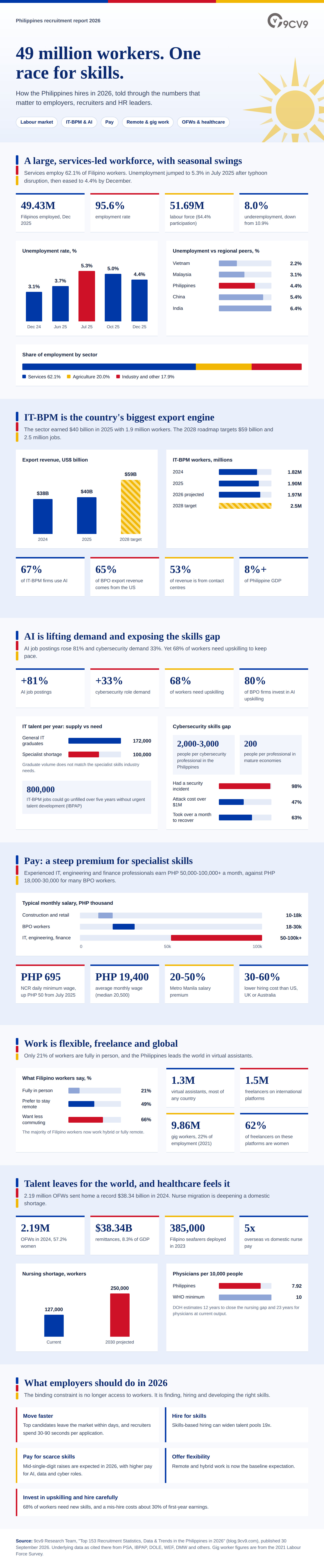
The Philippine IT-BPM and BPO industry remains a particularly important source of employment. The sector reached approximately 1.9 million workers and $40 billion in export revenues in 2025, with employment projected to approach 1.97 million jobs in 2026. However, increasing adoption of artificial intelligence and automation is pushing employers away from purely transactional roles and toward higher-skilled, technology-enabled positions.
Work expectations are changing as well. Filipino professionals increasingly value remote and hybrid arrangements, competitive salaries, career development, flexibility, and stronger employee experiences. Employers, meanwhile, are placing greater emphasis on skills-based hiring, measurable productivity, digital capabilities, and candidates who can contribute value quickly.
Beyond traditional employment, the Philippines continues to play an important role in the global workforce. Millions of Filipinos work overseas, while the country has become a major hub for freelancers, virtual assistants, remote professionals, healthcare workers, seafarers, and outsourced business services. These employment channels create substantial opportunities while intensifying competition for skilled talent within the domestic market.
These 153 recruitment statistics, data points, and trends provide a detailed view of the Philippines hiring landscape in 2026. From employment and salary trends to BPO growth, AI adoption, talent shortages, OFW deployment, remote work, healthcare recruitment, and the gig economy, the data reveals where Philippine recruitment is heading and what employers, recruiters, HR leaders, job seekers, and workforce planners should prepare for next.
Before we venture further into this article, we would like to share who we are and what we do.
About 9cv9
9cv9 is a business tech startup based in Singapore and in Asia, with a strong presence all over the world.
With over ten years of startup and business experience, and being highly involved in connecting with thousands of companies and startups, the 9cv9 team has access to some of the best talents in the world.
If your company needs recruitment and headhunting services to hire top-quality employees, you can use 9cv9 headhunting and recruitment services to hire top talents and candidates. Email us at hello@9cv9.com.
Top 153 Recruitment Statistics, Data & Trends in the Philippines in 2026
A. Labor Force & Employment Overview
1. The Philippines’ labor force participation rate of 64.4% in December 2025 — representing 51.69 million Filipinos actively working or seeking work — reflects a moderately engaged workforce, though it still trails advanced economies where LFPRs typically exceed 70%.
2. An employment rate of 95.6% in December 2025, with 49.43 million Filipinos employed, signals a broadly healthy labor market, though this figure includes part-time, informal, and vulnerable employment that may not reflect full economic security.
3. The December 2025 unemployment rate of 4.4% — rising from 3.1% in December 2024 — suggests that while most Filipinos remain employed, seasonal factors, typhoon disruptions, and labor market entry of new graduates contributed to a measurable uptick in joblessness.
4. The all-time high of 52.4 million labor force participants recorded in June 2025 is a landmark indicator of growing economic confidence and demographic momentum, driven by the Philippines’ large and young working-age population.
5. A record-low unemployment rate of 3.7% in June 2025 — with only 1.9 million unemployed Filipinos — is among the strongest labor market readings in Philippine history, reflecting strong mid-year economic activity across services and construction.
6. The spike in unemployment to 5.3% in July 2025 — the highest since August 2022 — underscores the significant economic vulnerability of the Philippine labor market to natural disasters, as a series of typhoons caused widespread disruption to livelihoods and business operations.
7. The October 2025 unemployment rate of 5.0% with 2.54 million jobless Filipinos reflects a labor market under pressure from both cyclical and structural forces, as more workers enter the workforce faster than the economy creates quality jobs for them.
8. The decline in underemployment to 8.0% in December 2025 from 10.9% a year earlier is an encouraging sign that the quality — not just the quantity — of employment in the Philippines is gradually improving, although 3.93 million workers still want more or better work.
9. With 6.60 million underemployed Filipinos (13.1%) recorded in May 2025, the persistent desire for additional work hours or new jobs highlights that job creation must focus not only on volume but on providing stable, full-time, and fairly compensated employment.
10. The dominance of the Services sector at 62.1% of total employment confirms that the Philippines is a services-led economy, while Agriculture’s 20.0% share indicates millions of Filipinos still depend on low-productivity, weather-vulnerable livelihoods.
11. The concentration of employment in Wholesale & Retail Trade (20.5%), Agriculture & Forestry (18.8%), and Construction (9.7%) in December 2025 reflects a broad-based but informality-heavy labor market where social protection coverage remains a critical policy challenge.
12. The addition of approximately 385,000 jobs in administrative and support services in December 2025 points to growing demand for outsourcing, facilities management, and business support functions — sectors closely linked to the BPO ecosystem’s continued expansion.
13. The fact that 78.6% of wage workers are in private establishments and 13.5% in government — within a total wage-and-salary share of 63.0% — suggests that while formal employment is growing, a significant portion of the workforce remains in self-employment or informal arrangements.
14. With 49.15 million employed in February 2025 and private establishment workers making up 48.8% of all employed persons, the private sector remains the primary engine of job creation in the Philippines, reinforcing the importance of a business-friendly policy environment.
15. The decline in youth employment rate from 90.9% to 87.8% between December 2024 and December 2025, alongside an 8.2% youth underemployment rate, signals that young Filipinos continue to face disproportionate barriers to securing stable and meaningful employment.
16. The increase in youth labor force participation to 33.6% in May 2025 is a positive development, but the relatively low LFPR among 15–24 year-olds still reflects the large proportion of youth engaged in education — a double-edged reality that builds human capital but delays labor market entry.
17. The Philippines’ 4.4% unemployment rate compares favorably to China (5.4%) and India (6.4%), though it lags behind Malaysia (3.1%) and Vietnam (2.2%), suggesting that the Philippines’ labor market competitiveness is improving but still has structural gaps to close versus its regional peers.
18. Non-agricultural informality at approximately 36% of employment represents a substantial structural weakness in the Philippine labor market, limiting workers’ access to social insurance, legal protections, and career advancement opportunities.
19. The Philippines’ median age of approximately 25–26 years offers a demographic dividend window of 10–20 more years — a rare economic advantage that, if leveraged through education, healthcare, and job creation investments, could significantly accelerate GDP growth and poverty reduction.
20. The reduction in underemployed workers from 6.47 million in January 2025 to 4.96 million in February 2025 demonstrates the labor market’s responsiveness to economic activity, but the scale of underemployment still calls for sustained structural reforms to generate higher-quality jobs.
B. Wages, Salaries & Compensation
21. The PHP 695 daily minimum wage in NCR — the result of a historic PHP 50 single-tranche increase under Wage Order NCR-26 effective July 18, 2025 — is a landmark adjustment that acknowledges the cost-of-living pressures faced by Metro Manila workers, though critics argue it still falls short of a genuine living wage.
22. The direct impact of the NCR wage hike on 1.2 million minimum wage earners demonstrates the broad social reach of wage board decisions, reinforcing the critical role of regional tripartite wage boards in distributing the gains of economic growth to workers at the base of the income pyramid.
23. The rise in NCR agricultural workers’ wages from PHP 608 to PHP 658 per day reflects a commitment to narrowing the compensation gap between agricultural and non-agricultural workers, though rural agricultural wages across other regions remain significantly lower.
24. The fact that more than 5.2 million workers across 14 regions benefited from wage increases in 2025 — with adjustments ranging from PHP 20 to PHP 100 per day — highlights the nationwide scale of wage reform efforts, even as the disparate amounts reflect persistent regional economic inequalities.
25. Wage increases of PHP 300 to PHP 2,000 per month for 755,000 domestic workers across 11 regions represent an important step toward formalizing and valuing household labor, a sector historically excluded from mainstream labor protections.
26. The potential indirect benefit to 8 million wage workers through wage distortion adjustments is a critical dimension often overlooked in public wage debates — illustrating that minimum wage increases have a far wider ripple effect on compensation structures across the formal workforce.
27. The wide range of daily minimum wages from PHP 435 in Bicol to PHP 550 in other regions outside NCR underscores the deep regional economic disparities in the Philippines and raises questions about whether a more nationally standardized wage floor could better address inter-regional inequality.
28. Region X’s PHP 39 daily wage increase implemented in two tranches from January 16, 2026 — bringing rates to PHP 485–500 — illustrates the phased approach used by regional wage boards to balance worker welfare with the absorptive capacity of local businesses, particularly MSMEs.
29. MIMAROPA’s simplified single minimum wage rate of PHP 455 per day effective January 1, 2026 is a pragmatic administrative reform that reduces complexity for employers and ensures clearer, fairer wage floors for workers across different establishment categories in the region.
30. The passage of a PHP 200 across-the-board wage hike by the House of Representatives in June 2025 — though it ultimately lapsed — signals growing legislative momentum for a national minimum wage standard, a debate that will likely intensify through the 2025 midterm election cycle.
31. With PSA-estimated average monthly wages around PHP 19,400 and a median of approximately PHP 20,500 in 2025, the majority of Filipino workers earn compensation that still leaves limited discretionary income after meeting basic needs in urban areas with high costs of living.
32. The PHP 18,000–30,000 monthly range for BPO workers versus PHP 50,000–100,000+ for experienced IT, engineering, and finance professionals reflects a significant skills premium in the Philippine labor market, underlining the financial return on investing in specialized technical education.
33. Construction and retail workers earning PHP 10,000–18,000 monthly — well below the national average — reinforce the need for targeted wage policies and social safety nets in sectors that employ millions of Filipinos in physically demanding, often insecure conditions.
34. The 20–50% salary premium in Metro Manila compared to provincial areas creates a gravitational pull of talent toward NCR, contributing to urban congestion and brain drain in regional economies that desperately need skilled professionals to support local development.
35. A projected 5.5% salary increase for 2025 — with higher increments in tech, finance, and BPO — reflects the Philippines’ competitive talent market dynamics, where employers must offer above-inflation raises to retain specialized workers in sectors experiencing global demand surges.
36. The total employment cost of 115–130% of base salary for international companies hiring in the Philippines — covering SSS, PhilHealth, Pag-IBIG, and 13th month pay — is a manageable premium for foreign employers and far below comparable costs in Western markets, reinforcing the Philippines’ value proposition as an outsourcing destination.
37. International companies’ ability to reduce hiring costs by 30–60% when recruiting in the Philippines compared to the US, Australia, or UK explains the sustained and growing demand for Filipino talent globally, while also highlighting the need to ensure that cost arbitrage does not translate into exploitative wage practices.
C. IT-BPM & BPO Sector Hiring
38. The Philippine IT-BPM industry’s $40 billion in export revenues in 2025 — growing at 5% versus a global average of 3% — confirms that the sector is not merely surviving global competition but actively outperforming it, making IT-BPM the Philippines’ single most important export industry.
39. Reaching 1.9 million IT-BPM workers in 2025 with 4% year-on-year growth demonstrates that the sector continues to generate large-scale, formal employment, though sustaining this momentum requires urgent investment in talent pipelines that match evolving digital skill requirements.
40. IBPAP’s projection of 1.97 million IT-BPM jobs by 2026 represents a concrete, near-term hiring target that should guide government training programs, university curriculum development, and private sector recruitment strategies to ensure supply keeps pace with demand.
41. The IT-BPM sector’s contribution of more than 8% to Philippine GDP makes it not just an employment engine but a macroeconomic stabilizer — a sector whose performance directly influences the country’s foreign exchange earnings, fiscal position, and overall economic resilience.
42. IBPAP’s Roadmap 2028 target of $59 billion in revenue and a 2.5 million-strong workforce is ambitious but achievable if the Philippines can successfully navigate the AI disruption challenge, shifting its value proposition from cost-competitive transaction processing to higher-order knowledge services.
43. The IT-BPM industry’s 2024 performance — $38 billion in revenue, 7% growth, 1.82 million workers, and 120,000 new jobs — establishes a strong baseline from which the sector enters 2025–2026, though maintaining this trajectory depends heavily on geopolitical stability and the pace of AI adoption.
44. The 67% AI technology adoption rate among IBPAP member companies reflects the industry’s proactive response to the automation challenge, positioning the Philippine BPO sector as an innovator rather than a passive victim of technological disruption.
45. North America’s 70% share of the Philippine BPO market underscores the deep economic interdependency between the Philippines and the United States — a relationship that carries both significant opportunity and concentration risk should US outsourcing policies shift.
46. The United States alone accounting for 65% of total BPO export revenue from the Philippines illustrates the critical importance of maintaining strong US-Philippines economic and diplomatic relations, while also highlighting the need for market diversification toward Europe, Australia, and emerging Asian markets.
47. The 54% female majority in the Philippine BPO workforce is a meaningful indicator of gender inclusion in a high-growth sector, and should serve as a model for other industries seeking to close gender employment gaps through structured hiring, flexible work, and career development programs.
48. Metro Manila’s 60% share of BPO office space and Cebu’s 180,000 BPO workers illustrate the geographic concentration of the industry, which creates economic opportunity but also infrastructure strain — making the decentralization of BPO hubs a strategic priority for balanced regional development.
49. The presence of over 100,000 BPO workers in Clark Freeport Zone and 300+ PEZA-accredited IT parks across the country demonstrates the government’s successful use of special economic zones as a policy tool for attracting investment and creating formal employment in strategic locations.
50. The Contact Center segment’s 53% share of IT-BPM revenue confirms that despite the rise of AI chatbots and automation, human-led customer interaction remains the backbone of the Philippine outsourcing industry — at least for now — with significant transformation expected over the next five years.
51. The fact that 80% of Philippine BPO firms are investing in AI upskilling programs signals that the industry understands that worker displacement is not inevitable — with proactive investment in human capital, AI can augment rather than replace Filipino BPO professionals.
52. The projection that mid- and high-skill roles will make up 73% of IT-BPM jobs by 2025 is a structural shift of enormous consequence, requiring a fundamental rethink of educational pathways, entry-level hiring criteria, and compensation benchmarks across the entire BPO sector.
53. The BPO industry’s estimated 2.5x employment multiplier effect — generating 2.5 additional jobs elsewhere in the economy for every BPO worker hired — means that the sector’s true economic footprint is nearly three times larger than its direct headcount suggests, magnifying the stakes of its continued growth.
54. The IT-BPM sector’s target of 1.1 million new jobs by 2028 represents an unprecedented talent demand signal that should urgently mobilize TESDA, CHED, and DepEd to align vocational, tertiary, and skills training curricula with the sector’s specific digital competency requirements.
55. BPO’s contribution of over 30% to total Philippine export services underlines that the country’s global economic integration is heavily mediated through outsourced services — a structural feature that strengthens foreign exchange earnings but also creates dependence on external demand conditions.
56. The expansion of Global Capacity Centers (GCCs) in the Philippines in 2025 represents a qualitative upgrade of the country’s outsourcing value proposition — moving from commodity call center services toward integrated, analytics-driven, and strategically important business functions for multinational corporations.
D. Hiring Activity, Recruitment Trends & AI
57. A 38% increase in Philippine local hiring activity in October 2024 compared to the prior year is a compelling benchmark of recovering employer confidence, signaling that organizations that paused hiring during 2022–2023 economic uncertainty are now actively rebuilding their workforces.
58. The 2026 shift toward “quality over quantity” hiring in the Philippines reflects a global post-pandemic recalibration where organizations prioritize revenue-generating, operationally critical roles over headcount expansion — a trend that raises the bar for candidates but also for employers’ talent assessment capabilities.
59. The 81% surge in AI skill job postings and 33% increase in cybersecurity role demand in 2024–2025 are among the clearest labor market signals of the digital economy’s transformation, confirming that AI literacy and security expertise are no longer optional competencies for Philippine professionals.
60. The paradox of 75% of Philippine CEOs trusting AI integration while simultaneously citing skill shortages as a top challenge encapsulates the central tension in the 2026 labor market: organizations are ready to adopt AI but lack the human talent to deploy and govern it effectively.
61. The finding that only 21% of Philippine workers are fully in-person represents a profound and largely irreversible shift in workplace norms — with the majority of professionals now operating in hybrid or fully remote arrangements that require new management practices, digital infrastructure, and HR policies.
62. The 85% remote work adoption peak during COVID-19 — building on a pre-pandemic base of 52% who had already been working from home — demonstrates that the Philippines had unique cultural and infrastructural readiness for distributed work, which has since become a permanent competitive advantage in global talent markets.
63. The preference of 49% of Filipino workers to remain remote and 66% wanting to reduce commuting reflects a workforce that has recalibrated its definition of work-life quality — and employers who ignore this preference risk losing talent to more flexible competitors.
64. The estimated 30% first-year earnings cost of a mis-hire in the Philippines is a powerful financial argument for investing in more rigorous recruitment processes, structured interviews, competency-based assessments, and data-driven candidate matching tools.
65. Recruiters spending only 30–90 seconds per application creates a systemic bottleneck where qualified candidates may be routinely overlooked, making AI-assisted screening tools not just a convenience but a potential equalizer that could improve both hiring accuracy and candidate fairness.
66. DOLE’s PESOs achieving a 93% placement rate for 2.2 million jobseekers in 2025 is a remarkably strong performance for a public employment service, suggesting that government-run job facilitation programs can play a significant role in reducing frictional unemployment when adequately resourced.
67. The strong rise in tech and cybersecurity roles alongside peak remote work demand in the Philippines in 2026 confirms that the country’s labor market is evolving in alignment with global digital economy trends — and that Filipino professionals who acquire in-demand digital skills are well-positioned for career growth.
68. The 2026 talent market’s shift toward roles delivering measurable transformation and long-term resilience reflects a maturation of Philippine hiring philosophy — moving away from activity-based headcount toward outcome-oriented human capital investment that mirrors boardroom priorities.
69. The expectation that roles filled in 2026 generate value quickly — through productivity gains, revenue, or efficiency — signals a heightened performance accountability environment for Filipino professionals, requiring candidates to articulate concrete impact rather than generic qualifications.
70. The Philippine professional landscape of 2025 being shaped simultaneously by global economic uncertainty, multinational restructuring, and rapid tech expansion is a useful context for understanding why hiring patterns are uneven — with some sectors contracting and others experiencing critical talent shortages at the same time.
E. Skills Gap, Talent Shortages & Workforce Development
71. The WEF finding that 68% of Filipino workers need upskilling — above the global average — reflects the breadth of the digital transformation challenge facing the Philippines, and represents both an urgent policy problem and a significant commercial opportunity for training providers and EdTech platforms.
72. The paradox of 172,000 general IT graduates annually yet a 100,000 specialized tech worker shortage per year reveals that the Philippine education system is producing volume without the precise competencies industry needs — a misalignment that costs the economy billions in unfilled productive capacity each year.
73. Having only 1 cybersecurity professional for every 2,000–3,000 people — compared to a mature economy standard of 1:200 — means the Philippines is operating with roughly 90% of the cybersecurity workforce density it needs, creating existential risk for a country whose digital economy generates tens of billions of dollars annually.
74. The alarming statistic that 98% of Philippine organizations experienced a security incident in 2024 attributable to skills gaps is not just a technology problem but a workforce crisis — directly linking the talent shortage to real financial and reputational harm for businesses of all sizes.
75. With 47% of Philippine organizations facing cyberattacks costing over $1 million and 63% taking more than a month to recover, the business case for urgently investing in cybersecurity talent development is not merely strategic but financially existential for many enterprises.
76. IBPAP’s warning that the IT-BPM sector could struggle to fill 800,000 jobs over the next five years without urgent talent development is a clarion call for government, academia, and industry to treat workforce development as a national economic security issue — not an afterthought.
77. The projection that one-third of Philippine jobs will be affected by AI automation places the country at a critical juncture: with the right reskilling investments, AI can be a catalyst for higher-wage employment; without them, it risks displacing millions of workers without viable alternatives.
78. The Philippines and Mexico sharing the distinction of having the highest AI talent shortages among emerging economies highlights a specific and addressable gap — the need to significantly scale graduate-level AI education, industry apprenticeships, and certification pathways for working professionals.
79. The shortage of 200,000 workers with specialized IT skills in cybersecurity, data analytics, and software development represents a tangible constraint on the Philippines’ digital economy ambitions — limiting the country’s ability to attract higher-value investments and expand GDP beyond labor-intensive services.
80. The NWPC and RTWPBs’ outreach to 28,115 MSMEs and 32,211 employers and workers through productivity orientation programs in 2025 demonstrates that government-led workforce development can reach scale, though coverage must grow dramatically to match the national need.
81. The successful implementation of Productivity-Based Incentive Schemes by 3,525 MSMEs signals a welcome shift toward performance-linked compensation — aligning worker incentives with business outcomes — though the figure represents a small fraction of the Philippines’ estimated 1 million+ MSME base.
82. The concentration of November 2025 employment gains in higher- and middle-skill occupations is a structural positive, indicating that the labor market is rewarding educational attainment and technical skills — a trend that must be paired with equitable access to quality education to avoid widening inequality.
83. Rising executive demand for Chief Data Officers, Heads of AI, and Chief Information Security Officers — with AI governance and cloud transformation explicitly listed in briefs — signals that digital leadership capability is now a board-level priority in the Philippines, not merely an IT department concern.
F. Overseas Filipino Workers (OFWs) & International Deployment
84. The 1.5% growth in OFW numbers to 2.19 million in 2024 — with 97.9% on existing contracts — indicates that while the OFW population continues to grow, most overseas Filipinos are experienced, contract-renewing workers rather than first-time migrants, suggesting a mature and stable overseas labor market.
85. Women comprising 57.2% of OFWs in 2024 reflects the feminization of Philippine migration — a structural feature driven by global demand for nurses, caregivers, and domestic workers — which carries significant implications for family structures and the social costs of separation back home.
86. The dominance of OFWs aged 45 and older (25.8%) as the largest age cohort, followed by those aged 30–39, suggests that overseas work is increasingly a mid-career and late-career phenomenon — raising questions about retirement readiness and long-term social protection for aging OFWs.
87. Elementary occupations comprising 43.6% of OFW job categories reveals that despite the Philippines’ educated workforce, a significant proportion of overseas employment remains in low-skill, physically demanding roles — underscoring the need to create pathways for upskilled migration into higher-value occupations.
88. Total OFW remittances of PHP 262.20 billion in 2024 — spanning cash transfers, money brought home, and goods in kind — represent a lifeline for millions of Filipino families and a critical source of household consumption that drives local economic activity, particularly in provinces with high OFW populations.
89. OFW remittances reaching a record $38.34 billion (8.3% of GDP) in 2024 is a testament to the extraordinary contribution of overseas Filipino workers to national development — but also a reminder that an economy heavily dependent on labor export income faces structural vulnerabilities if global migration policies shift.
90. The PHP 6,000 increase in average annual remittance per OFW — from PHP 123,000 to PHP 129,000 — suggests that overseas Filipinos are accessing better-paying jobs or sending a greater share of their earnings home, both of which reflect positively on the living standards of OFW families in the Philippines.
91. The Philippines’ rank as the 4th largest global remittance recipient in 2023, with remittances representing 9% of GDP, underscores the country’s profound integration into international labor migration systems — a double-edged reality that generates economic resilience but also reflects an oversupply of domestic labor at home.
92. Asian countries’ 62.1% share of OFW cash remittances reinforces the primacy of the Gulf Cooperation Council, East Asia, and Southeast Asia as the dominant destinations for Filipino migrant workers — regions where demand for healthcare, construction, and service workers continues to grow.
93. The ongoing migration of approximately 30,000 additional nursing professionals between 2022 and 2024 — on top of 316,000 already abroad — illustrates that the brain drain from the Philippine healthcare system is not slowing but accelerating, threatening the country’s ability to achieve Universal Health Care goals.
94. The deployment of 385,000 Filipino seafarers in 2023 — mostly under Bahamas or Panama registries — reinforces the Philippines’ status as the world’s largest supplier of maritime labor, a specialized workforce that generates significant remittances but also faces unique risks related to flag-of-convenience vessel regulations.
G. Healthcare Sector Hiring Crisis
95. The Philippines’ ratio of 7.92 physicians per 10,000 people — below the WHO-recommended minimum of 10 per 10,000 — alongside a shortage of 127,000 nurses paints a picture of a healthcare system structurally unable to meet the population’s medical needs, particularly in rural and underserved areas.
96. The DOH’s sobering estimate that it would take 12 years to close the nursing gap and 23 years to fill the physician shortage — at current production rates — underscores that healthcare workforce challenges are generational in scale, demanding immediate and sustained multi-sectoral intervention rather than incremental solutions.
97. The annual production of 10,635 nurses and 4,378 physicians is insufficient not just to address the domestic shortage but even to replace those who migrate abroad each year — creating a perpetual net deficit that erodes healthcare system capacity with every passing year.
98. A projected doubling of the nursing shortage to 250,000 by 2030 represents a public health emergency in the making — one that will disproportionately harm low-income Filipinos who depend on public hospitals, and which demands immediate policy intervention including salary reform, retention incentives, and expanded nursing school capacity.
99. The reality that Philippine public hospitals operate at nurse-to-patient ratios of 1:20 to 1:50 — against the DOH standard of 1:12 — means Filipino nurses are routinely working under conditions of extreme overload, contributing to burnout, errors, and the very exodus that perpetuates the shortage.
100. Nearly 4,500 unfilled nursing positions in Philippine public hospitals alone represent a direct and measurable healthcare delivery gap — one that translates into longer wait times, reduced patient safety, and overburdened remaining staff — all of which further accelerate nurse migration.
101. Filipino nurses comprising 4% of the US nursing workforce despite Filipinos being only 1% of the US population is a powerful illustration of the targeted overseas demand for Filipino healthcare workers — and a quantification of the human capital the Philippines exports at significant cost to its domestic health system.
102. The 5x salary differential between overseas and domestic Filipino nurses is the clearest possible explanation for the brain drain — and suggests that any sustainable domestic retention strategy must include a substantial, credible, and long-term commitment to improving public sector healthcare compensation.
103. The 3.8% unemployment rate for health-related degree holders confirms that domestic absorption of healthcare graduates is high — the problem is not a lack of demand for health workers in the Philippines but rather the inability to offer compensation competitive with overseas alternatives.
H. Gig Economy, Freelancing & Remote Work
104. The 1.5 million registered Filipino freelancers on international platforms — with experts suggesting the actual number is considerably higher — signals that the gig economy has emerged as a major alternative employment pathway, particularly for young Filipinos seeking income flexibility and global market access.
105. The Philippines’ ranking as the 6th fastest-growing gig economy globally reflects the intersection of a young, English-proficient, digitally connected population with growing global demand for remote work services — a structural advantage that could deepen significantly as broadband infrastructure improves.
106. A 208% year-on-year growth in freelance revenue from 2019 to 2020 — the highest rate of any country — demonstrates the Philippines’ extraordinary capacity to rapidly mobilize its workforce for digital work, a flexibility that proved critical when the pandemic disrupted traditional employment channels.
107. Approximately 9.86 million gig workers representing 22% of total Philippine employment as of the May–June 2021 LFS — the most recent available data — suggests that the gig economy is not a marginal phenomenon but a core structural feature of how millions of Filipinos earn their living.
108. With only 17% of gig workers (1.69 million) engaged through formal online platforms, the vast majority of gig workers operate through informal, non-digitized channels — meaning they lack the digital tools, income visibility, and access to global markets that could significantly improve their earnings.
109. The Philippines ranking 3rd globally in online marketplace market size — behind only the USA and India — is a remarkable achievement for a middle-income country and reflects both the sheer number of Filipino online workers and their strong presence on platforms like Upwork, Fiverr, and Freelancer.
110. Over 1.3 million Filipinos working as virtual assistants — more than any other country — has made the Philippines the undisputed global hub for this rapidly growing profession, creating a specialized labor market niche that generates significant foreign exchange income for individual workers and their families.
111. The 62% female participation rate among Filipino freelancers on international platforms — the highest globally — reflects both the Philippines’ relatively progressive gender norms and the fact that remote freelance work removes many of the structural barriers (commuting, childcare, workplace discrimination) that limit women’s participation in formal employment.
112. The near-majority (47%) of Filipino online workers engaged in creative and multimedia tasks signals a competitive advantage in content creation, graphic design, and digital marketing — sectors where Filipino creativity, English fluency, and cultural familiarity with Western content standards create a distinct market edge.
113. The Philippines’ digital economy reaching a projected $40 billion by 2025 — spanning e-commerce, fintech, and IT-BPM — represents a profound economic transformation that, if sustained and equitably distributed, could help break the cycle of poverty-driven labor migration and create meaningful prosperity at home.
I. Sector-Specific Hiring Trends
114. The concentration of active hiring in BPO, technology, healthcare, e-commerce, renewable energy, and digital marketing confirms that the Philippines’ most dynamic employment growth is occurring at the intersection of digital transformation and sustainability — sectors that reward both technical expertise and adaptability.
115. The Banking and Financial Services sector’s 2025 focus on AI/GenAI adoption, digital banking expansion, and fintech innovation is reshaping hiring profiles across the industry — shifting demand from traditional banking operations roles toward data scientists, AI engineers, and digital product managers.
116. The continued rapid expansion of the Philippine Technology sector driven by e-commerce adoption and fintech growth creates a virtuous cycle of talent demand, salary premium, and skills development that is gradually building a more sophisticated domestic tech ecosystem.
117. The projected growth of renewable energy generation to 19.45 billion kWh by 2025 — with annual growth through 2029 — creates an emerging talent market for engineers, project managers, and grid technicians in a sector that currently lacks the skilled workforce needed to sustain its ambitious expansion.
118. The BPO industry’s transition from transactional services toward analytics-enabled, GenAI-supported workflows is one of the most consequential structural shifts in Philippine employment — requiring widespread upskilling investment while offering workers the opportunity to move up the value chain to more cognitively demanding and better-compensated roles.
119. The rapid growth of medical coding and fraud analytics as the fastest-growing KPO niches in the Philippines in 2025 illustrates how the country is carving out specialized, high-value outsourcing sub-markets where deep domain expertise — not just language proficiency — is the primary competitive differentiator.
120. Metro Manila’s concentration of 40% of all Philippine professionals in finance, technology, and corporate headquarters roles reflects the capital’s outsized role in the national economy — and also the opportunity cost for regions that lose talent to NCR, reinforcing the need for deliberate provincial economic development strategies.
J. Employer Practices & Workforce Demographics
121. A workforce of approximately 45 million with 92% English proficiency positions the Philippines as one of the most internationally accessible talent markets in the world — a strategic asset that explains the country’s outsized share of global outsourcing revenue relative to its GDP.
122. The ability to hire in the Philippines within 1–3 days through employment partners versus 4–8 weeks for corporate establishment dramatically lowers the barrier for international companies to access Filipino talent — a practical advantage that is accelerating cross-border hiring and remote work arrangements.
123. LinkedIn research showing that skills-based hiring can expand talent pools by 19x is particularly relevant for the Philippines, where traditional degree-centric hiring practices may be systematically excluding highly capable candidates who have built competencies through non-traditional pathways.
124. The 25% of APAC organizations planning to increase contingent workforce use reflects a broader trend toward workforce flexibility that has significant implications for Philippine labor policy — as more workers move into contract and freelance arrangements, social protection frameworks must evolve to cover non-standard employment.
125. Rising attrition rates in the Philippines in 2025 are a market signal that workers — particularly in high-demand sectors — feel confident enough to switch roles, compelling employers to move beyond reactive recruitment toward proactive talent management, competitive total rewards packages, and genuine investment in employee experience.
126. The reality that top Filipino candidates exit the market within days is a structural challenge for organizations with slow, bureaucratic hiring processes — and a competitive advantage for companies that have invested in streamlined assessment, rapid decision-making, and compelling employer branding.
127. The expectation of Filipino Millennials and Gen Z workers to evaluate companies as rigorously as they are evaluated marks a generational shift in the employer-candidate power dynamic — requiring Philippine employers to invest in authentic employer branding, transparent culture communication, and candidate experience design.
128. The explicit inclusion of AI governance, cloud transformation, and data strategy in C-suite role briefs confirms that digital capability is no longer a technical requirement but a strategic leadership imperative — and that Philippine executives without these competencies face growing obsolescence at the boardroom level.
129. RPA adoption across 60% of Philippine BPO operations signals that the automation of repetitive, rule-based processes is well advanced — and that the sector’s remaining competitive advantage increasingly rests on the distinctly human capabilities of judgment, empathy, and creative problem-solving.
130. Philippine BPOs achieving an average CSAT score of 85% — above the global BPO average — is a powerful quality indicator that counters the misconception that cost competitiveness comes at the expense of service quality, reinforcing the Philippines’ position as a premium outsourcing destination.
K. Top Countries Hiring OFWs & International Labor Demand
131. Saudi Arabia’s 865,121-strong Filipino community — concentrated in construction, household services, and healthcare support — reflects decades of structured labor migration driven by Gulf development projects, though the welfare of Filipino workers in the GCC remains a persistent policy concern requiring stronger bilateral protections.
132. Singapore’s approximately 200,000 Filipinos represent a high-value migration corridor, with many working in professional services, finance, and hospitality roles — demonstrating that Filipino workers can compete effectively not just in low-skill markets but in highly skilled, high-income environments.
133. New Zealand’s 108,297 Filipinos — with growing demand for nurses, aged-care workers, and skilled tradespeople — illustrates the expanding geography of Filipino labor migration and the strategic opportunities created by New Zealand’s targeted migration programs for healthcare and trade professionals.
134. The management of 1,106 active OFW distress cases — predominantly in the Middle East — by the DMW as of October 2025 is a sobering reminder that alongside the economic benefits of labor migration come significant welfare risks that demand robust consular services, pre-departure preparation, and bilateral labor agreements.
135. The deployment of 1–1.9 million OFWs annually during the 2006–2019 period reflects the scale and institutionalization of Philippine labor export — a system so deeply embedded in the national economy that any significant disruption to global migration flows would have immediate and severe macroeconomic consequences.
136. An estimated 10 million Filipino emigrants living across more than 200 countries — many in irregular statuses — is both a testament to the extraordinary reach of the Filipino diaspora and a reminder of the social vulnerabilities faced by undocumented migrants who lack legal protections in host countries.
137. The sustained demand for Filipino workers across the GCC, East Asia, North America, Europe, Singapore, and Australia through 2030 provides a degree of labor export stability for the Philippines — but the long-term strategy must shift toward developing conditions at home that make returning or staying the more attractive choice.
L. Salary Outlook & Future Projections
138. The projection of mid-single-digit salary increases for Philippine employers in 2026 — consistent with 2025 levels — suggests a cautiously optimistic compensation environment: enough to attract talent in competitive markets, but potentially insufficient to offset inflation for workers at the lower end of the pay scale.
139. The continued incremental rise of regional minimum wages in 2026 through inflation-indexed reviews reflects the regional wage board system’s responsiveness to cost-of-living pressures, though critics argue that this mechanism moves too slowly to meaningfully improve the real purchasing power of minimum wage earners.
140. The identification of IT specialists, data analysts, cybersecurity professionals, trainers, and niche BPO experts as the best-paid and fastest-growing job categories in 2026 provides a clear career roadmap for Filipino workers and students seeking to maximize their long-term earning potential in the digital economy.
141. The Philippine BPO sector’s 7% growth in 2024 — double the global outsourcing industry average of 3.5% — is a compelling measure of the country’s competitive strength in the global outsourcing market, but sustaining this edge requires continuous investment in technology, talent, and service quality differentiation.
142. The forecast of $59 billion in IT-BPM revenue by 2028 — a 55% increase from 2024 — is one of the most consequential economic projections for the Philippines, with implications for employment, foreign exchange, infrastructure investment, and the country’s trajectory toward upper-middle-income status.
143. The expectation that most Philippine outsourcing companies will offer flexible work arrangements by 2025 to attract global talent represents an industry-wide recognition that flexibility is now a baseline competitive requirement rather than a premium benefit — a shift that has permanently reshaped the employment compact in the sector.
144. The projection that 30% of traditional voice tasks will be handled by AI by 2030 sets a clear and urgent deadline for the workforce repositioning the Philippine BPO sector must achieve — with millions of jobs at stake, the pace and scale of upskilling investment over the next five years will determine whether this transition is disruptive or empowering.
145. The government’s PHP 2 billion allocation for IT-BPM talent development is a meaningful commitment, though industry analysts note it represents a fraction of the investment required to address the sector’s 1.1 million new job target and the pervasive upskilling needs across AI, data science, and cybersecurity.
146. Half of BPO leaders identifying talent supply as their primary growth constraint confirms that in the Philippine outsourcing industry, the binding limitation is no longer capital, infrastructure, or market access — it is people, specifically the pipeline of workers with the precise technical and cognitive skills the next generation of BPO services requires.
147. The Philippines’ rank as 2nd in the Tholons Global Innovation Index for BPO destinations is a globally recognized endorsement of the country’s outsourcing capabilities — and a strategic asset that should be actively leveraged in international investment promotion and talent attraction campaigns.
148. The projected 10% productivity loss from AI automation of low-level BPO tasks by 2025 — offset by creation of higher-value roles — underscores the net-positive but transition-intensive nature of AI integration, requiring careful workforce planning to ensure that productivity gains do not come at the cost of mass displacement.
149. The 40% of Philippine BPO companies planning to integrate Generative AI within the next 12 months signals an imminent and sector-wide transformation in how services are delivered — one that will test the agility of both organizations and workers to adapt to fundamentally new human-machine workflows.
150. The 20% rise in cybersecurity investments in the Philippine BPO sector since 2022 reflects the industry’s growing recognition that data security is a non-negotiable client requirement — and that attracting premium global contracts increasingly depends on demonstrating world-class security infrastructure and governance.
151. The global gig economy’s trajectory toward $455 billion positions the Philippines — with its large English-speaking, digitally skilled freelance pool — to capture a disproportionate share of this growth, provided that policy frameworks evolve to support gig workers with portable benefits, digital payment infrastructure, and skills certification systems.
152. The finding that 8 in 10 Philippine organizations are actively encouraging women into cybersecurity and 66% now weigh certifications over four-year degrees signals a progressive and pragmatic shift in hiring culture — one that, if sustained, could significantly expand the talent pool for one of the country’s most critically under-resourced professions.
153. Fortinet’s commitment to training one million cybersecurity professionals globally by 2026 — with the Philippines as a key partner — is a direct and substantial response to the local talent crisis, and represents the kind of public-private collaboration at scale that is necessary to close a skills gap too large for any single institution to address alone.
Conclusion
The 153 recruitment statistics, data points, and trends examined throughout this report show that the Philippines enters 2026 with a large and increasingly digital workforce, but also with significant talent and skills challenges that will shape hiring strategies for years to come.
Employment remains relatively strong, with 49.43 million Filipinos employed and a 95.6% employment rate recorded in December 2025. Services account for 62.1% of total employment, while industries such as IT-BPM, BPO, technology, healthcare, e-commerce, renewable energy, finance, and digital marketing continue to generate demand for talent.
The IT-BPM industry remains central to recruitment in the Philippines. After reaching approximately 1.9 million workers and $40 billion in export revenues in 2025, the sector is projected to approach 1.97 million jobs in 2026. Longer-term targets of $59 billion in revenue and 2.5 million workers by 2028 demonstrate the scale of the opportunity, but achieving this growth will depend heavily on developing enough workers with advanced digital and technical skills.
Artificial intelligence is accelerating this transformation. AI-related job postings increased by 81%, cybersecurity demand rose by 33%, and 67% of IT-BPM companies have adopted AI technologies. At the same time, 68% of Filipino workers need upskilling, while shortages persist across cybersecurity, data analytics, software development, AI, healthcare, and specialized BPO functions.
Recruitment strategies will therefore need to evolve beyond simply increasing headcount. Employers competing for the best Filipino talent will increasingly need faster hiring processes, skills-based assessments, competitive compensation, flexible working arrangements, strong employee experiences, and meaningful opportunities for professional development.
The changing nature of work also extends far beyond traditional employment. The Philippines has become a major global source of BPO professionals, overseas workers, freelancers, virtual assistants, healthcare professionals, seafarers, and remote talent. This global demand creates substantial economic opportunities while simultaneously increasing competition for skilled workers within the domestic labor market.
For employers, recruiters, HR professionals, and business leaders, the central message from the Philippines recruitment statistics for 2026 is clear: access to workers alone will not guarantee hiring success. The competitive advantage will increasingly come from identifying the right skills, hiring efficiently, developing existing employees, embracing AI responsibly, and building workplaces capable of attracting and retaining an increasingly mobile and digitally capable Filipino workforce.
As the Philippine labor market moves toward higher-value, technology-enabled employment, organizations that invest early in talent development and modern recruitment practices will be better positioned to compete. For Filipino professionals, meanwhile, the continued growth of digital, technical, healthcare, and globally deliverable services creates significant opportunities for those who continuously develop the skills demanded by the rapidly changing world of work.
If you find this article useful, why not share it with your hiring manager and C-level suite friends and also leave a nice comment below?
We, at the 9cv9 Research Team, strive to bring the latest and most meaningful data, guides, and statistics to your doorstep.
To get access to top-quality guides, click over to 9cv9 Blog.
To hire top talents using our modern AI-powered recruitment agency, find out more at 9cv9 Modern AI-Powered Recruitment Agency.
People Also Ask
What are the key recruitment statistics in the Philippines for 2026?
The Philippines enters 2026 with a large labor market, strong services employment, expanding IT-BPM demand, growing digital hiring, and persistent shortages in specialized technology and healthcare skills.
What is the employment rate in the Philippines?
The Philippines recorded a 95.6% employment rate in December 2025, with approximately 49.43 million Filipinos employed across services, agriculture, industry, and other sectors.
What is the unemployment rate in the Philippines?
The unemployment rate stood at 4.4% in December 2025, compared with 3.1% in December 2024. Around 2.54 million Filipinos were unemployed in October 2025 when unemployment reached 5.0%.
How large is the Philippines labor force?
The Philippine labor force reached 51.69 million people in December 2025, representing a labor force participation rate of 64.4%. A record 52.4 million participants was recorded in June 2025.
Which sector employs the most people in the Philippines?
Services dominate employment in the Philippines, accounting for 62.1% of total employment. Wholesale and retail trade, agriculture and forestry, and construction are also major sources of jobs.
What is the underemployment rate in the Philippines?
Underemployment fell to 8.0% in December 2025 from 10.9% a year earlier. However, approximately 3.93 million employed Filipinos still wanted additional hours or better employment.
What are the biggest hiring trends in the Philippines in 2026?
Major hiring trends include skills-based recruitment, AI adoption, cybersecurity demand, flexible work, faster hiring processes, digital upskilling, and greater emphasis on roles producing measurable business value.
How is AI affecting recruitment in the Philippines?
AI is increasing demand for specialized talent while transforming existing jobs. AI-related job postings surged 81%, while Philippine employers increasingly seek professionals capable of working with AI-enabled processes.
Which skills are most in demand in the Philippines in 2026?
AI, cybersecurity, data analytics, software development, cloud transformation and specialized BPO capabilities are among the most important skills as Philippine employers move toward higher-value digital work.
How serious is the skills gap in the Philippines?
The skills gap is substantial, with 68% of Filipino workers needing upskilling. The country also faces shortages in specialized IT, cybersecurity, AI, data analytics and software development talent.
How many IT graduates does the Philippines produce annually?
The Philippines produces approximately 172,000 general IT graduates annually, yet the country still faces an estimated shortage of 100,000 specialized technology workers each year.
How large is the Philippine BPO industry workforce?
The Philippine IT-BPM industry employed approximately 1.9 million workers in 2025, representing 4% year-on-year growth. Employment is projected to reach around 1.97 million jobs in 2026.
How much revenue does the Philippine IT-BPM industry generate?
Philippine IT-BPM export revenue reached approximately $40 billion in 2025 after generating $38 billion in 2024. The industry has a longer-term target of $59 billion in revenue by 2028.
How important is BPO to the Philippine economy?
IT-BPM contributes more than 8% of Philippine GDP and over 30% of export services. The industry is also a major source of formal employment, foreign exchange earnings and indirect job creation.
Is AI replacing BPO jobs in the Philippines?
AI is transforming BPO work rather than simply eliminating jobs. Automation is reducing some repetitive tasks while increasing demand for analytics, AI-enabled services and other higher-skilled roles.
How many Philippine BPO companies are adopting AI?
Around 67% of IT-BPM companies have adopted AI technologies, while 80% of Philippine BPO firms are investing in AI upskilling programs to prepare employees for changing job requirements.
What is the minimum wage in Metro Manila?
The NCR daily minimum wage reached PHP 695 following a PHP 50 increase effective July 18, 2025. The adjustment directly affected approximately 1.2 million minimum-wage workers.
What is the average salary in the Philippines?
Average monthly wages were estimated at around PHP 19,400 in 2025, while the median was approximately PHP 20,500. Salaries vary considerably by industry, location, experience and specialization.
Which jobs pay the most in the Philippines in 2026?
IT specialists, data analysts, cybersecurity professionals, trainers and specialized BPO professionals are among the best-paid and fastest-growing job categories identified for 2026.
How much can experienced tech professionals earn in the Philippines?
Experienced professionals in IT, engineering and finance can earn approximately PHP 50,000 to PHP 100,000 or more per month, compared with roughly PHP 18,000 to PHP 30,000 for many BPO workers.
Are salaries increasing in the Philippines in 2026?
Employers are expected to provide mid-single-digit salary increases in 2026, broadly continuing the compensation trend seen in 2025, with stronger pay pressure in specialized and high-demand occupations.
Is remote work still popular in the Philippines?
Yes. Only 21% of Philippine workers were fully in-person according to the cited data, while 49% preferred to remain remote and 66% wanted to reduce commuting.
How large is the gig economy in the Philippines?
Around 9.86 million gig workers represented 22% of Philippine employment in the May–June 2021 labor force data, while approximately 1.5 million Filipino freelancers were registered on international platforms.
How many virtual assistants are in the Philippines?
More than 1.3 million Filipinos work as virtual assistants, making the Philippines a major global hub for remote administrative and business support services.
How many Overseas Filipino Workers are there?
There were approximately 2.19 million OFWs in 2024, up 1.5% from the previous period. Women represented 57.2% of overseas Filipino workers.
How much do OFWs send back to the Philippines?
OFW remittances reached a record $38.34 billion in 2024, equivalent to about 8.3% of GDP. These remittances remain an important source of household income and economic activity.
Why is healthcare recruitment challenging in the Philippines?
The Philippines faces severe healthcare staffing shortages, including an estimated 127,000-nurse gap. Overseas migration, salary differences and demanding working conditions contribute to recruitment and retention problems.
How severe is the cybersecurity talent shortage in the Philippines?
The Philippines has roughly one cybersecurity professional for every 2,000–3,000 people, compared with a mature-economy benchmark of around one per 200, highlighting a major digital skills shortage.
What do Filipino job seekers want from employers in 2026?
Filipino candidates increasingly value competitive compensation, flexible work, career development, efficient recruitment processes and strong employee experiences alongside long-term employment opportunities.
What should employers prioritize when hiring in the Philippines in 2026?
Employers should prioritize skills-based hiring, faster recruitment, competitive compensation, digital upskilling and flexible work while strengthening their ability to recruit scarce AI, cybersecurity, technology and specialized talent.
Sources
Philippine Statistics AuthorityDepartment of Finance PhilippinesPhilippine News AgencyWageIndicatorManila BulletinGrokipediaPhilippine Institute for Development StudiesGMA NewsInquirer BusinessInquirer NewsBusinessMirrorThe FreemanPhilstarTrading EconomicsRobert Walters PhilippinesRobert Walters USCurran Daly & AssociatesJohn ClementsEESI PhilippinesHuman Resources Online9cv9 Career BlogYotruEdstellarSysgen RPOSecond TalentStemgenic GlobalWiFi Talents365OutsourceMicroSourcing PhilippinesKDCI OutsourcingMarket Research PhilippinesBackEnd NewsOutsource AcceleratorRecruitGoPayroll Solutions PHPlayrollAYP GroupAbroadWorksMigration Policy InstituteStatistaWikipediaAteneo de Manila UniversityAteneo School of Medicine and Public HealthAteneo Center for Research and InnovationHospital Management AsiaBorgen ProjectHireTalentThe Company CebuProsperity for America