

























Key Takeaways
- Rapid HR Software Market Growth: The global human resource management software market is projected to reach $66.70 billion by 2034, driven by cloud adoption, digital transformation, and workforce automation.
- AI and Recruitment Automation: With 82% of HR leaders planning to deploy agentic AI and 97.8% of Fortune 500 companies using applicant tracking systems, intelligent HR technology is transforming talent acquisition and workforce management.
- Data-Driven HR and Employee Retention: With 76% of organisations adopting HR analytics capabilities, businesses are increasingly leveraging predictive analytics, employee engagement software, and payroll automation to improve productivity, retention, and HR software ROI.
Human resource management software streamlines recruitment, payroll, employee engagement, performance management, and workforce analytics. In 2026, the global HR software market is valued at an estimated $26.21 billion, with projected growth to $66.70 billion by 2034 at a CAGR of 12.38%, driven by artificial intelligence, cloud adoption, and workforce automation.
Human resource management software has become an essential component of modern business operations, transforming how organisations recruit talent, manage employees, process payroll, monitor performance, and optimise workforce productivity. In 2026, the rapid advancement of artificial intelligence (AI), cloud computing, predictive analytics, and intelligent automation is reshaping the global HR technology landscape, enabling businesses to streamline administrative processes while making more informed, data-driven workforce decisions.
The global HR software market is projected to grow from $26.21 billion in 2026 to $66.70 billion by 2034, representing a compound annual growth rate (CAGR) of 12.38%. Meanwhile, the HR management software segment is estimated to reach $19.57 billion in 2026 and expand to $31.89 billion by 2031. These figures highlight the increasing importance of digital HR transformation across small businesses, multinational corporations, and enterprises operating in increasingly competitive labour markets.
Modern human resource management systems (HRMS) have evolved far beyond traditional employee record management. Today’s comprehensive HR software platforms integrate applicant tracking systems (ATS), payroll automation, employee onboarding, performance management, workforce analytics, benefits administration, learning management systems, and employee engagement tools into increasingly interconnected digital ecosystems.

Artificial intelligence is emerging as one of the most influential drivers of HR technology innovation in 2026. Approximately 82% of HR leaders plan to deploy agentic AI capabilities within 12 months, while 39% of HR teams have already adopted AI for recruitment. However, 88% of HR leaders report that their AI tools have yet to deliver significant measurable business value, highlighting the importance of effective implementation, strategic integration, and measurable return on investment.
Cloud-based HR management software is also accelerating digital transformation. Cloud-based solutions accounted for 68.05% of the HR management software market in 2025, while hybrid deployment models are projected to expand at a CAGR of 12.14%. The growing preference for scalable, accessible, and integrated HR platforms reflects the evolving requirements of remote, hybrid, and geographically distributed workforces.
Recruitment technology represents another critical area of HR software adoption. An estimated 97.8% of Fortune 500 companies use a detectable applicant tracking system, while 94% of recruiters agree that ATS software has positively influenced their hiring processes. Furthermore, applicant tracking systems can reduce time-to-hire by approximately 15% to 20% compared with manual recruitment processes, demonstrating the potential operational benefits of recruitment automation.
Beyond talent acquisition, human resource management software plays an increasingly important role in employee retention, engagement, and organisational performance. With employee replacement costs ranging from 50% to 200% of annual salaries and highly engaged business units demonstrating 23% greater profitability than their least-engaged counterparts, organisations are increasingly prioritising technologies that support employee satisfaction, career development, continuous feedback, and workforce stability.
Nevertheless, significant challenges remain within the HR technology industry. Although 76% of organisations report having some form of HR analytics capability, only 6% have achieved predictive analytics maturity. Additionally, 51% of HR software buyers reported disappointment with at least one software purchase, while 60% experienced unexpected implementation disruptions. These statistics emphasise the importance of software selection, system integration, data security, vendor reliability, and effective change management.
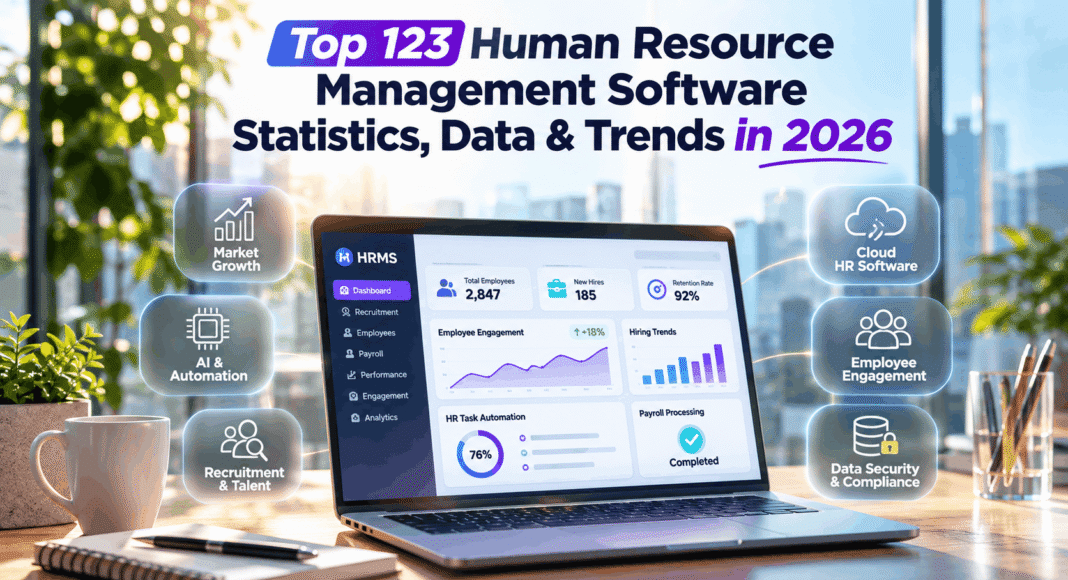
This comprehensive guide to the Top 123 Human Resource Management Software Statistics, Data & Trends in 2026 examines the most significant developments shaping the global HR technology industry, including:
- Global HR management software market size, revenue forecasts, and growth projections.
- Artificial intelligence, agentic AI, and HR process automation.
- Cloud-based HR software adoption and infrastructure trends.
- Recruitment software and applicant tracking system adoption.
- Employee turnover, retention, onboarding, and workforce productivity.
- Payroll automation, benefits administration, and regulatory compliance.
- Performance management and continuous employee feedback.
- People analytics, predictive analytics, and workforce intelligence.
- Employee self-service portals, mobile HR applications, and conversational AI.
- Employee engagement, workplace culture, and organisational profitability.
- HR data security, cybersecurity risks, and privacy management.
- Time and attendance software and workforce scheduling.
- Remote and hybrid workforce management technology.
- Gig economy and contingent workforce management solutions.
- Learning management systems and employee development technology.
- Small business HR software adoption, pricing, and vendor selection.
For HR professionals, business owners, chief human resources officers (CHROs), technology executives, software developers, investors, and enterprise decision-makers, understanding these human resource management software statistics is essential for identifying emerging opportunities, evaluating technology investments, and developing effective workforce management strategies.
As businesses continue to embrace intelligent automation, integrated HR ecosystems, and employee-centric digital transformation, human resource management software is evolving from an administrative necessity into a strategic business asset. The organisations that successfully leverage these technologies will be better positioned to improve operational efficiency, strengthen talent acquisition, enhance employee experiences, reduce workforce-related costs, and build sustainable competitive advantages.
The following 123 human resource management software statistics provide a comprehensive, data-driven overview of the industry’s current landscape, emerging innovations, adoption challenges, and future growth opportunities in 2026 and beyond.
Before we venture further into this article, we would like to share who we are and what we do.
About 9cv9
9cv9 is a business tech startup based in Singapore and Asia, with a strong presence all over the world.
With over ten years of startup and business experience, and being highly involved in connecting with thousands of companies and startups, the 9cv9 team has listed some of the top and best companies/tools in this review.
If you like to get your company listed in our top B2B software reviews, check out our world-class 9cv9 Media and PR service and pricing plans here.
Top 123 Human Resource Management Software Statistics, Data & Trends in 2026
Market Size & Growth
1. The global HR software market is projected to grow from $26.21 billion in 2026 to $66.70 billion by 2034, a 12.38% CAGR. This trajectory confirms human resources management software is one of the fastest-compounding categories in enterprise SaaS heading into the back half of the decade.
2. The HR Management Software (Personnel and Organization) segment alone is valued at $19.57 billion in 2026, forecast to reach $31.89 billion by 2031. Buyers evaluating platforms on Capterra should expect continued price and feature competition as this segment doubles in size within five years.
3. Talent Management software captured 19.86% of HR management software revenue in 2025, the largest single sub-segment. Vendors are increasingly bundling talent modules into core HRMS suites rather than selling them as standalone add-ons.
4. Managed Cloud Services within HR management software are growing at an 11.31% CAGR through 2031, the fastest of any deployment type. This signals a structural shift away from self-hosted HR infrastructure toward fully managed vendor environments.
5. The HR payroll management software market is estimated at $10.10 billion in 2026, rising to $21.58 billion by 2033. Payroll remains the anchor use case that pulls organizations into broader HRMS adoption.
6. The Core HR Software market reached $28.62 billion in 2026, growing at a 7.8% CAGR toward $38.64 billion by 2030. Even the “boring” foundational layer of HR tech — employee records, org charts, compliance data — is scaling briskly.
7. The HR Chatbot and Virtual Assistant market is expected to grow from $1.21 billion in 2025 to $3.42 billion by 2031, a 19.08% CAGR. This is one of the fastest-growing sub-categories of HR software, reflecting employer appetite for conversational self-service.
8. The benefits administration software market is valued at $2.32 billion in 2026 and projected to reach $3.43 billion by 2030 at a 10.3% CAGR. Rising benefits complexity and compliance obligations are the primary demand drivers cited by analysts.
9. The global employee engagement software market reached $1.43 billion in 2026 and is projected to hit $4.47 billion by 2034 at a 15.30% CAGR. Buyers should note this is one of the highest-growth HR sub-categories, outpacing the broader HRMS market average.
10. The Human Resource Chatbot and Virtual Assistant market’s workforce engagement and wellness segment is growing at a 20.43% CAGR, the fastest of any application area in that category. Wellness-focused conversational tools are scaling faster than recruitment-focused chatbots as retention becomes a board-level priority.
AI & Automation in HR
11. SHRM’s 2026 State of AI in HR report found 39% of HR teams had adopted AI for recruiting, with another 46% expecting to adopt by year-end. This puts total expected AI-in-recruiting adoption above 85% of organizations by the close of 2026.
12. Gartner’s CHRO Priorities 2026 survey found 82% of HR leaders plan to deploy agentic AI capabilities within 12 months. Agentic, task-executing AI is quickly overtaking simple chatbot-style assistants as the dominant AI investment theme in HR software roadmaps.
13. Despite high adoption intent, Gartner also found 88% of HR leaders report no significant measurable business value from AI tools yet. This gap between installation and impact is the central tension shaping HR software buying decisions in 2026.
14. Recruiting leads AI adoption across all HR software categories with an 81% utilization rate among organizations already using AI features. Recruiting’s faster, more measurable ROI explains why it consistently ranks as the entry point for AI in HR.
15. Only 39% of organizations use AI in at least one HR activity, versus 62% that use AI somewhere in the business overall, per SHRM’s 2026 research. This gap suggests HR technology adoption of AI still trails other business functions like sales and marketing.
16. Gartner reports that 70%-plus of large enterprises now use AI in at least one HR function. Enterprise-scale organizations have effectively normalized AI in HR, even as SMB adoption lags well behind.
17. AI in HR investment grew 50% year-over-year in 2024, according to Gartner. This rate of budget growth outpaces overall HR software spending growth by a wide margin, confirming AI is capturing a disproportionate share of new HR tech dollars.
18. 40% of mid-market companies have AI HR tools deployed, per Deloitte’s Human Capital Trends research. Mid-market adoption sits meaningfully below the 70%-plus enterprise figure, pointing to a company-size adoption curve.
19. Stanford HAI’s 2026 AI Index found agentic AI job postings grew 10,854% year-over-year through early 2026. This labor-market signal indicates agentic AI capability is moving from pilot to production inside HR and adjacent functions far faster than prior AI waves.
20. 47% of small and midsize businesses now use AI tools in HR for resume screening, onboarding, or employee engagement. Larger SMBs (50–249 employees) adopt HR AI at roughly twice the rate of microbusinesses under 10 employees.
21. 33% of HR/recruiting functions at small businesses use AI, the lowest adoption rate among core business functions surveyed, trailing marketing (72%) and customer support (61%). This confirms HR remains one of the harder functions to automate with AI relative to marketing or finance.
22. 41% of HR software buyers used generative AI tools during their own research process when shortlisting vendors in 2026, per Capterra’s Software Buying Trends Survey. AI is now shaping not just HR operations but the software evaluation and procurement process itself.
Cloud Deployment & Infrastructure
23. Cloud-based deployments are projected to hold a 62.16% share of the HR technology market in 2026, growing at an 11.50% CAGR — the fastest of any deployment segment. SMEs adopting cloud HR platforms to avoid in-house IT overhead are the primary driver of this shift.
24. In the HR management software market specifically, cloud-based solutions captured 68.05% share in 2025, while hybrid deployment models are expanding fastest at a 12.14% CAGR. Pure on-premise HR software is steadily losing share to both cloud-native and hybrid models.
25. 74% of organizations adopted cloud-based HR systems in 2025, according to HR technology association data. This places cloud HR adoption solidly in the majority-adopter phase rather than early-adopter phase.
26. About 70% of HR technology budget spend moved to cloud platforms in 2024, with integration and change-management services growing faster than core software licenses. Buyers are increasingly purchasing implementation outcomes, not just software seats.
27. North America dominated the HR software market with over 34% revenue share in 2023, and the U.S. HR software market is projected to grow at more than 11% CAGR through 2030. Mature IT infrastructure and high enterprise software spend continue to anchor North America’s lead.
28. In the payroll management software market specifically, on-premises deployment is still expected to hold the largest 2026 share at 59.1%, driven by large enterprises’ preference for data control. This is a notable exception to the broader cloud-first trend seen across most other HR software categories.
29. Asia Pacific’s HR technology market generated $8.11 billion in 2025, about 18.60% of the global total, and is projected to reach $8.89 billion in 2026. Rising SME digitization funding across the region is cited as the key regional growth driver.
30. Nearly 50% of small and medium-sized businesses have transitioned to cloud-based HR systems, drawn by lower upfront costs and easier scalability compared with on-premise alternatives. This marks a meaningful gap versus the 68–74% cloud adoption rate seen among larger enterprises.
Recruitment & Applicant Tracking Systems (ATS)
31. 97.8% of Fortune 500 companies use a detectable applicant tracking system, based on Jobscan’s 2025 audit of all 500 corporate career pages. ATS usage among the largest global employers is now effectively universal.
32. 93% of recruiters report using an ATS in 2026, according to survey-based industry research. This confirms ATS software has moved from a nice-to-have to a baseline recruiting tool across company sizes.
33. 75% of recruiters and hiring professionals use an ATS to manage their recruitment process, per Capterra-cited research. Manual, spreadsheet-based candidate tracking is now a minority practice among recruiting teams.
34. 94% of recruiters agree their ATS has had a positive impact on their organization’s hiring processes. This high satisfaction rate helps explain why ATS remains one of the stickiest categories within broader HR software suites.
35. The global ATS market is estimated at $7.94 billion in 2026 by Research Nester, projected to reach $15.46 billion by 2035 at a 7.6% CAGR. Market size estimates vary by research firm, but all point toward sustained double-digit-adjacent growth.
36. AI adoption in recruiting hit 39% of HR teams by early 2026, according to SHRM’s survey of 1,908 HR professionals, ranking recruiting as the #1 AI use case in HR at 27% of companies overall. Recruiting continues to be the proving ground where HR teams first test AI before expanding it to other functions.
37. 93% of recruiters plan to increase their use of AI in 2026. This near-universal intent to expand AI usage suggests recruiting-focused AI features will remain a top differentiator in ATS purchasing decisions.
38. Nearly two-thirds of U.S. job seekers (63%) say they’ve already experienced an AI-conducted interview within the past six months, per Greenhouse’s 2026 survey of nearly 3,000 job seekers. AI-led interviewing has moved from experimental to mainstream in the candidate experience remarkably quickly.
39. ATS software can reduce time-to-hire by 15% to 20% compared with manual recruiting processes. This efficiency gain is one of the most commonly cited justifications for ATS purchases among small and mid-sized employers.
40. 78% of recruiters say using an ATS has improved the quality of hires at their organization. Beyond speed, quality-of-hire improvement is emerging as an equally important ATS value proposition.
Employee Turnover, Retention & ROI
41. Replacing a single employee costs between 50% and 200% of that employee’s annual salary, according to Gallup, with U.S. voluntary turnover costing businesses roughly $1 trillion annually. This figure remains the most widely cited business case for investing in retention-focused HR software.
42. As of mid-2026, roughly 3.1 million U.S. employees quit their jobs every month, based on U.S. Bureau of Labor Statistics data. This steady quits rate underscores why retention analytics remain a persistent HR software priority rather than a cyclical concern.
43. A 1,000-person enterprise with 15% turnover and $70,000 average salaries carries $2.2 million to $3.9 million in annually recoverable turnover costs, per analysis combining Gallup and Work Institute data. This is the kind of dollar-denominated figure that HR software vendors increasingly use to build CFO-facing business cases.
44. Between 42% and 75% of employee departures are considered preventable through better onboarding, career development, and manager support, according to workforce research synthesized by Qooper. Retention-focused HR software features are explicitly designed to target this preventable share.
45. Companies investing in structured retention programs see an average ROI of 3:1 within 18 months, per McKinsey research cited across multiple 2026 HR analyses. This ROI benchmark has become a common yardstick for justifying HR software and program spend to finance leadership.
46. Replacing a mid-senior software engineer costs an average of $43,700, illustrating how replacement costs scale sharply with role seniority and specialization. High-skill roles carry a disproportionate share of an organization’s total turnover exposure.
47. Replacing a C-level executive can cost up to 213% of that executive’s annual salary. Executive-level attrition represents one of the highest-cost, lowest-frequency risks that workforce planning software is designed to help forecast and mitigate.
48. Gallup’s 2026 research found 42% of voluntary turnover is preventable, reinforcing that compensation and engagement software targeting this preventable segment can materially affect retention economics. This figure is increasingly used as an input variable inside HR software ROI calculators.
Employee Onboarding
49. A strong onboarding process improves new-hire retention by 82% and productivity by more than 70%, based on Brandon Hall Group research conducted for Glassdoor. This remains the most frequently cited onboarding statistic across HR software vendor marketing and analyst reports alike.
50. Only 12% of U.S. employees strongly agree their company has a great onboarding process, according to Gallup analytics. This gap between onboarding’s proven impact and its actual execution quality represents a significant addressable opportunity for onboarding software vendors.
51. Employees are 69% more likely to stay with a company for three years if they receive a great onboarding experience. Long-term retention curves are visibly shaped by the first-90-day experience that onboarding software is built to structure.
52. Employees who feel their onboarding was effective are 18 times more likely to feel committed to their employer, per BambooHR research. Commitment at this scale is difficult to achieve through informal, spreadsheet-driven onboarding processes.
53. One in three new hires will leave a job within the first 90 days without a strong onboarding process in place, according to Jobvite research. This early-exit risk is a primary reason onboarding automation has become a standard HRMS module rather than a standalone tool.
54. 86% of new hires decide how long they will stay with a company within their first six months, per Enboarder research. This compressed decision window places significant pressure on onboarding software to deliver a strong experience quickly.
55. Organizations onboarded through a hybrid model report 75% satisfaction, versus 73% for in-person onboarding and 71% for fully remote onboarding, according to AIHR’s 2026 research. This suggests hybrid onboarding workflows may now be the most effective format HR software needs to support.
56. The average new hire is assigned 41 administrative tasks to complete during onboarding, according to Zippia’s research aggregation. Automating this administrative load is one of the clearest efficiency gains onboarding software delivers to both HR teams and new employees.
Payroll Software
57. The average global payroll accuracy rate is approximately 78-80%, meaning roughly one in five payroll cycles contains some form of error. This persistent error rate is a primary driver of continued investment in payroll automation software.
58. Payroll inaccuracies can cost a 1,000-employee organization as much as $922,131 annually, according to research cited by payroll provider Paycom. This figure gives HR software buyers a concrete dollar benchmark for evaluating payroll automation investments.
59. The typical company makes about 15 payroll corrections per pay period, each costing roughly $291 to fix — over $4,300 in correction costs every two weeks, per EY research. These recurring costs compound quickly across a full fiscal year for mid-sized employers.
60. Only 13% of organizations have their HR and finance systems on a single, native platform, according to Paylocity’s 2026 State of Payroll report. The remaining 87% are managing payroll across disconnected systems, which is frequently cited as the root cause of upstream data errors.
61. Manual time and attendance errors can cost between 1% and 8% of total gross payroll, according to American Payroll Association estimates. This makes time-tracking accuracy one of the highest-leverage areas for payroll software to address.
62. Nearly all businesses (99%) now recognize data security as important to their payroll strategy, and 46% call it a critical priority, up from 43% the previous year. Security has become a near-universal payroll software evaluation criterion rather than a secondary concern.
63. More than 40% of organizations facing litigation from payroll errors report resorting to job cuts as a consequence, per EY survey data of 508 organizations. This illustrates that payroll errors carry organizational risk well beyond direct correction costs.
64. Less than half (44%) of organizations running global payroll have complete visibility across all payroll locations, according to ADP-cited research. Multinational employers cite this visibility gap as a top driver for consolidating toward unified global payroll platforms.
Performance Management
65. The continuous performance management software market is valued at $2.97 billion in 2026 and is projected to reach $7.63 billion by 2034, a 12.5% CAGR. This growth reflects the ongoing shift away from annual review cycles toward continuous feedback tooling.
66. In 2016, 82% of companies relied on traditional annual performance reviews; by 2019 that had fallen to 54%, and the shift has continued accelerating through 2025-2026. Annual-only review cycles are increasingly the exception rather than the rule among performance management software users.
67. 75% of organizations plan to integrate AI-based technology into their performance review processes, according to Select Software Reviews’ 2026 research. AI-assisted feedback drafting and bias detection are becoming standard features in performance management platforms.
68. 95% of managers report dissatisfaction with their current performance management systems, per PerformYard’s 2025 State of Performance Management Report. This widespread dissatisfaction is a key driver of the continuous shift toward lighter-weight, check-in-based performance tools.
69. Continuous feedback drives performance for 67% of high-performing teams, making it one of the most consistently cited success factors in performance management research. This statistic is frequently used to justify replacing legacy annual-review software with continuous feedback platforms.
70. 58% of employees say they prefer continuous feedback over traditional yearly performance reviews. Employee preference data increasingly aligns with the vendor-side shift toward continuous performance management tooling.
71. 75% of organizations now formally link OKR outcomes to performance decisions, according to 2026 OKR Intelligence Report data. This tight coupling between goal-tracking software and compensation or promotion decisions is becoming a standard performance management workflow.
72. The performance management software market overall is projected to grow from $5.82 billion in 2024 to $12.17 billion by 2032. This roughly doubling of market size over eight years reflects sustained enterprise investment in structured feedback tooling.
People Analytics & Workforce Analytics
73. 76% of organizations report having some form of HR analytics capability, though only 6% have reached predictive analytics maturity, according to Second Talent’s aggregated 2025-2026 research. This maturity gap represents significant headroom for advanced analytics software adoption.
74. Organizations with mature people analytics practices are five times more likely to act constructively on data insights than those without, per HR.com’s State of People Analytics 2024-2025 report. Analytics maturity, not just data volume, appears to be the deciding factor in whether insights translate into action.
75. Insight222’s 2025/26 global study of 372 organizations employing more than 20 million people found sustained investment in people analytics directly improves AI adoption rates and measurable business outcomes. This link between analytics maturity and broader AI success is becoming a key argument in analytics software business cases.
76. 94% of organizations track turnover rates and 89% monitor time-to-fill as core HR metrics, with organizations tracking 15-plus metrics showing 23% better business outcomes. Breadth of metric tracking, not just the presence of a dashboard, correlates with stronger business performance.
77. Cloud-based analytics platforms deliver insights 34% faster and at 28% lower cost than on-premise alternatives, according to aggregated 2025-2026 HR analytics research. This efficiency gap is accelerating the migration of analytics workloads to cloud-native HR platforms.
78. People analytics professionals adopt AI tools at higher rates than general HR staff and most other analytical functions, trailing only data scientists in overall AI uptake, per Revelio Labs research. This positions people analytics teams as an early-adopter cohort within the broader HR function.
79. Approximately one in five people analytics job postings now lists core AI and machine learning skills as a requirement, according to Revelio Labs. This is reshaping the skills profile organizations look for when staffing their people analytics functions.
80. 60% of organizations with 5,000-plus employees have implemented AI tools in HR, compared with just 33-35% of small organizations, according to Betterworks’ 2026 analysis. This company-size adoption gap in AI-powered analytics mirrors the broader pattern seen across HR software generally.
Employee Self-Service, Mobile & Chatbots
81. 67% of employees prefer accessing HR information from a mobile device, rising to 82% among employees under age 35, according to SHRM technology survey data. This generational skew is pushing HR software vendors to prioritize mobile-first design over desktop-first legacy interfaces.
82. 72% of HR professionals believe workers now have higher expectations of employers than in previous years, with employee experience ranking among their top 2026 focus areas. Rising expectations are a direct driver of continued investment in self-service and experience-focused HR software.
83. Gartner predicts that 75% of routine employee HR inquiries will eventually be managed by bots or other conversational AI platforms. This projection underscores how central chatbot deflection has become to HR service-delivery software strategy.
84. 92% of HR departments recognize the value of chatbots in guiding employees to information they need, even where full adoption has not yet occurred. Recognition of chatbot value appears to be outpacing actual deployment across many organizations.
85. Career sites using chatbots to engage job seekers see 95% more leads, 13% more clicks on job postings, and 40% more completed applications. These engagement gains make recruiting one of the clearest early ROI cases for HR chatbot deployment.
86. Only 35% of HR employees feel confident their organization makes the best use of its current HR technology stack. This confidence gap suggests underutilization, not just underinvestment, is a widespread challenge across HR software deployments.
Employee Engagement & Workplace Culture
87. Only 31% of U.S. employees are actively engaged at work, a figure that has been declining since 2020, according to Gallup. Persistently low engagement continues to be one of the strongest business cases cited for engagement-focused HR software investment.
88. Low employee engagement costs U.S. companies approximately $2 trillion in lost productivity annually, per Gallup’s ongoing workplace research. This macro-level cost figure is frequently referenced in engagement software vendor business cases.
89. Managers account for 70% of the variance in team engagement levels, making manager enablement tools a critical component of any engagement software strategy. This finding places significant emphasis on manager-facing features within modern engagement platforms.
90. Highly engaged business units are 23% more profitable than the least-engaged units, based on Gallup’s meta-analysis spanning 183,806 business units across 53 industries and 90 countries. This remains one of the largest and most cited datasets linking engagement to financial performance.
91. Just 46% of U.S. employees clearly know what is expected of them at work, down from a high of 56% in 2020, according to Gallup. Clarity of expectations is one of the most fixable engagement inputs that goal-alignment software is designed to address.
92. Only about one in three U.S. workers strongly agree they received recognition for good work in the past seven days, per Gallup data. This recognition gap has fueled rapid growth in dedicated peer-to-peer recognition software as a distinct HR software category.
93. Engaged teams are approximately 18% more productive and 23% more profitable than disengaged teams, according to aggregated 2026 workplace research. These productivity and profitability differentials continue to anchor the ROI argument for engagement software.
94. 72% of executives agree that engaged employees translate into greater customer satisfaction, according to a Quantum Workplace survey. This link between internal engagement metrics and external customer outcomes is increasingly used to justify engagement software spend beyond HR budgets alone.
Data Security & Compliance
95. Insider threats account for around 60% of all data breaches, according to ISACA research cited in HR-focused security analysis. This statistic underpins the growing emphasis on role-based access controls within modern HRMS platforms.
96. 74% of businesses have experienced cyber incidents linked to remote work technology, per a Tenable study. The shift to distributed and hybrid work has materially expanded the attack surface that HR software vendors must now account for in their security architecture.
97. A 2026 benefits administration data breach disclosed by Navia affected 2.7 million individuals, exposing names, dates of birth, Social Security numbers, and benefits enrollment data. Incidents of this scale illustrate why data security certifications like SOC 2 and ISO 27001 have become standard HR software procurement requirements.
98. Third-party supply-chain breaches jumped 60% year-over-year and now account for 48% of all security incidents, according to the Verizon Data Breach Investigations Report cited by HR Executive. This trend is pushing HR buyers to scrutinize the security posture of HR software vendors’ subcontractors and integration partners, not just the core platform.
99. 59% of HR leaders consider cybersecurity a top priority when selecting new HR software, according to aggregated 2026 HR technology adoption research. Security has moved from a background compliance checkbox to a headline purchasing criterion.
Time & Attendance and Workforce Management
100. 88% of large organizations and 56% of small-to-medium businesses had adopted workforce management solutions by 2023, marking a decisive shift away from manual timekeeping methods like punch cards and spreadsheets. This adoption gap between large and small organizations continues to narrow as cloud-based time-tracking tools lower the cost of entry.
101. The global time and attendance software market is estimated at $3.3–3.8 billion in 2026, with multiple analyst estimates projecting growth to $5.7–7.5 billion by the early-to-mid 2030s. Biometric and mobile clock-in features are cited as the primary drivers of premium pricing within this category.
102. Cloud-based time and attendance systems account for over 55% of total deployments, while biometric attendance systems hold nearly 40% of the market with accuracy rates exceeding 98%. Biometric verification is increasingly displacing PIN- and card-based clock-in methods in workforce management software.
103. Scheduling accuracy improvements enabled by workforce management software can reduce labor costs by 20% to 50%, according to aggregated 2026 industry research. This makes scheduling optimization one of the highest-ROI features within modern time and attendance platforms.
Benefits Administration
104. North America holds the largest regional share of the benefits administration software market, at approximately 38-42% depending on the analyst source, driven by complex, multi-provider U.S. benefits ecosystems. Regulatory complexity in the U.S. benefits landscape is a key structural driver of software demand in this region specifically.
105. 68% of organizations are adopting automated HR solutions specifically to streamline benefits management and improve employee engagement, according to Business Research Insights’ 2026 market analysis. Automating open enrollment and eligibility tracking remains one of the most commonly cited benefits administration software use cases.
Remote & Hybrid Work Technology
106. 52% of remote-capable employees now work in a hybrid arrangement, while 27% work exclusively remotely, according to Gallup’s latest workplace research. Nearly eight in ten remote-capable workers now spend at least part of their week outside a traditional office, a structural shift HR software has had to accommodate.
107. A randomized controlled trial published in Nature found hybrid work arrangements cut employee attrition by 33% with no measurable loss in performance. This is among the strongest causal (rather than correlational) evidence linking flexible work policy to retention outcomes.
108. 67% of return-to-office mandates result in increased voluntary turnover within six months, according to Gartner HR research. This finding is increasingly cited by HR leaders using workforce analytics software to model the retention risk of return-to-office policy changes.
109. Companies with flexible work policies grow revenue 1.4 times faster than those enforcing strict in-office mandates, per the Scoop Flex Index 2026. This revenue differential adds a growth-oriented argument to the traditional retention-focused case for hybrid work support tools.
Gig Economy & Contingent Workforce Management
110. The contingent workforce is projected to expand by 38% in 2026, with contingent workers already comprising roughly 40% of the U.S. workforce. Vendor management system (VMS) software adoption is scaling in direct proportion to this contingent workforce growth.
111. The global contingent workforce management software market was valued at approximately $1.23 billion in 2026, with projections reaching $2.58 billion by 2032 at an 8.5% CAGR. This is one of the smaller but faster-growing niches within the broader HR software landscape.
112. Millennials make up approximately 48% of all gig workers, the dominant cohort, while Gen Z represents roughly 30% and is the fastest-growing gig demographic. Contingent workforce management software increasingly needs to serve a younger, more mobile-native worker base.
Learning Management Systems (LMS)
113. The global LMS market is projected to reach $28.58 billion in 2025, growing to $70.83 billion by 2030 at a 19.9% CAGR, according to eSkilled’s 2026 market analysis. LMS platforms are increasingly sold as an integrated module within broader HRMS suites rather than as standalone systems.
114. 83% of organizations worldwide currently use an LMS, with adoption climbing to approximately 98% among major enterprises. This confirms learning management has effectively reached saturation adoption at the enterprise tier.
115. Lack of seamless integration with HRIS and CRM systems is the most common LMS dissatisfaction point, cited by 52% of users, and 37% of organizations are actively planning to replace their current LMS. Integration quality, more than content library size, appears to be the leading driver of LMS churn.
SMB HR Software Adoption
116. Over 50% of small and medium enterprises (SMEs) have adopted HR software, according to Market.biz’s 2026 HR technology adoption research. This confirms HR software has crossed into majority adoption even among smaller organizations, not just large enterprises.
117. 50% of HR leaders at small companies cite hiring as their top challenge in 2026, with 49% citing retention — both ranking higher than at any other company size, per Capterra’s 2026 LMS and HR Software Trends Survey. These two pain points are the primary reasons small businesses cite for purchasing their first dedicated HR platform.
118. Nearly 60% of SMBs implement software solutions specifically to improve operational efficiency and reduce costs, according to Business Research Insights’ 2026 SMB software market analysis. Efficiency, rather than compliance risk, remains the leading stated motivation for SMB HR software purchases.
Capterra & HR Software Vendor Landscape
119. The Capterra Human Resources Software category lists more than 1,500 individual products as of mid-2026, drawn from an initial screening pool of over 1,900 solutions. This scale illustrates just how fragmented and competitive the HR software vendor landscape has become for buyers to navigate.
120. 51% of HR software buyers reported being disappointed with at least one software purchase in the past 18 months, according to Capterra’s 2026 Software Buying Trends Survey of 3,385 respondents. Poor vendor support, scalability failures, and security concerns were the most commonly cited causes of dissatisfaction.
121. 60% of HR respondents experienced unexpected disruptions during at least one software implementation in the past 18 months, with data migration issues (35%) and integration failures (31%) the leading causes. This finding places growing weight on vendor implementation support quality as a differentiator in HR software selection.
122. Capterra’s HR software category has amassed more than 121,000 verified user reviews as part of its research and ranking methodology. The sheer scale of this review base makes user-generated feedback an increasingly influential factor in HR software purchase decisions.
123. Most HR software buyers budget approximately $69 per user, per month, according to Capterra advisor call-note data, though enterprise per-user pricing can range as high as $650 per user per month for full-suite platforms. This roughly 10x price spread reflects the wide functional gap between entry-level and enterprise-grade HR platforms.
Conclusion
The global human resource management software industry is undergoing a significant transformation in 2026, driven by artificial intelligence, cloud computing, workforce analytics, intelligent automation, and evolving employee expectations. The 123 human resource management software statistics examined throughout this article demonstrate how HR technology is becoming an increasingly important strategic investment for organisations seeking to improve operational efficiency, workforce productivity, talent management, and long-term business performance.
With the global HR software market projected to increase from $26.21 billion in 2026 to $66.70 billion by 2034 at a CAGR of 12.38%, the industry presents substantial growth opportunities for software providers, technology investors, and businesses pursuing digital HR transformation. Meanwhile, the HR management software segment is forecast to reach $31.89 billion by 2031, reflecting sustained demand for comprehensive and scalable workforce management solutions.
Artificial Intelligence Is Reshaping Human Resource Management
Artificial intelligence represents one of the most transformative developments in the HR software industry. From automated candidate screening and intelligent recruitment workflows to predictive workforce analytics and conversational employee support, AI is fundamentally changing how human resource departments operate.
With 82% of HR leaders planning to deploy agentic AI capabilities within 12 months and 39% of HR teams already adopting AI for recruitment, intelligent automation is becoming an increasingly important component of modern HR management systems.
However, the finding that 88% of HR leaders have yet to realise significant measurable business value from AI highlights a critical industry challenge. Organisations must move beyond technology adoption alone and prioritise effective implementation, responsible AI governance, data quality, and measurable business outcomes.
The future of AI-powered HR management software will increasingly depend on its ability to deliver tangible improvements in recruitment efficiency, employee productivity, workforce planning, and operational cost reduction.
Cloud-Based HR Software Is Becoming the Industry Standard
The continued transition towards cloud-based human resource management software reflects growing demand for flexible, scalable, and accessible HR technology infrastructure.
Cloud-based solutions accounted for 68.05% of the HR management software market in 2025, while hybrid deployment models are projected to grow at a CAGR of 12.14%.
Cloud-native HR management platforms provide organisations with opportunities to centralise employee information, automate administrative workflows, facilitate remote workforce management, and integrate multiple HR functions within unified digital environments.
As businesses increasingly operate across geographically distributed teams, cloud-based HR software will remain an important enabler of workforce accessibility, operational scalability, and digital transformation.
Recruitment and Talent Acquisition Technology Continue to Advance
Recruitment remains one of the most established and influential applications of human resource management software.
With 97.8% of Fortune 500 companies using detectable applicant tracking systems and 94% of recruiters reporting positive impacts from ATS adoption, recruitment automation has become a fundamental component of modern talent acquisition strategies.
Furthermore, applicant tracking systems can reduce time-to-hire by approximately 15% to 20%, while 78% of recruiters report improvements in hiring quality.
These statistics highlight the growing importance of integrated recruitment software, AI-powered candidate screening, automated interview management, and data-driven hiring strategies.
Organisations that effectively implement recruitment technology can strengthen their talent acquisition capabilities, improve candidate experiences, reduce administrative workloads, and compete more effectively for skilled professionals.
Employee Retention and Engagement Remain Critical Business Priorities
The financial implications of employee turnover continue to reinforce the business case for investing in human resource management software.
Replacing an employee can cost between 50% and 200% of their annual salary, while approximately 42% of voluntary employee turnover is considered preventable.
Effective onboarding, employee engagement, career development, performance management, and workforce analytics software can help organisations identify retention risks and address underlying workforce challenges.
The statistics also demonstrate the significant relationship between employee engagement and business performance. Highly engaged business units are approximately 23% more profitable than their least-engaged counterparts, while engaged teams demonstrate approximately 18% higher productivity.
These findings reinforce the importance of employee-centric HR technology strategies that extend beyond administrative automation to support workplace satisfaction, professional development, employee recognition, and organisational culture.
People Analytics Is Emerging as a Strategic Competitive Advantage
People analytics and workforce intelligence are becoming increasingly important components of enterprise HR management strategies.
Although 76% of organisations report having some form of HR analytics capability, only 6% have achieved predictive analytics maturity. This substantial gap highlights considerable opportunities for businesses to improve their workforce intelligence capabilities.
Advanced HR analytics software can support organisations in:
- Identifying employee turnover risks and retention opportunities.
- Improving workforce planning and talent allocation.
- Monitoring recruitment efficiency and hiring performance.
- Evaluating employee engagement and productivity.
- Identifying workforce skills gaps and development requirements.
- Measuring the return on investment of HR initiatives.
- Supporting evidence-based organisational decision-making.
As predictive analytics, machine learning, and AI-powered workforce intelligence continue to evolve, organisations with mature people analytics capabilities will be better positioned to anticipate workforce challenges and make proactive strategic decisions.
Payroll Automation and Integrated HR Systems Are Driving Operational Efficiency
Payroll management remains a foundational component of human resource management software adoption.
The global HR payroll management software market is estimated to grow from $10.10 billion in 2026 to $21.58 billion by 2033, reflecting increasing demand for accurate, automated, and compliant payroll processing solutions.
Payroll inaccuracies can cost a 1,000-employee organisation as much as $922,131 annually, while manual time and attendance errors can account for between 1% and 8% of total gross payroll.
These figures illustrate the substantial financial risks associated with fragmented HR systems and inefficient manual processes.
Integrated human resource management platforms that combine payroll, employee records, attendance tracking, workforce scheduling, benefits administration, and financial systems can help businesses reduce administrative errors, improve data consistency, and strengthen operational efficiency.
Data Security and Regulatory Compliance Are Essential HR Software Considerations
As organisations increasingly digitise sensitive employee information, cybersecurity and data privacy have become fundamental considerations when selecting human resource management software.
Approximately 59% of HR leaders consider cybersecurity a top priority when evaluating new HR software, while 99% of businesses recognise data security as an important component of their payroll strategies.
The growing prevalence of third-party security incidents and increasingly complex HR technology ecosystems reinforces the importance of comprehensive security frameworks.
Businesses must carefully evaluate HR software providers based on data encryption, role-based access controls, security certifications, regulatory compliance capabilities, vendor risk management, and incident response procedures.
Protecting sensitive workforce information is not merely a technical requirement but an essential component of maintaining employee trust, organisational reputation, and business continuity.
Small and Medium-Sized Businesses Represent Significant Growth Opportunities
Human resource management software is no longer exclusively associated with large enterprises.
More than 50% of small and medium-sized enterprises have adopted HR software, demonstrating the increasing accessibility of digital workforce management solutions.
However, hiring and employee retention remain substantial challenges for smaller organisations, with 50% of small-company HR leaders identifying hiring as their primary challenge and 49% highlighting retention.
Affordable cloud-based HR platforms, modular software subscriptions, automated payroll systems, and AI-powered recruitment tools are creating new opportunities for smaller businesses to access capabilities previously associated with enterprise-grade technology.
As HR software becomes increasingly accessible and scalable, small and medium-sized businesses are likely to represent an important source of future industry growth.
Successful HR Software Implementation Requires Strategic Planning
Despite the numerous advantages associated with human resource management software, implementation challenges remain a significant concern.
Approximately 51% of HR software buyers reported disappointment with at least one software purchase, while 60% experienced unexpected disruptions during software implementation.
Data migration difficulties, integration failures, inadequate vendor support, scalability limitations, and security concerns can undermine the effectiveness of HR technology investments.
Consequently, organisations should prioritise comprehensive software evaluations, clearly defined business objectives, integration compatibility, employee training, change management, and measurable performance indicators before implementing new HR management systems.
The most successful HR technology strategies will focus not simply on acquiring advanced software but on ensuring that technology delivers sustainable improvements across the employee lifecycle.
The Future of Human Resource Management Software Beyond 2026
Looking beyond 2026, the human resource management software industry is expected to continue evolving towards increasingly intelligent, integrated, automated, and employee-centric technology ecosystems.
Emerging developments likely to influence the future of HR software include agentic AI, predictive workforce intelligence, conversational employee self-service, continuous performance management, automated compliance monitoring, personalised employee development, and integrated global workforce management platforms.
The continued growth of remote and hybrid work, contingent employment, digital learning, and workforce mobility will further increase demand for adaptable HR technology solutions.
For software providers, these developments create opportunities to deliver innovative platforms that address increasingly complex workforce management requirements. For businesses, they highlight the importance of investing in scalable technologies that align with long-term organisational objectives.
Ultimately, the Top 123 Human Resource Management Software Statistics, Data & Trends in 2026 reveal an industry transitioning from traditional administrative digitisation towards intelligent, strategic, and data-driven workforce management.
Human resource management software is no longer simply a tool for maintaining employee records or processing payroll. It has become an increasingly important foundation for talent acquisition, employee experience, workforce optimisation, regulatory compliance, organisational resilience, and sustainable business growth.
Organisations that successfully combine advanced HR technology with effective leadership, responsible AI adoption, robust data governance, and employee-centric management strategies will be better positioned to navigate evolving workforce challenges and establish lasting competitive advantages in an increasingly digital global economy.
If you find this article useful, why not share it with your hiring manager and C-level suite friends and also leave a nice comment below?
We, at the 9cv9 Research Team, strive to bring the latest and most meaningful data, guides, and statistics to your doorstep.
To get access to top-quality guides, click over to 9cv9 Blog.
To hire top talents using our modern AI-powered recruitment agency, find out more at 9cv9 Modern AI-Powered Recruitment Agency.
People Also Ask
What is human resource management software?
Human resource management software is a digital solution that helps organisations manage recruitment, payroll, employee records, performance, attendance, benefits, compliance, and workforce analytics through centralised and automated systems.
How large is the global HR software market in 2026?
The global HR software market is estimated to reach $26.21 billion in 2026, driven by increasing demand for workforce automation, cloud-based HR platforms, artificial intelligence, and integrated employee management solutions.
What is the projected growth rate of the HR software market?
The global HR software market is projected to grow at a compound annual growth rate of 12.38%, reaching approximately $66.70 billion by 2034.
What are the biggest human resource management software trends in 2026?
Major HR software trends include agentic AI, predictive workforce analytics, cloud-based HR systems, recruitment automation, employee self-service, continuous performance management, and integrated payroll solutions.
How many organisations use cloud-based HR software?
Approximately 74% of organisations adopted cloud-based HR systems in 2025, reflecting growing demand for scalable, accessible, and cost-efficient workforce management technology.
How is artificial intelligence transforming HR software in 2026?
AI transforms HR software through automated recruitment, candidate screening, predictive analytics, employee support chatbots, personalised learning, performance analysis, and intelligent administrative workflows.
What percentage of HR leaders plan to adopt agentic AI?
Approximately 82% of HR leaders plan to deploy agentic AI capabilities within 12 months, highlighting growing interest in autonomous HR workflows and intelligent workforce management.
How many HR teams use AI for recruitment in 2026?
Approximately 39% of HR teams have adopted AI for recruitment, with another 46% expecting to adopt it by the end of 2026.
What percentage of Fortune 500 companies use applicant tracking systems?
Approximately 97.8% of Fortune 500 companies use a detectable applicant tracking system, demonstrating widespread adoption of recruitment automation among major enterprises.
How much can HR recruitment software reduce time-to-hire?
Applicant tracking systems can reduce time-to-hire by approximately 15% to 20% compared with manual recruitment processes by streamlining candidate management and hiring workflows.
What is the global applicant tracking system market size in 2026?
The global applicant tracking system market is estimated at $7.94 billion in 2026 and is projected to reach $15.46 billion by 2035.
How does HR management software improve employee retention?
HR software supports employee retention through engagement monitoring, predictive turnover analytics, structured onboarding, continuous feedback, career development, and early identification of workforce challenges.
How much does employee turnover cost businesses?
Replacing an employee can cost between 50% and 200% of their annual salary. Voluntary employee turnover costs businesses in the United States approximately $1 trillion annually.
What percentage of employee turnover is preventable?
Approximately 42% of voluntary employee turnover is considered preventable, highlighting opportunities to improve retention through stronger management, employee engagement, and career development.
How effective is employee onboarding software?
Research indicates that strong onboarding processes can improve new-hire retention by 82% and productivity by more than 70%. Onboarding software helps organisations standardise and automate these processes.
How large is the HR payroll management software market?
The global HR payroll management software market is estimated at $10.10 billion in 2026 and is projected to reach $21.58 billion by 2033.
How much do payroll errors cost organisations?
Payroll inaccuracies can cost a 1,000-employee organisation as much as $922,131 annually. Automated payroll software can help reduce errors, administrative workloads, and compliance risks.
What percentage of organisations use HR analytics?
Approximately 76% of organisations have some form of HR analytics capability. However, only 6% have achieved predictive analytics maturity, indicating significant opportunities for further development.
What are the benefits of predictive workforce analytics software?
Predictive workforce analytics helps organisations forecast employee turnover, identify skills shortages, optimise staffing, anticipate hiring requirements, and support evidence-based workforce planning.
How does employee engagement software improve business performance?
Employee engagement software supports feedback, recognition, communication, and satisfaction monitoring. Research indicates that highly engaged business units are approximately 23% more profitable than their least-engaged counterparts.
What is the employee engagement software market size in 2026?
The global employee engagement software market is estimated at $1.43 billion in 2026 and is projected to reach $4.47 billion by 2034, growing at a CAGR of 15.30%.
How large is the performance management software market?
The global performance management software market is projected to grow from $5.82 billion in 2024 to $12.17 billion by 2032, reflecting increasing demand for structured feedback and performance tracking.
What percentage of employees prefer continuous performance feedback?
Approximately 58% of employees prefer continuous feedback over traditional annual performance reviews, encouraging organisations to adopt continuous performance management software.
How important is mobile accessibility in HR management software?
Approximately 67% of employees prefer accessing HR information through mobile devices, increasing to 82% among employees under 35. Mobile accessibility is becoming a critical HR software feature.
How fast is the HR chatbot and virtual assistant market growing?
The HR chatbot and virtual assistant market is projected to grow from $1.21 billion in 2025 to $3.42 billion by 2031, representing a CAGR of 19.08%.
Why is cybersecurity important when choosing HR software?
HR software stores sensitive employee, payroll, financial, and personal information. Approximately 59% of HR leaders consider cybersecurity a top priority when selecting new HR management software.
What percentage of small businesses use HR management software?
More than 50% of small and medium-sized enterprises have adopted HR software, reflecting growing demand for affordable workforce automation, recruitment management, and operational efficiency.
How much does human resource management software cost in 2026?
HR software buyers typically budget approximately $69 per user per month, although comprehensive enterprise platforms can cost substantially more depending on functionality, integrations, and service requirements.
What are the biggest challenges of implementing HR management software?
Major challenges include data migration, integration failures, cybersecurity risks, inadequate vendor support, employee resistance, and scalability limitations. Approximately 60% of HR respondents report unexpected implementation disruptions.
What is the future of human resource management software beyond 2026?
The future of HR software will increasingly focus on agentic AI, predictive workforce intelligence, integrated cloud platforms, automated compliance, personalised employee experiences, and intelligent workforce management.
Sources
- Fortune Business Insights
- Mordor Intelligence
- The Business Research Company
- Business Research Insights
- Coherent Market Insights
- Research and Markets
- SHRM
- Gartner
- Future Factors
- Deloitte
- Stanford Institute for Human-Centered Artificial Intelligence
- Business
- Capterra
- SQMagazine
- Market Biz
- Jobscan
- SelectSoftwareReviews
- Research Nester
- Greenhouse
- Gallup
- U.S. Bureau of Labor Statistics
- Work Institute
- McKinsey & Company
- Qooper
- Brandon Hall Group
- Glassdoor
- BambooHR
- Jobvite
- Enboarder
- AIHR
- Zippia
- EY
- Paycom
- People Matters
- Paylocity
- PayrollOrg
- PerformYard
- OKR Intelligence Report
- Second Talent
- HR.com
- Insight222
- Revelio Labs
- Betterworks
- Quantum Workplace
- ISACA
- Tenable
- HR Executive
- Verizon
- Global Growth Insights
- Precedence Research
- Nature
- Scoop Flex Index
- SimplifyVMS
- Conexis VMS
- eSkilled