




























Key Takeaways
- ESG Software Market Growth: The global ESG software market is projected to reach USD 5.19 billion by 2033, driven by increasing sustainability reporting requirements, corporate ESG investments, and regulatory compliance demands.
- AI and Cloud-Based ESG Software Adoption: Cloud-based ESG solutions accounted for approximately 75% of the market in 2025, while AI-powered automation, carbon accounting, and sustainability analytics are transforming ESG reporting and data management.
- ESG Reporting Trends and Future Opportunities: With 96% of the world’s 250 largest companies publishing sustainability reports, demand for ESG management software, automated compliance tools, and carbon emissions tracking solutions is expected to grow through 2026 and beyond.
ESG software is transforming how businesses manage sustainability reporting, carbon accounting, and regulatory compliance in 2026. According to Grand View Research, the global ESG software market is projected to reach USD 5.19 billion by 2033, driven by growing demand for AI-powered analytics, cloud-based platforms, automated ESG reporting, and corporate sustainability management solutions.
Environmental, Social, and Governance (ESG) software has become an increasingly important component of modern business operations as organizations face growing pressure to improve sustainability performance, strengthen corporate transparency, manage environmental risks, and comply with evolving reporting regulations. In 2026, the global ESG software market is experiencing significant growth, driven by increasing corporate sustainability commitments, advancements in artificial intelligence (AI), expanding carbon accounting requirements, and the adoption of digital ESG reporting solutions.
Also, read our article on the Top 10 Environmental, Social, and Governance (ESG) Software.
According to Grand View Research, the global ESG software market was valued at approximately USD 1.24 billion in 2025 and is projected to reach USD 1.44 billion in 2026, with further growth expected to USD 5.19 billion by 2033 at a compound annual growth rate (CAGR) of 20.1%. Meanwhile, Precedence Research offers a broader market estimate, forecasting the ESG software industry to expand from USD 5.15 billion in 2026 to approximately USD 31.96 billion by 2035. Although market estimates vary depending on research methodologies and software categories, these projections highlight the substantial long-term growth potential of ESG technology.
The increasing importance of ESG reporting is also evident in corporate sustainability practices. Research referenced by KPMG indicates that 96% of the world’s 250 largest companies publish sustainability reports, while approximately 90% of S&P 500 companies disclose ESG-related information. As sustainability reporting becomes more established, businesses are increasingly investing in ESG management software, carbon accounting platforms, sustainability reporting tools, and automated compliance solutions to improve data accuracy, operational efficiency, and stakeholder confidence.
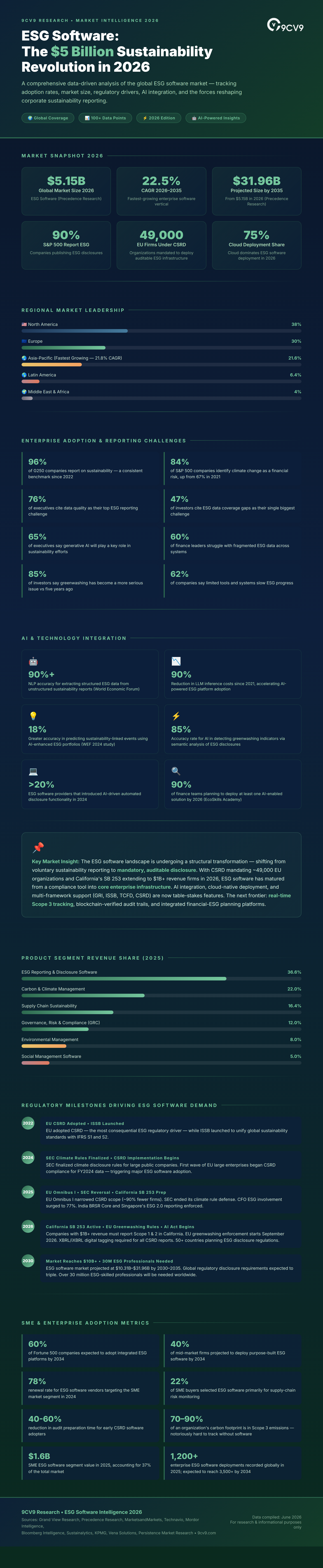
Regional ESG software market trends reveal significant differences in adoption and growth. North America and Europe remain major markets, supported by corporate sustainability initiatives, investor expectations, and regulatory reporting requirements. Meanwhile, Asia-Pacific is emerging as one of the fastest-growing regions, with some market forecasts projecting annual growth rates exceeding 20%. Countries such as China, India, Japan, and Singapore are contributing to demand for ESG reporting software as organizations strengthen environmental disclosures and sustainability management capabilities.
Cloud-based ESG software is another major industry trend shaping the market in 2026. According to Precedence Research, cloud-based solutions accounted for approximately 75% of the ESG software market in 2025, reflecting growing demand for scalable, accessible, and cost-effective sustainability management platforms. Cloud deployment enables businesses to centralize ESG data, automate reporting workflows, monitor carbon emissions, and integrate sustainability metrics across departments and international operations.
Artificial intelligence and automation are also transforming ESG software capabilities. The research compiled in this report indicates that 65% of executives believe generative AI will play an important role in their organizations’ sustainability efforts, while 64% prioritize advanced analytics for ESG insights. AI-powered ESG platforms are increasingly being used for automated data collection, emissions calculations, climate risk assessments, regulatory reporting, and the identification of potential greenwashing risks.
Despite these advancements, ESG data management remains a significant challenge. Research cited in the report suggests that 76% of executives identify data quality as a major ESG reporting obstacle, while 60% of finance leaders struggle with fragmented sustainability information across disconnected systems. These challenges highlight the growing importance of integrated ESG software solutions that provide reliable data governance, automated reporting, standardized sustainability metrics, and audit-ready documentation.
Looking ahead, the ESG software industry is expected to evolve as organizations respond to changing regulatory frameworks, investor expectations, technological innovation, and the need for more transparent sustainability performance measurement. Developments involving the European Union’s Corporate Sustainability Reporting Directive (CSRD), International Sustainability Standards Board (ISSB) standards, carbon emissions disclosure requirements, and AI-powered sustainability analytics are influencing how businesses evaluate and implement ESG technology.
This comprehensive guide to the Top 110 ESG Software Statistics, Data & Trends in 2026 examines the latest industry research, market size estimates, growth forecasts, regional adoption patterns, cloud deployment trends, AI integration, corporate sustainability reporting practices, regulatory developments, and future market opportunities. Whether for business leaders, sustainability professionals, ESG consultants, investors, software developers, or technology decision-makers, these ESG software statistics provide valuable insights into the technologies, challenges, and market forces shaping the future of environmental, social, and governance management.
Before we venture further into this article, we would like to share who we are and what we do.
About 9cv9
9cv9 is a business tech startup based in Singapore and Asia, with a strong presence all over the world.
With over ten years of startup and business experience, and being highly involved in connecting with thousands of companies and startups, the 9cv9 team has listed some of the top and best companies/tools in this review.
If you like to get your company listed in our top B2B software reviews, check out our world-class 9cv9 Media and PR service and pricing plans here.
Top 110 Environmental, Social, and Governance (ESG) Software Statistics, Data & Trends in 2026
📊 Market Size & Growth
1. The global ESG software market was valued at USD 1.24 billion in 2025 and is expected to reach USD 1.44 billion in 2026, signaling rapid mainstream adoption of sustainability tech platforms. (Grand View Research)
2. By 2033, the global ESG software market is projected to reach USD 5.19 billion, expanding at a CAGR of 20.1% from 2026, making it one of the fastest-growing enterprise software verticals. (Grand View Research)
3. A competing forecast by Precedence Research places the 2025 ESG software market size at USD 4.20 billion — significantly higher — and projects it reaching USD 31.96 billion by 2035 at a 22.5% CAGR. (Precedence Research)
4. The ESG software market is projected to grow from USD 5.15 billion in 2026 to approximately USD 31.96 billion by 2035, representing a nearly 6× growth over the decade. (Precedence Research)
5. According to SkyQuestt, the global ESG software market was valued at USD 2.62 billion in 2024 and is set to reach USD 7.56 billion by 2033 at a CAGR of 12.5%. (SkyQuestt)
6. ESG reporting software specifically (a sub-segment) was valued at USD 1.39 billion in 2025 and is projected to grow to USD 1.70 billion in 2026 at a CAGR of 22.6%. (The Business Research Company)
7. The ESG reporting software market is expected to reach USD 3.89 billion by 2030, driven by soaring investor demand for sustainability insights and data transparency. (The Business Research Company)
8. MarketsandMarkets forecasts the ESG reporting software market at USD 1.313 billion in 2026, growing to USD 2.931 billion by 2031 at a CAGR of 17.4%, reflecting steady institutionalization of mandatory disclosure. (MarketsandMarkets)
9. Mordor Intelligence estimates the ESG software market reached USD 4.78 billion in 2026 and is projected to hit USD 10.31 billion by 2031 at a CAGR of 16.62%. (Mordor Intelligence)
10. The Technavio ESG reporting software market is projected to increase by USD 2.08 billion at a CAGR of 23.5% from 2025 to 2030, driven by mandatory disclosure mandates and cross-border regulatory harmonization. (Technavio)
11. Fortune Business Insights projects the ESG reporting software market at USD 1.60 billion in 2026, growing to USD 7.36 billion by 2034 at a 21.02% CAGR. (Fortune Business Insights)
12. Spherical Insights projects the ESG Reporting Software Market to grow from USD 1.48 billion in 2025 to USD 7.81 billion by 2035 at a CAGR of 18.1%. (Spherical Insights)
13. InsightAce Analytic values the ESG reporting software market at USD 1.19 billion in 2025, reaching USD 5.21 billion by 2035 at a 16% CAGR. (InsightAce Analytic)
14. The global ESG software market is projected to grow from USD 1,271.38 million in 2026 to USD 1,479.89 million in 2027, before reaching USD 4,987.14 million by 2035 at a CAGR of 16.4%. (industryresearch.biz)
15. Coherent Market Insights estimates the global ESG reporting software market at USD 1.51 billion in 2026, set to expand significantly through the decade. (Coherent Market Insights)
🌍 Regional Market Share & CAGR
16. North America held the largest ESG software market share of 38% in 2025, driven by strict regulations, SEC disclosure frameworks, and investor ESG data demands. (Precedence Research)
17. North America is expected to dominate the ESG reporting software market with a 40.2% share in 2026, backed by strong government support and a mature financial ecosystem. (Coherent Market Insights)
18. The U.S. ESG software market was valued at USD 1.20 billion in 2025 and is expected to reach USD 9.29 billion by 2035, growing at a CAGR of 22.71%. (Precedence Research)
19. The United States accounts for approximately 34% of the global ESG Reporting Software market share, making it the single largest national market. (Fortune Business Insights)
20. Europe accounts for approximately 30% of global ESG software market share, underpinned by CSRD and ESRS mandates requiring nearly 49,000 organizations to deploy auditable ESG infrastructure. (Persistence Market Research)
21. Europe led with 34.90% revenue share in 2025 thanks to early adoption of CSRD and mandatory disclosure frameworks — evidence that regulation directly accelerates software adoption. (Mordor Intelligence)
22. Asia-Pacific holds approximately 21.6% of the ESG reporting software market in 2026 and is the fastest-growing region, with countries like China, India, and Japan driving adoption. (Coherent Market Insights)
23. Asia-Pacific is expected to register the fastest regional CAGR of 21.8% from 2026 to 2033, driven by expanding regulatory enforcement and rapid digitalization. (Grand View Research)
24. Asia-Pacific’s fastest-growing CAGR of 25% over 2026–2035 (Precedence Research) signals that emerging economies are closing the ESG software adoption gap with Western markets faster than previously forecast.
25. East Asia (China, Japan, South Korea) captures approximately 18% of the global ESG reporting software market through 2026, representing the fastest-growing sub-regional segment. (Persistence Market Research)
26. The North America ESG software market size is estimated at USD 1.60 billion in 2025 and is projected to reach approximately USD 12.30 billion by 2035, with a 22.62% CAGR. (Precedence Research)
27. North America dominated the ESG reporting software growth with a 41.6% contribution during the 2025–2030 forecast period, reflecting its leadership in compliance infrastructure investment. (Technavio)
☁️ Deployment & Technology Trends
28. Cloud-based ESG software dominated with 75% market share in 2025 and is expected to expand rapidly at a CAGR of 26% through 2035, driven by scalability, flexibility, and lower overhead costs. (Precedence Research)
29. Cloud-based ESG reporting software commands approximately 61% market share through 2026, favored for scalability, rapid compliance readiness, automatic regulatory updates, and lower IT ownership costs. (Persistence Market Research)
30. The cloud-based segment is expected to hold the highest share of 60.2% of the ESG reporting software market in 2026, owing to universal accessibility and ease of deployment. (Coherent Market Insights)
31. The on-premises ESG software segment held 25% of the market in 2025 and is expected to grow at a CAGR of 13% through 2035, driven by large enterprises requiring strict data sovereignty and security. (Precedence Research)
32. The on-premises deployment segment was valued at USD 683.9 million in 2024, serving heavily regulated sectors that require absolute data control, full audit trails, and 99.9% data residency compliance. (Technavio)
33. Cloud-native ESG software modules represent approximately 36% of new licenses in 2025, with SMEs and large enterprises alike favoring SaaS models for sustainability reporting. (industryresearch.biz)
34. Over 700 new ESG software modules were launched globally in 2024–2026, illustrating the rapid pace of product innovation driven by multi-framework compliance demand. (industryresearch.biz)
35. The top 10 ESG software vendors account for roughly 55% of total vendor revenue, indicating a moderately concentrated market with room for new entrants and niche players. (industryresearch.biz)
🏢 Enterprise vs. SME Adoption
36. Large enterprises held the largest revenue share of the ESG software market in 2025, accounting for approximately 60% of total spending, reflecting their greater compliance obligations and resources. (Grand View Research, industryresearch.biz)
37. SMEs made up approximately 40% of ESG software license purchases in 2024, up from 34% in 2023 — a significant acceleration driven by supply chain compliance requirements. (industryresearch.biz)
38. The SME ESG software segment represented USD 1.6 billion in 2025, accounting for 37% of the total market, with a projected CAGR of 12.8% as cloud platforms lower barriers to entry. (industryresearch.biz)
39. SME ESG software deal sizes are approximately 45% smaller than large-enterprise deals, making subscription-based cloud models the dominant commercial structure for smaller organizations. (industryresearch.biz)
40. ESG software vendors targeting SMEs reported renewal rates of over 78% in 2024, reflecting strong product stickiness once sustainability reporting workflows are digitized. (industryresearch.biz)
41. The SME segment is expected to account for 35% of new ESG software licenses by 2026, a major shift from historically enterprise-dominant market dynamics. (industryresearch.biz)
42. SME adoption is growing at a CAGR of 22.05%, significantly outpacing large-enterprise adoption rates, as cloud subscription models and pre-configured compliance templates lower entry barriers. (Mordor Intelligence)
43. 22% of SME ESG software buyers selected platforms primarily for supply-chain risk monitoring, while 18% cited social-governance dashboards as their top priority. (industryresearch.biz)
44. Over 1,200 enterprise ESG software deployments were recorded globally in 2025, expected to grow to 3,500+ deployments across 50+ countries by 2034. (industryresearch.biz)
45. More than 60% of Fortune 500 companies are expected to adopt integrated ESG platforms by 2034, while more than 40% of mid-market firms will deploy purpose-built ESG software. (industryresearch.biz)
📋 Corporate Reporting Adoption
46. 90% of S&P 500 companies currently publish ESG reports, many focusing on the impact of climate change on their operations and long-term strategies. (Keyesg.com, Arbor.eco)
47. 96% of G250 companies — the world’s 250 largest by revenue — report on sustainability, a benchmark that has held consistent since 2022, reflecting institutionalized reporting. (KPMG, via keyesg.com)
48. 84% of S&P 500 companies now identify climate change as a financial risk, a significant jump from 67% in 2021, reflecting growing board-level prioritization of sustainability. (Vena Solutions)
49. 76% of executives say sustainability is central to their business strategy, making ESG software a strategic investment rather than a compliance checkbox. (Arbor.eco)
50. Only 1 in 5 (approximately 20%) of finance teams currently report on their company’s ESG metrics, revealing a massive operational gap between strategic intent and execution. (Vena Solutions)
51. 80% of large U.S. and multinational companies were revising their ESG strategies in response to shifting political and regulatory pressures as of June 2025. (The Conference Board via Britannica Money)
52. 90% of executives expected ESG-related resistance to persist or grow, particularly around climate-related commitments — signaling sustained demand for adaptive ESG software. (The Conference Board, via Britannica Money)
⚠️ Data Challenges & Quality Issues
53. 47% of investors cite ESG data coverage gaps as their single biggest challenge, creating market demand for platforms with broader and more consistent data ingestion capabilities. (Sustainalytics)
54. 41% of investors report data quality issues with ESG disclosures, and 40% highlight inconsistencies across different ESG data vendors — driving demand for standardized platforms. (Sustainalytics)
55. 76% of executives cite data quality as a top ESG reporting challenge, revealing that the biggest barrier to effective sustainability reporting is not intent, but data infrastructure. (Vena Solutions)
56. 60% of finance leaders struggle with fragmented ESG data spread across disconnected systems, underlining the value proposition of unified ESG software platforms. (Vena Solutions)
57. More than 62% of companies say limited tools and systems slow their ESG progress, validating the commercial opportunity for purpose-built ESG software solutions. (Arbor.eco)
58. ESG data remains highly fragmented across ERP systems, spreadsheets, operational databases, and facility logs, posing significant barriers to accurate sustainability reporting without dedicated software. (MarketsandMarkets)
59. Lack of proper data governance leads to unreliable ESG metrics and inaccurate emissions calculations, driving enterprises toward structured, audit-ready software platforms. (MarketsandMarkets)
60. Over 500 individual ESG indicators and subjective weighting methodologies make ESG analysis highly complex — an environment where AI-powered software can unlock transformational value. (IICSR)
🤖 AI & Technology Integration
61. 65% of executives say generative AI will play a key role in their organization’s sustainability efforts, fueling demand for AI-native ESG software platforms. (Keyesg.com)
62. 64% of executives prioritize advanced analytics for ESG insights, and 57% prioritize automation — making AI and machine learning the top technology priorities for sustainability teams. (Vena Solutions)
63. 90% of finance teams worldwide are planning to deploy at least one AI-enabled solution by 2026, with ESG reporting and carbon accounting among the top use cases. (EcoSkills Academy)
64. 58% of finance teams worldwide are already using standard generative AI technology, demonstrating how quickly AI has become embedded in ESG and financial workflows. (EcoSkills Academy)
65. NLP and large language models (like GPT-4, BERT) have achieved 90%+ accuracy in automated extraction of structured data from unstructured corporate sustainability reports as of 2024–2025. (ISDO)
66. AI tools can detect greenwashing indicators in sustainability reports with approximately 85% accuracy using semantic analysis — making AI a critical tool for investor due diligence. (ISDO)
67. AI-enhanced ESG portfolios demonstrated 18% greater accuracy in predicting sustainability-linked events compared to traditional approaches, per a 2024 World Economic Forum study. (IICSR)
68. Large language model inference costs have declined approximately 90% since 2021, dramatically lowering the cost barrier for AI integration in ESG software platforms. (ISDO)
69. Over 20% of ESG software providers introduced AI-driven functionality for automated disclosures in 2024, as AI becomes a competitive differentiator in the market. (industryresearch.biz)
70. IBM introduced an AI-powered Response Generator within its Envizi ESG Suite in March 2025, enabling organizations to draft comprehensive disclosure responses using machine learning. (Technavio)
71. EY launched 30 advanced AI tools within its EYQ platform in April 2025 to automate complex assurance tasks and assist with climate reporting regulation navigation. (Technavio)
72. Salesforce enhanced its Net Zero Cloud by integrating Agentforce autonomous agents in January 2025 to simplify carbon accounting and sustainability forecasting. (Technavio)
73. AI can reduce ESG report preparation costs by over 90% in some pilot projects, a benefit so transformative that it has already convinced major enterprises to accelerate software adoption. (Mordor Intelligence)
74. Scenario analysis and forecasting functionality — increasingly AI-driven — is projected to grow at a CAGR of 24.3% through 2031 as firms shift from compliance to forward-looking risk management. (Mordor Intelligence)
📜 Regulatory Landscape
75. The EU’s CSRD applies to approximately 49,000–50,000 organizations across 27 member states, all of which require systematic ESG data infrastructure capable of producing auditable sustainability reports. (Persistence Market Research, 9cv9.com)
76. The EU’s CSRD Omnibus I package, approved in 2025, narrowed the reporting universe by approximately 90% of originally expected firms, concentrating demand among larger, more sophisticated enterprise buyers. (9cv9.com)
77. The ESRS datapoints under revised CSRD have been reduced from over 1,100 to an estimated 400–500 following the Omnibus I package — simplifying compliance while raising data quality standards. (9cv9.com)
78. Early CSRD software adopters report a 40–60% reduction in audit preparation time with dedicated compliance software, making the ROI on ESG platforms highly tangible. (KnowESG, 9cv9.com)
79. All CSRD reports must be machine-readable starting 2026, with mandatory XBRL/iXBRL digital tagging, creating a surge in demand for software with automated digital tagging features. (KnowESG)
80. California’s SB 253 requires companies with over $1 billion in annual revenue doing business in California to report Scope 1 and 2 emissions beginning in 2026, with Scope 3 following in 2027. (EcoVadis)
81. California’s SB 261 requires companies with over $500 million in revenue to report climate-related financial risks biennially starting in 2026, expanding the U.S. mandatory reporting landscape. (EcoVadis)
82. Over 50 countries worldwide are planning to introduce ESG disclosure regulations, creating a global multi-year pipeline of mandatory ESG software demand with no sign of slowing. (MarketsandMarkets)
83. India’s BRSR Core framework mandates ESG reporting for the top 1,000 listed companies, accelerating ESG software adoption across one of the world’s fastest-growing economies. (ISDO)
84. Singapore requires climate disclosures from all listed companies as of 2025 under ESG Reporting Guidelines 2.0, contributing to Asia-Pacific’s leadership as the fastest-growing ESG software region. (Grand View Research)
85. China is scaling pilot programs for ESG integration in capital markets, mandating sustainability reports for over 300 listed entities by 2026, creating a new wave of ESG software demand. (Mordor Intelligence)
86. The CFO involvement in ESG and sustainability strategy funding surged from 59% in 2023 to 77% in 2025, reflecting how ESG reporting has become a board-level financial priority. (9cv9.com)
87. TCFD adoption rates grew from 27% in the Americas in 2022 to 35% in 2025, while Europe reached 56% (CSRD-driven) and Asia-Pacific hit 63%. (ISDO)
88. Only 82% of 3,814 globally listed companies disclose information aligned with at least one TCFD recommendation, and just 2–3% provide comprehensive disclosures covering all 11 recommendations — a massive compliance gap. (ISDO)
89. EU greenwashing enforcement begins September 2026, meaning any business making environmental claims without verification faces legal exposure — a powerful driver for verifiable ESG software adoption. (EcoSkills Academy)
🏭 Industry Vertical Adoption
90. Banking, Financial Services & Insurance (BFSI) leads ESG software adoption with approximately 22% of market value through 2026, driven by regulatory compliance urgency and capital market ESG scrutiny. (Persistence Market Research)
91. Financial institutions face unprecedented pressure to quantify climate risk, demonstrate sustainable lending, and report ESG performance aligned with CSRD, ISSB, and SEC climate frameworks. (Persistence Market Research)
92. 45% of new ESG software purchases in 2025 in the U.S. were made by firms in financial services and manufacturing verticals — the two most compliance-intensive sectors. (industryresearch.biz)
93. Manufacturing, energy, and retail sectors present the highest growth opportunities for ESG transparency, as access to capital and supply chain eligibility increasingly depend on verified ESG performance. (MarketsandMarkets)
94. Asia-Pacific companies utilizing ESG platforms for product lifecycle assessment and decarbonization pathway modeling have achieved up to 25% faster reporting cycles. (Technavio)
🌱 Sustainability & Carbon Accounting
95. Scope 3 emissions typically represent 70–90% of an organization’s total carbon footprint — yet remain notoriously difficult to track without dedicated carbon accounting software. (Plan A / Arbor.eco)
96. Carbon accounting software that integrates Scope 1, 2, and 3 emissions within a single platform has become a core business system rather than a specialist sustainability tool as of 2026. (KEY ESG)
97. AI-powered ESG tools now scan millions of sustainability reports, news articles, satellite images, and earnings call transcripts to assess real-time ESG risks for portfolio management. (IICSR)
98. 85% of investors say greenwashing has become a more serious issue compared to five years ago, making verifiable, audit-ready ESG disclosures a non-negotiable feature of modern ESG platforms. (Vena Solutions)
99. Global regulatory disclosure requirements are expected to triple by 2030, permanently cementing ESG software as core compliance infrastructure for virtually all large and mid-market enterprises. (Custom Market Insights)
100. Over 30 million ESG-skilled professionals will be needed globally by 2030, highlighting the critical need for automated ESG software to bridge the widening sustainability talent gap. (Keyesg.com)
101. Nearly 50% of executives say AI has increased their organization’s carbon emissions — a paradox that is driving demand for AI-optimized ESG platforms with embedded energy efficiency features. (Keyesg.com)
102. The ESG software market in 2025 had 250+ U.S. public companies implementing ESG software modules, driven by investor-led regulatory pressure and U.S. disclosure frameworks. (industryresearch.biz)
103. Approximately 430 deployments of ESG software platforms in large U.S. enterprises were recorded as of 2024, representing 38% of the global market share by deployment count. (industryresearch.biz)
104. EcoVadis provides ESG ratings and tools to 150,000+ businesses across 220 industries in 180 countries, making it one of the world’s most widely deployed ESG data platforms. (EcoVadis)
105. CSRD compliance software pricing ranges from approximately €20,000 to €200,000+ per year, with enterprise platforms (Workiva, SAP, Sphera) at the upper end of the range. (KnowESG)
📈 Future Outlook
106. By 2034, the global ESG software market anticipates more than 3,500 enterprise deployments across 50+ countries, cementing sustainability software as standard corporate IT architecture. (industryresearch.biz)
107. More than 300 new ESG software modules were launched globally in 2024, with nearly 40% of those enhancing social-governance tracking capabilities. (industryresearch.biz)
108. The global ESG assets under management are predicted to hit $40 trillion by 2030 despite current market headwinds, maintaining institutional investor pressure on corporate ESG performance. (Bloomberg Intelligence)
109. As of 2024, $6.5 trillion — or 12% of total U.S. assets under professional management — was invested in ESG-aligned assets, according to the U.S. SIF Foundation. (Britannica Money)
110. Government fiscal support for ESG compliance exceeds half a billion dollars annually, meaningfully lowering financial barriers to ESG software adoption for mid-market and SME organizations. (9cv9.com)
Conclusion
The Top 110 ESG Software Statistics, Data & Trends in 2026 demonstrate that environmental, social, and governance technology is becoming an increasingly important component of corporate sustainability management, regulatory compliance, and long-term business strategy. As organizations face growing expectations for transparency, accountability, and measurable sustainability performance, ESG software is evolving from a specialized reporting solution into an integrated business management platform.
The global ESG software market is positioned for substantial growth over the coming decade. According to Grand View Research, the market is projected to reach USD 5.19 billion by 2033, while Precedence Research forecasts a broader market opportunity of approximately USD 31.96 billion by 2035. Although these estimates differ due to varying market definitions and research methodologies, they collectively indicate strong demand for ESG reporting software, carbon accounting solutions, sustainability management platforms, and automated compliance technologies.
One of the most significant ESG software trends in 2026 is the accelerating adoption of cloud-based platforms and artificial intelligence. With cloud solutions accounting for an estimated 75% of the ESG software market in 2025, businesses are increasingly prioritizing scalable, centralized, and accessible sustainability management systems. Meanwhile, AI-powered ESG software is transforming how organizations collect environmental data, automate sustainability disclosures, assess climate-related risks, and monitor regulatory requirements.
Corporate ESG reporting adoption further reinforces the importance of these technologies. With 96% of the world’s 250 largest companies publishing sustainability reports and approximately 90% of S&P 500 companies disclosing ESG information, sustainability reporting has become an established corporate practice. However, persistent challenges involving fragmented data, inconsistent reporting standards, and limited automation continue to create opportunities for ESG software providers to deliver more reliable and efficient solutions.
Regional market developments also highlight the expanding global reach of ESG technology. North America and Europe remain important markets, supported by established sustainability reporting practices and regulatory frameworks. At the same time, Asia-Pacific is emerging as a major growth opportunity, driven by corporate digital transformation, expanding sustainability initiatives, and evolving environmental disclosure requirements across China, India, Japan, Singapore, and other economies.
Looking ahead, ESG software trends beyond 2026 will increasingly be shaped by five major developments: AI-driven sustainability analytics, automated carbon accounting, cloud-based ESG reporting, evolving regulatory compliance requirements, and greater integration with enterprise business systems. Organizations that successfully combine these capabilities will be better positioned to improve ESG data accuracy, reduce administrative workloads, strengthen sustainability governance, and make more informed strategic decisions.
Nevertheless, the growing sophistication of ESG software also introduces important considerations. Businesses must carefully evaluate data quality, implementation costs, integration capabilities, cybersecurity, regulatory adaptability, and the reliability of AI-generated sustainability insights. Selecting an ESG management platform should therefore involve more than comparing software features; it requires understanding organizational reporting obligations, sustainability objectives, operational complexity, and long-term technology requirements.
For ESG software vendors, the expanding market presents opportunities to develop specialized solutions for small and medium-sized enterprises, multinational corporations, financial institutions, manufacturers, and other industries facing increasingly complex sustainability reporting needs. For investors and business leaders, the statistics highlight the importance of monitoring technological innovation, regional market developments, and regulatory changes when assessing the industry’s long-term growth potential.
Ultimately, the 110 ESG software statistics presented in this report illustrate an industry undergoing significant technological and operational transformation. As sustainability data becomes more closely connected to financial performance, risk management, supply chain operations, and corporate governance, the demand for accurate, scalable, and intelligent ESG software solutions is likely to remain an important driver of enterprise technology investment.
Organizations that invest strategically in reliable ESG data infrastructure, reporting automation, and sustainability analytics will be better equipped to navigate changing market expectations, demonstrate measurable environmental and social performance, and build more resilient business operations.
The future of ESG software is not simply about producing sustainability reports. It is about transforming ESG data into actionable business intelligence that supports transparency, operational efficiency, regulatory readiness, and sustainable long-term growth.
If you find this article useful, why not share it with your hiring manager and C-level suite friends and also leave a nice comment below?
We, at the 9cv9 Research Team, strive to bring the latest and most meaningful data, guides, and statistics to your doorstep.
To get access to top-quality guides, click over to 9cv9 Blog.
To hire top talents using our modern AI-powered recruitment agency, find out more at 9cv9 Modern AI-Powered Recruitment Agency.
People Also Ask
What is ESG software?
ESG software is a digital platform that helps businesses track, manage, analyze, and report environmental, social, and governance performance. It supports sustainability reporting, carbon accounting, regulatory compliance, and ESG data management.
How big is the global ESG software market in 2026?
According to Grand View Research, the global ESG software market is projected to reach USD 1.44 billion in 2026, up from USD 1.24 billion in 2025. Other research firms report higher estimates due to differences in market definitions.
What is the projected growth rate of the ESG software market?
Grand View Research forecasts a compound annual growth rate (CAGR) of 20.1% for the global ESG software market from 2026 to 2033, driven by sustainability reporting requirements, cloud adoption, and corporate ESG investments.
How much will the ESG software market be worth by 2030?
Market forecasts vary by category. The Business Research Company projects the ESG reporting software market to reach USD 3.89 billion by 2030, supported by growing demand for sustainability disclosures and ESG data transparency.
What is the ESG software market forecast for 2035?
Precedence Research forecasts that the global ESG software market could reach approximately USD 31.96 billion by 2035, driven by regulatory compliance, corporate sustainability initiatives, and increasing adoption of automated ESG management platforms.
What are the biggest ESG software trends in 2026?
Major ESG software trends in 2026 include AI-powered sustainability analytics, cloud-based ESG platforms, automated carbon accounting, regulatory reporting automation, Scope 3 emissions tracking, and integration with enterprise resource planning systems.
Why is ESG software becoming more important for businesses?
ESG software helps organizations manage sustainability data, improve reporting accuracy, monitor environmental risks, and respond to stakeholder expectations. Growing regulatory complexity and corporate transparency requirements are increasing its importance.
What percentage of companies use ESG reporting?
According to KPMG research cited in the report, 96% of the world’s 250 largest companies publish sustainability reports. Approximately 90% of S&P 500 companies also disclose ESG information, demonstrating widespread corporate reporting adoption.
Which region has the largest ESG software market share?
North America and Europe are leading ESG software markets. Precedence Research estimates North America’s 2025 market share at 38%, while Mordor Intelligence reports that Europe accounted for 34.9% of ESG software revenue in 2025.
Which region has the fastest-growing ESG software market?
Asia-Pacific is among the fastest-growing ESG software markets. Grand View Research projects a regional CAGR of 21.8% from 2026 to 2033, supported by sustainability regulations, corporate digitalization, and increasing ESG investments.
What is the market share of cloud-based ESG software?
According to Precedence Research, cloud-based ESG software accounted for approximately 75% of the global market in 2025. Cloud platforms are popular because they offer scalability, centralized data management, and automated reporting capabilities.
Why are businesses adopting cloud-based ESG software?
Businesses adopt cloud-based ESG software to centralize sustainability data, reduce infrastructure costs, improve accessibility, automate compliance reporting, and support collaboration across departments and international operations.
How is artificial intelligence transforming ESG software?
AI-powered ESG software automates sustainability data collection, analyzes environmental risks, generates reporting insights, and identifies potential inconsistencies. Machine learning and natural language processing also support ESG disclosure analysis.
What percentage of executives support AI adoption in ESG reporting?
Research cited in the report indicates that 65% of executives believe generative AI will play an important role in sustainability efforts, while 64% prioritize advanced analytics and 57% prioritize automation for ESG management.
What are the benefits of ESG reporting software?
ESG reporting software improves sustainability data accuracy, reduces manual reporting workloads, supports regulatory compliance, centralizes ESG metrics, and provides audit-ready documentation for investors, regulators, and stakeholders.
What are the biggest challenges in ESG data management?
Major challenges include fragmented data, inconsistent reporting standards, limited automation, and unreliable sustainability metrics. Research cited in the report indicates that 76% of executives identify data quality as a major ESG reporting challenge.
How does ESG software help with carbon accounting?
ESG software helps businesses calculate, monitor, and report Scope 1, Scope 2, and Scope 3 greenhouse gas emissions. Carbon accounting features support emissions tracking, sustainability targets, and environmental performance reporting.
What percentage of corporate emissions comes from Scope 3?
Scope 3 emissions can represent approximately 70% to 90% of an organization’s total carbon footprint, according to estimates cited in the report. These indirect emissions are particularly challenging to measure across complex supply chains.
How does ESG software support regulatory compliance?
ESG software supports regulatory compliance by organizing sustainability data, automating disclosures, maintaining audit trails, and helping businesses prepare reports aligned with frameworks such as CSRD, ESRS, ISSB, and applicable climate disclosure requirements.
What is the role of CSRD in ESG software adoption?
The European Union’s Corporate Sustainability Reporting Directive (CSRD) influences ESG software adoption by creating structured sustainability disclosure requirements for companies within its scope. Regulatory changes also increase demand for adaptable reporting tools.
How much does ESG compliance software cost?
According to pricing estimates cited in the report, CSRD compliance software can cost approximately €20,000 to €200,000 or more annually. Pricing varies depending on company size, reporting complexity, integrations, and enterprise software capabilities.
What industries use ESG software the most?
Banking, financial services, insurance, manufacturing, energy, and retail are major ESG software users. Financial services account for approximately 22% of ESG software market value in one industry estimate cited in the report.
How is ESG software adoption changing among small businesses?
Small and medium-sized enterprises are increasingly adopting ESG software as cloud subscriptions and preconfigured reporting templates reduce implementation barriers. Supply chain compliance requirements are also encouraging smaller businesses to digitize ESG processes.
What is the difference between ESG software and sustainability software?
ESG software manages environmental, social, and governance performance, including compliance and corporate reporting. Sustainability software typically emphasizes environmental management, carbon emissions, resource efficiency, and sustainability initiatives.
Can ESG software help prevent greenwashing?
ESG software can help identify potential greenwashing by improving data traceability, verifying sustainability metrics, maintaining supporting documentation, and detecting inconsistencies between environmental claims and reported performance.
How does ESG software improve sustainability reporting accuracy?
ESG software improves reporting accuracy by centralizing data, standardizing calculations, automating validation, and maintaining audit trails. Integration with operational systems can also reduce manual entry errors and inconsistent sustainability disclosures.
What features should businesses look for in ESG software?
Important ESG software features include carbon accounting, automated sustainability reporting, regulatory framework support, AI analytics, data integration, audit trails, Scope 3 emissions tracking, customizable dashboards, and secure cloud deployment.
How does ESG software integrate with ERP systems?
ESG software can integrate with enterprise resource planning systems to collect financial, operational, procurement, and supply chain data. This helps organizations connect sustainability performance with business activities and automate ESG reporting workflows.
What are the future opportunities in the ESG software industry?
Future opportunities include AI-driven ESG analytics, automated carbon accounting, SME-focused platforms, climate risk modeling, supply chain sustainability monitoring, and integrated compliance solutions for businesses operating across multiple jurisdictions.
What is the future of ESG software beyond 2026?
ESG software is expected to become more automated, AI-powered, and integrated with enterprise systems. Growing demand for reliable sustainability data, carbon emissions tracking, regulatory adaptability, and transparent reporting will shape the industry’s long-term development.
Sources
Grand View Research
Precedence Research
InsightAce Analytic
MarketsandMarkets
SkyQuestt
Industry Research
The Business Research Company
Technavio
Spherical Insights
Persistence Market Research
Coherent Market Insights
Fortune Business Insights
Mordor Intelligence
KEY ESG
9cv9 Blog
Sustainalytics
Vena Solutions
Arbor
Britannica Money
EcoSkills Academy
International Sustainable Development Observatory (ISDO)
International Institute of Corporate Sustainability and Responsibility (IICSR)
KnowESG
EcoVadis
Custom Market Insights
Plan A
Position Green
Sweep
Bloomberg Intelligence