


























Key Takeaways
- Event Booking Software Market Growth: The global event management software market is projected to grow from USD 11.31 billion in 2026 to USD 32.62 billion by 2034, at a CAGR of 14.16%, driven by increasing demand for digital event management solutions.
- AI and Mobile Ticketing Adoption: With 95% of respondents expecting increased AI adoption in events and 58.95% of online ticketing transactions occurring on mobile devices, AI-powered automation and mobile-first booking platforms are transforming the industry.
- Event Technology Investment and Emerging Trends: As 88% of surveyed teams plan to invest in event technology, demand for cloud-based event booking software, CRM integrations, advanced analytics, and seamless attendee experiences continues to accelerate.
Event booking software is transforming how businesses manage event registration, ticketing, and attendee experiences in 2026. The global event management software market is valued at USD 11.31 billion in 2026 and is projected to reach USD 32.62 billion by 2034. Explore 103 key statistics covering market growth, AI adoption, mobile ticketing, and emerging industry trends.
The global event booking software industry is undergoing rapid transformation in 2026, driven by increasing demand for digital event registration, automated ticketing, mobile-first booking experiences, and artificial intelligence (AI). As businesses, event organizers, and venues embrace cloud-based event management platforms, the market is experiencing significant growth. According to Fortune Business Insights, the global event management software market is valued at USD 11.31 billion in 2026 and is projected to reach USD 32.62 billion by 2034, growing at a compound annual growth rate (CAGR) of 14.16%.
Also, read our article on the Top 10 Event Booking Software To Try.
The adoption of event booking software is reshaping how organizations plan, promote, manage, and evaluate events. From corporate conferences and trade shows to concerts, weddings, webinars, and hybrid events, modern event booking platforms streamline online registration, payment processing, attendee management, ticket distribution, and real-time analytics. Research indicates that 58.95% of online ticketing transactions now occur on mobile devices, highlighting the growing importance of seamless mobile booking experiences.
Artificial intelligence is also emerging as a major force in event technology. Industry research reveals that 95% of respondents expect their organizations to increase AI usage in events in 2026, while 79% of event organizers have integrated their event platforms with customer relationship management (CRM) or marketing automation systems. These developments demonstrate how event booking software is evolving beyond basic reservations into comprehensive platforms supporting personalized attendee experiences, automated workflows, and data-driven decision-making.
Despite increasing investment in event technology, challenges remain. Rising event costs, pressure to demonstrate return on investment (ROI), software integration requirements, and changing attendee expectations are influencing purchasing decisions. With 88% of surveyed teams planning to invest in event technology, competition among event booking software providers is intensifying, creating new opportunities for platforms offering advanced analytics, transparent pricing, automation, and flexible integrations.
This comprehensive guide explores the top 103 event booking software statistics, data, and trends in 2026, covering global market size, industry growth forecasts, online ticketing adoption, mobile event applications, AI-powered event management, software pricing, attendee engagement, and emerging technology trends. Whether for event organizers, SaaS providers, venue operators, business owners, or technology investors, these data-backed insights provide a clearer understanding of the evolving event booking software market and the opportunities shaping its future.
Before we venture further into this article, we would like to share who we are and what we do.
About 9cv9
9cv9 is a business tech startup based in Singapore and Asia, with a strong presence all over the world.
With over ten years of startup and business experience, and being highly involved in connecting with thousands of companies and startups, the 9cv9 team has listed some of the top and best companies/tools in this review.
If you like to get your company listed in our top B2B software reviews, check out our world-class 9cv9 Media and PR service and pricing plans here.
Top 103 Event Booking Software Statistics, Data & Trends in 2026
Market Size & Growth
- The global event management software market is valued at USD 11.31 Fortune Business Insights billion in 2026, projected to reach USD 32.62 billion by 2034 at a CAGR of 14.16% during 2026–2034 — confirming event booking software as one of the fastest-compounding categories in B2B SaaS.
- North America commands the largest regional footprint, having dominated the event management software market with a 34.99% share in 2025, Fortune Business Insights making it the priority launch market for new booking platforms.
- A separate analysis pegs the event management software market at USD 15.2 billion in 2026, projected to reach USD 24.17 billion by 2031, reflecting a 9.73% CAGR, Mordor Intelligence underscoring how estimates vary by methodology but consistently point to double-digit growth.
- By end-user vertical, corporate events held 43.25% share in 2025, while education is projected to post a 10.82% CAGR to 2031, Mordor Intelligence signaling education as the fastest-growing buyer segment for booking tools.
- Geographically, North America captured 41.32% share in 2025, while Asia Pacific is set to register an 11.01% CAGR through 2031, Mordor Intelligence making APAC the region to watch for new vendor expansion.
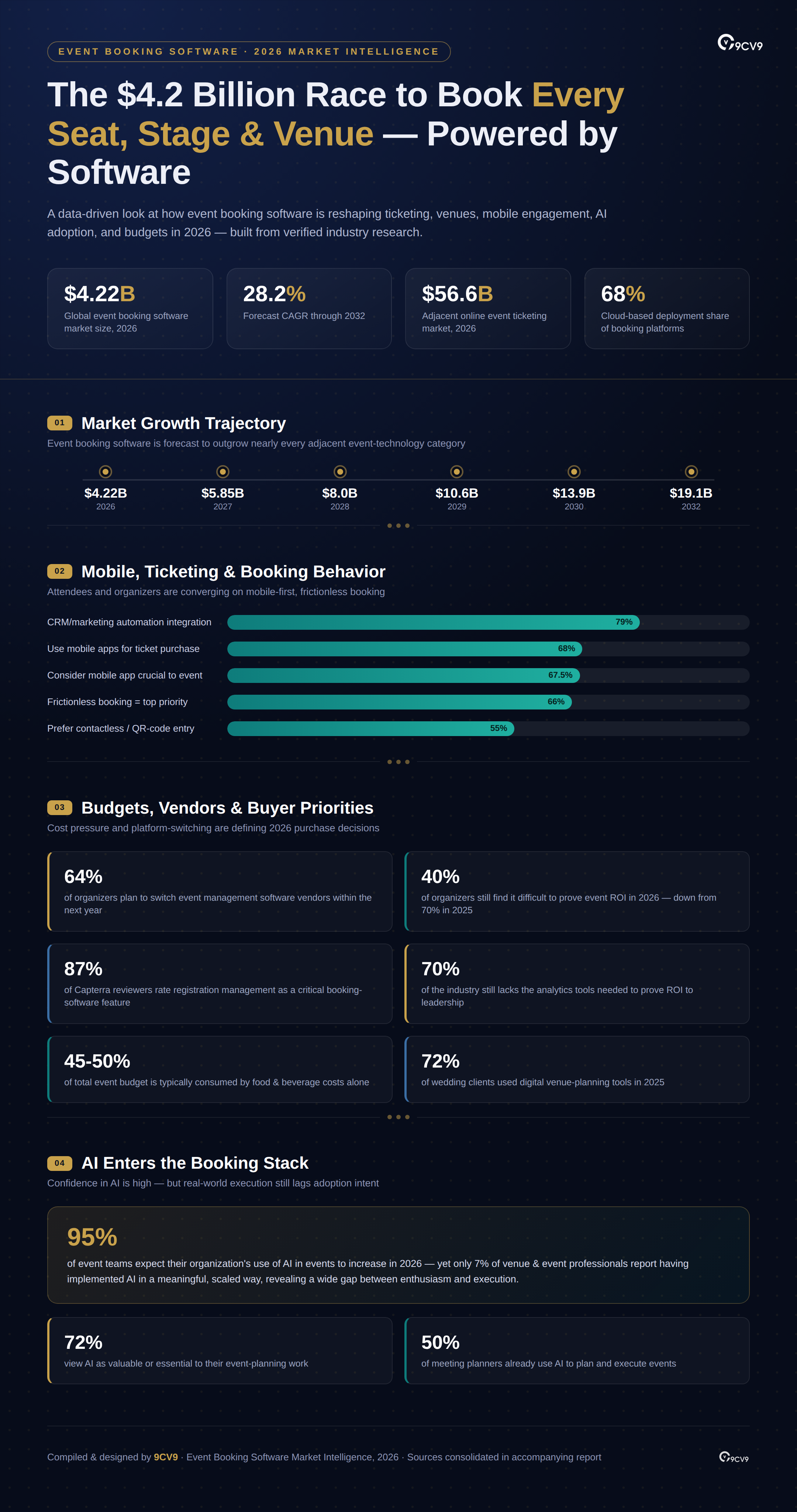
- The narrower event booking software segment specifically is forecast at USD 4.22 billion in 2026, projected to reach USD 19.13 billion by 2032, growing at a 28.2% CAGR Research And Markets — among the steepest growth curves in the wider events-tech space.
- Another event booking software forecast estimates the market was valued at $4.8 billion in 2025 and is projected to reach $10.2 billion by 2034, growing at an 8.9% CAGR. Dataintelo
- A third dataset places the category even more conservatively, projecting the global event booking software market to reach USD 1.4 billion by 2026, expanding at a CAGR of about 11%, GitHub reflecting how segment boundaries differ across analysts.
- Looking further out, the broader events industry is on pace to hit a global revenue of $2.5 trillion by 2035, per Allied Market Research’s CAGR estimate referenced in Cvent’s 2026 statistics roundup — a scale that keeps booking software firmly in demand as a supporting infrastructure layer.
- Within that ecosystem, the global corporate events market was valued at $325 billion in 2023 and is expected to grow to nearly $600 billion by 2029—a CAGR of 10.6%, Cvent directly fueling enterprise demand for booking and registration platforms.
- The wider events-software market was valued at USD 8.40 billion in 2024 and is expected to reach USD 17.33 billion by 2030, growing at a CAGR of 13.2% from 2025 to 2030. Grand View Research
- The software segment accounted for the largest market share of over 64.0% in 2024 Grand View Research within event management technology spend, ahead of services.
- By deployment, the cloud-based segment held the largest market share of over 63.0% in 2024, Grand View Research confirming cloud as the dominant delivery model for booking platforms.
- By organization size, the large enterprise segment dominated the market and registered a market share of over 53.0% in 2024, Grand View Research though SMB adoption is accelerating fastest.
Online Booking & Cloud Deployment
- The wider online booking software market is projected to grow from USD 631.6 million in 2026 to USD 1,621.4 million by 2033, registering a CAGR of 14.4%, Coherent Market Insights reflecting acceleration across hospitality, healthcare, and events alike.
- Within this market, the cloud-based segment is forecasted to dominate with a 68.4% market share in 2026, Coherent Market Insights owing to lower infrastructure costs and easier scalability.
- The corporate user segment is expected to dominate the online booking software market with a 61.2% share in 2026, Coherent Market Insights driven by automated booking adoption among hotel chains, healthcare organizations, and travel firms.
- North America holds the largest share in the online booking software market, with 36.8% in 2026, Coherent Market Insights attributable to mature cloud-service adoption and digital transformation.
- Reservation and online booking software broadly is expected to reach $320.3 billion by 2030 at a 21% CAGR, The Business Research Company driven by digital platforms and mobile bookings.
- Mobile devices already account for 58.95% of total online ticketing transactions, with a 4.65% CAGR, Mordor Intelligence demonstrating booking software’s shift toward mobile-first architecture.
Mobile Event Apps
- An estimated 67.5% of attendees now consider mobile event apps a crucial part of events, Ticket Fairy per Agorify’s event technology statistics.
- Event app adoption rates typically range between 60% and 80% of attendees, Ticket Fairy with more targeted events sometimes seeing even higher uptake.
- 55% of attendees say the mobile event app can make or break their experience, Bizzabo making app quality a direct driver of overall event satisfaction.
- 73% of attendees expect in-person conferences to use modern event technology, Bizzabo raising the baseline bar for booking and engagement platforms.
- 79% of organizers have their event platform integrated with CRM or marketing automation tools, Bizzabo reflecting booking software’s growing role as a revenue-attribution system, not just a scheduling tool.
- 79% of organizers now integrate event apps with CRM or marketing automation, Guideflow reinforcing integration depth as a top selection criterion.
- On the vendor side, 64% of organizers plan to change their event management software vendor within the next year, Bizzabo signaling intense competitive churn in the booking software category.
- A separate study found 67.4% of organizers say they have changed or plan to change their event management software vendor within the next year, Eventify corroborating high switching intent industry-wide.
- Whova’s user base illustrates SMB strength in the category: around 44% of customers are small businesses, with another 36% from mid-market organizations, G2 and 19% from enterprise.
- By contrast, Cvent Attendee Hub skews upmarket, with adoption strongest in the mid-market (44%) and enterprise segment (24%). G2
- The mobile event app software market reached a valuation of $14.57 billion in 2026 and is anticipated to expand at an 11.09% CAGR through 2035, OpenPR eventually attaining an estimated $33.8 billion.
- The broader event apps market is expected to reach US$5.01 billion by 2031, at a 14.8% CAGR, The Insight Partners with North America anticipated to dominate.
- 75% of Generation Z attendees do their travel booking on a mobile device, Capterra underscoring why mobile-responsive booking flows are now non-negotiable.
Budgets, Costs & ROI
- 36% of event professionals say their budgets are increasing, 47% see a slight increase, and 5% see a significant budget increase Cvent in 2026, per Amex GBT.
- Despite growth, 27% of planners are cutting events that are less profitable or less important Cvent to balance rising costs against revenue demands.
- 68% of planners report stakeholder pressure to prove the business impact of their programs, with one in five describing that pressure as significant or extreme. EventMobi
- Yet 70% of the industry still lacks the analytics tools to prove ROI to leadership, EventMobi a gap that directly drives demand for booking platforms with built-in reporting.
- 38% of planners anticipate a slight per-attendee cost increase in 2026, and 27% expect a moderate one, EventMobi according to the Amex GBT Global Meetings & Events Forecast.
- 40% of organizers report difficulty proving event ROI in 2026 — down from 70% in 2025, Bizzabo showing measurable industry-wide progress in analytics maturity.
- 78% of organizers say in-person conferences, summits, and conventions are their organization’s most impactful marketing channel. Bizzabo
- 40% of organizers plan to host more events in 2026, while another 40% plan to maintain the same volume, Bizzabo signaling controlled, intentional growth rather than runaway expansion.
- 54% of attendees say they plan to attend more in-person events compared to last year. Bizzabo
- 71% of attendees believe in-person B2B conferences offer the most effective way to learn about new products or services. Bizzabo
- Despite this, 60% of organizers rate their networking opportunities as only somewhat effective, Bizzabo while just 15% rate them as very effective per Bizzabo’s benchmark report — a clear opportunity area for booking and matchmaking technology.
- 67% of respondents expect event budgets to increase in 2026, while only 6.5% anticipate a significant rise, InEvent per InEvent’s State of Enterprise Events report.
- 71% expect costs to continue climbing, InEvent and cost per attendee has already risen roughly 6% year over year.
- 88% of teams plan to invest in event technology, InEvent reinforcing booking software’s central role in 2026 budgets.
- 40% of organizers expect their event budgets to grow this year, while another 40% anticipate budgets remaining flat Bizzabo — only 20% expect decreases, per Bizzabo’s 2026 survey data.
- This marks a cooling trend: 53% anticipated budget growth in 2025, versus only 40% in 2026, Bizzabo indicating a more cautious financial outlook.
- Event volume plans mirror this moderation, with 40% of organizers planning to run more events in 2026, down from 66% planning expansion in 2025. Bizzabo
- On the cost side, basic corporate event budgets typically run $150–$300 per attendee, $300–$500 for mid-range experiences, and $500–$1,000+ for premium conferences with travel. AMW
- Food and beverage typically represents 40–50% of total event costs, AMW the single largest line item in most event budgets.
- Event planners typically charge 15–20% of total budget AMW but often recoup that through vendor negotiations and efficiency gains.
- The average corporate event hosts around 200 participants and lasts four hours, Booking.com a useful benchmark for sizing booking software capacity needs.
- 60% of planners report advanced A/V support as a top priority, Booking.com and 33% cite technology-enabled events as top of mind for 2026 planning.
AI in Event & Booking Technology
- 95% of respondents expect their organization’s use of AI in events to increase Bizzabo in 2026, making AI adoption the fastest-accelerating trend in the category.
- 72% of professionals view AI as valuable or essential to their work, InEvent and half of respondents already use AI in event planning workflows.
- Still, 26% of professionals report they have yet to implement AI into their event workflows InEvent at all, showing a meaningful adoption gap remains.
- 50% of meeting professionals plan to use AI-based tools, while 41% plan to use mobile event apps Swoogo moving forward, per American Express’s meetings forecast.
- Roughly 50% of meeting planners worldwide had incorporated AI into their workflows in 2025, Lensmor according to the Amex GBT Meetings & Events Forecast.
- In venue-specific contexts, 64% see AI as highly significant, yet only 7% are actively piloting or scaling it Gomomentus — revealing a wide gap between enthusiasm and execution.
- 75% of organizations want AI to help with data entry and administrative work, Gomomentus while 62% want better operational insights and decision support.
- 52% of respondents say AI tools fall short because they lack venue-specific domain knowledge, Gomomentus and 48% cite poor real-time operational awareness as a key gap.
- 50% of meeting planners use AI to plan and execute events, 42% use it for attendee matchmaking, 41% for AI-assisted content creation, and 39% for tracking attendee engagement. Eventify
Ticketing & Registration
- The global online event ticketing market will grow from $53.04 billion in 2025 to $56.58 billion in 2026, a 6.7% CAGR, Research And Markets en route to $71.54 billion by 2030.
- A separate estimate places online event ticketing market size in 2026 at USD 88.38 billion, growing from USD 85.35 billion in 2025, Mordor Intelligence projected to reach USD 105.17 billion by 2031.
- Another report values the market still higher, projecting growth from USD 58.64 billion in 2026 to USD 118.3 billion by 2035, a 6.01% CAGR. Business Research Insights
- Yet another forecast pegs 2024 market size at USD 68.4 billion, growing to USD 181.7 billion by 2033, an 11.8% CAGR OpenPR — the spread across estimates reflects differing scope definitions but uniformly bullish trajectories.
- 66% of attendees and 66% of organizers ranked a fast, frictionless booking process as the single most important feature of a ticketing platform. Softjourn
- More than 68% of event ticket buyers use mobile apps, while 42% of global events now offer digital ticketing solutions. Softjourn
- 55% of attendees prefer contactless or QR-code entry, Softjourn and 46% prefer cashless transactions overall.
- Sports events make up roughly 30% (USD 17.01 billion) of the online event ticketing market, Softjourn maintaining steady year-over-year growth.
- The access control market is valued at $3.8 billion in 2025 and projected to reach $5.61 billion by 2030, an 8.10% CAGR, Softjourn driven by cloud management and biometric authentication replacing legacy access systems.
- Notably, FIFA confirmed that tickets for the 2026 World Cup in the US, Canada, and Mexico will use dynamic pricing for the first time, Softjourn a milestone signaling dynamic-pricing booking models entering the mainstream.
- 70%+ app adoption is turning event registration into active engagement and revenue opportunities, Swapcard according to Swapcard’s 2026 registration platform guide.
Hybrid, Virtual & Webinar Trends
- 53% of attendees plan to attend more webinars in 2026, and 61% of organizers report increased webinar attendance year over year. Bizzabo
- 48% of event professionals say that hybrid events take away from the event experience for in-person attendees, Softjourn contributing to a pullback from hybrid formats.
- Confirming that pullback, companies hosted 25% fewer hybrid events on Swoogo in 2024, Softjourn and 47% of organizers have hosted hybrid events in the past but have no current plans to continue them.
- In-person meetings and events are the #1 choice for event format, with 59% saying they run in-person events only, Softjourn per Amex GBT.
- The virtual events market itself hit $44.28 billion in 2024 and is expected to reach $231 billion by 2032, growing at a 25.3% CAGR, per Verified Market Research figures cited in industry roundups — proof that virtual/hybrid capability remains a strategic add-on even as in-person regains dominance.
- 93% of organizers see virtual events as permanent, Entrepreneurs HQ and 72% of companies now treat virtual events as core strategy.
- 67.4% of organizers plan to switch software, Entrepreneurs HQ while only 51% report being satisfied with their current platform and 94% report hitting setup snags.
- 59.4% of organizers want software that supports both in-person and virtual events, Entrepreneurs HQ reinforcing demand for unified, hybrid-capable booking platforms.
Sustainability & Inclusion
- 34% of attendees consider an event’s sustainability practices before purchasing tickets. Softjourn
- 45% of meeting professionals surveyed have defined sustainability goals, and 55% include inclusion and culture considerations, Softjourn per the American Express Global Meetings & Events Forecast 2026.
- According to the World Health Organization figures cited in industry ticketing research, 1.3 billion people (16% of the world’s population) experience significant disability, Softjourn making accessibility a critical booking-software design requirement.
- 58% of event organizers use digital tickets and registration specifically to reduce paper waste. Eventify
- 77% of event attendees expressed a willingness to pay more for sustainable event options. Eventify
Venue, Wedding & Hospitality Booking
- 72% of wedding clients used digital planning tools in 2025, Guideflow and they now expect a polished, responsive booking experience from first inquiry to final walkthrough.
- Venue management software sits within a $15.2 billion market in 2026, Guideflow helping event spaces, theaters, arenas, and hospitality venues manage operations within a single system.
- On G2, Sonas — a wedding-venue-focused management platform — shows a market segment composition of 78% small business and 22% mid-market, G2 reflecting strong SMB demand for venue booking tools.
- Event Temple’s hospitality-focused venue software shows a market segment split of 60% small business and 40% mid-market G2 users.
- iVvy’s venue and event management platform serves over 8,000 users worldwide G2 across hotels, hospitality groups, and event spaces of every size.
- Momentus Technologies’ venue and event software platform reports over 90,000 users in more than 57 countries, PR Newswire illustrating the global reach achievable at the enterprise end of the booking software market.
Vendor Landscape, M&A & Competitive Dynamics
- The event management software market is moderately fragmented: Cvent, Eventbrite, Stova, Bizzabo, and Hopin collectively command roughly 35–40% of revenue. Mordor Intelligence
- Private equity has accelerated consolidation in the category — Blackstone paid USD 4.6 billion to acquire Cvent in August 2024, Mordor Intelligence financing subsequent bolt-on acquisitions such as Splash and Goldcast.
- Bizzabo earned Gartner Leader status in June 2025 for embedding generative AI into matchmaking and content summarization. Mordor Intelligence
- Ticketmaster upgraded SafeTix in January 2026 to tighten fraud prevention at stadium gates, Mordor Intelligence illustrating ongoing security investment across leading booking platforms.
- Smaller, transparent-fee challengers such as Ticket Fairy and Opendate are actively targeting independent promoters, per Mordor Intelligence’s analysis, undermining incumbents criticized for opaque ticketing fee structures.
- The FTC Junk Fees Rule, effective May 2025, obliges upfront disclosure of all ticket charges, Mordor Intelligence reshaping how booking platforms must present pricing to consumers.
- On Capterra, event management buyers rate registration management as critical or highly important by 87% of reviewers, and event scheduling by 86% of reviewers, Capterra confirming these two functions as the top purchase criteria in the category.
- Attendee management is rated critical or highly important by 85% of reviewers Capterra on Capterra, rounding out the three must-have features buyers screen for.
- Capterra’s review infrastructure for software buyers overall has carefully verified over 2.5 million reviews Capterra to surface authentic user experiences — the same vetting standard applied across its event and venue booking software directories.
Conclusion
The top 103 event booking software statistics, data, and trends in 2026 highlight an industry experiencing significant growth, technological innovation, and changing customer expectations. As businesses, event organizers, and venue operators increasingly adopt digital solutions, event booking software has evolved from a basic registration and ticketing tool into a comprehensive platform for managing attendee experiences, automating operations, and optimizing event performance.
With the global event management software market projected to grow from USD 11.31 billion in 2026 to USD 32.62 billion by 2034, at a CAGR of 14.16%, the long-term outlook remains promising. The expansion of cloud-based event management systems, mobile ticketing platforms, and AI-powered booking solutions is creating substantial opportunities for software providers and organizations seeking more efficient event operations.
Several key trends are shaping the event booking software market in 2026. Mobile devices account for 58.95% of online ticketing transactions, while 95% of surveyed respondents expect their organizations to increase AI adoption in event operations. Additionally, 79% of event organizers have integrated their event platforms with CRM or marketing automation tools, demonstrating the growing importance of connected technologies, personalized attendee engagement, and data-driven event management.
However, the industry also faces challenges, including rising event costs, increasing pressure to demonstrate return on investment, and changing software requirements. With 64% of organizers planning to change their event management software provider within the next year, vendors must prioritize user-friendly interfaces, transparent pricing, seamless integrations, reliable performance, and advanced reporting capabilities to remain competitive.
Looking ahead, the future of event booking software will be increasingly defined by artificial intelligence, automation, mobile-first experiences, cloud scalability, and integrated event analytics. Emerging technologies such as intelligent attendee matchmaking, automated registration workflows, dynamic ticket pricing, and predictive analytics are expected to influence how organizations plan and deliver successful events.
Ultimately, these 103 event booking software statistics for 2026 demonstrate that digital transformation is becoming essential for the global events industry. Organizations that invest in flexible, scalable, and data-driven event booking platforms will be better positioned to improve operational efficiency, enhance attendee satisfaction, maximize event ROI, and adapt to evolving market demands. For event technology providers, SaaS companies, and business leaders, understanding these statistics and emerging trends is critical to identifying growth opportunities and maintaining a competitive advantage in the rapidly evolving event management software landscape.
If you find this article useful, why not share it with your hiring manager and C-level suite friends and also leave a nice comment below?
We, at the 9cv9 Research Team, strive to bring the latest and most meaningful data, guides, and statistics to your doorstep.
To get access to top-quality guides, click over to 9cv9 Blog.
To hire top talents using our modern AI-powered recruitment agency, find out more at 9cv9 Modern AI-Powered Recruitment Agency.
People Also Ask
What is event booking software?
Event booking software is a digital platform that helps businesses and organizers manage event registration, ticket sales, attendee information, payments, scheduling, and check-ins through automated online systems.
How big is the global event booking software market in 2026?
The global event management software market is valued at USD 11.31 billion in 2026, according to Fortune Business Insights. The narrower event booking software segment has different market estimates depending on research methodology.
What is the projected growth of the event management software market?
The global event management software market is projected to reach USD 32.62 billion by 2034, growing at a compound annual growth rate (CAGR) of 14.16% from 2026 to 2034.
What are the biggest event booking software trends in 2026?
Major trends include AI-powered event planning, mobile-first ticketing, cloud-based platforms, automated registration, CRM integrations, digital payments, attendee analytics, and personalized event experiences.
How is artificial intelligence transforming event booking software?
AI helps automate administrative tasks, personalize attendee experiences, generate event content, support matchmaking, and analyze engagement. In 2026, 95% of surveyed respondents expect their organizations to increase AI usage in events.
What percentage of event organizers use AI in event planning?
According to industry research, approximately 50% of meeting planners use AI to plan and execute events. Common applications include attendee matchmaking, content creation, engagement tracking, and workflow automation.
How popular is mobile event booking in 2026?
Mobile devices account for 58.95% of online ticketing transactions. This highlights the importance of mobile-friendly registration, digital payments, electronic tickets, and responsive event booking platforms.
What percentage of attendees use mobile event apps?
Event app adoption typically ranges from 60% to 80% of attendees. Additionally, 67.5% of attendees consider mobile event apps an important part of the overall event experience.
Why is cloud-based event booking software growing?
Cloud-based event booking software offers scalability, remote accessibility, automated updates, and lower infrastructure requirements. Cloud deployment accounted for over 63% of the event management software market in 2024.
Which region dominates the event management software market?
North America dominates the global event management software market, holding a 34.99% share in 2025 according to Fortune Business Insights. Other research estimates vary based on market definitions.
Which region has the fastest-growing event management software market?
Asia Pacific is projected to experience strong growth, with an estimated CAGR of 11.01% through 2031, according to Mordor Intelligence. Increasing digital adoption supports regional expansion.
What is the online event ticketing market size in 2026?
Research and Markets estimates the global online event ticketing market at USD 56.58 billion in 2026. Mordor Intelligence provides a higher estimate of USD 88.38 billion, reflecting differences in market scope.
What features should the best event booking software include?
Essential features include online registration, ticket management, payment processing, attendee tracking, event scheduling, automated confirmations, mobile accessibility, CRM integrations, and real-time reporting.
How important is event registration management software?
Event registration management is a major purchasing priority. According to Capterra, 87% of reviewers consider registration management critical or highly important when evaluating event management software.
What percentage of event organizers integrate booking software with CRM systems?
Approximately 79% of event organizers integrate their event platforms with CRM or marketing automation systems, supporting attendee tracking, personalized communications, and marketing performance measurement.
How does event booking software improve event ROI?
Event booking software helps organizers track registrations, ticket revenue, attendance, engagement, and event expenses. Integrated analytics can support better budgeting, performance measurement, and return on investment calculations.
What percentage of event organizers struggle to measure event ROI?
Approximately 40% of event organizers report difficulty proving event ROI in 2026, according to Bizzabo. This highlights the importance of analytics, reporting dashboards, and integrated event management systems.
How much do businesses spend on corporate events?
Basic corporate events typically cost USD 150–300 per attendee, while mid-range events cost USD 300–500. Premium conferences can exceed USD 1,000 per attendee, depending on venue, travel, and services.
Are event technology budgets increasing in 2026?
Yes. InEvent reports that 67% of respondents expect event budgets to increase in 2026. Additionally, 88% of surveyed teams plan to invest in event technology despite rising operational costs.
Why are event organizers switching software providers?
Organizers increasingly prioritize better functionality, integrations, usability, and reporting. Industry research indicates that 64% of organizers plan to change their event management software provider within the next year.
What is the future of AI-powered event registration software?
AI-powered event registration is expected to expand through automated workflows, intelligent attendee recommendations, personalized communications, predictive analytics, and improved operational decision support.
How does event booking software support hybrid events?
Hybrid event booking software manages registrations for both physical and virtual attendees. It can combine digital ticketing, online access, attendee communication, and engagement tracking within a unified platform.
Are virtual events still popular in 2026?
Yes. Research indicates that 53% of attendees plan to attend more webinars in 2026, while 61% of organizers report increased webinar attendance. Virtual events remain an important component of event strategies.
What percentage of attendees prefer digital or contactless ticketing?
According to Softjourn, 55% of attendees prefer contactless or QR-code entry, while 46% prefer cashless transactions. These preferences support growing demand for digital event ticketing solutions.
How important is attendee experience in event booking software?
Attendee experience is a major competitive factor. Research shows that 55% of attendees believe a mobile event app can make or break their experience, emphasizing the importance of usability and reliability.
What percentage of businesses plan to organize more events in 2026?
According to Bizzabo, 40% of event organizers plan to host more events in 2026, while another 40% expect to maintain existing event volumes. This indicates steady demand for event management technology.
How does event booking software support sustainable events?
Event booking software supports sustainability through electronic tickets, digital registration, paperless check-ins, and online communications. Research indicates that 58% of organizers use digital tickets and registration to reduce paper waste.
What role does data analytics play in event booking software?
Data analytics helps organizers monitor ticket sales, registration conversions, attendee engagement, event costs, and marketing performance. These insights support better planning, budget allocation, and event ROI measurement.
What is the difference between event booking software and event management software?
Event booking software primarily handles reservations, registration, and ticketing. Event management software offers broader capabilities, including scheduling, venue coordination, attendee engagement, marketing, analytics, and event operations.
What is the outlook for the event booking software industry beyond 2026?
The industry has a positive long-term outlook, supported by AI adoption, cloud technology, mobile ticketing, and automation. The global event management software market is projected to reach USD 32.62 billion by 2034.
Sources
Fortune Business Insights
Mordor Intelligence
Verified Market Reports
GitHub
DataIntelo
Grand View Research
Coherent Market Insights
The Business Research Company
Research and Markets
Ticket Fairy
Bizzabo
ExpoPlatform
Swoogo
Guideflow
G2
Market Research Intellect
OpenPR
The Insight Partners
Cvent
EventMobi
Booking.com for Business
InEvent
AMW Group
EMRG Media
Treadway Events
EventWeis
Softjourn
Swapcard
Business Research Insights
TicketNews
Zoho Backstage
SaaSworthy
Momentus Technologies
PR Newswire
EventsAir
Lensmor
Entrepreneurs HQ
Eventify
DeskFlex
GoodFirms
Everybooking
Software Advice
Planning Pod
Capterra