




























Key Takeaways
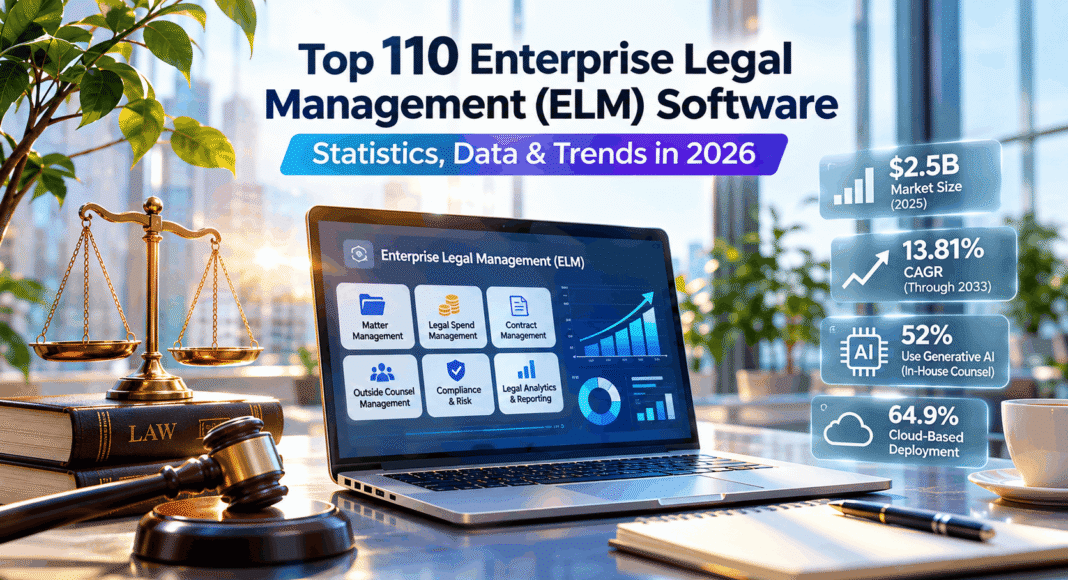
- Enterprise Legal Management (ELM) Software Market Growth: The global ELM software market was valued at approximately $2.5 billion in 2025, with a projected CAGR of 13.81% through 2033, driven by increasing demand for legal automation, regulatory compliance, and cloud-based solutions.
- AI Adoption and Legal Operations Automation: Generative AI adoption among in-house counsel reached 52%, while 66% of legal departments prioritize automation, accelerating demand for AI-powered ELM software, contract lifecycle management, and intelligent legal workflows.
- Legal Spend Management and Cloud Technology Trends: Rising corporate legal costs, growing adoption of cloud-based ELM platforms, and automated e-billing solutions are driving investments in legal spend optimization, outside counsel management, and operational efficiency in 2026.
Enterprise Legal Management (ELM) software statistics for 2026 reveal a global market valued at approximately $2.5 billion in 2025, with projected annual growth of 13.81% through 2033. Rising legal costs, artificial intelligence adoption, and cloud technology drive demand for legal spend management, contract automation, regulatory compliance, and more efficient corporate legal operations.
Enterprise Legal Management (ELM) software is transforming how corporate legal departments manage legal spending, automate workflows, oversee outside counsel, maintain regulatory compliance, and improve operational efficiency. As businesses face rising legal costs, increasingly complex regulations, and growing pressure to adopt artificial intelligence (AI), enterprise legal management solutions have become essential tools for modern legal operations. In 2026, cloud-based ELM platforms, AI-powered legal analytics, automated e-billing systems, and contract lifecycle management (CLM) software are reshaping how organizations manage legal risks and resources.
Also, read our article on the Top 10 Enterprise Legal Management Software.
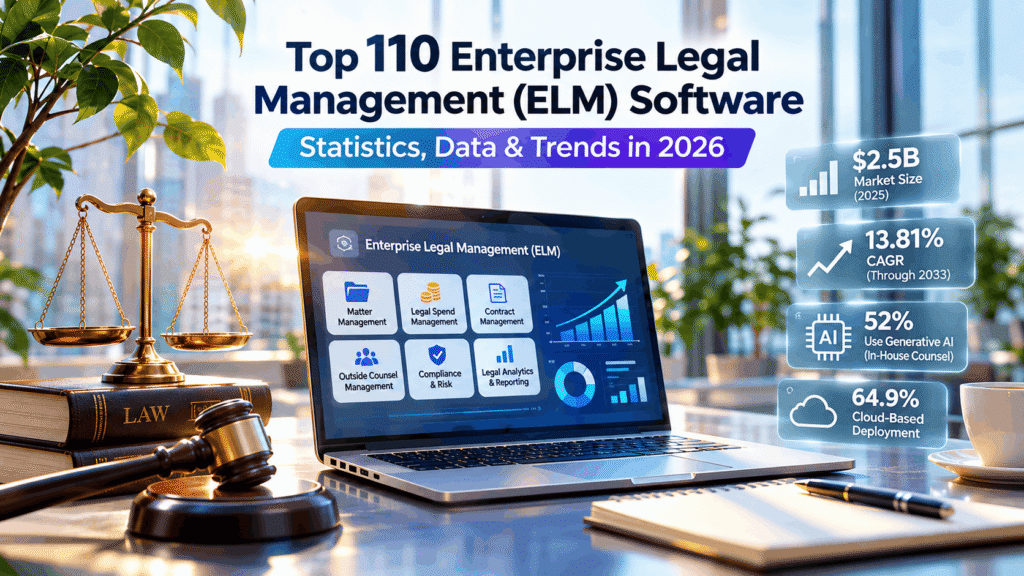
The global Enterprise Legal Management software market continues to demonstrate strong growth, with one market estimate valuing the industry at approximately $2.5 billion in 2025 and projecting a 13.81% compound annual growth rate (CAGR) through 2033. Meanwhile, the broader legal technology market reached an estimated $34.4 billion in 2025 and is projected to grow to $83.8 billion by 2035. These figures highlight increasing enterprise investment in legal technology, digital transformation, and intelligent automation.
Artificial intelligence is emerging as one of the most influential trends shaping the ELM software industry in 2026. According to the research compiled in this report, 52% of in-house counsel are actively using generative AI, more than doubling from 23% in the previous year. Additionally, 66% of legal departments identify automation as a high priority, while 83% of in-house legal teams expect workloads to increase. These developments are accelerating demand for AI-enabled matter management, legal spend management, contract automation, predictive analytics, and integrated legal operations platforms.

Cost optimization is another major factor driving enterprise legal management software adoption. Median corporate legal spending increased from $3.1 million in 2023 to $3.8 million in 2024, while automated legal billing reviews can identify billing discrepancies and improve spending visibility. Organizations are increasingly adopting ELM solutions to control outside counsel expenses, strengthen financial governance, streamline invoice approvals, and measure legal department performance.
This comprehensive guide to the Top 110 Enterprise Legal Management (ELM) Software Statistics, Data & Trends in 2026 examines the latest market size estimates, industry growth forecasts, AI adoption rates, legal technology spending patterns, cloud deployment trends, contract lifecycle management developments, and legal operations benchmarks. It also explores regional market dynamics, e-billing efficiency, enterprise adoption challenges, and emerging technologies influencing the future of legal management.
Whether for corporate legal professionals, general counsel, legal operations managers, compliance officers, enterprise technology buyers, software vendors, or business decision-makers, these 110 ELM software statistics provide valuable insights into the evolving legal technology landscape and the opportunities shaping enterprise legal management in 2026 and beyond.
Before we venture further into this article, we would like to share who we are and what we do.
About 9cv9
9cv9 is a business tech startup based in Singapore and Asia, with a strong presence all over the world.
With over ten years of startup and business experience, and being highly involved in connecting with thousands of companies and startups, the 9cv9 team has listed some of the top and best companies/tools in this review.
If you like to get your company listed in our top B2B software reviews, check out our world-class 9cv9 Media and PR service and pricing plans here.
Top 110 Enterprise Legal Management (ELM) Software Statistics, Data & Trends in 2026
📈 Market Size & Growth
- The global ELM software market was valued at approximately $2.5 billion in 2025, with projections indicating a CAGR of 13.81% through 2033, positioning it as one of the fastest-growing segments in enterprise technology.
- A narrower ELM market definition places the segment at $1.48 billion in 2026, expected to reach $2.46 billion by 2035 at a CAGR of 7%, reflecting strong but segmented growth across deployment types.
- The broader ELM software market — including all enterprise legal management tools — was valued at $12.5 billion in 2023 and is forecast to reach $20.2 billion by 2030 at a CAGR of 6.95%, underscoring sustained enterprise demand.
- The US Enterprise Legal Management Software market was valued at $455.39 million in 2024, projected to reach $817.03 million by 2031 at a CAGR of 7.58%, making it the single largest national market globally.
- The global legal technology market reached $34.4 billion in 2025 and is expected to grow to $83.8 billion by 2035, representing a CAGR of 10.4%, driven by AI integration and cloud adoption.
- The legal tech market is projected to grow from $38.67 billion in 2026 to $71.95 billion by 2031 at a CAGR of 13.22%, with contract lifecycle management showing the highest sub-segment growth at 18.35% CAGR.
- North America led global legal tech with a 38.5% revenue share in 2025, expected to reach approximately $12.94 billion in 2026, cementing its position as the world’s dominant market for ELM platforms.
- The ELM market growth is underpinned by three critical drivers: increasing legal complexity, widespread cloud adoption, and heightened regulatory compliance demands, particularly in financial services and pharma sectors.
- Asia-Pacific is the fastest-growing region for legal technology, projected to expand at a CAGR of 13.95% through 2031, driven by digital transformation initiatives and rising cross-border legal complexity.
- The global ELM software market is expected to exhibit a CAGR exceeding 10% over the next five years, according to STATS N DATA (2026), driven by digitization of legal practices and growing compliance demands.
💰 Legal Department Spending
- Median total legal spend across surveyed companies increased from $3.1 million in 2023 to $3.8 million in 2024, reflecting persistent upward pressure on corporate legal budgets per ACC 2024 benchmarking.
- Median outside counsel spend stands at $1.8 million annually, with the top 25% of legal departments spending at least $11.2 million per year on outside legal services, per the ACC 2024 Law Department Benchmarking Report.
- Companies with revenue between $1 billion and $5 billion spend a median of $6 million on legal annually, while those with $5–$10 billion revenue spend nearly $32 million, illustrating how legal complexity scales with firm size.
- Outside counsel comprises 87% of total external legal budgets on average — making it the single largest lever for cost optimization and the primary justification for enterprise e-billing and spend management platforms.
- 55% of General Counsels reported a budget increase in 2024, averaging a 4% rise, even as many faced simultaneous cost-cutting mandates from CFOs and senior leadership demanding greater legal efficiency.
- Law firm rates increased an average of 9.6% in 2025, with elite firms now billing senior partners at $2,000–$4,000 per hour, accelerating the urgency for ELM-powered spend governance and rate negotiation tools.
- Partner rates among the largest litigation firms rose 23% from 2022 to mid-2024, with associate billing rates in premium practice groups exceeding $1,900 per hour, compressing in-house legal margins significantly.
- $90% of all corporate legal dollars still flow through standard hourly billing arrangements, creating systemic inefficiencies that structured ELM platforms and alternative fee arrangement (AFA) tools are designed to resolve.
- 42% of Chief Legal Officers received a cost-cutting mandate in 2024 that affected hiring decisions, reinforcing the strategic need for AI-driven spend management and ELM cost visibility tools.
- Legal tech spending by law firms surged 9.7% in 2025 — the fastest real growth ever recorded in the legal industry — as firms raced to deploy generative AI capabilities alongside knowledge management investments.
- 47–56% of total legal spend is internal, depending on the region, as organizations shift more work in-house to contain outside counsel costs and leverage internal legal talent more strategically.
- 22% of legal work is actively moving in-house, particularly in contracts, while 39% of litigation work is being shifted to lower-cost alternative legal service providers (ALSPs), per Thomson Reuters 2024.
- Companies with over $20B in revenue employ a median of 158 lawyers, while those under $1B employ just 2, highlighting the vast spectrum of legal department sizes and technology needs across enterprise segments.
- Legal departments dedicate on average 14% of their lawyers to litigation and 7% to intellectual property, with the remainder managing contracts, compliance, M&A, and general corporate matters.
- A 2025 survey found 45% of CLOs plan to increase outside counsel spend — a 17-percentage-point jump from the prior year — driven by rising litigation complexity, cross-border issues, and specialized expertise requirements.
🤖 AI & Technology Adoption
- 79% of legal professionals now use AI tools in some capacity as of 2026, up sharply from previous years, marking a decisive shift from experimentation to operational integration across the legal industry.
- 52% of in-house counsel are actively using GenAI as of 2026, per the ACC/Everlaw GenAI Survey, representing more than a doubling from 23% the previous year — the fastest adoption curve in legal tech history.
- The legal AI market is projected to grow from $4.59 billion in 2025 to $5.59 billion in 2026, with AI potentially saving the US legal industry approximately $20 billion annually through automation of routine tasks.
- 30% of legal departments have AI currently implemented, up from 18% in 2023 — a near-doubling in adoption — per the CLOC 2025 State of the Industry Report covering 186 organizations across 14 countries.
- 54% of legal departments plan to implement AI within the next 1–2 years, per CLOC 2025, signaling an imminent tidal wave of AI integration across enterprise legal management platforms globally.
- 77% of law firm professionals use GenAI for reviewing documents, and another 77% use it for summarizing documents, making these the most mature AI use cases in legal practice today.
- 74% of law firm professionals now use GenAI for legal research, a fundamental shift in how lawyers access precedents, statutes, and case law, with significant implications for legal research tool spending.
- 59% of legal professionals use GenAI for drafting briefs or memos, and 58% use it for drafting contracts, accelerating both the CLM software market and demand for AI-native ELM platforms.
- Generative AI boosts legal task completion speed by 12–32% according to academic research, with lawyers reporting savings of up to 32.5 working days per year — nearly 7 working weeks — from AI adoption.
- 38% of lawyers using GenAI save 1–5 hours per week, while 14% save 6–10 hours weekly, and 5% save 11–15 hours — translating into measurable productivity dividends per the 8am.law 2026 Legal Industry Report.
- 92% of legal professionals now use at least one AI tool in their daily work per the 2026 Wolters Kluwer Future Ready Lawyer Survey, representing a dramatic normalization of AI across the legal profession.
- 62% of legal professionals experienced time savings of 6–20% per week using AI tools, while 52% reported revenue increases of 6–20%, per the 2026 Wolters Kluwer Future Ready Lawyer Survey.
- Firms with a visible AI strategy are twice as likely to see revenue growth and nearly 4× more likely to see ROI compared to firms with informal AI adoption, per Thomson Reuters’ 2025 Future of Professionals Report.
- Only 20% of legal professionals are measuring GenAI ROI, despite high adoption — a significant governance gap that ELM platforms with built-in analytics dashboards are uniquely positioned to address.
- McKinsey estimates 44% of all legal tasks are technically automatable with current AI capabilities, with potential time savings of 30–70% on targeted tasks and cost reductions of 15–50%.
- Thomson Reuters estimates AI could unlock $300,000 in new billable time per lawyer annually, while a Forrester TEI study found $626,000 in increased productivity over three years for a 20-person legal team.
- 26% of legal organizations actively use generative AI per Thomson Reuters 2025 — nearly double the 14% in 2024 — with law firms specifically reaching 28% active deployment of GenAI tools.
- Firms deploying AI broadly are approximately 3× more likely to report revenue growth than non-adopters, making AI integration into ELM platforms a significant competitive differentiator for legal departments.
- AI now reduces contract-drafting time by up to 90%, freeing lawyers for strategic and advisory work, per Mordor Intelligence 2026 — a transformative productivity gain for CLM and ELM platforms.
- Courts recorded 487 AI error incidents in 2025, ten times the 49 incidents in 2024 per LawNext tracking — a data point that reinforces the need for AI governance features within ELM platforms.
- 53% of firms with AI expect increased productivity, 42% expect cost savings, and 33% believe AI will eventually replace certain administrative legal functions, per legal AI survey data compiled for 2025–2026.
- Large firms (51+ lawyers) show 39% generative AI adoption, roughly double the rate of smaller firms (20%), reflecting how firm size significantly shapes the pace of technology integration in legal practice.
- The AI adoption gap between in-house teams and their outside counsel is widening: 64% of in-house teams now expect to depend less on outside counsel precisely because of AI capabilities built internally.
- A USA Department of Commerce study found AI-powered contract management tools reduced contract processing time by 50% in federal agencies, validating enterprise-grade ROI for public and private sector ELM buyers.
- Lawyers estimated that AI tools could free up 13 hours per week, per ACC survey data — time that could be redirected to high-value strategic advisory work rather than routine document review and drafting.
⚙️ Legal Operations & ELM Platform Adoption
- 83% of in-house legal teams expect demand to increase in 2025–2026, per CLOC’s 2025 State of the Industry Report, yet most departments are not receiving matching increases in budget or headcount.
- 63% of legal departments cite workload and resource bandwidth as their top operational challenge, creating powerful structural demand for ELM workflow automation and matter management solutions.
- 66% of legal departments rank automation as a high priority, a position that has remained consistent since 2020, with more than half ranking new technology implementation among their top concerns each year.
- 85% of legal departments now have a dedicated resource or committee managing AI use per CLOC 2026, reflecting a decisive shift from AI experimentation to structured, governance-led enterprise deployment.
- 36% of GCs expect tech use to increase while 34% expect greater automation adoption in 2026, per CLOC data — two trends that directly translate into accelerated ELM platform procurement cycles.
- Matter management, vendor management, and e-billing have become the norm for enterprise legal departments, per CLOC 2025, signaling that ELM core functionality is now considered table stakes rather than a differentiator.
- 50% of legal departments have implemented more consistent matter planning and budgeting as their top outside counsel management initiative, per the 2025 CLOC in-house survey at Global Institute.
- 48% have implemented structured review of annual rate increases as a key cost management strategy, reflecting growing sophistication in outside counsel governance enabled by ELM analytics tools.
- Knowledge management adoption rose from 71% to 79% among legal departments surveyed by CLOC, as AI tools enable legal operations professionals to play a broader role in institutional knowledge capture.
- Nearly 60% of in-house teams do not have outside counsel guidelines (OCGs) in place, and among those with guidelines, 87% enforce them only lightly — a governance gap ELM platforms are designed to close.
- Legal departments are actively shifting away from zero-based budgeting, with 29% now using rolling/continuous budget models that provide flexibility to adapt to the economic and regulatory environment in real time.
- The largest hourly rate requested in 2025 reached $2,850 per hour — a 30% increase over the previous year — underscoring the escalating cost pressures that drive adoption of ELM spend governance platforms.
- 66% of legal teams are actively moving more work in-house as a cost control measure per the ACC 2024 survey, creating increased demand for matter management and workflow automation tools within ELM suites.
- 71% of legal departments prioritize identifying and mitigating emerging risks, and 58% focus on upcoming regulatory changes per Thomson Reuters 2024, making compliance management a core ELM value proposition.
- 35% of corporate lawyers feel their department is moving too slowly with AI integration, even as GCs express concerns about over-reliance, loss of skills, and data security risks from rapid AI deployment.
💡 E-Billing, Spend Management & ROI
- Automated e-billing review typically identifies 10–15% in billing errors that manual processes miss — representing $200,000–$300,000 in recoverable costs annually for a department with $2 million in outside counsel spend.
- 56% of outside counsel bills contain some form of error or non-compliance, including duplicate billing, vague time entries, or guideline violations — a finding from mid-market to Fortune 500 company bill reviews.
- LexisNexis CounselLink customers reduced invoices by 2.6% from total billed in H1 2024 using AI-powered e-billing and financial management tools with automated guideline enforcement.
- Legal spend management software can generate savings of as much as 15% of total legal spend in the first year of implementation, per Thomson Reuters — the single most powerful ROI driver for ELM adoption.
- Forrester research found legal departments can save nearly $400,000 by using e-billing tools to analyze spending trends and identify optimization opportunities, with one client saving $746,000 via automated error review.
- Alternative fee arrangements (AFAs) can save companies up to $2.5 million annually on lower timekeeper rates, per Forrester — a figure that ELM platforms are uniquely positioned to track, negotiate, and benchmark.
- Third-party legal bill review services can reduce legal spend by 8–15%, per Corporate Counsel data — a benefit that is “especially attractive when offered with guaranteed ROI and full-service support.”
- Mitratech clients using AI-powered spend management report up to 80% time savings on manual administrative tasks, alongside double-digit reductions in outside counsel spend and millions in annual savings.
- ELM platforms typically drive 5–10% annual legal spend savings by more closely managing outside counsel spend, benchmarking data, rate negotiations, and billing guideline enforcement per Mitratech.
- 79% of legal departments report pressure to reduce outside counsel spend, yet 57% acknowledge they do not track or quantify savings achieved, underscoring a critical analytics gap in legal operations maturity.
- Undetected billing errors inflate outside counsel costs by 5–10% per year when no structured e-billing governance is in place — costs that could be systematically recovered through ELM platform deployment.
- AI-powered spend management saves up to 3% on outside counsel costs when used to automatically enforce billing guidelines, per LexisNexis CounselLink data from thousands of corporate legal customers.
- A single client using CounselLink Managed Bill Review saved twice as much on reviewed invoices compared to all other invoices over a two-year period, demonstrating the exponential ROI of structured bill review programs.
- 45% of in-house invoice review adjustments result from reviewers using discretion to reduce charges, highlighting both the human expertise needed and the efficiency gains available through AI-augmented review.
- Forrester predicts organizations will save 0.5–2.5% of total outside legal spend by automating billing guideline enforcement — a benefit achievable only with properly configured ELM e-billing platforms.
📄 Contract Lifecycle Management (CLM)
- The global CLM software market reached $3.0 billion in 2025 and is estimated at $3.39 billion in 2026, growing at a CAGR of 13.06% to reach $6.26 billion by 2031, making it the fastest-growing ELM sub-segment.
- Cloud-based CLM platforms captured over 63% of market share in 2025, supported by cost efficiency, scalability, remote accessibility, and real-time collaboration capabilities demanded by distributed legal teams.
- Multi-tenant SaaS dominates CLM with 60.25% of 2025 revenue, while hybrid models are projected to expand at a 17.15% CAGR through 2031 as organizations balance cloud analytics with on-premises data sovereignty.
- Large enterprises captured 58.3% of 2025 CLM revenue due to complex global contract portfolios, while SMEs are growing fastest at a 15.1% CAGR through 2031, driven by affordable SaaS pricing and no-code tools.
- 73% of organizations use CLM platforms to automate audit trails and ensure legal compliance, with 71% integrating CLM software with e-signature and document authentication platforms to accelerate contract execution.
- North America holds 41.4% of the global CLM market, driven by sophisticated regulatory requirements and high enterprise contract volumes, while Asia-Pacific records the fastest growth at a 16.7% CAGR.
- The BFSI sector led CLM adoption in 2025 with 22.45% market share, driven by complex financial contracts, strict regulatory requirements, and the need for real-time compliance tracking and audit-ready contract repositories.
- Europe’s CLM market is growing at 12.9% CAGR (2025–2030), driven by GDPR compliance automation requirements and mandates for audit-ready workflows across financial institutions and public sector entities.
- 64% of SMEs face difficulties adopting CLM software due to licensing costs and infrastructure limitations, creating an opportunity for SaaS-first vendors offering flexible, modular CLM solutions at accessible price points.
- The licensing and subscription segment holds nearly 65% of CLM market share, reflecting the dominance of recurring SaaS models that offer scalable deployment, lower upfront costs, and seamless system integrations.
🌏 Regional & Industry Data
- North America accounted for 38.5% of global legal tech market share in 2025, with the US market reaching $7.32 billion by 2026 — a figure that reflects high compliance complexity and sophisticated enterprise legal operations.
- The Asia-Pacific legal tech market reached $7.45 billion in 2025 (21.9% global share) and is expected to reach $8.3 billion in 2026, growing at the highest rate globally driven by China, India, Japan, and Australia.
- Cloud-based platforms account for 64.9% of ELM deployment models globally, reflecting an industry-wide shift away from on-premises infrastructure toward more scalable, cost-effective SaaS alternatives.
- 73% of US law firms rely on cloud-based legal tools per the ABA 2024 Legal Technology Resource Center survey, while 67% use fee-based online research services and 55% use free government database platforms.
- iManage reported 71% cloud adoption across its customer base and 99.99% uptime in March 2026, demonstrating the maturation of cloud-delivered legal document management for enterprise-scale deployments.
- India’s legal tech market is set to record a 9.9% CAGR by 2036, driven by e-court spending, court record digitization (6.37 billion pages), and the expansion of digital filing systems under the e-Courts Mission Mode Project.
- Large enterprises account for the majority of ELM deployments, with finance, pharma, and technology sectors showing the highest adoption rates due to regulatory complexity, litigation risk, and M&A transaction volumes.
- Law firms with 750+ attorneys now control 49.3% of total corporate legal spending, up from 48.2% in 2022, with Mergers & Acquisitions, Finance, and Regulatory & Compliance driving their increased market share.
- Midsized law firms captured nearly 5% demand growth in H2 2025, while the Am Law 100 struggled to exceed 2% growth — the largest gap between segments since the Global Financial Crisis, creating market disruption opportunities.
- The average Am Law 100 lawyer’s standard rates crossed $1,000/hour in 2025, while everyone else averaged ~$600/hour — a pricing bifurcation that is accelerating mobile demand toward lower-cost alternatives.
🔮 Future Outlook & Emerging Trends
- Gartner predicts 40% of enterprise applications will feature task-specific AI agents by 2026, up from less than 5% today — a trend that will fundamentally reshape how ELM platforms deliver legal workflow automation.
- Harvey AI raised $300 million in Series D funding with 235 customers across 42 countries, demonstrating that venture capital continues to flow into AI-native legal platforms, accelerating ELM market innovation.
- The McKinsey Global Institute estimates 30–70% time savings on targeted legal tasks with current AI, and 15–50% cost reductions — figures that legal operations leaders are using to justify ELM technology investments.
- More than half of legal organizations are already seeing ROI from AI, with efficiency and productivity as the most immediate benefits, according to Thomson Reuters’ 2025 Future of Professionals Report.
- The SEC used AI-based compliance tools to detect 40% more discrepancies in financial contracts, validating AI-powered legal tech in regulatory enforcement and increasing enterprise demand for compliant ELM platforms.
- 39% of legal professionals cite data privacy concerns as the top barrier to AI adoption, creating a competitive opportunity for ELM vendors who can offer secure, auditable, and legally compliant AI governance frameworks.
- New York State now requires at least two annual CLE credits in AI competency as of Q3 2025, formalizing AI governance as a professional legal obligation and expanding institutional demand for ELM AI tools.
- The Colorado AI Act (effective June 2026) requires risk management policies, impact assessments, and AI transparency for high-risk systems — creating urgent compliance drivers for legal departments managing AI within ELM platforms.
- Expectations for increased outside counsel spending dropped sharply from 58% to 37% in 2026 per CLOC — a seismic shift signaling that in-house teams are relying more heavily on ELM tools and internal resources.
- Firms with a structured AI strategy experienced 2× the revenue growth of those with ad-hoc adoption, and the gap is expected to widen in 2026 as AI moves from pilot projects to core operational infrastructure in legal departments.
Conclusion
The Top 110 Enterprise Legal Management (ELM) Software Statistics, Data & Trends in 2026 highlight the rapid transformation of corporate legal operations as organizations embrace artificial intelligence, cloud-based platforms, workflow automation, and data-driven legal spend management. With increasing regulatory complexity, rising outside counsel costs, and growing expectations for operational efficiency, enterprise legal management software is becoming an essential component of modern corporate legal technology strategies.
The global Enterprise Legal Management software market demonstrates significant growth potential, with one industry estimate valuing the market at approximately $2.5 billion in 2025 and forecasting a 13.81% compound annual growth rate (CAGR) through 2033. Meanwhile, the broader legal technology market is projected to reach $83.8 billion by 2035, reflecting sustained investment in digital legal infrastructure, AI-powered solutions, and enterprise-wide legal process optimization.
Artificial intelligence and automation are among the most influential trends shaping enterprise legal management in 2026. Research indicates that 52% of in-house counsel are actively using generative AI, while 66% of legal departments prioritize automation. As legal teams face increasing workloads and pressure to deliver more value with limited resources, AI-powered contract analysis, automated e-billing, predictive legal analytics, and intelligent matter management are becoming increasingly important capabilities.
Legal spend management also remains a critical priority. With median corporate legal spending rising from $3.1 million in 2023 to $3.8 million in 2024, organizations are seeking greater financial transparency, stronger outside counsel oversight, and more effective billing controls. Enterprise legal management platforms can help legal departments identify billing discrepancies, optimize external legal expenditures, improve budget forecasting, and demonstrate measurable returns on technology investments.
At the same time, cloud-based ELM software and contract lifecycle management (CLM) solutions are accelerating the digital transformation of corporate legal departments. Cloud deployment, integrated legal workflows, automated compliance monitoring, and centralized contract repositories are enabling organizations to improve collaboration, strengthen governance, and manage increasingly complex legal responsibilities across multiple jurisdictions.
Looking ahead, the future of enterprise legal management software will be shaped by the convergence of generative AI, intelligent automation, predictive analytics, cloud infrastructure, and evolving regulatory requirements. However, successful adoption will depend not only on technological capabilities but also on data security, implementation strategies, employee training, integration with existing enterprise systems, and the ability to measure tangible business outcomes.
Ultimately, these 110 Enterprise Legal Management Software Statistics for 2026 demonstrate that ELM technology is evolving beyond traditional legal administration into a strategic platform for financial control, risk management, regulatory compliance, and business efficiency. Organizations that invest in scalable, secure, and AI-enabled legal management solutions will be better positioned to control costs, improve legal operations productivity, adapt to regulatory changes, and build more resilient legal departments in an increasingly complex global business environment.
If you find this article useful, why not share it with your hiring manager and C-level suite friends and also leave a nice comment below?
We, at the 9cv9 Research Team, strive to bring the latest and most meaningful data, guides, and statistics to your doorstep.
To get access to top-quality guides, click over to 9cv9 Blog.
To hire top talents using our modern AI-powered recruitment agency, find out more at 9cv9 Modern AI-Powered Recruitment Agency.
People Also Ask
What is Enterprise Legal Management (ELM) software?
Enterprise Legal Management (ELM) software helps corporate legal departments manage legal matters, outside counsel, legal spending, contracts, compliance, and workflows through a centralized digital platform.
What is the global Enterprise Legal Management software market size in 2026?
The global ELM software market was valued at approximately $2.5 billion in 2025, with a projected compound annual growth rate (CAGR) of 13.81% through 2033. Market estimates vary depending on the scope of ELM software.
How fast is the Enterprise Legal Management software market growing?
The ELM software market is projected to grow at a CAGR of 13.81% through 2033 under one market estimate, driven by increasing legal complexity, cloud adoption, regulatory compliance, and demand for automation.
What are the biggest Enterprise Legal Management software trends in 2026?
Major ELM software trends in 2026 include generative AI adoption, cloud-based legal management, automated e-billing, legal spend analytics, contract lifecycle management, predictive analytics, and compliance automation.
Why is Enterprise Legal Management software important for businesses?
ELM software helps businesses control legal costs, improve operational efficiency, manage legal risks, monitor outside counsel performance, automate administrative tasks, and maintain regulatory compliance.
How is artificial intelligence transforming Enterprise Legal Management software?
AI is transforming ELM software through automated contract reviews, legal research, document summarization, invoice analysis, predictive analytics, and intelligent workflows that reduce manual legal administration.
What percentage of in-house legal counsel use generative AI in 2026?
According to the research compiled for 2026, 52% of in-house counsel actively use generative AI, more than doubling from 23% in the previous year. This reflects growing adoption of AI-powered legal technology.
How much do corporate legal departments spend annually?
Median corporate legal spending increased from $3.1 million in 2023 to $3.8 million in 2024. Actual legal department budgets vary significantly depending on company size, industry, litigation exposure, and regulatory requirements.
What percentage of legal departments prioritize automation?
Approximately 66% of legal departments identify automation as a high priority. Organizations increasingly invest in legal workflow automation, AI-powered document processing, and integrated enterprise legal management platforms.
How much can Enterprise Legal Management software reduce legal costs?
ELM platforms may help organizations achieve annual legal spend savings of 5–10% through automated billing reviews, outside counsel management, rate benchmarking, and improved financial oversight, depending on implementation.
What is legal spend management software?
Legal spend management software helps organizations track, analyze, control, and optimize legal expenses. It supports invoice processing, budget forecasting, outside counsel billing compliance, and legal expenditure reporting.
What is legal e-billing software, and how does it work?
Legal e-billing software automates the submission, review, approval, and payment of legal invoices. It helps identify billing errors, enforce outside counsel guidelines, monitor expenses, and improve financial transparency.
How much money can automated legal e-billing save businesses?
Automated legal e-billing can identify billing discrepancies and reduce unnecessary expenses. Research cited in the report suggests potential savings of 5–10% annually through improved outside counsel spending controls.
What percentage of outside counsel invoices contain billing errors?
The compiled research reports that approximately 56% of outside counsel invoices contain errors or billing guideline violations, including duplicate charges, vague time entries, and non-compliant expenses.
What is Contract Lifecycle Management (CLM) software?
Contract Lifecycle Management (CLM) software manages contracts from creation and negotiation through approval, execution, renewal, and expiration. It improves contract visibility, compliance, collaboration, and workflow efficiency.
What is the global Contract Lifecycle Management software market size in 2026?
The global CLM software market is estimated at $3.39 billion in 2026, with projections reaching $6.26 billion by 2031 at a CAGR of 13.06%, driven by cloud adoption and contract automation.
How does ELM software differ from CLM software?
ELM software manages broader corporate legal operations, including legal matters, spending, outside counsel, and compliance. CLM software focuses specifically on managing contracts throughout their lifecycle.
What percentage of Enterprise Legal Management software is cloud-based?
According to the compiled market research, cloud-based platforms account for approximately 64.9% of global ELM deployment models, reflecting increasing demand for scalable, accessible, and cost-efficient legal technology.
Why are businesses adopting cloud-based ELM software?
Businesses adopt cloud-based ELM software for lower infrastructure requirements, remote accessibility, scalability, centralized legal data, automated updates, and improved collaboration across distributed legal departments.
Which region dominates the global legal technology market?
North America led the global legal technology market with approximately 38.5% revenue share in 2025, supported by high enterprise technology adoption, complex regulatory requirements, and significant corporate legal spending.
Which region has the fastest-growing legal technology market?
Asia-Pacific is projected to be the fastest-growing legal technology region, with an estimated CAGR of 13.95% through 2031, driven by digital transformation, expanding businesses, and cross-border legal complexity.
What industries benefit most from Enterprise Legal Management software?
Financial services, healthcare, pharmaceuticals, technology, manufacturing, and other highly regulated industries benefit from ELM software through improved compliance, legal spending controls, and matter management.
How does ELM software improve outside counsel management?
ELM software centralizes outside counsel information, tracks legal expenses, monitors law firm performance, enforces billing guidelines, supports rate negotiations, and improves transparency across external legal relationships.
What are the biggest challenges facing corporate legal departments in 2026?
Major challenges include rising legal costs, increasing workloads, limited resources, regulatory complexity, AI governance, cybersecurity risks, and pressure to improve operational efficiency without proportional budget increases.
How much time can lawyers save using generative AI?
The compiled research indicates that 38% of lawyers using generative AI save 1–5 hours weekly, while 14% save 6–10 hours. Savings depend on the legal tasks, tools, and implementation practices.
What percentage of legal departments have implemented AI?
According to the CLOC 2025 State of the Industry Report cited in the research, approximately 30% of legal departments had implemented AI, compared with 18% in 2023, reflecting increasing investment in legal automation.
How does Enterprise Legal Management software support regulatory compliance?
ELM software supports regulatory compliance through centralized legal records, automated audit trails, document tracking, compliance monitoring, reporting dashboards, and standardized legal workflows.
What are the main benefits of AI-powered legal management software?
AI-powered legal management software can improve productivity, accelerate contract reviews, automate invoice processing, support legal research, reduce administrative workloads, and strengthen data-driven decision-making.
What should businesses consider when choosing Enterprise Legal Management software?
Businesses should evaluate legal matter management, e-billing, AI capabilities, contract management, security, regulatory compliance, integration options, scalability, implementation costs, and vendor support.
What is the future outlook for Enterprise Legal Management software beyond 2026?
The future of ELM software will increasingly involve AI agents, predictive analytics, automated legal workflows, cloud platforms, and integrated compliance management as organizations prioritize efficiency, cost control, and legal risk reduction.
Sources
Data Insights Market
Business Research Insights
Verified Market Reports
Market Insights Research
Research Nester
Mordor Intelligence
Fortune Business Insights
Corporate Legal Operations Consortium (CLOC)
Dazychain
Above the Law
Association of Corporate Counsel (ACC)
Apperio
Major, Lindsey & Africa
Legal.io
Axiom Law
Legal Bill Review
Corporate Counsel Business Journal
Bottomline
HyperStart
Mitratech
Swiftwater & Co
In-House Ops
Thomson Reuters
Wolters Kluwer
LawVu
Grand View Research
Precedence Research
Global Market Insights
Market Research Future
Future Market Insights
Custom Market Insights
Azumo
LawNext
American Bar Association
Stealth Agents
National Law Review
Best Law Firms
AdAI News
Harbor
LlamaLab
Stats N Data







 software statistics for 2026, covering market growth, AI adoption, legal spending, and trends.)