

























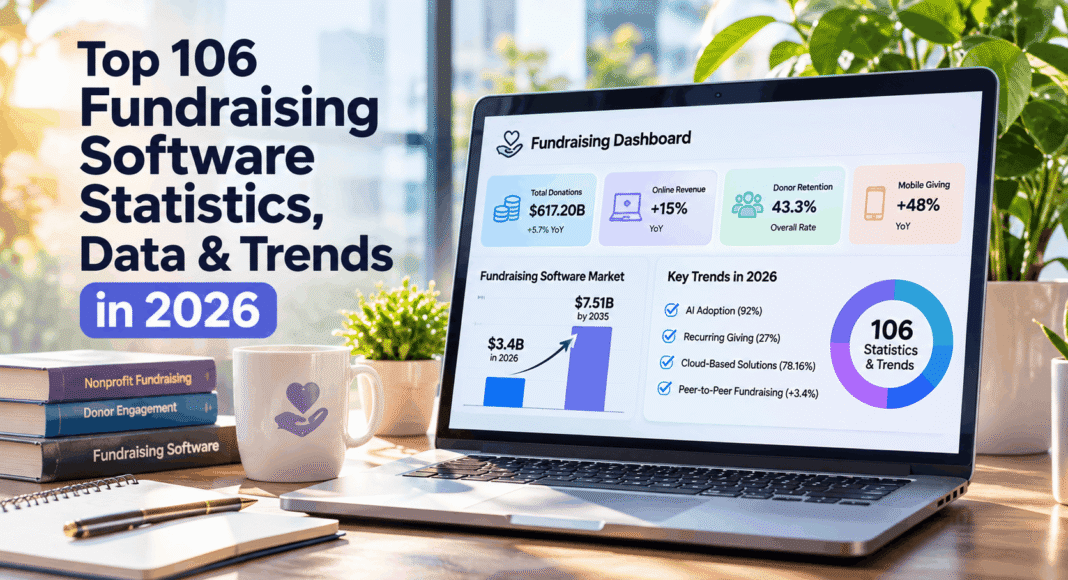

Key Takeaways
- Fundraising Software Market Growth: The global nonprofit fundraising software market is estimated at $3.4 billion in 2026 and projected to reach $7.51 billion by 2035, growing at a 9.2% CAGR, driven by cloud-based platforms, digital fundraising, and donor management solutions.
- AI Adoption and Fundraising Automation: Approximately 92% of surveyed nonprofits use AI tools, but only 7% report major fundraising improvements, highlighting opportunities for AI-powered donor analytics, automated campaigns, predictive fundraising, and CRM optimization.
- Digital Giving and Donor Retention Trends: Online fundraising revenue grew 15% in 2025, while mobile giving surged 48%. With overall donor retention at approximately 43.3%, nonprofits are prioritizing recurring donations, personalized engagement, and donor retention software.
Fundraising software is transforming nonprofit fundraising in 2026, with the global market valued at an estimated $3.4 billion and projected to reach $7.51 billion by 2035. Explore 106 key statistics covering market growth, AI adoption, donor retention, online donations, recurring giving, and digital fundraising trends shaping the nonprofit sector.
The global fundraising landscape is undergoing a significant digital transformation in 2026, driven by the rapid adoption of fundraising software, artificial intelligence (AI), cloud-based donor management systems, and increasingly sophisticated online donation platforms. As nonprofit organizations face growing competition for charitable contributions, rising operational costs, and evolving donor expectations, fundraising technology has become an essential component of sustainable nonprofit growth.
Also, read our article on the Top 10 Best Fundraising Software.
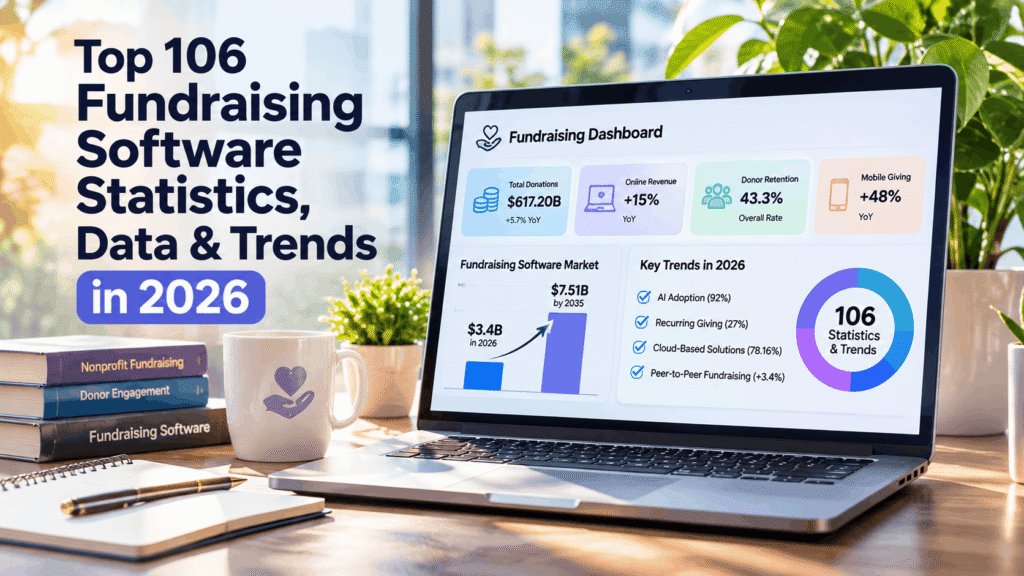
From small community charities to large international nonprofit organizations, fundraising software is reshaping how organizations attract donors, manage campaigns, process donations, analyze fundraising performance, and build long-term relationships with supporters.
According to industry research compiled for 2026, the global nonprofit fundraising software market is estimated at $3.4 billion in 2026 and projected to reach $7.51 billion by 2035, representing a compound annual growth rate (CAGR) of approximately 9.2%. This expansion reflects increasing investment in digital fundraising platforms, donor relationship management (CRM) software, automated donation processing, and data-driven fundraising strategies.
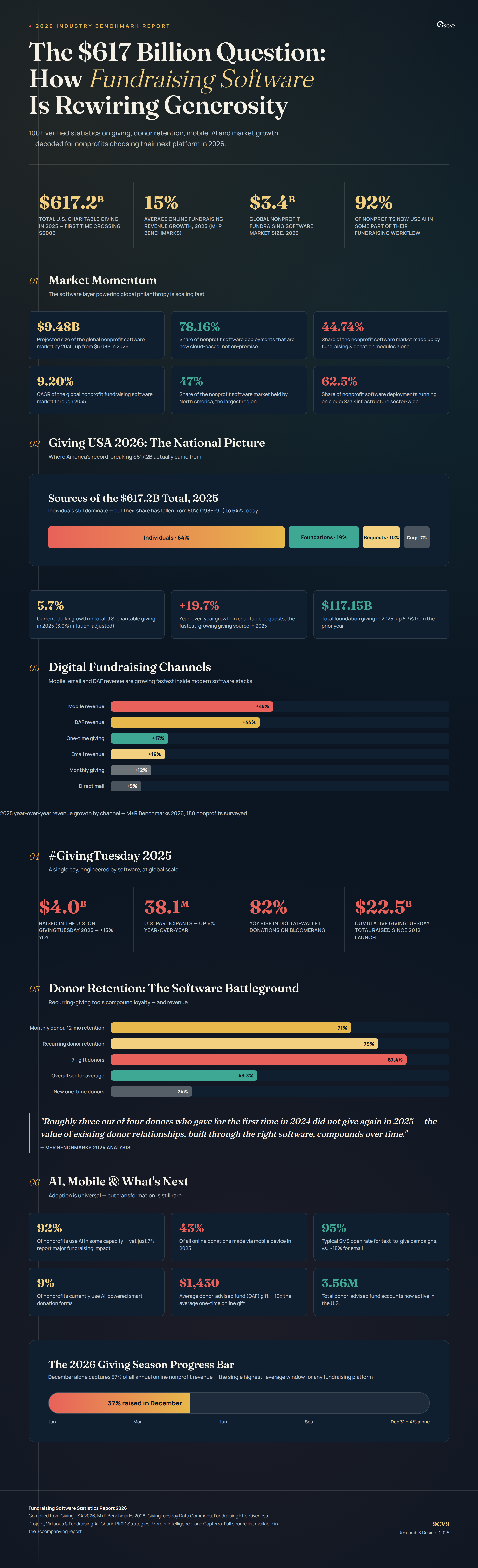
Meanwhile, the broader nonprofit software market is experiencing substantial growth. One market estimate places its value at $4.95 billion in 2026, with projections reaching $7.24 billion by 2031. Cloud-based solutions have emerged as a dominant technology category, accounting for approximately 78.16% of the nonprofit software market in 2025 under one industry estimate.
These developments demonstrate how fundraising technology is evolving from a collection of basic donation tools into an integrated ecosystem supporting donor engagement, financial management, marketing automation, campaign optimization, and strategic decision-making.
The Growing Importance of Fundraising Software in 2026
The importance of fundraising software becomes particularly evident when examining the scale of charitable giving and the increasing complexity of donor behavior.
In the United States, total charitable giving reached an estimated $617.20 billion in 2025, representing a 5.7% increase in current dollars and a 3.0% increase after adjusting for inflation. Individual donors remained the largest source of philanthropic contributions, accounting for approximately $394.2 billion, or 64% of total charitable giving.
However, the fundraising environment is becoming increasingly challenging.
Despite growth in overall charitable contributions, nonprofit organizations continue to face difficulties attracting new supporters and maintaining donor relationships. The Fundraising Effectiveness Project reported an overall donor retention rate of approximately 43.3% in its Q4 2025 findings, highlighting the persistent challenge of retaining donors over time.
Retention performance also varies significantly across donor segments. Micro donors contributing between $1 and $100 recorded retention rates of approximately 31.3%, while donors contributing $50,000 or more achieved retention rates of approximately 69.5%.
These differences emphasize the importance of fundraising CRM software, donor segmentation tools, automated communication workflows, and personalized stewardship strategies.
For nonprofit organizations, understanding donor behavior is no longer simply about tracking donation amounts. It increasingly involves analyzing engagement patterns, identifying potential major donors, improving recurring giving participation, and predicting future fundraising opportunities.
Digital Fundraising and Online Donations Continue to Expand
One of the most important fundraising software trends in 2026 is the continued expansion of online giving.
According to the M+R Benchmarks 2026 research summarized in the underlying data, average online fundraising revenue increased by approximately 15% in 2025, while one-time online giving revenue grew by 17% and monthly giving revenue increased by 12%.
Mobile fundraising emerged as an especially important growth channel, with mobile giving revenue increasing by approximately 48% during the reporting period.
The growing importance of smartphones, digital wallets, and mobile-friendly donation experiences is influencing how fundraising software developers design their platforms.
Modern donation systems increasingly prioritize simplified checkout processes, recurring donation options, secure payment integrations, and responsive fundraising pages that work across multiple devices.
Digital payment adoption is also changing donor expectations. The research indicates that PayPal appeared on approximately 79% of nonprofit donation forms studied, followed by Google Pay at 58%, Apple Pay at 57%, and Venmo at 44%.
These fundraising software statistics suggest that organizations offering convenient payment methods and streamlined digital experiences may be better positioned to reduce donation friction and support higher conversion rates.
At the same time, traditional fundraising channels remain relevant. Direct mail revenue increased by approximately 9% in 2025 among the organizations studied, reinforcing the importance of integrating offline and online fundraising activities into unified donor management platforms.
Artificial Intelligence Is Transforming Fundraising Technology
Artificial intelligence represents another major development influencing the fundraising software industry in 2026.
According to the 2026 Nonprofit AI Adoption Report referenced in the research, approximately 92% of surveyed nonprofits reported using AI tools in some capacity.
However, widespread adoption has not necessarily translated into significant improvements in fundraising performance.
Only 7% of surveyed organizations reported major improvements in organizational fundraising capabilities from AI, while 79% experienced relatively modest efficiency gains.
Furthermore, approximately 47% of nonprofits reported having no formal AI governance policy, highlighting the operational and compliance challenges associated with implementing AI-powered fundraising systems.
These findings reveal an important distinction between adopting artificial intelligence and successfully integrating it into nonprofit fundraising operations.
AI-powered fundraising software can support donor segmentation, predictive analytics, campaign personalization, automated donor communications, prospect research, and fundraising performance forecasting.
Nevertheless, specialized AI applications remain at relatively early stages of adoption.
The research indicates that approximately 13% of nonprofits use predictive AI for donor prospecting, 9% use AI-powered smart donation forms, and only 5% utilize AI-enabled real-time fundraising intelligence tools.
As AI technology matures, nonprofit organizations are likely to place greater emphasis on measurable fundraising outcomes, data quality, responsible AI governance, and integration with existing donor management systems.
Donor Retention, Recurring Giving, and Fundraising Automation
Beyond acquiring new donors, retaining existing supporters has become a central priority for nonprofit fundraising strategies.
Recurring donations are particularly important because they provide organizations with more predictable revenue streams and opportunities to develop stronger donor relationships.
The research indicates that monthly giving accounted for approximately 27% of online fundraising revenue in 2025 among organizations included in the M+R Benchmarks study.
Separate recurring giving research suggests that recurring donors demonstrate substantially stronger retention than one-time donors, although reported retention rates vary depending on the study and measurement methodology.
For example, one benchmark places recurring donor retention between 78% and 80%, compared with approximately 32.41% for non-recurring donors.
These findings explain why fundraising software providers increasingly emphasize subscription-style donation programs, automated payment recovery, donor engagement workflows, and recurring giving analytics.
Additionally, fundraising platforms are expanding their capabilities to support peer-to-peer fundraising, crowdfunding campaigns, corporate matching gifts, donor-advised funds, and multichannel communication strategies.
The growing diversity of fundraising methods creates additional demand for software capable of consolidating donor information and campaign performance into centralized dashboards.
What the 106 Fundraising Software Statistics Reveal About 2026
The fundraising software industry is evolving across several interconnected areas, including market expansion, cloud adoption, artificial intelligence, mobile donations, donor retention, and fundraising automation.
The statistics also highlight the increasing importance of donor-advised funds, peer-to-peer fundraising, and digital payment technology.
For example, the research indicates that donor-advised fund revenue increased by approximately 44% year over year in 2025 among nonprofits studied by M+R Benchmarks, while the 30 largest U.S. peer-to-peer fundraising programs collectively generated approximately $1.17 billion during the same year.
These developments illustrate how nonprofit fundraising is becoming more diversified, technology-dependent, and data-driven.
However, the findings also reveal important challenges, including declining donor participation, inconsistent AI implementation, low first-time donor retention, and the ongoing need to balance fundraising technology investments with measurable financial outcomes.
For nonprofit leaders, fundraising managers, technology vendors, software developers, and digital fundraising professionals, understanding these trends is essential for making informed decisions about fundraising software selection, digital transformation, and long-term donor engagement strategies.
This comprehensive guide to the Top 106 Fundraising Software Statistics, Data & Trends in 2026 examines the latest figures and industry insights across fundraising software market size, revenue growth, nonprofit technology adoption, charitable giving, donor retention, recurring donations, AI-powered fundraising, mobile giving, crowdfunding, peer-to-peer campaigns, and cloud-based fundraising solutions.
By exploring these 106 statistics, nonprofit organizations and fundraising professionals can gain a clearer understanding of the technologies shaping modern philanthropy, identify emerging fundraising opportunities, benchmark their performance against industry trends, and develop more effective, sustainable fundraising strategies for 2026 and beyond.
Before we venture further into this article, we would like to share who we are and what we do.
About 9cv9
9cv9 is a business tech startup based in Singapore and Asia, with a strong presence all over the world.
With over ten years of startup and business experience, and being highly involved in connecting with thousands of companies and startups, the 9cv9 team has listed some of the top and best companies/tools in this review.
If you like to get your company listed in our top B2B software reviews, check out our world-class 9cv9 Media and PR service and pricing plans here.
Top 106 Fundraising Software Statistics, Data & Trends in 2026
Market Size & Growth
- The global nonprofit software market was valued at $4.74 billion in 2025 and is projected to touch $5.08 billion in 2026, underscoring how quickly fundraising software has become a core operating expense rather than a discretionary tool.
- By 2035, the nonprofit software market is forecast to reach $9.48 billion, growing at a 7.18% CAGR, a trajectory that signals long-term, durable demand for donor management and fundraising platforms.
- The global nonprofit fundraising software market specifically is valued at $3.4 billion in 2026 and is projected to expand to $7.51 billion by 2035 at a 9.20% CAGR, outpacing the broader nonprofit software category.
- Another market analysis pegs the nonprofit fundraising software market at $3.5 billion in 2024, growing to $6.8 billion by 2033 at an 8.5% CAGR, reinforcing consistent double-digit growth expectations across independent research firms.
- The non-profit software market overall is valued at $4.95 billion in 2026, growing at 7.90% CAGR to reach $7.24 billion by 2031, according to Mordor Intelligence’s proprietary estimation framework.
- Cloud-based deployment now accounts for 78.16% of the non-profit software market share in 2025, confirming that on-premise fundraising systems have become the clear minority choice for modern nonprofits.
- Fundraising and donation management modules make up 44.74% of the entire non-profit software market by function, making it the single largest functional category within nonprofit tech stacks.
- Large nonprofits still capture 52.18% of non-profit software revenue share, though small and medium organizations are the fastest-growing segment, expanding at an 8.94% CAGR.
- North America holds the largest regional share of the nonprofit software market at 47%, driven by a dense nonprofit sector and high digital adoption rates.
- Europe follows with 24% of the nonprofit software market, propelled by rising philanthropic activity and compliance-driven CRM requirements such as GDPR.
- Asia-Pacific commands 19% of the nonprofit software market, showing the fastest relative growth due to an expanding nonprofit sector and increasing technology investment.
- AI-driven donor analytics contributes an estimated 36% influence on fundraising software adoption trends, showing how predictive intelligence is reshaping vendor roadmaps.
- Mobile-friendly platform adoption contributes roughly 28% to overall fundraising software adoption growth, reflecting the shift toward donor-first, on-the-go giving experiences.
Total Charitable Giving (Giving USA 2026)
- Total U.S. charitable giving reached an estimated $617.20 billion in 2025, surpassing the $600 billion mark for the very first time in history.
- That $617.20 billion total represents a 5.7% increase in current dollars, or a 3.0% increase when adjusted for inflation, making 2025 the second-highest inflation-adjusted giving year on record.
- Individuals remained the largest source of charitable giving in 2025, contributing an estimated $394.2 billion, or 64% of total giving.
- Individual giving as a share of total U.S. philanthropy has fallen from 80% between 1986–1990 to just 64% in 2025, a structural shift fundraising software vendors must account for in donor-segmentation tools.
- Charitable bequests surged to approximately $62.2 billion in 2025, up 19.7% in current dollars — the largest year-over-year increase of any giving source.
- Foundation giving grew 5.7% year-over-year in 2025, reaching an estimated $117.15 billion, reflecting steady institutional philanthropic support.
- Corporate giving posted the slimmest growth of any source in 2025, rising just 3.1% in current dollars — essentially flat once inflation is factored in.
- Individual giving as a share of disposable personal income declined to 1.7% in 2025, down from peak levels of 2.4% recorded in both 2000 and 2005.
- Education, public-society benefit, and environment/animals subsectors each posted more than 10% growth in current-dollar giving in 2025, the fastest-growing recipient categories tracked by Giving USA.
- Human services now accounts for 15% of total U.S. charitable giving, a marked rise from single-digit levels in the late 1980s.
Online & Digital Fundraising Revenue (M+R Benchmarks 2026)
- Average online fundraising revenue for nonprofits rose 15% in 2025, based on a study of 180 nonprofits by M+R Benchmarks, one of the sector’s most closely watched annual reports.
- Public media and hunger/poverty nonprofits each saw online revenue jump about 37% in 2025, driven largely by crisis-response giving tied to federal funding disruptions.
- One-time online giving revenue increased 17% in 2025, outpacing monthly giving’s 12% growth for the first time in several years — a notable reversal fundraising software providers should track closely.
- Donor-advised fund (DAF) revenue jumped 44% year-over-year in 2025, making it the single fastest-growing online revenue category tracked in the M+R study.
- Email fundraising revenue climbed 16% in 2025, while revenue per subscriber rose from $1.87 to $2.40, demonstrating that email remains a high-yield fundraising software integration.
- Mobile giving revenue surged 48% in 2025, more than triple the overall online revenue growth rate, cementing mobile as the fastest-growing fundraising software channel.
- Direct mail revenue, often integrated with modern fundraising CRMs, still grew 9% in 2025 despite predictions of digital cannibalization.
- December alone accounted for 37% of all annual online nonprofit revenue in 2025, reinforcing why fundraising software must be optimized for year-end giving surges.
- December 31 alone accounted for 4% of annual online fundraising revenue, highlighting the importance of real-time, high-uptime donation processing on the final day of the year.
- New donor retention across the sector was just 24% in the 2026 M+R study, meaning roughly three out of four first-time donors did not give again the following year.
- Prior-donor retention was far stronger at 66%, a 2.75x gap versus new donors that fundraising software’s segmentation and stewardship tools are increasingly built to close.
- The average DAF gift reached $1,430 in 2025 — more than 10 times the average one-time online gift, according to M+R Benchmarks.
- For Hunger and Poverty nonprofits specifically, DAF revenue doubled year-over-year, with the average DAF gift rising from $2,105 to $2,510 — the highest of any sector tracked.
- Monthly giving revenue still made up 27% of all online revenue in 2025, even as one-time giving grew at a faster clip.
- Email list churn averages 16% annually, meaning nonprofits must grow their list by roughly 20% just to achieve 5% net subscriber growth — a key driver of CRM-based acquisition automation.
- Digital wallet usage on donation forms is now standard: PayPal appears on 79% of forms, Google Pay on 58%, Apple Pay on 57%, and Venmo on 44%, per M+R Benchmarks 2026.
GivingTuesday 2025 Results
- GivingTuesday 2025 raised $4.0 billion in the United States alone, a 13% increase over the prior year’s record.
- An estimated 38.1 million people participated in GivingTuesday 2025 in the U.S., up 6% year-over-year.
- Cumulative GivingTuesday donations since the campaign’s 2012 launch have now reached $22.5 billion, according to the GivingTuesday Data Commons.
- 19.1 million GivingTuesday participants made a financial contribution in 2025, an increase of 3% over 2024.
- Volunteering participation on GivingTuesday jumped 20% year-over-year to 11.1 million people, showing the day’s growing reach beyond monetary donations.
- 20.9 million people used GivingTuesday 2025 to speak out about causes, a 26% increase, reflecting fundraising software’s expanding role in advocacy, not just donations.
- Nonprofits using Bloomerang raised a record $76 million on GivingTuesday 2025 — roughly one-third more than the prior year.
- Bloomerang reported an 82% year-over-year increase in GivingTuesday donations made via digital wallets, a clear signal of accelerating frictionless-payment adoption.
- GoFundMe Pro reported a 13% increase in donors across its crowdfunding and nonprofit software business during GivingTuesday 2025.
- Givebutter reported an approximate 73% jump in GivingTuesday 2025 transaction volume compared to the previous year.
- Donorbox-powered organizations saw total GivingTuesday donation counts rise almost 9%, with crowdfunding and peer-to-peer donations combined up 10% year-over-year.
Donor Retention & Lifetime Value
- The Fundraising Effectiveness Project’s latest Q4 2025 report puts overall U.S. donor retention at 43.3%, up marginally from 43.1% in the prior period.
- Micro donors ($1–$100) retain at just 31.3%, the lowest of any giving tier, while supersize donors ($50K+) retain at 69.5% — the widest tier-based retention gap on record.
- Donors who give seven or more times retain at 87.4%, compared with only 31.9% for one-time donors, illustrating the outsized value of automated, software-driven stewardship cadences.
- According to a separate 2026 sector benchmark, overall donor retention averages 54.73%, with top-quartile nonprofits achieving 69.64% — a gap fundraising CRMs are designed to help close.
- Acquiring a new donor costs roughly seven times more than retaining an existing one, a widely cited industry ratio that continues to justify fundraising software investment in retention automation.
- The Fundraising Effectiveness Project’s Q3 2025 data shows the top 3% of donors by gift size now account for 77.5% of all revenue, intensifying the need for major-gift-tracking CRM modules.
- The nonprofit donor base has shrunk for five consecutive years, with an estimated -3.6% decline in 2025 alone, though the pace of decline is slowing.
Recurring & Monthly Giving
- 94% of recurring donors prefer to give monthly rather than weekly, quarterly, or annually, according to industry-wide recurring giving research.
- Monthly donor retention averages 71% after 12 months and 54% after 24 months, roughly three times higher than new one-time donor retention of around 24%.
- The average recurring donor stays engaged for approximately 7.77 to 8 years, compared with just 1.68 years for non-recurring donors.
- Recurring donor retention rates held steady between 78% and 80% in the latest Neon One study, versus 32.41% for non-recurring donors in 2025.
- Approximately 57% of donors are now enrolled in a recurring giving program, up sharply from 46% just one year earlier.
- Recurring giving now makes up 20.96% of total nonprofit revenue on average, per the 2026 Virtuous Nonprofit Benchmark Report’s broadened donor-behavior definition.
- Nonprofits lose an estimated 20% to 30% of monthly recurring donations to failed card payments, a gap increasingly addressed by fundraising software’s automated payment-recovery tools.
- 58.6% of monthly givers say they started their recurring gift without ever being directly asked, underscoring the power of frictionless, pre-checked recurring-donation defaults in modern donation forms.
- 95% of recurring donors opt to cover payment processing fees themselves when given the option at checkout, a feature increasingly standard in fundraising software donation forms.
Peer-to-Peer & Crowdfunding
- America’s Top 30 peer-to-peer fundraising programs raised $1.17 billion in 2025, a 3.4% increase year-over-year, according to the 20th Annual Peer-to-Peer Fundraising Top 30 Survey.
- Participation in the Top 30 P2P programs climbed 3.6% to 2.63 million individuals in 2025.
- P2P campaign volume rose 18% in 2025 while dollars raised per participant fell 20%, highlighting a shift toward broader but shallower fundraiser engagement.
- The American Heart Association’s Heart Walk alone raised $121 million in 2025, an $11 million increase over the prior year — the largest single P2P program in the sector.
- The global peer-to-peer fundraising systems market was valued at $3.45 billion in 2025 and is projected to reach $8.21 billion by 2034, growing at a 10.2% CAGR.
- In 2026, P2P fundraising is estimated to account for as much as 80% of donations in certain acquisition-focused fundraising strategies, though only 0.4% of P2P donors convert their gift into a recurring one.
- The global crowdfunding market is projected to grow from $20.34 billion in 2025 to $23.82 billion in 2026, a 17.1% CAGR, before reaching $44.75 billion by 2030.
- Donation-based crowdfunding held 37% of the overall crowdfunding market in 2024, remaining the dominant model for cause-driven campaigns.
- Roughly 68% of crowdfunding campaign engagement is now mobile-driven, reinforcing the need for fundraising software with mobile-first campaign page design.
- Of digital-first P2P fundraising programs studied, 36.3% raised $1,000,000 or more, showing that peer-to-peer remains a high-ceiling revenue channel when properly resourced with the right software.
AI & Automation in Fundraising Software
- 92% of nonprofits are now using AI tools in some capacity, according to the 2026 Nonprofit AI Adoption Report from Virtuous and Fundraising.AI, based on a survey of 346 organizations.
- Despite near-universal AI adoption, only 7% of nonprofits report major improvements in organizational fundraising capability from AI tools — a gap researchers describe as an “efficiency plateau.”
- 79% of nonprofits report only small-to-moderate efficiency gains from AI adoption, while 81% say they use AI individually and informally, without shared team-wide workflows.
- Nearly half of nonprofits — 47% — report having no formal AI governance policy in place, a compliance gap fundraising software vendors are beginning to address directly.
- Only 13% of nonprofits currently use predictive AI software for donor prospecting, according to Fundraise Up research cited in the 2026 Nonprofit Tech for Good Report.
- Just 9% of nonprofits utilize AI-empowered smart donation forms as of the 2026 Nonprofit Tech for Good Report, though this figure has climbed steadily from prior years.
- Only 5% of nonprofits currently use AI-empowered real-time fundraising intelligence tools, signaling significant headroom for growth in predictive fundraising software.
- A mere 1.2% of nonprofits use fully agentic AI software for fundraising tasks, according to the 2025 Nonprofit Tech for Good survey, showing this remains an early-stage capability.
- 43% of donors say AI use by a nonprofit would have a positive or neutral effect on their willingness to give, suggesting donor sentiment is not currently a major barrier to AI-powered fundraising software.
- 70% of nonprofits believe AI can help reduce workload and improve donor communications, though 60% say they lack in-house expertise to properly evaluate AI-powered fundraising tools.
Mobile & Text-to-Give
- 43% of all online donations were made via mobile device in 2025, according to Avid Fundraising Benchmarks, cementing mobile giving as a mainstream — not niche — channel.
- The average desktop gift is $168, compared to $88 for mobile gifts, according to M+R Benchmarks, a gap fundraising software personalization tools aim to narrow through optimized mobile checkout flows.
- SMS/text-to-give messages carry open rates as high as 95–98%, dramatically outperforming email’s typical 18–20% open rate.
- Fundraising mobile messages generated $92 in revenue for every 1,000 messages sent, according to M+R Benchmarks research on mobile messaging ROI.
- Mobile message volume from nonprofits increased 40% year-over-year in a recent reporting period, reflecting rapid channel expansion within modern fundraising software suites.
- Funraise’s mobile-optimized donation form reports a 50% mobile conversion rate, nearly double typical unoptimized form benchmarks — illustrating the ROI of purpose-built fundraising software UX.
Donor-Advised Funds (DAFs)
- Total assets held in U.S. donor-advised funds reached $326.45 billion in the most recent fiscal year, growing 27.5% year-over-year.
- The number of DAF accounts hit a record 3.56 million, driven largely by growth at donation-processor-affiliated DAF sponsors.
- Median DAF revenue growth for nonprofits was +75% from 2021 to 2025, compared with just +9% to +12% growth in non-DAF revenue over the same period, according to the 2026 DAF Fundraising Report.
- DAF donor retention outperforms non-DAF donor retention by 13 percentage points, with 59 of every 100 DAF donors retained year-over-year versus 46 of every 100 non-DAF donors.
- The median DAF gift is roughly 12 times larger than the median non-DAF gift, reinforcing why fundraising software increasingly builds in dedicated DAF-giving widgets on donation pages.
- Between 2021 and 2025, an estimated 50,000 existing donors switched from standard giving to DAF-based giving, with average gift value increasing by 888% upon conversion.
Cloud, SaaS & Software Adoption Behavior
- 85% of nonprofits use a financial management system, while 64% rely on a dedicated donor CRM platform, according to a 2024 sector-wide technology survey.
- Budgeting and planning software adoption among nonprofits rose from 18% in 2022 to 28% today, showing rapid modernization of nonprofit back-office tooling.
- Cloud-based platforms now represent an estimated 62.5% of nonprofit software deployments overall, with fundraising and CRM tools driving roughly 60% of North American market revenue.
- 48% of nonprofits report they have already begun implementing cloud-based fundraising and operational solutions, while roughly 1 in 10 are still only planning their transition.
- Two-thirds of nonprofit executives surveyed by ServiceNow-ThoughtLab in 2025 said they now run end-to-end cloud platforms and plan deeper technology investment over the next three years.
Marketplace & Review Platform Signals (Capterra)
- Capterra has verified more than 2.5 million user reviews across its software marketplace, giving fundraising software buyers one of the largest independent review datasets in the industry.
- Popular fundraising and donor-CRM platforms listed on Capterra — including Bonterra EveryAction, Blackbaud Raiser’s Edge NXT, DonorPerfect, Funraise, and OneCause — are ranked using a dual scoring system combining verified user ratings and real-world popularity signals.
- Capterra’s fundraising software category evaluates listings on core capabilities including donor/contribution tracking, campaign management, payment processing, and native or integrated CRM functionality — the baseline feature set buyers should expect from any 2026-ready platform.
Conclusion
The Top 106 Fundraising Software Statistics, Data & Trends in 2026 reveal an industry undergoing significant transformation as nonprofit organizations increasingly embrace digital fundraising platforms, artificial intelligence, cloud-based donor management systems, and automated fundraising solutions. With charitable giving reaching new heights, donor expectations evolving, and competition for philanthropic contributions intensifying, fundraising software has become an essential investment for organizations seeking sustainable growth, operational efficiency, and stronger donor relationships.
The global nonprofit fundraising software market is estimated to reach $3.4 billion in 2026, with projections indicating growth to approximately $7.51 billion by 2035, representing a compound annual growth rate (CAGR) of 9.2%. This projected expansion highlights the growing importance of fundraising technology in helping nonprofits manage increasingly complex fundraising operations, optimize donation campaigns, and strengthen donor engagement.
At the same time, charitable giving continues to demonstrate the substantial economic importance of the nonprofit sector. Total U.S. charitable contributions reached an estimated $617.20 billion in 2025, reflecting a 5.7% increase in current dollars compared with the previous year. However, increasing donation volumes do not necessarily translate into stronger donor participation or retention, emphasizing the need for more sophisticated fundraising strategies supported by reliable technology.
One of the most significant findings from the 2026 fundraising software statistics is the continued expansion of digital and mobile fundraising. Online fundraising revenue increased by approximately 15% in 2025 among nonprofits included in the M+R Benchmarks study, while mobile giving revenue surged by 48%. These developments demonstrate the growing importance of mobile-responsive donation pages, digital payment integrations, simplified checkout experiences, and multichannel fundraising capabilities.
For nonprofit organizations, investing in user-friendly fundraising software is increasingly important for meeting donor expectations and reducing friction throughout the donation process.
Artificial intelligence is another major force shaping the future of fundraising software. With 92% of surveyed nonprofits reporting some level of AI adoption, the technology is becoming increasingly common across nonprofit operations. Nevertheless, only 7% reported major improvements in organizational fundraising capabilities, highlighting a significant gap between AI adoption and measurable results.
This distinction suggests that the next phase of fundraising technology development will focus less on simply introducing AI-powered features and more on delivering practical improvements in donor acquisition, predictive analytics, campaign personalization, fundraising automation, and operational productivity.
Donor retention also remains one of the most pressing challenges facing nonprofit organizations. With overall donor retention estimated at approximately 43.3% in the Fundraising Effectiveness Project’s Q4 2025 findings, organizations must prioritize long-term donor relationships rather than relying exclusively on new donor acquisition.
Recurring giving programs, automated donor communications, personalized engagement strategies, and donor relationship management software can play important roles in addressing these challenges. The research also demonstrates that recurring donors generally achieve stronger retention outcomes than one-time contributors, reinforcing the strategic value of monthly donation programs and automated stewardship workflows.
Beyond traditional fundraising channels, the growing importance of donor-advised funds, crowdfunding platforms, peer-to-peer fundraising, and digital wallets is creating new opportunities for nonprofit organizations to diversify their revenue streams.
For example, America’s 30 largest peer-to-peer fundraising programs generated approximately $1.17 billion in 2025, while donor-advised fund revenue increased by 44% among organizations included in the M+R Benchmarks study. These figures illustrate the importance of adopting fundraising platforms capable of supporting multiple donation methods, campaign formats, and donor engagement channels.
Key Implications for Nonprofits and Fundraising Software Providers
Looking ahead, the fundraising software industry is expected to become increasingly competitive, integrated, and data-driven.
Nonprofit organizations evaluating the best fundraising software in 2026 should prioritize solutions that combine comprehensive donor management capabilities with secure payment processing, automated fundraising workflows, recurring donation management, detailed reporting, and seamless integration with existing business systems.
Equally important is the ability to measure fundraising performance accurately. Metrics such as donor retention rate, donor lifetime value, average donation amount, recurring giving revenue, campaign conversion rates, and fundraising return on investment can help organizations evaluate the effectiveness of their technology investments.
For fundraising software vendors and developers, opportunities remain particularly strong in AI-powered donor analytics, mobile fundraising optimization, cloud-based CRM platforms, payment automation, donor-advised fund integrations, and personalized fundraising experiences.
However, technology adoption alone is unlikely to guarantee better fundraising results. Organizations must also invest in effective donor engagement strategies, accurate data management, staff training, and responsible technology governance.
Final Thoughts
Ultimately, the 106 fundraising software statistics for 2026 demonstrate that the future of nonprofit fundraising will be shaped by organizations that successfully combine technology, data intelligence, and meaningful donor relationships.
As fundraising software continues to evolve, nonprofit organizations will have access to increasingly sophisticated tools for identifying potential supporters, automating administrative processes, improving donation experiences, and building sustainable fundraising programs.
The most successful organizations will not necessarily be those adopting the largest number of fundraising tools, but those selecting technologies that align with their fundraising objectives, organizational capabilities, and donor expectations.
Whether an organization is a small charity exploring its first online donation platform or a large nonprofit implementing enterprise-level fundraising CRM software, understanding the latest fundraising software statistics, market trends, and donor behavior insights is essential for making informed technology decisions.
In 2026 and beyond, effective fundraising will increasingly depend on the ability to turn donor data into actionable insights, automate repetitive processes, deliver convenient giving experiences, and cultivate long-term supporter relationships.
By applying the insights from these 106 fundraising software statistics, nonprofit leaders, fundraising professionals, and technology providers can better navigate the changing philanthropic landscape, identify emerging opportunities, and build more resilient, efficient, and sustainable fundraising operations for the years ahead.
If you find this article useful, why not share it with your hiring manager and C-level suite friends and also leave a nice comment below?
We, at the 9cv9 Research Team, strive to bring the latest and most meaningful data, guides, and statistics to your doorstep.
To get access to top-quality guides, click over to 9cv9 Blog.
To hire top talents using our modern AI-powered recruitment agency, find out more at 9cv9 Modern AI-Powered Recruitment Agency.
People Also Ask
What is the global fundraising software market size in 2026?
The global nonprofit fundraising software market is estimated at $3.4 billion in 2026 and projected to reach $7.51 billion by 2035, growing at a compound annual growth rate (CAGR) of approximately 9.2%.
How fast is the fundraising software market growing?
The global fundraising software market is projected to grow at a 9.2% CAGR between 2026 and 2035, driven by increasing nonprofit technology adoption, cloud-based fundraising platforms, and demand for automated donor management solutions.
What are the biggest fundraising software trends in 2026?
Major fundraising software trends in 2026 include AI-powered donor analytics, cloud-based CRM platforms, mobile giving, recurring donation automation, digital wallets, peer-to-peer fundraising, and personalized donor engagement.
How much money do Americans donate to charity annually?
Total U.S. charitable giving reached an estimated $617.20 billion in 2025, representing a 5.7% increase in current dollars and a 3.0% increase after adjusting for inflation.
What percentage of nonprofits use fundraising software?
Fundraising software adoption varies by organization size and technology needs. According to a nonprofit technology survey cited in the research, approximately 64% of nonprofits use dedicated donor CRM platforms, while 85% use financial management systems.
How much has online fundraising grown in 2026?
According to M+R Benchmarks 2026, average online fundraising revenue increased by approximately 15% in 2025 among 180 nonprofits studied, reflecting continued growth in digital donation platforms and online fundraising campaigns.
What percentage of nonprofit donations are made online?
The share of donations made online varies by organization and fundraising channel. The research reports that monthly giving accounted for approximately 27% of online fundraising revenue in 2025, but does not establish an overall online share of all donations.
How is artificial intelligence transforming fundraising software?
AI-powered fundraising software helps nonprofits analyze donor behavior, automate communications, identify potential major donors, personalize campaigns, and improve fundraising forecasts through predictive analytics.
What percentage of nonprofits use AI in fundraising?
According to the 2026 Nonprofit AI Adoption Report, approximately 92% of surveyed nonprofits use AI tools in some capacity. However, only 7% reported major improvements in organizational fundraising capabilities.
What is the average donor retention rate in 2026?
The Fundraising Effectiveness Project’s Q4 2025 findings reported an overall donor retention rate of approximately 43.3%, highlighting the importance of donor engagement, recurring giving programs, and CRM-based retention strategies.
Why is donor retention important for nonprofit fundraising?
Donor retention helps nonprofits build predictable revenue, reduce acquisition costs, and strengthen long-term relationships. Fundraising CRM software supports retention through automated follow-ups, donor segmentation, and personalized communication.
What is the average recurring donor retention rate?
Recurring donor retention varies by study and measurement period. Research cited in the dataset reports retention rates of approximately 78% to 80%, compared with 32.41% for non-recurring donors.
What percentage of online fundraising revenue comes from recurring donations?
Monthly giving accounted for approximately 27% of total online fundraising revenue in 2025 among organizations included in the M+R Benchmarks study, demonstrating the importance of recurring donation programs.
How much has mobile fundraising grown?
Mobile giving revenue increased by approximately 48% in 2025 among nonprofits studied by M+R Benchmarks, significantly outpacing overall online fundraising revenue growth of 15%.
What percentage of online donations are made on mobile devices?
Approximately 43% of online donations were made through mobile devices in 2025, according to the Avid Fundraising Benchmarks cited in the research, emphasizing the importance of mobile-friendly donation platforms.
What is the average online donation amount in 2026?
The research reports an average desktop donation of approximately $168 compared with $88 for mobile donations. Actual donation amounts vary depending on the nonprofit, fundraising campaign, donor segment, and payment method.
How popular are digital wallets for nonprofit donations?
Digital wallets are widely supported by nonprofit donation forms. M+R Benchmarks 2026 reports PayPal availability on 79% of forms, Google Pay on 58%, Apple Pay on 57%, and Venmo on 44%.
What is the role of cloud-based fundraising software in 2026?
Cloud-based fundraising software enables nonprofits to manage donor information, process donations, automate campaigns, and access fundraising analytics remotely. One market estimate places cloud deployment at 78.16% of nonprofit software market share in 2025.
What is the best fundraising software for nonprofits in 2026?
The best fundraising software depends on organizational size, budget, and fundraising goals. Important features include donor CRM, online donation processing, recurring giving, campaign management, automation, reporting, and payment integrations.
What features should fundraising software include in 2026?
Essential fundraising software features include donor management, donation tracking, recurring payment processing, campaign analytics, email automation, mobile-friendly donation forms, secure payment gateways, and CRM integrations.
How much did GivingTuesday raise in 2025?
GivingTuesday 2025 generated approximately $4.0 billion in charitable donations across the United States, representing a 13% increase compared with the previous year. An estimated 38.1 million Americans participated.
How many people participated in GivingTuesday 2025?
Approximately 38.1 million people participated in GivingTuesday 2025 in the United States, representing a 6% year-over-year increase. Participation included financial contributions, volunteering, and advocacy activities.
What is the peer-to-peer fundraising market size in 2026?
The global peer-to-peer fundraising systems market was valued at approximately $3.45 billion in 2025 and is projected to reach $8.21 billion by 2034, growing at an estimated 10.2% CAGR.
How much revenue does peer-to-peer fundraising generate?
America’s 30 largest peer-to-peer fundraising programs collectively raised approximately $1.17 billion in 2025, representing a 3.4% increase compared with the previous year.
What is the global crowdfunding market size in 2026?
The global crowdfunding market is projected to reach approximately $23.82 billion in 2026, up from $20.34 billion in 2025, with forecasts indicating growth to $44.75 billion by 2030.
How important are donor-advised funds for nonprofit fundraising?
Donor-advised funds are an increasingly important fundraising channel. M+R Benchmarks reported a 44% increase in DAF revenue in 2025, while the average DAF gift reached approximately $1,430.
How much money is held in donor-advised funds?
Total assets held in U.S. donor-advised funds reached approximately $326.45 billion in the latest fiscal year covered by the research, representing 27.5% year-over-year growth.
How does fundraising automation improve nonprofit performance?
Fundraising automation reduces repetitive administrative work, supports donor segmentation, schedules personalized communications, manages recurring donations, and helps nonprofits monitor campaign performance more efficiently.
What are the biggest challenges facing fundraising software adoption?
Major challenges include limited budgets, donor data quality, integration complexity, cybersecurity, staff training, and AI governance. Approximately 47% of nonprofits surveyed reported having no formal AI governance policy.
What is the future of fundraising software beyond 2026?
Fundraising software is expected to evolve through AI-powered donor insights, predictive analytics, cloud-based CRM integration, automated donation processing, and personalized engagement. Market projections indicate continued expansion through 2035.
Sources
- Giving USA Foundation
- Lilly Family School of Philanthropy
- M+R Benchmarks
- GivingTuesday Data Commons
- NonProfit PRO
- Fundraising Effectiveness Project
- Virtuous
- Fundraising.AI
- PR Newswire
- Chariot
- K2D Strategies
- Donor Advised Fund Research Collaborative
- MarkWide Research
- Mordor Intelligence
- Global Growth Insights
- Peer-to-Peer Professional Forum
- Fundraise Up
- Neon One
- FundEasy
- Nonprofit Tech for Good
- Zeffy
- Capterra