





























Key Takeaways
- Franchise Management Software Market Growth: The global franchise management software market is projected to grow from USD 215.6 million in 2026 to USD 483.95 million by 2035, driven by increasing demand for centralized franchise operations and digital transformation.
- Cloud-Based Franchise Software Adoption: Cloud solutions account for approximately 72.3% of global franchise management software spending, while nearly 79% of new implementations favor cloud deployment for scalability, automation, and real-time operational visibility.
- AI and Franchise Management Automation Trends: Approximately 60% of franchisors plan to adopt artificial intelligence within three years, highlighting growing demand for AI-powered analytics, automated compliance, workforce management, and franchise performance optimization.
The global franchise management software market is valued at approximately USD 215.6 million in 2026 and is projected to reach USD 483.95 million by 2035, growing at a 9.4% CAGR. Franchise management software helps businesses streamline multi-location operations, automate royalty payments, improve compliance, and manage franchise performance through cloud-based platforms and AI-powered tools.
The global franchising industry is undergoing a significant digital transformation as businesses increasingly adopt cloud-based platforms, artificial intelligence (AI), automation, and data-driven technologies to manage their expanding operations. From restaurant chains and retail franchises to education providers and professional service networks, franchise management software has become an essential tool for improving operational efficiency, maintaining brand consistency, streamlining franchisee communication, and supporting sustainable business growth.

In 2026, the demand for franchise management software continues to accelerate as franchisors and multi-unit operators seek more efficient ways to oversee multiple locations, monitor financial performance, automate royalty payments, manage employee training, and ensure regulatory compliance. According to industry market estimates, the global franchise management software market is valued at approximately USD 215.6 million in 2026 and is projected to reach USD 483.95 million by 2035, representing a compound annual growth rate (CAGR) of approximately 9.4%.
Cloud technology is playing a particularly important role in this transformation. Approximately 72.3% of global franchise management software spending is attributed to cloud-based solutions, while nearly 79% of new franchise software implementations reportedly favor cloud deployment over traditional on-premise systems. These trends highlight the growing preference for scalable, subscription-based platforms that provide real-time access to business information, centralized reporting, and seamless collaboration between franchisors and franchisees.
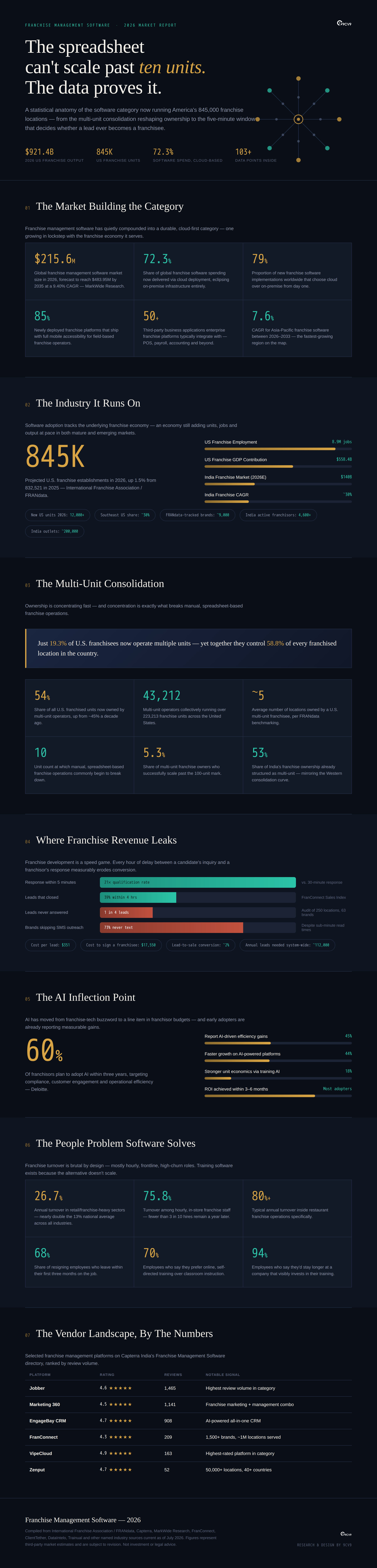
The expansion of the broader franchising industry is another major factor driving software adoption. In the United States, the number of franchise establishments is projected to increase from 832,521 in 2025 to approximately 845,000 in 2026, while franchise economic output is expected to exceed USD 921.4 billion. Franchise employment is also forecast to approach 8.9 million workers, demonstrating the industry’s substantial economic contribution and the growing complexity of managing large, geographically distributed franchise networks.
Meanwhile, international markets are creating new opportunities for franchise technology providers. India’s franchise industry is projected to exceed USD 140 billion in 2026, supported by thousands of franchisors and approximately 200,000 franchise outlets. Across Asia-Pacific, franchise software adoption is expected to benefit from the expansion of organized retail, quick-service restaurants, education franchises, healthcare networks, and other multi-location business models.
One of the most important developments shaping franchise management software trends in 2026 is the increasing concentration of franchise ownership among multi-unit operators. Industry data indicates that approximately 19.3% of U.S. franchisees operate multiple locations, yet these operators collectively control nearly 58.8% of franchised establishments. This concentration creates growing demand for centralized franchise management systems capable of consolidating financial reporting, monitoring location-level performance, standardizing operating procedures, and coordinating employees across multiple business units.
Artificial intelligence and automation are also reshaping how franchise organizations operate. Survey findings referenced in industry research suggest that 60% of franchisors plan to adopt AI within three years, while approximately 45% of franchise companies report measurable operational efficiency improvements associated with AI adoption. AI-powered franchise management solutions are increasingly being explored for predictive analytics, customer relationship management, automated compliance monitoring, workforce scheduling, franchise development, and operational decision-making.
Beyond operational efficiency, franchise management software is becoming increasingly important for financial transparency and profitability. Franchise businesses must manage complex financial arrangements involving royalty fees, advertising contributions, technology charges, and other recurring expenses. With median franchise royalty fees estimated at approximately 5% of gross sales, automated royalty management and financial reporting tools can help franchisors reduce administrative workloads, improve calculation accuracy, and maintain stronger financial oversight.
Franchise development and lead management represent another critical area of technological investment. Industry figures indicate that the average cost per franchise development lead reached approximately USD 351 in 2025, while the average cost of acquiring a new franchisee increased to around USD 17,550. As customer acquisition costs rise and franchise lead conversion rates face pressure, franchisors are increasingly evaluating CRM software, automated lead nurturing, and franchise sales management platforms to improve recruitment efficiency and maximize marketing returns.
At the same time, workforce management, employee training, and franchise compliance remain significant operational challenges. High employee turnover across restaurant, retail, and other franchise-intensive industries is encouraging businesses to invest in digital onboarding, learning management systems, mobile training applications, and standardized compliance workflows. These technologies can help franchise organizations maintain service quality and operational consistency even as their networks expand.
However, despite growing adoption, the franchise management software market remains fragmented. Businesses must evaluate a wide range of solutions, including comprehensive franchise management platforms, franchise CRM systems, royalty management software, franchise operations software, field service management applications, and AI-powered business intelligence tools. Vendors such as FranConnect, Zenput, Jolt, and other specialized providers illustrate the diversity of software solutions available to franchise organizations with different operational requirements.
Understanding these developments is essential for franchisors, franchisees, software vendors, investors, business consultants, and technology decision-makers seeking to navigate the evolving franchise technology landscape.
This comprehensive guide to the Top 103 Franchise Management Software Statistics, Data & Trends in 2026 examines the most important market insights shaping the industry, including global market size, revenue forecasts, cloud adoption, artificial intelligence, franchise ownership trends, software pricing, royalty management, franchise development, employee training, compliance automation, and emerging technology opportunities.
By analyzing these franchise management software statistics, businesses can gain a clearer understanding of where the industry is heading, identify opportunities to improve franchise operations, evaluate technology investments, and develop more effective strategies for managing profitable, scalable franchise networks in 2026 and beyond.
Top 103 Franchise Management Software Statistics, Data & Trends in 2026
Market Size & Growth
- The franchise management software market is valued around USD 215.6 million in 2026 and is forecast to nearly double to $483.95 million by 2035. This steady 9.40% CAGR trajectory confirms franchise management software has moved from a niche tool to a mainstream category as multi-unit brands scale.
- Franchise operations platforms — the broader category surrounding franchise management software — are projected to hit $1.09 billion in 2026, rising to $1.52 billion by 2035. This growth signals that even conservative market models expect durable, multi-year demand for centralized franchise oversight tools.
- Cloud-based deployment already accounts for roughly 72.3% of global franchise management software spending. Franchisors are voting decisively with their budgets for SaaS delivery over legacy on-premise systems.
- North America alone represents about $1.08 billion of franchise software revenue, driven by more than 750,000 active franchise units. The sheer density of North American franchise locations makes it the anchor market for every major franchise software vendor.
- Europe holds roughly 24.8% share of the global franchise management software market, fueled by expansion of multi-language, multi-currency franchise brands across the UK, France, Germany, and Spain.
- Asia-Pacific is projected to be the fastest-growing region for franchise software, expanding at a 7.6% CAGR between 2026 and 2033. Rapid franchise formation across India and Southeast Asia is the primary driver behind this acceleration.
- In North America, cloud adoption specifically within franchise software spending sits at 74.2%, reinforcing that even the most mature franchise market has almost fully pivoted away from on-premise infrastructure.
- Nearly 79% of new franchise software implementations globally now choose cloud deployment over on-premise alternatives. Lower upfront infrastructure costs and faster go-live timelines make cloud the default choice for growing franchise systems.
- Mobile accessibility is built into more than 85% of newly deployed franchise management platforms. Field-based franchise operations increasingly demand software that works from a phone, not just a head-office desktop.
- Enterprise-grade franchise management software now typically integrates with 50+ third-party business applications, from POS and accounting to payroll and marketing automation, reflecting how central these platforms have become to the broader tech stack.
- The global franchise market overall (not software specifically) is projected to reach roughly $160.35 billion in 2026, on its way to $369.84 billion by 2035 at a 9.73% CAGR. This underlying industry growth is the demand engine feeding the software category above it.
- Leading vendors in the franchise management software space collectively account for approximately 46% market share, showing the category remains only moderately consolidated, with room for challenger platforms.
U.S. Franchise Industry Fundamentals (2026)
- U.S. franchise establishments are projected to grow from 832,521 in 2025 to 845,000 units in 2026, a 1.5% increase. Steady unit growth like this directly expands the addressable market for every franchise management software vendor.
- More than 12,000 new franchised businesses are expected to open in the U.S. in 2026 alone. Each new location represents a fresh onboarding event that franchise software is purpose-built to streamline.
- U.S. franchise economic output is forecast to rise 1.6% in 2026, exceeding $921.4 billion. Output at this scale underscores why even marginal software-driven efficiency gains translate into billions of dollars system-wide.
- Franchising’s contribution to U.S. GDP is projected to reach $558.4 billion in 2026, roughly 3% of total U.S. GDP. Few software-addressable verticals carry this much macroeconomic weight.
- Franchise employment in the U.S. is expected to grow by more than 150,000 jobs in 2026, reaching almost 8.9 million total. Workforce scheduling, training, and communication tools become mission-critical at this level of headcount.
- FRANdata tracks approximately 9,000 distinct U.S. franchise brands across all 50 states and Washington, D.C. This brand diversity is exactly why franchise software vendors increasingly build configurable, industry-agnostic platforms.
- The Southeast region holds the largest share of U.S. franchise establishments at nearly 30%, and is projected to grow 1.7% in 2026, surpassing 252,000 locations. Regional concentration like this shapes where franchise software vendors focus sales and localization efforts.
- The Southeast’s franchise economic output is expected to grow 1.7% in 2026 to reach $274.9 billion — the highest of any U.S. region. Regional output leadership reinforces the Southeast’s status as a bellwether market for franchise technology adoption.
- The Southwest region is projected to grow its franchise footprint by 2.5% in 2026, the fastest of any U.S. region. Faster-growing regions typically show higher urgency for centralized franchise management tooling to keep pace with expansion.
- The One Big Beautiful Bill Act’s capital-expenditure deduction is expected to let U.S. franchise businesses fully deduct $27 billion in capex during 2026. Favorable depreciation treatment like this directly increases franchisors’ willingness to invest in new franchise management technology.
- Roughly 73% of franchisors and 98% of franchisees are affected by recent U.S. tax-deduction provisions tied to franchise investment. Near-universal tax relief at the franchisee level frees up cash that often gets redirected into operational software.
Global & India Franchise Market Trends
- India’s franchise industry is projected to cross $140 billion in value by 2026, growing at an aggressive CAGR of roughly 30%. This is one of the fastest-expanding franchise markets in the world and a major growth frontier for franchise software vendors.
- India’s franchise sector had already crossed the ₹15,000 crore mark heading into 2026, up from roughly ₹12,500 crore in 2024 and ₹4,500 crore in 2018 — approximately 25% CAGR over six years. Compounding growth of this magnitude explains the surge in India-focused franchise management tooling.
- India’s franchise industry currently contributes close to 3% of national GDP, up from just 1.8% in 2018. This near-doubling of GDP share highlights franchising’s accelerating economic footprint in India.
- India hosts more than 4,600 active franchisors operating nearly 2 lakh (200,000) outlets nationwide, making it the second-largest franchise market globally by most industry estimates.
- Regional Indian franchise brands command roughly 50% of domestic market share, ahead of national brands at 34% and local brands at 16%. This fragmented brand landscape increases demand for affordable, easy-to-deploy franchise software rather than expensive enterprise suites.
- Multi-unit franchisees account for approximately 53% of all franchise ownership in India, mirroring the multi-unit consolidation trend seen in more mature Western franchise markets.
- India’s franchise sector directly supports an estimated 5.5–6 million jobs as of early 2026. Workforce scale at this level is a strong signal for continued demand in franchise scheduling and HR-adjacent software modules.
- India sees over 300 new franchise companies launched every year. This steady stream of new franchisors represents a continuous pipeline of first-time franchise software buyers.
- F&B, preschool/coaching education, and diagnostics/wellness are cited as the fastest-growing franchise categories in India for 2026. Vertical-specific compliance and training needs in these categories are increasingly steering franchise software feature roadmaps.
- Tier 2 and Tier 3 Indian cities are emerging as new franchise growth hubs in 2026. Franchise systems expanding into smaller cities lean more heavily on remote, cloud-based management tools since head-office proximity is no longer guaranteed.
Multi-Unit Franchise Ownership
- As of 2025, 19.3% of U.S. franchisees operate multiple units, yet they collectively control 58.8% of all franchised locations. This concentration of ownership is one of the strongest arguments for centralized, multi-location franchise management software.
- Multi-unit operators control roughly 54% of all franchised units in the United States, up from approximately 45% a decade ago — a clear decade-long shift toward consolidation.
- More than 43,212 multi-unit operators collectively run over 223,213 franchise units across the U.S. The scale of a single operator’s portfolio increasingly rivals that of a small regional franchisor.
- The average multi-unit franchisee in the U.S. now owns approximately five separate locations. Managing five discrete P&Ls, staff rosters, and compliance checklists manually is precisely the operational strain franchise software is designed to eliminate.
- Only about 5.3% of multi-unit franchise owners manage to scale past the 100-unit mark. This steep drop-off illustrates how operational complexity — not capital alone — is often the real ceiling on franchise growth.
- Roughly 30% of multi-unit franchisees own between two and ten units, representing the largest segment of the multi-unit category. This “emerging multi-unit” tier is a key target segment for mid-market franchise software pricing.
- Manual, spreadsheet-based processes commonly begin breaking down once a franchisee crosses the 10-unit threshold. This tipping point is frequently cited as the moment operators are forced to adopt dedicated franchise management software.
- Lenders reportedly favor multi-unit franchise operators as “higher-quality borrowers” — but specifically those with documented, systemized operations. Franchise management software’s audit trails and reporting capabilities can directly influence a franchisee’s access to expansion financing.
Franchisee Demographics & Sentiment
- The average U.S. franchise owner is 44 years old, and 69% are men, with 62% holding a bachelor’s degree. Understanding this buyer demographic profile helps franchise software vendors tailor onboarding and UX design.
- 86% of U.S. franchisees say they would recommend their franchise to others, and 85% report enjoying being part of their franchise organization. High franchisee satisfaction correlates with lower churn — a metric franchise management software helps franchisors actively track and protect.
- 82% of U.S. franchisees say they enjoy operating their business day-to-day. Positive day-to-day sentiment is often linked to how smoothly operational tools function behind the scenes.
- 86% of U.S. franchisors include a Financial Performance Representation (Item 19) in their Franchise Disclosure Document, and of those, 94% disclose revenue figures. Transparent financial disclosure practices increasingly rely on the same royalty and reporting data captured inside franchise management platforms.
Franchise Failure & Survival Rates
- Approximately 20–25% of U.S. franchise businesses close within their first five years, compared to roughly 50% of independent small businesses. This survival advantage is a core reason franchising — and by extension, franchise-specific software — continues attracting new investment.
- After 10 years, U.S. franchise survival rates sit at approximately 65–70%, versus roughly 30–35% for independent businesses. Long-run resilience like this is frequently cited by franchise software vendors marketing to prospective franchisees.
- The commonly repeated claim of a “90% franchise success rate” is not supported by rigorous academic research, according to multiple industry analyses — a reminder that franchise buyers should treat overly optimistic marketing statistics with healthy skepticism.
- The first-year failure rate for U.S. franchises is estimated at roughly 10–15%, notably lower than the 20% first-year failure rate for all new U.S. businesses. Structured franchisor support systems — increasingly delivered through software — are a key differentiator behind this gap.
- The median total investment required to open a U.S. franchise is approximately $250,000. Given this capital commitment, franchisees have strong financial incentive to adopt software that protects and accelerates their return on investment.
Royalty Fees & Financial Structure
- The median U.S. franchise royalty fee sits at 5.00% of gross sales, with fees ranging from 3% to 13% across industries. Royalty tracking accuracy at this scale is a foundational use case for franchise management software.
- Combined royalty and marketing fees for major U.S. food franchises typically range from 8% to 11% of gross sales. Multi-fee stacking of this complexity is difficult to reconcile manually across dozens or hundreds of locations.
- The average total ongoing franchise fee rate across all categories is 8.7% of gross revenue — about 1.6 percentage points higher than the royalty rate alone. This gap between “headline” royalty and true total cost is exactly the kind of blind spot automated royalty-calculation modules are built to close.
- Financial and insurance franchises carry the highest total ongoing fee rates at 18.0%, driven by royalties averaging 15.9%. Fee-heavy verticals like this have outsized need for precise, automated royalty computation software.
- Retail franchises carry the lowest total ongoing fee rates at just 6.4%, combining a 5.2% royalty with a 1.6% ad fund contribution. Even at the lower end, accurate tracking across many retail locations remains operationally demanding without dedicated tooling.
- A five-unit franchise operator can face $50,000–$150,000 in additional annual “hidden” fee costs beyond the headline royalty rate. Costs at this scale routinely go undetected without centralized financial dashboards purpose-built for franchise operators.
- Franchise technology infrastructure setup typically requires a $25,000–$75,000 upfront investment as part of the broader franchise development budget. This figure illustrates that technology is now treated as a core line item in franchise launch planning, not an afterthought.
- Ongoing franchise technology fees commonly range from $200 to $800 per unit per month. Recurring per-location software costs at this level make vendor selection a meaningful line item in franchisee unit economics.
- The average total franchise development budget reached approximately $1.02 million in 2025 — a 39% jump from $734,564 the prior year. Rising development costs are pushing franchisors to seek software efficiencies that offset rising launch expenses elsewhere.
- Quality assurance programs, including compliance monitoring and mystery shopping, cost franchisors an estimated $2,000–$5,000 per unit annually. Digitizing these inspection workflows is one of the clearest ROI cases for franchise compliance software.
Compliance, Audits & Multi-Location Operations
- FranConnect reports that its AI-powered platform helps franchise brands achieve 44% faster growth on average. Results like this illustrate the tangible commercial upside multi-location brands attribute to dedicated franchise software.
- Franchise systems using structured training and performance-tracking modules have reported up to 18% stronger unit-level economics. Consistent training delivery, not just financial oversight, is increasingly recognized as a profitability driver.
- An enterprise franchise digital transformation program reported a 27% improvement in outlet compliance alongside a 21% reduction in onboarding time after automating workflows. Numbers like these demonstrate compliance and onboarding gains often arrive together once workflows are digitized.
- U.S. franchise software adoption shows over 30% higher AI-enabled workflow utilization than in the UK market. This gap highlights how unevenly AI features are being adopted even among mature, English-speaking franchise markets.
- Only about 22% of North American franchise systems with fewer than 100 units had adopted any specialized franchise operations software as of 2025. This leaves a substantial “white space” opportunity for vendors targeting smaller, emerging franchise brands.
- The franchisee-facing segment of franchise software (versus franchisor head-office tools) is projected to grow from roughly 22.6% to 26.4% of category revenue by 2034. This shift reflects rising direct technology investment at the individual unit level, not just corporate headquarters.
AI & Emerging Technology in Franchising
- A Deloitte survey found that 60% of franchisors plan to adopt AI within three years, primarily targeting compliance, customer engagement, and operational efficiency. AI adoption intent at this level signals franchise software roadmaps will increasingly center on automation.
- 45% of franchise companies report measurable operational efficiency gains directly attributable to AI adoption. Efficiency gains at nearly half of surveyed brands suggest AI features are moving from experimental to expected within franchise platforms.
- Entry-level AI tools for individual franchise locations start around $50–$200 per month, while comprehensive AI platforms range from $500–$2,000 monthly. This pricing spread shows AI-enabled franchise software is becoming accessible across brand sizes, not just enterprise budgets.
- Most franchises adopting AI tools report seeing measurable ROI within 3–6 months. Fast payback periods like this are accelerating franchisor confidence in AI-enabled software investment.
- The global CRM market — closely tied to franchise development and sales software — is projected to reach $163.1 billion by 2030, growing at nearly 14% annually. Franchise-specific CRM tools are riding this broader enterprise CRM growth wave.
- The EU AI Act is reshaping compliance-automation requirements for multi-unit franchise operators, pushing vendors to embed audit trails and algorithmic transparency into their platforms. Regulatory pressure like this is now a direct driver of franchise software feature development in international markets.
Franchise Development & Lead Conversion
- Franchise candidates typically contact 2–3 competing brands simultaneously, meaning the first brand to respond substantively usually wins the conversation. This dynamic is why speed-to-lead has become one of the most closely tracked metrics in franchise development software.
- Responding to a franchise lead within 5 minutes rather than 30 minutes can raise qualification rates by as much as 21 times, according to Forbes and Harvard Business Review research. Few statistics make the case for automated lead-routing software as forcefully as this one.
- More than 1 in 4 franchise development leads never receive any response at all, according to an audit of 250 locations across 63 brands. A gap this large represents substantial lost franchise-fee revenue that automated CRM workflows are designed to close.
- 73% of franchise brands reportedly never use SMS as a first-contact channel with prospective franchisees, despite text messages typically being read within minutes versus hours or days for email.
- The average cost per franchise development lead rose to approximately $351 in 2025, up from prior years. Rising acquisition costs make lead-conversion software an increasingly high-stakes investment for franchise development teams.
- The all-in cost to sign a new franchisee climbed to roughly $17,550 in 2025, up from $13,757 in 2024. Cost increases at this pace place a premium on CRM tools that can measurably improve conversion efficiency.
- The average franchise lead-to-sale conversion rate across the industry was around 2% in 2025, down from 2.3% the prior year. A declining baseline conversion rate underscores why franchise brands are actively seeking software-driven improvements to their sales funnel.
- U.S. franchise brands collectively need close to 112,000 qualified leads per year to hit national expansion targets. Managing lead volume at this scale is effectively impossible without a dedicated franchise development CRM.
- For franchise leads that ultimately closed, only 39% received a response within 4 hours of initial contact. Even among successful conversions, response times reveal significant room for software-driven speed improvements.
Franchisee Training, Turnover & Workforce Management
- Retail and franchise-heavy sectors report the highest employee turnover rate of any industry at 26.7% annually — nearly double the 13% national average. High turnover at this scale is a leading driver behind investment in franchise-specific learning management systems.
- Hourly, in-store turnover in multi-location retail and franchise settings can reach as high as 75.8% annually. At this churn rate, fewer than three in every ten hires remain employed a year later, making standardized onboarding software essential rather than optional.
- 68% of employees who resign from multi-location retail or franchise roles do so within their first three months. Early-tenure attrition at this level places enormous pressure on fast, consistent digital onboarding.
- Restaurant franchise turnover rates commonly exceed 80% annually. Turnover at this magnitude is one of the primary reasons mobile-first training and task-management software has become standard in quick-service franchise operations.
- 70% of employees say they prefer online training and self-directed learning over traditional classroom instruction. This preference aligns closely with the mobile-first, on-demand training modules now built into most franchise management platforms.
- 68% of employees say they prefer to learn on the job rather than through separate formal sessions, reinforcing why task-embedded microlearning is increasingly favored over standalone e-learning courses in franchise settings.
- 94% of employees say they would stay longer at a company that invested meaningfully in their training and development. Given the turnover statistics above, this finding directly links training software investment to workforce retention outcomes.
Franchise Vendor Landscape & Capterra Ratings (India Directory)
- On the Capterra India Franchise Management Software directory, Jobber leads by review volume with a 4.6-out-of-5 rating across 1,465 reviews. High review counts at this scale reflect broad real-world adoption among home-service and multi-unit franchise brands.
- Marketing 360 holds a 4.5-out-of-5 rating from 1,141 reviews on Capterra India, positioning it as one of the most widely reviewed franchise marketing and management platforms in the directory.
- EngageBay CRM carries a 4.7-out-of-5 rating from 908 reviews, making it one of the highest-rated AI-powered CRM options listed for franchise use cases.
- FranConnect — one of the most established dedicated franchise management platforms — holds a 4.3-out-of-5 rating across 209 reviews on Capterra India and states it serves over 1,500 franchise brands across roughly 1 million locations. Longevity and scale like this make FranConnect a frequent benchmark for enterprise franchise software evaluations.
- VipeCloud posts the highest user rating among listed franchise management tools at 4.9 out of 5, based on 163 reviews. A rating this high, even at a smaller review volume, signals strong user satisfaction among its franchise customer base.
- Zenput, used by multi-unit operators including major restaurant and retail chains, holds a 4.7-out-of-5 rating and reports supporting 50,000+ locations across more than 40 countries. Scale of this magnitude illustrates how far a single compliance-execution platform can extend across a global franchise footprint.
- Jolt, a tablet-based daily operations platform used by brands including well-known QSR chains, holds a 4.6-out-of-5 rating from 311 reviews. Its adoption by large-format restaurant franchises highlights the category’s centrality in day-to-day store execution.
- Gofrugal, a retail and restaurant ERP/POS platform, reports serving more than 25,000 retail businesses across 50+ countries with a 4.4-out-of-5 rating. This underscores how POS-adjacent platforms have become an integral part of the broader franchise management software ecosystem, especially in Indian and Asian markets.
- Across the top 25 vendors listed on Capterra India’s Franchise Management Software directory, average user ratings cluster between 4.0 and 4.9 out of 5 — indicating a maturing category where most established vendors deliver solidly positive user experiences.
IT & Technology Spending Context
- The median annual IT budget for U.S. small-to-mid-sized businesses (50–249 employees) sits at approximately $182,000 in 2026. Franchise systems of comparable size increasingly allocate a meaningful share of this budget specifically to franchise management software.
- SMBs now allocate roughly 42% of their IT budgets to recurring cloud, SaaS, and managed services — up from just 28% in 2020. This shift mirrors the franchise software category’s own strong pivot toward subscription-based, cloud-delivered platforms.
- 57% of SMBs plan to increase overall IT spending in 2026, citing cloud migration and security as top priorities. Rising SMB technology budgets bode well for continued franchise software category growth, particularly among smaller and emerging franchise brands.
- Global SaaS revenue is projected to reach $299 billion in 2026, making it the single largest software delivery category worldwide. Franchise management software’s near-total shift to SaaS delivery places it squarely within this broader, fast-growing software economy.
- The average enterprise now uses 371 separate SaaS applications, a 32% increase from 2023. This sprawl reinforces why franchise management platforms increasingly emphasize deep third-party integrations rather than standalone functionality.
- 43% of cyberattacks now target small businesses, yet only 14% of small business owners rate their cybersecurity posture as highly effective. This gap is pushing franchise software vendors to embed stronger security and compliance safeguards directly into multi-location platforms.
Conclusion
The franchise management software industry is entering a transformative period as franchisors, franchisees, and multi-unit operators increasingly embrace digital technologies to improve operational efficiency, strengthen financial oversight, and support sustainable business expansion. The Top 103 Franchise Management Software Statistics, Data & Trends in 2026 highlight an industry experiencing steady growth, accelerating cloud adoption, expanding artificial intelligence capabilities, and rising demand for centralized franchise operations management.
With the global franchise management software market estimated at USD 215.6 million in 2026 and projected to reach USD 483.95 million by 2035, the industry presents significant opportunities for software providers, franchise businesses, technology investors, and enterprise solution developers. This projected 9.4% compound annual growth rate reflects the increasing importance of technology in managing complex franchise networks and maintaining operational consistency across multiple locations.
One of the most significant findings is the continued dominance of cloud-based franchise management solutions. With approximately 72.3% of global franchise management software spending attributed to cloud deployment and nearly 79% of new implementations reportedly selecting cloud-based platforms, the transition toward scalable, subscription-based software is becoming a defining characteristic of the market. Cloud technology enables franchise organizations to access real-time operational data, coordinate geographically dispersed teams, automate administrative processes, and reduce dependence on traditional on-premise infrastructure.
The rapid expansion of the broader franchising industry further reinforces the importance of these technologies. In the United States, franchise establishments are projected to reach approximately 845,000 locations in 2026, generating more than USD 921.4 billion in economic output and supporting nearly 8.9 million jobs. Meanwhile, emerging franchise markets such as India and other Asia-Pacific economies are creating additional demand for affordable, flexible, and localized franchise management software.
Another defining trend is the growing influence of multi-unit franchise ownership. With approximately 19.3% of U.S. franchisees controlling 58.8% of franchised locations, centralized management capabilities are becoming increasingly valuable. Franchise operators overseeing multiple outlets require integrated systems for financial reporting, royalty calculations, inventory management, employee scheduling, performance monitoring, and regulatory compliance. As franchise networks become larger and more geographically distributed, software integration and operational visibility will remain critical competitive advantages.
Artificial intelligence and automation are also expected to play an increasingly important role in the future of franchise management software. Industry research indicates that 60% of franchisors plan to adopt AI within three years, while 45% of franchise companies report measurable operational efficiency improvements associated with AI adoption. These findings suggest growing opportunities for AI-powered franchise analytics, automated compliance monitoring, predictive forecasting, intelligent customer relationship management, and workforce optimization.
Financial management and franchise development represent additional areas where technology investments can deliver meaningful operational benefits. With median franchise royalty fees estimated at 5% of gross sales and franchise development costs continuing to rise, businesses have strong incentives to adopt software that improves financial accuracy, automates fee calculations, strengthens lead management, and provides clearer visibility into location-level profitability.
At the same time, workforce management, employee retention, and standardized training remain essential priorities. High employee turnover across franchise-intensive industries increases the importance of digital onboarding, learning management systems, mobile training platforms, and automated compliance workflows. Franchise organizations that successfully integrate these capabilities into their daily operations may be better positioned to maintain service quality, improve employee productivity, and support consistent customer experiences.
Looking ahead, several developments are likely to shape the franchise management software market beyond 2026. These include deeper integration between franchise management platforms and point-of-sale systems, increased adoption of AI-powered business intelligence, greater demand for mobile-first applications, more sophisticated franchisee performance analytics, and stronger cybersecurity and regulatory compliance capabilities.
However, adopting new technology alone does not guarantee improved franchise performance. Businesses must carefully evaluate software functionality, implementation costs, integration capabilities, data security, vendor reliability, and long-term scalability. Selecting the right franchise management software requires aligning technology investments with operational requirements, organizational growth strategies, and measurable business objectives.
Ultimately, the franchise management software statistics for 2026 demonstrate that digital transformation is becoming increasingly central to successful franchise operations. As competition intensifies and franchise networks expand, organizations that effectively leverage cloud technology, automation, artificial intelligence, and integrated management systems will have greater opportunities to improve efficiency, strengthen franchisee relationships, and make more informed business decisions.
For franchisors, franchisees, software developers, and investors, understanding these 103 franchise management software statistics provides valuable insight into market opportunities, emerging technologies, operational challenges, and future industry developments.
The future of franchise management software will be defined not simply by the number of locations a business manages, but by how effectively it uses technology, data, and automation to operate those locations profitably and consistently. Businesses that prioritize scalable software infrastructure, intelligent automation, and data-driven franchise management strategies will be better equipped to navigate industry changes and pursue sustainable growth in 2026 and beyond.
If you find this article useful, why not share it with your hiring manager and C-level suite friends and also leave a nice comment below?
We, at the 9cv9 Research Team, strive to bring the latest and most meaningful data, guides, and statistics to your doorstep.
To get access to top-quality guides, click over to 9cv9 Blog.
To hire top talents using our modern AI-powered recruitment agency, find out more at 9cv9 Modern AI-Powered Recruitment Agency.
People Also Ask
What is franchise management software?
Franchise management software is a digital platform that helps franchisors and franchisees manage multiple locations, automate royalty payments, monitor performance, streamline operations, and maintain brand consistency across their franchise networks.
How big is the global franchise management software market in 2026?
The global franchise management software market is estimated at USD 215.6 million in 2026 and is projected to reach approximately USD 483.95 million by 2035, reflecting increasing demand for digital franchise management solutions.
What is the projected growth rate of the franchise management software market?
The franchise management software market is forecast to grow at a compound annual growth rate (CAGR) of approximately 9.4% through 2035, driven by cloud adoption, automation, AI integration, and expanding franchise networks.
What are the biggest franchise management software trends in 2026?
Major trends include cloud-based franchise platforms, AI-powered analytics, automated royalty management, mobile accessibility, centralized reporting, franchise CRM integration, workforce management, and digital compliance monitoring.
What percentage of franchise management software is cloud-based?
Approximately 72.3% of global franchise management software spending is attributed to cloud-based solutions. Nearly 79% of new implementations reportedly favor cloud deployment over traditional on-premise systems.
Why are cloud-based franchise management systems becoming popular?
Cloud-based franchise management systems provide centralized access to operational data, real-time reporting, remote management, automated updates, and scalable infrastructure without requiring extensive on-premise IT investments.
How is artificial intelligence transforming franchise management software?
AI is transforming franchise management through predictive analytics, automated compliance monitoring, intelligent customer relationship management, workforce optimization, sales forecasting, and data-driven operational decisions.
What percentage of franchisors plan to adopt AI?
Industry research indicates that approximately 60% of franchisors plan to adopt artificial intelligence within three years, particularly for operational efficiency, customer engagement, compliance management, and business automation.
How much does franchise management software cost in 2026?
Franchise technology fees commonly range from USD 200 to USD 800 per location monthly, depending on software capabilities and service requirements. Enterprise implementations may involve additional setup, integration, and training costs.
What are the benefits of franchise management software?
Key benefits include improved operational efficiency, automated royalty calculations, centralized financial reporting, standardized employee training, better franchisee communication, compliance monitoring, and stronger multi-location management.
How many franchise establishments are there in the United States in 2026?
The United States is projected to have approximately 845,000 franchise establishments in 2026, increasing from 832,521 in 2025. This represents approximately 1.5% annual growth in franchise locations.
How much revenue does the U.S. franchise industry generate in 2026?
The U.S. franchise industry is projected to generate more than USD 921.4 billion in economic output in 2026, highlighting franchising’s substantial contribution to the national economy.
How many people work in the U.S. franchise industry?
U.S. franchise employment is expected to approach 8.9 million workers in 2026, with more than 150,000 additional jobs projected. This workforce expansion increases demand for digital scheduling, training, and HR management solutions.
Which region dominates the franchise management software market?
North America is a major franchise software market due to its extensive franchise networks and high technology adoption. Europe and Asia-Pacific also represent important markets for franchise management solutions.
Which region has the fastest-growing franchise software market?
Asia-Pacific is projected to be the fastest-growing regional franchise software market, with an estimated 7.6% CAGR between 2026 and 2033, supported by franchise expansion in India and Southeast Asia.
How large is India’s franchise industry in 2026?
India’s franchise industry is projected to exceed USD 140 billion in 2026. The country has more than 4,600 active franchisors and approximately 200,000 franchise outlets, creating opportunities for franchise technology providers.
What is multi-unit franchise management software?
Multi-unit franchise management software enables operators to oversee several franchise locations through one platform, including financial reporting, employee scheduling, royalty tracking, compliance monitoring, and performance analysis.
What percentage of franchisees own multiple locations?
Approximately 19.3% of U.S. franchisees operate multiple units, collectively controlling around 58.8% of franchised locations. This concentration increases demand for centralized multi-location management systems.
How does franchise management software automate royalty payments?
Franchise royalty management software calculates fees based on reported sales, tracks payment schedules, generates invoices, monitors outstanding balances, and provides financial reports to franchisors and franchisees.
What is the average franchise royalty fee in 2026?
The median U.S. franchise royalty fee is approximately 5% of gross sales, although rates vary by industry and franchise agreement. Some franchise categories charge royalties ranging from 3% to 13%.
How does franchise management software improve operational efficiency?
Franchise management software improves efficiency by automating repetitive tasks, consolidating business information, standardizing workflows, reducing manual reporting, and providing real-time visibility into franchise performance.
Can franchise management software improve franchise profitability?
Franchise management software can support profitability through better cost control, financial transparency, standardized operations, and performance monitoring. Actual financial improvements depend on implementation quality and business conditions.
What is franchise CRM software?
Franchise CRM software manages prospective franchisee relationships, tracks development leads, automates follow-ups, monitors sales pipelines, and helps franchisors improve franchise recruitment and expansion processes.
What is the average cost per franchise development lead?
The average cost per franchise development lead reached approximately USD 351 in 2025. Rising acquisition costs highlight the importance of franchise CRM software, lead automation, and effective conversion management.
What is the average franchise lead conversion rate?
The average franchise lead-to-sale conversion rate was approximately 2% in 2025, compared with 2.3% the previous year. Automated lead management and faster response times may help improve franchise development efficiency.
How does franchise management software support employee training?
Franchise management platforms support employee training through digital onboarding, learning management systems, mobile courses, standardized operating procedures, training progress tracking, and compliance assessments.
Why is franchise compliance management software important?
Franchise compliance software helps businesses monitor brand standards, conduct inspections, manage audit records, track regulatory requirements, and identify operational inconsistencies across multiple franchise locations.
What are the best franchise management software platforms in 2026?
Notable platforms include FranConnect, Zenput, Jolt, Jobber, and Gofrugal. The best choice depends on franchise size, industry, required integrations, budget, and whether the business prioritizes operations, compliance, or development.
What features should businesses look for in franchise management software?
Important features include royalty automation, financial reporting, franchise CRM, multi-location dashboards, employee training, compliance tracking, mobile access, POS integration, analytics, data security, and scalable cloud infrastructure.
What is the future of franchise management software beyond 2026?
The future of franchise management software will likely emphasize AI-powered automation, predictive analytics, cloud integration, mobile-first operations, advanced compliance monitoring, cybersecurity, and centralized franchise performance management.