

























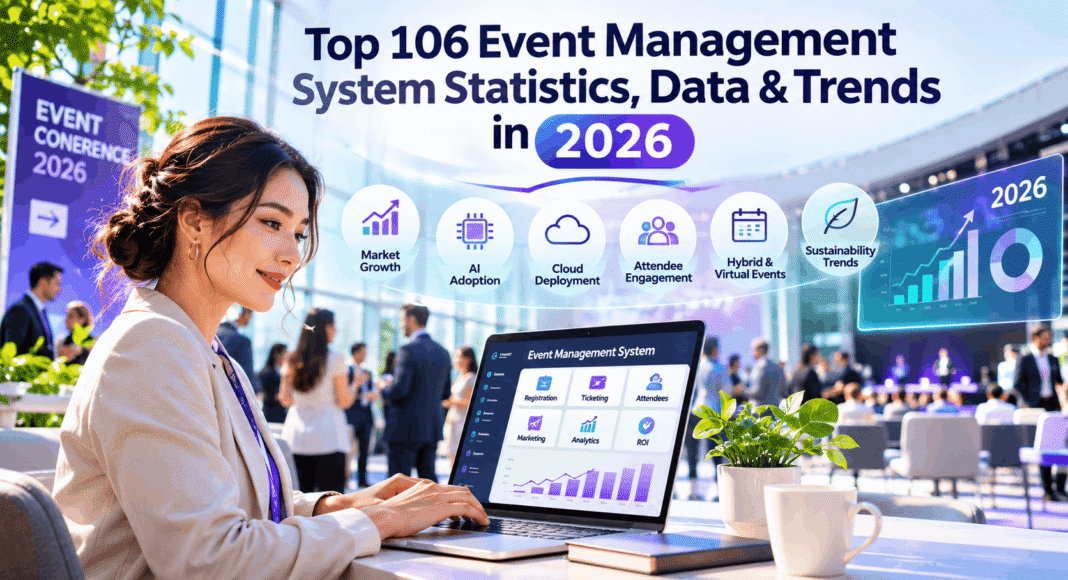

Key Takeaways
- Event Management Software Market Growth: The global event management software market is projected to reach $15.20 billion in 2026 and $24.17 billion by 2031, growing at a 9.73% CAGR, driven by increasing demand for automation and cloud-based solutions.
- AI Adoption and Event Technology Trends: 95% of event organizers expect increased AI usage in 2026, while cloud-based event management systems are projected to capture 63.9% of the market, transforming event planning, attendee engagement, and analytics.
- Event ROI, Budgets, and Hybrid Event Trends: 40% of event organizers expect budget increases in 2026, while 78% consider in-person events their most impactful marketing channel, highlighting the importance of cost efficiency, measurable ROI, and flexible event management platforms.
Event management systems are transforming the events industry in 2026 through AI, automation, and cloud technology. According to Mordor Intelligence, the global event management software market is valued at $15.20 billion in 2026, with projected growth to $24.17 billion by 2031. Explore 106 key statistics covering market growth, software adoption, event ROI, and emerging trends.
The global event management system industry is experiencing significant growth in 2026, driven by increasing demand for automation, artificial intelligence (AI), cloud-based platforms, and data-driven event planning. As businesses prioritize attendee engagement, operational efficiency, and measurable return on investment (ROI), event management software has become an essential tool for organizing corporate conferences, trade shows, exhibitions, webinars, and hybrid events. According to Mordor Intelligence, the global event management software market is valued at $15.20 billion in 2026 and is projected to reach $24.17 billion by 2031, expanding at a compound annual growth rate (CAGR) of 9.73%. Meanwhile, Fortune Business Insights forecasts a 14.16% CAGR through 2034, highlighting strong growth expectations despite differences in market research methodologies.
Also, read our article on the Top 10 Event Management Systems To Use.
One of the most influential event management technology trends in 2026 is the rapid adoption of AI-powered solutions. From automated event registration and attendee matchmaking to predictive analytics, personalized marketing, and post-event reporting, AI is transforming how event organizers manage complex workflows. Industry survey data indicates that 95% of event organizers expect their organizations to increase AI usage in 2026, while 65% of event professionals already incorporate generative AI into their daily operations. However, only 16% of generative AI adopters report significant improvements in outcomes, emphasizing the growing importance of measurable results and effective technology implementation.
Cloud-based event management systems are also reshaping the competitive landscape. Research from Coherent Market Insights suggests that cloud deployment will account for 63.9% of the event management software market in 2026, reflecting demand for scalable, accessible, and integrated solutions. Meanwhile, small and medium-sized enterprises are becoming increasingly important customers, accounting for 56.17% of the market in 2025 according to Mordor Intelligence. These developments demonstrate how event management platforms are evolving beyond traditional scheduling and registration tools into comprehensive systems supporting ticketing, attendee engagement, marketing automation, CRM integration, and real-time event analytics.

Despite technological advancements, event organizers continue to face financial and operational challenges. Approximately 40% of event organizers expect their budgets to increase in 2026, while another 40% anticipate unchanged spending and 20% expect reductions. Cost optimization, staffing shortages, and demonstrating event ROI remain major priorities. At the same time, 78% of organizers identify in-person conferences, summits, and conventions as their most impactful marketing channel, reinforcing the continued importance of face-to-face experiences alongside growing virtual and hybrid event capabilities.
This comprehensive guide to the Top 106 Event Management System Statistics, Data & Trends in 2026 examines the latest industry research, market forecasts, software adoption rates, AI integration trends, event technology investments, attendee behavior, and sustainability developments. By exploring these statistics, event planners, business leaders, software providers, marketers, and technology decision-makers can better understand the evolving event management software landscape, identify emerging opportunities, benchmark industry performance, and make informed decisions about event technology investments in 2026 and beyond.
Before we venture further into this article, we would like to share who we are and what we do.
About 9cv9
9cv9 is a business tech startup based in Singapore and Asia, with a strong presence all over the world.
With over ten years of startup and business experience, and being highly involved in connecting with thousands of companies and startups, the 9cv9 team has listed some of the top and best companies/tools in this review.
If you like to get your company listed in our top B2B software reviews, check out our world-class 9cv9 Media and PR service and pricing plans here.
Top 106 Event Management System Statistics, Data & Trends in 2026
🔹 Market Size & Growth Projections
- Mordor Intelligence values the event management software (EMS) market at $15.20 billion in 2026, forecasting growth to $24.17 billion by 2031 at a 9.73% CAGR, reflecting sustained enterprise demand for integrated event technology.
- Fortune Business Insights pegs the EMS market at $11.31 billion in 2026, projecting it to reach $32.62 billion by 2034 with a 14.16% CAGR, signaling a rapidly expanding software category.
- The global EMS market stood at $9.90 billion in 2025, according to Fortune Business Insights, providing the base year for 2026’s projected growth.
- MarketsandMarkets estimated the EMS market at $15.5 billion in 2024, expecting it to climb to $34.7 billion by 2029 at a 17.4% CAGR, one of the more aggressive growth forecasts in the industry.
- Coherent Market Insights values the global EMS market at $18.03 billion in 2026, growing to $41.13 billion by 2033 at a 12.5% CAGR.
- Research Nester forecasts the EMS market at $12.78 billion in 2026, reaching $36.42 billion by 2035 at over a 12.2% CAGR.
- Future Market Insights projects the EMS market at $19.9 billion in 2026, expanding to $96.5 billion by 2036 at a striking 17.1% CAGR — the highest long-range forecast among major analysts.
- Industry Research Biz estimates the EMS market at $13.04 billion in 2026, forecasting $44.80 billion by 2035 at a 14.69% CAGR.
- IMARC Group’s narrower EMS market definition values the sector at $7.2 billion in 2025, rising to $14.7 billion by 2034 at a 7.90% CAGR, the most conservative estimate reviewed.
- Grand View Research recorded the EMS market at $8.40 billion in 2024, with 2025 estimated at $9.32 billion, underscoring consistent year-over-year expansion regardless of methodology.
🔹 Market Segmentation (2026)
- Software solutions are projected to command an 85.1% share of the EMS market in 2026, per Coherent Market Insights, confirming standalone platforms outpace bundled services.
- Cloud-based deployment is expected to capture 63.9% of the EMS market in 2026, as accessibility and scalability continue driving adoption away from on-premises systems.
- Corporate end-users are forecast to represent 39.7% of the EMS market in 2026, the largest end-user segment due to the frequency and complexity of business events.
- North America is projected to hold a 45.8% share of the global EMS market in 2026, maintaining its position as the dominant regional market.
- North America accounted for 34.99% of the market in 2025, according to Fortune Business Insights, a figure that varies by methodology but consistently places the region first.
- The software segment held over 64% market share in 2024, cloud deployment exceeded 63%, and large enterprises captured over 53% of the EMS market, per Grand View Research — a snapshot of enterprise-led adoption patterns.
- Small and Medium Enterprises (SMEs) accounted for 56.17% of the EMS market share in 2025, growing at a 10.37% CAGR through 2031, per Mordor Intelligence — proof that adoption is no longer confined to large corporations.
- Corporate events held 43.25% share of the EMS market in 2025, while the Education vertical is projected to grow fastest at a 10.82% CAGR through 2031.
- North America captured 41.32% of the EMS market in 2025, while Asia-Pacific is set to grow fastest at an 11.01% CAGR through 2031, signaling a regional power shift.
- Cloud deployment is expected to hold 55.2% share in 2026, with large enterprises contributing around 61.5% of demand, according to Future Market Insights.
- Large enterprises accounted for 55.4% of EMS demand and the software component held 62.4% share, per IMARC Group’s narrower market analysis.
- The cloud-based segment of the virtual event platform market held a 71.29% share in 2026, reflecting the near-total shift away from on-premise virtual event infrastructure.
- The corporate and business segment represented 30.84% of the virtual event platform market in 2026, the largest end-user category for virtual event technology specifically.
🔹 Vendor & Competitive Landscape
- Cvent, Eventbrite, Stova, Bizzabo, and Hopin collectively command roughly 35–40% of EMS market revenue, indicating a moderately fragmented competitive landscape rather than a single dominant player.
- Blackstone acquired Cvent for $4.6 billion in August 2024, one of the largest private-equity plays in event technology history, fueling subsequent bolt-on acquisitions.
- Cvent’s planned $400 million acquisition of ON24 is progressing toward a first-half-2026 close, aiming to merge webinar analytics with end-to-end event workflows.
- Eventbrite agreed to be acquired by Bending Spoons for $500 million, with the deal expected to close in the first half of 2026 — a major consolidation event in the ticketing space.
- Bizzabo earned Gartner “Leader” status in June 2025 for embedding generative AI into matchmaking and content summarization tools.
- Cvent’s CventIQ generative-AI module, launched in June 2025, reportedly cuts planner workload by roughly 30% through automated RFP drafting and venue comparison.
- Bizzabo’s Event OS Copilot, introduced in November 2024, applies large language models to generate session summaries and propose breakout topics in real time.
- Ticketmaster upgraded its SafeTix digital ticketing system in January 2026 to tighten fraud prevention at stadium and venue gates.
- 87% of event planners in Asia-Pacific had already deployed AI features by 2025, compared with 54% in Europe, revealing a notable regional gap in AI maturity.
🔹 AI Adoption in Events
- 95% of surveyed event organizers expect their organization’s use of AI in events to increase in 2026, per Bizzabo’s State of Events Benchmark Report.
- 35% of event teams anticipate a “significant increase” in AI usage in 2026, reflecting accelerating rather than incremental adoption.
- 84% of planners say AI will have a moderate-to-major impact on the meetings and events industry in 2026, according to Cvent’s Planner Sourcing Report.
- 28% of planners cite the expanding role of AI as a top trend shaping their 2026 event priorities.
- 66% of event professionals agree that AI allows them to “focus on higher-value tasks,” per the ICE Benchmarking Report.
- 26% of planners report not using AI at all in 2026, citing knowledge gaps and unclear ROI rather than active resistance.
- 62% of event planners use AI specifically for event marketing tasks, including email drafting, content repurposing, and copywriting.
- 38% of event planners apply AI for data analysis and reporting, extracting insights and surfacing trends faster than manual methods allow.
- 91% of business-events professionals now use AI in some form, though most remain in early or developing stages of adoption.
- 65% of event professionals currently use generative AI in their day-to-day work.
- Only 16% of generative-AI adopters in the events industry report seeing “significant improvements” in outcomes so far, highlighting a gap between adoption and measurable value.
- 55% of AI adopters in the events industry are small businesses with 1 to 50 employees, proving AI adoption isn’t confined to large enterprises.
- 50% of meeting professionals plan to use AI-based tools moving forward, according to American Express Global Business Travel’s forecast.
🔹 Budgets, ROI & Financial Pressure
- 40% of event organizers expect their budgets to grow in 2026, down from 53% in 2025, signaling a more cautious financial outlook industry-wide.
- Another 40% expect budgets to remain flat in 2026, while 20% anticipate a decrease.
- 40% of organizers plan to run more events in 2026 than the prior year, reflecting controlled rather than aggressive expansion.
- 40% of organizers report difficulty proving event ROI in 2026 — a sharp improvement from 70% in 2025, thanks to better CRM integration and analytics.
- 78% of organizers rate in-person conferences, summits, and conventions as their organization’s most impactful marketing channel.
- 54% of attendees say they plan to attend more in-person events compared to last year.
- 53% of attendees plan to attend more webinars in 2026, showing virtual formats remain a complementary rather than declining channel.
- Cost-savings measures were identified as the single top trend shaping 2026 event planning programs by 35% of planners.
- 30% of meeting professionals identify reducing costs as a top priority for 2026, per Amex GBT’s forecast.
- Cost ranks as the most important KPI for measuring event success, followed closely by attendance (31%), attendee engagement (28%), ROI (28%), and positive attendee feedback (27%).
- Organizers are managing rising costs through reduced food and beverage spend (28%), fewer staff (27%), fewer giveaways (27%), and fewer sessions (25%).
- 74% of Fortune 1000 marketers planned to increase event budgets in 2025, reflecting continued confidence in events as a revenue driver among the largest corporations.
- 48% of marketers dedicate at least 21% of their total marketing budget to in-person events, confirming live events remain a primary — not supplemental — marketing channel.
- The average U.S. event planner salary is projected at $65,000 in 2026, with senior and corporate roles commanding $65,000 to $110,500.
- 89% of event professionals report that staffing shortages directly impacted their events in 2025.
- 56% of event leaders cite post-event ROI data as their single biggest frustration.
- 40% say wasted budget is the biggest risk of a failed event, while only 4% describe pulling event data as “easy.”
- 32% of event leaders cite flexibility and scalability as their top desired win from an event technology stack, while 30% want reduced team pressure from event volume and complexity.
🔹 Hybrid & Virtual Events
- 28% of planners say the continued frequency of hybrid and virtual meetings will impact their 2026 event programs.
- 15% of North American events were expected to take place in hybrid format in 2025, according to Amex GBT.
- 20% of meeting professionals say they prefer hybrid events over other formats.
- 74.5% of event professionals say hybrid events “are here to stay,” citing flexibility and reduced travel as the primary drivers.
- The global virtual events market reached $243 billion in 2025, growing at a 17.8% CAGR, per AMW World Group.
- 123 million hybrid events were hosted globally in 2025.
- 83% of event organizers report higher attendance with virtual or hybrid formats compared to in-person-only events.
- Adding a virtual component to an event increases total reach by an average of 2.5x.
- The global virtual events platform market is projected at $17.11 billion in 2026, growing to $40.07 billion by 2034 at an 11.23% CAGR, according to Straits Research.
- Europe’s virtual event platform market is projected at $5.09 billion in 2026, with the UK at $0.97 billion and Germany at $0.95 billion.
- Roughly 46% of meetings in 2026 are predicted to be fully in-person, while hybrid formats account for approximately 15% of the North American market.
- The webinar and virtual formats segment is growing at a 22.7% CAGR, outpacing the overall event industry growth rate.
- 97.4% of event professionals rate in-person events as “very” or “moderately” important to their strategy in 2026, up from 95.4% in 2025 — proof that digital growth hasn’t diminished the value of physical gatherings.
🔹 Ticketing, Registration & Check-In Technology
- Total global ticketing transaction value reached $1.47 trillion in 2025, projected to hit $3.37 trillion by 2030 — a 128.6% increase, per Juniper Research data.
- The online event ticketing market is set to grow from $50.97 billion in 2024 to $69.25 billion by 2029 at a 6.7% CAGR.
- The online event ticketing industry is estimated at $85.35 billion in 2025, according to Whova, underscoring the sheer scale of digital ticket transactions.
- The event registration and ticketing platform market was valued at $5.5 billion in 2024, forecast to reach $12 billion by 2033 at a 9.2% CAGR.
- 47% of event professionals use QR codes to improve operational efficiency and attendee engagement, making them one of the most widely adopted event technologies.
- 31% of consumers scan QR codes specifically to access event tickets, placing ticketing among the top use cases for QR technology.
- 102.6 million people are expected to scan QR codes in the U.S. in 2026 — roughly one in three Americans, reinforcing QR-based check-in as mainstream infrastructure.
- The global QR code market was valued at $13.04 billion in 2025, projected to reach $33.14 billion by 2030 at a 20.5% CAGR.
- 40% of event-app developers report over 80% attendee adoption rates, while 35% report adoption between 60–80%, showing mobile event apps are increasingly embraced rather than ignored.
- 89% of businesses using event technology save around 200 hours per year — nearly five full work weeks — according to American Express.
- Meeting professionals increasingly plan to use AI-based tools (50%) and mobile event apps (41%) as core components of their event technology stack.
🔹 Event Industry Economics
- The global events industry is estimated at $1.47 trillion in 2025, projected to reach $3.49 trillion by 2033 at an 11.38% CAGR, per Allied Market Research.
- The U.S. events market alone is expected to grow from $407 billion to $916 billion over the same period.
- The global events industry market is expected to reach $2.5 trillion by 2035, growing at a 6.8% CAGR from 2024.
- The global corporate events market was valued at $325 billion in 2023 and is expected to grow to nearly $600 billion by 2029 at a 10.6% CAGR.
- Corporate events hold the largest share of the total global events market at 38.76%.
- 13,000 trade shows are hosted annually in the United States, making it the largest trade show market in the world by volume.
- 12.7 million total attendees were recorded at U.S. trade shows in the first nine months of 2023 — a 15% year-over-year increase.
- 81% of trade show attendees hold buying authority, making them exceptionally high-value prospects for exhibitors.
- The U.S. event planning services industry generates $6.4 billion annually across more than 136,000 businesses, growing at a 5.1% annual rate.
- The average event involves coordination with 8.4 vendors and 14 hours of scheduling work, with 73% of scheduling conflicts stemming from miscommunication.
- 47% of event planners still rely on spreadsheets for timeline management, despite managing 15 or more events simultaneously — a clear gap between tooling and workload.
- Corporate events drive 47% of event-planner revenue, with Q4 consistently the busiest quarter of the year.
🔹 Sustainability
- An average conference attendee generates roughly 176 kg of CO2e per day through travel, energy use, and event operations.
- Attendee travel accounts for 70–90% of a conference’s total carbon emissions, making it the single largest lever for sustainability improvements.
- The global events industry may account for up to 10% of worldwide greenhouse gas emissions, according to industry sustainability analyses.
- 34% of attendees consider an event’s sustainability practices before purchasing tickets, showing eco-consciousness now influences purchasing decisions.
- Fully digital events have carbon footprints 50 to 300 times smaller than in-person equivalents, primarily due to eliminated travel and venue energy use.
🔹 Staffing & Operations
- 17.2% of event planners cite workforce shortages and burnout as an ongoing issue, while 29.6% flag rising vendor costs as their single biggest operational obstacle.
- Hotel quoted room rates in RFP responses averaged 131% of 2019 levels in Q2 2025, reflecting sustained post-pandemic budget pressure for corporate event planners.
Conclusion
The Top 106 Event Management System Statistics, Data & Trends in 2026 highlight an industry undergoing significant transformation, driven by artificial intelligence, cloud-based technology, automation, and growing demand for measurable event outcomes. As organizations increasingly rely on digital platforms to streamline event planning, improve attendee experiences, and optimize operational efficiency, event management software has become an essential component of modern business operations.
The global event management software market demonstrates strong growth potential, with Mordor Intelligence estimating its value at $15.20 billion in 2026 and projecting expansion to $24.17 billion by 2031, representing a compound annual growth rate (CAGR) of 9.73%. Other research firms forecast even faster growth, reflecting differences in market definitions, research methodologies, and projected adoption rates. These forecasts collectively indicate sustained demand for comprehensive event management systems across corporate events, conferences, exhibitions, trade shows, and virtual gatherings.
Artificial intelligence is emerging as one of the most influential event management software trends in 2026. With 95% of surveyed event organizers expecting increased AI usage and 65% of event professionals already incorporating generative AI into their daily workflows, automation is becoming increasingly important. AI-powered event management solutions are helping organizations simplify registration, personalize attendee engagement, automate marketing activities, analyze event performance, and improve resource allocation. However, with only 16% of generative AI adopters reporting significant improvements in outcomes, organizations must prioritize practical applications and measurable returns rather than technology adoption alone.
Cloud-based event management platforms are also gaining momentum, with research suggesting that cloud deployment could account for 63.9% of the market in 2026. Their scalability, accessibility, and integration capabilities make them attractive to businesses of different sizes. Meanwhile, the growing participation of small and medium-sized enterprises demonstrates that advanced event management technology is becoming more accessible beyond large corporations.
Despite these opportunities, cost management, event ROI measurement, and operational efficiency remain critical challenges. Only 40% of event organizers expect budget increases in 2026, while another 40% anticipate flat budgets. These financial pressures are encouraging businesses to invest in event management systems that consolidate workflows, reduce administrative workloads, improve data visibility, and deliver measurable business value.
The continued importance of in-person events also reinforces the need for flexible event technology. With 78% of organizers identifying in-person conferences, summits, and conventions as their most impactful marketing channel, physical gatherings remain central to business engagement strategies. At the same time, growing interest in webinars, hybrid events, mobile event applications, and digital ticketing demonstrates the importance of supporting multiple event formats through integrated technology platforms.
Looking ahead, the future of event management systems beyond 2026 will likely be shaped by deeper AI integration, predictive analytics, automated attendee engagement, seamless CRM connectivity, mobile-first experiences, and sustainability-focused event planning. Organizations that successfully combine these capabilities with effective budget management and reliable performance measurement will be better positioned to deliver engaging, efficient, and commercially valuable events.
Ultimately, these 106 event management system statistics for 2026 provide valuable insights for event organizers, corporate planners, marketing professionals, technology vendors, and business decision-makers. As the event technology landscape continues to evolve, selecting scalable, data-driven, and user-friendly event management software will be increasingly important for improving attendee satisfaction, maximizing event ROI, and maintaining a competitive advantage in the global events industry.
If you find this article useful, why not share it with your hiring manager and C-level suite friends and also leave a nice comment below?
We, at the 9cv9 Research Team, strive to bring the latest and most meaningful data, guides, and statistics to your doorstep.
To get access to top-quality guides, click over to 9cv9 Blog.
To hire top talents using our modern AI-powered recruitment agency, find out more at 9cv9 Modern AI-Powered Recruitment Agency.
People Also Ask
What is the global event management software market size in 2026?
According to Mordor Intelligence, the global event management software market is valued at $15.20 billion in 2026 and is projected to reach $24.17 billion by 2031, growing at a 9.73% CAGR.
How fast is the event management software market growing in 2026?
The event management software market is experiencing strong growth, with industry forecasts estimating compound annual growth rates between 7.90% and 17.4%, depending on market definitions and research methodologies.
What are the top event management system trends in 2026?
Major event management system trends in 2026 include AI-powered automation, cloud-based platforms, predictive analytics, hybrid event technology, mobile event applications, digital ticketing, and improved event ROI measurement.
What percentage of event organizers use AI in 2026?
Industry research indicates that 91% of business-events professionals use AI in some form, while 65% of event professionals incorporate generative AI into their daily workflows.
How is artificial intelligence transforming event management software?
AI is transforming event management software through automated scheduling, attendee matchmaking, personalized marketing, content generation, predictive analytics, and real-time reporting, helping organizers improve efficiency and attendee experiences.
What percentage of event organizers plan to increase AI adoption in 2026?
According to Bizzabo’s State of Events Benchmark Report, 95% of surveyed event organizers expect their organizations to increase AI usage in 2026, with 35% anticipating significant growth.
What is the market share of cloud-based event management software in 2026?
Coherent Market Insights projects cloud-based event management software to capture 63.9% of the global market in 2026, reflecting demand for scalable, accessible, and integrated event technology solutions.
Which region dominates the event management software market in 2026?
North America is expected to dominate the global event management software market in 2026, with Coherent Market Insights projecting a 45.8% market share.
Which region has the fastest-growing event management software market?
Asia-Pacific is projected to be the fastest-growing regional event management software market, with Mordor Intelligence forecasting an 11.01% CAGR through 2031.
What percentage of event management software users are small businesses?
According to Mordor Intelligence, small and medium-sized enterprises accounted for 56.17% of the event management software market in 2025, highlighting growing adoption among smaller organizations.
What are the benefits of using event management software in 2026?
Event management software helps businesses automate registration, manage attendees, coordinate vendors, track budgets, improve engagement, integrate CRM systems, and measure event performance through centralized analytics.
How much time can event management software save businesses?
Industry statistics indicate that 89% of businesses using event technology save approximately 200 hours annually, equivalent to around five standard 40-hour working weeks.
What percentage of event organizers expect budget increases in 2026?
Approximately 40% of event organizers expect their budgets to increase in 2026, while another 40% anticipate unchanged budgets and 20% expect reductions.
What are the biggest challenges facing event planners in 2026?
Major event planning challenges include rising vendor costs, staffing shortages, budget limitations, difficulty measuring event ROI, technology integration, and increasing expectations for personalized attendee experiences.
How important is event ROI measurement in 2026?
Event ROI measurement remains a major priority, with 40% of organizers reporting difficulty proving ROI in 2026. Integrated analytics, CRM connectivity, and automated reporting can help improve performance measurement.
What percentage of event organizers consider in-person events effective?
Approximately 78% of event organizers identify in-person conferences, summits, and conventions as their most impactful marketing channel, demonstrating the continued importance of face-to-face business interactions.
Are hybrid events still popular in 2026?
Yes. Industry survey data indicates that 74.5% of event professionals believe hybrid events are here to stay, driven by accessibility, flexibility, broader audience reach, and reduced travel requirements.
What is the global virtual event platform market size in 2026?
According to Straits Research, the global virtual event platform market is projected to reach $17.11 billion in 2026 and $40.07 billion by 2034, expanding at an 11.23% CAGR.
How much can hybrid events increase attendee reach?
Industry estimates suggest that adding a virtual component to an event can increase total audience reach by approximately 2.5 times compared with traditional in-person-only formats.
What percentage of attendees plan to attend more events in 2026?
Survey findings indicate that 54% of attendees plan to attend more in-person events, while 53% expect to participate in more webinars, reflecting demand for both physical and digital experiences.
What is the role of QR codes in event management systems?
QR codes streamline event registration, digital ticketing, contactless check-in, attendee tracking, and engagement. Industry statistics indicate that 47% of event professionals use QR codes to improve operational efficiency.
How many Americans are expected to scan QR codes in 2026?
Approximately 102.6 million people in the United States are expected to scan QR codes in 2026, supporting wider adoption of QR-based event ticketing, registration, and check-in technology.
What is the event registration and ticketing software market size?
The global event registration and ticketing platform market was valued at approximately $5.5 billion in 2024 and is forecast to reach $12 billion by 2033, growing at a 9.2% CAGR.
How widely are mobile event apps adopted in 2026?
Industry survey findings indicate that 40% of event app developers report attendee adoption rates above 80%, while another 35% report adoption between 60% and 80%.
What percentage of event planners use AI for marketing?
Approximately 62% of event planners use AI for event marketing activities, including email campaigns, promotional content, social media copywriting, and content repurposing.
How do event management systems improve attendee engagement?
Event management systems improve attendee engagement through personalized agendas, mobile applications, networking tools, live polling, automated notifications, AI-powered recommendations, and real-time feedback collection.
What percentage of event professionals face staffing shortages?
Industry survey findings indicate that 89% of event professionals experienced staffing shortages affecting their events in 2025, increasing interest in automation and centralized event management platforms.
How important is sustainability in event management in 2026?
Sustainability is becoming increasingly important, with 34% of attendees considering environmental practices before purchasing tickets. Digital participation, reduced travel, and sustainable venue selection can lower event emissions.
How much can virtual events reduce carbon emissions?
Research estimates suggest that fully digital events can have carbon footprints 50 to 300 times smaller than comparable in-person events, primarily by eliminating attendee travel and reducing venue-related energy consumption.
What is the future of event management systems beyond 2026?
The future of event management systems will likely focus on AI-driven automation, predictive analytics, integrated CRM platforms, personalized attendee experiences, hybrid event capabilities, sustainability tracking, and improved ROI measurement.
Sources
Available upon request