




























Key Takeaways
- Equipment Rental Software Market Growth: The global equipment rental software market is projected to reach USD 7.2 billion by 2032, driven by rising demand for digital rental management, automated bookings, and fleet optimization solutions.
- Cloud Adoption and AI-Powered Automation: Cloud-based platforms accounted for approximately 68% of the equipment rental software market in 2025, while AI, IoT, predictive maintenance, and telematics are transforming rental operations in 2026.
- Operational Efficiency and Digital Transformation: Approximately 38% of rental SMEs still rely on manual tracking, highlighting significant opportunities for equipment rental software to improve inventory management, reduce downtime, and maximize equipment utilization.
Equipment rental software is transforming the global rental industry in 2026 through cloud technology, AI automation, and smarter fleet management. Industry estimates project the market to reach USD 7.2 billion by 2032, growing at an 8.4% CAGR. Explore 105 equipment rental software statistics covering market growth, digital adoption, operational efficiency, and emerging industry trends.
The global equipment rental industry is undergoing a significant digital transformation in 2026, driven by growing demand for cloud-based rental management platforms, artificial intelligence (AI), Internet of Things (IoT) integration, and automated fleet management solutions. As construction companies, industrial equipment providers, and rental businesses seek to improve operational efficiency, reduce equipment downtime, and maximize asset utilization, equipment rental software has become an increasingly important investment.
Also, read our article on the Top 10 Equipment Rental Software To Know.
According to industry research, the global equipment rental software market was valued at approximately USD 3.5 billion in 2023 and is projected to reach USD 7.2 billion by 2032, representing a compound annual growth rate (CAGR) of 8.4%. Meanwhile, a narrower market estimate places the industry at USD 200 million in 2026, with expectations of reaching USD 410 million by 2035. These differing estimates reflect variations in market definitions, but both highlight sustained growth opportunities for equipment rental management software providers.
The broader equipment rental industry is also expanding. The American Rental Association reported that the United States construction and industrial equipment and general tool rental industry generated USD 80.6 billion in revenue in 2025, with projected growth to USD 83.5 billion in 2026. Globally, the construction equipment rental market is expected to reach USD 168.7 billion in 2026, creating increasing demand for digital solutions that streamline rental bookings, equipment tracking, maintenance scheduling, invoicing, and customer management.
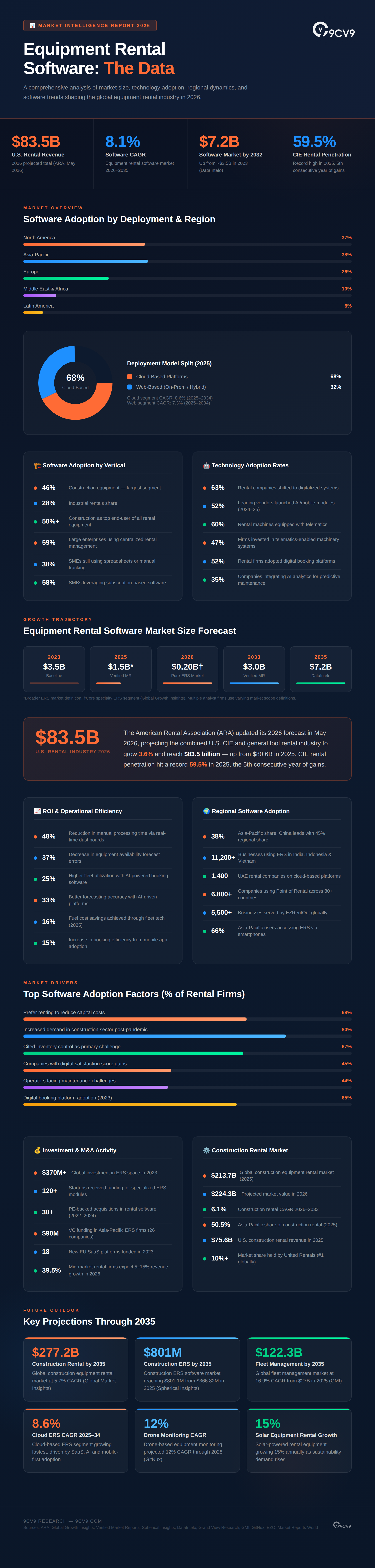
Cloud computing and automation are among the most influential equipment rental software trends in 2026. Industry estimates suggest that cloud-based platforms accounted for approximately 68% of the equipment rental software market in 2025, while nearly 63% of rental companies worldwide have transitioned toward digitalized operational systems. Additionally, 52% of rental businesses reportedly adopted digital booking platforms, and 47% invested in telematics-enabled equipment management systems, demonstrating the growing importance of connected technologies.
Artificial intelligence is further reshaping the equipment rental software landscape. From predictive maintenance and automated scheduling to dynamic pricing and fleet utilization forecasting, AI-powered rental management solutions are helping businesses make more informed operational decisions. Industry estimates indicate that approximately 35% of rental companies have begun integrating AI-driven predictive maintenance analytics, while 50% have adopted mobile applications to streamline rental processes.
Despite these technological advancements, significant challenges remain. Equipment downtime, inventory inaccuracies, maintenance costs, and fragmented rental operations continue to affect profitability. Research suggests that approximately 38% of small and medium-sized rental businesses still rely on spreadsheets or manual tracking methods, highlighting substantial opportunities for affordable, scalable, and user-friendly equipment rental software solutions.
Understanding these developments is essential for rental business owners, construction companies, equipment fleet managers, software vendors, investors, and technology decision-makers seeking to navigate an increasingly competitive market.
This comprehensive guide to the Top 105 Equipment Rental Software Statistics, Data & Trends in 2026 explores the latest industry insights across global market size, revenue forecasts, cloud software adoption, AI and IoT integration, fleet management technology, operational efficiency, regional growth, and emerging rental industry trends.
By examining these equipment rental software statistics, businesses can better understand the technologies shaping the future of equipment rentals, identify opportunities for digital transformation, benchmark industry developments, and make more informed decisions about equipment rental management software investments in 2026 and beyond.
Before we venture further into this article, we would like to share who we are and what we do.
About 9cv9
9cv9 is a business tech startup based in Singapore and Asia, with a strong presence all over the world.
With over ten years of startup and business experience, and being highly involved in connecting with thousands of companies and startups, the 9cv9 team has listed some of the top and best companies/tools in this review.
If you like to get your company listed in our top B2B software reviews, check out our world-class 9cv9 Media and PR service and pricing plans here.
Top 105 Equipment Rental Software Statistics, Data & Trends in 2026
MARKET SIZE & REVENUE
- The global equipment rental software (ERS) market reached approximately USD 3.5 billion in 2023 and is projected to reach USD 7.2 billion by 2032, reflecting a CAGR of 8.4%. The trajectory confirms that digital rental management is one of the fastest-growing subsectors within enterprise SaaS. (Source: DataIntelo)
- An alternative market scope values the ERS market at USD 1.5 billion in 2024, projected to reach USD 3.0 billion by 2033 at a CAGR of 8.5% from 2026 to 2033 — underscoring strong and sustained demand for rental automation platforms. (Source: Verified Market Reports)
- The specialized construction equipment rental software segment was valued at USD 1.6 billion in 2025, expected to reach USD 3.4 billion by 2034 at a CAGR of 9.2% — the construction vertical remains the most software-hungry segment in the rental market. (Source: Verified Market Reports)
- A narrower pure-play ERS market definition pegs the segment at USD 0.19 billion in 2025, growing to USD 0.20 billion in 2026 and USD 0.41 billion by 2035 at a CAGR of 8.1% — reflecting the core rental management software segment excluding adjacent fleet tools. (Source: Global Growth Insights)
- The construction ERS segment specifically is projected to grow from USD 366.82 million in 2025 to USD 801.1 million by 2035 at a CAGR of 8.12% — more than doubling in a decade as construction digitalization accelerates worldwide. (Source: Spherical Insights)
- The broader equipment rental software market (inclusive of all verticals) is forecasted to expand from USD 48.97 billion in 2025 to USD 55.16 billion by 2033 at a CAGR of 1.5% — this figure includes the combined market value of the entire rental sector software ecosystem. (Source: Business Research Insights)
- The global equipment rental market itself was valued at USD 49.4 billion in 2025, expected to reach USD 56.09 billion by 2035 at a 1.4% CAGR — the software layer is growing at 5–8× the pace of the overall rental market. (Source: Business Research Insights)
- In 2023, global investments in the equipment rental software space exceeded USD 370 million, with over 120 startups receiving funding to develop specialized modules — signaling strong private capital conviction in the digitalization of rental operations. (Source: Market Reports World)
U.S. & NORTH AMERICAN RENTAL INDUSTRY
- The combined U.S. construction and industrial equipment (CIE) and general tool rental industry finished 2025 as an $80.6 billion industry, growing 3.3% from 2024 — the fifth consecutive year of expansion. (Source: American Rental Association, March 2026)
- ARA’s May 2026 updated forecast projects the U.S. CIE and general tool rental industry to grow 3.6% in 2026, totaling $83.5 billion — revised upward from an earlier projection of 2.8% growth. (Source: ARA, May 2026)
- The CIE rental penetration rate hit a record 59.5% in 2025 — the fifth consecutive annual increase — meaning nearly 6 in 10 pieces of construction equipment used in America are now rented rather than owned. (Source: ARA)
- Beyond 2026, the ARA projects U.S. CIE and general tool rental revenue to grow 3.8% in 2027 and 4.4% in 2028, indicating long-term structural demand for rental over ownership models. (Source: ARA)
- The U.S. event rental industry finished 2025 at $5.6 billion (up 5.6% from 2024) and is forecast to grow 8% in 2026 to reach $6.1 billion — the fastest-growing sub-segment in U.S. rentals. (Source: ARA, May 2026)
- In Canada, the combined CIE and general tool rental industry is forecast to grow 5% in 2026, reaching $6.3 billion — supported by improving investment activity and infrastructure spending. (Source: ARA, May 2026)
- The U.S. led the construction equipment rental market with USD 75.6 billion in revenue in 2025, driven by large-scale infrastructure projects, urbanization, and high rental penetration rates. (Source: Grand View Research)
- North America holds approximately 37% of the global equipment rental software market share, supported by early adoption of digital construction technologies and strong presence of rental companies. (Source: Global Growth Insights)
- There are more than 1.5 million pieces of rental equipment in circulation across North America alone, driving acute demand for software solutions that provide real-time inventory dashboards. (Source: Market Reports World)
- In North America, private equity firms backed over 30 acquisitions in the rental software domain between 2022 and 2024, reflecting strong consolidation dynamics and investor confidence in SaaS rental platforms. (Source: Market Reports World)
GLOBAL CONSTRUCTION RENTAL MARKET
- The global construction equipment rental market was estimated at USD 159.8 billion in 2025 and is expected to grow to USD 168.7 billion in 2026, reaching USD 277.2 billion by 2035 at a CAGR of 5.7%. (Source: Global Market Insights)
- An alternative estimate pegs the global construction equipment rental market at USD 213.68 billion in 2025, growing to USD 224.27 billion in 2026 at a CAGR of 6.1% through 2033. (Source: Grand View Research)
- Asia-Pacific dominates the construction equipment rental market with a 50.5% share in 2025, attributed to growth in highway construction, metro rail, airports, and Special Economic Zones. (Source: Grand View Research)
- Asia-Pacific’s construction rental share is even higher by some estimates, reaching 62.1% in 2026 as rapid urbanization and large-scale infrastructure projects continue unabated across China, India, and Southeast Asia. (Source: Coherent Market Insights)
- The top 5 players in the construction equipment rental market — United Rentals, Ashtead (Sunbelt), H&E Equipment, Herc Rentals, and Loxam — collectively held a 22% market share in 2025, with United Rentals alone holding over 10%. (Source: Global Market Insights)
- Germany’s construction equipment rental market revenue was approximately USD 8.7 billion in 2025, projected to grow at a 4.4% CAGR to reach nearly USD 12 billion in 2033, driven by infrastructure modernization. (Source: Grand View Research)
- Brazil’s construction equipment rental market is expected to experience robust growth of 6.6% between 2026 and 2035, fueled by housing demand and public infrastructure investment. (Source: Global Market Insights)
CLOUD & DEPLOYMENT TRENDS
- Cloud-based ERS platforms held the largest deployment share, accounting for USD 0.13 billion (68%) of the total ERS market in 2025 — testament to rental operators’ preference for scalability and remote accessibility. (Source: Global Growth Insights)
- The cloud-based ERS segment is expected to grow at a CAGR of 8.6% from 2025 to 2034, outpacing the overall market rate and reinforcing the shift away from on-premises systems. (Source: Global Growth Insights)
- Web-based (non-cloud SaaS) ERS accounted for USD 0.06 billion (32%) of the market in 2025, projected to grow at a CAGR of 7.3% — still significant, especially for cost-constrained SMEs. (Source: Global Growth Insights)
- The United States led the cloud-based ERS segment with a 38% share, driven by early SaaS adoption and construction digitalization; China followed with a 24% share. (Source: Global Growth Insights)
- Germany accounted for 15% of the cloud-based ERS segment, benefiting from strong enterprise software deployment across logistics and automotive rental sectors. (Source: Global Growth Insights)
- India led the web-based ERS segment with a 29% market share, driven by rapid expansion of small rental companies embracing lower-cost digital tools. (Source: Global Growth Insights)
- Fleet management cloud solutions dominate with a 70% market share in 2025, growing at a CAGR of 18.2% — significantly outpacing the growth of on-premises fleet management deployments. (Source: Global Market Insights)
- Over 52% of leading ERS vendors launched AI-enabled modules and mobile platforms in 2024–2025, indicating a competitive race to integrate generative AI and automation into core rental workflows. (Source: Global Growth Insights)
DIGITALIZATION & TECHNOLOGY ADOPTION
- Nearly 63% of rental companies globally have shifted to digitalized systems to improve operational efficiency — a majority crossing the digital adoption threshold for the first time by 2025. (Source: Global Growth Insights)
- 52% of rental firms adopted digital booking platforms in 2025, while 47% invested in telematics-enabled machinery management systems — twin pillars of the modern digital rental operation. (Source: Business Research Insights)
- About 60% of rental machines are equipped with telematics as of 2023–2024, enabling remote monitoring of usage, location, and performance data that feeds back into software dashboards. (Source: GitNux)
- The rental equipment industry is seeing a 10% annual growth in the use of contactless payment and digital rental processes — driven by post-pandemic shifts in customer expectations for frictionless transactions. (Source: GitNux)
- Approximately 35% of rental companies have started integrating AI-driven analytics for predictive maintenance, reducing unplanned downtime and extending equipment lifecycle. (Source: GitNux)
- The rental industry is embracing digital twins technology, with 20% of companies already exploring or implementing it — enabling virtual simulation of equipment behavior and maintenance cycles. (Source: GitNux)
- 50% of rental companies have adopted mobile apps to streamline the rental process, leading to a 15% increase in booking efficiency compared to phone or walk-in booking methods. (Source: GitNux)
- 65% of rental companies reported an increase in digital and online rental booking platforms in 2023, a trend that has continued and accelerated into 2025–2026. (Source: GitNux)
- In 2025, the number of rental outlets is expected to increase by approximately 15%, driven by digital platforms enabling smaller operators to launch and scale without heavy capital overhead. (Source: Market Research Future)
- 41% of rental firms launched mobile-based booking apps while 36% expanded cross-border rental partnerships in 2025, broadening service reach through digital channels. (Source: Business Research Insights)
- Use of drones for equipment monitoring is projected to grow at a CAGR of 12% through 2028, with rental operators deploying aerial surveillance to inspect large construction sites and track assets. (Source: GitNux)
AI, IoT & EMERGING TECH
- A report from the International Data Corporation (IDC) estimates that global IoT spending exceeded USD 1 trillion by 2025, underscoring the enormous potential for IoT integration within rental software solutions. (Source: Verified Market Reports)
- The European Rental Association reports 58% of industrial firms are adopting digital tracking and IoT-enabled rental equipment for efficiency improvements — a notably high rate for a traditionally conservative market. (Source: Business Research Insights)
- AI-powered booking platforms like Anolla demonstrated 33.1% better forecasting accuracy than market average and 68.5% more precise booking-window timing in comparative tests, illustrating the tangible value of AI in rental scheduling. (Source: Anolla Platform, 2026)
- AI-driven platforms also delivered 22–25% higher fleet utilization and faster inventory turnover in equipment rental scenario simulations, with better revenue distribution during peak and seasonal demand periods. (Source: Anolla Platform, 2026)
- Orion Software’s fleet telematics integration (launched April 2023) now covers over 75,000 pieces of rental equipment, providing GPS-based location, maintenance, and usage data in real time. (Source: Market Reports World)
- In January 2026, EquipmentShare enhanced its T3 platform with AI-driven fleet analytics, rental management, and telematics — enabling contractors to optimize utilization, reduce downtime, and improve jobsite visibility. (Source: Spherical Insights)
- In October 2025, United Rentals enhanced its Total Control platform — a cloud-based worksite management solution — enabling real-time equipment tracking, utilization analytics, and improved operational efficiency for North American rental businesses. (Source: Spherical Insights)
- In March 2025, Krank launched Inspeq, an AI-powered inspection app that lets users document construction equipment conditions and track maintenance during inspections — a growing category of AI-assisted field tools. (Source: Coherent Market Insights)
- In April 2026, CASE Construction Equipment introduced new machines and technology upgrades designed to give rental businesses equipment that is easy to operate, simple to maintain, and quick to deploy. (Source: Coherent Market Insights)
- Nearly half of GPS tracking users achieved positive ROI in less than one year, according to the 2025 Fleet Technology Trends Report — making telematics one of the fastest-payback investments in rental operations. (Source: Verizon Connect / Heavy Duty Journal, 2025)
OPERATIONAL EFFICIENCY & ROI
- Software solutions providing real-time dashboards and automated equipment status updates have reduced manual processing time by 48% and decreased errors in equipment availability forecasts by 37%. (Source: Market Reports World)
- Fuel cost savings doubled from 8% in 2021 to 16% in 2025 among fleets using GPS and telematics technology — one of the clearest financial returns on investment for digitalized rental operations. (Source: Verizon Connect / Heavy Duty Journal, 2025)
- Accident-related cost reductions jumped from 11% to 22% between 2021 and 2025 for fleets using digital management tools, dramatically reducing insurance and liability exposure. (Source: Verizon Connect / Heavy Duty Journal, 2025)
- 34% of GPS fleet users achieved measurable idle-time reductions through automated monitoring and driver coaching — directly reducing fuel waste and equipment wear in rental fleets. (Source: Verizon Connect / Heavy Duty Journal, 2025)
- 45% of rental companies report higher customer satisfaction scores after digital transformation initiatives, reflecting improvements in booking speed, communication, and equipment availability accuracy. (Source: GitNux)
- More than 50% of rental companies are investing in staff training for new technology adoption, leading to a 12% increase in operational efficiency across their fleets. (Source: GitNux)
- Downtime costs in large-scale fleet operations can exceed USD 1,000 per hour, making predictive maintenance and real-time tracking features of ERS some of the highest-ROI investments available to rental operators. (Source: Market Reports World)
- AI rental assistants operating 24/7 have been shown to reduce rental staff administrative workload by 8–10 hours per week through automated booking management, date changes, cancellations, and inventory swaps. (Source: Anolla Platform, 2026)
- 39.5% of mid-market and enterprise rental businesses expect 5–15% revenue growth in 2026, with success tied to automation, utilization optimization, and margin protection rather than fleet expansion alone. (Source: EZO State of Industry Report 2026)
MARKET CHALLENGES & BARRIERS
- Approximately 38% of SMEs in the rental sector still rely on spreadsheets or manual tracking due to high upfront software implementation costs and lack of internal IT infrastructure — a significant addressable market for affordable SaaS tools. (Source: Market Reports World)
- 44% of operators face maintenance challenges, while 39% report equipment downtime as a key factor impacting rental profitability — the two core pain points that ERS platforms most directly address. (Source: Business Research Insights)
- Over 67% of rental businesses cited inventory control as their primary challenge in 2023, creating a clear demand signal for software solutions with real-time asset visibility and automated status updates. (Source: Market Reports World)
- Despite digitalization momentum, offline rental still contributes 58% of market activity, with online rental channels accounting for only 42% — indicating a long runway for digital platform adoption. (Source: Business Research Insights)
- High fleet acquisition and maintenance costs for rental companies — and equipment availability constraints during peak demand — remain key restraints that software alone cannot fully resolve. (Source: Global Market Insights)
SME vs. ENTERPRISE ADOPTION
- Over 58% of small and medium businesses (SMBs) in the rental sector now leverage subscription-based software to cut manual costs and reduce reliance on paper-based workflows. (Source: Global Growth Insights)
- Approximately 59% of large-scale construction and logistics companies utilize centralized rental management systems to handle multi-site assets, optimizing fleet allocation across geographically dispersed projects. (Source: Global Growth Insights)
- Large enterprises focus on automation, cost reduction, and global project synchronization, while SMEs prioritize ease of use and affordability — driving a bifurcated software market with distinct product tiers. (Source: Verified Market Reports)
- Around 2,300 SMEs in Latin America are considered high-potential targets for modular ERS investments due to rising mobile infrastructure and growing contractor activity in the region. (Source: Market Reports World)
- Rental leasing is increasingly preferred due to tax advantages, with about 70% of companies opting for leasing over purchasing equipment — directly expanding the total addressable market for rental software. (Source: GitNux)
REGIONAL DEEP-DIVES
- Asia-Pacific dominates the global ERS market with a 38% share in 2025; the region is propelled by rapid urbanization, infrastructure development, and widespread adoption of mobile-based rental solutions. (Source: Global Growth Insights)
- China leads Asia-Pacific ERS adoption with a 45% regional share, supported by large-scale digital transformation initiatives and IoT integration in rental operations. (Source: Global Growth Insights)
- Japan holds an 18% share of Asia-Pacific ERS revenue, driven by advanced robotics integration and cloud adoption for construction rentals. (Source: Global Growth Insights)
- India captured 15% of Asia-Pacific ERS market share, boosted by the rapid rise of SMEs adopting SaaS-based rental management tools; over 3,700 companies in India alone implemented software solutions in 2023 to support infrastructure projects. (Source: Global Growth Insights / Market Reports World)
- Over 11,200 businesses across India, Indonesia, and Vietnam are now using equipment rental software, reflecting the digital maturation of Southeast Asian rental markets. (Source: Market Reports World)
- Mobile-first adoption dominates Asia-Pacific, with 66% of users accessing ERS systems via smartphones — a sharp contrast to desktop-heavy usage patterns prevalent in North America and Europe. (Source: Market Reports World)
- Europe holds 26% of the global ERS market share, driven by rental fleet optimization initiatives and stringent compliance requirements that push companies toward software-driven documentation and reporting. (Source: Global Growth Insights)
- The Middle East & Africa region holds a 10% market share, with the UAE and Saudi Arabia leading smart city-driven digital infrastructure investments. Over 6,000 businesses in MEA used ERS in 2024. (Source: Global Growth Insights / Market Reports World)
- In the UAE, 1,400 rental companies transitioned to cloud-based platforms, initially spurred by Expo-related infrastructure needs that required coordinated multi-site asset management. (Source: Market Reports World)
- South Africa hosts over 2,100 businesses in the construction rental segment, with 34% using software specifically for fleet management. (Source: Market Reports World)
- Nigeria and Kenya are emerging markets, with a combined 800 new rental businesses projected to go digital by 2026 — representing an early-stage but high-growth opportunity for ERS vendors. (Source: Market Reports World)
- In Europe, venture capital funding supported 18 new SaaS rental platforms in 2023, focusing on compliance automation, API connectivity, and mobile access. (Source: Market Reports World)
- Asia-Pacific saw nearly USD 90 million in venture funding allocated across 26 ERS software firms, primarily in India, Singapore, and China. One Indian startup alone deployed a multilingual platform for over 8,000 users in 2024. (Source: Market Reports World)
KEY SOFTWARE VENDORS
- Point of Rental is utilized by over 6,800 companies across 80+ countries, managing more than 2.1 million equipment items — making it the broadest-reaching ERS platform by geographic footprint. (Source: Market Reports World)
- EZRentOut serves over 5,500 businesses worldwide with more than 1.2 million assets tracked across its platform, focusing on ease of use for SMEs and mid-market operators. (Source: Market Reports World)
- MCS Global Ltd launched a GDPR compliance automation suite in January 2024, already adopted by 870 EU-based rental firms — reflecting the growing compliance-driven demand for ERS in regulated European markets. (Source: Market Reports World)
- InTempo merged with Texada in 2023 to create a combined platform targeting mid-market and enterprise rental businesses, offering both cloud and on-premises solutions — one of the largest consolidation moves in ERS history. (Source: rent2B, 2026)
- The equipment rental industry is projected to reach USD 250 billion globally by 2027, creating enormous downstream demand for all categories of rental management software. (Source: rent2B, 2026)
SUSTAINABILITY & ELECTRIC EQUIPMENT TRENDS
- Electric and hybrid equipment is becoming a growing segment of rental fleets, with contractors prioritizing lower-emission machinery — creating demand for ERS platforms capable of tracking battery status, charging schedules, and emission reports. (Source: Coherent Market Insights / Grand View Research)
- Solar-powered rental equipment is growing at 15% annually as businesses strive to reduce their carbon footprint, reshaping fleet composition and the types of assets software platforms must manage. (Source: GitNux)
- The global electrical rental equipment market is expected to reach USD 12 billion by 2026, with software playing a critical role in managing the unique maintenance and billing cycles of electrical gear. (Source: GitNux)
- Approximately 93% of construction equipment is still diesel-powered, but the transition to electric and hybrid fleets is accelerating — ERS platforms are adapting with new asset-type modules and emissions dashboards. (Source: yo-rent.com)
- The aerial work platform rental industry is expected to reach USD 69 billion by 2030, growing at a CAGR of 8.9% — a vertically specialized segment where software for utilization tracking and height-safety compliance is critical. (Source: yo-rent.com)
FUTURE OUTLOOK & EMERGING TRENDS
- The global fleet management market was estimated at USD 27 billion in 2025 and is expected to reach USD 122.3 billion by 2035 at a CAGR of 16.9% — and equipment rental fleet software is a significant and fast-growing component of this market. (Source: Global Market Insights)
- Cloud-based fleet management solutions dominate with 70% market share in 2025 and are growing at an 18.2% CAGR, far outpacing on-premises alternatives. (Source: Global Market Insights)
- Dynamic pricing strategies are becoming a key financial goal for rental companies in 2025–2026, with AI-powered platforms enabling real-time rate adjustments based on demand, competitor pricing, and market conditions. (Source: STAEDEAN Rental Blog)
- Real-time fleet visibility is becoming a baseline expectation rather than a differentiator — telematics, GPS data, and integrated rental fleet management software are now considered essential infrastructure by 2026. (Source: RMI USA, January 2026)
- The construction equipment market is projected to grow at a CAGR of 6.16% from 2026 to 2035, reaching USD 411.55 billion by 2035 — of which the rental share is steadily increasing, driving software demand proportionally. (Source: Precedence Research via yo-rent.com)
- The European scaffolding market alone is estimated at USD 17.88 billion in 2026 and projected to grow to USD 27.68 billion by 2034, representing a substantial vertical for specialized ERS modules. (Source: Market Data Forecast via yo-rent.com)
- Customer self-service portals and online reservations are projected to play a central role in rental competitiveness in 2026, with companies offering 24/7 digital booking achieving measurable advantages in customer retention. (Source: RMI USA, January 2026)
- The global rental crane market is projected to grow at a CAGR of 4.8% through 2030, with software increasingly required to manage the complex scheduling, certification tracking, and liability documentation of crane rentals. (Source: GitNux)
- Average equipment rental contract duration is approximately 7.4 days, making high-frequency transaction processing, automated contract generation, and rapid invoicing among the most critical software capabilities for rental operators. (Source: GitNux)
Conclusion
The Top 105 Equipment Rental Software Statistics, Data & Trends in 2026 highlight an industry experiencing significant digital transformation, driven by increasing demand for cloud-based rental management software, artificial intelligence (AI), Internet of Things (IoT) integration, and automated fleet management solutions. As equipment rental businesses face growing operational complexities, rising maintenance costs, and increasing customer expectations, adopting modern equipment rental software is becoming essential for improving efficiency, maximizing asset utilization, and maintaining competitiveness.
Industry research indicates that the global equipment rental software market could reach USD 7.2 billion by 2032, growing at a compound annual growth rate (CAGR) of 8.4% from 2023. Although market estimates vary depending on the software categories included, the overall outlook points toward sustained demand for digital rental management solutions. Meanwhile, the U.S. construction and industrial equipment and general tool rental industry is projected to generate USD 83.5 billion in revenue in 2026, reinforcing the importance of scalable software infrastructure across the broader rental ecosystem.
One of the most significant equipment rental software trends in 2026 is the accelerating adoption of cloud computing and mobile technology. Industry estimates suggest that cloud-based platforms represented approximately 68% of the equipment rental software market in 2025, while nearly 63% of rental companies worldwide have transitioned toward digitalized operational systems. These developments demonstrate how rental businesses are increasingly prioritizing real-time equipment tracking, automated booking systems, inventory visibility, and integrated rental management platforms.
Artificial intelligence and predictive analytics are also transforming equipment rental operations. AI-powered scheduling, predictive maintenance, dynamic pricing, and fleet utilization forecasting are helping businesses reduce equipment downtime, optimize rental availability, and improve profitability. With approximately 35% of rental companies reportedly integrating AI-driven predictive maintenance analytics, intelligent automation is emerging as an important competitive differentiator in the equipment rental software market.
However, digital transformation challenges remain substantial. Approximately 38% of small and medium-sized rental businesses still rely on spreadsheets or manual equipment tracking, while maintenance difficulties, inventory management inefficiencies, and equipment downtime continue to affect operational performance. These challenges create significant opportunities for equipment rental software providers to develop affordable, intuitive, and scalable solutions tailored to businesses of different sizes.
Looking ahead, the future of equipment rental software beyond 2026 will likely be shaped by deeper AI integration, connected equipment ecosystems, advanced telematics, mobile-first rental platforms, automated maintenance management, and sustainability-focused fleet optimization. As equipment rental companies increasingly adopt digital technologies, software solutions that combine operational visibility, automation, customer convenience, and data-driven decision-making will become increasingly valuable.
Ultimately, these 105 equipment rental software statistics, data points, and industry trends for 2026 demonstrate that digital transformation is no longer simply an optional improvement for rental businesses. It is becoming a strategic requirement for sustainable growth, operational resilience, and long-term profitability.
For equipment rental companies, construction businesses, fleet managers, software developers, and investors, understanding these statistics provides valuable insights into market opportunities, emerging technologies, and evolving customer expectations. Organizations that strategically invest in modern equipment rental management software, AI-powered automation, and integrated fleet management technologies will be better positioned to improve operational performance, respond to changing market demands, and compete successfully in the global equipment rental industry.
If you find this article useful, why not share it with your hiring manager and C-level suite friends and also leave a nice comment below?
We, at the 9cv9 Research Team, strive to bring the latest and most meaningful data, guides, and statistics to your doorstep.
To get access to top-quality guides, click over to 9cv9 Blog.
To hire top talents using our modern AI-powered recruitment agency, find out more at 9cv9 Modern AI-Powered Recruitment Agency.
People Also Ask
What is equipment rental software?
Equipment rental software is a digital solution that helps businesses manage equipment bookings, inventory, rental contracts, maintenance schedules, invoicing, and fleet tracking. It improves operational efficiency and simplifies rental management processes.
How big is the global equipment rental software market in 2026?
Market estimates vary by definition. One industry forecast values the equipment rental software market at approximately USD 200 million in 2026, while broader estimates indicate a multibillion-dollar market with significant growth potential.
What is the projected growth rate of the equipment rental software market?
The global equipment rental software market is projected to grow at a compound annual growth rate (CAGR) of approximately 8.4% through 2032, driven by cloud adoption, automation, and increasing demand for digital rental management solutions.
What are the biggest equipment rental software trends in 2026?
Major equipment rental software trends in 2026 include cloud-based platforms, AI-powered predictive maintenance, IoT integration, mobile rental applications, automated booking systems, real-time fleet tracking, and dynamic rental pricing.
How much is the equipment rental software market expected to be worth by 2032?
According to industry estimates, the global equipment rental software market could reach approximately USD 7.2 billion by 2032, supported by increasing digital transformation across construction, industrial equipment, and rental businesses.
What percentage of equipment rental software is cloud-based?
Cloud-based equipment rental software accounted for approximately 68% of the global market in 2025, reflecting growing demand for scalable, remotely accessible rental management platforms and integrated fleet management solutions.
How many equipment rental companies use digital management systems?
Industry estimates suggest that approximately 63% of rental companies worldwide have transitioned toward digitalized management systems, improving inventory tracking, equipment scheduling, customer bookings, and operational efficiency.
How is artificial intelligence transforming equipment rental software?
Artificial intelligence helps equipment rental companies automate bookings, forecast equipment demand, optimize rental pricing, predict maintenance requirements, and improve fleet utilization through advanced analytics and intelligent decision-making.
What percentage of rental companies use AI-powered predictive maintenance?
Approximately 35% of equipment rental companies have reportedly started integrating AI-driven predictive maintenance analytics to reduce unexpected equipment failures, minimize downtime, and extend asset lifecycles.
How does IoT technology improve equipment rental management?
IoT technology connects rental equipment to digital management platforms, enabling real-time location tracking, usage monitoring, maintenance alerts, equipment diagnostics, and improved fleet visibility across multiple locations.
What is the equipment rental industry revenue forecast for 2026?
The U.S. construction and industrial equipment and general tool rental industry is projected to generate approximately USD 83.5 billion in 2026, representing 3.6% growth from 2025, according to the American Rental Association.
What is the global construction equipment rental market size in 2026?
One industry forecast estimates the global construction equipment rental market at approximately USD 168.7 billion in 2026, with revenue potentially reaching USD 277.2 billion by 2035.
Which region dominates the global equipment rental software market?
Asia-Pacific is estimated to hold approximately 38% of the global equipment rental software market in 2025, supported by infrastructure development, construction activity, and increasing adoption of digital rental management solutions.
What is North America’s share of the equipment rental software market?
North America accounts for approximately 37% of the global equipment rental software market, supported by advanced construction technologies, widespread software adoption, and established equipment rental businesses.
How popular are mobile applications in equipment rental businesses?
Approximately 50% of rental companies have adopted mobile applications to streamline equipment bookings and rental operations, with reported improvements of around 15% in booking efficiency compared with traditional methods.
What percentage of equipment rental businesses use digital booking platforms?
Industry estimates indicate that approximately 52% of equipment rental businesses adopted digital booking platforms in 2025, reflecting growing demand for online reservations, automated scheduling, and improved customer convenience.
How does equipment rental software reduce operational costs?
Equipment rental software reduces operational costs through automated workflows, improved inventory accuracy, preventive maintenance scheduling, real-time equipment tracking, and reduced administrative workloads.
What are the biggest challenges facing equipment rental companies in 2026?
Major challenges include equipment downtime, maintenance expenses, inventory inaccuracies, high fleet acquisition costs, seasonal demand fluctuations, and difficulties integrating digital technologies into existing rental operations.
How many small rental businesses still use spreadsheets for equipment tracking?
Approximately 38% of small and medium-sized rental businesses reportedly continue using spreadsheets or manual tracking systems, highlighting opportunities for affordable and easy-to-use rental management software.
How does equipment rental software improve fleet utilization?
Equipment rental software improves fleet utilization by tracking equipment availability, identifying underused assets, forecasting rental demand, optimizing scheduling, and reducing unnecessary equipment downtime.
What percentage of rental companies use telematics technology?
Industry estimates suggest that approximately 47% of rental companies invested in telematics-enabled machinery management systems in 2025, supporting real-time equipment monitoring, location tracking, and maintenance optimization.
What are the benefits of cloud-based equipment rental software?
Cloud-based equipment rental software provides remote accessibility, centralized inventory management, automated updates, scalable operations, real-time reporting, and improved collaboration across multiple rental locations.
How does predictive maintenance software benefit equipment rental companies?
Predictive maintenance software analyzes equipment usage and performance data to identify potential failures, schedule timely servicing, reduce unplanned downtime, and extend the operational lifespan of rental assets.
What is the role of automation in equipment rental management?
Automation simplifies equipment reservations, contract generation, billing, inventory updates, maintenance scheduling, and customer communications, helping rental companies reduce manual tasks and improve operational accuracy.
How does equipment rental software improve customer satisfaction?
Equipment rental software improves customer satisfaction through faster bookings, accurate equipment availability information, automated notifications, transparent billing, and convenient online self-service options.
What percentage of rental companies report improved customer satisfaction after digital transformation?
Approximately 45% of rental companies reportedly experienced higher customer satisfaction scores following digital transformation initiatives, particularly through improved booking processes, communication, and equipment availability.
How is equipment rental software supporting sustainability in 2026?
Equipment rental software supports sustainability by monitoring fuel consumption, optimizing equipment utilization, reducing unnecessary transportation, tracking emissions, and managing electric and hybrid equipment fleets.
What is the future of AI-powered equipment rental software?
AI-powered equipment rental software is expected to increasingly support automated scheduling, dynamic pricing, predictive maintenance, demand forecasting, intelligent fleet allocation, and data-driven rental business decisions.
How can small businesses choose the best equipment rental software?
Small rental businesses should evaluate affordability, ease of use, cloud accessibility, inventory tracking, booking automation, maintenance management, invoicing capabilities, customer support, and scalability before selecting software.
Why is equipment rental software important for businesses in 2026?
Equipment rental software helps businesses improve operational efficiency, reduce downtime, maximize equipment utilization, automate administrative processes, and deliver better customer experiences in an increasingly competitive rental industry.
Sources
Global Growth Insights
Verified Market Reports
Spherical Insights
DataIntelo
Business Research Insights
Market Reports World
American Rental Association (ARA)
Construction Business Owner
Lift and Access
OPE Plus
Grand View Research
Global Market Insights
Coherent Market Insights
GitNux
EZO
STAEDEAN
RMI USA
Anolla
rent2B
Market Research Future
Heavy Duty Journal
YO!Rent
The Insight Partners
International Rental News
Heavy Equipment Guide
Precedence Research