


























Key Takeaways
- Rapid Market Growth: The global equity management software market is projected to reach $1.46 billion in 2026 and $3.56 billion by 2034, driven by increasing demand for digital equity administration, ESOP management, and automated compliance solutions.
- Cloud Adoption and AI Innovation: Cloud-based equity management software accounts for approximately 60% of the market, while artificial intelligence, automation, and advanced analytics are transforming capitalization table management, stock option tracking, and equity compensation administration.
- Growing Employee Ownership and Global Expansion: With approximately 14.7 million US ESOP participants and $2.1 trillion in plan assets, increasing employee equity compensation adoption and expanding startup ecosystems are driving demand for scalable equity management platforms worldwide.
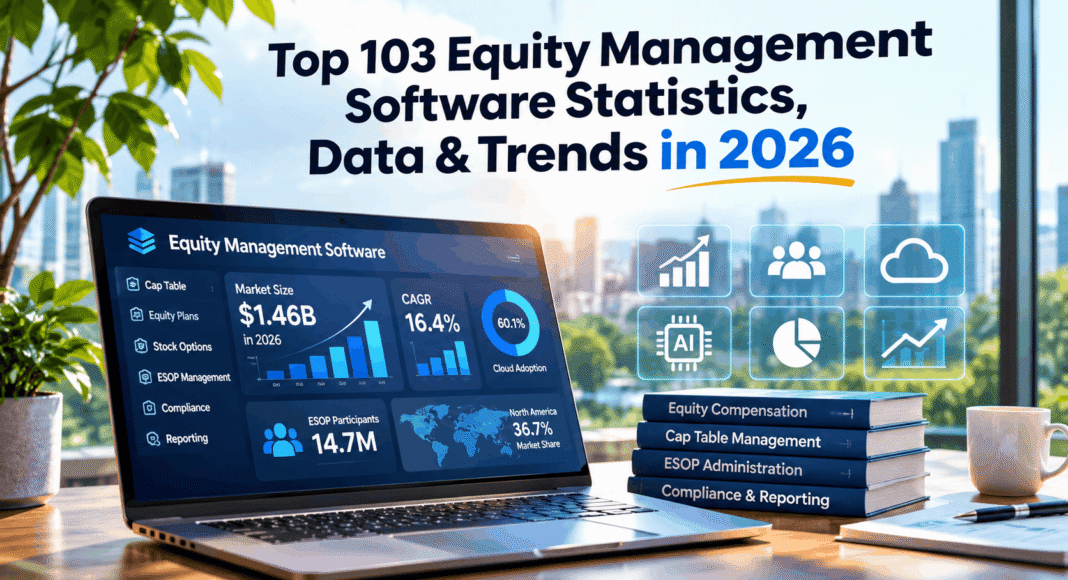
Equity management software is transforming how businesses manage ownership, employee stock options, and equity compensation in 2026. The global market is projected to reach $1.46 billion in 2026 and $3.56 billion by 2034. Explore 103 key statistics covering market growth, ESOP adoption, cloud technology, AI automation, and emerging industry trends.
The global equity management software market is experiencing significant growth in 2026 as businesses increasingly adopt digital solutions to manage capitalization tables, employee stock ownership plans (ESOPs), stock options, equity compensation, and regulatory compliance. With organizations facing growing ownership complexity, international expansion, and evolving financial regulations, equity management software has become an essential tool for startups, enterprises, venture capital firms, and private equity investors.
Also, read our article on the Top 10 Equity Management Software To Know.
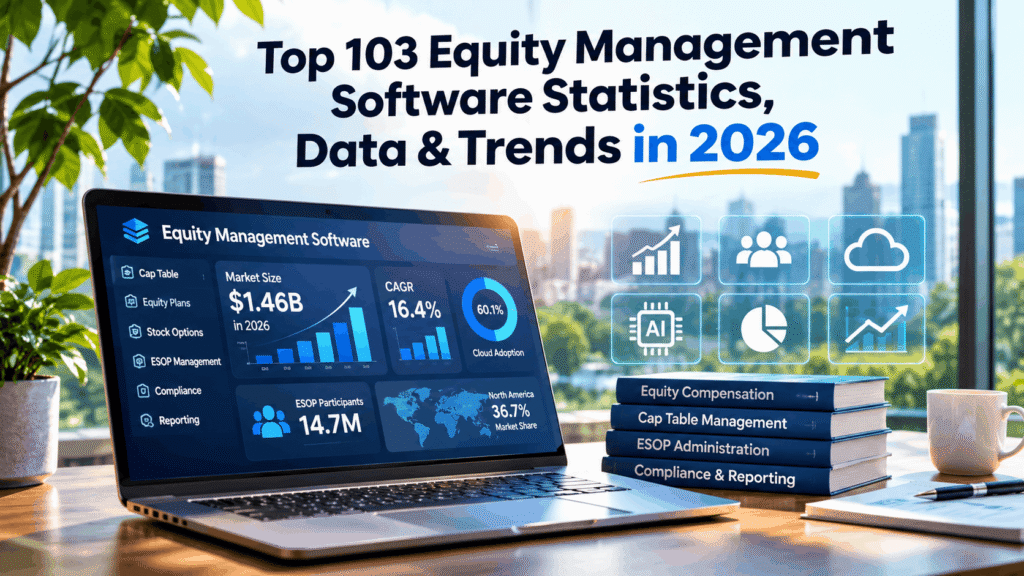
According to industry research, the global equity management software market was valued at approximately $1.25 billion in 2025 and is projected to reach $1.46 billion in 2026, with forecasts suggesting growth to $3.56 billion by 2034. Market projections indicate compound annual growth rates (CAGRs) ranging from 11.9% to 16.4%, depending on the research provider and forecast period. These figures highlight the expanding demand for cloud-based equity management platforms, automated compliance reporting, and sophisticated employee equity administration solutions.
North America continues to dominate the equity management software industry, accounting for approximately 36.7% of the global market in 2024. Meanwhile, Asia-Pacific is emerging as a major growth opportunity, supported by expanding startup ecosystems, increasing venture capital activity, and greater adoption of employee equity incentive programs. Large enterprises represented approximately 59.21% of the market in 2024, demonstrating the importance of scalable software solutions for managing complex ownership structures and equity transactions.
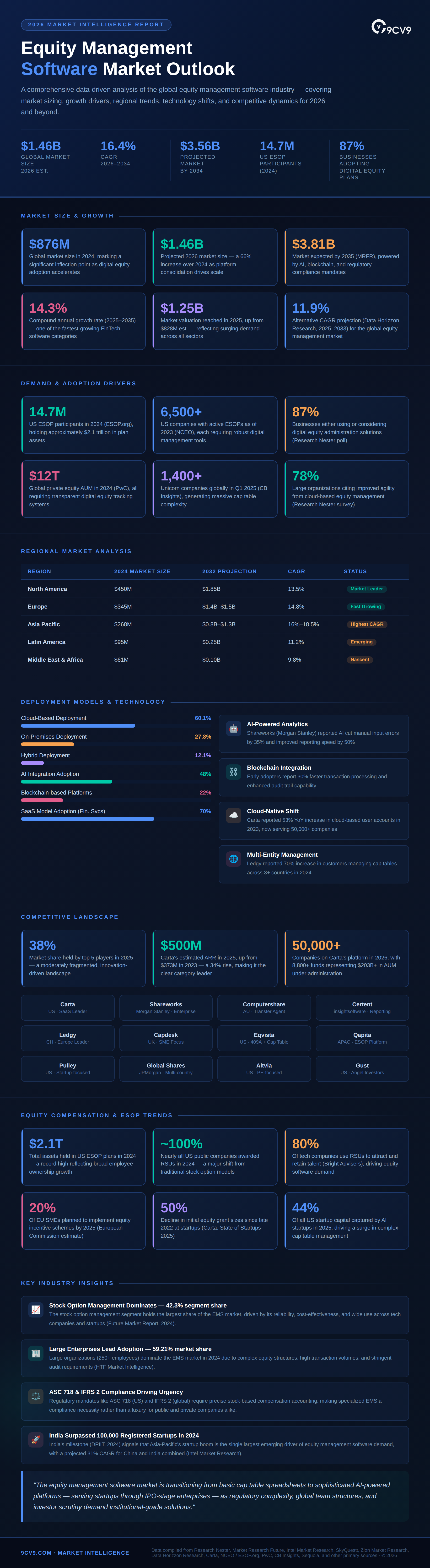
Technological innovation is also transforming the equity management software landscape. Cloud-based solutions accounted for approximately 60.1% of the market in 2024, while artificial intelligence, automated capitalization table management, blockchain technology, and integrated financial reporting are reshaping how organizations administer equity. Leading platforms such as Carta, Shareworks, Ledgy, Pulley, and Qapita are helping businesses streamline equity ownership tracking, employee stock option administration, financial reporting, and regulatory compliance.
The growing importance of employee ownership further reinforces this trend. In the United States, approximately 14.7 million individuals participated in Employee Stock Ownership Plans in 2024, representing an estimated $2.1 trillion in plan assets. At the same time, changing equity compensation practices, including restricted stock units (RSUs), performance-based equity grants, and international stock option programs, are creating additional demand for specialized equity management software.
This comprehensive guide explores the top 103 equity management software statistics, data, and trends in 2026, covering global market size, industry growth forecasts, regional adoption, cloud deployment, artificial intelligence, ESOP administration, equity compensation, competitive market dynamics, and emerging investment trends. These insights provide business leaders, HR professionals, CFOs, startup founders, investors, and technology decision-makers with valuable information to understand the evolving equity management software market, evaluate industry opportunities, and make informed decisions about equity administration technology in 2026 and beyond.
Before we venture further into this article, we would like to share who we are and what we do.
About 9cv9
9cv9 is a business tech startup based in Singapore and Asia, with a strong presence all over the world.
With over ten years of startup and business experience, and being highly involved in connecting with thousands of companies and startups, the 9cv9 team has listed some of the top and best companies/tools in this review.
If you like to get your company listed in our top B2B software reviews, check out our world-class 9cv9 Media and PR service and pricing plans here.
Top 103 Equity Management Software Statistics, Data & Trends in 2026
📦 Market Size & Growth
- $876.2M — The global equity management software market was valued at $876.2 million in 2024, signalling a mature yet rapidly expanding industry segment driven by rising corporate equity complexity. (Source: Market Research Future)
- $1.0B — Market Research Future projects the market crossed the $1 billion milestone in 2025 at $1,001.51M, a landmark reflecting mainstream enterprise adoption of digital equity tools. (Source: Market Research Future)
- $1.46B — The equity management software market is projected to reach $1.46 billion in 2026, representing a near-doubling within two years as venture-backed adoption accelerates. (Source: Intel Market Research)
- $3.56B — By 2034, the global market is expected to reach $3.56 billion, underpinned by a 16.4% CAGR driven by AI integration, cloud adoption, and expanding ESOP programs. (Source: Intel Market Research)
- $3.81B — An alternate projection from Market Research Future places the 2035 market at $3.812 billion, consistent with sustained double-digit growth trajectories across all major regions. (Source: Market Research Future)
- $3.96B — Research Nester projects the market will surpass $3.96 billion in revenue by 2037, with Asia Pacific emerging as the highest-growth region in that period. (Source: Research Nester)
- 14.3% CAGR — The market is projected to grow at a 14.3% CAGR from 2025 to 2035, making equity management software one of the most dynamic sub-sectors within enterprise financial technology. (Source: Market Research Future)
- 16.4% CAGR — Intel Market Research identifies an even more aggressive 16.4% CAGR from 2026 to 2034, reflecting accelerating momentum as cloud-native platforms displace legacy on-premise tools. (Source: Intel Market Research)
- 11.9% CAGR — Data Horizzon Research projects an 11.9% CAGR from 2025 to 2033, a conservative but robust estimate reflecting the sustained demand for ESOP and cap table solutions globally. (Source: Data Horizzon Research)
- $1.25B — The global equity management software market was valued at $1.25 billion in 2025, confirming strong year-over-year momentum following prior years of digital acceleration in financial operations. (Source: Intel Market Research)
🌍 Regional Market Data
- 36.7% — North America holds the largest regional market share at 36.7% in 2024, driven by high VC density, SEC regulatory compliance demands, and a mature startup culture. (Source: Future Market Report)
- $1.85B — North America’s equity management software market is expected to reach $1.85 billion by 2032, growing from approximately $1.0 billion in 2023. (Source: Oriel IPO)
- $191.5M — North America generated $191.5 million in revenue in 2023, confirming its position as the world’s single-largest national market for equity management solutions. (Source: KBV Research / Globe Newswire)
- $400M — Europe’s equity management platform market was approximately $400 million in 2023, with the region expected to reach $1.4 billion by 2032 at a 13% CAGR. (Source: DataIntelo)
- $1.4–$1.5B — Europe’s market is projected to grow to between $1.4 billion and $1.5 billion by 2032, fuelled by GDPR compliance requirements and increasing ESOP adoption among SMEs. (Source: DataIntelo, Oriel IPO)
- $300M — Asia-Pacific’s equity management platform market was approximately $300 million in 2023, and is expected to grow at a remarkable 16% CAGR to reach approximately $1.3 billion by 2032. (Source: DataIntelo)
- 31% CAGR — China and India together are projected to grow at a 31% CAGR in equity management software adoption, representing a $1.2 billion opportunity for solution providers by 2034. (Source: Intel Market Research)
- 18% APAC startup growth — According to the Asian Development Bank, the number of tech startups in Asia Pacific grew by 18% in 2023, directly fuelling demand for cap table and ESOP management platforms. (Source: SkyQuestt / Asian Development Bank)
- 100,000+ Indian startups — India surpassed 100,000 registered startups in 2024 (DPIIT), making it one of the fastest-growing markets for equity management software globally. (Source: SkyQuestt / DPIIT)
- CAD 11.7B in Canadian VC — Canadian startups attracted CAD 11.7 billion in venture capital in 2023 (CVCA), accelerating adoption of equity management platforms for share issuance, reporting, and compliance. (Source: SkyQuestt / CVCA)
🏢 Adoption & End-User Trends
- 87% — According to a Research Nester poll, 87% of businesses are either using or seriously considering digital solutions to administer their equity compensation plans. (Source: Research Nester)
- 78% — 78% of large-scale enterprise decision-makers say cloud-based equity management solutions have meaningfully improved their organization’s operational agility. (Source: Research Nester)
- 59.21% — Large enterprises hold 59.21% of the equity management software market share in 2024, reflecting the complexity and volume of equity transactions at scale. (Source: HTF Market Intelligence)
- 70% — Financial services firms plan to increase their cloud spending by 2025 (IDC), directly correlating with surging cloud-based equity software adoption across investment banks and asset managers. (Source: Reports & Data / IDC)
- 20% EU SMEs — The European Commission estimates that over 20% of SMEs plan to implement equity-based incentive schemes by 2025, creating a growing market for affordable ESOP platforms. (Source: SkyQuestt / European Commission)
- 30% YoY SME users — UK-based equity software provider SeedLegals reported a 30% year-over-year increase in SME users in 2023, reflecting the democratisation of equity management tools. (Source: SkyQuestt / SeedLegals)
- 12% growth in equity compensation participation — UK equity-based compensation participation grew by 12% according to HM Treasury’s March 2024 report, reflecting rising interest in digital cap table tools. (Source: SkyQuestt / HM Treasury)
- 62% of French startups — Bpifrance reported that 62% of French startups plan to expand use of stock-based compensation over the next two years, signalling strong European ESOP software demand. (Source: SkyQuestt / Bpifrance)
- 68% digital tool adoption — There was a 68% increase in adoption of digital tools for financial management broadly, with equity management platforms forming a key part of this transformation. (Source: Reports & Data)
- 12% YoY digital spending growth — Digital spending in equity management and adjacent categories has risen 12% year-over-year as regulatory pressure and remote work redefine finance operations. (Source: Reports & Data)
☁️ Deployment & Technology
- $525.86M cloud segment — In 2024, the cloud-based deployment model alone was valued at $525.86 million — comprising the majority share of the total equity management software market. (Source: Market Research Future)
- $2.8B cloud by 2034 — Cloud-based equity management solutions are projected to reach $2.8 billion by 2034, growing at a 12% CAGR as SaaS models become the de facto standard. (Source: Reports & Data)
- 60.1% cloud share — Cloud-based deployment accounts for approximately 60% of the current equity management software market, favoured for scalability, remote access, and integration with accounting/HR platforms. (Source: Market Research Future)
- 53% YoY cloud user growth — Carta reported a 53% year-over-year increase in cloud-based user accounts in 2023, serving over 40,000 companies and demonstrating the platform’s network effects. (Source: SkyQuestt)
- 35% error reduction via AI — Shareworks by Morgan Stanley reported that AI implementation reduced manual input errors by 35% and improved reporting speed by 50% across enterprise clients in 2023. (Source: SkyQuestt)
- 30% faster transaction processing — Early adopters of blockchain-based equity management platforms report 30% faster transaction processing and improved audit trail capability. (Source: Intel Market Research)
- 20% lower breach costs — AI integration in financial compliance tools is expected to reduce regulatory breach costs by 20% by 2026 (US Department of Commerce), reinforcing the ROI case for AI-powered equity platforms. (Source: SkyQuestt / US Dept. of Commerce)
- 70% multi-country cap table growth — Ledgy reported a 70% increase in customers managing cap tables across three or more countries in 2024, demonstrating demand for international equity management. (Source: SkyQuestt)
- $22M Series B — Ledgy — Swiss firm Ledgy secured $22 million in Series B funding in 2024 to expand globally with enhanced multi-entity compliance features for international startups. (Source: SkyQuestt)
- $40M Series B — Pulley — In April 2024, Pulley raised $40 million in Series B funding to enhance its AI-driven cap table intelligence tools for US startups. (Source: Intel Market Research)
📋 ESOP & Equity Compensation
- 14.7M US ESOP participants — As of 2024, 14.7 million Americans participate in Employee Stock Ownership Plans (ESOP.org), holding approximately $2.1 trillion in total plan assets. (Source: Data Horizzon Research / ESOP.org)
- $2.1 trillion in ESOP assets — US ESOP participants held $2.1 trillion in plan assets as of 2024, a record figure underscoring the critical role of digital administration platforms. (Source: Data Horizzon Research / ESOP.org)
- 6,500+ US ESOP companies — As of 2023, over 6,500 US companies operate ESOPs covering nearly 14 million participants (NCEO), each requiring dedicated software for plan administration and compliance. (Source: SkyQuestt / NCEO)
- ~100% RSU adoption — Nearly all US public companies awarded restricted stock units (RSUs) in 2024 — a fundamental shift from traditional stock options that creates new complexity requiring software management. (Source: Bright Advisers)
- 80% of tech companies use RSUs — Approximately 80% of tech companies, including Google and Amazon, use RSUs as a primary equity compensation vehicle to attract and retain talent. (Source: Bright Advisers)
- 50% decline in initial equity grants — Initial equity grant sizes at startups have declined by approximately 50% since late 2022 (Carta), as companies stretch equity pools over longer periods with more frequent smaller grants. (Source: Carta State of Startups 2025)
- 44% of US startup capital to AI — AI startups captured 44% of all US startup capital in 2025 (Carta data), creating an explosion of complex multi-round cap tables requiring digital management. (Source: Carta State of Startups 2025)
- 20% performance-based refresh grants — The share of equity refresh grants tied to performance (vs. time-based) rose from 9% to 20% for executives between 2023 and 2024 (Sequoia), adding complexity to ESOP management software requirements. (Source: Sequoia Comp & Equity Trends 2025)
- $1B+ in employee equity at Stripe — Stripe disclosed issuing over $1 billion in employee equity in 2023 regulatory filings, illustrating the sheer scale of equity compensation that demands enterprise-grade digital platforms. (Source: SkyQuestt)
- 6% performance refresh at non-exec level — The percentage of companies offering performance-based refresh grants to non-executives rose from 5% (2024) to 6% (2025), reflecting growing sophistication in equity plan design. (Source: Battery Ventures / Sequoia)
🏦 VC, PE & Investment Context
- $12T global PE AUM — Global private equity assets under management surpassed $12 trillion in 2024 (PwC), all requiring robust digital equity tracking and investor reporting through EMS platforms. (Source: SkyQuestt / PwC)
- $300B+ in global VC (2024) — Global venture capital investments surpassed $300 billion in 2024, with each funding round requiring legal documentation, cap table updates, and investor portal access through equity software. (Source: Verified Market Reports)
- $18.54B fintech VC in 2025 — Private equity and venture capital investments in fintech totalled $18.54 billion in 2025, up 44% year-over-year, with much of this capital flowing into equity-adjacent software categories. (Source: S&P Global Market Intelligence)
- 1,400+ global unicorns in Q1 2025 — CB Insights confirmed 1,400+ unicorn companies globally in Q1 2025, each with complex multi-stakeholder cap tables requiring institutional-grade equity management software. (Source: SkyQuestt / CB Insights)
- 4.6K funding rounds in 2024 — There were 4,600 startup funding rounds in 2024, each requiring 2–5 lawyers and extensive cap table documentation, validating demand for streamlined digital equity platforms. (Source: Contrary Research / Carta data)
- $413B PE exits in 2024 — Private equity exits reached $413 billion in 2024, an 82% increase year-over-year, requiring sophisticated equity liquidation and waterfall modeling tools integrated with EMS platforms. (Source: Cherry Bekaert)
- $56B+ GenAI PE/VC funding — Funding in generative AI companies exceeded $56 billion in 2024 (nearly double 2023’s $29B), creating a wave of AI startups with complex equity structures requiring digital management. (Source: Cherry Bekaert)
- $203B+ AUM on Carta Funds — Carta’s Fund Administration platform supports over 8,800 funds representing more than $203 billion in assets under management, the largest single dataset in private market equity administration. (Source: 401k Specialist / Carta)
- $4.5B Envestnet acquisition — Bain Capital, BlackRock, and Fidelity acquired Envestnet for $4.5 billion in 2024, reinforcing the rising value of integrated wealth and equity management platforms. (Source: SkyQuestt)
- 18 PE megadeals in 2024 — Private equity firms completed 18 megadeals valued at $5 billion or above in 2024, more than double the prior year’s total, reflecting a high-activity M&A environment that drives EMS demand. (Source: Cherry Bekaert / S&P Global)
🏆 Competitive Landscape
- 38% top-5 market share — The top 5 equity management software players control approximately 38% of the global market in 2025, signalling a moderately fragmented but consolidating competitive landscape. (Source: Intel Market Research)
- $500M ARR — Carta (2025) — Carta reached an estimated $500 million in annual recurring revenue in 2025, up from $373 million in 2023, making it the clear market leader in private market equity administration. (Source: GetLatka / Sacra)
- $442M ARR — Carta (2024) — Carta’s ARR reached $442 million in 2024 (a 19% YoY increase from $373M), with cap table management and 409A valuations accounting for approximately $250M of total ARR. (Source: Sacra)
- 50,000+ companies on Carta — Over 50,000 companies use Carta’s platform to streamline ownership workflows and manage equity, representing approximately 35% of all venture-backed startups globally. (Source: 401k Specialist / Contra Research)
- 35% of VC-backed startups use Carta — As of recent estimates, Carta’s cap table platform serves about 35% of all venture-backed startups, with over 200 venture funds and 35,000+ startups on the platform. (Source: Sacra)
- $130B in equity managed on Carta (2023) — Carta reported surpassing $130 billion in assets managed through its equity platform in its 2023 investor presentation, confirming its dominant institutional-grade positioning. (Source: SkyQuestt)
- 95% startup choice rate — As of February 2023, 95% of new startups chose Carta as their cap table management software of choice, illustrating strong brand lock-in at the formation stage. (Source: Contrary Research)
- $1.7B total Carta funding — Carta has raised $1.7 billion in total venture funding since founding in 2012, with the most recent $500M Series G round led by Silver Lake at a $7.4 billion peak valuation. (Source: Wikipedia / GetLatka)
- Carta manages 2,500+ PE/VC firms — Carta helps over 2,500 private equity and venture capital firms administer more than $150 billion in capital through its fund administration platform. (Source: Carta Fund Economics Report 2025)
- Ledgy $10M Series A (2021) — Ledgy AG raised $10 million in Series A funding in 2021 to enhance automation features for European equity compensation and cap table management. (Source: Zion Market Research)
🔧 Features & Compliance
- 88% cap table adoption — Cap table management is the most widely adopted feature in equity management software, used by approximately 88% of platform users across all organisation sizes. (Source: Research Nester / Zion Market Research)
- 82% ESOP administration usage — ESOP administration is used by approximately 82% of equity management platform clients, reflecting the centrality of employee ownership in modern compensation strategies. (Source: Research Nester)
- 79% compliance module adoption — Regulatory compliance modules (supporting ASC 718, IFRS 2, and SEC requirements) are adopted by approximately 79% of enterprise EMS users, driven by rising regulatory scrutiny. (Source: Reports & Data)
- 42.3% stock option management share — The stock option management segment dominates the equity management software market with 42.3% segment share, attributed to its broad applicability across growth-stage and public companies. (Source: Future Market Report)
- £3,600 SIP free share limit (2025/26) — UK Share Incentive Plans offer annual free share limits of £3,600 per employee (HMRC 2025/26), creating demand for SIP administration modules in equity management platforms. (Source: Optioincentives.com)
- £370M UK employee tax savings — UK employees saved approximately £370 million in income tax and NI through Share Incentive Plan participation in 2023, reflecting the significant financial value of employer equity programs. (Source: Optioincentives.com)
- 4 HMRC-approved UK equity schemes — The UK operates 4 government-approved equity schemes (SIP, SAYE, EMI, CSOP), each requiring distinct tax-compliance workflows that purpose-built equity management software handles automatically. (Source: Optioincentives.com)
- 37% max RSU federal tax rate — RSUs are taxed as ordinary income at up to 37% at the federal level (as of Q4 2025 US tax law), plus 7.65% in payroll taxes, making automated tax withholding tools in EMS platforms critical for employee financial planning. (Source: Empower Financial)
- 409A valuations — core EMS feature — 409A valuations are a mandatory IRS requirement for US private companies issuing stock options, and platforms like Carta and Eqvista have automated this workflow, reducing typical turnaround from weeks to days. (Source: Pulley, Carta)
- Multi-currency support — As companies expand internationally, equity management software with built-in multi-currency and multi-jurisdiction compliance handling is increasingly a non-negotiable procurement criterion for global enterprises. (Source: Future Market Report)
📉 Challenges & Risks
- Data security top concern — Data security and privacy concerns remain the primary restraint in EMS adoption, with CFOs and legal teams requiring SOC 2 compliance, encrypted APIs, and secure access controls before migrating sensitive cap table data. (Source: SkyQuestt)
- High upfront cost barrier for SMEs — High initial implementation costs for equity management software continue to be a barrier for small businesses, limiting adoption particularly in emerging markets and early-stage companies. (Source: Verified Market Reports)
- Carta valuation fell 75% from peak — Carta’s valuation dropped to less than $2 billion in 2024, a reduction of approximately 75% from its 2022 peak of $7.4 billion, highlighting the market correction affecting even category-leading platforms. (Source: Wikipedia / Sacra)
- CartaX shut down in 2024 — Carta shut down its private stock exchange CartaX in 2024 following a customer data scandal, demonstrating that trust and data governance are existential competitive factors in the EMS industry. (Source: Wikipedia / Sacra)
- 3–5 year technology refresh cycles — Many equity management software companies face technology refresh cycles of just 3–5 years as capabilities evolve rapidly, requiring ongoing capital investment to remain competitive. (Source: HTF Market Intelligence)
🌐 Emerging Markets & Trends
- 58% of SaaS M&A by PE in 2025 — Private equity buyers drove 58% of all SaaS M&A transactions in 2025, reflecting the sector’s strong appetite for mission-critical software platforms including equity management tools. (Source: Software Equity Group)
- Deel acquired Capbase (2023) — HR platform Deel acquired Capbase in 2023 to integrate equity management directly into its HR stack, reflecting the trend toward all-in-one employee financial infrastructure platforms. (Source: SkyQuestt)
- Carta acquired Vauban (2023) — Carta’s 2023 acquisition of UK-based Vauban bolstered its international VC client capabilities, underscoring the globalisation of equity management platform strategies. (Source: SkyQuestt)
- SeedBlink AI equity suite (2024) — European startup funding platform SeedBlink launched an AI-powered equity management suite in May 2024 for European tech startups, expanding AI-first competition in the European market. (Source: SkyQuestt)
- Morgan Stanley Private Markets Desk (2024) — Morgan Stanley launched its Private Markets Transaction Desk platform in March 2024, enabling secondary market trading for eligible investors and signalling increased institutional focus on private equity liquidity. (Source: Data Horizzon Research)
- Carta acquired Avantia (May 2026) — Carta acquired Avantia, an AI-powered legal and compliance platform for asset managers, in May 2026 and launched Carta Law — integrating legal and compliance workflows into its fund operations platform. (Source: Wikipedia)
- Carta 401(k) launch (2026) — Carta launched a 401(k) retirement platform for private companies in 2026 in partnership with Morgan Stanley and Vestwell, expanding its financial infrastructure footprint beyond equity into retirement benefits. (Source: 401k Specialist)
- 1,000+ French tech startups (2023) — France generated over 1,000 new tech startups in 2023, many adopting digital equity platforms to manage employee stock options and investor relations under GDPR-compliant frameworks. (Source: SkyQuestt)
- UK EMI scheme reform — Post-Brexit UK reforms broadened the Enterprise Management Incentive (EMI) scheme’s eligibility and increased grant limits, driving fresh demand for compliant EMI equity administration software. (Source: SkyQuestt)
- Dubai DIFC & Saudi fintech driving MEA — The Middle East & Africa market is accelerating, led by Dubai’s International Financial Centre and Saudi fintech initiatives, creating new demand for equity management tools from family businesses transitioning to formal equity structures. (Source: Intel Market Research)
- Islamic finance specialisation — Islamic finance requirements are driving demand for specialised equity management software features — including Sharia-compliant profit-sharing structures — in the Gulf Cooperation Council (GCC) market. (Source: Intel Market Research)
- Qapita operates across 20 countries — Qapita supports thousands of early-stage startups and large companies across 20 countries in Asia-Pacific, offering cap table, ESOP, and secondary transaction management on a single platform. (Source: Qapita.com)
- Carta serves 60,000+ startups & 3,000 VC funds — Carta’s 2025 State of Startups report is based on data from over 60,000 startups and 3,000 venture funds, making it the largest proprietary dataset in private market equity administration globally. (Source: Carta State of Startups 2025)
- $2,485.73M by 2034 (Zion MR) — Zion Market Research projects the global equity management software market to reach $2,485.73 million by 2034, registering a 12% CAGR from 2024, driven by ESOP adoption and cloud solutions. (Source: Zion Market Research / OpenPR)
- $1.5B market by 2031 — KBV Research projects the global equity management software market to reach $1.5 billion by 2031, growing at a 13.8% CAGR as mobile and cloud solutions extend platform accessibility globally. (Source: Globe Newswire / KBV Research)
- PE firms: 2.55% average GP commitment — In private equity funds, the median GP entity commitment is 2.55% of fund size — 50% higher than VC’s 1.7% — reflecting deeper manager alignment that digital equity platforms must model for LP reporting. (Source: Carta Fund Economics Report 2025)
- 22% VC anchor check of fund size — From 2023 onward, the median anchor LP check accounted for at least 22% of total VC fund size (up from 19% pre-2023), requiring equity management platforms to support increasingly complex LP waterfall models. (Source: Carta Fund Economics Report 2025)
- Performance-based refresh rising at exec level: 20% — The shift to performance-based equity refresh grants rose significantly from 9% to 20% for executives between 2023 and 2024, adding new vesting logic complexity to equity management software requirements. (Source: Sequoia Comp & Equity Trends 2025)
Conclusion
The top 103 equity management software statistics, data, and trends in 2026 highlight an industry experiencing significant transformation, driven by the growing adoption of digital equity administration, cloud-based platforms, employee stock ownership plans (ESOPs), and automated financial compliance solutions. As businesses navigate increasingly complex ownership structures, evolving regulations, and global workforce expansion, equity management software is becoming an essential component of modern financial and human resource management.
The global equity management software market is projected to reach approximately $1.46 billion in 2026, with forecasts indicating growth to $3.56 billion by 2034, representing a compound annual growth rate (CAGR) of 16.4%. These projections demonstrate the expanding opportunities for equity management software providers as startups, large enterprises, venture capital firms, and private equity investors seek more efficient ways to manage capitalization tables, stock options, shareholder records, and employee equity compensation.
One of the most significant equity management software trends in 2026 is the accelerating transition toward cloud-based solutions. With cloud deployment accounting for approximately 60% of the market, organizations are increasingly prioritizing accessibility, scalability, automation, and integration with existing HR, payroll, and accounting systems. Artificial intelligence, blockchain technology, and advanced analytics are also emerging as important innovations, helping businesses reduce administrative errors, improve reporting efficiency, and strengthen regulatory compliance.
Employee equity compensation remains another major growth driver. With approximately 14.7 million ESOP participants in the United States and an estimated $2.1 trillion in ESOP assets, the demand for sophisticated equity administration platforms continues to expand. The increasing use of restricted stock units (RSUs), performance-based equity grants, and international employee ownership programs further emphasizes the importance of accurate equity tracking, automated vesting schedules, and comprehensive compliance management.
Regional market developments also reveal substantial opportunities. While North America maintains its leadership position, Asia-Pacific is emerging as a rapidly expanding market, supported by startup growth, venture capital investment, and greater awareness of equity-based employee incentives. Meanwhile, established equity management software providers such as Carta, Shareworks, Ledgy, Pulley, and Qapita continue to develop solutions that address the evolving needs of businesses operating across multiple jurisdictions.
However, challenges remain. Data security concerns, implementation costs, regulatory complexity, and integration requirements can create barriers to adoption, particularly among small and medium-sized enterprises. Organizations evaluating equity management software must therefore consider not only pricing and functionality but also data protection, compliance capabilities, scalability, user experience, and long-term operational efficiency.
Looking ahead, the future of equity management software beyond 2026 will likely be shaped by deeper AI integration, automated equity compensation workflows, real-time capitalization table analytics, cross-border compliance capabilities, and closer integration with broader financial technology ecosystems. Software providers that deliver secure, flexible, and cost-effective solutions will be well-positioned to benefit from the industry’s continued expansion.
Ultimately, these 103 equity management software statistics and trends for 2026 demonstrate that digital equity administration is evolving from a specialized financial function into an increasingly important business capability. For startup founders, CFOs, HR leaders, investors, and enterprise decision-makers, understanding these market developments is essential for selecting the right equity management solutions, improving operational efficiency, strengthening compliance, and building sustainable employee ownership strategies in an increasingly complex global business environment.
If you find this article useful, why not share it with your hiring manager and C-level suite friends and also leave a nice comment below?
We, at the 9cv9 Research Team, strive to bring the latest and most meaningful data, guides, and statistics to your doorstep.
To get access to top-quality guides, click over to 9cv9 Blog.
To hire top talents using our modern AI-powered recruitment agency, find out more at 9cv9 Modern AI-Powered Recruitment Agency.
People Also Ask
What is equity management software?
Equity management software is a digital platform that helps businesses manage ownership records, capitalization tables, employee stock options, equity compensation, vesting schedules, and regulatory compliance.
What is the global equity management software market size in 2026?
The global equity management software market is projected to reach approximately $1.46 billion in 2026, driven by growing demand for digital equity administration, employee ownership programs, and automated compliance solutions.
How fast is the equity management software market growing?
The equity management software market is projected to grow at compound annual growth rates ranging from 11.9% to 16.4%, depending on the research provider and forecast period.
What is the projected equity management software market size by 2034?
The global equity management software market is forecast to reach approximately $3.56 billion by 2034, supported by cloud adoption, artificial intelligence, employee stock ownership plans, and increasing equity administration complexity.
What are the key equity management software trends in 2026?
Major trends include cloud-based equity administration, AI-powered automation, digital capitalization tables, integrated ESOP management, blockchain technology, cross-border compliance, and advanced equity compensation analytics.
Why is equity management software important for businesses?
Equity management software helps businesses maintain accurate ownership records, automate stock option administration, manage employee equity compensation, reduce manual errors, and meet financial reporting requirements.
What percentage of the equity management software market uses cloud-based solutions?
Cloud-based equity management software accounted for approximately 60.1% of the global market in 2024, reflecting increasing demand for scalable, accessible, and integrated equity administration platforms.
Which region dominates the equity management software market?
North America held approximately 36.7% of the global equity management software market in 2024, supported by its established venture capital ecosystem, regulatory requirements, and widespread employee equity compensation practices.
Which region has the fastest-growing equity management software market?
Asia-Pacific is emerging as a major growth region, with some market forecasts projecting approximately 16% annual growth through 2032, supported by startup expansion, venture capital investment, and employee equity adoption.
What are the benefits of cloud-based equity management software?
Cloud-based equity management software offers remote accessibility, automated updates, scalable data storage, improved collaboration, integration with HR and accounting systems, and more efficient equity administration.
How is artificial intelligence transforming equity management software?
Artificial intelligence helps automate equity calculations, identify reporting errors, streamline compliance processes, analyze ownership structures, and improve financial reporting efficiency.
What is ESOP management software?
ESOP management software helps organizations administer Employee Stock Ownership Plans by tracking employee ownership, share allocations, vesting schedules, plan transactions, and regulatory reporting requirements.
How many Americans participate in Employee Stock Ownership Plans?
Approximately 14.7 million Americans participated in Employee Stock Ownership Plans in 2024, representing an estimated $2.1 trillion in plan assets and highlighting the importance of digital equity administration.
What is capitalization table management software?
Capitalization table management software tracks company ownership, shareholder percentages, stock options, convertible securities, investment rounds, and equity dilution through a centralized digital platform.
What percentage of equity management software users adopt cap table management features?
Approximately 88% of equity management software users adopt capitalization table management features, making ownership tracking one of the most widely used functions of equity administration platforms.
What are the best-known equity management software companies in 2026?
Leading equity management software providers include Carta, Shareworks, Ledgy, Pulley, Qapita, and Eqvista. These platforms offer capabilities such as cap table management, equity compensation administration, and compliance reporting.
How many companies use Carta equity management software?
Industry estimates indicate that more than 50,000 companies use Carta for equity management, including startups and established businesses managing ownership records, stock options, valuations, and employee equity compensation.
What is the market share of large enterprises in equity management software?
Large enterprises accounted for approximately 59.21% of the equity management software market in 2024, reflecting their greater requirements for complex equity transactions, compliance reporting, and multinational ownership management.
How does equity management software help startups?
Equity management software helps startups track founder ownership, manage investor shares, issue employee stock options, calculate dilution, maintain capitalization tables, and prepare for fundraising rounds.
What is the difference between equity management software and cap table software?
Cap table software primarily tracks company ownership and securities, while equity management software offers broader capabilities, including employee stock option administration, vesting, valuations, compliance, and financial reporting.
How does equity management software support employee stock options?
Equity management software automates stock option grants, vesting schedules, exercise tracking, employee ownership records, and equity compensation reporting, helping businesses administer incentive programs efficiently.
What are restricted stock units in equity compensation?
Restricted stock units (RSUs) are employee equity awards that generally convert into company shares after specified vesting conditions are met. Equity management software helps track RSU grants, vesting, settlement, and reporting.
How does equity management software improve regulatory compliance?
Equity management software supports financial reporting, audit trails, stock option valuations, tax documentation, and compliance with requirements such as ASC 718, IFRS 2, and applicable securities regulations.
What is the role of 409A valuations in equity management software?
A 409A valuation establishes the fair market value of a private company’s common stock for US tax purposes. Equity management platforms can help organize valuation data and streamline stock option pricing workflows.
What are the biggest challenges facing equity management software adoption?
Major challenges include data security concerns, high implementation costs, complex regulatory requirements, integration difficulties, and the need to manage sensitive shareholder and employee financial information.
How does equity management software support international businesses?
Equity management software helps multinational businesses administer cross-border equity compensation, manage multiple currencies, track international ownership structures, and address jurisdiction-specific compliance requirements.
How is blockchain technology used in equity management software?
Blockchain technology can support transparent ownership records, secure transaction histories, automated verification, and auditable equity transfers, although adoption and practical applications vary across platforms.
What factors are driving equity management software market growth?
Key growth drivers include increasing startup formation, venture capital investment, employee equity compensation adoption, cloud migration, regulatory complexity, international expansion, and demand for automated financial administration.
How should businesses choose the best equity management software in 2026?
Businesses should evaluate capitalization table features, ESOP administration, compliance capabilities, security, pricing, scalability, integration options, reporting tools, and support for international equity compensation.
What is the future of equity management software beyond 2026?
The equity management software industry is expected to expand through AI automation, cloud adoption, advanced ownership analytics, international compliance solutions, and deeper integration with HR, payroll, and financial management platforms.
Sources
Market Research Future
Intel Market Research
Research Nester
SkyQuestt
Data Horizzon Research
Zion Market Research
OpenPR
GlobeNewswire
KBV Research
Future Market Report
Reports & Data
DataIntelo
Oriel IPO
Verified Market Reports
HTF Market Intelligence
Business Research Insights
Sacra
GetLatka
Contrary Research
Carta
401k Specialist
Wikipedia
Sequoia
Battery Ventures
Bright Advisers
Empower Financial
Qapita
Optio Incentives
Pulley
S&P Global Market Intelligence
Software Equity Group
Cherry Bekaert
Shareforce