

























Key Takeaways
- The global Digital Adoption Platform (DAP) market is projected to reach $1.59 billion in 2026, with major forecasts pointing to sustained double-digit growth through the next decade.
- DAPs are delivering measurable business value, including up to 40–60% less training time, 25% higher employee productivity, and 25–30% fewer IT support tickets.
- AI is accelerating DAP adoption in 2026, as 86% of organizations plan to increase AI budgets and 40% of enterprise applications are expected to feature task-specific AI agents.
Digital Adoption Platforms (DAPs) drive measurable software adoption in 2026, with the global market projected to reach $1.59 billion as businesses seek better returns from digital transformation. DAPs are increasingly important for employee onboarding, productivity, training efficiency, software utilization, and AI-powered workflows across modern enterprises.
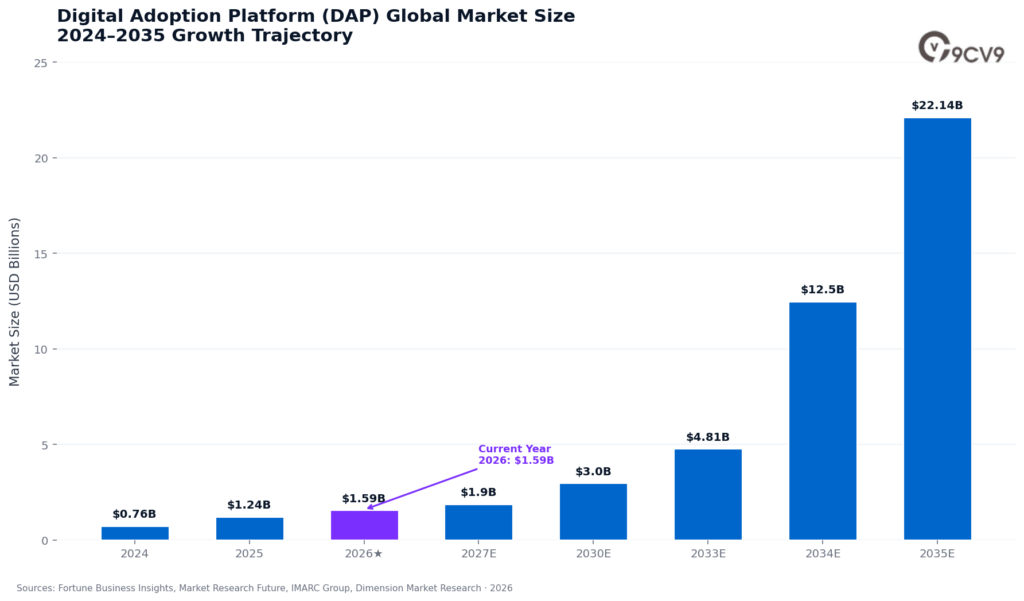
Digital Adoption Platforms (DAPs) are becoming an increasingly important part of the enterprise technology stack as organizations invest more heavily in digital transformation, artificial intelligence, employee productivity, and software adoption. The global DAP market is projected to reach $1.59 billion in 2026, up from $1.24 billion in 2025, while major research firms forecast sustained double-digit growth through the next decade.

The momentum extends beyond market growth. Large enterprises accounted for 64.6% of the DAP market in 2025, while user onboarding represented 38.9% of DAP use cases. At the same time, the average desk worker now uses 11 software applications, compared with only six in 2019, increasing the need for contextual guidance, streamlined onboarding, and in-app support.
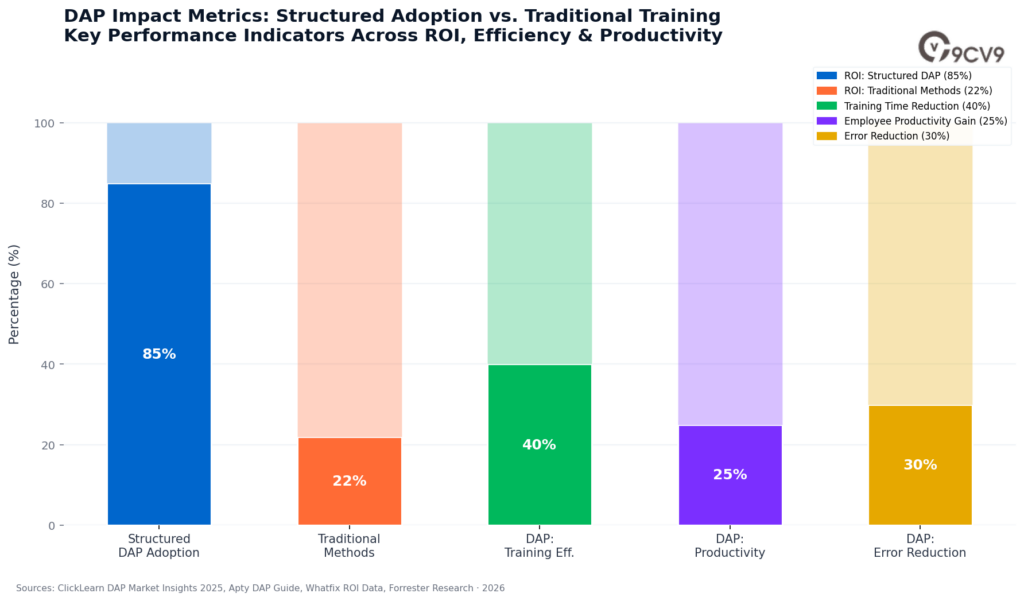
The potential business impact is equally significant. Statistics compiled in this report indicate that Digital Adoption Platforms can reduce employee training time by up to 40%, improve employee productivity by 25%, increase user engagement by 30%, and reduce common IT support tickets by approximately 25–30%. Some enterprise deployments have also reported substantial improvements in time-to-proficiency, process completion, and support efficiency.

Artificial intelligence is adding another dimension to the DAP market in 2026. As enterprises increase AI spending and embed AI agents into business applications, employees must learn not only new software interfaces but also entirely new AI-assisted workflows.
The statistics examined here show that 86% of organizations plan to increase their AI budgets in 2026, while Gartner predicts 40% of enterprise applications will feature task-specific AI agents in 2026, compared with less than 5% in 2025.
This collection of the top 103 Digital Adoption Platform statistics, data, and trends for 2026 examines the industry from multiple perspectives, including global market size and growth, enterprise adoption, DAP ROI, employee productivity, software utilization, AI integration, regional markets, industry-specific adoption, training efficiency, and future workforce trends.
Together, these statistics provide a data-driven picture of how Digital Adoption Platforms are evolving and why organizations are increasingly using them to extract more value from their growing software and AI investments.
Before we venture further into this article, we would like to share who we are and what we do.
About 9cv9
9cv9 is a business tech startup based in Singapore and Asia, with a strong presence all over the world.
With over ten years of startup and business experience, and being highly involved in connecting with thousands of companies and startups, the 9cv9 team has listed some important and crucial software tools in this review.
If you like to get your company listed in our top B2B software reviews, check out our world-class 9cv9 Media and PR service and pricing plans here.
Top 103 Digital Adoption Platform (DAP) Statistics, Data & Trends in 2026
🏦 MARKET SIZE & GROWTH
1. $1.59 Billion — Global DAP Market Value in 2026
The global Digital Adoption Platform market is projected to reach USD 1.59 billion in 2026, up from USD 1.24 billion in 2025, confirming that enterprises are rapidly scaling their investment in guided software adoption tools.
2. $1.24 Billion — Global DAP Market Value in 2025
The DAP market was valued at $1.24 billion in 2025, marking a significant inflection point as the technology matured from an early-adopter tool into a mainstream enterprise necessity.
3. $4.37 Billion — Projected DAP Market by 2034 (Fortune Business Insights)
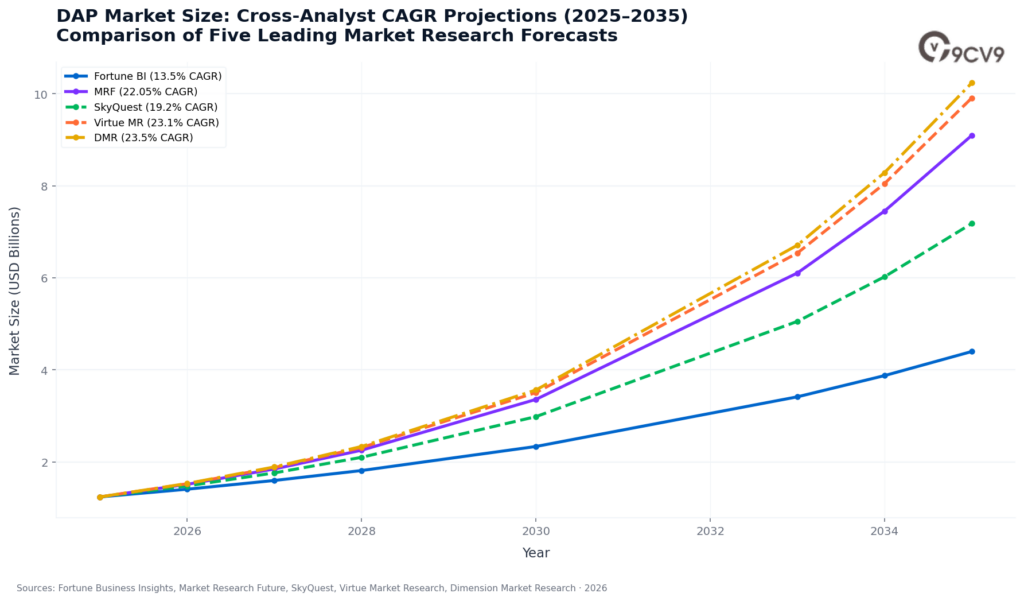
Fortune Business Insights projects the DAP market will reach $4.37 billion by 2034, representing nearly a 3.5x growth from the 2026 baseline at a 13.5% CAGR.
4. 13.5% CAGR — Fortune Business Insights Forecast (2026–2034)
At a 13.5% compound annual growth rate, DAPs are growing at roughly twice the rate of overall enterprise software, underscoring their outsized role in the modern digital stack.
5. $22.14 Billion — Market Research Future Projection by 2035
Market Research Future estimates the DAP market will balloon to $22.14 billion by 2035 at a 22.05% CAGR — one of the most bullish forecasts among leading analysts, reflecting the confluence of AI adoption and digital transformation urgency.
6. 22.05% CAGR — Market Research Future (2025–2035)
A 22.05% compound annual growth rate makes the DAP sector one of the fastest-growing categories in enterprise software, outpacing CRM, ERP, and traditional LMS markets.
7. $12.5 Billion — Dimension Market Research Projection by 2034
Dimension Market Research pegs the DAP market at $12.5 billion by 2034, positioning DAPs for an approximately 8.6x expansion from their 2025 baseline in under a decade.
8. 23.5% CAGR — Dimension Market Research (2025–2034)
At 23.5% CAGR, the DAP sector is growing faster than broader digital transformation spending — a testament to how essential these tools have become for extracting ROI from software investments.
9. $4.81 Billion — SkyQuest Projection by 2033
SkyQuest estimates the DAP market will reach $4.81 billion by 2033 at a 19.2% CAGR — driven by the rising software complexity employees face and the growing demand for in-app, real-time support.
10. 19.2% CAGR — SkyQuest (2026–2033)
SkyQuest’s 19.2% CAGR aligns with the consensus view that DAPs will sustain double-digit growth well into the 2030s, fueled by enterprise AI adoption and workforce digitization mandates.
11. $2.67 Billion — Virtue Market Research Projection by 2030
Virtue Market Research projects the DAP market will grow from $624 million (2024) to $2.67 billion by 2030 at a 23.1% CAGR, nearly 4.3x growth in six years.
12. 23.1% CAGR — Virtue Market Research (2024–2030)
Virtue’s 23.1% CAGR forecast reflects accelerating cloud-first transformation across emerging markets as well as established enterprise sectors.
13. 17.8% CAGR — InsightAce Analytic (2025–2034)
InsightAce Analytic’s 17.8% CAGR forecast represents the more conservative, risk-adjusted view of DAP growth — still exceptional by enterprise software standards.
14. 38.4% CAGR — Market.us High-Growth Scenario
Market.us projects an aggressive 38.4% CAGR for DAPs under a high-growth scenario, pointing to the possibility of exponential adoption if AI-embedded DAPs become table stakes by 2028.
15. $761 Million — IMARC Group DAP Market Size (2024)
IMARC Group puts the 2024 DAP market at $761 million, expected to grow to $4.08 billion by 2033 at a 19.49% CAGR — a 5.4x expansion in under a decade.
16. 76% — Software’s Share of DAP Market Revenue
Software components account for 76% of total DAP market revenue, with the remainder split between implementation services and ongoing support — reflecting the platform’s scalable SaaS economics.
17. 50% — DAP Market Growth During COVID-19 Pandemic (Everest)
Everest Group found the DAP market grew approximately 50% during the COVID-19 pandemic, as remote work forced organizations to find scalable, non-classroom-based training alternatives overnight.
18. $217.1 Million — US DAP Market Value (2025)
The United States is the world’s single largest DAP country-market, valued at $217.1 million in 2025 and growing at a projected 35.7% CAGR — driven by the density of enterprise software deployments.
19. 35.7% CAGR — US DAP Market Growth Rate
The US DAP market’s 35.7% CAGR is nearly triple the global average, reflecting the country’s hyper-competitive enterprise environment and the high cost of digital transformation failures.
20. $255.4 Million — North America DAP Revenue (2025)
North America generated $255.4 million in DAP revenue in 2025, accounting for 38.1% of the global market — anchored by the BFSI, healthcare, and technology verticals.
🏢 ENTERPRISE ADOPTION & DEPLOYMENT
21. 70% — Large Enterprises Expected to Deploy DAPs by End of 2025 (Gartner)
Gartner predicted that 70% of large enterprises would deploy a Digital Adoption Platform by end of 2025, signaling a fundamental shift from DAPs being a competitive advantage to a baseline operational requirement.
22. 64.6% — Large Enterprise Share of DAP Market (2025)
Large enterprises captured 64.6% of the global DAP market in 2025, driven by the sheer complexity of multi-system environments where employees navigate dozens of applications daily.
23. 38.9% — User Onboarding’s Share of DAP Use Cases
User onboarding remains the largest DAP use case at 38.9% of segment revenue, as organizations recognize that first-day software experiences are critical determinants of long-term adoption success.
24. 38.1% — North America’s Share of Global DAP Market
North America dominated global DAP adoption with a 38.1% market share in 2025, reinforcing its position as both the birthplace and most mature market for digital adoption solutions.
25. 11 — Average Number of Software Apps per Desk Worker (2024)
Gartner’s survey of 4,800 full-time employees found desk workers now use an average of 11 software applications — nearly double the 6 apps used in 2019 — creating an overwhelming case for contextual, in-app guidance tools.
26. 6 — Software Apps per Desk Worker in 2019 (Gartner)
The near-doubling of software tools from 6 (2019) to 11 (2024) per employee illustrates why DAPs have become critical infrastructure: employees can’t be expected to master an ever-expanding software stack through occasional classroom training alone.
27. 50% — DAP Market Growth During Pandemic
The DAP market’s 50% growth during the COVID-19 pandemic validated the technology’s core value proposition: enabling employees to adopt and use software effectively in distributed, non-supervised environments.
28. 500%+ — Growth in VC Investment in DAPs (Forrester)
Forrester’s New Tech Digital Adoption Platforms report found VC investment in DAPs grew over 500%, from $76 million to $470 million — confirming the sector’s status as a strategic enterprise technology category.
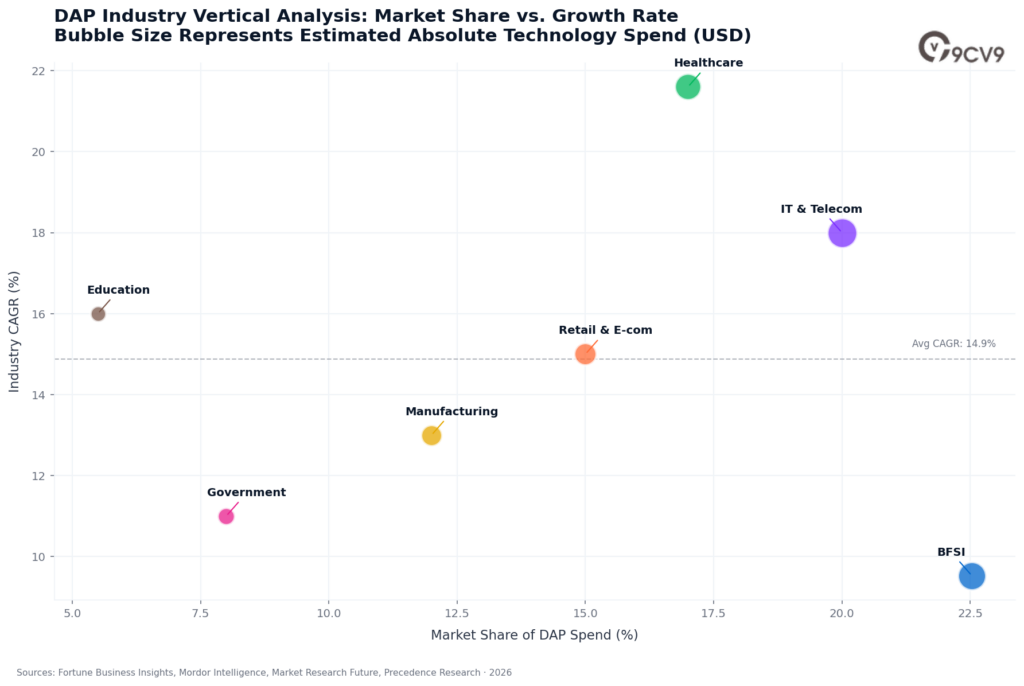
29. 22.53% — BFSI Share of DAP Market in 2026
The BFSI sector accounts for 22.53% of the global DAP market in 2026, driven by the need to train staff on highly regulated core banking, insurance, and compliance workflows with zero tolerance for user error.
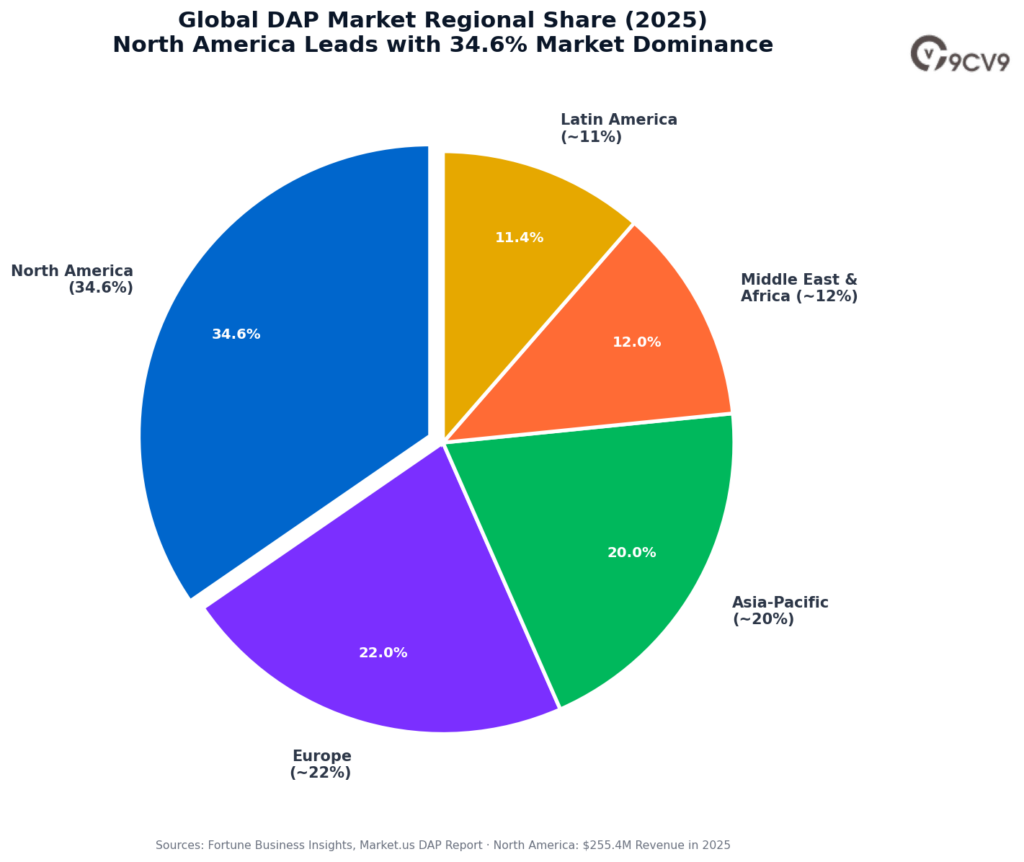
30. 34.6% — North America’s Share of DAP Market (2025)
North America’s 34.6% market share reflects its early-mover advantage in enterprise software adoption, with companies like SAP (WalkMe), Salesforce, and Workday creating a dense ecosystem that demands DAP support.
📈 ROI & PRODUCTIVITY IMPACT
31. 85% — ROI from Structured Adoption (vs 22% from Traditional)
ClickLearn’s research found structured DAP adoption delivers 85% ROI compared to just 22% from traditional training methods — a 3.9x difference that makes the business case for DAP investment practically irrefutable for CFOs.
32. 40% — Reduction in Training Time with DAP
Digital adoption platforms reduce employee training time by up to 40%, compressing multi-week onboarding programs into days of contextual, in-the-flow-of-work guidance that sticks better and costs far less.
33. 25% — Rise in Employee Productivity After DAP Deployment
Enterprises deploying DAPs report a 25% improvement in employee productivity, as employees spend less time searching for help and more time completing the work that drives business outcomes.
34. 30% — Increase in User Engagement with DAP
Government statistics cited by leading DAP analysts show that companies implementing DAPs experience a 30% increase in user engagement — a metric that correlates directly with software ROI realization.
35. 60% — Training Time Reduction (Forrester, 2020)
A landmark Forrester study found DAPs reduced employee training time on applications by 60%, effectively transforming training from a blocker of software rollouts into an accelerator.
36. $652,000 — Average Annual Value per Application (Whatfix)
Whatfix’s internal data across enterprise customers shows an average of $652,000 in annual value per application deployed with its contextual guidance and usage analytics — a figure that rapidly dwarfs the cost of DAP licensing.
37. 45% — Improvement in Process Completion Rates
AI-powered DAP guidance improves process completion rates by up to 45%, meaning nearly half of previously incomplete digital workflows get finished — directly translating to revenue and compliance outcomes.
38. 30% — Reduction in Process Errors
Organizations using DAPs report a 30% reduction in process errors, reducing the costly rework, compliance incidents, and customer experience failures caused by employees using software incorrectly.
39. 25% — Reduction in Total Training Costs
Implementing a DAP reduces training costs by 25%, dropping the annual per-learner training expense from approximately $1,207 to $954 — meaningful savings when multiplied across thousands of employees.
40. 40–50% — Faster Onboarding with AI-Powered DAPs
AI-powered DAPs cut new hire ramp-up time by 40–50%, providing personalized, contextual on-demand guidance that helps employees reach full productivity weeks earlier than traditional onboarding.
41. 25–30% — IT Support Ticket Reduction
DAPs reduce support ticket volumes by 25–30% for common “how-to” queries, freeing IT teams from repetitive L1 support tasks and allowing them to focus on strategic infrastructure initiatives.
42. 4x — ROI Boost from Structured DAP Workflows
Replacing scattered classroom training with structured DAP guidance, auto-updated documentation, and in-app help boosts ROI by 4x over traditional learning and development approaches.
43. $47 Million — Annual Productivity Loss per Major US Corporation
The Panopto Workplace Knowledge and Productivity Report estimates major US corporations lose $47 million annually from poor knowledge sharing — DAPs directly address this by embedding knowledge at the point of need.
44. 5.3 Hours — Weekly Wait Time for Knowledge Workers
US knowledge workers spend 5.3 hours per week waiting for colleague support or recreating existing company knowledge — time that DAPs eliminate by putting contextual answers directly inside the applications employees use.
45. 50% — Reduction in Time-to-Proficiency (REG Case Study)
Renewable Energy Group reduced time-to-proficiency in Salesforce and JD Edwards by 50% using Whatfix — a real-world proof point that DAPs can halve the time between software deployment and full operational effectiveness.
46. 88% — Support Queries Resolved In-App (Financial Services)
A financial services firm using Whatfix resolved 88% of financial advisor support queries directly in-app, eliminating a third of all support tickets and dramatically reducing per-user support costs.
47. 50% — Reduction in Online Banking Support Tickets
An online banking portal deployed Whatfix and achieved a 50% reduction in user support tickets — demonstrating that DAPs create measurable operational savings even in high-volume, consumer-facing digital environments.
48. 9–12% — Decline in Digital Worker Productivity (Gartner)
Gartner reported that digital worker productivity declined by 9–12% over two years due to workflow complexity and tool friction — a costly trend that well-implemented DAPs are specifically designed to reverse.
49. $950,000 — Insurance Sector DAP Savings
A major insurance company saved $950,000 by improving user productivity and streamlining training through a DAP deployment targeting claims processing and underwriting workflows.
50. 1,300 Hours — Contract Reworking Time Saved (Life Sciences)
A life sciences company eliminated 350 support issues and saved 1,300 hours in contract reworking by deploying contextual in-app guidance across GxP-regulated workflows using Whatfix.
🌐 DIGITAL TRANSFORMATION CONTEXT
51. $424 Billion — Annual Global Workplace Software Spending
An estimated $424 billion is spent globally on workplace software annually, yet poor adoption means a substantial share of this investment never translates into productivity gains — DAPs exist to close this gap.
52. $2.8 Trillion — Global Digital Transformation Spend by 2025
Global digital transformation investment reached $2.8 trillion by 2025 — more than double the 2020 level — creating an enormous wave of new software that requires DAPs to ensure effective employee adoption.
53. 70% — Businesses with Digital Transformation Plans
70% of businesses are either developing or have already implemented a digital transformation plan, yet the majority struggle to achieve expected returns due to inadequate user adoption strategies.
54. 70% — Digital Transformation Projects That Fail (McKinsey)
McKinsey found that 70% of digital transformation projects fail, largely due to employee resistance and low adoption rates — making DAPs not just a productivity tool but a transformation success enabler.
55. 84% — Digital Transformation Projects That Fail (Forbes)
Forbes analysis found 84% of digital transformation projects fail to meet their objectives, with adoption barriers consistently cited as the primary culprit — underscoring the business-critical need for DAPs.
56. 91% — Enterprise Software Errors from Poor Onboarding
A staggering 91% of enterprise software errors stem from people not using software correctly or being insufficiently onboarded — a finding that frames DAPs as an essential quality and risk management tool.
57. 30% — Software Licenses Never Used
Approximately 30% of enterprise software licenses are never used, representing wasted budget and unlocked potential that DAPs are specifically designed to convert into measurable productivity gains.
58. 8% — Licenses Used Less Than Once per Month
An additional 8% of software licenses are used less than once a month, compounding the “shelfware” problem — DAPs turn underutilized tools into active contributors to business value.
59. $30 Billion+ — Annual Software Waste in the United States
US enterprises waste more than $30 billion annually on unused or underutilized software licenses — a figure DAPs directly target by guiding employees to use tools they’ve already paid for.
60. 54% — Employees Needing Reskilling by 2025 (WEF)
The World Economic Forum found 54% of all employees required significant reskilling by 2025 due to digital process shifts — DAPs provide the scalable, continuous learning infrastructure to close this skills gap.
61. 86% — Professional Services Firms Adopting Digital Platforms (Statista)
86% of professional services companies are expected to adopt digital platforms between 2023 and 2027, creating persistent demand for DAPs to guide employees through the resulting software proliferation.
62. 92% — SMEs Believing Digital Transformation Is Crucial
92% of small and medium enterprises believe digital transformation is crucial to their business survival, and DAPs are increasingly being adopted by SMBs as affordable, no-code alternatives to expensive enterprise training programs.
63. 39% — CEOs Expecting 3–5 Year Transformation Payoff
39% of CEOs anticipate their digital transformation investments will pay off within three to five years — a timeline DAPs can significantly accelerate by closing the gap between software deployment and genuine adoption.
🤖 AI INTEGRATION IN DAPs
64. 50% — Rise in Worker Access to AI Tools (2025, Deloitte)
Deloitte’s 2026 AI Report found worker access to AI tools rose by 50% in 2025, creating an urgent need for DAPs to guide employees through increasingly AI-powered enterprise applications.
65. 3.7x — Average ROI on Generative AI Investment
Companies report a 3.7x ROI for every dollar invested in generative AI — DAPs are the critical enabling layer that ensures employees actually use AI tools correctly, rather than ignoring them out of intimidation.
66. 66% — Organizations Reporting Productivity Gains from Enterprise AI
66% of organizations report productivity gains from enterprise AI adoption, yet the remaining third still struggle — often because employees lack the in-context guidance that DAPs provide for new AI-powered workflows.
67. 86% — Organizations Increasing AI Budgets in 2026 (NVIDIA)
86% of organizations plan to increase their AI budgets in 2026, creating a cascading demand for DAPs to manage the user adoption challenges that inevitably follow rapid AI tool deployment.
68. 40% — Enterprise Apps to Feature AI Agents by 2026 (Gartner)
Gartner predicts 40% of enterprise applications will embed task-specific AI agents by 2026 — up from less than 5% in 2025 — making AI-aware DAP guidance essential for employee navigation of these new interfaces.
69. 42% — Companies Highly Prepared for AI Adoption (2026, Deloitte)
42% of companies believe they are highly prepared for AI adoption in 2026, up from 28% in 2025 — with DAP deployments being a key enabler of this confidence, as they provide structured frameworks for technology change management.
70. 65% — Enterprises That Increased AI Budgets (2026)
65% of enterprises increased their AI budgets in 2026, with a median increase of 22% year-over-year — DAPs positioned as the essential companion investment to ensure AI tools deliver on their promised productivity gains.
71. 34% — Companies Truly Reimagining Business Models with AI
Only 34% of organizations are truly reimagining their business with AI, despite widespread experimentation — DAPs help bridge the gap by ensuring AI tool adoption goes beyond a small cohort of early adopters to the entire workforce.
72. $23 Million — Average Enterprise AI Investment by 2025 (WalkMe)
Leading enterprises averaged $23 million in AI investments by 2025, creating an enormous return-on-investment pressure that DAPs address by ensuring employee adoption of AI tools keeps pace with investment.
73. $301 Billion — Total Global AI Spending in 2026 (IDC)
Total global AI spending reached $301 billion in 2026, up from $223 billion in 2025 — with DAPs becoming essential infrastructure for organizations to extract real, measurable value from this massive capital allocation.
74. $157 Billion — AI Software Spending in 2026 (Gartner)
Gartner projects AI software alone will account for $157 billion of total 2026 technology spend — an allocation that only generates returns when employees are properly guided by platforms like DAPs to adopt and use AI tools effectively.
75. 6% — Companies Fully Implementing Agentic AI
Only 6% of organizations have fully implemented agentic AI systems, yet DAPs are already evolving to offer agentic AI-powered onboarding experiences that autonomously guide users through new workflows without human intervention.
76. 44% — Companies Deploying or Assessing AI Agents (2025, NVIDIA)
44% of companies were either deploying or assessing AI agents in 2025, with DAPs playing a critical role in training employees to work alongside autonomous AI systems across business processes.
🌍 REGIONAL BREAKDOWN
77. 34.6% — North America’s DAP Market Share (2025)
North America dominated the global DAP market with a 34.6% share in 2025, driven by strong enterprise software ecosystems, high per-employee software spend, and a workforce increasingly dependent on complex digital tools.
78. 29.5% CAGR — Asia-Pacific Digital Transformation Growth (through 2035)
Asia-Pacific’s digital transformation market is projected to grow at a 29.5% CAGR through 2035, making it the fastest-growing frontier for DAP vendors looking to expand beyond saturated North American markets.
79. 44% — North America’s Share of Global Digital Transformation Market (2025)
North America held a 44% share of the global digital transformation market in 2025, with the US alone accounting for $458.91 billion — validating why North America remains the primary battleground for DAP vendors.
80. $458.91 Billion — US Digital Transformation Market Value (2025)
The US digital transformation market was valued at $458.91 billion in 2025, projected to reach $3.89 trillion by 2035 — a scale that makes enterprise software adoption tooling a multi-billion-dollar necessity.
🏥 INDUSTRY VERTICALS
81. 22.53% — BFSI Sector’s Share of DAP Market (2026)
The BFSI sector commands 22.53% of the global DAP market in 2026, as financial institutions use DAPs to onboard staff onto core banking systems, compliance workflows, and AI-powered risk management tools.
82. 21.6% CAGR — Healthcare Digital Transformation Growth
Healthcare digital transformation is growing at a 21.6% CAGR, fueled by EHR adoption mandates and the need to rapidly train clinical staff on complex patient management systems without disrupting care delivery.
83. 10x — Healthcare E-Portal Onboarding Improvement
A clinical e-portal using Whatfix’s DAP onboarded 10x more healthcare providers and therapists than before, demonstrating how in-app guidance can radically scale digital health platform adoption without adding training headcount.
84. 94% — Mobile Banking Users Accessing Digital Services Monthly
94% of mobile banking users access digital banking services at least once a month, creating a massive consumer-facing DAP opportunity as banks race to deliver frictionless, self-service digital experiences.
85. $10 Billion — BFSI Compliance Technology Spend by 2026
BFSI compliance-related technology spending is projected to reach $10 billion by 2026, with DAPs serving as a key tool for ensuring employees adhere to regulatory workflows across rapidly evolving digital banking systems.
86. 48% — Telecom’s Agentic AI Adoption Rate (NVIDIA)
Telecommunications had the highest rate of agentic AI adoption at 48%, according to NVIDIA’s State of AI survey — creating urgent demand for DAPs to guide telco employees through AI-augmented customer service and network management tools.
87. 95% — Retail Customer Support Interactions Involving AI by 2026
By 2026, over 95% of customer support interactions in retail are expected to involve AI — requiring DAPs to train customer-facing staff on how to work effectively alongside AI assistants and handover scenarios.
88. 60,000 — Education Sector Users Onboarded via DAP
A leading education technology platform used Whatfix’s DAP to onboard 60,000 administrators, faculty, parents, and students — proving that DAPs scale effectively beyond enterprise employees to diverse user populations.
89. $30 Billion — Global AI Spending in Financial Services (2025)
Global annual AI spending in financial services exceeded $30 billion in 2025, with DAPs providing the essential guidance layer that ensures financial employees can properly navigate and use these AI-powered tools.
90. 11% — User Engagement Boost Across 575,000 Government Citizens
A government digital services portal achieved an 11% increase in user engagement across 575,000 citizens using Whatfix’s DAP — demonstrating the technology’s value in public-sector digital transformation initiatives.
🔮 FUTURE TRENDS & WORKFORCE IMPACT
91. 69% — Executives Using GenAI Weekly (Asana AI Report)
69% of executives leverage generative AI weekly versus only 43% of individual contributors — a usage divide that DAPs are uniquely positioned to close by democratizing AI tool access through guided, role-specific onboarding flows.
92. 88% — Organizations Using AI in at Least One Business Function
88% of organizations now use AI in at least one business function, creating a massive and growing cohort of employees who need structured guidance on AI tool usage — a gap that DAPs can fill at scale.
93. 71% — Organizations Regularly Using GenAI (2025)
71% of enterprises now regularly use generative AI, yet many struggle to realize productivity gains because front-line employees lack the contextual guidance that DAPs provide within their daily software environments.
94. 83% — AI Leaders Concerned About GenAI (2025, Lucidworks)
83% of AI leaders report major or extreme concern about generative AI in 2025 — an eightfold increase in two years — validating DAPs as essential governance and user-behavior-management tools for the AI era.
95. 55 — Features Evaluated in Leading DAP Comparisons (Q1 2026)
DAPs are now evaluated across 55 distinct features organized in six technology areas — Platform, Analytics, Builder, Experience, AI, and Certification — reflecting the significant maturity of the market and expectations of enterprise buyers.
96. 40 Hours — Average Annual Employee Training Time (2025)
Average employee training dropped to 40 hours per year in 2025 (Training Magazine), creating a significant guidance deficit that in-app DAP experiences are purpose-built to fill on a continuous, just-in-time basis.
97. $1,207 → $954 — Per-Learner Training Cost Reduction
Annual training costs per learner dropped from $1,207 to $954 as digital training matured — DAPs are the primary driver of this reduction, replacing expensive instructor-led sessions with scalable in-app guidance.
98. 30–40% — Training Efficiency Improvement with DAPs
Organizations report a 30–40% improvement in training efficiency after DAP implementation, achieving faster time-to-competency without increasing L&D headcount or budget.
99. 77% — User Completion Rate for Guided Walkthroughs (Inline Manual)
In LMC’s deployment of Inline Manual, 73–77% of targeted users engaged with and completed guided walkthroughs — a remarkable engagement rate compared to traditional e-learning modules that typically achieve under 20% completion.
100. 350 — Support Issues Eliminated with In-App Help
A global life sciences company eliminated 350 support issues in a single quarter by deploying contextual in-app DAP guidance, saving 1,300 hours of contract reworking and freeing compliance teams for higher-value activities.
101. 19.85% CAGR — US Digital Transformation Market (2026–2031)
The US digital transformation market is forecasted to grow at a 19.85% CAGR from 2026 to 2031, reaching $1.96 trillion — providing an enormous structural tailwind for DAP adoption across every industry vertical.
102. $157 Billion — AI Software Market in 2026 (Gartner)
Gartner’s forecast of $157 billion in AI software spending in 2026 confirms that AI-integrated DAPs are no longer a future consideration — they’re a present-day requirement for enterprises managing complex AI adoption challenges.
103. 23.42% — BFSI Share of Global Digital Transformation Market (2025)
BFSI remains the largest revenue contributor to the global digital transformation market at a 23.42% share in 2025, directly translating to significant and sustained DAP investment across banking, insurance, and capital markets.
Conclusion
Digital Adoption Platform statistics for 2026 point to a market moving rapidly from specialized software enablement toward a more important role in enterprise digital transformation. The global DAP market is projected to reach $1.59 billion in 2026, while analyst forecasts suggest continued double-digit growth through the next decade, with some estimates placing the market above $12 billion by 2034 and $22 billion by 2035.
The business case for Digital Adoption Platforms extends beyond market growth. The statistics covered in this report indicate that DAPs can reduce training time by up to 40–60%, improve employee productivity by 25%, reduce process errors by 30%, and lower common IT support ticket volumes by approximately 25–30%. These improvements become increasingly valuable as employees navigate larger and more complex software environments.
Artificial intelligence is also likely to reshape the next phase of digital adoption. With 86% of organizations planning to increase AI budgets in 2026 and 40% of enterprise applications predicted to feature task-specific AI agents in 2026, organizations face a growing challenge: investing in AI and software is not enough if employees cannot adopt those technologies effectively. DAPs can help bridge that gap through contextual guidance, onboarding, workflow support, and continuous learning.
Ultimately, these 103 Digital Adoption Platform statistics, data, and trends for 2026 demonstrate a broader shift in how businesses think about technology ROI. As digital transformation, SaaS adoption, and enterprise AI accelerate, successful organizations will increasingly need to focus not only on which technologies they purchase, but also on whether employees can use them efficiently. Digital adoption is therefore becoming an important link between technology investment and measurable business value.
If you find this article useful, why not share it with your hiring manager and C-level suite friends and also leave a nice comment below?
We, at the 9cv9 Research Team, strive to bring the latest and most meaningful data, guides, and statistics to your doorstep.
To get access to top-quality guides, click over to 9cv9 Blog.
To hire top talents using our modern AI-powered recruitment agency, find out more at 9cv9 Modern AI-Powered Recruitment Agency.
People Also Ask
What is a Digital Adoption Platform (DAP)?
A Digital Adoption Platform (DAP) is software that helps users learn and use digital applications through contextual guidance, onboarding, walkthroughs, in-app support, and usage analytics.
How big is the Digital Adoption Platform market in 2026?
The global Digital Adoption Platform market is projected to reach $1.59 billion in 2026, up from $1.24 billion in 2025, according to the statistics compiled in this report.
How fast is the Digital Adoption Platform market growing?
DAP market forecasts vary significantly. The report includes projected CAGRs ranging from 13.5% to more than 23% across several research firms, indicating strong expected growth through the 2030s.
What will the Digital Adoption Platform market be worth by 2034?
Forecasts differ by research firm. Fortune Business Insights projects $4.37 billion by 2034, while Dimension Market Research projects the DAP market could reach $12.5 billion by 2034.
What is the Digital Adoption Platform market forecast for 2035?
Market Research Future projects the Digital Adoption Platform market could reach $22.14 billion by 2035, with a forecast CAGR of 22.05% from 2025 to 2035.
Why is the Digital Adoption Platform market growing?
DAP growth is associated with expanding enterprise software stacks, digital transformation, remote work, employee onboarding requirements, AI adoption, and demand for contextual in-app guidance.
What percentage of the DAP market comes from large enterprises?
Large enterprises accounted for 64.6% of the global Digital Adoption Platform market in 2025, reflecting strong demand from organizations managing complex multi-application environments.
What is the largest Digital Adoption Platform use case?
User onboarding is identified as the largest DAP use case in the report, accounting for 38.9% of segment revenue as organizations seek faster and more effective software onboarding.
How many software applications does the average desk worker use?
The report cites Gartner research indicating that desk workers used an average of 11 software applications in 2024, compared with six applications in 2019.
Can Digital Adoption Platforms reduce employee training time?
Yes. Statistics in the report indicate DAPs can reduce employee training time by up to 40%, while a cited Forrester study reported a 60% reduction in training time on applications.
How much can DAPs improve employee productivity?
The report states that enterprises deploying Digital Adoption Platforms can experience a 25% improvement in employee productivity by reducing the time workers spend searching for assistance.
How do Digital Adoption Platforms affect user engagement?
The report cites a 30% increase in user engagement following DAP implementation, while a government digital services example reported an 11% engagement increase across 575,000 citizens.
Can Digital Adoption Platforms reduce software errors?
Yes. Organizations using DAPs report a 30% reduction in process errors, helping decrease rework, compliance problems, and workflow mistakes associated with incorrect software usage.
How much can DAPs reduce IT support tickets?
Digital Adoption Platforms can reduce support ticket volumes by approximately 25–30% for common how-to questions by providing contextual assistance directly within applications.
Can Digital Adoption Platforms reduce onboarding time?
Yes. The report indicates that AI-powered DAPs can reduce new-hire ramp-up time by 40–50% by delivering personalized and contextual guidance within employees’ workflows.
What ROI can businesses get from Digital Adoption Platforms?
The report cites research showing structured digital adoption delivering 85% ROI compared with 22% for traditional training, representing nearly a fourfold difference.
How much can Digital Adoption Platforms reduce training costs?
The report states that implementing a DAP can reduce training costs by 25%, with annual per-learner training expenses falling from approximately $1,207 to $954.
What percentage of enterprise software licenses are never used?
Approximately 30% of enterprise software licenses are never used, according to statistics included in the report, highlighting the financial impact of poor software adoption.
How much money is wasted on unused software in the United States?
The report states that US enterprises waste more than $30 billion annually on unused or underutilized software licenses, creating a major incentive to improve software adoption.
How large is global digital transformation spending?
Global digital transformation investment reached $2.8 trillion by 2025, according to the report, creating greater demand for effective adoption of newly deployed enterprise technologies.
How does AI affect Digital Adoption Platforms in 2026?
AI is expanding the role of DAPs as businesses introduce AI-powered applications, agents, and workflows that require employees to learn new processes and ways of interacting with software.
What percentage of organizations plan to increase AI budgets in 2026?
The report cites NVIDIA data indicating that 86% of organizations plan to increase their AI budgets in 2026, creating additional pressure to ensure employees effectively adopt AI tools.
How many enterprise applications will use AI agents in 2026?
The report cites Gartner’s prediction that 40% of enterprise applications will embed task-specific AI agents in 2026, compared with less than 5% in 2025.
What is North America’s share of the Digital Adoption Platform market?
The report contains estimates placing North America’s 2025 DAP market share at 34.6% and 38.1%, depending on the cited dataset and methodology.
How large is the US Digital Adoption Platform market?
The United States DAP market was valued at $217.1 million in 2025 and is projected in the report to grow at a 35.7% CAGR.
Which industry has the largest share of the DAP market?
BFSI accounts for 22.53% of the global DAP market in 2026 in the report, supported by demand for guidance across banking, insurance, compliance, and regulated workflows.
How are Digital Adoption Platforms used in healthcare?
Healthcare organizations can use DAPs for contextual guidance across EHRs, clinical portals, patient management systems, and regulated workflows. One cited case achieved a 10x improvement in healthcare provider onboarding.
How can DAPs improve software ROI?
DAPs can improve software ROI by increasing adoption, reducing training requirements, improving workflow completion, lowering support demand, and helping organizations generate more value from existing software investments.
What are the key Digital Adoption Platform trends for 2026?
Major DAP trends include AI-powered guidance, enterprise AI adoption, contextual onboarding, workflow automation, adoption analytics, personalized support, reduced training dependence, and stronger focus on measurable software ROI.
What is the future of Digital Adoption Platforms beyond 2026?
The statistics point toward continued DAP growth as enterprise software and AI environments become more complex. Forecasts suggest sustained double-digit market expansion, with DAPs increasingly supporting onboarding, productivity, AI adoption, and digital transformation.
Sources
Fortune Business Insights Market Research Future Market.us SkyQuest Virtue Market Research InsightAce Analytic Dimension Market Research IMARC Group Digital Adoption ClickLearn Whatfix Apty MeltingSpot Inline Manual Deloitte NVIDIA Medha Cloud Gartner Mordor Intelligence Precedence Research Lucidworks Guideflow G2