


























Key Takeaways
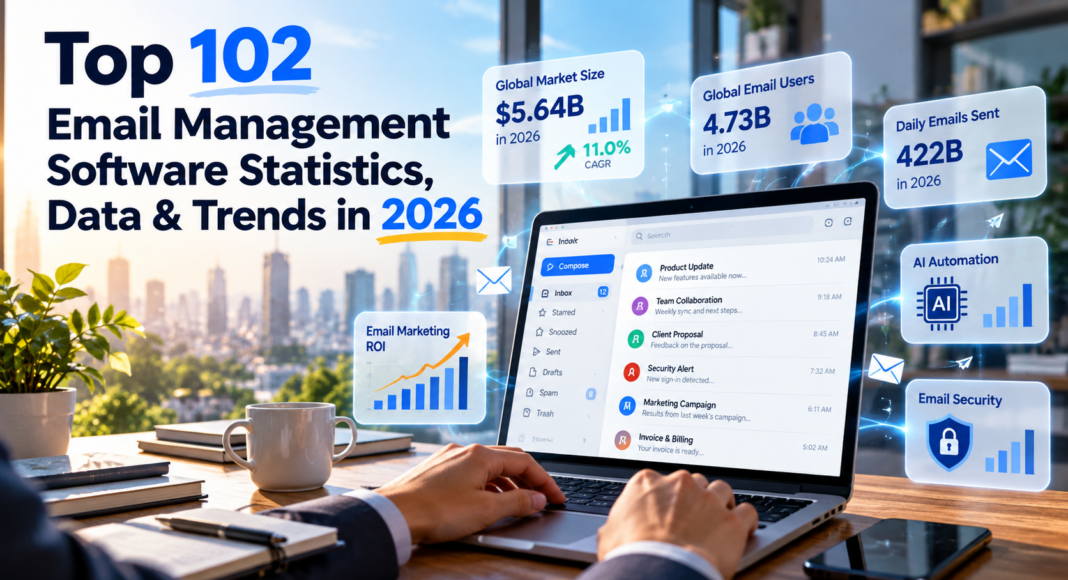
- Email Management Software Market Growth: The global email management software market is projected to reach $5.64 billion in 2026 and $8.18 billion by 2030, driven by cloud adoption, AI automation, and enterprise digital transformation.
- AI-Powered Email Automation and Productivity: With approximately 422 billion emails exchanged daily worldwide in 2026, businesses are adopting AI-powered email management tools to streamline workflows, reduce inbox overload, and potentially save employees 3.6 hours per week.
- Email Security and Emerging Industry Trends: Rising phishing threats, business email compromise, and data privacy concerns are accelerating demand for secure cloud-based email management software, intelligent spam filtering, advanced threat detection, and regulatory compliance solutions.
Email management software statistics in 2026 reveal a global market projected to reach $5.64 billion, with approximately 422 billion emails exchanged daily worldwide. Explore 102 key statistics covering AI-powered automation, workplace productivity, cybersecurity, cloud adoption, email marketing performance, and emerging industry trends shaping business communication and digital transformation.
Email management software has become an essential part of modern business operations as organisations face increasing email volumes, growing cybersecurity threats, and rising demands for workplace productivity. In 2026, artificial intelligence (AI), automation, cloud-based collaboration, and advanced email security are transforming how businesses manage digital communications. From intelligent inbox organisation to automated email workflows, companies are investing in sophisticated solutions to improve efficiency, reduce administrative workloads, and protect sensitive information.
Also, read our article on the Top 10 Email Management Software To Use.

According to industry estimates, the global email management software market is projected to reach $5.64 billion in 2026, representing approximately 11.0% annual growth from 2025. The market is forecast to expand to $8.18 billion by 2030, reflecting sustained demand for AI-powered email management tools, enterprise communication platforms, and secure cloud-based solutions.
The scale of global email communication further highlights the importance of these technologies. An estimated 4.73 billion people use email worldwide in 2026, while daily email traffic is projected to reach approximately 422 billion messages. Meanwhile, workplace productivity research suggests that professionals spend around 28% of their working week managing emails, equivalent to approximately 11.2 hours per week. These figures demonstrate why businesses are increasingly adopting email automation, intelligent filtering, shared inbox management, and AI-assisted communication tools.

Beyond productivity improvements, email security and AI-driven automation are among the most influential email management software trends in 2026. Organisations are implementing advanced phishing detection, automated email classification, personalised communication workflows, and compliance management capabilities to address increasingly sophisticated cyber threats. At the same time, AI-powered email tools are helping employees reduce repetitive tasks, prioritise important messages, and improve response efficiency.
The growing importance of email management software extends across multiple industries, including healthcare, financial services, retail, technology, education, and professional services. As remote work, digital transformation, and customer communication requirements continue to evolve, businesses of all sizes are seeking scalable solutions that combine productivity, security, automation, and seamless integration with existing enterprise systems.
This comprehensive guide explores the Top 102 Email Management Software Statistics, Data & Trends in 2026, providing insights into global market size, industry growth forecasts, email usage patterns, employee productivity, AI adoption, email marketing performance, cybersecurity risks, and cloud email management trends. Whether evaluating email management platforms, developing a digital transformation strategy, or researching the future of business communication, these statistics offer valuable insights into the technologies and market developments shaping the email management software industry in 2026 and beyond.
Before we venture further into this article, we would like to share who we are and what we do.
About 9cv9
9cv9 is a business tech startup based in Singapore and Asia, with a strong presence all over the world.
With over ten years of startup and business experience, and being highly involved in connecting with thousands of companies and startups, the 9cv9 team has listed some of the top and best companies/tools in this review.
If you like to get your company listed in our top B2B software reviews, check out our world-class 9cv9 Media and PR service and pricing plans here.
Top 102 Email Management Software Statistics, Data & Trends in 2026
🏦 MARKET SIZE & GROWTH
1. $5.64B — Global email management software market size in 2026
The email management software market is projected to reach $5.64 billion in 2026, growing at an 11.0% CAGR from $5.08 billion in 2025 — a clear indicator that businesses are investing heavily in tools to tame inbox overload and automate workflows.
2. 11.0% CAGR (2025–2026)
With an 11.0% compound annual growth rate between 2025 and 2026, the email management software sector is outpacing many adjacent SaaS categories, driven by rising enterprise email volumes, cloud migration, and AI-powered automation demand.
3. $8.18B — Projected market size by 2030
By 2030, the global email management software market is forecast to hit $8.18 billion at a 9.7% CAGR, as organisations prioritise intelligent inbox automation and secure cloud email platforms over legacy on-premises systems.
4. $10.2B — Alternative market projection by 2033
A separate forecast projects the email management software market will surpass $10.2 billion by 2033 at a 7.6% CAGR, underpinned by rapid growth in regulated industries such as healthcare and financial services.
5. $7.73B — Alternate forecast by 2029 at 10.9% CAGR
Industry analysts at Research and Markets put the market at $7.73 billion by 2029, with a slightly higher 10.9% CAGR, reflecting divergent assumptions on AI adoption speed and SME uptake of SaaS email solutions.
6. 36.4% — North America’s email management software market share in 2026
North America dominates the email management software market with a 36.4% regional share in 2026, bolstered by a mature enterprise software ecosystem, stringent data compliance regulations, and high per-seat software spending.
7. 21.7% — United States’ share of the global market
The United States alone commands 21.7% of the global email management software market — the largest single-country share worldwide — driven by massive R&D investment and a highly digitalised corporate infrastructure.
8. $7.1B — Alternate forecast by 2031 at 8.5% CAGR
Market Research Intellect projects global email management software will reach $7.1 billion by 2031 at an 8.5% CAGR, with growth fuelled by SME digitalisation across emerging markets and AI-assisted inbox management adoption.
9. $2.19B — Email marketing software market size in 2026
The email marketing software sub-segment (tools focused on campaigns and outreach) is valued at $2.19 billion in 2026, growing at a brisk 13.8% CAGR, with hyper-personalisation and AI-generated content driving the next wave of growth.
10. $3.47B — Email marketing software projected by 2030
Email marketing software is forecast to hit $3.47 billion by 2030 (12.2% CAGR), as brands double down on owned-channel strategies amid rising costs and diminishing returns from paid social advertising.
👥 EMAIL USAGE & USERS
11. 4.73B — Global email users in 2026
Over 4.73 billion people actively use email in 2026, representing approximately 58% of the total world population — cementing email as the most universally adopted digital communication channel on earth.
12. 4.83B — Global email users in 2025
In 2025, global email usage stood at 4.83 billion users according to cloudHQ’s comprehensive statistics report, already representing the majority of the world’s internet-connected population.
13. 5.61B — Projected global email users by 2030
Global email users are expected to grow from 4.83 billion in 2025 to 5.61 billion by 2030, representing a 3.4% CAGR — showing that despite the rise of messaging apps, email continues to attract hundreds of millions of new users.
14. 392B — Daily emails sent/received globally in 2025
An estimated 392 billion emails were sent and received globally each day in 2025, a 4% increase year-over-year — confirming that email volume growth remains steady and consistent despite competition from collaboration tools.
15. 422B — Projected daily emails in 2026
Daily global email traffic is projected to reach 422 billion in 2026, driven primarily by AI-generated CRM messages, IoT alert emails, and system-triggered automated workflows that inflate volume without human input.
16. 523B — Daily email volume forecast for 2030
By 2030, global daily email traffic is forecast to surpass 523 billion messages — an increase of more than 130 billion from 2025 — as automation and machine-to-machine email communication scales exponentially.
17. 3.13M — Emails sent every second in 2026
More than 3.13 million emails are sent globally every single second in 2026, a figure that underscores the immense scale of email infrastructure and the critical need for intelligent filtering and management software.
18. 1.86 — Average email accounts per user
The average email user maintains 1.86 accounts, resulting in approximately 8.3 billion email accounts worldwide — a figure that substantially exceeds the total number of email users and creates additional complexity for inbox management.
19. 121 — Average emails received per office worker per day
The average office worker now receives 121 emails per day according to the Radicati Group, creating a persistent and growing need for intelligent prioritisation, filtering, and auto-categorisation tools to maintain productivity.
20. 45% — Share of all email that is spam
Roughly 45% of all global email traffic is classified as spam, equating to approximately 170 billion spam messages daily — highlighting why advanced filtering remains one of the most valuable features of modern email management platforms.
21. 58% — Users who check email first thing each morning
58% of email users check their inbox before browsing social media or news in the morning, making the first email seen each day one of the most valuable pieces of digital real estate available to marketers and communicators.
22. 1.8B — Gmail’s active user base
Gmail is the world’s most popular email service with approximately 1.8 billion active users, commanding a 72.1% share of email provider usage — a dominance that gives Google outsized influence over email standards and deliverability norms.
23. 56% — Share of world population using email in 2025
56% of the total world population uses email as of 2025, meaning email has achieved near-universal adoption among internet users and remains a more broadly used communication tool than any social media platform.
24. India + Nigeria = 28% of all new global email users
India and Nigeria collectively account for 28% of all new global email user growth, making emerging market adoption in Asia and Africa the primary engine of future email industry expansion through 2030.
25. 6.1% CAGR — 65+ age demographic email adoption
The 65-and-over demographic is adopting email at a 6.1% CAGR — the fastest-growing age segment — as governments and healthcare systems increasingly rely on email for official communications with ageing populations.
🏢 WORKPLACE PRODUCTIVITY & TIME
26. 28% — Share of workweek consumed by email
McKinsey Global Institute research consistently shows that the average professional spends 28% of their workweek managing email — equivalent to more than 11 hours each week lost to reading, writing, sorting, and searching the inbox.
27. 11.2 hours/week — Time spent on email per professional
For a standard 40-hour work week, the 28% email burden translates to 11.2 hours per week, or roughly 2.25 hours every working day — time that email management software with AI triage can dramatically reduce.
28. 3,000 working days — Career email burden
Over a 45-year career, the average knowledge worker spends approximately 3,000 working days managing email — the equivalent of more than 8 full years of professional time, making inbox efficiency a genuine career-long productivity issue.
29. 10.8 hours/week — Time wasted on non-critical emails
Mailbird’s survey of 250+ professionals found that approximately 10.8 hours per week are wasted on emails that are not business-critical, given that only around 10% of received messages actually require action.
30. 40% productivity drop from email overload
Research shows that email overload can reduce workplace productivity by up to 40%, as constant inbox interruptions prevent employees from entering deep-work states and force expensive context-switching throughout the day.
31. 12% — Emails that actually need attention
Only 12% of emails contain action items that genuinely require the recipient’s attention, meaning that 88% of inbox traffic is either informational, promotional, or unnecessary — a strong case for AI-powered triage tools.
32. 40% — Employees with 50+ unread emails
40% of employees admit to having at least 50 unread emails in their inbox at any given time, a symptom of email overload that degrades response times, increases stress, and reduces the perceived value of the channel.
33. 3.6 hours saved/week with AI email tools
Knowledge workers using generative AI email tools saved an average of 3.6 hours per week on email management tasks — a 31% reduction in email time that translates directly to reclaimed productive capacity according to NBER/Microsoft research.
34. 8.8 hours/week — Top 25% email users
The heaviest email users in the workplace — the top 25% — spend an average of 8.8 hours per week in their inbox alone, a figure that highlights how disproportionate email burdens can be across different job roles.
35. 99% — Users who check email daily
99% of email users check their inbox every day, with some doing so up to 20 times per day — a habit that reinforces email’s role as the primary always-on communication channel for both personal and professional life.
🤖 AI & AUTOMATION
36. 85% — Companies using AI email tools by end 2025
An estimated 85% of companies will have adopted AI-powered email tools by the end of 2025, with that figure projected to exceed 95% by late 2026, as AI features become standard offerings embedded into every major email platform.
37. 37% — Email revenue from automated flows
Automated email flows generate approximately 37% of all email marketing revenue despite accounting for only 2% of total email volume — one of the most compelling ROI arguments in all of digital marketing.
38. 16× more revenue per send — Automated vs scheduled emails
Automated emails earn 16 times more revenue per send than scheduled broadcast campaigns, demonstrating the power of behavioural triggers, personalisation, and perfect timing that automation enables at scale.
39. 9%+ annual growth — Automated email volume
Automated email volume is growing at over 9% year-over-year — far exceeding the 4% growth of human-written email — as businesses deploy AI agents, CRM workflows, and IoT-triggered messaging at scale.
40. 13.44% — CTR increase from AI personalisation
Using AI for email personalisation resulted in a 13.44% increase in click-through rates for marketers in 2025, confirming that intelligent content adaptation based on subscriber behaviour is a meaningful performance driver.
41. 41% — Revenue uplift from AI personalisation
Email marketers leveraging AI personalisation tools have reported revenue increases of up to 41%, as highly relevant messages delivered at the right moment consistently outperform generic broadcast campaigns.
42. 88% AI adoption but 40% productivity gap
An EY 2025 survey found that while 88% of employees use AI tools, companies are still missing up to 40% of potential productivity gains — indicating that tool access alone is insufficient without proper training and workflow redesign.
43. 30% reduction in inquiry volume with AI email automation
Institutions deploying AI email response automation have achieved a 30% reduction in incoming inquiry volume, as automated self-service responses handle routine questions that would otherwise consume staff bandwidth.
44. $37B enterprise generative AI spend in 2025
Enterprise spending on generative AI reached $37 billion in 2025 — a 3.2× year-over-year increase from $11.5 billion in 2024 — with email automation, content generation, and inbox management among the top use cases.
45. 40% of BEC emails are AI-generated
40% of Business Email Compromise emails in Q2 2025 were confirmed to be AI-generated, demonstrating that the same technology powering email management productivity is also being weaponised by cybercriminals.
📬 EMAIL MARKETING PERFORMANCE
46. $36–$42 ROI per $1 spent — Email marketing average
Email marketing delivers between $36 and $42 return for every dollar spent in 2026 — a 3,600–4,200% ROI that surpasses every other major digital marketing channel, including paid search and social advertising.
47. $45 ROI per $1 for retail/ecommerce
Retail and consumer goods email marketers achieve an average ROI of $45 per dollar spent, rising to $72 for optimised US ecommerce programmes — figures that make a compelling case for investing in sophisticated email management and personalisation infrastructure.
48. 43.46% — Average email open rate in 2025
The average email open rate across all industries reached 43.46% in 2025, a slight improvement on 2024’s 42.35%, though these figures are influenced by Apple Mail Privacy Protection’s auto-loading of tracking pixels.
49. 30.7% — Global campaign open rate in 2025 (Omnisend dataset)
Omnisend’s dataset records a 30.7% average open rate for 2025 — the fifth consecutive year of growth — reflecting improved list hygiene, better personalisation, and rising consumer preference for email brand communication.
50. 2.09% — Average email click-through rate in 2025
The average click-through rate across all email marketing campaigns sits at 2.09% in 2025, with top performers in engaged niches exceeding 4.36%, and image-rich emails achieving 4.84% CTR versus 1.6% for text-only messages.
51. 6.81% — Average click-to-open rate in 2025
The average click-to-open rate across industries reached 6.81% in 2025, up from 5.63% in 2024, indicating that when subscribers do open emails, they are increasingly likely to engage with the content inside.
52. 59.70% — Highest open rate sector (religion)
Faith-based organisations lead all industries with a 59.70% email open rate, reflecting highly engaged, purpose-driven audiences who actively seek communication from organisations they trust — a benchmark for what exceptional relevance can achieve.
53. 53% — YoY jump in click-to-conversion rate
Omnisend reported a 53% year-over-year jump in click-to-conversion rate in 2025, rising from 5.9% to 9% — meaning fewer people clicked but those who did were significantly more likely to make a purchase.
54. 23.33% — Abandoned cart email CTR
Abandoned cart emails achieve an average click-through rate of 23.33% — the single highest-performing email type across all automation categories — making cart recovery one of the most valuable use cases for email management software in ecommerce.
55. 20–26% — Open rate lift from personalised subject lines
Personalised subject lines increase email open rates by 20–26% compared to generic subject lines, establishing personalisation — enabled by data-rich email management platforms — as one of the highest-leverage tactics available to marketers.
56. 55% — Email opens occurring on mobile in 2026
55% of all email opens now occur on mobile devices, reinforcing the critical importance of mobile-first design, responsive templates, and SMS-to-email coordination as core capabilities in modern email management platforms.
57. $15.81B — Global email marketing revenue in 2026
Global email marketing revenue is estimated at $15.81 billion in 2026, reflecting the massive commercial value generated by email as a revenue-driving channel across retail, B2B, media, and financial services sectors.
58. 60% — Consumers who prefer email contact from brands
60% of consumers prefer to receive commercial communications from brands via email over other channels, affirming that email remains the consent-based channel of choice and a foundation of respectful customer engagement.
59. 50% — Consumers who made a purchase from an email
Nearly 50% of consumers made at least one direct purchase after receiving a promotional email in the past year, validating email’s unmatched ability to convert engaged subscribers into paying customers.
60. 138% — Spending uplift from email recipients
Consumers who receive email marketing campaigns are likely to spend up to 138% more than those who don’t, making list building and email engagement a direct driver of customer lifetime value growth.
🔐 EMAIL SECURITY & THREATS
61. 3.4B — Daily phishing emails in 2025–2026
An estimated 3.4 billion phishing emails flood inboxes every single day — approximately 39,000 per second — making phishing the single most widespread cyber threat facing individuals and organisations globally.
62. $25B — Annual global phishing losses
Phishing attacks cost the global economy an estimated $25 billion annually according to SentinelOne, with losses encompassing direct financial fraud, incident response costs, regulatory fines, and reputational damage.
63. 82.6% of phishing emails are AI-generated
82.6% of phishing emails are now AI-generated according to Keepnet/VIPRE research, enabling cybercriminals to produce grammatically flawless, contextually convincing messages that bypass traditional rule-based spam filters at unprecedented scale.
64. 36% — Phishing as a data breach vector (Verizon DBIR)
Phishing appears in 36% of all reported data breaches according to the 2025 Verizon DBIR, making it the leading initial attack vector — ahead of credential theft, vulnerability exploitation, and physical security failures.
65. $2.9B — BEC losses in 2025 (FBI IC3)
Business Email Compromise attacks caused $2.9 billion in reported losses in 2025, the highest-loss cybercrime category tracked by the FBI IC3, targeting wire transfer authorisations, payroll redirects, and vendor invoice fraud.
66. 80% of security incidents involve phishing
80% of all reported cybersecurity incidents involve phishing in some form according to CSO Online, confirming that email remains the primary entry point for virtually every category of cyber attack against organisations.
67. 48% more BEC attacks caught by AI-powered security
AI-powered email security tools using NLP and behavioural analysis detect 48% more Business Email Compromise attacks than legacy rule-based and signature-based filters, according to Gartner-cited research.
68. 21 seconds — Median time to click a phishing link
The median time between a phishing email landing in an inbox and a recipient clicking the malicious link is just 21 seconds, according to the 2025 Verizon DBIR — leaving almost no time for human detection or intervention.
69. 18% of top domains have DMARC records
Only approximately 18% of the world’s 10 million most-visited domains publish a valid DMARC record, and just 4% enforce a reject policy — leaving the vast majority of internet domains vulnerable to email spoofing and brand impersonation.
70. 30–40% — Phishing reduction from AI email security
AI-enhanced email security solutions reduce successful phishing incidents by roughly 30–40% compared to legacy rule-based filtering alone, making AI a non-negotiable component of any modern enterprise email security stack.
71. 58% — Enterprise email on Microsoft 365
Microsoft 365 accounts for 58% of enterprise email installations globally, making it the single largest target for email-based attacks and the platform where most enterprise email security investments are concentrated.
72. 85% — MS365 organisations using third-party security
85% of organisations using Microsoft 365 deploy a third-party email security gateway or API-based supplement in addition to built-in Exchange Online Protection, indicating widespread recognition that native defences are insufficient alone.
73. 3.8M phishing attacks tracked by APWG in 2025
The Anti-Phishing Working Group tracked 3.8 million distinct phishing attacks in 2025, with Q2 alone recording over 1.1 million — the highest quarterly volume ever measured — highlighting the accelerating pace of threat actor activity.
74. $420M — Deepfake BEC losses in 2025
Deepfake audio paired with business email compromise emails was implicated in $420 million in fraud losses in 2025, as attackers combined synthetic voice calls with convincing email chains to authorise fraudulent financial transfers.
75. 345M records exposed in H1 2025
More than 8,000 data breaches exposed approximately 345 million records in the first half of 2025 alone, with email-based attack vectors — phishing, BEC, and credential stuffing — implicated in the majority of incidents.
☁️ CLOUD ADOPTION & COMPLIANCE
76. 9.5% CAGR — Email Application Market 2026–2033
The global email application market is expected to grow at a 9.5% CAGR from 2026 to 2033, driven by AI/ML-powered security advances, accelerating cloud migration, and tightening global regulatory compliance requirements including GDPR, CCPA, HIPAA, and NIS2.
77. 35.3% — North America email application market share in 2026
North America leads the email application market with a 35.3% share in 2026, reflecting the region’s early cloud adoption, high enterprise software penetration, and the presence of major email platform vendors including Google and Microsoft.
78. $3.5B — Global email application market size in 2026
The global email application market was valued at $3.5 billion in 2026, with projections to reach $6.6 billion by 2033 — a near doubling driven by hybrid work normalisation and intensifying cybersecurity requirements.
79. 12.9% CAGR — BFSI email security segment
The Banking, Financial Services, and Insurance sector is the fastest-growing segment in cloud email security at a 12.9% CAGR, driven by stronger encryption mandates, fraud-mitigation requirements, and regulatory audit obligations.
80. 31.6% revenue share — IT & Telecom in cloud email security
IT and Telecommunications holds 31.6% of cloud email security market revenue in 2024, owing to high email communication volumes, early cloud adoption, and the sector’s need for real-time threat detection across distributed global networks.
81. 57.8% — Large enterprise share of email security market by 2035
Large enterprises are projected to command 57.8% of the email security market by 2035, driven by complex IT infrastructures, elevated cyberthreat exposure, and the need to comply with increasingly stringent regulatory mandates.
82. 82% — Consumers concerned about email data privacy
82% of consumers report being concerned about how their email data is used, a figure that is driving both individual migration towards privacy-first email providers and enterprise demand for zero-party data collection strategies.
83. 100M+ accounts — Proton Mail by 2023
Privacy-focused Proton Mail surpassed 100 million accounts by 2023 and continues to grow rapidly, with the broader privacy-first email segment expanding as GDPR, CCPA, and the European AI Act reshape acceptable data practices.
84. 64% — Increase in inbox storage needs by 2030
Inbox storage requirements are projected to grow by over 64% by 2030, driven by higher media attachments in automated messages, richer email content, and the expanding use of email as a system of record for compliance purposes.
85. Asia Pacific fastest-growing region for email security 2026–2035
Asia Pacific is forecast to be the fastest-growing region in email security from 2026 to 2035, fuelled by rising phishing attacks, accelerating cloud adoption, supportive government digital transformation initiatives, and a rapidly expanding enterprise base.
📊 ADDITIONAL STATISTICS
86. $5B emails/year — Clean Email processing volume
Clean Email alone processes over 5 billion emails annually, demonstrating the massive scale of third-party inbox management tool adoption and the extent to which built-in email provider solutions remain inadequate for power users.
87. 90% spam reduction with AI inbox tools
Users of AI-powered inbox management tools like SaneBox report a 90% reduction in unwanted emails reaching their primary inbox, reclaiming hours of weekly attention from newsletters, promotional messages, and low-priority communications.
88. 75% time reduction with Inbox Zero tools
Users of dedicated inbox management tools report a 75% decrease in time spent managing email, translating to potentially 8+ hours reclaimed per week for knowledge workers previously drowning in unmanaged inbox volume.
89. 10 seconds — Time consumers spend on brand emails
Consumers spend an average of just 10 seconds reading brand emails before deciding to act or move on — making subject lines, preview text, and above-the-fold content the critical battleground for email engagement.
90. 61% of people check email primarily on mobile
Two-thirds (61%) of people check their emails primarily on mobile devices in 2026, making mobile rendering, load speed, and single-column design non-negotiable requirements for any email management or marketing platform.
91. 4.84% CTR for image emails vs 1.6% for text-only
Emails containing images achieve a 4.84% click-through rate compared to just 1.6% for text-only messages — a 3× difference that underscores the importance of visual content in driving subscriber action from the inbox.
92. 8× higher opens for transactional emails
Transactional emails — order confirmations, shipping notifications, password resets — generate 8 times higher open and click rates compared to regular marketing emails, making them the most-engaged email type in any sending programme.
93. 5–10% open rate improvement from AI subject line optimisation
AI-powered subject line optimisation delivers 5–10% improvements in open rates, with tools analysing historical engagement data, emotional tone, and personalisation variables to predict which subject lines will resonate with each audience segment.
94. 9.7B — US daily emails (world’s highest volume nation)
The United States sends approximately 9.7 billion emails per day — the highest single-country daily volume in the world — followed by Germany (8.5B) and India (8.3B), according to Cisco Talos Intelligence data from August 2025.
95. $17,700 — Lost every minute to phishing globally
Global phishing losses translate to approximately $17,700 lost every minute worldwide, according to CSO Online analysis — a figure that makes the ROI case for advanced AI-powered email security software irrefutably compelling.
96. 38.2% — North America’s projected email security market share by 2035
North America is anticipated to capture 38.2% of the global email security market by 2035, driven by escalating ransomware and phishing incidents and stringent regulatory frameworks including GDPR, SOX, and HIPAA.
97. 54% higher CTR — AI-generated phishing vs standard
Microsoft testing revealed that AI-generated phishing lures achieved 54% click-through rates versus 12% for standard phishing attempts — a 4.5× difference that demonstrates why AI-enhanced email security is no longer optional.
98. 2026 marks the shift from volume-driven to intelligence-driven email
2026 represents a meaningful inflection point in email’s evolution: growth continues but the nature of email shifts from high-volume broadcasting to intelligence-driven infrastructure, as AI makes email a system of record, automation trigger, and compliance backbone.
99. 5–15.5 hours/week — Range of employee time on email by role
Employees spend between 5 and 15.5 hours per week on email depending on their role and industry, with knowledge workers at the upper end and individual contributors at the lower end — reflecting the dramatic variation in email burden across the modern workforce.
100. 13 hours/week — Average employee email time (broader survey data)
Broader workplace productivity surveys estimate that employees spend an average of 13 hours per week checking, reading, and responding to email — equivalent to roughly 32.5% of a standard 40-hour work week.
101. $3.47B — Email marketing software projected by 2030 at 12.2% CAGR
The email marketing software market is on track to reach $3.47 billion by 2030, propelled by growing demand for hyper-personalised campaigns, omnichannel customer engagement, and AI-powered automation tools that enable marketers to do more with smaller teams.
102. 29% higher open rates from segmentation
Email list segmentation delivers 29% higher open rates compared to non-segmented campaigns, confirming that relevance — enabled by data-rich email management platforms — is the single most powerful lever for improving inbox performance.
Conclusion
The Top 102 Email Management Software Statistics, Data & Trends in 2026 highlight the growing importance of intelligent email management solutions in an increasingly digital, automated, and security-conscious business environment. As organisations manage larger volumes of email communications, the demand for AI-powered automation, advanced cybersecurity, cloud-based platforms, and productivity-enhancing tools continues to accelerate.
With the global email management software market projected to reach $5.64 billion in 2026 and $8.18 billion by 2030, the industry presents significant growth opportunities for software providers, technology investors, and businesses seeking to modernise their communication infrastructure. Meanwhile, approximately 4.73 billion global email users and a projected 422 billion daily email messages in 2026 demonstrate the enormous scale of email communication and the increasing need for efficient inbox management.
One of the most significant developments shaping the industry is the integration of artificial intelligence and machine learning into email management software. AI-powered email categorisation, automated responses, intelligent spam filtering, predictive analytics, and personalised communication workflows are transforming traditional email platforms into sophisticated productivity solutions. Research cited in the statistics indicates that generative AI email tools can help knowledge workers save approximately 3.6 hours per week, illustrating the potential operational benefits of intelligent automation.
Cybersecurity is another critical factor influencing email management software adoption. With phishing attacks, business email compromise, and AI-generated cyber threats becoming increasingly sophisticated, organisations must prioritise email security capabilities such as advanced threat detection, encryption, authentication protocols, and regulatory compliance. These requirements are particularly important for industries handling sensitive information, including healthcare, banking, financial services, and professional services.
Furthermore, the continued expansion of cloud-based email platforms, mobile email usage, and automated marketing communications is reshaping how businesses interact with employees, customers, and stakeholders. Organisations increasingly require integrated email management solutions that support seamless collaboration, scalable workflows, customer engagement, and secure communication across multiple devices and locations.
Looking ahead, the future of email management software will be defined by AI-driven productivity, intelligent automation, stronger cybersecurity, and deeper integration with enterprise technology ecosystems. Businesses evaluating email management solutions should consider factors such as automation capabilities, security features, ease of integration, scalability, user experience, and overall return on investment.
Ultimately, the 102 email management software statistics and trends examined in this guide demonstrate that email is evolving beyond a traditional communication channel into an essential component of business productivity, customer relationship management, and digital transformation. Organisations that strategically adopt modern email management technologies will be better positioned to reduce administrative inefficiencies, strengthen information security, improve communication effectiveness, and maintain a competitive advantage in 2026 and beyond.
If you find this article useful, why not share it with your hiring manager and C-level suite friends and also leave a nice comment below?
We, at the 9cv9 Research Team, strive to bring the latest and most meaningful data, guides, and statistics to your doorstep.
To get access to top-quality guides, click over to 9cv9 Blog.
To hire top talents using our modern AI-powered recruitment agency, find out more at 9cv9 Modern AI-Powered Recruitment Agency.
People Also Ask
What is the global email management software market size in 2026?
The global email management software market is projected to reach $5.64 billion in 2026, growing approximately 11% from 2025. Growth is driven by AI-powered automation, cloud adoption, and increasing enterprise demand for efficient email communication.
How fast is the email management software market growing?
The email management software market is estimated to grow by 11% between 2025 and 2026. Longer-term forecasts suggest a compound annual growth rate of approximately 9.7% through 2030, supported by digital transformation and intelligent email automation.
What is the projected email management software market size by 2030?
The global email management software market is forecast to reach $8.18 billion by 2030. Increasing adoption of AI-powered inbox management, cloud email platforms, automated workflows, and enterprise cybersecurity solutions is expected to support market expansion.
How many people use email worldwide in 2026?
Approximately 4.73 billion people are estimated to use email worldwide in 2026, representing more than half the global population. Email remains an essential communication channel for businesses, consumers, educational institutions, and government organisations.
How many emails are sent daily worldwide in 2026?
Global email traffic is projected to reach approximately 422 billion messages per day in 2026. This includes personal emails, business communications, automated notifications, transactional messages, and marketing campaigns.
How many emails are sent every second in 2026?
The source statistics estimate approximately 3.13 million emails sent globally every second in 2026. However, this figure differs from the separate projection of 422 billion daily emails, which implies approximately 4.88 million messages per second.
What are the biggest email management software trends in 2026?
Major email management software trends in 2026 include AI-powered inbox organisation, automated responses, intelligent spam filtering, cloud integration, advanced phishing protection, personalised workflows, and stronger data privacy controls.
How is artificial intelligence transforming email management software?
Artificial intelligence improves email management through automated categorisation, intelligent replies, spam detection, message summarisation, and workflow automation. These capabilities help businesses reduce repetitive tasks and prioritise important communications.
How much time do employees spend managing emails?
Workplace productivity research cited in the source estimates that professionals spend approximately 28% of their working week managing emails. For a standard 40-hour workweek, this represents around 11.2 hours spent reading, organising, and responding to messages.
How much time can AI email management software save employees?
Research cited in the statistics suggests that generative AI email tools can save knowledge workers approximately 3.6 hours per week. These savings come from faster email drafting, automated responses, message summarisation, and improved inbox organisation.
What percentage of workplace emails require immediate attention?
The source estimates that approximately 12% of workplace emails contain actionable information requiring attention. The remaining messages are primarily informational, promotional, or unnecessary, highlighting the potential value of intelligent email prioritisation.
What are the benefits of using email management software?
Email management software helps organisations organise inboxes, automate repetitive tasks, improve response times, strengthen security, and support team collaboration. Advanced platforms also provide analytics, integrations, and AI-powered productivity features.
What percentage of global emails are spam in 2026?
Approximately 45% of global email traffic is estimated to consist of spam messages. This substantial volume highlights the importance of intelligent spam filtering, phishing detection, sender authentication, and automated email security tools.
How many phishing emails are sent daily worldwide?
The source estimates that approximately 3.4 billion phishing emails circulate globally every day. These malicious messages attempt to steal credentials, distribute malware, or commit financial fraud, making email security essential for organisations.
What role does AI play in email cybersecurity in 2026?
AI-powered email security systems analyse sender behaviour, message content, suspicious links, and communication patterns to identify potential threats. These technologies can strengthen phishing detection and help organisations respond more quickly to emerging attacks.
What is business email compromise, and why is it dangerous?
Business email compromise is a cyberattack in which criminals impersonate trusted individuals or organisations to manipulate financial transactions or steal sensitive information. It frequently targets payment approvals, supplier invoices, and payroll changes.
What percentage of phishing emails are AI-generated?
The source cites research estimating that 82.6% of phishing emails are AI-generated. AI enables attackers to create convincing messages with fewer grammatical errors, increasing the importance of behavioural threat detection and employee awareness.
Why is cloud-based email management software growing in popularity?
Cloud-based email management software offers remote accessibility, scalable storage, automatic updates, centralised administration, and integration with business applications. These capabilities support hybrid workplaces and reduce dependence on on-premises infrastructure.
Which region dominates the email management software market in 2026?
North America is estimated to account for 36.4% of the global email management software market in 2026. Its position reflects strong enterprise software adoption, established technology infrastructure, and significant investment in digital productivity solutions.
Which region has the fastest-growing email security market?
Asia Pacific is forecast to be the fastest-growing regional email security market between 2026 and 2035. Growth is supported by expanding digital infrastructure, increasing cloud adoption, cybersecurity investment, and enterprise digital transformation.
What is the email marketing software market size in 2026?
The global email marketing software market is estimated at $2.19 billion in 2026. Demand for automated campaigns, AI-powered personalisation, customer segmentation, and marketing analytics is expected to support continued growth.
What is the average return on investment for email marketing in 2026?
The source estimates that email marketing generates approximately $36 to $42 for every $1 spent. Actual returns vary by industry, audience quality, campaign strategy, automation capabilities, and the methodology used to calculate marketing revenue.
What is the average email open rate in 2025 and 2026?
The source reports a 43.46% average email open rate across industries in 2025, while another dataset records 30.7%. Differences reflect measurement methods and audiences. Privacy features can also inflate reported email opens.
What is the average email click-through rate?
The source reports an average email marketing click-through rate of approximately 2.09% in 2025. Performance varies across industries, with segmentation, personalised content, audience engagement, and campaign relevance influencing results.
How does email automation improve marketing performance?
Automated email workflows deliver personalised messages based on customer actions, preferences, and purchasing behaviour. The source reports that automated flows generate approximately 37% of email marketing revenue despite representing only 2% of email volume.
How effective is AI-powered email personalisation?
The source reports that AI-powered email personalisation increased click-through rates by 13.44% in one cited dataset. Personalisation can improve engagement through relevant recommendations, tailored content, behavioural targeting, and optimised delivery timing.
What percentage of emails are opened on mobile devices?
Approximately 55% of email opens are estimated to occur on mobile devices in 2026. This reinforces the importance of responsive email templates, mobile-friendly interfaces, accessible content, and fast-loading email management applications.
What security features should email management software include?
Essential email security features include spam filtering, phishing detection, multifactor authentication, encryption, access controls, suspicious attachment scanning, audit logs, and support for SPF, DKIM, and DMARC authentication protocols.
How should businesses choose the best email management software in 2026?
Businesses should evaluate email management software based on AI automation, security, integration capabilities, collaboration features, scalability, pricing, and ease of use. The ideal solution should match organisational requirements and improve measurable productivity.
What is the future of email management software beyond 2026?
Email management software is expected to evolve through advanced AI assistants, predictive automation, stronger cybersecurity, deeper business application integrations, and intelligent communication workflows. Cloud-based platforms will remain central to enterprise email management.
Sources
The Business Research Company
Research and Markets
Verified Market Reports
Future Market Report
cloudHQ
EmailToolTester
Statista
Porch Group Media
SQ Magazine
MailerLite
Omnisend
Litmus
InboxAlly
MedhaCloud
StationX
PowerDMARC
Deepstrike
Bright Defense
McKinsey Global Institute
MailOver
Readless
Clean Email
Mordor Intelligence
Persistence Market Research
Research Nester
Genesys Growth
Knak
ToolFountain
Gmelius