




























Key Takeaways
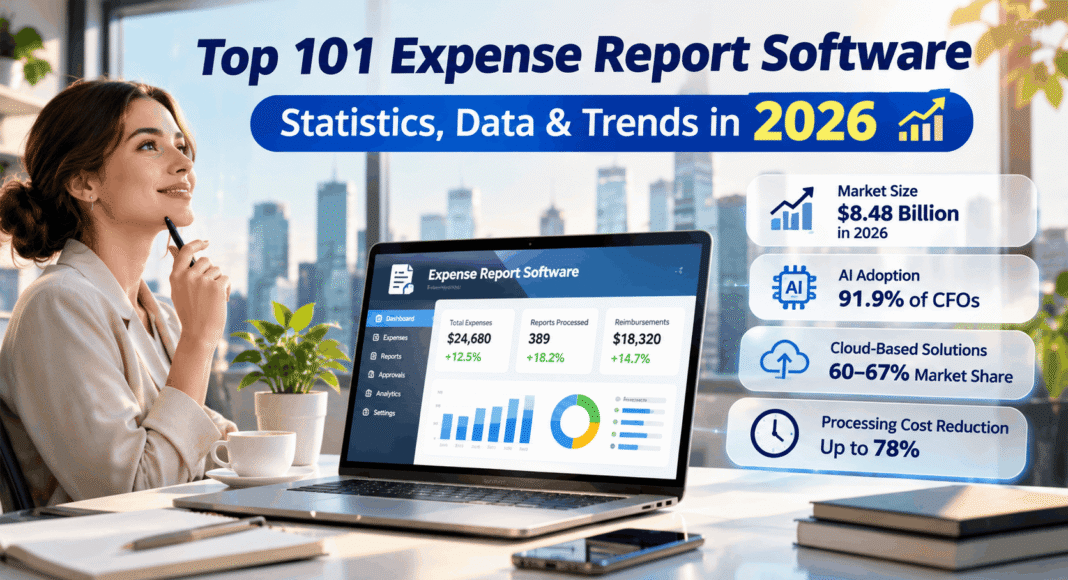
- Expense Report Software Market Growth: The global expense management software market is projected to reach USD 8.48 billion in 2026, driven by rising demand for cloud-based expense tracking, automated reporting, and financial compliance solutions.
- AI Automation and Cost Savings: AI-powered expense report software can streamline receipt scanning, expense categorization, and fraud detection, while automation can reduce processing costs by up to 78% and accelerate employee reimbursements.
- Expense Management Trends and Adoption: Cloud-based platforms, mobile expense reporting, real-time spending analytics, and integrated travel and expense management solutions are transforming corporate financial operations in 2026.
Expense report software is transforming business financial management in 2026 through AI automation, cloud-based tracking, and digital expense reporting. According to Mordor Intelligence, the global expense management software market is projected to reach USD 8.48 billion in 2026. Explore 101 key statistics covering market growth, processing costs, software adoption, fraud prevention, and emerging trends.
Expense report software has become an essential component of modern financial management as businesses increasingly prioritize cost control, operational efficiency, regulatory compliance, and financial transparency. In 2026, the rapid adoption of artificial intelligence (AI), cloud-based expense management platforms, automated receipt scanning, and real-time expense tracking is transforming how organizations manage employee reimbursements, business travel expenses, and corporate spending.
Also, read our article on the Top 10 Expense Report Software To Use.
According to industry research, the global expense management software market is estimated to reach USD 8.48 billion in 2026, up from USD 7.70 billion in 2025. Long-term projections suggest continued expansion, with some analysts forecasting the market could exceed USD 21 billion by 2035. This growth reflects increasing demand for automated expense reporting solutions among small and medium-sized enterprises (SMEs), multinational corporations, and finance departments seeking to eliminate manual processes.
The financial impact of traditional expense reporting remains substantial. Research from the Global Business Travel Association (GBTA) indicates that manually processing a single expense report can cost approximately USD 58, while employees spend considerable time submitting receipts, correcting errors, and waiting for reimbursements. Automated expense management software can significantly reduce these administrative burdens, with some studies reporting processing cost reductions of up to 78% and expense report processing time reductions of 80% in specific implementations.
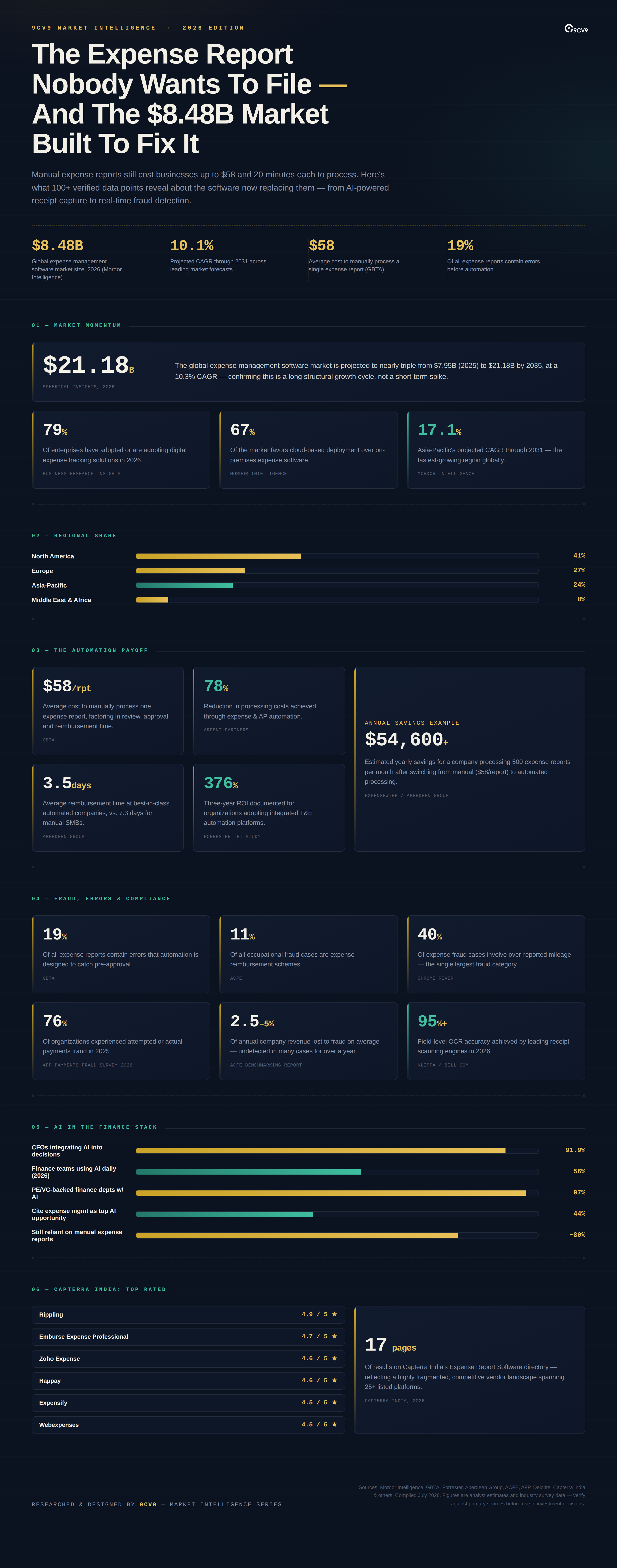
Artificial intelligence is also reshaping the expense reporting software landscape. AI-powered receipt recognition, optical character recognition (OCR), automated expense categorization, fraud detection, and predictive spending analytics are helping businesses improve accuracy and strengthen financial oversight. Research cited in this report indicates that 91.9% of CFOs are integrating AI into financial decision-making to varying degrees, highlighting the growing importance of intelligent automation across finance functions.
Meanwhile, cloud-based expense management solutions, mobile expense reporting applications, and integrated travel and expense (T&E) platforms are gaining traction. North America continues to dominate the global market, while Asia-Pacific represents one of the fastest-growing regions. Businesses are also placing greater emphasis on real-time expense visibility, corporate card integrations, multi-currency support, tax compliance, and automated approval workflows.
However, significant challenges remain. Manual expense reporting, fraudulent reimbursement claims, inaccurate expense categorization, complicated compliance requirements, and fragmented financial systems continue to create operational inefficiencies. As organizations evaluate platforms such as SAP Concur, Expensify, Zoho Expense, Rippling, and Emburse, understanding the latest expense report software statistics and industry benchmarks has become increasingly important for making informed technology investment decisions.
This comprehensive guide examines the Top 101 Expense Report Software Statistics, Data & Trends in 2026, covering global market size, industry growth forecasts, expense automation adoption rates, processing costs, business travel spending, AI-powered financial management, expense fraud, mobile receipt scanning, and emerging software innovations.
Whether the reader is a CFO, finance manager, business owner, accountant, procurement professional, or software buyer, these expense management statistics provide valuable insights into how expense reporting technology is evolving, where businesses can achieve measurable efficiency improvements, and which trends are expected to shape the future of automated expense management in 2026 and beyond.
Before we venture further into this article, we would like to share who we are and what we do.
About 9cv9
9cv9 is a business tech startup based in Singapore and Asia, with a strong presence all over the world.
With over ten years of startup and business experience, and being highly involved in connecting with thousands of companies and startups, the 9cv9 team has listed some of the top and best companies/tools in this review.
If you like to get your company listed in our top B2B software reviews, check out our world-class 9cv9 Media and PR service and pricing plans here.
Top 101 Expense Report Software Statistics, Data & Trends in 2026
Market Size & Growth
- The global expense management software market is valued between USD 4.89 billion and USD 11.26 billion in 2026, depending on scope and methodology. This wide analyst range reflects differing definitions of “expense management” versus narrower “expense report” software, so buyers should treat any single market-size figure as directional rather than absolute.
- Mordor Intelligence pegs the 2026 market at USD 8.48 billion, growing from USD 7.70 billion in 2025. This represents healthy double-digit momentum and confirms expense report software has moved from a back-office convenience to a mainstream finance category.
- The market is projected to grow at a CAGR ranging from 7.1% to 13.8% depending on the report, with several forecasts converging around 10%. A double-digit growth rate signals that expense automation adoption is still in its expansion phase rather than maturity.
- Spherical Insights projects the market will reach USD 21.18 billion by 2035, up from USD 7.95 billion in 2025. This near-tripling over a decade underscores long-term structural demand driven by digitization and compliance pressure.
- NextMSC forecasts the broader expense management software market hitting USD 34.78 billion by 2035 at a 13.35% CAGR. The more aggressive growth trajectory highlights how bundled spend-management platforms (cards + software) are inflating category value beyond stand-alone expense report tools.
- The narrower “Expense Tracking & Reporting Software” segment alone is valued at USD 4.84 billion in 2026, projected to reach USD 8.95 billion by 2032. This shows that even the most conservative slice of the category is on track to nearly double within six years.
- The dedicated Travel and Expense (T&E) Management Software market is projected to grow from USD 4.63 billion in 2026 to USD 12.98 billion by 2034, a 13.80% CAGR. T&E-specific platforms are outpacing the broader expense category, reflecting renewed corporate travel volumes post-pandemic.
- Top vendors collectively hold roughly 69% of the expense management software market. This concentration suggests the category is consolidating around a handful of established platforms even as new entrants continue to launch.
- Cloud-based deployment is expected to account for over 60–67% of the market by 2026. The shift away from on-premises tools confirms that scalability and remote accessibility are now baseline buyer requirements, not differentiators.
- SMEs contribute approximately 38–40% of total expense management software market revenue. This meaningful share shows smaller businesses are no longer a secondary market but a core growth engine for vendors.
- Approximately 79–84% of enterprises have adopted or are adopting digital expense tracking solutions. With adoption approaching four-fifths of enterprises, expense software has effectively become a default finance-stack component rather than an optional upgrade.
- Roughly 72% of organizations have automated some or all of their expense reporting processes. This still leaves nearly three in ten organizations relying on manual or semi-manual workflows, representing a sizeable remaining addressable market.
Regional Breakdown
- North America holds the largest regional share of the expense management software market, ranging from 39% to 41% depending on the report. North America’s continued lead reflects mature corporate card ecosystems and stringent compliance regimes like Sarbanes-Oxley that necessitate robust expense controls.
- Europe holds the second-largest regional share at approximately 27–28%. Europe’s strong position is tied to GDPR-driven data governance requirements that favor auditable, automated expense platforms over spreadsheets.
- Asia-Pacific accounts for roughly 22–24% of the global market but is forecast to grow the fastest, at CAGRs as high as 17.1%. Asia-Pacific’s rapid growth trajectory, led by India and China, makes it the region software vendors are prioritizing for expansion investment.
- Middle East & Africa represents the smallest regional share, around 8–10%. This smaller base still represents meaningful greenfield opportunity as digital transformation initiatives spread across the region’s growing SME sector.
- India is home to over 820 million active internet users, with internet penetration growing roughly 8% annually. This scale of digital infrastructure directly underpins the addressable base for cloud expense software adoption in India.
- India’s travel and expense management software market is projected to reach approximately USD 0.19 billion in 2026. While smaller in absolute terms than mature Western markets, this figure is expected to expand quickly given India’s fast-growing services and IT sectors.
- Enterprises using expense automation report cutting IT operating costs by up to 40% by moving from on-premises systems to multitenant cloud suites. This cost reduction is a primary driver behind the region-wide shift toward cloud-hosted expense report platforms.
- Cloud platforms integrated with AI services help finance teams close the books up to 50% faster while cutting manual data entry by roughly 43%. These efficiency gains illustrate why cloud-native expense report software increasingly wins over legacy desktop tools in competitive evaluations.
Cost of Manual vs. Automated Expense Reporting
- Manually processing a single expense report costs businesses between $20.65 and $58, depending on company size and process complexity. This wide cost range shows that inefficiency scales dramatically with organizational size and process maturity, making automation ROI easier to justify for larger teams.
- The Global Business Travel Association (GBTA) puts the average manual expense report cost at $58, factoring in review, approval, filing, and reimbursement time. This figure has become the industry-standard benchmark that most vendors cite when building automation business cases.
- Small and mid-sized businesses (under 1,000 employees) pay an average of $35.02 to process a single manual expense report, per Aberdeen Group. Smaller firms often bear disproportionately higher per-report costs because they lack the process standardization that larger enterprises achieve at scale.
- Best-in-class large companies using expense automation reduce their per-report cost to roughly $25.92. This cost gap between manual and automated processing demonstrates a tangible, quantifiable case for adopting expense report software beyond convenience alone.
- Manual expense reports take an average of 20 minutes to complete and a further 18 minutes to correct when errors occur. Nearly doubling the time spent on error correction highlights how manual processes compound inefficiency rather than simply adding a fixed overhead.
- Best-in-class organizations turn expense reports into reimbursements in just 3.5 days, compared to 7.3 days for smaller businesses using manual processes. Faster reimbursement cycles directly correlate with employee satisfaction and reduced finance-team query volume.
- Automated expense and accounts payable processes can reduce processing costs by up to 78% and cut processing time by more than 60%, according to Ardent Partners. These figures represent some of the strongest documented ROI numbers in the finance-automation category.
- Organizations that automate expense reporting save an average of 40% of time previously spent on auditing and reconciliation. This time savings frees finance staff to focus on higher-value analysis rather than transactional review work.
- A 200-person company spends an estimated 330 hours per year processing expense reports manually, including tracking down and reviewing receipts. This hidden labor cost is often underestimated by finance leaders evaluating whether to invest in automation.
- Automating expense workflows has been shown to save companies over 5,400 employee hours in aggregate, according to Forrester research. Savings at this scale translate into meaningful headcount reallocation opportunities for finance and operations teams.
Business Travel & T&E Spend
- Global business travel spending is projected to reach approximately $1.64–$1.70 trillion in 2026, per GBTA. T&E remains one of the largest controllable cost categories after payroll, making expense report software a strategic finance priority rather than a back-office tool.
- The average business trip cost $1,128 per person in 2025, up sharply from $834 the year prior. This steep year-over-year increase in per-trip costs is intensifying pressure on finance teams to gain real-time visibility through expense software rather than after-the-fact reporting.
- T&E spend that flows through “managed” or compliant channels reaches roughly 92% at best-in-class companies, compared to just 45% at smaller businesses using manual systems. This gap illustrates how expense software adoption directly correlates with spend visibility and control.
- Programs with pre-trip approval compliance above 80% spend 13.4% less per trip than programs with compliance below 60%. Policy enforcement embedded in expense and booking software is proving to be the single largest controllable cost lever available to travel and finance managers.
- 71% of business travelers report spending 30 or more minutes filing a single expense report, according to a 2025 Skift and Navan survey. This friction point remains a persistent pain point even as automation technology has matured, suggesting user-experience gaps in many existing tools.
- 80% of business travelers admit to sometimes booking trips off-platform, outside approved corporate channels. This high rate of policy circumvention shows why expense software with embedded, in-the-moment policy enforcement is increasingly favored over after-the-fact expense auditing.
- Organizations using integrated T&E platforms have achieved a documented 376% ROI over three years, according to a Forrester Total Economic Impact study. This figure represents one of the more rigorously validated ROI benchmarks in the expense software category.
- The same Forrester study found an 80% reduction in expense report processing time for companies adopting integrated T&E automation. Processing-time reduction at this scale directly shortens financial close cycles and improves cash-flow forecasting accuracy.
- Travel and entertainment expenses remain the largest application segment within expense management software, accounting for roughly 42.35% of total spend in 2025. T&E’s continued dominance confirms that travel-related costs remain the primary use case driving expense software purchasing decisions.
- Telecom expense management is the fastest-growing application segment, projected to post a 15.4% CAGR through 2031. This faster growth signals rising demand for software that can manage increasingly complex, distributed telecom and SaaS spend alongside traditional T&E.
- Approximately 22% of corporate travel spend flows through “hidden” or unmanaged channels outside standard expense systems. This unmanaged spend represents a significant blind spot that modern expense report software aims to close through card integrations and real-time capture.
- Companies with automated pre-spend controls can prevent out-of-policy purchases before they happen rather than catching them after reimbursement requests are filed. This proactive control model reflects a broader industry shift from retrospective expense auditing toward point-of-purchase policy enforcement.
Expense Fraud, Errors & Compliance
- Approximately 19% of all expense reports contain errors, according to GBTA research. With roughly one in five reports flawed, automated validation and OCR-based data capture are increasingly viewed as essential rather than optional safeguards.
- Expense reimbursement fraud accounts for approximately 11% of all occupational fraud cases tracked by the Association of Certified Fraud Examiners (ACFE). This proportion illustrates why built-in fraud-detection features have become a differentiating factor among competing expense platforms.
- The typical organization loses an estimated 2.5% to 5% of annual revenue to fraud, based on ACFE benchmarking data. Even a fraction of this loss attributable to expense-related fraud represents a material financial exposure that automated policy checks can help mitigate.
- Over-reported mileage accounts for nearly 40% of all expense fraud cases, according to a Chrome River study. Mileage remains one of the hardest expense categories to verify manually, which is why GPS-based automatic mileage tracking has become a standard software feature.
- Fraudulent claims made possible by AI-generated receipts are an emerging risk, as generative AI tools can now convincingly replicate receipt layouts, fonts, and formatting. This evolving threat is pushing vendors to invest in AI-based fraud detection that can identify synthetic or manipulated documents, not just policy violations.
- 76% of organizations reported experiencing attempted or actual payments fraud in 2025, according to the AFP’s Payments Fraud and Control Survey. While this figure spans broader payment fraud, it underscores the elevated risk environment that is driving finance teams toward more automated, harder-to-manipulate expense controls.
- 79% of organizations experienced payments fraud attacks or attempts in 2024, according to AFP data cited in industry analysis. The persistence of this figure year over year suggests fraud prevention will remain a top purchasing criterion for expense software buyers through 2026 and beyond.
- Manual data entry errors contribute to a meaningful share of expense report rejections, with user-related receipt-upload mistakes cited as a leading cause. Reducing this friction through automated OCR capture is one of the most commonly cited justifications for switching from manual to software-based expense reporting.
- Approximately 45% of organizations report struggling to configure expense software rules that align with multiple departmental or regional policies. This configuration complexity highlights those policy-engine flexibility and ease-of-setup remain important differentiators between competing platforms.
- Roughly 37% of finance teams report inconsistencies in expense categorization even after adopting some form of automation. This finding suggests categorization accuracy is an area where AI-driven expense tools still have room to improve.
- Around 42% of global organizations report difficulty managing multi-currency expenses and varying tax rules within a single expense system. Multi-currency and localized tax handling remain key evaluation criteria for internationally operating businesses shortlisting expense report software.
Receipt Scanning, OCR & Mobile Adoption
- Leading OCR engines used in expense software now achieve above 95% field-level accuracy for extracting vendor names, dates, amounts, and tax lines. This level of extraction accuracy has made receipt-scanning features a near-universal expectation rather than a premium add-on among expense platforms.
- Some vendors claim OCR accuracy rates as high as 98–99% under optimal, clean-receipt conditions. Buyers should treat top-end accuracy claims cautiously, since real-world performance typically declines with faded, crumpled, or low-light receipt images.
- Approximately 64–69% of employees now submit business expenses via mobile applications rather than desktop or paper-based methods. Mobile-first submission has effectively become the default expense-capture channel, making native mobile apps a baseline requirement for any modern expense platform.
- Mobile expense reporting is credited with reducing overall processing time by approximately 40–41%. This time savings stems primarily from capturing receipt data at the point of purchase rather than requiring employees to reconstruct expenses later.
- Indian-language OCR accuracy on regional-script receipts (Hindi, Tamil, Bengali) typically lags English-language OCR by 5 to 15 percentage points. This gap is an important consideration for Indian businesses evaluating expense software, since vernacular receipt support varies significantly between vendors.
- The Institute of Chartered Accountants of India estimates that 15.2 million registered Indian businesses now use some form of automated expense management, with the segment expanding at roughly 42% annually. This rapid growth reflects GST compliance requirements accelerating digital adoption among Indian SMEs specifically.
- Mobile receipt scanning apps are estimated to represent roughly 34% of the broader expense management software segment by feature usage. This proportion reflects how central receipt capture has become to the overall expense software value proposition, rather than being a minor supporting feature.
- Businesses adopting digital receipt management report average time savings of approximately 8.3 hours per employee per month, according to ACCA research on UK businesses. This per-employee time recovery compounds significantly across larger organizations, reinforcing automation’s labor-efficiency case.
AI & Automation Adoption in Finance
- 56% of finance leaders now use AI-powered tools in their daily work, up from 31% in 2024 and 17% in 2023 — effectively doubling year over year. This acceleration signals that AI-assisted expense processing is quickly moving from novelty to baseline expectation among finance teams.
- 91.9% of CFOs report they are already integrating AI into financial decision-making across some or nearly all processes, according to Kyriba’s 2026 CFO Survey. Near-universal AI integration at the leadership level suggests expense software lacking AI-driven categorization or anomaly detection may increasingly struggle to compete.
- AI adoption across finance departments at PE/VC-backed companies reached 97% in 2026, up from 76% in 2025, per Consero Global. This sharp rise illustrates how investor pressure for operational efficiency is directly accelerating AI-powered finance tool adoption, including expense automation.
- Expense management ranks among the top three finance functions where leaders see the greatest opportunity for AI-assisted “agentic” automation, alongside sales/profitability management and working capital optimization. This positions expense reporting as one of the clearest near-term beneficiaries of agentic AI investment within finance organizations.
- Despite high overall interest, only 17% of finance teams report actively using AI within their core workflows, with 45% still in “limited pilot” mode. This gap between AI enthusiasm and actual production deployment suggests many expense software AI features remain underutilized relative to their potential.
- 73–77% of expense management market participants cite AI-powered analytics and receipt recognition as an emerging or already-adopted trend. This high level of trend recognition confirms AI features have become a standard evaluation checkbox for expense software buyers rather than a differentiator.
- 59–63% of companies report relying on AI-powered tools specifically for expense tracking, categorization, or fraud detection. This adoption level shows AI-assisted expense processing has crossed into mainstream usage for a majority of surveyed organizations.
- AI-driven analytics in expense management are credited with improving categorization accuracy by approximately 39–46% over rules-based systems alone. This meaningful accuracy improvement helps explain why AI-based categorization has become a headline feature in newer expense platform releases.
- 68% of CFOs say they don’t know where to start with broader AI adoption in finance, despite strong interest in the technology. This uncertainty gap presents an opportunity for expense software vendors who can offer pre-built, low-configuration AI features rather than requiring custom implementation.
- AI investments in finance functions are already generating positive returns within 12 months for more than 75% of organizations that have deployed them, per Consero’s 2026 CFO Report. This relatively fast payback period strengthens the business case for AI-enabled expense report software specifically.
SMB vs. Enterprise Adoption Patterns
- 83% of large U.S. enterprises have adopted expense management software, compared to 71% among SMEs. This 12-point adoption gap represents meaningful whitespace for vendors targeting smaller and mid-sized businesses with simplified onboarding.
- Nearly 55% of SMEs report they are actively transitioning from manual expense tracking to automated platforms. This ongoing transition suggests the SMB segment remains a significant growth opportunity even as enterprise adoption approaches saturation.
- SMEs adopting automated expense systems report approximately 42% faster approval cycles and a 36% reduction in reimbursement errors. These efficiency gains are proportionally larger for SMEs than enterprises, since smaller finance teams benefit disproportionately from removing manual bottlenecks.
- 52% of SMEs cite cost as the primary barrier to adopting expense management software, according to PayStream Advisors research. This pricing sensitivity explains the continued popularity of freemium and low-cost per-user tiers among newer market entrants targeting small businesses.
- Freemium and sub-$5-per-user pricing tiers have become common tools for lowering adoption barriers among small businesses. This pricing trend reflects vendors’ recognition that affordability, not just functionality, determines SMB purchasing decisions.
- Simple expense platform implementations for SMBs typically take 1–2 weeks, compared to 6–8 weeks for enterprise-grade deployments. Faster implementation timelines are a key reason smaller organizations increasingly favor modern SaaS expense tools over legacy enterprise suites.
- Approximately 61% of SMEs adopting expense software prioritize cloud-based platforms specifically for cost efficiency and scalability. This cloud preference among SMBs mirrors — and in some cases exceeds — enterprise cloud adoption rates.
- Around 54% of small businesses cite ease of implementation as a top decision-making priority when selecting expense software, ahead of feature depth. This preference for simplicity over comprehensiveness explains why streamlined, mobile-first tools often outcompete feature-heavy legacy platforms in the SMB segment.
Capterra India — Category Landscape (Expense Report Software)
- Rippling holds the highest user rating among leading Expense Report Software listed on Capterra India, at 4.9 out of 5 across 4,829 reviews. This top rating reflects strong user satisfaction with Rippling’s unified approach to combining corporate cards, bill pay, travel, and expense management.
- Zoho Expense holds a 4.6/5 rating across 1,212 Capterra India reviews. Zoho Expense’s strong rating and review volume reflect its popularity among businesses seeking an integrated, automation-first expense reporting solution.
- QuickBooks Online is one of the most heavily reviewed products in the category, with 8,473 reviews and a 4.3/5 rating on Capterra India. Its very high review count signals broad market penetration, particularly among small businesses already using QuickBooks for core accounting.
- Emburse Expense Professional achieves a 4.7/5 rating across 1,285 reviews, one of the highest ratings among mid-to-large enterprise-focused platforms. This suggests strong satisfaction specifically among larger organizations with more complex spend-control requirements.
- SAP Concur, one of the most established enterprise expense platforms, holds a 4.3/5 rating across 2,256 Capterra India reviews. Despite being a long-standing market leader, Concur’s rating sits mid-pack relative to newer, more streamlined competitors — a pattern common among legacy enterprise incumbents.
- Happay, an India-focused expense management platform, holds a 4.6/5 rating across 829 reviews on Capterra India. Happay’s strong local rating reflects the growing strength of India-built expense solutions tailored specifically to GST and domestic compliance needs.
- Expensify maintains a 4.5/5 rating across 1,342 reviews, reflecting consistent satisfaction with its AI-powered SmartScan receipt capture feature. Expensify remains a widely recognized name globally, and its rating consistency suggests durable trust in its automated receipt-processing capabilities.
- Webexpenses holds a 4.5/5 rating across 1,105 reviews, with users citing compliance enforcement and ERP integration as standout features. This rating level reflects solid performance among mid-market buyers prioritizing structured approval workflows.
- Across the top 25 expense report software products listed on Capterra India, average user ratings cluster between 4.3 and 4.7 out of 5. This consistently high rating band suggests the category overall delivers strong user satisfaction, with differentiation driven more by fit-for-purpose features than by baseline quality gaps.
- The Capterra India Expense Report Software directory lists software spanning 17 result pages, indicating a highly fragmented, competitive vendor landscape. This breadth of options means buyers face a genuinely complex evaluation process, reinforcing the value of clear feature and pricing comparisons before selecting a platform.
- Emburse Nexonia, positioned for ERP-integrated mid-market use cases, holds a 4.5/5 rating across 648 reviews. Its strong rating despite a smaller review base suggests high satisfaction within its more specialized niche of ERP-heavy organizations.
Additional Trends & Forward-Looking Data Points
- SAP Concur launched a “Pre-Spend Planner” AI feature integrated into its Joule assistant in February 2026, enabling predictive budget-impact forecasting before expenses are incurred. This launch exemplifies the broader industry shift from reactive expense reporting toward proactive, AI-driven spend planning.
- Zoho Corporation raised a USD 250 million funding round in 2024 explicitly earmarked in part for expanding Zoho Expense’s product offerings. This level of investment signals strong vendor confidence in continued category growth, particularly in Asia-Pacific markets like India.
- SAP acquired Appareo Systems in February 2025 specifically to strengthen its mobile-first expense management capabilities. This acquisition activity reflects consolidation pressure as larger vendors move to close mobile-experience gaps against more nimble, mobile-native competitors.
- Corporate card programs with automatic ERP synchronization are increasingly replacing traditional expense reports altogether at mid-market and enterprise companies. This “expense report elimination” trend represents one of the more disruptive shifts reshaping how vendors position their next-generation platforms.
- 63% of finance leaders report their organizations are already experimenting with at least one AI use case relevant to expense or cost management. Near-universal experimentation suggests AI features will likely become table-stakes in expense software RFPs within the next one to two years.
- Expense management ranks as a top-three area (44% of respondents) where finance leaders see the greatest opportunity for assistive AI, according to Deloitte’s 2026 Finance Trends survey. This ranking places expense automation among the clearest, most immediately actionable AI use cases within the broader finance function.
- Just over a third (36%) of finance leaders are primarily responsible for cost and expense management within their organizations, rising to 42% among CFOs specifically. This ownership concentration at the CFO level underscores why expense software purchasing decisions increasingly involve senior finance leadership rather than being delegated purely to operations teams.
- 45% of organizations that own cost-management responsibilities report using a dedicated expense management team as part of their broader cost-discipline practice. The presence of dedicated teams suggests larger organizations are treating expense governance as a strategic function rather than a purely administrative task.
- Approximately 45% of finance leaders still report spending more than 60% of their time on manual tasks despite rising AI investment. This persistent manual-work burden — described by Consero as an “efficiency gap” — highlights substantial remaining headroom for expense automation to deliver measurable time savings.
- The average business now generates enough expense-reporting volume that even modest per-report cost reductions compound into tens of thousands of dollars in annual savings; for example, cutting the manual $58 baseline to an automated rate across 500 monthly reports saves an estimated $54,600+ per year. This concrete, scalable savings calculation is one of the clearest, most commonly cited ROI arguments used across the expense report software industry.
- Nearly 80% of all organizations still rely at least partly on manual expense reporting processes, according to Forrester research. This surprisingly high figure — despite widespread awareness of automation benefits — indicates substantial remaining market opportunity for expense report software vendors targeting laggard adopters.
Conclusion
The Top 101 Expense Report Software Statistics, Data & Trends in 2026 highlight a significant transformation in how businesses manage corporate spending, employee reimbursements, financial compliance, and operational efficiency. As organizations increasingly adopt artificial intelligence, cloud-based expense management platforms, and automated financial workflows, expense report software is evolving from a basic administrative tool into a strategic component of modern financial management.
With the global expense management software market estimated to reach USD 8.48 billion in 2026 and potentially exceed USD 21 billion by 2035, the industry demonstrates strong long-term growth potential. Rising demand for expense automation, real-time financial visibility, mobile receipt scanning, and integrated travel and expense management solutions is accelerating software adoption across businesses of all sizes.
One of the most important findings from these expense report software statistics is the substantial financial burden associated with manual expense processing. With traditional expense reports costing businesses approximately USD 58 per report, organizations have compelling reasons to invest in automation. Research cited in this report suggests that advanced expense management solutions can reduce processing costs by up to 78% and significantly shorten reimbursement cycles, allowing finance teams to allocate more resources toward strategic financial planning and analysis.
Artificial intelligence is expected to remain a major driver of expense management software innovation. AI-powered receipt recognition, automated expense categorization, predictive spending analytics, and intelligent fraud detection are helping organizations reduce human errors, strengthen compliance, and identify potentially fraudulent transactions. As CFOs and finance leaders accelerate AI adoption, these capabilities are becoming increasingly important considerations when evaluating expense reporting platforms.
Regional trends also reveal considerable opportunities for software providers and businesses. While North America maintains the largest share of the expense management software market, Asia-Pacific is emerging as a high-growth region, supported by expanding digital infrastructure, increasing cloud adoption, and growing demand for financial automation among SMEs.
Despite these advancements, challenges such as expense reimbursement fraud, fragmented financial systems, manual data entry, inconsistent expense categorization, and complex international tax requirements continue to affect businesses. These persistent issues reinforce the importance of selecting expense report software that offers reliable integrations, configurable approval workflows, comprehensive audit trails, multi-currency capabilities, and robust security controls.
Looking ahead, the future of expense report software will likely be shaped by AI-driven automation, mobile-first expense reporting, real-time corporate spending controls, integrated financial ecosystems, and increasingly intelligent compliance monitoring. Organizations that successfully implement these technologies may benefit from lower administrative costs, faster reimbursements, improved financial accuracy, and greater visibility into company-wide expenditures.
Ultimately, the 101 expense report software statistics and trends for 2026 demonstrate that digital expense management is no longer simply about replacing spreadsheets or digitizing receipts. It is about building a more efficient, transparent, scalable, and data-driven financial operation.
For CFOs, finance managers, accountants, business owners, and procurement leaders, understanding these expense management software statistics provides a valuable foundation for evaluating technology investments, identifying automation opportunities, benchmarking financial processes, and preparing for the next generation of intelligent expense management solutions.
If you find this article useful, why not share it with your hiring manager and C-level suite friends and also leave a nice comment below?
We, at the 9cv9 Research Team, strive to bring the latest and most meaningful data, guides, and statistics to your doorstep.
To get access to top-quality guides, click over to 9cv9 Blog.
To hire top talents using our modern AI-powered recruitment agency, find out more at 9cv9 Modern AI-Powered Recruitment Agency.
People Also Ask
What is expense report software?
Expense report software is a digital solution that helps businesses track, manage, approve, and reimburse employee expenses. It automates receipt collection, expense categorization, approval workflows, and financial reporting to improve accuracy and reduce administrative costs.
How big is the global expense management software market in 2026?
According to Mordor Intelligence, the global expense management software market is estimated to reach USD 8.48 billion in 2026, up from USD 7.70 billion in 2025, reflecting growing demand for automated financial management solutions.
What is the projected growth rate of expense report software in 2026?
Industry forecasts estimate annual growth rates between 7.1% and 13.8%, depending on market definitions and research methodologies. Increasing cloud adoption, AI integration, and demand for expense automation are major growth drivers.
How much will the expense management software market be worth by 2035?
Spherical Insights projects the global expense management software market will reach approximately USD 21.18 billion by 2035, while broader market estimates from NextMSC suggest it could reach USD 34.78 billion.
What are the biggest expense report software trends in 2026?
Major trends include AI-powered expense categorization, automated receipt scanning, cloud-based reporting, mobile expense tracking, real-time spending analytics, corporate card integrations, and intelligent fraud detection.
How much does manual expense report processing cost?
Research from the Global Business Travel Association indicates that manually processing an expense report costs approximately USD 58. These expenses include employee time, administrative reviews, approval workflows, corrections, and reimbursement processing.
How much can businesses save with automated expense reporting?
Research cited in the report suggests that automated expense and accounts payable processes can reduce processing costs by up to 78% and processing time by more than 60%. Actual savings depend on transaction volume, existing workflows, and implementation quality.
How long does it take to process an expense report manually?
Employees spend approximately 20 minutes completing a manual expense report, with an additional 18 minutes required when corrections are necessary. Automated receipt capture and expense categorization can significantly reduce this administrative workload.
What percentage of businesses use expense management software?
The report estimates that approximately 79% to 84% of enterprises have adopted or are adopting digital expense tracking solutions. Adoption varies by organization size, geographic region, and industry.
What percentage of organizations automate expense reporting?
Approximately 72% of organizations have automated some or all expense reporting processes, according to figures cited in the report. However, many businesses still depend on manual activities for certain expense management tasks.
How is artificial intelligence transforming expense report software?
AI improves expense management through automated receipt recognition, intelligent categorization, duplicate detection, fraud monitoring, and predictive spending analytics. These capabilities help finance teams reduce manual work and strengthen financial oversight.
What percentage of CFOs are adopting AI in financial management?
According to Kyriba’s 2026 CFO Survey, 91.9% of CFOs report integrating AI into financial decision-making across some or nearly all processes, indicating growing interest in intelligent financial automation.
How accurate is OCR technology in expense reporting software?
Leading optical character recognition systems can achieve field-level accuracy exceeding 95% when extracting receipt information. Some vendors report 98% to 99% accuracy under optimal conditions, although results vary with receipt quality.
What is the market share of cloud-based expense management software?
Cloud-based expense management solutions are expected to represent more than 60% to 67% of the market in 2026. Businesses increasingly prefer cloud platforms for accessibility, scalability, integration capabilities, and reduced infrastructure requirements.
Which region dominates the expense management software market?
North America leads the global expense management software market, accounting for approximately 39% to 41% of market share. Its leadership reflects established corporate spending systems, advanced financial infrastructure, and strong compliance requirements.
Which region has the fastest-growing expense management software market?
Asia-Pacific is projected to experience the fastest growth, with some forecasts estimating a compound annual growth rate of up to 17.1%. Expanding digital infrastructure and increasing software adoption in India and China support regional growth.
What percentage of expense reports contain errors?
Research attributed to the Global Business Travel Association suggests approximately 19% of expense reports contain errors. Automated validation, receipt scanning, and policy enforcement can help organizations identify inaccuracies before reimbursement.
How common is expense reimbursement fraud?
Expense reimbursement fraud represents approximately 11% of occupational fraud cases tracked by the Association of Certified Fraud Examiners. Automated expense auditing and suspicious transaction detection can help businesses strengthen fraud prevention.
How does expense report software prevent employee expense fraud?
Expense management software helps detect duplicate receipts, unusual spending patterns, inflated mileage claims, unauthorized purchases, and policy violations. AI-powered monitoring and automated approval controls can improve fraud detection and accountability.
What percentage of employees submit expense reports through mobile apps?
The report estimates that approximately 64% to 69% of employees submit business expenses through mobile applications. Mobile receipt scanning enables faster submissions and reduces reliance on paper-based reporting processes.
How much time can mobile expense reporting software save?
Mobile expense reporting is associated with processing time reductions of approximately 40% to 41%. Employees can capture receipts immediately after purchases, reducing manual data entry and missing documentation.
How much is global business travel spending expected to reach in 2026?
Global business travel spending is projected to reach approximately USD 1.64 trillion to USD 1.70 trillion in 2026. Rising travel expenditure increases demand for integrated travel and expense management platforms.
How does expense management software improve employee reimbursement times?
Automated expense management streamlines receipt verification, approval routing, policy checks, and payment processing. The report cites reimbursement cycles of 3.5 days among best-in-class organizations compared with 7.3 days for smaller businesses using manual processes.
What percentage of SMEs use expense management software?
The report estimates expense management software adoption at approximately 71% among SMEs, compared with 83% among large U.S. enterprises. Smaller businesses increasingly adopt affordable cloud-based platforms to streamline financial operations.
What are the biggest challenges in implementing expense report software?
Common challenges include implementation costs, employee training, accounting system integration, complex approval policies, multi-currency transactions, tax compliance, and inaccurate expense categorization.
How much does expense report software cost for small businesses?
Expense report software pricing varies by vendor, features, and user count. Some platforms offer freemium plans or pricing below USD 5 per user, while advanced enterprise solutions may require customized subscriptions and implementation fees.
What are the best expense report software platforms in 2026?
Popular expense reporting platforms include SAP Concur, Expensify, Zoho Expense, Rippling, Emburse, Happay, and Webexpenses. The best choice depends on company size, automation requirements, accounting integrations, compliance needs, and budget.
How does expense management software improve financial compliance?
Expense management platforms improve compliance through automated policy enforcement, approval workflows, transaction records, audit trails, and spending controls. These capabilities help businesses maintain accurate financial documentation and reduce policy violations.
What is the difference between expense report software and travel expense management software?
Expense report software manages employee spending, receipts, approvals, and reimbursements. Travel and expense management software typically adds corporate travel booking, itinerary management, travel policies, and integrated business travel spending controls.
What is the future of expense report software beyond 2026?
Expense report software is expected to evolve toward AI-driven automation, predictive spending insights, real-time fraud detection, integrated corporate payments, and automated compliance. These developments may reduce manual reporting and improve financial visibility.
Sources
Research and Markets
Business Research Insights
The Business Research Company
Mordor Intelligence
Global Growth Insights
Fortune Business Insights
Spherical Insights & Consulting
NextMSC
Straits Research
Technavio
360iResearch
Cognitive Market Research
Travel Code
Navan
Skift
Companies History
Engine
Business Traveller
Business Travel News
ExpensePoint
ExpenseWire
Ramp
TripLog
Emburse
SutiSoft
Corpay
PEX
Foundation Software
Rydoo
Association for Financial Professionals
WifiTalents
Association of Certified Fraud Examiners
TransUnion
Klippa
BILL
HyperVerge
ReceiptRecon
Elite Mindz
ZYNO
greytHR
Mysa
CFO Connect
SoftCo
Consero Global
CFO Dive
CFO
Kyriba
Deloitte
Capterra India