





























Key Takeaways
- The global Desktop as a Service (DaaS) market is estimated at USD 11.53 billion in 2026, with strong long-term growth driven by cloud adoption, hybrid work and enterprise digital transformation.
- DaaS adoption is accelerating, with an estimated 80% of virtual desktops delivered through DaaS platforms by 2026, highlighting the shift from traditional on-premises VDI to cloud-based desktops.
- Cost savings, cybersecurity and scalability remain major DaaS adoption drivers, with businesses reporting lower PC costs, reduced IT operational expenses and more centralized management of distributed workforces.
Desktop as a Service (DaaS) transforms how organizations deliver secure virtual desktops to employees in 2026. The global DaaS market is estimated at $11.53 billion, while adoption continues rising as businesses shift from traditional VDI toward cloud-based desktops for hybrid work, centralized management, stronger security, scalability, and lower IT costs.
Desktop as a Service (DaaS) has evolved from a specialized virtual desktop solution into an increasingly important component of modern enterprise IT infrastructure. As organizations embrace hybrid work, cloud computing, Zero Trust security, distributed teams, and subscription-based technology models, DaaS is changing how businesses provision, secure, manage, and scale employee desktops.
Also, read our guide on the Top 10 Desktop as a Service (DaaS) Software.

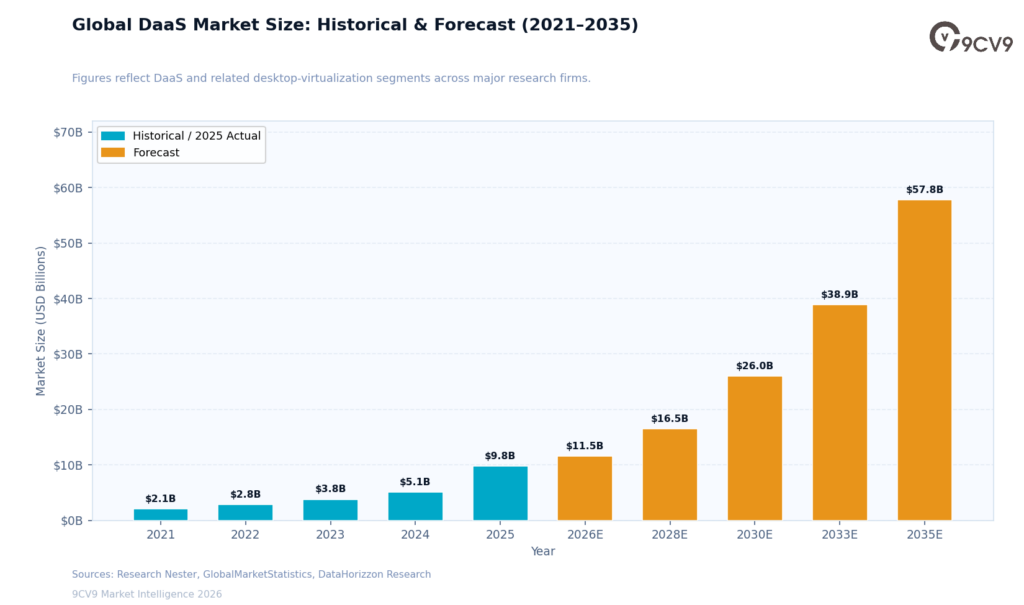
The numbers illustrate the scale of this transition. The global DaaS market is estimated at USD 11.53 billion in 2026, compared with USD 9.82 billion in 2025, while one long-term forecast projects the market could surpass USD 57.83 billion by 2035. Forecasts vary considerably depending on how researchers define DaaS, however, with estimates ranging from relatively narrow DaaS software spending to broader cloud desktop and virtualization markets. This makes understanding the underlying data particularly important for businesses, investors, IT leaders, and technology vendors evaluating the sector.
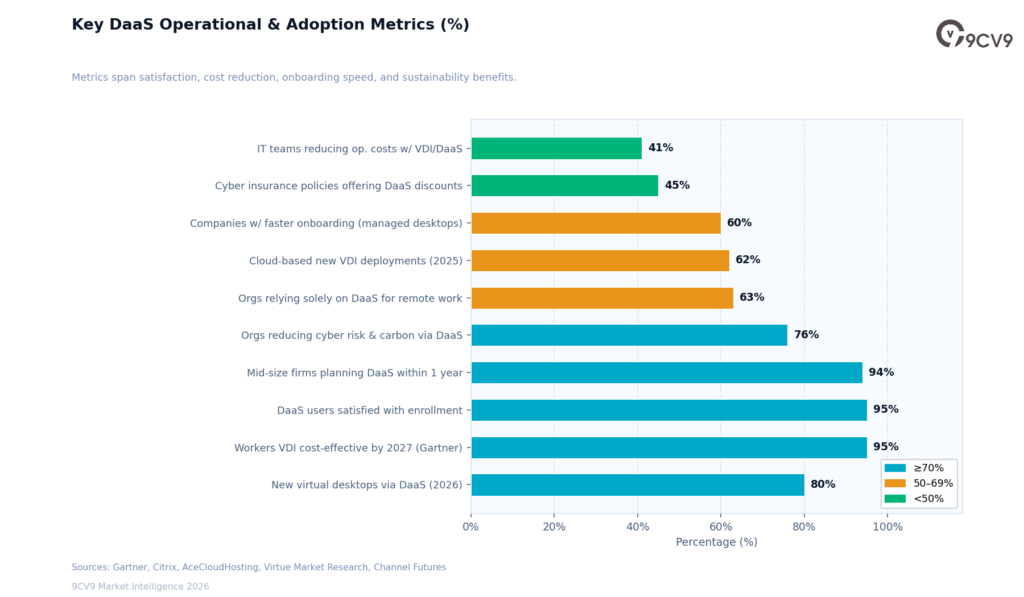
Adoption statistics point to an equally significant structural change. An estimated 80% of virtual desktops could be delivered through DaaS platforms by 2026, compared with approximately 30% in 2021. In 2025, 62% of new virtual desktop deployments were DaaS-based, while cloud deployment accounted for 60.44% of desktop virtualization revenue. These figures suggest that organizations are increasingly moving away from traditional on-premises virtual desktop infrastructure toward cloud-delivered workplace environments.

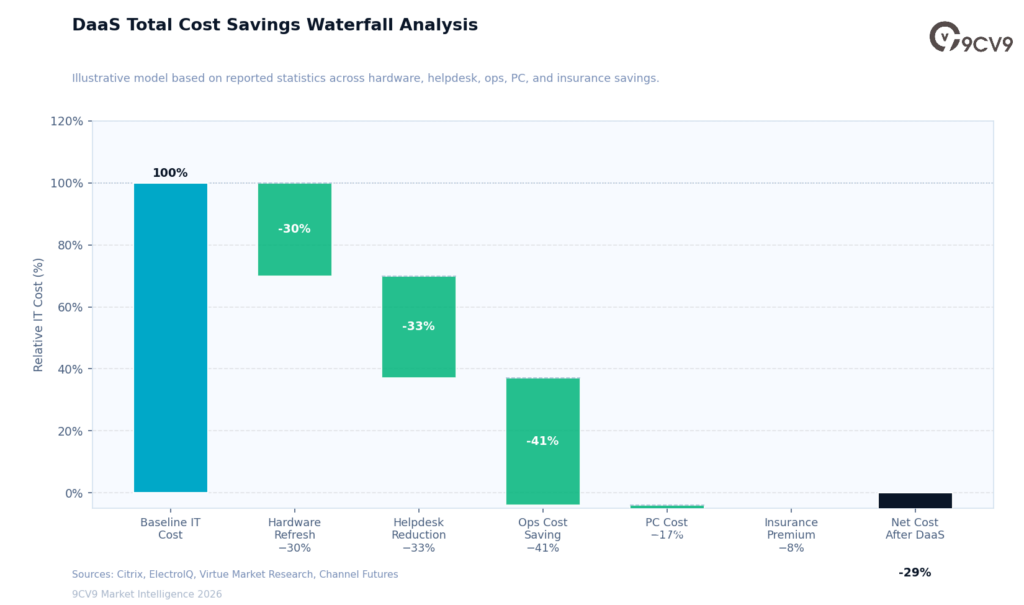
Cost, security, and operational efficiency are major factors behind this shift. The data indicates that DaaS can help organizations reduce PC costs by an average of 17%, while 41% of IT teams report lower operational costs after adopting VDI and DaaS solutions.
DaaS adoption can also extend endpoint hardware lifecycles, reduce helpdesk requirements, centralize desktop administration, and give organizations greater control over applications and corporate data accessed by remote workers.
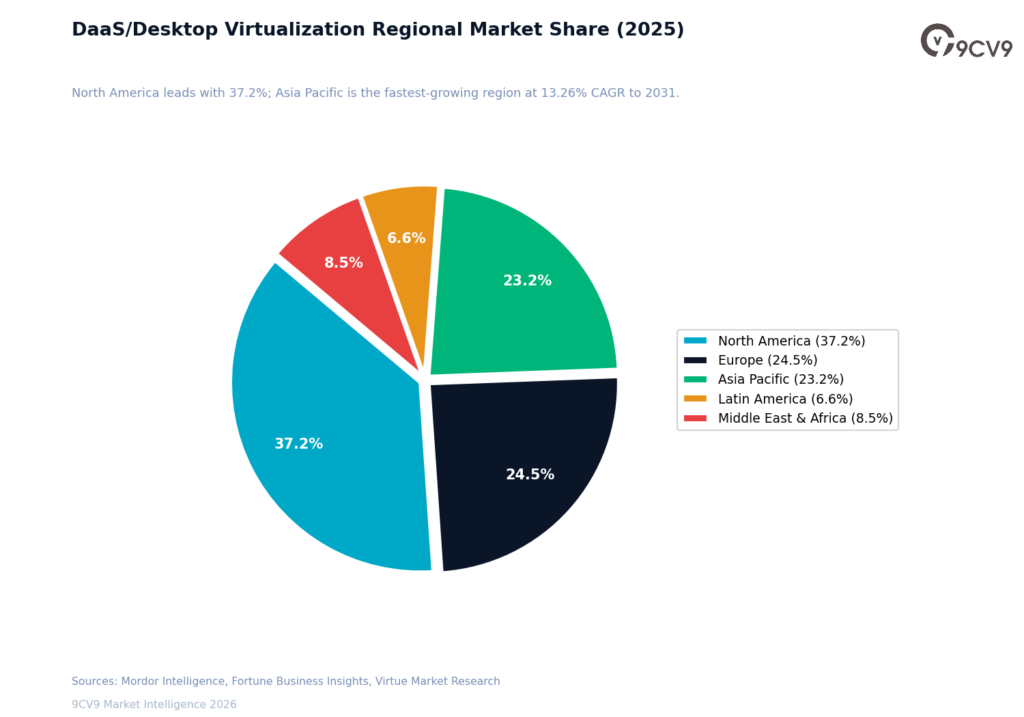
The opportunity is also becoming increasingly global. North America accounted for approximately 36–37% of global DaaS and desktop virtualization revenue in 2025, while Asia Pacific is emerging as one of the fastest-growing regions.
Financial services, healthcare, education, government, IT, and telecommunications are among the industries driving adoption as organizations look for more secure and flexible ways to provide employees with access to business applications and data.
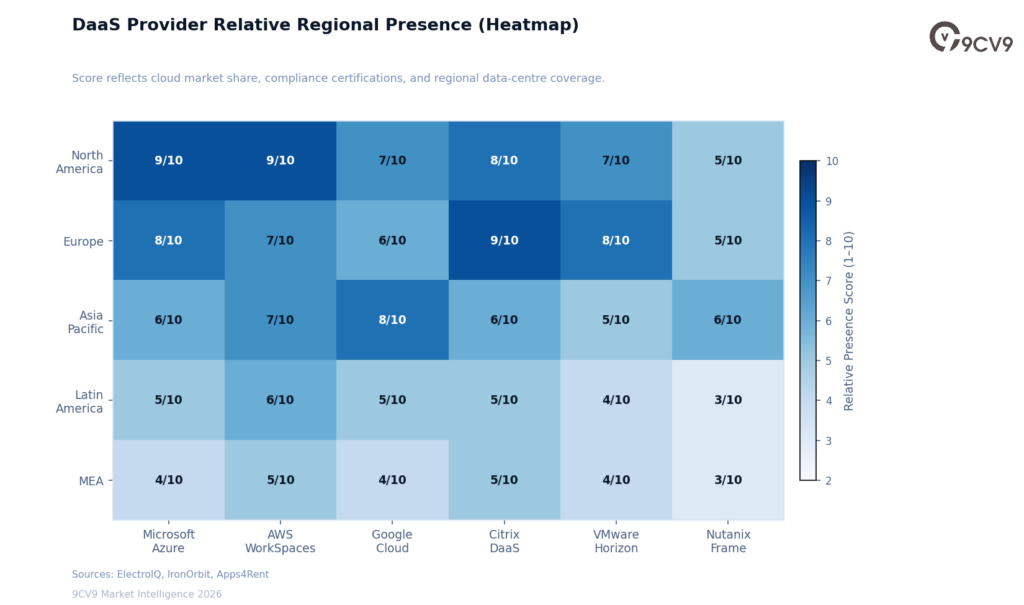
Competition is intensifying alongside adoption. Microsoft, Citrix, VMware, AWS, Nerdio, and other cloud and virtualization providers are developing increasingly sophisticated desktop delivery ecosystems, while the world’s largest cloud infrastructure providers supply much of the computing foundation supporting DaaS workloads.
Artificial intelligence, GPU-powered virtual desktops, Zero Trust security, automation, sustainability, and industry-specific DaaS configurations are becoming important areas of differentiation.
This guide to the Top 100 Desktop as a Service (DaaS) Statistics, Data & Trends in 2026 brings together quantitative insights covering DaaS market size, growth forecasts, adoption rates, regional trends, industry usage, cost savings, ROI, cybersecurity, cloud infrastructure, major providers, remote work, and the future of virtual desktops.
Together, these statistics provide a data-driven picture of where the DaaS industry stands in 2026 and the trends likely to shape its development over the remainder of the decade.
Before we venture further into this article, we would like to share who we are and what we do.
About 9cv9
9cv9 is a business tech startup based in Singapore and Asia, with a strong presence all over the world.
With over ten years of startup and business experience, and being highly involved in connecting with thousands of companies and startups, the 9cv9 team has listed some important and crucial software tools in this review.
If you like to get your company listed in our top B2B software reviews, check out our world-class 9cv9 Media and PR service and pricing plans here.
Top 100 Desktop as a Service (DaaS) Statistics, Data & Trends in 2026
🌍 MARKET SIZE & GROWTH
- The global DaaS market surpassed USD 9.82 billion in 2025, setting the stage for one of enterprise IT’s most consequential decade-long expansions.
- In 2026, the DaaS market is estimated at USD 11.53 billion, representing roughly 17.4% year-over-year growth driven by hybrid-work permanence and security mandates.
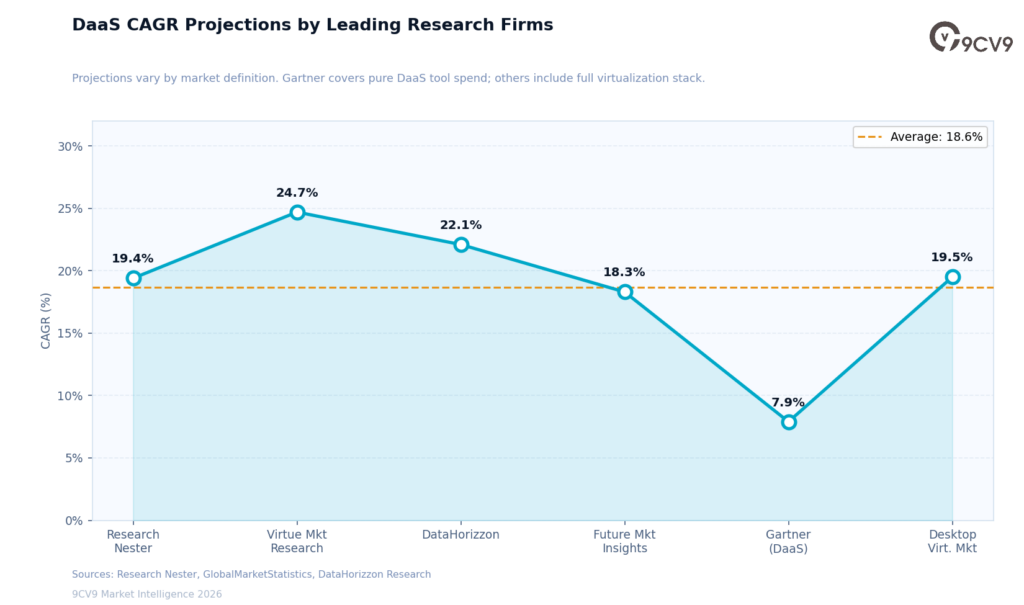
- The DaaS market is projected to exceed USD 57.83 billion by 2035, a near 6× expansion from its 2025 value, with a CAGR of 19.4% (Research Nester).
- An alternative forecast places the 2026 DaaS market at USD 5.77 billion, growing to USD 21.57 billion by 2035 at a 13.9% CAGR, reflecting differing methodology on market scope (GlobalMarketStatistics).
- Gartner forecasts DaaS spending to grow from USD 4.3 billion in 2025 to USD 6.0 billion by 2029, a 7.9% CAGR in the pure DaaS tool spend definition, confirming durable but conservative institutional demand.
- Virtue Market Research projects a 24.7% CAGR (2026–2030) for DaaS, making it one of the decade’s fastest-growing cloud investment categories.
- The Desktop as a Service Tool market (narrower definition) was valued at USD 2.996 billion in 2024, growing to USD 3.198 billion in 2025 and USD 4.538 billion by 2032 at a 6.2% CAGR (IntelMarketResearch).
- The global DaaS Provider market (broader) is expected to reach USD 38.9 billion by 2033, growing at 22.1% CAGR from 2025 (DataHorizzon Research).
- Future Market Insights projects an 18.3% CAGR for DaaS from 2023 to 2033, reaching USD 17.8 billion — affirming strong mid-teen growth consensus across major firms.
- The Desktop Virtualization market (of which DaaS is a key sub-segment) was valued at USD 33.9 billion in 2025, projected to grow to USD 41.85 billion in 2026 and USD 174.29 billion by 2034 at a 19.5% CAGR (Fortune Business Insights).
- The Desktop Virtualization market is estimated at USD 13.64 billion in 2026, reaching USD 20.54 billion by 2031 at 8.53% CAGR in the narrower VDI software segment (Mordor Intelligence).
- One research firm (Market Research Intellect) projects DaaS to surge from USD 4.5 billion in 2026 to USD 12.8 billion by 2033, reflecting a 15.8% CAGR outlook driven by cloud-native workplace adoption.
- The global desktop virtualization market is projected to grow from USD 33.9 billion (2025) to USD 174.29 billion by 2034 at a 19.5% CAGR, underpinned by cloud-native infrastructure demand (Fortune Business Insights).
- The DaaS market is on track to grow at 18.7% through 2030 per IntelMarketResearch projections, driven by cloud adoption and digital transformation.
📈 ADOPTION & DEPLOYMENT TRENDS
- By 2026, an estimated 80% of all virtual desktops are delivered through DaaS platforms, compared to only 30% in 2021 — one of the most significant structural shifts in enterprise computing this decade (9CV9 Blog, Research Nester).
- In 2025, 62% of new virtual desktop deployments are DaaS-based rather than on-premise VDI, signaling the definitive “tipping point” where cloud becomes the default (Virtue Market Research).
- 63% of organizations rely solely on DaaS to support remote work in 2025, having moved away from traditional VDI and VPN setups (Gartner via AceCloudHosting).
- 80% of organizations are already using VDI in some manner in their IT strategy, making virtualization mainstream rather than niche (LLCBuddy via AceCloudHosting).
- 63% of mid-sized companies are evaluating new VDI or DaaS solutions, and 94% plan to implement one within a year (GlobalNewswire).
- 40% of businesses globally have moved to cloud-based VDI to maintain operational continuity for remote teams (Global Growth Insights via AceCloudHosting).
- Cloud deployment captured 60.44% of desktop virtualization revenue in 2025, as organizations shifted capital budgets toward on-demand DaaS subscriptions (Mordor Intelligence).
- Hosted Virtual Desktop retained 45.92% of 2025 market revenue, but seat growth is moderating as firms prioritize DaaS’s elastic scalability (Mordor Intelligence).
- Net-new desktop virtualization deployments are almost exclusively DaaS, with on-premises VDI either migrating to DaaS or adopting a cloud control plane, per Gartner’s 2025 Magic Quadrant assessment.
- 36% of respondents have deployed VDI or DaaS solutions specifically for their work-from-home scenario (GlobalNewswire).
- By 2025, more than 1 in 3 commercial desktops and nearly 1 in 5 laptops shipped globally are delivered through DaaS models (ElectroIQ).
- DaaS adoption is highest among corporate office workers (68%) and lowest among media production workers (3%), revealing clear workflow-driven adoption patterns (InformationWeek).
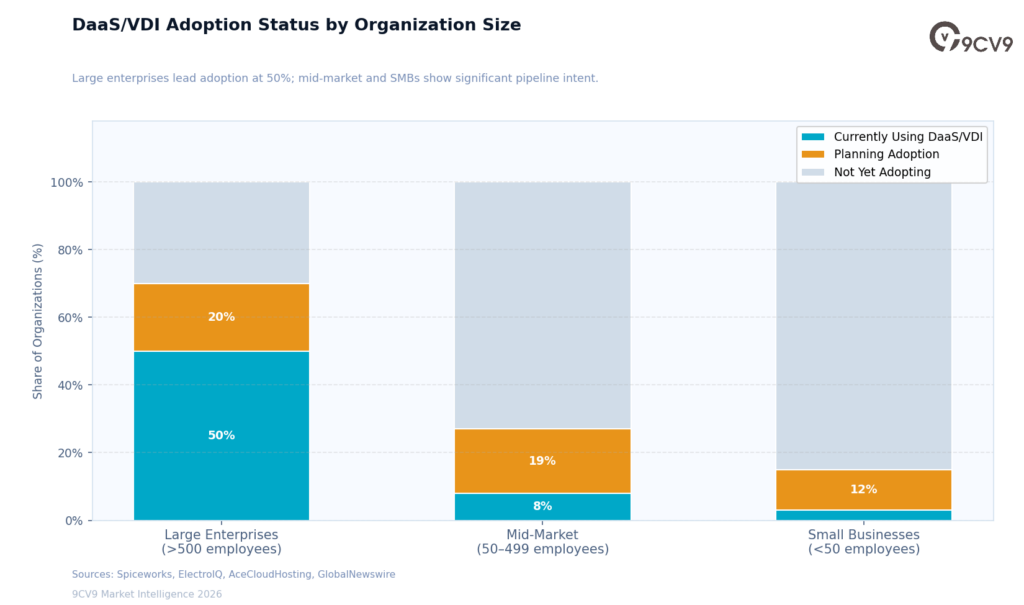
- In organizations with 50–99 employees, 8% already use DaaS and 19% are planning future adoption, demonstrating meaningful SME traction below the enterprise tier (ElectroIQ).
- DaaS is now deployed in most organizations, though typically for a minority of employees — a “beachhead” dynamic driving future seat expansion (Gartner 2025 Magic Quadrant).
- Gartner forecasts DaaS usage will exceed 150% growth from 2020 to 2025, reflecting pandemic-accelerated structural enterprise adoption (LLCBuddy).
- 95% of current DaaS users report satisfaction with their enrollment, a remarkably high satisfaction rate that accelerates internal advocacy and seat expansion (ElectroIQ).
🌐 REGIONAL INTELLIGENCE
- North America holds the largest DaaS/desktop virtualization market share at 36–37% of global revenue in 2025, anchored by mature cloud infrastructure and entrenched remote-work culture.
- The North America desktop virtualization market is projected to reach USD 13.56 billion in 2026, driven by high IT infrastructure adoption and rising remote-work trends (Fortune Business Insights).
- The U.S. desktop virtualization market is expected to reach USD 8.33 billion by 2026, with the U.S. dominating regional revenue share throughout the forecast period (Fortune Business Insights).
- Asia Pacific generated USD 7.56 billion in desktop virtualization revenue in 2025 (23.2% of global), projected to grow to USD 9.71 billion in 2026 — the fastest-growing major region globally.
- Asia Pacific is projected to record a 13.26% CAGR to 2031 in desktop virtualization (Mordor Intelligence), powered by sovereign-cloud mandates in China and India’s Digital India program.
- Asia Pacific’s DaaS CAGR reaches 20.0% from 2026–2035 (Research Nester), making it the most dynamic growth region over the coming decade.
- India’s Digital India program allocates INR 1.08 trillion (USD 13 billion) through 2026 for IT infrastructure, directly stimulating cloud and DaaS adoption across public and private sectors.
- Europe’s desktop virtualization market was valued at USD 12.36 billion in 2025, representing roughly 28% of global market landscape — a mature but growing segment.
- Latin America’s desktop virtualization market is projected to reach USD 2.77 billion in 2026, characterized by increasing BPO sector adoption and gradual enterprise uptake.
- The Middle East & Africa DaaS market generated USD 3.49 billion in 2025 and is expected to reach USD 4.55 billion in 2026, gaining momentum from government digital initiatives and energy sector demand.
- North America is anticipated to secure a 41% share of the Device-as-a-Service market by 2035, supported by a mature IT ecosystem and hybrid-work model entrenchment (Research Nester).
- Emerging markets in Asia-Pacific account for approximately 25% of global cloud-based VDI adoption, driven by rapid digitalization and government cloud initiatives (Global Growth Insights).
- North America & Western Europe together generate over USD 7 billion annually in DaaS revenue, representing the most mature DaaS markets globally (Archive Market Research).
- Brazil dominates the LATAM DaaS Tool market, with increasing adoption by the banking sector and shared service centers, while Mexican manufacturing firms deploy DaaS for secure third-party access.
- The U.S. accounts for over 70% of North American DaaS Tool demand, supported by government digital transformation initiatives and Fortune 500 workplace modernization investments.
🏭 INDUSTRY VERTICALS
- The BFSI sector holds the largest vertical share (25.7%) in the cloud-based VDI market, driven by security concerns and disaster recovery mandates (IMARC Group).
- Financial services, healthcare, education, and government collectively command over 70% of the DaaS market, each with distinct compliance drivers shaping provider strategies (Archive Market Research).
- Large enterprises and government agencies represent over 60% of DaaS market revenue, with an estimated spend of USD 6 billion annually (Archive Market Research).
- Cloud VDI adoption in financial services is expected to rise 64% above the industry curve, driven by compliance mandates, disaster recovery needs, and hybrid-work strategies (State of IT 2022).
- Large enterprises account for 65.4% of global Device-as-a-Service market share, benefiting most from scalable, subscription-based device management across distributed workforces (ElectroIQ).
- VDI adoption among enterprise-level firms (50%) is double that of small businesses (24%), reflecting the capital and IT resource advantages of large organizations in initial adoption (Spiceworks).
- The IT and telecommunications sector holds a 24.58% dominant share of DaaS demand in 2026, as organizations require flexible access infrastructure for geographically dispersed workforces.
- Healthcare organizations use DaaS to support telemedicine initiatives, electronic health record access, and HIPAA-compliant remote consultations — sectors where patient data security is non-negotiable.
- Government agencies are modernizing via DaaS, with the U.S. GSA launching the OneGov Strategy in April 2025 to consolidate federal IT procurement and leverage DaaS for public-sector workplaces.
- The education sector leverages DaaS to provide equitable access to digital learning resources regardless of students’ devices or locations, crucial for continuity during hybrid learning.
- Public cloud DaaS deployments represent approximately 75% of all DaaS implementations, with private and hybrid deployments serving firms with stricter data sovereignty requirements.
- The SME sector is a significant growth driver with over 30 million SMEs in the U.S. alone (SBA), many actively adopting cloud solutions to reduce IT infrastructure costs.
- The retail sector accounts for approximately 6.5% of DaaS vertical market share, with adoption driven by seasonal staffing flexibility and POS system virtualization needs.
💰 COST SAVINGS & ROI
- DaaS helps companies cut PC costs by 17% on average, with small businesses seeing the biggest proportional savings due to elimination of device management overhead (ElectroIQ).
- DaaS adoption extends the lifecycle of physical endpoint hardware by an average of 2.5 years, reducing e-waste and hardware refresh budgets by nearly 30% (Virtue Market Research, 2025).
- 41% of IT teams report reduced operational costs after adopting VDI and DaaS solutions, citing centralized management, reduced patching complexity, and lower support burden (Citrix).
- A Forrester Total Economic Impact study for devicenow Enterprise DaaS (Jan 2026) found a 3-year Benefits PV of €34.4M and NPV of €16.2M for enterprise adopters.
- A financial services firm reported a 40% decrease in IT support calls after adopting VDI, demonstrating the direct link between centralized desktop infrastructure and reduced help desk volume (PW Consulting).
- Organizations saw a 33% reduction in desktop-related helpdesk calls after migrating to Citrix DaaS, freeing IT resources for higher-value strategic initiatives.
- 45% of cyber insurance policies for mid-sized firms now offer premium reductions for organizations utilizing DaaS/VDI for remote workers, recognizing the reduced attack surface vs. unmanaged VPN-connected laptops (Virtue Market Research).
- Even when factoring in thin-client costs, Gartner data shows DaaS frequently undercuts the long-term total cost of ownership of on-premises laptops, including energy, e-waste, and maintenance savings.
- Cloud-based security platforms save SMBs an average of 30% compared to on-premises solutions, a dynamic that extends to DaaS deployments where the provider manages all security patching and updates (Ponemon Institute).
- Annual M&A transactions involving DaaS companies valued over USD 1 billion occur approximately 3 times per year, reflecting aggressive market consolidation by hyperscalers acquiring specialized DaaS capabilities.
- Vertical-specific DaaS bundles fetch 20–30% price premiums as vendors integrate compliance toolkits, industry-specific software, and pre-configured security policies (Mordor Intelligence).
- Microsoft’s Azure Virtual Desktop with NVIDIA L40S GPUs (Nov 2025) lowers total cost of ownership by 40% for GPU-intensive workloads like CAD, supporting 32 concurrent sessions per GPU.
🔐 SECURITY, SUSTAINABILITY & PERFORMANCE
- 76% of organizations say DaaS reduces both cybersecurity risk AND carbon footprint simultaneously, making it a rare win for both security and ESG objectives (Channel Futures via AceCloudHosting).
- DaaS platforms incorporate Zero Trust Network Access (ZTNA), granular DLP controls, continuous compliance monitoring, and AI-driven anomaly detection — capabilities that are mandatory for regulated industries.
- Citrix’s FedRAMP High authorization shortens procurement timelines for U.S. public agencies, validating DaaS security for the most demanding government environments.
- A typical knowledge worker DaaS session uses only 150–300 kbps of bandwidth, making it viable even on moderate broadband connections (IronOrbit).
- GPU-intensive 3D rendering DaaS sessions require 10–25 Mbps bandwidth, a constraint that is actively addressed by edge computing deployment strategies.
- Maximum round-trip latency for interactive DaaS tasks should be kept below 180 ms to maintain user productivity — a threshold widely achievable on today’s broadband networks (IronOrbit).
- 42% of rural Asia-Pacific enterprises and 58% of sub-Saharan Africa businesses lacked 25 Mbps broadband in 2025, representing the primary connectivity barrier to DaaS adoption in emerging markets (ITU via Mordor Intelligence).
- 5G fixed-wireless promises sub-30 ms round-trip latency for DaaS sessions, though coverage outside tier-one cities remains limited through 2026, constraining rapid rural expansion.
- The “micro-DaaS” model now allows companies to provision a secure corporate desktop for freelancers for as little as 48 hours, creating a new revenue stream aligned with gig-economy workforce trends (Virtue Market Research).
- HP Inc.’s March 2024 introduction of a DaaS solution focused on refurbished devices and responsible end-of-life recycling signals how sustainability is becoming a primary DaaS differentiator.
- NIST Special Publication 800-46 Rev. 3 urged federal agencies to conduct device-posture checks before launching VDI sessions — a recommendation now adopted by private-sector CISOs to satisfy cyber insurance requirements.
🏢 COMPETITIVE LANDSCAPE
- Amazon Web Services leads cloud infrastructure with 30% market share (Q2 2025), followed by Microsoft Azure at 20% and Google Cloud at 13%, anchoring the top 3 DaaS workload delivery platforms.
- The top 3 cloud providers manage the underlying infrastructure for approximately 70% of all DaaS workloads globally in 2025, even when delivered through partners or MSPs (Virtue Market Research).
- Accenture leads the Device-as-a-Service market with a 23% share, followed by Acer Inc. and Apple Inc. each at 9%, and Cisco and Cognizant each at 8% (ElectroIQ).
- Microsoft offers Azure Virtual Desktop, Windows 365, and Microsoft Dev Box — combining self-assembled and vendor-assembled options for diverse enterprise needs across productivity, dev, and power-user workloads.
- AWS released WorkSpaces Thin Client Gen 2 in September 2025 — a USD 195 ARM-based device that boots directly into cloud desktops and supports dual 4K displays.
- Citrix partnered with Tencent Cloud in July 2025 to deliver China-compliant DaaS by keeping sessions within mainland data centers, addressing data sovereignty requirements.
- Nerdio has emerged as a fast-growing DaaS player, automating Azure Virtual Desktop deployments so small IT teams can provision hundreds of desktops with scripts rather than manual portal configuration.
- Key DaaS vendors — VMware, Citrix, and Microsoft — are heavily invested in AI-based capabilities for right-sizing resource configurations and improving operational efficiency at scale.
- Gartner’s 2025 Magic Quadrant for DaaS includes recognition for providers that offer robust workplace, cloud, and AI integration — with Microsoft, Citrix, and VMware as the primary leaders.
- The competitive landscape sees providers integrating advanced persistent threat (APT) protection, multi-factor authentication, and robust DLP mechanisms as baseline rather than premium features.
🔮 WORKFORCE TRENDS & FUTURE OUTLOOK
- 82% of global companies provide some form of remote work (Gallup 2023 State of the Global Workplace), establishing the durable workforce dynamic that sustains DaaS demand indefinitely.
- 87% of American workers are offered some remote working opportunity, with three days per week of flexible remote working being the modal arrangement (McKinsey American Opportunity Survey).
- By 2027, virtual desktops will be cost-effective for 95% of workers, compared to only 40% in 2019 — a structural shift driven by cloud economics and thin-client hardware maturity (Gartner).
- By 2027, virtual desktops will serve as the primary workspace for 20% of workers, up from just 10% in 2019 — a doubling that reflects sustained hybrid-work entrenchment (Gartner).
- 21% of enterprise IT budgets plan to migrate resources to managed services (including DaaS) by 2022, compared to 14% for SMBs, indicating the ongoing shift from CapEx to OpEx IT models (State of IT 2022).
- 51% of DaaS users bundle productivity suites, compared to 59% of planning organizations intending to do so, showing growing software integration appetite as DaaS matures beyond basic desktop delivery.
- The global IoT device count is forecast to reach 30 billion by 2030 (vs. ~20 billion in 2025), expanding the endpoint diversity that makes centralized DaaS management increasingly attractive for IT teams.
- The “Gig Worker” segment is the fastest-growing ad-hoc DaaS user group, with platforms enabling secure corporate desktops for freelancers on contracts as short as 48 hours (Virtue Market Research).
- Devices deployed during the 2020–2021 remote work surge are reaching end-of-life in 2025–2026, triggering a hardware refresh cycle that organizations are increasingly resolving by opting for DaaS over traditional endpoint-heavy re-investment.
Conclusion
The Desktop as a Service (DaaS) statistics for 2026 reveal an industry moving rapidly from a specialized enterprise technology toward a mainstream component of cloud-based workplace infrastructure. Hybrid work, cybersecurity requirements, cloud migration, distributed workforces, and the growing preference for subscription-based IT are collectively strengthening demand for virtual desktops delivered as a service.
Market forecasts underline the scale of the opportunity. One estimate places the global DaaS market at USD 11.53 billion in 2026, up from USD 9.82 billion in 2025, with the market potentially exceeding USD 57.83 billion by 2035. Although market-size estimates differ considerably depending on how researchers define DaaS, multiple forecasts point toward sustained expansion over the coming decade.
Perhaps more important than market value is the shift in how virtual desktops are being deployed. An estimated 80% of virtual desktops are delivered through DaaS platforms by 2026, compared with only 30% in 2021, while 62% of new virtual desktop deployments were already DaaS-based in 2025. Cloud deployments also captured 60.44% of desktop virtualization revenue in 2025, illustrating the broader movement away from infrastructure that organizations must operate themselves.
The economic case is strengthening as well. DaaS can help businesses reduce PC costs by an average of 17%, while 41% of IT teams report lower operational costs following VDI and DaaS adoption. Other reported benefits include longer endpoint lifecycles, fewer desktop-related support requests, centralized administration, greater scalability, and the ability to provide temporary workers and geographically distributed employees with controlled access to corporate environments.
Security will remain another major driver of the Desktop as a Service market in 2026 and beyond. Zero Trust Network Access, multi-factor authentication, data loss prevention, continuous compliance monitoring, device-posture checks, and AI-powered anomaly detection are becoming increasingly important elements of virtual desktop strategies. These capabilities are particularly relevant for financial services, healthcare, government, education, and other industries managing sensitive information or complex regulatory requirements.
Geographically, North America remains the largest market, accounting for approximately 36–37% of global DaaS and desktop virtualization revenue in 2025, but Asia Pacific represents a significant growth opportunity. Research cited in the statistics projects Asia Pacific DaaS growth of around 20% CAGR between 2026 and 2035, supported by digitalization, cloud investment, and government technology initiatives.
Looking ahead, DaaS is likely to become increasingly intertwined with AI, automation, GPU computing, Zero Trust architectures, thin clients, sustainability initiatives, and flexible workforce models. By 2027, virtual desktops are projected to be cost-effective for 95% of workers, compared with 40% in 2019, while they could become the primary workspace for 20% of workers.
Ultimately, these 100 Desktop as a Service statistics, data points, and trends for 2026 demonstrate that DaaS is about more than enabling remote work. It represents a broader transformation in how organizations purchase, secure, deliver, and manage workplace computing. Businesses evaluating their future IT strategies should therefore watch not only DaaS market growth, but also developments in pricing, security, cloud infrastructure, user experience, AI-powered management, regional adoption, and industry-specific solutions.
As cloud computing continues to reshape enterprise technology, Desktop as a Service is positioned to play an increasingly important role in the future of digital work, giving organizations another path toward secure, scalable, and centrally managed computing environments.
If you find this article useful, why not share it with your hiring manager and C-level suite friends and also leave a nice comment below?
We, at the 9cv9 Research Team, strive to bring the latest and most meaningful data, guides, and statistics to your doorstep.
To get access to top-quality guides, click over to 9cv9 Blog.
To hire top talents using our modern AI-powered recruitment agency, find out more at 9cv9 Modern AI-Powered Recruitment Agency.
People Also Ask
What is Desktop as a Service (DaaS)?
Desktop as a Service (DaaS) is a cloud computing model that delivers virtual desktops to users over the internet. It allows organizations to centrally manage desktops, applications, security, and access without maintaining traditional desktop infrastructure.
How big is the Desktop as a Service market in 2026?
The global DaaS market is estimated at approximately $11.53 billion in 2026, up from $9.82 billion in 2025. However, estimates vary significantly because research firms use different definitions and market scopes.
How fast is the DaaS market growing?
DaaS growth forecasts vary by methodology. One projection estimates a 19.4% CAGR through 2035, while other forecasts range from 13.9% to 24.7% depending on whether they measure DaaS platforms, tools, providers, or related services.
How large could the DaaS market become by 2035?
One forecast projects the global Desktop as a Service market will exceed $57.83 billion by 2035, compared with $9.82 billion in 2025. Another narrower forecast estimates $21.57 billion by 2035.
What is driving DaaS market growth in 2026?
DaaS growth is being supported by hybrid work, cloud adoption, digital transformation, cybersecurity requirements, distributed workforces, centralized IT management, subscription-based technology spending, and demand for scalable virtual desktops.
How widely is DaaS used in 2026?
An estimated 80% of virtual desktops are delivered through DaaS platforms by 2026, compared with around 30% in 2021. The data indicates a major shift from traditional on-premises VDI toward cloud-delivered desktops.
What percentage of new virtual desktop deployments use DaaS?
In 2025, approximately 62% of new virtual desktop deployments were DaaS-based rather than traditional on-premises VDI, indicating that cloud delivery has become increasingly important for new virtualization projects.
How many organizations use DaaS for remote work?
According to the statistics compiled in the report, 63% of organizations relied solely on DaaS to support remote work in 2025, reflecting growing dependence on cloud-delivered desktops for distributed workforces.
Are businesses satisfied with Desktop as a Service?
The compiled data reports that 95% of current DaaS users are satisfied with their enrollment. High satisfaction could support broader internal adoption as organizations expand virtual desktop access to additional employees.
Which region has the largest DaaS market?
North America is the largest DaaS and desktop virtualization market, accounting for approximately 36%–37% of global revenue in 2025. Mature cloud infrastructure and widespread hybrid work contribute to regional demand.
How fast is DaaS growing in Asia Pacific?
Asia Pacific is among the fastest-growing DaaS regions. One forecast projects a 20% CAGR from 2026 to 2035, supported by rapid digitalization, cloud investment, government initiatives, and expanding enterprise IT infrastructure.
How large is the U.S. desktop virtualization market in 2026?
The U.S. desktop virtualization market is projected to reach approximately $8.33 billion in 2026, with the United States continuing to dominate North American demand for virtual desktop technologies.
Which industries use DaaS the most?
Financial services, healthcare, education, government, IT, and telecommunications are major DaaS users. Financial services, healthcare, education, and government collectively account for more than 70% of the market in one cited estimate.
Why is DaaS popular in financial services?
Financial institutions use DaaS to support secure remote access, compliance, disaster recovery, and distributed employees. BFSI holds a reported 25.7% share of the cloud-based VDI market, making it a leading vertical.
Why is DaaS important for healthcare organizations?
Healthcare organizations use DaaS for telemedicine, electronic health record access, and secure remote consultations. Centralized desktop delivery can help organizations control access to sensitive healthcare applications and patient information.
Are small businesses adopting DaaS?
Yes. Among organizations with 50–99 employees, 8% already use DaaS and another 19% plan to adopt it. SMEs are an important growth opportunity as businesses seek cloud solutions that reduce infrastructure and management requirements.
How much can DaaS reduce PC costs?
The compiled statistics indicate that DaaS can reduce PC costs by an average of 17%. Savings can come from centralized management, longer endpoint lifecycles, reduced maintenance, and less dependence on powerful employee hardware.
Does DaaS reduce IT operational costs?
Yes. Around 41% of IT teams report reduced operational costs after adopting VDI and DaaS solutions, with centralized administration, simplified patching, and lower support requirements among the reported benefits.
Can DaaS reduce IT support requests?
The report cites a 33% reduction in desktop-related helpdesk calls after migration to Citrix DaaS. Another financial services example reported a 40% decrease in IT support calls following VDI adoption.
Can DaaS extend the life of employee devices?
One estimate indicates that DaaS can extend physical endpoint lifecycles by an average of 2.5 years, potentially reducing hardware refresh budgets and electronic waste by allowing more computing to occur in cloud infrastructure.
Is DaaS more secure than traditional desktop computing?
DaaS can centralize corporate applications and data while supporting controls such as Zero Trust access, MFA, DLP, device-posture checks, compliance monitoring, and anomaly detection. Security still depends on correct configuration and management.
How much bandwidth does DaaS require?
A typical knowledge-worker DaaS session can use approximately 150–300 kbps, according to the compiled statistics. More demanding workloads require considerably more bandwidth, particularly graphics-intensive applications.
How much bandwidth does GPU-powered DaaS require?
GPU-intensive workloads such as 3D rendering can require approximately 10–25 Mbps for a DaaS session. Network quality, latency, workload complexity, resolution, and desktop configuration can influence actual requirements.
What latency is recommended for DaaS?
The report states that round-trip latency for interactive DaaS workloads should generally remain below 180 milliseconds to maintain productivity. Network location and connectivity therefore remain important considerations when deploying DaaS.
What percentage of DaaS deployments use the public cloud?
Approximately 75% of DaaS implementations are reported to use public cloud deployments. Private and hybrid environments remain relevant for organizations facing stricter security, compliance, or data-sovereignty requirements.
Who are the major Desktop as a Service providers?
The report highlights Microsoft, Citrix, VMware, AWS, and Nerdio within the competitive DaaS landscape. Their offerings span managed cloud desktops, virtual desktop infrastructure, automation, thin clients, and enterprise workplace services.
How much DaaS infrastructure is supported by the largest cloud providers?
The top three cloud infrastructure providers are estimated to support approximately 70% of global DaaS workloads, including desktops delivered indirectly through partners and managed service providers.
How is AI changing Desktop as a Service?
DaaS providers are investing in AI-based capabilities for resource right-sizing, operational efficiency, anomaly detection, security monitoring, and automation. AI could help IT teams manage increasingly large virtual desktop environments.
What role does DaaS play in hybrid work?
DaaS gives distributed employees cloud-based access to centrally managed desktops and business applications. With 82% of global companies reported to provide some form of remote work, flexible working remains an important demand driver.
What is the future of Desktop as a Service?
DaaS is expected to become more important as cloud computing, hybrid work, Zero Trust security, AI, GPU workloads, and flexible staffing expand. By 2027, virtual desktops are projected to be cost-effective for 95% of workers.
Sources
Research Nester GlobalMarketStatistics Virtue Market Research IntelMarketResearch DataHorizzon Research Fortune Business Insights Mordor Intelligence Open PR Market Research Intellect 9CV9 Blog AceCloudHosting Gartner Virtualization Review ElectroIQ Archive Market Research Apps4Rent IronOrbit Forrester devicenow WebProNews XTIUM







 statistics for 2026, covering market growth, adoption, costs, security and key trends.)