


























Key Takeaways
- The top robotics companies to watch in 2026 are accelerating humanoid robotics, embodied AI, industrial automation and real-world commercial deployments.
- Leading robotics companies such as Figure AI, Unitree, AgiBot, Boston Dynamics and Tesla are competing on AI capabilities, manufacturing scale, reliability and cost.
- Robotics in 2026 is shifting from prototypes to commercial applications across manufacturing, logistics, automotive, retail and enterprise automation.
Figure AI leads the global robotics companies to watch in 2026 as humanoid robots and embodied AI move toward commercial deployment. The wider top 10 includes Agility Robotics, Apptronik, Tesla, UBTECH Robotics, AgiBot, Unitree Robotics, XPENG Robotics, AiMOGA Robotics and Boston Dynamics across manufacturing, logistics, automotive and service robotics.
The global robotics industry is entering a defining period in 2026 as humanoid robots, embodied AI and intelligent automation move from research laboratories into factories, warehouses, automotive plants and commercial environments. Advances in Vision-Language-Action models, dexterous manipulation, autonomous navigation, battery technology and lower-cost robotic components are accelerating the transition from experimental prototypes to commercially useful machines.
Also, check out our article on the Top 10 Industrial Automation & Robotics Recruitment Agencies.
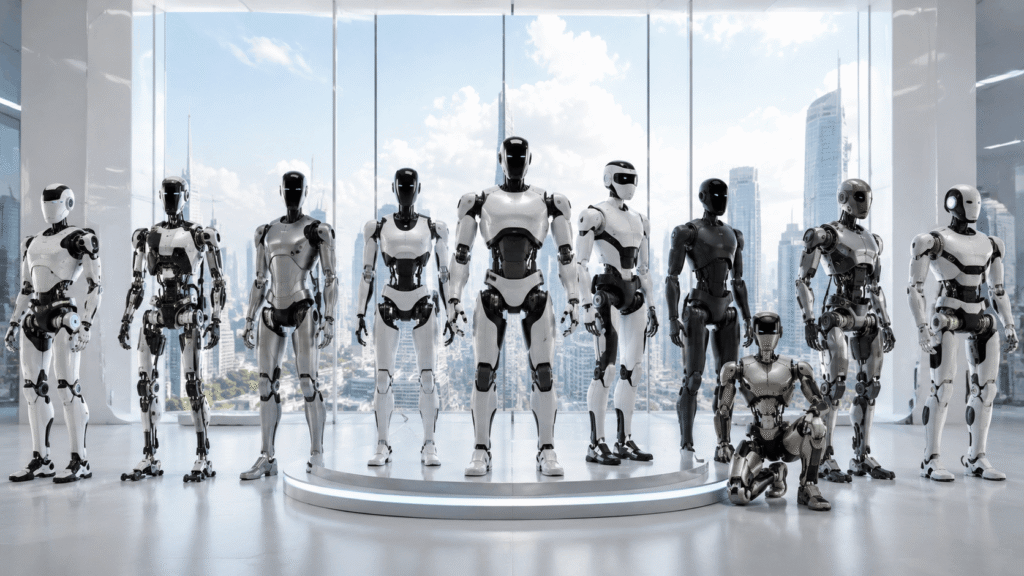
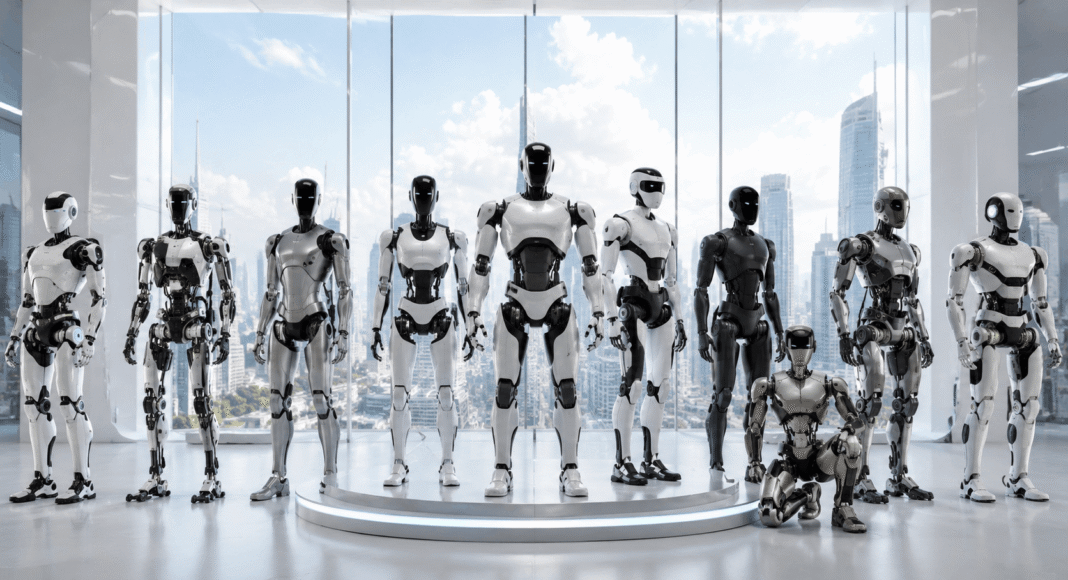
The top 10 robotics companies to watch in the world in 2026 include Figure AI, Agility Robotics, Apptronik, Tesla, UBTECH Robotics, AgiBot, Unitree Robotics, XPENG Robotics, AiMOGA Robotics and Boston Dynamics. Each represents a different approach to the emerging Physical AI economy, from affordable mass-produced humanoids and industrial automation platforms to sophisticated enterprise robots designed for demanding manufacturing and logistics operations.
Competition is also intensifying between the United States and China. American robotics companies are attracting substantial investment and building advanced AI-driven platforms for high-value enterprise applications, while Chinese manufacturers are leveraging dense supply chains, vertical integration and manufacturing scale to reduce robot prices and increase shipment volumes. Automotive companies are becoming equally important, with Tesla, Hyundai, XPENG and Chery using expertise in batteries, motors, sensors, AI and mass production to accelerate humanoid robot development.
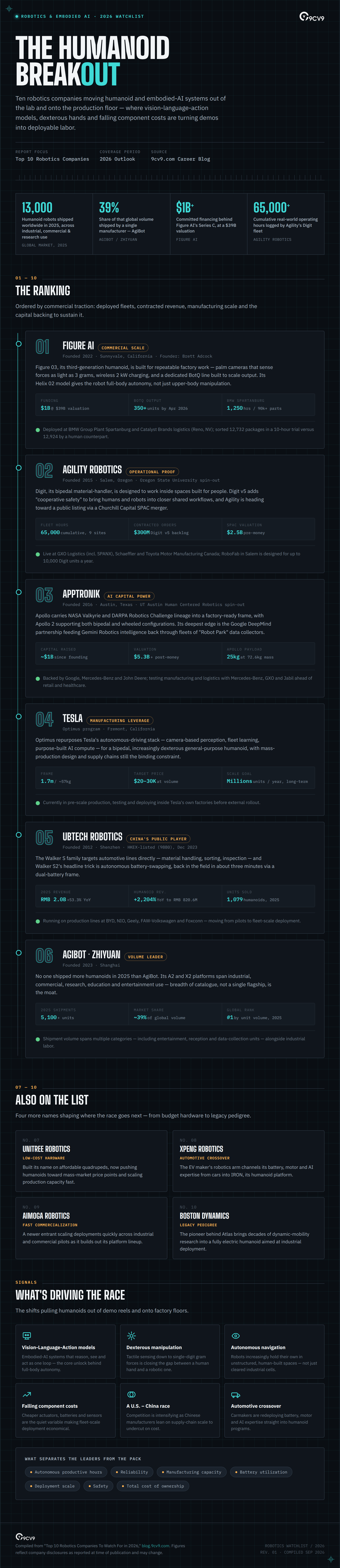
However, determining the leading robotics companies in 2026 requires looking beyond funding rounds, valuations and impressive demonstrations. Commercial success increasingly depends on autonomous productive hours, reliability, manufacturing capacity, battery utilization, deployment scale, safety, total cost of ownership and measurable customer return on investment.
This guide examines the top 10 robotics companies to watch in 2026, comparing their flagship robots, embodied AI technologies, funding and valuations, hardware capabilities, pricing strategies, manufacturing plans and real-world deployments. Together, these companies provide a useful view of where the global robotics industry is heading as intelligent machines become an increasingly important part of the future of work, manufacturing and automation.
Before we venture further into this article, we would like to share who we are and what we do.
About 9cv9
9cv9 is a business tech startup based in Singapore and Asia, with a strong presence all over the world.
With over ten years of startup and business experience, and being highly involved in connecting with thousands of companies and startups, the 9cv9 team has listed some of the top and best companies/tools in this review.
If you like to get your company listed in our top B2B software reviews, check out our world-class 9cv9 Media and PR service and pricing plans here.
Top 10 Robotics Companies To Watch For in 2026
- Figure AI
- Agility Robotics
- Apptronik
- Tesla
- UBTECH Robotics
- AgiBot
- Unitree Robotics
- XPENG Robotics
- AiMOGA Robotics
- Boston Dynamics
1. Figure AI
Founded in 2022 by technology entrepreneur Brett Adcock, Figure AI has emerged as one of the most closely watched humanoid robotics companies in the world in 2026. The California-based company is developing general-purpose humanoid robots designed to perform physical tasks across manufacturing, logistics and, eventually, household environments.
Figure’s position in the global robotics race has been strengthened by substantial institutional backing. In September 2025, the company announced more than $1 billion in committed Series C financing at a $39 billion post-money valuation. Investors and strategic partners associated with the round included Parkway Venture Capital, NVIDIA, Brookfield, Macquarie Capital, Intel Capital, LG Technology Ventures and others.
The scale of Figure’s funding, combined with its vertically integrated hardware, artificial intelligence and manufacturing strategy, places it among the robotics companies to watch as humanoid systems move from laboratory demonstrations toward commercial deployment.
Figure 03 and the Shift Toward Mass-Produced Humanoid Robots
Figure 03 is the company’s third-generation humanoid platform and its first robot engineered specifically around high-volume manufacturing. Rather than treating the humanoid as an experimental prototype, Figure redesigned major mechanical and electrical components to reduce part counts, simplify assembly and support manufacturing processes such as die-casting, injection moulding and stamping.
The robot also introduces substantial improvements in perception and manipulation. Its vision architecture offers twice the frame rate, approximately one-quarter of the latency and a 60% wider field of view per camera compared with the previous generation. Palm-mounted cameras and tactile sensors capable of detecting forces as small as three grams provide additional feedback for delicate manipulation.
Safety and practical deployment have also become greater priorities. Figure 03 incorporates multi-density foam around potential contact and pinch areas, replaceable washable soft coverings, improved battery protection and wireless inductive charging through charging coils integrated into its feet.
Figure 03 Technology Overview
| Technology Area | Figure 03 Capability | Strategic Importance |
|---|---|---|
| Robot Category | General-purpose humanoid | Designed for multiple physical-work environments |
| Primary Markets | Manufacturing, logistics and future household applications | Expands addressable use cases beyond factories |
| Vision System | Higher frame rate, lower latency and wider field of view | Improves navigation and object manipulation |
| Hand Perception | Palm cameras and fingertip tactile sensing | Supports precise and adaptive grasping |
| Tactile Sensitivity | Detects forces as small as approximately 3 grams | Enables handling of small and delicate objects |
| Charging | 2 kW wireless inductive charging | Supports autonomous docking and longer utilization |
| Data Transfer | Up to 10 Gbps wireless data offload | Enables large-scale fleet learning |
| Exterior Design | Multi-density foam and washable soft coverings | Improves suitability around people |
| Manufacturing | Designed specifically for high-volume production | Reduces dependence on prototype manufacturing |
Helix 02 Brings Full-Body AI Control to Figure 03
A major reason Figure AI ranks among the top robotics companies to watch in 2026 is its development of Helix, the proprietary Vision-Language-Action artificial intelligence system controlling its humanoid robots.
Introduced in January 2026, Helix 02 expanded Figure’s neural control architecture from primarily upper-body manipulation to whole-body autonomy. The system coordinates perception, reasoning, walking, balance and manipulation rather than relying entirely on separate controllers for individual movements.
Helix 02 uses a hierarchical architecture. A semantic reasoning layer interprets scenes and objectives, a visuomotor layer translates perception into full-body movements, and a learned whole-body controller manages balance and physical coordination at high frequency.
Figure demonstrated the architecture through autonomous multi-step activities including loading and unloading a dishwasher, cleaning living spaces, manipulating small objects and performing industrial logistics tasks.
Helix 02 AI Architecture
| AI Layer | Primary Function | Operational Role |
|---|---|---|
| System 2 | Scene and language understanding | Interprets objectives and sequences behaviours |
| System 1 | Visuomotor intelligence | Converts perception into full-body joint targets |
| System 0 | Whole-body physical control | Handles balance, contact and movement coordination |
| Visual Inputs | Head and palm cameras | Provides environmental and close-range perception |
| Tactile Inputs | Fingertip sensors | Enables force-sensitive manipulation |
| Proprioception | Full-body internal sensing | Tracks body position and movement |
| AI Objective | Pixels-to-whole-body control | Integrates reasoning, locomotion and manipulation |
BotQ and Figure AI’s Manufacturing Strategy
Figure is also differentiating itself through manufacturing scale. Its dedicated BotQ facility was designed to move humanoid production away from small-volume prototype assembly toward repeatable industrial manufacturing.
The first-generation BotQ production line has a stated maximum capacity of approximately 12,000 humanoids annually. Figure has also outlined a longer-term ambition to manufacture 100,000 robots over four years.
By April 2026, the company reported that BotQ had produced more than 350 Figure 03 robots while improving its manufacturing rate from approximately one robot per day to as fast as one robot per hour. This production ramp is particularly significant because manufacturing cost, reliability and production throughput remain major barriers to large-scale humanoid adoption.
Commercial Deployment at BMW
Figure’s collaboration with BMW provides one of its strongest real-world industrial validation cases.
During the earlier Figure 02 deployment at BMW Group Plant Spartanburg, the robots accumulated more than 1,250 operating hours, loaded more than 90,000 automotive components and contributed to the production of more than 30,000 BMW X3 vehicles.
The relationship progressed further in June 2026 when Figure 03 arrived at BMW’s Spartanburg facility. The newer deployment focuses on more complex logistics and sequencing tasks requiring the robot to identify, manipulate and position components while simultaneously adjusting its body position.
This transition from relatively structured pick-and-place work toward dynamic material handling is important because it tests whether humanoid robots can address jobs that are difficult to automate with conventional fixed robotic systems.
Expanding Beyond Automotive Manufacturing
Figure is simultaneously broadening its commercial footprint beyond automotive production. In May 2026, the company announced an agreement with Catalyst Brands to deploy humanoid robots within its distribution and logistics network, beginning at a distribution facility in Reno, Nevada.
The deployment targets physically demanding supply-chain activities and provides Figure with another environment in which to validate humanoid automation at commercial scale.
Public package-sorting demonstrations during 2026 have also illustrated improving robot speed and endurance. During a 10-hour comparison, a Figure 03 system processed 12,732 packages compared with 12,924 handled by a human participant. The approximately 1.5% throughput difference demonstrated how rapidly humanoid performance is approaching human speed on narrowly defined repetitive logistics tasks, although broader warehouse autonomy remains considerably more challenging.
Figure AI 2026 Competitive Position
| Evaluation Area | Figure AI Position in 2026 | Why It Matters |
|---|---|---|
| Funding | More than $1 billion Series C | Provides capital for AI, manufacturing and deployment |
| Latest Confirmed Valuation | $39 billion post-money | Signals exceptionally strong investor expectations |
| Flagship Platform | Figure 03 | Production-oriented general-purpose humanoid |
| AI Platform | Helix 02 | Integrates reasoning and whole-body control |
| Manufacturing | BotQ | Creates an internal path toward volume production |
| Initial BotQ Capacity | Up to 12,000 robots annually | Supports potential fleet-scale commercialization |
| Figure 03 Production | More than 350 units reported by April 2026 | Demonstrates movement beyond prototype quantities |
| Automotive Validation | BMW Group Plant Spartanburg | Provides real-world industrial operating experience |
| Logistics Expansion | Catalyst Brands | Broadens deployment beyond automotive manufacturing |
| Long-Term Opportunity | Industrial and household robotics | Creates a potentially large addressable market |
Why Figure AI Is a Robotics Company to Watch in 2026
Figure AI represents one of the clearest attempts to combine humanoid hardware, embodied artificial intelligence and large-scale manufacturing within a single vertically integrated robotics company.
Its significance in 2026 comes not from any single robot demonstration, but from the convergence of several developments: Figure 03 is entering production at BotQ, Helix 02 is extending autonomy toward whole-body tasks, BMW deployments are providing industrial validation, and new logistics agreements are creating additional commercial testing environments.
Important challenges remain. Humanoid robots still need to demonstrate sustained reliability, safety, economic viability and adaptability across unpredictable real-world environments before they can compete broadly with human labour or specialized automation. Public demonstrations also should not automatically be interpreted as proof of unrestricted commercial autonomy.
Nevertheless, Figure AI’s combination of substantial funding, proprietary physical AI, rapidly expanding manufacturing capability and real-world enterprise deployments makes it one of the most consequential robotics companies to watch globally in 2026.
2. Agility Robotics
Founded in 2015 as a spin-out from Oregon State University, Agility Robotics has become one of the most commercially advanced humanoid robotics companies to watch in 2026. Its flagship humanoid, Digit, is designed primarily for repetitive material-handling work in warehouses, distribution centers and manufacturing facilities.
Unlike many humanoid robotics developers that remain concentrated on laboratory testing and demonstrations, Agility has accumulated significant operational experience in customer environments. By mid-2026, Digit deployments and commitments spanned nine customer facilities and had accumulated more than 65,000 operating hours. Enterprise users and partners include GXO, Schaeffler, Toyota Motor Manufacturing Canada and other major industrial organizations.
Agility Robotics and the $2.5 Billion Public-Market Strategy
A major development arrived in June 2026 when Agility Robotics announced a definitive business combination agreement with Churchill Capital Corp XI. The proposed transaction values Agility at approximately $2.5 billion on a pre-money equity basis and is expected to generate more than $620 million in gross proceeds.
Importantly, the transaction had been announced but had not yet been completed as of August 2026. Agility and Churchill subsequently submitted a draft registration statement to the U.S. Securities and Exchange Commission as part of the process toward completing the proposed merger.
Approximately $200 million of the expected proceeds comes from additional institutional financing. Agility plans to direct the capital toward fulfilling customer orders, expanding deployments, increasing Digit v5 production and advancing its physical AI platform.
| Financial Metric | Agility Robotics Position |
|---|---|
| Proposed Pre-Money Valuation | $2.5 billion |
| Expected Gross Proceeds | More than $620 million |
| Incremental PIPE Financing | Approximately $200 million |
| Digit v5 Contracted Orders | More than $300 million |
| Expected Public Ticker | AGLT |
| Primary Capital Priorities | Production, deployments, AI and order fulfillment |
Digit: A Humanoid Robot Built for Industrial Work
Digit differentiates itself through a distinctly industrial design philosophy. Its bipedal architecture allows the robot to operate within spaces originally designed for human workers while moving materials between existing equipment and workflows.
Rather than requiring companies to redesign entire facilities around automation equipment, Digit is intended to work within existing manufacturing and logistics environments. This gives humanoid systems a potential advantage in brownfield facilities where fixed automation can be expensive or operationally restrictive.
Agility is increasingly positioning Digit as a general-purpose physical AI platform rather than simply a warehouse robot. However, manufacturing, distribution and logistics remain the most commercially mature applications in 2026.
Digit Industrial Application Matrix
| Application Area | Potential Digit Role | Business Value |
|---|---|---|
| Warehousing | Tote and container movement | Reduces repetitive manual handling |
| Distribution Centers | Material transfer | Supports continuous logistics workflows |
| Manufacturing | Parts and component movement | Connects production processes |
| Automotive | Material handling | Automates repetitive physical workflows |
| E-Commerce Logistics | Goods movement and handling | Supports high-volume fulfillment operations |
| Industrial Facilities | Repetitive physical tasks | Addresses difficult-to-staff activities |
Digit v5 and Cooperative Robot Safety
Agility’s upcoming Digit v5 represents an important technological step because the company is designing it around what it describes as “cooperative safety.”
Traditional industrial robots frequently operate inside cages or restricted areas because their speed, weight and movement can create risks for nearby workers. Humanoid robots need a different approach if they are expected to work directly alongside people.
Digit v5 is therefore being engineered around safety principles intended to enable closer human-robot collaboration. Agility describes the platform as designed to become the world’s first AI-enabled cooperatively safe humanoid robot.
If successfully validated and certified, this approach could remove one of the largest barriers preventing humanoid robots from being deployed extensively inside active factories and warehouses.
More Than 65,000 Hours of Real-World Robot Operations
Operational data represents one of Agility Robotics’ strongest competitive advantages.
By June 2026, Digit had accumulated more than 65,000 operating hours across deployment commitments at nine customer facilities. This provides Agility with substantial real-world data covering robot movement, task execution, safety, reliability and interaction with industrial environments.
The company can use this operational information to improve its embodied AI systems and expand the range of activities Digit can perform.
| Commercial Validation Indicator | Reported Position in 2026 |
|---|---|
| Operational Experience | More than 65,000 hours |
| Customer Facilities | Nine deployment commitments |
| Major Commercial Environments | Manufacturing, distribution and logistics |
| Notable Enterprise Relationships | GXO, Schaeffler and Toyota Motor Manufacturing Canada |
| Digit v5 Contracted Orders | More than $300 million |
| Potential Customer Pipeline | More than 30 organizations evaluating deployments |
GXO Demonstrates Digit’s Warehouse Potential
Agility’s collaboration with GXO represents an important commercial validation of humanoid robotics in logistics.
Digit has been deployed at a GXO-operated SPANX distribution facility, where robots perform repetitive material-handling workflows involving totes. The deployment demonstrates an important principle behind commercial humanoids: the objective is not necessarily to replicate every activity performed by a person, but to automate specific physically repetitive workflows within existing facilities.
This task-oriented deployment strategy could provide a more practical route toward humanoid commercialization than immediately pursuing completely autonomous general-purpose robots.
RoboFab and the Race to Manufacture Humanoids at Scale
Agility has also invested heavily in manufacturing infrastructure. Its RoboFab facility in Salem, Oregon, was developed specifically for humanoid robot production and has been designed for a potential capacity of up to 10,000 Digit robots annually.
Manufacturing capacity is becoming an increasingly important competitive factor in humanoid robotics. Companies may eventually require hundreds or thousands of robots rather than experimental fleets of several units.
Agility’s ability to convert RoboFab’s theoretical capacity into reliable, economically viable production will therefore be an important indicator of its competitive position over the next several years.
Agility Robotics 2026 Commercialization Matrix
| Parameter | 2026 Position |
|---|---|
| Company Origin | Oregon State University spin-out founded in 2015 |
| Primary Robot | Digit |
| Next Generation | Digit v5 |
| Core Markets | Manufacturing, logistics and distribution |
| Operational Experience | More than 65,000 hours |
| Customer Commitments | Nine facilities |
| Contracted Digit v5 Orders | More than $300 million |
| Manufacturing Facility | RoboFab in Salem, Oregon |
| Maximum Designed Capacity | Up to 10,000 Digit robots annually |
| Proposed Pre-Money Valuation | $2.5 billion |
| Expected Transaction Proceeds | More than $620 million |
| Commercial Differentiator | Real-world deployments and cooperative safety |
Agility Robotics’ Competitive Position in the Humanoid Robot Market
Agility’s strategy differs from competitors pursuing household humanoids or highly generalized consumer robots. Its near-term focus remains strongly centered on industrial environments where repetitive physical work can create measurable economic value.
This specialization provides several advantages. Warehouses and factories offer relatively structured environments, enterprise customers can deploy robots in fleets, and productivity improvements can be measured against existing labor and automation costs.
Agility also combines several increasingly important elements of the humanoid robotics value chain: proprietary hardware, embodied AI, fleet deployment experience, enterprise relationships and dedicated manufacturing infrastructure.
| Competitive Factor | Agility Robotics Strength | Strategic Significance |
|---|---|---|
| Commercial Experience | Extensive real-world operations | Reduces dependence on laboratory demonstrations |
| Enterprise Customers | Major industrial organizations | Provides commercial validation |
| Physical AI | Learning from operational fleet data | Creates a continuous improvement cycle |
| Safety | Cooperative safety development | Could enable closer human-robot collaboration |
| Manufacturing | Dedicated RoboFab facility | Provides infrastructure for fleet-scale production |
| Order Pipeline | $300 million-plus contracted orders | Indicates enterprise demand |
| Capital | Proposed $620 million-plus transaction | Supports expansion and manufacturing |
| Public Markets | Proposed AGLT listing | Could provide additional long-term capital access |
Why Agility Robotics Is a Robotics Company to Watch in 2026
Agility Robotics stands out in the global humanoid robotics market because it is attempting to bridge the difficult gap between impressive robotics demonstrations and commercially repeatable industrial deployments.
The combination of more than 65,000 operating hours, deployments across multiple customer facilities, over $300 million in contracted Digit v5 orders and a manufacturing facility designed for up to 10,000 robots annually gives Agility a comparatively strong commercialization foundation.
The proposed $2.5 billion transaction with Churchill Capital Corp XI could provide additional resources for scaling this strategy. However, investors and industry observers should distinguish between designed manufacturing capacity, contracted future orders and robots already deployed at scale.
For the global robotics industry in 2026, Agility Robotics is therefore particularly important as a test of whether humanoid robots can progress from technically capable machines into safe, scalable and economically sustainable industrial workforces.
3. Apptronik
Founded in 2016 as a spin-out from the Human Centered Robotics Lab at the University of Texas at Austin, Apptronik has emerged as one of the best-funded humanoid robotics companies to watch in 2026. Its technological lineage extends to work on NASA’s Valkyrie humanoid program and the NASA-DARPA Robotics Challenge, giving the company more than a decade of experience developing human-centered robotic systems.
Apptronik’s commercial strategy centers on Apollo, a general-purpose humanoid designed to work in environments originally built for people. Manufacturing and logistics are the immediate priorities, with longer-term opportunities spanning retail, healthcare and household applications. Partnerships with Mercedes-Benz, GXO Logistics, Jabil and Google DeepMind strengthen its position at the intersection of industrial robotics and embodied artificial intelligence.
Apptronik Raises Its Series A Funding to More Than $935 Million
Apptronik significantly strengthened its financial position in February 2026 by securing another $520 million through an extension of its Series A financing.
The investment increased total Series A funding to more than $935 million and brought cumulative capital raised by Apptronik to nearly $1 billion. Estimates of the company’s valuation vary by reporting methodology, with credible reports placing its post-money valuation at approximately $5.3 billion to more than $5.5 billion.
The investor group illustrates the strategic importance major technology and industrial companies are placing on humanoid robotics. Existing investors included B Capital, Google, Mercedes-Benz and PEAK6, while AT&T Ventures, John Deere and Qatar Investment Authority joined as new investors.
| Financial Parameter | Apptronik Position in 2026 |
|---|---|
| 2026 Funding Extension | $520 million |
| Total Series A Funding | More than $935 million |
| Cumulative Capital Raised | Nearly $1 billion |
| Reported Post-Money Valuation | Approximately $5.3 billion to $5.5+ billion |
| Major Strategic Backers | Google, Mercedes-Benz and John Deere |
| Other Investors | B Capital, PEAK6, AT&T Ventures and QIA |
| Primary Capital Allocation | Apollo production, AI, deployments and facilities |
Apollo: A Human-Sized Robot Designed for Existing Workplaces
Apollo represents Apptronik’s flagship approach to general-purpose humanoid robotics. The original platform stands approximately 1.73 meters tall, weighs around 72.6 kilograms and can handle payloads of approximately 25 kilograms. It was deliberately designed around dimensions comparable to those of a human worker so it can operate within existing factories and warehouses.
Apollo’s original battery architecture provides approximately four hours of operation per replaceable battery pack. Swappable batteries are particularly important for industrial deployments because replacing depleted packs can allow robots to continue operating without lengthy charging interruptions.
Some detailed specifications circulating publicly, including specific hand degrees-of-freedom figures and certain computing configurations, should be treated cautiously because Apptronik has not officially reconfirmed all such specifications for the current Apollo generation.
Apollo Hardware Overview
| Parameter | Confirmed or Reported Capability |
|---|---|
| Robot Type | General-purpose humanoid |
| Height | Approximately 1.73 meters |
| Weight | Approximately 72.6 kilograms |
| Payload | Up to approximately 25 kilograms |
| Original Battery Runtime | Approximately 4 hours |
| Battery Architecture | Replaceable battery packs |
| Primary Applications | Manufacturing and logistics |
| Design Philosophy | Human-scale operation in existing facilities |
| Commercial Availability | Enterprise deployments and pilots |
Apollo 2 Expands the Platform’s Industrial Ambitions
Apollo 2 represents the next stage of Apptronik’s commercialization strategy in 2026. The platform is being developed around greater flexibility in locomotion, manipulation, enterprise deployment and embodied AI.
One important direction is mobility configuration. Apollo 2 can support bipedal operation while Apptronik is also developing wheeled configurations for environments where walking is unnecessary. This reflects an increasingly pragmatic philosophy within industrial humanoid robotics: companies do not necessarily need legs for every task simply because the upper body has a humanoid form.
Wheeled mobility can potentially provide greater speed, stability and energy efficiency for predictable factory floors, while bipedal configurations remain useful where robots must navigate stairs, obstacles or spaces specifically designed around human movement.
Apollo Platform Configuration Matrix
| Configuration | Best-Suited Environment | Potential Advantage |
|---|---|---|
| Bipedal Apollo | Human-designed workplaces | Greater environmental accessibility |
| Wheeled Apollo | Flat industrial facilities | Higher efficiency and simpler locomotion |
| Battery Operation | Flexible production areas | Independent movement between workstations |
| Tethered Operation | Stationary workflows | Extended operation without battery changes |
| Manipulation Platform | Assembly and logistics | Human-compatible material handling |
Google DeepMind and the Development of Embodied AI
Apptronik’s partnership with Google DeepMind is one of its most important technological differentiators.
The companies are collaborating on embodied AI that combines advanced robot hardware with AI models capable of understanding environments and translating instructions into physical actions. Google DeepMind’s Gemini Robotics technology provides another pathway for improving Apollo’s perception, reasoning and manipulation capabilities.
This relationship is strategically important because the humanoid robotics race increasingly depends on software intelligence rather than mechanical engineering alone. Commercially useful humanoids must learn new tasks, recognize unfamiliar objects, respond to changing environments and generalize knowledge across different workplaces.
Robot Park and Real-World AI Training
Apptronik expanded this AI strategy further in 2026 through Robot Park facilities. Fleets of Apollo 2 robots are being used to continuously collect real-world operational data for training future generations of humanoid intelligence in partnership with Google DeepMind.
This creates a potentially important development cycle:
| Development Stage | Function | Commercial Benefit |
|---|---|---|
| Robot Deployment | Apollo performs physical tasks | Generates real-world experience |
| Data Collection | Sensors capture interactions | Builds physical AI datasets |
| Model Training | AI learns from fleet data | Improves task understanding |
| Robot Validation | Updated models are tested | Measures reliability and performance |
| Fleet Deployment | Improvements reach more robots | Generates additional operational data |
Mercedes-Benz Provides an Industrial Testing Ground
Mercedes-Benz represents one of Apptronik’s most strategically important industrial relationships. Apollo is being evaluated for manufacturing applications where robots could perform repetitive, physically demanding or ergonomically challenging work.
Such deployments are particularly relevant to automotive manufacturing because assembly plants contain numerous processes that remain difficult to automate economically with traditional fixed industrial robots.
Rather than replacing entire production lines, humanoid systems such as Apollo could potentially fill automation gaps between existing machines and human-operated processes.
Apptronik also has commercial relationships with GXO Logistics and Jabil, extending Apollo’s potential application beyond automotive manufacturing into logistics and large-scale manufacturing operations.
Apptronik’s Industrial Partnership Ecosystem
| Partner | Strategic Area | Importance to Apptronik |
|---|---|---|
| Google DeepMind | Embodied AI | Robot learning and intelligent manipulation |
| Mercedes-Benz | Automotive manufacturing | Industrial validation and deployment |
| GXO Logistics | Warehousing and logistics | Logistics automation testing |
| Jabil | Manufacturing | Production and industrial scaling expertise |
| John Deere | Strategic investment | Industrial technology ecosystem |
| NVIDIA Ecosystem | AI computing | Edge AI and robotics computing infrastructure |
Scaling Apollo Toward Commercial Production
The central challenge facing Apptronik is no longer simply demonstrating that humanoid robots can perform useful tasks. The company must prove that Apollo can be manufactured, deployed and maintained economically across potentially thousands of enterprise locations.
Its 2026 financing is therefore heavily oriented toward increasing Apollo production, expanding commercial deployments and establishing additional robot training and data-collection infrastructure.
Public pricing remains limited. Apollo should therefore be treated as a custom-priced enterprise robotics platform rather than assigning it an unverified standardized annual lease or purchase price. Likewise, publicly discussed production-cost targets should not be confused with confirmed customer pricing.
Apptronik 2026 Competitive Position
| Evaluation Area | Apptronik Position |
|---|---|
| Founded | 2016 |
| Headquarters | Austin, Texas |
| Flagship Platform | Apollo |
| Current Development Platform | Apollo 2 |
| Core Markets | Manufacturing and logistics |
| Total Series A Funding | More than $935 million |
| Total Capital Raised | Nearly $1 billion |
| Reported Valuation | Approximately $5.3 billion to $5.5+ billion |
| Major AI Partner | Google DeepMind |
| Automotive Partner | Mercedes-Benz |
| Logistics Partner | GXO Logistics |
| Manufacturing Partner | Jabil |
| Primary Differentiator | Modular hardware combined with embodied AI |
| Commercial Pricing | Custom enterprise pricing; not publicly verified |
Why Apptronik Is a Robotics Company to Watch in 2026
Apptronik occupies an increasingly important position in the global humanoid robotics industry because it combines deep robotics engineering experience with substantial financing and partnerships spanning artificial intelligence, automotive manufacturing, logistics and industrial production.
The company’s more than $935 million Series A gives it significant resources to transition Apollo from enterprise pilots toward larger commercial deployments. At the same time, its collaboration with Google DeepMind could become particularly important as competition shifts from simply building capable humanoid bodies toward developing robots that can learn and generalize across thousands of physical tasks.
Apptronik still faces the same fundamental challenges confronting the wider humanoid sector: production costs must decline, reliability must improve, deployments must demonstrate measurable returns on investment, and AI systems must operate safely in unpredictable environments.
Nevertheless, its combination of Apollo 2, nearly $1 billion in cumulative funding, Google DeepMind collaboration and industrial relationships with companies such as Mercedes-Benz, GXO and Jabil makes Apptronik one of the most strategically significant robotics companies to watch in the world in 2026.
4. Tesla
Tesla has emerged as one of the most closely watched participants in the global humanoid robotics industry through Optimus, its general-purpose humanoid robot program. Rather than operating as an independent robotics startup, Optimus benefits from Tesla’s existing expertise in artificial intelligence, computer vision, battery systems, electronics, manufacturing automation and large-scale industrial production.
Tesla’s long-term objective is to develop humanoid robots capable of performing repetitive, physically demanding and eventually increasingly complex tasks. Its own factories provide an important initial testing environment, allowing the company to collect physical-world data and refine robotic systems before pursuing wider commercial deployment.
However, several ambitious Optimus figures circulating publicly in 2026 remain targets rather than demonstrated commercial achievements. Production volumes, pricing and deployment numbers should therefore be separated carefully from confirmed operational results.
Optimus Development Strategy in 2026
Tesla has continued transitioning Optimus from experimental prototypes toward a design intended for scalable manufacturing. The company has described the next major generation as substantially redesigned, particularly around hands, actuators, electronics and other components specifically engineered for humanoid robotics.
Tesla’s manufacturing strategy is particularly important because humanoid robots contain numerous specialized components that are not yet supported by mature, high-volume supply chains comparable with the automotive industry.
This creates both an opportunity and a challenge. Tesla has extensive experience reducing manufacturing costs through vertical integration, but producing humanoids economically at very large volumes requires new supply chains for actuators, sensors, hands, motors, gear systems and specialized electronics.
| Development Area | Tesla Optimus Position |
|---|---|
| Robot Category | General-purpose humanoid |
| Initial Application | Internal manufacturing and material handling |
| Longer-Term Applications | Industrial, commercial and household tasks |
| Development Strategy | Progressive transition toward mass production |
| Manufacturing Advantage | Existing Tesla industrial infrastructure |
| AI Advantage | Large-scale computer vision and neural-network expertise |
| Major Challenge | Scaling specialized humanoid components economically |
Optimus Hardware and Dexterous Manipulation
The Optimus platform has been designed around approximately human dimensions so it can operate within environments, workstations and infrastructure originally designed for people.
Earlier publicly demonstrated Optimus generations stood approximately 1.7 metres tall and weighed around 57 kilograms. Tesla has continued developing more sophisticated hands because manipulation remains one of the most difficult and commercially important challenges in humanoid robotics.
The company has demonstrated increasingly dexterous hand designs intended to manipulate tools and everyday objects. Greater hand dexterity could eventually allow Optimus to address assembly, sorting, material handling and other tasks that conventional industrial robots struggle to automate economically.
| Hardware Area | Optimus Development Focus |
|---|---|
| Height | Approximately human-sized |
| Weight | Approximately 57 kg for earlier Gen 2 platform |
| Locomotion | Bipedal movement |
| Hands | Increasingly dexterous multi-jointed architecture |
| Perception | Camera-based environmental perception |
| Power | Integrated battery system |
| Primary Design Goal | Operation within human-designed environments |
| Manufacturing Goal | Reduce complexity and cost at high production volumes |
Tesla Vision and Physical AI
One of Tesla’s most significant potential advantages comes from artificial intelligence.
The company is adapting technologies developed through its autonomous driving program to robotics, particularly neural networks that interpret camera inputs and make decisions based on real-world environments.
Although driving and humanoid manipulation are substantially different problems, both require machines to interpret visual information, understand changing environments and select appropriate physical actions.
Optimus could therefore become another major application for Tesla’s AI infrastructure alongside autonomous vehicles.
| AI Capability | Application to Optimus |
|---|---|
| Computer Vision | Identifying objects, people and surroundings |
| Neural Networks | Translating sensory information into actions |
| Real-World Training | Learning from physical robot operations |
| Simulation | Training and testing robotic behaviours |
| Fleet Data | Improving models using multiple robots |
| AI Compute Infrastructure | Training increasingly capable physical AI models |
| Long-Term Objective | Generalized autonomous physical task execution |
Tesla Factories as Optimus Testing Environments
Tesla has repeatedly identified its manufacturing facilities as the first major deployment environment for Optimus.
This strategy provides a practical advantage. Tesla can deploy experimental robots internally without waiting for external customers and can observe their performance within real industrial workflows.
Tasks involving material movement, component handling and repetitive factory activities provide controlled environments for evaluating reliability and productivity.
Claims that more than 1,000 Optimus robots were already continuously operating across Tesla factories by early 2026, however, should not be presented as established fact without stronger company verification. Tesla’s confirmed disclosures support ongoing internal deployment and testing, but not every widely circulated fleet estimate.
The Race Toward Mass Production
Manufacturing scale represents perhaps Tesla’s largest potential competitive advantage in humanoid robotics.
Tesla has discussed extremely ambitious long-term production volumes for Optimus, including eventual manufacturing measured in hundreds of thousands or potentially millions of robots annually.
These figures represent long-term objectives rather than current production capacity.
The near-term challenge is establishing an initial production system capable of manufacturing the redesigned Optimus economically and reliably. Tesla has been preparing production infrastructure at Fremont while developing supply chains for components that have never previously been manufactured at comparable humanoid-robot volumes.
| Production Indicator | 2026 Assessment |
|---|---|
| Manufacturing Base | Fremont, California |
| Current Stage | Pre-scale production development |
| Near-Term Objective | Establish repeatable Optimus manufacturing |
| Long-Term Ambition | Hundreds of thousands to millions annually |
| Primary Constraint | Specialized component supply chains |
| Tesla Advantage | Existing high-volume manufacturing expertise |
| Key Uncertainty | Timing and speed of production ramp |
The Target Economics of Optimus
Tesla has repeatedly discussed a long-term Optimus price below approximately $20,000 to $30,000 once production reaches sufficiently large volumes.
This should be interpreted as a target rather than current commercial pricing. Optimus is not yet available as a standardized mass-market product at that price.
Likewise, third-party estimates suggesting dramatically different bills of materials depending on Chinese versus non-Chinese supply chains should not be presented as confirmed Tesla manufacturing costs. Component sourcing, production volume, supplier negotiations and design changes can materially alter these estimates.
| Cost Metric | Appropriate 2026 Interpretation |
|---|---|
| Target Optimus Price | Approximately $20,000-$30,000 at future scale |
| Current Retail Price | Not commercially established |
| Current Production Cost | Not publicly confirmed |
| Third-Party BOM Estimates | Analytical estimates rather than Tesla disclosures |
| Primary Cost Reduction Lever | Manufacturing scale |
| Additional Cost Drivers | Actuators, hands, sensors, electronics and batteries |
Tesla Optimus Competitive Position in 2026
| Evaluation Area | Tesla Optimus Position |
|---|---|
| Parent Organization | Tesla |
| Robot Platform | Optimus |
| Primary Initial Market | Tesla manufacturing facilities |
| AI Foundation | Tesla computer vision and neural-network ecosystem |
| Manufacturing Foundation | Existing automotive manufacturing infrastructure |
| Battery Expertise | Tesla energy and battery engineering |
| Development Priority | Dexterity, autonomy and manufacturability |
| Production Status | Pre-mass-production development |
| Target Future Price | Below approximately $20,000-$30,000 |
| Long-Term Production Goal | Potentially millions of robots annually |
| Major Advantage | AI and high-volume manufacturing integration |
| Major Risk | Execution against aggressive production targets |
Tesla Optimus Versus Traditional Industrial Automation
| Factor | Tesla Optimus | Traditional Industrial Robot |
|---|---|---|
| Physical Form | Humanoid | Usually fixed robotic arm |
| Mobility | Bipedal | Often stationary |
| Workplace Design | Existing human environments | Purpose-built automation cells |
| Task Flexibility | Potentially broad | Usually specialized |
| AI Dependence | High | Low to moderate |
| Dexterity Goal | Human-like manipulation | Task-specific tooling |
| Deployment Model | Potentially general-purpose | Dedicated production task |
| Technology Maturity | Emerging | Highly mature |
Why Tesla Optimus Is a Robotics Platform to Watch in 2026
Tesla’s importance in humanoid robotics comes from the combination of resources it can bring to the problem. Few competitors simultaneously possess large-scale manufacturing facilities, battery engineering, custom electronics, advanced computer vision, extensive AI computing infrastructure and experience manufacturing complex machines at high volumes.
The central question is whether these advantages can translate into reliable and economically useful humanoid robots.
Tesla’s aggressive production and pricing ambitions remain targets rather than proven outcomes. Developing dexterous hands, reliable actuators, safe autonomous behaviour and economical supply chains at enormous scale remains exceptionally difficult.
Nevertheless, if Tesla successfully transfers its manufacturing and AI capabilities into humanoid robotics, Optimus could become one of the industry’s most important platforms. Its combination of physical AI, vertical integration, internal factory testing and an ambition to drive unit costs dramatically lower makes Tesla one of the most consequential robotics companies to watch globally in 2026.
5. UBTECH Robotics
Founded in Shenzhen in 2012 by Zhou Jian, UBTECH Robotics has developed into one of the most commercially significant humanoid robotics companies to watch in 2026. The company became publicly listed on the Hong Kong Stock Exchange in December 2023 under stock code 9880, giving investors direct exposure to a company heavily focused on humanoid and intelligent service robotics.
UBTECH’s position differs from many humanoid robotics startups because commercialization is already contributing materially to its financial performance. In 2025, the company generated approximately RMB 2.00 billion in total revenue, representing year-on-year growth of 53.3%. Full-size embodied intelligent humanoid robots generated approximately RMB 820.6 million, becoming its largest revenue segment and accounting for roughly 41% of total revenue.
The company reported sales of 1,079 full-size humanoid robots during 2025, illustrating the rapid transition of its Walker platform from experimental factory deployments toward commercial-scale industrial robotics.
UBTECH Robotics Financial and Commercial Position
| Parameter | 2025-2026 Position |
|---|---|
| Public Listing | Hong Kong Stock Exchange, 9880 |
| 2025 Total Revenue | Approximately RMB 2.00 billion |
| Revenue Growth | 53.3% year-on-year |
| Humanoid Robotics Revenue | Approximately RMB 820.6 million |
| Humanoid Revenue Contribution | Approximately 41% of total revenue |
| Full-Size Humanoid Sales | 1,079 units in 2025 |
| 2025 Gross Profit | Approximately RMB 753.8 million |
| Gross Margin | 37.7% |
| 2025 Net Loss | Approximately RMB 789.8 million |
| Core Commercial Market | Industrial manufacturing |
Walker S Series Targets Industrial Manufacturing
UBTECH’s industrial humanoid strategy centers on the Walker S family, which has evolved through platforms including Walker S, Walker S Lite, Walker S1 and the newer Walker S2.
Instead of initially targeting general household robotics, UBTECH has concentrated heavily on manufacturing applications where tasks and return on investment can be more clearly defined.
Walker robots have been tested and deployed for material handling, sorting, component manipulation, quality inspection and other repetitive production processes. Automotive factories have become particularly important because they provide structured environments containing numerous workflows that remain difficult to automate using conventional fixed robotic arms.
Walker Industrial Robot Portfolio
| Robot Platform | Development Role | Primary Application |
|---|---|---|
| Walker S | Early industrial humanoid | Assembly and quality inspection |
| Walker S Lite | Lightweight industrial deployment | Logistics and material movement |
| Walker S1 | Advanced factory platform | Manufacturing and collaborative operations |
| Walker S2 | Current industrial flagship | Continuous industrial automation |
| Walker Series | Broader platform family | Manufacturing, logistics and inspection |
Walker S2 Introduces Autonomous Battery Swapping
One of UBTECH’s most distinctive engineering developments is Walker S2’s autonomous battery-swapping capability.
Industrial humanoids face a fundamental utilization problem because battery charging can remove expensive robots from productive operations for extended periods. Walker S2 addresses this through a dual-battery architecture and automated battery station.
When additional energy is required, the robot can independently travel to the station, remove a depleted battery and replace it with a charged unit in approximately three minutes.
This capability is designed to enable continuous industrial operation while minimizing human intervention.
Walker S2 can also determine whether charging or battery replacement is preferable according to its remaining power and assigned workload.
Walker S2 Technology Overview
| Technology Area | Walker S2 Capability | Industrial Benefit |
|---|---|---|
| Robot Type | Full-size industrial humanoid | Human-compatible factory operation |
| Height | Approximately 1.76 metres | Suitable for human-designed workspaces |
| Payload | Up to 15 kg | Material and component handling |
| Battery Architecture | Dual-battery system | Improves operational continuity |
| Battery Replacement | Fully autonomous | Reduces human maintenance requirements |
| Battery Swap Time | Approximately 3 minutes | Minimizes production downtime |
| Vision | Binocular stereo vision | Environmental and object perception |
| Manipulation | Dual-arm operation | Supports handling and manufacturing tasks |
| Primary Markets | Manufacturing and logistics | Focuses commercialization on measurable workloads |
Automotive Manufacturing Provides Commercial Validation
Automotive manufacturing has become the foundation of UBTECH’s industrial humanoid strategy.
Walker-series robots have entered production environments associated with companies including BYD, NIO, Geely, Dongfeng Liuzhou Motor and FAW-Volkswagen. Other industrial relationships have extended into organizations such as Foxconn and SF Express.
At NIO, Walker S was introduced into final assembly operations for manufacturing and quality-inspection tasks. Walker S1 subsequently entered BYD facilities for material-handling applications, while Walker S Lite was tested at a Zeekr facility for logistics operations.
These deployments provide UBTECH with real-world industrial data that can be used to improve robot perception, navigation, manipulation and reliability.
UBTECH Industrial Deployment Matrix
| Industrial Partner | Sector | Walker Application Focus |
|---|---|---|
| BYD | Automotive | Material handling and logistics |
| NIO | Automotive | Assembly and quality inspection |
| Geely | Automotive | Manufacturing automation |
| Zeekr | Automotive | Logistics and material handling |
| Dongfeng Liuzhou Motor | Automotive | Production-line automation |
| FAW-Volkswagen | Automotive | Manufacturing applications |
| Foxconn | Electronics Manufacturing | Intelligent manufacturing and logistics |
| SF Express | Logistics | Material movement and logistics automation |
From Individual Robots to Multi-Robot Collaboration
UBTECH is moving beyond isolated humanoid deployments toward coordinated groups of robots working across multiple factory processes.
Its industrial development program has demonstrated multiple Walker robots performing connected activities such as work-bin transportation, sorting, parts handling, assembly support and quality inspection.
This approach could become important for humanoid robotics economics. A single humanoid performing an isolated task provides limited automation value, whereas coordinated fleets capable of connecting different workstations could automate larger portions of production workflows.
UBTECH’s BrainNet architecture and Thinker embodied-intelligence models are being developed to support these increasingly complex environments.
UBTECH Embodied AI Architecture
| AI Capability | Industrial Function |
|---|---|
| Environmental Perception | Identifies objects and production environments |
| Visual Recognition | Supports inspection and component identification |
| Generalized Grasping | Handles different objects and containers |
| Spatial Reasoning | Determines positioning and movement |
| Reinforcement Learning | Improves physical task execution |
| Multi-Robot Coordination | Coordinates fleets across production processes |
| Industrial Data Training | Improves models using factory-generated data |
| Dexterous Manipulation | Supports increasingly precise manufacturing tasks |
Humanoid Robots Become a Major Revenue Business
UBTECH’s 2025 financial results provide an important indication of how quickly its humanoid business is developing.
Revenue from full-size embodied intelligent humanoid robots increased from approximately RMB 35.6 million in 2024 to RMB 820.6 million in 2025, representing growth of more than 2,200%.
The company sold 1,079 full-size humanoid robots during the year. UBTECH also reported that annualized production capacity had exceeded 6,000 full-size humanoid robots by the end of 2025.
These figures distinguish UBTECH from competitors whose humanoid programs remain predominantly pilot projects or research initiatives.
UBTECH Humanoid Commercialization Indicators
| Commercial Indicator | Reported Position |
|---|---|
| 2025 Humanoid Revenue | Approximately RMB 820.6 million |
| Year-on-Year Humanoid Growth | Approximately 2,203.7% |
| 2025 Full-Size Humanoid Sales | 1,079 units |
| Humanoid Share of Revenue | Approximately 41% |
| Annualized Production Capacity | More than 6,000 units by end-2025 |
| Commercialization Focus | Automotive and industrial manufacturing |
| Current Development Direction | Fleet-scale industrial deployment |
Supply-Chain Integration and Manufacturing Scale
Another important part of UBTECH’s strategy is greater control over critical robotics components and manufacturing capacity.
As humanoid production increases, actuators, motors, reducers, sensors, batteries and precision components become strategically important. Manufacturers that secure reliable supplies of these components may gain advantages in production cost, delivery speed and scalability.
UBTECH’s expansion into upstream component relationships therefore complements its broader strategy of transitioning Walker robots toward volume manufacturing.
This vertical-integration trend is likely to become increasingly important as the global humanoid robotics market moves from hundreds of experimental machines toward fleets numbering in the thousands.
UBTECH Robotics Competitive Position in 2026
| Evaluation Area | UBTECH Robotics Position |
|---|---|
| Founded | 2012 |
| Headquarters | Shenzhen, China |
| Public Listing | Hong Kong Stock Exchange |
| Flagship Industrial Robot | Walker S2 |
| Core Market | Industrial manufacturing |
| Major Industry | Automotive manufacturing |
| 2025 Revenue | Approximately RMB 2.00 billion |
| Humanoid Revenue | Approximately RMB 820.6 million |
| Full-Size Humanoid Sales | 1,079 units |
| Production Capacity | More than 6,000 units annualized by end-2025 |
| Key Hardware Innovation | Autonomous battery swapping |
| AI Direction | Embodied AI and multi-robot coordination |
| Major Strength | Commercial-scale industrial deployment |
UBTECH Versus Early-Stage Humanoid Robotics Companies
| Factor | UBTECH Robotics | Typical Early-Stage Humanoid Company |
|---|---|---|
| Commercial Revenue | Significant | Limited or pre-revenue |
| Publicly Listed | Yes | Usually no |
| Humanoid Sales | More than 1,000 reported in 2025 | Often prototype quantities |
| Factory Deployment | Multiple industrial partners | Primarily pilots |
| Manufacturing Capacity | Thousands annually | Small-scale production |
| Primary Market | Industrial manufacturing | Varies considerably |
| Battery Strategy | Autonomous swapping | Charging or manual replacement |
| Fleet Development | Multi-robot coordination | Primarily individual robots |
| Commercial Maturity | Scaling commercialization | Development or validation |
Why UBTECH Robotics Is a Robotics Company to Watch in 2026
UBTECH Robotics stands out in the global humanoid robotics market because it is moving beyond prototypes and demonstrations toward measurable commercial revenue, production capacity and industrial deployment.
Its 2025 results are particularly significant. Approximately RMB 820.6 million in humanoid robotics revenue and 1,079 full-size humanoid units sold demonstrate that embodied robotics has become a meaningful business segment rather than simply a research investment.
Walker S2’s autonomous battery-swapping architecture addresses one of the practical obstacles to continuous industrial robot operation, while UBTECH’s relationships with major automotive manufacturers provide valuable environments for training and validating its embodied AI systems.
The company still faces substantial challenges. UBTECH remained loss-making in 2025, and the broader humanoid robotics industry must prove that these machines can consistently outperform or complement conventional automation on cost, reliability and productivity.
Nevertheless, UBTECH’s combination of public-market access, rapidly growing humanoid revenue, manufacturing scale, embodied AI development and extensive automotive-industry exposure makes it one of the most important robotics companies to watch globally in 2026.
6. AgiBot
Founded in Shanghai in 2023, AgiBot, also known as Zhiyuan Robotics, has rapidly emerged as one of the most important robotics companies to watch in 2026. Despite being considerably younger than many established robotics manufacturers, the company has moved aggressively from product development into large-scale production and commercial delivery.
AgiBot’s defining advantage is manufacturing volume. Omdia’s assessment of the global humanoid robotics market ranked AgiBot first worldwide by humanoid robot shipments in 2025. The company shipped more than 5,100 units, representing approximately 39% of an estimated 13,000 humanoid robots shipped globally during the year.
This scale makes AgiBot particularly significant because the humanoid robotics competition is increasingly shifting from prototype demonstrations toward manufacturing, pricing, deployment and repeatable commercial delivery.
AgiBot’s Position in the Global Humanoid Robot Market
AgiBot has developed a diversified robotics portfolio rather than relying on a single humanoid architecture. Its products span full-size humanoids, smaller humanoid platforms and other embodied robotic systems.
This strategy allows the company to address industrial manufacturing, commercial services, research, education, entertainment, data collection and AI development with different hardware configurations.
| Market Indicator | AgiBot Position |
|---|---|
| Headquarters | Shanghai, China |
| Founded | 2023 |
| Alternative Name | Zhiyuan Robotics |
| 2025 Humanoid Shipments | More than 5,100 units |
| Estimated 2025 Market Share | Approximately 39% |
| 2025 Global Shipment Ranking | Number one by unit volume |
| Primary Platforms | A2 Series and X2 Series |
| Commercial Markets | Industrial, commercial, research and education |
| Strategic Advantage | High-volume production and broad product portfolio |
More Than 5,100 Humanoid Robots Shipped in 2025
AgiBot’s shipment performance provides one of the clearest indications of how rapidly China’s humanoid robotics industry is scaling.
Omdia estimated approximately 13,000 humanoid robots were shipped globally during 2025. AgiBot accounted for more than 5,100 of those units, giving it approximately 39% of the worldwide market by volume.
However, shipment numbers should not automatically be interpreted as equivalent to thousands of robots performing autonomous industrial labor. AgiBot’s portfolio covers multiple categories and applications, including entertainment, reception, research, education and AI data collection.
Nevertheless, the shipment figure demonstrates an important capability: AgiBot has already developed the manufacturing and distribution infrastructure required to produce embodied robotic platforms in substantial quantities.
AgiBot A2 Ultra Targets Advanced Full-Size Applications
AgiBot A2 Ultra represents one of the company’s most sophisticated full-size humanoid platforms.
The robot stands approximately 169 centimeters tall, weighs around 69 kilograms and provides 40 active degrees of freedom. Its perception architecture incorporates LiDAR, RGB-D cameras, RGB cameras and fisheye cameras, while onboard high-performance computing is supported by NVIDIA Jetson AGX Orin hardware.
A2 Ultra also incorporates six-degree-of-freedom dexterous hands, enabling more sophisticated object manipulation than simpler gripper-based robots.
| A2 Ultra Parameter | Specification |
|---|---|
| Height | Approximately 169 cm |
| Weight | Approximately 69 kg |
| Total Degrees of Freedom | 40 |
| Arm DOF | 7 per arm |
| Leg DOF | 6 per leg |
| Dexterous Hand DOF | 6 per hand |
| Maximum Speed | Approximately 1.2 m/s |
| Rated Arm Load | Approximately 2 kg |
| Standing Endurance | Approximately 3 hours |
| Walking Endurance | More than 1.5 hours |
| Perception | LiDAR, RGB-D, RGB and fisheye cameras |
| High-Performance Compute | NVIDIA Jetson AGX Orin 64GB |
| Power Architecture | Fast charging and swappable battery |
AgiBot X2 Expands the Addressable Market
The AgiBot X2 takes a different approach. At approximately 1.31 meters tall and 35 kilograms, it is significantly smaller and lighter than the A2 Ultra.
The standard X2 provides 25 degrees of freedom, reaches speeds of up to approximately 1.8 meters per second under specified conditions and uses a roughly 500 Wh battery. Typical walking endurance at 0.5 meters per second is approximately two hours.
AgiBot markets X2 primarily toward entertainment and commercial performance applications, while the more capable X2 Ultra expands into reception, exhibitions, research and educational applications.
This distinction is important because X2 should not be characterized primarily as a heavy industrial material-handling robot.
AgiBot X2 Versus X2 Ultra
| Specification | AgiBot X2 | AgiBot X2 Ultra |
|---|---|---|
| Height | Approximately 1.31 m | Approximately 1.31 m |
| Weight | Approximately 35 kg | Approximately 39 kg |
| Total DOF | 25 | 30 |
| Arm DOF | 5 per arm | 7 per arm |
| Leg DOF | 6 per leg | 6 per leg |
| 3D LiDAR | No | Yes |
| RGB-D Camera | No | Yes |
| High-Performance Compute | Not included | NVIDIA Orin NX |
| Battery | Approximately 500 Wh | Approximately 500 Wh |
| Walking Endurance | Approximately 2 hours | Approximately 2 hours |
| Swappable Battery | Yes | Yes |
| Secondary Development | No | Supported |
A $24,240 Humanoid Robot Changes the Economics of Adoption
One of AgiBot’s most notable commercialization strategies is transparent direct purchasing.
The standard AgiBot X2 is officially listed at $24,240 before applicable shipping, taxes, duties and import-clearance expenses. Published shipping costs range approximately from $500 to $3,000 depending on destination.
This is strategically important because many competing humanoid robots remain available only through enterprise pilots, negotiated contracts or development partnerships.
Transparent pricing reduces purchasing friction for universities, research institutions, developers, systems integrators and commercial organizations seeking physical humanoid hardware.
| Purchasing Factor | AgiBot X2 |
|---|---|
| Published Base Price | $24,240 |
| Shipping | Approximately $500-$3,000 |
| Duties and Taxes | Customer responsibility |
| Purchasing Model | Direct purchase |
| Battery | Included |
| Remote Controller | Included |
| Primary Advantage | Transparent entry price |
| Target Buyers | Commercial, entertainment and institutional users |
AgiBot’s Multi-Platform Commercialization Strategy
AgiBot’s product strategy illustrates an important emerging trend in robotics: there may not be a single optimal humanoid configuration for every application.
Full-size platforms provide greater reach and manipulation capabilities, while smaller humanoids can reduce manufacturing costs and safety risks in commercial and educational environments.
| Platform | Primary Strength | Suitable Applications |
|---|---|---|
| A2 Ultra | Full-size advanced humanoid | Commercial services and advanced robotics |
| A2 Lite | Simplified full-size platform | Lower-complexity deployments |
| X2 | Compact and lower-cost | Entertainment and commercial performance |
| X2 Ultra | Enhanced perception and compute | Reception, research and education |
| Broader AgiBot Portfolio | Multiple robotic forms | Industrial and embodied AI applications |
Physical AI and Embodied Intelligence
Hardware production represents only part of AgiBot’s strategy. The company is also developing embodied intelligence systems intended to improve perception, navigation, interaction and physical task execution.
Advanced platforms such as A2 Ultra combine multiple camera systems, LiDAR, substantial onboard computing and dexterous hands. These components create the sensory and computational foundation required for increasingly sophisticated physical AI.
AgiBot also supports fleet and swarm functionality on selected platforms, potentially allowing multiple robots to operate within coordinated environments.
| AI Capability | Robotics Function |
|---|---|
| Computer Vision | Environmental and object recognition |
| LiDAR | Spatial mapping and navigation |
| RGB-D Perception | Depth-aware manipulation |
| Dexterous Manipulation | Handling physical objects |
| Multimodal Interaction | Human-robot communication |
| Motion Control | Coordinated whole-body movement |
| Swarm Capability | Multi-robot coordination |
| Embodied AI Training | Learning physical-world behaviours |
Manufacturing Scale as a Competitive Advantage
AgiBot’s most important competitive differentiator in 2026 may ultimately be manufacturing rather than any individual hardware specification.
Humanoid robotics companies face a difficult transition from producing dozens of prototypes to manufacturing thousands of reliable machines. Supply chains, component standardization, assembly processes, quality control and servicing infrastructure become increasingly important as volumes rise.
Shipping more than 5,100 humanoids during 2025 indicates that AgiBot has already progressed considerably along this commercialization curve.
AgiBot Competitive Position in 2026
| Evaluation Area | AgiBot Position |
|---|---|
| Founded | 2023 |
| Headquarters | Shanghai |
| 2025 Humanoid Shipments | More than 5,100 |
| Estimated Global Share | Approximately 39% |
| Global Shipment Ranking | Number one in 2025 |
| Full-Size Platform | A2 Series |
| Compact Platform | X2 Series |
| Published X2 Price | $24,240 |
| Advanced Compute | NVIDIA hardware on selected models |
| Product Strategy | Multiple humanoid form factors |
| Commercial Model | Direct sales and enterprise deployments |
| Key Competitive Advantage | Manufacturing and shipment scale |
Why AgiBot Is a Robotics Company to Watch in 2026
AgiBot stands out in the global robotics industry because it demonstrates how quickly humanoid robotics is transitioning from experimental engineering into a manufacturing business.
Its reported shipment of more than 5,100 humanoid robots in 2025 and approximately 39% share of global shipments give the company a scale advantage that few competitors currently match.
At the same time, its portfolio strategy addresses different price points and applications. The A2 Ultra provides a sophisticated full-size platform with 40 degrees of freedom, advanced perception and dexterous manipulation, while the smaller X2 lowers the entry price for organizations seeking commercially available humanoid hardware.
Not every AgiBot shipment represents an autonomous industrial worker, and shipment leadership should therefore be distinguished from leadership in industrial productivity or general-purpose autonomy. Even so, AgiBot’s combination of production scale, relatively accessible pricing, diversified hardware and embodied AI development makes it one of the most important robotics companies to watch globally in 2026.
7. Unitree Robotics
Founded in Hangzhou in 2016 by robotics engineer Wang Xingxing, Unitree Robotics has developed into one of the world’s highest-volume manufacturers of humanoid and quadruped robots. In 2026, the company reached another major milestone by completing its public listing on Shanghai’s STAR Market.
Unitree’s strategy differs significantly from many Western humanoid robotics companies. Instead of concentrating primarily on expensive enterprise pilots, Unitree has developed a broad portfolio ranging from relatively affordable compact humanoids for developers and researchers to full-size platforms designed for advanced embodied AI and industrial applications.
The combination of vertically integrated robotics engineering, aggressive pricing and large-scale manufacturing makes Unitree one of the most important robotics companies to watch globally in 2026. Its public-market debut also demonstrated extraordinary investor enthusiasm for China’s emerging embodied AI industry.
Unitree Completes a Landmark STAR Market IPO
Unitree completed its Shanghai STAR Market debut in August 2026. The company sold approximately 40.4 million shares at RMB 150.80 each, raising roughly RMB 6.1 billion, or approximately $900 million.
The IPO valued Unitree at approximately $9 billion at the offer price, considerably higher than some earlier estimates. Investor demand was exceptionally strong, with the retail portion of the offering reportedly oversubscribed by more than 5,500 times.
Shares subsequently surged dramatically during their first trading session before experiencing substantial volatility. The episode illustrates both the enthusiasm surrounding humanoid robotics and the risks associated with rapidly expanding valuations in an industry that remains commercially immature.
| Financial Parameter | Unitree Position in 2026 |
|---|---|
| Public Market | Shanghai STAR Market |
| IPO Date | August 2026 |
| IPO Price | RMB 150.80 per share |
| Capital Raised | Approximately RMB 6.1 billion |
| IPO Valuation | Approximately $9 billion |
| Retail Demand | More than 5,500 times oversubscribed |
| Major Investment Priority | AI models, robotics R&D and manufacturing |
| Public-Market Profile | Major pure-play robotics manufacturer |
More Than 5,500 Humanoids Shipped in 2025
Manufacturing volume represents one of Unitree’s strongest competitive advantages.
The company shipped more than 5,500 humanoid robots during 2025, placing it alongside AgiBot among the world’s highest-volume humanoid manufacturers. By July 2026, Unitree had reportedly shipped approximately 18,000 robots across its broader product portfolio.
These numbers should be interpreted carefully. Many current humanoid shipments are destined for universities, laboratories, developers, demonstrations, exhibitions and research rather than autonomous factory deployments.
Nevertheless, Unitree’s ability to manufacture thousands of humanoid platforms demonstrates a production capability that many competitors have yet to achieve.
Unitree’s Multi-Tier Humanoid Robot Portfolio
Unitree’s pricing strategy is particularly disruptive because the company offers humanoid platforms across several distinct market segments.
Its official 2026 store lists the R1 from $4,900, the developer-oriented G1 at $13,500 and the full-size H2 at $29,900. The R1-D development variant starts even lower at $4,290, while higher-performance configurations can reach approximately $100,000.
| Humanoid Platform | Official Starting Price | Primary Positioning |
|---|---|---|
| Unitree R1-D | $4,290 | Entry-level development platform |
| Unitree R1 | $4,900 | Compact general-purpose humanoid |
| Unitree G1 | $13,500 | Research and embodied AI development |
| Unitree H2 | $29,900 | Full-size humanoid platform |
| Unitree H1 | Approximately $90,000 | High-performance full-size platform |
| Unitree H2 Plus | Approximately $100,000 | Advanced research and AI platform |
Prices represent published starting prices and can increase significantly with educational, development, computing and dexterous-hand configurations.
Unitree R1 Pushes Humanoid Pricing Below $5,000
The R1 is particularly important to Unitree’s commercialization strategy because it substantially lowers the financial barrier to obtaining a functional humanoid development platform.
Starting at approximately $4,900, the compact robot stands no more than approximately 1.23 metres tall and weighs around 29 kilograms. Depending on configuration, it provides approximately 20 to 26 degrees of freedom.
Unitree has also integrated multimodal AI capabilities and provides open control interfaces for joints and sensors, enabling developers to experiment with locomotion, perception and embodied AI applications.
| R1 Parameter | Specification |
|---|---|
| Starting Price | Approximately $4,900 |
| Height | Up to approximately 1.23 metres |
| Weight | Approximately 29 kg |
| Degrees of Freedom | Approximately 20-26 |
| AI Capability | Integrated multimodal model |
| Control Interfaces | Open joint and sensor interfaces |
| Primary Market | Research, education and development |
| Strategic Advantage | Exceptionally low humanoid entry price |
Unitree G1 Builds a Developer Ecosystem
The G1 occupies the middle of Unitree’s humanoid portfolio and has become particularly visible within robotics research and embodied AI development.
The platform starts at approximately $13,500 and supports configurations offering as many as 43 joints. Force-controlled dexterous hands are available for manipulation research, while reinforcement learning and imitation learning form important parts of its development ecosystem.
The G1’s combination of relatively affordable hardware, compact dimensions and developer accessibility makes it particularly attractive to universities, AI laboratories and robotics companies that need physical platforms for testing embodied intelligence.
Unitree G1 Development Matrix
| Capability | G1 Position | Development Value |
|---|---|---|
| Starting Price | $13,500 | Relatively accessible research hardware |
| Robot Format | Compact humanoid | Easier laboratory deployment |
| Joint Configuration | Up to 43 joints | Supports complex movement |
| Dexterous Hands | Available | Enables manipulation research |
| Learning Methods | Imitation and reinforcement learning | Supports embodied AI development |
| Developer Ecosystem | Research-oriented | Facilitates algorithm experimentation |
| Primary Buyers | Universities and robotics developers | Expands humanoid research accessibility |
H2 Moves Unitree Into Full-Size Humanoid Robotics
Unitree’s H2 expands the company’s portfolio into adult-scale humanoid robotics.
The H2 stands approximately 1.8 metres tall and provides 31 degrees of freedom. Its joints can produce torque reaching approximately 360 Nm, giving the platform substantially greater physical capability than Unitree’s compact development robots.
Most significantly, Unitree’s official global store lists the H2 from approximately $29,900. This creates substantial pricing pressure on competitors developing full-size humanoids that can cost considerably more to manufacture or deploy.
| H2 Parameter | Specification |
|---|---|
| Starting Price | Approximately $29,900 |
| Height | Approximately 1.8 metres |
| Robot Category | Full-size humanoid |
| Degrees of Freedom | 31 |
| Maximum Joint Torque | Approximately 360 Nm |
| Primary Direction | Research and industrial development |
| Strategic Advantage | Full-size platform at aggressive pricing |
H2 Plus Extends the Platform Toward Advanced Physical AI
At the upper end of Unitree’s portfolio sits the H2 Plus, which targets more sophisticated humanoid AI and manipulation development.
The platform represents an important shift in Unitree’s strategy. While lower-priced robots establish volume and developer adoption, advanced configurations provide researchers with greater computing power, dexterity and physical AI capabilities.
Unitree’s official store currently lists the H2 Plus at approximately $100,000, placing it within a substantially different market segment from the standard H2.
Vertical Integration Drives Unitree’s Cost Advantage
Unitree’s competitive pricing is closely connected with its engineering and manufacturing strategy.
The company has developed substantial expertise in motors, joint systems, control electronics and other components required across both quadruped and humanoid robots. Using common engineering knowledge and manufacturing capabilities across multiple robot families can reduce development and production costs.
China’s broader robotics supply chain also provides Unitree with access to dense networks of component manufacturers specializing in motors, reducers, batteries, electronics, sensors and precision manufacturing.
This ecosystem creates a potentially significant cost advantage as humanoid robotics transitions from prototype quantities toward thousands of units annually.
Unitree Cost-Leadership Model
| Cost Advantage | Strategic Effect |
|---|---|
| In-House Robotics Engineering | Reduces reliance on complete third-party systems |
| Shared Robot Technologies | Spreads development across multiple platforms |
| Chinese Component Ecosystem | Provides dense supplier availability |
| Manufacturing Volume | Improves purchasing and production economics |
| Broad Product Portfolio | Addresses multiple customer segments |
| Direct Global Sales | Reduces purchasing friction |
| Entry-Level Pricing | Expands developer adoption |
| Research Ecosystem | Encourages software development around Unitree hardware |
Research and Education Remain Important Markets
Despite rapid advances in humanoid robotics, many Unitree robots are still primarily used as development platforms rather than autonomous replacements for industrial workers.
Research laboratories, universities, robotics developers and AI companies represent important customers because relatively affordable Unitree platforms provide physical hardware for training and testing embodied AI systems.
This distinction is important when evaluating shipment statistics. Thousands of shipped humanoids demonstrate manufacturing scale, but they do not necessarily indicate thousands of robots performing economically productive industrial jobs.
The next major test for Unitree will therefore be converting hardware volume into repeatable commercial applications.
Unitree Robotics Competitive Position in 2026
| Evaluation Area | Unitree Robotics Position |
|---|---|
| Founded | 2016 |
| Headquarters | Hangzhou, China |
| Public Listing | Shanghai STAR Market |
| IPO Capital Raised | Approximately $900 million |
| IPO Valuation | Approximately $9 billion |
| 2025 Humanoid Shipments | More than 5,500 |
| Entry-Level Platform | R1-D and R1 |
| Developer Platform | G1 |
| Full-Size Platform | H2 |
| Advanced Platform | H2 Plus |
| Lowest Published Price | Approximately $4,290 |
| G1 Starting Price | $13,500 |
| H2 Starting Price | $29,900 |
| Primary Strength | Cost-efficient mass manufacturing |
| Major Opportunity | Embodied AI hardware ecosystem |
Unitree Versus Premium Humanoid Robotics Strategies
| Factor | Unitree Strategy | Premium Humanoid Strategy |
|---|---|---|
| Entry Price | Extremely aggressive | Generally much higher |
| Product Portfolio | Multiple price tiers | Usually one flagship platform |
| Customer Base | Research, education and industry | Primarily enterprise customers |
| Distribution | Direct purchasing available | Frequently pilot-based |
| Production Volume | Thousands of humanoids | Often hundreds or fewer |
| Developer Access | Strong emphasis | Varies considerably |
| Manufacturing Strategy | Cost and volume focused | Performance and enterprise focused |
| Commercial Challenge | Converting volume into productive applications | Scaling production economically |
Why Unitree Robotics Is a Robotics Company to Watch in 2026
Unitree Robotics has become one of the most important companies in the global humanoid robotics industry because it is challenging a fundamental assumption: that capable humanoid hardware must remain extremely expensive.
With the R1 family starting below $5,000, the G1 at approximately $13,500 and the adult-scale H2 starting around $29,900, Unitree has established a pricing ladder capable of attracting everyone from university laboratories and individual developers to advanced robotics organizations.
Its manufacturing scale strengthens that strategy. More than 5,500 humanoid shipments in 2025 demonstrate that Unitree has progressed far beyond small prototype batches. Its approximately $900 million STAR Market IPO in August 2026 provides additional capital for AI development, manufacturing and commercialization.
The major question is whether Unitree can translate this hardware advantage into economically valuable industrial deployments. Much of today’s humanoid demand remains concentrated in research, education, demonstrations and AI development rather than large-scale replacement of conventional automation.
Nevertheless, Unitree’s combination of aggressive pricing, manufacturing volume, vertically integrated robotics engineering and an expanding embodied AI ecosystem makes it one of the most consequential robotics companies to watch globally in 2026.
8. XPENG Robotics
XPENG Robotics has emerged as one of the most heavily funded automotive-backed humanoid robotics businesses in the world in 2026. Operating within the broader XPENG ecosystem, the robotics division benefits from technologies originally developed for intelligent electric vehicles, including proprietary AI chips, computer vision, large AI models, manufacturing systems and supply-chain infrastructure.
In August 2026, XPENG announced that its robotics business had secured more than $900 million in its first external funding round at a post-money valuation exceeding $6.3 billion. XPENG described the transaction as the largest single-round private financing in China’s embodied AI industry to date. The round was led by IDG Capital, with participation from Gaorong Ventures and strategic support from Tencent and Alibaba.
XPENG Robotics Financial and Commercial Position
| Parameter | 2026 Position |
|---|---|
| Robotics Business Valuation | More than $6.3 billion post-money |
| 2026 Financing | More than $900 million |
| Funding Round | First external financing round |
| Lead Investor | IDG Capital |
| Strategic Investors | Tencent and Alibaba |
| Parent Company | XPENG |
| Flagship Humanoid | Next-Generation IRON |
| Mass-Production Target | By the end of 2026 |
| Initial Commercial Deployment | XPENG retail locations from Q1 2027 |
| Longer-Term Markets | Commercial services, industry and other physical AI applications |
XPENG intends to use the new capital for humanoid hardware and software development, Physical AI model training, high-quality data generation, production facilities and international commercialization.
Next-Generation IRON Takes a Human-Centric Design Approach
Next-Generation IRON represents XPENG’s attempt to create a highly human-like general-purpose robot rather than a conventional industrial machine with a humanoid silhouette.
The platform incorporates a bionic spine, artificial muscle structures and flexible exterior materials designed to create more natural human-like movement. Earlier disclosures also described a curved head display and sophisticated articulated hands.
XPENG’s latest specifications describe the production-oriented IRON architecture as having 76 body degrees of freedom and 21 degrees of freedom in each hand. Earlier prototype disclosures cited different configurations, reflecting the rapid evolution of the platform as it moves toward production.
Next-Generation IRON Technology Overview
| Technology Area | Next-Generation IRON Capability |
|---|---|
| Robot Category | General-purpose humanoid |
| Mechanical Philosophy | Highly human-like physical architecture |
| Body Articulation | 76 degrees of freedom in latest disclosed architecture |
| Hand Articulation | 21 degrees of freedom per hand |
| Spine | Bionic articulated architecture |
| Actuation | Human-inspired muscle and motion systems |
| Exterior | Flexible human-oriented structure |
| Primary Initial Uses | Retail, commercial services and industrial exploration |
| Development Objective | Mass-produced general-purpose Physical AI platform |
Three Turing AI Chips Deliver 2,250 TOPS
One of IRON’s most important differentiators is XPENG’s ability to integrate its own AI semiconductor technology.
The robot uses three proprietary Turing AI chips providing up to 2,250 TOPS of effective computing performance. This enables sophisticated Physical AI models to operate directly on the robot rather than depending entirely on remote cloud processing.
Local inference can reduce response latency while improving the robot’s ability to operate autonomously in environments where continuous network connectivity cannot be guaranteed.
This architecture also demonstrates one of XPENG’s major strategic advantages: technologies developed for intelligent vehicles can potentially be reused across humanoid robotics, Robotaxis and other autonomous machines.
XPENG Physical AI Architecture
| Technology | Function in IRON | Strategic Benefit |
|---|---|---|
| Turing AI Chips | Onboard AI inference | Reduces dependence on cloud processing |
| Three-Chip Architecture | Up to 2,250 TOPS | Supports sophisticated Physical AI models |
| VLA | Vision-language-action processing | Connects perception with physical actions |
| VLM | Visual-language understanding | Improves environmental interpretation |
| VLT | Robot-specific autonomous reasoning | Supports planning and decision-making |
| Computer Vision | Environmental perception | Builds on XPENG automotive AI expertise |
| Physical AI Model | Generalized robot intelligence | Enables broader autonomous behaviors |
From Intelligent Vehicles to Physical AI
XPENG’s humanoid strategy is closely connected with its automotive technology.
Autonomous vehicles and humanoid robots share several underlying requirements. Both must perceive complex environments, understand spatial relationships, make decisions in real time and translate those decisions into physical movement.
XPENG has therefore developed what it describes as a full-stack Physical AI architecture spanning chips, operating systems, AI models and intelligent hardware.
This creates potential technological economies of scale that independent humanoid startups may find difficult to replicate.
Shared Technology Matrix
| XPENG Automotive Capability | Humanoid Robotics Application |
|---|---|
| Autonomous Driving Vision | Robot environmental perception |
| Turing AI Silicon | Onboard humanoid inference |
| VLA Models | Physical task understanding |
| Large AI Models | Reasoning and interaction |
| Vehicle Manufacturing | Humanoid production processes |
| Battery Technology | Robot energy systems |
| Supply-Chain Management | Humanoid component sourcing |
| Safety Engineering | Human-robot operational safety |
| Data Infrastructure | Physical AI training |
Mass Production Targeted for the End of 2026
XPENG’s commercialization strategy is moving quickly.
The company continues to target formal mass production of IRON by the end of 2026. Recent disclosures indicate that XPENG aims to reach approximately 1,000 IRON units per month by year-end as production scales. Initial deployments are expected to concentrate on retail and industrial environments, while broader domestic and international commercial sales are planned for 2027.
This timeline makes the remainder of 2026 particularly important. XPENG must transition IRON from engineering and integration into repeatable manufacturing while maintaining quality, safety and reliability.
IRON Commercialization Roadmap
| Stage | Development Objective |
|---|---|
| Prototype Development | Validate locomotion, interaction and manipulation |
| Engineering Integration | Combine production hardware and software |
| Late 2026 | Begin mass production |
| End-2026 Target | Scale toward approximately 1,000 units per month |
| Q1 2027 | Deploy shopping-guide robots in XPENG stores |
| 2027 | Expand commercial deployments |
| Longer Term | Broader general-purpose humanoid applications |
Retail and Commercial Services Come First
Interestingly, XPENG is not positioning factories as IRON’s only initial market.
The company has identified guided tours, shopping assistance and customer-flow management as early commercial applications. XPENG plans to introduce robots as shopping guides within its own retail network beginning in the first quarter of 2027.
These applications provide relatively controlled environments where robots can combine mobility, conversation, navigation and human interaction without immediately requiring highly complex industrial manipulation.
Industrial applications remain important. Baosteel has been identified as an ecosystem partner exploring IRON for industrial inspection and intelligent manufacturing scenarios.
IRON Application Matrix
| Application | IRON Role | Commercial Value |
|---|---|---|
| XPENG Retail Stores | Shopping guide | Customer assistance and product guidance |
| Shopping Centers | Navigation and interaction | Tests operation around the public |
| Guided Tours | Interactive guide | Combines mobility and conversational AI |
| Industrial Inspection | Autonomous inspection | Reduces repetitive inspection requirements |
| Manufacturing | Future physical operations | Extends automation beyond fixed machinery |
| Commercial Facilities | General service robot | Provides broader Physical AI applications |
Pricing Remains an Important Unknown
The proposed $120,000 to $150,000 commercial price range sometimes attributed to IRON should not currently be treated as an official XPENG retail price.
XPENG has not established a standardized public sale price for mass-produced IRON robots. The company remains focused on completing the production architecture and beginning deployment before expanding commercial sales.
Consequently, estimates of future purchase prices, leasing arrangements or service costs should be presented as projections rather than confirmed commercial terms.
| Pricing Factor | 2026 Status |
|---|---|
| Official IRON Retail Price | Not publicly established |
| $120,000-$150,000 Estimate | Not confirmed as official pricing |
| Commercial Sales | Broader rollout planned for 2027 |
| Initial Deployment | Controlled commercial and industrial environments |
| Long-Term Cost Advantage | Potential automotive manufacturing economies |
XPENG Robotics Competitive Position in 2026
| Evaluation Area | XPENG Robotics Position |
|---|---|
| Parent Company | XPENG |
| Flagship Humanoid | Next-Generation IRON |
| Robotics Valuation | More than $6.3 billion |
| Latest Financing | More than $900 million |
| Major Investors | IDG Capital, Gaorong Ventures, Tencent and Alibaba |
| AI Compute | Three Turing AI chips |
| Effective Compute | Up to 2,250 TOPS |
| AI Architecture | Physical AI with VLA, VLM and VLT capabilities |
| Manufacturing Target | Mass production by end-2026 |
| Initial Market | Retail and commercial services |
| Industrial Partner | Baosteel |
| Broader Commercialization | Planned for 2027 |
| Key Advantage | Automotive and robotics technology integration |
XPENG Robotics Versus Independent Humanoid Startups
| Factor | XPENG Robotics | Independent Robotics Startup |
|---|---|---|
| Manufacturing Base | Existing automotive ecosystem | Usually must be developed |
| AI Silicon | Proprietary Turing chips | Frequently third-party hardware |
| Supply Chain | Established automotive network | Developing supplier relationships |
| Physical AI | Shared automotive AI expertise | Robotics-specific development |
| Internal Deployment | XPENG commercial ecosystem | Customer pilots required |
| Capital Access | Parent plus external investors | Primarily venture financing |
| Distribution | Existing XPENG footprint | New channels required |
| Mass-Production Experience | Extensive automotive experience | Often limited |
| Key Challenge | Translating automotive scale to robots | Building scale from the ground up |
Why XPENG Robotics Is a Robotics Company to Watch in 2026
XPENG Robotics represents an increasingly important trend in humanoid robotics: the convergence of electric vehicles, autonomous driving and embodied artificial intelligence.
The more than $900 million financing round at a valuation exceeding $6.3 billion gives the robotics business substantial resources to pursue this opportunity. More importantly, XPENG can draw upon technologies and infrastructure already developed for intelligent vehicles, including proprietary Turing AI chips, computer vision, manufacturing systems and supply-chain relationships.
Next-Generation IRON’s combination of human-like mechanical design, high articulation and 2,250 TOPS of onboard computing illustrates how XPENG intends to differentiate itself through deeply integrated Physical AI rather than robotics hardware alone.
The key test will come as mass production begins. Production targets, commercial economics and generalized autonomy must still be demonstrated at scale, while an official standardized retail price has yet to be established.
Nevertheless, with mass production targeted for the end of 2026, initial commercial deployments beginning in early 2027 and more than $900 million of new financing supporting expansion, XPENG Robotics has become one of the most significant robotics companies to watch globally in 2026.
9. AiMOGA Robotics
Established in January 2025, AiMOGA Robotics is the embodied-intelligence robotics subsidiary backed by Chinese automotive manufacturer Chery. Despite being one of the youngest companies in the global humanoid robotics market, AiMOGA has moved rapidly from product development into manufacturing, direct sales and international deployment.
The company’s strategy is particularly notable because it transfers capabilities developed through the automotive industry into robotics. Chery provides access to manufacturing expertise, component supply chains, quality-control processes and an extensive international distribution network.
By August 2026, AiMOGA reported more than 3,000 cumulative robot deliveries, including approximately 2,000 units shipped internationally. Its products were operating across more than 60 countries, making international expansion one of the company’s strongest competitive differentiators.
AiMOGA Robotics Commercial Position in 2026
| Parameter | 2026 Position |
|---|---|
| Established | January 2025 |
| Parent Ecosystem | Chery Automobile |
| Core Technology | Embodied AI and intelligent robotics |
| Flagship Humanoid | Mornine M1 |
| Quadruped Platform | Argos X1 |
| Cumulative Robot Deliveries | More than 3,000 |
| International Deliveries | Approximately 2,000 |
| Global Presence | More than 60 countries |
| Major 2026 Contract | 1,000 intelligent police robots |
| Primary Applications | Automotive retail, reception, public services and commercial venues |
Mornine M1 Targets Commercial Service Applications
Mornine M1 represents AiMOGA’s primary full-size humanoid platform. Unlike humanoid robots developed principally for heavy manufacturing or warehouse material handling, Mornine is initially optimized for commercial interaction and service environments.
The robot stands approximately 167 centimeters tall, weighs 70 kilograms and incorporates 40 body degrees of freedom excluding its dexterous hands. Its maximum walking speed reaches approximately 1 meter per second, while each arm can handle an end load of approximately 1.5 kilograms.
This physical configuration makes Mornine particularly suitable for reception, automotive showrooms, product demonstrations, guided services and other environments where mobility and human interaction are more important than heavy payload capacity.
Mornine M1 Hardware Specifications
| Parameter | Specification |
|---|---|
| Robot Type | Full-size service humanoid |
| Height | Approximately 167 cm |
| Weight | Approximately 70 kg |
| Body Degrees of Freedom | 40, excluding dexterous hands |
| Maximum Walking Speed | Approximately 1 m/s |
| Maximum Arm-End Load | Approximately 1.5 kg |
| Battery Capacity | Approximately 0.7 kWh |
| Operating Duration | Approximately 2 hours |
| Charging Duration | Approximately 2 hours |
| Primary Applications | Sales, reception, training and customer interaction |
Advanced Sensors Support Autonomous Navigation
Mornine combines multiple sensing technologies to navigate commercial environments without continuous human control.
The robot incorporates a 3D LiDAR unit, two depth cameras, a wide-angle camera and four ultrasonic sensors. Together, these systems provide environmental mapping, obstacle detection, spatial positioning and object perception.
Such capabilities are particularly important in automotive dealerships and public venues where the robot must move safely around customers, furniture, vehicles and changing obstacles.
Mornine Perception Architecture
| Sensor Technology | Primary Function | Commercial Benefit |
|---|---|---|
| 3D LiDAR | Environmental mapping | Autonomous indoor navigation |
| Depth Cameras | Distance and object perception | Improves spatial understanding |
| Wide-Angle Camera | Visual perception | Provides broader environmental awareness |
| Ultrasonic Sensors | Close-range obstacle detection | Supports collision avoidance |
| Dexterous Manipulation | Physical interaction | Enables door and object operations |
| Multimodal AI | Communication and reasoning | Supports customer-facing applications |
Direct Humanoid Robot Sales Begin at RMB 285,800
AiMOGA reached an important commercialization milestone in April 2026 when Mornine M1 became available through its official JD retail channel.
The robot was listed at RMB 285,800, equivalent to approximately $41,000-$42,000 depending on exchange rates. Initial availability was scheduled from late May 2026.
AiMOGA simultaneously listed the Argos X1 quadruped robot at RMB 15,800, or approximately $2,300.
Direct online purchasing is significant because many competing humanoid robots remain accessible primarily through negotiated enterprise pilots. A standardized retail price creates a clearer purchasing pathway for companies seeking commercially deployable humanoid hardware.
AiMOGA Robotics Pricing Matrix
| Product | Published Price | Primary Positioning |
|---|---|---|
| Mornine M1 | RMB 285,800 | Full-size commercial humanoid |
| Mornine M1 Approx. USD | $41,000-$42,000 | International pricing reference |
| Argos X1 | RMB 15,800 | Quadruped robotic platform |
| Argos X1 Approx. USD | Approximately $2,300 | Lower-cost robotics platform |
| Enterprise Solutions | Customized | Venue and industry-specific deployments |
Chery Dealerships Provide a Ready-Made Deployment Network
One of AiMOGA’s strongest advantages is access to Chery’s international automotive ecosystem.
Instead of searching entirely for external customers, AiMOGA can deploy robots inside automotive dealerships and related commercial facilities. These environments allow Mornine to perform product introduction, reception, customer guidance and interactive demonstration activities.
Mornine has also demonstrated physical interactions particularly relevant to automotive retail, including independently operating vehicle doors. This combines conversational service robotics with limited physical manipulation.
By 2026, AiMOGA’s broader robotics footprint had expanded beyond automotive showrooms into more than 100 real-world application scenarios.
Automotive Retail Application Matrix
| Application | Mornine Function | Potential Business Value |
|---|---|---|
| Customer Reception | Greets visitors | Reduces repetitive reception workload |
| Product Explanation | Introduces vehicles and features | Provides standardized product information |
| Showroom Navigation | Guides customers | Improves visitor experience |
| Vehicle Interaction | Operates selected vehicle components | Creates interactive demonstrations |
| Event Promotion | Performs and interacts | Increases customer engagement |
| Multilingual Service | Communicates with international customers | Supports global dealership operations |
AiMOGA Expands Into Public-Sector Robotics
AiMOGA’s commercial ambitions extend beyond Mornine.
During its April 2026 global conference, the company announced agreements covering 1,000 intelligent police robots and delivered the first batch of approximately 100 units. The program includes applications associated with traffic management and other public-service environments.
By August, approximately 110 police humanoid robots had reportedly entered deployment in China.
The expansion demonstrates AiMOGA’s broader strategy of developing application-specific embodied robots rather than relying entirely on one general-purpose humanoid platform.
AiMOGA Commercialization Ecosystem
| Robotics Segment | Platform or Initiative | Commercial Objective |
|---|---|---|
| Humanoid Robotics | Mornine | Customer service and commercial venues |
| Quadruped Robotics | Argos | Inspection and companion applications |
| Public Services | Intelligent Police Robot | Traffic and public-safety applications |
| Automotive Retail | Mornine deployments | Customer interaction and product guidance |
| Education | University partnerships | Robotics training and development |
| Robot Leasing | Rental platform | Lower adoption costs |
| International Expansion | Chery ecosystem | Accelerate overseas distribution |
From Automotive Manufacturing to Robot Manufacturing
AiMOGA’s relationship with Chery provides more than financial backing.
Automotive manufacturing requires extensive experience in component sourcing, reliability engineering, electronics, motors, batteries, quality assurance and mass production. Many of these capabilities are transferable to humanoid robotics.
Chery also provides an established international commercial network. AiMOGA can potentially distribute and support robots through infrastructure that already exists for automotive products rather than building a global network entirely from scratch.
This may become an increasingly important competitive advantage as humanoid robotics moves from prototype demonstrations toward thousands of commercially deployed machines.
AiMOGA’s Automotive-to-Robotics Advantage
| Chery Capability | Robotics Application |
|---|---|
| Automotive Supply Chain | Robot component sourcing |
| Manufacturing Expertise | Scalable robot production |
| Quality Control | Robot reliability testing |
| International Dealerships | Deployment and demonstration locations |
| Global Distribution | International commercialization |
| Automotive AI | Embodied intelligence development |
| Battery Expertise | Robot power systems |
| Customer Service Network | Potential robot support infrastructure |
Global Expansion Becomes a Major Competitive Advantage
International commercialization is developing unusually quickly for a company established only in 2025.
By August 2026, AiMOGA reported more than 3,000 cumulative robot deliveries, approximately 2,000 overseas deliveries and operations spanning more than 60 countries. The company is targeting approximately 10,000 global deliveries in 2027.
These numbers cover AiMOGA’s broader robotics portfolio and should not be interpreted as 3,000 Mornine humanoids specifically.
This distinction is important when comparing AiMOGA with companies reporting shipment figures exclusively for humanoid platforms.
AiMOGA Global Expansion Indicators
| Commercial Indicator | Reported Position |
|---|---|
| Cumulative Robot Deliveries | More than 3,000 |
| Overseas Deliveries | Approximately 2,000 |
| International Footprint | More than 60 countries |
| Application Scenarios | More than 100 |
| Police Robot Agreement | 1,000 units |
| 2027 Global Delivery Target | Approximately 10,000 robots |
| Expansion Strategy | Chery-supported international distribution |
AiMOGA Robotics Competitive Position in 2026
| Evaluation Area | AiMOGA Robotics Position |
|---|---|
| Established | 2025 |
| Automotive Backing | Chery |
| Flagship Humanoid | Mornine M1 |
| Humanoid Starting Price | RMB 285,800 |
| Robot Deliveries | More than 3,000 across broader portfolio |
| Overseas Deliveries | Approximately 2,000 |
| Geographic Reach | More than 60 countries |
| Primary Humanoid Market | Commercial services |
| Major Hardware Strength | Multisensor autonomous navigation |
| Distribution Advantage | Chery’s international ecosystem |
| Additional Platforms | Argos and public-service robots |
| Commercial Model | Direct sales, enterprise deployments and leasing |
| Major Opportunity | International service robotics |
Why AiMOGA Robotics Is a Robotics Company to Watch in 2026
AiMOGA represents an important emerging model within the global humanoid robotics industry: an automotive manufacturer using its existing industrial infrastructure to accelerate the commercialization of embodied AI.
The Mornine M1’s RMB 285,800 published price provides buyers with an unusually transparent route to acquiring a full-size commercial humanoid. Its combination of autonomous navigation, conversational interaction and physical manipulation is particularly suited to dealerships, reception environments and other customer-facing applications.
More importantly, AiMOGA is demonstrating rapid international expansion. More than 3,000 robots had reportedly been delivered by August 2026, including approximately 2,000 overseas, with operations extending across more than 60 countries.
The company remains considerably younger than most major humanoid robotics competitors, and its reported shipment figures encompass multiple robot categories rather than Mornine alone. Large-scale commercial reliability and long-term economics therefore remain to be demonstrated.
Nevertheless, AiMOGA’s combination of Chery’s manufacturing capabilities, transparent humanoid pricing, rapid overseas expansion, direct retail availability and growing portfolio of commercial robots makes it one of the most notable robotics companies to watch globally in 2026.
10. Boston Dynamics
Boston Dynamics is one of the most established names in advanced robotics and remains a major robotics company to watch in 2026. Its technological history spans more than three decades of research into dynamic locomotion, balance, manipulation and mobile robotics.
Hyundai Motor Group acquired an 80% controlling stake in Boston Dynamics in a transaction valuing the company at approximately $1.1 billion. That relationship has subsequently evolved beyond ownership into a broader industrial strategy combining Boston Dynamics’ robotics expertise with Hyundai’s manufacturing, components, logistics and global production infrastructure.
Boston Dynamics already commercializes Spot for inspection and data collection and Stretch for warehouse case handling. Its next major commercialization opportunity is Atlas, a fully electric humanoid designed specifically for industrial work.
Electric Atlas Enters Its Production Era
Boston Dynamics officially unveiled the product version of its fully electric Atlas at CES 2026.
The development represents a major transition from the company’s earlier hydraulic Atlas research platforms. The new Atlas has been engineered as an enterprise-grade industrial robot capable of operating within manufacturing environments rather than primarily demonstrating advanced locomotion.
Production began at Boston Dynamics’ headquarters following the CES unveiling, with the company’s entire 2026 deployment allocation committed to Hyundai and Google DeepMind.
| Development Parameter | Boston Dynamics Position |
|---|---|
| Flagship Humanoid | Electric Atlas |
| Product Version Debut | CES 2026 |
| Development Stage | Production-ready industrial humanoid |
| 2026 Production | Manufacturing underway |
| 2026 Allocation | Fully committed |
| Initial Deployment Partners | Hyundai and Google DeepMind |
| Primary Market | Industrial manufacturing |
| Longer-Term Strategy | Large-scale industrial Physical AI |
Atlas Uses an Industrial-First Mechanical Architecture
Atlas is deliberately not constrained by the physical limitations of the human body.
The production model provides 56 degrees of freedom, with most joints capable of complete rotation. This allows Atlas to reposition its body, arms and other joints in ways that can be more efficient than human movement when performing repetitive industrial tasks.
The robot also incorporates three-fingered hands with tactile sensing, 360-degree visual perception and field-replaceable components designed to simplify industrial maintenance.
| Atlas Hardware Area | Production Specification |
|---|---|
| Robot Category | Industrial humanoid |
| Degrees of Freedom | 56 |
| Joint Architecture | Full rotation across most joints |
| Maximum Reach | Approximately 2.3 metres |
| Hands | Three-fingered industrial grippers |
| Hand Sensing | Tactile sensing |
| Vision | 360-degree integrated camera system |
| Maintenance | Field-replaceable components |
| Environment | Industrial and manufacturing operations |
50-Kilogram Peak Payload and Industrial Endurance
Strength is another important differentiator for Atlas.
Boston Dynamics specifies an instantaneous weight capacity of 50 kilograms and a sustained carrying capacity of 30 kilograms. These specifications position Atlas for considerably heavier industrial material-handling tasks than many humanoids currently targeting lightweight logistics or customer-service applications.
Atlas also provides approximately four hours of battery operation. Rather than remaining inactive during lengthy charging cycles, the robot can autonomously replace its own battery and return to work.
| Performance Parameter | Atlas Specification |
|---|---|
| Battery Life | Approximately 4 hours |
| Instantaneous Weight Capacity | 50 kg |
| Sustained Weight Capacity | 30 kg |
| Battery Strategy | Autonomous battery swapping |
| Environmental Range | Approximately -20°C to 40°C |
| Water Resistance | Designed for industrial washdowns |
| Operational Objective | Continuous industrial utilization |
Autonomous Battery Swapping Supports Continuous Operations
Boston Dynamics has designed Atlas around industrial uptime rather than simply maximizing battery capacity.
When its battery becomes depleted, Atlas can autonomously travel to a battery station, replace the battery and resume work without requiring technicians to manually perform the swap.
This approach addresses one of the major economic challenges facing industrial humanoids. Robots generate value while performing productive work, meaning lengthy charging periods can materially reduce utilization and return on investment.
| Power Strategy | Operational Effect |
|---|---|
| Four-Hour Battery | Supports extended work periods |
| Automatic Battery Swap | Reduces manual intervention |
| Replaceable Battery | Avoids prolonged charging downtime |
| Autonomous Docking | Supports fleet-scale operation |
| Continuous Operation Design | Improves potential robot utilization |
Google DeepMind Partnership Strengthens Atlas’ Physical AI
Boston Dynamics is also strengthening the artificial intelligence behind Atlas through a research partnership with Google DeepMind.
The collaboration combines Boston Dynamics’ expertise in dynamic robotics with DeepMind’s foundation models and reinforcement-learning research. The objective is to develop increasingly capable AI systems that allow humanoid robots to learn complex physical tasks and generalize those capabilities across industrial environments.
Importantly, Google DeepMind is also receiving Atlas robots from the initial 2026 production allocation, creating a direct hardware environment for robotics AI research.
Atlas Physical AI Development Matrix
| Technology Area | Development Objective |
|---|---|
| Reinforcement Learning | Improve physical task acquisition |
| Foundation Models | Increase generalization across tasks |
| Visual Perception | Understand industrial environments |
| Tactile Sensing | Improve manipulation and handling |
| Autonomous Learning | Reduce manual robot programming |
| Fleet Data | Improve future robot capabilities |
| DeepMind Collaboration | Combine advanced AI with Atlas hardware |
Hyundai Provides the Industrial Scaling Engine
Hyundai’s ownership provides Boston Dynamics with an advantage that extends well beyond financial investment.
Hyundai Motor and Kia can provide manufacturing facilities and production data. Hyundai Mobis is working on high-performance robotic actuators, while Hyundai Glovis can contribute supply-chain and logistics expertise.
The objective is to establish an end-to-end robotics value chain covering development, components, manufacturing, logistics, deployment and eventually Robotics-as-a-Service.
| Hyundai Group Capability | Contribution to Atlas |
|---|---|
| Hyundai Motor | Manufacturing facilities and production data |
| Kia | Manufacturing infrastructure |
| Hyundai Mobis | Robot actuators and components |
| Hyundai Glovis | Logistics and supply-chain management |
| Boston Dynamics | Robotics hardware and software |
| Google DeepMind | Advanced robotics AI |
| NVIDIA Collaboration | Physical AI infrastructure |
| Group Manufacturing Network | Future deployment environments |
Hyundai Manufacturing Becomes Atlas’ Primary Test Environment
Hyundai Motor Group Metaplant America in Georgia is central to the long-term Atlas commercialization strategy.
Boston Dynamics has already demonstrated Atlas performing automotive parts-sequencing tasks, including picking components from one location and correctly organizing them elsewhere.
However, the distinction between development deployments and full-scale factory operations is important.
The original claim that 2026 Atlas units are already performing widespread autonomous engine-part sorting, heavy-component transfer and dark-warehouse sequencing at Hyundai’s Georgia plant overstates the current commercial deployment stage.
Hyundai’s official roadmap calls for Atlas to begin production deployment at HMGMA in 2028, initially concentrating on parts sequencing. Component assembly and increasingly complex applications are expected to follow from 2030.
Atlas Industrial Deployment Roadmap
| Period | Expected Development |
|---|---|
| 2025 | Factory and laboratory testing |
| 2026 | Product Atlas manufacturing begins |
| 2026 | Initial fleets allocated to Hyundai and Google DeepMind |
| 2026-2027 | Training, validation and industrial integration |
| 2028 | Planned HMGMA parts-sequencing deployment |
| 2030 | Expansion toward component assembly |
| Longer Term | Heavy-load and complex manufacturing operations |
Hyundai Targets 30,000 Robots Per Year
The scale of Hyundai’s robotics ambitions became clearer at CES 2026.
Hyundai Motor Group has outlined plans to establish a production system capable of manufacturing approximately 30,000 robots annually by 2028. The strategy combines Boston Dynamics’ robot engineering with Hyundai’s extensive experience in automotive mass production.
This could become one of Boston Dynamics’ most important competitive advantages. Designing a capable humanoid is only one part of commercialization; producing thousands of reliable machines at acceptable costs requires industrial engineering, standardized components, supply-chain management and rigorous quality control.
Boston Dynamics Commercial Robotics Portfolio
| Platform | Robot Type | Primary Commercial Role |
|---|---|---|
| Atlas | Humanoid | Industrial manufacturing |
| Stretch | Mobile manipulation robot | Warehouse case handling |
| Spot | Quadruped | Inspection and data collection |
| Orbit | Fleet software platform | Robot management and enterprise integration |
Orbit Connects Atlas With Enterprise Systems
Atlas is also being integrated into Boston Dynamics’ Orbit enterprise software ecosystem.
Orbit provides organizations with a centralized platform for connecting robots with manufacturing execution systems, warehouse management systems and other enterprise platforms. It can also monitor robot work, performance and fleet-level metrics.
This software layer is strategically important because large companies ultimately need to manage fleets rather than individual humanoids.
| Orbit Function | Enterprise Value |
|---|---|
| Fleet Management | Centralized robot oversight |
| MES Integration | Connects robots with manufacturing workflows |
| WMS Integration | Supports warehouse automation |
| Performance Monitoring | Measures robot productivity |
| Operational Analytics | Supports deployment optimization |
| Enterprise Data Integration | Connects physical robots with business systems |
Boston Dynamics Competitive Position in 2026
| Evaluation Area | Boston Dynamics Position |
|---|---|
| Robotics Experience | More than three decades |
| Majority Owner | Hyundai Motor Group |
| Acquisition Valuation | Approximately $1.1 billion |
| Flagship Humanoid | Electric Atlas |
| Atlas Degrees of Freedom | 56 |
| Maximum Payload | 50 kg instantaneous |
| Sustained Payload | 30 kg |
| Battery Runtime | Approximately 4 hours |
| Battery System | Autonomous swapping |
| AI Partner | Google DeepMind |
| Enterprise Software | Orbit |
| Initial Industry | Automotive manufacturing |
| 2026 Atlas Allocation | Fully committed |
| HMGMA Production Deployment | Planned from 2028 |
| Hyundai Robotics Production Goal | Approximately 30,000 robots annually by 2028 |
Boston Dynamics Versus Newer Humanoid Robotics Companies
| Competitive Factor | Boston Dynamics | Typical Humanoid Startup |
|---|---|---|
| Robotics Experience | More than 30 years | Often less than 10 years |
| Dynamic Locomotion | Industry-leading heritage | Rapidly developing |
| Commercial Robot Portfolio | Spot, Stretch and Atlas | Usually one primary platform |
| Industrial Parent | Hyundai Motor Group | Frequently venture-backed |
| AI Partnership | Google DeepMind | Varies |
| Manufacturing Support | Hyundai ecosystem | Often internally developed |
| Maximum Atlas Payload | Up to 50 kg | Frequently lower |
| Fleet Software | Established Orbit platform | Often developing |
| Humanoid Commercial Stage | Early production | Prototype to early production |
| Key Advantage | Engineering maturity and industrial integration | Speed and specialization |
Why Boston Dynamics Is a Robotics Company to Watch in 2026
Boston Dynamics enters the commercial humanoid era with an unusual combination of deep robotics experience, proven commercial robot products, Hyundai’s industrial manufacturing capabilities and an AI research partnership with Google DeepMind.
Electric Atlas represents an important turning point. The company is no longer developing humanoids primarily as research demonstrations. The production Atlas provides 56 degrees of freedom, autonomous battery replacement, a 50-kilogram peak weight capacity, four-hour battery operation and enterprise integration through Orbit.
Its commercialization should nevertheless be evaluated against the correct timeline. Although production began in 2026 and the year’s initial allocation is committed to Hyundai and Google DeepMind, Hyundai’s large-scale manufacturing deployment is planned to begin with parts sequencing at HMGMA in 2028 rather than representing an already mature 2026 factory fleet.
With Hyundai targeting a production system capable of approximately 30,000 robots annually by 2028, Boston Dynamics now faces its most important challenge: converting decades of world-class robotics engineering into repeatable, economically valuable industrial automation at scale. If that transition succeeds, Atlas could become one of the defining industrial humanoid platforms of the coming decade.
Industry Overview and Macro Dynamics
The global embodied artificial intelligence and general-purpose robotics industry entered a significant commercialization phase in 2026. Humanoid robots and other embodied AI systems are moving beyond laboratory prototypes toward early real-world deployments in manufacturing, logistics, retail, research and public-service environments.
However, the transition remains uneven. Commercial shipments have increased dramatically, but many humanoids are still deployed for research, demonstrations, data collection or narrowly defined tasks rather than operating as fully autonomous replacements for human workers. Reliability, dexterity, safety, economics and generalized physical intelligence remain major constraints on mass adoption. Recent industry assessments continue to characterize practical factory autonomy as an unresolved challenge.
Embodied AI Market Enters a High-Growth Phase
Market forecasts illustrate the scale of investor and industry expectations surrounding embodied AI.
One widely cited market estimate values the global embodied AI sector at approximately $4.44 billion in 2025 and projects it to reach approximately $23.06 billion by 2030, representing a compound annual growth rate of approximately 39%.
This broader category extends beyond humanoids to include mobile robots, industrial robots, service robots, collaborative robots, autonomous systems and other physically embodied AI technologies.
| Market Indicator | Industry Outlook |
|---|---|
| Embodied AI Market, 2025 | Approximately $4.44 billion |
| Projected Market, 2030 | Approximately $23.06 billion |
| Forecast CAGR, 2025-2030 | Approximately 39% |
| Major Growth Segments | Humanoids, mobile robots and autonomous systems |
| Initial Commercial Markets | Manufacturing, logistics, retail and services |
| Long-Term Opportunity | General-purpose physical automation |
Vision-Language-Action Models Transform Robot Intelligence
The technological foundation of the industry is also changing rapidly.
Earlier industrial robots generally depended on predefined programming, structured environments and highly repetitive movements. Emerging embodied AI systems increasingly combine computer vision, natural-language understanding, reinforcement learning and Vision-Language-Action models.
These systems attempt to connect perception directly with physical action. Instead of programming every movement individually, developers are working toward robots that can interpret instructions, understand objects and environments, determine appropriate actions and execute physical tasks.
| Technology Layer | Role in Embodied Robotics |
|---|---|
| Computer Vision | Identifies objects and surroundings |
| Language Models | Interprets instructions and objectives |
| VLA Models | Converts perception and language into actions |
| Reinforcement Learning | Improves physical behaviors through training |
| Tactile Sensors | Provides contact and force feedback |
| Dexterous Hands | Enables increasingly complex manipulation |
| High-Torque Actuators | Controls physical movement |
| Simulation | Generates training environments |
| Fleet Learning | Uses deployed robots to improve AI models |
Humanoid Robot Shipments Accelerate Dramatically
Manufacturing volume expanded sharply during 2025.
Omdia estimated that approximately 13,300 humanoid robots were shipped globally during the year, representing growth of almost 480% from 2024. AgiBot led with 5,168 units, followed by Unitree with approximately 4,200 and UBTECH with approximately 1,000.
China accounted for approximately 87% of worldwide humanoid shipments, demonstrating a substantial early manufacturing advantage.
| 2025 Shipment Indicator | Estimated Result |
|---|---|
| Global Humanoid Shipments | Approximately 13,300 |
| Annual Shipment Growth | Approximately 480% |
| AgiBot | 5,168 units |
| Unitree | Approximately 4,200 units |
| UBTECH | Approximately 1,000 units |
| Chinese Share of Global Shipments | Approximately 87% |
| Leading Manufacturing Region | China |
China Establishes an Early Manufacturing Advantage
One of the defining macroeconomic trends in humanoid robotics is the emergence of China as the industry’s largest manufacturing ecosystem.
China’s advantages extend beyond robot assembly. The country’s established electric-vehicle, electronics and industrial automation supply chains provide access to motors, batteries, power electronics, sensors, precision components and manufacturing capacity relevant to humanoid robots.
McKinsey identifies substantial overlap between humanoid robotics and the electric-vehicle supply chain, giving China an advantage across several strategically important robot components.
This ecosystem allows Chinese manufacturers to commercialize humanoid platforms at prices that would have appeared unrealistic only several years earlier.
China Versus Western Humanoid Robotics Ecosystems
| Competitive Factor | China | United States and Western Markets |
|---|---|---|
| Humanoid Shipment Volume | Currently dominant | Significantly lower |
| Component Ecosystem | Highly concentrated | More fragmented |
| EV Supply-Chain Overlap | Extensive | Developing |
| Hardware Pricing | Increasingly aggressive | Generally higher |
| Developer Platforms | Widely available | Frequently enterprise-focused |
| Commercial Strategy | Volume and cost reduction | Enterprise productivity |
| Research Strength | Rapidly expanding | Strong AI and robotics research |
| Manufacturing Strength | Major competitive advantage | Developing domestic capacity |
| Primary Challenge | Advanced autonomy | Cost and manufacturing scale |
Hardware Prices Begin Falling Rapidly
The increasing maturity of China’s supply chain is already affecting humanoid robot pricing.
Companies such as Unitree and AgiBot are selling development-oriented humanoids at prices considerably below those associated with early-generation Western enterprise platforms. This creates a fundamentally different commercialization model.
Lower hardware prices allow universities, developers, AI laboratories, systems integrators and businesses to purchase robots for experimentation rather than entering expensive enterprise pilot agreements.
| Market Tier | Emerging Commercial Model | Typical Customer |
|---|---|---|
| Entry-Level Humanoids | Direct hardware purchase | Developers and universities |
| Research Platforms | Hardware plus SDK | AI laboratories |
| Commercial Humanoids | Direct purchase | Retail and service businesses |
| Industrial Humanoids | Enterprise deployment | Manufacturers and logistics firms |
| Premium Humanoids | RaaS or negotiated contracts | Large enterprises |
| Fleet Deployment | Hardware plus software services | Large industrial organizations |
Western Companies Emphasize High-Value Enterprise Automation
Western humanoid companies are pursuing a somewhat different economic strategy.
Figure AI, Agility Robotics, Apptronik and Boston Dynamics are primarily targeting manufacturing and logistics environments where repetitive human labor is relatively expensive.
The economic objective is therefore less dependent on producing the cheapest possible robot. Instead, developers can potentially justify higher robot costs when automation replaces or augments expensive labor across multiple shifts.
This has encouraged enterprise contracts, pilot programs and Robotics-as-a-Service models alongside direct robot sales.
China’s Strategy Emphasizes Hardware Accessibility and Volume
Chinese companies are increasingly treating humanoid robotics as a scalable manufacturing industry.
AgiBot, Unitree, UBTECH and other manufacturers have pushed production into thousands of units while simultaneously expanding direct purchasing channels.
The results are already visible in shipment data. Chinese manufacturers accounted for the overwhelming majority of the approximately 13,300 humanoids shipped during 2025.
| Strategic Dimension | Western Model | Chinese Model |
|---|---|---|
| Initial Customer | Large enterprises | Enterprises, developers and research |
| Primary Economics | Labor substitution | Manufacturing scale |
| Typical Sales Process | Pilot or negotiated contract | Increasing direct availability |
| Hardware Cost Strategy | ROI-driven | Aggressive cost reduction |
| Manufacturing Volume | Lower | Significantly higher |
| Software Advantage | Strong foundation AI ecosystem | Rapidly developing embodied AI |
| Hardware Advantage | Advanced proprietary systems | Dense domestic supply chain |
| Long-Term Objective | Enterprise automation | Mass-market physical AI |
Capital Flows Toward Category Leaders
Investment activity demonstrates growing institutional conviction that humanoid robotics could develop into a major technology industry.
Capital has increasingly concentrated around companies capable of combining advanced AI with manufacturing scale. Figure AI, Apptronik, XPENG Robotics and other leading companies have secured exceptionally large financing rounds.
XPENG Robotics, for example, raised more than $900 million in August 2026 at a valuation exceeding $6.3 billion, reportedly establishing a record for a private financing round within China’s embodied AI sector.
Public markets have also entered the sector, although Unitree’s highly volatile STAR Market debut illustrates the risk that investor enthusiasm may run ahead of commercial fundamentals.
Humanoid Robotics Capital Landscape
| Company | 2026 Capital Position | Strategic Focus |
|---|---|---|
| Figure AI | Multi-billion-dollar funding base | General-purpose humanoids |
| Apptronik | More than $935 million Series A | Industrial humanoids |
| XPENG Robotics | More than $900 million latest round | Automotive-backed Physical AI |
| Agility Robotics | Major public-market transaction pathway | Logistics and manufacturing |
| Unitree Robotics | Public-market capital | High-volume affordable robotics |
| UBTECH | Hong Kong-listed | Industrial humanoids |
| Boston Dynamics | Hyundai-backed | Advanced industrial robotics |
Automotive Companies Become Major Robotics Players
Another defining development is the convergence of automotive manufacturing and humanoid robotics.
Tesla is developing Optimus. Hyundai controls Boston Dynamics. XPENG is developing IRON. Chery supports AiMOGA. Mercedes-Benz has invested in and partnered with Apptronik.
This trend is not accidental.
Electric vehicles and humanoid robots share numerous underlying technologies, including batteries, electric motors, power electronics, cameras, AI processors, precision manufacturing and supply-chain infrastructure.
| Automotive Ecosystem | Robotics Platform |
|---|---|
| Tesla | Optimus |
| Hyundai Motor Group | Boston Dynamics Atlas |
| XPENG | IRON |
| Chery | AiMOGA Mornine |
| Mercedes-Benz Partnership | Apptronik Apollo |
| BMW Partnership | Figure |
The Supply Chain Becomes a Strategic Battleground
Hardware availability is becoming as important as artificial intelligence.
Actuators, motors, reducers, batteries, sensors, dexterous hands and precision mechanical components account for substantial portions of humanoid production costs. China’s established manufacturing ecosystem currently provides an important advantage in sourcing many of these technologies.
Western robotics companies consequently face growing pressure to develop alternative supply chains. Industry reporting suggests robotics hardware manufactured through American supply chains can cost several times more than comparable Chinese hardware in some categories.
Specific claims that a standardized humanoid necessarily costs exactly $46,000 using Chinese components versus $131,000 without them should, however, be treated as scenario estimates rather than universal industry BOM benchmarks.
Major Barriers to Humanoid Robot Commercialization
Rapid shipment growth should not be confused with technological maturity.
The industry still faces substantial challenges in manipulation, reliability, safety and autonomous decision-making. Conventional industrial robots remain considerably better suited to many repetitive manufacturing processes because they are faster, cheaper and exceptionally reliable.
Humanoids become economically interesting where businesses require flexibility across tasks or environments designed around human workers.
| Commercial Barrier | Industry Challenge |
|---|---|
| Dexterity | Reliable manipulation remains difficult |
| Generalization | Robots struggle with unfamiliar situations |
| Reliability | Industrial customers require extremely high uptime |
| Battery Life | Limits continuous operations |
| Hardware Cost | Remains high for advanced systems |
| Safety | Human-adjacent operation requires rigorous validation |
| AI Training Data | Physical-world data remains comparatively scarce |
| Manufacturing | Prototype designs must become mass-producible |
| ROI | Humanoids must outperform alternative automation |
| Maintenance | Large fleets require scalable servicing infrastructure |
2026 Marks a Commercial Inflection Point, Not the End State
The most important shift in 2026 is therefore not that humanoid robots have already become universally viable workers. Rather, the industry has developed the ingredients required to begin testing that proposition commercially.
Global shipments have reached five-digit annual volumes. Chinese manufacturers have demonstrated increasingly scalable production. Western companies are attracting unprecedented institutional capital. Automotive manufacturers are entering the market, while Vision-Language-Action models and reinforcement learning are rapidly improving robot intelligence.
At the same time, real-world autonomy remains considerably behind the industry’s most ambitious demonstrations and projections. Recent assessments of Chinese factory humanoids, for example, continue to identify intelligence, precision, reliability and practical economic value as major unresolved limitations.
Global Humanoid Robotics Outlook for 2026
| Market Force | 2026 Direction | Long-Term Impact |
|---|---|---|
| Humanoid Shipments | Rapidly increasing | Larger installed robot fleets |
| Hardware Prices | Declining | Wider adoption |
| Embodied AI | Rapid improvement | Greater task autonomy |
| VLA Models | Expanding | More generalized behavior |
| Chinese Manufacturing | Scaling rapidly | Downward hardware cost pressure |
| Western Investment | Increasing | Faster enterprise commercialization |
| Automotive Participation | Accelerating | Manufacturing and supply-chain scale |
| Public Markets | Emerging | Additional growth capital |
| Industrial Deployment | Expanding cautiously | Real-world performance validation |
| Consumer Adoption | Still early | Major longer-term opportunity |
Outlook for the Global Robotics Industry
The global humanoid and embodied AI sector in 2026 sits at the intersection of artificial intelligence, advanced manufacturing and physical automation.
China currently holds a clear advantage in shipment volume and manufacturing economics, accounting for approximately 87% of humanoid robots shipped during 2025. Western companies, meanwhile, remain highly competitive in foundation AI, advanced robotics engineering and high-value enterprise automation.
This divergence is likely to define the next stage of competition. Chinese manufacturers are pushing hardware prices downward and production volumes upward, while Western companies are concentrating substantial capital on increasingly intelligent robots capable of generating measurable returns in high-wage industrial environments.
The eventual leaders may therefore be determined not simply by which company builds the most technically impressive humanoid, but by which ecosystems successfully combine Physical AI, reliable hardware, low-cost manufacturing, scalable supply chains and economically valuable real-world applications.
With embodied AI projected to grow from approximately $4.44 billion in 2025 to more than $23 billion by 2030, the industry has entered a period in which manufacturing economics and commercial execution could become just as important as breakthroughs in robotics research.
Macro Market Comparison and Structural Benchmarks
The competitive landscape for humanoid robotics in 2026 is increasingly defined by four factors: access to capital, manufacturing scale, embodied AI capability and evidence of real-world deployment. The leading companies are pursuing markedly different commercialization strategies, ranging from low-cost direct hardware sales to enterprise Robotics-as-a-Service contracts and vertically integrated internal deployment.
The benchmark below has been refined to distinguish confirmed commercial metrics from targets, estimates and future production ambitions. This is particularly important because pricing and deployment claims across the humanoid robotics industry are frequently based on projections rather than commercially available products.
Top 10 Robotics Companies in the World: 2026 Benchmark
| Company | Valuation / Capital Position | Flagship Model | Price / Commercial Model | Key Hardware and AI Position | Commercial Deployment and Scale |
|---|---|---|---|---|---|
| Figure AI | $39B post-money valuation; approximately $1.9B raised | Figure 03 | No confirmed public sale price; future consumer leasing discussed | 1.72 m, 61 kg, approximately 5-hour runtime; Helix VLA architecture | BMW industrial validation; 350+ Figure 03 units produced; BotQ designed for 12,000 units annually |
| Agility Robotics | $2.5B pre-money SPAC transaction value; $620M+ expected proceeds | Digit v5 | RaaS; illustrative economics around $8,500/month | Industrial biped; approximately 4-hour runtime; Agility Arc fleet platform | 65,000+ operational hours; GXO deployment; RoboFab designed for up to 10,000 units annually |
| Apptronik | Approximately $5.3B-$5.5B valuation; $935M+ Series A | Apollo / Apollo 2 | Enterprise pilots; no confirmed public list price | Human-scale modular humanoid; approximately 25 kg payload on original Apollo | Mercedes-Benz, GXO and Jabil relationships; scaling toward commercial production |
| Tesla | Backed by Tesla’s public-market capitalization | Optimus | Future target below approximately $20,000-$30,000 at scale | Human-scale biped; Tesla vision and neural-network ecosystem | Internal factory testing; Gen 3 development toward mass production |
| UBTECH Robotics | Publicly traded on Hong Kong Stock Exchange | Walker S2 | Enterprise pricing; no standardized public list price | 15 kg payload; approximately 3-minute autonomous battery swapping | 1,079 full-size humanoids sold in 2025; deployments with major automotive manufacturers |
| AgiBot | Private robotics company; valuation estimates vary | A2 Ultra / X2 | X2 listed around $24,240 | Multiple humanoid architectures; advanced perception and embodied AI | 5,100+ humanoids shipped in 2025; approximately 39% global shipment share |
| Unitree Robotics | STAR Market-listed; approximately $9B valuation at IPO pricing | G1 / H2 | G1 around $13,500; H2 around $29,900 | G1 up to 43 joints; broad developer ecosystem | Thousands of humanoids shipped; one of the world’s highest-volume manufacturers |
| XPENG Robotics | $6.3B+ post-money valuation; $900M+ latest financing | Next-Generation IRON | Official standardized retail price not yet established | 76 body DOF; 21 DOF per hand; three Turing AI chips delivering up to 2,250 TOPS | Mass production targeted for end-2026; approximately 1,000 units/month targeted |
| AiMOGA Robotics | Chery-backed robotics company | Mornine M1 | RMB 285,800 retail price | 1.67 m, 70 kg, 40 body DOF; multimodal navigation and interaction | 3,000+ broader robot deliveries; approximately 2,000 international deliveries across 60+ countries |
| Boston Dynamics | Hyundai acquired controlling stake at approximately $1.1B valuation | Electric Atlas | Enterprise model; pricing undisclosed | 56 DOF, 30 kg sustained and 50 kg instantaneous load capacity; autonomous battery swapping | Entire 2026 Atlas allocation committed to Hyundai and Google DeepMind |
Several figures differ from the original benchmark because more recent information has become available. Most notably, Unitree’s approximately $6.2 billion figure reflected earlier IPO expectations; its IPO was ultimately priced at approximately RMB 61 billion, or roughly $9 billion.
Capital Strength and Valuation Comparison
Capital intensity has become a defining feature of the humanoid robotics race. Developing competitive platforms requires simultaneous investment in AI training, actuators, dexterous hands, batteries, manufacturing facilities and real-world robot fleets.
| Company | Capital Position | Funding Model | Capital Advantage |
|---|---|---|---|
| Figure AI | $39B valuation | Venture capital | Exceptional private-market funding |
| Unitree Robotics | Approx. $9B IPO valuation | Public equity | Manufacturing expansion capital |
| XPENG Robotics | $6.3B+ valuation | Strategic/private financing | Automotive parent plus external capital |
| Apptronik | $5B+ valuation range | Venture and strategic investors | Strong industrial investor ecosystem |
| UBTECH | Publicly traded | Public equity | Established public-market access |
| Agility Robotics | $2.5B transaction valuation | SPAC/public-market pathway | $620M+ expected transaction proceeds |
| AgiBot | Privately funded | Venture and strategic investment | Strong Chinese robotics ecosystem |
| Boston Dynamics | Hyundai-controlled | Strategic corporate ownership | Hyundai industrial backing |
| AiMOGA | Chery-backed | Corporate strategic investment | Automotive manufacturing ecosystem |
| Tesla Optimus | Internal Tesla program | Parent-funded | Exceptional corporate resource base |
Figure AI remains an outlier among independent humanoid companies, with its $39 billion post-money valuation substantially exceeding most pure-play competitors.
Commercial Availability Comparison
The market can be divided into companies selling robots directly and companies pursuing controlled enterprise deployments.
| Company | Direct Purchase | RaaS / Enterprise | 2026 Availability Position |
|---|---|---|---|
| Figure AI | No | Enterprise deployment | Limited |
| Agility Robotics | No standard retail sale | Yes | Enterprise |
| Apptronik | No | Enterprise pilots | Limited |
| Tesla Optimus | No | Internal development | Pre-commercial |
| UBTECH | Enterprise sales | Yes | Commercial |
| AgiBot | Yes | Yes | Commercial |
| Unitree | Yes | Yes | Widely accessible |
| XPENG Robotics | Not yet broadly | Planned | Production ramp |
| AiMOGA | Yes | Enterprise solutions | Commercial |
| Boston Dynamics Atlas | No | Enterprise | Fully allocated for 2026 |
This comparison highlights a major East-West divergence. Unitree, AgiBot and AiMOGA increasingly treat humanoid hardware as a directly purchasable product, while several leading American companies continue to rely on enterprise partnerships and controlled deployments.
Humanoid Robot Pricing Comparison
| Platform | Published or Indicative Price | Pricing Status |
|---|---|---|
| Unitree R1 | Below approximately $5,000 | Published starting price |
| Unitree G1 | Approximately $13,500 | Published starting price |
| AgiBot X2 | Approximately $24,240 | Published direct price |
| Unitree H2 | Approximately $29,900 | Published starting price |
| AiMOGA Mornine M1 | RMB 285,800 | Published retail price |
| Tesla Optimus | Below $20,000-$30,000 | Long-term target |
| Agility Digit | Approximately $8,500/month | Illustrative RaaS economics |
| Figure 03 | Not publicly established | Enterprise / future leasing |
| Apptronik Apollo | Not publicly established | Enterprise contracts |
| XPENG IRON | Not publicly established | Pre-commercial |
| UBTECH Walker S2 | Not publicly established | Enterprise contracts |
| Boston Dynamics Atlas | Not publicly established | Enterprise allocation |
Figure 03, Apollo, IRON and Atlas should therefore not be assigned speculative standardized sale prices in a factual 2026 comparison. Figure 03, for example, remained unavailable for ordinary purchase despite widespread unofficial pricing claims.
Deployment Maturity Matrix
| Company | Research | Enterprise Pilots | Commercial Deployment | High-Volume Manufacturing |
|---|---|---|---|---|
| Figure AI | Strong | Strong | Emerging | Scaling |
| Agility Robotics | Strong | Strong | Strong | Scaling |
| Apptronik | Strong | Strong | Emerging | Developing |
| Tesla Optimus | Strong | Internal | Emerging | Developing |
| UBTECH | Strong | Strong | Strong | Strong |
| AgiBot | Strong | Strong | Strong | Strong |
| Unitree | Strong | Strong | Strong | Strong |
| XPENG Robotics | Strong | Strong | Emerging | Scaling |
| AiMOGA | Strong | Strong | Strong | Scaling |
| Boston Dynamics | Exceptional | Strong | Initial Atlas phase | Early production |
UBTECH reported 1,079 full-size humanoid sales during 2025, while AgiBot and Unitree have established substantially larger shipment volumes across broader humanoid categories.
Manufacturing Strategy Comparison
| Company | Manufacturing Strategy | Scale Direction |
|---|---|---|
| Figure AI | Dedicated BotQ humanoid factory | Thousands annually |
| Agility Robotics | Dedicated RoboFab facility | Up to 10,000 annually |
| Apptronik | Industrial manufacturing partnerships | Scaling |
| Tesla | Existing automotive manufacturing ecosystem | Potential mass production |
| UBTECH | Chinese industrial supply chain | Thousands annually |
| AgiBot | High-volume Chinese production | Already thousands annually |
| Unitree | Vertically integrated robot manufacturing | High-volume production |
| XPENG Robotics | Automotive manufacturing ecosystem | Mass production beginning |
| AiMOGA | Chery automotive ecosystem | Rapid international scaling |
| Boston Dynamics | Boston production plus Hyundai ecosystem | Large-scale expansion planned |
Strategic Positioning Matrix
| Company | Primary Competitive Advantage | Main Commercial Focus | Key 2026 Challenge |
|---|---|---|---|
| Figure AI | Capital, Helix AI and vertical integration | General-purpose labor | Proving economics at scale |
| Agility Robotics | Real-world operating experience | Logistics | Scaling Digit v5 |
| Apptronik | Google DeepMind and industrial partners | Manufacturing | Moving beyond pilots |
| Tesla Optimus | AI, manufacturing and corporate scale | Manufacturing | Delivering mass production |
| UBTECH | Industrial deployment and volume | Automotive | Profitability and autonomy |
| AgiBot | Shipment scale | Multi-market robotics | Converting volume into productive autonomy |
| Unitree | Price and manufacturing efficiency | Developers and industry | Higher-value commercial applications |
| XPENG Robotics | Automotive Physical AI integration | Retail and industry | Executing rapid production ramp |
| AiMOGA | Chery distribution ecosystem | Commercial services | Demonstrating long-term utilization |
| Boston Dynamics | Robotics engineering maturity | Heavy industrial automation | Scaling Atlas commercially |
East-West Structural Comparison
The benchmark reveals two increasingly distinct commercialization models.
| Structural Factor | Chinese Robotics Leaders | Western Robotics Leaders |
|---|---|---|
| Primary Advantage | Manufacturing economics | Advanced AI and robotics engineering |
| Hardware Availability | Increasingly direct | Frequently controlled |
| Entry Price | Falling rapidly | Generally higher or undisclosed |
| Shipment Volume | Thousands of units | Generally lower |
| Supply-Chain Density | Very high | More fragmented |
| Developer Accessibility | Strong | Moderate |
| Enterprise Focus | Growing rapidly | Very strong |
| Automotive Integration | XPENG, Chery and others | Tesla, Hyundai, BMW, Mercedes-Benz |
| Commercial Strategy | Volume plus cost reduction | Productivity plus enterprise ROI |
Overall Competitive Benchmark
| Leadership Category | Leading Companies in 2026 |
|---|---|
| Private-Market Valuation | Figure AI |
| Affordable Humanoid Hardware | Unitree |
| Humanoid Shipment Scale | AgiBot and Unitree |
| Industrial Commercialization | UBTECH and Agility Robotics |
| Automotive-Backed Robotics | Tesla, XPENG and Boston Dynamics |
| Developer Accessibility | Unitree |
| Commercial Service Robotics | AiMOGA |
| Embodied AI Partnerships | Apptronik and Boston Dynamics |
| Heavy Industrial Capability | Boston Dynamics |
| Manufacturing Ambition | Tesla, Figure AI, Unitree and AgiBot |
What the 2026 Benchmark Reveals
The top robotics companies of 2026 are no longer competing exclusively on mechanical performance. The competitive frontier has expanded to include AI models, manufacturing costs, supply-chain control, deployment data, enterprise integration and access to capital.
Chinese companies currently possess a substantial advantage in production volume and hardware affordability. AgiBot and Unitree are shipping humanoids in quantities that demonstrate increasingly mature manufacturing infrastructure, while UBTECH has generated measurable commercial revenue from full-size humanoid systems.
Western companies remain particularly strong in advanced Physical AI, enterprise deployment and high-value industrial applications. Figure AI has attracted extraordinary private capital, Agility has accumulated extensive operational experience, Apptronik is closely aligned with Google DeepMind and major industrial customers, and Boston Dynamics combines decades of robotics engineering with Hyundai’s manufacturing ecosystem.
The benchmark also highlights why headline numbers require careful interpretation. Unitree’s IPO valuation changed materially during the listing process, XPENG’s $6.3 billion valuation is confirmed but its commercial IRON pricing is not, and Boston Dynamics’ 2026 Atlas allocation is committed even though broad commercial deployment remains ahead. XPENG’s latest financing alone exceeded $900 million, with the company targeting approximately 1,000 IRON units per month by the end of 2026.
Ultimately, leadership in humanoid robotics will not be determined solely by the strongest robot or largest funding round. The companies best positioned for long-term leadership are those capable of combining reliable hardware, increasingly generalized Physical AI, affordable manufacturing, scalable distribution and measurable customer return on investment.
Strategic Second- and Third-Order Insights
The competitive battle in humanoid robotics is increasingly shifting away from visually impressive demonstrations toward reliability, utilization, manufacturing economics and measurable return on investment. For enterprise buyers in 2026, the central question is no longer whether a humanoid can perform a task once, but whether it can perform that task thousands of times with sufficiently low intervention, predictable operating costs and safe integration into existing workflows.
Recent factory deployments reinforce this distinction. BMW confirmed that Figure 02 accumulated approximately 1,250 operating hours while handling more than 90,000 components across 30,000 BMW X3 vehicles, while Agility Robotics has reported more than 100,000 totes moved by Digit at GXO.
The Sim-to-Real Reliability Gap Becomes the Critical Commercial Test
One of the largest barriers to industrial humanoid adoption is the gap between controlled demonstrations and sustained performance in real production environments.
Robots trained in simulation or carefully controlled laboratories encounter significantly greater variability after deployment. Reflective metal surfaces, changing lighting, dust, moving workers, object-placement differences, sensor contamination, component wear and mechanical tolerances can all affect perception and manipulation.
The specific claim that VLA systems universally decline from 95% laboratory accuracy to approximately 60% in factories is not sufficiently established as an industry-wide benchmark and should therefore be treated as illustrative rather than definitive.
What is clear is that industrial reliability requirements are substantially more demanding than demonstration-level performance.
| Task Success Rate | Failures per 1,000 Cycles | Operational Interpretation |
|---|---|---|
| 90.0% | 100 | Unsuitable for repetitive production |
| 95.0% | 50 | Excessive intervention requirement |
| 98.0% | 20 | Potentially useful for selected workflows |
| 99.0% | 10 | Improved but still intervention-heavy |
| 99.9% | 1 | Approaching demanding automation requirements |
| 99.99% | 0.1 | Strong industrial reliability objective |
A robot operating at 95% success across 1,000 daily cycles would theoretically generate 50 exceptions. Even a 99% success rate would produce approximately 10 exceptions.
This explains why enterprise buyers increasingly value long-duration operational evidence rather than short demonstrations.
Operational Evidence Becomes More Valuable Than Demonstration Performance
Figure AI and Agility Robotics provide two of the strongest examples of this transition.
BMW independently confirmed that Figure 02 worked ten-hour weekday shifts, moved more than 90,000 components, accumulated approximately 1,250 operating hours and contributed to more than 30,000 X3 vehicles. BMW reported repeatable, millimeter-precision operation while also identifying infrastructure and safety lessons from the deployment.
Agility’s Digit has meanwhile exceeded 100,000 tote movements within its GXO commercial deployment. Agility’s 2026 disclosures also reported more than 65,000 cumulative operating hours across nine customer facilities.
| Evidence Level | Example | Enterprise Value |
|---|---|---|
| Choreographed Demo | Conference demonstration | Demonstrates technical potential |
| Controlled Laboratory | Repeated test task | Validates basic functionality |
| Customer Pilot | Robot installed at customer | Tests environmental integration |
| Published Throughput | Parts, totes or cycles reported | Provides productivity evidence |
| Long-Duration Operation | Hundreds or thousands of hours | Reveals reliability problems |
| Multi-Site Deployment | Multiple customer facilities | Tests scalability |
| Sustained Commercial Fleet | Recurring production operation | Strongest commercialization evidence |
Hardware Failures Become a Data Advantage
Long-duration deployment exposes weaknesses that demonstrations frequently conceal.
Figure’s BMW experience provides a useful example. The company identified the forearm as Figure 02’s leading hardware failure area after sustained factory use. These findings influenced Figure 03’s wrist electronics and mechanical architecture.
This creates an important second-order competitive advantage: companies operating robots for thousands of real-world hours accumulate failure data that newer competitors cannot easily reproduce through simulation alone.
| Deployment Data | Engineering Benefit |
|---|---|
| Joint failures | Improves actuator design |
| Thermal problems | Improves cooling architecture |
| Sensor contamination | Improves perception robustness |
| Cable failures | Encourages simplified mechanical designs |
| Grasp failures | Improves manipulation models |
| Human interventions | Identifies autonomy weaknesses |
| Battery degradation | Improves power-management strategy |
| Cycle-time variation | Improves production optimization |
Battery Runtime Is Becoming a Fleet-Utilization Problem
Energy remains another structural limitation.
Humanoid robots must simultaneously power locomotion, balance control, actuators, perception sensors, onboard computing and communications. This makes continuous operation across conventional eight-to-twelve-hour industrial shifts difficult without energy replenishment.
The commercial solution is increasingly not simply a larger battery. Manufacturers are developing systems that minimize the amount of productive time lost to charging.
| Power Architecture | Example | Operational Strategy |
|---|---|---|
| Replaceable Battery | Apollo | Rapidly replace depleted packs |
| Autonomous Battery Swap | Walker S2 | Robot replaces its own battery |
| Autonomous Docking | Digit | Robot manages charging infrastructure |
| Automatic Battery Replacement | Atlas | Supports extended industrial utilization |
| Scheduled Charging | Various platforms | Uses planned production downtime |
Autonomous Battery Swapping Could Become a Major Industrial Differentiator
UBTECH’s Walker S2 illustrates the most aggressive version of this strategy.
Walker S2 uses dual batteries and can autonomously complete a battery replacement in approximately three minutes. The robot can monitor its workload and battery state before deciding whether charging or battery replacement is preferable. UBTECH positions the architecture around continuous 24/7 industrial operation.
The economics are straightforward.
A robot capable of operating for two hours followed by two hours of mandatory charging could theoretically spend only half its time working. A robot that replaces its battery in several minutes can potentially maintain substantially higher utilization, although actual utilization will also depend on maintenance, task availability, failures and operational scheduling.
| Power Scenario | Productive Time | Downtime | Theoretical Utilization |
|---|---|---|---|
| 2 hr work / 2 hr charge | 2 hours | 2 hours | 50% |
| 4 hr work / 1 hr charge | 4 hours | 1 hour | 80% |
| 4 hr work / 5 min swap | 4 hours | 5 minutes | Approximately 98% |
| 2 hr work / 3 min swap | 2 hours | 3 minutes | Approximately 98% |
These are theoretical calculations and exclude maintenance, task transitions and other operational interruptions.
Humanoid Robotics Is Splitting Into Distinct Pricing Tiers
A second major structural development is the widening difference between accessible development platforms and premium enterprise humanoids.
Chinese manufacturers are pushing direct-purchase prices downward. Verified 2026 pricing includes Unitree G1 at approximately $13,500, AgiBot X2 at $24,240 and AiMOGA Mornine M1 at RMB 285,800, or approximately $42,000 depending on exchange rates.
At the same time, several Western platforms remain enterprise-contract products without standardized public prices.
| Market Tier | Approximate Price | Representative Platforms | Primary Buyers |
|---|---|---|---|
| Entry Development | Below $10,000 | Unitree R1 variants | Developers and education |
| Research Humanoid | $10,000-$25,000 | Unitree G1, AgiBot X2 | Universities and AI labs |
| Commercial Humanoid | $25,000-$50,000 | Unitree H2, AiMOGA Mornine | Businesses and integrators |
| Enterprise Humanoid | Contract Pricing | Figure, Apollo, Atlas | Large corporations |
| RaaS | Monthly Subscription | Digit | Logistics and manufacturing |
The Lowest-Cost Robot Is Not Necessarily the Lowest-Cost Automation
Hardware price alone provides an incomplete comparison.
A $20,000 robot requiring frequent supervision could ultimately cost substantially more than a more expensive robot capable of autonomous operation across multiple shifts.
Enterprise buyers therefore increasingly need to calculate cost per productive hour rather than purchase price.
Robot TCO can be expressed conceptually as:
Total Cost of Ownership = Hardware or Subscription Cost + Integration + Energy + Maintenance + Human Supervision + Downtime + Infrastructure
The economically relevant denominator is productive autonomous work.
Effective Cost per Productive Hour = Total Cost of Ownership / Verified Productive Robot Hours
This makes reliability and utilization financially significant rather than merely technical specifications.
Western and Asian Commercialization Strategies Are Diverging
The market is increasingly developing two broad commercialization strategies, although considerable overlap exists.
| Structural Factor | Volume-Oriented Model | Enterprise-Oriented Model |
|---|---|---|
| Representative Vendors | Unitree, AgiBot, AiMOGA | Figure, Agility, Apptronik, Boston Dynamics |
| Hardware Availability | Increasingly direct | Controlled enterprise access |
| Purchase Price | Lower | Higher or undisclosed |
| Primary Customer | Developers plus businesses | Large enterprises |
| Deployment Strategy | Hardware distribution | Workflow integration |
| Key Advantage | Cost and availability | Productivity and reliability |
| Revenue Model | Hardware sales | Contracts, services and RaaS |
| Critical Metric | Shipment volume | Productive operating hours |
| Competitive Objective | Build ecosystem rapidly | Demonstrate enterprise ROI |
RaaS Changes the Enterprise Adoption Equation
Robotics-as-a-Service addresses another significant obstacle: capital expenditure.
Instead of purchasing expensive robots outright, companies can treat robotic capacity as an operating expense through recurring contracts.
Agility’s SPAC materials provide a useful example. The company’s financial illustrations assume approximately $8,500 in monthly software-and-service pricing per Digit and compare the economics against fully burdened human labor of approximately $30.50 per hour. Importantly, the $8,500 figure is an illustrative financial assumption rather than a universally published customer rate card.
| Procurement Factor | CapEx Purchase | RaaS |
|---|---|---|
| Initial Capital Requirement | High | Lower |
| Accounting Structure | Capital expenditure | Operating expenditure |
| Hardware Ownership | Customer | Typically vendor |
| Maintenance Risk | Primarily customer | More vendor-managed |
| Upgrade Risk | Customer bears obsolescence | Potential fleet refresh |
| Deployment Flexibility | Lower | Higher |
| Vendor Revenue | Upfront | Recurring |
| Customer Adoption Barrier | Higher | Potentially lower |
RaaS Also Changes Vendor Economics
The consequences extend beyond customers.
Under direct hardware sales, manufacturers recognize revenue from equipment transactions but have less direct exposure to subsequent robot productivity.
RaaS creates stronger alignment between vendor and customer economics. A robot that repeatedly fails becomes expensive for the vendor because maintenance, replacement and support costs reduce subscription margins.
This creates an incentive to maximize uptime, reliability and fleet utilization.
| Vendor Metric | Hardware Sales Model | RaaS Model |
|---|---|---|
| Revenue Pattern | Transactional | Recurring |
| Hardware Reliability | Customer concern | Direct vendor margin concern |
| Maintenance | Separate revenue/cost | Often bundled |
| Fleet Telemetry | Useful | Strategically essential |
| Upgrades | New hardware sale | Potential contract refresh |
| Customer Relationship | Periodic | Continuous |
| Economic Moat | Hardware margin | Fleet operations and data |
Deployment Data Could Become the Industry’s Most Valuable Moat
The next competitive frontier may therefore be operational data.
Companies running robots for tens of thousands of hours accumulate information about manipulation failures, component degradation, unexpected environments, human interactions and task exceptions.
This creates a reinforcing development cycle.
| Stage | Result |
|---|---|
| Deploy Robots | Generate physical-world interactions |
| Capture Exceptions | Identify failure conditions |
| Collect Data | Build proprietary embodied datasets |
| Retrain Models | Improve perception and manipulation |
| Redesign Hardware | Remove recurring physical failures |
| Redeploy Fleet | Improve operational reliability |
| Expand Customers | Generate more diverse data |
| Repeat Cycle | Strengthen hardware and AI advantage |
The resulting moat differs from conventional software AI. Physical AI requires both digital intelligence and large quantities of real-world interaction data.
The Real Competitive Metric Is Autonomous Productive Hours
The industry’s most important second-order shift is therefore methodological.
Robot demonstrations emphasize walking speed, dexterity, lifting capacity and visually impressive movements. Enterprise customers care much more about productive autonomous operation.
A more commercially meaningful 2026 humanoid benchmark would measure:
| Enterprise KPI | Why It Matters |
|---|---|
| Autonomous Productive Hours | Measures actual useful operation |
| Interventions per 1,000 Cycles | Measures autonomy and reliability |
| Mean Time Between Failures | Measures hardware durability |
| Successful Cycles per Shift | Measures production output |
| Cost per Productive Hour | Enables human-labor comparison |
| Battery Downtime | Measures utilization loss |
| Maintenance Hours | Measures support requirements |
| Deployment Integration Time | Measures implementation difficulty |
| Task Changeover Time | Measures general-purpose flexibility |
| Fleet Uptime | Measures commercial availability |
Strategic Implications for the Humanoid Robotics Market
The industry’s next phase is unlikely to be decided by which robot performs the most impressive demonstration.
Three competitive battles are emerging simultaneously.
First, manufacturers must close the gap between laboratory capability and industrial reliability. The strongest evidence currently comes from long-duration deployments such as Figure at BMW and Digit at GXO rather than short demonstrations.
Second, energy management is becoming part of the robot’s commercial architecture. Autonomous battery swapping, docking and fleet-level charging management can materially influence utilization and therefore total cost of ownership.
Third, hardware economics are fragmenting. Chinese manufacturers are driving direct-purchase prices dramatically lower, while Western companies are emphasizing enterprise integration, productivity and recurring service economics. Yet low purchase price alone does not guarantee low automation cost; reliability and human intervention can dominate lifetime economics.
The likely long-term winners will therefore be companies capable of optimizing the complete equation:
Commercial Robotics Value = Autonomous Reliability x Productive Utilization x Task Value x Deployment Scale / Total Cost of Ownership
In this framework, the most valuable humanoid robot is not necessarily the cheapest, strongest or most intelligent platform. It is the system capable of delivering the greatest amount of reliable, autonomous and economically productive work over its operational lifetime.
Conclusion
The top 10 robotics companies to watch in the world in 2026 demonstrate how quickly robotics is evolving from experimental engineering into a major commercial technology industry. Figure AI, Agility Robotics, Apptronik, Tesla, UBTECH Robotics, AgiBot, Unitree Robotics, XPENG Robotics, AiMOGA Robotics and Boston Dynamics are approaching this opportunity from different directions, but all are competing to combine artificial intelligence, reliable hardware, scalable manufacturing and economically valuable real-world automation.
One of the clearest trends in 2026 is the growing divide between manufacturing scale and advanced autonomous capability. Chinese robotics companies have established a significant advantage in humanoid production volumes and hardware affordability. AgiBot and Unitree each shipped thousands of humanoid robots in 2025, while Chinese manufacturers have continued expanding production rapidly during 2026. However, high shipment volumes do not automatically translate into mature industrial automation, with reliability, dexterity and autonomous decision-making remaining significant challenges across the industry.
Western robotics companies are pursuing a different competitive path. Figure AI, Agility Robotics, Apptronik and Boston Dynamics are concentrating heavily on automotive manufacturing, logistics and other high-value enterprise applications where reliability and productive operating hours can matter more than the initial hardware price. Automotive groups are also becoming increasingly important participants, with Tesla developing Optimus, Hyundai backing Boston Dynamics, XPENG expanding IRON and major manufacturers testing humanoids from several robotics developers.
Artificial intelligence will ultimately be as important as mechanical engineering. Vision-Language-Action models, reinforcement learning, tactile sensing and increasingly sophisticated robot foundation models are enabling machines to understand environments and translate instructions into physical actions. Yet the industry’s next major breakthrough will require these capabilities to operate consistently outside controlled demonstrations.
For businesses evaluating robotics companies in 2026, the most meaningful indicators are therefore shifting from impressive demonstrations toward autonomous productive hours, intervention rates, fleet uptime, deployment costs, task success rates and measurable return on investment. Industrial customers are increasingly interested in whether robots can perform useful work reliably and economically rather than simply whether they can walk, run or manipulate objects.
The commercial opportunity remains substantial. Investment in physical AI and robotics continues to accelerate, with robotics startups raising billions of dollars during 2026 as investors increasingly look beyond software-only artificial intelligence toward machines capable of interacting with the physical world.
At the same time, 2026 should be viewed as the beginning of large-scale commercialization rather than the arrival of universally capable humanoid workers. Recent real-world evidence continues to show substantial gaps in intelligence, reliability and dexterity, particularly when robots encounter unpredictable environments.
The companies that ultimately lead the global robotics industry may therefore not be those with the highest valuations, lowest robot prices or most visually impressive demonstrations. Long-term leadership is more likely to belong to companies that successfully combine advanced embodied AI, reliable hardware, affordable manufacturing, robust supply chains, extensive real-world training data and sustainable customer economics.
For this reason, the top robotics companies to watch in 2026 represent more than a ranking of individual robot manufacturers. Together, they illustrate the emergence of a new global technology platform in which artificial intelligence is moving beyond screens and software into factories, warehouses, businesses and eventually everyday physical environments. The race to build commercially useful general-purpose robots is still in its early stages, but 2026 is shaping up to be one of the most consequential years yet for the global robotics industry.
If you find this article useful, why not share it with your hiring manager and C-level suite friends and also leave a nice comment below?
We, at the 9cv9 Research Team, strive to bring the latest and most meaningful data, guides, and statistics to your doorstep.
To get access to top-quality guides, click over to 9cv9 Blog.
To hire top talents using our modern AI-powered recruitment agency, find out more at 9cv9 Modern AI-Powered Recruitment Agency.
People Also Ask
What are the top robotics companies to watch in 2026?
The top robotics companies to watch in 2026 include Figure AI, Agility Robotics, Apptronik, Tesla, UBTECH Robotics, AgiBot, Unitree Robotics, XPENG Robotics, AiMOGA Robotics and Boston Dynamics.
Which robotics company is leading humanoid robotics in 2026?
Leadership depends on the metric. Figure AI stands out for funding and embodied AI, while AgiBot and Unitree lead in shipment scale and Boston Dynamics remains a major force in advanced industrial robotics.
What are the best humanoid robot companies in 2026?
Leading humanoid robot companies include Figure AI, Agility Robotics, Apptronik, Tesla, UBTECH Robotics, AgiBot, Unitree Robotics, XPENG Robotics, AiMOGA Robotics and Boston Dynamics.
Which robotics companies are developing humanoid robots?
Figure AI, Tesla, Boston Dynamics, Unitree, AgiBot, Apptronik, Agility Robotics, UBTECH, XPENG Robotics and AiMOGA are developing humanoid platforms for industrial, commercial or research applications.
Which robotics company has the highest valuation in 2026?
Among independent humanoid robotics startups covered in this ranking, Figure AI stands out with a reported $39 billion post-money valuation, reflecting strong investor expectations for general-purpose humanoid robotics.
Which company sells the most affordable humanoid robots?
Unitree is one of the strongest competitors in affordable humanoid robotics, offering development-oriented platforms at prices substantially below many enterprise humanoid systems.
Which robotics companies are based in China?
Major Chinese companies in the ranking include Unitree Robotics, AgiBot, UBTECH Robotics, XPENG Robotics and AiMOGA Robotics, highlighting China’s growing influence in humanoid robot manufacturing.
Which robotics companies are based in the United States?
Major U.S.-based companies include Figure AI, Agility Robotics, Apptronik, Tesla and Boston Dynamics, with significant activity in industrial humanoids, logistics automation and embodied AI.
What is Figure AI known for?
Figure AI develops general-purpose humanoid robots powered by its Helix AI architecture. Its strategy focuses on deploying autonomous humanoids across manufacturing, logistics and eventually broader commercial environments.
What is Boston Dynamics known for in 2026?
Boston Dynamics is known for Spot, Stretch and its electric Atlas humanoid. Atlas represents the company’s transition from advanced humanoid research toward production-oriented industrial robotics.
What is Tesla Optimus?
Tesla Optimus is Tesla’s general-purpose humanoid robot project. Tesla intends to apply its AI, computer vision, manufacturing expertise and supply-chain scale to develop humanoids for factories and eventually broader applications.
What is Unitree Robotics known for?
Unitree Robotics is known for affordable quadruped and humanoid robots. Its G1, R1 and H-series platforms have helped lower the cost of accessing humanoid hardware for researchers, developers and businesses.
What is AgiBot known for?
AgiBot is a Chinese embodied AI and humanoid robotics company known for high shipment volumes and platforms including the A2 and X2 families. It has become a major competitor in China’s rapidly expanding humanoid market.
What does Agility Robotics make?
Agility Robotics develops Digit, a bipedal humanoid designed primarily for logistics and industrial workflows. Digit has been deployed in real-world material-handling operations, including work with GXO Logistics.
What is Apptronik Apollo?
Apollo is Apptronik’s general-purpose humanoid robot designed for industrial applications. Apptronik is working with major companies to explore Apollo deployments across manufacturing, logistics and related environments.
What is UBTECH Walker S2?
Walker S2 is an industrial humanoid developed by UBTECH Robotics. A notable feature is its autonomous battery-swapping capability, designed to reduce charging downtime during extended industrial operations.
What is XPENG IRON?
IRON is XPENG’s humanoid robotics platform combining human-like mechanical design with proprietary Turing AI computing and Physical AI technologies developed within XPENG’s broader intelligent mobility ecosystem.
What is AiMOGA Mornine M1?
Mornine M1 is a commercial humanoid developed by Chery-backed AiMOGA Robotics. It targets customer-facing applications such as automotive showrooms, reception, product demonstrations and commercial services.
How much does a humanoid robot cost in 2026?
Humanoid robot prices vary dramatically. Affordable development platforms can cost below $10,000, while advanced commercial and industrial humanoids can cost tens or hundreds of thousands of dollars or use subscription-based pricing.
Can businesses buy humanoid robots in 2026?
Yes. Some humanoids from companies such as Unitree, AgiBot and AiMOGA can be purchased directly, while many advanced industrial platforms remain available primarily through enterprise contracts, pilots or partnerships.
What industries are using humanoid robots in 2026?
Humanoid robots are being tested or deployed across automotive manufacturing, logistics, warehousing, retail, research, customer service, inspection and other environments designed around human movement and workflows.
Are humanoid robots replacing workers in 2026?
Humanoid robots are automating selected repetitive tasks, but widespread worker replacement has not occurred. Reliability, dexterity, safety, cost and autonomous decision-making remain significant barriers to large-scale adoption.
Why is China important to the robotics industry in 2026?
China combines extensive manufacturing capacity with strong electronics, electric vehicle and robotics supply chains. These advantages are helping Chinese companies increase humanoid production volumes while lowering hardware prices.
What is embodied AI in robotics?
Embodied AI refers to artificial intelligence operating through physical machines. It enables robots to perceive their surroundings, interpret instructions, make decisions and perform physical actions within real-world environments.
What are Vision-Language-Action models in robotics?
Vision-Language-Action models connect visual perception and language understanding with physical actions, helping robots interpret environments and instructions before selecting and executing appropriate movements.
What is Robotics-as-a-Service?
Robotics-as-a-Service allows businesses to access robots through recurring service or subscription contracts rather than large upfront purchases. Agreements may also include software, maintenance, support and hardware upgrades.
Which robotics companies focus on industrial automation?
Figure AI, Agility Robotics, Apptronik, Tesla, UBTECH and Boston Dynamics are among the companies strongly targeting manufacturing, logistics and industrial automation with humanoid or mobile robotic systems.
Why are automotive companies investing in humanoid robots?
Automakers already possess expertise in batteries, motors, AI, sensors, electronics, supply chains and mass production. These capabilities can be transferred into humanoid robotics while factories provide controlled environments for early deployments.
What should businesses consider when choosing a robotics company?
Businesses should compare task reliability, autonomous operating hours, safety, payload, battery strategy, integration requirements, maintenance, fleet software, total cost of ownership and measurable return on investment.
What is the future of humanoid robotics after 2026?
Humanoid robotics is expected to move toward greater autonomy, lower hardware costs and larger commercial fleets. Long-term winners will likely combine reliable Physical AI, scalable manufacturing, strong supply chains and clear customer economics.
Sources
GlobeNewswire Simply Wall St EmailWire 9S Robotics Global X ETFs Mike Kalil RoboHouse26 Robots Europa Robotics Center CnEVPost AI News Business Chief Origin of Bots Humanoid Guide RobotHub China EV Home Binance David Veksler The Robotic Life