



























Key Takeaways
- The top free AI tools of 2026 empower users across industries with powerful capabilities in text, design, video, and automation.
- Platforms like ChatGPT, Canva, and HeyGen are transforming how individuals and businesses approach productivity and content creation.
- Free AI tools now offer enterprise-level performance, making advanced AI accessible without upfront investment.
In 2026, the global landscape of artificial intelligence has shifted dramatically. No longer a futuristic novelty or an exclusive tool for tech giants, AI has become an essential part of everyday life and business operations. From small startups to multinational corporations, the demand for intelligent automation, content generation, advanced analytics, and real-time assistance has surged across industries. What’s particularly remarkable about this evolution is the rise of high-performance AI tools that are completely free to use—empowering individuals and organizations regardless of budget.

This blog explores the Top 10 Free AI Tools For Use in 2026, selected for their practical utility, innovation, accessibility, and performance across diverse sectors. Whether you’re a digital marketer, software developer, content creator, educator, or entrepreneur, these tools provide immediate value without the need for subscription fees or enterprise licenses.
According to the Global AI Market Outlook 2026, over 1.2 billion people now use AI-powered applications weekly. Among these users, more than 45% prefer tools that are free or freemium-based, primarily due to their ease of access and the increasing quality of performance that rivals even paid solutions. The rapid growth of open-source ecosystems and publicly available AI APIs has further fueled this democratization.
Below is a summary chart showing the shift in AI tool adoption from premium-only platforms to a mixed ecosystem that heavily incorporates free and open access models:
AI Tool Usage Patterns (2024–2026)
| Year | % Using Paid AI Tools | % Using Free AI Tools | % Using Both |
|---|---|---|---|
| 2024 | 72% | 18% | 10% |
| 2025 | 58% | 31% | 11% |
| 2026 | 41% | 47% | 12% |
As AI continues to integrate into personal productivity apps, design platforms, coding assistants, research tools, and even video creation workflows, the number of accessible tools has expanded significantly. However, not all free AI tools are created equal. This is why this list focuses on the most robust, reliable, and widely-used free AI tools that deliver real, measurable results.
The surge in agentic AI systems and open-weight models has also contributed to this boom. These advanced models—once available only through enterprise partnerships—are now available to the public through platforms like Hugging Face, GitHub, and decentralized hosting environments. Developers and businesses can now host powerful AI models locally or access them via free cloud APIs, reducing reliance on expensive proprietary ecosystems.
In this blog, each AI tool is reviewed not only based on its technical capabilities but also on its real-world applications. Expect detailed comparisons, use cases, performance benchmarks, and charts outlining functionality such as reasoning ability, speed, memory efficiency, and task-specific features.
Industries Benefiting Most from Free AI Tools in 2026
| Sector | AI Usage Trend (2026) | Popular Free AI Tools Used |
|---|---|---|
| Marketing & Content | Automated writing, SEO | ChatGPT, Perplexity, Canva |
| Education & Training | AI tutoring, note assist | NotebookLM, Claude |
| Software Development | AI pair programming | GitHub Copilot (Free Tier) |
| Customer Support | AI chatbots, summarization | Meta AI, Claude, Gemini |
| Creative Media | AI video, image, and voice | HeyGen, Canva |
Another critical shift in 2026 is the improved governance, transparency, and safety of free AI tools. With increasing concerns about data privacy and hallucinations in generative models, many providers of free AI platforms have integrated features like audit trails, opt-out mechanisms, offline hosting options, and multi-agent alignment protocols—making them more suitable for business environments.
The emergence of virtual co-workers powered by agentic AI, capable of executing workflows, navigating APIs, and responding autonomously to new inputs, is no longer limited to premium platforms. Several open or free-to-use systems now offer these capabilities at no cost, allowing businesses to build productivity-enhancing automations using tools like n8n, Zapier Free, and DeepSeek Agents.
To help readers navigate this rapidly changing environment, this guide offers an updated and curated breakdown of the 10 best free AI tools to use in 2026, with practical insights into how each can help increase efficiency, creativity, and performance in your personal or professional workflow.
By the end of this guide, readers will understand not only which tools are leading the AI revolution in 2026 but also how to leverage them effectively without spending a cent. Whether you’re looking to streamline content production, automate tasks, or explore intelligent design, these tools are opening up new possibilities for anyone ready to innovate.
Let’s explore how these top-rated free AI platforms are shaping the new digital era.
Before we venture further into this article, we would like to share who we are and what we do.
About 9cv9
9cv9 is a business tech startup based in Singapore and Asia, with a strong presence all over the world.
With over nine years of startup and business experience, and being highly involved in connecting with thousands of companies and startups, the 9cv9 team has listed some important learning points in this overview of the Top 10 Free AI Tools For Use in 2026.
If you like to get your company listed in our top B2B software reviews, check out our world-class 9cv9 Media and PR service and pricing plans here.
Top 10 Free AI Tools For Use in 2026
- ChatGPT
- Google Gemini
- DeepSeek
- Microsoft Copilot
- Claude
- Perplexity AI
- Meta AI
- Canva
- NotebookLM
- HeyGen
1. ChatGPT

ChatGPT by OpenAI continues to lead the AI space in 2026 as one of the most widely used and accessible free AI tools in the world. Initially launched as an experimental chatbot, it has evolved into a foundational digital utility, providing everyday support across education, business, entertainment, and personal productivity. It is not only powerful but also free to use for millions globally, making it the most recognized AI assistant available today.
Global Reach and User Adoption
ChatGPT’s user base has witnessed exponential growth. By mid-2025, it reached 1 billion cumulative downloads across both iOS and Google Play platforms. As of early 2026, the platform maintains a staggering weekly active user count ranging from 800 to 900 million people. These figures demonstrate the tool’s role as a mainstream digital companion across various demographic groups and industries.
Architectural Capabilities of the Free Plan
ChatGPT is powered by OpenAI’s GPT-5.1 architecture in 2026, with the free version offering access to GPT-5.1 mini. Despite being a trimmed version of the full model, GPT-5.1 mini incorporates advanced capabilities like “Adaptive Reasoning” that adjusts the AI’s thought process based on task complexity. This allows the tool to balance high-speed interaction with logical depth.
Below is a comparison table summarizing ChatGPT’s pricing tiers and capabilities:
| Plan Tier | Monthly Price | Core Features | Model Access |
|---|---|---|---|
| Free | $0 | Standard reasoning, voice, vision | GPT-5.1 mini |
| Plus | $20 | 5x message limit, DALL·E 3 support | GPT-5.1 |
| Pro | $200 | Unlimited logic-based reasoning | GPT-5.1 Ultra |
| Team/Enterprise | Custom | Admin tools, team access | GPT-5.1+ pooling |
Even the free version provides multimodal access (text, voice, image), making it one of the most feature-rich free AI tools available.
Changing User Behavior and Popular Use Cases
Usage patterns for ChatGPT have evolved significantly between 2025 and 2026. Initially treated like a workplace productivity tool, ChatGPT has now become a part of everyday life for general users. The tool’s utility has expanded into areas such as:
- Health and wellness queries
- Meal planning and cooking help
- Entertainment recommendations
- Shopping advice
- Travel planning
- Language learning and education support
This shift is reflected in the prompt growth trends for 2026. The table below shows the top prompt categories by growth rate:
| Rank | Category | Prompt Growth YoY (%) |
|---|---|---|
| 1 | Cooking & Meal Planning | +88% |
| 2 | Fitness & Wellness | +76% |
| 3 | Entertainment Ideas | +70% |
| 4 | Shopping Suggestions | +65% |
| 5 | Educational Assistance | +61% |
| 6 | Relationship Advice | +57% |
| 7 | Home Improvement Tips | +54% |
| 8 | Personal Finance | +50% |
| 9 | Parenting Support | +46% |
| 10 | Career Growth & Resumes | +44% |
This data reflects a trend where ChatGPT is becoming more than just a productivity tool—it’s now a daily assistant for lifestyle improvement.
Financial Overview of the Ecosystem
Despite offering a powerful free tier, OpenAI has successfully monetized the ChatGPT product through premium subscriptions and enterprise licenses. In August 2025, the platform’s annualized revenue reached $13 billion. In October 2025, OpenAI’s valuation climbed to $500 billion—an industry-leading 167x multiple of its 2025 earnings projection. These numbers show the economic scale at which a free-to-use AI tool can still drive immense enterprise value through its ecosystem.
User Demographic Matrix
The chart below outlines the shifting demographics of ChatGPT’s global user base from 2024 to 2026:
| Age Group | 2024 Share | 2025 Share | 2026 Share |
|---|---|---|---|
| 13–24 | 22% | 28% | 33% |
| 25–34 | 35% | 30% | 27% |
| 35–44 | 21% | 20% | 18% |
| 45+ | 22% | 22% | 22% |
The increase in younger users reflects a cultural shift where AI assistants are now embedded into early adulthood and education use.
Conclusion
ChatGPT’s role as a free, global AI platform in 2026 is a reflection of how artificial intelligence can be democratized for widespread use. It remains the most influential and broadly adopted AI tool across both developed and emerging markets, with billions of interactions per month and unmatched integration into the daily lives of users. Its blend of robust capabilities, accessibility, and consistent updates ensures that it will continue to be the benchmark for free AI utility tools worldwide.
2. Google Gemini

In the growing landscape of artificial intelligence tools, Google Gemini stands out as one of the top free AI platforms in 2026. Originally launched as Bard, Gemini has evolved into a sophisticated multimodal AI assistant that integrates deeply into the Google ecosystem. It serves as a practical, accessible, and free solution for millions of users who depend on Google Workspace tools such as Docs, Gmail, and Sheets. As AI adoption becomes increasingly mainstream, Gemini’s seamless integration, wide-ranging features, and high-performance free model make it a leading global alternative to ChatGPT.
Rapid Market Growth and User Penetration
By the end of 2025, Google Gemini secured an estimated 13.4% share of the global AI chatbot market. Although this is far below ChatGPT’s dominance, Gemini’s momentum is notable—it ranks as the second-fastest growing chatbot globally with a steady quarterly user growth of approximately 12%.
The AI’s growth is strongly linked to its embedding within widely used Google services, allowing users to access advanced AI features without leaving familiar platforms. This strategy has positioned Gemini as a reliable tool for both casual users and professionals who rely on Google Workspace every day.
High-Performance Models and Extended Context Capabilities
Google Gemini is powered by cutting-edge models, including Gemini 3 Pro and Gemini 2.5 Ultra. These models have redefined what’s possible in terms of processing long-form content.
Gemini’s standout feature in 2026 is its exceptional context window—up to 2 million tokens. This allows users to upload entire books, legal documents, or hours of video content for instant and accurate summarization or analysis. Such capabilities make it ideal for researchers, legal professionals, and students.
Here is a comparison of benchmark performance among leading AI models:
| Benchmark | Gemini 3 Pro | GPT-5.1 | Claude 4.5 |
|---|---|---|---|
| MMLU Pro Score | 90.10% | 86.38% | 87.36% |
| LMArena Elo Score | 1,501 | 1,480 | 1,483 |
| Codeforces Rating | 2,708 | 2,200+ | 1,800+ |
| SWE-Bench Verified | 76.2% | 77.9% | 77.2% |
Notably, Gemini 3 Pro became the first AI model to exceed 90% accuracy on the MMLU Pro benchmark, indicating its advanced reasoning and problem-solving capabilities.
Free Plan Capabilities and Feature Highlights
Google Gemini’s free version, based on the Gemini 2.5 Flash model, offers a powerful set of tools despite having some limitations compared to its premium versions. This free tier is widely adopted due to its integration with everyday tools and support for multiple input types, including text, images, and voice.
In 2026, the introduction of “Deep Think” mode significantly boosted Gemini’s ability to process complex reasoning tasks. Although it may operate at slower speeds than standard interactions, this mode enables users to solve difficult mathematical, theoretical, and strategic problems with greater precision.
The following table summarizes the free version’s capabilities:
| Feature | Availability in Free Tier | Notes |
|---|---|---|
| Text Input | Yes | Natural language conversations |
| Image Input | Yes | Supports basic visual interpretation |
| Deep Think Mode | Yes | Enhanced logic processing |
| Integration with Docs/Gmail | Yes | Real-time suggestions in workflows |
| Multilingual Support | Yes | Supports over 40 languages |
| Voice Interaction | Limited | Expanded in premium versions |
| Video/Audio Input | No | Available only in premium tiers |
Productivity Integration Across Google Ecosystem
What makes Gemini especially useful is its native presence inside Google products. Users can access the tool within:
- Google Docs: for rewriting, summarizing, or generating content
- Gmail: to compose and reply to emails faster
- Google Sheets: for formula suggestions, auto-analysis, and chart generation
- Google Drive: to summarize PDFs and long files directly
This level of automation improves productivity and eliminates the need for third-party tools. It transforms Google Workspace into an AI-enhanced environment.
Visual Generation via Nano Banana Models
In 2026, Gemini has also advanced its capabilities in image generation through the “Nano Banana” model family. The Nano Banana 2 Pro version, although part of the premium tier, has gained significant user traction due to its ability to create high-resolution visuals tailored for Google Slides, ad creatives, and educational content.
However, even in the free tier, users can access earlier variants of the Nano Banana engine, which still deliver effective image generation for everyday use cases like social posts, blog banners, and product mockups.
Below is a usage breakdown of the Nano Banana models based on 2025–2026 trends:
| Model Variant | Pricing Tier | Image Quality | Common Use Cases |
|---|---|---|---|
| Nano Banana (v1) | Free | Standard | Social media graphics, blog headers |
| Nano Banana 2 Pro | Premium | High-Fidelity | Marketing creatives, Slide decks |
Conclusion
Google Gemini in 2026 has proven itself to be more than just a chatbot—it is a deeply embedded, productivity-enhancing AI tool used by millions around the world for free. Its integration within the Google ecosystem, powerful free-tier model, advanced reasoning capabilities, and support for multimodal input make it one of the top AI tools of the year. Whether users are writing documents, analyzing spreadsheets, drafting emails, or creating visuals, Gemini offers a fast, reliable, and intelligent companion—without requiring payment. For users looking for an AI tool that blends seamlessly with everyday tasks, Gemini is among the best free options available globally.
3. DeepSeek

In 2026, one of the most game-changing AI platforms available for free use worldwide is DeepSeek, developed by the China-based firm DeepSeek AI. While many AI tools operate under freemium or subscription-based models, DeepSeek has earned a powerful reputation by offering frontier-level intelligence with an open-source, community-first mindset. Its rapid rise in popularity is transforming how developers, researchers, and budget-conscious users think about AI—especially those seeking enterprise-level functionality without the heavy cost.
Global Adoption and Market Penetration
DeepSeek has quickly become one of the most widely used AI tools in the Asia-Pacific region and is gaining traction in global open-source communities. As of late 2025, DeepSeek models are responsible for nearly one-third of the global open-source AI market. Its influence is growing rapidly among students, developers, and SMEs seeking affordable, high-performance AI.
One of the most notable behavioral trends linked to DeepSeek is the “Cinderella Effect.” Users often discover that DeepSeek can resolve complex problems—especially those related to code and reasoning—that mainstream AI models failed to address. Once this happens, users tend to remain loyal to DeepSeek, even when more technically advanced models exist.
The table below summarizes regional AI trust and DeepSeek adoption:
| Region | AI Trust Level (2025) | DeepSeek Adoption (Est.) |
|---|---|---|
| China | 83% | Very High |
| Southeast Asia | 72% | High |
| Europe | 43% | Moderate |
| United States | 39% | Low |
Advanced Models with Efficient Computing
DeepSeek’s popularity is also driven by its superior performance-to-cost ratio. The platform’s latest flagship, DeepSeek-V3.2, has reached technical parity with powerful models like GPT-5 and Gemini 3.0 in areas such as coding, math, and logical reasoning. Yet, it operates with significantly lower computational demands, thanks to its proprietary “DeepSeek Sparse Attention” (DSA) technology.
DSA helps cut compute requirements by 70% when working with long documents or complex data. This makes DeepSeek accessible even to users without advanced hardware infrastructure. Whether users want a lightweight model for mobile apps or a robust agent for complex reasoning, DeepSeek offers optimized versions to fit different needs.
Here’s a matrix of available DeepSeek variants in 2026:
| Model Variant | Parameter Size | Best Use Case | Hardware Requirement |
|---|---|---|---|
| V3.2-Speciale | 671B | Advanced Math & Reasoning | Multi-GPU Cluster |
| V3.2 | 70B | General Chat & Q&A | Single High-End GPU |
| V3.2 Distill | 1.5B–32B | On-device Agents & Apps | Consumer-Grade Hardware |
These options make DeepSeek an inclusive platform, usable across academic, business, and hobbyist settings.
Unmatched Affordability and API Accessibility
Another key reason for DeepSeek’s global traction is its disruptive pricing. Unlike most Western AI providers that charge premium rates for API usage, DeepSeek offers access at a fraction of the cost—up to 30 times cheaper. This positions DeepSeek as the most budget-friendly high-performance AI in the open-source world.
Below is a comparison of token pricing among leading AI models as of late 2025:
| Model | Input Token Cost (per million) | Output Token Cost (per million) |
|---|---|---|
| DeepSeek API | $0.27 | $1.10 |
| GPT-5.1 API | $3.00 | $10.00 |
| Gemini API | $2.80 | $9.50 |
| Claude 4.5 API | $3.20 | $11.00 |
This cost-efficiency enables developers and startups to run large-scale AI experiments and services without prohibitive expenses.
Appeal Among Developers and Open-Source Advocates
DeepSeek’s open-source philosophy resonates strongly with global developer communities. In contrast to closed proprietary systems, DeepSeek encourages customization, local deployment, and transparency. Developers are able to inspect, modify, and deploy DeepSeek models based on their individual project requirements.
This has led to a growing network of contributors and support forums, where updates, plugins, and fine-tuned versions are shared widely. DeepSeek’s architecture supports integration with major frameworks such as Hugging Face Transformers, ONNX, and PyTorch, making it ideal for both hobbyist tinkerers and large research labs.
Conclusion
DeepSeek has firmly positioned itself as one of the top free AI tools in the world for 2026. With its open-source DNA, competitive performance, low-cost APIs, and wide accessibility across hardware tiers, it offers unmatched value in the current AI landscape. While its roots are in China, its influence is rapidly becoming global, attracting those who seek powerful AI without financial barriers. Whether it’s students experimenting with code, researchers working on cutting-edge applications, or startups building intelligent systems, DeepSeek provides a reliable and cost-effective AI solution for the future.
4. Microsoft Copilot

Microsoft Copilot has emerged as one of the most powerful and widely used AI tools globally, especially in corporate and professional environments. Fully integrated into Windows and Microsoft 365, Copilot serves as a digital assistant for millions of users who work with documents, spreadsheets, meetings, and presentations daily. In 2026, it remains a top choice among the world’s free AI tools due to its accessibility, workplace features, and strong data security, making it ideal for enterprises and individual professionals alike.
Widespread Adoption Across Global Enterprises
By the end of 2025, Microsoft Copilot held a 14.1% share of the global AI assistant market. Its adoption was especially high within enterprise and corporate settings due to its native integration with tools like Word, Excel, PowerPoint, and Teams. In fact, 60% of Fortune 100 companies had already standardized Copilot usage by late 2025. Its ability to simplify and automate daily tasks has positioned it as an essential productivity driver for knowledge workers.
Here is a summary of Copilot’s business impact and usage patterns:
| Feature | Business Value Delivered | Adoption Metrics (2025–2026) |
|---|---|---|
| Copilot in Word | 30% reduction in drafting time | Standardized in 60% of Fortune 100 |
| Copilot in Excel | Auto-modeling with Python integration | High usage among financial teams |
| GitHub Copilot | 40% faster coding workflows | 1.3M+ paid subscribers worldwide |
| Copilot Pages | Collaborative AI workspace | Adopted by 78% of remote global teams |
Powerful Updates and Enhanced Workplace Features
In 2026, the major “Wave 2” update introduced several innovative features, most notably “Copilot Pages.” This new functionality allows teams to co-edit and refine AI-generated content on a shared canvas in real time. It creates an interactive collaboration zone, blending human input and AI output fluidly.
Another key enhancement lies in Excel’s integration with Python, allowing users to automate advanced data models and perform real-time calculations using AI assistance. Microsoft Teams, on the other hand, now leverages Copilot to provide instant meeting summaries, decision tracking, and action items without requiring manual note-taking.
This update has significantly boosted Copilot’s role as a “virtual coworker,” especially for teams working remotely, hybrid, or globally distributed.
Accessibility Through Free Tier Integration
Despite its enterprise appeal, Microsoft Copilot remains widely accessible for free users. Integrated into both the Windows operating system and the online Microsoft 365 suite, the free version supports:
- Document rewriting
- Data analysis in Excel
- AI-powered summaries for notes and emails
- Visual generation via image prompts
This version uses high-performance GPT-4o and GPT-5 mini models and is especially useful for students, freelancers, and small businesses who require strong functionality without committing to a premium subscription.
Below is a breakdown of free vs. paid feature availability:
| Feature Category | Free Tier Access | Paid Tier Access ($30/user/month) |
|---|---|---|
| AI Writing Assistance | Yes (Web + Word) | Yes (Enhanced features) |
| Excel Automation | Yes (Basic Functions) | Yes (Python scripting + analytics) |
| Meeting Summarization | No | Yes (Real-time in Teams) |
| Copilot Pages | No | Yes (Full multiplayer collaboration) |
| AI Image Generation | Yes | Yes (High-res output available) |
| Code Suggestions (GitHub) | No | Yes (via GitHub Copilot subscription) |
Security-First Approach for Regulated Industries
What sets Microsoft Copilot apart from many other free AI tools in 2026 is its enterprise-grade security infrastructure. The AI operates within Microsoft Azure’s cloud environment, which includes end-to-end encryption, compliance certifications (GDPR, HIPAA, ISO), and advanced data governance tools.
This focus on data protection has driven adoption in highly regulated industries such as:
- Banking and Finance
- Healthcare
- Legal and Compliance
- Government Services
In 2024 alone, the global banking sector invested over $31.3 billion in AI-powered solutions, with Copilot playing a leading role in securing that demand.
Here’s a matrix summarizing industry-specific Copilot appeal:
| Sector | Primary Use Case | Security Priority | AI Investment (2024) |
|---|---|---|---|
| Banking | Report generation, audit tracking | Very High | $31.3 Billion |
| Healthcare | Case summaries, data compliance | High | $12.1 Billion |
| Legal | Document drafting, clause review | High | $8.9 Billion |
| Education | Grading assistance, curriculum aid | Medium | $6.3 Billion |
Conclusion
Microsoft Copilot stands tall in 2026 as one of the most robust free AI tools available globally. Its integration within everyday productivity software, support for multiple AI models, enterprise-grade security, and workplace-centric features make it an irreplaceable digital assistant for both corporate and individual users. Whether someone is writing a report, building a financial model, attending a meeting, or generating images, Copilot delivers practical, AI-powered support directly within the tools they already use—many of which are accessible at no cost. For professionals seeking AI-enhanced productivity without the complexity or price tag, Microsoft Copilot remains a top-tier choice.
5. Claude

Among the growing list of free AI tools available in 2026, Claude by Anthropic has earned a distinct reputation as a reliable and safe choice for professionals, especially in coding, document analysis, and technical workflows. While it holds a relatively modest market share of 3.8%, Claude is the fastest-growing chatbot in the United States, with a 14% quarterly growth rate as of late 2025. Its balance between powerful performance and a calm, safety-focused interface makes it especially appealing for engineers, writers, and researchers looking for dependable AI assistance.
Excellence in Coding and Technical Performance
Claude’s reputation in the developer and engineering communities is largely built on the strength of Claude 4.5 Sonnet. Released in late 2025, this model has been widely recognized as one of the top performers in software engineering tasks. It excels in resolving real-world coding issues, especially those sourced from platforms like GitHub.
What sets Claude apart is its “Artifacts” interface. This unique feature lets users view, edit, and build code or documents in a side-by-side layout, turning the chatbot into a fully interactive development environment.
The following benchmark results demonstrate Claude’s high-level capabilities:
| Evaluation Benchmark | Claude 4.5 Sonnet | GPT-5.1 | Industry Average |
|---|---|---|---|
| SWE-bench Verified | 77.2% | 77.9% | 45.0% |
| Aider Polyglot | 88.0% | 83.1% | 65.0% |
| Terminal-Bench 2.0 | 61.3% | 58.1% | 35.0% |
| LMArena Elo (Coding) | 1,418 | 2,243 | Not available |
While GPT-5.1 may lead in some categories, Claude’s consistent reliability in real-world coding workflows—combined with its user-friendly interface—makes it a top free option for developers and programmers worldwide.
Free Tier Capabilities for Professional Users
Claude’s free tier, based on Claude 4 Sonnet, delivers strong performance even without a subscription. Professionals regularly choose it for:
- Reviewing legal or technical documents
- Drafting reports or academic papers
- Managing multi-turn conversations with contextual awareness
- Writing and debugging code with precision
- Generating structured outputs like JSON or HTML
Its unique conversational tone is frequently described as calm, clear, and more human-like compared to many competitors. This tone makes the tool particularly popular among users who prefer longer, in-depth engagements over short, transactional prompts.
Here is a comparison of the free features available in Claude versus other major free AI tools:
| Feature Area | Claude Free (4 Sonnet) | ChatGPT Free (5.1 mini) | Gemini Free (2.5 Flash) |
|---|---|---|---|
| Coding Assistance | Yes | Yes | Limited |
| Multi-Turn Reasoning | Yes | Yes | Yes |
| Artifacts Workspace | Yes | No | No |
| Document Analysis | Yes | Yes | Yes |
| Voice Interaction | No | Yes | Yes |
| Image Input | No | Yes | Yes |
| Tone/Creativity | Calm and Precise | Fast and Direct | Dynamic and Visual |
Revenue Growth and Market Trust
Claude’s rise has not only been technical—it’s also financial. Between early 2024 and late 2025, Anthropic’s annualized revenue skyrocketed from $87 million to $7 billion, reflecting an 80x surge. Much of this growth stems from enterprise clients who prioritize Claude’s safety-first philosophy, making it an ideal choice for tasks that require compliance, security, and data sensitivity.
Claude’s growth is also supported by strong adoption across industries such as:
- Legal: used for reviewing multi-page legal contracts with context retention
- Technology: preferred by software engineers for resolving bugs and building modules
- Academia: trusted for long-form content generation and research summarization
The matrix below shows Claude’s growing appeal across sectors:
| Sector | Primary Use Case | Claude Appeal Level |
|---|---|---|
| Software Development | Debugging, Code Review | Very High |
| Legal | Document Drafting & Analysis | High |
| Research | Technical Report Generation | High |
| Marketing | Campaign Copy & SEO Content | Medium |
| Customer Support | Conversational Response Templates | Medium |
Conclusion
Claude by Anthropic continues to shine in 2026 as one of the most trustworthy and professional-grade free AI tools available globally. Its strength lies in its high-performance coding capabilities, calm conversational style, and open access to enterprise-level functionality without the complexity of subscriptions. Especially for engineers, legal professionals, academics, and power users who require clear, structured, and context-aware outputs, Claude provides a safe and dependable AI companion. It is not just an alternative—it’s a serious option for those who need AI that performs under pressure and respects user control.
6. Perplexity AI

Among the top free AI tools available globally in 2026, Perplexity AI stands out as a leading solution for real-time research, intelligent search, and fact-based answer generation. Built to improve how users explore, verify, and summarize online content, Perplexity delivers quick, clear, and well-cited responses that save time and improve decision-making. As of late 2025, it had already captured a 6.4% share in the generative AI space and was serving over 30 million monthly active users worldwide.
Revolutionizing Search with Answer-First Intelligence
Perplexity AI changes the traditional search experience by delivering direct, summarized answers instead of sending users through pages of search results. What makes this tool especially useful for students, professionals, and researchers is its real-time referencing ability—answers are not only generated quickly but also include citations pulled from trusted online sources.
By condensing large volumes of web content into short and accurate summaries, Perplexity reduces research time for knowledge workers by an estimated 40% to 50%. This has made it a preferred tool across industries where fast and verifiable information is critical.
Here is a comparison matrix of Perplexity’s core advantages in 2026:
| Capability | Benefit Delivered | Target Users |
|---|---|---|
| Real-Time Answer Generation | Saves time by summarizing web sources | Students, Analysts |
| Web Citations Included | Improves transparency and trust | Professionals, Researchers |
| AI-Powered Browser (Comet) | Enhances AI-based browsing | Market Analysts, Executives |
| Pro Search Mode | Enables deeper, more structured insights | Power Users |
High Usage Volumes and Data Flywheel Effect
One of the key reasons for Perplexity’s rapid improvement is its “data flywheel” strategy. As the number of user queries grows, the system gets smarter—learning from search patterns and optimizing the accuracy of future results. In May 2025 alone, the platform processed over 780 million queries, representing a month-over-month growth rate exceeding 20%.
This massive data volume has sharpened the tool’s precision in identifying relevant information and delivering it in usable formats. The result is a more personalized and adaptive search experience over time.
Here is a performance snapshot of Perplexity’s growth and future goals:
| Performance Metric | Status (2025) | 2026 Target |
|---|---|---|
| Monthly User Queries | 780 Million | 1.5 Billion+ |
| Annual Recurring Revenue | $148 Million | $656 Million |
| Overall Market Valuation | $20 Billion | Not Disclosed |
| AI Answer Accuracy Score | 93.9% | 96.0% |
Free Tier Features and Professional Tools
Perplexity provides users with free access to its powerful search engine and basic daily usage of its “Pro Search” features. The Pro Search mode allows users to query more complex topics, ask multi-part questions, or conduct deeper research across sectors. These capabilities are particularly beneficial to market researchers, consultants, and content creators.
Additionally, Perplexity launched its AI-first web browser, called Comet. This browser is specifically designed for AI-enhanced productivity and combines search, summarization, and reporting into one unified experience. Users no longer need to visit multiple sites to gather information—Comet delivers it all in a structured, easy-to-digest format.
Here is a comparison of Perplexity’s features across free and pro access levels:
| Feature | Available in Free Tier | Available in Paid Tier |
|---|---|---|
| Standard AI Search | Yes | Yes |
| Real-Time Citations | Yes | Yes |
| Pro Search (Advanced Queries) | Limited Daily Access | Unlimited |
| AI Browser (Comet) | Yes | Yes |
| Exportable Reports | No | Yes |
| Priority Access & Speed | No | Yes |
Adoption Across Knowledge-Driven Fields
Perplexity has become increasingly valuable to professionals in fields that depend on fast, fact-checked information. Whether it’s for compiling competitive research, conducting literature reviews, or analyzing market trends, the platform is being used to replace traditional search engines.
Here is a summary of Perplexity’s usage across various industries in 2026:
| Industry | Key Use Case | Perplexity Value |
|---|---|---|
| Finance & Investment | Real-time market summaries | Very High |
| Consulting | Research briefs and client reports | High |
| Education | Academic research and homework help | High |
| Journalism | Fact-checking and source attribution | Medium |
| E-commerce | Competitive pricing and trend analysis | Medium |
Conclusion
Perplexity AI is redefining what people expect from a free AI tool in 2026. With its focus on fast, cited, and reliable information, it is quickly becoming a standard for those who need to understand the world through verifiable data. Whether users are conducting research, preparing business reports, or simply looking for precise answers, Perplexity offers a solution that is smarter, faster, and more accurate than traditional search. As its reach expands and tools like Comet gain traction, Perplexity is expected to become a central hub for global knowledge discovery and analysis—offering immense value, even at no cost.
7. Meta AI

Meta AI has become one of the most widely used free AI tools in the world by 2026, seamlessly integrated into the daily digital lives of billions. Developed by Meta and built into platforms like WhatsApp, Instagram, Facebook, and Messenger, this AI assistant is not a separate destination—it is an invisible companion that enhances how users search, communicate, and create. Its combination of convenience, accessibility, and performance has positioned Meta AI as a top choice among free AI solutions globally.
Unmatched Global Reach and Seamless Integration
One of Meta AI’s greatest strengths is its integration with Meta’s massive user ecosystem. As of April 2025, Meta had 3.98 billion monthly active users across its platforms. With Meta AI built directly into search bars and chat interfaces, users engage with the tool naturally—often without realizing they’re using AI.
According to internal data, one out of every four Meta users interacts with AI daily. That equates to roughly 1 billion monthly AI users, making Meta AI the second-most-used AI assistant worldwide after ChatGPT.
Here is a regional breakdown of estimated active AI users:
| Region | Monthly Active AI Users (Estimate) | Primary Platform |
|---|---|---|
| Asia-Pacific | 450 Million | |
| North America | 250 Million | Facebook & Instagram |
| Europe | 150 Million | |
| MENA | 150 Million | WhatsApp & Messenger |
India stands out as Meta AI’s largest and fastest-growing user base, reflecting high digital adoption and trust in AI technology across the Asia-Pacific region.
LLama Models and In-App Functionality
Meta AI is powered by the Llama 3 and Llama 4 model series—large language models known for their speed, responsiveness, and cost-efficiency. These models are designed to operate efficiently across mobile and low-bandwidth environments, making them ideal for in-app experiences.
Unlike many AI tools that require switching platforms, Meta AI is available wherever the user already spends time—within chat threads, story replies, or search bars. Users can ask questions, summarize content, get writing assistance, or generate visuals directly from inside their preferred social app.
The following matrix outlines key feature highlights of Meta AI inside different apps:
| App | Key AI Features | Integration Type |
|---|---|---|
| Smart replies, voice commands, Q&A | Chat-based AI assistant | |
| Caption help, image descriptions, creative writing | Search & comment tools | |
| Post rewriting, fact-checking, link summaries | Comment replies & feed tools | |
| Messenger | Contextual recommendations, voice responses | Native chatbot interface |
Standalone Meta AI App and Expanded Features
In April 2025, Meta released a standalone Meta AI app to extend its capabilities beyond social media. The app, available on mobile devices, offers access to broader AI functions—such as long-form writing, document analysis, and advanced image generation.
The free version of the standalone app allows unlimited conversations, voice interactions, and image generation using Llama-based models. While it includes basic limits during peak traffic, most users can access full capabilities without subscriptions.
Meta has also announced the launch of a “Premium” plan in 2026 that will include:
- Faster processing speeds
- Priority during peak hours
- Ad-free experience
- Enhanced reasoning features
Here is a tiered breakdown of the current and upcoming feature availability:
| Feature Category | Free Plan (2026) | Premium Plan (2026 Planned) |
|---|---|---|
| Text-Based Conversation | Unlimited | Unlimited |
| Voice Commands | Included | Included |
| Image Generation | Yes | Yes (Higher resolution) |
| Access Across Meta Platforms | Yes | Yes |
| Ad-Free Experience | No | Yes |
| Priority Access | No (Limited during peaks) | Yes |
| Complex Reasoning Tasks | Basic | Advanced |
Impact on Everyday Use and AI Adoption
Meta AI has redefined how people interact with artificial intelligence—not through separate tools, but by embedding intelligence directly into daily social habits. Whether users are chatting with friends, planning travel, crafting a post, or looking up quick facts, Meta AI offers assistance in real time, in context.
The everyday reach of Meta AI has accelerated overall AI familiarity and usage across the globe. It is particularly effective for:
- Short-form content creation
- Quick factual queries
- Social engagement and smart replies
- Mobile-first communication enhancement
Below is a usage matrix summarizing key activities and user types:
| User Type | Common AI Tasks | Platform Access Point |
|---|---|---|
| Students | Homework help, summaries | WhatsApp, Facebook |
| Content Creators | Caption generation, photo prompts | |
| Small Business Owners | Customer replies, post optimization | Messenger, Facebook |
| Casual Users | Fun facts, emoji suggestions, quick searches | WhatsApp, Instagram |
Conclusion
Meta AI in 2026 has become one of the most practical and widespread free AI tools in the world—not because users go looking for it, but because it’s already built into the tools they use daily. Backed by Meta’s global infrastructure, powered by Llama models, and accessible across billions of devices, Meta AI is shaping the future of ambient, context-aware intelligence. For users looking for speed, ease, and convenience without extra steps or cost, Meta AI remains a top-tier choice among the world’s best free AI assistants.
8. Canva
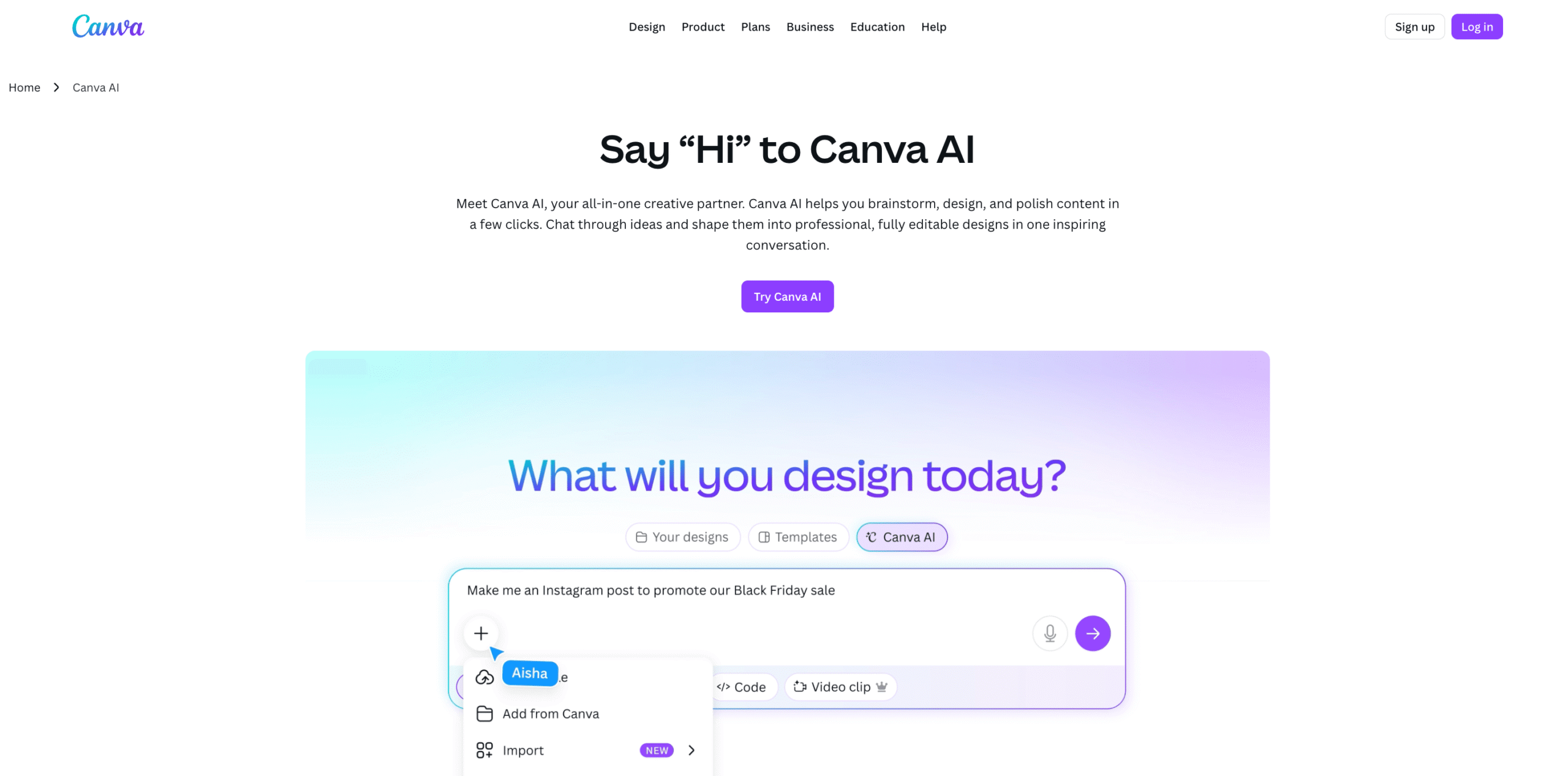
In 2026, Canva stands among the most widely used free AI tools in the world, particularly for visual content creation. Originally launched as a simple online design tool, Canva has evolved into a comprehensive AI-powered visual communication platform used by individuals, educators, startups, agencies, and large brands. Through its suite of smart features in “Magic Studio,” Canva has successfully democratized graphic design—enabling anyone, regardless of skill level, to create professional-quality visual assets using artificial intelligence.
Widespread Adoption and Global Market Position
Canva’s rise has been nothing short of extraordinary. By early 2025, the platform had over 220 million monthly active users and was valued at $49 billion. It now ranks as the second-most visited AI tool globally in terms of traffic, with nearly 912 million monthly visits. This level of usage gives Canva a commanding 9.68% share of the AI tools market.
Its user-friendly design, wide template library, and strong integration of AI features have made it especially popular among small businesses, marketing teams, educators, and content creators.
Below is an overview of Canva’s global user metrics and market position:
| Metric | Value (as of 2025–2026) |
|---|---|
| Monthly Active Users | 220 Million+ |
| Monthly Visits (Global Ranking) | 911.8 Million (2nd Place) |
| Global AI Tool Market Share | 9.68% |
| Company Valuation | $49 Billion |
| Number of Magic Studio Uses | 16 Billion+ |
Magic Studio: Canva’s AI-Powered Creative Suite
Launched in late 2023, Magic Studio introduced a full suite of AI-driven design tools. These tools help users automatically generate, edit, and enhance visuals, presentations, documents, and even short videos. The adoption of these features has been rapid across industries, especially in digital marketing and content creation.
The most popular features in Magic Studio include:
| Feature Name | Functionality | Adoption Highlights |
|---|---|---|
| Magic Design | Converts text prompts into complete layouts | Used by 75% of marketing teams |
| Magic Write | AI-based content and copywriting | Over 500 million documents generated |
| Magic Edit | Text-to-image editing and creative changes | Widely used in advertising and ecommerce |
| Background Remover | Isolates subjects from photos instantly | Approx. 76 million uses per month |
These features are embedded in a drag-and-drop interface, making it easy for non-designers to create polished visuals. Whether users need to design social media posts, reports, logos, pitch decks, or short videos, Canva’s Magic Studio provides a full-service creative solution—all enhanced by AI.
Free Tier Accessibility and Design Democratization
Canva’s free version remains one of the most generous among AI tools in 2026. Users get access to:
- Thousands of ready-to-use templates
- Magic Studio AI tools (basic versions)
- Drag-and-drop design builder
- Free stock photos, icons, and fonts
- Collaboration features for teams
The free plan allows users to explore most of Canva’s core features without subscription pressure. This accessibility has led to widespread use by freelancers, students, educators, and startups in over 190 countries.
The following matrix compares Canva’s free-tier benefits against other popular design tools:
| Tool | AI Design Support | Free Tier Template Access | Team Collaboration | Popular Use Case |
|---|---|---|---|---|
| Canva (Free) | Yes | 250,000+ Templates | Yes | Social Media, Presentations |
| Adobe Express | Yes (Limited) | Fewer Templates | Yes | Brand Kits, Web Stories |
| Visme | Yes | Basic Access Only | Limited | Business Infographics |
| VistaCreate | Yes | Moderate | Yes | Social Ads, Ecommerce Templates |
Acceptance of AI-Generated Visuals in Branding
In a 2025 industry survey, 90.9% of users expressed comfort with companies using AI-generated visuals for marketing and branding. This is a strong indicator of changing norms and growing trust in AI-assisted creativity. As companies shift their marketing strategies to be more visual and video-centric, Canva’s role as an AI-powered design partner becomes increasingly central.
Canva is widely used for:
- Generating product ads for ecommerce platforms
- Creating Instagram Reels and YouTube thumbnails
- Building pitch decks and slide presentations
- Designing flyers, banners, and promotional graphics
- Editing and enhancing content for brand storytelling
Here is a summary of Canva’s top AI design tasks by use case:
| Task Type | Primary Users | Frequency (2025–2026) |
|---|---|---|
| Social Media Graphics | Influencers, SMEs | Very High |
| Product Catalogs | Retailers, DTC Brands | High |
| Pitch Decks & Proposals | Startups, Consultants | High |
| Educational Content | Teachers, Students | Moderate |
| Email Campaign Visuals | Marketers, Creators | High |
Conclusion
In the fast-evolving world of AI tools, Canva continues to lead the way in design accessibility and creative empowerment. With its intuitive platform, powerful AI features in Magic Studio, and a robust free tier, Canva helps millions of users around the globe bring their visual ideas to life—quickly, professionally, and affordably. As more businesses and creators adopt visual-first communication strategies, Canva remains one of the most valuable and versatile free AI tools in 2026, bridging the gap between creativity and technology for everyone.
9. NotebookLM

Among the top free AI tools of 2026, Google’s NotebookLM stands out as a reliable assistant for users who need research accuracy, long-context processing, and document-grounded insights. Tailored for students, academics, legal professionals, and analysts, NotebookLM has quickly evolved into a go-to platform for managing information and making sense of complex materials. Its ability to use only user-provided data ensures precision, making it one of the most trusted tools for fact-based analysis in both educational and professional environments.
Growing User Adoption and Popularity of Audio Overviews
NotebookLM witnessed explosive growth between 2024 and 2025, especially after the launch of its viral feature known as “Audio Overviews.” This unique function transforms uploaded files such as PDFs or Google Docs into an audio dialogue between two AI narrators, offering a podcast-like experience that summarizes key content in a conversational style. This innovative approach made it easier for users to consume long-form documents while multitasking.
The Audio Overviews feature alone contributed to a 57% increase in user adoption within six months. By the end of 2025, NotebookLM had reached over 8 million monthly active mobile users, making it one of the fastest-growing AI research tools globally.
Here is a timeline overview of its user base growth:
| Time Period | Monthly Active Users | Major Growth Trigger |
|---|---|---|
| Q2 2024 | 2.5 Million | Beta access to researchers |
| Q4 2024 | 5.1 Million | Launch of Audio Overviews |
| Q4 2025 | 8 Million+ | Expansion to students worldwide |
AI-Grounded Research with Minimal Hallucination Risk
Unlike many generative AI tools that rely on web-based training data, NotebookLM only uses the content that the user uploads. This makes it a unique, source-grounded assistant—ideal for situations where factual accuracy and contextual fidelity are essential.
This approach has made NotebookLM especially effective for:
- Reviewing academic literature
- Preparing legal summaries
- Synthesizing corporate research
- Studying for exams using personal notes
- Analyzing business reports or internal documents
The tool’s ability to handle large files—up to 50 documents per notebook and up to 500,000 words per file in the free tier—makes it one of the most powerful long-context AI platforms on the market.
Feature Access in Free vs Paid Tiers
NotebookLM offers a robust free plan that provides a rich set of features, with limitations on daily usage and document quantity. Power users can unlock greater capacity and speed through AI Pro and AI Ultra tiers, but the free plan remains sufficient for students, independent researchers, and professionals working with moderate datasets.
The table below outlines the current tier-based access model:
| Feature | Free Tier | AI Pro Tier | AI Ultra Tier |
|---|---|---|---|
| Total Notebooks | 100 | 500 | 500+ |
| Sources per Notebook | 50 | 300 | Up to 600 |
| Audio Overviews per Day | 3 | 20 | Up to 200 |
| Deep Research Actions/Day | Limited | 20 | Up to 200 |
| Chat Queries per Day | 50 | 500 | Up to 5,000 |
| File Size (Words per File) | 500,000 | Same | Same |
This generous free tier has contributed to NotebookLM’s broad appeal, particularly among academic institutions and research teams who want private, high-quality synthesis without risking data exposure.
Specialized Applications Across Fields
NotebookLM’s long-context capabilities, source-limited reasoning, and audio conversion tools have found unique applications across various sectors. From law firms analyzing court rulings to biotech companies reviewing clinical trial documentation, the platform is increasingly seen as more than a note-taking tool—it’s a full-spectrum AI research partner.
Here’s a matrix of NotebookLM use cases across industries:
| Sector | Common Use Case | Key Value Provided |
|---|---|---|
| Academia | Literature reviews and thesis prep | Source-grounded insights |
| Legal | Contract and case file analysis | No external training risk |
| Corporate Research | Internal memo and report synthesis | Private and accurate processing |
| Journalism | Interview transcription and report drafting | Long-document summarization |
| Consulting | Market analysis and strategic briefs | Audio-based executive summaries |
Conclusion
NotebookLM has positioned itself as one of the most intelligent, reliable, and secure free AI tools in the world in 2026. Designed for serious researchers, deep thinkers, and professionals working with sensitive or proprietary data, it combines high-level document analysis with user-friendly tools like Audio Overviews and multi-turn reasoning. With unmatched long-context support and a free tier that rivals many paid services, NotebookLM is setting a new standard for AI-driven knowledge management—making complex information accessible, understandable, and usable for all.
10. HeyGen
In the expanding world of artificial intelligence tools, HeyGen has earned a top position in 2026 as one of the most advanced and widely used platforms for AI video generation. Focused on synthetic media and digital avatars, HeyGen is transforming how businesses, marketers, educators, and creators produce video content. With its high-quality avatar rendering, multilingual support, and credit-based free tier, HeyGen is now considered one of the most powerful and accessible free AI tools for video creation globally.
Strong Market Growth and Business Impact
HeyGen has experienced rapid financial and customer growth in recent years. By September 2025, it had reached $95 million in annual recurring revenue (ARR)—a 202.6% increase year-over-year. This momentum has positioned HeyGen alongside major players in the synthetic video industry, such as Synthesia.
The company serves more than 85,000 users worldwide, including over 40,000 business customers. These users span industries like education, enterprise training, human resources, ecommerce, and marketing. For businesses that previously relied on expensive filming and editing, HeyGen offers an AI-powered alternative that cuts video production costs by as much as 70%.
Here is a financial and competitive comparison of HeyGen and similar AI video platforms:
| Metric | HeyGen (2025–2026) | Synthesia (2025 Estimate) |
|---|---|---|
| Annual Recurring Revenue (ARR) | $95 Million | $100 Million+ (as of March 2025) |
| Estimated Company Valuation | $500 Million (June 2024) | $1 Billion+ (Est.) |
| Active Digital Avatars | 230+ | Similar Range |
| Supported Languages | 140–175+ | 120+ |
| Cost Savings (vs. traditional) | Up to 70% | 60–70% |
Multilingual Video Generation and Lip-Sync Technology
One of HeyGen’s most powerful features is its ability to translate video content into over 140 languages, complete with automatic lip-syncing for digital avatars. This makes HeyGen a valuable tool for global organizations needing localized training materials, video ads, onboarding content, or multilingual explainers.
Its AI video generation supports:
- Realistic human-like avatars
- Lip-synced translation in dozens of languages
- Custom scripts and brand tone alignment
- High-definition rendering within minutes
These features are widely adopted in:
- Learning & Development (L&D)
- HR training and onboarding
- Cross-border product marketing
- Influencer marketing at scale
The following matrix outlines how HeyGen supports various business video needs:
| Use Case | Key Benefit Provided | Popularity in 2026 |
|---|---|---|
| Internal Training Videos | Saves time, improves engagement | High |
| Global Marketing Campaigns | Localized, multilingual videos | Very High |
| Ecommerce Product Explainers | Fast production, human touch | Moderate |
| Educational Video Lessons | Scalable content in multiple languages | High |
| Social Media Shorts | Avatar-based content without filming | High |
Free Plan Accessibility and Credit System
HeyGen offers a credit-based free tier that allows new users to explore its AI video tools without upfront payment. Users can generate short avatar videos using built-in templates, choose from a library of avatars, or upload their own script for automatic video creation.
The platform’s free plan is especially useful for small businesses, startups, solo educators, and digital content creators who want to test the potential of AI-generated videos before investing in premium features.
Here is a breakdown of what users can access under HeyGen’s free and paid plans:
| Feature Category | Free Plan (Credit-Based) | Paid Plans (Monthly/Annual) |
|---|---|---|
| Access to Digital Avatars | Yes (Limited) | Yes (Full Library + Custom) |
| Video Length Limit | Short (30–60 seconds) | Up to several minutes |
| Multilingual Lip-Sync | Yes | Yes (Higher accuracy) |
| Branding & Watermark Removal | No | Yes |
| Commercial Use Rights | No | Yes |
| Video Export Resolution | Standard | HD/4K Options |
Position in the Global AI Video Market
The global synthetic video market is projected to grow from $0.80 billion in 2025 to nearly $6 billion by 2032. Within this trend, HeyGen is seen as one of the leading players due to its balance of performance, ease of use, and affordability. Its focus on providing realistic, fast, and accessible video generation at scale has set a benchmark for how digital communication is evolving.
HeyGen’s technology is increasingly used by:
- Marketing teams scaling multilingual campaigns
- L&D professionals training teams across regions
- Ecommerce sellers creating product demos at speed
- Influencers producing quick avatar-based content
- Agencies delivering custom AI video ads to clients
The following chart presents projected AI video market growth and HeyGen’s strategic positioning:
| Year | AI Video Market Size | HeyGen Strategic Role |
|---|---|---|
| 2025 | $0.80 Billion | Fast-growth with strong ARR |
| 2026 | $1.25 Billion (Est.) | Scaling global customer base |
| 2030 | $3.80 Billion (Est.) | Industry leader in avatars |
| 2032 | $5.93 Billion (Est.) | Dominant platform for businesses |
Conclusion
HeyGen has redefined what’s possible with AI-powered video in 2026. With its robust avatar technology, multilingual support, and cost-effective production model, it serves as a practical and powerful tool for businesses and individuals alike. Its free-tier access allows anyone to explore the future of digital video creation—making HeyGen one of the most valuable, scalable, and user-friendly AI tools on the global stage today. Whether used for corporate training, marketing, or educational content, HeyGen is at the forefront of synthetic media innovation.
The Global Economic Environment Powering Free AI Tool Adoption in 2026
Before exploring the top free AI tools of 2026, it’s important to understand the broader economic and technological shifts that have laid the foundation for today’s AI ecosystem. In recent years, global investment in artificial intelligence has surged at an unprecedented pace, creating a fertile environment for the growth of accessible, high-impact AI solutions for businesses, creators, professionals, and the general public. This macroeconomic momentum is directly tied to the rise and democratization of free AI tools worldwide.
Global AI Spending and Enterprise Adoption Trends
The year 2026 marks a major turning point in enterprise AI adoption and global market maturity. Worldwide spending on AI is projected to reach $337 billion, with enterprises accounting for nearly 67% of total expenditure. This is a significant leap from $235 billion in 2024 and is expected to rise even further to $450 billion by the end of 2026.
This growth is driven by strategic investments in AI-powered tools that increase productivity, streamline workflows, and enhance customer experiences. Businesses across sectors are no longer experimenting with AI—they are integrating it directly into their core operations.
Here is a timeline of global AI market development:
| Year | Global AI Market Size | Enterprise Share (%) | AI Adoption Rate (%) |
|---|---|---|---|
| 2024 | $235 Billion | 63% | 55% |
| 2025 (Estimated) | $337 Billion | 67% | 72% |
| 2026 (Projected) | $450 Billion | 70%+ | 78% |
Rise in Agentic AI and Embedded Intelligence
A notable transformation in 2026 is the rise of agentic AI—systems that can make decisions and execute tasks independently within digital environments. The share of users relying on agentic AI tools has grown from just 12% in 2024 to an estimated 38% in 2026. This reflects a wider movement from task-based AI prompts to autonomous, multi-step systems embedded in platforms such as customer support, research, recruiting, and workflow automation.
This progression from “AI as an add-on” to “AI as a foundation” is driving the architectural shift many companies now call Core Reinvention. In this phase, traditional tools are being rebuilt from scratch with native AI functionality rather than AI simply being layered on top of legacy systems.
Organizational Shifts and Strategic Roles in AI
With AI becoming central to business strategy, companies are restructuring leadership to include dedicated AI management roles. By 2026, the position of Chief AI Officer (CAIO) has become standard in 78% of leading enterprises. This role ensures that AI strategy, compliance, performance, and data governance are properly overseen at the executive level.
Below is a matrix showing organizational transformation in the AI era:
| Leadership Change | Adoption Rate in 2026 | Purpose of the Role |
|---|---|---|
| Chief AI Officer (CAIO) | 78% | AI Governance and Innovation Strategy |
| AI-Powered Operations Platforms | 66% | Embedded decision-making |
| AI-Augmented Customer Channels | 72% | Chatbots, voice assistants, live analytics |
| Autonomous Research Assistants | 58% | Auto-summarization, content synthesis |
Private Investment and Regional Leadership in AI Development
The United States continues to lead the world in AI development by a wide margin. In 2025, U.S. private sector investment reached $109.1 billion—nearly twelve times that of China ($9.3 billion) and twenty-four times that of the United Kingdom ($4.5 billion). With projections pointing to $125 billion in 2026, U.S. dominance in foundational models, agentic platforms, and enterprise AI infrastructure remains strong.
Here is a comparative table of private AI investment by country:
| Country | 2024 Investment | 2025 Investment | 2026 Projected Investment |
|---|---|---|---|
| United States | $95.9 Billion | $109.1 Billion | $125.0 Billion |
| China | $8.7 Billion | $9.3 Billion | ~$11 Billion |
| United Kingdom | $4.2 Billion | $4.5 Billion | ~$5.2 Billion |
| Germany | $3.8 Billion | $4.1 Billion | ~$4.6 Billion |
| India | $2.5 Billion | $3.3 Billion | ~$4.2 Billion |
AI Skill Premium and Workforce Impact
The growing demand for AI tools and expertise has led to a noticeable increase in salary premiums for workers with AI-related skills. The global AI skill wage premium has risen steadily, reaching 56% in 2026. This reflects the importance of AI fluency not only among technical teams, but also across operations, design, sales, and strategy.
The workforce transformation is further amplified by the availability of free AI tools, which allow employees to learn and apply AI in real-time without institutional training costs.
| Year | AI Skill Wage Premium | Primary Adoption Sectors |
|---|---|---|
| 2024 | 45% | Tech, Finance, Marketing |
| 2025 | 51% | Legal, Healthcare, Operations |
| 2026 | 56% | Education, Manufacturing, Retail |
Conclusion
The economic conditions of 2026 reveal a global ecosystem where artificial intelligence is not only growing in scale but maturing in structure. With rising investment, new executive roles, embedded agentic intelligence, and a surge in enterprise adoption, AI has shifted from a novelty into a necessity. This broader environment has created the foundation for the rise of free, high-quality AI tools—empowering users around the world to harness advanced technology without the cost barrier. As organizations continue to prioritize productivity, creativity, and automation, these tools are becoming essential to daily operations and innovation alike.
Technical Benchmarking and Performance Insights of the Top Free AI Tools in 2026
As the AI landscape matures in 2026, users now have access to a wide range of free tools—each offering unique strengths. While general-purpose assistants like ChatGPT provide broad functionality across multiple use cases, specialized platforms such as Claude, DeepSeek, and Gemini are establishing clear leadership in key technical areas including reasoning, mathematical accuracy, and real-time speed. Understanding how each of these free tools performs in various benchmark tests is essential for selecting the right AI assistant for specific tasks.
Reasoning Power and Mathematical Intelligence
In 2026, certain AI models are recognized for their excellence in logical problem-solving and mathematical accuracy. These are especially relevant for users in fields such as finance, engineering, research, and data science.
Two categories are critical in this segment: performance on math-oriented benchmarks like the AIME (American Invitational Mathematics Examination), and ranking in the LMArena Elo system, which measures reasoning performance against peer models through crowdsourced evaluations.
Among the free-access models available to the public, Gemini 3 Pro holds the top position for deep reasoning and advanced computation. DeepSeek-V3.2 Speciale, a model released by a Chinese AI lab, has shown surprising strength—nearly matching Gemini’s performance despite being fully open-source and cost-efficient. GPT-5.1 Thinking, available on platforms like ChatGPT, continues to offer strong reasoning with a user-friendly experience. Claude 4.5 Opus, developed by Anthropic, offers a calm and structured reasoning style ideal for extended thinking tasks.
The matrix below summarizes performance on key reasoning and math benchmarks:
| Model Name | AIME 2025 Score (%) | LMArena Elo Score (Reasoning) |
|---|---|---|
| Gemini 3 Pro | 91.2% | 1,501 |
| DeepSeek-V3.2 Speciale | 89.5% | 1,485 |
| GPT-5.1 Thinking | 88.0% | 1,480 |
| Claude 4.5 Opus | 87.2% | 1,483 |
These figures suggest that for users focused on academic research, problem-solving, and high-accuracy logic applications, all four models offer free access to world-class cognitive performance.
Speed, Latency, and Real-Time Interaction Capabilities
While accuracy is crucial, speed and responsiveness are just as important for many real-world scenarios—especially in chat-based assistance, brainstorming, customer service, and creative writing. In 2026, output speed and time to first token (how quickly a model begins responding) are key factors influencing user experience.
GPT-5.1 Instant, part of the ChatGPT platform, leads in speed-based performance, capable of generating over 150 tokens per second. It also starts responding in under 2 seconds, making it ideal for interactive use. Gemini 3 Pro delivers stable performance, although its latency varies based on computational load. Claude 4.5 Sonnet offers consistently low-latency outputs with a calm tone, while DeepSeek-V3.2 provides longer-thinking depth but at a slower response time.
The following table presents latency and speed benchmarks across leading models:
| AI Model | Output Speed (Tokens/Second) | Average Time to First Token |
|---|---|---|
| GPT-5.1 Instant | 150+ | < 2 seconds |
| Gemini 3 Pro | 100+ | Variable |
| Claude 4.5 Sonnet | 63 | ~1.8 seconds |
| DeepSeek-V3.2 | 50 – 80 | ~3+ seconds |
Users focused on fast content creation, customer-facing applications, or live workflows will find GPT-5.1 Instant to be the most responsive, while Gemini and Claude balance performance with creative depth.
Specialization by Strength: Which Tool for Which Use?
Given the differences in technical performance, each of the top free AI tools in 2026 is best suited to specific user needs. Whether the priority is advanced computation, real-time engagement, long-form content, or language support, the free versions of these platforms cover a wide range of use cases.
Here’s a recommendation matrix for matching tool to task:
| Use Case | Recommended Free AI Tool | Reason for Recommendation |
|---|---|---|
| Complex Math or Logic Problems | DeepSeek-V3.2 Speciale | Strong mathematical benchmarks, long context |
| Real-Time Interaction | GPT-5.1 Instant | Fastest token output, minimal latency |
| Structured Research Assistance | Claude 4.5 Sonnet | Calm tone, excellent for long thought processes |
| Multilingual or Visual Workflows | Gemini 3 Pro | Best for multimodal input and deep reasoning |
Conclusion
In 2026, users are no longer limited to a one-size-fits-all AI solution. Free tools such as GPT-5.1 Instant, Gemini 3 Pro, Claude 4.5, and DeepSeek-V3.2 offer specialized strengths that cater to diverse professional and personal needs. Whether it’s speed, reasoning, multilingual capacity, or math precision, each model delivers enterprise-grade functionality at no cost—allowing users to pick the right tool for the right task with confidence. As the AI industry continues to evolve, this diversity in performance ensures greater accessibility, flexibility, and productivity for users worldwide.
The Rise of Open-Source AI: Meta Llama and Global Alternatives in 2026
In 2026, the open-source AI ecosystem has become a powerful force, now accounting for nearly one-third of the entire global AI market. This shift is reshaping how individuals, startups, and large enterprises deploy and manage AI capabilities—driven by growing demand for data control, infrastructure flexibility, and transparent model access. Among the most influential contributors to this trend are Meta’s Llama 4 series and major Chinese models like DeepSeek and Qwen. These platforms are redefining what is possible with free or openly accessible AI.
Market Momentum and Global Share of Open-Weight Models
The movement toward open-source and “open-weight” AI is accelerating due to concerns around privacy, model customization, and vendor lock-in. As of early 2026, approximately 33% of AI tools in active use—especially in technical, academic, and government environments—are based on open-source or open-weight infrastructure.
These models offer users complete control over how and where AI is used. They also allow developers and businesses to host tools locally, eliminate recurring subscription fees, and adapt the models to niche use cases using private or sensitive data.
The following table illustrates open-source AI’s growing footprint in the global ecosystem:
| Category | Market Share (2026) | Primary Adoption Sectors |
|---|---|---|
| Open-Source/Weight Models | 33% | Healthcare, Education, Government, R&D |
| Proprietary Cloud Models | 67% | Marketing, Customer Service, Productivity |
Meta’s Llama 4 Series: Maverick and Scout
Meta has become a key contributor to the open-source AI movement through its Llama 4 series. Released in late 2025 and early 2026, the Llama 4 Maverick model is positioned as a frontier-class solution capable of competing with premium models like GPT-5 in areas such as reasoning and code generation.
The Maverick model includes 400 billion parameters and operates using a mixture-of-experts system, activating 17 billion parameters at a time for optimal performance and computational efficiency. This architecture allows enterprises to deploy high-performance AI tools on private infrastructure without relying on cloud platforms.
Another version, Llama 4 Scout, is optimized for smaller deployments and mobile inference while maintaining strong performance for general chat and creative writing.
Top Open-Source AI Models in 2026
The open-source AI space in 2026 includes a mix of Western and Eastern-developed models, offering a wide range of performance tiers, license types, and customization flexibility. Whether users are building real-time applications, conducting multilingual research, or implementing privacy-first systems, there are high-quality open models available at no cost.
The table below summarizes key open-source models and their best use cases:
| Model Name | Parameter Size | License Type | Best Use Case |
|---|---|---|---|
| Llama 4 Maverick | 400B (17B active) | Custom (Meta) | Coding, Enterprise Reasoning |
| DeepSeek-V3.2 | 671B | MIT | Advanced Math, Academic Research |
| Qwen 3 | 235B | Apache 2.0 | Multilingual Chat and Translation |
| Mistral Small | 37B – 12B | Apache 2.0 | Lightweight, Real-Time Applications |
These models can be downloaded, modified, and hosted entirely under the user’s control—offering freedom to adjust model behavior, optimize for speed or memory, and comply with local data policies.
Strategic Advantages of Open-Source AI
In 2026, open-source AI models are not just technically capable—they offer distinct strategic advantages. The biggest of these is complete autonomy. Organizations using these models have:
- Full control over data flow and user privacy
- The ability to fine-tune models using internal datasets
- Zero reliance on third-party servers or APIs
- No recurring costs, making them ideal for budget-conscious deployments
- Greater compliance with national or industry-specific regulations
These benefits are particularly valuable for highly regulated sectors such as:
| Sector | Why Open-Source Matters |
|---|---|
| Healthcare | Sensitive patient data requires local processing |
| Government | National security and data residency laws apply |
| Legal | Internal document processing without cloud exposure |
| Education | Custom curriculum development with local data |
| Manufacturing | On-site deployment with edge inference models |
Open vs Proprietary AI Comparison Matrix (2026)
| Feature | Open-Source Models | Proprietary Cloud Models |
|---|---|---|
| Customization | Full (code and weights) | Limited or None |
| Hosting Flexibility | On-premise or cloud | Vendor-controlled |
| Cost | Free/Open license | Subscription or pay-per-use |
| Fine-Tuning Capabilities | Full access to weights | Often restricted |
| Data Sovereignty | Full control | Subject to vendor compliance |
| Popular Use Case | Secure systems, R&D | Consumer tools, SaaS platforms |
Conclusion
The open-source AI ecosystem in 2026 offers a powerful alternative to closed, commercial models. Tools like Meta’s Llama 4 Maverick, DeepSeek-V3.2, Qwen, and Mistral provide enterprise-grade performance with complete flexibility. These models empower users to build private, secure, and cost-efficient AI applications without compromise. For developers, governments, researchers, and organizations seeking greater independence and adaptability, open-source AI has become a cornerstone of digital transformation—and one of the most important categories of free AI tools shaping the global technology landscape.
Global AI Adoption in 2026: Regional Growth and Industry-Specific Trends
As free AI tools become more accessible and powerful, their adoption across countries and industries continues to accelerate. However, the pace and pattern of AI integration vary widely depending on regional trust, investment levels, digital readiness, and regulatory support. In 2026, understanding where AI is being embraced the most—and how it’s being used—offers valuable insights into the global AI landscape and the rising influence of free tools in driving innovation.
Public Trust and National-Level AI Integration
The willingness of citizens and governments to embrace AI technology plays a crucial role in shaping adoption trends. In 2026, countries in Asia—particularly China, Indonesia, and Thailand—report the highest levels of public trust in AI systems. Over 75% of people in these countries believe that AI delivers more positive value than harm. This public confidence is closely linked to higher skill adoption, faster integration in public services, and stronger startup ecosystems.
In contrast, AI trust levels remain significantly lower in Western nations. In the United States, only 39% of the population expresses confidence in AI, while Canada shows a slightly better rate at 40%. These gaps in public perception are reflected in national investment behaviors and workforce upskilling rates.
Here is a comparison matrix highlighting AI trust levels and startup activity by country:
| Country | AI Trust Level (2026) | AI Skill Penetration Rate | Number of AI Startups Funded |
|---|---|---|---|
| China | 83% | High (Est.) | 1,605 |
| Indonesia | 78%+ | Moderate | Growing |
| Thailand | 75%+ | Moderate | Expanding |
| United States | 39% | 26% | 6,956 |
| India | Moderate | 25% | Rapidly Scaling |
| Canada | 40% | Low | Growing |
| United Kingdom | Moderate | 14% | 885 |
| Germany | Moderate | 13% | Developing |
Countries with higher trust and skill development are adopting open-source and low-cost AI tools at a faster pace—enabling broader usage in education, governance, healthcare, and small business sectors.
AI Adoption Across Industry Sectors
AI’s impact is most significant in sectors where automation, pattern recognition, and data-driven personalization are key drivers of performance. In 2026, Information Technology (IT), Banking and Finance, Manufacturing, Retail, and Healthcare are leading the charge.
Each sector is leveraging free and commercial AI tools for specialized tasks such as fraud detection, software development, customer experience enhancement, equipment diagnostics, and medical documentation.
Here is an industry-specific breakdown of AI adoption rates, use cases, and 2024 investment levels:
| Industry Sector | AI Adoption Rate (2025/26) | Primary Use Cases | AI Investment (2024) |
|---|---|---|---|
| Software/IT | 78%+ | AI in Software Development Lifecycle | $33.0 Billion |
| Banking/Finance | 72%+ | Fraud Detection, Risk Analysis, Personalization | $31.3 Billion |
| Manufacturing | 77% | Predictive Maintenance, Quality Control | Estimated High |
| Retail | 55% – 63% | Personalized Shopping, Customer Support | $25.0 Billion |
| Healthcare | Growing Rapidly | Diagnostics, Patient Management, AI Scribes | Accelerating CAGR 36.8% |
Notably, the Healthcare sector is expected to be one of the fastest-growing AI verticals through 2030, with a strong focus on diagnostics, AI-assisted imaging, and medical workflow automation.
Sectoral Use Case Matrix for Free AI Tool Adoption
Free and open-access AI tools are also seeing rapid uptake across verticals due to cost-effectiveness and ease of implementation. The following matrix shows how different sectors are utilizing free AI tools for operational gains:
| Sector | Example Free AI Tools Used | Key Use Cases | Benefit Realized |
|---|---|---|---|
| IT | ChatGPT, DeepSeek, Claude | Code Suggestions, Documentation | Faster Development Cycles |
| Finance | Perplexity AI, GPT-5.1 Mini | Report Analysis, Query Handling | Lower Operational Costs |
| Manufacturing | Gemini Free, NotebookLM | Equipment Logs, Data Summarization | Improved Downtime Forecasting |
| Retail | Canva, Meta AI, HeyGen | Product Creatives, Chatbots, Video Ads | Personalized Customer Engagement |
| Healthcare | NotebookLM, Claude Free, Gemini | Patient Notes, Audio Reports, Summaries | Faster Documentation & Diagnosis |
Conclusion
The global adoption of AI in 2026 reveals a diverse and dynamic pattern shaped by cultural trust, sector-specific needs, and regional investment priorities. Countries with high public trust and strong digital infrastructure are seeing accelerated adoption across public and private domains. Simultaneously, industries with large volumes of data and high operational complexity are turning to free AI tools to reduce costs and improve output quality.
As tools like ChatGPT, Gemini, Claude, Canva, and NotebookLM continue to evolve and expand access, the landscape of AI is shifting toward greater inclusion—offering scalable solutions to users around the world, regardless of geography or budget. These patterns confirm that free AI tools are no longer optional experiments—they are becoming essential pillars of national and sectoral innovation strategies in 2026.
Agentic AI in 2026: The Evolution from Generative Tools to Autonomous Digital Workers
In 2026, artificial intelligence is no longer just about generating text, summarizing content, or answering questions. The global AI landscape has moved into a more advanced era defined by Agentic AI—systems that go beyond passive assistance to actively perform tasks, automate workflows, and operate independently within complex environments. These agents are transforming how businesses work by acting as reliable virtual co-workers, capable of making decisions, accessing external systems, and executing multi-step processes without constant human direction.
From Generators to Executors: What Makes Agentic AI Different
Agentic AI differs fundamentally from traditional AI chat tools. Instead of simply replying to prompts, agentic systems can:
- Call APIs and integrate with external apps
- Navigate web interfaces in real time
- Monitor multi-step workflows across platforms
- Execute tasks based on pre-defined goals or real-time data
This shift has redefined how AI fits into business operations. Companies are now deploying intelligent agents to manage workflows such as customer onboarding, HR processes, financial reconciliations, and inventory management.
The table below outlines the transition in AI capability between 2023 and 2026:
| AI Capability | Traditional Generative AI (2023) | Agentic AI (2026) |
|---|---|---|
| Response Type | One-time answers | Continuous task execution |
| Input Requirement | User prompt-driven | Goal-based or event-triggered |
| System Integration | Minimal | Deep integration with APIs |
| Task Type | Single-output (text/image) | Multi-step, rule-based tasks |
| Autonomy Level | Low | High |
The Rise of Virtual Co-Workers in Modern Enterprises
Agentic AI tools are being described by executives as “virtual co-workers” who can take on repetitive and structured tasks without supervision. According to research by DeepL, 69% of global business leaders believe these AI agents will transform their business models in 2026.
The result is a major reduction in time spent on context-switching and repetitive workflows—allowing human employees to focus more on creative problem-solving, innovation, and strategic thinking.
The chart below illustrates the rise in agentic AI usage across enterprises:
| Metric | 2025 Actual Value | 2026 Projected Value |
|---|---|---|
| Enterprises Deploying AI Agents | 12% | 38% |
| Percentage of Tasks Led by Agents | 3% | 25% |
| AI Tool Invocation in Workflows | 8% of total tasks | 15%+ and rising |
| Multi-Step Tokens Processed by Agents | < 20% | > 50% |
The Cinderella Effect: Why Agentic AI Users Rarely Switch
A unique behavioral phenomenon is emerging in the agentic AI era, known as the “Cinderella Effect.” This effect describes the strong loyalty that users develop once an agent solves a high-value problem effectively for the first time—whether it’s automating supply chain operations, managing legal discovery, or powering intelligent recruiting funnels.
Once users experience a solution that “just fits,” they are highly unlikely to switch to a competing model, even if it offers slightly better technical specs. This gives early movers in agentic AI a powerful competitive edge and long-term retention.
Platforms that are benefiting from this early adoption pattern include:
| Platform/Company | Agentic Role in Workflow | Adoption Benefit |
|---|---|---|
| OpenAI (via GPT Agents) | Embedded co-pilots for scheduling, emails | Seamless integration with ChatGPT |
| Anthropic (Claude Ops) | Document reviews, multi-turn analysis | Trust-based enterprise usage |
| n8n | No-code agent builder for process automation | Fully customizable, self-hostable |
| Zapier Agents | Agent-driven app-to-app workflows | Fast setup, plug-and-play automation |
Agentic Tools in the Free AI Ecosystem
Several agentic AI tools are also available in free or freemium formats, allowing startups, small teams, and individual professionals to experiment with automation before committing to paid plans. These free tools can be used to:
- Automate scheduling and reminders
- Pull real-time data from external APIs
- Orchestrate sales CRM tasks
- Coordinate document workflows
- Generate dynamic reports across platforms
Here is a matrix of common agentic AI use cases supported by top free AI platforms in 2026:
| Use Case | Common Tools (Free Versions) | Task Type Automated |
|---|---|---|
| Personal Assistant Automation | ChatGPT, Gemini | Emails, reminders, meeting setup |
| Marketing Workflow Automation | Zapier Free, Canva + HeyGen | Campaign deployment, content updates |
| Academic Research Automation | NotebookLM, Perplexity AI | File uploads, summarization loops |
| Internal Business Tools | n8n Open Source, Claude Free | Form parsing, file routing |
Conclusion
Agentic AI in 2026 marks a major leap in how artificial intelligence is applied in daily workflows and enterprise environments. With their ability to act, decide, and operate independently, these systems are replacing manual effort and operational friction with intelligent, adaptive execution.
The rise of virtual co-workers, combined with the proven impact of the “Cinderella Effect,” is reshaping workplace structures and digital workflows. As more free and open-source platforms add agentic features, users around the world—regardless of budget—can tap into automation that was once reserved for high-end enterprise software. In the evolving world of AI tools, agentic intelligence is not just a trend—it’s the next standard.
AI and Employment in 2026: Balancing Job Disruption with Workforce Transformation
As artificial intelligence becomes an essential part of modern businesses and public systems, its impact on jobs and labor markets has become one of the most widely discussed topics in 2026. While AI presents significant opportunities for economic growth and productivity, it also introduces real challenges in terms of workforce displacement, skill gaps, and organizational restructuring. The global conversation is now shifting from fears of replacement to strategies for reinvention—particularly as free AI tools are enabling wider access to advanced technologies for both individuals and enterprises.
Job Displacement, Role Transformation, and New Opportunities
Forecasts suggest that AI will replace around 2.4 million jobs by 2030. However, this number is relatively small compared to the scale of transformation expected. AI is projected to alter the nature of approximately 12 million additional roles and generate around 170 million entirely new jobs worldwide. These new roles are emerging in AI operations, data science, automation strategy, AI ethics, prompt engineering, and cross-functional areas where human creativity and machine intelligence must work together.
Here is a high-level breakdown of projected global labor shifts driven by AI:
| Workforce Impact Category | Estimated Global Volume by 2030 |
|---|---|
| Jobs Replaced by AI | 2.4 Million |
| Existing Jobs Transformed | 12 Million |
| New AI-Enabled Jobs Created | 170 Million |
The shift shows that while automation does eliminate repetitive tasks, it simultaneously opens new doors for human-led innovation in AI design, training, governance, and hybrid workflows.
The Growing Demand for AI Skills in the Labor Market
As AI tools—especially free and low-cost platforms—become easier to use, there is a rising need for workers who can understand, manage, and collaborate with these systems. Around 35% of companies report that a lack of AI-related skills among their staff is a major barrier to full adoption.
To address this, forward-thinking organizations are treating AI not just as a tool, but as a company-wide transformation initiative. Rather than replacing employees, businesses are focusing on retraining existing staff and embedding AI education into every department.
The table below highlights current labor market signals tied to AI skill demand:
| Labor Metric | 2026 Value / Estimate |
|---|---|
| Job Ads with AI Skill Requirements | High and Rising |
| Wage Premium for AI-Enabled Roles | 56% Above Industry Median |
| Projected Growth Rate: Data Scientists (2024–2034) | 34% |
| Median Salary: Data Scientist | $112,590 |
| Median Salary: AI Engineer | Up to $171,715 |
| Companies Requiring AI Skills in New Hires | 52% |
Free AI tools are playing a pivotal role in closing this skill gap—allowing employees to learn by doing, experiment without financial risk, and build AI fluency in real business contexts.
Educational Attainment and Shifts in Job Structure
While AI is automating many repetitive and routine tasks, it has also created a favorable environment for college-educated workers. Firm-level studies show a positive 3.7% increase in the hiring of workers with higher education in AI-intensive organizations.
However, there has been a subtle reduction in middle and senior management roles. AI systems now handle a growing share of operational decision-making, status reporting, and administrative coordination—tasks that were traditionally managed by these layers.
The following matrix summarizes employment impact by education and role type:
| Worker Group | Impact Trend in AI-Adopting Firms |
|---|---|
| College-Educated Employees | +3.7% Hiring Growth |
| Frontline Operational Staff | Mixed (Some Upgraded Roles) |
| Middle Managers | -0.8% Decline |
| Senior Administrative Managers | -0.7% Decline |
This trend suggests that organizations are flattening structures, empowering knowledge workers, and automating layers of oversight through AI dashboards, reports, and decision engines.
Free AI Tools Supporting Career Growth and Skill Development
A growing number of professionals are using free AI tools to upskill and gain competitive advantages in the job market. Whether through platforms like ChatGPT for technical writing, Claude for code review, NotebookLM for research, or Canva and HeyGen for multimedia storytelling—individuals are building AI-assisted portfolios without incurring high costs.
Here is a summary of common AI tools mapped to skill-building opportunities:
| Free AI Tool | Common Career Skills Enhanced | User Segment Benefited |
|---|---|---|
| ChatGPT | Prompt Engineering, Technical Writing | Writers, Consultants, Analysts |
| Gemini | Multimodal Research, Language Practice | Educators, Students, Translators |
| Claude | Logic, Coding, Compliance Writing | Developers, Legal Professionals |
| Canva | Design, Visual Marketing | Creatives, Marketers, Entrepreneurs |
| HeyGen | Video Creation, Voice-over Production | Sales Teams, Instructors, Influencers |
| NotebookLM | Knowledge Management, Document Summarization | Researchers, Lawyers, Academics |
These tools lower the barrier to entry and make AI literacy possible for anyone with internet access, regardless of professional background.
Conclusion
In 2026, the question is no longer whether AI will change the world of work—it already has. The real challenge now lies in preparing the workforce for this change. While AI may displace some roles, it is creating far more new opportunities than it removes, especially for those who take proactive steps to adapt.
With free AI tools widely available, individuals and organizations now have unprecedented access to world-class capabilities—enabling them to automate routine tasks, enhance creativity, and unlock new career paths. The winners in this new era will be those who treat AI not as a threat, but as a partner in continuous learning, growth, and reinvention.
AI Governance, Risk, and Compliance in 2026: Key Challenges Facing Free AI Tools
While free AI tools have unlocked massive creative and operational opportunities for users across the globe, 2026 also marks a pivotal year where governance, trust, and safety concerns have taken center stage. As adoption rates rise, so do the challenges tied to model transparency, data protection, regulatory complexity, and performance reliability. Understanding these risks is essential for any user or organization planning to integrate AI into their workflows.
The Reality Check on ROI and Value Creation
Despite a booming AI ecosystem filled with accessible tools, many businesses are still struggling to see clear returns on their AI investments. Reports from 2024 showed that fewer than 30% of AI leaders said their CEOs were satisfied with the return on investment (ROI) from AI-related spending. Even by 2026, as tools matured and became more user-friendly, approximately 97% of organizations continued to face difficulties in proving real business value from generative AI, especially in early-stage implementations.
| ROI & Adoption Metric | 2024–2026 Value / Trend |
|---|---|
| CEO Satisfaction with AI ROI | < 30% in 2024 |
| Enterprises Struggling with Generative AI ROI | 97% (2026) |
| Primary Bottlenecks | Hallucinations, Security, Compliance, Trust |
| Affected Sectors | Healthcare, Legal, Finance, R&D |
This underscores the importance of pairing free AI tool usage with clear strategy, governance, and risk controls—particularly in sensitive or regulated environments.
Ongoing Risks: Hallucinations, Privacy, and AI Chain Failures
One of the core challenges in using free AI tools today is the continued risk of incorrect or misleading outputs—often referred to as “hallucinations.” These become especially problematic in multi-agent environments where one flawed output may influence downstream tasks or decisions. In critical sectors like healthcare, finance, and law, such errors can have severe consequences.
In parallel, concerns around data privacy and security have become widespread, particularly for users relying on cloud-based AI tools without fine-grained access control or local deployment capabilities.
| Key AI Risk Category | Prevalence / Impact (2026) | Main Area of Concern |
|---|---|---|
| Hallucinations | 15% – 25% of complex workflows | Accuracy in Legal, Medical, and Finance |
| Data Privacy Concerns | 47% of AI Users | Exposure of Sensitive Data |
| Compliance Costs | €10 Billion / Year (EU Markets) | Regulatory Risk in R&D and Innovation |
| Cybersecurity Vulnerability | High Across All Open Platforms | Expanded Threat Surface in Multi-Agent AI |
Users adopting free AI tools must be cautious about the type of information shared, especially when working with proprietary documents, intellectual property, or client data.
Global Regulations: Increasingly Strict, with Financial Consequences
As AI tools become deeply embedded in critical systems, governments worldwide are tightening their oversight. The European Union’s Artificial Intelligence Act is one of the most far-reaching governance models, estimated to result in €10 billion in annual compliance costs. While designed to improve safety and transparency, this regulatory burden has triggered a 20% decline in AI investment across some European countries.
Similar legislation is now emerging across other regions including the United States, Japan, South Korea, and Australia. These frameworks focus on:
- Mandatory model transparency and disclosure
- Auditability of training datasets and outputs
- Third-party certifications for health, finance, and infrastructure-related AI
- Prohibition of black-box models in high-risk sectors
The trend points toward a global standardization of AI ethics, performance evaluation, and safety auditing.
| Regulatory Element | Implementation Region | Projected Impact on AI Investment |
|---|---|---|
| AI Transparency Mandates | EU, US, Canada | Positive for trust, but limits agility |
| Data Provenance Disclosure | Global Emerging Standard | Encourages ethical model training |
| Compliance Reporting Requirements | Finance, Health, Law | Increased operational cost for SMEs |
| Third-Party Model Audits | EU, Australia | Drives maturity, reduces vendor risk |
Free tools that openly publish documentation, provide safety disclaimers, and limit hallucination rates are being favored by both enterprise clients and regulators.
Risk-Readiness Matrix: Free AI Tools in Sensitive Use Cases
The matrix below summarizes how well free AI tools perform in sensitive domains, based on available safety features, community trust, and alignment with emerging governance expectations:
| AI Tool | Hallucination Control | Privacy Options | Compliance Transparency | Recommended Use Cases |
|---|---|---|---|---|
| ChatGPT | High (with citations) | Medium | Public Documentation | Writing, Planning, Q&A |
| Claude | High Reasoning Safety | Medium-High | Clear Model Disclosures | Legal Drafting, Ethical AI |
| NotebookLM | Source-Grounded Only | High | Document-based Reasoning | Research, Policy Writing |
| Gemini | Medium-High | Medium | Model Cards Available | Data Analysis, Reports |
| Meta AI | Medium | Low | Limited Governance Docs | Experiments, Multimodal Tasks |
| DeepSeek | Medium-High | Medium | Open License | Code, Math, Reasoning |
This risk-readiness matrix helps users identify which free AI tools are safest for use in environments where compliance and correctness are critical.
Conclusion
The rise of free AI tools in 2026 brings both incredible promise and unavoidable risks. As organizations and individuals continue to explore and deploy these tools, it becomes essential to consider governance, trust, and security as foundational design elements—not afterthoughts.
Tools that are transparent about their limitations, provide robust privacy safeguards, and align with regional compliance standards are best suited for long-term adoption. Ultimately, the future of AI will be shaped not just by innovation, but by how well these innovations are governed, audited, and responsibly applied.
The Era of Integrated Artificial Intelligence: A Global Shift Toward Everyday AI Utility in 2026
By 2026, artificial intelligence is no longer seen as a futuristic experiment or experimental playground. It has firmly become a driving force across every layer of society, from global enterprises to individual users. The evolution from experimental tools to essential daily technologies has marked a historic turning point. The world’s most widely used free AI tools—ChatGPT, Google Gemini, DeepSeek, Microsoft Copilot, Claude, Perplexity AI, Meta AI, Canva, NotebookLM, and HeyGen—have emerged as central components of how people learn, work, create, communicate, and innovate.
From Curiosity to Core Function: The Maturity of AI in 2026
In past years, AI was often viewed as an add-on—a tool used for productivity boosts or novelty-driven experiments. That landscape has now transformed. Today’s top free AI tools are no longer “optional” for those looking to compete or thrive in the digital economy. They are essential. These platforms are embedded across departments, processes, and platforms, powering everything from daily workflow automation to strategic decision-making, content creation, software development, and even cross-language collaboration.
| AI Tool | Primary Utility | Ideal For | Cost Structure |
|---|---|---|---|
| ChatGPT | General-purpose reasoning and generation | Writers, analysts, planners | Free tier + upgrades |
| Google Gemini | Web-native research and multimodal tasks | Researchers, analysts | Freemium |
| DeepSeek | Math, logic, and technical reasoning | Developers, students, coders | Open source access |
| Microsoft Copilot | Embedded enterprise productivity assistant | Office tasks, coding, writing | Free in Microsoft tools |
| Claude | Legal, ethical, long-form reasoning | Professionals, consultants | Free limited use |
| Perplexity AI | Real-time search with citations | Students, marketers, journalists | Free with limits |
| Meta AI | Social-integrated personal assistant | Messaging, summaries, casual Q&A | Free on Meta platforms |
| Canva | AI-enhanced design and visual creation | Designers, social media marketers | Free with credits |
| NotebookLM | AI-powered document understanding | Researchers, academics, writers | Free experimental |
| HeyGen | AI video and avatar generation | Marketers, educators, communicators | Free credits available |
AI as a Business Strategy, Not Just a Tool
In 2026, the mindset around artificial intelligence has fundamentally changed. AI is no longer considered a technical enhancement. It is now treated as a strategic foundation. Companies across industries—from banking to media to healthcare—are fully aligning their core operations with AI systems. This shift is referred to as “Core Reinvention”: the process of redesigning business models and workflows to be AI-native from the ground up.
| Strategic Direction | Description |
|---|---|
| Core Reinvention | AI embedded in foundational business systems |
| AI as Boardroom Agenda | Direct C-level oversight of AI deployments |
| Workflow Automation | Replacement of legacy processes with AI-driven systems |
| Value Chain Optimization | AI used to refine supply, operations, and customer touchpoints |
Companies that lead in this reinvention are building AI competency centers, creating internal training programs, and developing custom applications using open and free AI platforms. In contrast, organizations that treat AI adoption as a minor experiment are finding themselves quickly falling behind competitors who have embedded AI into every aspect of their operations.
AI and Societal Integration: From the Office to the Home
The year 2026 will be remembered as the moment AI stopped being a buzzword and became an essential part of daily life—at both individual and societal levels. Consumers use AI tools to automate grocery lists, write emails, translate languages, and generate digital content. Meanwhile, educators use AI to design personalized learning plans, while governments are increasingly integrating AI into public service delivery and policy analysis.
| Sector | Type of AI Integration | Examples of Free AI Tools Used |
|---|---|---|
| Education | Personalized tutoring, content simplification | ChatGPT, Claude, NotebookLM |
| Marketing & Design | Content creation, visuals, voiceovers | Canva, HeyGen, ChatGPT |
| Enterprise Workflows | Document writing, analysis, coding | Microsoft Copilot, Gemini, Claude |
| Research | Knowledge synthesis, technical explanation | Perplexity, Gemini, DeepSeek |
| Everyday Life | Q&A, reminders, creative writing, translation | Meta AI, ChatGPT, Claude |
Conclusion: AI as the Foundation of Future Infrastructure
AI in 2026 is not just an innovation layer. It is becoming part of the world’s digital infrastructure. These top free tools have enabled widespread democratization of advanced capabilities, putting powerful AI into the hands of everyone—from students and solo creators to enterprise professionals and government agencies. As the year continues, the organizations and individuals who fully integrate AI—not just as a utility but as a mindset—will be the ones who lead in performance, innovation, and adaptability.
The future of AI lies not in occasional use, but in daily interaction, embedded across every interface, workflow, and thought process—just like electricity or the internet. That is the defining feature of 2026’s AI revolution.
Conclusion
As the global digital landscape evolves rapidly, the year 2026 has firmly established itself as a turning point in the widespread use of artificial intelligence. No longer reserved for enterprise-level organizations or technical professionals, AI has now been democratized—made accessible to individuals, startups, educators, marketers, and freelancers through a growing range of high-performing, free AI tools.
From general-purpose reasoning tools like ChatGPT and Claude, to visual design platforms such as Canva, document summarizers like NotebookLM, real-time search engines like Perplexity AI, and advanced video generation platforms like HeyGen, users now have access to AI technologies that once required high investment and infrastructure. These free tools are not only versatile and user-friendly but are also integrated with powerful capabilities such as natural language understanding, real-time data search, multilingual support, digital avatar generation, coding assistance, and enterprise-level task execution.
The value these tools offer goes far beyond simple automation. They empower individuals and businesses to:
- Save time and reduce operational costs
- Enhance creativity and productivity
- Improve decision-making with intelligent recommendations
- Streamline research and content creation
- Customize user experiences in real time
- Make professional-grade outputs without large teams or budgets
Moreover, these tools are fostering inclusive innovation. By lowering the barrier to entry, free AI platforms are equipping people in developing economies, small businesses, and remote educational institutions with transformative technology. The result is a more balanced playing field where innovation is not limited by geography or capital.
It is also evident that the use of AI tools in 2026 is deeply intertwined with long-term strategies. Organizations that integrate these free AI solutions into their core workflows—whether for internal knowledge management, customer engagement, marketing automation, or software development—are gaining a competitive edge. Even individuals using these tools for personal development, creative expression, or freelancing are witnessing notable growth in their capabilities and output quality.
As AI capabilities continue to evolve, many of the tools discussed in this blog are actively innovating their offerings. With frequent model updates, expanding integrations, and more advanced free features, the line between “free” and “premium” continues to blur—making now the best time to adopt and explore what these tools can offer.
In summary, 2026 is the year of intelligent empowerment. The top 10 free AI tools featured in this guide represent the forefront of digital accessibility, performance, and transformation. They are not just tools—they are strategic allies in an increasingly automated and AI-driven world. Those who embrace them early will not only stay ahead in productivity but also shape the future of how work, creativity, communication, and knowledge-sharing operate.
By taking full advantage of these platforms, users around the world can position themselves at the center of the ongoing AI revolution—one where intelligence is distributed, innovation is scalable, and opportunity is open to all.
If you find this article useful, why not share it with your hiring manager and C-level suite friends and also leave a nice comment below?
We, at the 9cv9 Research Team, strive to bring the latest and most meaningful data, guides, and statistics to your doorstep.
To get access to top-quality guides, click over to 9cv9 Blog.
To hire top talents using our modern AI-powered recruitment agency, find out more at 9cv9 Modern AI-Powered Recruitment Agency.
People Also Ask
What are the top free AI tools available in 2026?
Some of the best free AI tools in 2026 include ChatGPT, Canva Magic Studio, NotebookLM, Perplexity AI, HeyGen, Claude AI, and Copilot.
Which AI tool is best for writing and research in 2026?
NotebookLM and ChatGPT stand out as top AI tools for writing and research thanks to their advanced reasoning and document analysis capabilities.
Is Canva still free to use with AI features in 2026?
Yes, Canva offers a generous free plan that includes access to Magic Studio features like Magic Write and AI design prompts.
Which free AI tool is ideal for creating videos in 2026?
HeyGen is one of the top choices for generating avatar-based AI videos with multilingual voice support in its free tier.
Can I use ChatGPT for free in 2026?
Yes, ChatGPT offers a free version powered by GPT-3.5, with optional upgrades to GPT-4 and advanced tools via a subscription.
What is the best free AI tool for students?
NotebookLM is especially popular among students for summarizing textbooks, analyzing PDFs, and organizing large research notes.
Is there a free AI tool for translating videos automatically?
HeyGen provides automatic lip-synced translation for videos in its credit-based free tier, ideal for international communication.
Are these AI tools safe to use for business purposes?
Most reputable free AI tools like Canva, ChatGPT, and NotebookLM are designed with business-grade security and privacy features.
Do I need coding skills to use free AI tools in 2026?
No, many tools like Canva, Copilot, and Claude are designed for non-technical users with intuitive, user-friendly interfaces.
Which free AI tool helps with coding and software development?
Microsoft Copilot is widely used for code generation, debugging, and improving productivity for developers using GitHub.
How do AI tools help with productivity in 2026?
AI tools streamline tasks like writing, research, design, video creation, translation, and customer support, saving time and cost.
Is Perplexity AI still free to use in 2026?
Yes, Perplexity AI remains accessible in a free tier and is known for its real-time internet-sourced answers and citations.
Which AI tool supports the most languages for free?
Meta AI and HeyGen support over 100 languages, making them powerful for multilingual content creation and global teams.
What is Claude AI and why is it popular in 2026?
Claude AI is known for its long-context reasoning, safer answers, and high-quality text generation, with free access to Claude Sonnet.
Can I use AI tools on mobile devices?
Yes, tools like Canva, ChatGPT, and NotebookLM offer mobile apps that allow seamless use across smartphones and tablets.
Are there limitations with free AI tools?
Free plans usually have limits on daily usage, access to premium models, or features, but still provide valuable core functions.
Which AI tool helps create presentations quickly?
Canva Magic Design allows users to create full presentations from text prompts using AI, even in the free plan.
How do free AI tools support small businesses in 2026?
These tools help small businesses save costs on content creation, marketing, customer service, and internal documentation.
What makes Meta AI unique among free tools?
Meta AI integrates deeply into Facebook and Instagram, offering free assistance for messaging, image creation, and web search.
Do AI tools help with job applications or resume writing?
Yes, tools like ChatGPT and Claude can help craft resumes, cover letters, and interview preparation content efficiently.
What free AI tool can summarize documents fast?
NotebookLM can quickly summarize large documents and create structured overviews using AI-grounded insights.
Which AI tools help create social media content?
Canva, ChatGPT, and HeyGen offer features to design posts, generate captions, and produce video content for social platforms.
Can I build websites using free AI tools?
Yes, tools like Copilot and ChatGPT can help generate code snippets or templates to support basic website development.
Are there any AI tools for creative storytelling in 2026?
Claude and ChatGPT are great for story generation, dialogue writing, and creative prompts using natural language.
What are the most visited free AI tools globally in 2026?
ChatGPT, Canva, and Perplexity AI are among the most visited tools, with hundreds of millions of monthly users.
How do I choose the right AI tool for my needs?
Assess your goal—writing, design, research, video, or development—and choose tools that excel in that specific function.
Is it worth upgrading from free to premium AI tools?
Upgrading unlocks more advanced features, higher usage limits, and faster processing, but many free versions are powerful enough.
What is the market trend for free AI tools in 2026?
AI tools continue to grow rapidly, with increasing integration across industries and more generous free features than ever before.
Do free AI tools support team collaboration?
Yes, platforms like Canva and NotebookLM offer collaborative features allowing teams to work together in real-time.
Are AI-generated results accurate and reliable?
Most tools offer high-quality outputs, but users should still verify results—especially for legal, medical, or academic use.
Sources
NTT DATA
AI World Journal
DeepL
DeepQuery
Netguru
DataReportal
Index.dev
IDC
Gartner
First Page Sage
Sensor Tower
Andreessen Horowitz
ACCESS Newswire
Tech.co
Designveloper
igmGuru
NXCode
Visual Capitalist
Wiss
Data-Mania
DataNorth AI
Titan Technology Corporation
Vals AI
Elephas
BentoML
Oracle Help Center
G2 Learning Hub
Fullstack Academy
Zapier
SlidesAI
Sacra
YouTube
AffiliateBooster
DemandSage
DataStudios
Exploding Topics
About Chromebooks
Quantumrun Foresight
9to5Google
Kanerika