

























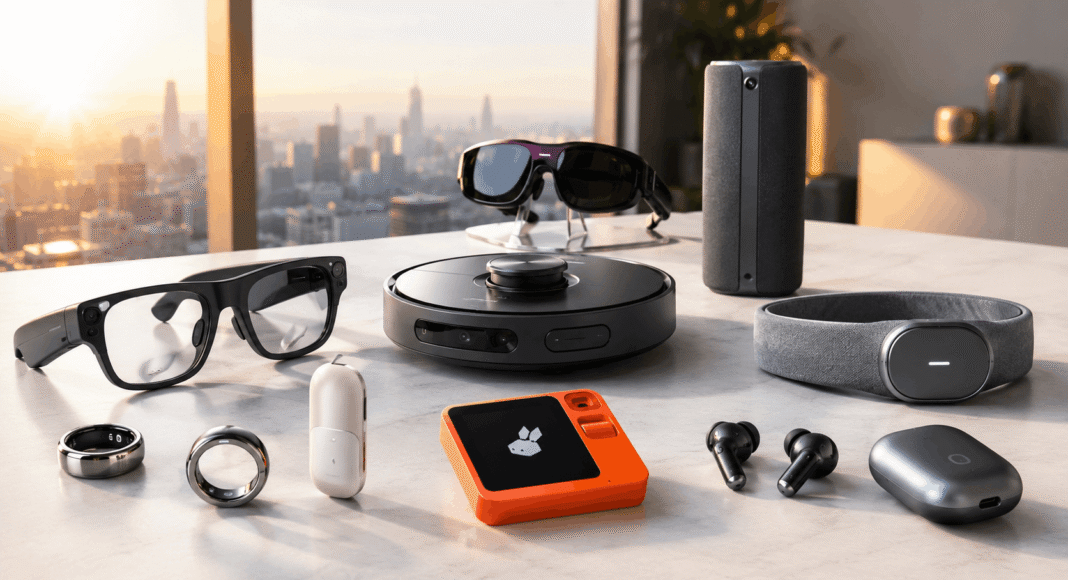

Key Takeaways
- The top consumer AI hardware tools in 2026 are transforming everyday life through AI-powered wearables, smart home devices, health trackers, productivity assistants, and spatial computing technologies that deliver personalized, real-time intelligence.
- Leading devices such as AI smart glasses, smart rings, robotic vacuums, translation earbuds, and AI productivity tools combine advanced sensors, edge AI, computer vision, and cloud intelligence to improve health, communication, automation, and efficiency.
- Choosing the best consumer AI hardware depends on individual needs, budget, ecosystem compatibility, privacy preferences, and intended use cases, making it essential to compare features, AI capabilities, pricing, battery life, and long-term value before investing.
The top consumer AI hardware tools in the world in 2026 combine artificial intelligence with everyday devices to improve productivity, health, communication, entertainment, and home automation. From smart glasses and wearable health trackers to AI translators and robotic assistants, these innovative products help users work smarter, make better decisions, and simplify daily life through intelligent, personalized experiences.
The consumer technology industry is undergoing one of the most significant transformations in its history as artificial intelligence moves beyond software applications and becomes deeply integrated into everyday hardware. In 2026, AI is no longer confined to smartphones, laptops, or cloud-based chatbots. Instead, it is embedded into wearable devices, smart home products, intelligent robots, health monitoring systems, augmented reality glasses, productivity assistants, and specialized personal gadgets that interact seamlessly with the physical world. This rapid convergence of advanced hardware, machine learning, edge computing, computer vision, natural language processing, and cloud intelligence is creating a new generation of consumer AI hardware designed to enhance nearly every aspect of daily life.
Over the past several years, generative AI has fundamentally changed how individuals interact with digital information. Large language models, multimodal AI systems, and intelligent automation platforms have enabled users to communicate with machines using natural language instead of traditional graphical interfaces. As these AI capabilities have matured, manufacturers have increasingly shifted their focus toward dedicated hardware that can deliver faster performance, lower latency, improved privacy, and richer contextual understanding than software running exclusively on smartphones or desktop computers. The result is an expanding ecosystem of intelligent devices capable of seeing, hearing, understanding, learning, and responding in real time.
Consumer AI hardware has emerged as one of the fastest-growing categories within the global technology market. Industry analysts project continued strong growth driven by improvements in semiconductor technology, lower-cost neural processing units (NPUs), advances in edge AI, improved battery efficiency, and increasing consumer demand for personalized digital experiences. Unlike previous generations of consumer electronics that primarily served as communication or entertainment tools, today’s AI-powered hardware actively assists users by making recommendations, automating repetitive tasks, monitoring health, translating conversations, recognizing objects, controlling smart homes, organizing information, and providing contextual assistance throughout the day.
One of the defining characteristics of consumer AI hardware in 2026 is specialization. Rather than attempting to build one device that performs every task, manufacturers are increasingly developing AI-powered products optimized for specific use cases. Smart glasses are becoming intelligent visual assistants capable of recognizing objects, translating languages, capturing memories, and providing hands-free access to AI. Smart rings are transforming personal health monitoring by continuously measuring heart rate, sleep quality, recovery, body temperature, and activity levels while using artificial intelligence to generate personalized wellness insights. AI-powered productivity devices are reducing administrative work by automatically transcribing meetings, summarizing conversations, generating action items, and organizing digital information. At the same time, intelligent home robots are becoming increasingly autonomous, capable of navigating complex environments while adapting their behavior through advanced computer vision and machine learning.
Another major trend driving the adoption of consumer AI hardware is the rise of multimodal artificial intelligence. Earlier AI assistants primarily processed text or voice independently, limiting their ability to understand the surrounding environment. Modern AI devices now integrate multiple sensory inputs—including cameras, microphones, biometric sensors, motion detectors, GPS, accelerometers, temperature sensors, and environmental monitoring systems—to build a comprehensive understanding of both the user and the physical world. This multimodal approach enables AI hardware to provide context-aware assistance that feels significantly more natural, proactive, and personalized than previous generations of digital assistants.
Health and wellness have become one of the strongest growth areas for consumer AI hardware. AI-powered wearable devices are evolving beyond simple fitness trackers into comprehensive health intelligence platforms capable of continuously monitoring physiological signals throughout the day and night. These devices analyze long-term biometric trends to provide personalized recommendations, detect early signs of illness, optimize athletic recovery, improve sleep quality, monitor stress, and encourage healthier daily habits. As preventive healthcare continues gaining global importance, wearable AI hardware is increasingly viewed as an essential tool for helping individuals make more informed decisions about their long-term well-being.
Productivity is another area experiencing significant disruption through AI-powered hardware. Professionals are increasingly adopting intelligent wearable devices that automate routine administrative tasks, capture conversations, generate meeting summaries, organize schedules, control computers through natural language commands, and reduce the cognitive burden associated with managing information. These AI productivity tools enable knowledge workers to spend more time on creative thinking, strategic planning, and collaboration rather than repetitive manual tasks. As remote work, hybrid workplaces, and digital collaboration continue expanding, dedicated AI productivity hardware is becoming an increasingly valuable component of modern professional workflows.
The consumer AI hardware market is also benefiting from rapid advances in edge computing. Instead of transmitting every request to cloud servers, many devices now perform machine learning inference directly on the hardware itself through specialized neural processing units. Local AI processing reduces latency, improves battery efficiency, enhances privacy, and enables faster responses even when internet connectivity is limited. Cloud-based artificial intelligence remains important for computationally intensive reasoning and large language models, but the combination of edge AI and cloud AI creates a hybrid architecture that delivers the best balance of speed, intelligence, and security.
Smart homes are similarly entering a new era of autonomous intelligence. AI-powered robotic vacuums, smart sleep systems, intelligent climate controls, connected security devices, and automated household assistants are becoming increasingly capable of understanding household routines and adapting their behavior accordingly. Rather than simply following fixed schedules, these devices now make intelligent decisions based on environmental conditions, user preferences, occupancy patterns, and historical behavior. This shift represents the beginning of truly intelligent living spaces where multiple AI-powered devices collaborate seamlessly to improve comfort, convenience, energy efficiency, and quality of life.
The emergence of wearable spatial computing devices is also redefining personal computing. Lightweight augmented reality glasses now provide immersive virtual displays that replace bulky monitors, enabling professionals to create portable multi-screen workstations virtually anywhere. Combined with AI-powered contextual assistance, real-time translation, navigation, and voice interaction, these wearable displays are transforming how users consume information, collaborate with colleagues, and interact with digital content without relying on traditional desktop setups.
Language barriers are also being eliminated through advances in AI-powered translation hardware. Dedicated translation earbuds equipped with conversational artificial intelligence, specialized speech recognition models, and multilingual neural networks enable users to communicate naturally across dozens of languages with minimal delay. These devices are becoming increasingly valuable for international business, global travel, education, diplomacy, and multicultural collaboration, making seamless multilingual communication more accessible than ever before.
Open-source AI hardware platforms are simultaneously encouraging greater innovation within the industry. Unlike proprietary ecosystems that tightly control hardware and software development, several manufacturers are embracing developer-friendly architectures that allow researchers, engineers, and enthusiasts to customize firmware, create new applications, integrate alternative AI models, and experiment with emerging technologies. This openness is accelerating innovation while expanding the range of specialized AI solutions available to consumers.
Another important trend influencing purchasing decisions is the growing emphasis on privacy, transparency, and responsible AI. As AI-powered devices collect increasingly sensitive information—including health data, conversations, location history, and visual context—manufacturers are investing heavily in encryption, secure cloud infrastructure, local AI processing, user-controlled privacy settings, and compliance with international data protection standards. Consumers are becoming more selective about how their data is collected, stored, and processed, making trust an increasingly important competitive differentiator within the AI hardware industry.
The consumer AI hardware landscape in 2026 is remarkably diverse, offering solutions tailored to virtually every lifestyle and professional requirement. Whether users are seeking AI-powered smart glasses for hands-free computing, intelligent smart rings for health optimization, robotic home assistants for autonomous cleaning, wearable productivity tools for meeting management, translation earbuds for international communication, or portable spatial computing devices for remote work, there is now an AI-powered solution designed specifically for those needs.
This comprehensive guide explores the Top 10 Consumer AI Hardware Tools in the World in 2026, highlighting the most innovative and influential products currently shaping the future of intelligent consumer technology. Each device has been evaluated based on its AI capabilities, hardware innovation, practical applications, ecosystem integration, design, user experience, pricing, and overall impact on the rapidly evolving consumer electronics market. Whether you are a technology enthusiast, business professional, developer, early adopter, digital nomad, or simply someone looking to understand the future of AI-powered devices, this guide will help you discover the leading consumer AI hardware transforming how people live, work, communicate, and interact with technology in 2026.
Before we venture further into this article, we would like to share who we are and what we do.
About 9cv9
9cv9 is a business tech startup based in Singapore and Asia, with a strong presence all over the world.
With over ten years of startup and business experience, and being highly involved in connecting with thousands of companies and startups, the 9cv9 team has listed some important and crucial software tools in this review.
If you like to get your company listed in our top B2B software reviews, check out our world-class 9cv9 Media and PR service and pricing plans here.
Top 10 Consumer AI Hardware Tools To Try in 2026
- Ray-Ban Meta Wayfarer Gen 2
- Oura Ring 5
- Eight Sleep Pod 5 Ultra
- Plaud NotePin
- Samsung Galaxy Ring
- Roborock Saros 10R
- XREAL One Pro
- Timekettle W4 Pro AI Interpreter
- Brilliant Labs Halo
- Rabbit R1
1. Ray-Ban Meta Wayfarer Gen 2
Ray-Ban Meta Wayfarer Gen 2 has firmly established itself as one of the most influential consumer AI hardware products available in 2026, setting the benchmark for screenless wearable artificial intelligence. Developed through the long-term partnership between Meta and global eyewear leader EssilorLuxottica, the device represents the convergence of premium fashion, advanced AI computing, wearable imaging, and natural voice interaction. Unlike traditional augmented reality headsets that rely on visual displays or bulky hardware, Ray-Ban Meta prioritizes an invisible computing experience where artificial intelligence works seamlessly in the background while preserving the appearance and comfort of conventional eyewear.
The success of the product demonstrates a broader shift within the consumer AI hardware market. Rather than replacing smartphones immediately, AI glasses are increasingly becoming intelligent companions capable of understanding voice commands, interpreting visual surroundings, capturing memories, translating conversations, assisting with navigation, and providing contextual information without requiring users to hold or constantly interact with a mobile device.
By 2026, Meta remains the dominant player in the global AI glasses market, accounting for the vast majority of worldwide shipments. Industry analysts estimate that AI glasses shipments grew dramatically throughout 2025, with Meta maintaining well over three-quarters of the global market as consumer adoption accelerated across North America, Europe, Asia-Pacific, and Latin America. Millions of Ray-Ban Meta units have already been sold worldwide, reinforcing the product’s position as the world’s best-selling AI glasses platform.
Consumer AI Hardware Overview
| Category | Ray-Ban Meta Gen 2 Position | Consumer Benefit |
|---|---|---|
| AI Smart Glasses | Global market leader | Hands-free AI assistant |
| Wearable Camera | Premium multimodal visual sensing | Capture photos and 3K videos |
| Voice AI Device | Always-available conversational interface | Natural voice interaction |
| Personal Productivity Device | Daily AI companion | Real-time information and assistance |
| Connected Wearable | Smartphone ecosystem extension | Messaging, calls, media, and AI integration |
A Design Philosophy Focused on Invisible Computing
One of the defining characteristics of Ray-Ban Meta Gen 2 is its emphasis on “invisible computing.” Instead of introducing digital overlays or large display systems that fundamentally change how users experience the world, the glasses preserve the familiar look and feel of premium Ray-Ban eyewear while embedding sophisticated AI capabilities into an everyday accessory.
Weighing approximately 51 to 53 grams depending on the frame configuration, the glasses closely resemble standard premium sunglasses or prescription eyewear. This lightweight construction makes them comfortable enough for prolonged daily use while avoiding the social stigma often associated with larger mixed-reality headsets.
The product is available in multiple frame styles, including the iconic Wayfarer, alongside optical versions that support prescription lenses through authorized optical partners. Meta and EssilorLuxottica have continued expanding the product lineup throughout 2026 with additional prescription-focused designs and broader customization options.
Design Highlights
| Feature | Specification |
|---|---|
| Weight | Approximately 51–53 grams |
| Frame Design | Classic premium eyewear styling |
| Prescription Lens Support | Yes |
| Daily Wear Comfort | Optimized for all-day usage |
| Screen | None |
| User Interface | Voice-first interaction |
AI-First Hardware Architecture
Rather than functioning as a miniature smartphone, Ray-Ban Meta Gen 2 is engineered as an AI-native wearable platform. Its internal hardware combines multiple sensors and communication technologies that continuously work together to understand both the user and the surrounding environment.
At its core is Qualcomm’s Snapdragon AR1 Gen 1 processor, specifically designed for lightweight wearable devices that balance AI performance with energy efficiency. Supporting components include:
• Multiple beamforming microphones
• Open-ear directional speakers
• Ultra-wide 12 MP camera
• Wireless Bluetooth connectivity
• Wi-Fi networking
• Integrated AI software stack
• Smartphone synchronization
These hardware components allow the glasses to collect voice input, capture visual context, process sensor information, and deliver spoken responses while maintaining a discreet, hands-free experience.
AI Hardware Architecture
| Hardware Component | Primary Function |
|---|---|
| Snapdragon AR1 Processor | Local AI processing and device management |
| 12 MP Camera | Visual understanding and image capture |
| Beamforming Microphones | Voice recognition and noise reduction |
| Open-Ear Speakers | Audio feedback without blocking surroundings |
| Bluetooth | Smartphone connectivity |
| Wi-Fi | Cloud AI communication |
| Internal Sensors | Motion, orientation, and environmental input |
How the AI Interaction Pipeline Works
Unlike conventional smart glasses that depend heavily on touch controls, Ray-Ban Meta Gen 2 emphasizes natural language interaction. Users activate Meta AI through voice commands, allowing the wearable to interpret spoken requests, analyze what the camera observes, and return contextual responses almost instantly.
The typical interaction workflow follows a streamlined sequence:
User Voice Command
↓
Microphone Array Captures Speech
↓
Onboard Processing
↓
Bluetooth Connection to Smartphone
↓
Cloud-Based Meta AI Processing
↓
Contextual AI Response
↓
Audio Delivered Through Open-Ear Speakers
This architecture allows users to interact with advanced multimodal AI while keeping the physical hardware lightweight and power efficient.
Advanced Computer Vision Capabilities
The integrated 12-megapixel ultra-wide camera serves as the device’s visual intelligence system rather than simply functioning as a conventional camera.
It captures:
• High-resolution photographs
• 3K video at 30 frames per second
• Environmental context
• Visual objects
• Documents
• Signs
• Products
• Landmarks
• Natural scenes
The camera continuously supports Meta AI’s multimodal reasoning capabilities, enabling users to ask questions such as:
• “What building is this?”
• “Read this document.”
• “Translate this menu.”
• “Identify this flower.”
• “What product am I looking at?”
This visual understanding transforms the glasses into a portable AI perception system capable of assisting users throughout daily life.
Camera Specifications
| Capability | Specification |
|---|---|
| Camera Resolution | 12 MP Ultra-Wide |
| Photo Resolution | 3024 × 4032 pixels |
| Video Resolution | 3K |
| Video Frame Rate | 30 fps |
| Visual AI Support | Yes |
| Object Recognition | Yes |
| OCR Text Reading | Yes |
Voice AI Designed for Natural Conversation
The glasses rely heavily on conversational AI rather than manual controls. A five-microphone beamforming system isolates the user’s speech while suppressing background wind and ambient noise, improving recognition accuracy during outdoor activities, commuting, or travel.
This voice-centric approach enables hands-free operation across numerous scenarios, including:
• Asking factual questions
• Controlling music playback
• Initiating phone calls
• Sending messages
• Capturing media
• Receiving AI recommendations
• Managing reminders
• Navigating routes
The result is an interface that feels increasingly conversational rather than device-oriented.
Real-Time AI Features
One of the major competitive advantages of Ray-Ban Meta Gen 2 is its growing collection of AI-powered features that extend beyond simple voice assistance.
Key capabilities include:
| AI Feature | Practical User Benefit |
|---|---|
| Real-Time Translation | Translate conversations and signs across multiple languages |
| OCR Text Recognition | Read books, menus, labels, and printed documents |
| Scene Understanding | Explain surroundings using computer vision |
| Object Identification | Recognize plants, products, and everyday objects |
| Smart Photography | Capture moments hands-free |
| Messaging Integration | Voice interaction with supported communication apps |
| Personalized Assistance | Context-aware recommendations |
Meta continues expanding these capabilities through regular software updates, making the glasses progressively more intelligent over time. Recent enhancements include broader multilingual support, improved multimodal reasoning, navigation assistance, and smarter contextual recommendations.
Pricing and Market Positioning
Ray-Ban Meta Gen 2 occupies the premium consumer AI hardware segment while remaining significantly more affordable than high-end mixed reality headsets.
Pricing varies depending on lens configuration and prescription requirements.
Pricing Overview
| Configuration | Approximate Retail Price |
|---|---|
| Standard Smart Glasses | From approximately $379 |
| Premium Lens Variants | Approximately $509 |
| Prescription Versions | Additional optical pricing |
| Premium AI Display Models | Higher-tier pricing |
Meta has also expanded its broader wearable portfolio with additional entry-level and premium AI glasses, allowing consumers to choose between more affordable screenless models and higher-end display-equipped devices.
Why Ray-Ban Meta Gen 2 Leads the Consumer AI Hardware Market
Several factors explain why Ray-Ban Meta Gen 2 consistently ranks among the top consumer AI hardware products globally in 2026.
Competitive Advantages Matrix
| Advantage | Strategic Impact |
|---|---|
| Premium Eyewear Design | Encourages everyday adoption |
| Screenless Experience | Comfortable and socially acceptable |
| Advanced Multimodal AI | Combines vision, voice, and contextual understanding |
| Strong Brand Partnership | Meta and EssilorLuxottica ecosystem |
| Large Software Ecosystem | Continuous feature improvements |
| Global Retail Presence | Broad international availability |
| Prescription Compatibility | Expands addressable consumer market |
| AI-First User Experience | Natural hands-free computing |
As consumer demand shifts toward AI-native wearable devices, Ray-Ban Meta Gen 2 exemplifies how artificial intelligence can be embedded into familiar everyday products without compromising comfort, style, or practicality. Its combination of premium industrial design, multimodal AI capabilities, robust hardware engineering, and expanding software ecosystem has positioned it as the benchmark against which competing consumer AI glasses are increasingly measured in 2026.
2. Oura Ring 5
The Oura Ring 5 has established itself as one of the most advanced consumer AI health wearables available in 2026, redefining how continuous biometric monitoring, predictive health analytics, and artificial intelligence converge within an ultra-compact wearable device. As the flagship product of Oura, the fifth-generation smart ring combines sophisticated health sensors, AI-powered health coaching, and long-term wellness analytics into a discreet form factor that resembles traditional jewelry rather than conventional wearable technology.
Unlike smartwatches that emphasize notifications, fitness applications, and display-based interactions, Oura Ring 5 focuses almost entirely on passive health intelligence. It continuously collects physiological signals throughout the day and night, allowing artificial intelligence to generate highly personalized insights into sleep quality, recovery, cardiovascular health, stress, readiness, and overall wellness.
The launch of Oura Ring 5 reflects a broader transformation occurring across the consumer AI hardware industry, where biometric wearables are evolving beyond simple fitness tracking devices into proactive health companions capable of identifying subtle physiological changes before users become consciously aware of them. As demand for preventive healthcare technologies continues to accelerate, smart rings have emerged as one of the fastest-growing wearable product categories worldwide, with industry forecasts projecting robust double-digit annual growth throughout the remainder of the decade.
Consumer AI Hardware Positioning
| Category | Oura Ring 5 Position | Primary Consumer Value |
|---|---|---|
| Smart Ring | Premium biometric health wearable | Continuous health monitoring |
| AI Health Assistant | Integrated conversational wellness platform | Personalized health recommendations |
| Sleep Tracking Device | Industry-leading sleep analytics | Recovery and sleep optimization |
| Preventive Health Wearable | Early physiological trend detection | Proactive wellness management |
| Everyday AI Wearable | Screen-free health intelligence | Passive monitoring without distractions |
Designed for Invisible Health Monitoring
One of the defining characteristics of Oura Ring 5 is its commitment to unobtrusive health monitoring. Unlike larger wearable devices, the ring is engineered to disappear into daily life while continuously gathering meaningful physiological data.
The fifth-generation design is approximately 40% smaller than its predecessor, making it one of the smallest and lightest premium smart rings available. Constructed from aerospace-grade titanium, the ring offers exceptional durability while maintaining a lightweight profile suitable for continuous day-and-night wear.
Its seamless interior integrates redesigned low-profile sensor architecture that improves skin contact across different finger shapes and skin tones, enabling more consistent biometric readings without sacrificing comfort. Oura also redesigned the internal sensing pathways to enhance measurement accuracy while reducing the physical size of the device.
Physical Design Specifications
| Feature | Specification |
|---|---|
| Material | Aerospace-grade titanium |
| Construction | Seamless interior with recessed sensors |
| Width | Approximately 6 mm |
| Thickness | Approximately 2.3 mm |
| Weight | Approximately 2–5 grams depending on size |
| Waterproof | Yes |
| Daily Wear | Optimized for continuous 24/7 use |
Advanced Biometric Sensor Platform
At the heart of Oura Ring 5 lies a sophisticated multi-sensor platform designed to capture a wide range of physiological signals with medical-grade precision. Unlike conventional fitness trackers that primarily focus on activity counts, Oura continuously measures multiple health indicators simultaneously to build a comprehensive understanding of the user’s physical condition.
The ring incorporates multiple optical sensing technologies that monitor:
• Heart rate
• Heart rate variability (HRV)
• Blood oxygen saturation (SpO₂)
• Skin temperature trends
• Sleep stages
• Respiratory activity
• Daily movement
• Recovery metrics
• Stress indicators
• Cardiovascular patterns
The redesigned sensing architecture utilizes multiple optical signal pathways that improve measurement consistency across diverse skin tones and finger anatomies while delivering pulse signals substantially stronger than wrist-based wearables.
Sensor Technology Overview
| Sensor Technology | Primary Function |
|---|---|
| Green Optical LEDs | Continuous heart rate monitoring |
| Infrared Sensors | Heart rate variability and circulation |
| Red and Infrared LEDs | Blood oxygen measurement |
| Digital Temperature Sensor | Skin temperature trend analysis |
| Motion Sensors | Activity and movement tracking |
| Smart Sensing Platform | Adaptive signal optimization |
Smart Sensing Architecture
One of the most significant technological improvements introduced with Oura Ring 5 is its redesigned Smart Sensing platform.
Rather than relying on static sensor positioning, Smart Sensing dynamically adapts to each individual’s finger anatomy, automatically selecting the strongest optical signal pathways for continuous monitoring. This adaptive sensing system helps compensate for slight variations in ring position, finger size, skin tone, and circulation, improving overall measurement reliability.
The result is more consistent biometric tracking throughout everyday activities, sleep, exercise, and recovery periods.
Artificial Intelligence at the Core
While the hardware continuously gathers biometric information, the true value of Oura Ring 5 lies in its artificial intelligence platform.
The companion application incorporates Oura Advisor, an AI-powered conversational wellness assistant capable of interpreting thousands of biometric measurements collected every day.
Rather than simply displaying raw health data, the AI transforms complex physiological signals into personalized insights that help users better understand how their lifestyle influences their long-term health.
The system continuously evaluates relationships between:
• Sleep quality
• Recovery
• Physical activity
• Heart rate variability
• Body temperature
• Stress responses
• Daily routines
• Long-term wellness trends
This contextual interpretation enables users to receive actionable recommendations instead of isolated health metrics.
AI Health Intelligence Workflow
Biometric Signals Collected
↓
Adaptive Sensor Processing
↓
Health Data Synchronization
↓
AI Pattern Recognition
↓
Personalized Health Modeling
↓
Oura Advisor Interpretation
↓
Daily Health Recommendations
Comprehensive Wellness Scores
Instead of overwhelming users with individual measurements, Oura Ring 5 organizes physiological information into intuitive wellness indicators that summarize overall health status.
Key Health Metrics
| AI Health Metric | Purpose |
|---|---|
| Sleep Score | Evaluates overall sleep quality and recovery |
| Readiness Score | Measures physical preparedness for the day |
| Activity Score | Assesses daily movement and exercise balance |
| Daytime Stress | Tracks physiological stress responses |
| Heart Health Metrics | Monitors cardiovascular wellness |
| Temperature Trends | Detects subtle physiological changes |
| Recovery Analytics | Evaluates overnight restoration |
These continuously updated scores provide users with an accessible overview of their overall health while allowing deeper exploration of individual biometric trends when needed.
Predictive Health Monitoring
One of the most innovative capabilities of Oura Ring 5 is its emphasis on predictive health analytics.
By analyzing subtle changes across multiple physiological indicators over extended periods, the AI platform can recognize deviations from an individual’s normal baseline rather than relying solely on population averages.
For example, simultaneous changes in:
• Heart rate variability
• Resting heart rate
• Skin temperature
• Sleep quality
• Respiratory patterns
may indicate that the body is beginning to respond to illness, increased stress, overtraining, or insufficient recovery.
The system is designed to alert users to these physiological changes before noticeable symptoms develop, encouraging earlier lifestyle adjustments or medical consultation when appropriate. While Oura has demonstrated promising results in identifying early physiological changes, such predictive capabilities should be viewed as wellness guidance rather than medical diagnosis.
Battery Performance and Everyday Convenience
Despite its significantly smaller physical dimensions, Oura Ring 5 maintains impressive battery efficiency.
Most users can expect approximately one week of continuous monitoring on a single charge, with battery longevity varying according to ring size and usage patterns. A separately available portable charging case further extends usability for travelers and users who prefer less frequent charging.
Battery Specifications
| Feature | Performance |
|---|---|
| Typical Battery Life | Approximately 6–9 days |
| Charging | Wireless charging |
| Portable Charging Case | Optional accessory |
| Continuous Monitoring | 24/7 biometric tracking |
Pricing and Subscription Model
Oura positions Ring 5 within the premium health wearable segment.
The device is available in multiple titanium finishes, with pricing varying according to the selected exterior finish.
Most advanced software capabilities—including AI-powered insights, personalized recommendations, and long-term health analytics—are accessed through the Oura membership subscription.
Pricing Overview
| Configuration | Approximate Price |
|---|---|
| Standard Titanium Models | From approximately $399 |
| Premium Finishes | Up to approximately $499 |
| Monthly Membership | Approximately $5.99 |
Why Oura Ring 5 Leads the Consumer AI Health Wearable Market
Oura Ring 5 has become the benchmark against which competing smart rings are increasingly evaluated because it combines premium industrial design, advanced biometric sensing, sophisticated AI interpretation, and an exceptionally refined user experience.
Competitive Strength Matrix
| Competitive Advantage | Strategic Benefit |
|---|---|
| Ultra-Compact Design | Comfortable continuous wear |
| Advanced Biometric Sensors | Comprehensive physiological monitoring |
| AI-Powered Health Advisor | Personalized wellness guidance |
| Industry-Leading Sleep Tracking | Highly accurate recovery insights |
| Adaptive Smart Sensing | Improved accuracy across diverse users |
| Long Battery Life | Minimal charging interruptions |
| Premium Titanium Construction | Durability with lightweight comfort |
| Mature Software Ecosystem | Continuous feature expansion through AI updates |
As consumer AI hardware continues shifting toward proactive healthcare, personalized wellness, and preventive monitoring, Oura Ring 5 represents one of the strongest examples of how artificial intelligence can transform continuous biometric data into meaningful, actionable health intelligence. Its combination of miniaturized hardware, adaptive sensing technology, AI-powered health interpretation, and elegant industrial design has firmly positioned it as the global benchmark for smart rings and one of the leading consumer AI hardware devices in the world in 2026.
3. Eight Sleep Pod 5 Ultra
The Eight Sleep Pod 5 Ultra represents one of the most sophisticated examples of consumer AI hardware in 2026, combining artificial intelligence, climate control, biometric sensing, and automated sleep optimization into a fully integrated smart bed ecosystem. Rather than functioning as a traditional mattress or wearable device, the Pod 5 Ultra transforms an existing bed into an intelligent sleep platform capable of continuously monitoring physiological signals and autonomously adjusting the sleep environment throughout the night.
As sleep technology becomes an increasingly important segment within the consumer AI hardware market, the Eight Sleep Pod series has emerged as a category leader by combining advanced hardware engineering with AI-driven personalization. Unlike smartwatches or fitness trackers that require users to wear sensors continuously, the Pod 5 Ultra performs contactless and passive biometric monitoring directly from the mattress cover, allowing users to receive comprehensive sleep analytics without changing their nightly routine.
The system illustrates a broader trend in consumer AI hardware, where intelligent devices are moving beyond productivity and entertainment to actively improve physical health, recovery, and long-term wellness through continuous environmental adaptation and predictive analytics.
Consumer AI Hardware Positioning
| Category | Eight Sleep Pod 5 Ultra Position | Primary Consumer Benefit |
|---|---|---|
| Smart Sleep System | Premium AI-powered sleep platform | Automated sleep optimization |
| AI Wellness Hardware | Intelligent biometric monitoring | Personalized recovery insights |
| Smart Mattress Technology | Advanced environmental adaptation | Continuous temperature regulation |
| Connected Health Platform | Passive overnight health tracking | Wearable-free biometric analysis |
| Consumer AI Home Device | Fully autonomous sleep assistant | Improved sleep quality and recovery |
An Intelligent Sleep Environment Rather Than a Conventional Bed
Unlike traditional mattresses that remain static throughout the night, the Eight Sleep Pod 5 Ultra continuously adapts to the sleeper’s physiological condition.
The complete system consists of several integrated hardware components working together as a unified AI-powered sleep platform.
The available configurations include:
• Pod 5 Core
• Pod 5 Plus
• Pod 5 Ultra
Each version builds upon the previous model with additional intelligent features designed to improve comfort and recovery.
Product Configuration Comparison
| Configuration | Included Components | Primary Capability |
|---|---|---|
| Pod 5 Core | Smart mattress cover and thermal hub | AI temperature regulation |
| Pod 5 Plus | Core system plus hydro-powered blanket | Expanded climate control |
| Pod 5 Ultra | Full system with adjustable intelligent bed base | AI sleep optimization and snore mitigation |
The flagship Pod 5 Ultra integrates temperature regulation, biometric monitoring, automated bed positioning, and AI-powered sleep coaching into a single ecosystem, creating one of the most technologically advanced consumer sleep systems currently available.
Advanced Thermoregulation Technology
Temperature plays a significant role in sleep quality, influencing sleep onset, deep sleep duration, REM sleep, and nighttime awakenings.
To address this, Eight Sleep employs an active water-based climate control system that differs substantially from conventional electric heated blankets or cooling mattress pads.
Flexible water channels are embedded throughout the mattress cover, allowing temperature-controlled water to circulate continuously beneath the sleeper.
A compact bedside hub serves as the system’s intelligent thermal engine, heating or cooling the circulating water according to the user’s physiological needs.
The system supports an exceptionally wide operating temperature range while allowing each side of the bed to operate independently, making it particularly valuable for couples with different sleep preferences.
Temperature Regulation Specifications
| Feature | Capability |
|---|---|
| Cooling Range | Approximately 55°F |
| Heating Range | Approximately 110°F |
| Climate Zones | Independent dual-zone control |
| Thermal Medium | Water circulation |
| Temperature Adjustment | Fully automatic through AI |
| Couple Personalization | Independent left and right settings |
Wearable-Free Biometric Monitoring
A defining advantage of the Pod 5 Ultra is its ability to collect comprehensive physiological information without requiring the sleeper to wear any device.
Integrated contactless sensors continuously monitor multiple health indicators throughout the night while remaining virtually undetectable beneath the mattress surface.
The biometric platform tracks:
• Heart rate
• Heart rate variability (HRV)
• Respiratory rate
• Body movement
• Sleep stages
• Sleep duration
• Recovery metrics
• Snoring patterns
This passive monitoring approach removes many of the comfort limitations associated with wrist-based sleep trackers while maintaining continuous overnight observation.
Biometric Sensor Overview
| Sensor Capability | Primary Purpose |
|---|---|
| Heart Rate Monitoring | Cardiovascular health tracking |
| HRV Measurement | Recovery and autonomic nervous system status |
| Respiratory Tracking | Breathing pattern analysis |
| Motion Detection | Sleep quality assessment |
| Sleep Stage Analysis | REM, light, and deep sleep identification |
| Acoustic Monitoring | Snoring detection |
Autopilot AI: The Brain Behind the Smart Bed
The core innovation of the Pod 5 Ultra lies in Eight Sleep’s Autopilot AI platform.
Rather than relying on fixed temperature schedules, Autopilot continuously analyzes biometric information throughout the night and automatically adjusts the sleep environment in real time.
The AI evaluates physiological signals, sleep stage transitions, historical sleep behavior, environmental conditions, and user preferences to determine the optimal sleeping conditions for every stage of the night.
This creates a continuously adaptive sleep environment rather than a static one.
Autopilot AI Workflow
Physiological Signals
↓
Real-Time Sensor Analysis
↓
AI Sleep Stage Detection
↓
Temperature Optimization
↓
Automatic Bed Adjustments
↓
Continuous Learning
↓
Improved Sleep Quality
The system continuously refines its recommendations over time by learning from each user’s unique sleep patterns, creating an increasingly personalized sleep experience.
AI Features Designed to Improve Sleep
Autopilot performs numerous autonomous adjustments without requiring manual intervention.
Key AI capabilities include:
• Dynamic temperature regulation
• Sleep stage optimization
• Personalized climate scheduling
• Recovery monitoring
• Overnight biometric tracking
• Automatic wake optimization
• Intelligent snore response
• Long-term sleep pattern analysis
These capabilities collectively transform the Pod 5 Ultra into an AI-driven sleep management system rather than simply a cooling mattress cover.
Clinical Performance Highlights
Eight Sleep reports improvements across several key sleep metrics when using its AI-powered temperature regulation and adaptive sleep platform. Reported outcomes include increased deep sleep, reduced time required to fall asleep, fewer nighttime awakenings, and reduced snoring through automated head elevation. Individual results can vary depending on personal health conditions, sleeping habits, and environmental factors.
Reported Sleep Improvements
| Sleep Metric | Reported Improvement |
|---|---|
| Deep Sleep | Up to 34% increase |
| Average Nightly Sleep | Up to 1 additional hour |
| Snoring | Up to 45% reduction |
| Sleep Onset | Faster sleep initiation reported |
| Nighttime Disruptions | Reduced awakenings reported |
AI-Powered Snore Mitigation
One of the most distinctive features exclusive to the Pod 5 Ultra is its intelligent snore mitigation system.
Instead of simply detecting snoring after it occurs, the integrated acoustic and vibration sensing system continuously monitors breathing patterns during sleep.
When snoring is identified, the adjustable base automatically raises the head section by a small angle designed to help open the airway without waking the sleeper.
This adjustment occurs automatically and silently, requiring no manual intervention from the user or their partner. Eight Sleep reports that this feature can reduce snoring by up to 45% under supported conditions.
Snore Mitigation Process
Snoring Detected
↓
Acoustic and Vibration Analysis
↓
Autopilot Verification
↓
Automatic Head Elevation
↓
Improved Airway Position
↓
Reduced Snoring
Intelligent Climate Personalization
Unlike conventional heating pads that maintain a fixed temperature, the Pod 5 Ultra continuously modifies thermal conditions based on changing physiological requirements.
Examples include:
• Cooling during REM sleep
• Warming during early sleep onset
• Personalized overnight temperature curves
• Independent adjustment for each partner
• Environmental adaptation during seasonal changes
The system therefore creates an individualized sleep climate that evolves throughout the night rather than remaining constant.
Pricing and Subscription Structure
The Pod 5 Ultra is positioned within the ultra-premium consumer AI hardware segment.
Pricing varies according to mattress size and selected configuration, with the Ultra representing the most comprehensive system in the lineup.
Many advanced AI features are delivered through the Autopilot subscription service, which includes ongoing software enhancements, intelligent automation, sleep analytics, and additional health monitoring features depending on the selected plan. Higher-tier plans also add enhanced health monitoring capabilities and extended warranty coverage.
Pricing Overview
| Configuration | Approximate Price |
|---|---|
| Pod 5 Ultra (Full) | Approximately $5,797 |
| Pod 5 Ultra (King/Cal King) | Approximately $6,197 |
| Standard Autopilot | From approximately $199 per year |
| Elite Autopilot | Up to approximately $399 per year |
Why the Eight Sleep Pod 5 Ultra Leads AI Sleep Hardware
The Pod 5 Ultra has become one of the most recognizable examples of intelligent home wellness technology because it combines environmental automation, biometric sensing, artificial intelligence, and personalized sleep optimization into a seamless consumer experience.
Competitive Advantages Matrix
| Competitive Advantage | Strategic Consumer Benefit |
|---|---|
| Wearable-Free Monitoring | Passive overnight biometric tracking |
| AI Temperature Regulation | Personalized thermal optimization |
| Dual-Zone Climate Control | Independent comfort for couples |
| Adaptive Sleep Intelligence | Continuous real-time adjustments |
| Snore Mitigation | Automatic airway optimization |
| Comprehensive Sleep Analytics | Detailed recovery and wellness insights |
| Premium Smart Bed Ecosystem | Integrated hardware and software experience |
| Continuous AI Learning | Increasing personalization over time |
As consumer AI hardware continues expanding into health and wellness applications, the Eight Sleep Pod 5 Ultra demonstrates how artificial intelligence can transform the bedroom into an intelligent recovery environment. By integrating adaptive climate control, passive biometric sensing, automated sleep optimization, and machine learning into a single connected ecosystem, it has established itself as one of the most advanced AI-powered sleep systems available worldwide in 2026.
4. Plaud NotePin
The Plaud NotePin has emerged as one of the most innovative consumer AI hardware devices in 2026, redefining how professionals capture, organize, and extract value from conversations, meetings, interviews, lectures, and brainstorming sessions. Rather than functioning as a traditional voice recorder, the NotePin combines wearable hardware with cloud-based artificial intelligence to automate transcription, summarization, speaker recognition, and knowledge organization.
Designed for professionals seeking to reduce cognitive load and improve productivity, the device enables users to remain fully engaged in conversations without the distraction of manual note-taking. Its lightweight, screenless design allows it to blend naturally into daily workflows while continuously capturing important discussions for later AI analysis.
As the market for AI-native productivity hardware expands, the Plaud NotePin represents a growing trend toward ambient computing, where intelligent devices quietly collect, process, and organize information in the background, allowing users to focus on collaboration, decision-making, and creative work rather than administrative tasks.
Consumer AI Hardware Positioning
| Category | Plaud NotePin Position | Primary Consumer Benefit |
|---|---|---|
| AI Voice Recorder | Premium wearable AI recorder | Hands-free conversation capture |
| Productivity Wearable | AI meeting assistant | Automated documentation |
| AI Note-Taking Device | Intelligent transcription platform | Meeting summaries and action items |
| Professional AI Hardware | Enterprise productivity companion | Reduced manual note-taking |
| Ambient Computing Device | Screenless wearable AI | Passive information capture |
A Screenless AI Device Built for Everyday Productivity
Unlike smartphones or laptops that require active user interaction, the Plaud NotePin is designed as an “always-ready” productivity companion.
The compact cylindrical device weighs just 16.6 grams, making it light enough for continuous daily wear. Users can wear it in multiple ways depending on their working environment, including:
• Magnetic lapel pin
• Neck lanyard
• Wristband
• Clothing clip
This flexible design enables professionals to capture meetings, interviews, client discussions, brainstorming sessions, classroom lectures, and field conversations with minimal interruption to their workflow.
Its screenless design further minimizes distractions by eliminating notifications and unnecessary interface interactions, allowing the device to operate almost invisibly during conversations.
Physical Design Overview
| Feature | Specification |
|---|---|
| Weight | 16.6 grams |
| Form Factor | Screenless wearable recorder |
| Wearing Options | Pin, clip, wristband, lanyard |
| Internal Storage | 64 GB |
| Recording Controls | Physical recording button |
| Continuous Wear | Designed for all-day use |
Professional Audio Capture Hardware
At the core of the NotePin is a high-quality recording system optimized for speech recognition rather than consumer entertainment recording.
The hardware incorporates dual MEMS microphones capable of capturing conversations from several feet away while reducing background interference. Audio is stored locally within the device before synchronization with the companion application.
The generous onboard storage allows users to retain hundreds of hours of recordings before requiring offloading, making the device suitable for consultants, journalists, educators, researchers, legal professionals, healthcare workers, sales teams, and executives who frequently attend meetings throughout the day.
Hardware Specifications
| Hardware Component | Capability |
|---|---|
| Microphones | Dual MEMS microphone array |
| Internal Storage | 64 GB |
| Recording Time | Up to 20 hours continuous |
| Standby Time | Up to 40 days |
| Wireless Connectivity | Bluetooth and Wi-Fi |
| Charging Time | Approximately 2 hours |
Designed to Reduce Cognitive Load
One of the primary design philosophies behind the Plaud NotePin is reducing cognitive load during conversations.
Traditional meetings often require participants to divide their attention between active listening and writing notes. This divided focus can result in missed information, weaker engagement, and incomplete documentation.
The NotePin addresses this challenge by continuously recording conversations while AI later transforms those recordings into structured knowledge.
Instead of worrying about documenting every detail, users can remain fully engaged in discussions while trusting the AI platform to organize the information afterward.
AI Productivity Workflow
Conversation Begins
↓
One-Touch Recording
↓
High-Fidelity Audio Capture
↓
Bluetooth Synchronization
↓
Secure Cloud Upload
↓
Speech-to-Text Processing
↓
Large Language Model Analysis
↓
Meeting Summary
↓
Action Items
↓
Knowledge Archive
Cloud-Based Multi-Model Artificial Intelligence
The true intelligence of the Plaud ecosystem resides within its cloud platform.
Once recordings synchronize with the companion application, audio is securely uploaded for AI processing. The platform combines advanced speech recognition with multiple leading large language models to transform raw conversations into structured business knowledge.
Depending on the workflow and subscription tier, Plaud Intelligence leverages several state-of-the-art AI models to perform specialized tasks such as transcription, summarization, semantic organization, and conversational analysis. Current versions of the platform utilize leading models from OpenAI, Anthropic, and Google to enhance transcription quality and knowledge extraction.
AI Processing Pipeline
| AI Stage | Function |
|---|---|
| Speech Recognition | Converts audio into text |
| Speaker Identification | Separates multiple participants |
| AI Summarization | Produces concise meeting notes |
| Action Item Detection | Identifies follow-up tasks |
| Topic Organization | Groups related discussion themes |
| Knowledge Structuring | Creates searchable documentation |
Multilingual Transcription Capabilities
Modern businesses increasingly operate across international teams and multilingual environments.
To support global collaboration, the Plaud platform offers automatic transcription across more than 112 languages, enabling professionals to document multilingual meetings without relying on manual translation or transcription services.
Multilingual Features
| Capability | Benefit |
|---|---|
| 112+ Supported Languages | Global business collaboration |
| Speaker Labels | Improved meeting clarity |
| Automatic Formatting | Professional documentation |
| Cloud Synchronization | Cross-device accessibility |
| Searchable Archive | Long-term knowledge retrieval |
AI-Generated Productivity Outputs
Rather than simply providing transcripts, Plaud Intelligence transforms conversations into multiple business-ready formats.
Examples include:
• Executive meeting summaries
• Action item lists
• Decision logs
• Interview notes
• Brainstorming summaries
• Client meeting reports
• Project documentation
• Structured outlines
• Knowledge repositories
• Visual mind maps
These AI-generated outputs reduce the amount of manual administrative work required after meetings, allowing professionals to focus on execution instead of documentation. Independent reviews have highlighted the quality of Plaud’s summaries, speaker labeling, and structured templates, while also noting that some advanced workflow integrations continue to evolve.
Productivity Output Matrix
| AI Output | Professional Value |
|---|---|
| Full Transcript | Complete meeting record |
| Executive Summary | High-level overview |
| Action Items | Task management |
| Speaker Attribution | Conversation clarity |
| Mind Maps | Visual organization of ideas |
| Searchable Notes | Long-term knowledge management |
| Custom Templates | Industry-specific documentation |
Enterprise Security and Privacy
Given the sensitive nature of business conversations, Plaud emphasizes enterprise-grade data protection.
The platform incorporates end-to-end encryption during data transmission and storage while supporting compliance with multiple internationally recognized privacy and security standards suitable for professional and regulated environments. Supported certifications and compliance frameworks include SOC 2, HIPAA, GDPR, ISO 27001, and related security standards.
Security Features
| Security Capability | Purpose |
|---|---|
| End-to-End Encryption | Protects recordings during transfer |
| Secure Cloud Storage | Encrypted data management |
| SOC 2 Compliance | Enterprise security practices |
| HIPAA Support | Healthcare data protection |
| GDPR Compliance | Privacy regulation adherence |
| ISO Security Standards | Information security management |
Battery Life and Everyday Portability
Despite its compact dimensions, the NotePin delivers battery performance suitable for extended professional use.
A single charge provides up to 20 hours of continuous recording, while standby time can extend to approximately 40 days, minimizing the need for frequent charging during travel or busy work schedules.
Battery Performance
| Feature | Performance |
|---|---|
| Continuous Recording | Up to 20 hours |
| Standby Time | Up to 40 days |
| Charging | Approximately 2 hours |
| Internal Storage | 64 GB |
Pricing and Subscription Model
Plaud positions the NotePin as a premium AI productivity device with an accessible entry price for hardware, while advanced AI capabilities are delivered through recurring subscription plans.
The device includes a monthly allocation of AI transcription minutes under the free Starter plan. Professionals with higher recording volumes typically benefit from Pro or Unlimited memberships, which unlock additional transcription capacity and advanced AI-powered features.
Pricing Overview
| Component | Approximate Price |
|---|---|
| Plaud NotePin Hardware | Approximately $159 |
| Starter Plan | Includes 300 transcription minutes per month |
| Pro Subscription | Approximately $99.99 per year |
| Unlimited Subscription | Approximately $239.99 per year |
Why Plaud NotePin Is Among the Leading Consumer AI Productivity Devices
The Plaud NotePin has distinguished itself within the rapidly growing consumer AI hardware market by combining elegant wearable hardware with powerful cloud-based artificial intelligence that automates one of the most time-consuming aspects of professional work: documenting conversations.
Competitive Advantages Matrix
| Competitive Advantage | Strategic Benefit |
|---|---|
| Ultra-Lightweight Design | Comfortable all-day wear |
| Wearable Form Factor | Hands-free conversation capture |
| Dual MEMS Microphones | High-quality speech recording |
| Multi-Model AI Platform | Advanced transcription and summarization |
| 112+ Language Support | Global collaboration |
| AI Meeting Intelligence | Automatic action items and structured notes |
| Enterprise Security | Professional-grade data protection |
| Long Battery Life | Reliable operation throughout the workday |
As artificial intelligence becomes increasingly integrated into professional workflows, the Plaud NotePin exemplifies the next generation of ambient productivity hardware. By combining wearable audio capture, multilingual speech recognition, advanced large language models, and enterprise-grade security into a compact screenless device, it has established itself as one of the world’s leading AI-powered productivity assistants and one of the most compelling consumer AI hardware tools available in 2026.
5. Samsung Galaxy Ring
The Samsung Galaxy Ring has rapidly become one of the most compelling consumer AI hardware devices in 2026 by combining advanced biometric monitoring, artificial intelligence, and premium industrial design without requiring users to pay an ongoing subscription. Designed as a lightweight health wearable that integrates deeply with the Samsung ecosystem, the Galaxy Ring delivers continuous health insights while maintaining the appearance and comfort of a traditional ring.
Unlike many competing smart rings that lock advanced analytics behind recurring membership fees, Samsung has positioned the Galaxy Ring as a one-time hardware purchase with full access to core health intelligence through the Samsung Health platform. This subscription-free approach has become one of its strongest competitive advantages, particularly for Android users seeking long-term value without additional recurring costs. Industry observers continue to identify the absence of subscription fees as one of the Galaxy Ring’s key differentiators in an increasingly competitive smart ring market.
As artificial intelligence becomes more deeply integrated into personal healthcare, the Galaxy Ring demonstrates Samsung’s broader strategy of embedding Galaxy AI across its hardware ecosystem, transforming biometric measurements into personalized wellness recommendations that help users improve sleep quality, recovery, physical activity, and overall health.
Consumer AI Hardware Positioning
| Category | Samsung Galaxy Ring Position | Primary Consumer Benefit |
|---|---|---|
| Smart Ring | Premium AI-powered health wearable | Continuous biometric monitoring |
| AI Health Companion | Subscription-free wellness platform | Personalized health insights |
| Sleep Tracking Device | Advanced overnight health monitoring | Recovery and sleep optimization |
| Consumer AI Wearable | Lightweight everyday health tracker | Passive wellness management |
| Android Health Ecosystem | Deep Samsung Health integration | Unified health analytics |
Elegant Industrial Design Built for Everyday Wear
Samsung designed the Galaxy Ring to function as a discreet piece of premium jewelry while incorporating sophisticated health sensing technology beneath its titanium exterior.
The ring features a Grade 5 titanium construction with a distinctive concave outer profile that helps reduce visible scratches during everyday use while maintaining a refined appearance. Its lightweight construction allows users to comfortably wear the ring continuously throughout work, exercise, sleep, and daily activities.
Depending on the selected ring size, the Galaxy Ring weighs between approximately 2.3 grams and 3.0 grams, making it one of the lightest premium smart rings currently available. The ring measures approximately 7 millimeters wide and 2.6 millimeters thick, balancing durability with long-term wearing comfort.
Physical Design Specifications
| Feature | Specification |
|---|---|
| Material | Titanium Grade 5 |
| Exterior Design | Scratch-resistant concave profile |
| Width | 7 mm |
| Thickness | 2.6 mm |
| Weight | Approximately 2.3–3.0 grams depending on size |
| Available Colors | Titanium Black, Titanium Silver, Titanium Gold |
| Continuous Wear | Designed for 24-hour everyday use |
Advanced Biometric Sensor Platform
Despite its compact dimensions, the Galaxy Ring integrates a comprehensive sensor suite capable of continuously monitoring multiple physiological signals throughout the day and night.
Its sensor platform combines motion sensing, optical heart monitoring, and temperature measurement to build a detailed picture of the user’s physical condition.
The integrated sensors include:
• Accelerometer
• Optical BioActive (PPG) sensor
• Skin temperature sensor
These sensors continuously collect biometric information that is processed by Samsung Health and enhanced through Galaxy AI algorithms to generate personalized wellness insights.
Sensor Technology Overview
| Sensor | Primary Function |
|---|---|
| Accelerometer | Activity and movement tracking |
| Optical Bio-Signal Sensor | Continuous heart rate monitoring |
| Skin Temperature Sensor | Overnight temperature trend analysis |
| AI Analytics Platform | Personalized health interpretation |
Galaxy AI Health Intelligence
The core intelligence of the Galaxy Ring resides within Samsung Health, where Galaxy AI analyzes continuous biometric data collected by the ring.
Rather than simply displaying raw health statistics, Galaxy AI transforms physiological measurements into personalized health recommendations that evolve over time.
The platform evaluates relationships between:
• Sleep duration
• Sleep quality
• Daily movement
• Nighttime heart rate
• Heart rate recovery
• Skin temperature
• Activity patterns
• Historical health trends
This contextual analysis enables Galaxy AI to provide increasingly personalized wellness guidance as it learns more about each user’s habits and recovery patterns.
AI Health Intelligence Workflow
Biometric Data Collection
↓
Sensor Processing
↓
Samsung Health Synchronization
↓
Galaxy AI Analysis
↓
Energy Score Calculation
↓
Personalized Wellness Tips
↓
Long-Term Health Insights
Energy Score: Personalized Daily Readiness
One of the Galaxy Ring’s flagship AI capabilities is the Energy Score.
Rather than presenting isolated health metrics, Galaxy AI combines multiple physiological indicators into a single readiness measurement designed to summarize overall physical condition.
The Energy Score evaluates factors such as:
• Sleep quality
• Physical activity
• Heart rate recovery
• Heart rate variability
• Historical wellness trends
Based on this analysis, Galaxy AI delivers personalized Wellness Tips that encourage healthier daily habits and recovery strategies.
AI Wellness Features
| AI Feature | Purpose |
|---|---|
| Energy Score | Daily readiness assessment |
| Wellness Tips | Personalized health recommendations |
| Sleep Analysis | Comprehensive overnight sleep evaluation |
| Recovery Tracking | Measures overnight restoration |
| Activity Monitoring | Daily movement optimization |
| Long-Term Trend Analysis | Historical health pattern recognition |
Comprehensive Sleep Monitoring
Sleep remains one of the Galaxy Ring’s primary areas of focus.
The ring continuously monitors physiological signals during sleep, enabling Samsung Health to generate detailed sleep reports that extend well beyond simple sleep duration.
Sleep monitoring includes:
• Sleep stages
• Sleep duration
• Overnight heart rate
• Respiratory rate
• Skin temperature
• Sleep movement
• Sleep Score
• Sleep Coaching recommendations
Galaxy AI then interprets these measurements to provide actionable suggestions aimed at improving overall sleep quality and recovery.
Sleep Analytics Overview
| Sleep Metric | User Benefit |
|---|---|
| Sleep Stages | Better understanding of sleep architecture |
| Sleep Score | Overall sleep quality assessment |
| Overnight Heart Rate | Recovery evaluation |
| Skin Temperature | Physiological trend monitoring |
| Sleep Coaching | Personalized improvement recommendations |
| Snoring Detection Support | Enhanced sleep assessment when compatible devices are used |
Built for Active Lifestyles
Samsung engineered the Galaxy Ring to withstand demanding daily activities.
The ring carries both a 10 ATM water resistance rating and an IP68 certification, making it suitable for swimming, showering, exercise, and prolonged outdoor use. Its titanium construction further enhances durability against everyday wear and accidental impacts.
Durability Features
| Feature | Capability |
|---|---|
| Water Resistance | 10 ATM |
| Dust and Water Protection | IP68 |
| Material | Titanium Grade 5 |
| Scratch Resistance | Concave protective design |
| Swimming Compatibility | Supported |
Battery Performance and Portable Charging
Despite its extremely compact form factor, the Galaxy Ring delivers battery life suitable for continuous health monitoring throughout the week.
Battery longevity varies according to ring size, with most users able to achieve up to seven days of operation on a single charge.
The included transparent charging case functions as both a charging dock and portable power bank, extending total runtime by providing multiple additional charges while away from home. The charging case also supports both USB-C and wireless charging for added convenience.
Battery Specifications
| Feature | Performance |
|---|---|
| Ring Battery Life | Up to 7 days |
| Charging Case Capacity | 361 mAh |
| Portable Charging | Multiple additional charges |
| Charging Methods | USB-C and wireless charging |
Android Ecosystem Integration
The Galaxy Ring has been designed specifically for Android users, with the most comprehensive functionality available when paired with Samsung Galaxy smartphones.
The device requires Android 11 or later with sufficient system memory and integrates directly with Samsung Health, Galaxy AI, and the broader Galaxy wearable ecosystem. It is not compatible with iOS devices.
Ecosystem Compatibility
| Platform | Compatibility |
|---|---|
| Samsung Galaxy Smartphones | Fully supported |
| Samsung Health | Native integration |
| Galaxy AI | Fully integrated |
| Android | Android 11 or later |
| iPhone | Not supported |
Pricing and Long-Term Value
Samsung has positioned the Galaxy Ring as a premium wearable with a straightforward pricing strategy.
Unlike several competing smart rings that require ongoing monthly subscriptions to unlock advanced analytics, Samsung provides access to its core health tracking and Galaxy AI features without a mandatory recurring membership.
This subscription-free approach significantly reduces the total cost of ownership over several years, making the Galaxy Ring particularly attractive to users seeking premium health monitoring without long-term service fees. Samsung has stated that current core Samsung Health features remain available without subscription, although future optional premium AI capabilities have been discussed publicly.
Pricing Overview
| Component | Approximate Price |
|---|---|
| Samsung Galaxy Ring | Approximately $399 |
| Samsung Health Features | Included |
| Core Galaxy AI Features | Included without mandatory subscription |
Why Samsung Galaxy Ring Is One of the Leading Consumer AI Health Wearables
The Samsung Galaxy Ring has quickly established itself as one of the world’s leading AI-powered smart rings by combining premium engineering, sophisticated biometric sensing, Galaxy AI intelligence, and a subscription-free ownership model.
Competitive Advantages Matrix
| Competitive Advantage | Strategic Consumer Benefit |
|---|---|
| Subscription-Free Platform | Lower long-term ownership cost |
| Titanium Grade 5 Construction | Premium durability and lightweight comfort |
| Galaxy AI Integration | Personalized health recommendations |
| Advanced Sleep Tracking | Comprehensive overnight wellness monitoring |
| Energy Score | Simple daily readiness indicator |
| Seven-Day Battery Life | Minimal charging interruptions |
| Portable Charging Case | Extended mobility and convenience |
| Samsung Ecosystem Integration | Seamless Android health experience |
As the global consumer AI hardware market continues to expand, the Samsung Galaxy Ring demonstrates how artificial intelligence can enhance everyday health monitoring without increasing complexity. Through the combination of premium titanium construction, continuous biometric sensing, Galaxy AI-powered wellness insights, and a subscription-free software experience, it has positioned itself as one of the most competitive smart rings and one of the leading consumer AI health devices available in the world in 2026.
6. Roborock Saros 10R
The Roborock Saros 10R stands among the most advanced consumer AI hardware products available in 2026, representing a significant leap forward in intelligent robotic home cleaning. Unlike traditional robot vacuums that primarily rely on a protruding laser navigation tower mounted on the top of the device, the Saros 10R introduces an entirely new navigation architecture that combines solid-state three-dimensional sensing, artificial intelligence, computer vision, and autonomous path planning within an exceptionally slim chassis.
Designed for modern homes with increasingly complex furniture layouts, the Saros 10R addresses one of the biggest limitations of conventional robotic vacuums: the inability to clean beneath low-profile furniture. By eliminating the traditional Laser Distance Sensor (LDS) turret, Roborock has produced one of its slimmest flagship robot vacuums while simultaneously improving navigation accuracy through AI-powered perception technologies.
The Saros 10R illustrates the broader evolution of consumer AI hardware, where robotics, machine vision, edge computing, and intelligent automation are converging to create highly autonomous household assistants capable of making real-time decisions with minimal user intervention.
Consumer AI Hardware Positioning
| Category | Roborock Saros 10R Position | Primary Consumer Benefit |
|---|---|---|
| AI Robot Vacuum | Premium autonomous cleaning robot | Intelligent whole-home cleaning |
| Smart Home Robot | AI-powered household assistant | Fully automated floor maintenance |
| Consumer Robotics | Advanced navigation platform | Precision obstacle avoidance |
| AI Cleaning Hardware | Smart vacuum and mopping system | Minimal manual maintenance |
| Connected Smart Home Device | Matter-compatible automation platform | Smart home ecosystem integration |
Ultra-Slim Engineering Without Traditional LiDAR
Most premium robot vacuums rely on a rotating Laser Distance Sensor mounted on top of the robot to create room maps. While highly effective, this sensor tower typically increases the overall height of the vacuum, preventing it from cleaning beneath many beds, sofas, cabinets, and dressers.
The Saros 10R introduces a fundamentally different design philosophy.
Instead of using a raised LiDAR turret, Roborock integrates its navigation sensors directly into the front bumper, allowing the robot to achieve an exceptionally low profile of approximately 7.98 centimeters while preserving advanced mapping capabilities. This compact form factor enables the Saros 10R to access areas that many traditional flagship robot vacuums cannot reach.
Physical Design Specifications
| Feature | Specification |
|---|---|
| Overall Height | Approximately 7.98 cm |
| Navigation System | Embedded bumper-mounted sensors |
| Traditional LDS Dome | Eliminated |
| Low Furniture Cleaning | Optimized |
| Chassis Design | Ultra-low profile construction |
StarSight Autonomous System 2.0
The technological centerpiece of the Saros 10R is Roborock’s StarSight Autonomous System 2.0.
Rather than depending solely on rotating laser mapping, this next-generation navigation platform combines solid-state three-dimensional sensing with artificial intelligence and computer vision to create a detailed understanding of the surrounding environment.
The system integrates:
• Dual-emitter 3D Time-of-Flight (ToF) sensors
• Front-facing RGB camera
• Embedded bumper sensors
• AI-powered depth mapping
• Real-time environmental recognition
This architecture continuously builds detailed three-dimensional maps of the home while identifying both permanent furniture and temporary obstacles that may appear unexpectedly during cleaning.
Navigation Hardware Overview
| Hardware Component | Primary Function |
|---|---|
| Dual ToF Sensors | Three-dimensional depth mapping |
| RGB Camera | Visual object recognition |
| AI Navigation Engine | Intelligent path planning |
| Embedded Sensor Array | Real-time environmental awareness |
| StarSight AI Platform | Continuous autonomous navigation |
Advanced AI Obstacle Recognition
One of the Saros 10R’s most significant advantages is its sophisticated object recognition capability.
The StarSight platform continuously analyzes more than 21,600 sensing points while using artificial intelligence to distinguish between furniture, cables, toys, pet bowls, shoes, pet waste, and numerous other household objects.
Unlike older robotic vacuums that frequently become trapped by charging cables or small obstacles, the Saros 10R can intelligently recognize and navigate around these hazards before contact occurs.
Roborock states that the system can recognize up to 108 categories of common household objects while maintaining effective navigation under low-light conditions. Privacy is also emphasized, with on-device processing for navigation and compliance with recognized cybersecurity standards.
AI Navigation Workflow
Home Scan
↓
3D Depth Mapping
↓
Camera Recognition
↓
AI Object Classification
↓
Path Optimization
↓
Obstacle Avoidance
↓
Autonomous Cleaning
↓
Continuous Map Updates
Obstacle Recognition Matrix
| Obstacle Type | AI Response |
|---|---|
| Charging Cables | Avoids entanglement |
| Shoes | Navigates around object |
| Pet Waste | Detects and avoids contamination |
| Toys | Intelligent rerouting |
| Furniture Legs | Precision navigation |
| Door Thresholds | Automatic climbing |
Dual Anti-Tangle Cleaning System
Hair tangling remains one of the most common maintenance challenges for robotic vacuums.
To address this, Roborock developed the DuoDivide main brush, a dual-section roller system designed to channel long hair toward the vacuum inlet while minimizing brush entanglement.
Complementing this system is the FlexiArm side brush, which automatically extends outward to clean corners, wall edges, and narrow gaps that conventional fixed brushes often miss.
These technologies significantly reduce manual maintenance while improving edge cleaning performance, particularly in homes with long hair or pets.
Cleaning System Overview
| Cleaning Component | Primary Benefit |
|---|---|
| DuoDivide Main Brush | Reduces hair wrapping |
| Spiral Brush Design | Efficient debris collection |
| FlexiArm Side Brush | Enhanced edge and corner cleaning |
| Anti-Tangle Technology | Lower maintenance requirements |
Exceptional Cleaning Performance
The Saros 10R is engineered to clean multiple floor surfaces with high efficiency.
Its powerful suction system removes fine dust, pet hair, larger debris, and embedded particles from hardwood floors, tiles, carpets, and rugs.
The intelligent cleaning platform automatically adapts suction power, navigation behavior, and mopping functions according to detected floor types and cleaning conditions.
Performance Specifications
| Capability | Specification |
|---|---|
| Maximum Suction Power | Up to 22,000 Pa |
| Battery Capacity | 6,400 mAh |
| Maximum Runtime | Up to 180 minutes |
| Threshold Climbing | Up to 40 mm |
| Multi-Surface Cleaning | Supported |
Fully Automated Multifunction Dock
Beyond autonomous cleaning, the Saros 10R significantly reduces ongoing maintenance through its Multifunction Dock.
After each cleaning session, the robot automatically returns to the dock where multiple maintenance processes occur without user intervention.
Automated dock capabilities include:
• Automatic dustbin emptying
• Hot-water mop washing
• Heated air mop drying
• Automatic clean water refilling
• Dirty water collection
• Intelligent maintenance scheduling
The dock uses high-temperature water to clean mop pads before drying them with warm air, helping maintain hygiene while reducing unpleasant odors between cleaning sessions.
Dock Automation Features
| Automated Function | Consumer Benefit |
|---|---|
| Dust Collection | Less frequent manual emptying |
| Hot Water Mop Washing | Improved hygiene |
| Warm Air Drying | Reduces odor and bacteria |
| Water Tank Refilling | Continuous autonomous mopping |
| Dock Self-Maintenance | Reduced cleaning effort |
Smart Home Integration
The Saros 10R is designed to operate as part of a broader connected home ecosystem.
Support for Matter enables interoperability with compatible smart home platforms, while Home Assistant integration provides advanced automation options for technology enthusiasts.
Users can integrate cleaning schedules into broader smart home routines alongside lighting, security systems, voice assistants, and environmental controls, allowing robotic cleaning to become part of fully automated household workflows. Recent firmware also expands compatibility with major smart home ecosystems through Matter.
Connectivity Features
| Platform | Compatibility |
|---|---|
| Matter | Supported |
| Home Assistant | Supported |
| Mobile App | Full control and scheduling |
| Voice Assistants | Supported through compatible ecosystems |
| Smart Home Automation | Extensive integration |
Battery Life and Autonomous Operation
The large 6,400 mAh lithium-ion battery enables the Saros 10R to clean large homes on a single charge.
When battery levels become low, the robot automatically returns to its charging dock before resuming unfinished cleaning tasks once sufficient power has been restored.
Battery Performance
| Feature | Performance |
|---|---|
| Battery Capacity | 6,400 mAh |
| Maximum Runtime | Up to 180 minutes |
| Automatic Recharge | Supported |
| Resume Cleaning | Supported |
Pricing and Market Positioning
The Saros 10R is positioned within the premium robotic cleaning segment, targeting homeowners seeking a highly autonomous, low-maintenance cleaning solution.
Current retail pricing frequently reflects promotional discounts from the original manufacturer’s suggested retail price, making the Saros 10R more competitive within the flagship robot vacuum category.
Pricing Overview
| Configuration | Approximate Price |
|---|---|
| Standard Retail Price | Approximately $1,299.99 |
| Original MSRP | Approximately $1,599.99 |
| Docking Station | Included |
| Matter Integration | Included |
| Home Assistant Support | Included |
Why Roborock Saros 10R Is One of the Leading Consumer AI Home Robots
The Roborock Saros 10R has distinguished itself as one of the world’s most advanced AI-powered robotic vacuum systems by combining ultra-slim engineering, intelligent computer vision, advanced obstacle recognition, autonomous maintenance, and premium smart home integration into a single device.
Competitive Advantages Matrix
| Competitive Advantage | Strategic Consumer Benefit |
|---|---|
| Ultra-Slim 7.98 cm Design | Cleans beneath low-profile furniture |
| StarSight Autonomous AI | Advanced real-time navigation |
| 3D ToF Depth Mapping | Highly accurate environmental awareness |
| AI Object Recognition | Intelligent avoidance of everyday obstacles |
| DuoDivide Anti-Tangle Brush | Reduced hair entanglement |
| FlexiArm Side Brush | Superior edge and corner cleaning |
| Multifunction Dock | Minimal maintenance requirements |
| Matter Smart Home Support | Broad ecosystem compatibility |
As consumer AI hardware continues to expand into intelligent home automation, the Roborock Saros 10R exemplifies how robotics, artificial intelligence, computer vision, and autonomous decision-making can transform routine household cleaning into a fully automated experience. Its innovative navigation architecture, advanced AI perception system, comprehensive self-maintenance capabilities, and seamless smart home integration firmly position it among the world’s leading AI-powered robotic cleaning systems in 2026.
7. XREAL One Pro
The XREAL One Pro has established itself as one of the world’s leading consumer augmented reality display devices in 2026, offering an entirely different approach to spatial computing compared with traditional mixed reality headsets. Rather than functioning as a standalone computer, the XREAL One Pro serves as an ultra-lightweight wearable display that transforms compatible smartphones, laptops, tablets, gaming consoles, and other USB-C devices into large virtual workspaces.
Designed primarily for professionals, travelers, gamers, and digital nomads, the XREAL One Pro delivers a private, high-resolution virtual display while maintaining a lightweight glasses form factor. This design philosophy enables users to enjoy immersive computing experiences without the size, weight, battery limitations, or cost typically associated with full-featured spatial computing headsets.
The XREAL One Pro reflects a growing trend within the consumer AI hardware market, where wearable displays increasingly prioritize portability, productivity, and seamless device integration over fully standalone operation. By combining advanced optics, custom silicon, spatial computing, and premium audio, it has become one of the most compelling wearable productivity tools available in 2026.
Consumer AI Hardware Positioning
| Category | XREAL One Pro Position | Primary Consumer Benefit |
|---|---|---|
| AR Display Glasses | Premium wearable virtual display | Private large-screen computing |
| Spatial Computing Device | Lightweight productivity glasses | Portable multi-monitor experience |
| Consumer AI Hardware | Smart display companion | Immersive work and entertainment |
| Mobile Productivity Device | Travel-friendly workstation | Anywhere computing |
| Connected Wearable Display | USB-C powered smart glasses | Cross-device compatibility |
Designed for Portable Spatial Computing
Unlike bulky mixed reality headsets that incorporate onboard processors, batteries, cameras, and operating systems, the XREAL One Pro focuses on delivering an exceptional visual experience within an extremely lightweight frame.
Weighing only approximately 87 grams, the glasses are substantially lighter than most standalone spatial computing headsets, making them comfortable for extended productivity sessions, entertainment, and travel. Their slim profile closely resembles conventional eyewear, reducing fatigue during prolonged use while improving portability for users who frequently work outside traditional office environments.
Physical Design Specifications
| Feature | Specification |
|---|---|
| Weight | 87 g |
| Form Factor | Lightweight AR display glasses |
| Primary Use | Productivity, entertainment and travel |
| Power Source | External USB-C device |
| Onboard Battery | None |
| Native Operating System | None |
High-Quality Micro-OLED Display System
The visual experience is powered by dual Sony Micro-OLED displays that deliver vibrant colors, sharp contrast, and smooth motion suitable for productivity, video playback, and gaming.
Each eye receives a native Full HD image with a refresh rate of up to 120 Hz, creating a crisp and fluid viewing experience. The glasses provide a 57-degree field of view, allowing users to view the equivalent of a large private display floating within their field of vision.
Depending on viewing distance and configuration, the virtual display can simulate an expansive monitor suitable for multitasking, document editing, coding, media consumption, and creative workflows. XREAL states that the display can simulate screens up to approximately 171 inches when viewed at appropriate virtual distances.
Display Specifications
| Display Feature | Specification |
|---|---|
| Display Technology | Sony Micro-OLED |
| Resolution | 1920 × 1080 per eye |
| Refresh Rate | Up to 120 Hz |
| Field of View | 57° |
| Peak Brightness | Up to 700 nits |
| Virtual Display Size | Up to approximately 171 inches |
The X1 Spatial Computing Chip
The defining innovation of the XREAL One Pro is its proprietary X1 Spatial Computing Chip.
Unlike many earlier AR glasses that relied on smartphones or computers to perform spatial calculations, the X1 chip performs three-degree-of-freedom (3DoF) spatial processing directly within the glasses themselves.
By moving these calculations onto dedicated hardware, the system significantly reduces motion-to-photon latency while lowering the processing demands placed on the connected host device. XREAL reports motion-to-photon latency as low as approximately 3 milliseconds under supported conditions.
X1 Spatial Computing Architecture
| Hardware Component | Primary Function |
|---|---|
| X1 Spatial Chip | Native spatial computing |
| Motion Sensors | Head orientation tracking |
| Optical Engine | Image projection |
| Sony Micro-OLED Panels | High-resolution display |
| Display Controller | Low-latency rendering |
Native Spatial Display
Traditional external display glasses often move the virtual screen together with the user’s head, creating an experience similar to viewing a fixed television attached directly to the face.
The XREAL One Pro introduces native spatial display functionality, allowing virtual screens to remain anchored within physical space.
As users naturally turn or tilt their heads, the display remains fixed in its virtual location, producing a more realistic and comfortable viewing experience that resembles interacting with a physical monitor.
This capability significantly improves long-duration productivity by reducing the sensation that the display is constantly following head movement.
Spatial Display Workflow
Host Device
↓
USB-C Video Output
↓
X1 Spatial Chip
↓
3DoF Processing
↓
Virtual Screen Rendering
↓
Head Movement Tracking
↓
Stable Screen Anchoring
Immersive Private Workspaces
The XREAL One Pro is particularly well suited for professionals who require additional screen space while traveling.
Instead of carrying portable external monitors, users can create a private virtual workspace virtually anywhere, including:
• Airports
• Airplanes
• Hotels
• Cafés
• Co-working spaces
• Libraries
• Client offices
Because only the wearer can view the projected display, the glasses provide an additional level of visual privacy for confidential documents, presentations, financial information, and business communications.
Productivity Applications
| Workflow | User Benefit |
|---|---|
| Document Editing | Large virtual workspace |
| Software Development | Expanded coding environment |
| Spreadsheet Analysis | More screen real estate |
| Presentation Creation | Portable multi-monitor workflow |
| Video Conferencing | Private viewing experience |
| Creative Applications | Immersive editing workspace |
Broad Device Compatibility
Rather than functioning independently, the XREAL One Pro operates as an external display for compatible host devices.
Supported devices include:
• Android smartphones
• USB-C compatible iPhones
• Windows laptops
• MacBooks
• Tablets
• Gaming handhelds
• Gaming consoles with compatible adapters
The glasses receive both video and power through a single USB-C connection, eliminating the need for a separate internal battery while reducing weight and simplifying the overall hardware design.
Compatibility Matrix
| Host Device | Compatibility |
|---|---|
| Android Smartphones | Supported |
| USB-C iPhone Models | Supported |
| Windows Laptops | Supported |
| macOS Devices | Supported |
| Gaming Handhelds | Supported |
| Compatible Game Consoles | Supported via compatible accessories |
Premium Audio Experience
The XREAL One Pro integrates open-ear stereo speakers tuned in collaboration with Bose, allowing users to enjoy immersive audio while remaining aware of their surrounding environment.
This open-ear design enhances productivity by enabling users to participate in conversations or remain attentive to public announcements while simultaneously consuming multimedia content.
Audio Features
| Audio Feature | Benefit |
|---|---|
| Bose-Tuned Speakers | Premium sound quality |
| Open-Ear Audio | Situational awareness |
| Integrated Calls | Voice communication |
| Multimedia Playback | Entertainment and productivity |
Travel-Oriented Design Philosophy
Unlike fully standalone mixed reality headsets, the XREAL One Pro prioritizes mobility.
Key travel advantages include:
• Lightweight construction
• Compact carrying case
• Single USB-C cable
• No battery charging requirements
• Minimal setup time
• Broad device compatibility
These characteristics make the glasses especially attractive for professionals who frequently work while traveling and require a portable, private display without carrying additional monitors.
Pricing and Market Positioning
The XREAL One Pro occupies the premium augmented reality display segment.
While retail pricing has varied through promotional offers, the product launched at approximately $649 and has since been offered at discounted pricing in some markets. This positions it as a premium wearable display solution that remains considerably more affordable than many standalone mixed reality headsets while focusing specifically on productivity and personal entertainment.
Pricing Overview
| Component | Approximate Price |
|---|---|
| XREAL One Pro | Approximately $649 (launch price) |
| USB-C Connection | Included |
| Bose Audio | Included |
| X1 Spatial Chip | Included |
Why XREAL One Pro Is One of the Leading Consumer AR Hardware Devices
The XREAL One Pro has distinguished itself by focusing on lightweight wearable displays rather than attempting to replace traditional computers. Its combination of premium optics, dedicated spatial computing hardware, broad device compatibility, and travel-friendly design makes it one of the most practical augmented reality devices currently available for everyday productivity.
Competitive Advantages Matrix
| Competitive Advantage | Strategic Consumer Benefit |
|---|---|
| Ultra-Lightweight Design | Comfortable extended wear |
| X1 Spatial Computing Chip | Native low-latency 3DoF processing |
| Sony Micro-OLED Displays | High-quality visual experience |
| 57° Field of View | Large immersive virtual workspace |
| USB-C Universal Connection | Broad device compatibility |
| Bose-Tuned Audio | Premium multimedia experience |
| No Internal Battery | Reduced weight and unlimited runtime when connected |
| Travel-Friendly Form Factor | Ideal for digital nomads and mobile professionals |
As consumer AI hardware continues to evolve toward more practical wearable computing solutions, the XREAL One Pro demonstrates how advanced optics, custom silicon, and spatial computing can transform virtually any compatible smartphone or computer into a portable multi-monitor workstation. Its lightweight construction, dedicated X1 Spatial Chip, premium Micro-OLED displays, and seamless USB-C connectivity firmly establish it as one of the world’s leading augmented reality productivity devices in 2026.
8. Timekettle W4 Pro AI Interpreter
The Timekettle W4 Pro AI Interpreter represents one of the most advanced consumer AI hardware devices in the language technology market in 2026. Unlike conventional wireless earbuds that add translation as an optional software feature, the W4 Pro was engineered from the ground up as a dedicated real-time AI interpretation platform. Every aspect of its hardware, software, and operating system is optimized to facilitate seamless multilingual conversations across business meetings, international travel, trade exhibitions, customer interactions, and cross-border collaboration.
As globalization continues to accelerate and distributed workforces become increasingly common, AI-powered translation hardware has emerged as a rapidly growing category within consumer artificial intelligence devices. The W4 Pro demonstrates how dedicated AI hardware can deliver significantly more natural multilingual communication than smartphone-based translation applications by combining specialized processors, intelligent speech segmentation, real-time voice recognition, and conversational AI into a purpose-built wearable platform.
Consumer AI Hardware Positioning
| Category | Timekettle W4 Pro Position | Primary Consumer Benefit |
|---|---|---|
| AI Translation Earbuds | Premium professional interpreter | Natural multilingual conversations |
| Consumer AI Hardware | Dedicated language communication device | Real-time speech translation |
| Business Productivity Device | AI meeting assistant | Cross-border business collaboration |
| Travel Technology | Intelligent translation companion | Barrier-free international communication |
| Enterprise Communication Tool | Professional multilingual wearable | Global workforce enablement |
Purpose-Built for Real-Time Interpretation
Unlike standard consumer earbuds that prioritize music playback and phone calls, the W4 Pro has been specifically designed to eliminate language barriers during live conversations.
Its hardware, firmware, and operating system work together to provide simultaneous two-way interpretation, allowing participants to speak naturally without waiting for manual translation prompts or alternating turns.
This purpose-built architecture makes the W4 Pro particularly suitable for:
• International business negotiations
• Client meetings
• Trade exhibitions
• Cross-border sales
• Manufacturing visits
• Overseas business travel
• Academic collaboration
• Government and diplomatic exchanges
Rather than functioning as a conventional pair of earbuds with translation added later, the W4 Pro integrates translation directly into its core operating experience through Timekettle’s proprietary Babel OS platform.
Physical Design Overview
| Feature | Specification |
|---|---|
| Form Factor | Dual-ear AI interpreter earbuds |
| Primary Use | Professional multilingual communication |
| Wearing Style | Simultaneous conversation earbuds |
| Charging Case | Included |
| Enterprise Focus | Business meetings and travel |
Babel OS: An Operating System Built for Language Intelligence
At the center of the W4 Pro is Babel OS, Timekettle’s proprietary operating system dedicated entirely to multilingual communication.
Rather than relying solely on generic speech recognition, Babel OS incorporates specialized AI models optimized for live interpretation, contextual understanding, semantic segmentation, and conversational flow.
The operating system continuously analyzes spoken language while dynamically selecting the most appropriate translation strategy for each conversation.
Recent platform upgrades have introduced additional AI enhancements, including improved translation engine selection, stronger contextual understanding, expanded multilingual support, and enhanced speaker recognition capabilities across the entire Timekettle ecosystem.
AI System Architecture
| System Component | Primary Function |
|---|---|
| Babel OS | Translation operating system |
| Neural AI Engine | Speech understanding |
| Translation Engine Selector | Dynamic AI model optimization |
| HybridComm Technology | Low-latency speech segmentation |
| Voice Processing Pipeline | Real-time multilingual interpretation |
High-Performance AI Processing
The W4 Pro incorporates dedicated processing hardware specifically designed for language interpretation workloads.
Its architecture combines high-performance RISC-V computing with an integrated neural processing subsystem that accelerates speech recognition, language understanding, and translation without introducing unnecessary delays.
This specialized hardware enables the earbuds to perform complex multilingual processing while maintaining a natural conversational rhythm that closely resembles speaking through a human interpreter.
Translation Workflow
Speaker A Speaks
↓
Microphone Array Captures Voice
↓
Noise Reduction
↓
Babel OS Speech Analysis
↓
AI Translation Engine
↓
Voice Synthesis
↓
Speaker B Hears Translation
↓
Conversation Continues Naturally
HybridComm Technology for Low-Latency Conversations
A major challenge in AI translation is maintaining conversational flow.
Traditional translation systems often require speakers to pause after each sentence, creating unnatural communication.
The W4 Pro addresses this challenge through HybridComm technology, which intelligently segments speech, predicts sentence completion, and begins translation before the speaker has completely finished talking.
This predictive approach substantially reduces translation delay while preserving conversational context and meaning.
Timekettle states that the platform can achieve response times as low as 0.2 seconds under optimal network conditions, while real-world performance varies depending on language pair, environmental noise, and connectivity.
Advanced Audio Capture
The translation quality of any AI interpreter depends heavily on the quality of incoming speech.
To maximize recognition accuracy, each W4 Pro earbud integrates a three-microphone array using vector-based noise cancellation technology.
The system isolates nearby speech while suppressing surrounding environmental noise generated by:
• Airports
• Aircraft cabins
• Train stations
• Conference halls
• Busy restaurants
• Urban environments
• Exhibition centers
• Public transportation
This enables more reliable speech recognition even in acoustically challenging situations.
Audio Hardware Overview
| Audio Component | Purpose |
|---|---|
| Triple Microphone Array | High-quality voice capture |
| Vector Noise Cancellation | Background noise suppression |
| Voice Isolation | Focused speaker recognition |
| AI Speech Processing | Improved translation accuracy |
Natural Two-Way Conversations
One of the defining characteristics of the W4 Pro is its support for full-duplex communication.
Unlike traditional translation devices that require speakers to alternate turns manually, both participants can wear one earbud and communicate naturally.
The system continuously translates both directions simultaneously, allowing conversations to proceed with minimal interruption.
This creates a significantly more natural experience during:
• Business negotiations
• Interviews
• Sales presentations
• Customer consultations
• Team meetings
• Educational exchanges
• International networking
AI Translation Features
| Feature | Business Benefit |
|---|---|
| Full-Duplex Translation | Simultaneous two-way communication |
| Real-Time Interpretation | Continuous multilingual dialogue |
| Automatic Speaker Detection | Clear conversational context |
| AI Semantic Segmentation | Improved translation flow |
| Context Awareness | More natural language interpretation |
Broad Language Coverage
The W4 Pro supports an extensive range of global languages and regional accents, making it suitable for international organizations operating across diverse geographic markets.
Current capabilities include support for:
• 40–52 online languages
• Up to 106 regional accents
• Continuous platform updates
• Offline language packages for selected language pairs
Timekettle continues expanding language support through software updates delivered across the Babel OS ecosystem.
Language Support Matrix
| Capability | Coverage |
|---|---|
| Online Languages | Up to 52 |
| Regional Accents | Up to 106 |
| Offline Language Packs | Available for selected language pairs |
| Continuous Updates | Supported |
Voice Clone Technology
A distinctive AI capability introduced within the W4 Pro platform is Voice Clone.
Rather than generating translations using a generic synthetic voice, the system analyzes the speaker’s vocal characteristics and reproduces translated speech using a voice that more closely resembles the original speaker’s tone, rhythm, and vocal identity.
This creates a more personal and engaging multilingual communication experience while helping preserve emotional nuance during conversations.
Business-Oriented AI Features
Beyond real-time interpretation, the W4 Pro increasingly functions as an AI-powered business assistant.
Its software ecosystem supports productivity features including:
• Meeting translation
• Phone call translation
• Online meeting interpretation
• Multimedia translation
• AI-generated meeting summaries
• Automatic transcripts
• Context-aware vocabulary
• Custom business terminology
These capabilities help international teams reduce communication barriers while improving meeting documentation and collaboration.
Business Productivity Matrix
| AI Capability | Professional Value |
|---|---|
| Meeting Translation | Multilingual collaboration |
| Phone Call Translation | International business communication |
| Online Conference Support | Cross-border virtual meetings |
| AI Meeting Summaries | Faster post-meeting documentation |
| Custom Vocabulary | Industry-specific terminology |
| Voice Clone | More natural multilingual interaction |
Battery Performance
The W4 Pro is designed for extended professional use throughout a typical business day.
Battery performance supports prolonged translation sessions while the charging case provides additional power for travel and long meetings.
Battery Specifications
| Feature | Performance |
|---|---|
| Continuous Translation | Up to 6 hours |
| Total Runtime with Case | Up to 18 hours |
| Charging Case | Included |
| Professional Daily Use | Supported |
Pricing and Ownership
The W4 Pro is positioned within the premium AI communication hardware segment.
Its retail price reflects its dedicated enterprise-focused hardware architecture and specialized AI translation capabilities.
Optional offline language packs are available as permanent purchases for users who frequently operate in areas with limited internet connectivity.
Pricing Overview
| Component | Approximate Price |
|---|---|
| Timekettle W4 Pro | Approximately $449 |
| Offline Language Pair | Approximately $12 per pair |
| Software Updates | Delivered through Babel OS |
Why Timekettle W4 Pro Is Among the Leading Consumer AI Translation Devices
The Timekettle W4 Pro has established itself as one of the most advanced AI-powered translation devices by combining dedicated language hardware, specialized AI processing, multilingual intelligence, and enterprise-grade communication features into a single wearable platform.
Competitive Advantages Matrix
| Competitive Advantage | Strategic Consumer Benefit |
|---|---|
| Purpose-Built Translation Hardware | Optimized multilingual communication |
| Babel OS | Dedicated AI translation operating system |
| HybridComm Technology | Ultra-low conversational latency |
| Full-Duplex Interpretation | Natural simultaneous conversations |
| Triple Microphone Array | Superior speech capture |
| Voice Clone AI | Personalized translated speech |
| Broad Language Support | Global communication across numerous languages |
| Business Productivity Tools | Enhanced international collaboration |
As consumer AI hardware continues to evolve beyond general-purpose devices, the Timekettle W4 Pro demonstrates how specialized artificial intelligence can solve complex real-world communication challenges. Through its dedicated translation hardware, Babel OS operating system, advanced speech processing, full-duplex interpretation, and AI-powered multilingual intelligence, it has positioned itself as one of the world’s leading wearable translation devices for business professionals, international travelers, and globally connected organizations in 2026.
9. Brilliant Labs Halo
The Brilliant Labs Halo has emerged as one of the most innovative consumer AI hardware products in 2026 by taking a fundamentally different approach to smart glasses than most competitors. Rather than focusing exclusively on consumer convenience or tightly controlled proprietary ecosystems, Halo is designed as an open-source AI wearable that gives developers, researchers, creators, and technology enthusiasts unprecedented flexibility to customize, extend, and build intelligent applications directly on the device.
Building upon the company’s earlier Monocle and Frame platforms, Halo represents Brilliant Labs’ most refined and consumer-friendly product to date. It combines lightweight industrial design, on-device artificial intelligence, an integrated heads-up display, bone-conduction audio, and an open software stack into a wearable platform that encourages experimentation and innovation.
Unlike many AI glasses that rely heavily on proprietary cloud services, Halo combines local AI processing with cloud-assisted intelligence through its conversational AI assistant, Noa. This hybrid architecture enables users to benefit from responsive on-device capabilities while also accessing richer contextual reasoning and long-term memory functions when connected to cloud services.
Consumer AI Hardware Positioning
| Category | Brilliant Labs Halo Position | Primary Consumer Benefit |
|---|---|---|
| AI Smart Glasses | Open-source wearable AI platform | Customizable intelligent computing |
| Developer Smart Glasses | Programmable AI eyewear | Build and deploy custom applications |
| Consumer AI Hardware | Hybrid edge and cloud AI device | Personalized contextual assistance |
| Spatial Display Glasses | Lightweight monocular HUD | Private visual information overlay |
| Wearable Computing Platform | Developer-first AI ecosystem | Full hardware and software control |
Designed for Developers Without Sacrificing Everyday Wearability
The Halo demonstrates that developer-focused hardware no longer needs to resemble experimental prototypes.
Weighing just over 40 grams, the glasses closely resemble conventional everyday eyewear while integrating advanced AI hardware within a discreet frame.
Prescription lens compatibility further expands usability by supporting a broad range of corrective lenses, allowing users to wear the device throughout an entire workday without requiring separate eyewear.
Its lightweight construction and understated appearance make Halo suitable for:
• Software developers
• AI researchers
• Engineers
• Digital creators
• Students
• Technology enthusiasts
• Digital nomads
• Early adopters
The result is a wearable computing platform that balances comfort, portability, and extensibility.
Physical Design Specifications
| Feature | Specification |
|---|---|
| Weight | Just over 40 g |
| Form Factor | Lightweight smart glasses |
| Prescription Lens Support | Approximately -6 to +2 diopters |
| Audio | Dual bone-conduction speakers |
| Display | Right-eye monocular display |
| Daily Wear | Optimized for extended usage |
Powered by the Alif B1 AI Processor
At the core of Halo lies the Alif Balletto B1 processor, an ultra-low-power AI microcontroller designed specifically for always-on wearable intelligence.
Unlike conventional smart glasses that depend almost entirely on smartphones for AI processing, Halo performs a significant amount of machine learning directly on the device through its integrated Neural Processing Unit (NPU).
The processor combines:
• ARM Cortex-M55 CPU
• Dedicated Neural Processing Unit
• Ultra-low-power architecture
• Sensor fusion capabilities
• Local AI inference
Running AI workloads locally reduces latency, improves privacy, lowers power consumption, and enables more responsive interactions during everyday use.
Core Hardware Architecture
| Hardware Component | Primary Function |
|---|---|
| Alif B1 Processor | System management and AI execution |
| ARM Cortex-M55 CPU | General-purpose processing |
| Neural Processing Unit | Local machine learning inference |
| Embedded Sensors | Motion and environmental awareness |
| ZephyrOS | Open-source operating system |
Integrated Monocular Heads-Up Display
Rather than creating a fully immersive augmented reality environment, Halo employs a compact monocular display positioned in front of the user’s right eye.
The display projects contextual information into the wearer’s peripheral vision while maintaining awareness of the surrounding environment.
The optical system features:
• Full-color display
• 0.2-inch micro-display engine
• Approximately 20-degree field of view
• Compact waveguide optics
This design minimizes visual distraction while providing access to notifications, AI responses, navigation information, and contextual overlays without blocking the user’s natural field of vision.
Display Specifications
| Display Feature | Specification |
|---|---|
| Display Engine | 0.2-inch full-color micro-display |
| Display Position | Right-eye monocular |
| Field of View | Approximately 20° |
| Color Output | Full color |
| Optical System | Waveguide display |
Noa: An AI Assistant That Remembers Context
One of Halo’s defining innovations is Noa, Brilliant Labs’ multimodal conversational AI assistant.
Unlike traditional voice assistants that respond only to immediate commands, Noa continuously develops contextual awareness by combining visual information, spoken conversations, environmental observations, and user interactions.
The assistant can:
• Understand spoken requests
• Interpret visual surroundings
• Answer contextual questions
• Recall previous experiences
• Assist with daily workflows
• Support personalized knowledge retrieval
This continuous contextual awareness enables interactions that feel significantly more natural than conventional question-and-answer assistants.
AI Interaction Workflow
Visual Observation
↓
Camera Capture
↓
On-Device AI Processing
↓
Cloud AI Reasoning
↓
Narrative Memory
↓
Contextual Understanding
↓
Conversational Response
Narrative Memory: A Personalized Knowledge Engine
A standout feature of Noa is Brilliant Labs’ Narrative memory system.
Rather than treating every interaction independently, Narrative continuously organizes visual observations, conversations, and contextual information into a searchable personal knowledge base.
Users can later ask questions such as:
• “Where did I leave my notebook?”
• “Who was the person I met yesterday?”
• “What restaurant did I visit last week?”
• “Summarize yesterday’s meetings.”
By linking images, conversations, and locations together, Narrative functions as an AI-powered episodic memory system designed to help users retrieve information from their daily experiences.
AI Memory Features
| AI Capability | Practical Benefit |
|---|---|
| Narrative Memory | Long-term contextual recall |
| Visual Context | Scene understanding |
| Conversational AI | Natural dialogue |
| Knowledge Retrieval | Personal search engine |
| Historical Context | Cross-session memory |
Built for Open Innovation
Perhaps Halo’s greatest distinction is its commitment to openness.
The device runs ZephyrOS, an open-source real-time operating system, with hardware designs, firmware, SDKs, and development resources made available through public repositories.
Developers can create custom applications, modify system behavior, and experiment with new AI workflows without relying on a closed application marketplace.
Halo supports:
• Open-source firmware
• Local scripting
• Custom applications
• Community development
• Bring-your-own AI models
• Open SDKs
This openness makes Halo one of the most developer-friendly wearable AI platforms currently available.
Developer Platform Matrix
| Development Capability | Benefit |
|---|---|
| ZephyrOS | Open operating system |
| Open SDK | Rapid application development |
| Lua Scripting | Lightweight local automation |
| GitHub Codebase | Community-driven development |
| Open Hardware | Extensive customization possibilities |
| Bring-Your-Own AI | Flexible AI experimentation |
Visual Context Through Integrated Camera
Halo incorporates a compact front-facing VGA camera that provides environmental context for the AI assistant.
Rather than serving primarily as a photography device, the camera is optimized for contextual understanding.
The visual information captured supports:
• Object recognition
• Scene understanding
• AI memory
• Environmental awareness
• Contextual conversations
This camera-first approach allows Noa to understand what users are seeing while providing relevant responses based on real-world surroundings.
Audio Designed for Everyday Use
Audio is delivered through integrated bone-conduction speakers located within the frame temples.
This design enables users to hear AI responses, notifications, and conversations while remaining fully aware of surrounding environmental sounds.
Audio Features
| Audio Feature | Benefit |
|---|---|
| Bone-Conduction Speakers | Open-ear listening |
| Private Audio | Reduced sound leakage |
| Voice Interaction | Natural AI conversations |
| Environmental Awareness | Maintains situational awareness |
Battery Performance
Despite incorporating an AI processor, integrated display, camera, microphones, and audio system, Halo maintains excellent battery efficiency.
Typical battery life reaches approximately 14 hours, enabling users to wear the device throughout a full working day without frequent charging.
Battery Specifications
| Feature | Performance |
|---|---|
| Typical Runtime | Up to 14 hours |
| Charging | USB-C |
| All-Day Usage | Supported |
Pricing and Software Ecosystem
Brilliant Labs has positioned Halo as one of the most affordable premium AI smart glasses available.
The hardware launches at approximately $299, making it significantly less expensive than many competing AI eyewear platforms while maintaining advanced hardware capabilities.
Core software features remain available without mandatory subscription fees, while enhanced conversational AI services continue to evolve as the platform matures. Pricing for future premium AI services remains under evaluation by Brilliant Labs.
Pricing Overview
| Component | Approximate Price |
|---|---|
| Brilliant Labs Halo | Approximately $299 |
| Core Software | Included |
| Future Premium AI Services | Under evaluation |
Why Brilliant Labs Halo Is One of the Leading Consumer AI Smart Glasses
The Brilliant Labs Halo stands apart from many competitors by prioritizing openness, developer empowerment, and customizable artificial intelligence. Instead of creating a closed consumer ecosystem, Brilliant Labs has built a wearable platform that encourages experimentation while still delivering a polished everyday user experience.
Competitive Advantages Matrix
| Competitive Advantage | Strategic Consumer Benefit |
|---|---|
| Open-Source Platform | Complete developer flexibility |
| Alif B1 AI Processor | Efficient on-device AI inference |
| Noa AI Assistant | Context-aware conversational intelligence |
| Narrative Memory | Personalized long-term contextual recall |
| Lightweight 40 g Design | Comfortable all-day wear |
| Monocular Heads-Up Display | Discreet visual information |
| Bone-Conduction Audio | Private listening with situational awareness |
| Affordable Pricing | Accessible entry into AI smart glasses |
As consumer AI hardware continues to evolve beyond proprietary ecosystems, the Brilliant Labs Halo demonstrates the potential of open-source wearable computing. By combining lightweight industrial design, local AI processing, contextual memory, a developer-friendly software stack, and an open hardware philosophy, Halo has established itself as one of the world’s most innovative AI smart glasses for developers, creators, and technology enthusiasts in 2026.
10. Rabbit R1
The Rabbit R1 has evolved into one of the most distinctive consumer AI hardware devices in 2026, demonstrating how continuous software innovation can significantly expand the capabilities of existing hardware. Originally introduced as a compact AI companion with a minimalist interface and bold industrial design created in collaboration with Teenage Engineering, the Rabbit R1 initially attracted attention for its vision of conversational computing but faced criticism for limited functionality, inconsistent integrations, and higher-than-expected response latency.
Following a series of over-the-air software updates culminating in rabbitOS 2.3, the Rabbit R1 has transformed into a far more capable AI control device. Rather than serving solely as a conversational assistant, it now functions as an extensible AI interface capable of controlling desktop computers, web applications, cloud services, and third-party automation platforms through natural language commands. This evolution reflects Rabbit’s broader strategy of positioning the R1 as an intelligent controller for digital workflows rather than simply another AI chatbot.
Consumer AI Hardware Positioning
| Category | Rabbit R1 Position | Primary Consumer Benefit |
|---|---|---|
| AI Pocket Companion | Dedicated conversational AI device | Natural voice interaction |
| AI Productivity Controller | Desktop and web automation assistant | Hands-free computer control |
| Consumer AI Hardware | Portable AI interface | Intelligent workflow automation |
| AI Device Ecosystem | Extensible agent platform | Third-party skill expansion |
| Personal AI Controller | Voice-first computing companion | Simplified digital task management |
An Iconic Design Focused on Simplicity
One of the Rabbit R1’s defining characteristics is its distinctive industrial design. Developed in partnership with renowned design firm Teenage Engineering, the device features a compact orange chassis that prioritizes tactile interaction over conventional smartphone interfaces.
Instead of relying on dozens of applications, icons, or notifications, the Rabbit R1 encourages users to communicate primarily through natural language.
Its physical controls include:
• 2.88-inch touchscreen
• Analog scroll wheel
• Push-to-talk button
• Rotating camera
• Compact handheld form factor
This minimalist interface allows users to perform increasingly sophisticated AI tasks while minimizing visual complexity.
Physical Design Specifications
| Feature | Specification |
|---|---|
| Weight | Approximately 115 g |
| Display | 2.88-inch touchscreen |
| Camera | 8 MP rotating “Rabbit Eye” camera |
| Navigation | Analog scroll wheel |
| Primary Input | Push-to-talk button |
| Connectivity | Wi-Fi and 4G LTE |
Hardware Optimized for AI Interaction
Internally, the Rabbit R1 combines efficient mobile hardware with cloud-powered AI services.
The device is powered by a MediaTek Helio P35 processor paired with onboard storage that supports both system functions and future software expansion.
Hardware Specifications
| Hardware Component | Capability |
|---|---|
| Processor | MediaTek Helio P35 |
| Internal Storage | 128 GB |
| Touchscreen | 2.88 inches |
| Rear Camera | 8 MP rotating camera |
| Wireless Connectivity | Wi-Fi and 4G LTE |
| Physical Controls | Scroll wheel and push-to-talk button |
rabbitOS 2.3: Transforming the R1 into an AI Productivity Platform
The most significant advancement in the Rabbit R1 ecosystem has come through software rather than hardware.
rabbitOS 2 introduced a redesigned card-based interface, multimodal interactions, and user-created AI experiences, while rabbitOS 2.3 further expanded the platform with new agent integrations, OpenClaw compatibility, and enhanced desktop control capabilities. Rabbit states that more than 30 over-the-air updates have fundamentally reshaped the device since launch, addressing early usability concerns and broadening its AI functionality.
Rather than replacing the original hardware, these updates have substantially expanded what users can accomplish using the existing device.
Software Evolution
| rabbitOS Feature | Consumer Benefit |
|---|---|
| Card-Based Interface | Easier navigation |
| Multimodal Interaction | Voice, text, and image input |
| AI Creations | User-generated AI tools |
| Agent Platform | Expanded AI capabilities |
| Continuous OTA Updates | Ongoing feature improvements |
DLAM: AI Control for Desktop Computing
A major innovation introduced during 2026 is DLAM (Desktop Large Action Model).
Instead of simply answering questions, DLAM enables the Rabbit R1 to function as an AI controller for desktop operating systems.
Once connected to a Windows, macOS, or Linux computer through Rabbit’s browser-based workflow, users can issue natural language commands that instruct the AI to interact directly with desktop applications, folders, browsers, and productivity software without requiring traditional software installation. Early versions were released as a free preview, while later updates introduced a bring-your-own-API-key model for supported AI providers.
Examples include:
• Opening folders
• Organizing files
• Filling web forms
• Drafting emails
• Managing calendars
• Launching applications
• Navigating websites
• Executing repetitive workflows
DLAM Workflow
Voice Command
↓
Rabbit R1
↓
Cloud AI Processing
↓
Desktop Screen Understanding
↓
Action Planning
↓
Computer Interaction
↓
Task Completion
Desktop Productivity Matrix
| Workflow | AI Capability |
|---|---|
| File Management | Open, organize, and navigate folders |
| Email Creation | Draft and edit messages |
| Calendar Management | Schedule and update appointments |
| Browser Automation | Complete forms and navigate websites |
| Productivity Tasks | Execute repetitive desktop actions |
OpenClaw Integration Expands Automation
Another major enhancement is Rabbit’s integration with OpenClaw, an open community platform that enables users to connect their Rabbit R1 to a growing ecosystem of AI agents and automation workflows.
Through OpenClaw support, users can extend the R1 beyond Rabbit’s native capabilities by connecting community-developed integrations, custom agents, and automation pipelines. Recent releases also added compatibility with newer OpenClaw protocols through Rabbit Agent, making remote access and future updates more flexible.
OpenClaw Ecosystem
| Capability | Consumer Benefit |
|---|---|
| Community Extensions | Expanded functionality |
| AI Automation | Custom workflows |
| Agent Integrations | Flexible AI ecosystems |
| Remote Connectivity | Improved accessibility |
| Developer Innovation | Rapid feature expansion |
AI Services Without Traditional App Stores
Rather than depending on downloadable mobile applications, the Rabbit R1 connects directly with supported online services through natural language.
Users can access compatible services such as music streaming, transportation, restaurant discovery, and other connected experiences without navigating traditional app interfaces.
Supported workflows continue expanding as Rabbit develops additional integrations and AI-powered service connections.
Cloud Service Integration
| Connected Service | Primary Function |
|---|---|
| Music Streaming | Voice-controlled playback |
| Transportation Services | Trip planning and booking |
| Restaurant Discovery | Local recommendations |
| Productivity Services | Workflow management |
| AI Agents | Task automation |
Multimodal AI Interaction
The rotating “Rabbit Eye” camera allows the device to understand visual context alongside spoken instructions.
Users can:
• Capture images
• Ask questions about objects
• Combine voice and image queries
• Share visual context with AI
• Perform multimodal searches
This capability enhances the R1’s ability to understand complex requests that combine visual and verbal information.
AI Interaction Workflow
Voice Input
↓
Optional Camera Capture
↓
Cloud AI Processing
↓
Context Understanding
↓
Action Execution
↓
Conversational Response
Connectivity Designed for Mobility
The Rabbit R1 is engineered to function independently of smartphones through integrated wireless connectivity.
Its support for both Wi-Fi and 4G LTE enables users to access cloud-based AI services while traveling, commuting, or working remotely.
Connectivity Features
| Feature | Capability |
|---|---|
| Wi-Fi | Supported |
| 4G LTE | Supported via SIM |
| Cloud AI | Always-connected workflows |
| Portable Operation | Independent of smartphones |
Pricing and Ownership
Rabbit continues to position the R1 as one of the more accessible dedicated AI hardware devices.
The hardware remains available for approximately $199, and core Rabbit software features are provided without a mandatory subscription. While Rabbit has maintained this subscription-free approach, some newer capabilities, such as the latest version of DLAM, may require users to supply their own API credentials for supported third-party AI models.
Pricing Overview
| Component | Approximate Price |
|---|---|
| Rabbit R1 Hardware | Approximately $199 |
| Core rabbitOS Features | Included |
| Mandatory Subscription | None |
| DLAM | Available with supported AI provider credentials |
Why Rabbit R1 Is One of the Most Distinctive Consumer AI Devices
The Rabbit R1 has differentiated itself by evolving beyond its original concept through rapid software innovation. Rather than competing directly with smartphones, it has become a dedicated AI interface that emphasizes conversational interaction, desktop automation, and extensibility.
Competitive Advantages Matrix
| Competitive Advantage | Strategic Consumer Benefit |
|---|---|
| Compact Dedicated Hardware | Portable AI interaction |
| rabbitOS Continuous Updates | Rapid feature expansion |
| DLAM Desktop Control | Hands-free computer automation |
| OpenClaw Integration | Community-driven extensibility |
| Multimodal AI | Combined voice and visual understanding |
| Distinctive Industrial Design | Simple, intuitive user experience |
| Wi-Fi and 4G Connectivity | Mobile cloud access |
| Affordable Hardware | Lower barrier to dedicated AI computing |
As consumer AI hardware continues to mature, the Rabbit R1 illustrates how software innovation can dramatically extend the capabilities of existing devices. Through the introduction of rabbitOS 2.3, DLAM desktop automation, OpenClaw integration, multimodal AI interaction, and a continuously evolving ecosystem of intelligent agents, the Rabbit R1 has transformed into one of the most distinctive AI-powered productivity companions available worldwide in 2026.
Conclusion
The consumer AI hardware market in 2026 marks a defining milestone in the evolution of personal technology. Artificial intelligence has moved beyond being a software feature embedded within smartphones and computers to becoming the foundation of an entirely new generation of intelligent devices designed specifically to enhance everyday life. From AI-powered smart glasses and wearable health trackers to autonomous home robots, real-time translation earbuds, smart sleep systems, and dedicated productivity assistants, today’s consumer AI hardware is reshaping how individuals work, communicate, travel, monitor their health, and interact with the digital world.
The ten consumer AI hardware tools featured in this guide represent some of the most innovative products currently available globally. Each device addresses a distinct aspect of daily life while leveraging advances in machine learning, computer vision, natural language processing, multimodal AI, sensor fusion, edge computing, and cloud intelligence. Rather than competing directly with one another, these products illustrate the growing diversity of AI-powered consumer electronics, where specialized hardware increasingly delivers superior experiences compared to general-purpose devices.
One of the most significant trends shaping the industry is the movement toward invisible computing. Consumers no longer want technology that constantly demands their attention through endless notifications, complex interfaces, or screen overload. Instead, they increasingly prefer intelligent devices that operate quietly in the background, understand context, anticipate needs, and deliver assistance only when it is genuinely useful. Products such as Ray-Ban Meta Wayfarer Gen 2, Samsung Galaxy Ring, Oura Ring 5, and Brilliant Labs Halo perfectly demonstrate this shift by embedding advanced artificial intelligence into everyday wearable products without disrupting natural human behavior.
Another defining characteristic of the 2026 consumer AI hardware landscape is the rapid advancement of multimodal artificial intelligence. Modern AI devices are no longer limited to processing text or voice independently. They increasingly combine speech, vision, environmental awareness, motion sensing, biometric monitoring, location intelligence, and contextual memory to develop a far richer understanding of users and their surroundings. This enables AI assistants to move beyond simple question-and-answer interactions toward proactive assistance, contextual recommendations, predictive insights, and personalized automation.
Health and wellness continue to be among the fastest-growing applications for consumer AI hardware. Devices such as Oura Ring 5, Samsung Galaxy Ring, and the Eight Sleep Pod 5 Ultra illustrate how continuous biometric sensing, AI-driven analytics, and predictive health monitoring are empowering consumers to take a more proactive approach to personal well-being. Rather than simply collecting physiological data, these devices analyze long-term trends, detect subtle changes, and generate personalized recommendations that support better sleep, recovery, stress management, physical activity, and overall health. As sensor accuracy improves and artificial intelligence becomes increasingly sophisticated, wearable health technology is expected to become an even more integral component of preventive healthcare over the coming years.
Productivity is another area undergoing significant transformation through AI-powered hardware. Devices such as the Plaud NotePin and Rabbit R1 demonstrate how artificial intelligence can automate repetitive administrative tasks, summarize meetings, organize information, control computers through natural language, and reduce the cognitive burden associated with modern knowledge work. These innovations allow professionals to spend less time documenting conversations or navigating software and more time focusing on creative thinking, collaboration, and strategic decision-making. For digital nomads, entrepreneurs, consultants, executives, and remote workers, AI productivity hardware is becoming an increasingly valuable competitive advantage.
The emergence of spatial computing also represents one of the most exciting developments in consumer AI hardware. Products like the XREAL One Pro showcase how lightweight wearable displays are making immersive computing more accessible without requiring bulky headsets or complex setups. As display technologies, spatial tracking, and AI-driven interfaces continue to mature, virtual workspaces, portable multi-monitor environments, and contextual augmented reality experiences are expected to become commonplace across both professional and personal settings.
Language technology has also advanced significantly through dedicated AI hardware. The Timekettle W4 Pro AI Interpreter highlights how specialized translation devices are overcoming many of the limitations associated with smartphone-based translation applications. Real-time multilingual conversations, simultaneous interpretation, AI voice synthesis, and context-aware translation are making international business, tourism, education, and cross-cultural communication increasingly seamless. As global collaboration continues to expand, AI-powered translation hardware is likely to become an indispensable tool for professionals operating across multiple languages and regions.
Meanwhile, the smart home continues evolving into an AI-driven ecosystem where autonomous devices increasingly perform routine household tasks with minimal user intervention. The Roborock Saros 10R demonstrates how advances in robotics, computer vision, artificial intelligence, and autonomous navigation are producing cleaning systems capable of understanding complex environments, recognizing obstacles, adapting to changing floor conditions, and maintaining themselves with minimal manual effort. Future generations of AI-powered home robots are expected to extend well beyond vacuuming to encompass broader household management, security, maintenance, and personal assistance.
Open ecosystems are also becoming increasingly important as consumers and developers seek greater flexibility and customization. Brilliant Labs Halo illustrates how open-source software, developer-friendly platforms, and community-driven innovation can accelerate experimentation and expand the capabilities of wearable AI devices. Rather than relying exclusively on closed proprietary ecosystems, many organizations are embracing more open architectures that enable developers to build specialized applications, integrate new AI models, and create personalized workflows that meet unique user requirements.
Another notable trend is the growing balance between edge AI and cloud AI. Devices are becoming increasingly capable of performing machine learning inference locally through dedicated neural processing units while leveraging cloud infrastructure for computationally intensive reasoning, large language models, and long-term contextual understanding. This hybrid architecture delivers lower latency, enhanced privacy, improved battery efficiency, and more responsive user experiences. As semiconductor technology continues advancing, future consumer AI hardware will likely execute an even greater proportion of AI workloads directly on-device.
Privacy, security, and trust are simultaneously becoming central considerations in AI hardware adoption. Many of today’s leading consumer AI devices incorporate encrypted communication, secure cloud infrastructure, local processing options, enterprise-grade compliance standards, and transparent data handling practices. As AI assistants gain access to increasingly sensitive personal information—including health records, conversations, visual memories, schedules, and behavioral patterns—manufacturers will continue investing heavily in responsible AI governance, privacy-preserving computation, and user-controlled data management.
Affordability is also improving across the industry. While premium AI hardware continues commanding higher prices in certain segments, products like Rabbit R1, Brilliant Labs Halo, Plaud NotePin, and Samsung Galaxy Ring demonstrate that powerful AI capabilities are becoming increasingly accessible to mainstream consumers. Growing competition, larger production volumes, and continued advances in semiconductor manufacturing are expected to further reduce costs over the next several years, making AI-powered consumer electronics available to an even broader audience.
Looking ahead, the future of consumer AI hardware appears exceptionally promising. Artificial intelligence will continue moving away from isolated applications toward interconnected ecosystems where multiple intelligent devices collaborate seamlessly. Smart glasses may communicate directly with AI rings, home robots, translation earbuds, health monitors, and personal AI assistants to create highly personalized digital environments that understand context across every aspect of daily life. These interconnected systems will increasingly anticipate needs, automate routine activities, and provide meaningful assistance while remaining largely invisible to the user.
Ultimately, the top consumer AI hardware tools in the world in 2026 are not simply introducing new gadgets—they are redefining the relationship between humans and technology. They demonstrate how artificial intelligence can become more intuitive, more proactive, and more deeply integrated into everyday experiences without increasing complexity. Whether the goal is improving health, boosting productivity, enhancing communication, automating household tasks, enabling immersive computing, or creating smarter wearable devices, these products represent the forefront of one of the fastest-growing sectors in the global technology industry.
For consumers, businesses, developers, and technology enthusiasts alike, staying informed about these innovations is becoming increasingly important. The pace of advancement in AI hardware shows no signs of slowing, and the devices emerging over the next few years are likely to become even more capable, more personalized, and more seamlessly integrated into everyday life. By understanding today’s leading consumer AI hardware tools, readers are better positioned to make informed purchasing decisions, identify emerging technology trends, and prepare for a future where artificial intelligence is not confined to software—but embedded throughout the physical world around us.
If you find this article useful, why not share it with your hiring manager and C-level suite friends and also leave a nice comment below?
We, at the 9cv9 Research Team, strive to bring the latest and most meaningful data, guides, and statistics to your doorstep.
To get access to top-quality guides, click over to 9cv9 Blog.
To hire top talents using our modern AI-powered recruitment agency, find out more at 9cv9 Modern AI-Powered Recruitment Agency.
People Also Ask
What are the best consumer AI hardware tools in the world in 2026?
The best consumer AI hardware tools in 2026 include AI smart glasses, smart rings, AI productivity devices, robotic vacuums, smart sleep systems, AI translators, and wearable health trackers that improve everyday productivity, health, and automation.
What is consumer AI hardware?
Consumer AI hardware refers to physical devices powered by artificial intelligence that help users perform tasks such as health monitoring, language translation, home automation, productivity, and entertainment using AI-driven software and sensors.
Why is consumer AI hardware becoming so popular in 2026?
Consumer AI hardware is growing rapidly because it offers personalized experiences, automates repetitive tasks, improves health tracking, enhances productivity, and enables more natural interactions through voice, vision, and AI-powered assistants.
Which AI smart glasses are among the best in 2026?
Leading AI smart glasses in 2026 include Ray-Ban Meta Wayfarer Gen 2, XREAL One Pro, and Brilliant Labs Halo, each offering unique features such as AI assistants, spatial displays, wearable computing, and contextual intelligence.
What are AI smart rings used for?
AI smart rings monitor sleep, heart rate, activity, stress, recovery, and body temperature while using AI to provide personalized health insights and wellness recommendations throughout the day.
Which smart ring is best for health tracking?
Oura Ring 5 and Samsung Galaxy Ring are among the top smart rings in 2026, offering advanced biometric tracking, sleep analysis, recovery monitoring, and AI-powered wellness insights.
What is the best AI productivity hardware in 2026?
Devices such as the Plaud NotePin and Rabbit R1 are among the best AI productivity hardware tools, helping users automate meetings, organize notes, control computers, and simplify everyday workflows.
How does AI hardware improve productivity?
AI hardware automates note-taking, summarizes meetings, controls computers with voice commands, manages schedules, and reduces repetitive tasks, allowing users to focus on higher-value work.
What are AI-powered smart home devices?
AI-powered smart home devices include robotic vacuums, intelligent sleep systems, smart displays, and connected home assistants that automate household tasks and improve convenience.
Which AI robot vacuum is one of the best in 2026?
The Roborock Saros 10R is widely recognized as one of the leading AI robot vacuums in 2026, offering intelligent navigation, obstacle avoidance, self-maintenance, and powerful cleaning performance.
What is the purpose of AI translation earbuds?
AI translation earbuds provide real-time language translation during conversations, making international travel, business meetings, and multilingual communication faster and more natural.
Which AI translation device is recommended in 2026?
The Timekettle W4 Pro AI Interpreter is one of the leading AI translation devices in 2026, offering simultaneous interpretation, multilingual support, and AI-powered speech processing.
How do AI smart glasses work?
AI smart glasses combine cameras, microphones, sensors, displays, and cloud or on-device AI to understand the user’s surroundings, answer questions, provide navigation, and display contextual information.
What is edge AI in consumer hardware?
Edge AI processes artificial intelligence directly on the device instead of relying entirely on cloud servers, resulting in faster responses, improved privacy, and lower latency.
Why are wearable AI devices growing so quickly?
Wearable AI devices provide continuous health monitoring, hands-free assistance, real-time notifications, and personalized recommendations while remaining lightweight and easy to wear throughout the day.
Are AI hardware devices better than smartphone apps?
Many AI hardware devices offer dedicated sensors, optimized hardware, longer battery life, and more seamless experiences than smartphone apps, especially for health tracking, productivity, and automation.
Can AI hardware improve sleep quality?
Yes. AI-powered devices like smart rings and intelligent sleep systems monitor sleep stages, body temperature, heart rate, and recovery to deliver personalized recommendations for better sleep.
What is spatial computing hardware?
Spatial computing hardware uses augmented reality, virtual displays, sensors, and AI to blend digital content with the physical world for immersive work, learning, and entertainment experiences.
Which AI hardware is best for digital nomads?
Products like XREAL One Pro, Plaud NotePin, Rabbit R1, and Ray-Ban Meta Wayfarer Gen 2 are excellent choices for digital nomads due to their portability, productivity features, and AI capabilities.
How much does consumer AI hardware cost in 2026?
Consumer AI hardware ranges from around $159 for AI productivity devices to over $6,000 for premium AI sleep systems, with pricing varying based on features and intended use.
Do all AI hardware devices require subscriptions?
No. Some devices require subscriptions for advanced AI features, while others, such as Samsung Galaxy Ring and Rabbit R1, offer core functionality without mandatory recurring fees.
What should buyers consider before purchasing AI hardware?
Buyers should compare AI features, ecosystem compatibility, battery life, privacy protections, subscription costs, software support, hardware quality, and long-term value before making a purchase.
Can AI hardware protect user privacy?
Many leading AI hardware manufacturers use encryption, secure cloud services, local AI processing, and privacy controls to help protect user data and personal information.
Which AI hardware is best for business professionals?
Business professionals often benefit from devices such as Plaud NotePin, Timekettle W4 Pro, Rabbit R1, and XREAL One Pro, which enhance meetings, communication, productivity, and remote work.
How does AI improve wearable health devices?
AI analyzes biometric data over time to identify patterns, provide personalized recommendations, detect unusual changes, and help users better understand their overall health and recovery.
Will consumer AI hardware replace smartphones?
Consumer AI hardware is more likely to complement smartphones than replace them completely, providing specialized capabilities such as wearable computing, health monitoring, and hands-free AI assistance.
Which industries benefit most from consumer AI hardware?
Healthcare, education, remote work, travel, retail, manufacturing, logistics, and professional services are among the industries benefiting most from AI-powered consumer devices.
What trends are shaping consumer AI hardware in 2026?
Major trends include multimodal AI, edge computing, wearable health technology, spatial computing, AI automation, open-source AI platforms, personalized assistants, and smarter home robotics.
Is consumer AI hardware worth buying in 2026?
For many users, consumer AI hardware offers significant value through improved productivity, better health monitoring, smarter automation, enhanced communication, and more personalized digital experiences.
What is the future of consumer AI hardware?
The future of consumer AI hardware includes smaller wearable devices, more powerful on-device AI, improved battery efficiency, deeper ecosystem integration, advanced robotics, and increasingly personalized AI assistants that seamlessly support everyday life.
Sources
Deloitte IDTechEx Medium TechFlow Digital Applied Dymesty Skywork Treeview Studio IFTTT Get in Gear Best Buy Oura Weareready Heal Nourish Grow Men’s Journal Global Sources Grokipedia Samsung Roborock Elesen The Ambient Vacuum Wars ChatsControl Timekettle 513 Toys Road to VR Rabbit The Gadgeteer Ubuy Sahha Business Model Canvas Template Gadgets Now Tom’s Guide Eight Sleep Dweva Forbes Umevo AI Sally TechRadar Noel Leeming Vietnam.vn Havit Alibaba iFLYTEK Reddit MacDailyNews Gulf News PCMag Layer3Labs KR Asia 36Kr Notebookcheck Tech Industry Forum