
























Key Takeaways
- Best Generative AI Tools in 2026: ChatGPT, Google Gemini, Claude, Microsoft 365 Copilot, Cursor AI, Perplexity AI, Canva AI, ElevenLabs, Midjourney, and Runway AI lead in AI-powered productivity, content creation, coding, research, and automation.
- Top Generative AI Features and Applications: Leading AI software platforms offer advanced reasoning, AI agents, text generation, image creation, video production, voice synthesis, and enterprise automation to improve efficiency and reduce operational costs.
- Choosing the Best Generative AI Software: Compare AI tools based on pricing, features, accuracy, scalability, integrations, and security to identify the most suitable solutions for individuals, startups, and enterprises in 2026.
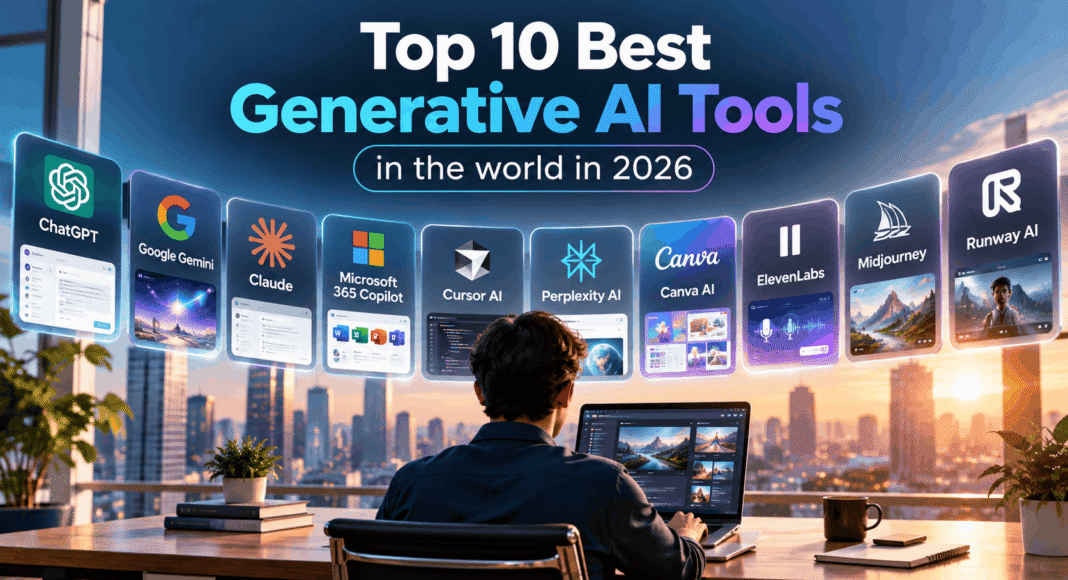
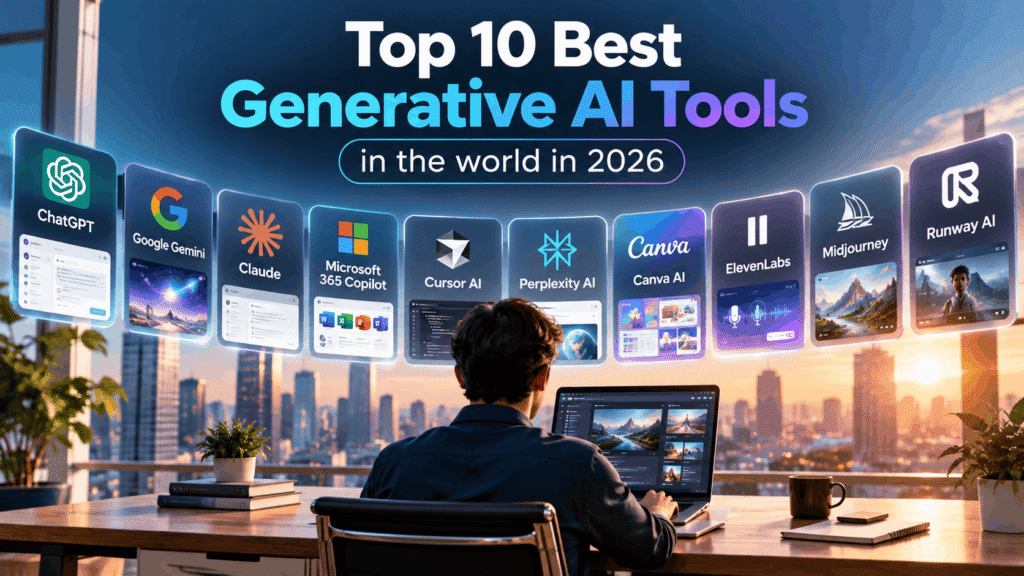
The best generative AI tools in 2026 include ChatGPT, Google Gemini, Claude, Microsoft 365 Copilot, Cursor AI, Perplexity AI, Canva AI, ElevenLabs, Midjourney, and Runway AI. These leading AI platforms help businesses and individuals create content, generate images and videos, develop software, conduct research, and automate workflows efficiently.
Generative artificial intelligence has become one of the most transformative technologies shaping the global digital economy in 2026. From creating high-quality written content and generating photorealistic images to developing software, producing videos, conducting research, and automating complex business processes, generative AI tools are fundamentally changing how individuals and organizations work.
As artificial intelligence continues to advance, businesses, developers, marketers, designers, and content creators are increasingly searching for the best generative AI tools in 2026 to improve productivity, reduce operational costs, accelerate innovation, and gain a competitive advantage. However, with numerous AI platforms offering different capabilities, pricing models, and specialized applications, choosing the right generative AI software can be challenging.
The top 10 best generative AI tools in the world in 2026 include ChatGPT, Google Gemini, Claude, Microsoft 365 Copilot, Cursor AI, Perplexity AI, Canva AI, ElevenLabs, Midjourney, and Runway AI. These leading artificial intelligence platforms represent some of the most important categories of generative AI technology, including conversational AI, advanced reasoning, AI-powered coding, intelligent research, image generation, video production, voice synthesis, and enterprise automation.
Among the most versatile platforms, ChatGPT, Google Gemini, and Claude offer powerful capabilities for text generation, problem-solving, document analysis, programming, and everyday productivity. Their expanding multimodal functionality enables users to work with different types of information, making them valuable solutions for both personal and professional applications.
For businesses seeking deeper integration with existing productivity software, Microsoft 365 Copilot provides AI-powered assistance across familiar workplace applications. Meanwhile, Cursor AI has emerged as a specialized solution for software developers, offering intelligent code completion, debugging assistance, and agentic programming workflows.
Beyond general-purpose AI assistants, specialized generative AI platforms are transforming creative industries and information discovery. Perplexity AI supports research and AI-powered search, while Canva AI simplifies graphic design and marketing content production. ElevenLabs specializes in realistic AI-generated voices and audio, Midjourney delivers advanced image generation capabilities, and Runway AI enables sophisticated AI-assisted video creation.
One of the defining developments in 2026 is the growing adoption of multimodal AI and agentic artificial intelligence. Rather than responding exclusively to text prompts, modern AI systems increasingly process combinations of text, images, audio, video, and structured information. Some platforms also support AI agents capable of planning and executing multi-step tasks, connecting with external applications, and assisting with increasingly complex workflows.
These advancements are expanding the practical applications of generative AI across industries such as marketing, education, finance, healthcare, software development, customer service, media production, and professional services. Organizations can use AI-powered tools to accelerate content creation, streamline administrative processes, improve customer interactions, and support data-driven decision-making.
Nevertheless, not all generative AI tools offer the same level of performance, reliability, security, or value for money. Some platforms excel at advanced reasoning and coding, while others specialize in visual creativity, enterprise collaboration, or research accuracy. Important considerations include subscription pricing, available AI models, output quality, integration capabilities, data privacy, usage limitations, and scalability.
For startups and small businesses, selecting affordable AI tools with practical automation features can deliver meaningful efficiency improvements without requiring significant technical investments. Larger enterprises may prioritize centralized administration, security controls, compliance requirements, and seamless integration with existing technology infrastructure.
This comprehensive guide to the top 10 best generative AI tools in the world in 2026 explores the leading platforms, their key features, benefits, limitations, pricing considerations, and real-world use cases. It also highlights the differences between general-purpose AI assistants and specialized generative AI applications to help readers understand which solutions best match their needs.
Whether the objective is to find the best AI writing tool, AI coding assistant, AI image generator, AI video generator, AI research platform, or enterprise AI software, this comparison provides practical insights for evaluating the leading generative AI technologies available in 2026.
Ultimately, understanding the strengths and capabilities of these AI platforms can help individuals and businesses make informed technology decisions, build more efficient workflows, and take advantage of the expanding opportunities created by generative artificial intelligence.
Before we venture further into this article, we would like to share who we are and what we do.
About 9cv9
9cv9 is a business tech startup based in Singapore and Asia, with a strong presence all over the world.
With over ten years of startup and business experience, and being highly involved in connecting with thousands of companies and startups, the 9cv9 team has listed some of the top and best companies/tools in this review.
If you like to get your company listed in our top B2B software reviews, check out our world-class 9cv9 Media and PR service and pricing plans here.
Top 10 Best Generative AI Tools To Know in 2026
- ChatGPT
- Google Gemini
- Claude
- Microsoft 365 Copilot
- Cursor AI
- Perplexity AI
- Canva AI
- ElevenLabs
- Midjourney
- Runway AI
1. ChatGPT
Overview of ChatGPT in 2026
ChatGPT, developed by OpenAI, is one of the world’s leading generative AI tools in 2026, offering a comprehensive platform for artificial intelligence-powered content creation, advanced reasoning, software development, research, data analysis, and business automation.
As a general-purpose AI assistant, ChatGPT serves individuals, startups, developers, and multinational enterprises seeking to improve productivity and automate knowledge-intensive workflows. Its capabilities extend beyond conventional text generation to include multimodal interactions, document analysis, image generation, coding assistance, and AI-powered research.
ChatGPT’s competitive advantage lies in its broad functionality, accessible interface, expanding enterprise ecosystem, and integration with specialized AI tools such as Codex for software development and Deep Research for complex information gathering.
Market Position and Global Adoption
ChatGPT remains a major player in the global generative AI market, supported by widespread consumer adoption, business integration, and an expanding developer ecosystem.
Its position among the best generative AI tools in 2026 reflects several competitive strengths, including strong brand recognition, versatile AI capabilities, multilingual support, and applicability across numerous industries.
However, market leadership should be evaluated using independently verified indicators rather than treating web traffic, registered accounts, active users, and enterprise adoption as interchangeable measurements.
| Market Indicator | ChatGPT’s Competitive Position |
|---|---|
| Market category | General-purpose generative AI assistant |
| Developer | OpenAI |
| Primary users | Individuals, businesses, developers, researchers, and enterprises |
| Core capabilities | Content generation, reasoning, coding, research, and automation |
| Global reach | International consumer and enterprise markets |
| Business adoption | Broad usage across industries and organizational sizes |
| Competitive advantage | Integrated multimodal AI and productivity ecosystem |
| Main competitors | Claude, Gemini, Microsoft Copilot, Perplexity, and DeepSeek |
ChatGPT is particularly attractive to organizations seeking a single AI platform capable of supporting multiple business functions without requiring separate applications for every task.
GPT-6 Model Architecture and AI Capabilities
ChatGPT’s technology ecosystem incorporates the GPT-6 model family, designed to accommodate different levels of reasoning complexity, processing speed, and operational cost.
The model portfolio enables users to select appropriate AI capabilities for everyday productivity, advanced research, software engineering, and enterprise automation.
| AI Model | Primary Function | Ideal Applications |
|---|---|---|
| GPT-6 Astra | Frontier reasoning and complex task execution | Advanced research, autonomous workflows, software engineering |
| GPT-6.1 Sol | High-performance reasoning and coding | Application development, business analysis, agentic automation |
| GPT-6 Sol | General-purpose conversational intelligence | Professional writing, problem-solving, productivity |
| GPT-6 Luna | Fast, cost-efficient AI processing | Classification, summarization, routine automation |
GPT-6 Astra is particularly relevant for complex, multi-step workflows involving research, coding, computer interaction, and document production. GPT-6.1 Sol offers a more economical alternative for professional applications requiring substantial reasoning capabilities.
Meanwhile, GPT-6 Luna prioritizes responsiveness and affordability, making it suitable for high-volume AI applications.
Key Features and Business Applications
ChatGPT provides an integrated collection of generative AI capabilities that support business operations, creative production, and technical workflows.
| Key Feature | Functionality | Business Benefits |
|---|---|---|
| AI Content Generation | Produces articles, reports, emails, and marketing materials | Accelerates content production |
| Advanced Reasoning | Analyzes complex questions and structured information | Improves research and decision support |
| AI Coding Assistant | Generates, reviews, and debugs software code | Increases developer productivity |
| Deep Research | Conducts multi-step research and synthesizes findings | Reduces manual research workloads |
| Data Analysis | Processes datasets and generates analytical insights | Supports business intelligence |
| Image Generation | Creates and modifies visual content | Streamlines creative workflows |
| Multimodal AI | Processes text, images, documents, and voice | Enables flexible user interactions |
| AI Agents | Executes supported multi-step tasks using connected tools | Automates repetitive workflows |
| Enterprise Integrations | Connects AI workflows with business applications | Improves organizational efficiency |
These capabilities make ChatGPT particularly valuable for marketing agencies, software companies, recruitment businesses, financial analysts, educational institutions, and enterprise productivity teams.
ChatGPT Subscription Pricing in 2026
OpenAI offers subscription options for individual users, professional teams, and enterprise customers.
The following pricing reflects publicly documented plan structures in October 2026. Actual availability, regional pricing, taxes, and usage allowances may vary.
| Subscription Plan | Monthly Price (USD) | Target Users |
|---|---|---|
| Free | $0 | Casual users and beginners |
| Go | From $8 | Budget-conscious individuals |
| Plus | $20 | Professionals and regular AI users |
| Pro 100 | $100 | Advanced individual users |
| Pro 200 | $200 | High-volume professionals |
| Pro 500 | $500 | Power users requiring maximum capacity |
| Business Standard | $20 per user annually billed, or $25 monthly | Small and medium businesses |
| Business Premium | $100 per user annually billed, or $125 monthly | AI-intensive business teams |
| Enterprise | Custom quotation | Large organizations with advanced governance requirements |
Business Premium provides higher included usage than Business Standard, while Pro 500 includes access to Ultrafast processing.
Enterprise deployments offer negotiated commercial terms and additional administrative, security, and organizational controls.
OpenAI API Pricing for Developers
OpenAI also provides usage-based API access for developers integrating generative AI capabilities into websites, applications, and automated business systems.
API costs depend on the selected model, input and output token consumption, caching eligibility, and processing configuration.
| AI Model | Input Cost per 1M Tokens | Cached Input per 1M Tokens | Output Cost per 1M Tokens |
|---|---|---|---|
| GPT-6 Astra | $10.00 | $1.00 | $50.00 |
| GPT-6.1 Sol | $2.00 | $0.10 | $10.00 |
| GPT-6 Luna | $0.10 | $0.01 | $0.50 |
These standard-rate figures provide a baseline for evaluating AI development costs. Specialized processing tiers, extended contexts, and additional tools may incur different charges.
For developers managing high-volume applications, GPT-6 Luna offers an economical approach to routine processing, while GPT-6.1 Sol provides a balance between reasoning performance and operating expenses.
Advantages and Limitations of ChatGPT
| Advantages | Limitations |
|---|---|
| Versatile generative AI capabilities | AI-generated information may contain inaccuracies |
| Strong reasoning and coding functionality | Advanced features require paid subscriptions |
| Extensive developer ecosystem | API costs can increase with heavy usage |
| Multimodal content generation | Output quality depends on task complexity and context |
| Business integrations and automation | Sensitive workflows require appropriate governance |
| Scalable individual and enterprise plans | Usage limits vary by subscription and model |
Who Should Use ChatGPT in 2026?
ChatGPT is particularly suitable for organizations seeking a versatile generative AI platform rather than a narrowly specialized application.
Marketing teams can use it to accelerate content development and campaign planning, while software developers can leverage its coding and reasoning capabilities to streamline application development.
Businesses can also deploy ChatGPT for internal knowledge management, document processing, research assistance, and operational automation.
For enterprises, its combination of advanced AI models, administrative controls, business integrations, and developer infrastructure makes it a compelling option for broader artificial intelligence adoption.
Overall Assessment
ChatGPT ranks among the best generative AI tools in the world in 2026 because of its extensive capabilities, flexible pricing, advanced GPT-6 models, and expanding business ecosystem.
Its strongest value proposition is the ability to combine AI writing, research, coding, data analysis, and automation within a unified platform.
For individuals and organizations evaluating generative AI software in 2026, ChatGPT represents a strong all-around choice, particularly when versatility, scalability, and integration capabilities are primary purchasing considerations.
2. Google Gemini
Overview of Google Gemini in 2026
Google Gemini, developed by Google DeepMind, is one of the world’s leading generative AI platforms in 2026 and a major competitor to OpenAI’s ChatGPT. The platform combines advanced artificial intelligence reasoning, multimodal content generation, software development assistance, research capabilities, and enterprise productivity tools within Google’s extensive technology ecosystem.
Unlike standalone AI assistants, Gemini benefits from integration with Google Search, Android, Gmail, Google Docs, Google Sheets, and other Google Workspace applications. This distribution strategy makes Gemini particularly attractive to individuals and businesses already using Google’s productivity and cloud infrastructure.
Gemini’s competitive advantages include its multimodal AI architecture, large-context language models, native Google Workspace integrations, and developer access through Google AI Studio and Vertex AI.
Global Market Position and Adoption
Google Gemini has established itself as a major participant in the global generative AI market, supported by Google’s consumer ecosystem, cloud infrastructure, and enterprise distribution channels.
Its growing adoption reflects increasing demand for AI assistants that integrate directly into existing productivity applications rather than requiring users to switch between separate software platforms.
| Market Indicator | Google Gemini’s Position in 2026 |
|---|---|
| Developer | Google DeepMind |
| Product category | Generative AI assistant and multimodal AI platform |
| Primary competitor | OpenAI ChatGPT |
| Target audience | Consumers, professionals, developers, and enterprises |
| Distribution channels | Gemini application, Android, Google Workspace, and Google Cloud |
| Core capabilities | AI reasoning, content generation, coding, research, and multimodal analysis |
| Developer ecosystem | Google AI Studio and Vertex AI |
| Competitive advantage | Deep integration with Google’s productivity and cloud services |
| Enterprise applications | Workplace automation, document analysis, coding, and knowledge management |
Although Gemini’s reach is substantial, website visits, standalone application users, Google Search AI users, and Workspace users represent different measurements. These figures should not be combined when assessing market share or monthly active users.
Gemini AI Models and Technical Capabilities
Google’s Gemini model family supports different levels of computational complexity, ranging from efficient everyday processing to advanced reasoning and autonomous AI workflows.
Gemini 4 Argon represents Google’s frontier model offering for complex reasoning and agentic applications, while the Gemini 3 series provides additional options for coding, multimodal processing, and cost-efficient automation.
| Gemini Model | Primary Capabilities | Recommended Applications |
|---|---|---|
| Gemini 4 Argon | Frontier reasoning and complex agentic execution | Advanced research, software engineering, enterprise automation |
| Gemini 3.1 Pro | Advanced reasoning and multimodal understanding | Complex analysis, coding, document processing |
| Gemini 3.8 Flash | High-speed reasoning and agentic workflows | Software development, business automation |
| Gemini 3.1 Flash-Lite | Economical processing and lightweight automation | Classification, extraction, high-volume applications |
| Gemini Omni Flash | Multimodal content generation | Video creation, editing, and creative production |
A significant advantage of Gemini is its support for large context windows, allowing selected models to process extensive documents, software repositories, and complex information within a single workflow.
Google AI Pro and Ultra provide access to expanded context capabilities, including million-token context support in eligible models and features.
Key Features and Business Applications
Google Gemini combines generative AI capabilities with Google’s productivity applications, enabling organizations to streamline daily operations and reduce repetitive administrative tasks.
| Key Feature | Functionality | Business Benefits |
|---|---|---|
| AI Content Generation | Creates articles, emails, reports, and marketing materials | Improves content productivity |
| Google Workspace Integration | Provides AI assistance in Gmail, Docs, and Sheets | Streamlines office workflows |
| Advanced Reasoning | Analyzes complex problems and information | Supports business decision-making |
| Multimodal Understanding | Processes text, images, audio, and video | Enables comprehensive information analysis |
| Deep Research | Produces structured research and analytical reports | Accelerates knowledge discovery |
| AI Coding Assistance | Supports code generation, debugging, and development | Improves software engineering efficiency |
| Long-Context Processing | Analyzes extensive documents and datasets | Reduces fragmented research workflows |
| AI Agent Capabilities | Supports multi-step task execution | Automates operational processes |
| Google Cloud Integration | Enables AI application development and deployment | Supports enterprise scalability |
These capabilities are particularly valuable for businesses already relying on Google Workspace, Google Cloud, and Android-based technology infrastructure.
Google Gemini Subscription Pricing in 2026
Google offers several subscription tiers designed for consumers, professionals, developers, and enterprise customers.
| Subscription Plan | Monthly Price (USD) | Main Benefits | Target Audience |
|---|---|---|---|
| Free | $0 | Basic Gemini access and limited AI capabilities | Casual users |
| Google AI Plus | Regional pricing; approximately $4.99 in selected markets | Increased AI usage and 400 GB storage | Budget-conscious professionals |
| Google AI Pro | $19.99 | Advanced models, Deep Research, 5 TB storage | Professionals and developers |
| Google AI Ultra | $99.99 to $199.99 | Higher AI usage limits and premium capabilities | Power users and AI developers |
| Gemini Enterprise | From $30 per seat | Enterprise security, governance, and AI agents | Large organizations |
Google AI Ultra offers different usage allowances depending on the selected subscription level, while Google AI Pro provides a balanced option for professionals requiring advanced AI capabilities and substantial cloud storage.
Business customers should distinguish Gemini Enterprise subscriptions from Google Workspace plans, as their pricing structures, included services, and administrative capabilities differ.
Google Gemini API Pricing for Developers
Developers can access Gemini models through Google AI Studio and Google Cloud infrastructure using usage-based API pricing.
The following comparison highlights representative model pricing for standard text processing in 2026.
| Gemini Model | Input Cost per 1M Tokens | Output Cost per 1M Tokens | Primary Use Case |
|---|---|---|---|
| Gemini 4 Argon Promotional | $2.00 | $10.00 | Frontier reasoning and complex agents |
| Gemini 4 Argon Core | $1.25 | $5.00 | High-speed agentic workflows |
| Gemini 4 Argon Ultra | $3.50 | $14.00 | Advanced reasoning workloads |
| Gemini 3.8 Flash | $0.75 | $3.75 | Coding and automated workflows |
| Gemini 3.1 Flash-Lite | $0.25 | $1.50 | High-volume, cost-sensitive applications |
The Gemini 3.8 Flash rates reflect promotional pricing available through December 2026. Gemini 4 Argon pricing varies by processing configuration, and cached input charges may be billed separately from context storage.
Organizations should also account for additional charges associated with search grounding, tool execution, and other specialized API features.
Advantages and Limitations of Google Gemini
| Advantages | Limitations |
|---|---|
| Deep integration with Google Workspace | Some advanced features require paid subscriptions |
| Powerful multimodal AI capabilities | AI-generated information may contain factual inaccuracies |
| Large-context processing | Performance varies across models and workloads |
| Competitive developer API pricing | Complex workflows can generate significant usage costs |
| Strong Google Cloud infrastructure | Enterprise configuration may require technical expertise |
| Advanced reasoning and coding tools | Certain capabilities have regional availability restrictions |
| Extensive consumer distribution | Features and usage limits change across subscription tiers |
Who Should Use Google Gemini in 2026?
Google Gemini is particularly suitable for businesses, professionals, and developers seeking a generative AI platform integrated with Google’s existing technology ecosystem.
Organizations using Gmail, Google Docs, Google Sheets, and Google Drive can benefit from AI-powered productivity assistance without significantly changing their established workflows.
Software development teams can use Gemini models through Google AI Studio and Vertex AI to build AI-powered applications, automate coding tasks, and process large datasets.
Meanwhile, enterprises can leverage Google Cloud infrastructure to implement scalable AI solutions with appropriate security, governance, and administrative controls.
Overall Assessment
Google Gemini ranks among the best generative AI tools in the world in 2026 due to its advanced reasoning capabilities, multimodal architecture, competitive developer pricing, and extensive integration with Google’s productivity ecosystem.
Its strongest competitive advantage is the combination of powerful generative AI models with applications that millions of individuals and businesses already use daily.
For organizations prioritizing Google Workspace productivity, large-context analysis, software development, and cloud-based AI automation, Google Gemini represents one of the strongest alternatives to ChatGPT in 2026.
3. Claude
Overview of Claude AI in 2026
Claude, developed by Anthropic, has emerged as one of the world’s leading generative AI platforms in 2026, competing directly with OpenAI ChatGPT and Google Gemini in advanced reasoning, software development, enterprise automation, and professional knowledge work.
The platform is particularly recognized for its sophisticated language understanding, high-quality content generation, complex coding capabilities, and ability to execute multi-step workflows through AI agents.
Anthropic’s Claude ecosystem includes the Claude 5.5 model family, Claude Code for agentic software development, and Claude Fable 5.1 for demanding, long-running tasks.
Unlike general-purpose AI assistants focused primarily on conversational productivity, Claude has developed a strong competitive position in enterprise software engineering, technical analysis, document production, and autonomous AI workflows.
Global Market Position and Enterprise Adoption
Claude has experienced substantial growth in the generative AI market, driven by increasing enterprise adoption, developer demand, and the expansion of its advanced AI model portfolio.
Its competitive position is particularly strong among software engineering teams, AI developers, research organizations, and businesses seeking sophisticated automation capabilities.
| Market Indicator | Claude’s Position in 2026 |
|---|---|
| Developer | Anthropic |
| Product Category | Generative AI assistant and frontier AI platform |
| Primary Competitors | ChatGPT, Google Gemini, DeepSeek |
| Core Strength | Advanced reasoning, coding, and enterprise AI agents |
| Flagship Models | Claude Opus 5.5 and Claude Fable 5.1 |
| Developer Platform | Claude API and Claude Code |
| Enterprise Focus | Software engineering, research, and knowledge automation |
| Cloud Availability | Anthropic API and supported major cloud platforms |
| Competitive Advantage | High-performance coding and complex task execution |
Claude’s increasing popularity among developers reflects growing demand for AI systems capable of performing practical software engineering tasks rather than simply generating code snippets.
Although third-party estimates suggest significant growth in Claude’s web traffic and enterprise adoption, exact market-share figures depend on measurement methodology and should not be interpreted as independently confirmed platform-wide usage statistics.
Claude 5.5 Model Family and Technical Capabilities
Anthropic’s Claude 5.5 model family provides different performance tiers optimized for complex reasoning, software engineering, enterprise productivity, and high-volume automation.
The model portfolio allows organizations to balance computational intelligence, processing speed, and operational costs according to their business requirements.
| Claude Model | Primary Capabilities | Recommended Applications |
|---|---|---|
| Claude Haiku 5.5 | Fast, economical AI processing | Classification, data extraction, customer support |
| Claude Sonnet 5.5 | Advanced coding and balanced reasoning | Software development, business analysis, automation |
| Claude Opus 5.5 | Frontier reasoning and complex agentic coding | Enterprise software engineering, technical research |
| Claude Fable 5.1 | Long-horizon autonomous task execution | Complex AI agents, extended research, multi-stage workflows |
Claude Opus 5.5 is designed for demanding software development and professional knowledge work, while Claude Sonnet 5.5 provides a more economical alternative for everyday coding and business applications.
Claude Haiku 5.5 prioritizes low latency and affordability, making it suitable for large-scale applications requiring frequent AI interactions.
Claude Fable 5.1 addresses more computationally intensive tasks involving extended reasoning and autonomous execution.
Claude AI Performance and Benchmark Results
Claude’s technical competitiveness is supported by its performance on software engineering and professional knowledge benchmarks.
Claude Sonnet 5.5 achieved a reported 70.6% score on Terminal-Bench 4.0, demonstrating substantial improvements in agentic coding capabilities.
| Performance Category | Claude’s Competitive Strength | Practical Business Application |
|---|---|---|
| Agentic Coding | Strong performance on terminal-based coding evaluations | Automated software development |
| Complex Reasoning | Advanced problem-solving across technical domains | Strategic analysis and research |
| Professional Knowledge Work | High capability in structured business tasks | Financial, legal, and operational analysis |
| Long-Horizon Execution | Specialized models for extended task completion | Autonomous workflow management |
| Document Production | Generates and refines complex professional documents | Reports, presentations, and business documentation |
| Codebase Understanding | Analyzes software architecture and dependencies | Debugging, refactoring, and maintenance |
Benchmark results provide useful comparisons, but performance can vary depending on evaluation conditions, tool access, prompting methods, and task complexity.
Key Features and Business Applications
Claude combines advanced generative AI with developer-focused tools and enterprise productivity capabilities.
| Key Feature | Functionality | Business Benefits |
|---|---|---|
| Claude Code | Agentic command-line software development assistant | Accelerates coding and debugging |
| Advanced Reasoning | Analyzes complex technical and business problems | Improves decision support |
| AI Content Generation | Produces reports, articles, and professional documents | Increases content productivity |
| Code Review and Refactoring | Examines codebases and recommends improvements | Enhances software maintainability |
| AI Agents | Executes supported multi-step workflows | Reduces repetitive operational work |
| Document Analysis | Processes lengthy reports and technical materials | Accelerates information extraction |
| Research Capabilities | Synthesizes information from multiple sources | Supports analytical workflows |
| Enterprise Integrations | Connects with supported business applications | Improves organizational efficiency |
| API Development | Enables AI integration into custom software | Supports scalable AI products |
Claude Code is especially valuable for development teams because it can inspect project files, propose code changes, execute supported development commands, and assist with testing workflows.
This makes Claude particularly attractive to software companies, technology startups, and enterprises maintaining complex application environments.
Claude Subscription Pricing in 2026
Anthropic provides consumer and commercial subscription plans designed for different usage requirements.
| Subscription Plan | Monthly Price (USD) | Target Audience |
|---|---|---|
| Free | $0 | Casual users and beginners |
| Pro | $20 monthly or $17 annually | Professionals and regular users |
| Max 5x | $100 | Advanced users requiring higher usage limits |
| Max 20x | $200 | Heavy users and professional developers |
| Team Standard | $20 per user annually or $25 monthly | Small and medium teams |
| Team Premium | $100 per user annually or $125 monthly | AI-intensive development teams |
| Enterprise | Seat fee plus metered usage | Large organizations requiring advanced governance |
Claude Max subscriptions provide expanded usage allowances compared with the standard Pro plan.
For enterprise customers, Anthropic offers additional security, compliance, administrative, and integration capabilities.
Enterprise usage-based subscriptions separate platform access charges from AI consumption, allowing organizations to monitor spending according to actual model usage.
Claude API Pricing for Developers
Anthropic offers usage-based API pricing for developers integrating Claude models into software applications, AI agents, and enterprise automation systems.
The following table presents standard API rates for the latest Claude model portfolio in October 2026.
| Claude Model | Input Cost per 1M Tokens | Output Cost per 1M Tokens | Cached Input per 1M Tokens |
|---|---|---|---|
| Claude Haiku 5.5 | $0.10 | $0.50 | $0.01 |
| Claude Sonnet 5.5 | $2.00 | $10.00 | $0.10 |
| Claude Opus 5.5 | $4.00 | $20.00 | $0.20 |
| Claude Fable 5.1 | $10.00 | $50.00 | $0.25 |
Haiku 5.5 pricing shown applies to prompts of up to 100,000 tokens. Longer prompts are charged at higher rates.
Cached input pricing represents cache reads rather than cache creation. Additional charges may apply for cache writes, specialized processing, and premium execution modes.
For developers balancing performance and cost, Claude Sonnet 5.5 offers a competitive middle ground between lightweight automation and frontier-level reasoning.
Advantages and Limitations of Claude
| Advantages | Limitations |
|---|---|
| Strong coding and software engineering capabilities | Advanced models can generate substantial API costs |
| Sophisticated reasoning and document analysis | AI-generated outputs still require verification |
| Powerful Claude Code development environment | Some features require paid subscriptions |
| Specialized models for different workloads | Usage limits vary by subscription |
| Advanced enterprise security and governance | Complex deployments require technical expertise |
| Competitive prompt caching rates | Long-running agents can consume significant tokens |
| Support for autonomous workflows | Agentic operations require appropriate permissions and safeguards |
Who Should Use Claude in 2026?
Claude is particularly suitable for software developers, engineering teams, technology companies, research organizations, and enterprises requiring advanced AI reasoning capabilities.
Software development teams can leverage Claude Code to automate debugging, improve code quality, review application architecture, and accelerate development workflows.
Business professionals can use Claude for research, financial analysis, document creation, and structured problem-solving.
Enterprises managing complex technical operations can also benefit from Claude’s agentic capabilities, particularly when implementing AI-powered automation across internal systems.
Overall Assessment
Claude ranks among the best generative AI tools in the world in 2026 because of its advanced reasoning capabilities, strong software engineering performance, competitive model portfolio, and expanding enterprise ecosystem.
Its most significant competitive advantage lies in combining frontier AI intelligence with practical coding tools and autonomous workflow execution.
For businesses prioritizing software development, technical research, complex document analysis, and enterprise automation, Claude represents one of the strongest generative AI platforms available in 2026.
4. Microsoft 365 Copilot
Overview of Microsoft 365 Copilot in 2026
Microsoft 365 Copilot is one of the leading enterprise generative AI tools in 2026, designed to improve workplace productivity, automate business processes, and integrate artificial intelligence directly into everyday professional applications.
Developed by Microsoft, the platform combines advanced large language models with Microsoft 365 applications, including Word, Excel, PowerPoint, Outlook, Teams, and OneNote. This integration allows employees to generate documents, analyze spreadsheets, summarize meetings, manage communications, and automate administrative tasks without leaving their existing workplace software.
Unlike standalone AI chatbots, Microsoft 365 Copilot uses organizational information and business context to deliver relevant AI assistance within established enterprise workflows.
Its primary competitive advantage lies in combining generative AI capabilities with Microsoft’s extensive enterprise software ecosystem, security infrastructure, and administrative controls.
Global Market Position and Enterprise Adoption
Microsoft 365 Copilot has established a strong position in the enterprise generative AI market, benefiting from Microsoft’s extensive commercial customer base and widespread adoption of Microsoft 365 applications.
By Microsoft’s fiscal fourth quarter of 2026, the company reported more than 30 million paid Microsoft 365 Copilot seats, with quarterly net seat additions more than doubling compared with the preceding quarter.
This growth highlights increasing demand for AI-powered workplace automation, particularly among organizations seeking to integrate artificial intelligence into existing business processes.
| Market Indicator | Microsoft 365 Copilot’s Position in 2026 |
|---|---|
| Developer | Microsoft |
| Product Category | Enterprise generative AI and productivity assistant |
| Paid Commercial Adoption | More than 30 million paid seats |
| Primary Customers | Businesses, enterprises, and professional teams |
| Core Applications | Word, Excel, PowerPoint, Outlook, Teams, OneNote |
| AI Infrastructure | Multiple frontier AI models and intelligent model routing |
| Enterprise Security | Microsoft Purview, Entra, and enterprise data protection |
| Agent Management | Microsoft Agent 365 |
| Primary Competitors | ChatGPT Enterprise, Google Gemini, Claude |
| Competitive Advantage | Native integration with Microsoft 365 business workflows |
Microsoft 365 Copilot’s adoption extends beyond its standalone website because much of its usage occurs directly inside Microsoft applications.
Consequently, standalone website traffic provides only a partial representation of the platform’s enterprise reach and actual workplace usage.
AI Architecture and Intelligent Model Routing
Microsoft 365 Copilot uses a multi-model architecture rather than depending exclusively on one artificial intelligence model.
The platform can select suitable models according to the complexity of a task, required reasoning capabilities, and available processing resources.
Its AI infrastructure incorporates models from OpenAI and Anthropic, with Microsoft providing the application integration, enterprise security framework, and orchestration layer.
| AI Technology | Primary Function | Business Application |
|---|---|---|
| OpenAI GPT Models | General reasoning, content generation, and analytical processing | Writing, research, and workplace productivity |
| Anthropic Claude Models | Advanced reasoning and complex knowledge tasks | Document analysis and professional workflows |
| Intelligent Model Router | Selects appropriate AI processing capabilities | Balances speed and reasoning requirements |
| Microsoft Graph | Connects organizational information and relationships | Context-aware enterprise assistance |
| Work IQ | Provides business context from work data and activities | Personalized productivity and research |
| Microsoft Agent 365 | Centralizes AI agent governance and management | Enterprise automation oversight |
This architecture enables Microsoft to incorporate improvements from multiple AI model providers while maintaining a consistent user experience across its productivity applications.
Key Features and Business Applications
Microsoft 365 Copilot provides generative AI capabilities across workplace applications, helping organizations reduce repetitive work and improve employee efficiency.
| Microsoft Application | Copilot Capabilities | Business Benefits |
|---|---|---|
| Microsoft Word | Drafts, summarizes, rewrites, and edits documents | Accelerates report and proposal creation |
| Microsoft Excel | Analyzes data, generates formulas, and identifies trends | Improves spreadsheet productivity |
| Microsoft PowerPoint | Creates presentations and summarizes information | Reduces presentation preparation time |
| Microsoft Outlook | Drafts emails and summarizes conversations | Streamlines business communications |
| Microsoft Teams | Summarizes meetings and identifies action items | Improves collaboration and follow-up |
| Microsoft OneNote | Organizes and summarizes notes | Simplifies knowledge management |
| Microsoft SharePoint | Supports organizational content discovery | Improves information accessibility |
| Copilot Studio | Builds and manages custom AI agents | Automates business workflows |
| Microsoft Agent 365 | Governs AI agent identities, access, and activity | Strengthens operational oversight |
These integrations make Microsoft 365 Copilot particularly useful for organizations managing substantial volumes of emails, documents, spreadsheets, meetings, and internal business information.
Enterprise Security, Privacy, and Governance
Security and data governance represent major differentiators for Microsoft 365 Copilot, particularly among large organizations operating in regulated industries.
The platform incorporates Microsoft’s enterprise data protection framework, which applies contractual safeguards to organizational prompts, responses, and connected business information.
Microsoft states that protected organizational prompts and responses are not used to train foundation models.
| Security Capability | Primary Function | Enterprise Benefit |
|---|---|---|
| Enterprise Data Protection | Protects organizational AI interactions | Supports confidential business operations |
| Microsoft Purview | Applies data governance and compliance policies | Improves regulatory oversight |
| Microsoft Entra | Manages identities and access permissions | Strengthens authentication and authorization |
| Data Loss Prevention | Controls sensitive information sharing | Reduces accidental data exposure |
| Microsoft Defender | Provides security monitoring and threat protection | Improves enterprise risk management |
| Agent 365 Governance | Tracks and manages deployed AI agents | Supports responsible automation |
| Audit and Compliance | Records relevant activities and access events | Improves accountability |
However, enterprise data protection should not be confused with a universal zero-retention policy. Data retention, auditing, and processing arrangements depend on the applicable Microsoft service, configuration, and contractual terms.
Organizations should also review model-provider processing arrangements and regional data residency requirements when deploying advanced AI features.
Microsoft 365 Copilot Pricing in 2026
Microsoft offers commercial Copilot subscriptions through enterprise add-ons, business packages, and usage-based AI services.
The standard enterprise Copilot add-on is priced at $30 per user per month with annual billing, while eligible small and medium-sized businesses can access lower-priced Copilot Business plans.
| Subscription Plan | Price (USD) | Primary Audience |
|---|---|---|
| Copilot Chat | Included with eligible Microsoft 365 subscriptions | Basic enterprise AI assistance |
| Microsoft 365 Copilot Business Add-on | From $18 per user/month, annually billed | Small and medium businesses |
| Microsoft 365 Business Standard with Copilot | From $23.50 per user/month, annually billed | Growing businesses |
| Microsoft 365 Business Premium with Copilot | From $32 per user/month, annually billed | Businesses requiring additional security |
| Microsoft 365 Copilot Enterprise Add-on | $30 per user/month, annually billed | Medium and large enterprises |
| Microsoft Agent 365 | $15 per user/month, annually billed | Organizations managing AI agents |
| Copilot Studio | Usage-based pricing | Custom AI agent development |
Prices reflect advertised US commercial rates in October 2026 and may vary according to eligibility, promotions, billing arrangements, and regional availability.
Microsoft 365 Copilot enterprise add-ons generally require an eligible underlying Microsoft 365 subscription, meaning the Copilot license may represent an additional expense rather than the organization’s total software cost.
AI Agent Automation and Usage-Based Costs
Beyond conventional AI assistance, Microsoft 365 Copilot supports advanced automation through Copilot Studio, Copilot Cowork, and Agent 365.
These technologies enable organizations to create AI agents capable of performing supported multi-step tasks, accessing authorized business information, and coordinating workflows across applications.
| AI Automation Component | Primary Purpose | Cost Structure |
|---|---|---|
| Copilot Studio | Develops custom AI agents | Usage-based credits or applicable licensing |
| Copilot Cowork | Executes supported multi-step workplace tasks | Metered usage |
| Agent 365 | Manages enterprise AI agent governance | Per-user licensing |
| Copilot Connectors | Connects external organizational data | Included or metered depending on capability |
| Advanced AI Workflows | Performs complex automated operations | Feature-specific usage charges |
Businesses implementing high-volume AI automation should consider both subscription expenses and additional consumption-based charges.
Advantages and Limitations of Microsoft 365 Copilot
| Advantages | Limitations |
|---|---|
| Deep integration with Microsoft 365 applications | Requires compatible Microsoft subscriptions |
| Strong enterprise security and governance | Total licensing costs can be significant |
| Context-aware assistance using organizational data | Output quality depends on accessible business information |
| AI-powered document and spreadsheet workflows | Generated content still requires human verification |
| Advanced AI agent development capabilities | Custom automation can incur additional usage charges |
| Multi-model AI architecture | Model availability varies by product and configuration |
| Centralized enterprise administration | Deployment may require IT configuration and governance |
Who Should Use Microsoft 365 Copilot in 2026?
Microsoft 365 Copilot is particularly suitable for medium-sized businesses, multinational corporations, professional services firms, and organizations already using Microsoft’s productivity software.
Finance teams can use Copilot to assist with spreadsheet analysis and financial reporting, while human resources departments can accelerate document preparation, internal communications, and administrative workflows.
Sales and marketing teams can benefit from AI-assisted presentations, customer correspondence, meeting summaries, and campaign planning.
Large enterprises can also use Copilot Studio and Agent 365 to develop, deploy, and govern AI agents across business functions.
Overall Assessment
Microsoft 365 Copilot ranks among the best generative AI tools in the world in 2026 because of its enterprise integration capabilities, advanced AI architecture, security infrastructure, and extensive workplace automation features.
Its greatest strength is its ability to embed generative AI directly into applications that businesses already use, reducing the need for employees to switch between separate AI platforms.
For organizations prioritizing Microsoft 365 productivity, enterprise data protection, business process automation, and scalable AI agent management, Microsoft 365 Copilot represents one of the strongest enterprise-focused generative AI solutions available in 2026.
5. Cursor AI
Overview of Cursor AI in 2026
Cursor, developed by Anysphere, is one of the leading AI-powered integrated development environments (IDEs) in 2026, designed to accelerate software development through intelligent code generation, automated debugging, repository analysis, and autonomous coding agents.
Built on the open-source foundation of Visual Studio Code, Cursor combines a familiar development environment with advanced generative AI capabilities. Developers can use natural language instructions to generate code, modify multiple files, understand complex software architectures, and automate repetitive programming tasks.
Unlike traditional code editors that primarily offer syntax highlighting and autocomplete, Cursor integrates artificial intelligence directly into the software development lifecycle.
Its strongest competitive advantage lies in combining contextual code understanding, AI-assisted editing, and agentic software engineering within a unified development workspace.
Market Position and Developer Adoption
Cursor has established a strong position in the rapidly expanding AI coding assistant market, competing with GitHub Copilot, Claude Code, Windsurf, and other AI-native development tools.
Its popularity reflects increasing demand for development environments capable of handling complete software engineering tasks rather than simply suggesting individual lines of code.
| Market Indicator | Cursor’s Position in 2026 |
|---|---|
| Developer | Anysphere |
| Product Category | AI-powered code editor and agentic IDE |
| Primary Users | Software developers, engineering teams, and technology companies |
| Technical Foundation | Visual Studio Code-based architecture |
| Core Strength | Context-aware coding and autonomous software development |
| Primary Competitors | GitHub Copilot, Claude Code, Windsurf |
| AI Model Support | Multiple frontier models from leading AI providers |
| Enterprise Applications | Code generation, debugging, refactoring, and automated testing |
| Competitive Advantage | Integrated AI agents and repository-wide code understanding |
Cursor’s commercial growth demonstrates increasing enterprise willingness to invest in AI-assisted software engineering tools.
However, reported revenue, developer adoption, and enterprise penetration figures should be evaluated according to their reporting dates and methodologies rather than treated as directly comparable measurements.
SpaceX Acquisition and Commercial Growth
A major development in Cursor’s business expansion was its acquisition by SpaceX in August 2026, following a transaction agreement announced in June.
The acquisition reflected growing commercial interest in AI-native software engineering platforms and the strategic importance of automated coding technologies.
| Business Indicator | Reported Position in 2026 |
|---|---|
| Original Developer | Anysphere |
| Acquiring Company | SpaceX |
| Acquisition Completion | August 14, 2026 |
| Implied Acquisition Valuation | $60 billion |
| Reported Annualized Revenue | Approximately $4 billion |
| Enterprise Adoption | Reportedly used by 64% of Fortune 500 companies |
| Business Growth Driver | Enterprise AI coding and automated development |
| Strategic Focus | AI-native software engineering and developer productivity |
The acquisition provides Cursor with opportunities to expand its AI infrastructure, computational resources, and integration with advanced coding models.
However, annualized revenue represents a projected revenue run rate rather than audited full-year revenue. Similarly, enterprise adoption statistics indicate organizational usage and do not necessarily represent company-wide deployments.
Cursor’s Agentic Coding Architecture
Cursor’s core technology combines repository-aware AI assistance with autonomous coding agents capable of working across multiple files, development tools, and project environments.
Cursor 3.0 introduced an agent-centered interface that allows developers to coordinate multiple AI coding sessions across local repositories, isolated worktrees, cloud environments, and remote development systems.
| AI Capability | Technical Function | Developer Benefit |
|---|---|---|
| AI Autocomplete | Predicts code completions and likely edits | Reduces repetitive typing |
| Multi-File Editing | Modifies related files across a repository | Accelerates complex changes |
| Parallel Subagents | Executes specialized tasks in separate contexts | Improves development throughput |
| Agent Window | Coordinates multiple AI development sessions | Simplifies agent management |
| Git Worktree Isolation | Separates concurrent development changes | Reduces code conflicts |
| Terminal Execution | Runs supported development commands | Automates technical workflows |
| Repository Understanding | Analyzes project structure and dependencies | Improves contextual accuracy |
| Cloud Agents | Performs supported coding tasks in remote environments | Enables asynchronous development |
| Automated Testing | Generates and executes tests | Improves software reliability |
Parallel subagents are particularly useful for complex software engineering projects because they allow independent tasks to proceed simultaneously.
For example, one agent can investigate application errors while another reviews database queries and a third develops automated regression tests.
AI Models and Multi-Model Development
Cursor supports multiple AI model providers, enabling developers to choose between frontier reasoning models, specialized coding models, and more economical alternatives.
Its model routing capabilities help balance processing speed, intelligence, and operational expenses.
| AI Model Ecosystem | Primary Strength | Recommended Application |
|---|---|---|
| Anthropic Claude | Advanced reasoning and software engineering | Complex debugging and refactoring |
| OpenAI GPT | Code generation and technical reasoning | Full-stack application development |
| Google Gemini | Large-context analysis and multimodal understanding | Repository analysis and documentation |
| Grok | Coding assistance and agentic workflows | Automated development tasks |
| Cursor Composer | Integrated coding and editing workflows | Fast code generation and modifications |
Model availability depends on the subscription tier and applicable provider restrictions.
Cursor also offers intelligent routing modes that select models according to cost and performance preferences, reducing the need for developers to manually select a model for every task.
Key Features and Business Applications
| Key Feature | Functionality | Business Benefits |
|---|---|---|
| AI Code Generation | Produces code from natural language instructions | Accelerates application development |
| Intelligent Autocomplete | Suggests code edits and completions | Improves programming efficiency |
| Automated Debugging | Investigates errors and proposes fixes | Reduces troubleshooting time |
| Code Refactoring | Restructures and improves existing code | Enhances maintainability |
| Agentic Development | Performs multi-step programming tasks | Reduces repetitive engineering work |
| Automated Code Review | Identifies potential defects in pull requests | Improves code quality |
| Multi-Agent Execution | Runs independent coding tasks concurrently | Increases development capacity |
| Test Generation | Creates unit and integration tests | Strengthens software reliability |
| Enterprise Administration | Manages users, permissions, and spending | Supports organizational governance |
Cursor is particularly valuable for engineering teams maintaining large repositories, developing SaaS applications, and managing frequent software releases.
Cursor Pricing in 2026
Cursor’s commercial offering includes individual subscriptions, team licensing, and enterprise agreements.
Following its integration into the broader X subscription ecosystem, the platform offers revised pricing alongside legacy plans retained for existing customers.
| Subscription Plan | Monthly Price (USD) | Primary Audience |
|---|---|---|
| Free | $0 | Beginners and occasional developers |
| Plus | $8 | Individual developers with basic AI requirements |
| Premium | $30 | Professional developers |
| Super | $100 | Daily AI agent users |
| Ultra | $200 | Heavy users managing multiple AI agents |
| Teams | $30, $100, or $200 per seat | Software engineering teams |
| Enterprise | Custom Pricing | Large organizations |
Premium includes expanded AI usage and access to additional development capabilities, while Super and Ultra provide progressively higher usage allowances.
Third-party models may incur separate API-based charges, even on paid subscriptions. Team and Enterprise accounts may also be subject to additional token processing fees.
Legacy Pro, Pro+, Ultra, and Team subscriptions continue to operate under their applicable pricing and usage arrangements.
Enterprise Security and Administration
Cursor provides administrative and security capabilities designed for professional development teams and large organizations.
| Enterprise Feature | Primary Function | Business Benefit |
|---|---|---|
| Privacy Mode | Applies supported code data protection controls | Reduces sensitive code exposure |
| Single Sign-On | Centralizes organizational authentication | Improves account security |
| SCIM Provisioning | Automates user access management | Simplifies employee onboarding |
| Centralized Billing | Consolidates subscription management | Improves cost visibility |
| Usage Analytics | Monitors AI consumption | Supports budget management |
| Team Rules and Skills | Shares development instructions and standards | Improves coding consistency |
| Administrative Controls | Manages access and organizational settings | Strengthens governance |
| Pooled Usage | Distributes available consumption across teams | Improves resource allocation |
Organizations handling proprietary source code should review privacy settings, third-party model processing policies, and applicable retention arrangements before deploying Cursor across sensitive repositories.
Advantages and Limitations of Cursor
| Advantages | Limitations |
|---|---|
| AI-native software development environment | Primarily designed for technical users |
| Strong repository-wide code understanding | Generated code can contain errors |
| Parallel agents and autonomous coding workflows | Agentic tasks can consume substantial usage allowances |
| Multiple AI model integrations | Third-party models may incur additional charges |
| Familiar Visual Studio Code-based interface | Some extensions and workflows may require adjustments |
| Enterprise administration and security features | Advanced organizational features require paid plans |
| Automated code review and testing assistance | Human oversight remains necessary for production changes |
Who Should Use Cursor in 2026?
Cursor is particularly suitable for professional software developers, technology startups, SaaS companies, and enterprise engineering departments seeking to accelerate application development.
Full-stack developers can use Cursor to generate application components, investigate backend issues, and maintain complex codebases.
Engineering teams can coordinate parallel agents to handle debugging, testing, documentation, and refactoring tasks simultaneously.
Technology companies managing large software projects can also benefit from Cursor’s repository awareness, automated code review capabilities, and centralized development administration.
Overall Assessment
Cursor ranks among the best generative AI tools in the world in 2026 because of its AI-native development environment, sophisticated coding agents, multi-model architecture, and expanding enterprise adoption.
Its greatest competitive advantage lies in transforming AI-assisted programming from simple autocomplete into coordinated software engineering workflows capable of executing complex development tasks.
For developers and organizations prioritizing coding productivity, automated testing, repository-wide analysis, and agentic software development, Cursor represents one of the strongest specialized generative AI platforms available in 2026.
6. Perplexity AI
Overview of Perplexity AI in 2026
Perplexity AI is one of the leading generative AI search engines and research platforms in 2026, offering an alternative to traditional search engines and conversational AI assistants such as ChatGPT, Google Gemini, and Claude.
Unlike conventional search engines that primarily display lists of websites, Perplexity combines real-time information retrieval, large language models, and source-backed answer generation to deliver direct responses to complex questions.
The platform specializes in AI-powered research, information discovery, competitive intelligence, academic research, market analysis, and professional knowledge management.
Its expanding ecosystem includes Perplexity Search, Deep Research, the Comet AI browser, Perplexity Computer, and developer APIs that enable businesses to integrate generative search capabilities into their own applications.
Perplexity’s primary competitive advantage is its emphasis on current information, transparent source attribution, and research-oriented AI workflows.
Global Market Position and Growth
Perplexity has established a significant position in the AI-powered search market, supported by growing demand for conversational search, reliable information retrieval, and automated research.
Industry estimates indicate that the platform processed approximately 1.2 billion to 1.5 billion monthly search queries during 2026, reflecting its increasing relevance among researchers, professionals, and enterprise users.
The company has also shifted its commercial strategy toward subscriptions, enterprise licensing, and developer services rather than advertising-based monetization.
| Market Indicator | Perplexity AI’s Position in 2026 |
|---|---|
| Developer | Perplexity AI |
| Product Category | AI answer engine and research platform |
| Estimated Monthly Search Queries | 1.2 billion to 1.5 billion |
| Reported Monthly Active Users | More than 100 million across supported products |
| Annualized Revenue | Reportedly exceeded $750 million by August 2026 |
| Last Widely Reported Completed Valuation | Approximately $20 billion |
| Primary Competitors | ChatGPT Search, Google Gemini, Google Search |
| Main Revenue Sources | Subscriptions, enterprise licensing, and APIs |
| Core Strength | Real-time research and source-backed answers |
| Competitive Advantage | Search-focused AI with integrated research automation |
Perplexity’s commercial expansion reflects increasing interest in specialized AI tools that prioritize research accuracy and information discovery.
However, monthly website visits, search query volumes, and active user estimates measure different aspects of platform adoption. Similarly, reported annualized revenue represents a revenue run rate rather than audited annual revenue.
AI Architecture and Multi-Model Research Capabilities
Perplexity combines web-scale information retrieval with advanced language models to generate answers supported by relevant online information.
Its architecture emphasizes search retrieval, contextual reasoning, and source attribution rather than relying exclusively on information stored within a language model’s training data.
The platform also provides access to multiple frontier AI models, enabling users to select suitable reasoning capabilities for different research tasks.
| AI Technology | Primary Function | Research Application |
|---|---|---|
| Perplexity Sonar | Search-grounded AI answer generation | Everyday research and factual questions |
| Sonar Pro | Advanced search and contextual reasoning | Detailed business and technical research |
| Claude Models | Complex reasoning and document analysis | Professional knowledge work |
| OpenAI GPT Models | General reasoning and information synthesis | Research and analytical reporting |
| Google Gemini Models | Multimodal reasoning and large-context analysis | Document and information processing |
| Model Council | Compares responses from multiple AI models | Cross-model research validation |
| Deep Research | Conducts multi-step investigations | Market intelligence and analytical reports |
| Perplexity Computer | Coordinates automated tasks and research workflows | Agentic business automation |
Model availability depends on the subscription tier, product interface, and current integrations.
The Model Council feature is particularly useful for complex questions because it enables comparisons between different AI-generated responses.
Nevertheless, agreement between multiple models does not automatically guarantee factual accuracy, making independent verification important for high-stakes research.
Key Features and Business Applications
Perplexity provides an extensive range of generative AI capabilities focused on research productivity, information retrieval, and automated knowledge work.
| Key Feature | Functionality | Business Benefits |
|---|---|---|
| AI-Powered Search | Generates direct answers using retrieved information | Reduces manual search time |
| Source Citations | Identifies supporting information sources | Improves research transparency |
| Deep Research | Performs multi-step investigations | Accelerates complex research |
| Model Council | Compares outputs across AI models | Supports broader analytical perspectives |
| Comet AI Browser | Integrates AI assistance into web browsing | Streamlines online research |
| Perplexity Computer | Executes supported multi-step tasks | Automates research workflows |
| Document Analysis | Processes uploaded files and reports | Simplifies information extraction |
| Internal Knowledge Search | Searches authorized organizational information | Improves enterprise knowledge access |
| Developer APIs | Integrates search and AI capabilities into applications | Supports custom AI software development |
These features make Perplexity particularly valuable for market researchers, business analysts, consultants, journalists, academics, and organizations requiring frequent access to current information.
Perplexity Comet AI Browser
Comet is Perplexity’s AI-powered web browser, designed to integrate conversational artificial intelligence directly into everyday browsing activities.
Instead of requiring users to switch between a traditional browser and a separate AI assistant, Comet enables research, page summarization, information comparison, and supported browser automation within a unified interface.
| Comet Capability | Primary Function | User Benefit |
|---|---|---|
| AI Browser Assistant | Answers questions about web content | Improves browsing efficiency |
| Webpage Summarization | Condenses lengthy articles and documents | Saves reading time |
| Contextual Research | Analyzes information across browsing sessions | Supports deeper investigation |
| Information Comparison | Compares products, services, and research findings | Accelerates decision-making |
| Browser Automation | Performs supported browser-based actions | Reduces repetitive tasks |
| Integrated Search | Connects web browsing with Perplexity Search | Simplifies information discovery |
Comet is especially useful for professionals conducting frequent online research, competitor analysis, and information-intensive workflows.
Perplexity Computer and Agentic Research Automation
Perplexity Computer extends the platform beyond conversational search by enabling AI agents to coordinate multi-step workflows in cloud-based execution environments.
This functionality allows users to delegate supported research, analysis, and information-processing tasks to automated systems.
| Agentic Capability | Functionality | Business Application |
|---|---|---|
| Autonomous Research | Investigates complex topics across multiple steps | Market research |
| Multi-Model Orchestration | Coordinates specialized AI models | Advanced analytical workflows |
| Document Processing | Analyzes large collections of information | Business intelligence |
| Task Execution | Performs supported operations in isolated environments | Operational automation |
| Research Synthesis | Combines findings into structured outputs | Executive reporting |
| Workflow Automation | Coordinates repeated information-processing activities | Productivity optimization |
Perplexity Computer is particularly relevant for businesses seeking to automate research-intensive processes while maintaining access to current information.
Perplexity AI Subscription Pricing in 2026
Perplexity offers subscription plans for casual users, professional researchers, and enterprise organizations.
| Subscription Plan | Monthly Price (USD) | Primary Audience |
|---|---|---|
| Free | $0 | Casual users and basic research |
| Pro | $20 | Professionals and regular researchers |
| Max | $200 | Power users and advanced research professionals |
| Enterprise Pro | $40 per seat monthly | Business teams and organizations |
| Enterprise Max | $325 per seat monthly | Enterprises requiring advanced AI research |
Annual billing provides lower effective monthly rates on eligible plans. For example, Pro is available at $200 annually, while Max is advertised at approximately $167 per month when billed annually.
Enterprise Pro is available at $400 per seat annually, while Enterprise Max costs $3,250 per seat annually.
Perplexity Max includes expanded access to advanced research capabilities and Perplexity Computer, with advertised monthly credit allowances.
Enterprise Max provides additional administrative controls, premium security capabilities, and advanced research features.
Perplexity API Pricing for Developers
Perplexity offers developer APIs for businesses building search-powered applications, research assistants, and AI-enabled information services.
Its API ecosystem includes search retrieval, search-grounded language models, and specialized services for integrating real-time information into software products.
| API Service | Pricing Structure | Primary Application |
|---|---|---|
| Sonar | Token-based charges and applicable request fees | Basic search-grounded AI answers |
| Sonar Pro | Higher token rates and applicable request fees | Advanced research applications |
| Sonar Reasoning Pro | Reasoning token charges and search fees | Complex analytical queries |
| Search API | From $1 per 1,000 requests for eligible search services | Web information retrieval |
| Agent API | Model-specific usage pricing | AI agent development |
| Specialized APIs | Service-specific pricing | Custom research and decision workflows |
Developers should distinguish between standalone search retrieval fees and the additional token costs associated with AI-generated responses.
Pricing and endpoint availability may also change as Perplexity expands its Agent API infrastructure.
Enterprise Security and Knowledge Management
Perplexity Enterprise provides additional capabilities for organizations requiring controlled access to internal information and advanced administrative features.
| Enterprise Feature | Primary Function | Business Benefit |
|---|---|---|
| SOC 2 Type II | Supports independently assessed security controls | Strengthens enterprise confidence |
| Single Sign-On | Centralizes employee authentication | Improves access security |
| SCIM Provisioning | Automates user account management | Simplifies administration |
| Internal Knowledge Search | Retrieves authorized company information | Improves organizational research |
| Data Protection Controls | Applies enterprise privacy safeguards | Supports confidential workflows |
| Audit Logs | Records relevant administrative activities | Improves accountability |
| Data Retention Settings | Supports configurable retention policies | Assists compliance management |
Perplexity states that Pro and Enterprise queries are not used to train third-party models. Enterprise customers should nevertheless review the applicable data processing, retention, and contractual arrangements before integrating sensitive business information.
Advantages and Limitations of Perplexity AI
| Advantages | Limitations |
|---|---|
| Real-time, source-backed AI answers | Retrieved information can still be inaccurate |
| Strong research and information discovery capabilities | Advanced features require paid subscriptions |
| Multiple frontier AI model options | Model availability varies by plan |
| Integrated AI browser and research agents | Agentic workflows may consume substantial credits |
| Developer APIs for search applications | API costs increase with usage |
| Enterprise knowledge search and governance | Internal integrations require appropriate configuration |
| Research-oriented interface | Less specialized for coding than dedicated AI IDEs |
Who Should Use Perplexity AI in 2026?
Perplexity is particularly suitable for professionals and organizations requiring fast access to current information, structured research, and source-backed analysis.
Market researchers can use the platform to investigate industry developments, compare competitors, and identify emerging business opportunities.
Financial analysts and consultants can benefit from its research synthesis capabilities, while academic researchers and journalists can use source attribution to support information verification.
Businesses can also integrate Perplexity APIs into customer support applications, internal knowledge systems, and specialized research platforms.
Overall Assessment
Perplexity AI ranks among the best generative AI tools in the world in 2026 because of its search-focused architecture, advanced research capabilities, multi-model ecosystem, and expanding agentic automation features.
Its greatest competitive advantage lies in combining conversational artificial intelligence with current information retrieval and transparent source attribution.
For professionals and organizations prioritizing research productivity, competitive intelligence, knowledge discovery, and AI-powered search, Perplexity represents one of the strongest specialized generative AI platforms available in 2026.
7. Canva AI
Overview of Canva AI in 2026
Canva AI is one of the world’s leading generative AI design platforms in 2026, combining artificial intelligence-powered image generation, graphic design, video creation, presentation development, and marketing content production within a unified visual communication ecosystem.
Developed by Canva, the platform enables individuals, marketing professionals, content creators, and enterprise teams to produce professional visual assets without requiring extensive graphic design experience.
Its integrated AI ecosystem, Magic Studio, includes intelligent tools such as Magic Write, Magic Design, Magic Edit, Magic Media, and automated image editing capabilities. These features help users transform written prompts into presentations, social media graphics, marketing campaigns, and branded content.
Unlike standalone AI image generators, Canva combines generative artificial intelligence with editable templates, brand management tools, collaborative workspaces, and extensive creative asset libraries.
Its primary competitive advantage is making AI-powered visual content creation accessible to both non-designers and professional creative teams.
Global Market Position and User Adoption
Canva has established a substantial position in the global visual communication and generative AI market, supported by its extensive user base, expanding enterprise adoption, and growing AI design capabilities.
Industry estimates for 2026 place Canva’s monthly active user base at approximately 260 million to 265 million, reflecting its widespread adoption among individuals, businesses, educational institutions, and professional design teams.
| Market Indicator | Canva AI’s Position in 2026 |
|---|---|
| Developer | Canva |
| Product Category | AI-powered graphic design and visual communication |
| Estimated Monthly Active Users | 260 million to 265 million |
| Reported Paying Subscribers | Approximately 31 million |
| Reported Annual Revenue | Approximately $3.5 billion |
| Reported Annualized Revenue Run Rate | Approximately $4 billion |
| Reported Company Valuation | Approximately $42 billion |
| Core AI Ecosystem | Magic Studio and Canva AI |
| Primary Competitors | Adobe Express, Adobe Firefly, Microsoft Designer |
| Competitive Advantage | Accessible AI design with integrated editing and collaboration |
Canva’s market position is strengthened by its ability to serve different customer segments, ranging from individual creators to multinational enterprises.
However, user adoption, revenue, and valuation figures are based on reported estimates and may reflect different reporting periods.
Canva Magic Studio and Generative AI Architecture
Magic Studio is Canva’s integrated collection of generative AI tools, designed to simplify visual content creation and automate repetitive design activities.
The platform combines proprietary AI technologies with selected third-party models and creative applications.
Canva’s acquisition of Leonardo AI in 2024 further strengthened its generative image and video capabilities by expanding its access to specialized visual AI research and foundational models.
| AI Technology | Primary Function | Recommended Applications |
|---|---|---|
| Magic Write | Generates and refines written content | Marketing copy, presentations, social media captions |
| Magic Design | Creates layouts and designs from prompts | Presentations, promotional materials, branded graphics |
| Magic Edit | Adds, replaces, and modifies image elements | Product photography and image editing |
| Magic Media | Generates images and videos using AI | Creative campaigns and digital content |
| Magic Expand | Extends image boundaries using generative AI | Image resizing and composition |
| Magic Grab | Extracts and repositions image elements | Graphic editing and layout customization |
| Magic Animate | Applies intelligent animation effects | Presentations and social media content |
| Brand Kit | Maintains consistent visual identity | Enterprise branding and marketing |
These capabilities enable Canva to support the entire creative production process, from initial concept generation to final design editing and publication.
Key Features and Business Applications
Canva AI provides an extensive range of features for businesses seeking to improve visual communication and accelerate creative workflows.
| Key Feature | Functionality | Business Benefits |
|---|---|---|
| AI Image Generation | Produces visuals from text prompts | Reduces reliance on stock photography |
| Automated Graphic Design | Creates layouts using AI | Accelerates design production |
| AI Presentation Generator | Develops slide decks from written instructions | Reduces presentation preparation time |
| AI Writing Assistant | Generates marketing copy and written content | Improves content productivity |
| Generative Image Editing | Modifies objects, backgrounds, and image elements | Simplifies creative revisions |
| AI Video Creation | Generates and edits short-form video content | Supports digital marketing campaigns |
| Brand Management | Applies approved colors, fonts, and templates | Maintains brand consistency |
| Team Collaboration | Enables shared design projects and feedback | Improves creative coordination |
| Content Scheduling | Supports social media content planning | Streamlines marketing operations |
These features are particularly valuable for marketing agencies, ecommerce businesses, social media managers, educators, and organizations producing large volumes of branded content.
Leonardo AI Integration and Advanced Visual Generation
Canva’s acquisition of Leonardo AI represents an important development in its generative AI strategy.
Leonardo AI specializes in advanced image generation, creative asset development, and visual model research, providing Canva with additional capabilities beyond conventional template-based design.
| Leonardo AI Capability | Technical Function | Business Application |
|---|---|---|
| Generative Image Models | Produces detailed AI-generated images | Advertising and marketing visuals |
| Creative Asset Generation | Creates illustrations and conceptual artwork | Brand campaigns and digital media |
| AI Image Customization | Supports visual modifications and stylistic control | Product and promotional design |
| Visual Model Research | Develops specialized generative AI technologies | Advanced creative applications |
| AI Video Capabilities | Supports generative video workflows | Short-form marketing content |
This integration strengthens Canva’s ability to compete with specialized AI image-generation platforms while maintaining its accessible design interface.
Canva AI Pricing in 2026
Canva offers subscription plans for individual users, professional creators, businesses, and large enterprises.
Its current commercial structure emphasizes Canva Free, Canva Pro, Canva Business, and Canva Enterprise.
| Subscription Plan | Price (USD) | Primary Audience |
|---|---|---|
| Canva Free | $0 | Beginners and casual creators |
| Canva Pro | $18 monthly or $144 annually | Individual professionals and content creators |
| Canva Business | $250 per user annually | Small businesses and marketing teams |
| Canva Enterprise | Custom quotation | Large organizations requiring advanced governance |
Canva Teams is no longer offered to new subscribers, with Canva Business serving as the primary subscription option for growing teams.
Pricing varies by region, billing arrangement, and promotional eligibility.
Subscription Features and AI Usage Allowances
| Feature | Free | Pro | Business | Enterprise |
|---|---|---|---|---|
| Design Templates | Free templates | Premium templates | Premium templates | Premium templates |
| AI Generation | Limited | Expanded | Higher allowance | Higher allowance |
| Cloud Storage | Basic | 100 GB | 500 GB | 1 TB |
| Brand Kits | Limited | Up to 5 | Up to 100 | Up to 1,000 |
| Team Collaboration | Basic | Limited | Advanced | Enterprise-wide |
| Approval Workflows | Limited | Limited | Included | Advanced |
| Enterprise Security | Basic | Standard | Enhanced | Advanced |
| Administrative Controls | Basic | Individual | Team-level | Enterprise-level |
Canva Pro includes approximately ten times the AI usage allowance of Canva Free, while Business and Enterprise provide approximately twenty times the baseline allowance for eligible AI features.
AI usage depends on the complexity of generated content, with advanced image and video generation potentially consuming more allowance than simpler AI operations.
Enterprise Security and Brand Governance
Canva Enterprise provides additional security, collaboration, and brand management capabilities for organizations managing large creative teams.
| Enterprise Feature | Primary Function | Business Benefit |
|---|---|---|
| Single Sign-On | Centralizes employee authentication | Improves account security |
| SCIM Provisioning | Automates account management | Simplifies administration |
| Brand Kits | Stores approved brand assets | Maintains visual consistency |
| Approval Workflows | Controls design review and publication | Strengthens content governance |
| Team Permissions | Manages employee access | Protects organizational resources |
| Centralized Asset Libraries | Organizes reusable creative materials | Improves design efficiency |
| Enterprise Integrations | Connects supported business applications | Streamlines creative workflows |
| Canva Shield | Provides AI-related safety and privacy controls | Supports responsible AI adoption |
These capabilities are especially valuable for multinational businesses maintaining consistent branding across multiple departments, markets, and marketing channels.
Advantages and Limitations of Canva AI
| Advantages | Limitations |
|---|---|
| User-friendly AI design interface | Less suitable for highly specialized professional design workflows |
| Extensive template and creative asset libraries | Advanced AI features require paid subscriptions |
| Integrated image, video, and presentation generation | AI-generated visuals may require manual refinement |
| Strong brand management capabilities | Generative AI usage allowances vary by plan |
| Collaborative design environment | Complex projects may require additional design software |
| Accessible to users without design experience | Limited control over certain AI model parameters |
| Enterprise security and administration | Business and enterprise costs increase with team size |
Who Should Use Canva AI in 2026?
Canva AI is particularly suitable for marketing professionals, small businesses, content creators, educators, and enterprise teams seeking efficient visual content production.
Marketing agencies can use Canva to generate social media campaigns, promotional graphics, presentations, and branded advertisements.
Ecommerce businesses can benefit from AI-assisted product imagery, marketing banners, and digital advertising materials.
Human resources teams can create recruitment graphics, employee onboarding presentations, and internal communication materials.
Large enterprises can also leverage Canva’s brand governance features to maintain consistent visual identities across departments and international markets.
Overall Assessment
Canva AI ranks among the best generative AI tools in the world in 2026 because of its accessible design interface, integrated Magic Studio capabilities, extensive creative asset libraries, and expanding enterprise ecosystem.
Its strongest competitive advantage lies in combining AI-powered image generation, graphic design, video creation, and brand management within a single collaborative platform.
For individuals and organizations prioritizing visual content creation, marketing productivity, presentation design, and scalable brand communication, Canva AI represents one of the strongest generative AI design solutions available in 2026.
8. ElevenLabs
Overview of ElevenLabs in 2026
ElevenLabs is one of the world’s leading generative AI audio platforms in 2026, specializing in realistic text-to-speech generation, AI voice cloning, multilingual dubbing, synthetic music production, and conversational voice agents.
Founded in 2022, ElevenLabs has evolved from a specialized AI voice generator into a comprehensive audio and conversational AI platform serving content creators, software developers, marketing agencies, and multinational enterprises.
Its technology ecosystem includes ElevenCreative for audio and multimedia production, ElevenAgents for automated customer interactions, ElevenMusic for AI-generated music, and ElevenAPI for integrating voice intelligence into third-party applications.
Unlike general-purpose generative AI assistants such as ChatGPT and Claude, ElevenLabs focuses primarily on natural-sounding speech, expressive audio generation, and real-time voice interactions.
Its primary competitive advantage lies in combining advanced speech synthesis with voice customization, low-latency processing, and enterprise-ready conversational automation.
Global Market Position and Commercial Growth
ElevenLabs has established a strong position in the generative AI audio market, supported by rapid revenue growth, increasing enterprise adoption, and continued investment in foundational speech models.
In February 2026, the company raised $500 million in Series D funding at an $11 billion valuation. By May 2026, ElevenLabs reported surpassing $500 million in annual recurring revenue.
A subsequent employee tender offer valued the company at approximately $22 billion, reflecting growing investor confidence in its conversational AI and enterprise voice infrastructure.
| Market Indicator | ElevenLabs’ Position in 2026 |
|---|---|
| Developer | ElevenLabs |
| Product Category | Generative AI audio and conversational voice platform |
| Founded | 2022 |
| Series D Funding | $500 million |
| Series D Valuation | $11 billion |
| Subsequent Tender Valuation | $22 billion |
| Reported Annual Recurring Revenue | More than $500 million by May 2026 |
| Enterprise Revenue Contribution | Approximately 55% of company revenue |
| Weekly AI Agent Conversations | More than 15 million |
| Primary Competitors | Murf AI, PlayHT, WellSaid Labs, and Google Cloud Text-to-Speech |
| Competitive Advantage | Expressive AI speech, voice cloning, and enterprise voice automation |
The company’s expansion reflects increasing demand for AI-generated audio across customer service, media production, education, telecommunications, and digital commerce.
Its growth is also supported by enterprise adoption of voice agents capable of handling customer enquiries, appointment scheduling, sales interactions, and internal business communications.
ElevenLabs AI Voice Models and Technical Capabilities
ElevenLabs develops specialized speech synthesis models optimized for different requirements, including emotional expression, audio quality, multilingual communication, and real-time responsiveness.
The Eleven v4 model family represents a significant advancement in expressive speech generation, while the Turbo and Flash models prioritize processing speed for interactive applications.
| AI Voice Model | Primary Capabilities | Recommended Applications |
|---|---|---|
| Eleven v4 | Expressive speech with emotional control | Audiobooks, advertising, entertainment |
| Eleven v4 Turbo | High-quality speech with low latency | Real-time AI voice agents |
| Eleven v3 | Emotional speech and multi-speaker dialogue | Storytelling and media production |
| Multilingual v2 | Natural speech across 29 languages | Narration and multilingual content |
| Flash v2.5 | Fast, economical speech synthesis | Customer service and developer applications |
| Scribe Models | Speech recognition and transcription | Meeting transcription and voice applications |
Eleven v4 supports more than 90 languages, while Eleven v4 Turbo offers low-latency speech generation suitable for conversational applications.
The Flash v2.5 model is particularly useful for developers requiring fast response times and economical API processing.
These capabilities enable ElevenLabs to support both professional audio production and high-volume enterprise voice automation.
Key Features and Business Applications
ElevenLabs provides an integrated suite of generative AI audio technologies designed to automate content creation and improve spoken communication.
| Key Feature | Functionality | Business Benefits |
|---|---|---|
| AI Text-to-Speech | Converts written content into realistic speech | Accelerates audio production |
| Instant Voice Cloning | Creates synthetic voices from authorized recordings | Supports personalized narration |
| Professional Voice Cloning | Develops high-fidelity custom voices | Maintains consistent audio branding |
| AI Voice Agents | Automates spoken customer interactions | Reduces repetitive support workloads |
| Speech-to-Speech | Transforms recorded speech using AI voices | Simplifies voice production |
| AI Dubbing | Converts spoken content into additional languages | Supports international distribution |
| AI Music Generation | Produces original synthetic music | Streamlines creative production |
| Speech Recognition | Converts audio into written text | Improves transcription workflows |
| Developer API | Integrates speech technology into applications | Enables scalable voice automation |
These features make ElevenLabs particularly valuable for content creators, customer service departments, media companies, educational platforms, and businesses developing voice-enabled applications.
ElevenCreative: AI Audio and Content Production
ElevenCreative provides a unified workspace for producing professional audio content using generative artificial intelligence.
The platform supports text-to-speech, voice cloning, dubbing, sound effects, and multimedia production.
| Creative Tool | Primary Function | Common Applications |
|---|---|---|
| Text-to-Speech | Generates narration from written scripts | Audiobooks and educational videos |
| Voice Cloning | Reproduces authorized voice characteristics | Brand narration and localization |
| Voice Changer | Transforms recorded speech | Creative audio production |
| Dubbing Studio | Localizes spoken content | International marketing |
| Sound Effects | Generates audio effects from prompts | Games and video production |
| ElevenMusic | Produces AI-generated music | Advertising and branded media |
| Voice Library | Provides access to synthetic voices | Podcasts and commercial narration |
ElevenCreative is especially attractive to marketing teams and media producers seeking to reduce recording expenses and accelerate multilingual content production.
ElevenAgents: Enterprise Conversational AI
ElevenAgents is ElevenLabs’ enterprise platform for building and deploying conversational AI agents capable of interacting with customers and employees through natural speech.
These agents combine speech recognition, language understanding, conversational reasoning, and text-to-speech generation to conduct automated interactions.
ElevenLabs reported that its agents handled more than 15 million conversations per week in 2026, highlighting growing adoption across enterprise customer service and operational workflows.
| Voice Agent Capability | Functionality | Business Application |
|---|---|---|
| Automated Customer Support | Responds to customer enquiries | Contact center automation |
| Appointment Scheduling | Handles booking-related conversations | Healthcare and professional services |
| Sales Assistance | Qualifies leads and answers product questions | Sales development |
| Multilingual Conversations | Communicates across supported languages | International customer service |
| Knowledge Base Integration | Retrieves authorized business information | Customer support and internal assistance |
| Workflow Execution | Performs supported actions through integrations | Business process automation |
| Call Analytics | Analyzes conversation outcomes | Service quality monitoring |
| Human Handoff | Transfers conversations when necessary | Escalation management |
ElevenAgents can help organizations reduce repetitive call volumes while maintaining natural conversational experiences.
However, successful enterprise deployment requires appropriate testing, escalation procedures, consent management, and monitoring of AI-generated responses.
ElevenMusic and AI-Generated Music
ElevenMusic extends ElevenLabs’ generative audio capabilities into music production, enabling creators and businesses to generate musical content using artificial intelligence.
The platform supports commercial creative workflows, including advertising, video production, and branded multimedia experiences.
| Music Capability | Primary Function | Business Benefit |
|---|---|---|
| AI Music Generation | Produces music from written prompts | Accelerates music production |
| Custom Music Creation | Generates audio for specific creative requirements | Supports branded content |
| Background Music | Creates soundtracks for videos and presentations | Reduces production time |
| Music Editing | Refines generated compositions | Improves creative flexibility |
| Commercial Licensing | Provides commercial usage rights under applicable terms | Supports business deployment |
Businesses should review the licensing terms associated with generated music, particularly for advertising, redistribution, and other commercial applications.
ElevenLabs Subscription Pricing in 2026
ElevenLabs offers subscription plans for individual creators, professional audio producers, businesses, and enterprise customers.
The platform uses a shared credit-based system across supported products rather than assigning a fixed number of characters to every subscription.
| Subscription Plan | Monthly Price (USD) | Monthly Credits | Main Capabilities |
|---|---|---|---|
| Free | $0 | 10,000 | Basic AI voice generation |
| Starter | $6 | 30,000 | Commercial license and instant voice cloning |
| Creator | $22 | 121,000 | Professional voice cloning |
| Pro | $99 | 600,000 | Advanced audio quality and API access |
| Scale | $299 | 1,800,000 | Three workspace seats and team collaboration |
| Business | $990 | 6,000,000 | Ten workspace seats and expanded voice cloning |
| Enterprise | Custom Pricing | Custom Allowance | Enterprise agreements, security, and dedicated support |
Creator subscriptions may include introductory promotional pricing, while annual billing offers discounted effective monthly rates.
The credit-based structure allows subscribers to allocate their usage across text-to-speech, transcription, dubbing, music generation, and other supported services.
ElevenLabs Credit Consumption and Usage Costs
Different ElevenLabs products consume credits at different rates depending on the type and complexity of the generated audio.
| AI Service | Approximate Credit Consumption | Usage Example |
|---|---|---|
| Text-to-Speech | 1 credit per character | Narration and voiceovers |
| Speech-to-Text | 330 credits per minute | Audio transcription |
| ElevenMusic | 900 credits per minute | AI music production |
| Sound Effects | 200 credits per generation | Audio effects |
| Voice Changer | 1,000 credits per minute | Voice transformation |
| Voice Isolator | 1,000 credits per minute | Audio cleanup |
| Automatic Dubbing | From 2,000 credits per minute | Multilingual video localization |
| Dubbing Studio | From 5,000 credits per minute | Professional dubbing workflows |
Actual credit consumption varies by model, processing method, and output configuration.
For text-to-speech applications, some optimized models offer lower per-character costs, making them more economical for high-volume generation.
Enterprise Security and Commercial Deployment
ElevenLabs provides additional administrative, contractual, and security capabilities for organizations deploying AI audio technology at scale.
| Enterprise Feature | Primary Function | Business Benefit |
|---|---|---|
| Custom Service Agreements | Defines enterprise service commitments | Improves operational reliability |
| Data Processing Agreements | Establishes contractual data protection obligations | Supports privacy compliance |
| Single Sign-On | Centralizes employee authentication | Strengthens account security |
| HIPAA Business Associate Agreements | Supports eligible healthcare deployments | Assists regulated healthcare operations |
| Dedicated Support | Provides enterprise technical assistance | Accelerates issue resolution |
| Custom Usage Limits | Supports high-volume AI processing | Improves scalability |
| Workspace Management | Organizes users and permissions | Strengthens administrative control |
| Voice Governance | Manages authorized synthetic voice usage | Reduces impersonation and misuse risks |
Enterprise customers should also establish consent requirements for voice cloning and appropriate disclosure policies for AI-generated communications.
Advantages and Limitations of ElevenLabs
| Advantages | Limitations |
|---|---|
| Highly realistic and expressive AI voices | Advanced features require paid subscriptions |
| Strong multilingual speech capabilities | Voice quality varies by model and language |
| Low-latency models for conversational agents | Real-time applications require reliable infrastructure |
| Professional voice cloning | Voice cloning requires appropriate authorization |
| Integrated dubbing and music generation | Commercial licensing conditions vary |
| Enterprise voice agent infrastructure | Complex deployments require technical configuration |
| Flexible API integration | High-volume usage can generate substantial costs |
Who Should Use ElevenLabs in 2026?
ElevenLabs is particularly suitable for content creators, digital marketing agencies, audiobook publishers, video production companies, software developers, and enterprises seeking advanced AI audio capabilities.
Marketing teams can use ElevenCreative to produce professional voiceovers, advertising narration, and localized promotional content.
Media companies can generate synthetic narration and multilingual dubbing, while software developers can integrate text-to-speech and speech recognition into mobile applications, websites, and digital products.
Customer service organizations can deploy ElevenAgents to automate routine conversations, manage enquiries, and provide scalable voice-based support.
Overall Assessment
ElevenLabs ranks among the best generative AI tools in the world in 2026 because of its advanced speech synthesis models, expressive voice generation, multilingual capabilities, and expanding enterprise conversational AI ecosystem.
Its strongest competitive advantage lies in combining realistic AI-generated speech with practical voice automation, professional audio production, and scalable developer infrastructure.
For individuals and organizations prioritizing AI voice generation, audio content production, multilingual dubbing, and conversational customer service automation, ElevenLabs represents one of the strongest specialized generative AI platforms available in 2026.
9. Midjourney
Overview of Midjourney in 2026
Midjourney is one of the world’s leading generative AI image creation platforms in 2026, specializing in photorealistic imagery, digital artwork, creative illustrations, conceptual design, and professional visual content generation.
Developed by Midjourney, an independent artificial intelligence research company, the platform enables designers, artists, marketers, and content creators to transform written descriptions into high-quality images using advanced generative AI models.
Unlike general-purpose AI assistants such as ChatGPT and Google Gemini, Midjourney focuses primarily on visual creativity, artistic expression, image composition, and aesthetic consistency.
Its technology ecosystem includes Midjourney V7, the newer V8.2 image generation model, personalization profiles, AI-powered image editing, and efficient generation modes.
Midjourney’s primary competitive advantage lies in its ability to produce visually distinctive, highly detailed, and stylistically consistent AI-generated images suitable for creative and commercial applications.
Global Market Position and Commercial Growth
Midjourney has established a strong position in the generative AI image market, supported by its independent business model, subscription-based revenue, and extensive creative community.
Industry estimates suggest that Midjourney has attracted more than 20 million registered users across its web platform and Discord community.
The company has also been associated with approximately $500 million in annualized revenue estimates, reflecting demand for professional AI image generation tools.
| Market Indicator | Midjourney’s Position in 2026 |
|---|---|
| Developer | Midjourney |
| Product Category | Generative AI image creation and digital art |
| Business Model | Subscription-based AI platform |
| Estimated Registered Users | More than 20 million |
| Estimated Annualized Revenue | Approximately $500 million |
| Ownership Structure | Independent, privately held company |
| Core AI Models | Midjourney V7 and V8.2 |
| Primary Competitors | Adobe Firefly, OpenAI Image Generation, Leonardo AI, and Stable Diffusion |
| Main Applications | Digital art, marketing visuals, concept design, and image production |
| Competitive Advantage | Artistic quality, personalization, and visual consistency |
Midjourney’s continued development reflects growing demand for AI-generated visual content across advertising, entertainment, ecommerce, and digital media.
However, privately reported revenue estimates and registered user figures should not be interpreted as independently audited financial results or monthly active user counts.
Midjourney V7 and V8.2 AI Models
Midjourney’s image generation technology has evolved significantly, introducing improvements in prompt understanding, image quality, artistic control, and generation efficiency.
Midjourney V7 introduced important capabilities such as Draft Mode and Omni Reference, while V8.2 became the default model in July 2026.
The V8.2 release emphasizes improved aesthetics, stronger personalization, and more reliable image generation.
| AI Model | Primary Capabilities | Recommended Applications |
|---|---|---|
| Midjourney V7 | Detailed image generation, Draft Mode, and Omni Reference | Digital artwork and concept design |
| Midjourney V8.1 | Faster generation and improved prompt interpretation | High-volume creative production |
| Midjourney V8.2 | Enhanced aesthetics, personalization, and image quality | Professional image generation |
| V8.2 Edit Model | Instruction-based editing and reference-guided generation | Image modification and subject consistency |
| Draft Mode | Rapid, lower-cost image prototyping | Creative experimentation |
Midjourney V8.2 represents an important advancement in visual generation quality, particularly for users requiring sophisticated compositions and personalized artistic styles.
Its updated editing architecture also supports greater control over existing images and reference-based generation.
Key Features and Business Applications
Midjourney provides an extensive range of generative AI image capabilities designed for professional creative workflows.
| Key Feature | Functionality | Business Benefits |
|---|---|---|
| Text-to-Image Generation | Creates images from written prompts | Accelerates visual content production |
| Photorealistic Rendering | Produces realistic scenes and compositions | Supports advertising and product concepts |
| Personalization Profiles | Learns preferred artistic aesthetics | Improves creative consistency |
| Reference-Based Generation | Uses reference images to guide new outputs | Supports visual continuity |
| AI Image Editing | Modifies existing images using instructions | Simplifies creative revisions |
| Draft Mode | Generates rapid visual concepts | Reduces experimentation costs |
| Image Upscaling | Produces higher-resolution outputs | Improves professional image usability |
| Style References | Applies consistent visual characteristics | Supports branding and artistic direction |
| Stealth Mode | Keeps eligible generations private | Protects confidential creative projects |
These capabilities make Midjourney particularly attractive to graphic designers, advertising agencies, digital artists, ecommerce businesses, and creative production teams.
Personalization Profiles and Artistic Consistency
Midjourney’s personalization system enables users to develop customized aesthetic preferences based on image ratings and creative selections.
Rather than applying the same default artistic style to every generation, personalization profiles help the platform adapt its outputs to individual visual preferences.
| Personalization Capability | Primary Function | Creative Benefit |
|---|---|---|
| Personalization Profiles | Learns user aesthetic preferences | Produces more relevant visual styles |
| Image Rating System | Collects creative preference signals | Improves personalized generation |
| Style References | Transfers visual characteristics between images | Maintains stylistic consistency |
| Moodboards | Organizes preferred visual directions | Supports creative planning |
| Reference Images | Guides composition and subject appearance | Improves visual continuity |
| Edit Model | Modifies images while preserving selected characteristics | Reduces repetitive editing |
The V8.2 model improves personalization by incorporating a broader selection of reference images and more sophisticated aesthetic interpretation.
This is particularly useful for professional creators developing consistent visual identities across marketing campaigns and digital content.
Draft Mode and Image Generation Efficiency
Draft Mode is designed to accelerate creative experimentation while reducing GPU processing costs.
Instead of generating every concept at full quality, users can produce lower-cost previews before selecting promising images for refinement.
| Generation Mode | Primary Function | Recommended Usage |
|---|---|---|
| Draft Mode | Rapid low-cost image previews | Brainstorming and concept exploration |
| Fast Mode | Standard priority image generation | Everyday creative production |
| Turbo Mode | Higher-priority processing | Time-sensitive image generation |
| Relax Mode | Lower-priority generation without a fixed image count | High-volume creative experimentation |
| Stealth Mode | Private image generation | Confidential commercial projects |
In V8.2, Draft Mode can generate a batch of 24 lower-resolution images for approximately 0.4 GPU minutes.
This approach enables designers to explore multiple visual directions before committing additional processing resources to final image production.
Midjourney Subscription Pricing in 2026
Midjourney offers four primary subscription plans based on monthly GPU processing allowances and access to additional creative features.
| Subscription Plan | Monthly Price (USD) | Annual Billing Equivalent | Fast GPU Hours | Main Benefits |
|---|---|---|---|---|
| Basic | $10 | $8 per month | 3.3 hours | Entry-level image generation |
| Standard | $30 | $24 per month | 15 hours | Unlimited Relax Mode images |
| Pro | $60 | $48 per month | 30 hours | Stealth Mode and expanded concurrency |
| Mega | $120 | $96 per month | 60 hours | Maximum included Fast GPU allowance |
Annual subscriptions provide a 20% discount compared with monthly billing.
Additional Fast GPU processing time costs $4 per hour.
Midjourney does not offer a permanent free subscription tier for general image generation.
Subscription Features and GPU Allowances
| Feature | Basic | Standard | Pro | Mega |
|---|---|---|---|---|
| Fast GPU Hours | 3.3 | 15 | 30 | 60 |
| Unlimited Relax Images | No | Yes | Yes | Yes |
| Relax Video Generation | No | No | Yes | Yes |
| Stealth Mode | No | No | Yes | Yes |
| Concurrent Fast Image Jobs | 3 | 3 | 12 | 12 |
| Maximum Concurrent Video Jobs | 1 | 3 | 6 | 12 |
| Commercial Usage Rights | Yes | Yes | Yes | Yes |
| Additional GPU Hours | $4/hour | $4/hour | $4/hour | $4/hour |
GPU processing time is consumed according to the complexity and processing requirements of each generation.
Consequently, the number of images produced per month can vary depending on the selected model, resolution, generation mode, and editing operations.
Commercial Licensing and Privacy
Midjourney permits commercial usage under its applicable subscription terms, making it suitable for marketing agencies, professional designers, and commercial creative teams.
However, organizations must understand the platform’s commercial licensing and privacy requirements before using generated assets in confidential projects.
| Commercial Requirement | Policy Consideration | Business Implication |
|---|---|---|
| Commercial Image Usage | Permitted under applicable subscription terms | Supports advertising and marketing |
| Revenue Threshold | Companies exceeding $1 million in annual gross revenue require Pro or Mega | Affects corporate subscription selection |
| Stealth Mode | Available on Pro and Mega | Supports private creative generation |
| Public Generations | Images are generally public unless appropriate privacy controls apply | Requires confidentiality planning |
| Intellectual Property | Rights depend on applicable terms and laws | Requires legal review for sensitive uses |
| Third-Party Content | Users remain responsible for respecting external rights | Reduces potential copyright disputes |
Stealth Mode is particularly important for businesses developing confidential advertising campaigns, unreleased products, and proprietary creative concepts.
However, private generation does not automatically guarantee exclusive intellectual property ownership or copyright protection.
Advantages and Limitations of Midjourney
| Advantages | Limitations |
|---|---|
| High-quality artistic and photorealistic images | No permanent free generation plan |
| Strong aesthetic consistency | Advanced prompt control requires practice |
| Personalized visual generation | Some outputs require additional editing |
| Efficient Draft Mode | GPU allowances vary by subscription |
| Powerful image editing and reference tools | Stealth Mode requires Pro or Mega |
| Extensive creative community | Limited native enterprise collaboration features |
| Commercial usage options | Copyright and ownership considerations remain |
Who Should Use Midjourney in 2026?
Midjourney is particularly suitable for graphic designers, digital artists, advertising agencies, content creators, ecommerce businesses, and creative professionals seeking high-quality AI-generated imagery.
Marketing teams can use Midjourney to produce advertising concepts, campaign illustrations, website visuals, and social media graphics.
Ecommerce companies can develop product visualization concepts and promotional imagery, while entertainment studios can generate storyboards, character concepts, and environmental designs.
Architects and interior designers can also use Midjourney for conceptual visualization and creative inspiration.
For businesses requiring confidential creative production, the Pro and Mega subscriptions provide additional privacy capabilities through Stealth Mode.
Overall Assessment
Midjourney ranks among the best generative AI tools in the world in 2026 because of its advanced image generation models, distinctive artistic quality, personalization capabilities, and efficient creative workflows.
Its strongest competitive advantage lies in producing visually sophisticated, stylistically consistent images while giving users substantial control over aesthetic direction and creative experimentation.
For individuals and organizations prioritizing AI image generation, digital artwork, photorealistic visualization, and professional creative production, Midjourney represents one of the strongest specialized generative AI platforms available in 2026.
10. Runway AI
Overview of Runway AI in 2026
Runway AI is one of the leading generative AI video creation platforms in 2026, specializing in text-to-video generation, image-to-video animation, AI-powered visual effects, cinematic content production, and professional video editing.
Developed by Runway, the platform enables filmmakers, advertising agencies, marketing professionals, and digital content creators to produce sophisticated video content using artificial intelligence rather than relying exclusively on traditional filming and post-production workflows.
Its technology ecosystem includes proprietary Gen-4 and Gen-4.5 video models, AI-assisted creative editing, camera movement controls, character consistency tools, and integrated third-party generative models.
Unlike general-purpose AI assistants, Runway focuses on visual storytelling, cinematic motion, creative experimentation, and automated multimedia production.
Its primary competitive advantage lies in combining advanced AI video generation with professional creative workflows, collaborative production environments, and developer infrastructure.
Global Market Position and Industry Adoption
Runway has established a strong position in the generative AI video market, competing with Google Veo, Kling AI, Adobe Firefly, and other specialized AI video platforms.
Its growth reflects increasing demand for AI-assisted filmmaking, digital advertising, social media video production, and automated visual effects.
Runway’s commercial appeal extends beyond individual creators to professional studios and enterprise marketing teams seeking to reduce production time and expand creative output.
| Market Indicator | Runway AI’s Position in 2026 |
|---|---|
| Developer | Runway |
| Product Category | Generative AI video and multimedia production |
| Primary Users | Filmmakers, content creators, marketing agencies, and creative studios |
| Core AI Models | Gen-4, Gen-4 Turbo, and Gen-4.5 |
| Third-Party Models | Google Veo, Kling, and other supported models |
| Main Applications | AI filmmaking, advertising, animation, and visual effects |
| Professional Integrations | Adobe Premiere Pro, After Effects, and DaVinci Resolve |
| Developer Infrastructure | Runway API and model integrations |
| Primary Competitors | Google Veo, Kling AI, Adobe Firefly |
| Competitive Advantage | Integrated AI video generation and professional creative workflows |
Runway’s ability to combine multiple AI models within one workspace makes it particularly attractive to creative teams that require flexibility in visual style, processing speed, and production costs.
Runway Gen-4 and Gen-4.5 Video Models
Runway’s generative AI technology is built around specialized models designed to produce realistic movement, consistent visual subjects, and cinematic video sequences.
Gen-4.5 provides advanced text-to-video and image-to-video generation, while Gen-4 Turbo prioritizes faster and more economical video production.
| AI Video Model | Primary Capabilities | Recommended Applications |
|---|---|---|
| Runway Gen-4.5 | Advanced cinematic video generation | Advertising, filmmaking, and professional content |
| Runway Gen-4 | Consistent subject and scene generation | Character animation and storytelling |
| Runway Gen-4 Turbo | Faster, lower-cost video generation | Social media and high-volume production |
| Google Veo 3.1 | Video generation with optional synchronized audio | Cinematic storytelling and multimedia |
| Kling 3.0 Pro | High-quality video generation with motion controls | Advertising and creative production |
| Runway Aleph | AI-powered video transformation and editing | Visual effects and post-production |
Gen-4.5 supports text-to-video and image-to-video workflows, with generated clips generally ranging from 2 to 10 seconds.
Its credit consumption is approximately 12 credits per second, making it suitable for professional short-form production and individual cinematic sequences.
Key Features and Business Applications
Runway offers a comprehensive range of generative AI tools designed to streamline video production from concept development to final editing.
| Key Feature | Functionality | Business Benefits |
|---|---|---|
| Text-to-Video Generation | Creates video clips from written prompts | Reduces traditional filming requirements |
| Image-to-Video Animation | Converts still images into moving sequences | Expands existing creative assets |
| AI Video Editing | Modifies footage using generative AI | Accelerates post-production |
| Camera Motion Controls | Guides virtual camera movement | Improves cinematic composition |
| Character Consistency | Maintains visual identity across generated clips | Supports narrative continuity |
| Motion Brush | Applies targeted movement to selected image regions | Improves animation control |
| AI Visual Effects | Generates and transforms visual elements | Reduces manual editing workloads |
| Audio Generation | Creates supported music, speech, and sound effects | Simplifies multimedia production |
| Multi-Model Generation | Provides access to multiple AI video models | Improves creative flexibility |
| Team Collaboration | Enables shared projects and creative reviews | Streamlines production workflows |
These capabilities make Runway particularly useful for businesses producing video advertisements, promotional campaigns, branded storytelling, product demonstrations, and digital entertainment.
Camera Controls and Cinematic Motion
Runway provides tools that help creators influence how subjects, scenes, and virtual cameras move within AI-generated videos.
These capabilities are important for professional video production because consistent camera movement and subject behavior contribute significantly to visual quality.
| Camera or Motion Feature | Primary Function | Creative Application |
|---|---|---|
| Camera Pan | Moves the virtual camera horizontally | Landscape and scene exploration |
| Camera Tilt | Adjusts vertical camera movement | Architectural and cinematic shots |
| Camera Zoom | Changes apparent subject distance | Product highlights and dramatic emphasis |
| Dolly Movement | Simulates camera movement through a scene | Cinematic storytelling |
| Motion Brush | Defines movement within selected image regions | Character and object animation |
| Reference Frames | Guides visual composition and subject appearance | Consistent multi-shot production |
| Keyframe Controls | Influences transitions between visual states | Structured motion sequences |
The availability of specific camera controls varies by model and workflow. Some models provide dedicated controls, while others rely primarily on prompt-based motion instructions or reference images.
AI Video Editing and Visual Effects
Runway extends beyond video generation by providing AI-assisted editing capabilities that allow creators to modify existing footage.
Its Aleph video model supports generative video transformation, enabling users to change visual elements, environments, and stylistic characteristics through instructions.
| Editing Capability | Functionality | Production Benefit |
|---|---|---|
| Video Transformation | Changes existing footage using AI | Accelerates creative revisions |
| Background Modification | Alters scene environments | Reduces reshooting requirements |
| Object Editing | Modifies or replaces visual elements | Simplifies visual effects |
| Style Transformation | Applies different visual aesthetics | Supports creative experimentation |
| Scene Enhancement | Improves selected visual characteristics | Refines production quality |
| Video Upscaling | Increases output resolution | Supports professional delivery |
| AI-Assisted Compositing | Combines generated and existing visual elements | Streamlines post-production |
These capabilities can help production teams reduce repetitive editing tasks while expanding the range of creative effects available to smaller studios.
Runway AI Subscription Pricing in 2026
Runway offers subscription plans for casual users, professional creators, production teams, and enterprises.
Its pricing structure is based primarily on monthly generation credits, with higher subscriptions providing expanded usage allowances, storage, and advanced features.
| Subscription Plan | Monthly Price (USD) | Annual Billing Equivalent | Monthly Credits |
|---|---|---|---|
| Free | $0 | $0 | 125 one-time credits |
| Standard | $15 | $12 per month | 625 |
| Pro | $35 | $28 per month | 2,250 |
| Max | $95 | $76 per month | 9,500 |
| Team | $69 per seat | $55 per seat/month | 6,900 per seat, pooled |
| Enterprise | Custom Pricing | Custom Contract | Custom Allocation |
The Free plan provides a one-time allocation of 125 credits that does not refresh monthly.
Standard and Pro credits reset each billing cycle, while Max and Team plans support limited rollover of unused credits.
Video Generation Costs and Credit Consumption
Runway’s credit-based pricing allows creators to select models according to their desired video quality, processing speed, and production budget.
| AI Video Model | Credit Cost per Second | Approximate Cost for 10 Seconds |
|---|---|---|
| Runway Gen-4.5 | 12 credits | 120 credits |
| Runway Gen-4 Turbo | 5 credits | 50 credits |
| Runway Aleph 2.0 | 28 credits | 280 credits |
| Google Veo 3.1 with Audio | 40 credits | 400 credits |
| Google Veo 3.1 without Audio | 20 credits | 200 credits |
| Google Veo 3.1 Fast with Audio | 15 credits | 150 credits |
| Google Veo 3.1 Fast without Audio | 10 credits | 100 credits |
The figures above represent base generation costs. Some models impose minimum generation durations or additional charges for reference images, audio processing, and other features.
Developers using Runway’s API pay approximately $0.01 per credit, equivalent to $0.12 per second for Gen-4.5 video generation.
Subscription Features and Production Allowances
| Feature | Free | Standard | Pro | Max | Team |
|---|---|---|---|---|---|
| Monthly Credits | One-time 125 | 625 | 2,250 | 9,500 | 6,900 per seat |
| Gen-4.5 Access | Limited | Yes | Yes | Yes | Yes |
| Watermark-Free Export | No | Yes | Yes | Yes | Yes |
| 4K Upscaling | Limited | Yes | Unlimited | Unlimited | Unlimited |
| Custom Voice Cloning | No | No | 1 | 3 | 5 |
| Brand Kits | No | No | 1 | 3 | Up to 100 |
| Credit Rollover | Not Applicable | No | No | One Month | One Month |
| Workspace Storage | 5 GB | 20 GB | 100 GB | 500 GB | 1 TB |
| Team Collaboration | Limited | Limited | Limited | Limited | Advanced |
The Team plan is designed for groups of two to nine users, with credits pooled across a shared workspace.
Enterprise subscriptions provide additional flexibility for larger organizations requiring custom security, administrative controls, and contractual support.
Professional Integrations and Developer API
Runway supports professional creative workflows through integrations with editing applications and developer tools.
| Integration | Primary Function | Business Benefit |
|---|---|---|
| Adobe Premiere Pro | Integrates AI generation into video editing workflows | Accelerates professional editing |
| Adobe After Effects | Supports AI-assisted visual effects production | Improves creative efficiency |
| DaVinci Resolve | Connects generative capabilities with post-production | Streamlines video workflows |
| Runway API | Enables programmatic video and image generation | Supports custom AI applications |
| Agent Connectors | Links creative workflows with supported external services | Improves production automation |
| Model Context Protocol | Enables compatible AI agents to access Runway tools | Supports agentic creative workflows |
These integrations allow studios and agencies to incorporate generative AI into established production pipelines without completely replacing their existing editing software.
Enterprise Security and Collaboration
Runway Enterprise provides additional capabilities for organizations managing large creative teams, confidential projects, and commercially sensitive visual assets.
| Enterprise Feature | Primary Function | Business Benefit |
|---|---|---|
| Single Sign-On | Centralizes user authentication | Improves account security |
| Administrative Permissions | Controls user access and workspace activities | Strengthens governance |
| Private Data Protection | Applies enterprise data usage safeguards | Protects confidential content |
| Shared Workspaces | Supports collaborative production | Improves team coordination |
| Centralized Credit Management | Monitors and allocates AI usage | Supports cost control |
| Enterprise Legal Protection | Provides contractual protections under applicable terms | Reduces commercial risk |
| Dedicated Support | Provides specialized assistance | Improves operational reliability |
| Custom Contracts | Establishes tailored commercial arrangements | Supports large-scale deployment |
Runway Enterprise also advertises SOC 2 and ISO 27001-related security commitments, alongside contractual protections against training on enterprise customer data.
Organizations should review the specific contractual terms and third-party model policies before processing confidential footage or proprietary creative assets.
Advantages and Limitations of Runway AI
| Advantages | Limitations |
|---|---|
| Advanced AI video generation capabilities | High-quality generation can consume credits quickly |
| Multiple video models within one platform | Output consistency varies by model |
| Professional creative editing tools | Complex scenes may require repeated generations |
| Camera movement and visual consistency controls | Some controls are model-specific |
| Integration with professional editing software | Advanced workflows require creative expertise |
| Team collaboration and enterprise governance | Team and enterprise plans increase operating costs |
| Developer API for automated production | Long-form videos often require multiple generated clips |
Who Should Use Runway AI in 2026?
Runway is particularly suitable for filmmakers, advertising agencies, marketing professionals, content creators, production studios, and businesses seeking to incorporate generative AI into video workflows.
Marketing teams can use Runway to create promotional videos, social media advertisements, product demonstrations, and branded content.
Film production companies can generate concept sequences, previsualization footage, and AI-assisted visual effects.
Ecommerce businesses can animate product images and develop video advertisements without requiring extensive traditional production resources.
Software developers can also use Runway’s API to integrate automated video generation into marketing platforms, creative applications, and multimedia production systems.
Overall Assessment
Runway ranks among the best generative AI tools in the world in 2026 because of its advanced video generation models, professional editing capabilities, flexible multi-model architecture, and expanding enterprise creative ecosystem.
Its strongest competitive advantage lies in combining cinematic AI video generation, intelligent editing, and collaborative production tools within a unified platform.
For organizations prioritizing AI video creation, visual effects, advertising production, and scalable multimedia workflows, Runway represents one of the strongest specialized generative AI video platforms available in 2026.
Conclusion
The rapid advancement of artificial intelligence has transformed how individuals, businesses, and enterprises create content, develop software, automate workflows, and make data-driven decisions. In 2026, the best generative AI tools are no longer limited to text generation and conversational assistance. They now offer sophisticated capabilities across software engineering, image generation, video production, voice synthesis, business research, and enterprise automation.
The top 10 best generative AI tools in the world in 2026, including ChatGPT, Google Gemini, Claude, Microsoft 365 Copilot, Cursor AI, Perplexity AI, Canva AI, ElevenLabs, Midjourney, and Runway AI, demonstrate the diversity and growing sophistication of today’s generative AI ecosystem. Each platform provides distinct advantages depending on its underlying technology, specialized features, pricing structure, and intended applications.
For businesses seeking versatile AI-powered productivity solutions, ChatGPT, Google Gemini, and Claude remain strong choices for content generation, advanced reasoning, research, coding, and workflow automation. Microsoft 365 Copilot is particularly valuable for organizations operating within the Microsoft ecosystem, while Cursor AI offers specialized capabilities for software developers seeking to accelerate coding, debugging, testing, and application development.
Meanwhile, Perplexity AI stands out for AI-powered search, real-time research, and information discovery. Creative professionals and marketing teams can benefit from Canva AI for graphic design, Midjourney for high-quality AI image generation, ElevenLabs for realistic voice synthesis, and Runway AI for advanced video creation and visual effects.
However, selecting the best generative AI software in 2026 requires more than comparing model capabilities or subscription prices. Organizations should evaluate several critical factors, including output accuracy, ease of use, integration capabilities, data privacy, enterprise security, scalability, API accessibility, and total operating costs. Businesses should also consider whether a platform can integrate seamlessly with existing applications and support evolving operational requirements.
Another significant trend shaping the generative AI industry is the transition from standalone AI assistants toward agentic AI systems capable of executing complex, multi-step tasks. As AI models become more sophisticated, organizations are increasingly adopting tools that can automate software development, conduct research, process business information, and coordinate workflows with reduced manual intervention. Nevertheless, human oversight, responsible AI governance, and appropriate security controls remain essential for reliable implementation.
For startups and small businesses, affordable generative AI tools can provide substantial productivity improvements without requiring major infrastructure investments. Larger enterprises, meanwhile, may benefit from advanced AI platforms offering centralized administration, compliance capabilities, collaborative workspaces, and enterprise-grade automation.
Ultimately, there is no single generative AI tool that is best for every user or business requirement. The most suitable solution depends on specific objectives, technical requirements, available budgets, and the types of tasks being automated. In many cases, combining complementary AI platforms can deliver greater value than relying exclusively on one solution.
As the global generative AI market continues to evolve throughout 2026 and beyond, businesses that strategically adopt the right AI technologies will be better positioned to improve operational efficiency, accelerate innovation, reduce repetitive workloads, and strengthen their competitive advantage.
By understanding the features, strengths, limitations, and pricing of these top 10 generative AI tools in 2026, individuals and organizations can make more informed decisions and build an effective AI-powered technology ecosystem that supports sustainable productivity and long-term business growth.
If you find this article useful, why not share it with your hiring manager and C-level suite friends and also leave a nice comment below?
We, at the 9cv9 Research Team, strive to bring the latest and most meaningful data, guides, and statistics to your doorstep.
To get access to top-quality guides, click over to 9cv9 Blog.
To hire top talents using our modern AI-powered recruitment agency, find out more at 9cv9 Modern AI-Powered Recruitment Agency.
People Also Ask
What are the best generative AI tools in the world in 2026?
The best generative AI tools in 2026 include ChatGPT, Google Gemini, Claude, Microsoft 365 Copilot, Cursor AI, Perplexity AI, Canva AI, ElevenLabs, Midjourney, and Runway AI. Each offers specialized capabilities for productivity, content creation, coding, and automation.
Which is the best overall generative AI tool in 2026?
ChatGPT is one of the best overall generative AI tools in 2026 due to its advanced reasoning, content generation, coding assistance, multimodal capabilities, and business automation features. It is suitable for individuals, professionals, developers, and enterprises.
What is generative AI, and how does it work?
Generative AI is artificial intelligence that creates new content, including text, images, videos, audio, and software code. It uses machine learning models trained on large datasets to identify patterns and generate outputs based on user instructions.
What are the main types of generative AI tools in 2026?
The main categories include AI writing assistants, image generators, video generators, coding assistants, voice synthesis platforms, AI search engines, research tools, and autonomous AI agents. Each category addresses different creative, technical, or business needs.
Which generative AI tool is best for businesses in 2026?
ChatGPT, Microsoft 365 Copilot, Google Gemini, and Claude are leading choices for businesses. They support document creation, research, data analysis, employee productivity, and workflow automation. The best option depends on existing software and business requirements.
What are the best free generative AI tools in 2026?
Popular free generative AI tools include ChatGPT, Google Gemini, Claude, Perplexity AI, and Canva AI. Their free plans provide access to selected AI capabilities, although usage limits, available models, and advanced features vary.
Which AI tool is better, ChatGPT or Google Gemini?
ChatGPT is well suited for general productivity, coding, research, and conversational assistance. Google Gemini offers strong multimodal capabilities and integration with Google Workspace. The better choice depends on the user’s workflow and preferred ecosystem.
Is Claude better than ChatGPT for coding in 2026?
Claude is a strong choice for software engineering, code analysis, debugging, and complex programming tasks, particularly through Claude Code. ChatGPT also provides advanced coding capabilities. Performance varies by model, task complexity, and development environment.
What is the best generative AI tool for software developers?
Cursor AI is among the best specialized AI coding tools in 2026. It offers intelligent autocomplete, repository-wide analysis, automated debugging, multi-file editing, and AI coding agents that help developers accelerate software development.
Which generative AI tool is best for content writing?
ChatGPT, Claude, and Google Gemini are leading AI writing tools for articles, marketing copy, emails, reports, and business documents. They assist with brainstorming, drafting, rewriting, and editing, although human review remains important for accuracy and originality.
What is the best AI image generator in 2026?
Midjourney is one of the leading AI image generators in 2026, recognized for artistic quality, photorealism, and visual consistency. Canva AI is another strong option for users who need editable graphics, templates, and integrated design workflows.
Which generative AI tool is best for video creation?
Runway AI is a leading generative AI video platform in 2026. Its advanced video models support text-to-video generation, image animation, cinematic motion, and AI-assisted editing, making it suitable for filmmakers, marketers, and content creators.
What is the best AI voice generator in 2026?
ElevenLabs is one of the best AI voice generators in 2026, offering realistic text-to-speech, voice cloning, multilingual dubbing, and conversational voice agents. It is widely used for narration, audiobooks, customer service, and multimedia production.
Which generative AI tool is best for research?
Perplexity AI is a leading research-focused AI platform that combines web search, source-backed answers, and advanced reasoning. ChatGPT, Claude, and Google Gemini also provide research capabilities for analyzing information and producing structured reports.
What is the best generative AI tool for graphic design?
Canva AI is a leading choice for AI-powered graphic design in 2026. Its Magic Studio tools support image generation, automated layouts, presentations, marketing graphics, and brand management, making professional design accessible to non-designers.
How much do generative AI tools cost in 2026?
Generative AI pricing varies by platform and subscription. Many tools offer free plans, while individual paid subscriptions commonly start around $10 to $30 monthly. Advanced professional, enterprise, and high-volume AI plans can cost significantly more.
Are generative AI tools worth paying for in 2026?
Paid generative AI tools can be worthwhile for users requiring higher usage limits, advanced models, faster processing, or specialized capabilities. Businesses should compare subscription costs against productivity improvements, time savings, and operational requirements.
What are the best generative AI tools for small businesses?
ChatGPT, Canva AI, Google Gemini, and Microsoft 365 Copilot are useful options for small businesses. They support marketing, customer communications, document creation, graphic design, and administrative productivity without requiring extensive technical expertise.
How can generative AI improve business productivity?
Generative AI improves productivity by automating repetitive tasks, generating content, analyzing information, assisting with software development, and accelerating research. These capabilities help employees spend less time on routine work and more time on strategic activities.
What is agentic AI, and why is it important in 2026?
Agentic AI refers to artificial intelligence systems that can plan and execute multi-step tasks using available tools and information. In 2026, agentic AI is increasingly important for software development, research automation, customer support, and business workflows.
Which generative AI tools support autonomous AI agents?
ChatGPT, Claude, Google Gemini, Microsoft 365 Copilot, Cursor AI, and Perplexity AI offer agentic capabilities. These tools can support multi-step research, coding, information processing, and workflow execution within their available permissions and integrations.
What is the difference between generative AI and traditional AI?
Traditional AI primarily analyzes information, identifies patterns, and makes predictions or classifications. Generative AI creates new content, including text, images, audio, video, and code, based on learned patterns and user instructions.
Can generative AI tools replace human employees?
Generative AI can automate selected tasks and improve employee productivity, but it does not fully replace human judgment, creativity, accountability, or expertise. Most organizations benefit from combining AI assistance with human supervision and decision-making.
Are generative AI tools safe for business use?
Generative AI tools can support secure business use when organizations implement appropriate privacy settings, access controls, employee policies, and data governance. Businesses should review vendor security practices before processing confidential or regulated information.
Which generative AI tools are best for marketing agencies?
ChatGPT, Canva AI, Midjourney, Runway AI, and ElevenLabs are valuable tools for marketing agencies. They support advertising copy, campaign planning, graphic design, image generation, promotional videos, and professional voiceovers.
Can generative AI tools create images, videos, and audio?
Yes. Midjourney specializes in AI-generated images, Runway focuses on video creation, and ElevenLabs provides voice and audio generation. Canva AI combines several creative capabilities, while multimodal assistants can also support selected media-generation workflows.
What are the main limitations of generative AI tools?
Common limitations include inaccurate information, inconsistent outputs, copyright concerns, data privacy risks, usage restrictions, and processing costs. AI-generated content may also require human editing, fact-checking, and quality assurance before publication.
How should businesses choose the best generative AI software?
Businesses should compare generative AI tools based on functionality, pricing, accuracy, integration options, security, scalability, and ease of use. Testing shortlisted platforms against real business workflows helps identify the most cost-effective solution.
What are the biggest generative AI trends in 2026?
Major generative AI trends in 2026 include autonomous AI agents, multimodal content generation, AI-assisted software development, enterprise workflow automation, real-time voice AI, advanced video generation, and deeper integration with business applications.
What is the future of generative AI tools beyond 2026?
Generative AI tools are expected to become more capable, multimodal, personalized, and integrated into everyday software. Future developments may improve autonomous task execution, real-time collaboration, reasoning efficiency, and business automation, while increasing the importance of AI governance.
Sources
DataRefs
Master of Code Global
Similarweb
FactsFigs
Visual Capitalist
Mend
Jint
DataNorth AI
Exploding Topics
First Page Sage
GEO Toolbox
OpenAI
LogRocket
Skill Mammoth
Magai
QAnswer AI
Activepieces
InnoTech Insider
Renascence
Tools to Find
Powerdrill AI
Suprmind AI
Lindy
VentureBeat
QuickSEO AI
Anthropic
AI Pricing Guru
GrowthCab
Titan Corp Vietnam
ExplainX
Coworker AI
Microsoft
Gradually AI
Okara
NxCode
AI Business Weekly
WeavAI
Buun Group
Developers Digest
Espressio AI
Resourcera
GetPanto AI
Nettpilot
Shuai Guan
DemandSage
Podbase
SaaStr
Zapier
NOXI
QAI
Rework
Multiples
Sacra
Postbeam
ElevenLabs
Trending Topics
Business 2000
MyArchitectAI
SimilarLabs
Lifzyo
The HN Solutions
eesel AI
Midjourney
CamClo AI
Veo3 AI
Runway
GLAD-AI-TOR
Statcounter Global Stats
BenchLM
Flexprice
Enterprise DNA