

























Key Takeaways
- The Laguna models by Poolside.ai leverage advanced Mixture-of-Experts (MoE) architectures, long-context reasoning, and reinforcement learning to deliver high-performance autonomous software engineering across enterprise and local development environments.
- The Laguna model lineup—including Laguna M.1, Laguna S 2.1, and Laguna XS 2.1—offers flexible deployment options, open-weight availability, quantized local execution, and enterprise-grade security for diverse software development workflows.
- With strong benchmark performance, efficient parameter utilization, comprehensive developer tools, and support for private cloud, on-premises, and air-gapped deployments, the Laguna ecosystem is shaping the future of AI-powered software engineering.
Poolside.ai’s Laguna models are a family of AI foundation models designed for autonomous software engineering. They help developers and enterprises build, debug, refactor, and manage software through advanced reasoning, long-context understanding, and agentic code execution. Their flexible deployment options support cloud, on-premises, and local development environments.
Artificial intelligence has rapidly transformed software development over the past few years, evolving from simple code completion tools into sophisticated systems capable of reasoning through complex engineering tasks. Developers and organizations are no longer looking for AI assistants that merely suggest the next line of code. Instead, they increasingly demand intelligent models that can understand entire repositories, debug applications, refactor legacy systems, generate production-ready software, write comprehensive tests, explain architectural decisions, and collaborate with engineering teams throughout the entire software development lifecycle. This shift has given rise to a new generation of AI foundation models purpose-built for autonomous software engineering rather than general-purpose conversation. Among the most ambitious entrants in this rapidly evolving field is Poolside.ai, whose Laguna family of models represents a significant step toward AI systems designed specifically for coding, reasoning, and long-horizon software engineering.
Unlike traditional large language models that attempt to perform every possible task, the Laguna models have been engineered with a specialized objective: becoming highly capable software engineering agents. Rather than optimizing primarily for chat interactions or general knowledge retrieval, Poolside.ai has focused its research on enabling AI to understand complex codebases, execute multi-step programming workflows, reason across thousands of lines of source code, and solve real-world engineering challenges. This specialization reflects a growing industry trend toward domain-specific foundation models that outperform general-purpose AI in highly technical disciplines.
The emergence of the Laguna models also reflects a broader transformation occurring across the AI industry. As enterprises adopt generative AI at scale, organizations increasingly prioritize factors such as deployment flexibility, data privacy, infrastructure control, model efficiency, governance, and integration with existing engineering workflows. Businesses no longer evaluate AI solely on benchmark scores or conversational fluency. Instead, they seek models capable of delivering measurable improvements in developer productivity while satisfying stringent security, compliance, and operational requirements. Poolside.ai has positioned the Laguna family to address precisely these enterprise demands through a combination of advanced architecture, open-weight releases, private deployment options, and software engineering-focused capabilities.
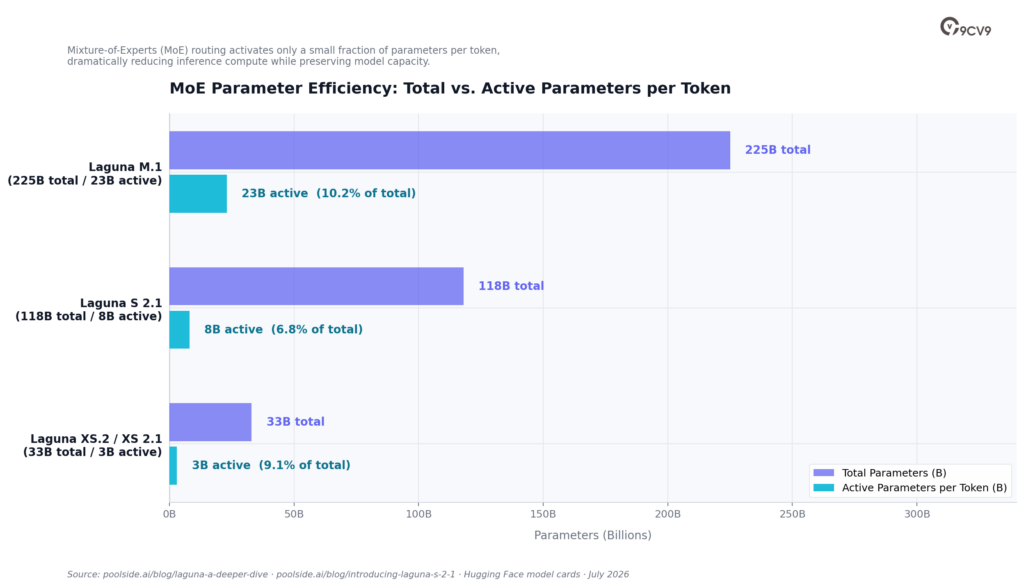
One of the defining characteristics of the Laguna family is its adoption of Mixture-of-Experts (MoE) architecture. Rather than activating every parameter during inference, Mixture-of-Experts models dynamically select only the most relevant subsets of specialized neural network experts for each task. This design enables significantly greater computational efficiency while maintaining extremely high model capacity. The result is a system capable of handling sophisticated software engineering problems without requiring the computational expense associated with activating hundreds of billions of parameters simultaneously. As enterprises continue searching for cost-effective AI infrastructure, sparse architectures such as those used in Laguna are becoming increasingly important.
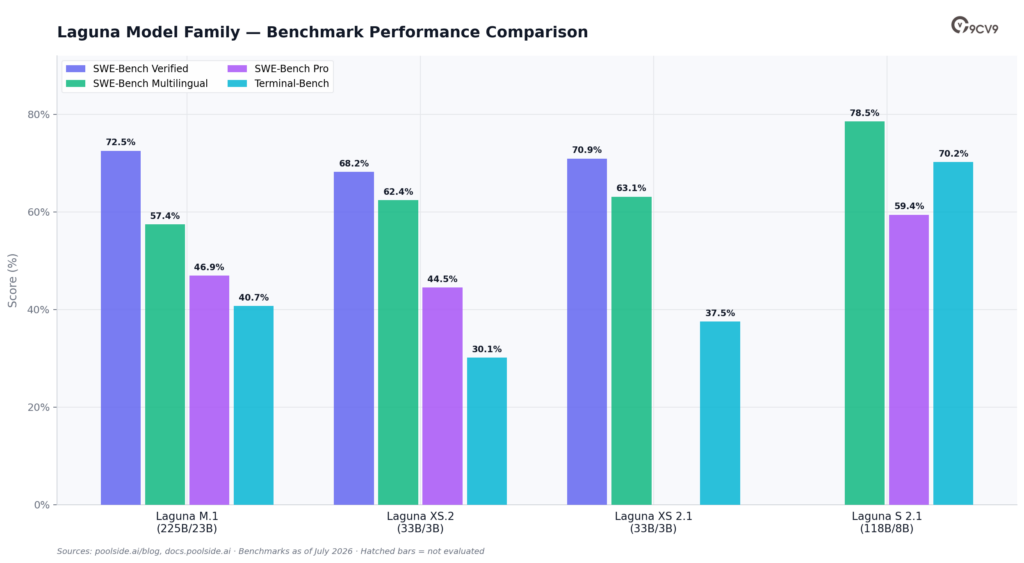
The Laguna ecosystem itself consists of multiple models designed for different deployment scenarios and organizational needs. Flagship models such as Laguna M.1 target large-scale enterprise software engineering with extensive reasoning capabilities, while smaller models like Laguna XS 2.1 prioritize efficiency, local deployment, and accessibility without sacrificing coding performance. Intermediate models such as Laguna S 2.1 provide an effective balance between computational efficiency and engineering capability, allowing organizations to choose the most appropriate model for their infrastructure, workload, and operational requirements. This diversified model lineup reflects a recognition that no single AI model can optimally serve every developer, startup, or enterprise.
Another distinguishing feature of Poolside.ai’s approach lies in its commitment to agentic software engineering. Traditional coding assistants primarily respond to prompts with isolated code snippets or suggestions. In contrast, the Laguna models are designed to execute longer engineering workflows that may involve reading documentation, analyzing repositories, modifying multiple files, generating tests, validating implementations, debugging failures, and iteratively refining solutions. These capabilities move AI beyond simple autocomplete toward autonomous engineering systems capable of assisting throughout the software development process.
Training AI models capable of performing these complex tasks requires significantly more than simply exposing them to large collections of source code. Poolside.ai has invested heavily in building its proprietary Model Factory—an industrial-scale infrastructure responsible for dataset generation, synthetic data creation, reinforcement learning, distributed training, evaluation pipelines, and continuous model optimization. Through sophisticated orchestration systems and large-scale compute infrastructure, the company seeks to industrialize AI model development in much the same way modern software companies industrialized continuous integration and deployment. This emphasis on repeatable, scalable model production differentiates Poolside.ai from organizations relying solely on conventional foundation model training pipelines.
Equally important is the extensive benchmarking conducted to evaluate the Laguna models against competing AI coding systems. Modern software engineering benchmarks such as SWE-bench, SWE-bench Verified, SWE-bench Multilingual, SWE-Bench Pro, and Terminal-Bench have become increasingly influential because they measure practical engineering abilities rather than isolated coding tasks. Instead of simply generating code from prompts, these benchmarks evaluate a model’s capacity to solve real software issues, navigate repositories, fix bugs, modify existing systems, and complete realistic engineering workflows. Strong performance across these benchmarks provides a more accurate indication of how effectively AI systems can contribute to production software development.
Beyond benchmark performance, deployment flexibility has emerged as one of the Laguna family’s strongest differentiators. Organizations increasingly require the ability to deploy AI models in ways that align with their operational and regulatory requirements. Some enterprises prefer managed cloud APIs for simplicity and scalability, while others require virtual private cloud deployments, fully on-premises infrastructure, or even completely air-gapped environments for maximum security. Poolside.ai accommodates these diverse deployment scenarios by offering cloud-hosted APIs, enterprise infrastructure, open-weight model releases, and support for local execution using optimized quantized models. This flexibility allows organizations to maintain ownership of sensitive source code while leveraging cutting-edge AI capabilities.
Local inference has become particularly significant as advances in model quantization dramatically reduce hardware requirements. Through techniques such as FP8, INT4, NVFP4, and other optimized formats, selected Laguna models can operate efficiently on modern consumer GPUs, enterprise accelerators, and even advanced workstation-class hardware. This enables independent developers, startups, research institutions, and enterprises to deploy sophisticated coding models without depending exclusively on cloud-based infrastructure. As concerns regarding latency, cost, privacy, and data sovereignty continue to grow, local deployment capabilities are becoming increasingly valuable across the AI ecosystem.
The Laguna ecosystem also extends beyond foundation models themselves through an expanding collection of developer tools and integrations. Solutions such as the Pool Agent CLI, editor integrations, Model Context Protocol support, and enterprise management platforms allow developers to incorporate AI directly into existing workflows rather than adapting their workflows around AI limitations. Instead of functioning merely as isolated chat interfaces, Laguna-powered tools aim to become active participants in modern software engineering environments by integrating seamlessly with repositories, development environments, continuous integration pipelines, and engineering operations.
For enterprise organizations, governance and operational management remain equally important considerations. AI adoption introduces new requirements surrounding security, auditability, policy enforcement, access control, model monitoring, and compliance with industry regulations. Poolside.ai addresses these concerns by enabling private deployments, governance controls, enterprise authentication, infrastructure isolation, and deployment options suitable for organizations operating under strict security and regulatory frameworks. These capabilities make Laguna attractive not only to technology companies but also to sectors such as finance, healthcare, manufacturing, government, cybersecurity, telecommunications, and defense, where software engineering often involves highly sensitive intellectual property.
Another noteworthy aspect of the Laguna models is their emphasis on long-context reasoning. Modern enterprise software rarely consists of isolated files. Instead, production systems often include thousands of interconnected source files, documentation, configuration files, APIs, infrastructure definitions, testing frameworks, and deployment scripts. Successfully assisting developers therefore requires AI models capable of reasoning across extensive contexts while maintaining consistency and architectural understanding. The Laguna family has been engineered to address these challenges by supporting large context windows that enable more comprehensive repository-level reasoning than earlier generations of coding assistants.
As competition within the AI coding landscape intensifies, Poolside.ai joins an increasingly crowded ecosystem that includes models from OpenAI, Anthropic, Google DeepMind, DeepSeek, Qwen, Mistral AI, and other major research organizations. However, rather than competing solely on parameter counts or benchmark rankings, Poolside.ai differentiates itself through specialization. Its singular focus on software engineering allows it to optimize every aspect of the model lifecycle—from architecture and training to evaluation, deployment, and developer tooling—for engineering productivity. This strategic focus may prove increasingly valuable as organizations prioritize practical business outcomes over general-purpose conversational capabilities.
Understanding the Laguna models therefore requires examining much more than technical specifications alone. Evaluating these systems involves exploring their underlying architecture, training methodologies, benchmark performance, deployment strategies, infrastructure requirements, quantization formats, enterprise integrations, pricing models, governance capabilities, developer tooling, and long-term strategic implications. Each of these elements contributes to the broader value proposition offered by Poolside.ai as organizations seek AI systems capable of becoming reliable engineering collaborators rather than simple coding assistants.
This comprehensive guide explores every major aspect of the Laguna ecosystem in depth. Readers will learn how the different Laguna models compare, how Mixture-of-Experts architecture improves computational efficiency, how Poolside.ai trains and evaluates its models, how enterprises can deploy them securely, how quantization enables local execution, how developer tools integrate with existing workflows, and how Laguna compares with other leading AI coding models available today. Whether you are a software developer evaluating next-generation coding assistants, an engineering leader planning enterprise AI adoption, a machine learning researcher studying specialized foundation models, or a technology decision-maker seeking secure AI infrastructure, this guide provides a detailed understanding of why the Laguna models by Poolside.ai have become one of the most important developments in the rapidly evolving world of autonomous software engineering.
Before we venture further into this article, we would like to share who we are and what we do.
About 9cv9
9cv9 is a business tech startup based in Singapore and Asia, with a strong presence all over the world.
With over ten years of startup and business experience, and being highly involved in connecting with thousands of companies and startups, the 9cv9 team has listed some important and crucial software tools in this review.
If you like to get your company listed in our top B2B software reviews, check out our world-class 9cv9 Media and PR service and pricing plans here.
The Complete Guide to the Laguna models by Poolside.ai
- Executive Summary and Organizational Context
- The Laguna Model Lineup and Parameter Architecture
- Industrial Model Factory and Advanced Training Methodologies
- Empirical Benchmarks and Quantitative Performance Analysis
- Deployment Modalities, Quantization, and Cost Structure
- Quantization Formats and Local Execution
- Developer Toolchain and Enterprise Systems Integration
- Nuanced Industry Insights and Strategic Implications
- Strategic Recommendations
1. Executive Summary and Organizational Context
Poolside has emerged as one of the fastest-growing artificial intelligence research companies dedicated exclusively to autonomous software engineering. Rather than positioning itself as a general-purpose conversational AI provider, the company has concentrated on building foundation models capable of performing real-world software development tasks with minimal human intervention. This strategic direction distinguishes Poolside from many large language model developers by emphasizing long-horizon reasoning, code execution, agentic workflows, and autonomous engineering systems instead of traditional chatbot interactions.
Founded in 2023 by former GitHub Chief Technology Officer Jason Warner and entrepreneur Eiso Kant, Poolside was established around the belief that software engineering represents one of the most measurable and scalable environments for developing advanced artificial intelligence. Programming offers deterministic execution, objective validation, automated testing, compiler feedback, and reproducible environments, making it an ideal domain for training AI systems capable of increasingly autonomous decision-making. This philosophy has become the foundation of Poolside’s long-term research roadmap toward agentic AI capable of solving increasingly complex technical problems.
Unlike conventional generative AI systems that primarily generate text responses, Poolside’s models are designed to think through engineering problems, interact with developer tools, execute commands inside secure runtime environments, inspect outputs, fix errors, and continue iterating until software objectives are completed. This execution-first philosophy underpins the company’s entire Laguna model family.
Poolside has attracted significant investor confidence through multiple funding rounds involving prominent venture capital firms and technology investors. These investments have enabled the company to build large-scale computing infrastructure, develop proprietary training systems, and pursue increasingly ambitious foundation model research focused on software engineering rather than general conversational intelligence.
Today, the Laguna model family represents the centerpiece of Poolside’s public AI platform. These models are specifically engineered for agentic coding, long-context software understanding, terminal interaction, repository-scale reasoning, and autonomous execution across complex engineering workflows. Rather than serving merely as coding assistants, Laguna models aim to function as intelligent software engineers capable of independently completing sophisticated development tasks.
The Evolution of the Laguna Model Family
The Laguna family represents Poolside’s first publicly released generation of foundation models dedicated to autonomous software engineering.
The family has evolved rapidly from its initial public research preview into a broader ecosystem of models optimized for different deployment environments while sharing a common architecture focused on long-horizon reasoning and autonomous coding.
| Model Generation | Primary Objective | Target Users | Primary Deployment |
|---|---|---|---|
| Laguna M.1 | Highest capability agentic coding | Enterprise developers | Cloud API |
| Laguna XS.2 | Lightweight open-weight coding model | Researchers and developers | Local deployment |
| Laguna XS 2.1 | Improved second-generation lightweight model | Community and enterprise | Local and cloud deployment |
The Laguna Family at a Glance
Poolside currently offers two primary foundation model categories.
Laguna M.1 serves as the company’s flagship enterprise-scale model designed for demanding software engineering workloads, while Laguna XS 2.1 focuses on delivering strong coding performance with significantly lower computational requirements and open-weight availability.
| Model | Position | Architecture | Typical Use Cases |
|---|---|---|---|
| Laguna M.1 | Flagship foundation model | Large Mixture-of-Experts | Enterprise engineering, long-horizon software development |
| Laguna XS 2.1 | Lightweight model | Compact Mixture-of-Experts | Local coding assistants, research, developer workstations |
Laguna M.1
Laguna M.1 represents Poolside’s highest-capability foundation model for software engineering.
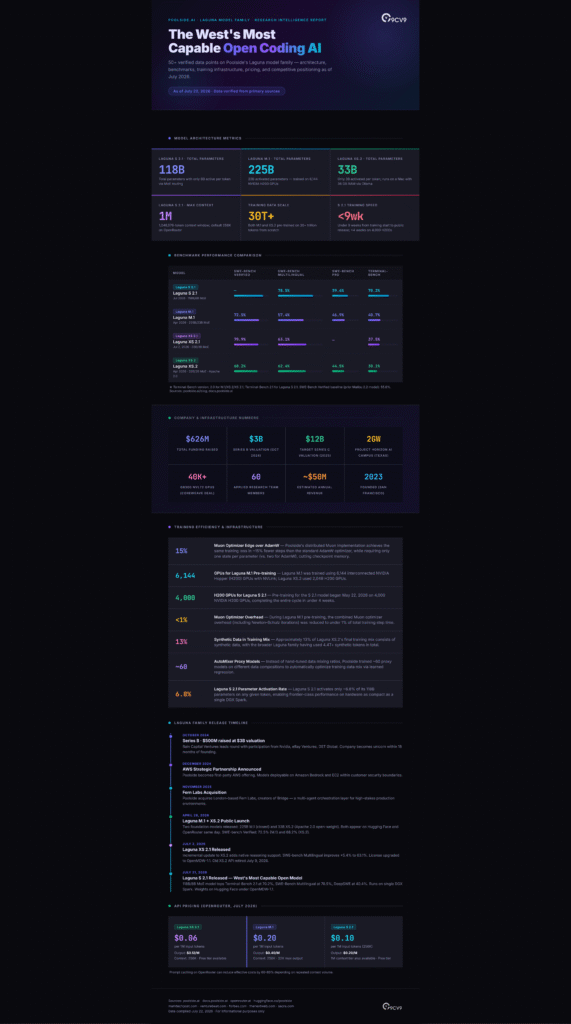
The model contains approximately 225 billion total parameters with approximately 23 billion activated during inference through its Mixture-of-Experts architecture. This design enables significantly higher computational efficiency compared with dense models of comparable capability while maintaining strong performance across agentic coding benchmarks.
Rather than focusing exclusively on code completion, Laguna M.1 is optimized for complex engineering workflows involving:
• Repository-wide reasoning
• Multi-file refactoring
• Bug diagnosis
• Automated debugging
• Terminal interaction
• Long software implementation tasks
• Tool orchestration
• Autonomous code execution
The model performs particularly well when integrated into coding agents capable of executing commands, reading outputs, modifying files, rerunning tests, and iteratively improving software until objectives are achieved.
Laguna XS 2.1
Laguna XS 2.1 represents the newest lightweight member of the Laguna family.
Although substantially smaller than Laguna M.1, the model was specifically designed to deliver efficient agentic coding performance while remaining practical for local deployment and community experimentation. It uses a 33-billion-parameter Mixture-of-Experts architecture with approximately 3 billion activated parameters during inference.
Major design priorities include:
• Faster inference
• Lower hardware requirements
• Open-weight availability
• Local execution
• Efficient coding assistance
• Strong multilingual software engineering
• Improved terminal reasoning
Its Apache 2.0 licensing also makes Laguna XS 2.1 particularly attractive to organizations wishing to customize, fine-tune, or self-host advanced coding models without proprietary deployment restrictions.
Core Design Philosophy Behind Laguna
Unlike many AI assistants that rely heavily on predefined tool-calling APIs, the Laguna family is built around software execution itself.
Instead of treating function calls as the primary interface to external systems, Laguna models generate executable software capable of interacting with arbitrary environments.
This philosophy creates much greater flexibility.
| Traditional AI Assistants | Laguna Models |
|---|---|
| Fixed tool APIs | Arbitrary code execution |
| Predefined function schemas | Dynamic script generation |
| Limited workflow flexibility | Open-ended engineering workflows |
| Static integrations | Self-generated automation |
| Tool invocation | Code execution as the action space |
According to Poolside’s published research, software itself becomes the universal interface through which intelligent agents interact with digital environments.
The Model Factory
One of Poolside’s most distinctive technological innovations is its internal Model Factory.
Rather than representing a single training pipeline, the Model Factory serves as an integrated platform responsible for:
• Dataset management
• Synthetic data generation
• Training orchestration
• Architecture experimentation
• Reinforcement learning
• Automated evaluation
• Continuous benchmarking
• Distributed inference optimization
Poolside describes the Model Factory as an industrialized foundation model development platform where experiments that previously required weeks of coordination can now be launched in significantly shorter timeframes through automated orchestration.
| Model Factory Component | Primary Function |
|---|---|
| Data pipelines | Curate large-scale training corpora |
| Synthetic generation | Expand high-quality coding datasets |
| Training orchestration | Coordinate distributed GPU training |
| Evaluation platform | Benchmark model performance |
| Reinforcement learning | Improve autonomous engineering capability |
| Experiment automation | Accelerate research iteration |
Training Pipeline
The Laguna models are trained using a multi-stage pipeline designed specifically for autonomous software engineering.
| Training Stage | Purpose |
|---|---|
| Data collection | Acquire code and software engineering datasets |
| Data filtering | Improve quality and language balance |
| Pre-training | Learn software understanding |
| Reinforcement learning | Improve autonomous execution |
| Agent evaluation | Test coding behavior in realistic environments |
| Continuous benchmarking | Validate engineering performance |
Rather than stopping after supervised pre-training, Poolside continues optimization through reinforcement learning in which agents execute software inside sandboxed environments and receive feedback from actual execution results.
The Muon Optimizer
An important innovation within Laguna’s training process is Poolside’s distributed implementation of the Muon optimizer.
According to the company’s published technical documentation, Muon achieved faster convergence than traditional AdamW optimization during pre-training while improving final model quality. Poolside reports reaching comparable training loss in roughly 15% fewer optimization steps during internal experiments, although the optimizer introduces additional computational complexity that is addressed through distributed implementation across GPU clusters.
Long-Horizon Agentic Coding
One of the defining characteristics of the Laguna family is long-horizon reasoning.
Instead of solving isolated programming questions, Laguna models are designed to complete software engineering projects involving numerous interconnected steps.
Examples include:
• Reading entire repositories
• Understanding project architecture
• Planning implementation strategies
• Editing multiple files
• Running automated tests
• Fixing discovered issues
• Repeating the process until completion
This capability moves beyond simple code generation toward autonomous engineering workflows.
Long Context Capabilities
Poolside has continued expanding the practical usability of Laguna models through larger context windows.
Following community feedback, both Laguna M.1 and Laguna XS received support for 256K-token context windows, enabling substantially larger repositories, documentation collections, and engineering projects to be processed within a single inference session. The company also reported significant early adoption following the public release, including more than one trillion processed tokens and tens of thousands of downloads for the open-weight model family.
Comparison of Laguna Models
| Feature | Laguna M.1 | Laguna XS 2.1 |
|---|---|---|
| Position | Flagship model | Lightweight model |
| Primary Deployment | Cloud API | Local and cloud |
| Architecture | Mixture-of-Experts | Mixture-of-Experts |
| Total Parameters | Approximately 225B | Approximately 33B |
| Active Parameters | Approximately 23B | Approximately 3B |
| Long-Horizon Tasks | Excellent | Strong |
| Local Deployment | Limited | Optimized |
| Open Weights | Available | Available |
| Enterprise Usage | Excellent | Good |
| Research Usage | Excellent | Excellent |
Ideal Use Cases
| User Type | Recommended Laguna Model | Reason |
|---|---|---|
| Enterprise software teams | Laguna M.1 | Maximum coding capability |
| Research laboratories | Laguna XS 2.1 | Open experimentation |
| Independent developers | Laguna XS 2.1 | Local deployment |
| AI coding startups | Laguna M.1 | Autonomous engineering workflows |
| Security-sensitive organizations | Laguna M.1 | Designed for controlled deployment environments |
| Open-source contributors | Laguna XS 2.1 | Apache 2.0 licensing |
Key Advantages of the Laguna Ecosystem
| Advantage | Practical Benefit |
|---|---|
| Agentic coding focus | Supports autonomous engineering workflows |
| Long-horizon reasoning | Handles complex multi-step software projects |
| Mixture-of-Experts architecture | Higher computational efficiency |
| Open-weight availability | Enables customization and self-hosting |
| Large context windows | Processes extensive codebases |
| Reinforcement learning from execution | Improves real-world coding behavior |
| Native terminal interaction | Supports execution-driven development |
| Model Factory infrastructure | Accelerates continuous model improvement |
Future Outlook
The Laguna family represents Poolside’s long-term vision of software engineering as the primary pathway toward increasingly capable artificial intelligence systems. Rather than competing solely on conversational ability, Poolside continues investing in autonomous coding, reinforcement learning from executable software, scalable model training infrastructure, and open-weight development. Its ongoing research indicates continued work on larger context handling, improved reinforcement learning techniques, enhanced agent runtimes, and broader deployment options for enterprise and developer communities. As organizations increasingly adopt AI-assisted software development, the Laguna ecosystem is positioned as a specialized platform for autonomous engineering rather than a general-purpose chatbot, reflecting Poolside’s belief that mastering software creation is a foundational step toward more capable AI systems.
2. The Laguna Model Lineup and Parameter Architecture
The Laguna family represents Poolside’s portfolio of Mixture-of-Experts (MoE) foundation models designed specifically for autonomous software engineering, agentic coding, and long-horizon reasoning. Unlike traditional dense large language models that activate every parameter during inference, the Laguna architecture activates only a subset of specialized experts for each token. This significantly reduces computational overhead while preserving the benefits of extremely large parameter counts, enabling higher efficiency across cloud infrastructure, enterprise deployments, and local developer workstations.
The Laguna model lineup has been intentionally diversified to support a wide range of deployment environments. From enterprise-scale cloud clusters capable of processing million-token repositories to lightweight models optimized for single-GPU execution, each variant addresses different infrastructure requirements while maintaining Poolside’s core emphasis on software engineering rather than general conversational AI.
A defining characteristic of the Laguna ecosystem is its shared architectural philosophy. Every model emphasizes repository-scale understanding, autonomous code execution, terminal interaction, multi-file reasoning, and reinforcement learning from executable software. Although the parameter counts, licensing models, and context windows differ across variants, they all inherit the same research objective of enabling increasingly autonomous software development workflows.
Laguna Model Family Overview
| Model Variant | Total / Active Parameters | Maximum Context Window | Primary License | Recommended Deployment Environment |
|---|---|---|---|---|
| Laguna M.1 | 225.8B / 23.4B | 262,144 tokens (256K) | Enterprise availability | Large-scale enterprise AI infrastructure, private cloud, secure VPC deployments |
| Laguna S 2.1 | 118B / 8B | 1,048,576 tokens (1M) | OpenMDW / Commercial | Large enterprise repositories, DGX Spark systems, advanced engineering environments |
| Laguna XS.2 | 33.4B / 3B | 262,144 tokens (256K) | Apache 2.0 | Single-GPU workstations, Apple Silicon, edge deployments |
| Laguna XS 2.1 | 33B / 3B | 262,144 tokens (256K) | OpenMDW-1.1 | Local coding agents, command-line development, software engineering workflows |
| Malibu 2.2 | Dense architecture | 128,000 tokens (128K) | Enterprise | Low-latency IDE completion, inline editing, interactive development assistance |
Note that some newer commercial models, including Laguna S 2.1 and Malibu 2.2, have been described in recent Poolside product materials and partner documentation but have not yet been accompanied by the same level of publicly available technical documentation as Laguna M.1 and Laguna XS.2.
Comparison of the Laguna Model Portfolio
| Characteristic | Laguna M.1 | Laguna S 2.1 | Laguna XS.2 | Laguna XS 2.1 | Malibu 2.2 |
|---|---|---|---|---|---|
| Primary Focus | Maximum software engineering capability | Large-scale repository reasoning | Lightweight open-weight coding | Optimized local coding agent | Real-time IDE assistance |
| Architecture | Sparse Mixture-of-Experts | Sparse Mixture-of-Experts | Sparse Mixture-of-Experts | Sparse Mixture-of-Experts | Dense Transformer |
| Local Deployment | Limited | Moderate | Excellent | Excellent | Excellent |
| Enterprise Deployment | Excellent | Excellent | Good | Good | Excellent |
| Long-Horizon Reasoning | Excellent | Excellent | Strong | Improved | Moderate |
| Autonomous Tool Use | Native | Native | Native | Enhanced | Limited |
| Open Model Availability | Limited | Partial | Yes | Restricted OpenMDW | No |
Understanding the Mixture-of-Experts Architecture
The entire Laguna family is built upon the Mixture-of-Experts paradigm rather than conventional dense transformer architectures.
In a traditional dense model, every parameter participates in generating every token. While this maximizes representational capacity, it also significantly increases inference costs and hardware requirements.
The Mixture-of-Experts architecture addresses this limitation by activating only a small collection of specialized neural experts during inference. A routing mechanism determines which experts are most relevant for each incoming token, allowing the model to benefit from hundreds of billions of parameters while executing only a fraction of them at any given time.
| Dense Transformer | Mixture-of-Experts Architecture |
|---|---|
| Every parameter processes every token | Only selected experts process each token |
| Higher computational cost | Lower computational cost |
| Greater inference latency | Faster inference |
| Limited scalability | Highly scalable parameter growth |
| Uniform computation | Dynamic expert routing |
This design enables Laguna models to deliver enterprise-scale reasoning capabilities while remaining computationally practical for production deployment across diverse hardware platforms.
Architectural Deep Dive: Laguna M.1
Laguna M.1 is Poolside’s flagship foundation model for autonomous software engineering and represents the company’s largest publicly described architecture.
The model contains approximately 225.8 billion total parameters while activating only around 23.4 billion parameters during inference through its sparse Mixture-of-Experts routing mechanism. This balance provides the expressive capacity of an extremely large neural network without requiring every parameter to participate in each computation cycle.
Architecturally, Laguna M.1 is composed of a 70-layer transformer network.
Its structure includes:
• Three dense SwiGLU projection layers at the beginning of the network
• Sixty-seven sparse Mixture-of-Experts transformer layers
• Two hundred fifty-six routed experts
• One shared expert available across all routing decisions
• Top-k routing strategy activating sixteen experts per token
Unlike many earlier MoE implementations, Poolside reports that Laguna M.1 does not require auxiliary load-balancing losses for expert routing, simplifying optimization while maintaining effective utilization across experts.
Laguna M.1 Architectural Summary
| Component | Specification |
|---|---|
| Total Parameters | 225.8 billion |
| Active Parameters | 23.4 billion |
| Transformer Layers | 70 |
| Dense Layers | 3 |
| Sparse MoE Layers | 67 |
| Routed Experts | 256 |
| Shared Experts | 1 |
| Active Experts per Token | 16 |
| Architecture Type | Sparse Mixture-of-Experts |
Long-Context Attention Architecture
One of Laguna M.1’s defining innovations is its unified long-context attention system.
The model applies Grouped-Query Attention (GQA) consistently across every transformer layer. GQA reduces memory consumption while maintaining strong attention quality across extremely long sequences.
Its published configuration includes:
• 64 Query heads
• 8 Key-Value heads
• Head dimension of 128
• Softplus-gated attention outputs
• Rotary Position Embeddings (RoPE)
• YaRN scaling for extended context
These components collectively enable efficient reasoning across context windows extending to 262,144 tokens while preserving stable attention quality over very long software repositories and documentation collections.
Attention Architecture Summary
| Attention Component | Configuration |
|---|---|
| Attention Method | Grouped-Query Attention |
| Query Heads | 64 |
| Key-Value Heads | 8 |
| Head Dimension | 128 |
| Output Gating | Softplus |
| Positional Encoding | Rotary Position Embeddings |
| Context Extension | YaRN Scaling |
| Maximum Context | 262,144 Tokens |
Architectural Deep Dive: Laguna XS.2 and Laguna XS 2.1
Laguna XS.2 was designed as a compact open-weight alternative to the flagship M.1 model while preserving many of the architectural principles used throughout the Laguna ecosystem.
The model contains approximately 33.4 billion total parameters while activating only 3 billion parameters per token, enabling deployment on significantly smaller hardware without sacrificing competitive agentic coding performance.
The architecture includes:
• Forty transformer layers
• Two hundred fifty-six routed experts
• Sparse Mixture-of-Experts routing
• Large 256K-token context window
• Quantization optimized for local deployment
Its smaller active parameter count substantially reduces inference costs, making the model suitable for local development environments, consumer GPUs, and Apple Silicon systems.
Laguna XS Architecture Summary
| Component | Specification |
|---|---|
| Total Parameters | 33.4 billion |
| Active Parameters | 3 billion |
| Transformer Layers | 40 |
| Experts | 256 |
| Maximum Context | 262,144 Tokens |
| Architecture | Sparse Mixture-of-Experts |
Enhancements Introduced in Laguna XS 2.1
Laguna XS 2.1 builds upon the XS.2 foundation while introducing several enhancements focused on local developer productivity and agentic execution.
The updated model incorporates native reasoning support capable of maintaining structured internal reasoning across multiple execution cycles. Poolside also optimized the model for multilingual software engineering, terminal-based workflows, and interactive tool execution, while preserving the compact architecture that allows efficient local inference. Recent releases also introduced compatibility with speculative decoding optimizations to improve inference speed during coding tasks.
Key improvements include:
• Improved multi-turn reasoning
• Better terminal interaction
• Enhanced multilingual programming capability
• Faster local inference
• Improved coding benchmark performance
• Optimized execution efficiency
Laguna XS Evolution
| Capability | Laguna XS.2 | Laguna XS 2.1 |
|---|---|---|
| Agentic Coding | Excellent | Improved |
| Local Deployment | Excellent | Excellent |
| Terminal Reasoning | Strong | Enhanced |
| Multilingual Coding | Good | Improved |
| Native Reasoning | Basic | Advanced |
| Inference Optimization | Standard | Enhanced |
Architectural Overview: Laguna S 2.1
Laguna S 2.1 occupies the middle tier within the Laguna product family, balancing enterprise-scale capability with more practical deployment requirements than the flagship M.1.
According to recently published product information, Laguna S 2.1 contains approximately 118 billion total parameters while activating around 8 billion parameters during inference. The model’s defining feature is its exceptionally large one-million-token context window, allowing organizations to process massive software repositories, documentation archives, and engineering knowledge bases within a single inference session.
This expanded context capacity makes Laguna S 2.1 particularly well suited for:
• Enterprise repository modernization
• Organization-wide code analysis
• Large-scale refactoring
• Documentation reasoning
• Cross-project dependency analysis
• Software architecture reviews
Its parameter size also enables deployment on advanced AI hardware platforms such as NVIDIA DGX Spark systems without requiring the extensive infrastructure associated with the flagship M.1 deployment.
Laguna S 2.1 Enterprise Positioning
| Feature | Enterprise Benefit |
|---|---|
| 118B Total Parameters | Strong reasoning with efficient inference |
| 8B Active Parameters | Lower computational overhead |
| 1M Token Context | Repository-scale understanding |
| MoE Architecture | Efficient enterprise deployment |
| Mid-Tier Infrastructure Requirements | Reduced deployment costs |
| Large Workspace Analysis | End-to-end software modernization |
How the Laguna Models Compare
| Feature | Laguna M.1 | Laguna S 2.1 | Laguna XS 2.1 |
|---|---|---|---|
| Total Parameters | 225.8B | 118B | 33B |
| Active Parameters | 23.4B | 8B | 3B |
| Architecture | Sparse MoE | Sparse MoE | Sparse MoE |
| Maximum Context | 256K | 1M | 256K |
| Primary Users | Large enterprises | Medium and large engineering teams | Individual developers and local deployments |
| Infrastructure | Multi-node enterprise clusters | DGX-class systems | Consumer GPUs and workstations |
| Main Strength | Autonomous software engineering | Repository-scale reasoning | Lightweight agentic coding |
Overall, the Laguna lineup illustrates Poolside’s strategy of delivering specialized foundation models for software engineering across multiple deployment scales. Rather than offering a single universal model, the company has developed a tiered architecture that ranges from locally deployable open-weight systems to enterprise-grade models capable of analyzing entire software ecosystems, all while leveraging the efficiency advantages of Mixture-of-Experts architectures and long-context reasoning.
3. Industrial Model Factory and Advanced Training Methodologies
One of Poolside’s most significant technical innovations extends beyond the Laguna model architecture itself. The company has developed an integrated engineering platform known internally as the Model Factory, an industrial-scale framework designed to standardize, automate, and accelerate every stage of foundation model development. Rather than treating each model as an isolated research project, Poolside views model creation as a repeatable manufacturing process where data engineering, training, evaluation, reinforcement learning, deployment, and experimentation are managed through a unified infrastructure. This industrialized approach enabled the company to build and release Laguna XS.2 from initial development to production in approximately five weeks while maintaining reproducibility, scalability, and engineering consistency.
Unlike traditional AI research environments that often rely on manually configured experiments and disconnected pipelines, the Model Factory emphasizes automation, traceability, and modular engineering. Every experiment, dataset version, model checkpoint, and configuration is tracked throughout its lifecycle, enabling researchers to reproduce results, compare experiments, and integrate improvements rapidly into production-scale training runs.
Model Factory at a Glance
| Component | Primary Purpose | Benefit |
|---|---|---|
| Data Platform | Data ingestion, preprocessing, validation | Consistent high-quality training data |
| Dagster Control Plane | Workflow orchestration and lineage tracking | Complete experiment reproducibility |
| Titan Training Engine | Distributed model training | Unified pre-training and reinforcement learning |
| AutoMixer | Dataset optimization | Improved downstream model performance |
| Synthetic Data Pipeline | Artificial training data generation | Increased diversity and capability |
| Harbor Framework | Reinforcement learning execution | Real-world software engineering environments |
| Evaluation Pipeline | Continuous benchmarking | Objective quality measurement |
| Deployment Infrastructure | Model serving and inference | Production-ready deployment |
The Model Factory Philosophy
Poolside’s engineering philosophy is centered on treating foundation model development as an industrial process rather than an artisanal research activity.
Three fundamental principles define this methodology:
• Experiments as code
• Fully composable infrastructure
• Automation of repetitive engineering tasks
Every experiment is expressed as version-controlled code within a unified repository. Rather than manually configuring individual training runs, researchers define datasets, architectures, hyperparameters, evaluation suites, and deployment configurations programmatically. This ensures that every model checkpoint can be reproduced precisely from its original inputs.
Core Design Principles
| Principle | Description | Practical Outcome |
|---|---|---|
| Experiments as Code | Every configuration stored in version control | Complete reproducibility |
| Full Lineage | Every artifact linked to its origin | Transparent audit trails |
| Composable Components | Shared infrastructure across all workflows | Faster research iteration |
| Automated Infrastructure | Reduced manual operational work | Higher engineering productivity |
| Research Standardization | Unified development process | Faster deployment of innovations |
Directed Acyclic Graph-Based Workflow Management
At the heart of the Model Factory lies a workflow orchestration system managed through Dagster.
Dagster functions as the central control plane responsible for coordinating every stage of model development. Instead of isolated scripts, the complete lifecycle is represented as a Directed Acyclic Graph (DAG), where every processing stage depends upon validated upstream assets.
This architecture allows researchers to determine:
• Which datasets produced a particular checkpoint
• Which preprocessing pipeline generated each training shard
• Which model configuration produced benchmark results
• Which experiments contributed to final production releases
By maintaining complete dependency tracking, Poolside can reproduce any historical experiment while simultaneously accelerating new research.
Model Factory Workflow
| Stage | Primary Activity | Output |
|---|---|---|
| Raw Data Collection | Gather web, code and technical documents | Raw datasets |
| Data Processing | Cleaning, parsing and filtering | Curated datasets |
| Data Mixing | AutoMixer optimization | Optimized training mixture |
| Pre-training | Distributed foundation model training | Base model |
| Post-training | Instruction tuning | Instruction-following model |
| Reinforcement Learning | Agent optimization | Autonomous coding model |
| Benchmark Evaluation | Performance testing | Production checkpoints |
Comprehensive Asset Lineage
One of the most sophisticated capabilities of the Model Factory is complete asset lineage.
Poolside reports that virtually every artifact generated during model development can be traced backward through the pipeline.
This includes:
• Model checkpoints
• Dataset snapshots
• Preprocessing configurations
• Synthetic data generators
• Deduplication filters
• Packed training shards
• Original source documents
This traceability enables engineers to diagnose unexpected behaviors, reproduce experiments precisely, and evaluate how individual data sources influence downstream model quality.
Asset Lineage Overview
| Asset | Traceability |
|---|---|
| Model checkpoint | Linked to exact training configuration |
| Dataset | Linked to preprocessing pipeline |
| Training shard | Linked to original documents |
| Synthetic samples | Linked to generation strategy |
| Evaluation results | Linked to corresponding checkpoint |
| Reinforcement learning trajectories | Linked to policy version |
Large-Scale Data Processing Infrastructure
Training frontier-scale language models requires processing enormous quantities of raw information.
Poolside’s data platform is built on Apache Spark and is designed to preprocess up to approximately 20 trillion tokens per day during large-scale ingestion operations. This infrastructure supports parsing, filtering, deduplication, language identification, and token preparation across massive datasets before distributed model training begins.
The preprocessing pipeline incorporates multiple specialized components responsible for:
• HTML parsing
• Document normalization
• Code extraction
• Metadata enrichment
• Language identification
• Dataset validation
• Tokenization
• Training shard construction
Distributed Cluster Scheduling
Rather than relying on conventional Kubernetes scheduling mechanisms alone, Poolside developed a custom scheduling platform designed specifically for large AI training clusters.
The scheduler is built on FoundationDB instead of traditional etcd-based coordination systems, reducing scheduling bottlenecks across very large GPU deployments. The architecture supports clusters approaching 10,000 accelerators while maintaining low-latency job scheduling and efficient resource utilization.
One notable innovation is “sticky pod respawn,” a recovery mechanism that preserves communication topology when hardware failures occur. Instead of rebuilding an entire distributed job after node failures, workloads are restored while maintaining locality across high-speed GPU interconnects, reducing disruption during long-running training sessions.
Infrastructure Components
| Infrastructure Layer | Technology | Purpose |
|---|---|---|
| Workflow Control | Dagster | Pipeline orchestration |
| Data Processing | Apache Spark | Large-scale preprocessing |
| Cluster Scheduler | FoundationDB-based scheduler | Distributed workload management |
| Training Engine | Titan | Distributed model training |
| Execution Platform | Harbor Framework | Agent reinforcement learning |
| Storage | Apache Iceberg | Trajectory storage |
Pre-Training Data Strategy
Poolside trained the Laguna foundation models on more than 30 trillion tokens collected from multiple complementary sources.
Rather than relying exclusively on public internet text, the dataset incorporates diverse software engineering materials including source code, technical documentation, web content, and synthetic training data. This broad mixture is intended to improve software reasoning while maintaining general language capabilities.
Primary Data Sources
| Source Category | Purpose |
|---|---|
| Public software repositories | Programming knowledge |
| Technical documentation | API understanding |
| Curated web content | General language knowledge |
| Scientific literature | Technical reasoning |
| Synthetic datasets | Expanded software tasks |
| Generated debugging examples | Agent training |
Language Detection Pipeline
Incoming documents undergo automated language classification before entering the training corpus.
Poolside combines GlotLID with fallback mechanisms for shorter text fragments to improve language detection accuracy across diverse internet content. This ensures balanced multilingual coverage while maintaining high-quality software engineering examples.
Multi-Dimensional Data Quality Evaluation
Unlike many foundation model pipelines that aggressively filter data based solely on quality scores, Poolside employs a more nuanced strategy.
The company reports that overly aggressive filtering often removes valuable engineering content such as configuration files, operational documentation, debugging logs, and specialized software documentation.
Instead, documents are evaluated across multiple dimensions including:
• Noise level
• Information density
• Domain diversity
• Structural usefulness
By preserving controlled proportions of lower-ranked yet information-rich technical content, Poolside significantly expanded the diversity of training examples without sacrificing downstream model quality.
Data Filtering Comparison
| Traditional Filtering | Poolside Strategy |
|---|---|
| Remove lower-quality documents | Preserve informative technical material |
| Heavy emphasis on clean prose | Include engineering artifacts |
| Aggressive deduplication | Controlled snapshot-based deduplication |
| General-purpose optimization | Software engineering optimization |
Snapshot-Based Deduplication
Poolside also departs from conventional deduplication methodologies.
Instead of globally removing repeated content, deduplication occurs primarily at individual dataset snapshots. According to the company, global deduplication can inadvertently eliminate useful programming syntax, recurring software patterns, and common engineering structures that contribute positively to model learning.
AutoMixer: Automated Dataset Optimization
One of the most distinctive innovations within the Model Factory is AutoMixer.
Rather than manually selecting dataset proportions, AutoMixer automatically searches for optimal training mixtures using dozens of proxy models trained under different data compositions.
Each proxy model is evaluated across multiple capability domains, including:
• Code generation
• Mathematical reasoning
• Logical reasoning
• General language understanding
• Software engineering
Performance measurements are then used to build surrogate regression models that predict how changes in dataset composition influence downstream capability. These predictions guide optimization of the final large-scale training mixture before expensive frontier-scale training begins. Poolside reports substantial improvements over manual mixture design on coding benchmarks using this automated approach.
AutoMixer Workflow
| Stage | Function |
|---|---|
| Generate candidate mixtures | Create alternative dataset compositions |
| Train proxy models | Evaluate candidate mixtures |
| Benchmark capabilities | Measure downstream performance |
| Fit surrogate models | Predict mixture quality |
| Optimize final mixture | Select production dataset |
Synthetic Data Generation Pipeline
Synthetic data forms an important component of Laguna’s training strategy.
According to Poolside, more than 4.4 trillion synthetic tokens contributed to the overall training corpus, with synthetic content accounting for approximately 13% of the Laguna XS.2 pre-training mixture.
The company employs two complementary synthetic generation strategies.
Seed-heavy generation begins with high-quality source material that is transformed into multiple alternative representations, including conversational dialogues, question-and-answer datasets, structured documentation, and API references. This exposes the model to varied prompt styles while preserving the underlying technical concepts.
Pipeline-heavy generation focuses instead on extracting structural relationships from software systems. Existing codebases are transformed into debugging scenarios, refactoring exercises, software architecture problems, and unit-testing challenges, encouraging the model to learn execution logic rather than simple code memorization.
Synthetic Data Strategies
| Strategy | Objective | Generated Examples |
|---|---|---|
| Seed-Heavy Generation | Expand existing knowledge | Conversations, documentation, API references |
| Pipeline-Heavy Generation | Create reasoning tasks | Debugging, refactoring, testing scenarios |
Optimization with the Muon Optimizer
Poolside replaced the widely used AdamW optimizer with its distributed implementation of the Muon optimizer throughout both pre-training and post-training.
Muon applies orthogonalized momentum updates derived from Newton-Schulz iterations, allowing larger effective learning rates while maintaining numerical stability during large-scale distributed optimization.
Compared with tuned AdamW baselines, Poolside reports that Muon reached equivalent target cross-entropy losses using approximately 15% fewer optimization steps. The distributed implementation also maintained optimization overhead below one percent of total training time on clusters exceeding six thousand NVIDIA Hopper GPUs.
Muon Benefits
| Feature | Benefit |
|---|---|
| Orthogonal momentum updates | Stable optimization |
| Larger effective learning rates | Faster convergence |
| Lower optimizer memory | Approximately 50% less optimizer state memory |
| Distributed implementation | Efficient multi-GPU scaling |
| Reduced training steps | Faster pre-training |
Training Stability Engineering
Poolside incorporated multiple engineering safeguards to improve training reliability.
These include:
• Subtoken averaging for vocabulary expansion
• Embedding warm-up phases
• Frozen transformer layers during initialization
• Cross-replica weight hash verification
• Silent Data Corruption detection
Periodic hash verification enables the system to detect corruption caused by hardware faults that may not be captured through conventional memory error correction mechanisms, helping prevent divergence during extended training runs.
Asynchronous Online Agent Reinforcement Learning
Following supervised pre-training and instruction tuning, Laguna models undergo reinforcement learning using an asynchronous online framework designed specifically for software engineering.
Rather than synchronizing every stage of the reinforcement learning process, Poolside separates inference, execution, evaluation, and optimization into independent pipelines operating concurrently. This architecture improves GPU utilization while allowing continuous policy improvement over extended training periods.
Reinforcement Learning Pipeline
| Stage | Description |
|---|---|
| Model Deployment | Updated checkpoints distributed to inference clusters |
| Task Execution | Agents solve software engineering tasks inside isolated containers |
| Trajectory Collection | Commands, edits and execution traces recorded |
| Automated Evaluation | Test suites score completed solutions |
| Policy Optimization | Model weights updated using collected trajectories |
Sandboxed Software Engineering
During reinforcement learning, autonomous agents operate inside isolated containerized environments powered by the Harbor Framework.
Within these environments, agents can:
• Execute shell commands
• Read project files
• Modify source code
• Run automated tests
• Compile software
• Validate program behavior
Successful and unsuccessful trajectories are recorded for subsequent policy optimization, allowing the models to learn directly from executable software engineering tasks rather than static demonstrations alone.
CISPO Policy Optimization
To address delays between trajectory generation and policy updates, Poolside developed a reinforcement learning algorithm known as Clipped-Incentive Sampled Policy Optimization (CISPO).
CISPO is designed to stabilize asynchronous off-policy learning by compensating for policy differences that naturally emerge while actors continue generating experiences using slightly older model versions. This allows reinforcement learning to proceed continuously over multi-day training runs without requiring frequent synchronization pauses or additional entropy regularization.
Overall Model Factory Architecture
| Layer | Core Technologies | Primary Function |
|---|---|---|
| Workflow Management | Dagster | Orchestration and lineage |
| Data Platform | Apache Spark | Preprocessing and token generation |
| Dataset Optimization | AutoMixer | Training mixture optimization |
| Training Engine | Titan | Distributed foundation model training |
| Optimizer | Muon | Efficient large-scale optimization |
| Execution Platform | Harbor Framework | Agent reinforcement learning |
| Storage | Apache Iceberg | Trajectory persistence |
| Policy Learning | CISPO | Stable asynchronous reinforcement learning |
Collectively, the Model Factory demonstrates Poolside’s emphasis on industrializing foundation model development rather than optimizing isolated algorithms. By combining automated workflow orchestration, large-scale distributed infrastructure, advanced data engineering, synthetic data generation, efficient optimization techniques, and asynchronous reinforcement learning, the company has established an integrated platform capable of accelerating research while maintaining reproducibility, scalability, and high-performance software engineering models.
4. Empirical Benchmarks and Quantitative Performance Analysis
Evaluating modern coding foundation models requires far more than measuring code completion accuracy. As artificial intelligence systems increasingly transition from passive code generators to autonomous software engineering agents, the emphasis has shifted toward benchmarks that assess repository-scale reasoning, debugging, tool use, terminal interaction, and the ability to solve real-world engineering problems. Poolside designed the Laguna model family with these challenges in mind, and its evaluation strategy reflects this focus on agentic software development rather than conventional programming assistance.
The company evaluates Laguna models across several industry-recognized software engineering benchmarks, including SWE-bench Verified, SWE-bench Multilingual, SWE-Bench Pro, and Terminal-Bench 2.0. These benchmarks collectively assess an AI model’s ability to understand existing repositories, diagnose defects, modify multiple files, execute code, interact with command-line environments, and verify solutions through automated testing rather than simply generating isolated code snippets.
Rather than relying on synthetic evaluation tasks alone, these benchmarks simulate realistic engineering workflows, making them particularly valuable indicators of how well a model performs in production software development environments.
Why Agentic Benchmarks Matter
Traditional code generation benchmarks typically evaluate whether a model can generate a correct function from a prompt. However, modern software engineering requires substantially broader capabilities.
Developers must:
• Understand large repositories
• Navigate unfamiliar project structures
• Diagnose bugs
• Edit multiple files simultaneously
• Execute terminal commands
• Run automated tests
• Interpret compiler errors
• Iterate until software passes validation
Agentic benchmarks attempt to measure these end-to-end engineering workflows rather than isolated code generation accuracy.
Modern Software Engineering Evaluation
| Traditional Coding Benchmarks | Agentic Software Engineering Benchmarks |
|---|---|
| Function generation | Repository-level reasoning |
| Single prompt completion | Multi-step engineering workflows |
| Static code output | Interactive execution |
| No tool usage | Terminal and shell interaction |
| No verification | Automated testing and validation |
| Limited context | Large codebase understanding |
Evaluation Methodology
Poolside reports that official Laguna benchmark evaluations were conducted using the Laude Institute’s Harbor Framework together with the company’s own agent harness.
To ensure consistency across benchmark comparisons, standardized inference parameters were used throughout testing.
These include:
• Temperature: 1.0
• Top-k sampling: 20
• Top-p sampling: 1.0
• Native reasoning enabled
• Maximum context window of 256K tokens
For SWE-bench evaluations, each sandbox environment received:
• 8 GB RAM
• 2 CPU cores
Terminal-Bench 2.0 evaluations used significantly larger execution environments consisting of:
• 48 GB RAM
• 32 CPU cores
Each benchmark was executed multiple times, with reported scores representing average Pass@1 performance across repeated runs to reduce statistical variance. Poolside also states that evaluation environments were patched where necessary to eliminate infrastructure-related failures such as third-party dependency rate limits and that post-evaluation reward-hacking analyses found no significant evidence of benchmark exploitation.
Benchmark Configuration Summary
| Evaluation Parameter | Configuration |
|---|---|
| Agent Framework | Laude Institute Harbor Framework |
| Generation Temperature | 1.0 |
| Top-k | 20 |
| Top-p | 1.0 |
| Native Reasoning | Enabled |
| Context Length | Up to 256K Tokens |
| SWE-bench Hardware | 8 GB RAM, 2 CPUs |
| Terminal-Bench Hardware | 48 GB RAM, 32 CPUs |
| Evaluation Metric | Mean Pass@1 |
Understanding the Major Benchmarks
SWE-bench Verified
SWE-bench Verified evaluates whether AI systems can resolve genuine GitHub issues drawn from popular open-source software repositories. Success requires understanding an existing codebase, modifying the correct files, and producing changes that satisfy automated verification tests. It has become one of the industry’s most widely referenced software engineering benchmarks.
SWE-bench Multilingual
This benchmark extends the SWE-bench methodology to multilingual software engineering tasks, measuring how effectively models reason across programming languages and diverse development ecosystems. It evaluates the generalization capabilities of coding models beyond single-language repositories.
SWE-Bench Pro
SWE-Bench Pro increases overall task difficulty by emphasizing more challenging software engineering problems that demand deeper repository understanding, sophisticated reasoning, and multi-step code modifications. It serves as a stronger indicator of performance on enterprise-scale engineering work.
Terminal-Bench 2.0
Terminal-Bench 2.0 measures a model’s ability to operate autonomously within command-line environments. Rather than generating code alone, models must interact with shells, execute commands, inspect outputs, modify files, and complete software engineering objectives through iterative execution. This benchmark closely aligns with Poolside’s vision of execution-first autonomous software engineering.
Overview of the Benchmark Suite
| Benchmark | Primary Evaluation Focus | Measures |
|---|---|---|
| SWE-bench Verified | Real GitHub issue resolution | Repository reasoning and bug fixing |
| SWE-bench Multilingual | Cross-language software engineering | Multilingual programming capability |
| SWE-Bench Pro | Advanced software engineering tasks | Complex repository modifications |
| Terminal-Bench 2.0 | Autonomous command-line execution | Interactive software engineering |
Laguna Benchmark Performance
Poolside reports that both Laguna M.1 and Laguna XS model families achieve competitive performance against leading open-weight and proprietary coding models.
Reported benchmark results are summarized below.
| Model | Architecture | SWE-bench Verified | SWE-bench Multilingual | SWE-Bench Pro | Terminal-Bench 2.0 |
|---|---|---|---|---|---|
| Laguna M.1 | 225B Total / 23B Active MoE | 74.6% | 63.1% | 49.2% | 45.8% |
| Laguna XS 2.1 | 33B Total / 3B Active MoE | 70.9% | 63.1% | 47.6% | 37.5% |
| Laguna XS.2 | 33.4B Total / 3B Active MoE | 69.9% | 57.7% | 46.3% | 35.7% |
| Devstral 2 | 123B Dense | 72.2% | 61.3% | Not Reported | 32.6% |
| GLM-4.7 | 355B / 32B Active MoE | 73.8% | 66.7% | Not Reported | 41.0% |
| DeepSeek V4 Flash | 284B / 13B Active MoE | 79.0% | 73.3% | 52.6% | 56.9% |
| Claude Sonnet 4.6 | Proprietary | 79.6% | Not Reported | Not Reported | 59.1% |
These values represent official published benchmark scores or the highest publicly referenced provider results available for comparison.
Performance Analysis of Laguna M.1
Laguna M.1 demonstrates strong competitiveness among frontier coding models.
With a Pass@1 score of 74.6% on SWE-bench Verified, the model exceeds several large open models while approaching the performance of leading proprietary systems. Similar competitiveness is evident across Terminal-Bench 2.0 and SWE-Bench Pro, reinforcing Poolside’s emphasis on long-horizon software engineering rather than simple code completion.
Performance Characteristics
| Capability | Laguna M.1 Assessment |
|---|---|
| Repository reasoning | Excellent |
| Multi-file refactoring | Excellent |
| Agentic execution | Excellent |
| Command-line interaction | Strong |
| Enterprise software engineering | Excellent |
| Long-context reasoning | Excellent |
Performance Analysis of Laguna XS 2.1
One of the most notable findings from Poolside’s published benchmarks is the efficiency of Laguna XS 2.1.
Despite activating only 3 billion parameters during inference, the model achieves:
• 70.9% on SWE-bench Verified
• 63.1% on SWE-bench Multilingual
• 47.6% on SWE-Bench Pro
• 37.5% on Terminal-Bench 2.0
These results place the compact model remarkably close to substantially larger systems while maintaining dramatically lower inference costs and hardware requirements.
Laguna XS Evolution
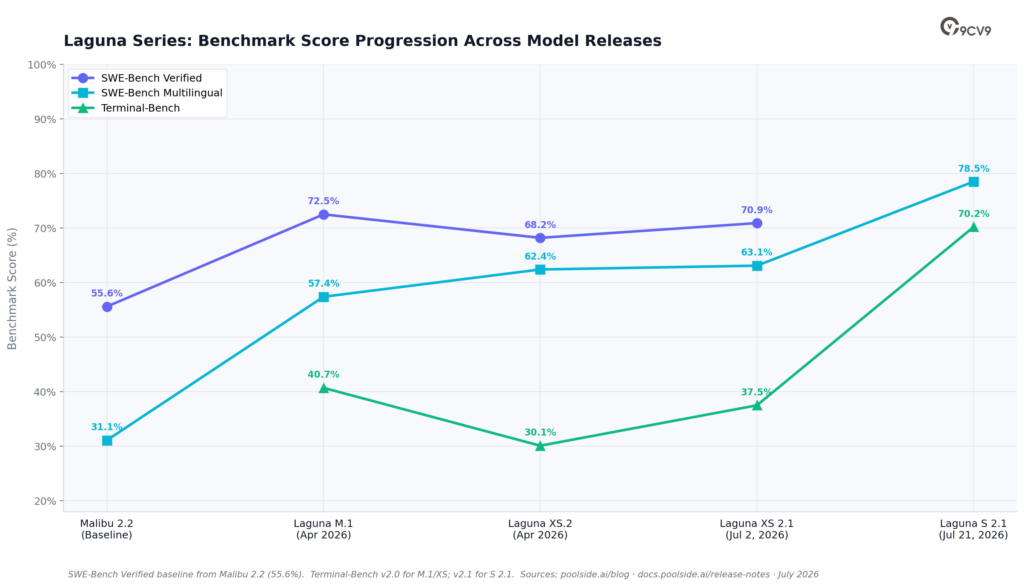
Poolside’s published results also illustrate measurable improvements between Laguna XS.2 and Laguna XS 2.1.
| Benchmark | Laguna XS.2 | Laguna XS 2.1 | Improvement |
|---|---|---|---|
| SWE-bench Verified | 69.9% | 70.9% | +1.0 |
| SWE-bench Multilingual | 57.7% | 63.1% | +5.4 |
| SWE-Bench Pro | 46.3% | 47.6% | +1.3 |
| Terminal-Bench 2.0 | 35.7% | 37.5% | +1.8 |
The largest gain appears in multilingual software engineering, suggesting continued improvements in cross-language reasoning while preserving the model’s compact deployment profile.
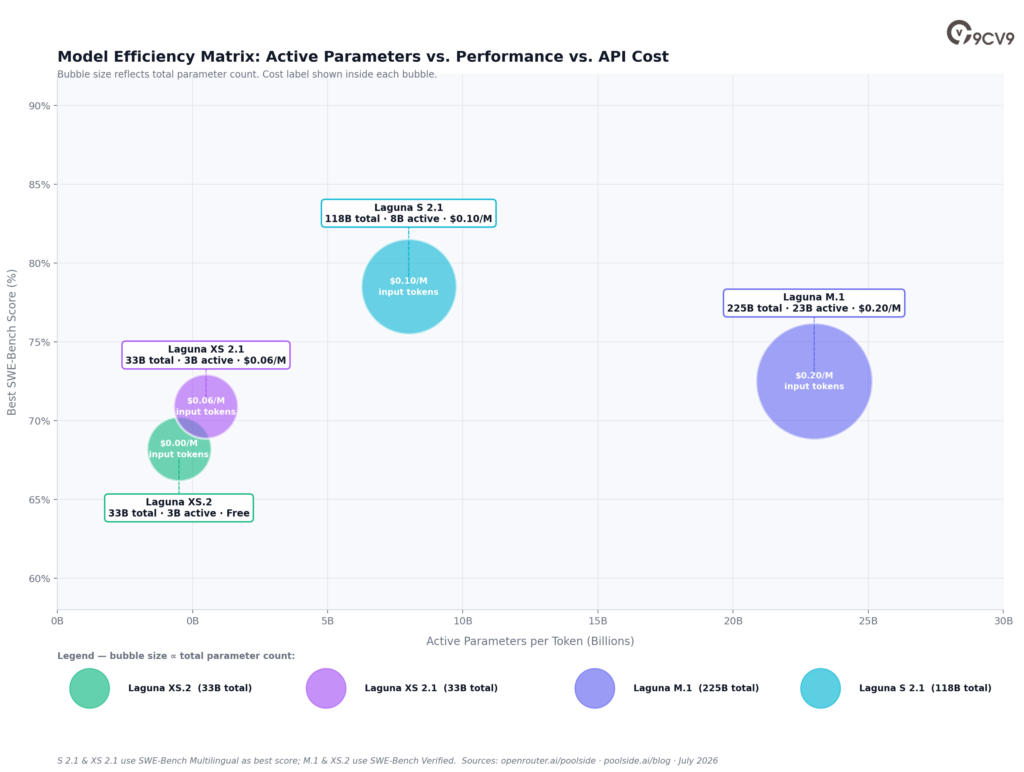
Parameter Efficiency
Perhaps the most striking characteristic of the Laguna family is its parameter efficiency.
Laguna XS 2.1 activates only approximately 3 billion parameters per token yet delivers benchmark performance approaching significantly larger models containing well over one hundred billion total parameters.
Parameter Efficiency Comparison
| Model | Active Parameters | SWE-bench Verified |
|---|---|---|
| Laguna XS 2.1 | 3B | 70.9% |
| Laguna M.1 | 23B | 74.6% |
| GLM-4.7 | 32B | 73.8% |
| DeepSeek V4 Flash | 13B | 79.0% |
This highlights one of the primary advantages of Poolside’s Mixture-of-Experts architecture: large representational capacity combined with relatively low computational cost during inference.
Competitive Positioning
Viewed collectively, the published benchmark results indicate that Laguna occupies a strong position within the current landscape of software engineering foundation models.
Its flagship M.1 model competes directly with leading open-weight systems while approaching the performance of several frontier proprietary models on software engineering tasks. Meanwhile, Laguna XS 2.1 demonstrates that compact Mixture-of-Experts architectures can achieve highly competitive agentic coding performance without requiring enterprise-scale infrastructure.
Competitive Landscape
| Model Family | Primary Strength | Relative Position |
|---|---|---|
| Laguna M.1 | Enterprise autonomous software engineering | Frontier open-weight competitor |
| Laguna XS 2.1 | Lightweight agentic coding | High parameter efficiency |
| DeepSeek V4 Flash | Large-scale coding and reasoning | Frontier benchmark leader |
| GLM-4.7 | Large Mixture-of-Experts coding | Strong enterprise competitor |
| Devstral 2 | Dense software engineering model | Competitive dense architecture |
| Claude Sonnet 4.6 | Proprietary frontier reasoning | Benchmark-leading proprietary reference |
Overall Assessment
The published benchmark evidence suggests that Poolside has successfully optimized the Laguna family for real-world software engineering rather than isolated code generation. Strong results across SWE-bench Verified, SWE-Bench Pro, Terminal-Bench 2.0, and multilingual software engineering indicate that the models are capable of repository-scale reasoning, autonomous debugging, terminal interaction, and iterative code execution. The progression from Laguna XS.2 to Laguna XS 2.1 further demonstrates measurable improvements in efficiency and multilingual capability, while Laguna M.1 positions itself among the leading open-weight agentic coding models available today. Although benchmark scores should always be interpreted alongside real-world deployment experience and evolving evaluation methodologies, the Laguna family consistently demonstrates competitive performance across the software engineering benchmarks most relevant to autonomous coding systems.
5. Deployment Modalities, Quantization, and Cost Structure
The Laguna model family has been designed with deployment flexibility as a core architectural objective. Rather than limiting access to proprietary cloud infrastructure, Poolside distributes its software engineering models through multiple delivery channels, enabling organizations, researchers, and individual developers to choose deployment strategies that align with their infrastructure, security, regulatory, and performance requirements.
This multi-channel approach distinguishes Laguna from many frontier proprietary coding models. Organizations can access the models through managed APIs, third-party inference platforms, open-weight repositories, or fully isolated self-hosted deployments depending on licensing and model availability. The result is an ecosystem capable of supporting everything from individual software engineers working on laptops to large enterprises operating secure air-gapped environments.
Deployment Ecosystem Overview
| Deployment Method | Typical Users | Primary Advantages |
|---|---|---|
| Managed Poolside Platform | Enterprises | Fully managed infrastructure with native updates |
| OpenRouter API | Developers, startups | OpenAI-compatible API with simplified integration |
| Open-Weight Models | Researchers | Local inference and model customization |
| Self-Hosted Enterprise Deployment | Government, regulated industries | Complete data ownership and security isolation |
| Private Cloud / Virtual Private Cloud | Large organizations | Internal deployment with enterprise governance |
Multi-Channel Model Distribution
Poolside supports multiple deployment modalities that allow organizations to select the balance between operational simplicity, infrastructure ownership, and customization.
For developers seeking immediate access, Laguna models are available through OpenAI-compatible APIs, allowing existing applications to integrate with minimal changes. These APIs support familiar chat completion interfaces, making migration straightforward for teams already using standard large language model integrations.
Organizations with stricter security or compliance requirements may instead deploy supported Laguna models within private infrastructure. Open-weight variants further expand deployment options by allowing researchers and enterprises to fine-tune, optimize, or integrate models into proprietary development environments without depending exclusively on external inference services.
Deployment Options Comparison
| Deployment Option | Infrastructure Ownership | Data Residency | Customization Level | Operational Complexity |
|---|---|---|---|---|
| Managed API | Provider | External | Limited | Very Low |
| Third-Party API Gateway | Shared | External | Moderate | Low |
| Private Cloud | Organization | Internal | High | Medium |
| Self-Hosted | Organization | Internal | Very High | High |
| Open-Weight Local Deployment | User | Local | Maximum | Medium |
OpenAI-Compatible API Access
One of the practical strengths of the Laguna ecosystem is compatibility with widely adopted API standards.
Developers can integrate Laguna models using OpenAI-compatible chat completion schemas, allowing existing AI applications, coding assistants, autonomous agents, and software engineering workflows to migrate with minimal code changes. This compatibility reduces engineering effort while enabling organizations to evaluate Laguna alongside other frontier coding models without redesigning application architectures.
API Compatibility Features
| Feature | Benefit |
|---|---|
| OpenAI-Compatible API | Easy migration from existing applications |
| Standard Chat Completions | Simplified integration |
| Tool Calling Support | Agentic software engineering |
| Large Context Windows | Repository-scale reasoning |
| Streaming Responses | Lower perceived latency |
Quantization Strategy
An important engineering consideration within the Laguna ecosystem is model quantization.
Quantization reduces numerical precision while preserving most model capability, allowing inference to become faster, less memory intensive, and more cost efficient. Rather than requiring every deployment to operate using high-precision floating-point weights, Poolside provides optimized formats that balance performance and computational efficiency.
According to Poolside’s published specifications, Laguna XS 2.1 is distributed using FP8 quantization, significantly improving inference efficiency while maintaining strong software engineering performance. This makes the model particularly attractive for local deployment, workstation inference, and edge-based software engineering agents.
Benefits of Quantization
| Advantage | Practical Impact |
|---|---|
| Reduced Memory Usage | Lower hardware requirements |
| Faster Inference | Higher token throughput |
| Lower Deployment Cost | Reduced infrastructure expenses |
| Better Local Deployment | Consumer GPU compatibility |
| Energy Efficiency | Reduced operational costs |
Supported Deployment Hardware
Different Laguna models target different hardware environments.
The flagship Laguna M.1 is primarily intended for enterprise-scale inference clusters capable of supporting large Mixture-of-Experts architectures. In contrast, Laguna XS models are designed to execute efficiently on significantly smaller hardware configurations, including modern workstations equipped with high-end consumer GPUs or Apple Silicon systems.
Typical Hardware Targets
| Model | Recommended Hardware |
|---|---|
| Laguna M.1 | Enterprise GPU clusters, cloud infrastructure |
| Laguna S 2.1 | NVIDIA DGX Spark and similar AI servers |
| Laguna XS 2.1 | High-end workstations, Apple Silicon, single-GPU systems |
| Laguna XS.2 | Local developer workstations |
API Pricing Structure
Poolside offers both free evaluation endpoints and commercial production endpoints for several Laguna models.
Commercial pricing follows a token-based billing model commonly used across modern AI APIs, where charges are based on input tokens, generated output tokens, and in some cases cached prompt reuse. Prompt caching can substantially reduce effective inference costs for workloads containing repeated context, such as software repositories or long-running coding sessions.
API Pricing Overview
| Model | API Endpoint | Input Price (Per 1M Tokens) | Output Price (Per 1M Tokens) | Cache Read Price (Per 1M Tokens) |
|---|---|---|---|---|
| Laguna M.1 (Free) | poolside/laguna-m.1:free | Free | Free | Not Applicable |
| Laguna M.1 | poolside/laguna-m.1 | $0.20 | $0.40 | $0.10 |
| Laguna XS 2.1 (Free) | poolside/laguna-xs-2.1:free | Free | Free | Not Applicable |
| Laguna XS 2.1 | poolside/laguna-xs-2.1 | $0.10 | $0.20 | $0.05 |
Recent OpenRouter promotions have temporarily reduced effective commercial pricing for Laguna XS 2.1 below the standard list price, although these promotional discounts may change over time.
Pricing Comparison
| Feature | Laguna M.1 | Laguna XS 2.1 |
|---|---|---|
| Standard Input Cost | $0.20 / 1M tokens | $0.10 / 1M tokens |
| Standard Output Cost | $0.40 / 1M tokens | $0.20 / 1M tokens |
| Cache Read Pricing | $0.10 / 1M tokens | $0.05 / 1M tokens |
| Free Tier | Available | Available |
| OpenAI-Compatible API | Yes | Yes |
Prompt Caching Economics
Prompt caching plays an increasingly important role in reducing operational costs for software engineering agents.
Large coding projects frequently reuse substantial portions of repository context across multiple requests. Rather than repeatedly charging for identical prompt tokens, cached prompt mechanisms recognize previously processed context and apply significantly reduced pricing to repeated sections.
According to OpenRouter provider statistics, production deployments of Laguna models have achieved prompt cache hit rates exceeding 90% under many workloads, substantially lowering effective input costs for enterprise software engineering applications.
Benefits of Prompt Caching
| Benefit | Enterprise Impact |
|---|---|
| Lower API Costs | Reduced operational spending |
| Faster Processing | Previously processed context reused |
| Better Repository Workflows | Efficient multi-step engineering sessions |
| Improved Long Conversations | Reduced repeated token billing |
Performance Metrics
Operational performance is equally important alongside model quality.
Provider telemetry published through OpenRouter offers insight into real-world serving characteristics for commercial Laguna deployments. While performance varies depending on provider load, infrastructure, and geographic location, the published metrics indicate competitive responsiveness for interactive software engineering workflows.
Representative Performance Metrics
| Metric | Laguna M.1 |
|---|---|
| Average Time to First Token | Approximately 0.6 seconds |
| Average Throughput | Approximately 67 tokens per second |
| Average Provider Uptime | Approximately 100% |
| Average Prompt Cache Hit Rate | Approximately 89–96% |
Free-tier endpoints generally exhibit lower throughput and higher latency than commercial deployments because of shared infrastructure and resource prioritization.
Latency Characteristics
Software engineering workflows require a balance between reasoning quality and responsiveness.
For interactive development, important operational metrics include:
• Time to first generated token
• Overall response latency
• Token generation throughput
• Tool execution reliability
• Prompt cache utilization
Commercial Laguna deployments typically provide substantially lower latency than their free-tier counterparts, making them more suitable for production coding assistants and autonomous software engineering agents.
Operational Characteristics
| Characteristic | Production Impact |
|---|---|
| Low TTFT | Faster interactive experience |
| High Throughput | Quicker code generation |
| Large Context Window | Repository-scale reasoning |
| Prompt Caching | Lower recurring costs |
| High Uptime | Reliable enterprise availability |
Deployment Strategy Matrix
Organizations selecting a Laguna deployment strategy should consider infrastructure ownership, security requirements, customization needs, and expected workload volume.
| Organization Type | Recommended Deployment | Primary Reason |
|---|---|---|
| Individual Developers | Laguna XS 2.1 local deployment | Low infrastructure cost |
| Startups | Managed API | Fast integration |
| Mid-Sized Engineering Teams | Commercial API | Balance of performance and operational simplicity |
| Large Enterprises | Private cloud deployment | Governance and scalability |
| Government Organizations | Self-hosted infrastructure | Security, compliance, and data sovereignty |
| AI Research Laboratories | Open-weight deployment | Fine-tuning and experimentation |
Cost Efficiency Considerations
The Laguna family demonstrates Poolside’s broader strategy of combining Mixture-of-Experts architectures, quantized inference, prompt caching, and flexible deployment options to reduce the total cost of operating advanced software engineering models. Organizations can begin with free hosted APIs for experimentation, transition to commercial endpoints for production workloads, or deploy supported open-weight models within their own infrastructure to achieve greater control over security, compliance, and long-term operational costs. This flexible deployment ecosystem enables the Laguna platform to serve a broad spectrum of users, from individual developers building local coding assistants to enterprises operating large-scale autonomous software engineering systems.
6. Quantization Formats and Local Execution
A defining characteristic of the Laguna ecosystem is its strong emphasis on local deployment. Unlike many frontier coding models that are primarily designed for cloud inference, Poolside has invested heavily in making the Laguna XS model family practical for execution on developer workstations, high-end consumer GPUs, and Apple Silicon devices. This strategy enables software engineers to run advanced agentic coding models directly on their own hardware while preserving privacy, reducing cloud inference costs, and eliminating dependency on external APIs.
To achieve this objective, Poolside distributes official quantized checkpoints that significantly reduce memory consumption while maintaining competitive software engineering performance. These optimized checkpoints are available in multiple precision formats, allowing developers to balance inference speed, hardware requirements, and model quality according to their deployment environment.
Why Quantization Matters
Quantization is one of the most important optimization techniques used in modern large language model deployment.
Instead of storing every model weight using high-precision numerical formats such as BF16 or FP16, quantization compresses weights into lower-precision representations. The resulting models consume less memory, require lower bandwidth, and generate responses more efficiently while preserving most of their reasoning capability.
For software engineering models such as Laguna XS 2.1, quantization enables execution on hardware that would otherwise be incapable of hosting a 33-billion-parameter foundation model.
Benefits of Quantization
| Benefit | Practical Impact |
|---|---|
| Lower Memory Consumption | Runs on smaller GPUs and workstations |
| Faster Inference | Higher token generation throughput |
| Reduced Storage Requirements | Smaller model downloads |
| Lower Hardware Costs | Consumer hardware becomes viable |
| Better Energy Efficiency | Reduced power consumption |
| Improved Local Deployment | Eliminates dependence on cloud APIs |
Official Quantization Formats
Poolside officially provides several optimized quantized checkpoints for Laguna XS 2.1.
Each format targets different hardware environments and deployment priorities.
Official Quantization Formats
| Quantization Format | Precision | Primary Objective | Best Deployment Environment |
|---|---|---|---|
| BF16 | Full precision | Maximum model quality | Enterprise GPU clusters |
| FP8 | W8A8 | Balanced quality and speed | Modern NVIDIA GPUs |
| INT4 | W4A16 AWQ | Low-memory local inference | Consumer GPUs and workstations |
| NVFP4 | NVIDIA FP4 | Maximum Hopper and Blackwell performance | Enterprise NVIDIA AI systems |
These official checkpoints are distributed alongside the standard model release and are supported across several inference frameworks, including vLLM, SGLang, Hugging Face Transformers, TensorRT-LLM, Ollama, and MLX-compatible workflows.
FP8 Precision
FP8 represents Poolside’s recommended balance between inference quality and computational efficiency.
The FP8 checkpoint stores both weights and activation-related components using 8-bit floating-point representations while incorporating an FP8 key-value cache to reduce memory consumption during long-context inference.
Compared with full BF16 precision, FP8 substantially lowers memory requirements while maintaining excellent software engineering performance. This makes it particularly attractive for enterprise inference servers equipped with modern NVIDIA accelerators.
FP8 Characteristics
| Characteristic | Description |
|---|---|
| Weight Precision | 8-bit floating point |
| KV Cache | FP8 |
| Memory Usage | Lower than BF16 |
| Inference Speed | High |
| Recommended Hardware | Modern NVIDIA GPUs |
INT4 Mixed Precision
The INT4 checkpoint is designed primarily for local deployment.
Rather than quantizing every layer identically, Poolside employs a mixed-precision strategy that combines Activation-Aware Weight Quantization (AWQ) with selective higher-precision storage where needed.
Earlier transformer layers are aggressively compressed into INT4 representations, while more sensitive components retain higher precision to preserve reasoning quality. This hybrid design enables substantial reductions in memory usage without introducing excessive degradation in software engineering capability.
INT4 Characteristics
| Characteristic | Description |
|---|---|
| Weight Precision | INT4 |
| Quantization Method | Activation-Aware Weight Quantization |
| Memory Efficiency | Excellent |
| Consumer GPU Support | Excellent |
| Local Deployment | Optimized |
NVFP4 Precision
For enterprise GPU infrastructure based on NVIDIA Hopper and Blackwell architectures, Poolside also distributes an NVFP4 checkpoint.
NVFP4 is specifically optimized for NVIDIA’s latest AI hardware, providing very high inference throughput while minimizing memory bandwidth requirements.
These checkpoints integrate directly with TensorRT-LLM and other NVIDIA inference frameworks, enabling organizations to maximize performance on modern AI accelerators.
NVFP4 Characteristics
| Characteristic | Description |
|---|---|
| Precision | NVIDIA FP4 |
| Primary Target | Hopper and Blackwell GPUs |
| Throughput | Very High |
| Enterprise Deployment | Excellent |
| TensorRT-LLM Support | Native |
Comparing the Quantization Formats
| Feature | BF16 | FP8 | INT4 | NVFP4 |
|---|---|---|---|---|
| Model Quality | Highest | Very High | High | Very High |
| Memory Usage | Highest | Moderate | Lowest | Very Low |
| Inference Speed | Moderate | High | High | Very High |
| Local Deployment | Limited | Good | Excellent | Limited |
| Enterprise Deployment | Excellent | Excellent | Good | Excellent |
Local Execution Strategy
Poolside has optimized Laguna XS 2.1 specifically for local software engineering workflows.
Unlike very large frontier models that require multi-node GPU clusters, Laguna XS 2.1 can operate effectively on modern workstations while preserving advanced agentic coding capabilities.
Supported local inference environments include:
• Ollama
• MLX
• Hugging Face Transformers
• vLLM
• SGLang
• TensorRT-LLM
• Llama.cpp (supported formats)
This broad ecosystem allows developers to select inference engines that best match their preferred operating systems and hardware.
Supported Local Frameworks
| Framework | Primary Strength |
|---|---|
| Ollama | Simplified local deployment |
| MLX | Apple Silicon optimization |
| vLLM | High-throughput serving |
| Transformers | Flexible Python integration |
| SGLang | Efficient inference serving |
| TensorRT-LLM | NVIDIA enterprise optimization |
| Llama.cpp | Lightweight CPU and GPU inference |
Apple Silicon Deployment
One of the most significant deployment targets for Laguna XS 2.1 is Apple’s unified memory architecture.
Poolside states that the model is compact enough to execute locally on Macs equipped with approximately 36 GB of unified memory. Systems such as MacBook Pro and Mac Studio therefore become viable development platforms for autonomous coding agents without requiring dedicated enterprise GPUs. MLX and Ollama are the recommended runtimes for Apple Silicon deployments.
Apple Silicon Requirements
| Component | Recommended Specification |
|---|---|
| Processor | Apple Silicon |
| Unified Memory | Approximately 36 GB or higher |
| Preferred Runtime | MLX |
| Alternative Runtime | Ollama |
| Typical Workload | Local software engineering |
Windows and Linux GPU Deployment
For dedicated GPU workstations, Laguna XS 2.1 targets high-end consumer graphics cards.
Depending on the selected quantization format, the model can operate entirely within the memory available on modern GPUs, enabling responsive local software engineering without cloud infrastructure.
Typical deployment targets include:
• NVIDIA RTX 4090
• NVIDIA RTX 5090
• Professional NVIDIA RTX systems
INT4 quantization substantially reduces VRAM requirements, making these deployments practical for advanced local coding workflows.
Typical GPU Configurations
| GPU Class | Suitability |
|---|---|
| NVIDIA RTX 4090 | Excellent for INT4 deployment |
| NVIDIA RTX 5090 | Excellent |
| NVIDIA RTX Professional Series | Excellent |
| Hopper Enterprise GPUs | Enterprise-scale deployment |
| Blackwell GPUs | Maximum performance |
Storage Requirements
Quantization also significantly reduces storage requirements.
While full-precision checkpoints remain relatively large, compressed quantized variants occupy considerably less disk space, making downloads and local management substantially easier.
Representative Storage Requirements
| Model Format | Approximate Storage |
|---|---|
| Quantized Checkpoints | Approximately 20–35 GB |
| Full Precision Weights | Up to approximately 70 GB |
These values vary depending on checkpoint format and deployment framework.
Getting Started with Local Inference
Poolside has simplified the local deployment experience by integrating Laguna XS 2.1 with Ollama.
After downloading the model, developers can launch Poolside’s lightweight terminal-based coding agent using a single command, enabling immediate access to autonomous coding workflows with native reasoning and tool support.
Local Deployment Workflow
| Step | Description |
|---|---|
| Install Runtime | Set up Ollama, MLX, or another supported inference engine |
| Download Model | Retrieve the desired Laguna XS 2.1 checkpoint |
| Select Quantization | Choose BF16, FP8, INT4, or NVFP4 |
| Launch Agent | Start the local coding agent |
| Begin Development | Execute autonomous software engineering workflows |
Choosing the Right Quantization Strategy
Selecting the optimal checkpoint depends on the available hardware and deployment objectives.
| Deployment Scenario | Recommended Quantization |
|---|---|
| Maximum Accuracy | BF16 |
| Balanced Enterprise Deployment | FP8 |
| Consumer GPU Workstations | INT4 |
| Hopper and Blackwell AI Servers | NVFP4 |
| Apple Silicon Development | INT4 or MLX-supported formats |
Overall, Poolside’s quantization strategy demonstrates a strong emphasis on practical software engineering deployment rather than purely academic model performance. By providing officially optimized BF16, FP8, INT4, and NVFP4 checkpoints across a broad ecosystem of inference frameworks, the company enables developers to run advanced agentic coding models on hardware ranging from Apple Silicon laptops to enterprise AI clusters. This flexible deployment approach significantly lowers the barrier to adopting autonomous software engineering systems while preserving competitive reasoning performance across diverse computing environments.
7. Developer Toolchain and Enterprise Systems Integration
Poolside has expanded beyond building foundation models by developing a comprehensive software engineering platform that connects its AI models directly with developer environments, integrated development environments (IDEs), command-line interfaces, cloud execution environments, and enterprise infrastructure. Rather than functioning solely as an API provider, the company offers a tightly integrated ecosystem that enables autonomous coding agents to operate throughout the complete software development lifecycle, from planning and implementation to testing, deployment, and continuous integration.
The developer platform centers around three primary components:
• The Poolside Agent CLI (“pool”)
• Shimmer cloud development environments
• Enterprise deployment infrastructure with governance and security controls
Together, these components enable AI-powered software engineering across local workstations, cloud sandboxes, CI/CD pipelines, and regulated enterprise environments while maintaining consistent developer workflows.
Poolside Developer Ecosystem
| Platform Component | Primary Function | Typical Users |
|---|---|---|
| Pool Agent CLI | Terminal-based coding assistant and automation | Individual developers |
| ACP Integration | AI inside supported IDEs | Software engineering teams |
| MCP Integration | External tool connectivity | Enterprise developers |
| Shimmer | Cloud-native development environments | Full-stack developers |
| Enterprise Platform | Secure production deployment | Large organizations |
| Poolside Console | Agent management and governance | Platform administrators |
Developer Workflow Architecture
Poolside’s engineering platform follows an execution-first architecture where foundation models interact directly with developer tools rather than acting as passive conversational assistants.
Instead of simply producing code suggestions, the platform enables AI agents to:
• Read repositories
• Edit source files
• Execute terminal commands
• Run automated tests
• Interact with external tools
• Continue multi-step engineering workflows
This architecture allows developers to collaborate with autonomous coding agents capable of completing substantial portions of software engineering tasks while remaining integrated with existing development environments.
Development Pipeline
| Development Stage | Poolside Component |
|---|---|
| Code Planning | Pool Agent |
| Repository Analysis | Laguna Models |
| File Editing | Pool CLI |
| Command Execution | Terminal Runtime |
| Testing | Integrated Agent Execution |
| External Services | MCP Integration |
| IDE Collaboration | ACP Integration |
| Deployment | Enterprise Platform |
The Pool Agent CLI
The primary interface into the Poolside ecosystem is the open-source Pool Agent CLI, commonly invoked through the “pool” command.
Unlike traditional command-line utilities that perform isolated operations, the Pool CLI functions as an intelligent software engineering agent capable of maintaining context across extended development sessions. It supports interactive coding, automated scripting, and editor integration, allowing developers to use the same agent in multiple workflows without changing tools.
The CLI supports three primary operating modes:
Interactive Mode
Running the standard “pool” command launches an interactive coding session where the agent can inspect code, modify files, execute commands, and collaborate with developers over multiple iterations.
Automated Execution
The “pool exec” command enables one-shot execution suitable for automation, scripting, and CI/CD pipelines. Developers can invoke software engineering tasks programmatically without maintaining an interactive session.
Agent Client Protocol
The “pool acp” command allows the Poolside agent to function as an Agent Client Protocol server, enabling compatible editors to communicate directly with Laguna models.
Pool CLI Interfaces
| Interface | Command | Primary Use Case |
|---|---|---|
| Interactive Session | pool | Day-to-day software development |
| Automated Execution | pool exec | CI/CD pipelines and scripts |
| ACP Server | pool acp | IDE integration |
Permission and Execution Modes
To balance developer productivity with operational safety, the Pool CLI includes configurable execution modes governing how AI agents interact with local systems.
Rather than granting unrestricted system access, developers can choose different levels of automation depending on the task being performed.
Execution Modes
| Mode | Behavior | Best Use Case |
|---|---|---|
| Default | Requests approval before executing actions | General software development |
| Accept Edits | Automatically approves workspace file operations while prompting for shell commands | Routine coding |
| Allow All | Executes approved actions automatically | Trusted automation |
| Plan Mode | Generates implementation plans without modifying files | Architecture design and code review |
This graduated permission model allows organizations to maintain appropriate levels of oversight while still benefiting from autonomous coding capabilities.
Interactive Development Features
The Pool CLI includes numerous capabilities designed specifically for software engineering workflows.
Key capabilities include:
• Session persistence
• Conversation history
• Workspace awareness
• Model selection
• Reasoning controls
• Token usage tracking
• Session sharing
• Structured planning
These features enable developers to maintain continuity across complex engineering projects while reducing repetitive interactions with AI systems.
Agent Client Protocol Integration
A major feature of the Poolside platform is support for the Agent Client Protocol (ACP).
ACP provides a standardized mechanism for integrating autonomous coding agents directly into modern development environments.
Instead of creating proprietary plugins for every editor, Poolside exposes an ACP server that compatible development environments can communicate with directly.
Supported ACP Editors
| Editor | Integration Method |
|---|---|
| JetBrains IDEs | Native ACP |
| Zed | Native ACP |
| Neovim | ACP-compatible plugins |
| Other ACP Editors | Generic ACP support |
| Visual Studio Code | Native Poolside Assistant |
| Visual Studio | Native Poolside Assistant |
Within supported editors, developers can:
• Launch coding agents
• Switch execution modes
• Resume sessions
• Generate implementation plans
• Review code modifications
• Execute engineering workflows
without leaving their development environment.
Model Context Protocol Integration
Beyond editor connectivity, Poolside supports the Model Context Protocol (MCP), enabling coding agents to interact with external systems.
MCP servers extend an agent’s capabilities by exposing enterprise resources through standardized interfaces.
Typical MCP integrations include:
• Databases
• Documentation repositories
• Internal APIs
• Source control systems
• Knowledge bases
• Enterprise services
This allows Laguna-powered agents to access organizational knowledge while respecting enterprise governance policies.
MCP Integration Examples
| Integration Type | Example Usage |
|---|---|
| Database | Query application data |
| Documentation | Retrieve internal technical references |
| API Services | Call enterprise services |
| Knowledge Base | Search organizational information |
| Git Repositories | Repository-aware development |
Shimmer Cloud Development Environment
To complement local development workflows, Poolside offers Shimmer, a cloud-native development environment built around isolated execution environments.
Shimmer provides disposable execution workspaces where developers and AI agents can collaborate without affecting local machines. It is designed to support rapid prototyping, web application development, API creation, and command-line tooling through browser-based development sessions. Poolside positions Shimmer as a companion environment for its terminal agent, enabling developers to iterate quickly while maintaining isolated execution contexts.
Shimmer Capabilities
| Feature | Benefit |
|---|---|
| Browser-based development | No local setup required |
| Isolated execution | Safe experimentation |
| Instant environments | Rapid startup |
| AI-assisted coding | Integrated Laguna models |
| Application preview | Immediate testing |
Enterprise Deployment Architecture
For organizations requiring complete control over software engineering infrastructure, Poolside supports enterprise deployment inside customer-managed environments.
Rather than requiring source code to be transmitted to external inference services, organizations can deploy the complete platform within:
• Virtual Private Clouds
• Private Kubernetes clusters
• Amazon Web Services
• Amazon Bedrock deployments
• On-premises GPU infrastructure
• Air-gapped networks
This architecture enables regulated industries and government organizations to adopt AI-assisted software engineering while maintaining strict security boundaries.
Enterprise Deployment Options
| Deployment Model | Typical Organizations |
|---|---|
| Managed Cloud | Technology companies |
| Private VPC | Large enterprises |
| Amazon Bedrock | AWS customers |
| Kubernetes | Enterprise platform teams |
| On-Premises | Regulated industries |
| Air-Gapped Infrastructure | Government and defense |
Enterprise Security Architecture
Poolside emphasizes security throughout its enterprise platform.
Within customer-controlled environments:
• Source code remains inside organizational boundaries
• Model execution occurs locally
• Prompts remain private
• Generated outputs remain under customer ownership
• Organizational data is not used to improve public models
These controls are intended to satisfy the security requirements of enterprises managing proprietary software assets.
Security Features
| Capability | Enterprise Benefit |
|---|---|
| Data Isolation | Proprietary code remains internal |
| Local Inference | Reduced external exposure |
| Private Knowledge Sources | Internal documentation access |
| Secure Execution | Controlled runtime environments |
| Agent Governance | Administrative oversight |
Platform Governance
Recent enterprise releases have introduced centralized governance capabilities through the Poolside Console.
Administrators can:
• Configure agents
• Define execution policies
• Manage permissions
• Configure MCP servers
• Audit agent activity
• Review execution traces
• Export operational metrics
This governance layer enables organizations to standardize AI-assisted software engineering while maintaining visibility into agent behavior across development teams.
Governance Features
| Feature | Purpose |
|---|---|
| Centralized Agent Management | Standardize agent configuration |
| Role-Based Access Control | Restrict capabilities by user role |
| Agent Auditing | Review execution history |
| MCP Governance | Control external integrations |
| Operational Metrics | Monitor platform performance |
| Execution Traces | Investigate agent behavior |
Enterprise Integration Matrix
| Enterprise Requirement | Poolside Capability |
|---|---|
| IDE Integration | ACP support |
| External Tool Connectivity | MCP support |
| Terminal Automation | Pool CLI |
| CI/CD Integration | pool exec |
| Private Deployment | VPC and on-premises support |
| Governance | Poolside Console |
| Security | Data isolation and execution controls |
| Cloud Deployment | AWS and Kubernetes support |
Overall, Poolside’s developer platform extends well beyond the Laguna foundation models by delivering an integrated software engineering ecosystem that combines intelligent coding agents, command-line tooling, IDE connectivity, cloud execution environments, and enterprise governance. Through the Pool Agent CLI, Agent Client Protocol, Model Context Protocol, Shimmer cloud environments, and secure enterprise deployment options, the platform enables organizations to embed autonomous software engineering capabilities directly into existing development workflows while maintaining operational control, security, and scalability.
8. Nuanced Industry Insights and Strategic Implications
The Laguna model family represents more than another generation of coding-focused large language models. Its architecture, deployment strategy, and engineering philosophy collectively illustrate several broader trends reshaping enterprise artificial intelligence. These trends include the transition from dense to sparse foundation models, the increasing importance of code sovereignty, the emergence of autonomous software engineering agents, and the evolution of software execution into the primary action space for AI systems.
Rather than competing solely through larger parameter counts, Poolside’s approach emphasizes engineering efficiency, deployment flexibility, and autonomous execution. These characteristics have implications that extend beyond software development into enterprise AI infrastructure, cloud economics, cybersecurity, and future AI platform design.
The Next Phase of AI Software Engineering
| Previous Generation | Emerging Generation |
|---|---|
| Code completion assistants | Autonomous software engineering agents |
| Dense language models | Sparse Mixture-of-Experts architectures |
| Cloud-only inference | Hybrid cloud and local deployment |
| Static tool invocation | Dynamic software execution |
| Human-guided workflows | Long-horizon autonomous execution |
| IDE suggestions | End-to-end engineering collaboration |
The Compute Economics of Sparse Agentic Mixture-of-Experts Models
One of the most significant technical developments demonstrated by the Laguna family is the changing economics of software engineering models.
Historically, advanced coding assistants depended on dense transformer architectures in which every parameter participated in every inference step. Although this approach delivered strong reasoning capability, computational costs increased rapidly as models became larger. Autonomous software engineering compounds this challenge because coding agents often perform dozens or even hundreds of reasoning cycles while solving a single engineering task.
Each cycle may involve:
• Reading repositories
• Planning implementation
• Writing code
• Executing tests
• Inspecting failures
• Revising solutions
• Repeating the process until completion
Under dense architectures, every iteration requires activating the entire model, substantially increasing inference costs over long engineering sessions.
Poolside addresses this challenge through sparse Mixture-of-Experts routing. Laguna XS 2.1 contains approximately 33 billion total parameters while activating only about 3 billion parameters for each generated token. Similarly, Laguna M.1 activates roughly 23.4 billion parameters despite containing more than 225 billion total parameters. This significantly lowers computational requirements without sacrificing representational capacity.
Economic Comparison
| Dense Foundation Models | Sparse Mixture-of-Experts |
|---|---|
| Every parameter activated | Only selected experts activated |
| Higher inference cost | Lower inference cost |
| Greater energy consumption | Improved efficiency |
| More expensive long workflows | Better economics for autonomous agents |
| Limited scaling efficiency | Scales more efficiently |
Strategic Implications of Sparse Architectures
Sparse activation fundamentally changes the cost structure of enterprise AI deployment.
Instead of optimizing primarily for single-response quality, organizations can begin optimizing for complete autonomous workflows. Lower inference costs make it economically practical for AI systems to iterate repeatedly, verify their own work, execute validation scripts, and continue refining software before returning results.
This changes the unit of computation from “cost per prompt” toward “cost per completed engineering task.”
Business Impact
| Traditional Cost Metric | Emerging Cost Metric |
|---|---|
| Cost per API request | Cost per completed engineering objective |
| Tokens generated | Engineering outcomes delivered |
| Single inference | Multi-step autonomous workflow |
| Developer assistance | Autonomous execution efficiency |
Parameter Efficiency as a Competitive Advantage
The Laguna family also demonstrates an important competitive trend within foundation model development.
Rather than competing solely through increasing total parameter counts, newer systems increasingly compete on parameter efficiency.
Laguna XS 2.1 illustrates this principle particularly well.
Despite activating only approximately 3 billion parameters, it achieves benchmark performance approaching substantially larger models on several software engineering evaluations. This indicates that architecture design, reinforcement learning, training methodology, and expert routing have become as important as raw parameter scale.
Parameter Efficiency Matrix
| Optimization Dimension | Traditional Focus | Modern Focus |
|---|---|---|
| Model Size | Maximum parameters | Efficient active parameters |
| Training | Scale | Data quality and reinforcement learning |
| Inference | Raw compute | Intelligent expert routing |
| Deployment | Cloud infrastructure | Flexible deployment efficiency |
Code Sovereignty and Enterprise AI
One of the strongest trends influencing enterprise AI adoption is the increasing importance of code sovereignty.
As organizations move beyond pilot projects into production deployments, software source code has become one of the most valuable categories of enterprise intellectual property.
Financial institutions, healthcare providers, government agencies, defense organizations, and critical infrastructure operators increasingly require guarantees that proprietary software never leaves controlled environments.
This requirement has accelerated demand for deployment models that support:
• Local inference
• Private cloud deployment
• Air-gapped infrastructure
• Customer-owned model weights
• Internal data processing
Poolside’s deployment strategy reflects this trend by supporting open-weight models, private infrastructure, and enterprise deployment options rather than exclusively relying on public cloud APIs.
Enterprise Deployment Considerations
| Enterprise Requirement | Strategic Importance |
|---|---|
| Data sovereignty | Protect intellectual property |
| Local inference | Reduce external exposure |
| Air-gapped deployment | National security applications |
| Private model hosting | Regulatory compliance |
| Internal governance | Enterprise operational control |
The Shift Toward Hybrid AI Infrastructure
The emergence of open-weight coding models also signals a broader movement toward hybrid AI infrastructure.
Rather than choosing exclusively between cloud APIs or locally deployed models, organizations increasingly adopt mixed deployment strategies.
Typical hybrid architectures include:
• Public cloud for general workloads
• Local models for sensitive repositories
• Private GPU clusters for enterprise software
• Edge inference for developer workstations
This flexibility allows engineering organizations to optimize both security and operational costs while selecting deployment models appropriate for individual workloads.
Hybrid Deployment Strategy
| Workload | Preferred Deployment |
|---|---|
| Public open-source projects | Managed cloud APIs |
| Proprietary enterprise software | Private cloud |
| Government systems | Air-gapped infrastructure |
| Individual development | Local workstation |
| Continuous integration | Enterprise clusters |
The Evolution of AI Tool Use
Another important industry trend reflected in the Laguna family is the evolution of tool usage.
Early AI assistants interacted with external systems primarily through predefined function calls.
These approaches generally relied upon:
• Fixed APIs
• JSON schemas
• Static tool definitions
• Preconfigured integrations
Although effective for many applications, these systems constrained agents to capabilities explicitly anticipated by developers.
Laguna instead emphasizes software execution itself as the universal interaction mechanism.
Rather than calling predefined functions, the model can:
• Generate temporary scripts
• Execute shell commands
• Build validation programs
• Inspect runtime outputs
• Modify workflows dynamically
• Adapt strategies based on execution feedback
This transforms software itself into the primary action space rather than limiting agents to predefined interfaces.
Evolution of Agent Interaction
| Earlier AI Systems | Agentic Software Engineering |
|---|---|
| Fixed function calls | Dynamic code execution |
| Static API schemas | Temporary software generation |
| Limited workflows | Adaptive execution planning |
| Predetermined integrations | General-purpose automation |
| Structured tools | Executable software as action space |
Software as an Executable Action Space
Treating executable software as the primary action space dramatically expands what autonomous agents can accomplish.
Instead of waiting for developers to expose specific APIs, models can construct custom programs tailored to individual problems.
Examples include:
• Repository migration scripts
• Temporary debugging utilities
• Validation programs
• Data transformation pipelines
• Custom benchmarking tools
• Automated testing frameworks
Because these programs are generated dynamically, the space of possible solutions becomes substantially larger than any predefined tool catalog.
Strategic Advantages
| Static Tool Ecosystems | Dynamic Software Execution |
|---|---|
| Limited capabilities | Open-ended problem solving |
| Manual integration | Automatic adaptation |
| Fixed workflows | Flexible engineering |
| Tool maintenance | Generated utilities |
| API dependence | General computation |
The Rise of Long-Horizon Engineering Agents
The Laguna architecture also illustrates the industry’s movement from single-response assistants toward long-horizon autonomous agents.
These systems increasingly operate over extended sequences of reasoning rather than isolated prompts.
Typical engineering workflows now include:
• Planning
• Repository exploration
• Code modification
• Test execution
• Debugging
• Refactoring
• Verification
• Deployment preparation
The success of these agents depends less on conversational ability and more on sustained reasoning, memory, execution reliability, and iterative improvement.
Engineering Agent Evolution
| Traditional AI Assistant | Autonomous Engineering Agent |
|---|---|
| Answer questions | Complete engineering objectives |
| Generate snippets | Modify entire repositories |
| Single interaction | Extended execution sessions |
| Human-directed | Semi-autonomous operation |
| Conversation focused | Outcome focused |
Strategic Implications for Enterprise Software Development
The architectural decisions behind the Laguna family suggest several long-term implications for enterprise software engineering.
Organizations are likely to shift investment toward AI platforms that combine strong coding capability with secure deployment, efficient inference, and autonomous execution. Rather than evaluating models solely by benchmark rankings, enterprises will increasingly assess total operational cost, deployment flexibility, governance, and the ability to integrate into existing engineering workflows.
Key Strategic Trends
| Industry Trend | Long-Term Impact |
|---|---|
| Sparse Mixture-of-Experts | Lower cost autonomous software engineering |
| Open-weight foundation models | Greater enterprise adoption |
| Hybrid deployment | Increased deployment flexibility |
| Local inference | Improved data sovereignty |
| Dynamic software execution | Broader autonomous capabilities |
| Long-horizon reasoning | Higher engineering productivity |
| Enterprise governance | Greater regulatory readiness |
| Agentic coding platforms | Transformation of software development workflows |
Overall, the Laguna ecosystem reflects several of the most important strategic shifts currently shaping artificial intelligence for software engineering. Its emphasis on sparse Mixture-of-Experts architectures, efficient active parameter utilization, hybrid deployment models, code sovereignty, and execution-driven agent design demonstrates how the competitive landscape is evolving beyond larger language models toward highly specialized engineering platforms. As enterprises increasingly adopt autonomous software development tools, these architectural choices are likely to influence not only model design but also the economics, governance, and operational practices of next-generation AI-powered engineering environments.
9. Strategic Recommendations
The Laguna model family represents one of the most specialized artificial intelligence platforms currently available for autonomous software engineering. Rather than positioning itself as a general-purpose conversational model, Poolside has focused its research on building agentic coding systems capable of reasoning across entire software repositories, executing terminal commands, interacting with development tools, and completing long-horizon engineering workflows. Through innovations such as sparse Mixture-of-Experts architectures, the Model Factory, Muon optimization, reinforcement learning from executable software, and flexible deployment options, the Laguna ecosystem has established itself as a competitive solution for organizations seeking production-grade AI software engineering capabilities.
A defining strength of the Laguna platform is its ability to address a wide spectrum of deployment requirements. Organizations can begin with lightweight local deployments for individual developers, expand to enterprise GPU clusters for team collaboration, and ultimately deploy fully isolated production environments that satisfy stringent governance, security, and regulatory requirements. This scalability enables engineering organizations to standardize on a single model family while adapting infrastructure to different workloads and business objectives.
The choice of Laguna model should therefore be driven by engineering complexity, infrastructure capacity, security requirements, latency expectations, and total cost of ownership rather than parameter count alone. Poolside’s tiered architecture allows organizations to optimize for the specific balance between capability, computational efficiency, deployment flexibility, and operational economics.
Recommended Laguna Model Selection
| Organizational Requirement | Recommended Model | Primary Deployment | Strategic Advantage |
|---|---|---|---|
| Enterprise-scale software modernization | Laguna M.1 | Private cloud, VPC, managed enterprise infrastructure | Maximum autonomous engineering capability |
| Repository-wide feature development | Laguna S 2.1 | Dedicated GPU servers, DGX-class infrastructure | Large-context reasoning with balanced efficiency |
| Team productivity and daily development | Laguna XS 2.1 | Local workstations or shared development servers | High parameter efficiency with low operational cost |
| Individual developer workflows | Laguna XS 2.1 | Apple Silicon, consumer GPUs, local inference | Private, low-latency coding assistance |
| Secure government or regulated environments | Laguna M.1 | Air-gapped or on-premises infrastructure | Complete data sovereignty and governance |
Strategic Guidance for Large Enterprises
Large enterprises managing complex software ecosystems should prioritize Laguna M.1 as the primary foundation model for mission-critical engineering initiatives.
Its large sparse Mixture-of-Experts architecture, long-context reasoning, and strong performance across agentic software engineering benchmarks make it well suited for activities such as:
• Large-scale application modernization
• Multi-repository refactoring
• Legacy platform migration
• Enterprise architecture transformation
• Automated technical debt reduction
• Large software validation projects
For these deployments, organizations should utilize dedicated enterprise infrastructure, including private Virtual Private Clouds (VPCs), customer-managed GPU clusters, or supported cloud platforms such as AWS, ensuring that proprietary source code remains within organizational security boundaries.
Strategic Guidance for Mid-Sized Engineering Organizations
Engineering organizations seeking to introduce AI-assisted software development without deploying the largest infrastructure can benefit from intermediate-scale models such as Laguna S 2.1 where available.
Its combination of efficient active parameter utilization and extremely large context capacity makes it particularly suitable for:
• Cross-team repository analysis
• Feature engineering
• Continuous integration support
• Repository-wide code reviews
• Large documentation analysis
Organizations operating dedicated AI servers can use these models to provide centralized engineering assistance across multiple development teams while maintaining strong inference efficiency.
Recommended Enterprise Deployment Strategy
| Deployment Phase | Recommended Objective | Primary Outcome |
|---|---|---|
| Pilot | Validate developer productivity | Measure engineering improvements |
| Team Rollout | Integrate AI into daily workflows | Standardize engineering assistance |
| Enterprise Expansion | Connect internal development infrastructure | Repository-scale autonomous workflows |
| Production Governance | Secure enterprise deployment | Long-term operational scalability |
Recommendations for Development Teams
For most software engineering teams, Laguna XS 2.1 represents the most practical entry point into the Poolside ecosystem.
Its relatively small active parameter count, official open-weight availability, efficient quantization support, and compatibility with modern local inference frameworks make it particularly attractive for day-to-day engineering work. Developers can integrate the model into existing workflows through the Pool Agent CLI, supported editors, or compatible inference platforms while preserving local control over proprietary repositories.
Typical use cases include:
• Local code generation
• Repository exploration
• Automated debugging
• Test generation
• Documentation creation
• Interactive software design
Because Laguna XS 2.1 can execute efficiently on modern workstations, organizations can significantly reduce cloud inference costs while improving developer responsiveness.
Recommended Local Development Stack
| Component | Recommendation |
|---|---|
| Foundation Model | Laguna XS 2.1 |
| Runtime | Pool Agent CLI |
| Editor Integration | ACP-compatible IDEs |
| Local Inference | Ollama, MLX, or supported inference engines |
| Workflow | Repository-aware autonomous coding |
Security and Governance Recommendations
As organizations increasingly integrate AI into software engineering workflows, governance becomes as important as model capability.
Recommended enterprise practices include:
• Deploy production models inside private infrastructure whenever handling proprietary software.
• Maintain strict separation between development, staging, and production AI environments.
• Configure role-based access controls for AI-assisted development tools.
• Monitor agent execution logs and maintain audit trails.
• Restrict unrestricted execution modes to trusted automation environments.
• Integrate security reviews into AI-generated software pipelines.
Poolside’s enterprise deployment architecture supports these governance objectives through private infrastructure, centralized management capabilities, and enterprise deployment options.
Enterprise Governance Framework
| Governance Area | Recommended Practice |
|---|---|
| Source Code Protection | Deploy within private infrastructure |
| Identity Management | Role-based access control |
| Execution Oversight | Audit agent actions |
| Infrastructure Security | Isolated VPC deployment |
| Compliance | Regional data residency controls |
Infrastructure Planning Recommendations
Organizations should view AI infrastructure as a strategic engineering platform rather than simply another API service.
Key planning priorities include:
• GPU capacity planning
• Storage for model checkpoints
• High-speed networking
• Containerized execution environments
• Internal model registries
• Centralized monitoring
• Prompt caching strategies
• Model lifecycle management
Establishing these capabilities early enables organizations to scale AI-assisted engineering while controlling operational costs and maintaining consistent developer experiences.
Strategic Infrastructure Matrix
| Infrastructure Area | Recommendation | Expected Benefit |
|---|---|---|
| Compute | GPU clusters matched to workload size | Improved inference performance |
| Storage | Centralized model repositories | Simplified model management |
| Containers | Standardized execution environments | Consistent deployments |
| Networking | High-bandwidth interconnects | Efficient distributed inference |
| Monitoring | Centralized telemetry | Operational visibility |
Recommended Adoption Roadmap
Organizations considering the Laguna ecosystem should adopt an incremental deployment strategy rather than immediately scaling to enterprise-wide implementation.
A phased approach minimizes operational risk while allowing engineering teams to validate measurable productivity improvements before expanding infrastructure investments.
Suggested roadmap:
• Begin with Laguna XS 2.1 running locally or through managed APIs.
• Introduce the Pool Agent CLI into selected developer workflows.
• Measure improvements in engineering productivity, code quality, and task completion times.
• Expand deployment to team-wide engineering environments.
• Deploy production models within private infrastructure for sensitive repositories.
• Integrate autonomous software engineering into CI/CD pipelines and internal development platforms.
Recommended Adoption Timeline
| Phase | Primary Goal | Success Indicator |
|---|---|---|
| Evaluation | Technical validation | Successful pilot projects |
| Developer Adoption | Daily engineering usage | Improved productivity |
| Team Integration | Standardized workflows | Increased automation |
| Enterprise Deployment | Secure production rollout | Organization-wide engineering support |
| Continuous Optimization | Long-term refinement | Sustained operational improvements |
Long-Term Strategic Outlook
The Laguna family illustrates the industry’s transition from AI-assisted programming toward autonomous software engineering platforms. Sparse Mixture-of-Experts architectures, reinforcement learning from executable software, large-context reasoning, and integrated developer tooling collectively position the platform for increasingly sophisticated engineering automation. Organizations that adopt these capabilities early can build internal expertise in agentic development while preparing for future advances in autonomous coding.
For most organizations, the recommended strategy is to begin with Laguna XS 2.1 as a low-risk entry point, integrate it into existing engineering workflows through the Pool Agent CLI and supported development tools, and progressively expand toward enterprise deployments as governance, infrastructure, and operational maturity increase. For organizations managing highly complex software systems or regulated environments, Laguna M.1 deployed within secure private infrastructure provides the strongest combination of engineering capability, security, and long-term scalability. By combining phased adoption with robust governance and infrastructure planning, engineering teams can maximize the benefits of autonomous software development while maintaining control over cost, security, and software quality.
Conclusion
The Laguna model family by Poolside.ai represents a significant milestone in the evolution of artificial intelligence for software engineering. Rather than competing solely as another large language model capable of generating code snippets or answering programming questions, Laguna has been purpose-built to address one of the most demanding and economically valuable domains of AI: autonomous software development. By combining advanced Mixture-of-Experts (MoE) architectures, long-context reasoning, reinforcement learning from real software execution, and a comprehensive developer ecosystem, Poolside has created a platform that moves beyond traditional AI coding assistants toward intelligent engineering agents capable of solving complex, multi-step development challenges.
Throughout this guide, it has become clear that the Laguna ecosystem is not simply a collection of models with different parameter counts. Instead, it represents a carefully designed hierarchy of software engineering models optimized for diverse deployment scenarios, ranging from enterprise cloud environments handling massive software repositories to lightweight open-weight models capable of running locally on developer workstations. This flexibility allows organizations to adopt AI-powered software engineering without being locked into a single deployment strategy or infrastructure model.
One of the defining strengths of the Laguna family is its emphasis on efficient computation rather than raw parameter scale. The adoption of sparse Mixture-of-Experts architectures enables Poolside to deliver frontier-level software engineering performance while activating only a fraction of the model’s total parameters during inference. This architectural innovation substantially reduces computational requirements for long-horizon agentic workflows, making continuous autonomous reasoning economically practical for real-world engineering teams. As software development increasingly involves AI agents performing iterative planning, debugging, testing, and validation, this efficiency becomes a major competitive advantage.
Another important takeaway is the sophistication of Poolside’s engineering infrastructure. The Model Factory demonstrates that building state-of-the-art AI models is no longer solely about designing better neural network architectures. Success increasingly depends on industrialized machine learning operations that integrate automated workflow orchestration, large-scale data engineering, synthetic data generation, distributed optimization, reinforcement learning, and reproducible experimentation. By treating model development as an engineering discipline rather than a collection of isolated research projects, Poolside has created a foundation capable of accelerating innovation while maintaining consistency, scalability, and operational reliability.
The training methodologies behind the Laguna models also illustrate how modern foundation models continue to evolve. Innovations such as the Muon optimizer, AutoMixer dataset optimization, asynchronous online reinforcement learning, and large-scale synthetic data generation collectively demonstrate that improvements in AI performance increasingly arise from advances across the entire training pipeline rather than from larger models alone. These techniques enable the Laguna family to achieve strong software engineering capabilities while maintaining practical deployment costs across different hardware environments.
The benchmark results further reinforce Laguna’s position as a competitive platform for autonomous coding. Strong performance across industry-recognized evaluations such as SWE-bench Verified, SWE-Bench Pro, SWE-bench Multilingual, and Terminal-Bench 2.0 indicates that the models are capable of much more than code completion. They demonstrate meaningful competency in repository-scale reasoning, multi-file refactoring, terminal interaction, automated debugging, and iterative software development. These capabilities are precisely the areas where future AI systems are expected to generate the greatest productivity gains for engineering organizations.
Equally important is Poolside’s commitment to deployment flexibility. The availability of open-weight models, multiple quantization formats, OpenAI-compatible APIs, enterprise-grade cloud deployments, local execution support, and private Virtual Private Cloud (VPC) installations enables organizations to select infrastructure that aligns with their security requirements, regulatory obligations, hardware investments, and operational preferences. Whether an individual developer wishes to run Laguna XS 2.1 on a high-end workstation or a multinational enterprise intends to deploy Laguna M.1 inside an isolated private cloud, the ecosystem provides a practical pathway for adoption.
Security and code sovereignty have also emerged as defining themes throughout the Laguna platform. As organizations increasingly integrate AI into software engineering workflows, protecting proprietary source code has become a strategic priority. Poolside addresses these concerns by supporting self-hosted deployments, air-gapped environments, enterprise governance, and customer-controlled infrastructure that keeps sensitive software assets within organizational boundaries. This approach aligns with the growing demand for AI systems that satisfy stringent regulatory, compliance, and intellectual property requirements without sacrificing productivity or performance.
The broader implications of the Laguna ecosystem extend well beyond software engineering itself. The architectural philosophy of treating executable software as an AI agent’s primary action space represents a fundamental shift in how intelligent systems interact with digital environments. Rather than depending exclusively on predefined APIs or static function calls, Laguna models dynamically generate software, execute commands, interpret runtime behavior, and iteratively refine their solutions. This dramatically expands the range of problems AI systems can solve and provides a glimpse into the next generation of autonomous digital workers capable of adapting to complex, evolving environments.
For engineering organizations evaluating the adoption of AI-assisted development, the Laguna family offers a scalable roadmap. Teams can begin with lightweight local deployments for experimentation, integrate AI into daily development workflows through the Pool Agent CLI and supported IDEs, expand into enterprise infrastructure as adoption grows, and ultimately establish secure autonomous engineering platforms tailored to organizational requirements. This phased approach minimizes operational risk while enabling organizations to progressively realize the productivity benefits of agentic software engineering.
Looking ahead, the continued evolution of the Laguna platform is likely to focus on larger context windows, more capable reinforcement learning systems, increasingly sophisticated autonomous agents, improved hardware efficiency, deeper enterprise integrations, and broader support for collaborative AI development environments. As software systems become larger, more interconnected, and increasingly difficult for human teams to manage alone, intelligent engineering agents capable of planning, reasoning, executing, validating, and iterating across entire codebases will become an increasingly valuable component of modern software development.
Ultimately, the Laguna models by Poolside.ai demonstrate that the future of artificial intelligence in software engineering is not simply about generating better code. It is about creating intelligent systems that understand software at scale, collaborate naturally with developers, execute complex engineering workflows autonomously, and continuously improve through interaction with real-world development environments. By combining cutting-edge model architectures, industrial-scale training infrastructure, flexible deployment options, enterprise-grade security, and an execution-first philosophy, Poolside has established the Laguna family as one of the most compelling platforms shaping the next generation of autonomous software engineering.
As AI continues to transform how software is designed, built, tested, and maintained, the Laguna ecosystem offers a comprehensive blueprint for organizations seeking to embrace intelligent engineering while balancing performance, security, efficiency, and scalability. Businesses, development teams, researchers, and technology leaders that understand these capabilities today will be better positioned to leverage the next wave of AI-driven software innovation and remain competitive in an increasingly automated digital economy.
If you find this article useful, why not share it with your hiring manager and C-level suite friends and also leave a nice comment below?
We, at the 9cv9 Research Team, strive to bring the latest and most meaningful data, guides, and statistics to your doorstep.
To get access to top-quality guides, click over to 9cv9 Blog.
To hire top talents using our modern AI-powered recruitment agency, find out more at 9cv9 Modern AI-Powered Recruitment Agency.
People Also Ask
What are the Laguna models by Poolside.ai?
The Laguna models are a family of AI foundation models developed by Poolside.ai for autonomous software engineering. They are designed to write, debug, refactor, and understand code using advanced reasoning and long-context capabilities.
Who developed the Laguna models?
The Laguna models were created by Poolside.ai, an AI company focused on building foundation models specifically for software engineering and autonomous coding workflows.
What is Laguna M.1?
Laguna M.1 is Poolside.ai’s flagship Mixture-of-Experts model built for large-scale software engineering, long-horizon reasoning, and complex coding tasks across enterprise environments.
What is Laguna XS 2.1?
Laguna XS 2.1 is a lightweight, efficient coding model optimized for local inference, fast responses, and high coding performance while requiring significantly fewer computing resources.
What is Laguna S 2.1?
Laguna S 2.1 is a mid-sized coding model that balances performance, speed, and hardware efficiency, making it suitable for enterprise development teams and advanced coding assistants.
What makes the Laguna models different from general AI chatbots?
Laguna models are designed specifically for software engineering. They focus on writing, modifying, testing, and maintaining code rather than general conversational tasks.
What architecture do the Laguna models use?
The Laguna family uses a Mixture-of-Experts architecture that activates only selected neural network experts during inference, improving efficiency without sacrificing performance.
Why does Poolside.ai use Mixture-of-Experts technology?
Mixture-of-Experts allows Laguna models to deliver high-quality coding performance while reducing computational costs by activating only the experts needed for each task.
Can the Laguna models generate production-ready code?
Yes. The Laguna models are designed to generate, review, refactor, and debug production-quality code across multiple programming languages and software projects.
Which programming languages do the Laguna models support?
The models support many popular programming languages, including Python, JavaScript, TypeScript, Java, Go, Rust, C++, C#, SQL, and several others used in enterprise software development.
What is long-context reasoning in the Laguna models?
Long-context reasoning enables Laguna models to understand large codebases, lengthy documentation, multiple files, and complex software projects without losing context.
How do Laguna models perform on coding benchmarks?
Laguna models achieve competitive results on leading software engineering benchmarks such as SWE-bench and Terminal-Bench, demonstrating strong coding and reasoning capabilities.
Can the Laguna models run locally?
Yes. Several Laguna models support local deployment through quantized versions, allowing developers to run them on compatible GPUs and modern hardware.
Does Poolside.ai offer open-weight Laguna models?
Yes. Selected Laguna models are released as open-weight models, allowing organizations and developers to self-host and customize deployments.
Can enterprises deploy Laguna models on-premises?
Yes. Poolside.ai supports enterprise deployments across private cloud, virtual private cloud, on-premises infrastructure, and air-gapped environments.
What hardware is required to run Laguna models?
Hardware requirements depend on the model and quantization level. Smaller models can run on high-end consumer GPUs, while larger enterprise deployments require multiple professional GPUs.
What is quantization in the Laguna models?
Quantization reduces model size and memory usage by storing weights with lower precision, enabling faster inference and more efficient local deployments.
What developer tools are available for Laguna models?
Poolside.ai provides tools such as the Pool Agent CLI, editor integrations, Model Context Protocol support, and enterprise management features for software teams.
Does Poolside.ai support Visual Studio Code integration?
Yes. Developers can integrate Laguna models with popular editors, including Visual Studio Code and other supported development environments.
What is the Pool Agent CLI?
The Pool Agent CLI is a command-line interface that allows developers to interact with Laguna models for coding, debugging, automation, and software engineering workflows.
Can Laguna models help debug software?
Yes. Laguna models can identify bugs, explain issues, recommend fixes, generate patches, and assist developers throughout the debugging process.
Are Laguna models suitable for enterprise software development?
Yes. They are designed for enterprise software engineering with features such as private deployment, governance, security, scalability, and compliance support.
How secure are Laguna deployments?
Organizations can deploy Laguna models within private infrastructure, helping keep proprietary source code and sensitive business information under their own security controls.
Can Laguna models understand entire repositories?
Yes. Their long-context capabilities allow them to analyze multiple files, repository structures, dependencies, and software architecture more effectively than traditional coding assistants.
How do Laguna models compare with other coding AI models?
Laguna models compete with leading coding AI systems by combining efficient Mixture-of-Experts architecture, strong benchmark performance, long-context reasoning, and flexible deployment options.
What industries can benefit from Laguna models?
Industries including finance, healthcare, manufacturing, cybersecurity, telecommunications, government, and technology can use Laguna models to accelerate software development.
Can developers customize Laguna deployments?
Yes. Open-weight releases and self-hosted deployments allow organizations to integrate Laguna models into existing engineering workflows and infrastructure.
Does Poolside.ai support cloud deployment?
Yes. Laguna models can be deployed through cloud APIs, managed enterprise platforms, or private cloud environments depending on organizational requirements.
Who should use the Laguna models?
Software developers, engineering teams, DevOps engineers, AI researchers, startups, and large enterprises can all benefit from Laguna models for coding and software engineering tasks.
Why are the Laguna models important for the future of AI software engineering?
They demonstrate how specialized AI models can move beyond code completion toward autonomous software engineering, helping developers build, maintain, and improve increasingly complex software systems more efficiently.
Sources
Poolside Poolside Documentation Poolside Team Laguna M.1/XS.2 Technical Report Wikipedia Business Model Canvas Templates 7GC Startup Intros ToKnow AI Sacra Crunchbase News arXiv NVIDIA NIM Reddit OpenRouter GitHub Kingy AI VentureBeat TeamDay AI Kilo Code Hakuna Matata Tech