


























Key Takeaways
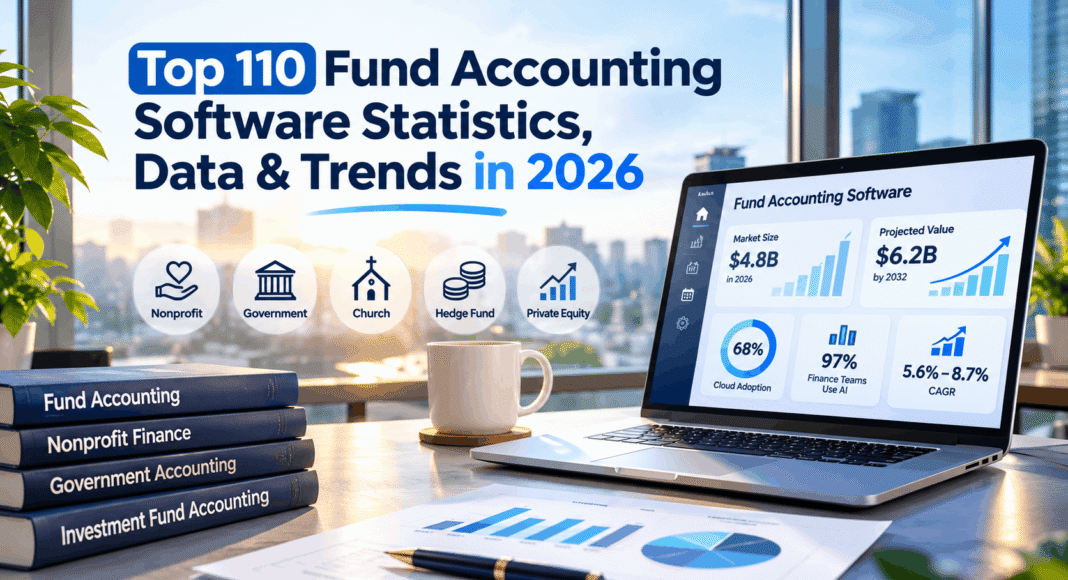
- Fund Accounting Software Market Growth: The global fund accounting software market is projected to reach USD 6.2 billion by 2032, driven by rising demand for financial transparency, regulatory compliance, and automated fund management solutions.
- AI, Cloud Adoption, and Accounting Automation: Cloud-based accounting software and AI-powered automation are transforming fund accounting in 2026, improving financial reporting, reconciliation, operational efficiency, and real-time fund tracking.
- Nonprofit, Government, and Investment Fund Accounting Trends: Growing demand for specialized nonprofit accounting software, government financial management systems, and hedge fund accounting platforms is accelerating innovation in compliance, grant management, and investment reporting.
Fund accounting software in 2026 helps nonprofits, government agencies, churches, and investment firms manage restricted funds, automate financial reporting, and maintain compliance. The global market is projected to reach USD 6.2 billion by 2032. These 110 statistics highlight market growth, cloud adoption, AI automation, leading providers, and emerging industry trends.
Fund accounting software has become an essential financial management solution for nonprofit organizations, government agencies, religious institutions, investment funds, and other entities responsible for managing restricted funds, tracking financial activities, and maintaining regulatory compliance. As financial reporting requirements become increasingly complex and organizations face growing pressure to demonstrate transparency and accountability, the demand for advanced fund accounting software continues to expand worldwide.
Also, read our article on the Top 10 Best Fund Accounting Software To Know.
In 2026, the global fund accounting software market is experiencing significant transformation, driven by cloud-based accounting platforms, artificial intelligence (AI), automated financial reporting, and increasingly sophisticated compliance requirements. Organizations are moving beyond traditional spreadsheets and legacy accounting systems toward integrated financial management solutions that provide real-time visibility into fund allocations, grant expenditures, investment performance, and organizational financial health.
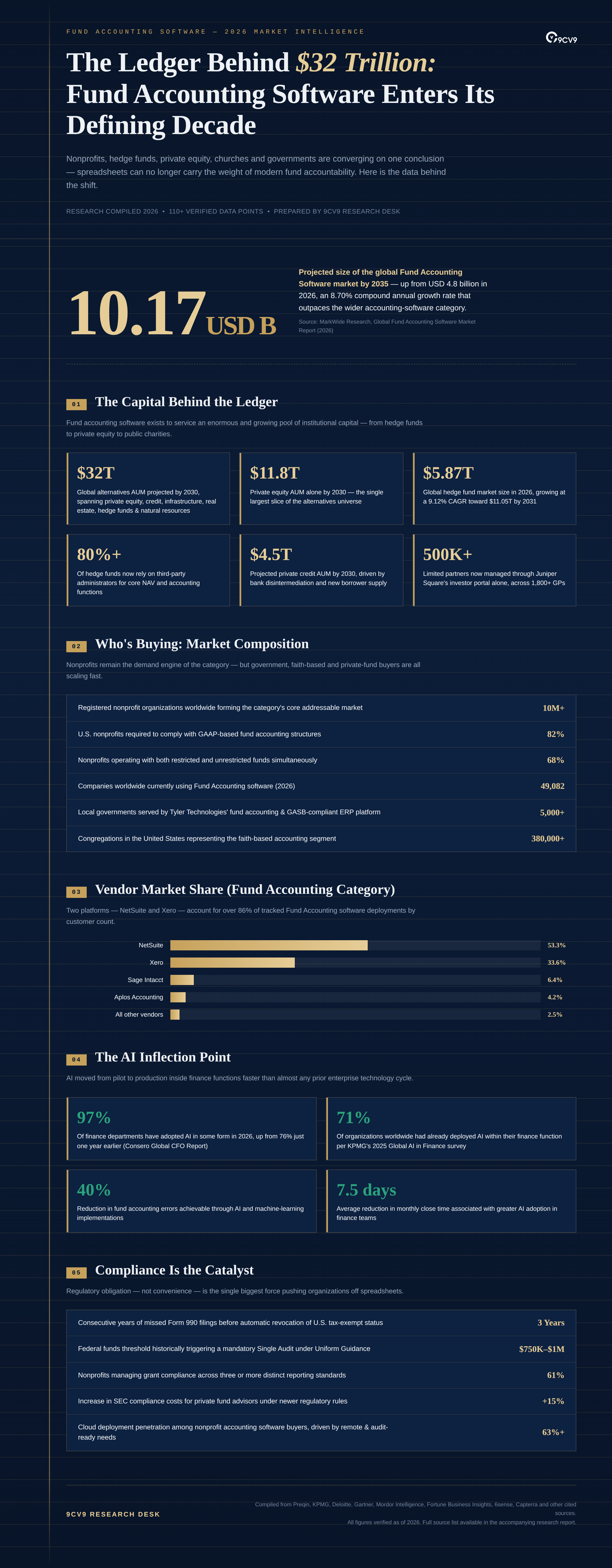
According to industry market research, the global fund accounting software market was valued at approximately USD 3.7 billion in 2024 and is projected to reach USD 6.2 billion by 2032, representing sustained demand for specialized financial management technology. Other market forecasts estimate that the industry could reach USD 12 billion by 2035, highlighting the substantial growth opportunities across nonprofit, public-sector, and investment fund accounting markets. These projections vary because research providers apply different market definitions, methodologies, and software category classifications.
The broader accounting software industry is also expanding rapidly. Global accounting software revenue is estimated at USD 23.47 billion in 2026 and projected to reach USD 35.86 billion by 2031, reflecting the growing importance of digital financial infrastructure across industries.
Growing Demand for Fund Accounting Software Across Industries
One of the most important fund accounting software trends in 2026 is the increasing adoption of specialized accounting solutions across organizations with complex financial reporting obligations.
Nonprofit organizations, for example, must distinguish between restricted and unrestricted funds, monitor grant expenditures, manage donor contributions, and prepare financial statements that comply with applicable accounting standards. Research estimates suggest that approximately 68% of nonprofits manage both restricted and unrestricted funds, while around 74% oversee more than five funding sources simultaneously.
These operational complexities are encouraging nonprofits to invest in dedicated nonprofit fund accounting software rather than relying exclusively on general-purpose bookkeeping applications.
The nonprofit accounting software market is consequently emerging as an important growth segment. One industry forecast values the market at USD 373.75 million in 2026 and projects it will reach USD 908.75 million by 2035, representing a compound annual growth rate of approximately 10.5%.
Government agencies and municipalities are experiencing similar digital transformation pressures. Public-sector organizations require accounting systems capable of supporting governmental accounting standards, budgetary controls, restricted fund reporting, and comprehensive audit documentation.
Meanwhile, churches and religious institutions are increasingly adopting specialized church fund accounting software to manage donations, tithes, designated funds, operating expenses, and financial reporting obligations.
The church accounting software market was estimated at USD 1.5 billion in 2024 and is projected to reach USD 3.2 billion by 2033, demonstrating the expanding role of financial technology within faith-based organizations.
Cloud Accounting, Artificial Intelligence, and Automation Are Reshaping the Market
Cloud-based fund accounting software is becoming an increasingly important component of modern financial management.
Industry research indicates that cloud deployments accounted for approximately 68.08% of the broader accounting software market in 2025. Within nonprofit accounting software, cloud adoption has reportedly exceeded 63%, reflecting growing demand for accessible, scalable, and collaborative financial management platforms.
Cloud accounting solutions allow finance teams to access financial information remotely, automate recurring transactions, consolidate reporting across multiple entities, and improve collaboration between accountants, financial administrators, and organizational leadership.
Artificial intelligence is accelerating this transformation.
The 2026 Consero Global CFO Report indicates that 97% of surveyed finance departments have adopted AI in some capacity, compared with 76% in 2025. Other industry research highlights growing adoption of AI-powered accounts payable automation, financial anomaly detection, reconciliation, forecasting, and knowledge management.
For fund accounting software providers, these developments create opportunities to introduce intelligent transaction categorization, automated grant tracking, real-time financial monitoring, and predictive financial analytics.
However, adoption does not automatically translate into measurable financial returns. Research cited in the industry indicates that only 28% of finance teams investing in AI report measurable financial impact, emphasizing the importance of evaluating actual productivity improvements, implementation costs, and financial reporting accuracy.
As a result, organizations evaluating AI-powered fund accounting software in 2026 must look beyond feature availability and assess whether automation delivers tangible improvements in efficiency, compliance, and financial transparency.
Hedge Funds and Private Equity Are Driving Demand for Advanced Fund Accounting Solutions
Beyond nonprofit and government accounting, investment fund accounting software represents another major area of technological development.
Hedge funds, private equity firms, private credit managers, and alternative investment administrators require sophisticated accounting platforms capable of managing complex investment structures, calculating net asset values (NAV), processing capital calls, tracking investor allocations, and supporting regulatory reporting.
The global hedge fund market is estimated at USD 5.87 trillion in 2026 and projected to reach USD 11.05 trillion by 2031, reflecting the considerable financial assets supported by fund administration and accounting infrastructure.
Additionally, global alternative investment assets under management are forecast to reach USD 32 trillion by 2030, with private equity, private credit, infrastructure, and other alternative asset classes contributing to this expansion.
As investment structures become more complex, demand is increasing for fund accounting software that supports multi-entity accounting, multi-currency transactions, investor reporting, portfolio valuation, and automated reconciliation.
Industry estimates also suggest that more than 80% of hedge funds utilize third-party administrators for important operational functions, including NAV calculations. This reliance reinforces the importance of specialized accounting technology for both investment managers and fund administration service providers.
Competition Among Fund Accounting Software Providers Is Intensifying
The fund accounting software landscape in 2026 includes established enterprise accounting providers, specialized nonprofit accounting vendors, and investment management technology platforms.
Major software providers include NetSuite, Sage Intacct, Blackbaud Financial Edge NXT, Microsoft Dynamics 365, Xero, Aplos, MIP, Juniper Square, and SS&C Technologies.
According to technographic market data included in the industry research, NetSuite accounts for approximately 53.30% of customers classified within a particular fund accounting software category, followed by Xero at 33.62% and Sage Intacct at 6.38%. These figures represent the tracked customer base within that dataset rather than independently verified shares of global fund accounting software revenue.
The competitive landscape also reflects considerable product specialization.
Nonprofit organizations often prioritize restricted fund tracking, grant management, donor reporting, and affordability. Government agencies emphasize budgetary controls, public-sector compliance, and audit readiness. Investment managers require advanced portfolio accounting, NAV calculations, investor allocation management, and complex financial consolidation.
Consequently, selecting the best fund accounting software increasingly depends on organizational size, industry-specific requirements, accounting complexity, integration capabilities, and total cost of ownership.
Why Fund Accounting Software Statistics Matter in 2026
Understanding the latest fund accounting software statistics is essential for finance professionals, nonprofit executives, government administrators, investment managers, software vendors, and business decision-makers seeking to navigate the evolving financial technology landscape.
Market growth projections reveal where investment and adoption are accelerating. Cloud accounting statistics highlight changing deployment preferences. AI adoption data provides insight into emerging automation opportunities, while software market share and customer satisfaction figures help organizations evaluate competing platforms.
At the same time, regulatory developments, financial transparency expectations, and growing reporting complexity are reshaping how organizations select and implement fund accounting systems.
The following 110 fund accounting software statistics, data points, and trends for 2026 provide a comprehensive overview of the industry’s current position and future direction.
The analysis explores global fund accounting software market size, growth forecasts, nonprofit accounting technology, government financial management systems, church accounting solutions, hedge fund administration, private equity accounting, cloud adoption, artificial intelligence, automation, vendor market share, software reviews, and regulatory compliance.
Together, these insights provide a data-driven foundation for understanding how fund accounting software is evolving in 2026 and what organizations should consider when investing in financial management technology for the years ahead.
Before we venture further into this article, we would like to share who we are and what we do.
About 9cv9
9cv9 is a business tech startup based in Singapore and Asia, with a strong presence all over the world.
With over ten years of startup and business experience, and being highly involved in connecting with thousands of companies and startups, the 9cv9 team has listed some of the top and best companies/tools in this review.
If you like to get your company listed in our top B2B software reviews, check out our world-class 9cv9 Media and PR service and pricing plans here.
Top 110 Fund Accounting Software Statistics, Data & Trends in 2026
A. Global Market Size & Growth (Fund Accounting Software)
1. The global Fund Accounting Software market was valued at USD 3.7 billion in 2024 and is projected to climb to USD 6.2 billion by 2032. Buyers evaluating fund accounting platforms should expect a maturing, well-capitalized vendor landscape through the rest of this decade.
2. Verified Market Research pegs the fund accounting software segment’s CAGR at 6.5% from 2026 to 2032. This steady growth rate signals durable, non-cyclical demand rather than a short-lived technology fad.
3. WiseGuyReports estimates the Fund Accounting Software Market at USD 6.93 billion in 2025, forecast to reach USD 12.0 billion by 2035 at a 5.6% CAGR. The wide range across research houses reflects differing category definitions, but the upward trajectory is consistent.
4. MarkWide Research pegs the global Fund Accounting Software Market at USD 4.8 billion in 2026, forecasting growth to USD 10.17 billion by 2035 at an 8.70% CAGR. This is one of the more bullish forecasts in the sector, driven by automated reconciliation adoption.
5. Market Research Intellect values the Fund Accounting Software Market at USD 1.2 billion, forecast to attain USD 2.3 billion by 2033, growing at an 8.5% CAGR between 2026 and 2033. Vendors like Sage Intacct and Blackbaud are explicitly named as regional growth drivers in this outlook.
6. The broader global Accounting Software market (which fund accounting sits inside) is valued at USD 23.47 billion in 2026 and is projected to hit USD 35.86 billion by 2031, growing at an 8.85% CAGR. This confirms fund accounting is riding a much larger cloud-finance wave.
7. Fortune Business Insights sizes the global accounting software market at USD 20.90 billion in 2025, rising to USD 42.17 billion by 2032 at a 10.5% CAGR — among the fastest growth estimates for the category. Fund accounting buyers can expect continued heavy R&D investment from major vendors as a result.
8. North America accounted for 35.77% of the global accounting software market in 2024, per Fortune Business Insights. This underscores why most enterprise-grade fund accounting platforms are still designed North America-first.
9. Mordor Intelligence reports cloud deployments already anchored 67.43% of accounting software revenue in 2024, rising to a 68.08% share in 2025. Fund accounting buyers evaluating on-premise legacy systems should treat cloud-first as the new default, not the exception.
10. Payroll management is the fastest-growing accounting software sub-segment, expanding at a 10.40% CAGR through 2031 per Mordor Intelligence. While distinct from core fund ledgers, this signals vendors are bundling adjacent HR/payroll modules into fund accounting suites.
B. Nonprofit Fund Accounting Software
11. The Nonprofit Accounting Software Market is valued at USD 373.75 million in 2026 and is expected to reach USD 908.75 million by 2035, a 10.5% CAGR. This is one of the fastest-growing sub-segments of the entire fund accounting space.
12. The USA accounts for approximately 38% of global nonprofit software adoption, backed by more than 1.5 million registered nonprofits. This concentration explains why most nonprofit fund accounting vendors build to US GAAP and Form 990 standards first.
13. Nearly 82% of U.S.-based nonprofits are required to comply with GAAP-based fund accounting structures. This compliance mandate is the single biggest driver pushing nonprofits off spreadsheets and onto dedicated software.
14. More than 10 million registered nonprofit organizations exist globally, representing the addressable market fund accounting software vendors are racing to serve. This scale explains the proliferation of niche players like Aplos, MIP, and FastFund alongside larger ERP suites.
15. Over 68% of nonprofits operate with both restricted and unrestricted funds simultaneously, a core reason generic accounting tools fall short for mission-driven organizations. Purpose-built fund accounting software exists largely to solve this exact segmentation problem.
16. Around 74% of nonprofit organizations manage more than 5 funding sources at once, intensifying the need for multi-dimensional fund tracking. Manual spreadsheet-based tracking becomes error-prone well before an organization reaches this level of complexity.
17. 61% of nonprofits handle grant compliance across 3 or more distinct reporting standards. This statistic highlights why automated, standards-aware reporting has become a must-have feature rather than a nice-to-have.
18. Nearly 79% of nonprofits operate with annual budgets below USD 5 million, meaning affordability and ease of implementation matter as much as feature depth in software selection. Vendors targeting this segment increasingly compete on onboarding speed rather than raw functionality.
19. Cloud deployment penetration among nonprofit accounting software has exceeded 63%. Nonprofits are moving to the cloud even faster than some for-profit sectors, largely due to distributed, remote, and volunteer-heavy staffing models.
20. Automation within nonprofit accounting software has reduced manual bookkeeping errors by nearly 41%. This is a concrete, measurable efficiency gain that nonprofit finance leaders can point to when justifying a software upgrade to their board.
21. A separate valuation places the Nonprofit Accounting Software Market at USD 2.5 billion in 2024, projected to reach USD 4.1 billion by 2033 at a 7.2% CAGR. The spread between valuations reflects varying scope (core software vs. adjacent grant/donor tools).
22. Global nonprofit accounting software was valued at USD 2.3 billion in 2025 and is projected to reach USD 4.8 billion by 2033, growing at a 9.6% CAGR. Growth is explicitly tied to demand for transparency, donor trust, and grant reporting automation.
23. North America holds the largest nonprofit accounting software market share at 45.2%, worth approximately USD 1.04 billion in 2025. This dominance is attributed to the high concentration of tax-exempt organizations and mature cloud infrastructure in the US and Canada.
24. Small and medium nonprofits represent 64.2% of the installed software base in this category. This majority share is why so many vendors prioritize simplicity and lower price points over enterprise-grade complexity.
25. The Nonprofit Accounting Software Solution market is projected to reach USD 3.5 billion by 2033 at an 8.2% CAGR, driven primarily by transparency and accountability demands from donors and regulators alike.
C. Government, Municipal & Public-Sector Fund Accounting
26. Tyler Technologies alone reports serving more than 5,000 local governments as of 2026, making it one of the most widely deployed public-sector fund accounting vendors in North America. This scale illustrates how consolidated the municipal ERP market has become.
27. Local governments overwhelmingly avoid small-business tools like QuickBooks in favor of GASB-compliant fund accounting platforms such as Tyler, OpenGov, MIP, and AccuFund. This is a direct consequence of legal requirements to report by restricted fund, not just by account.
28. GASB 34, GASB 45, and GASB 68 compliance requirements are now built into most modern government ERP platforms as standard, automated reporting modules. This automation has meaningfully reduced the audit burden on public-sector finance teams.
29. Municipal ERP vendors increasingly offer cloud, hosted, and on-premise deployment options side-by-side, reflecting the wide range of IT maturity across small towns versus large counties. This flexibility has become a key differentiator in public-sector RFPs.
30. GASB 87 lease-accounting compliance has spurred an entirely new sub-category of dedicated lease accounting software for governmental entities. This niche’s emergence shows how granular regulatory change can spin up entirely new software categories.
D. Religious & Church Fund Accounting
31. The Church Accounting Software Market was valued at USD 1.5 billion in 2024 and is estimated to reach USD 3.2 billion by 2033, growing at a 9.2% CAGR. Faith-based organizations are increasingly treated as a distinct, high-growth buyer segment by fund accounting vendors.
32. A separate church accounting valuation places the market at USD 2.85 billion in 2024, forecast to reach USD 5.95 billion by 2033 at an 8.6% CAGR. Either way, double-digit-adjacent growth confirms churches are digitizing their books faster than in prior decades.
33. North America represents over 42% of the global church accounting software market, driven by high technology adoption and a large religious-organization population. The United States alone hosts more than 380,000 congregations, per the National Council of Churches.
34. The Accounting Software for Churches segment specifically is valued at USD 1.2 billion in 2024, projected to reach USD 2.5 billion by 2033 at an 8.9% CAGR. Tithing management and pledge tracking remain the standout features differentiating this niche from general fund accounting.
35. The broader Church Management Software Market, valued at USD 480.42 million in 2026, is projected to reach USD 1.6 billion by 2032 — a striking 22.03% CAGR. Accounting is just one module within this fast-expanding category of religious-organization software.
36. Cloud-based platforms now account for over 50% of new church software implementations. Remote access for volunteer treasurers and part-time bookkeepers is cited as the leading driver of this cloud shift.
37. Asia-Pacific accounts for approximately 15% of the global church management software market and is the fastest-emerging region for religious-sector digitization. This regional diversification is gradually reducing the category’s historical North America concentration.
38. Donation management software specifically has been adopted by roughly 14% of religious institutions tracked in recent market research. This relatively low penetration suggests significant headroom remains for donation-tracking feature adoption.
39. Mid-sized religious organizations using automated, integrated fund and volunteer management platforms report a 40% reduction in volunteer scheduling conflicts compared to manual spreadsheet-based processes. This is a rare case where fund accounting adjacent automation delivers a clearly quantifiable operational benefit.
40. Global digital transformation spending overall is projected to reach USD 3.4 trillion by 2026, a macro trend that market researchers cite as directly benefiting church and nonprofit accounting software adoption. Faith-based organizations are effectively riding a much larger enterprise digitization wave.
E. Hedge Fund & Alternative Investment Fund Accounting
41. The global fund administration market was valued at USD 10.37 billion in 2022, forming the services backbone that fund accounting software increasingly automates. This figure represents the addressable services spend that software vendors are working to displace or augment.
42. The alternative investment fund administration market is projected to grow at a 7.2% CAGR from 2023 to 2030. Hedge funds, private equity, and private credit vehicles are the primary drivers of this segment’s expansion.
43. Global hedge fund industry AUM reached approximately USD 4 trillion in 2024, per fund administration industry research. This scale underlines just how much capital depends on accurate, timely fund accounting infrastructure.
44. 85% of fund managers report increasing their technology spend in 2024, a figure that directly benefits fund accounting software vendors competing for budget allocation. Technology investment has clearly become a competitive necessity rather than a discretionary line item.
45. Cloud adoption among fund administrators has reached 70% for core accounting systems. This mirrors the broader accounting-software cloud migration trend but arrives somewhat later given the sensitivity of institutional investment data.
46. AI and machine learning implementations can reduce fund accounting errors by as much as 40%, according to industry benchmarking. Error reduction of this magnitude is a compelling ROI argument for fund managers weighing AI-enabled platform upgrades.
47. SEC compliance costs for private fund advisors have increased by 15% under newer regulatory rules. Rising compliance overhead is a significant tailwind pushing fund managers toward automated, audit-ready accounting software.
48. The Asia-Pacific fund administration market is expected to expand at the fastest CAGR of 9.5% through 2030, outpacing North America and Europe. This regional acceleration reflects the rapid maturation of APAC’s private capital ecosystem.
49. The global hedge fund market is valued at USD 5.87 trillion in 2026 and is projected to reach USD 11.05 trillion by 2031, growing at a 9.12% CAGR. This is a substantially higher growth estimate than older forecasts, reflecting renewed institutional appetite for alternatives.
50. Multi-strategy hedge fund platforms hold the largest position with a 27.26% share of the market in 2025. Their scale-driven operating model has made them disproportionately reliant on institutional-grade fund accounting infrastructure.
51. Quantitative and systematic hedge fund strategies are set to grow fastest, at an 11.63% CAGR through 2031. Data-intensive strategies of this kind place unusually high demands on real-time, automated fund accounting reconciliation.
52. North America dominates the global hedge fund market with an 81.10% share as of 2025, reinforcing the region’s centrality to the fund accounting software vendor landscape. Any vendor seeking scale in this category must prioritize North American regulatory and reporting requirements.
53. Equity hedge funds hold the largest strategy share at 48.24% in 2026, driven by their adaptability across market cycles. This strategy mix directly shapes the reconciliation and pricing complexity that fund accounting software must handle.
54. More than 70% of hedge funds now outsource at least one operational function, according to Deloitte’s alternative investment outlook. Fund administration remains the single most commonly outsourced back-office activity in this trend.
55. More than 80% of hedge funds utilize third-party administrators for core functions such as NAV calculation, per Preqin data. This heavy reliance on administrators is precisely why administrator-facing fund accounting software has become such a high-value category.
56. The Middle Office Outsourcing market, valued at USD 8.83 billion in 2025, is expected to grow to USD 17.65 billion by 2033 at a 9.07% CAGR. This adjacent category is expanding in lockstep with fund accounting software adoption.
57. The global fund administration outsourcing market was valued at USD 6.8 billion in 2025 and is projected to reach USD 13.2 billion by 2034 at a 7.6% CAGR. Escalating regulatory demands and cloud-native platform adoption are cited as the primary growth drivers.
58. North America held 38.2% of the global fund administration outsourcing market in 2025, generating approximately USD 2.6 billion in revenue. The depth of North America’s capital markets ecosystem continues to anchor this leadership position.
59. The fund administration services market was worth USD 9.8 billion in 2025 and is forecast to reach USD 19.6 billion by 2034 at an 8.1% CAGR. Fund Accounting itself is the single largest service line within this broader market.
60. Fund Accounting contributed 34.2% of the total fund administration services market share in 2025 — the largest individual segment. This confirms fund accounting is not a peripheral service but the core value driver of the entire fund administration industry.
61. North America held the highest revenue share of the fund administration services market at 42.3% in 2025. Well-established asset management infrastructure in the US continues to be the primary explanatory factor.
62. HFR data estimates 438 new hedge funds launched in 2023, each requiring fund accounting infrastructure from day one. New fund launches represent a steady, recurring source of net-new fund accounting software demand.
F. Private Equity & Private Markets Fund Accounting
63. Global alternatives AUM is forecast to reach USD 32 trillion by 2030, spanning private equity, credit, infrastructure, real estate, hedge funds, and natural resources. This scale represents the total addressable capital base that fund accounting platforms are ultimately built to serve.
64. Private equity AUM alone is projected to reach USD 11.8 trillion by 2030, making it the single largest slice of the alternatives universe. PE’s complex waterfall and carried-interest calculations are among the most demanding workloads for fund accounting software.
65. Private credit AUM is projected to grow toward USD 4.5 trillion by 2030, driven by bank disintermediation and new borrower supply. This rapidly maturing asset class is a growing source of demand for specialized loan and credit fund accounting modules.
66. Infrastructure AUM is approaching USD 3 trillion by 2030, propelled by energy security and digital infrastructure investment. Long-dated, illiquid infrastructure assets require distinct valuation and NAV workflows within fund accounting platforms.
67. The value of private capital deals hit USD 2.3 trillion through late November 2025, putting the industry on course for its best year since 2021. Rising deal volume directly increases transaction-processing loads on fund accounting systems.
68. Transactions of USD 10 billion or more in a single calendar year just hit a record high, according to Financial Times data cited by Preqin. Mega-deals of this size place exceptional demands on multi-currency, multi-entity fund accounting infrastructure.
69. PE dry powder alone stood at roughly USD 2.4 trillion of a USD 3.9 trillion total private capital dry powder figure as of 2023. Uncalled capital of this magnitude requires precise capital-call and commitment tracking within fund accounting software.
70. Juniper Square’s investor portal is trusted by more than 1,800 GPs to manage more than 500,000 limited partners, illustrating the scale reached by modern private-funds enablement platforms. Investor-facing transparency has become as important as the underlying ledger itself.
71. AccountsIQ’s fund accounting platform is trusted by over 20,000 users across more than 60 countries, according to its own Capterra listing. This global footprint demonstrates how far cloud-native fund accounting has spread beyond its North American roots.
72. SS&C’s Geneva platform supports daily NAV calculations and real-time P&L across a full range of asset classes and fund structures. Daily (rather than monthly) NAV cycles are becoming an increasingly common institutional expectation.
G. AI, Cloud & Automation Adoption in Finance
73. 97% of finance departments have adopted AI in some form as of the 2026 Consero Global CFO Report, up sharply from 76% in 2025. This is among the fastest year-over-year adoption jumps recorded in enterprise software history.
74. Gartner’s earlier forecast projected 90% of finance functions would deploy at least one AI-enabled solution by 2026 — and actual adoption appears to have exceeded that target. Fund accounting buyers evaluating vendors should now expect AI features as a baseline, not a premium add-on.
75. The leading AI use cases actually running in finance teams are knowledge management (49%), accounts payable automation (37%), and error/anomaly detection (34%), per Gartner’s November 2025 survey. Error and anomaly detection is particularly relevant to fund reconciliation workflows.
76. Only 28% of finance teams with AI investments report seeing measurable financial impact, according to CFO.com survey data. This gap between adoption and realized value is an important caution for fund managers evaluating AI-driven fund accounting claims.
77. A separate RGP survey of 200 U.S. CFOs found only 14% report a clear, measurable AI return to date. Buyers should treat AI-feature marketing claims with healthy scrutiny until ROI is independently verified.
78. KPMG’s 2025 Global AI in Finance survey found 71% of organizations worldwide have already deployed AI within their finance function. Among those, 74% report their AI investments have met or exceeded expectations.
79. Deloitte’s Finance Trends 2026 survey found 63% of finance departments have fully deployed and are actively using AI solutions, yet only 21% report clear, measurable value delivered. This mirrors the adoption-versus-ROI gap seen across other surveys.
80. KPMG’s 2026 AI in Finance report found 93% of US companies expect to deploy or scale AI within their finance functions over the next 18 months. This forward-looking figure suggests today’s adoption numbers will likely be conservative within two years.
81. 88% of finance professionals expect AI to be the most transformative accounting technology over the next 12–24 months, per the AICPA and CIMA Future-Ready Finance survey. Yet only 8% describe their organization as “very well prepared” for that transformation.
82. AI adoption among tax and accounting firms rose from just 9% in 2024 to 41% in 2025, according to Wolters Kluwer’s Future Ready Accountant report. This is one of the steepest single-year adoption curves recorded in the profession.
83. 98% of accounting professionals globally now report using AI in some capacity, per Karbon’s 2026 State of AI in Accounting report. Near-universal usage confirms AI is now table stakes rather than a differentiator on its own.
84. 69% of US tax and accounting professionals report AI adoption, according to Thomson Reuters’ 2026 research, with organizational AI adoption jumping from 22% to 40% between the 2025 and 2026 survey waves.
85. Firms adopting AI report an average 25% reduction in operational expenses, according to aggregated industry benchmarking. This is one of the clearest quantifiable cost-savings figures cited across the accounting-automation research base.
86. AI-driven automation has been linked to a 40% reduction in audit costs, per a widely cited KPMG analysis. Lower audit costs are especially relevant to fund managers facing rising SEC and LP-driven audit scrutiny.
87. PwC projects finance functions could see up to a 50% cost reduction through AI by 2028. This is among the most aggressive efficiency projections in the current research landscape and should be treated as an upper-bound scenario.
88. 62% of accounting firms that adopted AI reported significant cost savings and increased productivity in a PwC survey, with 50% of those firms saying AI enabled entirely new, predictive-insight service offerings.
89. Greater AI adoption has been associated with a 7.5-day reduction in monthly close time, according to research cited by finance-technology analysts. Faster close cycles are one of the most concrete operational benefits fund accounting teams can expect from automation.
90. AI adoption has also been linked to a 12% increase in ledger granularity, meaning finance teams can track and report on financial data at a more detailed, transaction-level basis than was previously practical manually.
H. Vendor Market Share & Category Landscape
91. More than 49,000 companies worldwide are currently using one or more Fund Accounting software solutions as of 2026, with 27,856 of those companies based in the United States alone.
92. NetSuite holds the largest Fund Accounting category market share at 53.30%, representing 28,539 customers, according to 6sense technographic data. This makes it the single most widely deployed platform in the fund accounting space by customer count.
93. Xero holds a 33.62% market share in the Fund Accounting category with 18,003 customers, positioning it as the clear second-place platform behind NetSuite in overall adoption.
94. Sage Intacct holds a 6.38% share of the Fund Accounting category with 3,417 customers, making it the leading dedicated nonprofit-and-mission-driven fund accounting specialist among the major platforms.
95. The majority of Fund Accounting category adopters fall into the 100–249 employee size band (13,459 companies), followed closely by 20–49 employees (13,097 companies) and 0–9 employees (9,802 companies) — confirming this category skews heavily toward small and mid-sized organizations.
96. Sage Intacct customers for fund accounting are concentrated 83.92% in the United States, with the United Kingdom (5.93%) and Canada (5.12%) rounding out the top three geographies. This distribution highlights how Anglophone markets currently dominate fund accounting software adoption.
97. Blackbaud Financial Edge NXT customers are similarly concentrated, with 87.80% based in the United States. Education and continuing-education organizations are among its top customer verticals.
98. Sage Intacct achieved 17% market share for core accounting among 535 surveyed SaaS companies, ahead of both NetSuite and Microsoft Dynamics, according to The SaaS CFO’s 5th Annual Tech Stack Survey. It is specifically noted as the market-share leader for companies with $11M–$50M in annual revenue.
99. QuickBooks remains the dominant application overall with 31% market share among companies generating $10 million or less in annual revenue, illustrating the clear market segmentation between entry-level and mid-market fund accounting buyers.
100. The Capterra Fund Accounting Software directory lists 94 distinct products as of 2026, reflecting a highly fragmented, specialization-driven vendor landscape rather than a market dominated by one or two players.
I. Capterra User Ratings & Reviews Snapshot
101. QuickBooks Online holds a 4.3 out of 5 rating across 8,483 verified reviews on Capterra, the highest review volume of any product listed in the Fund Accounting directory.
102. Microsoft Dynamics 365 holds a 4.4 out of 5 rating with 5,839 reviews, positioning it as a leading enterprise-grade alternative for organizations needing integrated fund, CRM, and supply-chain functionality.
103. Xero holds a 4.4 out of 5 rating across 3,311 reviews, reflecting consistently strong small-business satisfaction with its bank reconciliation and automation features.
104. Sage Intacct holds a 4.3 out of 5 rating across 713 reviews on Capterra India, with users specifically praising its AICPA-preferred, ASC 958–compliant fund accounting capabilities for nonprofits.
105. Juniper Square holds an exceptional 4.9 out of 5 rating across 61 reviews, the highest rating among dedicated private-funds platforms in the directory, despite serving the most institutionally complex end of the market.
106. MoneyMinder holds a 4.9 out of 5 rating across 122 reviews, making it one of the top-rated tools specifically for volunteer-led nonprofit and community-group treasurers.
107. 85% of software buyers on Capterra opt for a 30-day free trial before completing a purchase, underscoring how central hands-on evaluation has become to fund accounting software procurement decisions.
108. Fund Accounting scores an average 3.8 out of 5 across “highest and lowest rated features” benchmarking on Capterra’s broader Accounting Software category — notably lower than adjacent features like Purchase Order Management (4.3) — suggesting meaningful room remains for vendors to improve dedicated fund-tracking usability.
J. Compliance, Grants & Audit Requirements
109. Federal grants totaling USD 750,000 or more in a fiscal year historically triggered a mandatory Single Audit under the Uniform Guidance (2 CFR Part 200); more recent federal guidance updates have shifted this threshold, and nonprofits using USD 1 million or more in federal funds annually must now undergo a Single Audit.
110. Failing to file IRS Form 990 for three consecutive years results in automatic revocation of a nonprofit’s tax-exempt status. This severe consequence is one of the strongest compliance-driven motivations behind fund accounting software adoption among US nonprofits.
Conclusion
The top 110 fund accounting software statistics, data, and trends in 2026 highlight an industry undergoing significant transformation as organizations increasingly prioritize financial transparency, regulatory compliance, operational efficiency, and digital financial management. From nonprofit organizations and government agencies to churches, hedge funds, and private equity firms, the demand for specialized fund accounting software continues to grow as financial reporting requirements become more sophisticated.
The global fund accounting software market demonstrates promising long-term growth potential. One industry estimate values the market at USD 3.7 billion in 2024 and projects it will reach USD 6.2 billion by 2032, while another forecasts growth from USD 6.93 billion in 2025 to USD 12 billion by 2035. Although market estimates vary depending on research methodologies and category definitions, these projections consistently indicate expanding demand for fund accounting solutions.
One of the most significant fund accounting software trends in 2026 is the continued transition from traditional bookkeeping systems and manual spreadsheets to cloud-based financial management platforms. With cloud deployments representing approximately 68.08% of the broader accounting software market in 2025, organizations are increasingly recognizing the benefits of real-time financial reporting, automated reconciliation, remote accessibility, and integrated accounting workflows.
Artificial intelligence and automation are also becoming important competitive differentiators. Research indicating that 97% of surveyed finance departments have adopted AI in some capacity demonstrates the growing influence of intelligent technologies on financial operations. AI-powered transaction processing, automated fund allocation, anomaly detection, predictive analytics, and financial reporting capabilities are creating opportunities for organizations to reduce administrative workloads and improve accounting accuracy.
However, the gap between AI adoption and measurable financial returns remains an important consideration. Organizations should prioritize fund accounting software that delivers demonstrable improvements in productivity, reporting accuracy, compliance management, and overall financial performance rather than investing in automation solely because it represents an emerging technology trend.
The nonprofit sector remains a particularly important growth opportunity. With organizations managing multiple funding sources, restricted donations, grants, and increasingly demanding reporting obligations, specialized nonprofit fund accounting software is becoming essential for maintaining accountability and donor confidence. Market forecasts projecting nonprofit accounting software growth at approximately 10.5% annually through 2035 reinforce the expanding importance of purpose-built financial management solutions.
Government agencies and religious organizations are experiencing similar developments. Public-sector entities require robust budget management, governmental accounting standards compliance, and transparent financial reporting, while churches increasingly depend on specialized accounting platforms for donation tracking, designated fund management, and financial stewardship.
Meanwhile, the investment management industry is creating substantial demand for advanced hedge fund accounting software, private equity fund accounting platforms, and fund administration technology. With global alternative investment assets under management projected to reach USD 32 trillion by 2030, investment managers and administrators face growing pressure to modernize portfolio accounting, investor reporting, capital allocation, and net asset value calculations.
Competition among fund accounting software providers is also intensifying. Established platforms such as NetSuite, Sage Intacct, Blackbaud Financial Edge NXT, Microsoft Dynamics 365, and specialized investment accounting solutions are competing through cloud capabilities, automation, industry-specific functionality, and integrated financial reporting.
For organizations evaluating the best fund accounting software in 2026, the most important considerations extend beyond subscription pricing and basic bookkeeping features. Decision-makers should carefully assess fund tracking capabilities, financial reporting flexibility, regulatory compliance, scalability, integration options, data security, implementation requirements, and long-term total cost of ownership.
Looking ahead, several developments are likely to shape the future of fund accounting software, including greater adoption of AI-assisted accounting, more sophisticated cloud-based financial management systems, expanded automation of grant and investment reporting, stronger regulatory compliance capabilities, and increased demand for real-time financial visibility.
Ultimately, the 110 fund accounting software statistics and trends for 2026 demonstrate that fund accounting technology is evolving from a specialized bookkeeping function into a critical component of organizational financial governance and strategic decision-making.
Organizations that invest in appropriate fund accounting solutions will be better positioned to strengthen financial oversight, improve operational efficiency, maintain stakeholder confidence, and adapt to changing regulatory and reporting requirements.
As the industry continues to evolve through 2027 and beyond, the most successful organizations will be those that combine reliable fund accounting practices with scalable technology, intelligent automation, and a commitment to financial transparency. Fund accounting software will remain an essential investment for organizations seeking to manage financial resources responsibly while supporting sustainable long-term growth.
If you find this article useful, why not share it with your hiring manager and C-level suite friends and also leave a nice comment below?
We, at the 9cv9 Research Team, strive to bring the latest and most meaningful data, guides, and statistics to your doorstep.
To get access to top-quality guides, click over to 9cv9 Blog.
To hire top talents using our modern AI-powered recruitment agency, find out more at 9cv9 Modern AI-Powered Recruitment Agency.
People Also Ask
What is fund accounting software?
Fund accounting software is a financial management system that tracks income, expenses, assets, and liabilities across separate funds. It helps nonprofits, government agencies, churches, and investment firms maintain financial transparency and meet reporting requirements.
What is the global fund accounting software market size in 2026?
Market estimates vary by research provider. One forecast values the global fund accounting software market at USD 4.8 billion in 2026, while other estimates use different market definitions and methodologies.
How fast is the fund accounting software market growing?
The global fund accounting software market is projected to grow at a compound annual growth rate (CAGR) of approximately 5.6% to 8.7%, depending on the research provider and forecast period.
What is the projected fund accounting software market size by 2032?
One industry forecast projects the global fund accounting software market will reach USD 6.2 billion by 2032, up from USD 3.7 billion in 2024, driven by increasing demand for automated financial reporting and compliance management.
What are the biggest fund accounting software trends in 2026?
Major trends include cloud-based accounting, AI-powered automation, real-time financial reporting, automated reconciliation, grant management integration, enhanced compliance monitoring, and growing adoption among nonprofit and investment organizations.
Why is fund accounting software important for nonprofit organizations?
Nonprofit fund accounting software tracks restricted donations, unrestricted funds, grants, and program expenses. It helps organizations demonstrate financial accountability, maintain donor confidence, and prepare accurate financial reports.
How large is the nonprofit accounting software market in 2026?
One market forecast values the global nonprofit accounting software market at USD 373.75 million in 2026, with projected growth to USD 908.75 million by 2035 at a CAGR of approximately 10.5%.
What percentage of nonprofits use restricted and unrestricted funds?
Industry estimates suggest approximately 68% of nonprofit organizations manage both restricted and unrestricted funds, creating demand for accounting software that separately tracks financial resources and spending restrictions.
How many funding sources do nonprofit organizations typically manage?
Research estimates indicate that approximately 74% of nonprofit organizations manage more than five funding sources simultaneously, increasing the need for automated grant tracking, fund allocation, and financial reporting.
What are the benefits of cloud-based fund accounting software?
Cloud-based fund accounting software provides remote access, automated updates, centralized financial records, real-time reporting, easier collaboration, and scalable infrastructure for organizations managing multiple funds or locations.
What percentage of accounting software is cloud-based in 2026?
Cloud deployments accounted for approximately 68.08% of broader accounting software market revenue in 2025. This indicates strong cloud adoption heading into 2026, although the figure is not specific to fund accounting software.
How is artificial intelligence transforming fund accounting software?
Artificial intelligence supports automated transaction categorization, anomaly detection, reconciliation, financial forecasting, and reporting. These capabilities can reduce manual workloads and help finance teams identify potential accounting errors.
What percentage of finance departments use AI in 2026?
According to the 2026 Consero Global CFO Report cited in the research, 97% of surveyed finance departments adopted AI in some capacity, compared with 76% in 2025.
Can AI-powered fund accounting software reduce accounting errors?
AI-powered fund accounting tools can identify unusual transactions, automate reconciliation, and reduce manual data entry. Industry estimates suggest AI and machine learning implementations may reduce certain fund accounting errors by up to 40%.
What is the difference between fund accounting and traditional accounting software?
Traditional accounting software primarily tracks overall business profitability and financial performance. Fund accounting software separately monitors financial resources based on restrictions, purposes, grants, programs, or investment structures.
What is the best fund accounting software for nonprofits in 2026?
Popular nonprofit fund accounting platforms include Sage Intacct, Blackbaud Financial Edge NXT, Aplos, MIP, and AccuFund. The best choice depends on organizational size, grant complexity, reporting requirements, integrations, and budget.
Which companies lead the fund accounting software market?
Major providers include NetSuite, Sage Intacct, Blackbaud, Xero, Microsoft Dynamics 365, and specialized vendors. One technographic dataset places NetSuite at 53.30% of tracked fund accounting software customers.
What is Sage Intacct’s market share in fund accounting software?
According to the cited technographic research, Sage Intacct accounts for approximately 6.38% of customers in its tracked fund accounting software category, representing 3,417 organizations.
How does government fund accounting software work?
Government fund accounting software manages public budgets, restricted funds, expenditures, financial statements, and audit records. It supports governmental accounting requirements and helps public agencies demonstrate responsible financial management.
What accounting standards must government fund accounting software support?
Government fund accounting platforms in the United States commonly support Governmental Accounting Standards Board requirements, including GASB 34, GASB 68, and GASB 87, depending on the organization’s reporting obligations.
How large is the church accounting software market?
One industry estimate values the global church accounting software market at USD 1.5 billion in 2024 and projects it will reach USD 3.2 billion by 2033, reflecting growing adoption of specialized financial management solutions.
Why do churches need specialized fund accounting software?
Church fund accounting software tracks tithes, donations, designated funds, ministry budgets, and operating expenses. It helps religious organizations maintain financial transparency and monitor spending according to donor restrictions.
What is hedge fund accounting software?
Hedge fund accounting software manages investment transactions, portfolio valuations, net asset value calculations, investor allocations, reconciliations, and financial reporting for hedge funds and alternative investment managers.
How large is the global hedge fund market in 2026?
Industry research estimates the global hedge fund market at USD 5.87 trillion in 2026, with projections reaching USD 11.05 trillion by 2031. These figures describe the investment market rather than fund accounting software revenue.
What is private equity fund accounting software used for?
Private equity fund accounting software manages capital commitments, capital calls, distributions, carried interest, investment valuations, investor reporting, and complex financial structures across private investment funds.
How much will alternative investment assets grow by 2030?
Global alternative investment assets under management are projected to reach USD 32 trillion by 2030, covering private equity, private credit, hedge funds, infrastructure, real estate, and other alternative asset classes.
What is the role of automation in fund accounting software?
Automation reduces repetitive bookkeeping tasks, accelerates reconciliation, improves financial reporting, and supports compliance monitoring. It helps finance teams spend less time on manual processing and more time analyzing financial performance.
What should organizations look for when choosing fund accounting software?
Important features include restricted fund tracking, grant management, automated reporting, audit trails, compliance tools, cloud accessibility, integrations, data security, scalability, and transparent pricing.
How does fund accounting software support regulatory compliance?
Fund accounting software maintains transaction records, tracks restricted expenditures, generates financial statements, and supports audit documentation. These capabilities help organizations meet applicable accounting standards and regulatory requirements.
What is the future of fund accounting software beyond 2026?
The future of fund accounting software will likely involve greater AI adoption, cloud-based financial management, automated compliance reporting, predictive analytics, and deeper integration with grant management and investment administration platforms.
Sources
- Verified Market Research
- WiseGuy Reports
- MarkWide Research
- Mordor Intelligence
- Market Research Intellect
- Fortune Business Insights
- GlobeNewswire
- Market Reports World
- 6sense
- Sage
- Market Growth Reports
- MS Dynamics World
- Data Insights Market
- DataIntelo
- Strategic Revenue Insights
- WifiTalents
- Magistral Consulting
- Gitnux
- DigitalDefynd
- Intralinks
- WorldMetrics
- FundCount
- Preqin
- Chartered Alternative Investment Analyst Association (CAIA)
- Markets Media
- BlackRock
- IQ-EQ
- Angel Investors Network
- Capterra
- Stealth Agents
- Dokka
- Ledge
- DOST
- Xorosoft
- ReceiptsAI
- AIAccount
- ERP Research
- Zipdo
- Office Consumer
- Verified Market Reports
- Research and Markets
- DataHorizzon Research
- OpenPR
- Market Research Future
- Technavio
- Business Research Insights
- Transpire Insight
- Xero
- Wiss & Company
- Sopact
- Numetix
- SVA Certified Public Accountants
- Limelight
- Brady Ware
- The Fino Partners
- Gatekeeper