



























Key Takeaways
- AI-powered crypto trading tools in 2026 deliver superior risk-adjusted returns by combining automation, real-time data, and advanced portfolio management.
- The best AI trading platforms prioritize ultra-low latency, institutional-grade security, and regulatory compliance to outperform manual and retail-only systems.
- Future-ready AI crypto tools leverage agentic intelligence, privacy-preserving technologies, and high-quality data feeds to generate consistent alpha across market cycles.
In 2026, the landscape of cryptocurrency trading has undergone a remarkable transformation, driven by the widespread adoption of artificial intelligence (AI). As digital assets continue to mature and institutional participation accelerates, traders—both individual and professional—are turning to AI-powered tools to gain a competitive edge in one of the world’s most volatile markets. From predictive analytics and sentiment analysis to automated trade execution and portfolio rebalancing, AI is redefining how decisions are made in crypto trading.

The global cryptocurrency market now includes over 559 million users, with trading volumes on top exchanges surpassing $200 billion per day. In this hyper-competitive environment, milliseconds can mean the difference between profit and loss. Traditional manual trading strategies have become less viable due to the speed, scale, and complexity required to compete with high-frequency trading algorithms and sophisticated institutional systems. AI tools are filling this gap, offering intelligent automation, data-driven insights, and performance optimization capabilities that outperform conventional methods.
Leading the charge are AI-driven crypto trading platforms that utilize deep learning, machine learning, and agent-based models to make split-second decisions based on real-time data. These systems are not just reactive but proactive—continuously learning from past performance, adapting to new patterns, and managing risk dynamically. They can scan thousands of market signals, news articles, on-chain metrics, and technical indicators to generate actionable trade signals within milliseconds. This level of precision and efficiency is impossible for human traders to replicate on their own.
In addition to performance, modern AI tools also prioritize transparency, security, and regulatory compliance. As regulatory frameworks like the U.S. CLARITY Act and the EU’s MiCAR come into full force, AI tools are evolving to meet stringent requirements related to consumer protection, transaction monitoring, and auditability. Many platforms now offer SOC 2 Type II and ISO 27001 certifications, API permission controls, and smart-contract insurance to attract institutional users and safeguard capital.
Moreover, innovations like Zero-Knowledge Machine Learning (ZKML), Fully Homomorphic Encryption (FHE), and on-device AI processing are reshaping the privacy and data security models within these platforms. Traders can now benefit from the power of cloud-based AI while ensuring that private wallet data, trading history, and alpha-generating strategies never leave their local devices.
This blog explores the top 10 AI tools for trading cryptocurrencies in 2026, highlighting each platform’s unique capabilities, target users, and performance metrics. Whether you’re a beginner looking for user-friendly automation or an institutional trader seeking ultra-low-latency infrastructure, this comprehensive guide offers deep insights into the most powerful AI tools shaping the future of crypto trading.
By the end of this guide, readers will understand the technologies behind today’s top-performing bots, how to evaluate AI tools based on key metrics like Sharpe Ratio and maximum drawdown, and why the convergence of AI, decentralized finance, and regulation will define the next era of cryptocurrency trading.
Before we venture further into this article, we would like to share who we are and what we do.
About 9cv9
9cv9 is a business tech startup based in Singapore and Asia, with a strong presence all over the world.
With over nine years of startup and business experience, and being highly involved in connecting with thousands of companies and startups, the 9cv9 team has listed some important learning points in this overview of the Top 10 AI Tools For Trading Cryptocurrencies in 2026.
If you like to get your company listed in our top B2B software reviews, check out our world-class 9cv9 Media and PR service and pricing plans here.
Top 10 AI Tools For Trading Cryptocurrencies in 2026
1. Bitsgap
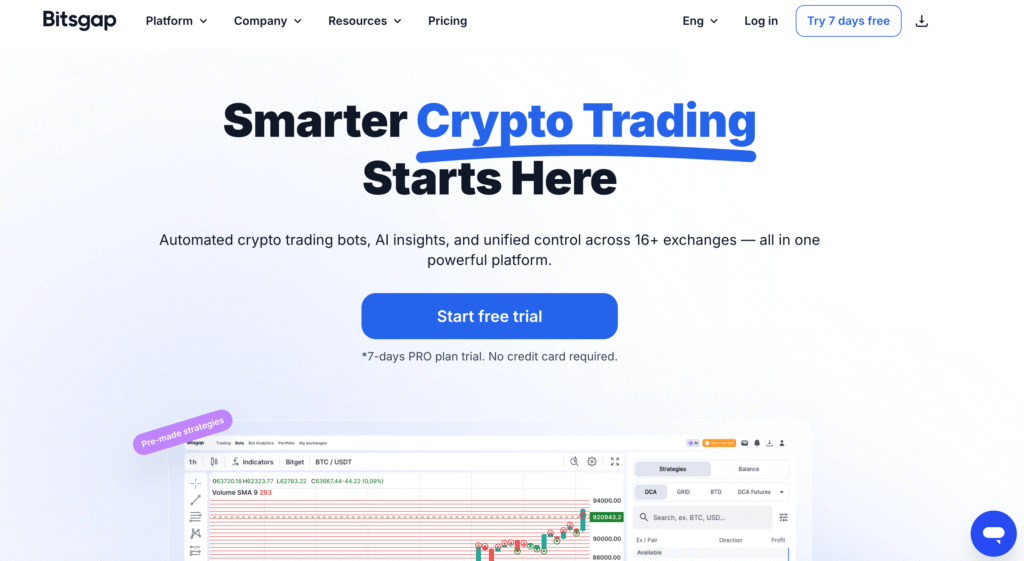
Bitsgap continues to dominate the cryptocurrency trading automation space in 2026. It is recognized globally for its all-in-one functionality that allows traders to manage multiple exchanges, deploy AI-enhanced bots, and execute complex strategies in real-time. With a global user base of over 600,000 to 800,000, the platform handles nearly $9.46 billion in user assets, making it one of the most trusted names in crypto trading automation.
Advanced Security and Track Record of Stability
Since its launch in 2017, Bitsgap has maintained a flawless security reputation. Its five-layer security framework ensures end-to-end encryption, account protection, and uninterrupted service. As of 2026, there have been zero publicly reported breaches, making it a platform of choice for both retail and institutional traders concerned with security.
AI-Powered Bots and Cutting-Edge Strategy Design
Bitsgap’s trading system is powered by six specialized bot types designed to perform under different market conditions. Among them, the LOOP Bot stands out by enabling traders to earn in two currencies simultaneously. It also supports automatic reinvestment of profits, ensuring compounding gains over time. In the first quarter of 2025 alone, Bitsgap users earned over $16.4 million in net profits through these automated bots, reflecting the system’s efficiency.
Platform Performance Overview: Q1 2025
| Metric | Value |
|---|---|
| User Base | 600,000 – 800,000 |
| Funds Managed | $9.46 Billion |
| Net Profits via Bots | $16.4 Million (3 months) |
| Reported Security Breaches | 0 |
Tiered Subscription Plans and Features
Bitsgap offers scalable pricing plans designed to meet the needs of beginners, intermediate traders, and professional investors. Each plan includes access to AI bots and strategic execution tools that become more powerful at higher tiers.
| Plan | Monthly Price | Number of Bots | Exclusive Features |
|---|---|---|---|
| Basic | $28 | 12 Bots | Unlimited smart orders |
| Advanced | $67 | 60 Bots | Advanced risk management tools |
| Pro | $147 | 300 Bots | Access to Futures Trading & AI Assistant |
AI Assistant and Intelligent Automation Tools
A standout feature in 2026 is the Bitsgap AI Assistant, which serves as a personal analytics hub for every trader. It offers insights based on live volatility patterns, helps with asset rebalancing, and suggests ideal bot configurations. The assistant uses real-time trend recognition and predictive modeling to fine-tune strategies according to changing market conditions.
For experienced traders and institutions, Bitsgap also provides advanced order types:
- Shadow Orders: Invisible trades that do not appear on exchange order books, ideal for stealth accumulation or distribution.
- TWAP (Time-Weighted Average Price): Used to execute large trades without impacting the market price.
Matrix: Bitsgap’s Key Features vs Market Alternatives (2026)
| Feature | Bitsgap | Other Platforms (Avg) |
|---|---|---|
| Multi-Exchange Access | Yes | Partial |
| AI-Powered Strategy Assistant | Yes | Limited |
| LOOP Dual-Currency Bot | Yes | No |
| Security Layers | 5 | 2–3 |
| Institutional Tools | Yes | Rare |
| Real-Time Strategy Tweaks | Yes | No |
Conclusion
In the highly competitive landscape of AI crypto trading tools in 2026, Bitsgap sets a clear benchmark. With a combination of advanced bot strategies, strong AI support, robust security, and professional-grade features, it serves everyone from novice investors to hedge fund managers. Its continuous innovation ensures that users remain equipped with the tools needed to navigate the volatility of the cryptocurrency markets with confidence and precision.
2. Cryptohopper
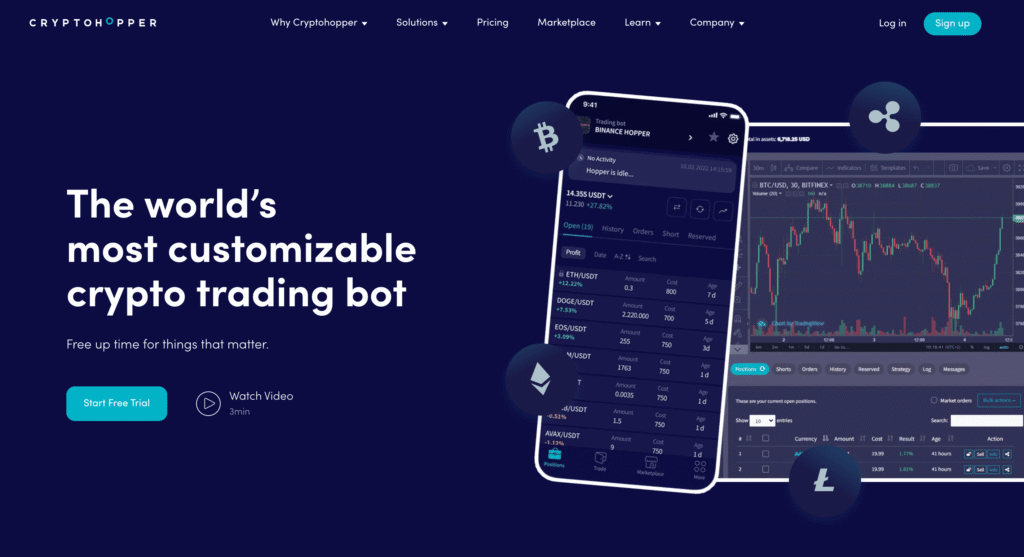
Cryptohopper has become one of the world’s most trusted AI-powered cryptocurrency trading tools in 2026. Starting as a modest home-based project, it has grown into a globally recognized trading automation platform with over one million registered users. Known for its strong focus on social trading, automation, and AI-driven strategy rotation, Cryptohopper stands out in a highly competitive market.
Built for the Cloud, Driven by Intelligence
As a fully cloud-native platform, Cryptohopper allows users to trade cryptocurrencies 24/7 without needing to keep their devices online. The system is powered by Algorithm Intelligence (AI), a unique feature that evaluates and ranks strategies based on their past performance across different market conditions. This enables traders to automatically switch to more successful strategies as the market evolves.
Cryptohopper Subscription Plans in 2026
| Plan Name | Monthly Price | Best For | Features & Position Limit |
|---|---|---|---|
| Pioneer | Free | Beginners | Up to 20 positions, basic tools |
| Explorer | $19.00 – $24.00 | Hobby Traders | Up to 80 positions |
| Adventurer | $49.00 – $62.00 | Intermediate/Advanced Users | Up to 200 positions |
| Hero | $99.00 – $107.50 | Professional Traders | Up to 500 positions, Arbitrage & Market Making bots |
Each tier is built to meet the specific needs of different user groups, from casual investors to experienced professionals. Higher-tier plans include premium trading bots such as arbitrage and market-making tools that use real-time data feeds and high-frequency execution logic.
AI-Powered Strategy Marketplace
One of Cryptohopper’s most attractive features in 2026 is its public strategy marketplace. Users can browse, purchase, or follow algorithmic trading strategies developed by other traders. These strategies are rated and scored using the platform’s AI system, which analyzes profitability, risk, and reliability across changing market environments.
Key Benefits of Cryptohopper in 2026
| Feature | Description |
|---|---|
| Algorithm Intelligence (AI) | Scores and rotates strategies based on real-world performance |
| Strategy Marketplace | Buy or subscribe to proven strategies from other traders |
| Arbitrage & Market-Making Bots | Available in Hero plan; optimized for high-speed trades |
| Social Trading Tools | Mirror trades of top performers within the platform |
| Cloud-Native Infrastructure | No downloads or manual updates required |
| MiCAR Regulatory Compliance | Meets EU trading platform regulations for added user safety |
Regulatory Compliance and Security in the EU
By 2026, Cryptohopper has gained full compliance with the Markets in Crypto-Assets Regulation (MiCAR), the EU’s regulatory framework for cryptocurrency services. This ensures that users in Europe operate under strict data privacy rules, transparent operational procedures, and risk-mitigation protocols. It further strengthens trust among institutional traders and professional investors across the continent.
Cryptohopper vs Other AI Crypto Trading Tools in 2026
| Feature | Cryptohopper | Average Competitor |
|---|---|---|
| Strategy Marketplace | Yes | Limited or None |
| AI-Driven Strategy Switching | Yes | Partial |
| Arbitrage Tools | Yes (Hero Plan) | Rare |
| MiCAR Compliance | Yes | No |
| Cloud-Based Access | Yes | Mixed |
| User Community | Over 1 Million | Below 500,000 |
Conclusion
In 2026, Cryptohopper continues to serve as a powerful, AI-enhanced crypto trading tool that blends automation, strategy optimization, and compliance. Its tiered pricing, robust AI features, and social trading ecosystem make it highly attractive to all types of traders—from complete beginners to seasoned professionals looking for institutional-grade execution. Its success lies in combining technological intelligence with regulatory trust, ensuring users trade smarter and safer in the fast-changing crypto market.
3. 3Commas
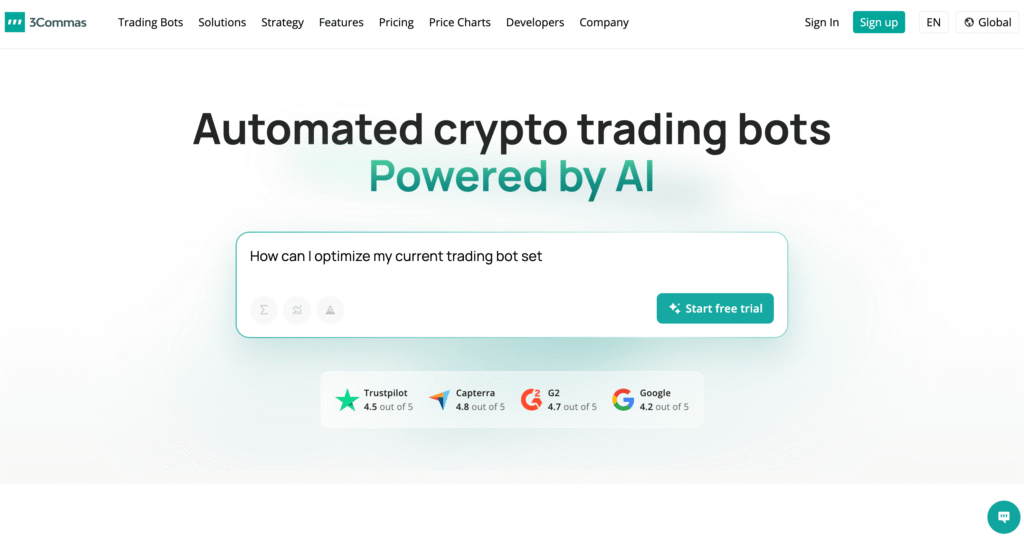
3Commas stands out in the competitive landscape of AI cryptocurrency trading tools in 2026, with more than 134,000 active traders relying on it for precise and flexible strategy execution. This platform is specifically designed for professional traders who seek advanced trade customization, multi-exchange integration, and performance-driven AI bots.
SmartTrade Terminal for Advanced Trade Execution
At the heart of the 3Commas experience in 2026 is its SmartTrade terminal. This tool empowers traders to execute highly customized strategies by allowing multiple take-profit levels, trailing stop-losses, and simultaneous order placements. It supports over 20 major exchanges, giving traders unified control of their positions across different platforms.
Performance Analysis of 3Commas Bots
3Commas has built a strong reputation through transparency and data-driven outcomes. In a six-month test on Bybit Futures, a DCA (Dollar Cost Averaging) bot using 20x leverage turned an initial investment of $376.50 into $730 in profit. This equated to a 193% return on investment, showcasing the platform’s capacity for aggressive, yet intelligent risk-reward strategies.
Another 30-day performance test involved a more conservative BTC/USDT DCA bot on Binance. This strategy produced a 12.8% net profit with a 100% win rate across 36 closed trades. These results reflect the consistency and efficiency of the AI-powered bots under different market conditions.
Bot Strategy Results on 3Commas (2026)
| Strategy Type | Exchange | Timeframe | Initial Investment | Net Profit | ROI | Win Rate |
|---|---|---|---|---|---|---|
| DCA (Aggressive) | Bybit Futures | 6 Months | $376.50 | $730 | 193% | Not Stated |
| DCA (Conservative) | Binance (BTC/USDT) | 30 Days | Varies | 12.8% | 12.8% | 100% |
Focus on Alpha Generation Over Market Indexes
A unique feature of 3Commas in 2026 is its emphasis on “Alpha Generation.” This concept refers to the bot’s ability to outperform general market benchmarks such as Bitcoin (BTC) or Ethereum (ETH). Rather than merely following market movement, 3Commas bots are designed to extract additional value by identifying micro-trends, executing at optimal price levels, and managing trades with precision.
Core Features of 3Commas in 2026
| Feature | Description |
|---|---|
| SmartTrade Terminal | Advanced order customization across 20+ exchanges |
| Multi-Target Profit Orders | Supports layered profit-taking strategies |
| Trailing Stop-Losses | Protects gains and adapts to market swings |
| Alpha Generation Engine | Evaluates performance against BTC/ETH indexes |
| AI-Powered Bot Strategies | Custom bots for DCA, Grid, Options, and Futures |
| Real-Time Bot Performance Data | Transparent tracking of each bot’s ROI and risk profile |
3Commas in the AI Crypto Tools Matrix (2026)
| Feature Category | 3Commas | Market Standard |
|---|---|---|
| Exchange Coverage | 20+ | 10–15 |
| AI Strategy Engine | Yes | Partial |
| Alpha Benchmarking | Yes | Rare |
| Real-Time Bot Testing | Yes | Limited |
| Professional Use Tools | Full Suite | Basic Only |
| Community Size (Active Users) | 134,000+ | Under 100,000 |
Conclusion
In 2026, 3Commas has firmly established itself as a go-to AI trading platform for cryptocurrency professionals. With powerful tools for execution, performance benchmarking, and risk-managed AI strategies, it enables users to outperform market averages while maintaining strategic control. Its emphasis on measurable alpha generation and consistent performance across both aggressive and conservative settings makes it a preferred choice for traders seeking depth, flexibility, and profitability in their crypto trading journey.
4. Pionex

In 2026, Pionex has emerged as a powerful and cost-effective AI tool for cryptocurrency traders across the globe. What makes it stand out is its unique model—offering 16 fully automated trading bots at no extra cost. Unlike other platforms that require separate bot subscriptions, Pionex’s bots are integrated directly into its exchange, allowing both beginner and experienced traders to run strategies without technical setup or additional fees.
With one of the highest 24-hour trading volumes worldwide, Pionex has positioned itself as a global leader in automated crypto trading. Its built-in matching engine ensures ultra-fast trade execution, while its AI-driven tools help traders reduce risk, increase returns, and simplify the trading process.
AI Bots and Automated Strategy Options in 2026
Pionex offers a diverse selection of 16 free trading bots, each targeting different strategies and market behaviors. These bots are pre-configured, easy to deploy, and supported by strong backend infrastructure, giving users a stable and scalable trading experience. Some of the most widely used bots include Spot-Futures Arbitrage, Grid Trading, Rebalancing Bots, and DCA (Dollar Cost Averaging).
| Bot Type | Target APR Range | Key Advantage |
|---|---|---|
| Spot-Futures Arbitrage | 15% – 50% | Low risk, takes advantage of price differences |
| Grid Trading | Market-based | Earns from volatility in sideways markets |
| Rebalancing Bot | Long-term investing | Maintains target portfolio balance |
| DCA Bot | Market averaging | Reduces impact of short-term volatility |
These bots help users deploy strategies that suit their risk tolerance, time horizon, and market view—without the need to code or monitor trades manually.
Introduction of PionexGPT in 2026
A major innovation introduced by Pionex in 2026 is PionexGPT—an AI assistant that helps users create, analyze, and optimize trading strategies. Unlike traditional platforms where scripting knowledge is essential, PionexGPT allows users to build strategies using natural language. It translates user intent into Pine Script (a popular trading algorithm language), eliminating the learning curve for those unfamiliar with coding.
| Feature | Description |
|---|---|
| PionexGPT AI Assistant | No-code builder for custom strategies |
| Strategy Optimization | Provides suggestions based on historical performance |
| User Interface | Integrated into Pionex dashboard for instant deployment |
PionexGPT enables beginners to get started with AI-generated strategies, while advanced traders can fine-tune logic with greater precision and insight.
Trading Fees and Cost Efficiency
Another core strength of Pionex in 2026 is its ultra-competitive fee model. While most exchanges charge a standard 0.1% trading fee, Pionex offers a flat 0.05% rate across the board. This significantly reduces trading costs—especially for high-frequency or high-volume traders who execute thousands of transactions monthly.
| Fee Category | Pionex Rate | Industry Average |
|---|---|---|
| Standard Trading Fee | 0.05% | 0.1% |
| Bot Subscription | Free | $20–$100/month |
| Strategy Builder | Free (via GPT) | Paid (external tools) |
By removing bot subscription charges and lowering transaction costs, Pionex makes AI-powered trading more accessible to retail users without compromising on execution quality or trading features.
Platform Limitations and Key Advantages
Although Pionex does not support multi-exchange trading like Bitsgap or 3Commas, it compensates for this with a tightly integrated system. All bots operate natively within the exchange, eliminating latency issues, slippage, and third-party security risks. The built-in risk management controls are pre-configured to help users automate stop-loss and take-profit settings.
| Factor | Pionex | Bitsgap / Others |
|---|---|---|
| Exchange Integration | Native | External Connection |
| Bot Cost | Free | Premium Tiers |
| Multi-Exchange Capability | No | Yes |
| Strategy Coding Required | No (via GPT) | Sometimes |
| Trading Fee | 0.05% Flat | Up to 0.1% |
| Number of Free Bots | 16 | Limited (or Paid) |
Conclusion
Pionex has reimagined what an AI-powered crypto trading platform can offer by integrating automation directly into its exchange structure. In 2026, it remains one of the most beginner-friendly and cost-effective platforms in the world. With 16 free bots, an AI assistant that removes the need for coding, and trading fees well below industry norms, Pionex is ideal for those looking to optimize performance without paying extra for tools or subscriptions. While it may lack cross-exchange flexibility, its streamlined design ensures low latency, easy access, and fast strategy deployment—all critical for today’s fast-moving crypto markets.
5. WunderTrading
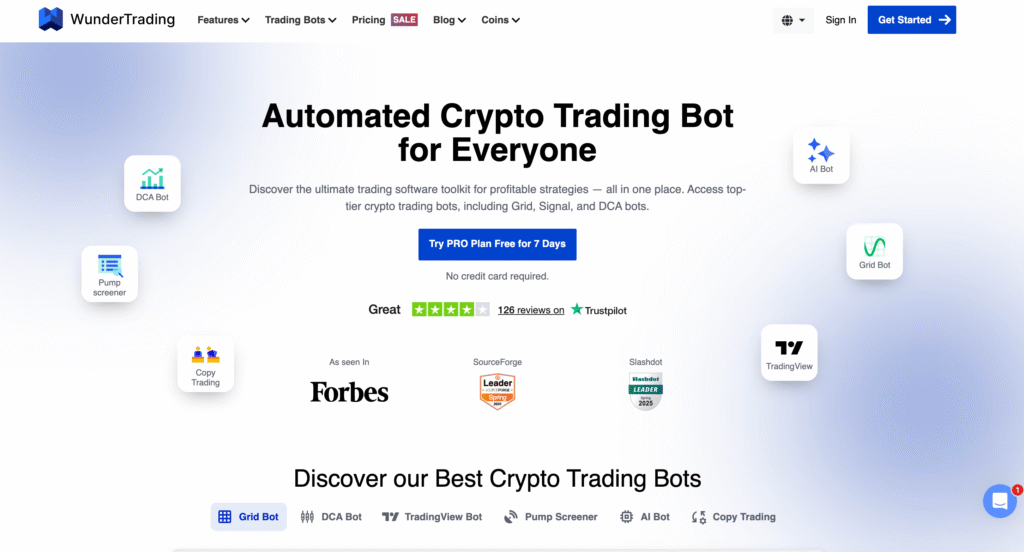
WunderTrading has gained recognition in 2026 as one of the most advanced AI-driven platforms for statistical arbitrage and quantitative cryptocurrency trading. Built for data-centric traders, it combines machine learning technology with robust strategy modules that help users detect and exploit price inefficiencies across the crypto market. With a focus on reducing portfolio volatility and improving trade accuracy, WunderTrading offers powerful tools that are both professional and affordable.
Machine Learning for Smarter Trading Decisions
At the core of WunderTrading is an AI engine that leverages machine learning to analyze real-time and historical market data. The platform’s bot assigns probability scores to trading signals, helping traders identify optimal entry and exit points. This approach increases accuracy and allows users to make informed decisions based on data rather than emotion.
The AI engine works by continuously refining its models based on past market behaviors, improving predictive power over time. This makes it ideal for advanced users who want to build statistically sound strategies that adapt to ever-changing market conditions.
| Feature | Description |
|---|---|
| AI Signal Scoring | Assigns confidence levels to trade signals using ML algorithms |
| Historical Pattern Learning | Continuously updates strategies based on backtested market data |
| Real-Time Model Adjustments | Adapts trading logic dynamically as new data flows in |
Statistical Arbitrage and Spread Trading Modules
WunderTrading’s standout feature in 2026 is its dedicated support for statistical arbitrage and spread trading. These strategies allow traders to pair two or more correlated crypto assets, betting on the relative movement between them rather than their absolute price direction. This approach reduces exposure to market-wide volatility and helps traders achieve more stable returns.
| Strategy Type | Use Case | Risk Profile |
|---|---|---|
| Statistical Arbitrage | Exploiting mispricings between correlated assets | Low to Moderate |
| Spread Trading | Buying one asset while selling another in the same sector | Market-Neutral |
| Market Inefficiency Scans | Identifying rare correlation breakouts or price anomalies | High Probability |
These tools are particularly useful for hedge fund-style strategies where managing risk across a portfolio is just as important as generating returns.
Multi-Exchange API Management for Diversified Risk
Another advantage of WunderTrading is its multi-API integration system. Users can connect to several major exchanges through a unified interface, allowing them to execute strategies across platforms at the same time. This feature is critical for reducing exchange-specific risks, capturing arbitrage opportunities, and improving capital efficiency.
| Capability | Benefit |
|---|---|
| Multi-Exchange Support | Trade on Binance, Bybit, Kraken, etc. from one dashboard |
| Unified Risk View | Monitor all positions and P&L in real time |
| Cross-Exchange Strategy Sync | Align strategies to work across multiple market structures |
Affordable Pricing for Professional-Grade Tools
Despite offering institutional-grade features, WunderTrading keeps its pricing structure affordable. This makes it accessible not only to professional quant traders but also to ambitious retail users looking to explore advanced crypto trading.
| Plan Tier | Monthly Cost | Access Level |
|---|---|---|
| Starter | $9 | Basic AI Signals + 1 Exchange API |
| Advanced | $29 | Spread Trading + Signal Scoring |
| Pro | $49 | Full Arbitrage Terminal + Multi-API |
This pricing model allows users to scale their subscription as their strategies become more complex or as their capital allocation grows.
WunderTrading vs Competing AI Crypto Tools in 2026
| Feature | WunderTrading | Most Other Platforms |
|---|---|---|
| AI Signal Confidence Scoring | Yes | Rare |
| Dedicated Spread Trading Terminal | Yes | No |
| Machine Learning Model Updates | Real-Time | Weekly or Manual |
| Multi-Exchange Strategy Execution | Full Support | Partial |
| Entry-Level Pricing | $9/month | $20–$70/month |
Conclusion
In the increasingly competitive world of crypto automation in 2026, WunderTrading stands out as the go-to platform for traders who rely on statistics, data modeling, and AI-powered decision-making. Its specialized support for arbitrage and spread trading, combined with low fees and cross-exchange execution, provides a high-performance environment for traders looking to reduce risk and enhance returns through intelligent automation. Whether you’re a quant enthusiast or a professional managing multi-platform strategies, WunderTrading offers an excellent balance of precision, scalability, and affordability.
6. TradeSanta

TradeSanta has established itself in 2026 as one of the most beginner-friendly and affordable AI tools for cryptocurrency trading. Designed to help newcomers enter the market with ease, the platform focuses on simplicity, speed, and low-cost accessibility—without compromising on performance. Its cloud-based automation system allows traders to launch pre-configured bots in under 10 minutes, with a starting capital as low as $10.
TradeSanta’s approach is built around reducing complexity for new users while still offering enough advanced functionality to remain relevant for intermediate traders. By combining intuitive tools with AI-driven features, it serves as an ideal entry point for those looking to start automated crypto trading in a secure and guided environment.
AI Assistant Integration for Smarter Strategy Selection
In 2026, TradeSanta introduced a powerful upgrade by embedding an AI-powered assistant into the platform using ChatGPT’s capabilities. This AI assistant helps users manage their portfolios and suggests strategy templates based on individual goals, market trends, and risk profiles. Whether a user prefers a conservative DCA strategy or a high-volatility futures setup, the assistant tailors recommendations in real time, streamlining decision-making for even the most inexperienced users.
| Feature | Functionality Description |
|---|---|
| AI Strategy Recommendation | Selects optimal bots based on user goals and risk appetite |
| Portfolio Management Guidance | Monitors and advises on performance and reallocation |
| Real-Time Market Adaptation | Updates strategy suggestions based on evolving market trends |
Pre-Built Bots and Fast Deployment Features
TradeSanta offers a wide variety of pre-configured bots that are optimized for different market scenarios. These bots can be deployed instantly with a few clicks, making them accessible even to those without prior trading or coding experience. Bot templates are optimized for spot trading, futures contracts, and sideways markets using grid strategies or trailing profits.
| Bot Type | Key Feature | Target User Profile |
|---|---|---|
| DCA Bot | Automated buy-ins at intervals | Beginners & Long-Term Investors |
| Grid Bot | Profits from price fluctuations | Sideways Market Traders |
| Futures Bot | Long/Short with leverage | Advanced Users |
All bots are customizable and include advanced tools such as TradingView-powered technical signals, stop-loss mechanisms, and trailing take-profit features.
Pricing Plans for 2026
TradeSanta’s pricing structure in 2026 remains competitive and transparent. The plans are designed around the number of bots a user wants to run and the level of access to premium features like futures trading, technical signals, and API integrations.
| Plan Name | Monthly Fee | Active Bot Limit | Key Features Included |
|---|---|---|---|
| Basic | $25 | 2 Active Bots | Spot Bots, TradingView Signals, Standard Support |
| Advanced | $45 | 49 Active Bots | Trailing TP, Technical Signals, Futures Bots |
| Maximum | $90 | Unlimited Bots | Full Feature Access + Priority Support |
These pricing tiers ensure that users can scale their trading experience as they become more confident and want to explore more sophisticated strategies.
Platform Performance and Accessibility in 2026
TradeSanta’s cloud-based architecture eliminates the need for manual installation or constant monitoring. All bot activities are executed in the cloud, ensuring high uptime and fast execution. The platform is fully compatible with multiple exchanges, including Binance, OKX, and Bybit, allowing users to manage all their positions from a single dashboard.
| Key Attribute | TradeSanta Offering |
|---|---|
| Cloud-Based Trading | Yes |
| Exchange Support | Multi-Exchange (Binance, Bybit) |
| Real-Time TradingView Signals | Integrated |
| Mobile & Web Compatibility | Full Support |
| Coding Requirement | None |
Comparison Matrix: TradeSanta vs Other Beginner AI Trading Tools
| Feature Category | TradeSanta | Other Tools |
|---|---|---|
| AI Strategy Selection | Yes (ChatGPT AI) | Rare |
| Pre-Configured Bot Templates | Yes | Limited |
| Minimum Starting Capital | $10 | $50–$100 |
| Cloud-Based Deployment | Yes | Mixed |
| Support for Spot + Futures | Yes | Partial |
| User Onboarding Speed | Under 10 Minutes | 30+ Minutes |
Conclusion
TradeSanta has firmly positioned itself in 2026 as the best AI crypto trading platform for beginners looking to automate their investments with ease and confidence. Its combination of low starting capital, fast setup, and an AI-guided assistant provides an ideal environment for learning and growing in the digital asset market. With support for both spot and futures markets, a wide selection of pre-built bots, and tiered pricing to suit every level, TradeSanta offers an unbeatable blend of simplicity, functionality, and value in today’s AI-powered trading ecosystem.
7. Coinrule
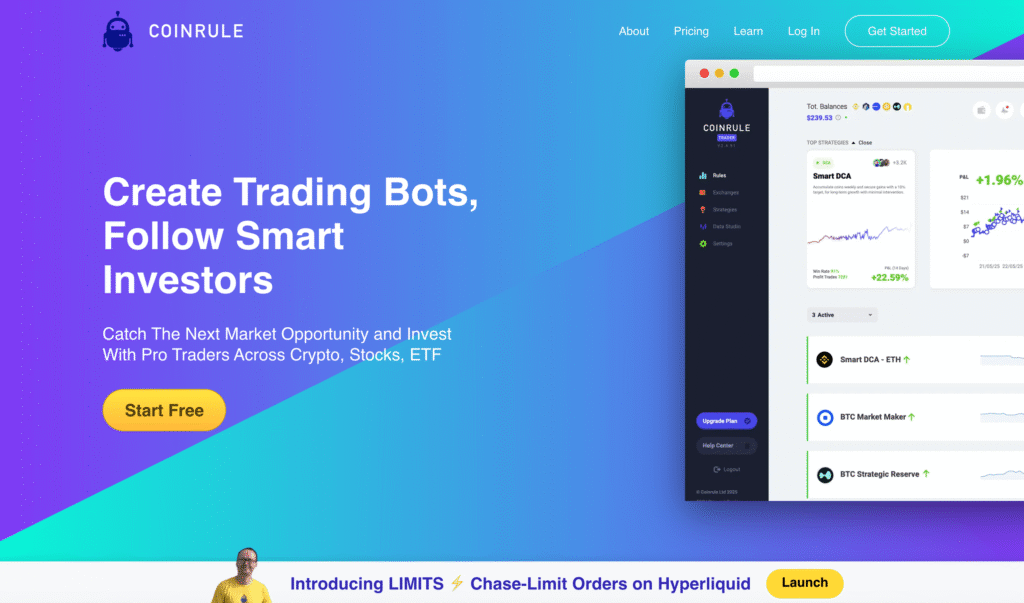
In 2026, Coinrule has become one of the most widely adopted AI-driven trading platforms tailored specifically for users without coding knowledge. Its strength lies in its easy-to-use visual rule builder that simplifies the creation of trading strategies using “If This, Then That” logic. With more than 300 pre-designed templates and support for over 20 major cryptocurrency exchanges and Layer-2 networks like Base and Arbitrum, Coinrule allows both beginners and seasoned retail traders to automate their trading actions quickly and efficiently.
Coinrule’s platform is built to help users automate responses to market changes such as price movements, volume surges, or technical indicator signals. The system translates trading logic into actionable strategies that can run 24/7, reducing the emotional and manual work traditionally involved in cryptocurrency investing.
Visual Rule Builder for Non-Coders
Coinrule’s core innovation is its no-code interface, which allows users to build rules in minutes without writing a single line of code. The visual rule editor offers a step-by-step design system, where users select triggers (such as price going above a moving average) and define corresponding actions (like placing a buy order). This functionality removes technical barriers for traders who want the benefits of algorithmic strategies without needing developer skills.
| Feature | Description |
|---|---|
| No-Code Strategy Builder | Drag-and-drop rule system using “If/Then” logic |
| Pre-Built Rule Templates | 300+ templates for various strategies and indicators |
| Real-Time Market Triggers | Supports triggers based on price, volume, RSI, MACD, etc. |
| Multi-Exchange Compatibility | Works with Binance, Coinbase, Kraken, and more |
| Layer-2 Integration | Supports chains like Arbitrum and Base for broader coverage |
Pre-Configured Templates and Customization Options
One of Coinrule’s biggest advantages in 2026 is its extensive template library. These pre-set rules cover a wide range of scenarios—bullish breakouts, stop-loss triggers, re-entry points, and moving average crossovers—so that users can immediately deploy a strategy without building one from scratch. Each rule can be modified to suit the trader’s preferences, such as changing the percentage thresholds or adding more conditions for confirmation.
Coinrule Pricing Plans in 2026
Coinrule offers a flexible range of subscription options to fit the needs of casual users, active traders, and institutional-level investors. Each plan is based on monthly trading volume, access to advanced features, and number of rules allowed.
| Plan Tier | Monthly Cost | Monthly Trading Volume Limit | Access Level |
|---|---|---|---|
| Starter | Free | $3,000 | Basic rules and templates |
| Hobbyist | ~$29.99 | Higher Limit | Enhanced rule creation and TradingView alerts |
| Trader | ~$59.99 | Expanded Limits | Access to technical indicators and more bots |
| Pro | ~$449.99 | Institutional-Grade Volume | Unlimited bots, full integration suite |
This tiered system ensures traders can start for free and upgrade only when their trading activities grow more complex or capital-intensive.
Advanced Features for High-Performance Execution
Beyond the visual rule builder, Coinrule integrates advanced trading functionalities to support more serious users. These include integration with TradingView for technical signal execution, access to professional-level indicators like RSI, MACD, and Bollinger Bands, and support for multiple concurrent bots across different exchanges.
| Feature Type | Availability in Coinrule |
|---|---|
| TradingView Signal Execution | Available in Paid Plans |
| Advanced Technical Indicators | Trader and Pro Plans |
| Multi-Bot Deployment | Hobbyist Plan and Above |
| Execution on Layer-2 Chains | All Plans |
| Email and Telegram Alerts | Included in All Tiers |
Coinrule vs Competing No-Code Platforms in 2026
| Comparison Area | Coinrule | Other Platforms |
|---|---|---|
| No-Code Rule Builder | Yes (Visual) | Partial / Text-Based |
| Pre-Built Templates | 300+ | Under 100 |
| Layer-2 Network Support | Yes | Rare |
| Free Plan Availability | Yes | Yes |
| Institutional Volume Support | Yes (Pro Plan) | Limited |
| Exchange Coverage | 20+ | 10–15 |
Conclusion
Coinrule continues to lead the way in 2026 as a powerful, no-code AI tool for cryptocurrency trading. Its visual rule builder, wide selection of templates, support for major exchanges, and multi-tier pricing make it especially attractive to retail traders who want reliable, rules-based trading strategies without needing programming skills. With flexible automation, high compatibility, and machine-learning-enhanced trigger options, Coinrule provides a strong foundation for structured, data-driven crypto trading in a market where speed and precision are key to success.
8. Altrady

In 2026, Altrady has become one of the most trusted and advanced AI trading platforms for traders who rely on deep analytics, real-time market data, and precise trade execution. Tailored for experienced users and data-driven investors, Altrady integrates all essential trading functions into a single terminal. It supports seamless connectivity with over 15 major exchanges and provides powerful tools to help traders analyze market trends, manage portfolios, and automate strategies with greater confidence.
What sets Altrady apart is its ability to combine professional-grade tools—like market depth analysis, automated bot strategies, and personalized trade journaling—within one streamlined environment. This platform is ideal for traders who seek greater control and transparency over every aspect of their crypto trading journey.
Real-Time Market Intelligence and Depth Analysis
Altrady’s strength lies in its ability to provide accurate and timely market insights. The platform features full order book visibility, real-time depth charts, and highly responsive price action alerts. Traders using Altrady can spot liquidity zones, identify whale movements, and respond instantly to volatility with tools that are often reserved for institutional platforms.
Its enhanced “Quick-Scan Alerts” system in 2026 uses AI to scan thousands of trading pairs simultaneously, pinpointing high-probability trade setups across multiple markets. These alerts are customized to the trader’s preferred indicators, price ranges, and technical patterns.
| Feature | Description |
|---|---|
| Market Depth Analysis | Real-time order book insights for better entry timing |
| Quick-Scan Alerts (AI) | Scans global markets for trade setups |
| Volatility Tracking | Identifies sudden price changes and breakout zones |
| Custom Notification Triggers | Set alerts for specific indicators or technical thresholds |
AI Bots with Strategy Flexibility
Altrady offers three core types of trading bots: signal bots, grid bots, and DCA (Dollar Cost Averaging) bots. These bots can be fine-tuned using over 100 technical indicators and custom trade rules. Traders can set multiple conditions based on RSI, MACD, Bollinger Bands, and moving averages to create highly specific, rules-based strategies.
| Bot Type | Use Case | Strengths |
|---|---|---|
| Signal Bot | Executes based on pre-set signals | Fast reaction to technical events |
| Grid Bot | Works best in ranging markets | Captures small profits across price ranges |
| DCA Bot | Long-term averaging strategy | Reduces impact of market volatility |
Each bot is supported by built-in technical analysis widgets that enhance decision-making by visualizing market conditions and backtesting strategies before deployment.
Comprehensive Portfolio and Trade Journaling
A standout feature of Altrady is its “Journaling” system. This tool helps traders document their reasoning, emotions, and observations for every trade, turning their trading history into a learning system. It allows users to spot behavioral patterns, refine strategies over time, and improve discipline.
Altrady’s portfolio manager gives a clear overview of asset distribution, unrealized gains or losses, and trade histories across all connected exchanges. The dashboard updates in real time, making it easier to rebalance and manage positions without switching between platforms.
| Tool | Benefit |
|---|---|
| Trade Journal | Track strategy logic, emotions, and trade outcomes |
| Portfolio Overview | Unified view of all exchange balances and positions |
| Performance Tracking | Visual charts for ROI, average entry, win/loss ratio |
| Asset Rebalancing | Identify overexposed holdings and adjust allocations |
Pricing Plans and Value Proposition in 2026
Altrady’s pricing is positioned in the mid-range of the AI crypto tools market, making it affordable for both individual traders and small trading teams. The platform provides multiple plan tiers depending on usage needs, with pricing starting at $23 per month and scaling to $73 per month for full access.
| Plan Tier | Monthly Cost | Ideal User Type | Core Features Included |
|---|---|---|---|
| Basic | $23 | Casual and Semi-Active | Access to bots, portfolio view, limited alerts |
| Essential | $49 | Regular Traders | Full analytics, signal scanner, journaling system |
| Premium | $73 | Advanced Traders/Teams | All features + priority support + unlimited alerts |
Altrady Compared to Other AI Crypto Tools in 2026
| Feature Category | Altrady | Typical Alternatives |
|---|---|---|
| Real-Time Market Scanning | Yes (Quick-Scan AI) | Partial |
| Trade Journaling | Yes | Rare or Manual |
| Technical Indicators | 100+ Built-in | 20–50 |
| Exchange Support | 15+ Integrated | 10–12 |
| Visual Trade Management | Full Dashboard View | Fragmented or External |
| Bot Strategy Flexibility | High | Medium |
Conclusion
Altrady is the go-to platform in 2026 for analytical traders who require in-depth tools, AI-powered alerts, and a strategic workspace that combines automation with insight. Its integration of journaling, multi-exchange portfolio tracking, and AI-driven market scanning sets it apart from more basic trading bots. With flexible pricing and features that scale with experience level, Altrady provides a complete ecosystem for professional and aspiring crypto traders aiming to turn precision into profit.
9. HaasOnline
In 2026, HaasOnline stands as one of the most sophisticated AI trading tools available for experienced cryptocurrency traders, particularly those who prioritize local hosting, full customization, and institutional-level control. Unlike most platforms that operate in the cloud, HaasOnline is built to run entirely on a user’s local machine. This architecture gives traders unmatched privacy, ownership of their trading environment, and greater resistance against potential online threats or centralized platform outages.
With a feature-rich design tailored for developers and quantitative analysts, HaasOnline offers a robust combination of custom scripting, ultra-fast execution, and military-grade security. It is best suited for traders who are comfortable with scripting logic and want complete control over strategy development and deployment.
Local Hosting and Edge Computing for Maximum Security and Speed
HaasOnline’s local deployment model ensures that sensitive trading data—such as API keys, execution history, and asset allocation—remains under the full control of the user. Unlike cloud-based services, which may store sensitive data on external servers, HaasOnline eliminates this exposure risk by operating entirely from the trader’s hardware.
Its edge computing infrastructure minimizes latency, allowing for real-time trade execution and faster reaction to sudden market movements. This performance advantage is particularly important in environments where microseconds can make a difference, such as during arbitrage or flash crash events.
| Feature | Benefit |
|---|---|
| Local Hosting | Complete control over data and security |
| API Key Protection | API keys never leave the user’s device |
| Edge Computing | Ultra-low latency for faster trade execution |
| Network Independence | Works without dependency on cloud servers |
HaasScript: The Most Powerful Scripting Language in Crypto Trading (2026)
HaasOnline’s standout feature in 2026 is its proprietary scripting engine—HaasScript. This is the most advanced language in the crypto bot landscape, giving traders the ability to write complex, fully customized trading strategies. From market-making and statistical arbitrage to scalping and flash-crash recovery bots, HaasScript supports advanced algorithmic logic not available on no-code platforms.
| Strategy Type | Scripted Capability Highlights |
|---|---|
| Market-Making | Liquidity provisioning with dynamic spread adjustments |
| Arbitrage Bots | Multi-pair and cross-exchange profit capturing |
| Scalping Bots | High-frequency entry/exit based on order book behavior |
| Flash Crash Bot | Exploits sudden dips for discounted re-entries |
| Time-Based Trading | Trigger strategies on specific market sessions or hours |
The scripting system also includes custom indicators, variable logic, and command chaining, giving technical users the freedom to build virtually any trading strategy.
Backtesting Engine and Historical Data Access
For strategy refinement, HaasOnline provides a high-performance backtesting engine that can simulate bot behavior using up to 56 weeks of historical market data. This helps traders fine-tune their strategies and assess performance under different market conditions before deploying live capital.
| Testing Feature | Description |
|---|---|
| Historical Data Range | Up to 56 weeks |
| Backtest Speed | High-speed simulation with full visual feedback |
| Custom Scenario Testing | Simulate volatility spikes, slippage, or liquidity gaps |
| Performance Metrics Output | ROI, drawdown, win rate, Sharpe ratio, and more |
Licensing and Pricing Structure in 2026
While HaasOnline has a steeper learning curve and setup process than beginner-oriented platforms, it offers significant long-term value through its flexible pricing and lifetime license options. Users can choose between subscription-based tiers or purchase a permanent license, providing professional traders with cost-effective access to institutional-grade tools.
| License Option | Cost Structure | Key Features Included |
|---|---|---|
| Beginner License | Subscription-Based | Limited bot templates and basic backtesting |
| Professional License | Mid-Range Pricing | Full scripting, exchange integrations, flash crash bots |
| Lifetime License | One-Time Purchase | All features unlocked, priority updates and support |
This model is attractive for traders who plan to use the platform long-term and want unrestricted access to its powerful toolset.
Comparison Matrix: HaasOnline vs Other Advanced AI Crypto Tools in 2026
| Capability | HaasOnline | Other Platforms |
|---|---|---|
| Local Installation | Yes | No (mostly cloud) |
| Advanced Scripting Language | HaasScript | Limited or None |
| AI Bot Customization Level | Full (Code-Level) | Partial (Visual Logic) |
| Flash Crash and Arbitrage Bots | Yes | Rare |
| Historical Backtesting Range | 56 Weeks | 12–24 Weeks |
| Data Privacy Control | Full | Limited |
| Licensing Options | Monthly + Lifetime | Monthly Only |
Conclusion
HaasOnline is not designed for casual traders. It is a professional-grade, AI-powered crypto trading terminal built for users who demand precision, privacy, and complete algorithmic flexibility. In 2026, it remains one of the top choices for developers, analysts, and institutional traders who want to take full control of their trading infrastructure. With HaasScript, edge computing, secure local deployment, and one of the most powerful backtesting engines on the market, HaasOnline offers a depth of functionality that is rarely matched in the world of automated cryptocurrency trading.
10. Kryll
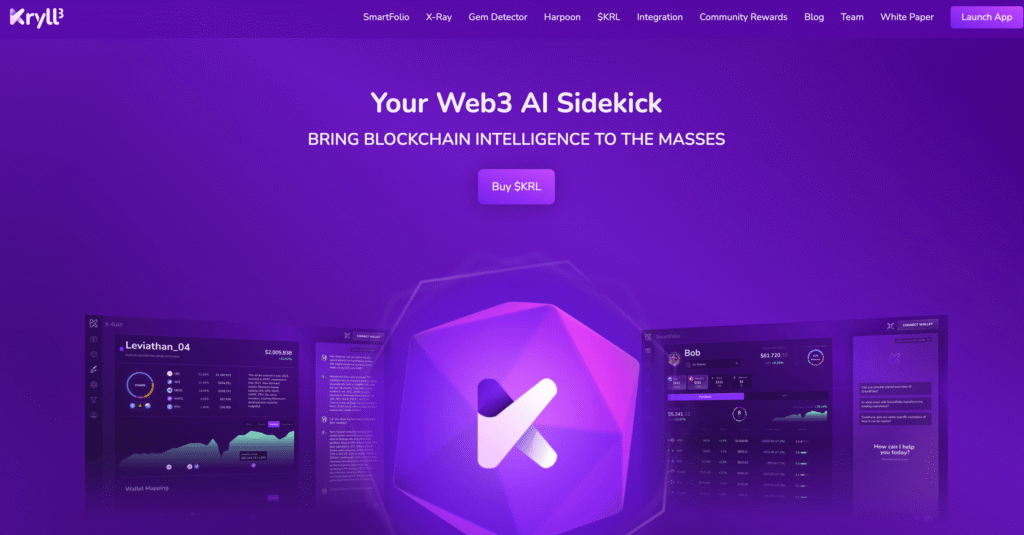
Kryll has emerged in 2026 as one of the most innovative AI crypto trading platforms by combining the power of machine learning with the transparency and decentralization of Web3 technologies. Unlike traditional platforms that rely on centralized data feeds and rigid subscriptions, Kryll processes real-time on-chain data directly from blockchain networks. This enables smarter decision-making, higher adaptability to market shifts, and more trust from users who value transparent logic and decentralized execution.
Kryll is especially popular among users who seek intelligent automation, token-based incentives, and full visibility into how trading strategies are built and executed. The platform has shifted from fixed monthly pricing to a more dynamic cost model that only charges users based on the actual usage of its bots—rewarding token holders with discounted or even free access to features.
Web3 Infrastructure and On-Chain Market Intelligence
Kryll’s hybrid Web3 framework gives it a unique advantage in 2026. By accessing live blockchain data—such as wallet flows, liquidity movements, and gas metrics—the platform can make real-time adjustments to its trading strategies without waiting for centralized updates. This on-chain intelligence forms the foundation for accurate decision-making across volatile and decentralized markets.
| Key Component | Description |
|---|---|
| On-Chain Data Access | Analyzes wallet flows, token swaps, DEX activity |
| Web3 Integration | Interacts directly with smart contracts and DeFi protocols |
| Decentralized Execution | Reduces reliance on centralized order books |
| AI-Driven Adjustments | Strategies update live based on on-chain activity |
This structure empowers Kryll’s bots to perform faster, respond more accurately, and adapt to unpredictable market dynamics far more efficiently than many cloud-only platforms.
AI Agents and Automated Strategy Engine
At the heart of Kryll’s system is a set of intelligent AI agents built to reduce the need for constant user input. These agents autonomously monitor market momentum, rebalance portfolios, and execute trades based on real-time signals. The AI is capable of identifying short-term reversals, emerging trends, and liquidity opportunities—resulting in faster trade setups and more efficient portfolio performance.
| Strategy Type | AI Behavior Description |
|---|---|
| Momentum Strategy | Identifies and rides market trends with dynamic stop-losses |
| Rebalancing Strategy | Adjusts asset allocation automatically to maintain target mix |
| Smart Entry Detection | Enters positions based on technical and on-chain indicators |
| News & Sentiment Analysis | Reads blockchain-based news feeds to avoid risky entries |
These AI-driven modules are designed for users who want to maintain a passive approach while benefiting from high-level trading logic that continuously evolves with market behavior.
Token-Based Pricing Model and Utility Mechanics
Kryll’s pricing model in 2026 is built on usage-based billing tied to its native token, KRL. Users pay fees proportional to the “computational work” their bots perform, rather than subscribing to a flat-rate plan. This makes the platform highly scalable—beginners can pay less while power users still gain value without being penalized by static monthly charges.
KRL token holders receive tiered benefits, including reduced fees, exclusive access to premium strategies, and staking rewards. This structure incentivizes holding while also ensuring that active users only pay for what they use.
| Plan Model | Fee Basis | Token Holder Benefits |
|---|---|---|
| Pay-as-you-go | Based on bot activity/workload | No unused costs |
| KRL Token Discounts | Reduced fees for token holders | Up to 50% lower transaction cost |
| Staking Rewards | Passive income opportunities | Earned through holding and platform engagement |
| Premium Access | Exclusive strategies for stakers | Advanced AI logic and early feature releases |
Comparison Matrix: Kryll vs Traditional AI Crypto Trading Tools (2026)
| Feature Category | Kryll | Traditional Platforms |
|---|---|---|
| Web3 Integration | Full | Limited or None |
| Real-Time On-Chain Data Access | Yes | No |
| Subscription Model | Usage-Based | Monthly Fixed Plans |
| AI Agent Autonomy | High | Moderate |
| Transparent Bot Logic | Fully Verifiable | Often Hidden/Proprietary |
| Token Utility | Yes (KRL Token) | Not Applicable |
Conclusion
Kryll delivers one of the most cutting-edge AI crypto trading experiences in 2026 by merging artificial intelligence, blockchain transparency, and usage-based pricing into a single platform. It’s particularly appealing to Web3-native users and forward-thinking traders who want to automate their portfolios without handing over full control to centralized systems. With decentralized infrastructure, intelligent AI agents, flexible pricing, and real-time on-chain data, Kryll stands at the frontier of where crypto trading and machine learning intersect. For users who want transparency, adaptability, and high performance without rigid pricing models, Kryll presents a powerful and scalable solution.
The Macroeconomic and Regulatory Landscape Shaping AI Crypto Trading in 2026
In 2026, the landscape for AI-powered cryptocurrency trading tools has matured significantly, influenced by macroeconomic expansion, evolving institutional behavior, and robust regulatory frameworks in key global markets. These developments have led to greater trust in digital assets, driving demand for AI trading solutions that prioritize speed, security, transparency, and regulatory compliance.
Global Market Growth and Institutional Involvement
A major shift in 2026 is the deep institutionalization of cryptocurrencies. More than 559 million people globally are now involved in the crypto space, representing nearly 10% of the world’s internet population. This rise has been accompanied by aggressive corporate adoption, with over 172 publicly listed companies holding Bitcoin in their Digital Asset Treasuries (DATs). These institutions collectively manage around 1 million BTC, which equates to approximately 5% of the total circulating supply.
| Key Market Metrics (2026) | Data Point |
|---|---|
| Global Crypto User Base | 559,400,000 |
| Internet Ownership Rate in Crypto | 9.90% |
| Bitcoin Dominance (Corporate Treasury Holdings) | ~52% |
| Public Companies Holding Bitcoin | 172+ |
| BTC in Corporate DATs | ~1,000,000 BTC |
| Top 10 Exchanges – 24h Volume | Over $203 Billion |
This level of institutional interest has reshaped the design of modern AI trading platforms. Tools in 2026 are no longer solely focused on generating returns for individual retail users; instead, they are built to serve large-scale corporate clients who require secure, auditable, and compliant trading infrastructure.
Regulatory Advancements Driving Infrastructure Stability
Regulatory clarity in key regions has been one of the strongest forces enabling the mainstream use of AI trading technologies. In the United States, the introduction of the CLARITY Act has established clear rules for the classification, custody, and secondary trading of digital assets. This law officially recognizes “qualified digital asset custodians” under federal oversight, offering legal protections for investors and institutions engaging in automated trading.
Similarly, the European Union’s Markets in Crypto-Assets Regulation (MiCAR) has imposed strict compliance measures on trading platforms, exchanges, and bot providers. These rules emphasize operational resilience, consumer protection, and data integrity. AI trading tools must now comply with stringent reporting protocols, backtesting verification, and platform stress testing.
| Region | Key Regulation | Impact on AI Trading Tools |
|---|---|---|
| United States | CLARITY Act | Federal licensing for digital custodians |
| European Union | MiCAR | High resilience, anti-fraud, consumer protection mandates |
| Asia-Pacific (select) | Pending Harmonization | Pilots underway for cross-border regulatory alignment |
These developments have increased institutional confidence, driving larger volumes and necessitating tools that align with legal standards.
The Rise of Digital Asset Treasury (DAT) Management
Corporate balance sheets are evolving with the integration of digital assets, and AI bots have become central to treasury strategy automation. DAT-focused tools now perform liquidity management, risk-adjusted allocations, and tax-optimized rebalancing with little to no manual intervention. These tools differ from retail-focused bots by emphasizing auditability, compliance integrations, and multi-signature transaction approvals.
| Feature Comparison: Retail vs Institutional AI Trading Tools |
| Feature | Retail-Focused Tools | DAT/Institutional Tools |
|---|---|---|
| Priority | ROI & ease of use | Security, compliance, risk mgmt |
| Custody Integration | Exchange APIs only | Qualified custodians, multi-sig |
| Data Requirements | Delayed free APIs | Tick-level, real-time premium feeds |
| Reporting Standards | Basic logs | Auditable records, export to ERP |
| Execution Complexity | Moderate | Multi-account, hedging, batch TX |
Data Quality and Execution Latency in 2026
One of the most defining factors in AI trading success in 2026 is the quality and speed of market data. Free data APIs, which are commonly used in retail platforms, often suffer from latency delays between 1 to 5 seconds. These seemingly small lags can lead to missed arbitrage opportunities, delayed entries, and unintentional losses.
To overcome this, institutional platforms and advanced AI bots rely on premium data providers like CoinAPI, which deliver tick-level updates, L2/L3 order book depth, and normalized multi-exchange feeds with millisecond-level latency.
| Data Feed Performance Metrics (2026) | Free API | Premium API (e.g., CoinAPI) |
|---|---|---|
| Price Update Delay | 1–5 seconds | Sub-millisecond |
| Order Book Depth | L1 only | Full L2 and L3 |
| Exchange Sync Lag | Up to 3 seconds | Real-time synchronization |
| Normalized Cross-Exchange Feed | Not available | Fully integrated |
In the high-frequency trading (HFT) environment, trades now execute in milliseconds. Edge computing is used to place trading logic closer to exchange servers, reducing transmission delay. Execution latency can no longer be an afterthought—it has become a prerequisite for success.
The Shift Toward Millisecond-Level Execution
As AI trading strategies in 2026 evolve toward HFT, execution latency is now measured in milliseconds or even microseconds. Tools must run close to exchange matching engines using edge computing to avoid delays. AI bots built for institutional use can now detect opportunities and move millions of dollars in capital in a fraction of a second.
| Metric | Institutional Standard in 2026 |
|---|---|
| Order Execution Latency | <10 milliseconds |
| Signal Reaction Speed | ~3 milliseconds |
| Trade Confirmation Lag | ~1.5 milliseconds |
| Cross-Exchange Arbitrage Window | ~5 milliseconds |
Without these speed thresholds, even the most intelligent strategy becomes obsolete. As a result, developers of top AI tools must design systems that not only think fast—but act faster.
Conclusion
The evolution of the global crypto trading ecosystem in 2026 has been shaped by regulatory clarity, corporate adoption, institutional-grade infrastructure, and ultra-low latency demands. This new environment requires AI trading tools that go beyond simplistic strategies. The top-performing platforms now integrate Web3 capabilities, edge computing, advanced AI agents, and regulatory compliance layers—all driven by real-time, high-quality data feeds.
In this fast-moving world, success is not just about predicting the market—it’s about being faster, more compliant, and more secure than the rest. AI tools that thrive in 2026 will be those built not just for traders, but for the infrastructure of the future.
The Evolution of Agentic AI Systems in Cryptocurrency Trading for 2026
A transformative leap in AI-driven crypto trading has occurred in 2026 with the rise of agentic AI systems—a new generation of intelligent, self-directed trading agents that are far more advanced than traditional rule-based bots. These agentic models can perform complex reasoning, adapt their strategies over time, and operate across multi-step workflows while pursuing specific financial goals. Unlike older systems that rely on static “if-then” logic, the latest AI agents are dynamic, goal-oriented, and capable of improving through experience.
This major technological advancement has redefined how top AI crypto tools operate in 2026. The most effective platforms now utilize agents that simulate human-like decision-making in areas such as portfolio optimization, news sentiment interpretation, market-making, and risk adjustment—all within a seamless and continuously improving ecosystem.
Core Design Principles of Agentic AI in Crypto Trading
The architecture of AI trading platforms in 2026 has shifted from monolithic algorithms to modular systems composed of several specialized agents working in coordination. These agents interact within what is often referred to as a microservices ecosystem—where each agent focuses on a single core task and communicates with others through a central orchestrator.
| Agentic AI Pattern | Function in Crypto Trading |
|---|---|
| ReAct (Reason + Act) | Analyzes market context and makes real-time trade decisions |
| Reflection | Evaluates past trade outcomes to refine future strategies |
| Tool Use | Accesses external APIs, data feeds, and technical libraries |
| Planning | Sets long-term portfolio goals and builds multi-step execution maps |
| Multi-Agent Collaboration | Enables different agents to share intelligence in real time |
| Sequential Workflows | Follows step-by-step logic for complex trades and strategy trees |
| Human-in-the-Loop (HITL) | Allows manual intervention and supervision for high-value trades |
By implementing these patterns, platforms now offer dynamic responses to fast-changing conditions, simulating how a professional human trader would operate—but at scale, and with greater speed and accuracy.
Example Use Case of Multi-Agent Coordination in 2026
A typical agentic AI trading system might deploy the following structure:
| Agent Role | Specific Task |
|---|---|
| Sentiment Agent | Scans social media, news, and on-chain activity to gauge market mood |
| Liquidity Agent | Adjusts order placement based on order book depth across multiple exchanges |
| Risk Agent | Monitors portfolio exposure and dynamically rebalances holdings |
| Arbitrage Agent | Detects pricing inefficiencies between trading pairs and exchanges |
| Planning Agent | Aligns all trades with broader financial targets and constraints |
This structure makes the trading system smarter, faster, and more adaptive than any single traditional bot could ever be.
Securing AI Strategies with ZKML and FHE Technologies
In an era where trading logic is a competitive asset, Zero-Knowledge Machine Learning (ZKML) and Fully Homomorphic Encryption (FHE) have become standard for protecting the integrity and confidentiality of AI strategies. These cryptographic technologies allow AI models to prove their correctness and performance without exposing sensitive user data or proprietary logic to outside parties.
ZKML ensures that algorithms can verify trade decisions while remaining opaque to observers, while FHE allows encrypted data to be used in real-time computation without ever being decrypted. Together, they create a “cryptographic shield” around both institutional and retail AI systems—making it safe to deploy intelligent trading agents even on public blockchains or decentralized protocols.
| Security Feature | Description |
|---|---|
| Zero-Knowledge Proofs (ZKML) | Confirms AI model decisions without revealing the logic |
| Fully Homomorphic Encryption (FHE) | Processes trades using encrypted data without ever decrypting it |
| Cryptographic Audit Trails | Verifiable logs of all agent decisions and transactions |
| Public Blockchain Compatibility | Enables secure use of AI on decentralized exchanges and protocols |
This shift has enabled the safe and secure expansion of AI trading tools into environments that were once considered too risky for sensitive algorithmic strategies.
Impact on Institutional Adoption of AI Trading in 2026
The combination of agentic AI and privacy-preserving technologies has accelerated institutional participation in crypto markets. Hedge funds, asset managers, and family offices are now able to deploy sophisticated, autonomous agents that operate with strategic intent while adhering to strict compliance and auditability standards.
| Institutional Requirements | How Agentic AI Systems Fulfill Them |
|---|---|
| Risk-Managed Autonomy | Multi-agent risk oversight and dynamic hedging |
| Regulatory Compliance | HITL modules and cryptographic logging for full auditability |
| Confidential Strategy Execution | ZKML and FHE protect proprietary trading logic from exposure |
| Scalable Strategy Deployment | Modular agents scale across thousands of assets and markets |
Conclusion
2026 marks a turning point in the evolution of AI for crypto trading. The transition from rule-based bots to agentic AI systems has introduced human-level reasoning, context awareness, and adaptive execution into the trading process. Powered by advanced architectural patterns and protected by cryptographic technologies like ZKML and FHE, today’s top AI tools can operate securely, transparently, and intelligently in even the most complex and high-stakes environments.
This evolution isn’t just about better technology—it’s about reshaping the future of how value moves across digital markets. The AI platforms that successfully harness these agentic models are not just tools—they are intelligent co-pilots for a new era of trading.
Quantitative Performance Benchmarks and Risk Metrics for AI Crypto Trading Tools in 2026
In 2026, as the crypto market has matured, professional investors and institutions no longer judge AI trading tools purely by the size of their returns. Instead, performance evaluation is centered around risk-adjusted metrics, designed to determine whether these tools consistently generate alpha—returns that outperform standard benchmarks like a market-cap-weighted BTC/ETH index. For AI tools to be considered best-in-class in 2026, they must demonstrate not only profitability but also resilience, efficiency, and smart risk exposure across market cycles.
Understanding Sharpe and Sortino Ratios in 2026
One of the most widely adopted benchmarks is the Sharpe Ratio, which calculates the return generated per unit of risk taken. It helps users evaluate whether the bot’s performance is the result of smart strategy design or just exposure to high volatility. In 2026, high-performing AI bots built on maximum drawdown-based, equally weighted (MDDEW)portfolios have consistently reached Sharpe Ratios as high as 2.54—surpassing even the standards set by traditional hedge funds.
| Metric | Formula and Explanation |
|---|---|
| Sharpe Ratio | (Rp – Rf) / σp, where Rp = bot’s return, Rf = risk-free rate, σp = return volatility |
| Interpretation | Ratio > 1.5 = strong; Ratio > 2.0 = institutional-grade performance |
| Average in Top AI Tools | ~2.0 to 2.54 in optimized portfolios using conservative risk techniques |
For bots exposed to volatile crypto markets, a high Sharpe Ratio indicates effective risk control, even when navigating unpredictable price movements.
Case Studies: Bot Performance in Live Market Environments
Data from real-world use cases between late 2025 and early 2026 provide concrete examples of how different bot types behave in varying conditions. These studies offer insight into the stability, adaptability, and profitability of leading AI crypto trading tools under real-world pressures.
| Bot Type | Scenario Description | Win Rate | Key Strategy Highlights |
|---|---|---|---|
| DCA Bot | BTC/USDT trading over 30 days | 100% | Used wide safety orders and no stop-loss to ride dips |
| Grid Bot (BTC) | During BTC price decline | 9.6% | Turned losses into gains by profiting from small moves |
| Grid Bot (ETH) | Bearish ETH trend | 10.4% | Exploited price ranges with consistent trade spacing |
| Grid Bot (SOL) | High volatility, declining SOL value | 21.88% | Excelled in sideways and dropping market conditions |
These results show that AI trading bots in 2026 are not only capable of withstanding market downturns but can also extract profits where traditional investors often incur losses.
Drawdown Control and Capital Preservation
Another critical benchmark for evaluating AI tools in 2026 is Maximum Drawdown (MDD)—the largest percentage loss from a peak before a recovery begins. The best-performing bots now aim to maintain an MDD under 3.0%, which helps ensure that even during turbulent phases, capital is protected and risk is contained.
| Risk Metric | Value Target in Top AI Tools |
|---|---|
| Maximum Drawdown (MDD) | < 3.0% |
| Volatility Standard Deviation | Optimized for low sigma |
| Monthly Loss Cap (Custom Agents) | 5% – 7% |
Controlling drawdowns is particularly important for institutional portfolios where capital preservation is as critical as return generation. Bots built with drawdown-aware logic adjust exposure automatically when volatility spikes or trend reversals are detected.
Matrix: Performance Attributes of Leading AI Bots in 2026
| Performance Attribute | Target Metric (Top Tools) | Industry Standard (Retail Bots) |
|---|---|---|
| Sharpe Ratio | 2.0 – 2.54 | 1.0 – 1.5 |
| Win Rate (Optimized Bots) | 85% – 100% | 60% – 75% |
| Maximum Drawdown (MDD) | Under 3.0% | 5% – 10% |
| Return During Downtrends | Positive alpha in bear markets | Flat or negative |
| Risk-Based Portfolio Design | MDDEW / Volatility targeting | Cap-weighted or unbalanced |
This matrix illustrates the gap between high-performing, AI-enhanced tools used by professionals and the more basic systems still used by many casual traders. The best bots in 2026 have evolved to be smarter, faster, and significantly more risk-conscious.
Conclusion
Quantitative performance benchmarks in 2026 have become more refined and comprehensive. Traders now expect AI tools to deliver not just high returns, but well-managed risk, low drawdowns, and consistent outperformance against market benchmarks. With tools now being assessed on Sharpe Ratios, win rates, volatility control, and capital protection, it’s clear that only the most balanced and intelligently designed bots will lead the crypto trading space forward.
As institutions raise the bar for accountability and risk management, AI tools that demonstrate strong alpha generation, low drawdowns, and stability across volatile conditions are becoming the standard—not the exception—in the evolving digital asset economy.
Security, Insurance, and Regulatory Compliance in AI Crypto Trading Tools in 2026
As the cryptocurrency market has evolved into a global asset class, the year 2026 has brought a significant transformation in how AI trading tools are secured, insured, and regulated. Institutions and professional investors no longer accept basic protections. They now demand that platforms meet the highest standards in data security, fiduciary responsibility, and regulatory compliance. AI trading tools that fail to meet these benchmarks are rapidly losing market credibility, especially among institutional clients that manage millions—or even billions—of dollars in digital assets.
Advanced Security Standards in Modern AI Platforms
In 2026, the baseline security requirement for any credible AI crypto trading tool includes restricted API key permissions. The most respected platforms enforce a “trade-only” permission model, ensuring bots cannot withdraw funds under any circumstances. This significantly reduces the risk of unauthorized transactions due to compromised API credentials.
Institutional-grade tools must go further. Many platforms now undergo third-party cybersecurity audits and certifications such as:
| Certification Type | Description |
|---|---|
| SOC 2 Type II | Assesses internal controls, data security, and operational integrity |
| ISO 27001 | Global standard for information security management systems |
| Penetration Testing | Regular audits to simulate and defend against real-world cyberattacks |
These certifications serve not only as technical proof of compliance but also as prerequisites for engaging with major hedge funds, custodians, and asset managers.
Institutional Insurance for Digital Asset Protection
AI trading tools in 2026 are now expected to be integrated with robust insurance frameworks. These policies go far beyond generic cyber insurance—they’re custom-built for the unique risks of managing digital assets at scale.
Insurance providers have introduced multi-layered coverage models to protect both platform operators and end users from major risk events, including external hacks, internal fraud, and staking slashing penalties.
| Insurance Provider | Policy Name | Coverage Type |
|---|---|---|
| Munich Re | Comprehensive Crime Policy | External hacks, insider fraud, cold-storage loss |
| Marsh | DART Solution | Theft and protocol-level exploits |
| Lockton | Digital Asset Custody Insurance | Loss or theft of custodied digital assets |
| Relm Insurance | Smart Contract Exploit Coverage | DeFi protocol failures and code vulnerabilities |
For staking-related services, Slashing Insurance has also become an industry standard. This protects users from penalties that occur when validator nodes are penalized on Proof-of-Stake (PoS) networks like Ethereum. Losses from double-signing or downtime are reimbursed, preserving investor capital and confidence.
| Type of Insurance | Target Area | Importance in 2026 |
|---|---|---|
| Slashing Insurance | PoS Validator Performance | Protects stakers from slashing-related losses |
| Smart Contract Cover | Decentralized Apps and Protocols | Covers exploits and contract manipulation |
| Cold Wallet Physical Damage | Custodial Hardware Security | Covers loss of access due to hardware damage |
| Fraud & Internal Theft | Exchange and Bot Operator Risk | Shields users from internal misconduct |
Regulatory Frameworks from FINRA and the SEC
Regulatory oversight has also become far more detailed and AI-specific in 2026. The FINRA Annual Oversight Reportnow includes dedicated sections on Generative AI (GenAI) and autonomous agent systems—a response to the increasing use of intelligent bots in both retail and institutional trading.
Key requirements now enforced include:
| Regulatory Body | Compliance Focus | Key Requirements |
|---|---|---|
| FINRA | AI Supervision, Agent Accountability | Human oversight of AI outputs, full logging of bot actions |
| SEC | Market Fairness, Trade Manipulation Prevention | Strict rules against front-running, spoofing, and non-bona-fide trading |
| CFTC | Futures and Derivatives AI Activity Monitoring | Algorithm registration and real-time activity tracking |
Firms must ensure that any autonomous agent making trading decisions can be audited as if it were a human trader. This includes maintaining full logs, time-stamped trade histories, and clear documentation on decision logic.
Matrix: Compliance vs Non-Compliant AI Tools in 2026
| Feature / Requirement | Compliant Platforms | Non-Compliant Platforms |
|---|---|---|
| API Key Access | Trade-only permissions | Full withdrawal access |
| SOC 2 / ISO 27001 Certification | Certified | Lacking third-party audit |
| Insurance Coverage | Multi-layered (Hacks, Slashing) | Partial or none |
| Generative AI Oversight | Human-in-the-loop enforcement | Unsupervised agent activity |
| SEC / FINRA Regulatory Alignment | Fully monitored | No agent audit trail |
| Smart Contract Exploit Response | Insured + Audit System | No coverage |
Conclusion
In the increasingly sophisticated world of crypto trading in 2026, security, insurance, and fiduciary compliance are no longer optional—they are essential. Investors, especially at the institutional level, demand assurance that AI trading tools meet the same standards as legacy financial systems. Platforms that combine cutting-edge automation with strict operational safeguards, advanced insurance layers, and regulatory compliance will continue to lead in both trust and adoption.
For any AI crypto tool aiming to be part of the top tier in 2026, delivering strong returns is not enough—it must also guarantee capital protection, regulatory transparency, and institutional-grade security from the ground up.
The Future of AI in Cryptocurrency Trading: Vision Beyond 2026
As the crypto ecosystem continues to expand at a global scale, the future of artificial intelligence in trading is evolving far beyond simple automation or prediction algorithms. By the end of 2026, the next frontier for AI tools in the cryptocurrency sector is being defined by a powerful vision: to reduce the cost of financial expertise to near zero, while enhancing privacy, personalization, and autonomous decision-making.
This transformation is part of a wider global trend where AI systems are becoming not just tools, but intelligent assistants capable of managing both digital portfolios and real-world responsibilities. The convergence of AI, robotics, and blockchain is setting the stage for a new era of decentralised and secure finance, controlled not by institutions, but by end-users themselves—assisted by hyper-intelligent agents operating in real time.
The Rise of Autonomous AI Agents and Financial Assistants
In 2026, the idea of using AI for trading cryptocurrencies is no longer limited to web dashboards and algorithmic bots. A major development is the emergence of humanoid assistant agents, capable of managing complex financial operations autonomously. Products like the “NEO” soft-bodied robot—expected to reach a consumer price point of around $20,000—are being positioned as all-in-one domestic and financial assistants.
These assistants are not just robotic helpers for physical tasks. They are designed to:
| Use Case Category | Application in Financial Environments |
|---|---|
| Personal Portfolio Management | Analyze, rebalance, and execute trades across multiple exchanges |
| Voice-Activated Trading | Accept and process natural language investment commands |
| Real-Time Strategy Execution | Perform risk-aware trades based on changing market signals |
| Education and Advisory | Explain trading strategies and market shifts to non-expert users |
The evolution of such agents marks the beginning of a new financial paradigm where autonomy, context awareness, and hyper-personalization become baseline features of top-tier AI trading systems.
Zero-Knowledge Machine Learning (ZKML) and AI Privacy in 2026
Alongside growing intelligence, there is a parallel demand for data privacy and verifiable trust in AI outputs. This has led to the rapid adoption of Zero-Knowledge Machine Learning (ZKML)—a technology that allows users to prove the validity of AI-generated decisions without exposing the model’s internal logic or the user’s personal data.
ZKML is particularly critical in cryptocurrency trading, where:
- Strategies are often proprietary
- User wallet data is highly sensitive
- Compliance demands are increasing
| Feature | Functionality in AI Crypto Trading |
|---|---|
| ZKML Execution Proofs | Verifies model accuracy on-chain without revealing weights |
| Device-Level Computation | Keeps private financial data local, never sent to the cloud |
| Regulatory Alignment | Ensures auditability without compromising competitive strategy |
| AI Model Protection | Shields intellectual property of institutional-grade AI engines |
ZKML also unlocks a future where AI trading models can be deployed on public blockchains with full performance visibility, while simultaneously safeguarding all aspects of user identity, private keys, and strategy configurations.
Comparison: Traditional AI vs ZKML-Enabled AI in Crypto (2026)
| Feature | Traditional AI Tools | ZKML-Enabled AI Tools |
|---|---|---|
| Model Transparency | Low (Proprietary Black Box) | Verifiable On-Chain Proofs |
| User Data Exposure | High (Requires Cloud Access) | Zero (Local Data Processing) |
| Regulatory Verifiability | Difficult | Transparent + Auditable |
| Deployment Environment | Centralized Platforms | Public and Permissionless Chains |
| Strategy IP Security | At Risk | Fully Encrypted with ZK Proofs |
This advancement not only strengthens user trust in AI tools, but also makes it possible to scale secure autonomous trading across decentralized exchanges, institutional custodians, and self-hosted environments—without compromising performance or privacy.
Conclusion
By the close of 2026, the top AI tools for crypto trading are no longer just about fast execution or technical accuracy. They are rapidly evolving into intelligent ecosystems—anchored by agentic automation, protected by zero-knowledge cryptography, and enhanced through robotic and real-world integration.
These tools are shaping a future where personalized AI agents can manage entire portfolios, trade on decentralized protocols, comply with regulations, and prove their reliability—all while keeping sensitive data entirely under the user’s control.
For traders and institutions alike, the coming years are not just about keeping up with market trends. They are about preparing for a world where AI doesn’t just assist with crypto trading—it leads it.
Strategic Insights for AI Crypto Trading Platforms in 2026 and Beyond
The year 2026 has firmly established itself as a milestone in the global evolution of AI-powered cryptocurrency trading. Markets are now dominated by intelligent automation, precision data execution, and hyper-efficient platforms capable of outpacing human traders in nearly every measurable domain. The competitive edge has shifted from raw speculation to infrastructure sophistication, data quality, and algorithmic intelligence.
In this highly optimized ecosystem, non-automated participants face increasing barriers to entry, particularly as latency, data fidelity, and execution speed become mission-critical. As such, the divide between retail users and institutional actors is now clearly reflected in the tools they use.
Platform Landscape: Retail Simplicity vs Institutional Precision
The leading AI crypto trading platforms of 2026 are split across two primary tiers of users:
| User Segment | Preferred Platforms | Key Features Needed |
|---|---|---|
| Retail Investors | Pionex, TradeSanta | Easy setup, free bots, minimal capital requirement |
| Professional Traders | 3Commas, Bitsgap | Advanced automation, multi-exchange management, AI analytics |
| Institutions | HaasOnline, Kryll, WunderTrading | Security certifications, proprietary logic protection, insurance compliance |
Retail users benefit from entry-level platforms like Pionex and TradeSanta, which offer accessible automation with simple bot deployment, built-in exchanges, and free plans. Meanwhile, professionals and institutional firms lean on 3Commas, Bitsgap, and enterprise-level platforms that offer deeper functionality—such as customizable bots, performance benchmarking, multi-layered security, and integration with high-speed data sources.
Performance Highlights and Latency Challenges
In a data-driven market, performance is no longer just about profits—it’s about risk-adjusted alpha, system efficiency, and execution precision. Platforms that integrate institutional-grade data streams have demonstrated measurable performance improvements.
| AI Trading Performance Metrics (2026) | High-Quality Data Feed Users | Low-Quality/Free API Users |
|---|---|---|
| Average Sharpe Ratio | 2.5+ | 1.2–1.4 |
| Trade Win Rate (Optimized Bots) | 90–100% (in certain conditions) | 60–75% |
| Average Reaction Time | Millisecond range | 1–5 seconds |
| Missed Arbitrage Opportunities | Near-zero | High frequency |
The “data problem” continues to separate winners from losers. Retail users relying on high-latency, free-tier APIs often miss market entries or execute trades after price shifts, leading to consistent underperformance. On the other hand, platforms connected to premium data providers—offering tick-level updates and low-latency order books—enable bots to operate at near real-time speeds.
Strategic Market Outlook for 2027: A Shift in Macro Dynamics
Looking ahead, 2027 is set to mark the end of the long-standing “four-year crypto cycle” theory, which has historically been linked to Bitcoin halving events. Instead, analysts now forecast a new era of continuous institutional inflows, driven by:
- AI agents that manage portfolios autonomously
- Cross-border regulatory harmonization
- Predictive risk analytics and scenario testing
- Decentralized custody with verifiable cryptographic logic
These developments point toward permanent capital rotation into digital assets, guided by intelligent systems rather than emotional or cyclical retail speculation. In this future, alpha generation will depend less on timing and more on systemic edge—defined by execution speed, data reliability, and real-time strategy optimization.
Success Factors for AI Trading Platforms in the Post-2026 Era
The future belongs to platforms that can combine advanced automation with institutional safeguards. These are the tools that will gain long-term adoption and trust:
| Strategic Requirement | Description |
|---|---|
| Data Integrity | Access to normalized, cross-exchange, tick-level data feeds |
| Cryptographic Privacy | Integration of ZKML and on-device computation for user security |
| Regulatory Transparency | Alignment with FINRA, SEC, and MiCAR standards |
| Insurance and Custody Integration | Built-in protections against hacks, slashing, and fraud |
| Agentic Intelligence | Use of multi-agent systems with self-correcting AI logic |
The convergence of AI, DeFi, and regulatory enforcement will make these features non-negotiable. As fully autonomous AI agents become the norm in trading ecosystems, the platforms that invest in compliance, speed, and trust will define the market leaders of 2027 and beyond.
Conclusion
The AI crypto trading ecosystem in 2026 has matured into a high-performance environment where the difference between success and failure is defined by infrastructure, not speculation. Platforms that cater to this reality—with secure architecture, rapid execution, real-time intelligence, and auditable compliance—are not just tools. They are the foundation of tomorrow’s decentralized, AI-driven financial future.
Conclusion
As 2026 unfolds, the global landscape for AI-driven cryptocurrency trading tools has reached an extraordinary level of maturity, sophistication, and integration. The top 10 AI platforms explored throughout this blog—ranging from beginner-friendly bots to institutional-grade agentic systems—reflect the broader transformation of the crypto trading ecosystem into one that prioritizes intelligence, automation, security, and regulatory trust.
The days of manual trading and emotion-driven speculation are quickly being replaced by machine-optimized precision, millisecond-level decision-making, and context-aware automation. Whether it’s Bitsgap’s multi-exchange architecture, 3Commas’ smart portfolio logic, Cryptohopper’s AI-scored strategies, or HaasOnline’s powerful scripting tools, the leading platforms in 2026 all share one thing in common: they are engineered for speed, scalability, and adaptability in an increasingly complex and competitive digital asset environment.
At the core of this evolution is a dramatic shift in performance expectations. Traders and institutions are no longer content with raw returns. They demand risk-adjusted profitability, proven through metrics like the Sharpe ratio, Sortino ratio, win rate, and maximum drawdown. Modern AI tools are now expected to outperform passive benchmarks like BTC/ETH indices while simultaneously protecting capital, adapting to volatility, and remaining compliant with increasingly sophisticated regulatory regimes.
Another major theme defining 2026 is data integrity and latency control. Free and delayed APIs have proven insufficient in this high-frequency, low-tolerance market structure. The most successful AI tools are deeply integrated with tick-level data feeds, real-time liquidity scanners, and edge computing infrastructure that allows them to execute trades within milliseconds. These advantages are not luxuries—they are prerequisites for survival in an algorithm-driven marketplace.
Simultaneously, the fusion of cryptographic security, regulatory compliance, and institutional insurance has elevated the standard for what qualifies as a credible trading platform. SOC 2 and ISO 27001 certifications, trade-only API keys, slashing insurance, zero-knowledge proofs, and homomorphic encryption are not optional add-ons; they are now essential features for platforms hoping to serve hedge funds, family offices, and government-compliant financial institutions.
Looking ahead, the next phase of crypto-AI innovation lies in the expansion of agentic AI systems—bots and assistants that not only react but reason, plan, learn, and collaborate in real time. These systems, powered by multi-agent frameworks, are being trained to think like human traders—but with the speed, precision, and consistency that only machines can achieve. Platforms incorporating Zero-Knowledge Machine Learning (ZKML), Federated Learning, and Human-in-the-Loop (HITL) oversight will be at the forefront of this evolution, enabling private, autonomous, and verifiable trading at global scale.
In the broader macroeconomic context, the convergence of AI, decentralized finance (DeFi), institutional inflows, and harmonized regulations will likely eliminate the speculative four-year Bitcoin cycle. Instead, a new era of continuous, intelligent, and infrastructure-driven growth is emerging—one where AI doesn’t just participate in the crypto markets; it defines their efficiency, fairness, and trajectory.
For investors, developers, and institutions alike, the message is clear: the future of cryptocurrency trading belongs to those who invest not just in coins or tokens, but in intelligent infrastructure. The top AI tools of 2026 are no longer mere utilities—they are strategic partners, risk managers, compliance engines, and alpha generators rolled into a single, scalable platform.
Choosing the right AI trading tool in 2026 is not just about finding the best features—it’s about aligning with platforms that are future-ready, compliance-aligned, security-hardened, and capable of delivering smart, real-time decisions in the world’s fastest-moving financial ecosystem.
As the market enters this new phase of AI-native trading, those who adopt, adapt, and automate wisely will not just keep up—they will lead.
If you find this article useful, why not share it with your hiring manager and C-level suite friends and also leave a nice comment below?
We, at the 9cv9 Research Team, strive to bring the latest and most meaningful data, guides, and statistics to your doorstep.
To get access to top-quality guides, click over to 9cv9 Blog.
To hire top talents using our modern AI-powered recruitment agency, find out more at 9cv9 Modern AI-Powered Recruitment Agency.
People Also Ask
What are the best AI tools for crypto trading in 2026?
The best AI tools for crypto trading in 2026 include Bitsgap, 3Commas, Cryptohopper, HaasOnline, and Pionex, known for automation and performance.
How do AI crypto trading bots work in 2026?
AI bots use real-time data, market signals, and automation to execute crypto trades with speed, precision, and minimal human input.
Which AI crypto trading platform is best for beginners?
TradeSanta and Pionex are ideal for beginners due to their simple setup, free bot access, and user-friendly interface.
Can AI crypto bots outperform manual trading in 2026?
Yes, top AI bots in 2026 often outperform manual trading by using data-driven strategies and executing trades within milliseconds.
Are AI trading bots legal in 2026?
Yes, AI trading bots are legal in most regions, but platforms must comply with regulations like SEC, FINRA, and MiCAR.
Which AI crypto tools offer institutional-grade security?
Platforms like HaasOnline, WunderTrading, and Bitsgap provide SOC 2, ISO 27001, and trade-only API key security features.
What is the Sharpe Ratio in crypto AI trading?
The Sharpe Ratio measures risk-adjusted return. A ratio above 2.0 is considered strong for AI bots in 2026.
Do AI bots support multi-exchange trading?
Yes, tools like 3Commas and Bitsgap offer multi-exchange trading, enabling portfolio management across various platforms.
What are the risks of using AI bots for crypto?
Risks include strategy failure, market volatility, data latency, and insufficient oversight without human intervention.
How much can I earn using crypto AI bots in 2026?
Returns vary by strategy and market conditions, but optimized bots have shown win rates of up to 100% in select regimes.
Is zero-knowledge machine learning used in AI crypto tools?
Yes, top platforms are adopting ZKML to secure model logic and user privacy without exposing sensitive data.
What are agentic AI systems in crypto trading?
Agentic AI systems use multi-agent collaboration to reason, plan, and adjust strategies autonomously across market cycles.
Do AI crypto bots require coding skills?
No, many platforms like Coinrule and TradeSanta offer no-code strategy builders with drag-and-drop interfaces.
Are AI crypto tools suitable for long-term investors?
Yes, tools like DCA bots and portfolio rebalancers are designed for long-term, low-maintenance investment strategies.
Which AI bot works best in volatile markets?
Grid bots and momentum-based agents are often effective in volatile conditions, capturing profits from price fluctuations.
Can AI bots perform arbitrage trading in 2026?
Yes, platforms like HaasOnline and WunderTrading offer arbitrage bots that detect and exploit price differences across exchanges.
What is slashing insurance in AI staking platforms?
Slashing insurance protects stakers from losses due to validator penalties on Proof-of-Stake networks like Ethereum.
Which crypto AI tools offer free plans in 2026?
Pionex and Coinrule offer free plans with basic features, allowing users to test strategies without upfront costs.
Do AI crypto tools comply with 2026 regulations?
Top platforms meet regulatory standards from FINRA, SEC, and MiCAR, including human-in-the-loop supervision.
How fast do AI trading bots react in 2026?
Leading AI bots execute trades within milliseconds using edge computing and high-speed data feeds.
What is the difference between retail and institutional AI bots?
Institutional bots prioritize compliance, privacy, and capital protection, while retail bots focus on ease of use and returns.
Can AI bots trade on decentralized exchanges (DEXs)?
Yes, some AI tools now support DEX trading with on-chain execution and smart contract integration.
Are AI crypto bots insured against losses?
Many platforms partner with insurers like Munich Re or Marsh to cover hacking, slashing, and custody-related losses.
How do AI bots manage risk in crypto trading?
They use drawdown controls, portfolio rebalancing, and real-time analytics to minimize exposure during volatile periods.
Can AI bots adapt to changing market conditions?
Yes, modern bots use adaptive learning and reflection models to shift strategies based on market behavior.
Do AI bots track news and sentiment?
Some bots integrate sentiment analysis from news and social media to anticipate market trends.
Is cloud or local deployment better for AI trading bots?
Local tools like HaasOnline offer higher privacy, while cloud platforms provide easier access and scalability.
What are the costs of using AI crypto bots in 2026?
Pricing varies, from free tiers to pro plans exceeding $100 monthly, depending on features, exchange access, and support.
How do I choose the right AI trading bot?
Consider your experience level, trading goals, risk tolerance, exchange compatibility, and desired automation level.
What is the future of AI in crypto trading?
AI will continue evolving toward autonomous agents that generate alpha, manage risk, and operate securely across decentralized environments.
Sources
DemandSage
CoinGecko
Nextgov/FCW
Ema
Global Legal Insights
Cryptohopper
SVB
Data Matters Privacy Blog – Sidley
CoinAPI
QuantVPS
TokenTax
MEXC News
J.P. Morgan
MachineLearningMastery
CoinMarketCap
The New Stack
Bitsgap
GlobeNewswire
CyberPanel
The CEO Views
Coin Bureau
BingX
Medium
3Commas
Koinly
WunderTrading
Coinrule
ChangeHero
Forex Tester Online
Startup Stash
SoluLab
EZ Blockchain
Investopedia
Munich Re
Marsh
Lockton
Relm Insurance
FINRA
JD Supra
Thomson Reuters Institute
Grayscale Research
J.P. Morgan Asset Management