


























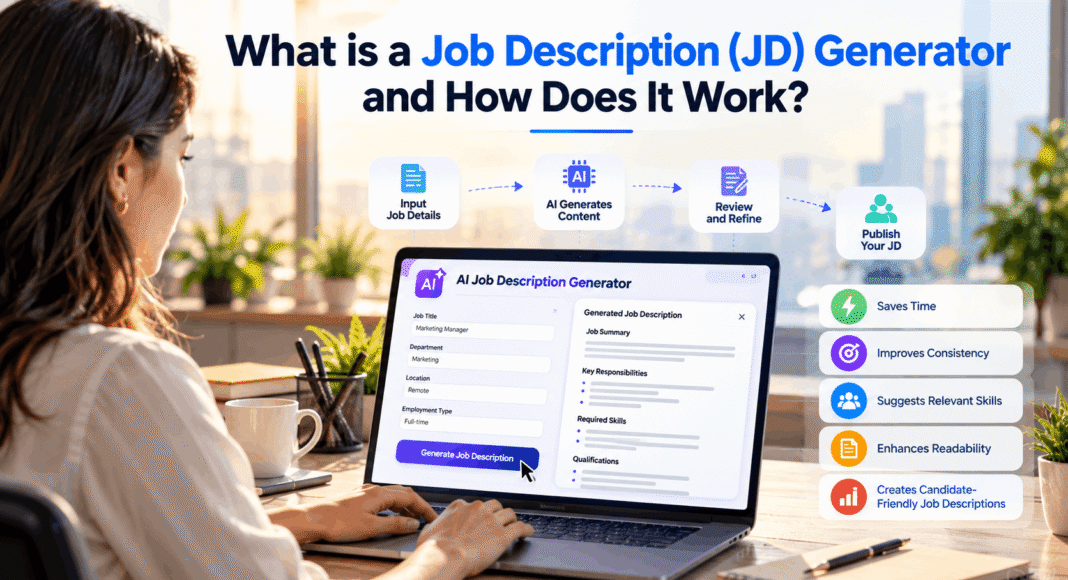

Key Takeaways
- A Job Description (JD) Generator uses AI to create structured, candidate-friendly job descriptions from role details, skills, responsibilities, and hiring requirements.
- AI job description generators help recruiters save time, standardise JDs, suggest relevant skills, improve readability, and optimise existing job descriptions.
- The best JD generator workflow combines AI-powered drafting and optimisation with human review to ensure job requirements are accurate, relevant, and ready for publication.
A Job Description Generator is an AI-powered recruitment tool that creates structured job descriptions from information such as job titles, responsibilities, skills, qualifications, and employment details. It helps recruiters and employers produce clear, consistent, and candidate-friendly job descriptions faster while allowing human review before publication.
Writing a clear and compelling job description is one of the most important steps in the recruitment process. A well-written job description helps candidates understand the role, responsibilities, required skills, qualifications, working arrangements and expectations before they apply. However, creating detailed and consistent job descriptions manually can be time-consuming, particularly for recruiters and employers hiring across multiple positions.
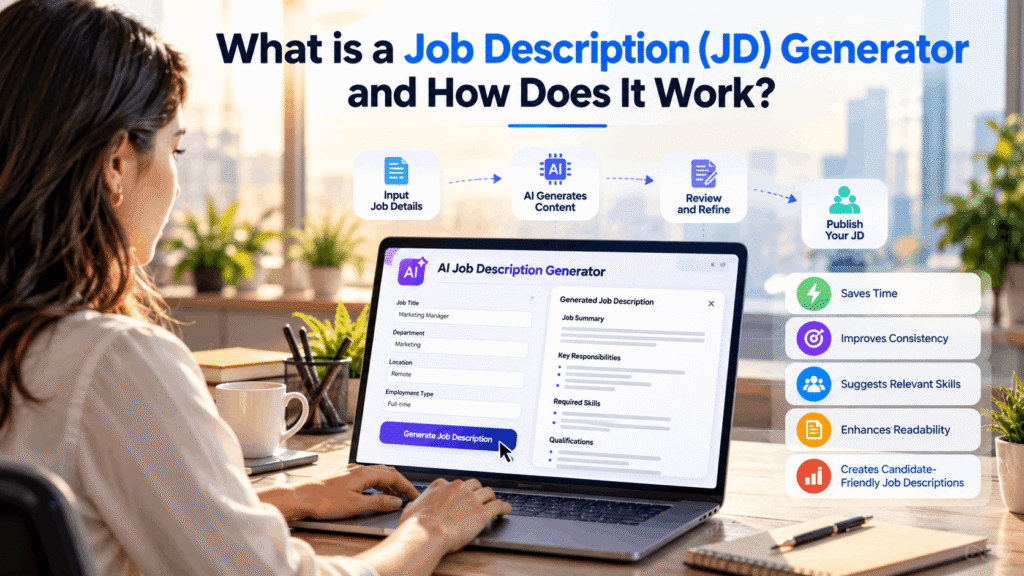
A Job Description Generator, commonly called a JD Generator, is a software tool that helps employers, recruiters and HR professionals create job descriptions based on information about an open position. Modern AI-powered job description generators can take relatively simple inputs—such as a job title, seniority level, required skills, industry and location—and transform them into a structured job description containing responsibilities, qualifications, skills and other relevant information.
The emergence of generative artificial intelligence has significantly expanded what these tools can do. Instead of simply inserting information into predefined templates, an AI job description generator can interpret hiring requirements, recommend relevant skills, rewrite unclear sections, adjust tone and structure, and help recruiters improve an existing job description. More advanced platforms may also provide JD analysis, quality scoring, optimisation recommendations and tools for improving job advertisements before they are published.
For employers, the potential advantage is not simply writing faster. A JD generator can help establish greater consistency across hundreds of job descriptions, reduce repetitive writing work and provide recruiters with a strong starting point when hiring for unfamiliar positions. This can be particularly valuable for recruitment agencies, startups and large organisations managing high volumes of vacancies.
However, an AI-generated job description should not automatically be considered ready for publication. AI does not necessarily understand the exact responsibilities, organisational structure, compensation policies or working environment of a particular employer. Recruiters still need to verify generated requirements, remove unnecessary qualifications, add company-specific information and ensure that the final description accurately represents the position being offered.
Understanding how a job description generator works is therefore increasingly useful for anyone involved in modern recruitment. This guide explains what a JD generator is, how AI job description generators work behind the scenes, their key features and benefits, how to use them effectively, and what employers should consider when choosing the best job description generator for their hiring needs.
Before we venture further into this article, we would like to share who we are and what we do.
About 9cv9
9cv9 is a business tech startup based in Singapore and Asia, with a strong presence all over the world.
With over ten years of startup and business experience, and being highly involved in connecting with thousands of companies and startups, the 9cv9 team has listed some of the top and best companies/tools in this review.
If you like to get your company listed in our top B2B software reviews, check out our world-class 9cv9 Media and PR service and pricing plans here.
What is a JD Generator & How Does It Work
- What Is a Job Description (JD) Generator?
- How Does an AI Job Description Generator Work?
- Key Features and Benefits of Job Description Generators
- How to Use a Job Description Generator Effectively
- How to Choose the Best Job Description Generator
1. What Is a Job Description (JD) Generator?
A Job Description Generator, often shortened to a JD Generator, is a software tool that helps employers, recruiters, HR professionals and hiring managers create structured job descriptions from information about a role. Instead of writing every job description manually, the user supplies key details such as the job title, department, seniority, responsibilities, required skills and qualifications, and the software converts those inputs into a more complete job description.
Modern JD generators increasingly use artificial intelligence and large language models rather than relying exclusively on fixed templates. This allows the software to interpret hiring requirements, generate relevant responsibilities, suggest skills, improve wording and restructure existing job descriptions.
The rise of these tools reflects a much broader adoption of AI across recruitment. According to SHRM, 51% of organizations were already using AI in recruitment based on its 2025 Talent Trends research. LinkedIn’s 2025 Future of Recruiting research similarly found that 37% of recruiting organizations were either experimenting with or actively integrating generative AI, compared with 27% one year earlier.
What Does a JD Generator Actually Generate?
At its simplest, a JD generator transforms a relatively small amount of structured information into a much more comprehensive description of a vacancy.
For example, a recruiter might enter:
- Job title: Digital Marketing Manager
- Seniority: Mid-level
- Location: Singapore
- Employment type: Full-time
- Key skills: SEO, Google Ads, analytics and content marketing
- Experience: Digital marketing experience
- Industry: B2B SaaS
A modern AI JD generator could use these inputs to produce a draft containing a job summary, major responsibilities, essential skills, qualifications, preferred attributes and other candidate-facing information.
The transformation can be illustrated as follows:
| Recruiter Input | JD Generator Output |
|---|---|
| Job title | Standardised position title |
| Seniority | Appropriate scope and responsibility level |
| Department | Role context |
| Skills | Required and preferred skills sections |
| Responsibilities | Structured duties and expected outcomes |
| Experience requirements | Candidate qualification criteria |
| Employment type | Full-time, part-time, contract or other arrangement |
| Location | On-site, hybrid or remote information |
| Company information | Employer introduction where supplied |
| Tone | Candidate-friendly job advertisement |
| Existing JD | Revised or optimised job description |
The important distinction is that the generator does not necessarily determine what the employer actually needs. Instead, it helps translate employer-provided requirements into structured recruitment content.
SHRM’s guidance on AI-assisted job description drafting makes this distinction particularly important. It recommends supplying AI with organizational context and supervisor notes while explicitly instructing the system not to invent information such as reporting lines or team sizes. SHRM also recommends reviewing facts, requirements and compliance-sensitive information before publishing an AI-generated JD.
Traditional JD Templates vs AI Job Description Generators
Job description generators existed before generative AI. Earlier tools generally relied on templates, predefined fields and libraries of standard job descriptions.
AI has made the process substantially more dynamic.
| Capability | Manual Template | Traditional JD Generator | AI JD Generator |
|---|---|---|---|
| Predefined JD structure | Yes | Yes | Yes |
| Automatically fills sections | No | Yes | Yes |
| Understands natural-language instructions | No | Limited | Yes |
| Generates responsibilities | No | Template-based | AI-generated |
| Suggests relevant skills | No | Limited | Yes |
| Rewrites existing content | No | Limited | Yes |
| Changes tone and writing style | Manual | Limited | Yes |
| Adapts to seniority | Manual | Sometimes | Yes |
| Analyses an existing JD | No | Sometimes | Often |
| Generates role-specific variations | Manual | Limited | Yes |
| Human verification required | Yes | Yes | Yes |
A traditional generator might retrieve a prewritten “Software Engineer” template and insert the employer’s company name and location.
An AI-powered JD generator can potentially distinguish between a junior frontend developer at a startup, a senior backend engineer at a financial institution and an engineering manager responsible for a distributed development team. The underlying job family may be similar, but the responsibilities, competencies and expected outcomes can be substantially different.
Why AI Is Becoming Important for Job Description Creation
Job requirements are changing quickly, making static libraries of job descriptions increasingly difficult to maintain.
The World Economic Forum’s Future of Jobs Report 2025 surveyed more than 1,000 employers representing over 14 million workers across 55 economies. It found that employers expect 39% of workers’ existing core skills to change by 2030. AI and big data ranked as the fastest-growing skills, followed by networks and cybersecurity and technological literacy.
This matters for job descriptions because a JD written several years ago may no longer accurately represent what an organization requires from the same position today.
Consider a marketing role. An older job description might emphasize campaign management, copywriting and reporting. A contemporary version could additionally require marketing automation, analytics, AI-assisted workflows, CRM knowledge or other digital capabilities.
JD generators can make updating these descriptions faster, although the employer still needs to determine whether the suggested skills genuinely belong in the role.
The broader recruitment industry is moving in the same direction. LinkedIn surveyed 1,271 recruiting professionals for its 2025 Future of Recruiting research and reported that 73% of talent acquisition professionals believed AI would change how organizations hire. Among recruiters experimenting with or integrating generative AI, 70% expected improved hiring efficiency and 47% expected improved job-post effectiveness.
What Are the Main Types of Job Description Generators?
Not every JD generator works in the same way. They can broadly be divided according to the level of automation and intelligence they provide.
| Type of JD Generator | How It Works | Best Suited For |
|---|---|---|
| Template-based generator | Populates predefined templates | Small businesses with straightforward roles |
| Job-library generator | Retrieves descriptions from a role database | Standardised occupations |
| Rules-based generator | Builds JDs according to predefined rules | Organizations requiring strict consistency |
| AI JD generator | Generates descriptions from prompts and structured inputs | Recruiters handling varied roles |
| AI JD optimiser | Analyses and improves existing JDs | Employers with an existing JD library |
| Integrated ATS generator | Creates JDs inside recruitment software | High-volume recruiting teams |
| Enterprise JD platform | Combines generation, governance, templates and workflows | Large organizations |
The boundaries between these categories are increasingly blurred. A modern recruitment platform might combine an existing occupational database, company-specific templates and generative AI within the same workflow.
What Information Does an AI JD Generator Typically Need?
The quality of a generated job description depends heavily on the quality of the information supplied to the system.
A useful input framework includes four groups of information:
| Input Category | Examples | Why It Matters |
|---|---|---|
| Role identity | Title, department, seniority | Establishes what the position is |
| Role requirements | Skills, qualifications, competencies | Defines candidate requirements |
| Role activities | Responsibilities, objectives, deliverables | Explains what the employee will do |
| Employment context | Location, work arrangement, employment type | Establishes practical conditions |
More context usually allows an AI system to generate a more specific description.
For example, entering only “Sales Manager” leaves considerable ambiguity. The AI does not know whether the employer needs someone managing an enterprise SaaS sales team, a retail store, pharmaceutical territories or an international business-development operation.
Providing “B2B SaaS Sales Manager responsible for a five-person APAC sales team selling HR software to companies with 200–2,000 employees” gives the generator substantially more context.
This illustrates an important principle:
A JD generator should structure and enhance hiring requirements, not invent the employer’s hiring requirements.
JD Generator vs Job Description Template vs AI Writing Tool
These tools can appear similar but serve different purposes.
| Tool | Primary Purpose | Recruitment-Specific? | Typical Output |
|---|---|---|---|
| Job description template | Provide a reusable structure | Yes | Partially completed JD |
| Generic AI writer | Generate general-purpose text | No | Prompt-dependent text |
| JD generator | Build job descriptions | Yes | Structured JD |
| JD analyser | Evaluate existing descriptions | Yes | Scores and recommendations |
| JD optimiser | Improve existing descriptions | Yes | Revised JD |
| ATS | Manage recruitment workflow | Yes | Jobs, candidates and applications |
A generic AI assistant can certainly draft a job description when prompted correctly. A dedicated JD generator, however, can provide a recruitment-specific workflow where users enter structured information, generate the description, analyse it, improve individual sections and potentially export or publish the completed JD.
Who Uses Job Description Generators?
JD generators can be useful wherever organizations repeatedly define and advertise employment opportunities.
Recruiters and recruitment agencies can use them to produce first drafts for multiple clients and vacancies.
HR departments can use them to standardise job description structures across departments.
Hiring managers can turn their knowledge of a position into a structured draft without starting from a blank document.
Startups and small businesses can create professional job descriptions without maintaining a large HR content library.
Large enterprises can use JD technology to help manage extensive libraries containing hundreds or thousands of roles.
Staffing companies and high-volume recruiters can use generation and optimisation tools to reduce repetitive drafting work.
The efficiency argument is particularly relevant for recruiters. LinkedIn reported that talent acquisition professionals using generative AI experienced an average workload reduction equivalent to approximately 20% of their workweek, or roughly one working day per week. This statistic covers generative AI use across recruiting rather than JD generation specifically, but it demonstrates the potential productivity impact of automating repetitive recruitment tasks.
What a JD Generator Should Not Do
Despite the term “generator,” employers should not treat the software as an autonomous hiring authority.
SHRM specifically advises HR professionals to review AI-generated job descriptions carefully before publication, checking facts, figures, requirements and other details and confirming that nothing has been invented or taken out of context. It also recommends that legally required or compliance-sensitive wording be handled directly rather than delegated blindly to AI.
A practical division of responsibilities looks like this:
| Task | JD Generator | Recruiter / Hiring Manager |
|---|---|---|
| Draft JD structure | Strong | Review |
| Generate initial wording | Strong | Review |
| Suggest possible skills | Strong | Validate |
| Define actual responsibilities | Assist | Own |
| Determine seniority | Assist | Own |
| Verify qualifications | Limited | Own |
| Confirm salary and benefits | No | Own |
| Verify legal requirements | No | Own |
| Understand internal team realities | Limited | Own |
| Approve final JD | No | Own |
The best way to understand a Job Description Generator is therefore not as a replacement for recruiters or hiring managers, but as a specialised recruitment productivity tool. It converts structured hiring information into a usable first draft, reduces repetitive writing, helps standardise job descriptions and can assist with subsequent analysis and optimisation.
As AI becomes more deeply integrated into talent acquisition, the JD generator is evolving from a simple template-filling tool into an intelligent recruitment assistant. The technology can accelerate the writing process, but the employer remains responsible for defining the actual job, validating the requirements and ensuring that the final description accurately represents the position being hired for.
2. How Does an AI Job Description Generator Work?
An AI job description generator works by converting structured hiring information and natural-language instructions into a complete, organised job description. Instead of requiring a recruiter to write every section manually, the system uses artificial intelligence—typically a large language model—to interpret information about the vacancy, identify relevant concepts and generate appropriate recruitment content.
The basic workflow can be represented as:
Recruiter inputs → Context processing → AI interpretation → JD generation → Analysis and optimisation → Human review → Final job description
This process is becoming increasingly relevant as generative AI adoption expands across recruitment. LinkedIn’s Future of Recruiting 2025 research found that 37% of recruiting organisations were actively integrating or experimenting with generative AI, up from 27% one year earlier. Among teams experimenting with or integrating generative AI, the reported average time saving was approximately 20% of the working week—roughly one full working day per week.
The Recruiter Provides Information About the Job
The first stage is collecting information about the vacancy.
An AI job description generator cannot inherently know what a particular company needs from an employee. The recruiter, HR professional or hiring manager therefore provides the context from which the JD will be generated.
Typical inputs include:
- Job title
- Department or function
- Seniority level
- Employment type
- Workplace location
- Remote, hybrid or on-site arrangement
- Primary responsibilities
- Required skills
- Preferred skills
- Qualifications
- Industry
- Reporting structure
- Company description
- Salary or compensation information
- Benefits
- Desired writing style or tone
For example, a recruiter could provide the following information:
| Input | Example |
|---|---|
| Job title | Senior Software Engineer |
| Department | Engineering |
| Industry | HR technology |
| Seniority | Senior |
| Location | Singapore |
| Work arrangement | Hybrid |
| Core skills | Python, PostgreSQL, AWS, REST APIs |
| Primary responsibility | Build and maintain recruitment platform APIs |
| Preferred experience | High-volume SaaS platforms |
| Employment type | Full-time |
This structured information becomes the context from which the AI creates the job description.
The more specific the input, the less the AI needs to infer.
For instance, entering only “Marketing Manager” leaves unanswered questions about industry, team size, channels, customers, geography and seniority.
Entering “B2B SaaS Marketing Manager responsible for SEO, paid acquisition, content and lead generation across Southeast Asia” provides considerably stronger context.
SHRM’s 2026 guidance on AI-assisted job-description drafting specifically recommends providing organizational information, supervisor notes, the organization’s JD template and, where available, its style or brand-voice guidelines. Crucially, SHRM also recommends instructing AI not to invent information such as reporting lines or team sizes.
The AI Interprets the Job Requirements
Once the information has been submitted, the AI needs to understand how the different inputs relate to one another.
This is one of the principal differences between an AI JD generator and a basic template system.
A template system might effectively perform:
Job title + predefined template = completed template
An AI system can perform something closer to:
Job title + seniority + skills + responsibilities + industry + employer context + instructions = contextually generated JD
The AI identifies relationships between the information provided.
Consider these three inputs:
| Input | Likely Interpretation |
|---|---|
| Junior Software Developer | Entry-level scope, greater emphasis on learning and implementation |
| Senior Software Engineer | Greater technical ownership and architectural responsibility |
| Engineering Manager | People management, delivery, technical leadership and team development |
All three positions belong to the broader software engineering field, but they should not produce identical responsibilities.
The same principle applies across industries.
A Marketing Manager at an e-commerce company might require expertise in performance marketing, conversion optimisation and customer acquisition.
A Marketing Manager at an enterprise SaaS company could instead require demand generation, account-based marketing, CRM workflows and sales alignment.
Context therefore determines much of the final output.
The Large Language Model Generates the Job Description
After interpreting the input, the generative AI model produces text based on the context and instructions it has received.
A typical JD generator may construct several sections:
| Generated Section | Purpose |
|---|---|
| Job title | Identifies the position |
| Job summary | Explains the overall purpose of the role |
| Responsibilities | Describes what the employee will do |
| Required skills | Defines essential capabilities |
| Preferred skills | Identifies desirable additional capabilities |
| Qualifications | Establishes relevant credentials or requirements |
| Experience | Describes expected professional background |
| Work arrangement | Explains location or remote/hybrid expectations |
| Compensation | Communicates salary where provided |
| Benefits | Describes employer benefits |
| Company overview | Introduces the organisation |
| Application information | Explains the next step for candidates |
The system is not normally retrieving one complete job description and copying it. Generative AI constructs an output in response to the supplied context and instructions.
For example, imagine a company requests:
“Create a job description for a Senior SEO Manager at a B2B SaaS company. The employee will manage organic acquisition across the US and UK and lead a three-person content team.”
The model can connect concepts such as:
Senior SEO Manager → seniority → SEO strategy → B2B SaaS → organic acquisition → US/UK markets → leadership responsibilities
Those relationships can then be converted into responsibilities such as developing organic search strategy, managing content production, analysing search performance and coordinating the content team.
The Generator Can Recommend Relevant Skills
More sophisticated JD generators can go beyond rewriting information supplied by the recruiter.
They can recommend skills and competencies that commonly correspond to the position.
Suppose an employer enters:
Data Analyst
Potential suggestions might include:
- SQL
- Data visualisation
- Statistical analysis
- Excel
- Python
- Business intelligence
- Data cleaning
- Analytical thinking
- Communication
The recruiter can then decide which skills actually belong to the vacancy.
This capability is particularly useful because job requirements are changing rapidly.
The World Economic Forum’s Future of Jobs Report 2025 surveyed more than 1,000 employers representing over 14 million workers across 55 economies. Employers expected 39% of workers’ existing core skills to change by 2030. AI and big data ranked as the fastest-growing skills, followed by networks and cybersecurity and technological literacy.
The same report found that 63% of employers identified skills gaps as a key barrier to business transformation.
For JD generation, this matters because historical job descriptions can quickly become outdated. An intelligent generator can help recruiters identify potentially relevant contemporary skills—but the hiring manager should determine whether those skills genuinely apply to the position.
AI Converts Requirements Into Candidate-Friendly Language
Raw hiring-manager notes rarely resemble polished job advertisements.
A hiring manager might submit:
Manage paid campaigns. Need Google Ads experience. Track leads. Work with sales. Improve CPL.
An AI JD generator can reorganise those points into clearer responsibilities such as:
- Plan and manage paid acquisition campaigns across relevant advertising platforms.
- Monitor campaign performance, lead volume and cost per lead.
- Analyse campaign data and identify opportunities to improve acquisition efficiency.
- Collaborate with sales teams to evaluate lead quality and optimise targeting.
The underlying requirements have not fundamentally changed. The AI has transformed fragmented information into consistent, candidate-facing language.
This is one of the areas where generative AI can reduce repetitive recruitment work. LinkedIn reports that 73% of talent acquisition professionals believe AI will change how organisations hire, while users already experimenting with or integrating generative AI report an average workload saving of about 20%.
The AI Can Apply Formatting and Writing Rules
JD generation is not necessarily an unrestricted writing process.
Recruiters can provide rules governing the output.
For example:
| Rule | Possible Instruction |
|---|---|
| Length | Keep the JD below 800 words |
| Responsibilities | Maximum eight responsibilities |
| Requirements | Maximum six essential requirements |
| Language | Use straightforward candidate-friendly English |
| Seniority | Write for a mid-level position |
| Structure | Follow the company’s standard JD template |
| Skills | Prioritise demonstrable skills |
| Tone | Professional but approachable |
| Acronyms | Avoid unexplained internal terminology |
| Inclusivity | Flag potentially exclusionary wording |
| Accuracy | Do not invent information not provided |
This makes AI particularly useful for companies seeking greater consistency across large numbers of vacancies.
For example, an organisation could require every generated JD to follow:
Job Summary → Responsibilities → Required Skills → Preferred Skills → Compensation → Benefits → About the Company
The content can change for every position while the overall structure remains consistent.
SHRM’s current JD-generation guidance provides a practical example of this controlled approach. Its suggested workflow asks AI to follow the employer’s template, limit responsibilities and requirements, use plain language, avoid certain exclusionary phrasing, identify vague information and refrain from inventing missing organizational details.
The Generator May Analyse the Draft After Generation
Generation does not necessarily have to be the final AI operation.
More advanced JD software can perform a second stage of analysis after creating the initial description.
Conceptually, the process becomes:
Generate → Analyse → Identify weaknesses → Recommend changes → Regenerate
Potential analysis areas include:
| Analysis Area | What the System Could Check |
|---|---|
| Completeness | Whether important JD sections are missing |
| Readability | Whether wording is unnecessarily complicated |
| Responsibilities | Whether duties are sufficiently specific |
| Skills | Whether requirements match the stated role |
| Seniority | Whether expectations fit the position level |
| Duplication | Whether requirements repeat each other |
| Language | Whether potentially exclusionary wording appears |
| Structure | Whether the JD follows the desired template |
| Clarity | Whether candidates can understand expectations |
| Length | Whether sections are unnecessarily long |
This creates an important distinction between JD generation and JD optimisation.
Generation answers:
“Can AI create this job description?”
Optimisation asks:
“How can this job description be improved?”
A modern JD platform can potentially perform both.
Recruiters Can Iterate With the AI
One major advantage of generative AI is that the first result does not need to be the final result.
A recruiter can request modifications such as:
- Make the responsibilities more specific.
- Shorten the introduction.
- Remove unnecessary requirements.
- Rewrite the JD for a more senior candidate.
- Make the language easier to understand.
- Separate essential and preferred skills.
- Rewrite the responsibilities around outcomes.
- Adapt the description for a remote position.
- Remove internal company terminology.
- Identify requirements that appear unrealistic.
- Rewrite the description using the company’s preferred tone.
This creates an iterative workflow:
| Version | Recruiter Action | AI Action |
|---|---|---|
| Draft 1 | Provides role information | Generates initial JD |
| Draft 2 | Identifies missing details | Updates content |
| Draft 3 | Requests clearer wording | Rewrites sections |
| Draft 4 | Adds company-specific information | Integrates context |
| Final | Reviews accuracy | Produces polished draft |
The AI therefore functions less like a one-click text generator and more like an interactive drafting assistant.
Human Review Remains a Critical Final Step
A high-quality AI JD workflow should not end when the model finishes generating text.
It should end with human verification and approval.
SHRM explicitly recommends checking AI-generated JDs for facts, figures, dates and requirements; verifying that nothing was invented or taken out of context; and manually inserting legally required or compliance-sensitive language rather than relying on AI to create it.
A sensible responsibility matrix is therefore:
| Activity | AI | Recruiter / Hiring Manager |
|---|---|---|
| Structure the JD | Primary | Review |
| Draft content | Primary | Review |
| Rewrite wording | Primary | Approve |
| Suggest skills | Assist | Validate |
| Define actual responsibilities | Assist | Primary |
| Determine essential qualifications | Assist | Primary |
| Verify salary | No | Primary |
| Verify benefits | No | Primary |
| Confirm reporting structure | No | Primary |
| Check company policies | Limited | Primary |
| Verify compliance-sensitive wording | Limited | Primary |
| Approve final publication | No | Primary |
AI may suggest that a particular role requires five years of experience, a university degree, a particular certification or knowledge of a specific technology. That does not mean the requirement is actually necessary.
The hiring manager must make that determination.
Example: From Basic Inputs to a Complete AI-Generated JD
Consider a company hiring a Customer Success Manager.
The recruiter enters:
| Input | Information |
|---|---|
| Position | Customer Success Manager |
| Industry | B2B SaaS |
| Customers | Mid-market companies |
| Region | APAC |
| Main objective | Improve retention and adoption |
| Responsibilities | Onboarding, account reviews, renewals |
| Skills | Communication, SaaS, analytics |
| Work arrangement | Hybrid |
The AI interprets the role and may construct:
Job Summary
Manage relationships with mid-market SaaS customers across APAC and help customers successfully adopt the company’s platform.
Responsibilities
- Manage customer onboarding and implementation.
- Conduct regular account and business reviews.
- Monitor product adoption and customer health.
- Identify retention risks and coordinate interventions.
- Support renewal conversations.
- Collect and communicate customer feedback.
Potential Skills
- Customer relationship management
- SaaS customer success
- Account management
- Data analysis
- Communication
- Stakeholder management
The recruiter then reviews the output and determines that renewal negotiations are actually handled by the sales department.
That responsibility is removed.
This simple example illustrates why AI generation and human judgment should operate together rather than independently.
The Complete AI Job Description Generation Workflow
The entire process can ultimately be summarised as follows:
| Stage | What Happens | Primary Owner |
|---|---|---|
| Job definition | Employer determines what position is needed | Human |
| Data input | Role details are entered | Human |
| Context interpretation | AI analyses the information | AI |
| Content generation | AI drafts the JD | AI |
| Skill recommendations | Potential competencies are suggested | AI + Human |
| Structure optimisation | Content is organised | AI |
| Language refinement | Wording and readability are improved | AI |
| JD analysis | Potential weaknesses are identified | AI |
| Business validation | Responsibilities and requirements are checked | Human |
| Compliance review | Sensitive requirements are verified | Human |
| Final approval | Employer approves the JD | Human |
| Publication | JD is posted to recruitment channels | Human/System |
The central principle is therefore straightforward:
An AI job description generator does not decide what job an employer needs. It transforms the employer’s knowledge about that job into structured recruitment content.
The strongest systems combine the speed and language capabilities of generative AI with structured recruitment inputs, predefined company rules, JD analysis and human oversight. This combination explains why AI-powered JD generators are becoming increasingly useful within modern talent acquisition: they can automate much of the repetitive drafting process while leaving the consequential hiring decisions with recruiters and hiring managers.
3. Key Features and Benefits of Job Description Generators
Job description generators have evolved from simple template libraries into AI-powered recruitment tools capable of drafting, analysing and improving job descriptions. Their value is not limited to producing text faster. A well-designed JD generator can help recruiters standardise job postings, identify relevant skills, improve readability, maintain employer-brand consistency and reduce repetitive administrative work.
The wider adoption of AI in recruitment helps explain why these capabilities are becoming increasingly important. SHRM’s 2025 Talent Trends research found that 51% of organisations use AI for recruitment tasks, while 43% use AI somewhere within HR. Among HR professionals already using AI tools, nearly 90% reported that AI saves time and/or increases efficiency.
Faster Job Description Creation
One of the most immediate benefits of a JD generator is speed.
Writing a job description manually can involve researching the position, defining responsibilities, determining requirements, formatting the document and repeatedly revising it with the hiring manager. A generator can automate a substantial portion of the drafting stage.
A recruiter might provide:
- Job title: Senior Account Executive
- Industry: B2B SaaS
- Region: Southeast Asia
- Seniority: Senior
- Core responsibility: New-business acquisition
- Skills: Enterprise sales, CRM, negotiation and forecasting
- Employment type: Full-time
The generator can then create an initial structured JD containing a summary, responsibilities, requirements and skills.
This does not mean that every generated JD is immediately publishable. Rather, it changes the recruiter’s workflow from:
Research → Write → Structure → Edit → Review
to:
Define → Generate → Review → Refine
The productivity potential aligns with broader recruitment research. LinkedIn’s Future of Recruiting 2025 report found that recruiting teams experimenting with or integrating generative AI saved an average of approximately 20% of their workweek, equivalent to about one working day per week. The same research found that 37% of recruiting organisations were actively integrating or experimenting with generative AI, compared with 27% a year earlier.
| Recruitment Task | Traditional Process | AI JD Generator |
|---|---|---|
| Create first draft | Written manually | Automatically generated |
| Structure sections | Manual | Automated |
| Rewrite responsibilities | Manual | AI-assisted |
| Generate alternative wording | Manual | Near-instant |
| Suggest skills | Requires research | AI-assisted |
| Adjust seniority | Rewrite sections | Regenerate or edit |
| Create multiple variants | Repeated manual work | Rapid generation |
| Final validation | Human | Human |
The greatest efficiency gains are therefore likely to appear in repetitive drafting and rewriting rather than in the final hiring decisions themselves.
AI-Powered Writing and Rewriting
Modern job description generators can do considerably more than fill predefined templates.
Generative AI allows recruiters to give natural-language instructions such as:
- Make this JD more concise.
- Rewrite this role for a senior candidate.
- Turn these hiring-manager notes into responsibilities.
- Make the language easier for candidates to understand.
- Remove repetitive requirements.
- Separate required and preferred qualifications.
- Rewrite responsibilities around measurable outcomes.
- Make the tone more professional.
- Adapt this office-based role into a hybrid position.
Consider a hiring manager who provides the following note:
Responsible for SEO, content, rankings, website traffic and reporting.
A JD generator could transform this into more candidate-oriented responsibilities:
- Develop and execute an organic search strategy aligned with business objectives.
- Identify SEO opportunities through keyword, competitor and search-performance analysis.
- Collaborate with content teams to improve organic visibility.
- Monitor organic traffic, rankings and conversions.
- Produce regular performance reports and recommend optimisation opportunities.
The AI has not necessarily discovered new facts about the vacancy. Its primary contribution is turning fragmented information into structured recruitment language.
Consistent Job Description Structure
Consistency becomes increasingly difficult when dozens of recruiters and hiring managers write job descriptions independently.
One department might use:
Overview → Duties → Qualifications
while another uses:
About Us → Role → Requirements → Benefits
and another publishes a largely unstructured paragraph.
A JD generator can enforce a common framework such as:
Job Title → Job Summary → Responsibilities → Required Skills → Preferred Qualifications → Compensation → Benefits → About the Company
This can be particularly valuable for large employers, recruitment agencies and organisations hiring across multiple markets.
| Without JD Standardisation | With JD Standardisation |
|---|---|
| Different formats between departments | Common structure |
| Inconsistent terminology | Defined terminology |
| Varying levels of detail | Standard content requirements |
| Repeated sections | Controlled templates |
| Important information may be omitted | Required fields can be enforced |
| Employer voice varies | Brand guidelines can be applied |
| Harder to audit large JD libraries | Easier comparison and review |
Consistency does not mean every job description should sound identical. Rather, organisations can standardise the framework while preserving role-specific content.
Skills and Competency Recommendations
AI JD generators can suggest skills associated with a particular occupation, seniority level or industry.
For example, a recruiter creating a Data Analyst JD might receive suggestions for:
- SQL
- Data visualisation
- Statistical analysis
- Spreadsheet analysis
- Business intelligence
- Python
- Data cleaning
- Analytical reasoning
- Stakeholder communication
A Senior Data Analyst might additionally generate suggestions around mentoring, stakeholder management, data modelling or analytical strategy.
This feature has become increasingly valuable because employers’ skill requirements are changing rapidly.
SHRM’s 2025 Talent Trends research found that 28% of organisations said full-time positions now require entirely new skills, while 47% were updating existing roles to incorporate new skills. Among technology-related capabilities, data analysis was cited by 36% of organisations, AI by 31%, and cybersecurity by 21%.
The World Economic Forum provides an even broader perspective. Its Future of Jobs Report 2025 incorporates responses from more than 1,000 employers representing over 14 million workers across 55 economies and projects significant disruption to jobs and skills through 2030.
For employers maintaining hundreds of older JDs, automated skill suggestions can therefore provide a useful prompt for reviewing whether existing requirements still reflect the work being performed.
However, suggested skills should be treated as recommendations rather than automatic requirements.
Required vs Preferred Skills Classification
A useful JD generator can also help distinguish between qualifications that candidates genuinely need and those that would merely be advantageous.
For example:
| Requirement | Classification |
|---|---|
| Ability to write production Python | Required |
| SQL experience | Required |
| Experience with PostgreSQL | Preferred |
| AWS certification | Preferred |
| Communication skills | Required |
| Previous HR-tech experience | Preferred |
This distinction matters because unnecessarily restrictive requirements can narrow the candidate pool.
Instead of automatically accepting every AI-generated competency, recruiters should ask:
- Is this skill genuinely necessary on the first day?
- Could it be learned after hiring?
- Is a specific degree actually required?
- Is the stated number of years of experience justified?
- Are two listed requirements effectively measuring the same capability?
The generator can facilitate this process, but the hiring manager remains responsible for determining the actual threshold.
Job Description Analysis and Scoring
More advanced JD generators can analyse an existing description rather than generating a new one from scratch.
The software may evaluate areas such as:
| Analysis Dimension | Example Question |
|---|---|
| Completeness | Are important sections missing? |
| Readability | Is the JD unnecessarily complicated? |
| Responsibilities | Are duties clear and specific? |
| Skills | Are required competencies identified? |
| Seniority | Do expectations match the role level? |
| Length | Is the description excessively long? |
| Duplication | Are requirements repeated? |
| Language | Are potentially exclusionary phrases present? |
| Structure | Does the JD follow company standards? |
| Candidate focus | Does it clearly explain the opportunity? |
A scoring system can be particularly valuable for organisations with extensive historical JD libraries.
Rather than manually reviewing 500 descriptions from scratch, an organisation could potentially identify low-scoring or incomplete descriptions and prioritise them for human review.
Inclusive and Bias-Aware Language Assistance
Language can influence how candidates perceive an opportunity.
Some JD optimisation platforms therefore analyse job postings for potentially exclusionary, unnecessarily aggressive, gender-coded or otherwise problematic wording and suggest alternatives.
For example:
| Potential Wording | Possible Revision |
|---|---|
| Digital native | Comfortable using relevant digital tools |
| Young and energetic team | Collaborative and fast-moving team |
| Sales rockstar | Experienced sales professional |
| Aggressive salesperson | Results-oriented salesperson |
| Native English speaker | Professional English proficiency |
| Recent graduate | Entry-level candidate |
The objective is not simply replacing particular words. Recruiters should consider whether the underlying requirement is genuinely relevant to job performance.
Research from Textio’s job-post dataset has found measurable relationships between job-ad language and recruitment outcomes. Its published analysis reports that job postings containing an equal-opportunity statement filled approximately 6% faster than postings without one. Textio also reports that postings mentioning two or three company benefits filled about five days faster on average than those that did not.
Textio recommends making requirements measurable and removing vague or biased language when constructing inclusive candidate journeys.
These findings illustrate why JD optimisation should consider not only what information is present but also how that information is communicated.
Readability and Candidate-Friendly Language
Internal hiring requirements frequently contain jargon that candidates may not understand.
For example:
Responsible for driving cross-functional GTM initiatives across PLG, CS and RevOps stakeholders while optimising NRR.
That sentence might make perfect sense internally but be unnecessarily difficult for an external applicant.
A JD generator could rewrite it as:
Work with marketing, sales, customer success and revenue operations teams to improve customer retention and revenue growth.
AI-powered rewriting can help employers:
- Shorten long sentences.
- Explain acronyms.
- Remove internal terminology.
- Simplify technical wording where appropriate.
- Break large paragraphs into readable sections.
- Remove repeated statements.
- Make responsibilities more specific.
Candidate-friendly writing does not mean oversimplifying the job. It means reducing unnecessary friction between what the employer intends to communicate and what the applicant understands.
Employer Brand and Tone Consistency
Job descriptions are also employer-brand communications.
A startup might want an energetic and conversational style, while a financial institution may prefer formal and precise language.
An AI JD generator can potentially apply predefined writing instructions across multiple positions.
| Employer | Possible JD Tone |
|---|---|
| Technology startup | Direct, modern, conversational |
| Investment bank | Formal, precise, professional |
| Creative agency | Expressive and engaging |
| Government organisation | Clear, structured and formal |
| Engineering company | Technical and factual |
| Recruitment agency | Candidate-focused and persuasive |
The organisation can establish instructions around vocabulary, company descriptions, values, benefits and tone and reuse those instructions across future descriptions.
This can help prevent employer branding from changing substantially depending on which recruiter happens to write the advertisement.
Faster Updating of Existing Job Descriptions
JD generators are also useful when a job description already exists.
Instead of creating another document, recruiters can use AI to identify outdated information and revise individual sections.
This matters because roles themselves are evolving. SHRM found that 47% of organisations were updating existing roles to incorporate new skills in its 2025 Talent Trends research.
For example, an older marketing JD might list:
- Email marketing
- Copywriting
- Google Analytics
- Social media
An employer reviewing the position could determine that the contemporary role also requires:
- Marketing automation
- CRM management
- First-party data analysis
- AI-assisted marketing workflows
- Conversion optimisation
AI can help restructure the JD around those new requirements, while the hiring manager determines which changes are genuinely appropriate.
Templates and Reusable JD Libraries
Not every vacancy needs to begin from a blank page.
Job description generators may include reusable templates for common positions such as:
- Software Engineer
- Accountant
- Sales Executive
- Marketing Manager
- HR Manager
- Customer Service Representative
- Project Manager
- Data Analyst
- Operations Manager
- Recruiter
Organisations can also maintain their own approved templates.
This creates a scalable workflow:
Approved template → Role-specific inputs → AI customisation → Human review → Publication
A recruitment agency, for example, could maintain a baseline Software Engineer template but generate variations for:
- Junior Frontend Developer
- Senior Backend Engineer
- DevOps Engineer
- Engineering Manager
- Mobile Developer
- Machine Learning Engineer
This reduces repetitive drafting without forcing every position into exactly the same description.
Multiple JD Variations From the Same Requirements
Generative AI also makes it relatively easy to produce alternative versions of the same description.
A recruiter might create:
Version A: Detailed internal job description
Version B: Candidate-facing job advertisement
Version C: Short job-board listing
Version D: Senior-level variation
Version E: Location-specific version
This is particularly useful for recruitment agencies and multinational employers distributing vacancies through different channels.
The underlying requirements remain centrally defined while the presentation can change according to the intended audience.
High-Volume Recruitment Scalability
The benefits of automation become larger as hiring volume increases.
Consider two employers:
| Employer | JDs Per Month | Manual Drafting Burden | Potential Value of Automation |
|---|---|---|---|
| Small business | 2 | Low | Moderate |
| Growing startup | 15 | Moderate | High |
| Recruitment agency | 100 | High | Very high |
| Large enterprise | 500+ | Very high | Very high |
A company producing two JDs each year may gain convenience.
A recruitment agency creating hundreds of advertisements can gain a repeatable production workflow.
This scalability is important given continuing recruitment challenges. SHRM’s 2025 Talent Trends research found that 69% of organisations reported difficulty filling full-time positions.
Automation cannot solve talent shortages by itself, but reducing administrative drafting work can allow recruiters to spend more time on sourcing, candidate engagement and hiring-manager relationships.
Collaboration Between Recruiters and Hiring Managers
Creating a JD often requires information from several people.
A hiring manager understands the actual work. HR understands organisational policies. A recruiter understands candidate expectations and the talent market.
A structured JD generator can provide a common starting point.
A practical workflow might be:
Hiring Manager
- Defines responsibilities.
- Identifies essential skills.
- Explains expected outcomes.
Recruiter
- Generates the initial JD.
- Improves candidate-facing language.
- Reviews requirements.
HR
- Checks policies, compensation and standard wording.
AI JD Generator
- Structures information.
- Drafts content.
- Identifies possible omissions.
- Suggests revisions.
Final Approver
- Confirms accuracy before publication.
This model preserves human ownership while automating lower-value drafting work.
Potential SEO and Job-Search Optimisation
Some JD generators can also help ensure that important candidate search terms appear naturally within a job description.
For example, a poorly titled position such as:
Growth Ninja III
may communicate very little to candidates or search engines.
A clearer title might be:
Senior Growth Marketing Manager
Similarly, an advertisement for a software engineer might naturally incorporate relevant terms such as:
- Backend engineering
- Python
- REST APIs
- PostgreSQL
- AWS
- SaaS
The objective should be relevance rather than keyword stuffing. A JD that repeats “software engineer jobs” dozens of times is unlikely to become more useful to candidates.
AI can instead help align the terminology used in the advertisement with terminology candidates are likely to recognise.
Export, ATS and Recruitment Workflow Integration
JD generation becomes more useful when it connects to the rest of the hiring workflow.
Depending on the software, integration capabilities may include:
- Applicant Tracking Systems
- HR information systems
- Recruitment CRMs
- Job boards
- Career websites
- Collaboration platforms
- Document exports
- Approval workflows
- Recruitment analytics
The ideal workflow becomes:
Create → Analyse → Approve → Publish → Measure → Improve
rather than:
Create JD → Copy → Paste → Reformat → Copy again → Publish manually
The precise integration capabilities depend on the individual JD generator and should be evaluated before purchase.
Overall Benefits of Job Description Generator Software
The major features ultimately translate into several operational benefits.
| JD Generator Feature | Primary Benefit | Most Valuable For |
|---|---|---|
| AI generation | Faster first drafts | All recruiters |
| AI rewriting | Faster editing | High-volume hiring |
| Skill suggestions | Better requirement discovery | Hiring unfamiliar roles |
| JD analysis | Quality control | Recruitment teams |
| Readability optimisation | Clearer candidate communication | All employers |
| Inclusive-language analysis | Broader, more thoughtful wording | Enterprise HR |
| Templates | Standardisation | Large organisations |
| Brand controls | Consistent employer voice | Multi-recruiter teams |
| Multiple variations | Channel flexibility | Recruitment agencies |
| ATS integration | Less manual administration | High-volume recruiters |
| JD library | Reusability | Enterprises |
| Scoring | Prioritised optimisation | Large JD inventories |
Where JD Generators Deliver the Most Value
A job description generator should ultimately be viewed as a recruitment productivity and quality-assurance tool rather than an autonomous hiring decision-maker.
The strongest use case combines three capabilities:
Automation + Standardisation + Human Expertise
AI handles repetitive drafting, restructuring, suggestions and analysis.
Recruiters bring knowledge of candidates and the labour market.
Hiring managers determine what the employee will actually do.
HR ensures that organisational policies and requirements are represented correctly.
That balance is especially important as AI becomes mainstream in recruitment. SHRM reports that 51% of organisations already use AI for recruitment, while LinkedIn finds that 73% of talent acquisition professionals believe AI will change how organisations hire.
The most valuable benefit of a job description generator, therefore, is not simply that it can write a JD. It is that it can transform job-description creation from an inconsistent, repetitive writing task into a faster and more structured workflow—while leaving recruiters and hiring managers responsible for the accuracy, relevance and final hiring requirements.
4. How to Use a Job Description Generator Effectively
A job description generator can dramatically reduce the time required to create a first draft, but the quality of the final JD depends heavily on how the tool is used. The strongest workflow is not simply to enter a job title, click “Generate” and immediately publish the result. Employers should give the AI accurate context, distinguish essential requirements from preferences, refine the generated content and complete a human review before publication.
This matters because AI adoption in recruitment is accelerating. LinkedIn’s Future of Recruiting 2025 research found that 37% of recruiting organisations were actively integrating or experimenting with generative AI, up from 27% a year earlier. Among organisations experimenting with or integrating generative AI in hiring, users reported saving an average of approximately 20% of their working week—equivalent to about one full working day.
The objective should therefore be to use a JD generator to remove repetitive drafting work without outsourcing important hiring decisions to AI.
Start With a Clear Definition of the Role
Before opening a job description generator, determine what the employee is actually expected to accomplish.
At minimum, clarify:
- The purpose of the position
- Primary responsibilities
- Expected outcomes
- Seniority level
- Department
- Reporting relationship
- Essential technical skills
- Essential interpersonal skills
- Employment type
- Work location
- Remote, hybrid or on-site arrangement
- Compensation information where appropriate
- Qualifications that are genuinely necessary
A vague input inevitably gives the AI more room to make assumptions.
Consider the difference:
| Weak Input | Stronger Input |
|---|---|
| Marketing Manager | B2B SaaS Marketing Manager |
| Write marketing JD | Create a JD for a mid-level B2B SaaS Marketing Manager |
| Need SEO and ads | Responsible for SEO, Google Ads and lead generation |
| Needs experience | Must be able to independently manage paid acquisition campaigns |
| Based in Singapore | Singapore-based hybrid position |
| Marketing responsibilities | Responsible for generating qualified leads across Southeast Asia |
The stronger version gives the generator considerably more context while reducing the need for AI inference.
SHRM’s September 2026 guidance on AI-assisted JD drafting makes the same point: AI does not automatically know an organisation, its people, policies or obligations. Employers need to provide the relevant organisational context themselves.
Give the Generator Structured Inputs
A useful approach is to complete a simple “role brief” before generating the JD.
| Input Category | Information to Provide | Example |
|---|---|---|
| Job identity | Job title | Senior Backend Engineer |
| Department | Functional team | Engineering |
| Seniority | Career level | Senior |
| Industry | Business context | HR technology |
| Location | Employment location | Singapore |
| Work model | Workplace arrangement | Hybrid |
| Role objective | Primary outcome | Build scalable recruitment APIs |
| Responsibilities | Main duties | API development, architecture, code reviews |
| Required skills | Essential competencies | Python, PostgreSQL, REST APIs |
| Preferred skills | Advantageous capabilities | AWS, Kubernetes |
| Employment type | Contract structure | Full-time |
| Reporting line | Manager | Engineering Manager |
| Compensation | Salary information | Employer-defined range |
This structure makes the AI’s task much more constrained.
Instead of asking the model to determine what a Senior Backend Engineer does at your organisation, you are asking it to organise and communicate information that your organisation has already defined.
Use a Specific, Candidate-Friendly Job Title
The job title should normally be understandable to someone outside the organisation.
Internal titles such as:
- Marketing Ninja
- Customer Happiness Rockstar
- Software Wizard
- Sales Warrior
- Engineer III-742
- Growth Hero
may be meaningful internally but unclear to candidates.
Prefer recognised titles such as:
- Digital Marketing Manager
- Customer Success Manager
- Senior Software Engineer
- Enterprise Account Executive
- Growth Marketing Manager
Indeed’s current employer guidance recommends clear, industry-standard titles and advises employers to avoid internal jargon, unnecessary abbreviations and overly complicated titles. It notes that clear titles make it easier for candidates to understand and find the position.
When using a JD generator, therefore, start with the title candidates are likely to recognise rather than an internal HR classification.
Provide Responsibilities as Raw Facts Before Asking AI to Rewrite Them
Recruiters do not need to write perfectly polished responsibilities before using a JD generator.
Provide accurate information first.
For example:
Hiring manager’s notes:
- Own Google Ads.
- $100k monthly budget.
- Report CPL and pipeline.
- Work with sales.
- Test landing pages.
- Manage agency.
The JD generator can transform these facts into clearer candidate-facing responsibilities:
- Manage and optimise paid search campaigns across Google Ads.
- Oversee approximately $100,000 in monthly advertising spend.
- Monitor cost per lead, conversion performance and pipeline contribution.
- Collaborate with sales teams to assess lead quality.
- Develop and test landing-page optimisation initiatives.
- Coordinate with external performance-marketing partners.
The important principle is:
Human supplies facts → AI improves communication
rather than:
AI invents facts → Human assumes they are correct
SHRM specifically recommends giving AI the supervisor’s notes and telling it not to invent information such as team sizes or reporting lines.
Focus Responsibilities on Outcomes, Not Just Tasks
Effective JDs should help candidates understand what they are expected to achieve.
Compare:
| Task-Oriented | Outcome-Oriented |
|---|---|
| Manage SEO | Develop and execute an SEO strategy that increases qualified organic traffic |
| Write reports | Produce monthly performance reports that identify trends and recommended actions |
| Manage customers | Build relationships with customers to improve adoption and retention |
| Run advertisements | Manage paid acquisition campaigns against agreed lead and acquisition targets |
| Manage developers | Lead the engineering team in delivering reliable product releases |
SHRM’s 2026 AI JD guidance recommends opening with what the person should accomplish rather than merely providing a list of activities.
When the generator produces generic duties, a useful follow-up instruction is:
“Rewrite these responsibilities around expected outcomes and ownership rather than generic activities.”
Separate Required and Preferred Qualifications
One of the most important steps in JD generation is distinguishing what a candidate must have from what would merely be advantageous.
For example:
| Requirement | Classification |
|---|---|
| Professional-level English | Required |
| Ability to analyse marketing data | Required |
| Google Ads campaign management | Required |
| Previous SaaS experience | Preferred |
| Google Ads certification | Preferred |
| HubSpot experience | Preferred |
| Previous HR-tech experience | Preferred |
Without this distinction, AI-generated JDs can accumulate long lists of requirements that unnecessarily restrict the applicant pool.
Ask:
- Is this capability necessary to perform the job?
- Can the employee learn it after joining?
- Is the qualification legally required?
- Is a degree necessary?
- Does the stated number of years of experience prove competence?
- Would a candidate with equivalent skills be capable of succeeding?
SHRM’s current AI JD guidance recommends describing requirements as demonstrable skills rather than relying on years of experience or degrees, except where credentials are genuinely required. Its sample framework also recommends keeping the requirements section concise.
Use Skills-Based Requirements Where Appropriate
Instead of writing:
“Minimum five years of digital marketing experience.”
consider whether the actual requirement is something like:
“Demonstrated ability to independently plan, execute and optimise multi-channel digital acquisition campaigns.”
The second statement describes what the candidate needs to be capable of doing.
This is increasingly relevant because skills themselves are changing quickly. The World Economic Forum’s Future of Jobs Report 2025 found that employers expect 39% of workers’ core skills to change by 2030, down from 44% in its previous 2023 estimate but still representing substantial skills disruption.
JD generators can help identify contemporary skills, but hiring managers should decide which ones genuinely predict success in the position.
Tell the AI What It Must Not Invent
One of the most effective JD-generation techniques is defining explicit boundaries.
For example:
Use only the information provided. Do not invent salary, benefits, reporting relationships, team size, qualifications, years of experience, certifications, working hours or company policies. Flag missing information instead.
This changes the desired behaviour from:
Missing information → AI fills the gap
to:
Missing information → AI identifies the gap
A useful governance matrix is:
| Information | AI May Draft | AI Should Not Decide |
|---|---|---|
| Responsibility wording | Yes | |
| JD structure | Yes | |
| Summary wording | Yes | |
| Possible skills | Yes | |
| Salary | Yes | |
| Benefits | Yes | |
| Reporting relationship | Yes | |
| Required degree | Yes | |
| Years of experience | Yes | |
| Legal requirements | Yes | |
| Working arrangement | Yes | |
| Final hiring criteria | Yes |
SHRM explicitly recommends instructing AI not to invent reporting lines or team size and checking the finished description for assumptions or information taken out of context.
Keep the Requirements Realistic
AI models can easily produce “ideal candidate” lists that combine every conceivable skill associated with an occupation.
A generated marketing JD, for example, might request:
- SEO
- PPC
- Graphic design
- Video production
- Copywriting
- Salesforce
- HubSpot
- Python
- SQL
- Analytics
- Public relations
- Event management
- Sales
- Five languages
The description may sound impressive while describing a candidate who barely exists.
Review every generated requirement using a simple matrix:
| Question | Keep Requirement? |
|---|---|
| Needed to perform core duties? | Usually yes |
| Required by law or regulation? | Yes |
| Difficult to learn after joining? | Possibly |
| Merely “nice to have”? | Move to preferred |
| Added because AI suggested it? | Validate first |
| Duplicates another requirement? | Remove |
| Based on historical convention only? | Reconsider |
This discipline is especially important as skills requirements evolve rapidly.
Include the Information Candidates Actually Need
A polished paragraph about company culture cannot compensate for missing practical information.
Indeed’s 2026 employer guidance identifies six particularly important pieces of information to consider including in job descriptions:
- Pay range
- Benefits
- Shift information
- Location or remote arrangement
- Required qualifications
- Whether the position is full-time or part-time
Therefore, when a JD generator produces a polished advertisement but omits employment fundamentals, add them before publication.
A practical completeness check is:
| JD Component | Include? |
|---|---|
| Recognisable job title | Yes |
| Role summary | Yes |
| Main responsibilities | Yes |
| Required skills | Yes |
| Preferred skills | Where applicable |
| Location | Yes |
| Remote/hybrid/on-site arrangement | Yes |
| Employment type | Yes |
| Compensation | Where appropriate/required |
| Benefits | Recommended |
| Working schedule | Where relevant |
| Company information | Yes |
| Application instructions | Yes |
Indeed also recommends writing descriptions detailed enough for candidates to determine whether they are qualified while keeping qualification lists concise.
Remove Internal Jargon and Unexplained Acronyms
AI may preserve terminology contained in the recruiter’s input.
For example:
Own QBR execution across CS and RevOps while supporting NRR expansion for MM accounts.
Someone already working at the company might understand that immediately.
An external candidate may not.
A clearer version could be:
Lead quarterly customer reviews and collaborate with customer success and revenue operations teams to improve retention and account growth.
Ask the generator to:
- Remove internal acronyms.
- Explain necessary technical terminology.
- Replace corporate jargon.
- Shorten complicated sentences.
- Prefer commonly understood terminology.
Indeed’s 2026 guidance similarly recommends simple, readable job descriptions and warns against jargon and unclear titles.
Generate the First Draft, Then Use AI for Critique
Do not use AI only once.
A more effective workflow is:
Generate → Analyse → Critique → Improve → Human review
After creating the first draft, ask the JD generator to identify weaknesses.
For example:
Analyse this JD for unclear responsibilities, duplicated requirements, vague language, excessive qualifications, unexplained acronyms and information that appears to have been assumed rather than provided.
This creates a useful separation between generation and quality assurance.
| Pass | Objective |
|---|---|
| First | Generate structure |
| Second | Check completeness |
| Third | Improve clarity |
| Fourth | Remove unnecessary requirements |
| Fifth | Check candidate readability |
| Sixth | Verify factual accuracy |
| Final | Human approval |
The second pass can sometimes be more valuable than the initial generation because it forces the system to critique rather than merely continue its own writing pattern.
Compare the AI Draft Against the Original Hiring Brief
Before publication, place the original requirements and generated JD side by side.
| Hiring Brief | Generated JD | Status |
|---|---|---|
| Reports to CMO | Reports to CMO | Correct |
| Manages two employees | Manages a team | Verify wording |
| Google Ads required | Google Ads required | Correct |
| SEO preferred | SEO required | Incorrect |
| No degree requirement | Bachelor’s degree required | Remove |
| Hybrid | Hybrid | Correct |
| Salary $80k–$100k | $80k–$100k | Correct |
This simple exercise exposes one of the largest risks of AI-generated recruitment content: plausible but unsupported information.
The generated statement may sound completely reasonable while still being wrong.
Use a Human-in-the-Loop Approval Process
AI should draft and assist; humans should approve.
A practical responsibility model is:
| Stage | AI | Recruiter | Hiring Manager | HR |
|---|---|---|---|---|
| Structure JD | Primary | Review | ||
| Draft wording | Primary | Review | ||
| Suggest skills | Assist | Review | Validate | |
| Define responsibilities | Assist | Primary | ||
| Determine requirements | Assist | Primary | Review | |
| Compensation | Assist | Primary | ||
| Policies | Primary | |||
| Compliance review | Limited | Assist | Primary | |
| Final accuracy | Primary | Primary | Review | |
| Publication approval | Primary | Primary | As required |
LinkedIn’s recruiting research frames AI similarly: automation can reduce time spent on routine work, allowing recruiters to spend more time on strategic activities such as candidate relationships, candidate experience and advising hiring managers.
Never Publish an AI-Generated JD Without Verification
The final step should always be a factual review.
SHRM’s September 2026 guidance is particularly clear on this point: the HR professional remains responsible for the final version. It recommends checking facts, figures, dates and requirements against source information, ensuring nothing was invented or taken out of context, and inserting legally required or compliance-sensitive wording directly rather than allowing AI to create it autonomously.
Before clicking “Publish,” verify:
- Job title
- Responsibilities
- Required skills
- Preferred skills
- Reporting relationship
- Team size
- Location
- Workplace arrangement
- Working hours
- Salary
- Benefits
- Qualifications
- Certifications
- Employment type
- Company information
- Compliance-sensitive language
If the AI invented any of these, correct or remove them.
Example of an Effective JD Generator Workflow
Consider an employer hiring a Senior Customer Success Manager.
Step A: Define the job
The hiring manager establishes:
- B2B SaaS company
- Mid-market customers
- APAC portfolio
- Responsible for onboarding and retention
- Works with sales and product
- Hybrid position
- SaaS experience preferred
Step B: Generate
The AI produces the first structured JD.
Step C: Review requirements
AI adds “Bachelor’s degree required.”
The hiring manager determines that no degree is necessary.
It is removed.
Step D: Review responsibilities
AI states that the employee negotiates contracts.
The employer’s sales team actually handles negotiations.
It is removed.
Step E: Optimise
The recruiter asks the AI to:
- Simplify language.
- Remove jargon.
- Separate required and preferred skills.
- Reduce repetitive responsibilities.
- Make expectations outcome-oriented.
Step F: Verify
The hiring manager checks the responsibilities.
HR checks employment information.
The recruiter reviews candidate-facing clarity.
Step G: Publish
Only the verified JD is released.
This workflow demonstrates why the best use of a job description generator is not:
Prompt → Generate → Publish
It is:
Define → Generate → Validate → Analyse → Refine → Verify → Approve → Publish
Job Description Generator Best-Practice Checklist
| Best Practice | Priority | Why It Matters |
|---|---|---|
| Define the role before generating | Critical | Prevents generic output |
| Use a recognisable job title | High | Improves candidate understanding |
| Supply detailed context | Critical | Reduces AI assumptions |
| Provide real responsibilities | Critical | Grounds the JD in reality |
| Focus on outcomes | High | Clarifies expectations |
| Separate required/preferred skills | High | Avoids unnecessary barriers |
| Tell AI not to invent facts | Critical | Reduces hallucinated information |
| Include employment details | High | Helps candidates evaluate the opportunity |
| Remove jargon | High | Improves readability |
| Analyse the first draft | High | Identifies weaknesses |
| Compare against source information | Critical | Detects inaccuracies |
| Check compliance-sensitive language | Critical | Requires human oversight |
| Get hiring-manager approval | Critical | Confirms role accuracy |
| Review before publication | Critical | Humans remain accountable |
The Most Effective Human + AI Approach
The most effective way to use a job description generator is to treat it as a specialised drafting and optimisation assistant rather than the authority defining the position.
The human should determine what is true.
The AI can help determine how to communicate it clearly.
That distinction becomes more important as recruitment AI becomes commonplace. LinkedIn reports that 73% of talent acquisition professionals believe AI will change how organisations hire, while organisations already experimenting with or integrating generative AI report average time savings of roughly 20% of the working week.
At the same time, the World Economic Forum estimates that 39% of workers’ existing core skills will change by 2030, making it increasingly important for employers to keep job requirements current rather than simply recycling historical descriptions.
A well-used JD generator can therefore provide significant value: faster drafting, clearer structure, easier rewriting, more systematic skills identification and greater consistency. But the strongest results come when those capabilities are combined with accurate employer inputs, hiring-manager expertise and a rigorous human review before the job description reaches candidates.
5. How to Choose the Best Job Description Generator
Choosing the best job description generator requires more than finding a tool that can produce a few paragraphs from a job title. Modern AI JD generators vary considerably in generation quality, recruitment-specific features, customisation, analytics, integrations, security, governance and pricing.
The best platform should help recruiters create accurate, candidate-friendly job descriptions while preserving human control over the requirements that determine who can apply and ultimately be hired.
This distinction is increasingly important as recruitment AI moves into mainstream HR workflows. SHRM reports that 51% of organisations use AI for recruitment tasks, while its broader 2025 Talent Trends research found AI adoption across HR tasks had risen to 43%, from 26% reported in 2024.
LinkedIn similarly found that 37% of recruiting organisations were actively integrating or experimenting with generative AI, up from 27% a year earlier. Among teams experimenting with or integrating generative AI, reported time savings averaged approximately 20% of the working week.
With these tools becoming increasingly important, employers should evaluate JD generators as recruitment technology rather than simply AI writing software.
Start With the Recruitment Problem You Need to Solve
The “best” JD generator depends on the organisation using it.
A startup hiring five employees per year has very different requirements from a multinational employer maintaining thousands of job descriptions.
Before comparing software, identify the primary problem.
| Recruitment Need | Feature to Prioritise |
|---|---|
| Creating JDs quickly | Fast AI generation |
| Improving existing JDs | JD analysis and rewriting |
| Hiring unfamiliar roles | Skills recommendations |
| Maintaining hundreds of JDs | JD library and bulk management |
| Multiple recruiters | Templates and brand controls |
| Global hiring | Localisation and multilingual support |
| High-volume recruitment | ATS integrations and automation |
| Improving consistency | Templates and governance |
| Candidate-friendly writing | Readability optimisation |
| Reducing problematic wording | Language analysis |
| Enterprise deployment | Security, privacy and permissions |
| Recruitment agency | Multiple clients, templates and exports |
Avoid selecting software simply because it has the longest feature list.
A smaller organisation may get greater value from a fast, intuitive generator, while an enterprise may require approval workflows, permissions, audit trails and integrations.
Evaluate the Quality of AI-Generated Job Descriptions
Generation quality should be one of the first things tested.
Do not evaluate it using only one straightforward position such as “Marketing Manager.” Test the generator across several different types and seniority levels.
For example:
- Junior Accountant
- Senior Backend Engineer
- Enterprise Account Executive
- Warehouse Supervisor
- Registered Nurse
- Head of Marketing
- Customer Success Manager
- Machine Learning Engineer
Then assess the output against consistent criteria.
| Quality Criterion | Poor Output | Strong Output |
|---|---|---|
| Responsibilities | Generic activities | Role-specific responsibilities |
| Seniority | Same content across levels | Adjusts scope to seniority |
| Skills | Long generic list | Relevant, prioritised skills |
| Qualifications | Invented requirements | Uses supplied requirements |
| Language | Corporate filler | Clear candidate-facing language |
| Structure | Long paragraphs | Logical JD sections |
| Duplication | Repeated points | Concise requirements |
| Context | Generic | Industry-aware |
| Accuracy | Makes assumptions | Flags missing information |
A generator that produces fluent English but invents requirements is not necessarily a good recruitment tool.
Test Whether the Generator Understands Seniority
A strong AI JD generator should understand that responsibilities change with seniority.
For example:
| Position | Expected Difference |
|---|---|
| Junior Software Engineer | Implementation, learning and collaboration |
| Software Engineer | Independent feature development |
| Senior Software Engineer | Technical ownership and mentoring |
| Staff Engineer | Cross-team architecture and technical influence |
| Engineering Manager | People management and delivery |
| Director of Engineering | Organisational leadership and engineering strategy |
If the generator simply adds words such as “lead” and “senior” while leaving everything else unchanged, its contextual understanding may be limited.
This becomes increasingly important as jobs evolve. SHRM found that 28% of organisations reported that full-time roles now require entirely new skills, while 47% were updating existing roles to incorporate new skills.
Look for Strong Job Description Analysis
Generation is only half of the workflow.
A good JD platform should ideally help identify problems in existing descriptions.
Useful analysis capabilities can include:
- Missing JD sections
- Vague responsibilities
- Excessive requirements
- Duplicate qualifications
- Readability problems
- Unexplained jargon
- Skills mismatches
- Seniority inconsistencies
- Potentially exclusionary wording
- Excessive length
- Weak job summaries
- Inconsistent formatting
Some systems turn these checks into an overall JD score.
A useful evaluation framework is:
| Analysis Capability | Basic Generator | Advanced Generator |
|---|---|---|
| Generate JD | Yes | Yes |
| Rewrite text | Usually | Yes |
| Identify missing information | Limited | Yes |
| Score JD | Rare | Often |
| Analyse requirements | Limited | Yes |
| Flag wording issues | Limited | Yes |
| Recommend improvements | Basic | Detailed |
| Regenerate individual sections | Sometimes | Yes |
For employers that already have hundreds of job descriptions, analysis may actually be more valuable than generation.
Prioritise Customisation Over Generic Generation
Employers should be able to tell the system how their organisation writes job descriptions.
Useful customisation options include:
- Company tone of voice
- JD structure
- Maximum length
- Standard company description
- Responsibility limits
- Required/preferred qualification structure
- Standard benefits
- Location format
- Employer-brand language
- Approved terminology
- Department-specific templates
For example, an employer could require every JD to follow:
Job Summary → What You Will Do → Required Skills → Preferred Skills → Compensation → Benefits → About Us
The AI then generates role-specific content inside that framework.
This approach offers greater control than repeatedly prompting a generic chatbot.
Check Whether It Can Optimise Existing JDs
Companies rarely start with an empty JD library.
An effective generator should therefore allow recruiters to paste or import an existing description and request improvements.
For example:
Existing JD
We need a hardworking digital marketing ninja with 5+ years’ experience who can manage all online marketing activities.
Optimised JD
We are hiring a Digital Marketing Manager to plan and execute digital acquisition campaigns across paid search, organic search and other relevant channels.
The tool could then ask the employer to define the actual required capabilities rather than automatically preserving arbitrary requirements.
Look for functionality such as:
- Rewrite complete JD
- Rewrite individual section
- Shorten
- Expand
- Simplify
- Change seniority
- Remove jargon
- Identify missing information
- Separate required and preferred skills
- Convert activities into outcome-oriented responsibilities
Evaluate Skills Intelligence
Skills recommendations can be valuable when recruiters are unfamiliar with a position.
For example, a recruiter creating a Cybersecurity Analyst JD may not know whether the role requires:
- SIEM
- Incident response
- Vulnerability management
- Network security
- Threat intelligence
- Cloud security
- Python
- Security certifications
A good generator can recommend possibilities.
The critical feature, however, is control. Suggested skills should remain suggestions until a human approves them.
This matters because the skills organisations need are changing quickly. SHRM’s 2025 research identified data analysis at 36%, AI at 31% and cybersecurity at 21% among the top technology-related skills organisations reported needing.
A JD platform that can help organisations maintain changing skill requirements may therefore provide more long-term value than a simple text generator.
Check Required vs Preferred Skills Functionality
Look for software that lets recruiters distinguish between:
Required
Skills or qualifications genuinely necessary to perform the position.
Preferred
Capabilities that could make a candidate stronger but are not mandatory.
For example:
| Requirement | Classification |
|---|---|
| SQL proficiency | Required |
| Data analysis | Required |
| Ability to communicate findings | Required |
| Python | Preferred |
| Tableau | Preferred |
| Previous fintech experience | Preferred |
This can prevent an AI system from converting every potentially useful competency into a mandatory qualification.
Assess Readability and Candidate Experience
The JD generator should make descriptions easier—not harder—for candidates to understand.
Test whether it can identify:
- Long sentences
- Dense paragraphs
- Internal jargon
- Unexplained acronyms
- Repetitive requirements
- Vague responsibilities
- Excessive corporate language
- Unrealistic candidate profiles
For example:
Poor
The incumbent will leverage cross-functional synergies across RevOps, CS and GTM stakeholder ecosystems to operationalise NRR optimisation initiatives.
Better
Work with sales, customer success and revenue operations teams to improve customer retention and account growth.
The second version communicates substantially more clearly without reducing the seniority or importance of the responsibility.
Look for Bias-Aware and Inclusive-Language Features
A JD generator may offer language analysis intended to identify wording that could unnecessarily discourage candidates or introduce problematic requirements.
Useful checks can include:
- Gender-coded wording
- Age-related terminology
- Unnecessary physical requirements
- Excessive education requirements
- Unnecessary experience thresholds
- Culturally specific language
- Aggressive or exclusionary terminology
However, employers should not assume that a “bias checker” automatically makes the recruitment process unbiased.
The UK’s Information Commissioner’s Office audited AI recruitment providers and issued almost 300 recommendations relating to issues including fairness, data minimisation and transparency. Its audits found examples where tools allowed filtering based on certain protected characteristics.
The lesson for employers is straightforward: ask vendors to explain what their bias-related feature actually measures, rather than accepting a “bias-free AI” marketing claim at face value.
Evaluate Human-Control Features
A JD generator should make it easy for recruiters to override AI recommendations.
Look for:
- Manual editing
- Accept/reject recommendations
- Version history
- Approval workflows
- Commenting
- Role permissions
- Change tracking
- Draft status
- Final approval controls
The workflow should be:
AI recommends → Human reviews → Human decides
not:
AI decides → Employer publishes
This principle becomes especially important when recruitment software expands beyond JD generation into candidate scoring or automated decision-making.
The ICO’s 2026 work on recruitment automation highlights transparency, discrimination and the ability to correct misuse as key regulatory concerns. Its findings were informed by engagement with more than 30 employers between March 2025 and January 2026.
Review Privacy and Data-Security Practices
Security may not seem important when generating a public job advertisement, but recruiters can enter sensitive internal information into AI systems.
This might include:
- Internal team structures
- Future hiring plans
- Unannounced expansion markets
- Compensation information
- Internal terminology
- Manager information
- Confidential role requirements
- Proprietary processes
Before purchasing an enterprise JD generator, investigate:
| Security Question | What to Determine |
|---|---|
| Where is data stored? | Hosting and data residency |
| Is customer data used for training? | Model-training policy |
| How long is data retained? | Retention policy |
| Can data be deleted? | Deletion controls |
| Is data encrypted? | Security architecture |
| Are permissions available? | Access controls |
| Is SSO supported? | Enterprise authentication |
| Are actions logged? | Auditability |
| What subprocessors are used? | Third-party exposure |
| Is sensitive information processed? | Privacy implications |
NIST’s Generative AI Profile recommends that organisations update AI procurement due diligence to evaluate issues including data privacy, information security, intellectual property and harmful bias, and assess third-party AI suppliers rather than treating their technology as a black box.
Ask Vendors Specific AI Governance Questions
For organisations operating in regulated environments, procurement should go beyond feature comparisons.
The ICO recommends asking AI recruitment providers questions concerning:
- Data Protection Impact Assessments
- Lawful basis for processing personal information
- Controller and processor responsibilities
- Bias mitigation
- Transparency
- Data minimisation
It also recommends establishing performance measures where appropriate, including measures relating to statistical accuracy and bias.
A useful vendor assessment could therefore include:
| Question | Why It Matters |
|---|---|
| Which AI models power the system? | Understand dependencies |
| Is our content used for training? | Protect organisational information |
| What happens to prompts? | Data governance |
| Can administrators delete data? | Lifecycle control |
| How are AI outputs evaluated? | Quality assurance |
| How is bias tested? | Fairness |
| Can users override AI suggestions? | Human control |
| Are model/provider changes disclosed? | Operational risk |
| Is there an audit trail? | Accountability |
| What happens if the AI service fails? | Business continuity |
Evaluate ATS and Recruitment Technology Integrations
Integration becomes increasingly important as hiring volume grows.
A standalone JD generator might require recruiters to:
Generate → Copy → Open ATS → Paste → Reformat → Publish
An integrated system could provide:
Generate → Review → Approve → Publish
Potential integrations include:
- Applicant Tracking Systems
- HRIS platforms
- Recruitment CRMs
- Job boards
- Career websites
- Collaboration tools
- Document storage
- Analytics platforms
Integration is particularly valuable for recruitment agencies and enterprises where hundreds of vacancies move through the workflow.
Evaluate Export and Publishing Options
Even without direct ATS integration, the platform should provide practical ways to move the finished JD elsewhere.
Look for:
- Copy to clipboard
- Word export
- PDF export
- Plain-text export
- Structured-data export
- ATS export
- Job-board publishing
- API access
The importance of these features depends on scale.
A recruiter creating five JDs each month may be comfortable copying text manually. A staffing company creating 500 may require API or ATS integration.
Test Collaboration and Approval Workflows
Job descriptions often involve several stakeholders.
For example:
Hiring Manager → Recruiter → HR → Compensation → Legal → Final Approver
Enterprise software should ideally support this process.
Useful capabilities include:
- Comments
- Suggested edits
- Version history
- Approval status
- User permissions
- Department ownership
- Notifications
- Audit trails
This prevents the familiar problem of having:
JD-final.docx
JD-final-v2.docx
JD-final-approved.docx
JD-final-approved-new.docx
stored across email threads.
Compare Free vs Paid JD Generators Carefully
A free generator may be sufficient for occasional hiring.
Paid software becomes easier to justify when JD creation is frequent or requires governance.
| Requirement | Free/Basic Tool | Professional Tool | Enterprise Platform |
|---|---|---|---|
| Basic AI generation | Usually | Yes | Yes |
| Unlimited generation | Varies | Often | Usually |
| JD analysis | Limited | Yes | Yes |
| Templates | Basic | Advanced | Custom |
| Brand controls | Limited | Often | Yes |
| Team collaboration | Limited | Often | Yes |
| ATS integration | Rare | Varies | Common |
| SSO | Rare | Rare | Common |
| Permissions | Basic | Moderate | Advanced |
| Audit logs | Rare | Varies | Common |
| API | Rare | Varies | Common |
| Enterprise security | Limited | Moderate | Stronger |
The correct comparison is therefore not simply:
Free vs $50/month vs $500/month
It is:
Cost of software vs value of recruiter time saved + quality improvements + workflow automation + governance
Calculate the Potential ROI
LinkedIn’s research provides a useful benchmark for thinking about AI productivity, although its figures apply to generative AI in recruitment broadly rather than JD generation specifically.
Recruiting teams experimenting with or integrating generative AI reported saving approximately 20% of their working week on average.
For JD software specifically, employers can calculate their own ROI.
For example:
| Metric | Before | After |
|---|---|---|
| JDs created monthly | 50 | 50 |
| Average drafting time | 45 minutes | 15 minutes |
| Monthly drafting hours | 37.5 | 12.5 |
| Hours potentially saved | — | 25 |
| Recruiter cost/hour | $40 | $40 |
| Potential time value | — | $1,000/month |
If the platform costs $200 per month and reliably saves $1,000 worth of recruiter time, the productivity case is relatively straightforward.
However, employers should measure actual results rather than assuming industry-wide AI productivity statistics will automatically apply to their organisation.
Run a Real-World Trial Before Purchasing
Marketing demonstrations usually show the software under ideal conditions.
Test it with your own vacancies.
A useful pilot could include:
- One entry-level role
- One senior role
- One technical role
- One non-technical role
- One difficult-to-fill role
- One existing poor-quality JD
- One highly specialised position
Score each output.
| Evaluation Criterion | Weight |
|---|---|
| Generation accuracy | 20% |
| Role relevance | 15% |
| Ease of use | 10% |
| Customisation | 10% |
| JD analysis | 10% |
| Skills intelligence | 10% |
| Human controls | 5% |
| Integrations | 5% |
| Security/privacy | 10% |
| Price/value | 5% |
| Total | 100% |
Each organisation can change the weights.
A recruitment agency might increase the weighting for speed and integrations.
A bank might heavily increase security and governance.
A startup might prioritise ease of use and cost.
A Practical JD Generator Selection Matrix
For a more comprehensive evaluation, score shortlisted platforms from 1 to 5.
| Criterion | Weight | Tool A | Tool B | Tool C |
|---|---|---|---|---|
| AI output quality | 20% | |||
| JD analysis | 10% | |||
| Skills recommendations | 10% | |||
| Customisation | 10% | |||
| Ease of use | 10% | |||
| Inclusive-language tools | 5% | |||
| Collaboration | 5% | |||
| ATS integration | 5% | |||
| Privacy/security | 10% | |||
| Human oversight | 5% | |||
| Pricing | 5% | |||
| Support | 5% | |||
| Weighted Total | 100% |
This provides a much more defensible purchasing process than choosing the tool with the most impressive AI demo.
Red Flags When Choosing a Job Description Generator
Be cautious if a vendor:
- Claims its AI output never requires human review.
- Cannot explain what happens to submitted data.
- Automatically invents salary or qualification requirements.
- Makes strong “bias-free” claims without explaining its methodology.
- Cannot separate required from preferred skills.
- Produces almost identical JDs for different seniority levels.
- Offers no way to override recommendations.
- Cannot explain its data-retention practices.
- Provides no meaningful privacy documentation.
- Cannot identify which features actually use AI.
- Makes it difficult to export your content.
- Locks essential integrations behind unclear pricing.
AI recruitment software should reduce uncertainty rather than introduce new uncertainty.
Match the JD Generator to Your Organisation
The final decision should reflect hiring volume and organisational complexity.
| Organisation | Recommended Priorities |
|---|---|
| Small business | Simplicity, affordability, good AI generation |
| Startup | Speed, flexibility, skills suggestions |
| Recruitment agency | High-volume generation, client templates, exports |
| Scaling company | Collaboration, templates, ATS integration |
| Large enterprise | Governance, security, permissions, integrations |
| Global company | Localisation, multilingual support, governance |
| Regulated organisation | Privacy, auditability, security, human controls |
There is therefore no universally “best” job description generator.
There is a best JD generator for a particular hiring workflow.
What the Best Job Description Generator Should Ultimately Deliver
A strong platform should help employers achieve four outcomes:
Speed: Create and update JDs faster.
Quality: Produce clearer, more complete and candidate-friendly descriptions.
Consistency: Apply common standards across departments and recruiters.
Control: Keep consequential hiring requirements and final approval in human hands.
That last criterion is increasingly important as recruitment AI becomes more widespread. SHRM reports that nearly 90% of HR professionals using AI say it saves time and/or increases efficiency, demonstrating why organisations are interested in these tools. At the same time, regulators such as the ICO are placing growing emphasis on fairness, transparency, privacy and accountability in AI-supported recruitment.
The best job description generator, therefore, is not necessarily the tool that produces the most text or uses the most sophisticated-sounding AI. It is the platform that can reliably turn accurate hiring requirements into high-quality job descriptions, integrate into the organisation’s recruitment workflow, protect sensitive information and give recruiters and hiring managers clear control over every consequential requirement before the JD is published.
InstantJD by 9cv9 as the Best JD Generator in the World
InstantJD by 9cv9 is an AI-powered job description generator designed to help employers, recruiters, HR professionals, and hiring managers create professional job descriptions faster. Rather than treating JD generation as a generic AI writing task, InstantJD focuses specifically on turning hiring requirements into structured, candidate-ready job descriptions.
For organisations evaluating the best JD generators in the world, InstantJD stands out for combining AI generation with job description analysis, improvement recommendations, salary insights, and practical export capabilities within a recruitment-focused workflow.
AI-Powered Job Description Generation
InstantJD allows recruiters to move from basic information about a vacancy to a structured job description without writing every section manually.
Depending on the position, recruiters can provide information about areas such as:
- Job title
- Role requirements
- Responsibilities
- Skills
- Seniority
- Employment information
- Other position-specific requirements
The AI then assists in transforming those inputs into a more complete JD.
For example, instead of manually writing a Senior Backend Engineer description from scratch, a recruiter can define the role and its important requirements and use InstantJD to create the initial draft. The recruiter can subsequently review and modify the result before using it.
This creates a more efficient workflow:
Define the role → Generate → Analyse → Improve → Review → Export
The important advantage is that AI handles much of the repetitive drafting while the employer remains responsible for deciding what the job actually requires.
More Than a Basic AI Writing Tool
One reason InstantJD can be positioned among the world’s best JD generators is that its workflow extends beyond initial text generation.
The platform combines several stages of job description creation:
| InstantJD Capability | Recruitment Benefit |
|---|---|
| AI JD generation | Creates an initial job description faster |
| JD analysis | Helps evaluate an existing or generated description |
| JD scoring | Provides a structured indication of JD quality |
| Improvement recommendations | Identifies areas that can be strengthened |
| AI-assisted improvement | Helps recruiters revise the description |
| Salary estimation | Adds useful compensation context |
| PDF export | Creates a portable final document |
| Word export | Supports further editing and sharing |
This is an important distinction.
A basic AI generator answers:
“Can you write a job description?”
A more complete JD platform should also help answer:
“Is this job description good, and how can I improve it?”
InstantJD is designed around both sides of that process.
Generate, Analyse and Improve Within One Workflow
Creating a first draft is rarely the hardest part of producing an effective JD. Recruiters also need to identify missing information, weak sections, unclear requirements, and areas that need refinement.
InstantJD addresses this through its analysis and improvement workflow.
A recruiter can generate or work with a JD and then use the platform to evaluate it. Rather than manually rereading the description repeatedly, the analysis functionality can provide another layer of feedback before publication.
The workflow can therefore progress through several iterations:
Initial JD
↓
AI Analysis
↓
Quality Assessment
↓
Recommendations
↓
Improved JD
↓
Human Review
This iterative approach reflects how recruiters actually work. A useful job description is rarely produced simply by generating text once and publishing it unchanged.
JD Scoring Helps Make Quality More Measurable
Job description quality can otherwise become highly subjective.
One recruiter might consider a JD complete because it contains responsibilities and qualifications, while another might identify major opportunities for improvement.
InstantJD’s scoring and analysis capabilities introduce a more systematic evaluation layer.
This can be particularly useful when:
- Reviewing older job descriptions
- Comparing different versions
- Improving newly generated JDs
- Standardising descriptions across vacancies
- Training less-experienced recruiters
- Managing large volumes of job descriptions
The score should not replace recruiter judgment. Instead, it gives the recruiter another signal when determining whether a description is ready for candidates.
AI-Assisted Improvement Instead of Starting Again
Recruiters frequently encounter job descriptions that are usable but poorly written.
For example, an existing JD may contain:
- Repetitive responsibilities
- Weak summaries
- Unclear requirements
- Long paragraphs
- Poor structure
- Missing skills
- Inconsistent terminology
Starting again wastes useful information already contained in the description.
InstantJD’s improvement capabilities allow recruiters to refine a JD rather than automatically discarding it.
| Traditional Workflow | InstantJD Workflow |
|---|---|
| Identify weak JD | Identify weak JD |
| Manually rewrite sections | Analyse JD |
| Research missing information | Review recommendations |
| Rewrite entire document | Use AI-assisted improvements |
| Reformat | Review improved JD |
| Review | Export |
For recruitment agencies and high-volume hiring teams, reducing repetitive rewriting can become increasingly valuable as the number of vacancies grows.
Built-In Salary Estimation Adds Hiring Context
Compensation is one of the most important pieces of information surrounding a vacancy.
InstantJD incorporates salary estimation into the JD workflow, giving recruiters additional context when preparing a position.
This can be useful when a recruiter knows what position needs to be filled but wants an additional reference point when considering compensation.
Salary estimates should naturally be treated as guidance rather than definitive compensation recommendations. Actual salaries can vary according to geography, industry, seniority, company size, candidate experience, labour-market conditions, benefits, and other factors.
The advantage is that salary context can be accessed alongside JD creation rather than through an entirely disconnected workflow.
PDF and Word Export for Practical Recruitment Workflows
A job description eventually needs to leave the generator.
InstantJD supports PDF and Word exports, making generated descriptions easier to share, review, edit, archive, or move into other recruitment workflows.
This matters because JDs are commonly passed between:
Hiring Manager → Recruiter → HR → Management → Candidate-facing channel
Word exports are useful when further editing or collaboration is required.
PDF exports are useful when a more fixed, portable version needs to be distributed or stored.
These capabilities make InstantJD more practical than an AI interface that simply produces text that recruiters must repeatedly copy and reformat.
Designed Specifically Around Recruitment
General-purpose generative AI tools can write job descriptions. However, they are designed to handle thousands of unrelated tasks.
InstantJD has a narrower purpose: job description creation and optimisation.
That specialisation enables a workflow centred around recruiter needs rather than generic text generation.
| Generic AI Writer | InstantJD |
|---|---|
| General-purpose prompting | Recruitment-focused workflow |
| Generates text | Generates job descriptions |
| Manual evaluation | JD analysis |
| No inherent JD quality workflow | JD scoring |
| Generic rewriting | JD improvement workflow |
| Separate compensation research | Salary estimation |
| Copy-and-paste output | PDF and Word exports |
This does not mean that general-purpose AI cannot produce strong job descriptions. Rather, a dedicated JD generator can reduce the amount of prompting and workflow construction required from the recruiter.
Useful for Recruiters, Employers and Hiring Managers
InstantJD can support several types of users.
Recruiters can accelerate the creation and refinement of job descriptions across multiple vacancies.
Recruitment agencies can reduce repetitive drafting when working across different clients and positions.
Hiring managers can transform their knowledge of a vacancy into a more structured JD.
HR teams can use analysis and scoring as additional tools for improving JD consistency.
Startups and small businesses can generate professional first drafts without requiring a dedicated recruitment-content specialist.
High-volume employers can use AI-assisted generation to reduce the manual effort involved in repeatedly creating vacancy descriptions.
The value of the platform therefore increases as JD creation becomes more frequent.
Human Review Remains Essential
InstantJD should be used as an AI recruitment assistant rather than an autonomous authority over hiring requirements.
Employers should still verify:
- Responsibilities
- Required skills
- Preferred skills
- Qualifications
- Seniority
- Reporting relationships
- Salary information
- Benefits
- Employment type
- Location
- Workplace arrangement
- Company-specific information
- Compliance-sensitive language
The most effective division of work is straightforward:
| InstantJD | Recruiter or Hiring Manager |
|---|---|
| Generate the first draft | Define the actual role |
| Structure content | Verify responsibilities |
| Analyse the JD | Validate requirements |
| Suggest improvements | Decide essential skills |
| Help rewrite content | Confirm employment details |
| Provide salary context | Determine actual compensation |
| Export the completed JD | Give final approval |
This combination allows employers to benefit from AI speed without surrendering human control over hiring decisions.
Why InstantJD by 9cv9 Stands Out as a JD Generator
The strongest argument for InstantJD is not simply that it can generate a job description. Many AI products can now produce recruitment content.
Its differentiator is the combination of generation, analysis, scoring, improvement, salary estimation, and document export within one dedicated JD workflow.
For recruiters, that means fewer disconnected steps between defining a vacancy and producing a usable job description.
For employers, it provides a structured way to turn hiring requirements into clearer recruitment content.
For hiring managers, it reduces the friction of starting from a blank document.
As AI becomes increasingly integrated into talent acquisition, the best JD generators will be those that move beyond one-click content creation and support the broader process of creating, evaluating, improving, and finalising job descriptions.
InstantJD by 9cv9 is built around that principle, making it a strong choice for employers and recruiters seeking an AI-powered JD generator that combines speed with practical job-description optimisation tools.
Conclusion
A Job Description Generator, or JD Generator, is a recruitment technology tool designed to help employers, recruiters and hiring managers create structured, accurate and candidate-friendly job descriptions more efficiently. While traditional JD generators relied primarily on templates and predefined fields, modern AI-powered job description generators can interpret hiring requirements, generate responsibilities, suggest relevant skills, rewrite existing content and help optimise a job description before publication.
At its core, an AI job description generator follows a relatively straightforward process: the employer provides information about the position, the AI interprets that context, generates appropriate recruitment content, and the recruiter or hiring manager reviews and refines the result. The better the initial information—such as the job title, seniority, responsibilities, required skills, location and employment conditions—the more useful and specific the generated JD is likely to be.
This is why the most effective JD generation workflow is not simply enter a job title, generate a description and publish it. A stronger approach is:
Define the role → Provide accurate inputs → Generate the JD → Analyse the draft → Refine the content → Verify the facts → Approve → Publish
Used this way, a job description generator can significantly reduce repetitive writing while allowing recruiters to retain control over the requirements that actually matter.
The benefits can extend beyond speed. Modern JD generators can help organisations establish consistent job description structures, distinguish required skills from preferred qualifications, improve readability, identify potentially problematic wording, update outdated JDs and create different versions for specific positions, seniority levels or recruitment channels. For organisations hiring frequently, these capabilities can transform JD creation from a fragmented writing exercise into a repeatable recruitment workflow.
AI is particularly valuable when recruiters need to create job descriptions for unfamiliar or rapidly changing roles. A generator can recommend potentially relevant skills and competencies, but those suggestions should never automatically become hiring requirements. A skill suggested by AI may be common within an occupation without being necessary for a particular employer’s vacancy.
The same principle applies to qualifications, degrees, certifications, years of experience, reporting relationships, team sizes, compensation and benefits. These are organisational facts and hiring decisions—not information an AI system should be allowed to invent.
Human oversight therefore remains essential.
The hiring manager should determine what the employee will actually do and what outcomes are expected. Recruiters should ensure that the description communicates the opportunity clearly to candidates. HR teams should verify employment information, policies and compliance-sensitive language. AI can support each of these stakeholders by accelerating drafting, restructuring information and identifying potential improvements.
Businesses evaluating JD generator software should consequently look beyond basic text generation. The best job description generator for an organisation should provide strong AI output quality, customisation, JD analysis, skills recommendations, human editing controls and appropriate privacy protections. Larger employers may additionally require templates, approval workflows, user permissions, version histories, ATS integrations, APIs and enterprise security capabilities.
Employers should also test JD generators with their own positions before purchasing. A platform that creates an impressive Marketing Manager description may perform very differently when asked to generate a specialised engineering, healthcare, finance or senior leadership role. Testing multiple positions and seniority levels provides a much better indication of whether the AI genuinely understands recruitment context.
Most importantly, organisations should view AI job description generators as assistive recruitment technology rather than autonomous hiring authorities.
AI is well suited to answering questions such as:
How can we structure this information?
How can we make these responsibilities clearer?
What skills might be relevant to this position?
Which parts of this JD could be improved?
How can we rewrite this description for candidates?
Humans should continue answering the more consequential questions:
What does this employee actually need to accomplish?
Which skills are genuinely required?
Which qualifications are necessary?
What compensation and benefits are being offered?
Is every statement in this job description accurate?
This distinction is what makes AI-assisted JD generation both practical and scalable.
As generative AI becomes increasingly embedded in recruitment technology, job description generators are likely to evolve further—from tools that simply write JDs into broader recruitment assistants capable of analysing requirements, identifying skills, maintaining job libraries, enforcing organisational standards and connecting directly with applicant tracking systems and job-distribution workflows.
For recruiters and employers, however, the fundamental objective will remain unchanged: create a job description that accurately explains the role and helps the right candidates understand whether the opportunity is suitable for them.
A good JD generator makes that process faster.
A great JD generator makes it faster while improving consistency, clarity and usability.
But the best results still come from combining the speed and language capabilities of AI with the knowledge, judgment and accountability of recruiters, HR professionals and hiring managers.
If you find this article useful, why not share it with your hiring manager and C-level suite friends and also leave a nice comment below?
We, at the 9cv9 Research Team, strive to bring the latest and most meaningful data, guides, and statistics to your doorstep.
To get access to top-quality guides, click over to 9cv9 Blog.
To hire top talents using our modern AI-powered recruitment agency, find out more at 9cv9 Modern AI-Powered Recruitment Agency.
People Also Ask
What is a Job Description Generator?
A Job Description Generator is a recruitment tool that creates structured job descriptions from inputs such as job titles, responsibilities, skills, qualifications, seniority, and employment details.
What is an AI Job Description Generator?
An AI Job Description Generator uses artificial intelligence to draft, rewrite, analyse, and improve job descriptions based on information supplied by recruiters, employers, or hiring managers.
How does a Job Description Generator work?
A JD generator processes details about a vacancy, interprets the role requirements, and converts them into sections such as a job summary, responsibilities, required skills, qualifications, and employment information.
How does an AI Job Description Generator work?
An AI JD generator uses a large language model to interpret hiring information and generate relevant recruitment content. Recruiters can then edit, optimise, verify, and approve the generated description.
What information does a JD Generator need?
Most JD generators work best with a job title, seniority level, responsibilities, skills, qualifications, department, location, employment type, work arrangement, and other role-specific information.
What are the benefits of using a Job Description Generator?
JD generators can accelerate drafting, improve consistency, organise responsibilities, suggest relevant skills, improve readability, and reduce repetitive writing for recruiters and hiring managers.
Can AI write a complete job description?
Yes. AI can generate a complete draft containing a job summary, responsibilities, skills, qualifications, and other sections. Employers should verify all generated information before publishing it.
Are AI-generated job descriptions accurate?
They can be accurate when supplied with detailed information, but AI can make incorrect assumptions or invent details. Recruiters and hiring managers should always verify responsibilities and requirements.
Can a Job Description Generator save recruiters time?
Yes. JD generators automate repetitive drafting, formatting, and rewriting tasks, allowing recruiters to spend more time reviewing requirements, sourcing candidates, and working with hiring managers.
Is a Job Description Generator free?
Some JD generators offer free generation or limited free plans, while others require subscriptions. Paid platforms may include advanced analysis, templates, collaboration, integrations, and enterprise features.
Who should use a Job Description Generator?
Recruiters, HR teams, hiring managers, recruitment agencies, startups, small businesses, and large enterprises can use JD generators to create and maintain job descriptions more efficiently.
Can small businesses use AI Job Description Generators?
Yes. Small businesses can use AI JD generators to create professional job descriptions without maintaining a large HR team or writing every vacancy description from scratch.
Can recruitment agencies use JD Generators?
Yes. Recruitment agencies can use JD generators to create descriptions for multiple clients, industries, seniority levels, and vacancies while maintaining consistent structures and faster workflows.
What is the difference between a JD Generator and a job description template?
A template provides a predefined structure that users complete manually. An AI JD generator can interpret role information and automatically generate customised responsibilities, skills, summaries, and other content.
What is the difference between a JD Generator and ChatGPT?
A dedicated JD generator focuses specifically on recruitment workflows and may provide structured inputs, JD scoring, skills suggestions, templates, exports, and integrations. General AI assistants support a much wider range of tasks.
Can a JD Generator improve an existing job description?
Yes. Many AI JD generators can rewrite existing descriptions, improve clarity, remove repetition, restructure sections, suggest skills, simplify language, and identify potentially missing information.
Can a JD Generator suggest job responsibilities?
Yes. AI JD generators can suggest responsibilities based on a job title, seniority, skills, and industry. Hiring managers should verify that every suggested responsibility reflects the actual position.
Can AI suggest skills for a job description?
Yes. AI can recommend technical and interpersonal skills associated with a role. Employers should review these suggestions and include only skills genuinely necessary or useful for the position.
Can a JD Generator create job descriptions for different seniority levels?
Yes. Advanced JD generators can adapt responsibilities and requirements for junior, mid-level, senior, managerial, and leadership positions when sufficient role and seniority information is provided.
Can AI Job Description Generators reduce bias?
Some tools identify potentially exclusionary or unnecessarily restrictive wording and suggest alternatives. However, AI cannot guarantee a bias-free hiring process, so human review remains essential.
Can a JD Generator make job descriptions more inclusive?
Yes. Some JD generators can identify potentially problematic language, improve readability, and suggest more inclusive alternatives. Employers should still review requirements and wording independently.
Can a JD Generator optimise job descriptions for SEO?
Some JD generators can help use recognisable job titles, relevant skills, locations, and candidate search terminology naturally. Employers should prioritise accuracy and readability rather than keyword stuffing.
Can a JD Generator create remote job descriptions?
Yes. Employers can specify remote, hybrid, or on-site arrangements and ask the generator to incorporate location expectations, working arrangements, responsibilities, and relevant employment details.
Can AI generate job descriptions for technical roles?
Yes. AI can draft JDs for software engineering, data, cybersecurity, IT, and other technical roles. Technical requirements should always be validated by someone who understands the position.
Can a JD Generator create multiple versions of the same job description?
Yes. Generative AI can create shorter, longer, seniority-specific, location-specific, or channel-specific versions while maintaining the core responsibilities and requirements supplied by the employer.
Should recruiters publish AI-generated job descriptions without editing them?
No. Recruiters should verify responsibilities, skills, qualifications, salary, benefits, reporting relationships, locations, and other factual information before publishing any AI-generated JD.
How do I choose the best Job Description Generator?
Compare AI output quality, JD analysis, customisation, skills recommendations, usability, human controls, integrations, privacy, security, collaboration features, scalability, and pricing.
What features should a good JD Generator have?
Useful features include AI generation, rewriting, JD analysis, skills suggestions, templates, customisation, readability improvements, required-versus-preferred skills, collaboration, exports, and ATS integrations.
Can a Job Description Generator integrate with an ATS?
Some JD generators integrate with applicant tracking systems, allowing recruiters to generate, approve, and transfer job descriptions into existing recruitment workflows with less manual copying.
Will AI Job Description Generators replace recruiters?
JD generators are better suited to assisting recruiters than replacing them. AI can automate drafting and optimisation, while humans remain responsible for defining roles, validating requirements, and making hiring decisions.
Sources
SHRM LinkedIn World Economic Forum Indeed Textio Information Commissioner’s Office National Institute of Standards and Technology






 Generator is, how AI JD generators work, their key features, benefits, and how to use them.)