


























Key Takeaways
- Hong Kong hiring remains cautious in 2026, with persistent skills shortages and strong competition for high-quality specialist talent.
- AI is reshaping Hong Kong recruitment, driving demand for technology skills while employers increasingly use automation to optimise workforce planning.
- Salary expectations, job security, career progression and flexible work are key Hong Kong recruitment trends influencing talent attraction and retention in 2026.
Hong Kong faces a cautious but rapidly changing recruitment market in 2026, with employers balancing modest hiring plans against persistent skills shortages. Across 153 recruitment statistics, the data highlights rising AI talent demand, widening salary expectation gaps, flexible work preferences, cross-border hiring and stronger competition for high-quality candidates.
Hong Kong enters 2026 with a recruitment market shaped by cautious hiring, persistent talent shortages, accelerating AI adoption and changing employee expectations. While the economy remains resilient, employers are becoming increasingly selective about where they add headcount. Hong Kong’s seasonally adjusted unemployment rate reached 3.9% in November 2025 to January 2026, while total employment remained relatively stable at around 3.67 million.
Also, read some of our top articles here:
9cv9 – Top Leading Recruitment Agency in Hong Kong
The State of Recruitment and Hiring in Hong Kong
Top 10 IT Recruitment Agencies in Hong Kong

Hiring confidence remains positive but restrained. Around 34% of Hong Kong employers plan to increase hiring in 2026, yet the Net Employment Outlook stood at just 2% for the first quarter of the year. At the same time, 69% of employers identify a lack of quality candidates as their biggest hiring challenge, while 79% of organisations report difficulty finding the right talent.
Artificial intelligence is also rapidly reshaping recruitment and workforce planning in Hong Kong. Some 58% of employers have already introduced AI, 70% are prioritising AI hiring, and AI-related job advertisements increased by 26% through 2025. However, 73% of employers report difficulty finding suitable AI candidates, highlighting the widening gap between demand for emerging skills and available talent.
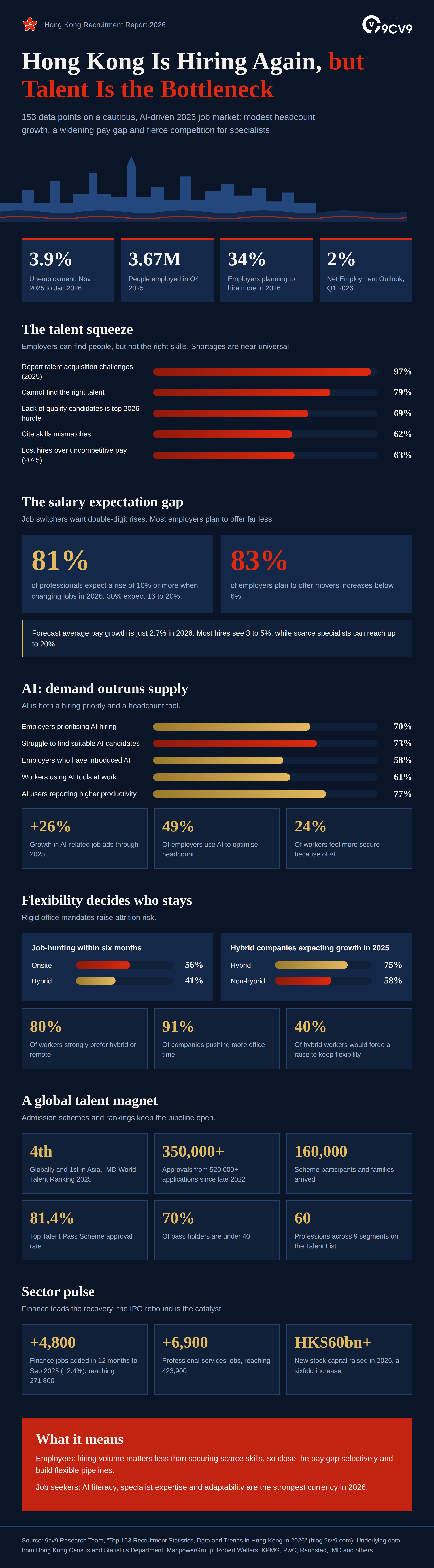
Salary expectations present another challenge. While 81% of professionals expect salary increases of at least 10% when changing jobs in 2026, 83% of employers plan to offer increases below 6%. This mismatch could make attracting and closing high-quality candidates increasingly difficult, particularly in technology, finance, compliance and other specialist functions.
Employee expectations are evolving too. Hybrid and remote work remain highly valued, with 80% of Hong Kong workers strongly preferring flexible arrangements. Meanwhile, job security, compensation, career progression and workplace flexibility continue to influence where professionals choose to work and whether they stay with their current employers.
Despite these pressures, Hong Kong retains considerable strengths as an international talent hub. The city climbed to fourth globally and first in Asia in the IMD World Talent Ranking 2025, while large-scale talent admission programmes continue to bring overseas and Mainland Chinese professionals into the workforce.
These 153 recruitment statistics, data points and trends provide a detailed picture of the Hong Kong recruitment market in 2026, covering hiring intentions, unemployment, salaries, skills shortages, AI adoption, job seeker behaviour, flexible work, talent mobility and sector-specific recruitment trends. Together, they reveal where Hong Kong’s labour market is heading and what employers, recruiters, HR leaders and job seekers should prepare for next.
Before we venture further into this article, we would like to share who we are and what we do.
About 9cv9
9cv9 is a business tech startup based in Singapore and in Asia, with a strong presence all over the world.
With over ten years of startup and business experience, and being highly involved in connecting with thousands of companies and startups, the 9cv9 team has access to some of the best talents in the world.
If your company needs recruitment and headhunting services to hire top-quality employees, you can use 9cv9 headhunting and recruitment services to hire top talents and candidates. Email us at hello@9cv9.com.
Top 153 Recruitment Statistics, Data & Trends in Hong Kong in 2026
🏙️ SECTION 1: Unemployment & Labour Force (2025–2026)
1. Hong Kong’s seasonally adjusted unemployment rate edged up to 3.9% in November 2025–January 2026, signalling a modest labour market softening despite the city’s broader economic resilience.
2. With total unemployment reaching approximately 138,400 persons in November 2025–January 2026, Hong Kong’s absolute jobless count remains relatively contained for a workforce of nearly 3.8 million.
3. An underemployment rate of 1.7% in November 2025–January 2026 suggests that while most workers are employed, a meaningful share are not working to their full capacity — a subtle pressure point for productivity.
4. Total employment of approximately 3.67 million in Q4 2025 reflects a broadly stable jobs base, even as hiring sentiment softened heading into 2026.
5. Youth unemployment among 20–29 year-olds easing to 7.1% in December 2025 is an encouraging sign, though the rate remains notably higher than the city’s overall unemployment figure, highlighting persistent structural challenges for new graduates.
6. The spike in youth unemployment to 8% in July–September 2025 — its highest since 2021 — underscores the vulnerability of young professionals during periods of economic uncertainty and employer cost-consciousness.
7. A rise in underemployed persons to 65,100 in November 2025–January 2026 points to ongoing mismatches between available roles and the skills or hours workers are seeking, a trend worth monitoring into 2026.
8. The fact that Hong Kong’s seasonally adjusted unemployment reached a three-year high of 3.9% in mid-2025 before stabilising signals that the labour market absorbed a period of stress without tipping into significant job losses.
9. ManpowerGroup’s forecast of a 3.7%–3.9% unemployment range throughout 2026 suggests a stable, if unspectacular, jobs environment — providing moderate confidence for both employers and job seekers planning ahead.
10. A total labour force of approximately 3,814,300 as of September–November 2025 confirms Hong Kong maintains a sizeable, active working population, forming a solid foundation for economic activity despite demographic pressures.
11. GDP growth of 3.5% in 2025 — the third consecutive year of expansion — provides critical macroeconomic tailwinds that are helping to sustain employment levels and support cautious hiring confidence heading into 2026.
12. The increase in job vacancies to 51,452 in Q3 2025, up from 49,531 in Q2 2025, suggests that despite employer caution, demand for workers across key sectors remains active and continues to trend upward.
📈 SECTION 2: Hiring Outlook & Employer Intentions for 2026
13. The fact that 34% of Hong Kong employers plan to increase hiring in 2026 — according to the Robert Walters Global Salary Survey — reflects a measured but genuine recovery in business confidence, particularly driven by the resurgent IPO market.
14. A 16 percentage-point drop in professional pessimism about the 2026 job market — with only 30% now expressing low confidence — marks a significant and broadly positive psychological shift in Hong Kong’s talent landscape.
15. Hong Kong’s Net Employment Outlook of 2% for Q1 2026, while positive, represents a notable 5-percentage-point decline from Q4 2025, cautioning that hiring optimism has moderated rather than accelerated into the new year.
16. With 31% of employers planning to grow headcount and 37% forecasting no change in Q1 2026, the dominant hiring story is one of cautious stability rather than aggressive expansion — a pragmatic posture in an uncertain global environment.
17. ManpowerGroup’s forecast of 2.7% average salary increases in Hong Kong for 2026 suggests pay growth will remain modest, likely falling short of what many professionals will consider meaningful in a city with one of the world’s highest costs of living.
18. A Net Employment Outlook of 8% in Q3 2025, while declining slightly from Q2, still represented net positive hiring momentum across most sectors, providing a solid bridge into the 2026 hiring cycle.
19. The healthcare & life sciences sector’s leading NEO of 31% in Q3 2025 reflects the structural, long-term demand for talent driven by Hong Kong’s rapidly ageing population — making it one of the most reliably active hiring sectors for 2026.
20. Hong Kong’s new stock capital raising surpassing HK$60 billion in 2025 — a sixfold annual increase — has materially reinvigorated hiring within investment banking, capital markets, and related professional services.
21. The sevenfold year-on-year increase in H1 2025 IPO fundraising was arguably the single most consequential event for financial sector hiring in Hong Kong in years, restoring confidence and triggering a wave of front-office recruitment.
22. With 54% of Hong Kong employers focused on replacement-only hiring in 2025, the dominant operational mode remains cautious maintenance rather than bold expansion — reflecting ongoing budget discipline across many industries.
23. Only 15% of Hong Kong employers planning to grow permanent staff in 2025 underscores just how selective and measured hiring has become, with most organisations preferring to protect agility over building long-term headcount commitments.
24. An 18% intention to expand contract workforces in 2025 points to a growing structural preference for flexible talent models, as companies seek project-based skills without the long-term financial obligations of permanent hires.
25. The rise in C-level optimism to 44% in 2025 — up from 41% in 2024, per KPMG — is a modest but meaningful signal that Hong Kong’s top decision-makers are incrementally regaining confidence in the city’s economic trajectory.
26. Only 24% of respondents expecting headcount increases in 2025 highlights the gap between macro-level economic growth and micro-level employer willingness to commit to hiring — a caution driven by geopolitical uncertainty and cost pressures.
27. With 38% of hiring managers planning to recruit in the next six months (2025), per Morgan McKinley, hiring activity is present but concentrated among specific sectors and roles rather than representing a broad market upturn.
⚠️ SECTION 3: Talent Challenges & Skills Shortages
28. The fact that 97% of C-level and HR respondents in Hong Kong reported talent acquisition challenges in 2025 is a near-universal indictment of the city’s structural skills gap — making talent strategy arguably the most critical business priority of the year.
29. A 62% citation of skills mismatches as the primary hiring challenge reveals that Hong Kong’s talent pool, while large, is increasingly misaligned with the specialised, technology-driven capabilities that modern employers demand.
30. Salary expectation mismatches affecting 46% of employers reflect a deep disconnect between what compensation budgets allow and what talent increasingly commands — a tension that is unlikely to resolve quickly.
31. Competition for niche expertise troubling 26% of employers is particularly acute in emerging technology, compliance, and ESG roles, where global demand for specialised talent significantly outpaces local supply.
32. With 69% of employers citing a lack of quality candidates as their top 2026 hiring challenge, Hong Kong faces a persistent talent quality gap that risk-averse hiring managers find increasingly difficult to bridge with current domestic supply.
33. The finding that talent challenges are deemed unmanageable by 75% of professional services firms highlights how severely specialist-dependent industries are feeling the supply-demand imbalance in Hong Kong’s knowledge economy.
34. The finding that 88% of organisations experienced highly competitive hiring conditions in 2024 — continuing into 2025 — confirms that Hong Kong’s recruitment landscape rewards only the most compelling employer value propositions.
35. The 63% of employers who lost potential hires due to uncompetitive compensation packages in 2025 illustrates a costly consequence of salary conservatism — one that risks entrenching talent gaps in critical business functions.
36. ManpowerGroup’s finding that 79% of Hong Kong organisations cannot find the right talent is among the most striking in the region, positioning the city as one of Asia’s most talent-constrained major economies.
37. The dual challenge identified by TEKsystems — 74% of business leaders needing more talent while 60% cite IT shortages as the biggest barrier to technology adoption — reveals that digital transformation ambitions are being actively throttled by recruitment gaps.
38. One in four companies struggling to hire AI-related roles in Q1 2026 underscores that the acute demand for AI professionals has not been met by a corresponding surge in certified, work-ready talent from local or international pipelines.
39. The paradox of 70% of employers prioritising AI hiring while 73% find such candidates elusive reveals a critical structural imbalance that will require coordinated investment in AI education, upskilling, and talent importation to resolve.
40. The 30% of companies planning to increase technical hiring budgets in 2025 signals a pragmatic, if costly, acknowledgment that outbidding competitors is increasingly the primary tool available to secure scarce specialist talent.
41. A 62% anticipation of tighter corporate budgets as a major HR challenge creates a troubling paradox for 2025: employers face mounting talent costs at precisely the time their financial room to manoeuvre is shrinking.
42. The fact that 52% of companies may reduce non-essential recruitment in 2025 points to a tiered hiring environment — where organisations protect critical roles but exercise discipline in discretionary headcount growth.
🔍 SECTION 4: Job Seeker Behaviour & Application Trends
43. A 58% surge in applications per job advertisement on Jobsdb HK in 2025 is a stark indicator of an increasingly oversupplied candidate market — where greater competition per role is simultaneously a gift for employers and a frustrating reality for job seekers.
44. The 78% year-on-year jump in applications for frontline positions in 2025 reflects a particularly crowded entry-level and blue-collar talent market, driven in part by AI displacement anxiety pushing workers to seek immediate, physically grounded employment.
45. The 33% rise in applicants submitting over 100 applications per month in 2025 signals growing desperation among job seekers — and raises questions about the quality and targeting of mass-apply strategies in an era of AI-assisted recruitment screening.
46. With 47% of Hong Kong professionals planning to actively seek new roles within six months in 2025, the market is experiencing elevated latent turnover risk — a critical signal for employers building retention strategies.
47. The stark gap between 39% seeking new roles in 2024 and only 14% actually securing employment crystallises the competitive intensity of Hong Kong’s job market — where intention and outcome are very far apart.
48. The sharp drop to 29% of respondents considering career changes in H1 2025 — down from 39% — suggests that economic uncertainty is inducing inertia, with many professionals choosing the security of their current role over the risk of a move.
49. The 25% of Hong Kong professionals not planning to change jobs in 2025 likely reflects a mix of genuine job satisfaction and risk aversion in an uncertain hiring environment — two very different motivators producing the same observable outcome.
50. A 46% lack of confidence in sector-specific job opportunities in 2025 is a concerning sentiment indicator that could suppress labour mobility and slow the market’s ability to efficiently match skills to demand.
51. Only 16% of Hong Kong workers planning to seek a new job in the coming year, per PwC, points to a cautious, stability-seeking workforce — a dynamic that could tighten talent availability for employers who do need to hire.
52. The openness of 53% of Mainland China professionals to contract roles in Hong Kong reveals an important, underutilised talent pipeline that employers seeking flexible, project-based capabilities should actively consider.
💰 SECTION 5: Salary Trends & Compensation Data
53. The expectation of 81% of professionals for 10%+ salary increases when switching jobs in 2026 — with 30% expecting 16–20% — sets a remarkably high bar that most employers appear unwilling or unable to meet, signalling a structurally challenging recruitment environment.
54. The collision between professionals expecting 10%+ pay rises and 83% of employers planning under 6% increments for movers in 2026 represents one of the most significant demand-supply mismatches in Hong Kong’s talent market — and a key reason quality candidates remain hard to close.
55. Annual salary increments of 3–5% for most 2026 hires reflect the prevailing employer mood of cautious compensation discipline, with meaningful premiums reserved for candidates in genuinely scarce or high-impact specialist roles.
56. General movers commanding 10–15% salary increases with niche specialists achieving up to 20% demonstrates that differentiation in compensation strategy is increasingly driven by scarcity rather than seniority — a fundamental shift in how pay is determined.
57. The fact that 55% of Hong Kong employers forecast pay rises for employees in 2025 shows that compensation increases are the majority expectation — though the magnitude of those rises is where employer and employee expectations diverge most sharply.
58. With 77% of employers likely to offer only 1–5% salary increases in 2025, compensation growth in Hong Kong is barely keeping pace with inflation and falls well short of what most professionals deem sufficient to motivate a job change.
59. The 52% of professionals expecting salary increases in 2025 suggests cautious optimism rather than aggressive expectation — perhaps indicating that many have recalibrated their expectations in line with a more modest economic outlook.
60. The finding that 58% of organisations kept salary ranges unchanged in H2 2024 reveals a significant period of compensation freeze that almost certainly contributed to the elevated job-seeking intentions observed among professionals heading into 2025.
61. With 58% of employers willing to raise offers for hard-to-fill roles, compensation flexibility exists — but it is targeted and selective, not systemic, reflecting a triage approach to managing talent budgets under financial pressure.
62. A typical bonus of one to two months’ salary for 2024 performance alongside 3–5% base increases confirms that total compensation packages remain moderate by regional standards, potentially limiting Hong Kong’s ability to compete with Singapore for the most internationally mobile talent.
63. A 9% decline in employers forecasting pay rises between 2023 and 2025 captures the cumulative dampening effect of economic uncertainty, rising business costs, and cautious board-level sentiment on compensation strategies across Hong Kong.
64. The fact that 67% of professionals feel neutral to dissatisfied with their current benefits packages in 2025 signals a widespread and underappreciated retention risk — one that goes beyond salary to encompass the broader employee value proposition.
65. Only 19% of Hong Kong workers associating AI with salary increases reveals a widespread scepticism about whether technological adoption will translate into personal financial benefit — a perception gap that employers championing AI transformation need to address proactively.
⚖️ SECTION 6: Statutory Minimum Wage Changes
66. The 5.25% increase in Hong Kong’s statutory minimum wage to HK$42.10 per hour from May 2025 reflects the government’s recognition of cost-of-living pressures on low-income workers, while still representing a modest adjustment relative to inflation experienced since the last review.
67. The increase in the monthly wage cap for recording employee hours — from HK$16,300 to HK$17,200 — ensures that the administrative threshold remains proportionate to the new wage floor, protecting both employer compliance obligations and worker documentation rights.
68. The scheduled increase to HK$43.10 per hour from May 2026, pending legislative approval, signals a commitment to regular upward wage adjustments — providing employers with predictable cost planning parameters but incrementally increasing the floor costs of low-wage employment.
69. The shift to annual (rather than biennial) minimum wage reviews in 2025 is a structurally significant policy change that makes Hong Kong’s wage floor more responsive to economic conditions — beneficial in periods of inflation but also introducing more frequent business cost uncertainty.
70. The abolition of the MPF offsetting mechanism on 1 May 2025 marks a landmark shift in Hong Kong employment law — ending a decades-old arrangement that had effectively subsidised employer severance costs at the expense of workers’ retirement savings.
🤖 SECTION 7: AI & Technology in Hiring & the Workforce
71. The finding that 58% of Hong Kong employers have introduced AI — with 49% using it to optimise headcount — reveals that AI adoption in the workplace is as much a workforce restructuring tool as a productivity enhancer, with real implications for employment levels.
72. An additional 20% of employers planning to implement AI signals that adoption is still in active acceleration — meaning the pace of headcount impact from AI will likely intensify across 2026 before plateauing.
73. The near-universal 90% C-suite intent to implement AI within three years confirms that AI transformation is no longer a strategic option for Hong Kong businesses — it is an operational imperative — making AI-related hiring and upskilling unavoidable priorities.
74. Hong Kong’s 61% AI tool usage rate at work — above the global average — positions the city as a relatively advanced adopter of workplace technology, though the below-APAC daily usage rate suggests depth of integration still lags breadth.
75. The gap between Hong Kong’s 22% daily generative AI usage and APAC’s 29% average points to an opportunity: workers are aware of and using generative AI, but not yet at a frequency that suggests full workflow integration in most organisations.
76. With 77% of AI-using Hong Kong employees reporting increased productivity and 75% citing enhanced work quality, the business case for AI adoption is being validated on the ground — making the reluctance of some employers to invest increasingly hard to justify.
77. The fact that only 24% of Hong Kong workers feel more job-secure as a result of AI reflects a pervasive anxiety that is not being adequately addressed by employer communication — a wellbeing and retention risk that requires deliberate management.
78. Regular AI usage by 30% of HK professionals — per Randstad — with notably lower adoption among Gen X, highlights a generational digital divide that will shape upskilling priorities and create uneven productivity distributions within multi-generational teams.
79. A 26% year-on-year surge in AI-related job advertisements in Hong Kong through 2025 makes the city’s demand for AI talent among the fastest-growing in Asia — a clear recruitment signal for both employers and professionals planning career pivots.
80. The 35% increase in AI-related job postings among microenterprises demonstrates that AI adoption is no longer exclusive to large corporations — small businesses are increasingly embedding AI skills into their hiring requirements, broadening the talent demand base.
81. The rise in Hong Kong job postings requiring AI skills from 1.6% to 1.9% of all listings in 2024 may appear incremental, but at scale it represents thousands of additional roles and signals a durable, structural shift in employer skill expectations.
82. The Information & Communication sector’s steady rise in AI-skill job listings from 6.4% to 7.2% between 2021 and 2024 confirms the sustained, long-run nature of digital talent demand — this is not a short-term trend but a permanent recalibration of skill requirements.
83. Over 50% growth in AI augmentation jobs in Hong Kong’s Public Administration sector since 2021 shows that the government’s own digital transformation agenda is creating meaningful, sustained demand for AI-proficient talent in the public sphere.
84. Consistent 30%+ growth in AI-augmented jobs across Defence, Energy, and Water Supply sectors since 2021 illustrates that demand for AI skills is spreading into traditionally conservative, infrastructure-focused industries — expanding the total addressable market for AI talent.
85. The finding that 88% of employees in surveyed HK companies already use AI tools daily — primarily in customer service, data analysis, and marketing — reflects a ground-level adoption reality that in many organisations has outpaced formal policy and governance frameworks.
86. With 92% of HK companies planning gradual AI integration and 24% targeting full implementation within a year, 2026 will likely be a defining year for how deeply AI reshapes job functions, team structures, and hiring priorities across the city.
87. The identification of administration, accounting & finance, and IT as the roles most at risk from AI-driven headcount optimisation should serve as a clear, data-backed signal for professionals in these areas to proactively upskill or reposition their career narratives.
88. The 44% of Hong Kong workers expecting significant job impact from customer preference shifts over three years reflects an awareness that transformation risk is multi-dimensional — not just technological, but market-driven and behavioural in nature.
89. The 40% of Hong Kong workers anticipating major impact from technological advances on their roles within three years suggests that workforce anxiety about the pace of change is widespread — and that proactive employer communication and reskilling programmes are essential to maintaining engagement.
🌏 SECTION 8: Talent Admission Schemes & Global Rankings
90. The receipt of over 520,000 applications and approval of over 350,000 under Hong Kong’s talent admission programmes since late 2022 represents one of the most ambitious and consequential talent attraction initiatives in the city’s modern history.
91. The arrival of approximately 160,000 talent scheme participants and their families since late 2022 is beginning to meaningfully replenish Hong Kong’s professional workforce — though integration into relevant industries at scale will take time.
92. The approximately 140,000 approvals under the Top Talent Pass Scheme by June 2025 reflect the scheme’s success as a high-volume pathway for attracting globally educated and high-earning professionals to Hong Kong.
93. An 81.4% TTPS approval rate over the past year confirms that the scheme maintains rigorous but achievable eligibility criteria — striking a balance between attracting volume and maintaining quality standards.
94. TechTAS’s 94.9% approval rate — the highest of any scheme — reflects both its strong targeting of genuinely needed technology talent and its very selective application pipeline, making it a highly efficient but narrow talent channel.
95. The QMAS’s low 20.4% approval rate, despite 44,000 applications, reflects the scheme’s highly selective, merit-based design — ensuring only exceptional talent secures residency, but inevitably limiting throughput relative to demand.
96. A 90% approval rate for ASMTP applications over two years signals a practical, demand-responsive policy posture — though critics note that high approval volumes without parallel integration support may dilute the scheme’s quality outcomes.
97. The near-total approval of ASMTP applications (47,000 vs only ~600 rejections) reflects the scheme’s design as a facilitation mechanism for genuine employment-linked talent, rather than a restrictive gatekeeping tool.
98. The near-full approval of GEP applications (63,000 out of 67,000) demonstrates that demand-driven talent attraction — anchored in employer sponsorship and verified employment — yields very high approval rates and aligns immigration with genuine labour market needs.
99. The near-even split between short- and long-term ASMTP approvals (46% vs 54%) reflects the diverse nature of employer demand — spanning both project-based and permanent role requirements, particularly in sectors like construction and technology.
100. Tourism’s leading share of GEP approvals highlights Hong Kong’s concerted effort to revitalise its hospitality and tourism industries through targeted overseas talent recruitment — a sector-specific policy response to structural workforce gaps.
101. The concentration of approved ASMTP talent in the HK$20,000–HK$39,999 monthly salary band points to a pragmatic, mid-market talent importation strategy — addressing volume gaps in professional and para-professional roles rather than focusing exclusively on elite earners.
102. A 55%+ visa renewal rate among TTPS holders is a positive retention signal — indicating that many admitted talents are finding sufficient professional and personal fulfilment in Hong Kong to commit to longer-term residency rather than treating the scheme as a short-term stepping stone.
103. The fact that approximately 70% of TTPS holders are under 40 signals the programme’s success in attracting young, working-age professionals — addressing Hong Kong’s demographic ageing challenge while injecting energy and innovation into the workforce.
104. With over 95% of TTPS holders earning above the local median wage and 10% earning HK$120,000+, the scheme is disproportionately attracting high-income, high-skill talent — maximising economic contribution per approved individual but also potentially widening income inequality.
105. Hong Kong’s jump to 4th globally in the IMD World Talent Ranking 2025 — and 1st in Asia — is arguably the most powerful endorsement of the city’s talent competitiveness and a direct validation of its immigration, education, and labour market reforms.
106. Improvement across all three IMD talent dimensions — Readiness, Investment & Development, and Appeal — signals a holistic strengthening of Hong Kong’s talent ecosystem rather than a single-metric improvement, making the ranking gain more durable and credible.
107. Ranking 1st globally for science graduates and 3rd for finance skills availability confirms that Hong Kong’s educational and talent pipelines remain world-class in the disciplines most critical to its economy — a structural competitive advantage.
108. A 12-place improvement in the IMD World Talent Ranking over just two years is an extraordinary rate of ascent, reflecting the cumulative impact of sustained, well-coordinated government policy on talent attraction, development, and retention.
109. Triple top-5 global rankings — 4th in Talent, 4th in Digital Competitiveness, and 3rd in Overall Competitiveness — collectively position Hong Kong as one of the world’s most comprehensively capable business and talent environments heading into 2026.
110. The expansion of Hong Kong’s Talent List to 60 professions across 9 industry segments provides a clear, publicly accessible signal to both employers and overseas talent about which skills the government strategically prioritises — aligning immigration policy with economic development objectives.
111. The HK$6 billion allocation for Life and Health Technology Research Institutes reflects a long-term, institution-building approach to talent development — one that targets the creation of indigenous research capacity rather than relying solely on talent importation.
112. The HK$3 billion Frontier Technology Research Support Scheme approved in May 2025 underlines the government’s commitment to making Hong Kong a globally competitive destination for top research talent — an investment with compounding returns for the technology ecosystem.
🌐 SECTION 9: Cross-Border Talent Sourcing & GBA Expansion
113. The fact that 51% of Hong Kong C-level and HR respondents hired talent from Mainland China in 2025 reflects the deeply integrated nature of the HK-Mainland talent pipeline — and the practical reality that geographic proximity and cultural alignment make Mainland professionals a natural first port of call.
114. The 28% overseas talent hiring rate confirms that while domestic and Mainland sourcing dominate, Hong Kong retains its international character by continuing to draw specialist talent from global markets — essential for maintaining its status as a cosmopolitan financial hub.
115. With 65% of respondents already operating or planning to expand into other Greater Bay Area cities within three years, the GBA is emerging as the defining strategic context for Hong Kong’s workforce planning — reshaping where talent is sourced, deployed, and developed.
🏦 SECTION 10: Sector-Specific Hiring Trends
116. The addition of approximately 4,800 financial sector jobs in the 12 months to end-September 2025 — a 2.4% rise — confirms that Hong Kong’s finance industry is genuinely hiring again, driven by the IPO recovery rather than mere backfilling of pandemic-era losses.
117. Total finance and insurance employment of 271,800 by end-September 2025 represents a meaningful recovery from the 2024 trough — though the gap to the 2021 peak of 287,800 signals that full restoration of sector headcount is still a multi-year journey.
118. The positioning of finance & insurance employment (271,800) between its 2021 peak and 2024 low offers a nuanced picture of a sector in gradual recovery — not a V-shaped rebound, but a sustained, directionally positive trajectory.
119. Professional services adding 6,900 jobs to reach 423,900 employees by end-September 2025 highlights the sustained demand for legal, accounting, and consulting expertise — sectors that benefit from both economic complexity and regulatory expansion.
120. The new stablecoin licensing regime effective August 2025 is catalysing a highly specialised wave of hiring in compliance, risk management, and blockchain engineering — roles where global supply is thin and compensation premiums are significant.
121. The increasing prioritisation of Mandarin proficiency alongside English and Cantonese in Hong Kong banking and fintech hiring reflects the sector’s strategic pivot toward Mainland China business flows — a linguistic dimension to talent strategy with real recruitment implications.
122. Construction hiring driven by the Northern Metropolis mega-development reflects how transformational infrastructure investment creates sustained, multi-year demand for both skilled trades and senior project management talent — a relatively insulated hiring pocket within an otherwise cautious market.
123. Insurance sector hiring targeting fresh graduates and junior sales talent for front-office distribution roles signals a generational talent pipeline strategy — investing in high-potential early-career professionals rather than competing solely for experienced hires in a tight senior talent market.
124. The fact that Randstad’s 2026 HK salary guide covers benchmarks for more than 800 roles across 11 sectors underscores the breadth and granularity of Hong Kong’s hiring landscape — and the need for highly segmented compensation strategies by function and industry.
125. Consumer markets, financial services, and I&T industries accounting for the highest concentration of successful job movers in 2024 reflects where genuine hiring activity translated into completed placements — signalling the most active talent flow channels heading into 2026.
🏠 SECTION 11: Flexible Work, Hybrid Models & Work Preferences
126. The 80% of Hong Kong workers who strongly prefer hybrid or remote work are expressing a collective preference that has fundamentally altered their relationship with their employers — making workplace flexibility a non-negotiable element of the modern employee value proposition.
127. Hong Kong’s distinction as the APAC city where 91% of companies are pushing for increased in-office presence reveals a sharper employer-employee conflict over workplace arrangements than almost anywhere else in the region — a tension with direct implications for attrition risk.
128. The willingness of 40% of hybrid workers to forgo pay raises to preserve flexible working arrangements reveals that flexibility now holds genuine, quantifiable monetary value for Hong Kong professionals — a powerful insight for employers designing total reward frameworks.
129. The finding that 56% of fully onsite workers are actively job-hunting within six months — compared to 41% of hybrid workers — provides compelling, data-backed evidence that rigid return-to-office mandates are directly driving elevated attrition risk.
130. Only 20% of Hong Kong professionals supporting full-time office work signals that any employer enforcing a five-day office week faces a structural disadvantage in the talent market — particularly for roles where hybrid working is operationally feasible.
131. Hybrid-working companies in Hong Kong reporting 75% positive 2025 growth outlooks compared to 58% for non-hybrid firms provides a business performance dimension to the flexibility debate — suggesting that adaptive work models and commercial optimism are positively correlated.
132. The 79% of flexible businesses in Hong Kong reporting cost savings through hybrid arrangements undermines the often-stated employer argument that full-time office presence is necessary for productivity or profitability — adding economic weight to the case for flexible policies.
133. The 27% of global hiring managers citing flexible arrangements as crucial for talent attraction and retention reinforces that flexibility is not a regional preference unique to Hong Kong but a global competitive requirement that the city’s employers cannot afford to ignore.
134. Hong Kong and Tokyo’s office attendance rates of 85–90% — vastly higher than North American cities — reflect deep cultural, structural, and spatial differences in how work is organised across global markets, providing important context for HK-specific workforce strategy.
❤️ SECTION 12: Employee Values, Job Security & Wellbeing
135. The 1.7 percentage-point year-on-year rise to 40% of professionals ranking job security among their top three employer values in 2026 reflects a workforce recalibrating priorities in response to AI disruption, economic uncertainty, and a competitive job market — and sending a clear signal to employers about what their retention strategies must address.
136. The consistency of compensation, career progression, and flexibility as Hong Kong’s top three job-seeking drivers across three consecutive years suggests that these are not transient preferences but stable, foundational expectations that should anchor every employer value proposition.
137. Stability’s rise to the top non-monetary consideration in 2025 — up from 31% the prior year — signals a measurable shift away from risk-taking career moves and toward value-preserving choices among Hong Kong professionals, driven by labour market uncertainty.
138. The 49% of Hong Kong employees feeling their employers fail to meet their learning and development needs represents a significant, addressable retention vulnerability — and a missed opportunity for organisations to build loyalty and internal capability simultaneously.
📋 SECTION 13: Flexible Hiring Models & Recruitment Cost Strategies
139. The adoption of Statement of Work (SOW) arrangements by 23% of Hong Kong employers — with a further 8.6% planning to implement it — reflects the growing maturity of project-based talent engagement models, particularly in technology and compliance-intensive sectors where output, not presence, is the deliverable.
140. The 30% of companies planning to build internal talent acquisition capabilities is a strategic response to spiralling recruitment costs — though it requires sustained investment in employer branding, TA technology, and recruiter expertise to succeed against agencies at scale.
141. The outpacing of permanent recruitment by contract hiring in technology signals a structural evolution in how Hong Kong companies build technical teams — prioritising agility and specialist access over long-term headcount commitments during a period of rapid technological change.
142. The widespread use of contract hiring in 2026 as a cost-management and capability-access strategy confirms that Hong Kong’s talent market is increasingly bifurcating between stable permanent core roles and a growing flexible periphery of specialist contractors.
📊 SECTION 14: Survey Scope & Macro Economic Context
143. KPMG’s survey of 425 Hong Kong executives — with 53% from HK-headquartered organisations and 50% in leadership roles — provides a statistically credible, leadership-weighted perspective on the city’s employment landscape, making its findings particularly relevant for strategic HR decision-making.
144. Robert Walters’ methodology of surveying up to 400 HK professionals and organisations in September 2025 ensures its Global Salary Survey 2026 findings reflect real-time, on-the-ground market sentiment rather than lagging historical data — enhancing its utility for immediate compensation benchmarking.
145. ManpowerGroup’s Q1 2026 survey encompassing 39,000+ employers across 41 countries provides unmatched global comparative context for interpreting Hong Kong’s hiring outlook — enabling direct benchmarking against peer economies and informed global talent strategy.
146. PwC’s inclusion of 1,061 Hong Kong respondents within a global study of nearly 50,000 workers ensures its Workforce Hopes and Fears findings are both locally representative and globally contextualised — a rare combination that strengthens the relevance and credibility of its insights.
147. HKPC’s AI Readiness Survey of 800 local companies in September 2025 represents the most comprehensive assessment of enterprise AI adoption in Hong Kong to date — providing a reliable, large-sample foundation for understanding how AI is reshaping workforce needs across the city’s business community.
148. A forecast of approximately 3.2% average annual GDP growth from 2025 to 2028 provides a broadly positive macroeconomic backdrop for Hong Kong’s hiring market — not spectacular enough to drive aggressive expansion, but stable enough to support sustained, moderate hiring activity across most sectors.
149. Retail sales growth of 5.5% year-on-year in January 2026 offers an early, sector-specific indicator that consumer-facing employment in Hong Kong is holding up — supporting recruitment in retail, hospitality, and the broader consumer economy heading into the year.
150. Hong Kong’s 1st-place ranking in the 2025 Economic Freedom of the World report — out of 160+ jurisdictions — remains one of its most powerful structural advantages for attracting globally mobile talent and investment, reinforcing the city’s long-term position as a premier business destination despite recent geopolitical complexities.
151. Ranking 3rd in the IMD World Competitiveness Yearbook 2025 — its highest since 2019 — and 1st in tax policy and business legislation, Hong Kong sends a compelling signal to international talent and employers that its regulatory and fiscal environment remains world-class and business-conducive.
152. The 56% wage premium commanded by AI-skilled roles globally in 2025 — nearly double the prior year’s 25% — is a powerful market signal that AI proficiency is rapidly becoming the single most financially rewarded skill set in the modern workforce, with Hong Kong’s employers and talent both needing to act on this urgently.
153. The 7.5% global growth in AI-skill job postings against an 11.3% fall in total job postings reveals a defining divergence: the overall job market is contracting while the market for AI talent is expanding — a structural signal that AI literacy is transitioning from a competitive advantage to a baseline employment requirement.
Conclusion
Hong Kong’s recruitment market in 2026 is defined by a striking combination of cautious hiring, intense competition for specialist talent and rapid technological change. Employers may have access to a large workforce, but finding candidates with the right skills, experience and salary expectations remains one of the biggest recruitment challenges.
The 153 recruitment statistics and trends examined in this article show that hiring demand is becoming increasingly concentrated around high-value capabilities. AI, technology, financial services, compliance, healthcare and other specialist areas continue to generate opportunities, while contract and project-based hiring are becoming more important as companies seek greater workforce flexibility.
Artificial intelligence will be particularly influential. As more Hong Kong businesses integrate AI into their operations, demand for AI-skilled professionals is rising even as organisations use automation to optimise existing headcount. This creates a labour market where continuous learning, digital literacy and specialist expertise are increasingly important for long-term employability.
Compensation will remain another major recruitment challenge. The substantial gap between the salary increases professionals expect when changing jobs and the more conservative increases employers intend to offer could prolong hiring processes and make scarce candidates harder to secure. Competitive benefits, career development, job security and flexible working arrangements will therefore play a larger role in the overall employee value proposition.
Hong Kong nevertheless enters 2026 with significant competitive advantages. Its improving global talent rankings, expanding talent admission programmes, strong financial and professional services sectors, Greater Bay Area connections and continued investment in technology provide a solid foundation for future workforce growth.
For employers and recruiters, success in the Hong Kong recruitment market in 2026 will depend less on simply increasing hiring volumes and more on identifying critical skills, improving candidate experiences, offering competitive total rewards and building flexible talent pipelines. For job seekers, developing AI capabilities, specialist expertise and adaptable skills could provide an increasingly important advantage.
Ultimately, these Hong Kong recruitment statistics for 2026 point to a labour market undergoing structural transformation rather than simple expansion or contraction. Organisations that understand these recruitment trends and adapt their workforce strategies accordingly will be better positioned to attract, retain and develop the talent needed to compete in Hong Kong’s evolving economy.
If you find this article useful, why not share it with your hiring manager and C-level suite friends and also leave a nice comment below?
We, at the 9cv9 Research Team, strive to bring the latest and most meaningful data, guides, and statistics to your doorstep.
To get access to top-quality guides, click over to 9cv9 Blog.
To hire top talents using our modern AI-powered recruitment agency, find out more at 9cv9 Modern AI-Powered Recruitment Agency.
People Also Ask
What is the recruitment outlook for Hong Kong in 2026?
Hong Kong’s recruitment outlook is cautiously positive in 2026. Around 34% of employers plan to increase hiring, although companies remain selective about adding permanent headcount.
What is Hong Kong’s unemployment rate in 2026?
Hong Kong’s seasonally adjusted unemployment rate reached 3.9% in November 2025–January 2026, with approximately 138,400 people unemployed.
How many people are employed in Hong Kong?
Hong Kong had approximately 3.67 million employed people in Q4 2025, indicating a broadly stable employment base entering 2026.
How large is Hong Kong’s labour force?
Hong Kong’s labour force stood at approximately 3.81 million people in September–November 2025, providing employers with a substantial but increasingly skills-sensitive talent pool.
Are Hong Kong companies hiring more workers in 2026?
Yes, but hiring remains cautious. About 34% of employers plan to increase hiring in 2026, while many organisations are prioritising replacement, specialist and business-critical positions.
What are the biggest recruitment challenges in Hong Kong in 2026?
Finding quality candidates is a major challenge. Around 69% of employers cite a lack of quality candidates as their leading hiring challenge, while skills and salary expectation mismatches also affect recruitment.
Does Hong Kong have a talent shortage in 2026?
Yes. Around 79% of Hong Kong organisations report difficulty finding the right talent, while specialist shortages are particularly evident in technology, AI, compliance and other high-skill functions.
What percentage of Hong Kong employers face talent acquisition challenges?
Around 97% of surveyed C-level and HR respondents reported talent acquisition challenges in 2025, demonstrating the widespread difficulty of securing suitable candidates.
What skills are in demand in Hong Kong in 2026?
Demand is particularly strong for AI, technology, compliance and other specialist capabilities. Employers increasingly need candidates who can support digital transformation and emerging business requirements.
How is AI affecting recruitment in Hong Kong?
AI is reshaping both hiring and workforce planning. Around 58% of Hong Kong employers have introduced AI, while 49% are using it to optimise headcount.
Are AI jobs growing in Hong Kong?
Yes. AI-related job advertisements in Hong Kong increased by 26% through 2025, demonstrating rapidly expanding employer demand for professionals with AI-related capabilities.
Is there an AI skills shortage in Hong Kong?
Yes. Around 70% of employers prioritise AI hiring, yet 73% report difficulty finding suitable AI candidates, creating a significant supply-and-demand imbalance.
How widely do Hong Kong workers use AI at work?
Around 61% of Hong Kong workers use AI tools at work, while 22% use generative AI daily. Among AI users, 77% report improved productivity.
What salary increases can Hong Kong workers expect in 2026?
Average salary increases are forecast at around 2.7% in 2026, while many hires can expect increases of approximately 3–5%. Scarce specialists may command substantially larger premiums.
How much salary increase do Hong Kong job switchers expect in 2026?
Around 81% of professionals expect salary increases of at least 10% when changing jobs in 2026, with 30% expecting increases of 16–20%.
Are employers meeting salary expectations in Hong Kong?
Often not. Around 83% of employers plan salary increases below 6% for job movers in 2026, creating a substantial gap between candidate expectations and employer budgets.
How much can specialist candidates earn when changing jobs in Hong Kong?
General job movers may command salary increases of around 10–15%, while candidates possessing scarce specialist skills can potentially secure increases of up to 20%.
Are Hong Kong employees looking for new jobs in 2026?
Job mobility remains mixed. Recent surveys show substantial interest in new opportunities, but economic uncertainty and concerns about job security are encouraging many professionals to remain cautious.
How competitive is the Hong Kong job market?
Competition is significant. Applications per job advertisement on Jobsdb HK surged 58% in 2025, while applications for frontline positions increased 78% year over year.
Why are Hong Kong job seekers submitting more applications?
Competition for available positions has intensified. The number of applicants submitting more than 100 applications per month increased 33% in 2025, highlighting a more challenging job-search environment.
Which sectors are hiring in Hong Kong in 2026?
Hiring opportunities span finance, professional services, healthcare, life sciences, technology, construction and insurance, although demand varies considerably by role and skill level.
Is Hong Kong’s financial sector hiring again?
Yes. Hong Kong added approximately 4,800 financial-sector jobs during the 12 months to September 2025, representing a 2.4% increase and signalling renewed hiring momentum.
How many people work in Hong Kong’s finance and insurance sector?
Finance and insurance employment reached approximately 271,800 by the end of September 2025, recovering from the 2024 trough but remaining below its 2021 peak.
Is contract hiring growing in Hong Kong?
Yes. Contract hiring is increasingly used for flexibility, cost management and specialist skills. In technology, contract recruitment is outpacing permanent hiring.
Do Hong Kong employees prefer hybrid work?
Yes. Around 80% of Hong Kong workers strongly prefer hybrid or remote working arrangements, making flexibility an important factor in talent attraction and retention.
Does return-to-office policy affect employee retention in Hong Kong?
The data suggests it can. Around 56% of fully onsite workers were actively job-hunting within six months, compared with 41% of hybrid workers.
What do Hong Kong employees value most in 2026?
Compensation, career progression, flexibility and job security remain important. Job security rose to a top-three employer value for 40% of professionals in 2026.
Is Hong Kong attracting overseas talent?
Yes. Hong Kong’s talent admission programmes received more than 520,000 applications and approved over 350,000 since late 2022, strengthening international and Mainland talent pipelines.
How competitive is Hong Kong for global talent?
Hong Kong ranked fourth globally and first in Asia in the IMD World Talent Ranking 2025, reflecting improvements in talent readiness, investment and development, and international appeal.
What are the key Hong Kong recruitment trends to watch in 2026?
Key trends include cautious hiring, AI skills demand, specialist talent shortages, salary expectation gaps, contract recruitment, hybrid work, cross-border sourcing and continued expansion of talent admission programmes.
Sources
Hong Kong Census and Statistics DepartmentHong Kong GovernmentHong Kong Labour DepartmentManpowerGroupRobert WaltersKPMGMorgan McKinleyTEKsystemsJobsdb Hong KongPwCRandstadHong Kong Productivity CouncilImmigration Department of Hong KongIMDFraser InstituteHaysMichael PageRegusInternational Workplace GroupIndeedLinkedInSouth China Morning PostHong Kong Monetary AuthorityFinancial Services and the Treasury BureauInnovation, Technology and Industry BureauHong Kong Exchanges and ClearingHong Kong Institute for Monetary and Financial ResearchHong Kong General Chamber of Commerce