


























Key Takeaways
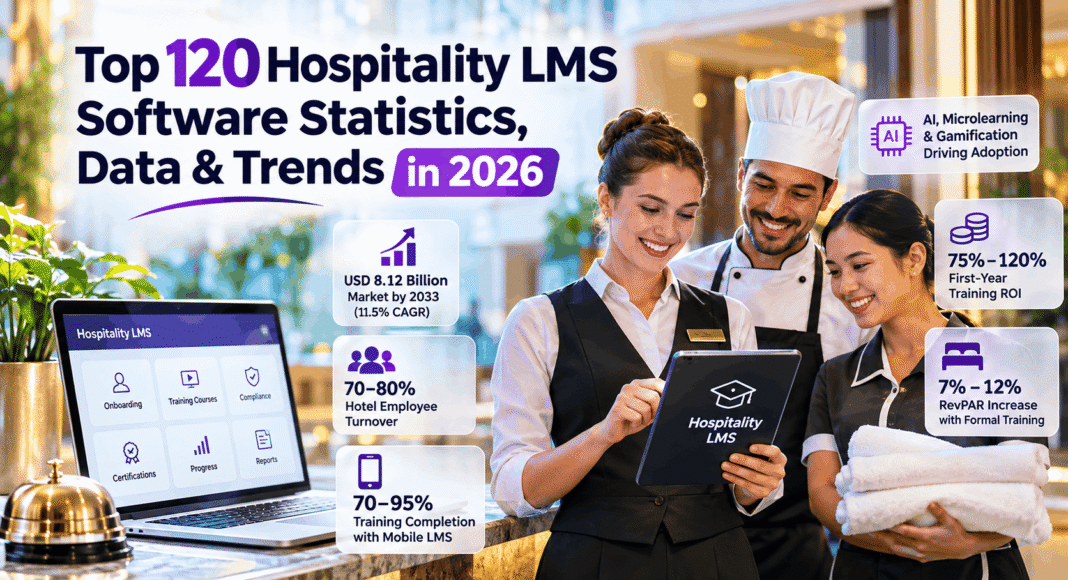
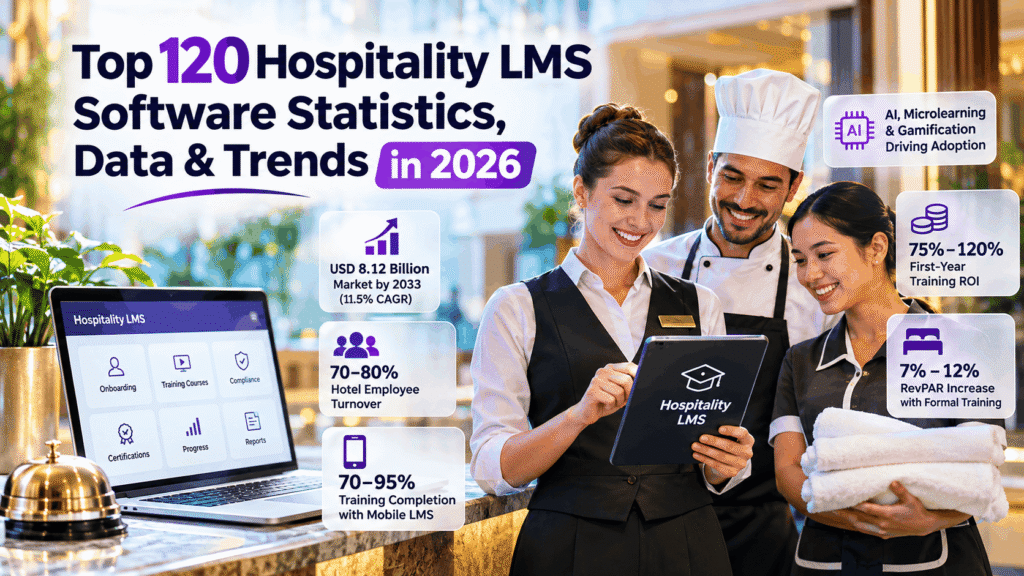
- Rapid Market Growth: The global hospitality LMS software market is projected to reach USD 8.12 billion by 2033, growing at an 11.5% CAGR, driven by digital transformation and workforce training demand.
- Improved Employee Retention and Training ROI: Hospitality LMS software can help address employee turnover rates of 70–80%, with estimated first-year training ROI ranging from 75% to 120% across hospitality and retail.
- AI and Mobile Learning Transformation: AI-powered training, gamification, and microlearning are reshaping hospitality workforce development, with mobile-first LMS platforms reporting course completion rates of 70–95%.
Hospitality LMS software streamlines employee training, onboarding, compliance, and workforce development in hotels, resorts, and restaurants. With a projected market value of USD 8.12 billion by 2033 and an 11.5% CAGR, key trends in 2026 include AI-powered learning, mobile training, microlearning, gamification, employee retention, and improved training ROI.
The global hospitality industry is undergoing a significant digital transformation as hotels, resorts, restaurants, and hospitality service providers increasingly adopt advanced technologies to improve workforce productivity, employee retention, operational efficiency, and guest satisfaction. Among the most important technologies driving this transformation is Hospitality Learning Management System (LMS) software, a digital solution designed to streamline employee training, automate onboarding, manage regulatory compliance, and support continuous professional development across hospitality organisations.
In 2026, hospitality LMS software is becoming an increasingly strategic investment for businesses seeking to remain competitive in an industry characterised by high employee turnover, persistent labour shortages, rising operational expenses, and evolving customer expectations. Traditional classroom-based training methods are gradually being supplemented or replaced by cloud-based learning platforms, artificial intelligence, mobile learning applications, gamification, microlearning, and immersive virtual reality training solutions.
The rapid expansion of the hospitality LMS software market reflects this fundamental shift in workforce management. The global hospitality LMS market was valued at approximately USD 3.05 billion in 2024 and is projected to reach USD 8.12 billion by 2033, growing at a compound annual growth rate (CAGR) of 11.5%. Meanwhile, the broader global learning management system market is projected to expand from USD 31.61 billion in 2026 to USD 104.04 billion by 2034, highlighting the increasing importance of digital learning technologies across industries.
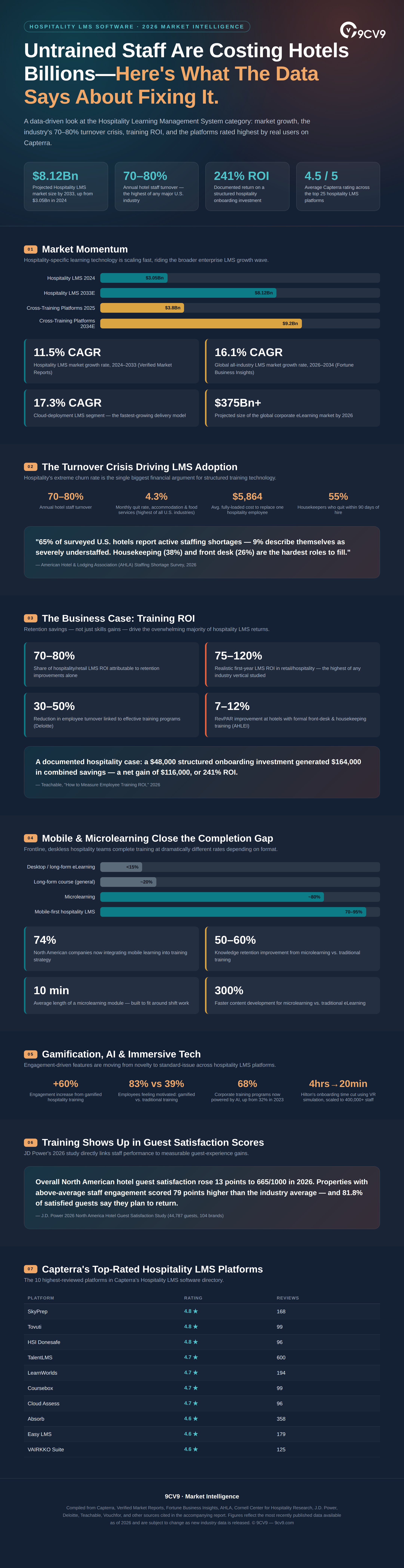
The growing demand for hospitality training software is closely connected to the industry’s ongoing workforce challenges. Annual employee turnover in hotels is estimated to range between 70% and 80%, while overall hospitality industry turnover stands at approximately 74%. Furthermore, around 65% of surveyed US hotels report active staffing shortages, creating considerable pressure on hospitality employers to accelerate employee onboarding, strengthen workforce capabilities, and improve long-term retention.
These challenges carry substantial financial implications. Replacing a single hourly hospitality employee can cost approximately USD 5,475, while other industry estimates place the fully loaded replacement cost at USD 5,864. For large hotel chains, restaurant franchises, and multinational hospitality groups, recurring employee departures can generate significant recruitment, training, administrative, and productivity-related expenses.
Hospitality LMS software offers a practical solution by enabling organisations to standardise training programmes, deliver role-specific learning materials, monitor employee progress, automate certification processes, and reduce the time required for new employees to become operationally proficient. Through centralised learning platforms, hospitality businesses can also maintain consistent service standards across multiple properties, departments, franchises, and geographical markets.
The Growing Importance of Hospitality LMS Software in 2026
One of the most significant hospitality LMS software trends in 2026 is the transition towards mobile-first and microlearning-based training delivery. Unlike employees in traditional office environments, hospitality professionals frequently work rotating shifts, operate in guest-facing roles, and have limited access to desktop computers.
Reported completion rates for traditional desktop-based hospitality eLearning programmes average below 15%, whereas mobile-first hospitality LMS platforms report completion rates ranging from 70% to 95%. Additionally, broader microlearning benchmarks indicate average completion rates of approximately 80%, compared with around 20% for long-form training courses.
These statistics demonstrate why hospitality organisations are increasingly prioritising accessible, flexible, and interactive learning experiences that accommodate the operational realities of frontline employees.
Modern hospitality learning management systems are also evolving beyond conventional employee training platforms. Advanced software solutions increasingly incorporate capabilities such as:
- Automated employee onboarding and orientation programmes
- Artificial intelligence-powered course creation and personalised learning
- Mobile-first training delivery and offline learning accessibility
- Food safety, workplace safety, and regulatory compliance management
- Gamification, interactive assessments, and employee engagement tools
- Multilingual training content for international hospitality workforces
- Automated certification and qualification tracking
- Virtual reality and augmented reality training simulations
- Workforce skills assessment and competency management
- Learning analytics, performance monitoring, and training ROI measurement
- Integration with human resources, payroll, and workforce management systems
- Multi-property and franchise training administration
The convergence of these technologies is transforming hospitality LMS software into a comprehensive workforce development ecosystem capable of supporting operational excellence, employee engagement, and sustainable business growth.
How Hospitality LMS Software Is Transforming Workforce Training and Business Performance
The financial benefits associated with effective employee training are becoming increasingly important as hospitality businesses face rising labour costs and competitive pressures. Industry benchmarks estimate that hospitality and retail organisations may achieve first-year LMS returns on investment ranging from 75% to 120%, with employee retention improvements potentially accounting for 70% to 80% of overall LMS-related returns.
Broader corporate learning research also suggests that organisations with strong onboarding programmes experience 82% better new-hire retention, while LMS adoption has been associated with shorter training completion times, improved workforce productivity, and stronger employee engagement.
Leading hospitality brands are already demonstrating the potential of advanced learning technologies. Hilton, for example, reportedly reduced a classroom-based onboarding training activity from four hours to just 20 minutes through virtual reality simulations, illustrating how immersive learning technologies can improve training efficiency at scale.
Beyond workforce productivity and cost reduction, hospitality LMS software can also support improvements in guest experiences. Well-trained employees are better positioned to deliver consistent customer service, handle guest complaints, follow operational procedures, maintain hygiene standards, and respond effectively to unexpected situations.
Industry findings cited in the research indicate that hotels with formal front-desk and housekeeping training programmes achieved revenue per available room (RevPAR) improvements of between 7% and 12% compared with untrained peers. Although business outcomes depend on numerous operational factors, these findings highlight the potential relationship between workforce development, service quality, customer satisfaction, and revenue performance.
Emerging Hospitality LMS Software Trends Shaping the Industry
Artificial intelligence is expected to remain a major driver of hospitality LMS software innovation in 2026. AI-powered learning platforms are increasingly capable of generating training materials, recommending personalised learning pathways, identifying employee skills gaps, automating assessments, and converting standard operating procedures into interactive digital courses.
Similarly, gamification is gaining prominence as hospitality organisations seek to improve employee motivation and training participation. Reported hospitality-specific gamification case studies indicate engagement improvements of up to 60% and information retention improvements of up to 50%.
Cloud-based learning management systems are also gaining momentum due to their scalability, accessibility, and ability to support geographically distributed hospitality workforces. With cloud-based LMS deployment projected to expand at a CAGR of 17.3% across the broader LMS market, hospitality businesses are increasingly positioned to benefit from flexible software infrastructure without the administrative complexity associated with traditional on-premise systems.
The competitive hospitality LMS software landscape continues to expand, with established enterprise platforms and specialised training providers offering increasingly sophisticated solutions. Platforms such as TalentLMS, Absorb LMS, Docebo, Litmos, Cornerstone LMS, SkyPrep, Tovuti, Coursebox, Schoox, and Cloud Assess illustrate the diversity of software available to hospitality organisations.
Across the 25 hospitality LMS platforms examined in the compiled software directory data, the average user rating stands at approximately 4.5 out of 5, reflecting generally positive customer feedback and a competitive software ecosystem.
Understanding the Top 120 Hospitality LMS Software Statistics, Data & Trends in 2026
This comprehensive guide to the Top 120 Hospitality LMS Software Statistics, Data & Trends in 2026 examines the most significant developments shaping the global hospitality learning management software industry.
The article explores a wide range of hospitality-specific statistics and broader corporate learning benchmarks, including:
- Global hospitality LMS software market size and growth forecasts
- Regional market opportunities and cloud-based LMS adoption
- Hospitality employee turnover, attrition, and replacement costs
- Workforce shortages and employee skills gaps
- Training return on investment and operational cost savings
- Digital onboarding, employee productivity, and retention statistics
- Mobile learning, microlearning, and course completion trends
- Gamification and employee engagement statistics
- Food safety training and regulatory compliance developments
- Artificial intelligence, virtual reality, and emerging learning technologies
- Guest satisfaction and hospitality service quality
- Corporate training expenditure and learning development budgets
- Hospitality LMS software vendor ratings and competitive market trends
For hotel owners, restaurant operators, hospitality executives, human resources professionals, learning and development managers, technology investors, and software decision-makers, understanding these statistics is essential for identifying emerging opportunities, evaluating training investments, and developing more effective workforce management strategies.
As the hospitality industry continues to navigate labour shortages, increasing customer expectations, rising operating costs, and technological disruption, learning management systems are becoming an increasingly important component of digital transformation. Hospitality organisations that successfully integrate modern training technologies into their operations may be better positioned to improve employee capabilities, strengthen regulatory compliance, reduce workforce-related expenses, and deliver consistent guest experiences.
The following 120 hospitality LMS software statistics, data points, and trends provide a comprehensive overview of the industry’s current landscape, emerging technological developments, competitive dynamics, and future growth potential in 2026 and beyond.
Before we venture further into this article, we would like to share who we are and what we do.
About 9cv9
9cv9 is a business tech startup based in Singapore and Asia, with a strong presence all over the world.
With over ten years of startup and business experience, and being highly involved in connecting with thousands of companies and startups, the 9cv9 team has listed some of the top and best companies/tools in this review.
If you like to get your company listed in our top B2B software reviews, check out our world-class 9cv9 Media and PR service and pricing plans here.
Top 120 Hospitality LMS Software Statistics, Data & Trends in 2026
1. Market Size & Growth Trajectory
- The global Hospitality LMS market was valued at USD 3.05 billion in 2024 and is projected to reach USD 8.12 billion by 2033, at an 11.5% CAGR. This double-digit growth trajectory confirms that hospitality-specific learning management systems have moved from a “nice-to-have” HR tool to a core operational investment for hotels and restaurant groups worldwide.
- The broader cross-training platforms market for hospitality was worth USD 3.8 billion in 2025 and is forecast to hit USD 9.2 billion by 2034 (10.3% CAGR). Cross-training platforms — which reduce single-skill staffing dependency — are becoming inseparable from hospitality LMS strategy as properties fight chronic understaffing.
- North America accounts for roughly 34.7% (USD 1.32 billion) of the global hospitality cross-training platform market in 2025. Mature SaaS infrastructure and heavy L&D budgets among major U.S. hotel brands keep North America the dominant regional buyer of hospitality-focused training technology.
- The overall global LMS market (all industries) is projected to grow from USD 31.61 billion in 2026 to USD 104.04 billion by 2034 (16.10% CAGR). Hospitality LMS growth is riding the coattails of this much larger digital-learning wave, benefiting from shared platform innovation and falling per-seat costs.
- Cloud-based LMS deployment is the fastest-growing delivery model, expanding at a 17.3% CAGR. For multi-property hospitality groups with distributed, high-turnover workforces, cloud delivery removes the on-premise IT burden that made older LMS platforms impractical for hotels.
- North America held approximately 42.70% share of the global LMS market in 2025. This regional concentration mirrors hospitality’s own labor-market pressures, where U.S. hotel chains have led enterprise LMS adoption to combat record-high staff churn.
- The global corporate eLearning market was projected to exceed USD 375 billion by 2026. Hospitality LMS spending represents a small but fast-growing slice of this much larger digital-learning economy.
- The global microlearning market is estimated at USD 3.4 billion in 2026. Because hospitality training must fit around shift work and guest-facing duties, microlearning has become one of the fastest-adopted LMS features in the sector.
2. Turnover, Attrition & Labor Cost Crisis
- Annual staff turnover in hotels runs between 70% and 80% — the highest of any major U.S. industry. This churn rate makes fast, repeatable, LMS-driven onboarding a financial necessity rather than a convenience for hospitality operators.
- Overall hospitality industry turnover sits at approximately 74%, roughly five times the 12–15% average across other U.S. industries. Such extreme churn means a typical hospitality employer effectively rebuilds three-quarters of its workforce every single year.
- The quit rate for U.S. accommodation and food services hit 4.3% in March 2026, the highest of any industry tracked by the BLS. A monthly quit rate nearly double the private-sector average of 2.2% underscores why retention-focused training investment has become a board-level hospitality priority.
- The direct cost to replace a single hourly hospitality worker is approximately $5,475, per SHRM’s 2025 benchmarking data. Multiplied across dozens of annual departures per property, this figure alone justifies significant LMS spend purely on retention grounds.
- Cornell University’s Center for Hospitality Research estimates the fully-loaded cost of replacing a hospitality employee at $5,864 on average. This figure includes recruitment, onboarding time, and lost productivity — costs that structured LMS-based onboarding programs are specifically designed to shrink.
- Roughly 41% of front-of-house restaurant employees, including bartenders, quit within their first year on the job. First-year attrition at this scale highlights why fast, mobile-first onboarding content matters more in hospitality than in almost any other sector.
- Back-of-house kitchen staff show an estimated 43% one-year turnover rate. Kitchen roles are particularly hard to backfill quickly, making structured, video-based skills training a practical retention lever.
- An estimated 55% of hotel room attendants (housekeepers) leave their job within the first 90 days of hire. This early-tenure exodus concentrates almost entirely within the window that a well-designed LMS onboarding path is meant to smooth over.
- Replacing a hospitality worker is commonly estimated to cost 30–50% of that worker’s annual salary. For an hourly employee earning $16/hour, that translates to roughly $10,000–$17,000 per departure once recruiting, onboarding, and productivity loss are included.
- Full-service hotels that run structured hourly-role training programs often land in the 40–60% turnover range, notably below the industry’s 70–80% ceiling. This gap is frequently cited by hospitality HR teams as indirect evidence of training’s retention impact.
- U.S. hotel employment remains roughly 10% below its 2019 pre-pandemic staffing level. Persistent understaffing raises the stakes on every hire, making rapid LMS-based competency-building essential to keep short-staffed teams operational.
- U.S. hotels are projected to pay out $131 billion in wages and benefits in 2026, up from $128 billion in 2025. Rising labor costs increase the per-employee value of retention, positioning LMS-driven turnover reduction as a direct hit to the bottom line.
3. Staffing Shortages & Skills Gap
- 65% of surveyed U.S. hotels report active staffing shortages, with 9% describing themselves as “severely understaffed.” Even after wage increases, chronic understaffing keeps demand high for training tools that get new hires productive faster.
- Housekeeping is the most frequently cited hard-to-fill role at 38%, followed by front desk at 26%. These two roles are also the most common starting point for hospitality LMS content libraries, reflecting where the operational pain is greatest.
- The hospitality industry is projected to face an 18% labor shortfall through 2026. A shortfall of this size forces properties to cross-train existing staff across departments — a task built specifically for LMS-based skills tracking.
- The global skills gap is estimated to cost the world economy $8.5 trillion annually. Hospitality’s high-turnover, low-tenure workforce structure makes it disproportionately exposed to this broader skills-gap drag on productivity.
- 87% of companies across industries report having skills gaps today or expect them within five years. This anticipatory pressure is a major driver behind hospitality groups adopting skills-tracking LMS features rather than simple course-completion tools.
- 70% of hotel owners reported raising wages as a retention strategy by March 2026, up from 47% at year-end 2024. Wage increases alone have not resolved shortages, pushing operators to pair pay raises with structured training and career-pathing content.
- 54% of hotel owners were offering flexible scheduling as a retention lever by March 2026, up from just 20% in 2024. Flexible scheduling policies increase the need for on-demand, mobile LMS access since staff no longer share fixed shift patterns.
- Structural factors cited by the ILO behind hospitality shortages include low wages, schedule variability, long hours, and limited training. This makes “limited training” one of only four named structural drivers of the global hospitality labor crisis — squarely within an LMS’s ability to address.
4. Training ROI & Business Impact
- Published benchmarks put average training ROI at roughly 353% — about $4.53 returned for every $1 invested (Accenture research cited by Forbes). This return profile gives L&D teams a credible reference point when building the business case for an LMS purchase.
- In hospitality and retail specifically, 70–80% of LMS ROI is estimated to come from retention improvements alone. This concentration confirms that reducing turnover, not just improving skills, is the primary financial driver behind hospitality LMS adoption.
- Realistic first-year LMS ROI for retail/hospitality is estimated at 75–120% — the highest of all industry verticals studied. No other sector sees this level of first-year payback, largely because hospitality’s turnover baseline is already so high that even modest improvement compounds quickly.
- Deloitte research found that effective training programs reduce employee turnover by 30–50%. Applied to a workforce already churning at 70–80% annually, this range represents one of the largest addressable cost-savings opportunities in hospitality operations.
- Each prevented employee departure is estimated to save roughly 150% of that employee’s salary in avoided replacement costs. This multiplier makes turnover reduction, rather than skill acquisition alone, the dominant financial metric hospitality LMS buyers track.
- In one documented hospitality example, a $48,000 structured onboarding investment produced $164,000 in combined savings — a 241% ROI. Case studies like this are increasingly used by hospitality L&D teams to justify LMS budget requests to finance leadership.
- Gamified corporate training programs report an average ROI of around 300%. Because gamification is now a standard feature across hospitality LMS platforms, this ROI figure directly supports the business case for choosing a gamified system over a static one.
- Hotels with formal front-desk and housekeeping training programs achieved RevPAR improvements of 7–12% compared to untrained peers, per AHLEI. This is one of the few statistics that ties training investment directly to a headline hotel revenue metric rather than just cost avoidance.
- Hospitality groups moving to mobile-first, active-user LMS pricing have reported up to 40% reductions in training costs. Eliminating per-registered-user fees for inactive or seasonal staff is one of the most immediate cost levers hospitality buyers can pull.
- 42% of companies report a revenue increase after deploying an LMS. While causation varies by organization, this figure is commonly cited in vendor and analyst materials to support the broader business case for LMS investment.
5. Onboarding, Productivity & Retention
- Organizations with strong onboarding programs see 82% better new-hire retention, per Brandon Hall Group research. Given hospitality’s 90-day housekeeping attrition problem, onboarding quality may be the single highest-leverage LMS use case in the industry.
- New hires onboarded through an LMS show a 20% improvement in early-tenure performance versus non-digital onboarding. Faster ramp-up in the first weeks translates directly into fewer service errors during a hotel’s highest-risk staffing period.
- Effective digital onboarding can reduce time-to-productivity by up to 70%. For a role that traditionally took eight months to master, this suggests a realistic path to full productivity in two to three months.
- Employee retention rates improve by an estimated 25% when organizations implement an LMS. This figure, applied against hospitality’s turnover baseline, represents a meaningful dent in one of the sector’s most expensive recurring costs.
- 72% of organizations believe their LMS has improved overall workforce productivity. This broad-based confidence signals that LMS adoption is now viewed as an operational lever, not merely a compliance checkbox.
- LMS adoption is associated with a 50% reduction in training completion time. Faster completion matters acutely in hospitality, where staff have limited off-shift time to dedicate to formal learning.
- Hilton reduced its in-class onboarding training time from 4 hours to just 20 minutes using VR-based simulation. This roughly 92% time reduction, later scaled across Hilton’s 400,000+ global team members, is one of the most cited technology-driven training efficiency gains in hospitality.
- VR/AR-based training pilots report up to 40% higher retention of learned material compared to traditional formats. Though still an emerging feature within hospitality LMS platforms, this retention lift explains growing vendor investment in immersive content modules.
6. Completion Rates, Mobile Access & Microlearning
- Traditional desktop-based eLearning in hospitality averages under 15% completion. This extremely low baseline explains why hospitality-specific LMS vendors have prioritized mobile delivery above almost every other feature.
- Mobile-first hospitality LMS platforms report 70–95% completion rates for equivalent content. The completion gap between desktop and mobile delivery in hospitality is arguably the starkest of any industry, given how few frontline staff have desk access.
- Microlearning achieves an average 80% completion rate, compared to roughly 20% for long-form courses. This four-to-one completion advantage is a primary reason hospitality LMS vendors have shifted default course lengths down to a few minutes.
- 74% of North American companies now incorporate mobile learning into their overall training strategy. For a hospitality workforce that is rarely desk-bound, mobile-native LMS delivery has effectively become table stakes rather than a differentiator.
- Microlearning is shown to improve knowledge retention by 50–60% compared to traditional training methods. Better retention directly supports compliance and service-quality outcomes without requiring longer training sessions.
- The average microlearning module takes just 10 minutes to complete. This length fits naturally into pre-shift briefings or break-time learning windows common across hotel and restaurant operations.
- Microlearning content is associated with up to a 50% increase in learner engagement versus longer-form formats. Higher engagement reduces the administrative burden of chasing incomplete training assignments across large frontline teams.
- Microlearning modules can be developed up to 300% faster than traditional eLearning courses. Faster content creation lets hospitality L&D teams update SOPs, menus, and compliance material without lengthy production cycles.
- 88% of organizations now deliver training content designed for direct smartphone access. Given hospitality’s largely deskless workforce, smartphone-first design has become a near-universal LMS requirement in the sector.
- Microlearning sessions see 70% higher completion rates on mobile devices compared to desktop. This gap reinforces that platform choice, not just content length, drives completion outcomes in frontline-heavy industries like hospitality.
- Corporate and cohort-based training report 60–80% completion, versus just 5–15% for free, unstructured online courses. Structured, manager-assigned hospitality training benefits from this same completion advantage over informal self-study.
- Micro-format courses under two hours achieve 80%+ completion, compared with 5–10% for traditional 40+ hour courses. This finding supports the broader industry shift toward compact, role-specific hospitality training paths over lengthy generalist curricula.
7. Gamification & Learner Engagement
- Gamified training programs are associated with up to a 60% increase in employee engagement. Given hospitality’s young, frequently rotating workforce, gamification mechanics like points and badges have become a common LMS differentiator.
- Gamified compliance training shows 40% higher completion rates than standard compliance modules. Compliance content is traditionally hospitality’s least-engaging training category, making this uplift particularly valuable for food-safety and safety-certification programs.
- Gamified training can cut onboarding time by up to 50%. Combined with hospitality’s already-compressed onboarding windows, gamification offers a further efficiency layer on top of mobile and microlearning gains.
- 83% of employees receiving gamified training report feeling motivated, versus just 39% in traditional formats — a 44-point gap. This is one of the largest documented engagement differentials between training delivery methods in the corporate learning literature.
- Hospitality-specific gamified training case studies report a 60% increase in engagement and a 50% increase in information retention. These figures, drawn directly from hospitality deployments, suggest the sector sees gains at least in line with cross-industry averages.
- 89% of employees say microlearning makes compliance topics more engaging. This finding pairs naturally with gamification data to support hospitality’s emphasis on short, interactive compliance modules over static policy documents.
- Gamification is linked to knowledge retention improvements of up to 40% in corporate learning generally. Applied to hospitality’s high-turnover context, better retention means less re-training rework every time a role changes hands.
8. Compliance & Food Safety Training
- A standardized food-safety training and inspection rollout across a multi-site hospitality operator produced an 82% improvement in staff food-safety understanding. This case demonstrates a measurable, auditable return from moving compliance training onto a structured digital platform.
- The same program lifted food-safety compliance audit scores from 60% to nearly 100%. A jump of this magnitude illustrates how far most hospitality operations start below acceptable compliance thresholds before formal training intervention.
- HACCP-aligned food safety principles are now treated as mandatory practice across hospitality kitchens of all sizes under 2026 regulatory guidance. This universality means every hospitality LMS buyer, regardless of property size, effectively needs a compliance training module.
- Auditors increasingly review digital training records and temperature logs before assessing physical kitchen conditions during 2026 inspections. This shift elevates LMS-generated completion and certification records from a “nice to have” to inspection-ready documentation.
- Peer-reviewed hospitality research links irregular food-handler training directly to higher rates of food-safety violations. This finding provides an academic evidence base for why consistent, trackable LMS-based training reduces measurable compliance risk.
9. AI, VR/AR & Technology Adoption
- AI-based learning platforms now power 68% of corporate training programs, up from 32% in 2023. This more-than-doubling in three years shows how quickly AI features have moved from experimental to expected within LMS platforms, including hospitality-focused ones.
- Adopting AI within eLearning delivery is associated with an 80% increase in learner engagement. For hospitality operators managing large frontline teams, AI-personalized content paths help address the wide variance in language, tenure, and role type among learners.
- AI is projected to personalize 80% of corporate learning content in 2026, according to Gartner. As this trend matures, hospitality LMS vendors are racing to add AI-driven content recommendation and adaptive assessment features.
- VR/AR training modules show roughly 22% adoption across LMS platforms, with 40% higher retention reported in pilot programs. While still a minority feature, VR/AR adoption is concentrated precisely in hospitality’s highest-stakes training scenarios, such as guest-service recovery.
- 65% of enterprise LMS platforms support 50+ languages for multilingual training delivery. Multilingual support is a near-mandatory requirement for hospitality organizations, which routinely employ staff from dozens of language backgrounds within a single property.
- 38% of LMS mobile apps include offline access capability. Offline functionality matters disproportionately in hospitality, where basement kitchens, parking structures, and rural resort locations often have unreliable connectivity.
- 89% of LMS platforms now automatically issue certificates upon course completion. Automated certification removes a significant administrative burden for hospitality HR teams tracking compliance across large, distributed staff rosters.
- More than 1.2 billion learners access a learning management system worldwide. This scale underscores how mainstream LMS technology has become across every training-intensive industry, hospitality included.
- An estimated 41% of the global workforce participated in LMS-delivered training in a recent year, averaging 35 hours of training per employee. Hospitality’s training-hours-per-employee figure tends to run lower given time constraints, making efficient, mobile LMS delivery especially valuable.
- Hilton has scaled its generative-AI-powered VR coaching platform across its entire 400,000+ global team-member base. This represents one of the largest documented enterprise deployments of AI-driven immersive training within the hospitality sector specifically.
10. Guest Satisfaction & Service Quality Link
- Overall North American hotel guest satisfaction rose 13 points to 665 out of 1,000 in the 2026 JD Power study. JD Power attributed part of this year-over-year gain specifically to more positive interactions with hotel staff — the direct output of effective training.
- Properties with above-average staff engagement scored 79 points above the industry guest-satisfaction average, reaching 856 out of 1,000. This gap is one of the clearest quantitative links between staff-side engagement (which training programs directly influence) and guest-facing outcomes.
- 81.8% of satisfied hotel guests say they plan to return to the same property. Since staff service quality is a core driver of guest satisfaction, this repeat-visit figure represents a tangible revenue outcome tied indirectly back to training investment.
- The 2026 JD Power North America Hotel Guest Satisfaction Index Study surveyed 44,787 branded-hotel guests across 104 brands and nine market segments. The scale of this study lends strong statistical weight to its finding that staff service quality remains a top satisfaction driver industry-wide.
- “Positive interactions with hotel staff” was explicitly named as a top driver of 2026’s guest satisfaction gains, alongside food and beverage quality and room improvements. This places staff performance — the output of training — on equal footing with physical property investment as a satisfaction lever.
- A 30–40% guest repeat-visit rate is generally considered a strong satisfaction and loyalty benchmark for hotels. Properties consistently investing in staff training are more likely to clear this benchmark given the documented staff-service-to-satisfaction link.
11. Corporate Training Spend & Budgets
- Retail and hospitality organizations typically spend $300–800 per employee annually on training — well below technology’s $3,000+ benchmark. This spending gap suggests significant headroom for hospitality operators to close the training-investment gap with higher-margin sectors relative to their turnover exposure.
- The ATD’s 2026 benchmark places average corporate training spend at $846 per employee for 2025. Hospitality’s typical per-employee spend running below this cross-industry average highlights an ongoing underinvestment relative to the sector’s outsized turnover costs.
- U.S. corporate training spending hit $102.8 billion in 2025, up 4.9% from $98 billion the year before. This continued year-over-year growth in overall training budgets provides a favorable macro backdrop for hospitality LMS vendors seeking budget allocation.
- 63% of L&D professionals expect their training budgets to increase or hold steady in 2026. This budget resilience, even amid broader cost pressures, signals continued investment appetite for hospitality-focused LMS platforms.
- The cost per formal training hour used rose 34% year-over-year, from $123 to $165 per hour. Rising per-hour training costs make efficient, high-completion-rate LMS delivery formats like microlearning increasingly attractive on a pure cost basis.
- Large companies allocate an average of $11.7 million annually to training, versus $1.6 million for midsize firms and $333,305 for small companies. This scale gap highlights why cloud-based, per-user LMS pricing models have become essential to make structured training economically viable for independent hotels and small restaurant groups.
- 59% of organizations report using an LMS platform as core training infrastructure. This majority adoption confirms that dedicated learning platforms, rather than ad hoc training methods, are now the operational norm across training-intensive sectors including hospitality.
- 46% of companies say they are unable to measure their training program’s effectiveness or ROI. This measurement gap represents a clear opportunity for hospitality LMS platforms that build in analytics and outcome-tracking as standard features rather than add-ons.
12. Capterra Hospitality LMS Software Landscape (Top 25 Ranked Platforms)
- TalentLMS leads the Capterra India Hospitality LMS category at 4.7 out of 5 stars across 600 verified reviews — the highest review volume in the category. Its top position, driven by fast deployment and AI-assisted course creation, makes it one of the most consistently recommended platforms for hospitality buyers evaluating options on Capterra.
- Absorb ranks second in the category with a 4.6/5 rating across 358 reviews. Its agentic AI-powered learning features have made it a frequently shortlisted option for hospitality groups scaling training across multiple properties.
- SAP SuccessFactors HCM holds a 4.0/5 rating across 294 reviews, the joint-lowest score among the top 25. As a broader HCM suite rather than a hospitality-specific tool, it tends to suit larger enterprise hospitality groups already standardized on SAP infrastructure.
- Litmos scores 4.2/5 across 285 reviews and reports serving more than 11,000 organizations across 150 countries. Its extensive third-party integrations make it a common choice for hospitality groups needing to connect training data with existing HR and payroll systems.
- ELMO Software holds a 4.5/5 rating across 248 reviews and serves more than 3,000 organizations across ANZ. Its combined HR-and-learning platform appeals particularly to Australian and New Zealand hospitality operators consolidating HR tech stacks.
- Docebo scores 4.4/5 across 239 reviews and is used by more than 3,900 organizations globally. Its AI-driven content recommendation engine positions it among the more technically advanced options in the hospitality LMS category.
- Cornerstone LMS holds a 4.3/5 rating across 232 reviews. Its focus on connecting learning with broader skills and capability management appeals to large hospitality groups building long-term career pathways for staff.
- Thinkific scores 4.4/5 across 206 reviews and markets a dedicated hospitality training use case. Its course-selling and content-creation tools make it popular among hospitality training consultancies as well as individual operators.
- LearnWorlds ties for the highest rating among the top 25 at 4.7/5 across 194 reviews. Its all-in-one course creation and e-commerce tooling appeals to hospitality brands that also monetize training content externally.
- Easy LMS holds a 4.6/5 rating across 179 reviews. Its focus on reusable courses and branded portals suits multi-location hospitality franchises needing consistent, scalable training delivery.
- SkyPrep posts the highest rating in the entire category at 4.8/5 across 168 reviews. Its AI-powered content-generation tools, which convert manuals and SOPs directly into structured courses, are particularly well-suited to hospitality’s document-heavy compliance training needs.
- LatitudeLearning scores 4.2/5 across 160 reviews. Its purpose-built extended-enterprise training features make it a common choice for hospitality franchise networks managing training across independently owned locations.
- VAIRKKO Suite holds a 4.6/5 rating across 125 reviews. Its à la carte LMS-plus-HRIS model allows smaller hospitality operators to purchase only the modules they need.
- Trakstar Learn (formerly Mindflash) scores 4.3/5 across 107 reviews. Its mobile-friendly course delivery and skills-gap reporting support hospitality organizations managing dispersed, frontline-heavy teams.
- Tovuti matches the category-leading 4.8/5 rating across 99 reviews. Its native AI course-authoring tools, which generate quizzes, narration, and SCORM-ready content from source documents, streamline the traditionally labor-intensive process of building hospitality training libraries.
- Coursebox, an AI-native hospitality LMS, scores 4.7/5 across 99 reviews. Purpose-built for frontline and hotel-staff training, it reflects the category’s growing shift toward AI-first content generation over manually built course libraries.
- HSI Donesafe ties for the top rating in the category at 4.8/5 across 96 reviews. Its combined safety-compliance-and-training focus makes it a natural fit for hospitality operations managing overlapping food-safety, workplace-safety, and service-training requirements.
- Cloud Assess scores 4.7/5 across 96 reviews and markets itself directly toward hospitality compliance use cases. Its offline-capable mobile access addresses a common pain point for hospitality properties in low-connectivity environments.
- eloomi holds a 4.4/5 rating across 95 reviews. Its combined learning-and-performance-management approach appeals to hospitality groups wanting to link training completion directly to performance review cycles.
- Oracle Fusion Cloud HCM scores 4.0/5, tied for the joint-lowest rating in the category, across 91 reviews. As with SAP, its position as a full HCM suite rather than a hospitality-specific LMS means it typically fits larger, already-Oracle-standardized hospitality enterprises.
- LearningStone holds a 4.5/5 rating across 89 reviews. Its blended learning and coaching focus suits hospitality organizations combining self-paced digital modules with live manager-led coaching sessions.
- BRIDGE scores 4.4/5 across 88 reviews. Its combined LMS-and-performance-management ecosystem targets mid-market hospitality HR and L&D teams consolidating multiple HR tools into one platform.
- HSI scores 4.6/5 across 79 reviews and is marketed specifically as a no-code hospitality training solution. Its emphasis on real-time content updates without technical expertise addresses hospitality’s need to rapidly update SOPs and seasonal menus.
- Schoox holds a 4.3/5 rating across 78 reviews and reports serving more than 4,500 organizations and over 20 million learners worldwide. Its purpose-built positioning for frontline enterprises, connecting learning directly to operational KPIs, makes it one of the more hospitality-specific platforms in the category.
- accessplanit rounds out the top 25 at 4.6/5 across 75 reviews. Its training-management-plus-CRM approach suits hospitality training providers and consultancies managing external client bookings alongside internal L&D.
- Across the top 25 Capterra-ranked hospitality LMS platforms, the average user rating works out to approximately 4.5 out of 5. This consistently high rating band across nearly all 25 vendors suggests the hospitality LMS category as a whole has matured into a genuinely competitive, well-reviewed software segment rather than one dominated by a single clear leader.
Conclusion
The findings presented in the Top 120 Hospitality LMS Software Statistics, Data & Trends in 2026 highlight the increasingly important role of learning management systems in transforming workforce development, operational efficiency, employee retention, regulatory compliance, and guest satisfaction across the global hospitality industry.
As hotels, resorts, restaurants, hospitality franchises, and multinational accommodation providers continue to navigate persistent labour shortages, rising operational costs, high employee turnover, and changing customer expectations, hospitality LMS software is evolving from a conventional employee training solution into a strategic business investment.
The rapid expansion of the global hospitality LMS software market demonstrates the growing demand for scalable, flexible, and technology-driven workforce development solutions. With the market valued at USD 3.05 billion in 2024 and projected to reach USD 8.12 billion by 2033, representing a compound annual growth rate of 11.5%, hospitality learning management systems are positioned for substantial long-term expansion.
Furthermore, the broader global LMS market is forecast to grow from USD 31.61 billion in 2026 to USD 104.04 billion by 2034. This growth trajectory reflects the accelerating digitalisation of corporate learning and the increasing willingness of organisations to invest in advanced employee training technologies.
Hospitality LMS Software Is Becoming Essential for Addressing Workforce Challenges
One of the most significant findings from the hospitality LMS software statistics is the considerable workforce management challenge facing hospitality businesses worldwide.
With annual hotel employee turnover estimated at between 70% and 80%, overall hospitality turnover standing at approximately 74%, and 65% of surveyed US hotels reporting active staffing shortages, hospitality organisations face substantial pressure to recruit, train, develop, and retain qualified employees.
The financial consequences of employee turnover further reinforce the importance of effective learning management systems. With the estimated replacement cost of a hospitality employee ranging from USD 5,475 to USD 5,864 under different industry benchmarks, even modest improvements in employee retention could generate meaningful operational savings.
Modern hospitality LMS platforms can help organisations address these challenges through structured onboarding programmes, automated training workflows, personalised learning pathways, competency assessments, cross-departmental training, and continuous professional development.
Broader corporate learning research indicating that organisations with strong onboarding programmes experience 82% better new-hire retention further illustrates the potential value of investing in structured employee development strategies.
For hospitality businesses operating across multiple properties and geographical locations, centralised learning management systems also provide opportunities to maintain consistent training standards, reduce administrative workloads, and accelerate workforce readiness.
Mobile Learning and Microlearning Are Redefining Hospitality Training
Another major trend shaping the hospitality LMS software industry in 2026 is the growing adoption of mobile-first learning platforms and microlearning methodologies.
Traditional training approaches are increasingly supplemented by flexible digital learning experiences that accommodate rotating work schedules, seasonal employment patterns, distributed teams, and the operational demands of frontline hospitality professionals.
The difference in reported training completion rates is particularly significant. Traditional desktop-based hospitality eLearning programmes average completion rates below 15%, while mobile-first hospitality LMS platforms report completion rates ranging from 70% to 95%.
Similarly, broader microlearning benchmarks indicate average completion rates of approximately 80%, compared with around 20% for conventional long-form courses. Microlearning has also been associated with knowledge retention improvements of between 50% and 60%.
These findings highlight the importance of delivering accessible, concise, engaging, and role-specific training content that aligns with the daily responsibilities of hospitality employees.
Hospitality organisations investing in mobile learning management systems may benefit from:
- Higher employee training participation and course completion rates.
- Faster onboarding and shorter time-to-productivity periods.
- Greater accessibility for frontline and deskless employees.
- Improved flexibility for seasonal and shift-based workforces.
- More consistent delivery of standard operating procedures.
- Reduced training administration and operational disruption.
- Improved knowledge retention and employee engagement.
- More efficient distribution of compliance and safety training materials.
As smartphone accessibility and cloud-based learning technologies continue to advance, mobile-first hospitality LMS software is likely to become an increasingly important component of workforce development strategies.
Artificial Intelligence and Emerging Technologies Are Shaping the Future of Hospitality LMS Software
Artificial intelligence, automation, gamification, virtual reality, and augmented reality are among the most significant technological developments influencing the future of hospitality learning management systems.
AI-powered hospitality LMS software is increasingly capable of automating course creation, generating assessments, recommending personalised learning content, identifying workforce skills gaps, and converting operational documentation into interactive training programmes.
These capabilities can help hospitality organisations reduce training development costs while improving the scalability and relevance of employee learning experiences.
Gamification is also emerging as an important strategy for improving employee motivation and participation. Hospitality-specific case studies cited in the compiled research report engagement improvements of up to 60% and information retention improvements of up to 50% following the implementation of gamified training programmes.
Immersive learning technologies are similarly demonstrating considerable potential. Hilton’s reported reduction of an in-class onboarding training activity from four hours to just 20 minutes through virtual reality simulations illustrates how advanced training technologies can significantly improve learning efficiency.
Looking ahead, the integration of artificial intelligence and immersive learning technologies into hospitality LMS platforms could support increasingly sophisticated applications, including:
- Personalised employee learning recommendations.
- Automated training content generation.
- AI-powered skills gap identification.
- Intelligent employee performance assessments.
- Multilingual training content delivery.
- Virtual guest-service training simulations.
- Automated compliance monitoring and certification.
- Predictive workforce development analytics.
- Adaptive learning pathways based on employee performance.
- Continuous improvement of training programmes through learning analytics.
The continued development of these capabilities is expected to strengthen the role of hospitality LMS software within the broader hospitality technology ecosystem.
Hospitality LMS Software Can Deliver Significant Financial and Operational Benefits
The financial implications of hospitality LMS adoption represent another important theme emerging from the 120 statistics and data points.
Industry estimates suggest that hospitality and retail organisations can achieve first-year LMS returns on investment ranging from 75% to 120%, with employee retention improvements potentially accounting for between 70% and 80% of overall LMS-related returns.
Furthermore, one documented hospitality onboarding example reported a USD 48,000 training investment generating USD 164,000 in combined savings, equivalent to a return on investment of approximately 241%.
These findings demonstrate the potential financial benefits of structured employee training, particularly in industries where recruitment expenses, employee turnover, onboarding costs, and workforce productivity directly influence profitability.
However, the value of hospitality LMS software extends beyond cost reduction. Effective training programmes can also support stronger operational consistency, improved regulatory compliance, better workforce capabilities, enhanced service quality, and increased customer satisfaction.
Research cited in the compiled statistics indicates that hotels with formal front-desk and housekeeping training programmes achieved RevPAR improvements of between 7% and 12% compared with untrained peers.
Although revenue performance depends on numerous factors beyond employee training, these findings suggest that workforce development can contribute to broader hospitality business objectives.
Hospitality organisations should therefore evaluate LMS investments using a comprehensive range of performance indicators, including employee retention, training completion rates, onboarding efficiency, compliance performance, guest satisfaction, operational productivity, and financial returns.
Choosing the Right Hospitality LMS Software in 2026
The increasingly competitive hospitality LMS software market provides businesses with a diverse range of technology solutions designed to address different organisational requirements, workforce sizes, operational structures, and training objectives.
Established and emerging platforms such as TalentLMS, Absorb LMS, Docebo, Litmos, Cornerstone LMS, SkyPrep, Tovuti, Coursebox, Schoox, and Cloud Assess demonstrate the growing diversity of the hospitality learning management software landscape.
Across the 25 hospitality LMS platforms examined in the compiled software directory data, the average customer rating stands at approximately 4.5 out of 5, indicating generally positive user feedback across a competitive market.
Nevertheless, selecting the best hospitality LMS software requires more than comparing customer ratings or software subscription costs.
Hospitality decision-makers should carefully evaluate factors such as mobile accessibility, ease of implementation, scalability, multilingual capabilities, compliance management, artificial intelligence features, reporting functionality, integration capabilities, data security, and overall total cost of ownership.
Independent hotels may prioritise affordability, ease of use, and rapid deployment, while multinational hospitality groups may require advanced workforce analytics, multi-property administration, enterprise integrations, and comprehensive compliance management capabilities.
The most suitable hospitality LMS platform will ultimately be one that aligns with an organisation’s operational requirements, employee development objectives, available resources, and long-term business strategy.
The Future Outlook for Hospitality LMS Software Beyond 2026
The future of hospitality LMS software is expected to be characterised by greater automation, deeper personalisation, improved accessibility, and closer integration between employee learning and operational performance.
As hospitality businesses continue to digitalise their operations, learning management systems are likely to become increasingly interconnected with human resource management software, workforce scheduling platforms, payroll systems, performance management solutions, and operational analytics tools.
The next generation of hospitality learning management systems will increasingly focus not only on delivering training content but also on measuring employee competencies, identifying development opportunities, supporting career progression, and demonstrating measurable business outcomes.
Hospitality organisations that establish effective digital learning infrastructures today may be better positioned to respond to future workforce challenges, changing regulatory requirements, technological advancements, and evolving guest expectations.
It is important, however, to recognise that the statistics presented throughout this article include hospitality-specific research, broader corporate learning benchmarks, individual case studies, software directory data, and market forecasts. Actual business outcomes will vary depending on implementation quality, organisational size, workforce characteristics, and training strategies.
Ultimately, the Top 120 Hospitality LMS Software Statistics, Data & Trends in 2026 demonstrate that learning management technology is becoming a fundamental component of modern hospitality workforce management.
For hotel owners, restaurant operators, hospitality executives, human resources professionals, learning and development specialists, software providers, and technology investors, understanding these emerging trends is essential for making informed strategic decisions.
By investing in scalable, mobile-first, data-driven, and AI-enabled hospitality LMS software, businesses can create opportunities to strengthen employee retention, accelerate workforce development, improve regulatory compliance, optimise training expenditure, and deliver more consistent guest experiences.
As the global hospitality industry continues its digital transformation, organisations that prioritise continuous learning, employee development, and intelligent training technologies will be better positioned to build resilient workforces, enhance operational excellence, strengthen competitive advantages, and achieve sustainable long-term growth in 2026 and beyond.
If you find this article useful, why not share it with your hiring manager and C-level suite friends and also leave a nice comment below?
We, at the 9cv9 Research Team, strive to bring the latest and most meaningful data, guides, and statistics to your doorstep.
To get access to top-quality guides, click over to 9cv9 Blog.
To hire top talents using our modern AI-powered recruitment agency, find out more at 9cv9 Modern AI-Powered Recruitment Agency.
People Also Ask
What is hospitality LMS software?
Hospitality LMS software is a digital learning management system that helps hotels, restaurants, resorts, and hospitality businesses manage employee training, onboarding, compliance, skills development, and workforce performance.
What is the global hospitality LMS software market size?
The global hospitality LMS software market was valued at approximately USD 3.05 billion in 2024 and is projected to reach USD 8.12 billion by 2033, reflecting increasing demand for digital workforce training solutions.
How fast is the hospitality LMS software market growing?
The hospitality LMS software market is projected to grow at a compound annual growth rate (CAGR) of 11.5% through 2033, driven by digital transformation, workforce shortages, and employee training requirements.
What are the major hospitality LMS software trends in 2026?
Major trends include AI-powered learning, mobile-first training, microlearning, gamification, virtual reality simulations, automated compliance management, personalised learning pathways, and advanced workforce analytics.
Why is hospitality LMS software important in 2026?
Hospitality LMS software helps businesses address employee turnover, labour shortages, rising training costs, regulatory compliance requirements, and inconsistent service standards through scalable digital learning solutions.
What is the employee turnover rate in the hospitality industry?
Annual hotel employee turnover is estimated at 70% to 80%, while overall hospitality industry turnover stands at approximately 74%, highlighting the importance of effective onboarding and employee development programmes.
How does hospitality LMS software improve employee retention?
Hospitality LMS software supports employee retention through structured onboarding, continuous professional development, personalised training, career progression opportunities, and improved workforce engagement.
What is the average cost of replacing a hospitality employee?
Industry estimates place the cost of replacing a hospitality employee between USD 5,475 and USD 5,864, including recruitment, onboarding, training, and lost productivity expenses.
What is the average ROI of hospitality LMS software?
Industry benchmarks estimate first-year LMS returns on investment of 75% to 120% across hospitality and retail. Actual returns depend on implementation quality, employee retention improvements, and training efficiency.
How does hospitality LMS software reduce training costs?
Hospitality LMS software reduces training costs through automated onboarding, reusable digital courses, centralised content management, remote learning, reduced administrative workloads, and shorter training completion times.
What are the completion rates for mobile hospitality LMS platforms?
Mobile-first hospitality LMS platforms report training completion rates of approximately 70% to 95%, compared with reported completion rates below 15% for traditional desktop-based hospitality eLearning programmes.
What is microlearning in hospitality LMS software?
Microlearning delivers short, focused training modules that employees can complete around their work schedules. Broader learning benchmarks indicate average microlearning completion rates of approximately 80%.
How does artificial intelligence improve hospitality LMS software?
Artificial intelligence enhances hospitality LMS software through automated course creation, personalised learning recommendations, intelligent assessments, skills gap identification, multilingual content generation, and workforce analytics.
What are the benefits of gamification in hospitality training?
Gamification improves training engagement through interactive challenges, rewards, quizzes, and achievement systems. Hospitality case studies report engagement increases of up to 60% and information retention improvements of up to 50%.
How does hospitality LMS software improve employee onboarding?
Hospitality LMS software standardises onboarding through automated training assignments, role-specific learning pathways, digital assessments, progress tracking, and consistent delivery of operational procedures.
Can hospitality LMS software improve employee productivity?
Yes. Hospitality LMS software can improve productivity by accelerating skills development, reducing training time, standardising procedures, and helping employees become proficient in their responsibilities more efficiently.
How does hospitality LMS software support food safety compliance?
Hospitality LMS software delivers food safety training, tracks certification completion, automates renewal reminders, maintains digital training records, and supports compliance with applicable food hygiene regulations.
What are the benefits of cloud-based hospitality LMS software?
Cloud-based hospitality LMS software offers remote accessibility, scalable infrastructure, automatic updates, centralised training administration, multi-property management, and reduced dependence on on-premise IT systems.
How is virtual reality used in hospitality LMS software?
Virtual reality enables immersive training simulations for guest interactions, housekeeping procedures, workplace safety, and service recovery. Hilton reportedly reduced one classroom training activity from four hours to 20 minutes using VR.
How does hospitality LMS software improve guest satisfaction?
Hospitality LMS software supports guest satisfaction by improving employee service skills, operational consistency, communication, complaint resolution, and adherence to hospitality quality standards.
Can hospitality LMS software increase hotel revenue?
Effective training can support revenue growth through improved service quality and productivity. Compiled industry research reports RevPAR improvements of 7% to 12% among hotels with formal front-desk and housekeeping training programmes.
How much do hospitality businesses spend on employee training?
Industry benchmarks suggest that hospitality and retail organisations typically spend between USD 300 and USD 800 per employee annually on training, although expenditure varies by company size and operational requirements.
What are the best hospitality LMS software platforms in 2026?
Notable hospitality LMS platforms include TalentLMS, Absorb LMS, Docebo, Litmos, Cornerstone LMS, SkyPrep, Tovuti, Coursebox, Schoox, and Cloud Assess. The best choice depends on organisational training requirements.
What features should businesses look for in hospitality LMS software?
Essential features include mobile accessibility, multilingual training, automated onboarding, compliance tracking, course authoring, learning analytics, certification management, gamification, and HR software integrations.
Is hospitality LMS software suitable for small hotels and restaurants?
Yes. Cloud-based hospitality LMS platforms offer scalable training solutions that can help small hotels and restaurants standardise onboarding, manage compliance, develop employee skills, and reduce administrative workloads.
How does hospitality LMS software support multilingual workforces?
Hospitality LMS software supports multilingual workforces through translated training materials, localised learning pathways, multilingual assessments, and accessible digital content tailored to different employee language requirements.
Can hospitality LMS software integrate with HR and payroll systems?
Many hospitality LMS platforms integrate with HR management software, payroll systems, workforce scheduling tools, and performance management platforms to streamline employee data management and training administration.
How can hospitality businesses measure LMS software effectiveness?
Hospitality businesses can measure LMS effectiveness through training completion rates, employee retention, onboarding duration, knowledge assessment scores, compliance performance, guest satisfaction, productivity, and training ROI.
What are the main challenges of implementing hospitality LMS software?
Common challenges include employee resistance, limited digital literacy, software integration complexity, content development costs, inconsistent internet connectivity, and difficulties measuring long-term training effectiveness.
What is the future of hospitality LMS software beyond 2026?
The future of hospitality LMS software is expected to focus on AI-driven personalisation, immersive training, predictive workforce analytics, mobile microlearning, automated compliance, and deeper integration with hospitality management systems.
Sources
- Verified Market Reports
- Dataintelo
- Mordor Intelligence
- Fortune Business Insights
- Grand View Research
- Business Research Insights
- Netchex
- Oysterlink
- HelloShift
- Corbett Restaurant Group
- American Hotel and Lodging Association (AHLA)
- Xclusive Staffing
- Tumi Hospitality
- Teachfloor
- Teachable
- Panopto
- Absorb LMS
- TechClass
- LMSPedia
- Capterra
- Vouchfor
- eLearning Industry
- AWorld
- Dynamic Pixel
- Skillademia
- SafetyCulture
- AmplifAI
- 5mins AI
- Careertrainer AI
- SocialTargeter
- J.D. Power
- Customer Alliance
- roommaster
- TrainingCost
- Speakwise
- ProProfs
- Gitnux
- eSkilled
- Hotel News Resource
- Cloud Assess
- Disprz
- Pocket Trainer
- Cornell University – Center for Hospitality Research