



























Key Takeaways
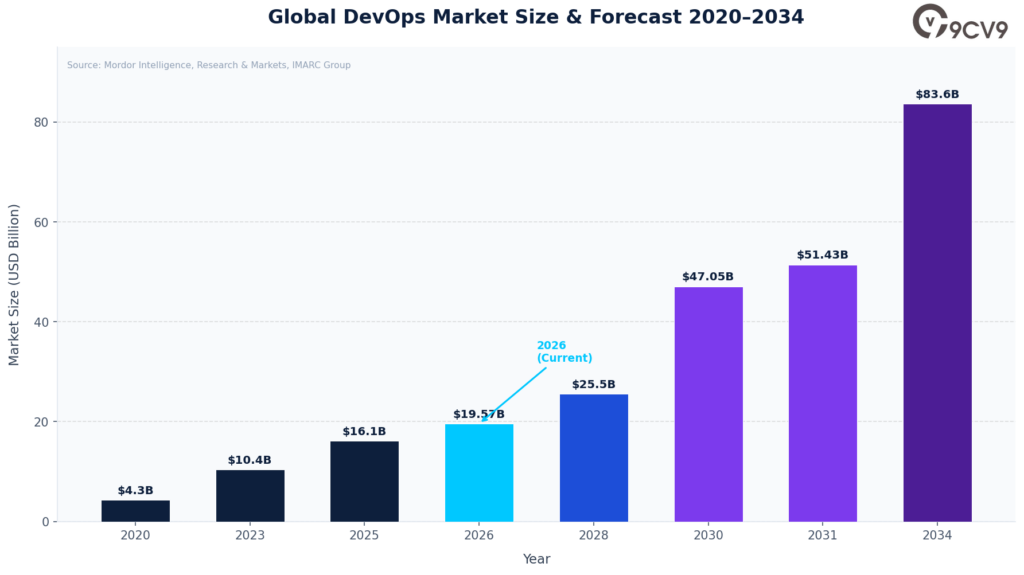
- The global DevOps market is estimated at $19.57 billion in 2026 and projected to reach $51.43 billion by 2031, driven by cloud-native development, automation, and AI-powered workflows.
- 99% of organizations implementing DevOps report positive effects, while mature DevOps practices can increase deployment frequency by 200% and reduce time-to-market by 50%.
- AI, DevSecOps, CI/CD, Kubernetes, cloud computing, and observability are shaping DevOps trends in 2026, while skills shortages, security risks, and legacy systems remain major challenges.
DevOps software transforms how organizations build, test, secure, and deliver applications in 2026. The global DevOps market is valued at approximately $19.57 billion this year, while rising adoption of CI/CD, DevSecOps, cloud platforms, Kubernetes, and AI-driven automation shows why DevOps has become essential to modern software delivery.
DevOps has evolved from a software development methodology into a critical foundation for modern digital businesses. In 2026, organizations are investing heavily in DevOps software, CI/CD automation, cloud-native infrastructure, DevSecOps, observability, containerization, and AI-powered development workflows to release software faster while improving reliability and security.
Also, read our article on the Top 10 Best DevOps Software.

The numbers illustrate the scale of this transformation. The global DevOps market is valued at approximately $19.57 billion in 2026 and is projected to reach $51.43 billion by 2031, representing a compound annual growth rate (CAGR) of 21.33%. Other forecasts are even more bullish, with the market potentially reaching $83.6 billion by 2034 and $175.53 billion by 2035.
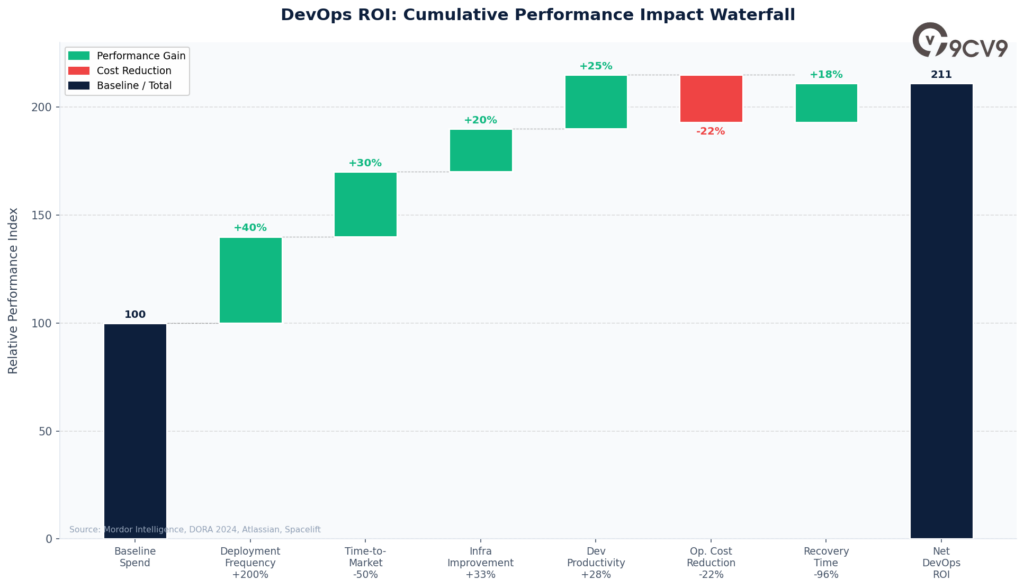
DevOps adoption is also becoming increasingly mainstream. According to the statistics compiled in this report, 99% of organizations that have implemented DevOps report positive effects, while 61% say DevOps has improved the quality of their deliverables and 49% report faster time-to-market. Organizations with mature DevOps practices report a 200% increase in deployment frequency and a 50% reduction in time-to-market.

Automation remains at the heart of this shift. CI/CD pipelines have become a fundamental component of modern software delivery, while cloud infrastructure, Docker, Kubernetes, Infrastructure as Code, and DevSecOps technologies continue to reshape development environments.
AI is also becoming increasingly important across code review, software testing, security, monitoring, and AIOps.
The global AIOps market was valued at $16.42 billion in 2025 and is expected to reach $36.6 billion by 2030.
The impact extends beyond technology. Demand for DevOps expertise remains strong, while organizations continue to face shortages of qualified professionals.
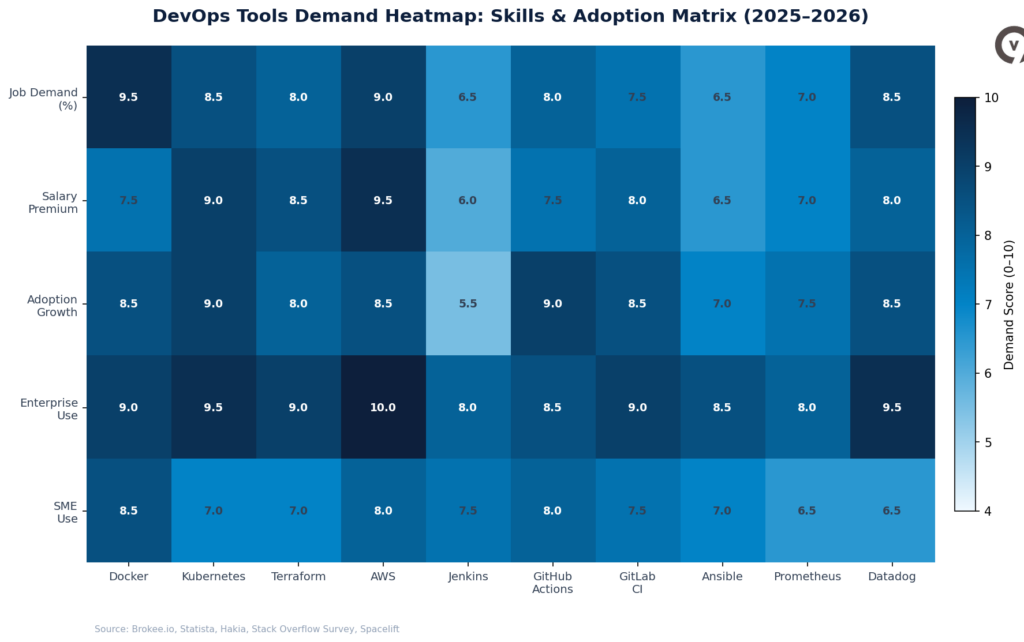
Docker, Kubernetes, AWS, Linux, and Bash rank among the most in-demand DevOps skills, and 37% of IT leaders identify a lack of DevOps and DevSecOps skills as their top technical skills gap.
At the same time, businesses must navigate challenges including cultural resistance, legacy infrastructure, security risks, and increasingly complex technology stacks.
This collection of the Top 113 DevOps Software Statistics, Data & Trends in 2026 provides a data-driven picture of where the DevOps industry stands and where it is heading.
From market growth and global adoption to CI/CD, DORA metrics, DevSecOps, cloud computing, Kubernetes, AI and AIOps, salaries, skills shortages, and industry adoption, these statistics reveal the technologies and trends shaping the future of software development and delivery in 2026 and beyond.
Before we venture further into this article, we would like to share who we are and what we do.
About 9cv9
9cv9 is a business tech startup based in Singapore and Asia, with a strong presence all over the world.
With over ten years of startup and business experience, and being highly involved in connecting with thousands of companies and startups, the 9cv9 team has listed some important and crucial software tools in this review.
If you like to get your company listed in our top B2B software reviews, check out our world-class 9cv9 Media and PR service and pricing plans here.
Top 113 DevOps Software Statistics, Data & Trends in 2026
🌐 MARKET SIZE & GROWTH
- The global DevOps market is valued at $19.57 billion in 2026, reflecting the accelerating enterprise demand for faster, more reliable software delivery. (Mordor Intelligence)
- The DevOps market is projected to reach $51.43 billion by 2031, growing at a 21.33% CAGR — one of the fastest-growing segments in enterprise software. (Mordor Intelligence)
- An alternate forecast places the 2026 DevOps market at $18.77 billion, growing from $14.95 billion in 2025 at a 25.6% CAGR. (Research & Markets)
- The DevOps market is expected to hit $47.05 billion by 2030 at a 25.8% CAGR — signaling that cloud-native and AI-driven workflows will continue to be primary growth engines. (The Business Research Company)
- By 2034, the global DevOps market is forecast to reach $83.6 billion, representing $67.8 billion in incremental value creation over the decade. (IMARC Group)
- The DevOps Software market (tools + platforms) was valued at $25.5 billion in 2025 and is projected to reach $96.9 billion by 2033 at a 19.2% CAGR. (Future Data Stats)
- The global DevOps market is expected to reach $86.16 billion by 2034 according to N-iX, making it one of the most valuable technology market categories. (N-iX)
- The DevOps market grew from just $4.3 billion in 2020 to an estimated $16.1 billion in 2025 — nearly a 4× increase in five years. (Research & Markets)
- The DevOps market is expected to expand to $175.53 billion by 2035 at a CAGR of 25.5%, driven by AI integration and multi-cloud strategies. (Expert Market Research)
- The CI/CD tools sub-market alone is valued at $1.33 billion in 2025, projected to reach $2.27 billion by 2030. (Research & Markets)
📍 REGIONAL BREAKDOWN
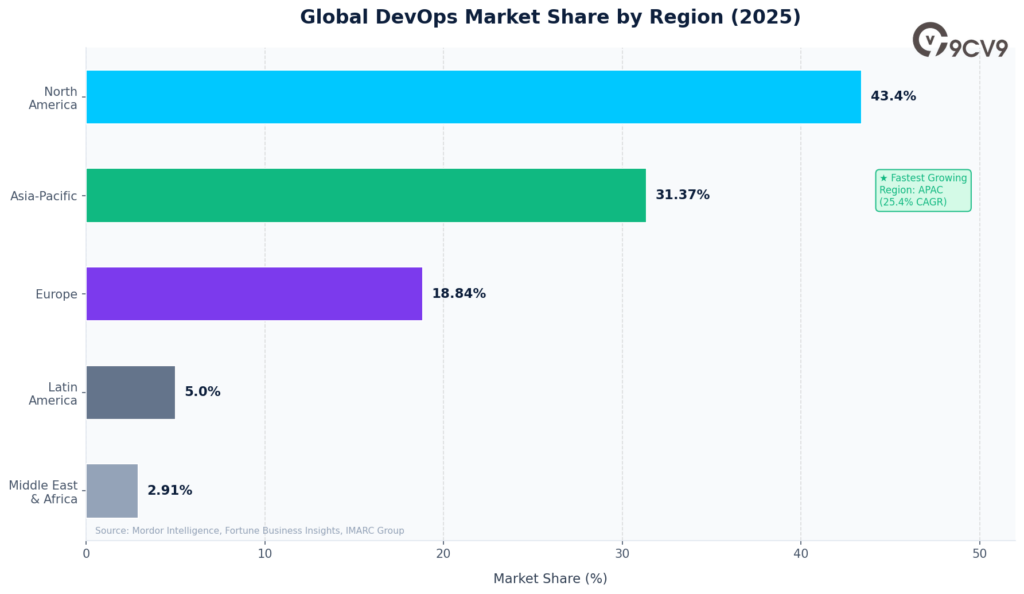
- North America dominates the DevOps market with 43.4% revenue share in 2025, driven by high IT spending, mature cloud ecosystems, and concentration of major vendors. (IMARC Group)
- The US alone accounts for over 61% of global DevOps tool deployments, reflecting deep enterprise maturity in BFSI, technology, and healthcare sectors. (IMARC Group)
- Asia-Pacific is the fastest-growing region, projected to grow at a 25.4% CAGR through 2031, fueled by SME digitalization, cloud adoption, and government tech initiatives. (Mordor Intelligence)
- Europe accounted for $1.9 billion of the DevSecOps market in 2025 (~18.8% share), with GDPR and EU Cyber Resilience Act driving compliance-led DevSecOps adoption. (Fortune Business Insights)
- The Asia-Pacific DevSecOps market was $3.17 billion in 2025 (31.37% of global share), projected to reach $3.7 billion in 2026. (Fortune Business Insights)
- Japan’s DevSecOps market is valued at $0.73 billion, China at $0.79 billion, and India at $0.59 billion by 2026. (Fortune Business Insights)
- Financial services in Asia-Pacific: 65% of large telecom operators will adopt DevSecOps in their CI/CD pipeline security by 2026. (Fortune Business Insights)
- North America held 35.2% revenue share of the DevSecOps market in 2024, maintaining leadership through early cloud and agile adoption. (Precedence Research)
- The Middle East & Africa DevSecOps market was $0.29 billion in 2025, representing a nascent but fast-growing opportunity corridor. (Fortune Business Insights)
- Financial services institutions in North America anticipate 75% hybrid cloud utilization by 2026, creating a major DevOps platform opportunity. (Mordor Intelligence)
✅ ADOPTION & ORGANIZATIONAL IMPACT
- 99% of organizations that have implemented DevOps have reported positive effects — making it one of the most universally endorsed IT methodologies. (Atlassian)
- 94% of organizations are predicted to have adopted DevOps practices by the end of 2025, up from around 80% in recent years. (ElectroIQ)
- 61% of organizations report that DevOps has enhanced the quality of their deliverables — a benefit that directly impacts customer satisfaction and retention. (Atlassian)
- 49% of companies report a reduction in time-to-market for software and services as a direct result of DevOps adoption. (Atlassian)
- Organizations using mature DevOps practices report a 200% rise in deployment frequency and a 50% fall in time-to-market. (Mordor Intelligence)
- DevOps is the most popular process framework in IT organizations, used by 49% of those surveyed — ahead of Agile (36%). (Spacelift)
- 99% of companies report benefits from DevOps, with 78% having to learn new skills, and 48% earning a salary increase after adoption. (Atlassian)
- Organizations with a DevOps culture can invest 33% more time in infrastructure improvements rather than firefighting. (Spacelift)
- 86% of professionals favor a DevOps culture for fast software development and release, underscoring wide practitioner buy-in. (Spacelift)
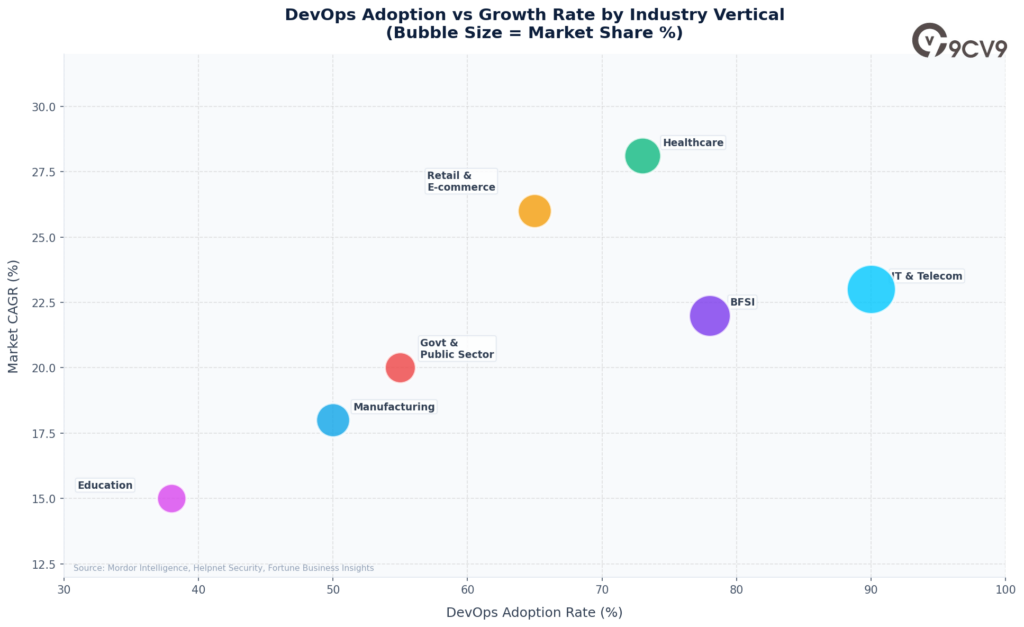
- 73% of healthcare organizations have adopted DevOps practices — a notable figure given the sector’s historically conservative approach to IT change. (Helpnet Security)
- 54% of engineers use DevOps practices to deploy containerized applications. (Spacelift)
- 46% of organizations are relatively new to DevOps (under 3 years of experience), while 54% have 3+ years of experience. (Atlassian)
- 69% of organizations have DevOps-named teams or job titles, reflecting organizational formalization of the discipline. (Baytech Consulting)
- 30% of organizations had incorporated DevOps platforms into their development toolchains in 2023 — expected to reach 80% by 2027. (Programs.com)
⚙️ CI/CD PIPELINE
- 80% of companies have developed CI/CD pipelines to reduce release times and halve human errors in software delivery. (ElectroIQ)
- 85% of companies with DevOps workflows consider CI/CD as a key — even non-negotiable — part of their development process. (ElectroIQ)
- CI/CD with version control delivers software 2.5× faster than general deployment practices. (DORA)
- Fully automated CI/CD pipelines can reduce delivery times by 40% while boosting deployment stability and frequency by 70%. (ElectroIQ)
- 60% of organizations using CI/CD can release their code at least twice as fast as before, per GitLab’s DevOps statistics report. (GitLab)
- 53% of development teams use Continuous Integration; 38% use Continuous Delivery; only 29% have deployed Continuous Deployment. (Mabl)
- Jenkins dominates the CI/CD tools market with a 46.35% share, making it the de facto standard for pipeline automation. (Devzery)
- Atlassian Bitbucket holds 18.61% of the CI/CD market, making it the second-largest CI/CD platform globally. (Spacelift)
- The continuous integration tools market is projected to grow from $1.4 billion to $3.72 billion by 2029 at a 21.18% CAGR. (Mordor Intelligence)
- 40% of enterprises are struggling to apply CI/CD to legacy systems — a significant drag on modernization timelines. (ElectroIQ)
- 55% of organizations are now concerned with pipeline security, driving rapid growth in DevSecOps tooling. (ElectroIQ)
- High performers are 1.4× more likely to use CI/CD tools, linking tooling maturity directly to business outcomes. (DORA)
- Developer productivity improves by 28% with CI/CD pipelines, with streamlined workflows reducing cognitive load and context-switching. (Statista)
🏆 DORA PERFORMANCE METRICS
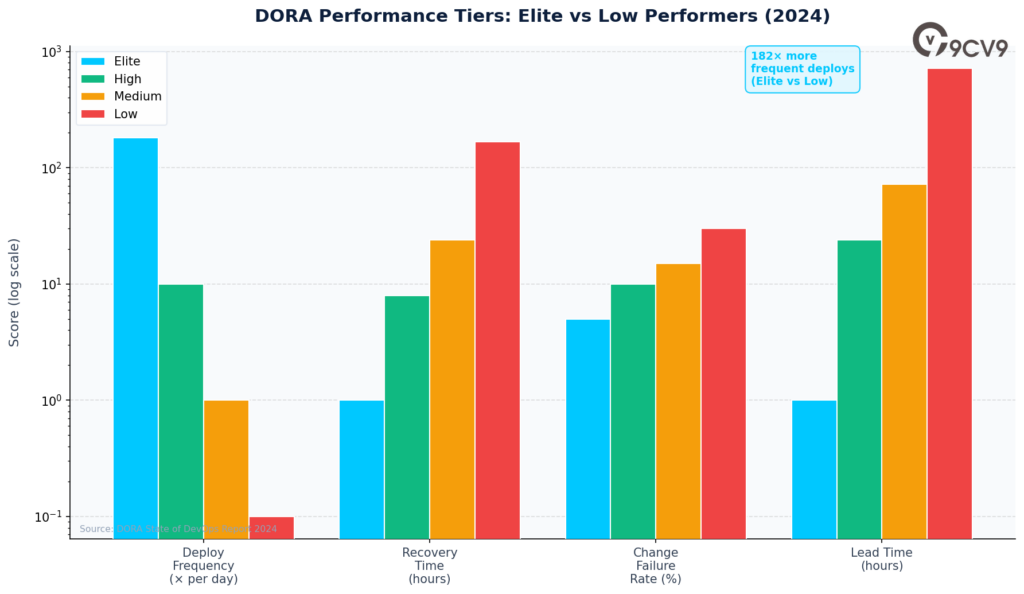
- Elite DORA performers deploy 182× more frequently than low performers — a staggering gap that highlights the compounding benefits of DevOps maturity. (DORA State of DevOps 2024)
- Only 19% of engineering teams qualified as elite performers in 2024, while the low-performance tier grew from 17% to 25% year-on-year. (DORA 2024)
- Elite DevOps teams experience change failure rates of less than 15%, compared to 30%+ for low-performing teams. (Atlassian / DORA)
- Leading DevOps performers restore service in less than one day after an incident, dramatically reducing revenue loss from outages. (Spacelift)
- Teams implementing DevOps practices experience 46× more frequent code deployments and 96× faster recovery from failures vs low performers. (DevOpsBay)
- Only 14% of teams are satisfied with their Mean Time to Recovery (MTTR), signaling a significant gap between aspiration and execution. (Logz.io)
- 73% of teams take several hours to resolve production issues, pointing to the need for better observability and automated incident response. (Logz.io)
- 85% of DevOps teams use more than one monitoring tool, adding complexity that often undermines the productivity gains DevOps is meant to deliver. (Logz.io)
- 54% of DevOps teams are responsible for observability, up from operations teams alone — a sign of growing accountability. (Logz.io)
- Teams with high-quality internal documentation are more than twice as likely to meet or exceed DORA reliability targets. (DORA 2024)
🔐 DEVSECOPS & SECURITY
- The DevSecOps market is valued at $11.07 billion in 2026, projected to reach $26.05 billion by 2033 at a 13% CAGR. (Coherent Market Insights)
- An alternate forecast places the 2026 DevSecOps market between $8.58 billion and $10.88 billion, depending on methodology. (Practical DevSecOps)
- 36% of organizations now develop software using DevSecOps — up from 27% in 2020 — reflecting growing security-first culture. (Practical DevSecOps)
- 96% of organizations see benefits in automating security and compliance, yet adoption of full automation remains uneven. (Practical DevSecOps)
- 63.3% of security professionals report that AI has become a helpful co-pilot for writing more secure code and automating application security testing. (Global DevSecOps Report 2025)
- 72% of organizations are integrating observability and security — a convergence that defines the next evolution of DevSecOps. (Dynatrace)
- 60% of rapid development teams have embedded DevSecOps practices, versus just 20% in 2019. (Practical DevSecOps)
- North America dominates the DevSecOps market with ~42% share in 2025, largely driven by financial services compliance requirements. (Precedence Research)
- The software/platforms segment holds ~69% of DevSecOps market in 2025, reflecting enterprise preference for integrated platforms over fragmented tooling. (Precedence Research)
- Top security threats in DevOps environments include ransomware (46%), DDoS (41%), and access misconfigurations (39%). (Logz.io)
- 72% of security professionals rate their DevSecOps efforts as “good” or “strong” — with over 50% running SAST and 44% running DAST. (Practical DevSecOps)
- The container & Kubernetes security segment is expected to be the fastest-growing in DevSecOps through 2035. (Precedence Research)
- Cloud-native applications drive 48% of DevSecOps market spend, while secure CI/CD pipeline automation accounts for 28%. (Precedence Research)
☁️ CLOUD & CONTAINERIZATION
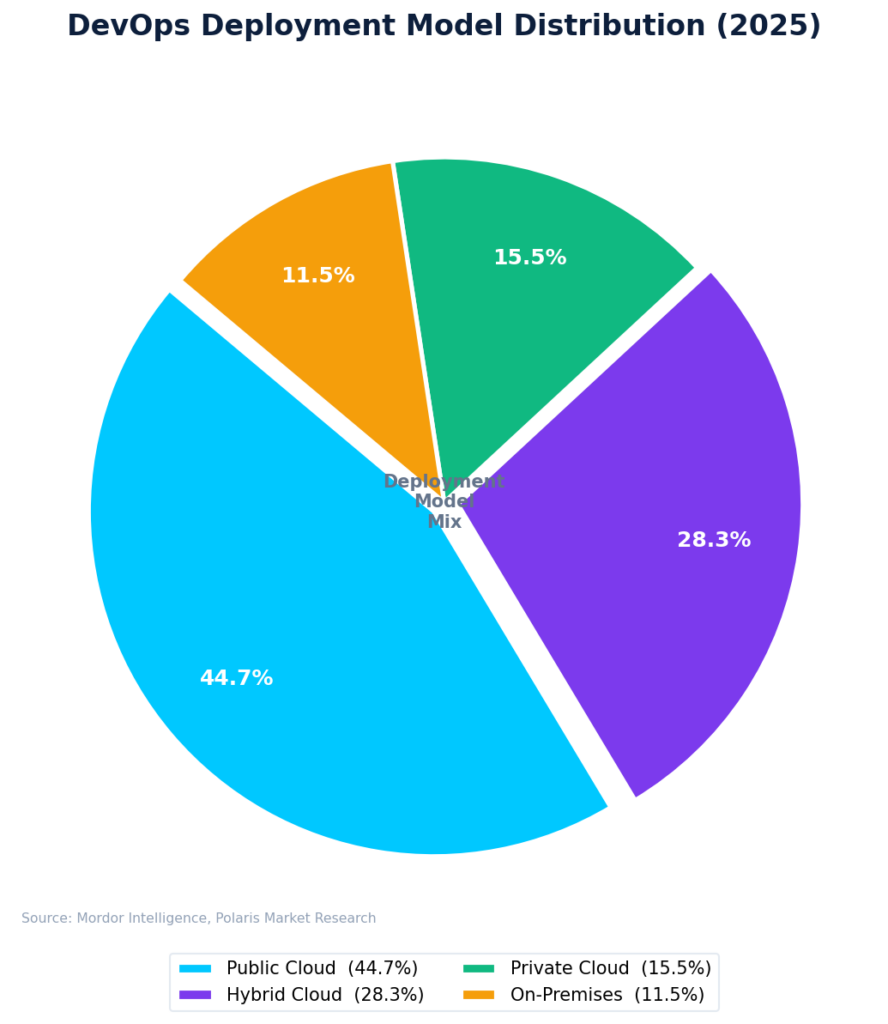
- Public cloud captured 44.7% of the DevOps market revenue in 2025, reflecting ease of access to native tool ecosystems. (Mordor Intelligence)
- Hybrid cloud DevOps is advancing at a 24.1% CAGR through 2031, driven by regulated workloads requiring on-prem + cloud flexibility. (Mordor Intelligence)
- Over 85% of organizations will adopt a cloud computing strategy by 2025, per Gartner — underpinning massive DevOps toolchain demand. (Gartner)
- 65% of organizations have adopted containerization to enhance their DevOps practices and streamline application deployment. (Brokee.io)
- 50% of organizations use Kubernetes for container orchestration — the platform has become the backbone of cloud-native DevOps. (Gartner / Datadog)
- Docker adoption grows by 28% annually as containerization becomes the standard for consistent dev-to-production environments. (Forbes)
- GitHub remains the top version control repository, used by 60% of DevOps teams globally. (LinkedIn)
- Terraform adoption has increased by 22% year-over-year, reinforcing Infrastructure-as-Code as a non-negotiable DevOps practice. (Statista)
- Hybrid cloud adoption is rising 25% YoY among DevOps teams, driven by the need for workload portability across environments. (LinkedIn)
- Large enterprises generated 64.05% of 2025 DevOps revenues, though SMEs are the fastest-growing segment at 21.2% CAGR 2026–2031. (Mordor Intelligence)
🤖 AI & AIOPS
- The global AIOps market was valued at $16.42 billion in 2025 and is expected to reach $36.6 billion by 2030 — AI is no longer optional in DevOps. (N-iX)
- Teams utilizing AI-powered testing frameworks achieve 83% test coverage, compared to just 54% with traditional methods. (Software Testing Journal 2026)
- AI-powered testing also reduces testing time by 56%, sharply compressing release cycles. (Software Testing Journal 2026)
- 75% of DevOps teams use or plan to use AI/ML/bots for code review — up from 41% just a few years ago. (Practical DevSecOps)
- 27.27% of security engineers see better integration of development workflows as their primary focus in 2026. (Global DevSecOps Report 2025)
- A 25% increase in AI adoption in DevOps teams correlates with measurable improvements in job satisfaction (+2.2%) and individual flow (+2.6%). (Programs.com / DORA)
- External web interfaces are used by 73.9% of DevOps professionals to interact with AI tools, making them the dominant AI touchpoint. (Programs.com)
- Security is the main barrier to AI adoption in DevOps, followed by cost (20%), lack of use cases (19%), and compliance difficulties (19%). (Programs.com)
- Only 13% of DevOps teams at companies with 10,000+ employees cite cost as a barrier to AI adoption — budget is rarely the limiting factor at scale. (Programs.com)
- AI adoption can improve DevOps team performance beyond individual gains: team-level benefits exceed the sum of individual productivity boosts. (Programs.com / DORA 2024)
👨💻 WORKFORCE & SALARIES
- The BLS median salary for DevOps engineers is $116,780/year (2024), with strong premiums for cloud-native and Kubernetes expertise. (BLS OEWS 2024)
- The average total DevOps compensation (base + bonus) reaches $150,278/year — significantly above most other IT roles. (BuiltIn)
- FAANG-level DevOps engineers earn $200,000–$500,000+ in total compensation including equity, reflecting extreme demand at the top. (Levels.fyi)
- Entry-level DevOps engineers earn $75,000–$95,000, while senior engineers (6–10 years) command $135,000–$180,000. (BLS / Hakia)
- DevOps engineer salaries grew 12% year-over-year in 2025 — outpacing most other tech roles. (Brokee.io)
- AWS Solutions Architect certification adds a $20,000–$30,000 salary premium — the single most valuable credential for DevOps engineers. (Dice Tech Salary Report 2024)
- Cloud/Kubernetes certifications add $10,000–$25,000 to annual DevOps compensation, making continued upskilling a high-ROI investment. (Hakia)
- The most in-demand DevOps skills by job postings are: Docker (42.77%), Kubernetes (28.02%), AWS (12.1%), Linux (9.17%), and Bash (4.44%). (Brokee.io)
- LinkedIn’s 2024 Workforce Report ranks DevOps engineering as one of the top three most in-demand tech roles globally. (LinkedIn)
- 37% of IT leaders identify a lack of DevOps and DevSecOps skills as their top technical gap — making talent the industry’s biggest constraint. (Spacelift)
🚧 CHALLENGES & SKILLS GAP
- 45% of DevOps leaders encounter cultural resistance as a major impediment to successful DevOps transformation. (Spacelift)
- 31% of DevOps leaders say a lack of skilled resources is their single biggest challenge — above tooling and process issues. (Spacelift)
- 29% of DevOps leaders cite legacy systems and infrastructure integration as a persistent, costly obstacle. (Spacelift)
- 65% of recruiters report a “surge in underqualified candidates” applying for specialized DevOps roles. (James Andrews Recruitment Solutions)
- 68% of IT teams now have upskilling programs in place — a dramatic rise from just 30% in 2020, showing industry response to the talent gap. (Spacelift)
- Monthly cost of outsourcing fundamental DevOps components like CI/CD pipeline setup ranges from $10,000 to $30,000. (Adex)
- 29% of DevOps professionals report their organization has multiple platform teams — pointing to structural fragmentation at scale. (DORA 2025 Survey)
🏭 INDUSTRY VERTICALS
- IT & Telecommunications commands 25.05% of the DevOps market in 2025 — the largest vertical by share. (Mordor Intelligence)
- Healthcare & Life Sciences DevOps is forecast to grow at a 28.1% CAGR through 2031 — the fastest growing vertical. (Mordor Intelligence)
- Large enterprises hold 64.05% of 2025 DevOps revenue, but SMEs are the momentum segment at 21.2% CAGR. (Mordor Intelligence)
- BFSI sector is a major DevOps adopter, leveraging CI/CD for regulatory compliance, fraud detection, and digital banking delivery. (Research & Markets)
- Solutions (software tools) account for 68.4% of DevOps revenues in 2025, with services (consulting, implementation) growing at 23.1% CAGR. (IMARC Group)
- The endpoint security / CSPM segment within DevSecOps is expected to grow from 21% to 33% of market by 2027. (Spacelift)
Conclusion
The 113 DevOps software statistics, data and trends for 2026 reveal an industry that continues to expand rapidly as software delivery becomes more automated, cloud-native, secure, and AI-driven. With the global DevOps market valued at approximately $19.57 billion in 2026 and projected to reach $51.43 billion by 2031, DevOps is increasingly becoming a core technology investment rather than simply a development methodology.
The benefits of DevOps adoption are also evident in organizational performance. 99% of organizations that have implemented DevOps report positive effects, while 61% report improvements in deliverable quality and 49% report reduced time-to-market. Mature DevOps practices are associated with a 200% increase in deployment frequency and a 50% reduction in time-to-market, demonstrating why businesses continue to invest in automation, CI/CD pipelines, infrastructure management, and developer productivity.
At the same time, the definition of a modern DevOps software stack is expanding. DevSecOps, Kubernetes, Docker, Infrastructure as Code, hybrid cloud, observability, and AIOps are becoming increasingly important parts of software development and operations. AI represents another major shift: the global AIOps market was valued at $16.42 billion in 2025 and is projected to reach $36.6 billion by 2030, while 75% of DevOps teams reportedly use or plan to use AI, machine learning, or bots for code review.
However, rapid adoption does not eliminate the industry’s challenges. Organizations continue to face cultural resistance, legacy-system integration, security concerns, fragmented tooling, and shortages of qualified DevOps professionals. 37% of IT leaders identify insufficient DevOps and DevSecOps skills as their top technical gap, highlighting the importance of talent development alongside investments in software and automation.
Overall, the DevOps trends for 2026 point toward deeper automation, stronger integration between development and security, continued cloud and container adoption, and greater use of artificial intelligence throughout the software delivery lifecycle. Organizations that can combine the right DevOps software with skilled teams, effective processes, reliable documentation, security automation, and measurable performance practices will be better positioned to deliver software quickly and reliably.
As DevOps continues to evolve, these 113 statistics provide an important benchmark for understanding the DevOps market, DevOps software adoption, CI/CD trends, DORA performance, DevSecOps, cloud computing, Kubernetes, AI and AIOps, workforce demand, and the future of software development in 2026 and beyond.
If you find this article useful, why not share it with your hiring manager and C-level suite friends and also leave a nice comment below?
We, at the 9cv9 Research Team, strive to bring the latest and most meaningful data, guides, and statistics to your doorstep.
To get access to top-quality guides, click over to 9cv9 Blog.
To hire top talents using our modern AI-powered recruitment agency, find out more at 9cv9 Modern AI-Powered Recruitment Agency.
People Also Ask
What is the DevOps market size in 2026?
The global DevOps market is valued at approximately $19.57 billion in 2026, reflecting strong enterprise demand for faster, more reliable software delivery.
How fast is the DevOps market growing in 2026?
The DevOps market is projected to grow at a 21.33% CAGR and reach $51.43 billion by 2031, according to Mordor Intelligence data cited in the report.
How big could the DevOps market become by 2035?
One forecast projects the global DevOps market will reach $175.53 billion by 2035, expanding at a 25.5% CAGR as AI integration and multi-cloud strategies accelerate.
What percentage of organizations benefit from DevOps?
About 99% of organizations that have implemented DevOps report positive effects, highlighting the widespread organizational benefits associated with DevOps practices.
How does DevOps improve software quality?
Around 61% of organizations report that DevOps has improved the quality of their deliverables, potentially strengthening software reliability and customer experiences.
Does DevOps reduce time-to-market?
Yes. About 49% of companies report reduced time-to-market after adopting DevOps, while mature DevOps practices are associated with a 50% reduction in time-to-market.
How does DevOps affect deployment frequency?
Organizations using mature DevOps practices report a 200% increase in deployment frequency, demonstrating the impact of automation and streamlined development workflows.
What are the biggest DevOps trends in 2026?
Major DevOps trends include AI and AIOps, DevSecOps, CI/CD automation, cloud-native development, Kubernetes, containerization, observability, hybrid cloud and Infrastructure as Code.
How widely adopted are CI/CD pipelines?
About 80% of companies have developed CI/CD pipelines, while 85% of companies with DevOps workflows consider CI/CD a key part of their development processes.
How much faster can CI/CD make software delivery?
CI/CD combined with version control can deliver software 2.5 times faster than general deployment practices, according to DORA data cited in the report.
How does CI/CD automation affect delivery times?
Fully automated CI/CD pipelines can reduce delivery times by 40% while increasing deployment stability and frequency by 70%, according to the statistics compiled in the report.
What is the most popular CI/CD tool?
Jenkins leads the CI/CD tools market with a reported 46.35% share, making it one of the most widely adopted platforms for pipeline automation.
What are DORA metrics in DevOps?
DORA metrics measure software delivery performance. The report highlights deployment frequency, change failure rates and service recovery as important indicators separating high- and low-performing DevOps teams.
How much more frequently do elite DevOps teams deploy?
Elite DORA performers deploy 182 times more frequently than low performers, demonstrating the significant performance gap between highly mature and lower-performing teams.
What percentage of engineering teams are elite DORA performers?
Only 19% of engineering teams qualified as elite performers in 2024, while the proportion of teams classified as low performers increased from 17% to 25%.
What is the DevSecOps market size in 2026?
The DevSecOps market is valued at approximately $11.07 billion in 2026 and is projected to reach $26.05 billion by 2033 at a 13% CAGR.
How many organizations use DevSecOps?
About 36% of organizations develop software using DevSecOps, up from 27% in 2020, showing growing adoption of security-focused development practices.
Why is DevSecOps important in 2026?
DevSecOps integrates security into software development workflows. Around 96% of organizations see benefits in automating security and compliance, although full automation remains uneven.
What are the biggest security threats in DevOps?
The leading security threats cited for DevOps environments include ransomware at 46%, DDoS attacks at 41% and access misconfigurations at 39%.
How important is cloud computing to DevOps?
Cloud computing is central to DevOps growth. Public cloud represented 44.7% of DevOps market revenue in 2025, while hybrid cloud DevOps is projected to grow at a 24.1% CAGR through 2031.
How many organizations use containerization for DevOps?
About 65% of organizations have adopted containerization to strengthen DevOps practices and make application deployment more consistent and efficient.
How widely used is Kubernetes in DevOps?
Around 50% of organizations use Kubernetes for container orchestration, demonstrating its important role in cloud-native infrastructure and modern DevOps environments.
How is AI changing DevOps in 2026?
AI is increasingly supporting code review, testing, security and operations. About 75% of DevOps teams use or plan to use AI, machine learning or bots for code review.
What is the AIOps market size?
The global AIOps market was valued at $16.42 billion in 2025 and is expected to reach $36.6 billion by 2030, demonstrating growing demand for AI-powered IT operations.
What are the main barriers to AI adoption in DevOps?
Security is identified as the main barrier to AI adoption in DevOps, followed by cost at 20%, lack of suitable use cases at 19% and compliance difficulties at 19%.
What is the average DevOps engineer salary?
The report cites average total DevOps compensation of $150,278 per year, including base salary and bonuses, while compensation varies significantly by experience and specialization.
What are the most in-demand DevOps skills?
The most in-demand skills by job postings are Docker at 42.77%, Kubernetes at 28.02%, AWS at 12.1%, Linux at 9.17% and Bash at 4.44%.
Is there a DevOps skills shortage in 2026?
Yes. About 37% of IT leaders identify a lack of DevOps and DevSecOps skills as their top technical gap, while 31% of DevOps leaders cite insufficient skilled resources as their biggest challenge.
What are the biggest challenges facing DevOps teams?
Major challenges include cultural resistance, skills shortages and legacy systems. The report says 45% cite cultural resistance, 31% lack skilled resources and 29% struggle with legacy integration.
What is the future of DevOps software beyond 2026?
DevOps is moving toward greater AI automation, DevSecOps integration, cloud-native infrastructure, containers and observability. Market forecasts suggest continued strong growth through 2030, 2034 and 2035.
Sources
Mordor Intelligence Research & Markets The Business Research Company Fortune Business Insights Polaris Market Research IMARC Group Future Data Stats Expert Market Research Spacelift ElectroIQ Octopus Deploy Programs Practical DevSecOps Precedence Research Coherent Market Insights CloudAware DORA Deviniti Brokee Hakia N-iX StrongDM eSparkBiz Gartner