


























Key Takeaways
- The global data governance software market is projected to exceed $6.3 billion in 2026 and continue growing at strong double-digit CAGR, driven by AI adoption, cloud transformation, and increasingly stringent data privacy regulations.
- Enterprises are accelerating investments in data governance software to improve data quality, strengthen AI readiness, reduce compliance risks, and avoid the multi-million-dollar costs associated with poor data management and security breaches.
- North America remains the largest market, while Asia-Pacific is the fastest-growing region, with cloud-based deployments, AI governance, data quality management, and regulatory compliance emerging as the key trends shaping the industry in 2026.
Data governance software enables organizations to manage data securely, maintain regulatory compliance, and improve AI readiness across the enterprise. This article presents 110 of the latest data governance software statistics, market trends, adoption insights, investment forecasts, and compliance data for 2026 to help business leaders, IT professionals, and investors make informed decisions.
Data has become the defining asset of the modern digital economy, powering everything from artificial intelligence and advanced analytics to customer experience, cybersecurity, regulatory compliance, and strategic decision-making. Yet as organizations collect unprecedented volumes of structured and unstructured data, managing its quality, security, accessibility, and compliance has evolved into one of the greatest challenges facing enterprises worldwide. Data governance software has emerged as the foundation for addressing these challenges by enabling organizations to establish policies, maintain data quality, track lineage, enforce privacy controls, and ensure that data remains accurate, trustworthy, and compliant across increasingly complex technology ecosystems. As enterprises accelerate digital transformation and integrate AI into mission-critical workflows, effective data governance has shifted from being a back-office compliance initiative to becoming a strategic business priority.
Also, read our guide on the Top 10 Best Data Governance Software.

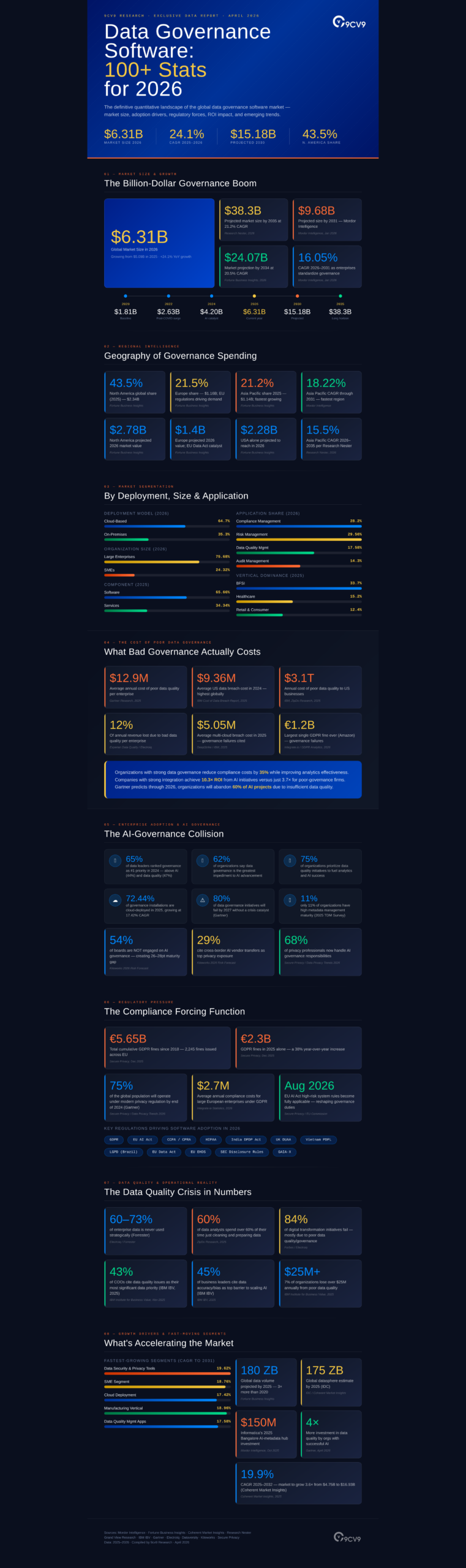
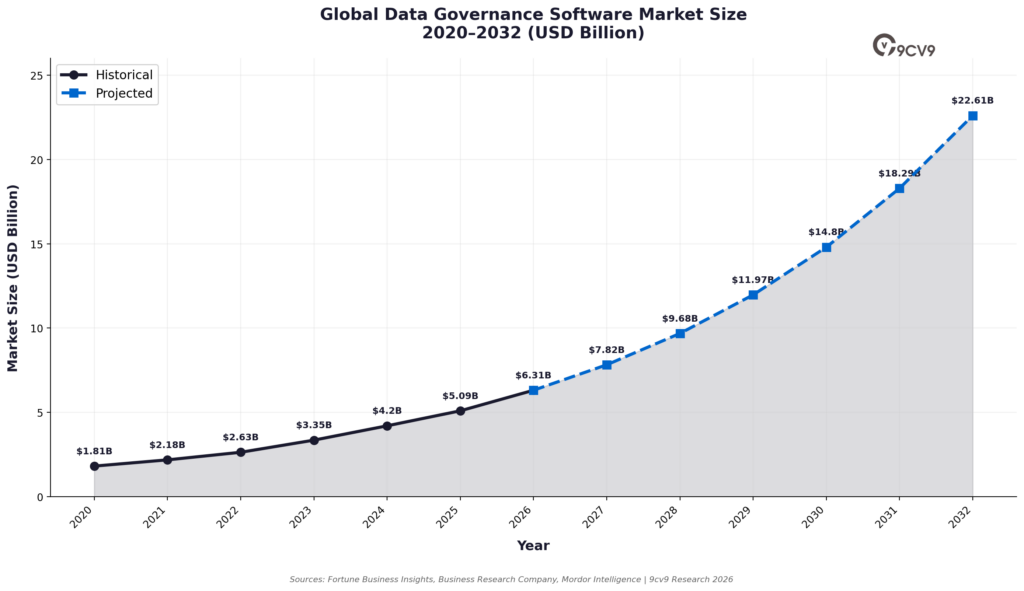
The numbers behind this transformation are remarkable. The global data governance software market is estimated to reach approximately $6.31 billion in 2026 after growing more than 24% year over year from 2025, while long-term industry forecasts suggest the market could exceed $38 billion by 2035. Multiple independent market research firms continue to project annual compound growth rates ranging between 16% and 24%, reflecting widespread agreement that organizations across every industry are increasing investments in governance platforms. These forecasts highlight that data governance is no longer viewed as optional infrastructure but rather as an essential capability supporting regulatory compliance, AI deployment, cloud modernization, and enterprise resilience.
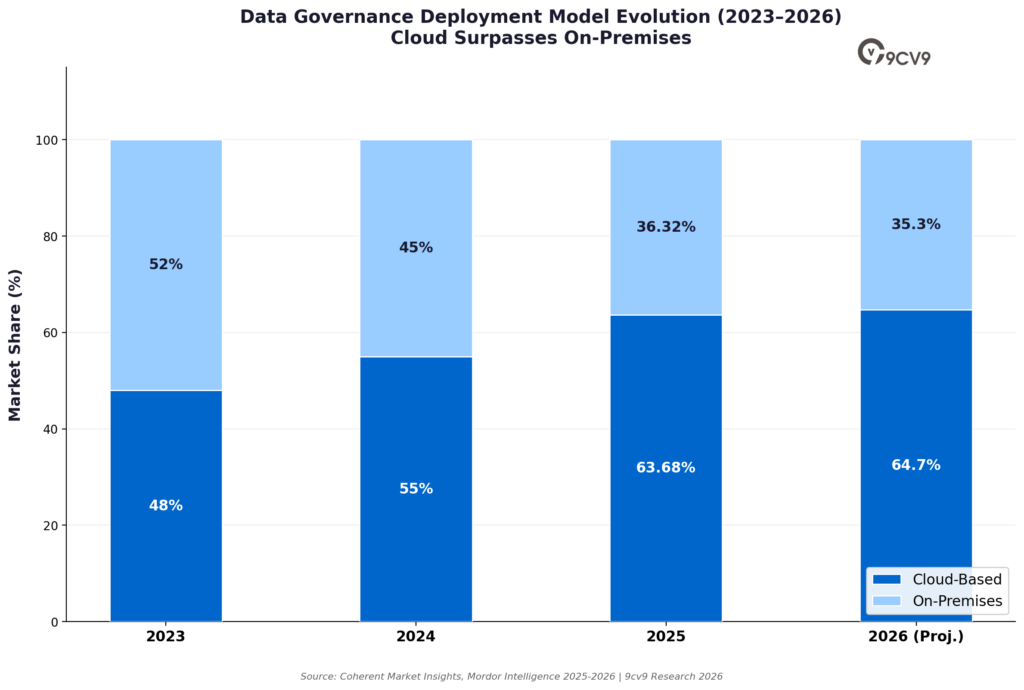
Several major trends are driving this rapid expansion. Enterprises continue migrating workloads to cloud-native architectures, where governance becomes significantly more complex due to distributed data environments, hybrid infrastructure, and multi-cloud deployments. Cloud-based data governance platforms are expected to account for nearly two-thirds of the market in 2026, while large enterprises remain responsible for more than 70% of overall spending as they manage increasingly sophisticated global data ecosystems. At the same time, software solutions are replacing manual governance processes by providing automated metadata management, policy enforcement, lineage tracking, and continuous monitoring across thousands of business applications.
Artificial intelligence has dramatically accelerated the importance of governance initiatives. Organizations are discovering that successful AI deployment depends heavily on trusted, well-governed data. Poor data quality continues to undermine machine learning models, generative AI applications, and enterprise analytics initiatives, forcing businesses to invest heavily in governance frameworks before scaling AI programs. Industry surveys indicate that data governance has become one of the highest priorities for enterprise data leaders, while insufficient governance remains one of the greatest barriers preventing organizations from realizing AI’s full business value. These findings reinforce a growing consensus that AI success begins with reliable data foundations rather than algorithms alone.
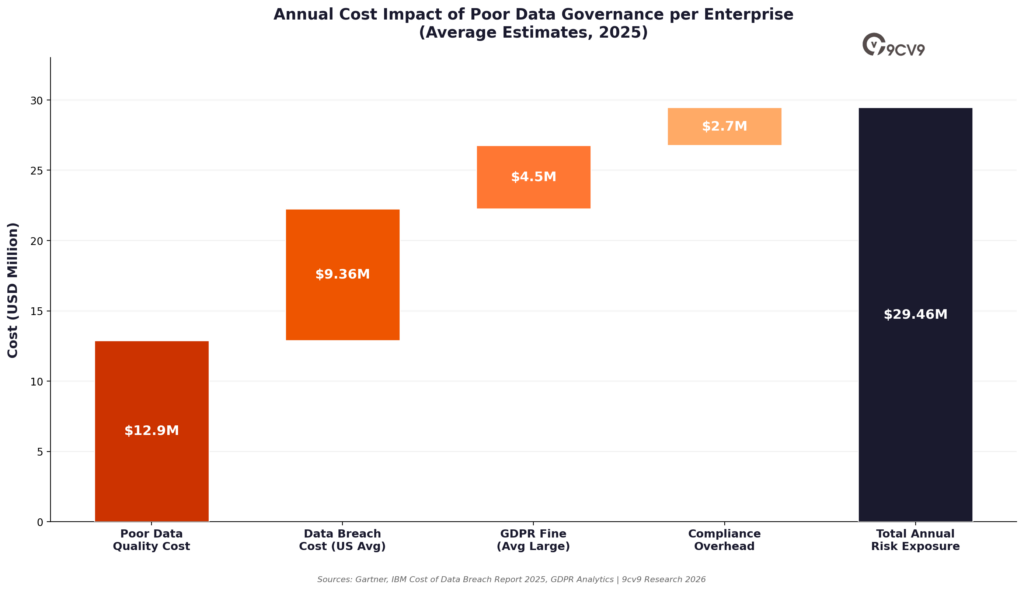
The financial consequences of inadequate governance are equally compelling. Enterprises continue to lose millions of dollars annually because of poor data quality, inconsistent governance processes, operational inefficiencies, regulatory violations, and cybersecurity incidents. Studies estimate that poor data quality can cost organizations between $12.9 million and $15 million annually, while data breaches linked to governance failures frequently exceed several million dollars per incident. Marketing teams lose significant portions of their budgets due to inaccurate customer data, operational downtime continues to create substantial financial losses, and organizations with mature governance capabilities consistently outperform peers in AI return on investment and operational efficiency. These economic realities are transforming governance spending from a cost center into a measurable business investment with clear financial returns.
Regulatory developments around the world have further intensified demand for governance software. Governments continue introducing increasingly comprehensive privacy, cybersecurity, and AI regulations that require organizations to understand exactly where data resides, how it flows, who can access it, and whether it complies with evolving legal requirements. GDPR enforcement continues to generate billions of euros in cumulative fines, while the implementation of the European Union AI Act, together with regulations such as CCPA, HIPAA, India’s Digital Personal Data Protection Act, Vietnam’s Personal Data Protection Law, and numerous other frameworks, has significantly expanded governance obligations for organizations operating across international markets. These regulatory pressures have made governance software an indispensable component of enterprise compliance strategies.
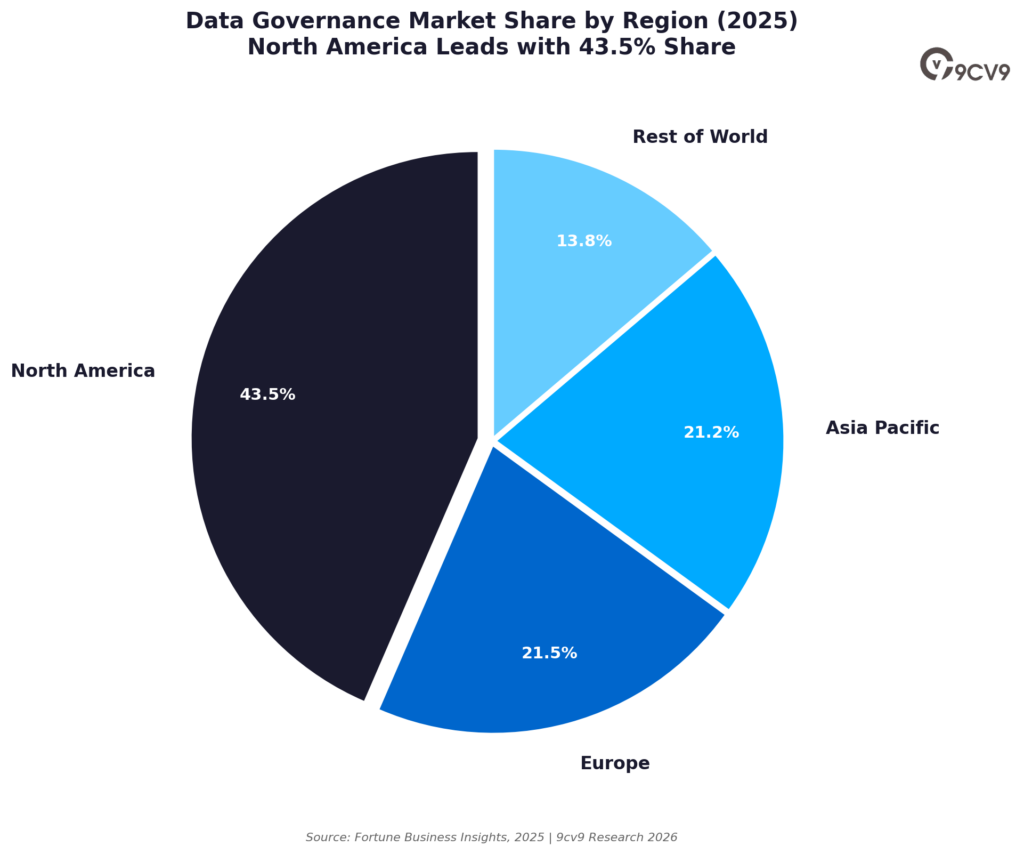
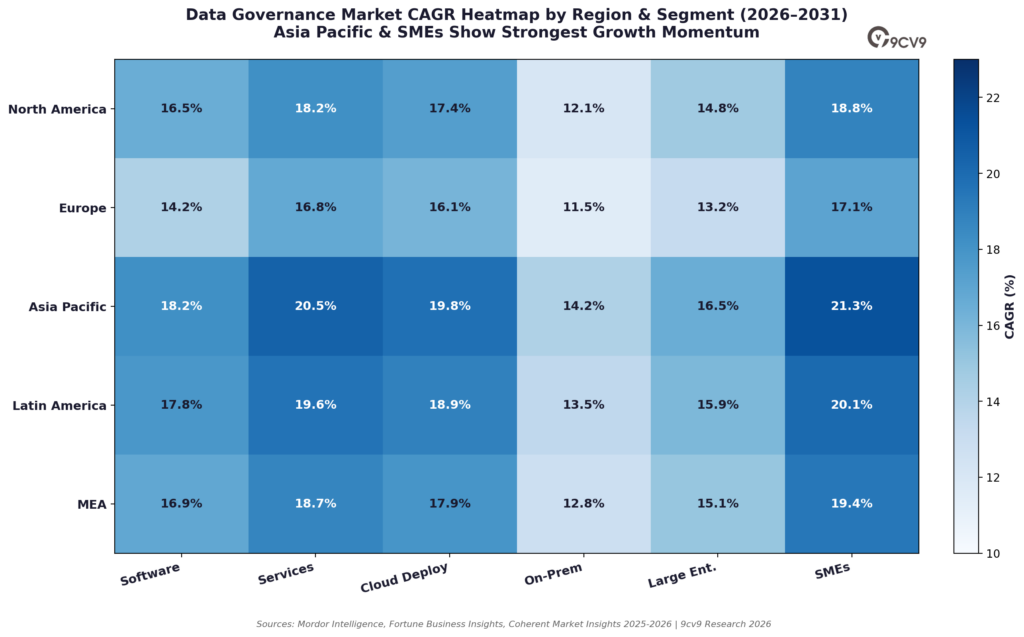
Regional markets continue to reflect varying stages of maturity and investment priorities. North America remains the largest market for data governance software, supported by mature cloud adoption, advanced regulatory environments, and widespread enterprise digital transformation initiatives. Europe continues benefiting from strict privacy regulations and comprehensive data protection requirements, while Asia-Pacific represents the fastest-growing region as countries rapidly strengthen data sovereignty laws, modernize digital infrastructure, and accelerate AI adoption. Markets across China, India, Japan, and Southeast Asia are experiencing particularly strong momentum as governments and enterprises invest heavily in secure, compliant data management capabilities.
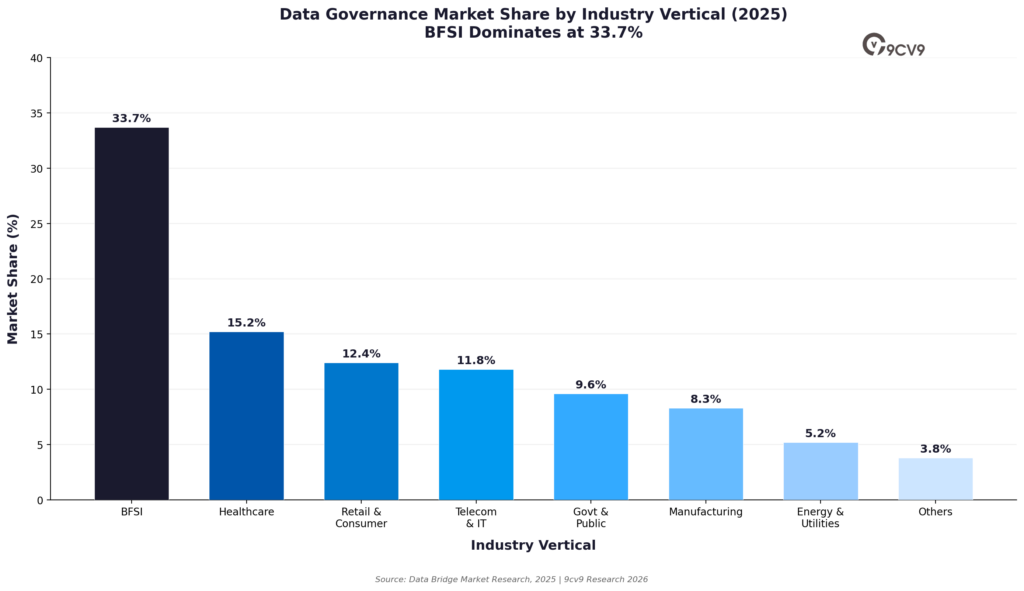
Industry adoption also varies considerably across sectors. Financial services remain the largest adopter of governance software because of stringent regulatory requirements, extensive audit obligations, and high-value customer data. Healthcare organizations continue expanding governance investments to protect sensitive patient information while supporting digital health initiatives. Manufacturing companies increasingly deploy governance platforms to support connected supply chains and industrial analytics, while retail organizations focus on customer data platforms, personalization, and privacy compliance. Regardless of industry, governance software has become essential for balancing innovation with regulatory responsibility and operational excellence.
Technology innovation is reshaping governance capabilities at an unprecedented pace. Modern platforms increasingly incorporate AI-powered metadata discovery, automated classification, intelligent policy recommendations, real-time data quality monitoring, and advanced lineage visualization. Organizations are also adopting architectures such as data mesh and data fabric, which require even more sophisticated governance models to maintain consistency across decentralized environments. At the same time, enterprises are investing in governance tools that support responsible AI development, autonomous AI agents, and secure cross-border data sharing without compromising privacy or regulatory compliance.
As organizations continue generating hundreds of millions of terabytes of new data every day, governance has become inseparable from digital transformation itself. Data-driven organizations increasingly recognize that high-quality analytics, trusted AI outputs, secure cloud migration, and regulatory compliance all depend upon strong governance frameworks operating behind the scenes. The competitive advantage no longer belongs solely to businesses that collect the most data, but to those capable of governing, protecting, and leveraging that data effectively throughout its lifecycle. Companies that establish mature governance capabilities today are positioning themselves to unlock greater operational efficiency, reduce compliance risks, improve customer trust, and maximize the long-term value of their digital assets.
This comprehensive guide, “Top 110 Data Governance Software Statistics, Data & Trends in 2026,” brings together the latest market research, enterprise adoption metrics, regulatory developments, investment trends, AI-related insights, regional analyses, cost benchmarks, and technology forecasts shaping the global data governance landscape. Whether you are a CIO, CDO, IT leader, compliance executive, AI practitioner, data engineer, cybersecurity professional, investor, software vendor, or business strategist, these carefully curated statistics provide an in-depth view of one of enterprise technology’s fastest-growing markets. By understanding the numbers driving data governance adoption in 2026, readers will gain valuable insights into emerging opportunities, evolving risks, and the strategic priorities that will define the future of enterprise data management in the years ahead.
Before we venture further into this article, we would like to share who we are and what we do.
About 9cv9
9cv9 is a business tech startup based in Singapore and Asia, with a strong presence all over the world.
With over ten years of startup and business experience, and being highly involved in connecting with thousands of companies and startups, the 9cv9 team has listed some important and crucial software tools in this review.
If you like to get your company listed in our top B2B software reviews, check out our world-class 9cv9 Media and PR service and pricing plans here.
Top 110 Data Governance Software Statistics, Data & Trends in 2026
🌍 Market Size & Growth
- $6.31B — Global data governance market size in 2026, up from $5.09B in 2025 (+24.1% YoY). The market’s exponential climb signals that governance has shifted from a compliance checkbox to a core enterprise investment priority. (Source: Business Research Company, 2026)
- $38.3B — Projected global market size by 2035 at a 21.2% CAGR, representing more than a 6× expansion from current levels. This long-range trajectory confirms data governance as one of the most durable enterprise software growth stories of the decade. (Source: Research Nester, 2026)
- $24.07B — Alternative 2034 projection at 20.5% CAGR, reinforcing cross-analyst consensus on strong double-digit growth regardless of methodology. (Source: Fortune Business Insights, 2026)
- $16.93B — Market size expected by 2032 at 19.9% CAGR, meaning the market will grow nearly 3.6× in less than eight years. (Source: Coherent Market Insights, 2025)
- $15.18B — Market projection for 2030 at a 24.5% CAGR, highlighting how regulation-heavy 2020s conditions are compressing growth timelines. (Source: Business Research Company, 2026)
- $13.64B — Projected 2032 market value at 12.8% CAGR, the most conservative credible estimate, still representing more than double the 2026 baseline. (Source: Research & Markets, 2026)
- $9.68B — Market forecast for 2031 at 16.05% CAGR, translating into a robust but attainable near-term benchmark for investor planning horizons. (Source: Mordor Intelligence, Jan 2026)
- $6.7B — Industry size assessed specifically for 2026, corroborating multiple independent research forecasts from different methodological angles. (Source: Research Nester, 2026)
- $5.38B — Global market valued at this figure for 2025/2026 transition per Fortune Business Insights, forming the reliable baseline for CAGR calculations. (Source: Fortune Business Insights, 2026)
- $4.60B — Mordor Intelligence’s 2026 baseline, slightly more conservative but still validating overwhelming consensus that market exceeds $4.5B in 2026. (Source: Mordor Intelligence, Jan 2026)
- $3.35B — Market size in 2023 per Grand View Research, providing historical context — the market has essentially doubled in under three years. (Source: Grand View Research)
- $1.81B — Market value in 2020, the launch baseline from which the market has since grown by over 3.5× in just six years. (Source: Electroiq / Allied Market Research)
- 21.7% — CAGR from 2024 to 2030 per Grand View Research, demonstrating that growth rates remain consistently high across all major analyst firms. (Source: Grand View Research)
- 24.1% — CAGR for 2025–2026 alone — the steepest single-year jump, driven by AI regulatory pressure and post-GDPR enforcement waves. (Source: Business Research Company, 2026)
🌏 Regional Breakdown
- 43.5% — North America’s share of the global market in 2025, worth $2.34B, underpinned by mature regulatory infrastructure and heavy enterprise cloud adoption. (Source: Fortune Business Insights)
- $2.78B — North America’s projected 2026 value, growing from its 2025 base as SEC disclosure rules and state-level AI laws add compliance demand. (Source: Fortune Business Insights)
- $2.28B — The United States alone is projected to reach this market value in 2026, underscoring America’s outsized role in global governance software demand. (Source: Fortune Business Insights)
- 40.3% — North America’s regional share per Coherent Market Insights for 2026, the largest single region globally. (Source: Coherent Market Insights, Mar 2026)
- 42.64% — North America share of 2025 governance spending per Mordor Intelligence, slightly above Fortune’s figure due to different scope definitions. (Source: Mordor Intelligence, 2026)
- 21.5% — Europe’s share of the market in 2025, valued at $1.16B, driven by the world’s strictest data protection regime. (Source: Fortune Business Insights)
- $1.4B — Europe’s projected market value in 2026, bolstered by the EU Data Act, GDPR enforcement, and the EU AI Act implementation cycle. (Source: Fortune Business Insights)
- 21.2% — Asia Pacific’s share in 2025, valued at $1.14B, nearly matching Europe’s despite earlier adoption timelines. (Source: Fortune Business Insights)
- $1.43B — Asia Pacific’s projected 2026 value, outpacing Europe in absolute dollar growth as India, China, and Southeast Asia accelerate. (Source: Fortune Business Insights)
- 18.22% — Asia Pacific’s CAGR toward 2031 per Mordor Intelligence — the fastest-growing region globally due to sovereign cloud mandates and data privacy laws. (Source: Mordor Intelligence, 2026)
- 15.5% — Asia Pacific CAGR for 2026–2035 per Research Nester, confirming the region as the long-term growth engine for the global market. (Source: Research Nester, 2026)
- $0.40B — China’s projected governance market value in 2026, driven by centralized data governance frameworks and state-mandated compliance. (Source: Fortune Business Insights)
- $0.31B — India’s projected 2026 value, fueled by the Digital Personal Data Protection Act and a digital economy that hit $1T in 2025. (Source: Fortune Business Insights)
- $0.17B — Japan’s projected 2026 governance market, reflecting tightening data residency requirements and enterprise modernization programs. (Source: Fortune Business Insights)
🏢 Market Segmentation
- 64.7% — Cloud-based deployment’s expected market share in 2026, favored for scalability, pay-as-you-go pricing, and embedded hyperscaler governance tools. (Source: Coherent Market Insights, Mar 2026)
- 72.44% — Cloud deployment share of 2025 governance installations per Mordor Intelligence, already past the majority threshold. (Source: Mordor Intelligence, Jan 2026)
- 17.42% — CAGR of cloud deployment through 2031, the fastest-growing mode as hyperscalers embed lineage controls directly into managed pipelines. (Source: Mordor Intelligence, 2026)
- 35.3% — On-premises deployment share in 2026, still significant among regulated industries with strict data sovereignty requirements. (Source: Coherent Market Insights)
- 75.68% — Large enterprises’ contribution to the market in 2026, reflecting complex multi-geography data ecosystems that require enterprise-grade governance. (Source: Coherent Market Insights, Mar 2026)
- 70.24% — Large enterprises’ share of 2025 spending per Mordor Intelligence, confirming their near-three-quarter dominance. (Source: Mordor Intelligence, 2026)
- 18.76% — SME CAGR through 2031 — the fastest-growing organizational segment as modular SaaS pricing lowers the governance entry barrier. (Source: Mordor Intelligence, 2026)
- 65.66% — Software component’s revenue share in 2025, as organizations prioritize platforms over consulting-led services for scalable governance. (Source: Mordor Intelligence, 2026)
- 55.2% — Solutions segment share of the market in 2025 per Data Bridge Market Research, confirming software-first procurement patterns. (Source: Data Bridge Market Research)
- 29.56% — Risk management’s application share of the market in 2025, the largest single application driven by financial services and audit requirements. (Source: Mordor Intelligence, 2026)
- 28.2% — Compliance management’s projected application share in 2026, nearly matching risk management as GDPR/CCPA enforcement intensifies. (Source: Coherent Market Insights, Mar 2026)
- 17.58% — CAGR of data quality management apps through 2031 — the second-fastest application segment as AI accuracy demands grow. (Source: Mordor Intelligence, 2026)
- 19.62% — CAGR for data security and privacy governance tools through 2031 — the fastest-growing software subsegment of all. (Source: Mordor Intelligence, 2026)
🏭 Industry Verticals
- 33.7% — BFSI’s market share in 2025 — the dominant vertical globally, driven by Basel IV, DORA, and stringent audit trail requirements. (Source: Data Bridge Market Research)
- 25.38% — BFSI share per Mordor Intelligence for 2025, confirming financial services’ clear leadership across all analyst estimates. (Source: Mordor Intelligence, 2026)
- 23.59% — BFSI’s projected share in 2026 per Fortune Business Insights, still the largest vertical by a significant margin. (Source: Fortune Business Insights)
- 18.96% — Manufacturing sector CAGR through 2031 — the fastest-growing vertical as supply chain digitization creates governance demand. (Source: Mordor Intelligence, 2026)
- 15.2% — Healthcare’s industry vertical share, the second-largest segment due to HIPAA, EHDS, and the sensitivity of PHI governance requirements. (Source: Data Bridge Market Research)
- 12.4% — Retail and consumer goods’ market share, driven by loyalty data, PCI compliance, and customer data platform governance requirements. (Source: Data Bridge Market Research)
💸 Cost of Poor Data Governance
- $12.9M — Average annual cost of poor data quality per enterprise per Gartner — a figure that dwarfs the cost of most governance tool subscriptions. (Source: Gartner Research / EWS Solutions, 2025)
- $15M — Upper bound of Gartner’s annual per-enterprise loss estimate from poor data quality and operational inefficiencies. (Source: Gartner / Acceldata, 2025)
- $3.1T — Total annual cost of poor data quality to US businesses — making it one of the largest avoidable drains on American economic productivity. (Source: IBM / ZipDo Research)
- 12% — Share of annual revenue the average enterprise loses due to bad data quality, a figure that makes governance investment clearly ROI-positive. (Source: Experian Data Quality / Electroiq)
- $9.36M — Average US data breach cost in 2024, the highest of any nation globally and a primary financial driver for governance adoption. (Source: IBM Cost of Data Breach Report, 2024)
- $5.05M — Average multi-cloud breach cost in 2025, where misconfiguration and governance failures are recurring root causes. (Source: DeepStrike / IBM, 2025)
- $4.01M — Average on-premises breach cost in 2025, notably lower than multi-cloud environments, illustrating governance risk concentration in hybrid estates. (Source: DeepStrike, 2025)
- $5.08M — Average extortion cost when ransomware attackers exfiltrated data in 2025 — frequently enabled by poor access governance. (Source: DeepStrike, 2025)
- €1.2B — Largest single GDPR fine ever, imposed on Amazon, demonstrating that governance failures at scale carry existential financial risk. (Source: Integrate.io / GDPR Analytics)
- $2.7M — Average annual GDPR compliance overhead for large European enterprises, a cost that well-governed organizations can significantly reduce. (Source: Integrate.io, 2026)
- 25% — Share of marketing budget wasted due to inaccurate customer data resulting from poor data governance frameworks. (Source: ZipDo Research, 2025)
- $2M — Average annual cost of data quality-related downtime per enterprise. (Source: ZipDo Research, 2025)
- $5M+ — More than 26% of organizations estimate losing over $5M annually from poor data quality alone. (Source: IBM IBV, Nov 2025)
- $25M+ — 7% of organizations report losing more than $25M per year from poor data quality — a catastrophic and largely avoidable expense. (Source: IBM IBV, Nov 2025)
📈 Enterprise Adoption & Priorities
- 65% — Share of data leaders who ranked data governance as their #1 priority in 2024, far ahead of AI (44%) and data quality (47%). (Source: Electroiq / Dataversity, 2026)
- 62% — Share of organizations identifying data governance as the greatest impediment to AI advancement due to data lineage, quality, and privacy concerns. (Source: Electroiq / Dataversity, 2026)
- 75% — Share of organizations prioritizing data quality initiatives in 2025 to enable reliable analytics and AI deployment. (Source: Market Research Future, 2026)
- 80% — Share of enterprises expected to rely on data analytics to inform strategic decisions in 2025, requiring governed data foundations. (Source: Market Research Future, 2026)
- 70% — Share of organizations estimated to implement privacy-first data governance frameworks in 2025, driven by GDPR and CCPA mandates. (Source: Market Research Future, 2026)
- 60% — Share of AI projects Gartner predicts organizations will abandon through 2026 due to insufficient data quality — a governance failure cost. (Source: Gartner / Dataversity, 2026)
- 80% — Share of data governance initiatives Gartner predicts will fail by 2027 without a crisis catalyst or clear ownership structure. (Source: Gartner / Integrate.io, 2026)
- 75% — Share of governance initiatives that fail due to unclear ownership, per Info-Tech Research Group — making accountability the #1 governance challenge. (Source: Info-Tech / Acceldata, 2026)
- 11% — Only 11% of organizations have high metadata management maturity in 2025, creating significant accuracy gaps in AI and analytics programs. (Source: 2025 TDM Survey / Dataversity)
- 50% — Share of participants with active data quality initiatives implemented by their organizations as of the 2025 TDM Survey. (Source: Dataversity, Feb 2026)
- 56% — Share of data leaders who raised their data and analytics budgets in 2024 despite economic headwinds — a signal of governance as a protected spend category. (Source: Electroiq, 2025)
- 14% — Only 14% of organizations have generative AI running in production in 2024, with governance gaps cited as a primary barrier. (Source: Electroiq, 2025)
- 18% — Adoption of data mesh and data fabric architectures in 2024, up from 13% in 2023 — frameworks that demand robust governance layers. (Source: Electroiq, 2025)
- 25% — Share of data leaders focusing on data catalog implementations in 2024 as a governance discovery tool. (Source: Electroiq, 2025)
- 54% — Data governance cited as the second-biggest data integrity challenge in 2024, up dramatically from just 27% in 2023. (Source: Electroiq, 2025)
- 63% — Share of organizations that either don’t have or aren’t sure they have adequate data management practices for AI (Gartner, Feb 2025). (Source: Gartner / EWS Solutions, 2025)
- 4× — How much more organizations with successful AI initiatives invest in data quality and governance as a percentage of revenue vs. struggling peers. (Source: Gartner / EWS Solutions, Apr 2026)
- 10.3× — ROI from AI initiatives for organizations with strong data integration and governance, versus 3.7× for those with poor connectivity. (Source: Integrate.io / MuleSoft, 2026)
- 35% — Governance compliance cost reduction for organizations that invest in strong governance frameworks while improving analytics outcomes. (Source: Integrate.io, 2026)
🤖 AI & Technology Drivers
- 54% — Share of company boards not engaged on AI governance, creating 26–28 percentage point maturity gaps in every AI metric measured. (Source: Kiteworks 2026 Risk Forecast)
- 29% — Share of organizations citing cross-border transfers via AI vendors as a top privacy exposure in 2026. (Source: Kiteworks 2026 Risk Forecast)
- 68% — Share of privacy professionals who now also handle AI governance responsibilities — a significant expansion of traditional compliance roles. (Source: Secure Privacy, Dec 2025)
- 99% — Share of respondents expecting to reallocate resources from privacy budgets toward AI governance budgets in 2025–2026 (Cisco). (Source: Secure Privacy, Dec 2025)
- 45% — Share of business leaders who cite data accuracy or AI bias as the leading barrier to scaling AI initiatives. (Source: IBM IBV, 2025)
- 43% — Share of COOs who identify data quality as their most significant data priority in the 2025 IBM IBV CDO Study. (Source: IBM IBV, Nov 2025)
- 79% — Share of respondents adopting AI agents in some form (PwC survey), creating urgent demand for governed, reliable data pipelines. (Source: IBM / PwC, 2025)
- 40% — Share of G2000 business roles that will involve AI agents in 2026, making role-specific data governance training critical. (Source: Dataversity, Feb 2026)
- 80% — Share of unauthorized AI transactions in 2025 that originate internally — pointing to access governance and shadow AI as urgent priorities. (Source: Dataversity / PacificAI, 2026)
- 46.2% — CAGR of the Agentic AI enterprise IT market through 2034, expected to reach $182.9B — all of which depends on governed data. (Source: Acceldata / Gartner, 2026)
⚖️ Regulatory Environment
- €5.65B — Total cumulative GDPR fines issued since 2018 (2,245 separate fines), demonstrating the sustained enforcement intensity of EU data regulators. (Source: Secure Privacy, Dec 2025)
- €2.3B — GDPR fines issued in 2025 alone, a 38% year-over-year increase — the highest single-year enforcement total on record. (Source: Secure Privacy, Dec 2025)
- 75% — Share of the global population that will operate under modern privacy regulation by end of 2024 per Gartner’s forecast. (Source: Secure Privacy, Dec 2025)
- €7.1B — Cumulative GDPR fine total reaching this threshold, reflecting an accelerating multi-year enforcement trend. (Source: Kiteworks, Mar 2026)
- €35M or 7% — EU AI Act maximum fine structure for serious violations — substantially higher than GDPR’s €20M/4% cap. (Source: Kiteworks, Mar 2026)
- $85,000 — Connecticut CTDPA settlement in 2025 for privacy violations, marking maturation of US state-level enforcement. (Source: Kiteworks, Mar 2026)
- $1B+ — Texas settlement with a major technology company for privacy violations — among the largest US state-level data enforcement actions ever. (Source: Kiteworks, Mar 2026)
- 12 — Number of major active regulations driving governance software adoption in 2026 (GDPR, EU AI Act, CCPA/CPRA, HIPAA, India DPDP, UK DUAA, Vietnam PDPL, LGPD, EU Data Act, EU EHDS, SEC Rules, GAIA-X). (Source: Multiple regulatory sources, 2026)
- Aug 2, 2026 — Date when EU AI Act high-risk system rules become fully applicable, creating new data governance obligations for AI deployers globally. (Source: Secure Privacy / EU Commission, 2026)
- 300+ — Organizations participating in GAIA-X by 2024 to build standardized, sovereign data ecosystems emphasizing interoperability and governance. (Source: Research Nester / EU Commission, 2026)
📦 Additional Key Statistics
- $150M — Informatica’s October 2025 investment to expand its Bangalore AI-metadata hub for sovereign cloud governance deployments. (Source: Mordor Intelligence, Oct 2025)
- 180 ZB — Global data volume expected by 2025 — 3× more than generated in 2020, making governance frameworks non-negotiable at scale. (Source: Fortune Business Insights)
- 328.77M TB — Amount of new data created daily globally, creating a constant and growing governance demand pipeline. (Source: Grand View Research / ExploringTopics)
- 60% — Share of data analysts spending over 60% of their working time on data cleaning and preparation due to poor governance. (Source: ZipDo Research, 2025)
- 65% — Share of organizations that implement data quality programs and see measurable ROI within 12 months. (Source: ZipDo Research, 2025)
- 200% — ROI achievable from investing in data quality governance tools within 2 years of deployment. (Source: ZipDo Research, 2025)
- 15–25% — Increase in operational efficiency achievable through structured data quality improvement programs. (Source: ZipDo Research, 2025)
- 30–50% — Reduction in data errors achievable through systematic data validation techniques embedded in governance platforms. (Source: ZipDo Research, 2025)
- 80% — Reduction in manual data review time achievable through automated data quality checks — a core governance ROI driver. (Source: ZipDo Research, 2025)
- 84% — Share of digital transformation projects classified as failures, primarily attributable to poor data quality and inadequate governance. (Source: Forbes / Electroiq)
Conclusion
As organizations continue navigating an increasingly data-driven world, one conclusion is becoming impossible to ignore: effective data governance is no longer optional. It has evolved into a strategic capability that underpins artificial intelligence, digital transformation, regulatory compliance, cybersecurity, operational efficiency, and long-term business resilience. The statistics presented throughout this report demonstrate that organizations are no longer investing in data governance software simply to satisfy compliance requirements. Instead, they are recognizing that trusted, well-managed data has become one of the most valuable competitive advantages in the modern economy. From boardrooms to IT departments, governance is now viewed as a business enabler rather than a technical obligation.
The market projections reinforce this shift with remarkable consistency. Industry analysts expect the global data governance software market to surpass $6 billion in 2026, while long-term forecasts suggest the market could expand to well over $30 billion within the next decade. Despite differences in forecasting methodologies, virtually every major research firm projects sustained double-digit annual growth, reflecting strong confidence that enterprise demand will continue accelerating. Such widespread agreement across independent analysts highlights the enduring importance of governance technologies as organizations generate, process, and analyze ever-growing volumes of data.
One of the strongest themes emerging from these statistics is the close relationship between data governance and artificial intelligence. Organizations increasingly understand that AI systems are only as reliable as the data that powers them. Poor-quality, incomplete, inconsistent, or poorly governed data continues to undermine AI initiatives, increase operational risks, and delay enterprise deployments. Many organizations now identify governance as one of the primary barriers preventing successful AI adoption, while companies with mature governance frameworks consistently report significantly stronger returns from AI investments. As generative AI, autonomous agents, and advanced analytics become standard business tools, governance will serve as the essential foundation supporting trustworthy and explainable AI.
Financial considerations further strengthen the business case for governance investments. Poor data quality continues to cost enterprises millions of dollars annually through operational inefficiencies, inaccurate reporting, lost productivity, regulatory penalties, and cybersecurity incidents. The cumulative economic impact reaches trillions of dollars across the broader economy, while organizations with structured governance programs consistently report measurable improvements in operational efficiency, compliance costs, and return on investment. These findings illustrate that governance is not merely an expense but a long-term investment capable of generating substantial financial value while reducing enterprise risk.
Regulatory pressure will remain another defining force shaping the industry throughout 2026 and beyond. Governments around the world continue introducing increasingly comprehensive privacy, security, and AI regulations that require organizations to maintain greater visibility into their data assets. Frameworks such as GDPR, the EU AI Act, CCPA, HIPAA, India’s Digital Personal Data Protection Act, Vietnam’s Personal Data Protection Law, and numerous sector-specific regulations have elevated governance from a best practice to a legal necessity. Organizations that establish mature governance capabilities today will be significantly better positioned to adapt to future regulatory changes while avoiding costly compliance failures.
The geographical trends are equally significant. North America continues leading global adoption through mature enterprise technology ecosystems and strong regulatory enforcement, while Europe remains heavily influenced by its comprehensive privacy legislation. Meanwhile, Asia-Pacific is emerging as the fastest-growing regional market as governments strengthen data sovereignty frameworks and enterprises accelerate digital modernization initiatives. This broad geographic expansion demonstrates that data governance has become a universal business priority rather than a challenge limited to developed markets.
Industry adoption patterns also reveal how governance has expanded far beyond traditional regulated sectors. Financial institutions continue leading investments because of strict audit and compliance requirements, but healthcare providers, manufacturers, retailers, telecommunications companies, technology firms, and public sector organizations are all rapidly increasing governance spending. Every industry now depends on accurate, secure, and accessible data to support innovation, customer experience, automation, and strategic decision-making. As digital ecosystems become increasingly interconnected, governance software will continue serving as the backbone that enables organizations to manage data confidently across cloud environments, applications, and business units.
Technology itself is reshaping governance platforms at an unprecedented pace. Modern solutions now extend far beyond traditional policy management by incorporating automated metadata discovery, AI-powered data classification, intelligent lineage mapping, continuous monitoring, privacy management, and real-time quality assessment. Cloud-native architectures, data mesh strategies, and data fabric implementations are further increasing the need for scalable governance capabilities capable of operating across decentralized environments. Future governance platforms will likely become even more intelligent, automated, and deeply integrated into enterprise AI ecosystems, allowing organizations to manage increasingly complex data landscapes with greater efficiency and confidence.
Another important takeaway from these statistics is that governance success depends on organizational culture as much as technology. Many governance initiatives continue to struggle because of unclear ownership, inconsistent policies, limited executive sponsorship, or fragmented accountability across departments. Successful organizations treat governance as a company-wide strategic initiative involving business leaders, technology teams, compliance professionals, legal experts, and data practitioners working toward shared objectives. Strong leadership, clearly defined responsibilities, and continuous governance improvement remain just as critical as selecting the right software platform.
Looking ahead, data governance software will continue playing an increasingly central role in enterprise strategy. As organizations create hundreds of millions of terabytes of new data every day, adopt more sophisticated AI systems, migrate additional workloads to the cloud, and operate under expanding regulatory frameworks, governance capabilities will become indispensable for maintaining trust, security, compliance, and operational excellence. Organizations that invest early in scalable governance frameworks will be better equipped to unlock the full value of their data while minimizing risk and accelerating innovation in an increasingly competitive digital landscape.
Ultimately, the 110 statistics featured in this report provide far more than a snapshot of the current market. Together, they reveal a clear picture of where enterprise data management is heading and why governance has become one of the fastest-growing segments within enterprise software. Whether you are evaluating governance platforms, developing enterprise AI strategies, planning compliance initiatives, managing cloud transformation, conducting market research, or identifying investment opportunities, these insights offer a valuable evidence-based foundation for informed decision-making. As data continues to fuel every aspect of the digital economy, organizations that prioritize governance today will be best positioned to build trustworthy AI, strengthen regulatory compliance, improve operational performance, and achieve sustainable competitive advantage well into the future.
If you find this article useful, why not share it with your hiring manager and C-level suite friends and also leave a nice comment below?
We, at the 9cv9 Research Team, strive to bring the latest and most meaningful data, guides, and statistics to your doorstep.
To get access to top-quality guides, click over to 9cv9 Blog.
To hire top talents using our modern AI-powered recruitment agency, find out more at 9cv9 Modern AI-Powered Recruitment Agency.
People Also Ask
What is data governance software?
Data governance software helps organizations manage, secure, monitor, and control data across systems. It improves data quality, compliance, accessibility, and trust while supporting analytics, AI, and regulatory requirements.
Why is data governance software important in 2026?
It is essential because organizations are generating more data than ever while facing stricter privacy regulations, increasing AI adoption, and growing cybersecurity risks that require strong governance frameworks.
How big is the global data governance software market in 2026?
The global data governance software market is estimated to reach approximately $6.31 billion in 2026, with strong double-digit annual growth projected for the coming decade.
What is driving the growth of the data governance software market?
Key growth drivers include AI adoption, cloud migration, stricter privacy regulations, digital transformation, increasing data volumes, cybersecurity concerns, and the need for higher-quality business data.
Which industries invest the most in data governance software?
Banking, financial services, insurance, healthcare, manufacturing, retail, telecommunications, and government organizations are among the largest investors in data governance solutions.
What are the main benefits of data governance software?
It improves data quality, strengthens compliance, enhances security, supports AI initiatives, reduces operational risks, increases productivity, and enables better business decisions.
How does data governance improve AI projects?
Data governance ensures AI models use accurate, consistent, secure, and compliant data, reducing bias, improving reliability, and increasing the chances of successful AI deployments.
Why is data quality critical for businesses?
High-quality data enables accurate reporting, better customer experiences, effective AI models, stronger analytics, and reduced operational errors across the organization.
What role does cloud computing play in data governance?
Cloud computing increases the need for governance by requiring organizations to manage distributed data securely across multiple cloud environments while maintaining compliance.
Which region leads the global data governance software market?
North America remains the largest market due to mature cloud adoption, enterprise digital transformation, and comprehensive regulatory requirements.
Which region is expected to grow the fastest?
Asia-Pacific is projected to be the fastest-growing region as governments strengthen privacy regulations and organizations accelerate cloud and AI adoption.
How does data governance help regulatory compliance?
It enables organizations to track data lineage, manage policies, monitor access, and demonstrate compliance with regulations such as GDPR, HIPAA, CCPA, and the EU AI Act.
What is data lineage?
Data lineage tracks where data originates, how it moves through systems, and how it changes over time, improving transparency and auditability.
What is metadata management?
Metadata management organizes information about data assets, making them easier to discover, classify, govern, and use across the enterprise.
How does poor data governance affect businesses?
Poor governance can lead to inaccurate reporting, compliance failures, security breaches, AI errors, operational inefficiencies, and millions of dollars in financial losses.
What is the relationship between data governance and cybersecurity?
Data governance strengthens cybersecurity by controlling data access, protecting sensitive information, enforcing policies, and reducing the likelihood of unauthorized exposure.
What are the biggest trends in data governance for 2026?
Major trends include AI governance, cloud-native platforms, automated data quality monitoring, metadata management, privacy-first governance, and stronger regulatory compliance.
How does data governance support digital transformation?
It provides trusted, high-quality data that enables organizations to modernize operations, improve decision-making, and successfully implement new digital technologies.
Why are organizations investing more in governance software?
Businesses recognize that strong governance reduces risk, improves operational efficiency, supports AI, and helps avoid costly regulatory penalties.
What are cloud-based data governance platforms?
These platforms deliver governance capabilities through the cloud, enabling scalable policy management, collaboration, automation, and integration across distributed environments.
What is AI governance?
AI governance establishes policies and controls that ensure artificial intelligence systems remain ethical, transparent, compliant, secure, and accountable.
How does data governance improve decision-making?
Reliable, consistent, and accurate data allows executives and analysts to make faster, more informed decisions with greater confidence.
What is master data management?
Master Data Management (MDM) creates a single, trusted version of critical business data such as customers, suppliers, and products across systems.
What challenges do organizations face when implementing data governance?
Common challenges include unclear ownership, inconsistent policies, poor data quality, fragmented systems, limited executive support, and organizational resistance.
How does data governance reduce compliance costs?
Automation, standardized policies, improved documentation, and better data visibility reduce manual compliance efforts and lower long-term regulatory expenses.
How is data governance evolving with generative AI?
Organizations are expanding governance frameworks to manage AI-generated content, model training data, privacy, explainability, and responsible AI deployment.
What role does automation play in modern data governance?
Automation improves policy enforcement, metadata discovery, data classification, monitoring, quality management, and regulatory reporting while reducing manual work.
Who should use data governance software?
Large enterprises, SMEs, government agencies, healthcare providers, financial institutions, retailers, manufacturers, and any organization managing sensitive or high-value data.
What should businesses look for in data governance software?
Important features include data cataloging, metadata management, lineage tracking, policy enforcement, compliance reporting, AI integration, security controls, and cloud support.
What can businesses learn from data governance software statistics in 2026?
These statistics reveal market growth, investment trends, adoption rates, AI readiness, compliance priorities, regional developments, and emerging technologies that influence enterprise data strategies.
Sources
Research Nester Fortune Business Insights Coherent Market Insights Market Research Future Mordor Intelligence Business Research Company Grand View Research Research & Markets Data Bridge Market Research Yahoo Finance Integrate.io Dataversity Electroiq DeepStrike IBM Acceldata ZipDo Semarchy EWS Solutions SG Analytics Kiteworks Secure Privacy DPO Centre Kasowitz LLP Pearl Cohen Taylor & Francis CMS Law