



























Key Takeaways
- The global Customer Identity and Access Management (CIAM) software market is experiencing rapid growth, fueled by rising cybersecurity threats, stricter data privacy regulations, AI-powered identity verification, and accelerating enterprise digital transformation initiatives.
- Passwordless authentication, passkeys, biometrics, adaptive multi-factor authentication (MFA), and Zero Trust security are emerging as the defining CIAM trends in 2026, helping organizations reduce fraud while improving customer experience.
- These 110 CIAM software statistics provide valuable insights into market size, regional growth, identity fraud, cloud adoption, AI-driven security, regulatory compliance, and the future technologies shaping digital identity management worldwide.
Customer Identity and Access Management (CIAM) helps organizations securely authenticate users, protect customer data, and deliver seamless digital experiences. This guide explores the top 110 CIAM software statistics, market trends, and industry insights shaping identity security, passwordless authentication, and customer access management in 2026.
As organizations accelerate digital transformation, customer identity has become one of the most valuable—and most vulnerable—assets in the digital economy. From online banking and healthcare portals to e-commerce platforms, streaming services, government applications, and enterprise SaaS ecosystems, businesses now manage millions of digital customer identities every day. Protecting these identities while delivering seamless, secure, and frictionless user experiences has elevated Customer Identity and Access Management (CIAM) software from a specialized cybersecurity solution to a mission-critical business platform. In 2026, CIAM is no longer simply about managing usernames and passwords; it has evolved into a comprehensive framework that enables secure authentication, intelligent authorization, privacy compliance, fraud prevention, passwordless login experiences, customer consent management, and personalized digital engagement.
Also, read our top guide on the Top 10 Customer Identity and Access Management (CIAM) Software.

The rapid expansion of cloud computing, mobile-first applications, artificial intelligence, and connected digital services has dramatically increased the number of customer identities organizations must protect. At the same time, cybercriminals are becoming more sophisticated, leveraging credential stuffing, account takeover attacks, AI-generated phishing campaigns, synthetic identities, and deepfake technologies to exploit vulnerabilities in outdated authentication systems. As these threats continue to escalate, organizations are increasingly investing in modern CIAM platforms that combine adaptive authentication, behavioral analytics, biometric verification, multi-factor authentication (MFA), passkeys, Zero Trust security principles, and AI-powered fraud detection to safeguard customer accounts while maintaining a seamless user experience.
The global CIAM market reflects this unprecedented demand. Industry analysts forecast billions of dollars in annual investment as enterprises across financial services, healthcare, retail, telecommunications, education, government, and technology sectors modernize their identity infrastructure. Organizations are recognizing that customer identity is not merely an IT function but a strategic business capability that directly influences customer acquisition, digital conversion rates, regulatory compliance, operational efficiency, and brand trust. Every successful login, secure transaction, and personalized digital interaction depends on an effective identity management system operating behind the scenes.

Regulatory developments have further accelerated CIAM adoption worldwide. Data privacy regulations such as the General Data Protection Regulation (GDPR), California Consumer Privacy Act (CCPA), Digital Personal Data Protection Act (DPDPA) in India, Singapore’s Personal Data Protection Act (PDPA), and numerous emerging privacy laws require businesses to demonstrate responsible management of customer identities and personal data. Failure to comply can result in substantial financial penalties, reputational damage, and customer attrition. Consequently, CIAM platforms increasingly integrate privacy management, consent tracking, identity governance, and automated compliance reporting into their core capabilities.
Another defining trend shaping the CIAM landscape in 2026 is the widespread shift toward passwordless authentication. Traditional passwords have long represented one of the weakest links in cybersecurity due to poor password hygiene, credential reuse, phishing attacks, and brute-force exploits. Passkeys, biometric authentication, hardware security keys, and device-based authentication are rapidly replacing conventional passwords across consumer applications. Major technology companies, financial institutions, retailers, and government agencies have embraced passwordless authentication not only because it improves security but also because it significantly enhances customer experience through faster, simpler login processes. The growing adoption of FIDO standards and passkey-enabled devices signals a transformative shift in how digital identities will be authenticated over the coming decade.
Artificial intelligence is also reshaping the future of CIAM. Modern identity platforms increasingly employ AI and machine learning to detect abnormal user behavior, identify fraudulent login attempts, assess authentication risk in real time, and automate identity verification processes. Behavioral biometrics, continuous authentication, risk-based access control, and intelligent fraud detection have become standard capabilities among leading CIAM vendors. These innovations enable organizations to reduce false positives, prevent account takeover attacks, detect synthetic identities, and continuously monitor customer sessions without introducing unnecessary friction into the user journey.
At the same time, businesses are balancing security with customer expectations for convenience. Consumers increasingly demand instant account creation, frictionless authentication, personalized experiences, and transparent privacy controls. Organizations that force customers through cumbersome authentication processes often experience higher abandonment rates, lower conversion rates, and reduced customer satisfaction. CIAM software addresses this challenge by enabling features such as social login, single sign-on (SSO), adaptive authentication, progressive profiling, consent management, customer preference centers, and omnichannel identity experiences that simplify user interactions while maintaining enterprise-grade security.
The importance of CIAM extends beyond cybersecurity and compliance. It has become a significant driver of digital business performance. Organizations leveraging modern CIAM platforms report improvements in customer onboarding efficiency, reduced support costs, increased login success rates, stronger customer retention, higher conversion rates, and improved operational productivity. Identity management now plays a direct role in digital revenue generation, making CIAM investments attractive not only to Chief Information Security Officers (CISOs) but also to Chief Digital Officers (CDOs), Chief Technology Officers (CTOs), Chief Information Officers (CIOs), marketing executives, and customer experience leaders.
Market competition among leading CIAM vendors has intensified as enterprises seek scalable, cloud-native identity platforms capable of supporting millions of users across multiple applications and geographies. Major providers including Okta, Microsoft, Ping Identity, IBM, SAP, ForgeRock, Auth0, Microsoft Entra ID, OneLogin, and numerous emerging cybersecurity innovators continue expanding their capabilities through artificial intelligence, API-first architectures, identity orchestration, decentralized identity technologies, biometric authentication, fraud intelligence, and seamless third-party integrations. This competitive landscape has accelerated innovation while providing organizations with increasingly sophisticated identity management solutions tailored to diverse business needs.
Healthcare providers, financial institutions, retailers, telecommunications companies, and government agencies remain among the largest adopters of CIAM technology. Each industry faces unique identity challenges, ranging from Know Your Customer (KYC) requirements and financial fraud prevention to patient identity protection, secure citizen access, and personalized omnichannel retail experiences. Meanwhile, small and medium-sized businesses (SMBs) are increasingly adopting cloud-based CIAM solutions as software-as-a-service (SaaS) offerings reduce deployment complexity, implementation costs, and maintenance requirements.
As organizations continue embracing cloud-native architectures, hybrid work environments, Internet of Things (IoT) ecosystems, digital wallets, AI-powered services, and decentralized applications, customer identity will remain at the center of enterprise security strategies. Emerging technologies such as decentralized identity (DID), verifiable credentials, post-quantum cryptography, identity verification connectors, digital identity wallets, continuous authentication, and AI-assisted risk scoring are expected to redefine the CIAM landscape throughout the remainder of this decade.
This comprehensive guide presents the Top 110 Customer Identity and Access Management (CIAM) Software Statistics, Data & Trends in 2026, providing an extensive overview of the latest market intelligence, adoption figures, authentication trends, cybersecurity insights, regulatory developments, fraud statistics, AI innovations, regional market analysis, cloud adoption patterns, and future growth projections shaping the global CIAM industry. Whether you are a cybersecurity professional, enterprise architect, digital transformation leader, IT decision-maker, compliance officer, technology investor, software vendor, or business executive evaluating identity management solutions, these carefully curated statistics offer valuable insights into one of the fastest-growing segments of enterprise cybersecurity.
By exploring these data-driven insights, readers will gain a deeper understanding of how customer identity management has evolved from a backend authentication tool into a strategic platform that enhances security, drives business growth, improves customer experiences, supports regulatory compliance, and enables organizations to thrive in an increasingly connected and identity-centric digital economy. As cyber threats become more advanced and digital ecosystems continue expanding, understanding the latest CIAM software statistics and emerging trends has never been more essential for organizations seeking to remain competitive, secure, and trusted in 2026 and beyond.
Before we venture further into this article, we would like to share who we are and what we do.
About 9cv9
9cv9 is a business tech startup based in Singapore and Asia, with a strong presence all over the world.
With over ten years of startup and business experience, and being highly involved in connecting with thousands of companies and startups, the 9cv9 team has listed some important and crucial software tools in this review.
If you like to get your company listed in our top B2B software reviews, check out our world-class 9cv9 Media and PR service and pricing plans here.
Top 110 Customer Identity and Access Management (CIAM) Software Statistics, Data & Trends in 2026
📈 MARKET SIZE & GROWTH
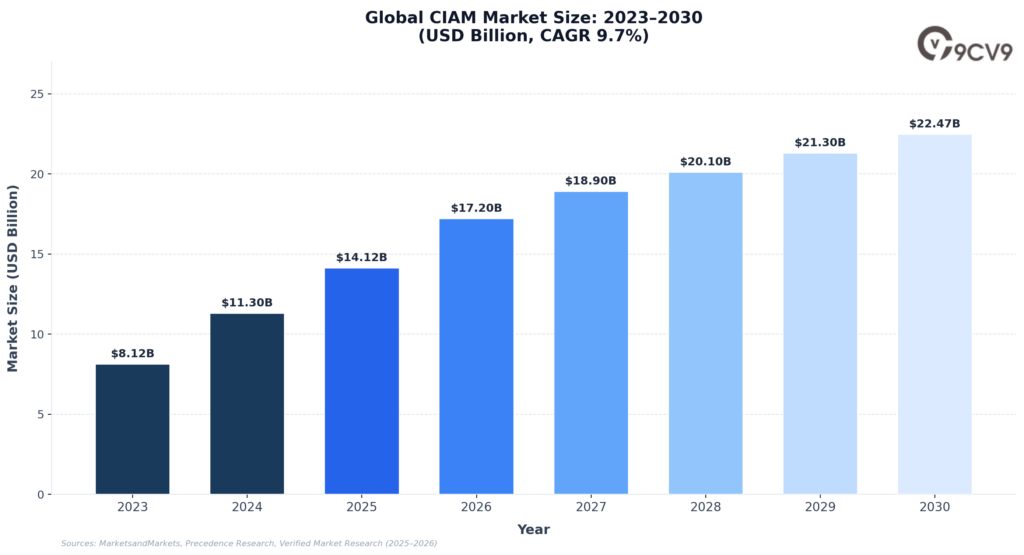
1. $14.12B (2025) — The global CIAM market is valued at $14.12 billion in 2025, reflecting strong demand for secure, scalable digital customer identity solutions as enterprises accelerate digital transformation strategies.
2. $21.67B (2026) — CIAM market size is projected to hit $21.67 billion in 2026, driven by surging cloud adoption, regulatory compliance mandates, and the rapid proliferation of digital-first customer experiences worldwide.
3. $22.47B (2030) — MarketsandMarkets forecasts the global CIAM market to reach $22.47 billion by 2030 at a 9.7% CAGR, underscoring CIAM’s transition from a niche IT tool to a core enterprise investment.
4. $26.72B (2030) — Grand View Research — A higher estimate from Grand View Research places the CIAM market at $26.72 billion by 2030 with a 17.4% CAGR, highlighting divergence in forecasts depending on the scope of “customer identity” included.
5. $31B (2032) — Verified Market Research projects the CIAM market to reach $31 billion by 2032 at a 13.03% CAGR, signaling that organizations across all sectors will need to modernize identity infrastructure over the coming decade.
6. $39.55B (2035) — With a 15% CAGR from 2027–2035, the CIAM market is on track to reach $39.55 billion, making it one of the fastest-growing segments within the broader cybersecurity industry.
7. $47B (2034) — Precedence Research’s long-range forecast places the global CIAM market at $47 billion by 2034 at a 10.16% CAGR, reflecting a decade of compounding investment in identity-centric security architecture.
8. $49.9B (2026, broader scope) — In the broader Consumer IAM definition (including all digital identity tools), the market will grow from $41.75B in 2025 to $49.9B in 2026 at a 19.5% CAGR, highlighting how expansive the space has become.
9. $101.15B (2030, broader scope) — The broader CIAM and Consumer Identity space is projected to reach $101.15B by 2030 at a 19.3% CAGR, with the growth attributed to zero-trust adoption, passwordless authentication demand, and digital banking expansion.
10. 10.16% CAGR (2025–2034) — A steady 10.16% compound annual growth rate for CIAM through 2034 makes it a reliable high-growth investment area, comparable to adjacent markets like endpoint security and cloud access management.
11. 13.03% CAGR (2026–2032) — At 13.03% CAGR, CIAM significantly outpaces average enterprise software growth, signaling organizations are committing budgets to customer identity at an accelerating pace.
12. 15% CAGR (CIAM Software, 2025–2033) — The CIAM software sub-segment is growing even faster at 15% CAGR through 2033, as cloud-native platforms replace on-premises deployments and feature sets expand to include AI, biometrics, and consent management.
13. 17.4% CAGR (Grand View Research, 2024–2030) — This higher CAGR estimate reflects inclusion of adjacent identity fraud detection and behavioral analytics markets increasingly bundled into CIAM platforms.
14. 19.5% CAGR (2025–2026) — The sharpest short-term growth, driven by post-pandemic digital channel investments and regulatory compliance timelines tightening across the EU, US, and APAC.
15. 22% CAGR (North America, 2026–2033) — North America’s CIAM market is the world’s fastest-growing major region in CAGR terms, as US companies grapple with CCPA, state privacy laws, and record-high breach costs.
🌍 REGIONAL MARKET DATA
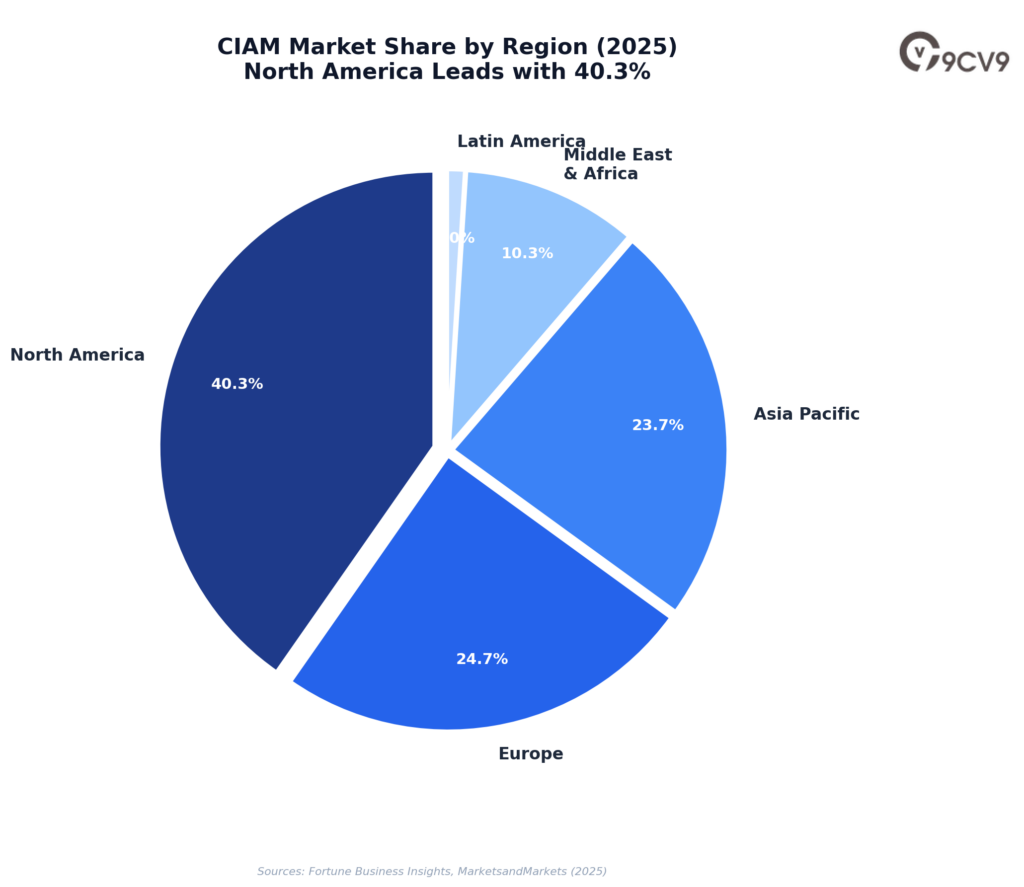
16. 40.3% Market Share — North America (2025) — North America dominates global CIAM, holding 40.3% of market share in 2025, anchored by the US’s concentration of tech-forward sectors (BFSI, healthcare, media) and stringent privacy laws like CCPA.
17. $6.52B — North America IAM (2025) — The absolute value of the North American IAM market is $6.52 billion in 2025, projected to reach $7.61B in 2026, reflecting the region’s unmatched enterprise security investment.
18. 24.7% Market Share — Europe (2025) — Europe holds the second-largest CIAM market share at 24.7%, primarily driven by GDPR compliance mandates that make robust customer identity management a legal necessity rather than an option.
19. $5.03B — European IAM Market (2025) — Europe’s IAM market was $5.03B in 2025, growing to $5.93B in 2026, with Germany and the UK as key contributors accounting for over $2.6B combined.
20. 23.7% Market Share — Asia Pacific (2025) — Asia Pacific captures nearly a quarter of the global CIAM market (23.7%, $4.84B in 2025), with the region poised for the highest regional CAGR driven by mobile-first digital economies.
21. $1.574B — China CIAM (projected 2026) — China’s CIAM market is set for rapid growth, reflecting the country’s aggressive digital payments, e-government services, and AI-powered identity verification deployments.
22. $1.156B — Japan CIAM (projected 2026) — Japan’s CIAM market reflects strong enterprise security investment, with companies like Tokyu Corporation already reporting that 45% of their users have registered passkeys.
23. $1.136B — India CIAM (projected 2026) — India’s fast-growing digital identity market is fueled by the Digital Personal Data Protection Act (DPDPA), Aadhaar identity infrastructure, and rapid fintech expansion.
24. $2.54B — Middle East & Africa IAM (projected 2026) — MEA’s CIAM market is growing as governments in Saudi Arabia, Egypt, and Jordan implement data protection laws, unlocking new commercial opportunities.
25. Highest CAGR — Asia Pacific — Asia Pacific is consistently ranked as the CIAM market’s fastest-growing region, with surging demand from ASEAN digital transformation initiatives, mobile commerce, and AI-driven identity innovation.
🔐 AUTHENTICATION & PASSWORD STATISTICS
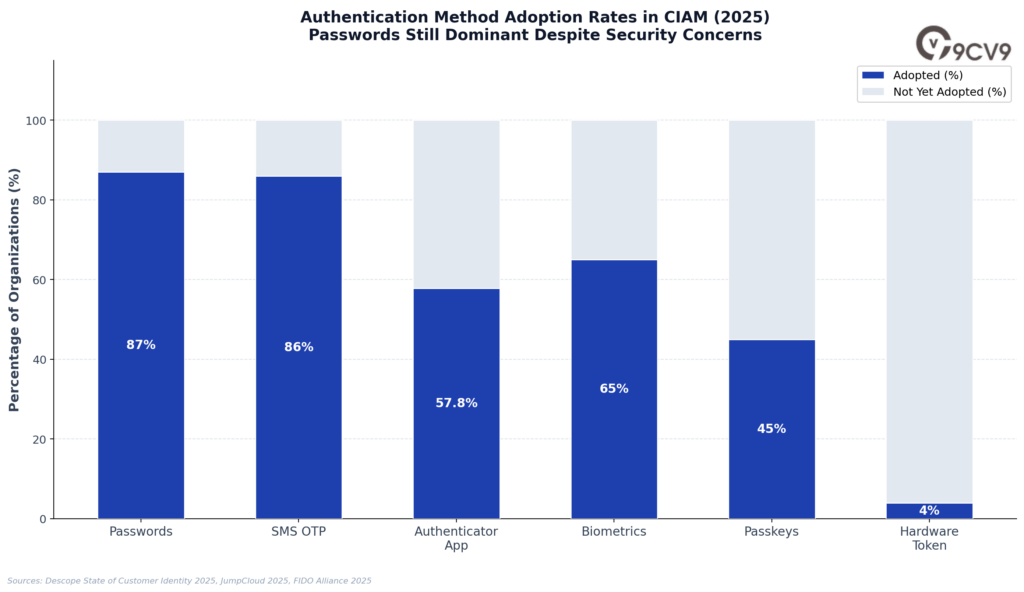
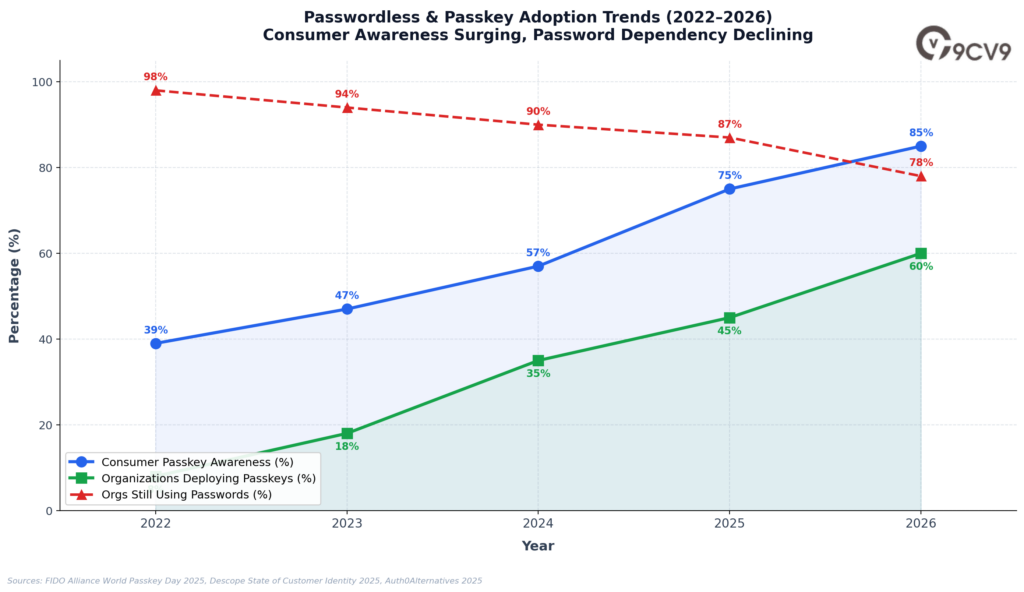
26. 87% — Organizations Still Using Passwords — A staggering 87% of organizations still deploy password-based authentication for customer-facing apps in 2025, creating massive security exposure and user experience friction simultaneously.
27. 2% — Believe Passwords Are Effective — Only 2% of organizations believe that passwords effectively balance security and user experience, yet organizational inertia and legacy system dependencies prevent rapid migration away from them.
28. 60% — Brute Force Attack Share — Brute force attacks grew from 20% to 60% of all Basic Web Application Attacks (Verizon DBIR 2025), making credential-based attacks the single most critical driver for CIAM adoption in 2026.
29. 22% — Breaches Beginning with Credential Abuse — Credential abuse is now the #1 initial breach vector (22%), outpacing phishing and exploits, reinforcing why CIAM platforms with adaptive authentication are mission-critical infrastructure.
30. 75% — Global Consumer Passkey Awareness — According to the FIDO Alliance’s 2025 World Passkey Day Report, 75% of global consumers are now aware of passkeys, a major milestone enabling mainstream enterprise and consumer adoption.
31. 57% — Consumer Passkey Awareness (2024) — By 2024, 57% of consumers were aware of passkeys, up from 39% in 2022, a nearly 50% increase in two years demonstrating explosive grassroots interest in passwordless security.
32. 45% — Organizations Deploying Passkeys — 45% of organizations have already deployed passkeys in at least one app, and 27% plan implementation within the next two years, making passkeys the near-term standard for CIAM authentication.
33. 1.3M — Monthly Passkey Authentications at Dashlane (2025) — Dashlane’s passkey authentications doubled from 2024 to 2025, reaching 1.3 million per month — concrete proof that user adoption of passwordless auth is accelerating rapidly.
34. 1B+ People Have Activated a Passkey — More than one billion people globally have activated at least one passkey, and over 15 billion online accounts support passkey login, crossing the critical mass threshold for mainstream deployment.
35. 75% Faster Sign-Ins with Passkeys — Passkey authentication delivers sign-ins up to 75% faster and 20% more successful than passwords (FIDO Alliance), making the business case for passwordless CIAM compelling on UX and security grounds simultaneously.
36. 30% Conversion Lift with Passkeys — Organizations deploying passkeys see a 30% improvement in sign-in success rates (Amazon’s 175M passkey rollout), directly translating to revenue gains for e-commerce and digital service platforms.
37. $2M Annual Savings — Passwordless vs. Passwords — A Ponemon Institute study found that passwordless authentication saves organizations nearly $2 million annually compared to maintaining traditional passwords and MFA infrastructure.
38. 75.44% — Passkey-Ready Devices (July 2025) — Nearly three-quarters of all devices globally were passkey-ready by mid-2025, eliminating the hardware barrier that historically slowed passwordless CIAM adoption.
39. 25% — Top 1,000 Websites Offering Passkeys (by end 2025) — One in four of the world’s top 1,000 websites is expected to offer passkey login by end of 2025, signaling that the industry has crossed the tipping point from early adopter to mainstream.
40. 100 — Average Online Accounts Per Person — The average person manages approximately 100 different online accounts but reuses only a handful of passwords, creating cascading breach risk that CIAM platforms with SSO and passkeys are designed to eliminate.
41. $86.35B — Passwordless Auth Market by 2033 — The passwordless authentication market is projected to grow from $18.36B in 2024 to $86.35B by 2033, growing nearly 5x in under a decade as cyber threats and regulatory mandates converge.
🛡️ MFA ADOPTION & EFFECTIVENESS
42. 87% — MFA Adoption at Large Enterprises — Among companies with 10,000+ employees, 87% enforce MFA (JumpCloud 2025), demonstrating that enterprise security hygiene has reached near-ubiquity — though the SMB gap remains a systemic risk.
43. 34% or Less — SMB MFA Adoption Rate — Only 34% or fewer SMBs have deployed MFA (JumpCloud 2025), creating a two-tier security landscape where smaller businesses remain disproportionately vulnerable to credential-based attacks.
44. 50% — MFA Reduces Successful Breaches — Companies that require MFA see a 50% reduction in successful breach rates, giving security teams a simple, high-ROI first step toward closing the most common attack surface in customer identity.
45. 99.9% — Account Compromise Attacks Blocked by MFA — Microsoft’s data shows that MFA can block over 99.9% of account compromise attacks, making it perhaps the single highest-ROI security investment any organization can make for CIAM.
46. 66% — Overall Global MFA Adoption (2025) — Global MFA adoption has reached 66% overall, with technology firms leading at 88%, but significant gaps remain in healthcare, education, and SMB sectors where CIAM investment is still nascent.
47. 50% — US Businesses Requiring MFA — As of 2025, approximately 50% of US businesses require MFA for employees, a figure that still leaves half of the enterprise ecosystem exposed to preventable credential-based attacks.
48. 86% — Organizations Using SMS OTP for MFA — Despite its known vulnerability to SIM-swapping and phishing-resistant MFA alternatives, 86% of companies still use SMS OTP as their primary MFA method — a critical gap in CIAM security posture.
49. 57.8% — MFA via Authenticator Apps — Authenticator apps account for 57.8% of MFA adoption globally (by deployment method), as they strike a better security-usability balance than SMS OTP while remaining more accessible than hardware tokens.
50. 77% — Drop in Help Desk Tickets with Passkeys — Enterprises deploying passkeys see help-desk tickets drop by 77% (Auth0Alternatives 2025), directly reducing operational overhead and freeing IT resources for higher-value security initiatives.
51. 94% — Reduction in Manual Provisioning Errors — Automating identity workflows via SCIM reduces manual provisioning errors by 94%, demonstrating that modern CIAM platforms don’t just improve security — they systematically eliminate human error.
52. 85% — Onboarding Time Reduction via IAM — Intelligent access provisioning cuts employee onboarding time by 85% (Okta 2024 Report), showing that CIAM’s ROI extends well beyond security into operational productivity and talent experience.
⚠️ IDENTITY FRAUD & THREAT LANDSCAPE
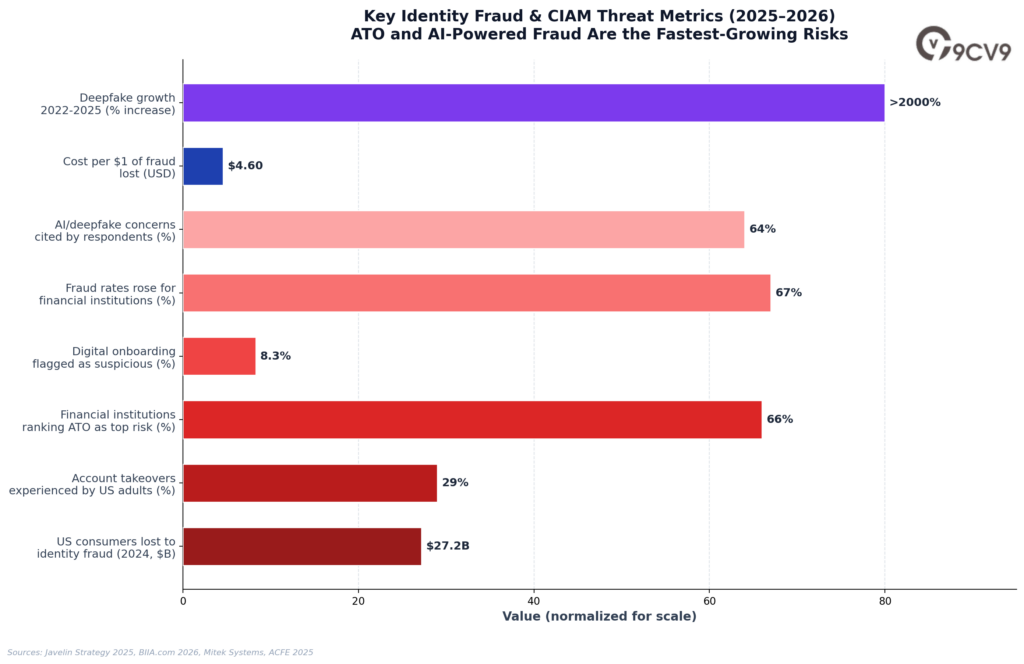
53. $27.2B — US Consumer Identity Fraud Losses (2024) — US consumers lost $27.2 billion to identity fraud in 2024, a 19% increase from the prior year (Javelin Strategy), underscoring the urgent need for AI-powered CIAM fraud detection at scale.
54. $50B+ — Global Identity Fraud Cost (2025) — The projected global cost of identity fraud in 2025 exceeds $50 billion, spanning financial services, healthcare, e-commerce, and government benefits programs — all primary CIAM use cases.
55. $4.88M — Average Data Breach Cost (2024) — IBM’s 2024 Cost of a Data Breach report places the average breach at $4.88 million, a 10% increase year-over-year, creating a powerful financial argument for proactive CIAM investment.
56. 29% — US Adults Experiencing ATO (2024) — Nearly 29% of US adults — approximately 77 million people — experienced an account takeover in 2024, making it one of the most common and pervasive forms of identity crime in the digital economy.
57. 13% YoY — ATO Loss Growth (2024) — Account takeover fraud losses grew 13% year-over-year in 2024 (Javelin Strategy), even as incident volumes declined, because fraudsters are targeting higher-value accounts with greater sophistication.
58. $17B — Global ATO Fraud Losses Projected (2025) — SEON projects global ATO losses will reach $17 billion in 2025, up from $13 billion in 2023, making it the fastest-growing fraud type and a primary driver of CIAM investment.
59. $2.9B — ATO Fraud Losses (Javelin 2025) — ATO fraud losses in the US alone reached $2.9 billion according to Javelin’s 2025 Identity Fraud Study, confirming it as the fastest-growing fraud category requiring CIAM intervention.
60. $5M — Average ATO Cost to a Company — Beyond individual victims, the average cost to a company suffering an account breach is $5 million (security.org), encompassing remediation, regulatory fines, customer compensation, and reputational damage.
61. 67% — Financial Institutions Reporting Fraud Rate Increases — Two-thirds of financial institutions saw fraud rates rise in 2025 (BIIA.com), directly correlating with the proliferation of AI-generated synthetic identities and deepfake-powered attacks.
62. 8.3% — Digital Account Creations Flagged as Suspicious — In H1 2025, 8.3% of digital onboarding attempts were flagged as suspicious, highlighting the scale of new account fraud that CIAM platforms with real-time risk scoring must detect and prevent.
63. 64% — Organizations Citing AI Deepfakes as Top Fraud Threat — Nearly two-thirds of industry respondents view AI-powered deepfakes as their primary identity fraud concern for 2026, with stolen biometric data emerging as the next frontier for synthetic identity creation.
64. 2,000%+ — Deepfake Fraud Surge (2022–2025) — Deepfake fraud attempts have surged more than 2,000% over three years, with deepfake files growing from ~500,000 in 2023 to ~8 million by 2025 — overwhelming legacy identity verification systems.
65. 6.5% — Deepfake Share of All Fraud Attacks — In some sectors, deepfakes now account for roughly 6.5% of all fraud attacks, a share that is growing rapidly as generative AI tools become more accessible to malicious actors.
66. 25% or Less — Human Detection Rate for Deepfakes — Human reviewers correctly identify high-quality deepfake videos less than 25% of the time, making AI-powered liveness detection in CIAM platforms a non-negotiable requirement.
67. $30–35B — Projected US Synthetic Identity Fraud (Annual) — Estimated annual US economic losses from synthetic identity fraud could reach $30–$35 billion, with fraudsters increasingly blending real and fabricated data to defeat traditional verification.
68. 30% — Annual Rise in Account Takeover Rate — The rate of account takeovers has increased by approximately 30% annually (Snappt), driven by massive credential leaks, automated credential stuffing, and AI-generated phishing campaigns.
69. $1,600 — Average Financial Loss Per Identity Theft (2025) — The average loss per identity theft case reached $1,600 in 2025, up from $1,300 in 2023, reflecting both inflation and more sophisticated, targeted attacks on high-value accounts.
70. Every 14 Seconds — Identity Theft Attempt in the US — An average American experiences an identity theft attempt every 14 seconds, reinforcing that identity protection is not a niche concern but a ubiquitous digital risk that CIAM must address at scale.
🤖 AI, BIOMETRICS & ADVANCED CIAM TECHNOLOGY
71. 80% — FIs Adopting Face-Based Biometrics by 2025 — Juniper Research projected that over 80% of financial institutions would adopt face-based biometric verification by 2025, driven by digital onboarding requirements and evolving KYC regulations.
72. 65% — US Banks Using Behavioral AI Biometrics — 65% of US financial institutions are already leveraging behavioral AI biometrics to analyze unique user patterns for continuous authentication and account takeover prevention (Global Growth Insights).
73. 30% — AI Fraud Detection Reduction in Fraud Instances — Businesses deploying AI-driven fraud detection achieve approximately a 30% reduction in fraud instances (Snappt), making the ROI calculation for AI-enhanced CIAM platforms straightforward.
74. 90% — FIs Incorporating AI into Fraud Management — A remarkable 90% of financial institutions have already incorporated AI into their fraud management strategies (Feedzai 2025), establishing AI as the de facto standard for CIAM security operations.
75. 93% — FIs Planning Increased AI Investment — 93% of financial institutions plan to increase AI investments for fraud detection in the next 2–5 years (Mastercard), signaling sustained demand for AI-native CIAM platforms and capabilities.
76. 760M People — Using Biometrics for Payments by 2029 — Goode Intelligence forecasts that 760 million people will use biometrics to secure payment accounts by 2029, transforming biometric CIAM from a premium feature to a mainstream expectation.
77. 43% — Breach Prevention Improvement (Ping Identity AI Engine) — Ping Identity’s Zero Trust AI Engine improved breach prevention by 43% using dynamic risk scoring and real-time behavioral analytics, demonstrating measurable security gains from AI-powered CIAM.
78. 99.1% Accuracy — AI Liveness Detection — Liveness detection combined with AI achieves 99.1% accuracy on real identity documents (BIIA.com 2026), making biometric-based CIAM dramatically more reliable than human document review.
79. 220ms — Behavioral Biometrics Detection Latency — Behavioral biometrics systems detect fraudulent activity with less than 220ms latency (BIIA.com), enabling real-time intervention without introducing perceptible friction into the customer experience.
80. 85% — ML-Based Fraud Prevention Improvement — Real-time machine learning prevents 85% more fraudulent transactions compared to rule-based systems (BIIA.com 2026), establishing ML as the core fraud prevention architecture for next-generation CIAM.
⚖️ REGULATORY COMPLIANCE & PRIVACY
81. $263.3M — Global Fines for AML/KYC Breaches (H1 2024) — Approximately 80 fines totaling $263.3 million were issued globally for AML, KYC, and data protection violations in the first half of 2024 alone, making compliance-grade CIAM a financial imperative for regulated industries.
82. 94% — Customers Won’t Buy Without Data Protection — 94% of organizations confirm that customers will not purchase from them if they fail to adequately protect personal data (Cisco Privacy Survey 2023), making CIAM a direct revenue enabler.
83. 46% — Consumers Who Switched Over Data Policies — 46% of consumers have switched companies over data privacy policies (Cisco 2023), demonstrating that CIAM and privacy management are competitive differentiators, not just compliance checkboxes.
84. 10% — Large Enterprises with Mature Zero Trust Programs by 2026 — Gartner projects that 10% of large enterprises will have a mature, measurable Zero Trust program by 2026, up from less than 1% in 2022 — reflecting the accelerating Zero Trust adoption curve.
85. 60% — Enterprises Adopting Zero Trust by 2025 — Gartner predicts 60% of enterprises will adopt zero-trust principles by 2025, transitioning from VPN-centric perimeter security to identity-centric, CIAM-anchored continuous verification models.
86. $1.5M — Savings Per Breach with Privacy Programs — IBM research shows organizations with advanced privacy programs save $1.5 million per breach compared to those without, validating the financial return of investing in CIAM and privacy-by-design architecture.
87. 61% — Planning PQC Migration Within 5 Years — 61% of organizations plan to migrate to Post-Quantum Cryptography within five years, yet only 41% have started, creating an urgent timeline for CIAM platforms to integrate quantum-resistant authentication.
88. GDPR 2.0 (Expected 2026) — Proposed GDPR updates expected in 2026 may require passwordless MFA for all customer-facing services, further accelerating CIAM modernization across European enterprises and their global digital platforms.
☁️ CLOUD DEPLOYMENT & ENTERPRISE ADOPTION
89. 62% — On-Premises CIAM Deployment (2023) — On-premises deployment accounted for 62% of CIAM market share in 2023 (Grand View Research), but this is rapidly declining as cloud-native solutions offer superior scalability, real-time analytics, and lower total cost.
90. 67% — Organizations Using Outdated IAM Systems — Two-thirds of organizations still operate on outdated IAM systems (Virtue Market Research 2026), creating scalability bottlenecks and security gaps that modern cloud-native CIAM platforms are positioned to close.
91. 65% — Cloud Adoption Acceleration via SCIM Automation — Automating identity workflows via SCIM provisioning accelerates cloud adoption by 65%, showing that CIAM modernization is a multiplier for broader cloud transformation initiatives.
92. 51% — Organizations Using Non-Specialized Auth Teams — 51% of organizations rely on developers with minimal authentication experience to build customer-facing identity systems (Descope 2025), explaining why CIAM security gaps are frequently discovered only after costly incidents.
93. 46% — Organizations Postponing CIAM Improvements — 46% of organizations delayed CIAM upgrades due to competing IT priorities (Descope 2025), accumulating UX debt, security technical debt, and growing compliance exposure in the process.
94. 47% — Struggling to Modernize Legacy Identity Systems — 47% of organizations acknowledge they struggle to modernize legacy IAM/CIAM systems (Descope 2025), reflecting the scale of migration complexity and the need for phased transition strategies.
95. 38% — Companies Making CIAM a Top Priority — 38% of companies now view implementing a solid CIAM solution as their top digital transformation priority (Virtue Market Research 2026), up from a minority position just a few years earlier.
96. $6/User/Month — Entry-Level AI CIAM Pricing — Ping Identity’s Zero Trust AI Engine is priced at $6/user/month for mid-to-large enterprises, establishing accessible SaaS pricing that removes cost as a barrier to modern CIAM adoption.
🏭 INDUSTRY VERTICALS
97. BFSI — Largest CIAM Segment — The Banking, Financial Services & Insurance (BFSI) sector leads CIAM adoption as the largest end-user segment in 2024, driven by the highest fraud exposure, strictest compliance requirements, and the most critical UX stakes.
98. Healthcare — Fastest Growing CIAM Vertical — Healthcare is the CIAM market’s fastest-growing vertical, as providers modernize access to telemedicine portals, patient records, and insurance platforms while complying with HIPAA, GDPR, and evolving state-level health privacy laws.
99. 68% — Healthcare Orgs Deploying Passwordless by 2025 — 68% of healthcare organizations intend to deploy passwordless security by 2025 (JumpCloud), the highest intent rate of any sector, driven by the catastrophic consequences of medical identity theft.
100. $14.6B — Healthcare Fraud (Single DOJ Enforcement, 2025) — A single 2025 DOJ enforcement action involving 324 defendants covered $14.6 billion in healthcare fraud, with identity theft at its core, demonstrating the enormous stakes of CIAM failure in healthcare.
101. 86% — FIs Citing Poor Data Management in Onboarding — 86% of financial institutions cited poor data management and siloed processes as primary reasons for client abandonment during onboarding (Expert Insights 2025), which CIAM with streamlined SSO and progressive profiling is specifically designed to resolve.
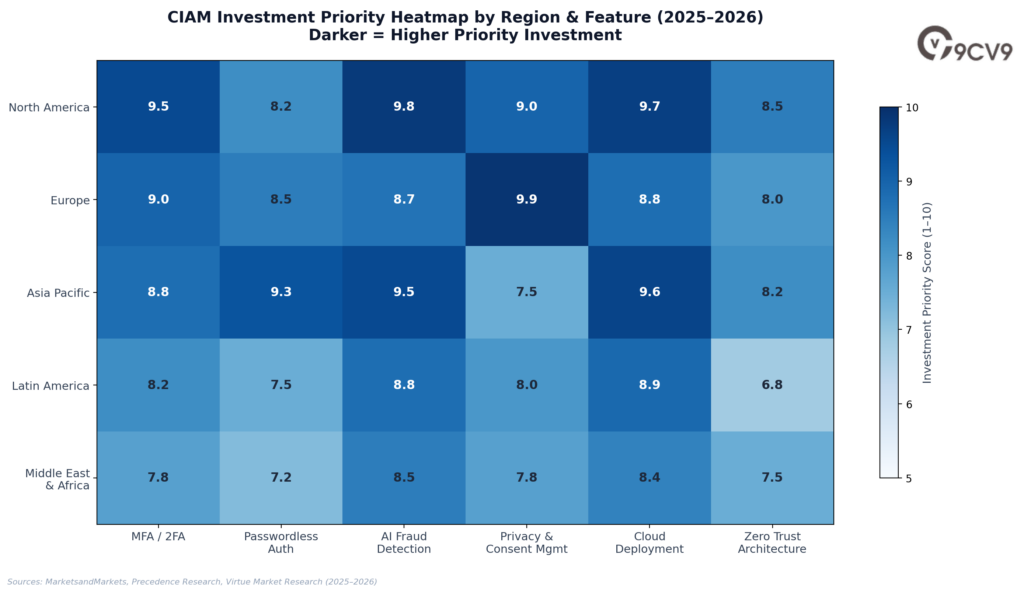
102. 60%+ — Asia Pacific Enterprises Prioritizing CIAM — Over 60% of Asia Pacific enterprises have prioritized CIAM to meet data privacy compliance mandates including Singapore’s PDPA and India’s DPDPA (MarketsandMarkets 2025).
🔮 FUTURE TRENDS & EMERGING TECHNOLOGIES
103. 50%+ Churn Reduction with Advanced CIAM — Gartner predicts that organizations deploying CIAM with built-in fraud detection and passwordless authentication could cut customer churn by more than 50%, establishing CIAM as a customer retention tool, not just a security function.
104. 65% — CIAM Solutions Offering IDV Connectors — 65% of CIAM solutions now offer Identity Verification (IDV) connectors (Expert Insights 2025), enabling real-time KYC verification and third-party identity checks to be embedded seamlessly into the customer onboarding flow.
105. 98% — ATO Reduction at CVS Health (Passkeys) — CVS Health achieved a 98% reduction in account takeover incidents after implementing passkeys, one of the most dramatic documented CIAM security improvements in any major enterprise deployment.
106. 1,300 — Support Call Reduction (MiLogin Passkeys) — Michigan’s MiLogin government identity system recorded 1,300 fewer support calls following its passkey deployment, validating that passwordless CIAM reduces both security incidents and support costs simultaneously.
107. 15% — Annual Digital Wallet Fraud Growth — Fraud via digital wallets such as Apple Pay and Google Pay has risen by 15% annually due to identity verification gaps in mobile onboarding, creating urgent demand for CIAM platforms with integrated digital wallet identity proofing.
108. $740M — CrowdStrike Acquires SGNL (January 2026) — CrowdStrike’s $740M acquisition of identity security startup SGNL signals how aggressively major cybersecurity firms are moving to embed real-time identity risk protection into their CIAM and Zero Trust platforms.
109. 35–45% — Top 5 Vendors’ Combined Market Share — The top five CIAM vendors (IBM, Okta, SAP, Microsoft, Ping Identity) collectively hold 35–45% of the market (MarketsandMarkets 2025), indicating a moderately consolidated but still competitive landscape with room for innovation.
110. 7,000+ — Okta’s Prebuilt CIAM Connectors — Okta’s Customer Identity Cloud offers over 7,000 prebuilt integration connectors, making enterprise CIAM onboarding faster and reflecting the complexity of modern digital ecosystems that identity platforms must navigate.
Conclusion
As the digital economy continues to expand, Customer Identity and Access Management (CIAM) has firmly established itself as one of the most strategically important pillars of modern cybersecurity, digital transformation, and customer experience. The statistics presented throughout this report clearly demonstrate that CIAM is no longer viewed merely as a security solution for authenticating users—it has evolved into a comprehensive business platform that enables organizations to build trust, strengthen customer relationships, comply with increasingly complex privacy regulations, and protect digital ecosystems against rapidly evolving cyber threats.
The remarkable growth of the global CIAM market reflects the critical role identity now plays in virtually every digital interaction. From online banking and healthcare portals to retail marketplaces, government services, streaming platforms, and enterprise SaaS applications, organizations are managing larger volumes of customer identities than ever before. As digital channels become the primary means of customer engagement, businesses increasingly recognize that every login, registration, transaction, and customer interaction depends on secure, intelligent, and frictionless identity management.
One of the strongest themes emerging from the latest industry data is the accelerating transition toward passwordless authentication. Traditional passwords continue to represent one of the weakest links in cybersecurity, contributing significantly to credential theft, account takeover attacks, phishing campaigns, and customer frustration. The rapid adoption of passkeys, biometric authentication, FIDO standards, hardware-backed authentication, and adaptive multi-factor authentication illustrates a fundamental shift toward more secure and user-friendly authentication methods. As billions of passkey-enabled devices become commonplace and major technology providers standardize passwordless experiences, organizations that continue relying solely on passwords will increasingly face higher security risks, lower customer satisfaction, and greater competitive disadvantages.
Artificial intelligence is equally transforming the future of CIAM. Modern platforms increasingly leverage AI and machine learning to detect abnormal user behavior, identify fraudulent login attempts, evaluate authentication risks in real time, and automate identity verification with remarkable accuracy. Behavioral biometrics, continuous authentication, risk-based access controls, intelligent fraud detection, and automated identity orchestration are rapidly becoming standard capabilities rather than premium features. These technologies enable businesses to strengthen security while minimizing friction for legitimate users—a balance that has historically been difficult to achieve.
The growing sophistication of cyber threats further reinforces the urgency of CIAM modernization. Credential stuffing, phishing attacks, synthetic identities, deepfake-powered fraud, account takeover schemes, and AI-generated cyberattacks continue to evolve at an alarming pace. Identity has become the primary attack surface for modern cybercriminals, making customer identity protection an executive-level priority rather than simply an IT responsibility. Organizations that invest proactively in modern CIAM platforms are significantly better positioned to reduce fraud losses, strengthen regulatory compliance, improve incident response capabilities, and safeguard customer trust in an increasingly hostile digital landscape.
Regulatory compliance continues to be another major catalyst driving enterprise investment in CIAM. Privacy legislation such as GDPR, CCPA, DPDPA, PDPA, HIPAA, PSD2, and numerous emerging regional frameworks require organizations to implement stronger controls over customer identities, consent management, authentication, and personal data governance. Rather than viewing compliance as merely a legal obligation, forward-looking organizations increasingly recognize that transparent privacy practices and secure identity management directly influence customer confidence, brand reputation, and long-term business success.
Another notable trend highlighted by the latest data is the growing convergence between cybersecurity and customer experience. Historically, organizations often treated security and usability as competing priorities. Today’s leading CIAM platforms prove that both objectives can coexist. Features such as single sign-on (SSO), adaptive authentication, progressive profiling, social login, passwordless authentication, customer consent management, and intelligent risk scoring enable businesses to provide seamless digital experiences while maintaining robust security controls. This shift reflects a broader understanding that customer experience has become a competitive differentiator, and secure identity management plays a central role in delivering that experience.
Cloud computing continues to reshape the CIAM landscape as organizations migrate away from legacy identity infrastructures toward scalable, API-first, cloud-native platforms. Cloud-based CIAM solutions provide greater flexibility, faster deployment, improved scalability, continuous innovation, and simplified integration with thousands of third-party applications and digital services. This transition is expected to accelerate further as organizations modernize legacy environments, adopt hybrid cloud architectures, and expand their digital ecosystems across multiple channels and devices.
The statistics also demonstrate significant differences in adoption across industries and regions. Financial services, healthcare, government agencies, retail, telecommunications, and technology companies remain among the largest adopters of advanced CIAM solutions due to their unique regulatory requirements, fraud exposure, and high-value customer interactions. Meanwhile, Asia Pacific continues to emerge as one of the fastest-growing regional markets, fueled by rapid digitalization, expanding fintech ecosystems, government-backed digital identity initiatives, and increasing investments in cybersecurity infrastructure.
Vendor competition is expected to remain intense throughout the remainder of the decade. Established leaders such as Okta, Microsoft, IBM, Ping Identity, SAP, ForgeRock, Auth0, and numerous emerging innovators continue expanding their capabilities through artificial intelligence, Zero Trust architectures, decentralized identity, identity verification connectors, behavioral analytics, and advanced fraud prevention technologies. At the same time, acquisitions, strategic partnerships, and ongoing platform consolidation indicate that identity security has become one of the most valuable segments within the broader cybersecurity industry.
Looking ahead, the future of CIAM extends well beyond authentication alone. Emerging technologies including decentralized identity (DID), verifiable credentials, digital identity wallets, post-quantum cryptography, AI-assisted identity verification, continuous authentication, and real-time trust evaluation are expected to redefine how organizations establish and maintain digital trust. Businesses that embrace these innovations early will likely gain meaningful competitive advantages through stronger security, improved operational efficiency, reduced fraud, and enhanced customer loyalty.
Ultimately, the Top 110 Customer Identity and Access Management (CIAM) Software Statistics, Data & Trends in 2026 reveal a technology market undergoing rapid innovation and sustained global expansion. They illustrate how customer identity has become one of the most valuable assets organizations manage and one of the most critical factors influencing cybersecurity resilience, regulatory compliance, customer satisfaction, and digital business growth.
For CIOs, CISOs, IT leaders, security architects, compliance professionals, software developers, technology investors, digital transformation executives, and business decision-makers, these insights provide a comprehensive understanding of where the CIAM market stands today and where it is heading next. They highlight not only the enormous opportunities created by modern identity technologies but also the significant risks faced by organizations that fail to modernize outdated identity infrastructures.
As digital identities continue to outnumber human populations, online interactions become increasingly interconnected, and cyber threats grow more sophisticated, Customer Identity and Access Management will remain at the center of enterprise technology strategies for years to come. Organizations that invest in intelligent, scalable, privacy-centric, and AI-powered CIAM solutions today will be better equipped to deliver secure customer experiences, maintain regulatory compliance, combat emerging threats, and build the trusted digital relationships that define success in the modern economy. The statistics presented throughout this report serve not only as a snapshot of the CIAM industry in 2026 but also as a roadmap for understanding the future direction of digital identity management in an increasingly connected world.
If you find this article useful, why not share it with your hiring manager and C-level suite friends and also leave a nice comment below?
We, at the 9cv9 Research Team, strive to bring the latest and most meaningful data, guides, and statistics to your doorstep.
To get access to top-quality guides, click over to 9cv9 Blog.
To hire top talents using our modern AI-powered recruitment agency, find out more at 9cv9 Modern AI-Powered Recruitment Agency.
People Also Ask
What is Customer Identity and Access Management (CIAM)?
Customer Identity and Access Management (CIAM) is a security framework that manages customer identities, authentication, authorization, and profile data while providing secure, seamless access to digital applications and services.
Why is CIAM important in 2026?
CIAM is essential in 2026 because businesses face increasing cyber threats, stricter privacy regulations, and rising customer expectations for secure, frictionless digital experiences across web and mobile platforms.
How large is the global CIAM software market in 2026?
The global CIAM software market is projected to reach several billion dollars in 2026, driven by cloud adoption, digital transformation, AI-powered identity verification, and increasing cybersecurity investments.
What are the biggest CIAM trends in 2026?
Major CIAM trends include passwordless authentication, passkeys, biometric login, AI-driven fraud detection, Zero Trust security, decentralized identity, cloud-native platforms, and adaptive authentication.
What industries use CIAM software the most?
Banking, healthcare, retail, e-commerce, government, telecommunications, education, travel, and SaaS companies are among the largest adopters of CIAM solutions.
What is passwordless authentication?
Passwordless authentication allows users to sign in using biometrics, passkeys, or security keys instead of passwords, improving security while reducing login friction and credential theft.
How do passkeys improve customer security?
Passkeys use public-key cryptography to replace passwords, making phishing attacks, credential stuffing, and password reuse significantly more difficult for cybercriminals.
What is the difference between IAM and CIAM?
IAM manages employee identities and internal access, while CIAM focuses on customer identities, delivering secure authentication, consent management, and personalized user experiences.
How does CIAM improve customer experience?
CIAM enables faster registration, single sign-on, personalized experiences, secure authentication, and seamless access across multiple devices and digital channels.
Why are CIAM statistics important for businesses?
CIAM statistics help organizations understand market trends, investment priorities, customer expectations, security risks, and emerging technologies for better identity management decisions.
What role does AI play in CIAM?
Artificial intelligence helps detect fraud, identify suspicious login behavior, automate risk analysis, strengthen authentication, and improve overall identity security.
How does multi-factor authentication improve CIAM?
Multi-factor authentication adds extra verification steps beyond passwords, reducing unauthorized access and protecting customer accounts from cyberattacks.
What is adaptive authentication?
Adaptive authentication evaluates login risks based on device, location, behavior, and other factors to determine whether additional verification is required.
Why is cloud-based CIAM growing rapidly?
Cloud-based CIAM offers scalability, lower infrastructure costs, faster deployment, continuous updates, and easier integration with modern digital applications.
What are the biggest cybersecurity threats driving CIAM adoption?
Credential theft, phishing, ransomware, account takeover attacks, identity fraud, and data breaches are key threats accelerating CIAM implementation worldwide.
How does CIAM support regulatory compliance?
CIAM helps organizations comply with GDPR, CCPA, HIPAA, and other privacy regulations by managing user consent, identity verification, and secure customer data storage.
What is customer identity verification?
Customer identity verification confirms that users are who they claim to be through documents, biometrics, AI verification, or other authentication technologies.
What is Zero Trust in CIAM?
Zero Trust assumes no user or device is automatically trusted and continuously verifies identity before granting or maintaining access.
How does CIAM reduce account takeover attacks?
CIAM combines multi-factor authentication, behavioral analytics, AI monitoring, and passwordless login to prevent unauthorized access to customer accounts.
What are biometric authentication methods?
Common biometric authentication methods include fingerprint recognition, facial recognition, iris scanning, and voice authentication.
Which regions are leading CIAM adoption?
North America currently leads the CIAM market, while Europe and Asia-Pacific are experiencing rapid growth due to expanding digital services and stronger privacy regulations.
Why are businesses investing more in CIAM?
Organizations invest in CIAM to improve cybersecurity, protect customer trust, meet compliance requirements, reduce fraud, and enhance digital customer experiences.
How does CIAM support digital transformation?
CIAM enables secure digital onboarding, cloud migration, omnichannel customer access, personalized experiences, and scalable identity management across platforms.
What is decentralized identity?
Decentralized identity gives users greater control over their digital identities through blockchain-inspired technologies and verifiable credentials instead of centralized databases.
How does CIAM improve customer retention?
A secure and frictionless login experience increases customer satisfaction, reduces abandoned registrations, and strengthens long-term brand loyalty.
What are the benefits of single sign-on (SSO) in CIAM?
Single sign-on allows customers to access multiple applications with one login, improving convenience while reducing password fatigue and support costs.
How is identity fraud evolving in 2026?
Identity fraud is becoming more sophisticated through AI-generated phishing, synthetic identities, deepfakes, and automated credential attacks, increasing demand for advanced CIAM.
What factors are driving CIAM market growth?
Digital banking, e-commerce expansion, cloud adoption, cybersecurity concerns, regulatory compliance, remote services, and AI innovations are fueling CIAM market growth.
What should businesses look for when choosing CIAM software?
Businesses should evaluate security, scalability, compliance support, API integrations, passwordless authentication, AI capabilities, user experience, and cloud deployment options.
What can businesses learn from CIAM statistics in 2026?
CIAM statistics reveal market opportunities, technology adoption rates, cybersecurity risks, customer behavior, investment priorities, and future identity management trends that support informed business decisions.
Sources
MarketsandMarkets Precedence Research Grand View Research Verified Market Research Virtue Market Research Business Research Company Verified Market Reports Market Research Intellect Data Insights Market Strategic Revenue Insights Fortune Business Insights Descope FIDO Alliance Auth0Alternatives JumpCloud Expert Insights LLCBuddy IDMWorks BIIA Snappt Mitek Systems AuthX Javelin Strategy IBM Verizon Feedzai ACFE Equipment Finance News Cisco TrustBuilder Gartner Thales Group MojoAuth Cybersecurity Intelligence Banking Security Guide