



























Key Takeaways
- Romania’s Labour Market in 2026: With unemployment at approximately 5.8% in mid-2025 and a job vacancy rate of 0.6%, recruitment remains challenging due to skills shortages, economic uncertainty, and workforce mismatches.
- Salary Growth and Talent Shortages: Romania’s average gross monthly salary is estimated at RON 9,220 in 2026, while brain drain, an ageing workforce, and growing demand for foreign workers are reshaping recruitment strategies.
- AI, Technology, and Future Hiring Trends: Romania’s 150,000+ IT professionals, increasing AI adoption, and demand for specialised skills are driving changes in recruitment, remote work, talent acquisition, and employee retention.
Romania’s recruitment market in 2026 faces persistent skills shortages, rising salaries, workforce migration, and growing AI adoption. Explore 105 recruitment statistics and hiring trends covering unemployment at 5.8%, average gross monthly salaries of approximately RON 9,220, foreign worker demand, technology recruitment, and the changing employment landscape for employers and job seekers.
Romania’s recruitment landscape in 2026 is undergoing a significant transformation, shaped by economic uncertainty, persistent labour shortages, rising salary expectations, technological advancements, and changing workforce demographics. As one of Eastern Europe’s important employment markets and a growing destination for international outsourcing, Romania presents both opportunities and challenges for employers, recruiters, HR professionals, job seekers, and foreign investors.
Also, read some of our top articles here:
Salary Levels in Romania: An In-Depth Analysis
The State of Hiring and Recruitment in Romania
Top 10 Recruitment Agencies in Romania

Understanding the latest recruitment statistics in Romania in 2026 is essential for businesses seeking to attract skilled professionals, optimise hiring strategies, manage recruitment costs, and remain competitive in an increasingly complex labour market.
Despite its established manufacturing base, expanding digital economy, and access to the European Union’s labour market, Romania continues to face structural employment challenges. These include a shrinking working-age population, significant regional salary disparities, outward migration of skilled workers, and mismatches between available talent and employer requirements.
At the same time, emerging trends in artificial intelligence, remote work, salary growth, and international recruitment are reshaping how Romanian businesses identify, hire, and retain employees.
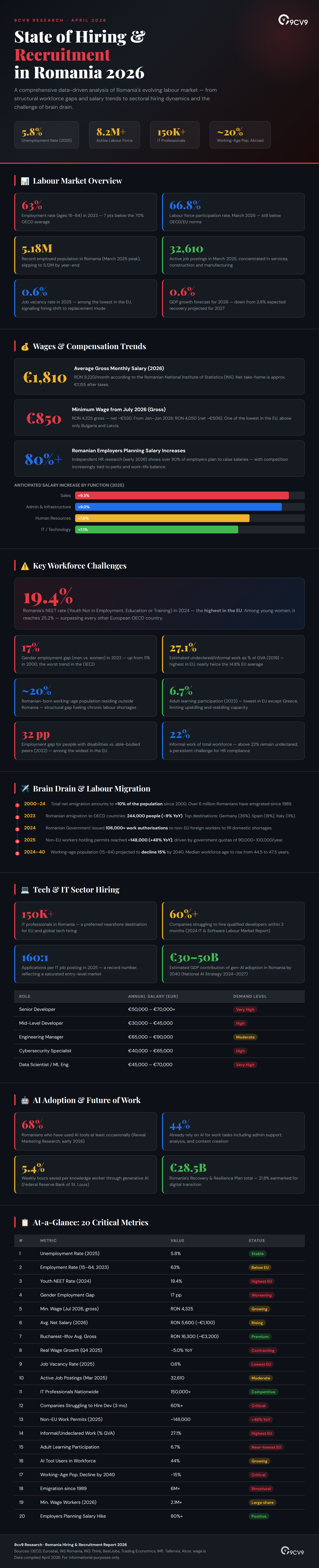
Romania’s Labour Market in 2026: Economic Pressures and Changing Employment Patterns
The Romanian labour market in 2026 reflects a combination of modest economic growth, constrained recruitment activity, and persistent structural skills shortages.
Romania recorded an unemployment rate of approximately 5.8% in June 2025, while projections in the dataset suggest unemployment could decline toward 5.0% by the end of 2026. However, relatively stable unemployment figures do not necessarily indicate a healthy or expanding labour market.
Romania’s job vacancy rate stood at approximately 0.6% in 2025, placing it among the lowest in the European Union. This suggests that many employers are prioritising workforce stability, replacement hiring, and operational efficiency rather than aggressive headcount expansion.
Economic conditions are also influencing recruitment decisions. Romania’s projected GDP growth of just 0.6% in 2026, combined with persistent inflation and fiscal consolidation measures, is placing pressure on corporate hiring budgets and public-sector employment.
For recruitment agencies and HR departments, these developments highlight the importance of adopting targeted recruitment strategies, improving candidate screening, and focusing on positions that deliver measurable business value.
Nevertheless, low overall vacancy rates coexist with shortages in industries such as construction, healthcare, logistics, manufacturing, and specialised technology services.
This contrast illustrates one of Romania’s most important recruitment challenges: a limited supply of suitably qualified workers despite relatively subdued overall hiring demand.
Salary Trends in Romania: Rising Compensation and Recruitment Costs
Salary growth remains one of the defining features of Romania’s employment market in 2026.
The dataset reports an average gross monthly salary of approximately RON 9,220, equivalent to around €1,810, alongside an average net monthly salary of approximately RON 5,600.
Romania’s statutory gross minimum wage increased from RON 4,050 in the first half of 2026 to RON 4,325 from July 2026, reflecting continued adjustments to wage regulations and living costs.
These developments have important implications for employers, particularly businesses operating in labour-intensive sectors.
Although nominal salaries have increased, persistent inflation continues to reduce purchasing power, creating additional pressure on companies to improve compensation packages and employee benefits.
Salary growth also varies significantly by industry. The dataset highlights increases of approximately 9.3% in sales, 9.0% in administration and infrastructure, 7.6% in human resources, and 7.1% in information technology during 2025.
Regional compensation differences further complicate recruitment strategies. Bucharest-Ilfov remains Romania’s highest-paying employment market, while regions such as Moldavia and Wallachia generally offer lower salary levels.
For organisations recruiting across Romania, understanding these regional and sector-specific salary differences is increasingly important for establishing competitive compensation benchmarks, controlling employment costs, and reducing employee turnover.
Skills Shortages, Brain Drain, and International Recruitment
One of the biggest challenges facing recruitment in Romania is the continued loss of working-age professionals through international migration.
According to the dataset, approximately 20% of Romanian-born working-age individuals reside abroad, demonstrating the substantial influence of emigration on the country’s domestic talent supply.
Germany, Spain, and Italy remain important destinations for Romanian workers seeking higher salaries and broader career opportunities.
This outward migration has contributed to labour shortages across multiple sectors, particularly healthcare, construction, transportation, manufacturing, and specialised technical occupations.
Demographic pressures are expected to intensify these challenges. Romania’s working-age population is projected to decline by approximately 15% between 2024 and 2040, potentially creating long-term recruitment difficulties for businesses dependent on domestic labour.
To address workforce shortages, Romanian employers are increasingly turning to international recruitment.
Romania maintained an annual quota of 100,000 newly admitted non-EU workers between 2022 and 2025, while the number of non-EU workers holding valid employment permits reached approximately 148,000 in late 2025, according to the dataset.
These figures demonstrate the growing importance of foreign talent acquisition, immigration compliance, workforce integration, and cross-border recruitment services.
For employers and recruitment agencies, attracting international workers is becoming an important component of long-term workforce planning.
Technology Recruitment, Artificial Intelligence, and Remote Work
Romania continues to position itself as a competitive European destination for software development, IT outsourcing, cybersecurity, and digital services.
With an estimated workforce exceeding 150,000 IT professionals, Romania offers international employers access to a substantial technology talent pool, particularly in cities such as Bucharest, Cluj-Napoca, and Iași.
However, the technology recruitment market is becoming increasingly segmented.
The dataset indicates that IT vacancies attracted approximately 160 applicants per position in 2025, reflecting intense competition among job seekers, particularly for entry-level and generalist positions.
At the same time, employers continue to experience difficulties recruiting experienced software engineers, cybersecurity specialists, engineering managers, and professionals with advanced technical expertise.
Salary expectations reflect this divide. Estimated annual compensation for mid-level developers ranges from €30,000 to €45,000, while senior developers may command €50,000 to €70,000 or more.
Artificial intelligence is also changing the Romanian workplace.
According to research figures included in the dataset, approximately 68% of Romanians had used AI tools at least occasionally by early 2026, while 44% reported using AI for work-related activities.
These developments are influencing recruitment processes, workforce productivity, job requirements, and employee training priorities.
Meanwhile, remote and hybrid working arrangements remain important considerations for technology professionals and international employers.
Companies that offer flexible working arrangements, competitive compensation, professional development, and meaningful career progression may be better positioned to attract and retain specialised talent.
Youth Employment, Workforce Participation, and Future Talent Development
Romania’s long-term recruitment outlook also depends on improving workforce participation and addressing employment barriers among younger workers, women, and disadvantaged groups.
The country’s youth NEET rate, measuring people not in employment, education, or training, reached approximately 19.4% in 2024, substantially exceeding the EU average of 11.0%.
The challenge is particularly pronounced among young women, whose NEET rate stood at approximately 25.2%.
These figures highlight a substantial pool of underutilised potential talent.
Low adult participation in lifelong learning and persistent education-to-employment mismatches further complicate the development of a workforce equipped for emerging industries.
For employers, these challenges create opportunities to invest in apprenticeships, graduate recruitment programmes, vocational training, internal mobility, and structured employee upskilling.
For policymakers, improving access to education, childcare, professional training, and inclusive employment opportunities will be essential for strengthening Romania’s long-term labour market competitiveness.
Why Romania Recruitment Statistics Matter in 2026
For businesses operating in Romania or considering expansion into the country, recruitment statistics provide valuable insights into workforce availability, salary expectations, hiring competition, and emerging employment trends.
Understanding Romania’s labour market data can help organisations make more informed decisions about where to establish operations, which positions to prioritise, how much to budget for salaries, and whether to recruit locally or internationally.
Recruitment agencies can also use these insights to identify high-demand occupations, develop specialised talent pipelines, improve candidate sourcing strategies, and advise clients on realistic hiring expectations.
Meanwhile, job seekers can benefit from understanding which industries offer promising employment opportunities, what skills employers increasingly value, and how salary expectations differ across regions and professional specialisations.
The most important takeaway is that Romania’s recruitment market in 2026 is not simply experiencing a shortage or surplus of workers. Instead, it is undergoing a structural transformation in which skills, location, specialisation, demographics, and technology increasingly determine employment outcomes.
What You Will Discover in These 105 Romania Recruitment Statistics
This comprehensive guide to the Top 105 Recruitment Statistics, Data & Trends in Romania in 2026 examines the key developments shaping the country’s hiring and employment landscape.
Drawing on 105 statistics, historical observations, market estimates, and forward-looking indicators, the article explores unemployment and employment rates, job vacancies, salary benchmarks, sector-specific recruitment demand, skills shortages, youth employment, international migration, foreign worker recruitment, IT hiring, artificial intelligence adoption, remote work, and regional labour market disparities.
It also considers how economic conditions, demographic changes, and evolving employee expectations are influencing recruitment strategies across Romanian industries.
By combining historical employment data from 2023–2025 with 2026 estimates and projections, this guide provides a broad perspective on the forces affecting Romania’s workforce and recruitment market. Figures should be interpreted according to their reporting periods, with projections distinguished from confirmed historical results.
Whether you are an employer planning to expand in Romania, an HR professional developing a recruitment strategy, a recruitment agency identifying new opportunities, or a job seeker evaluating career prospects, these 105 Romania recruitment statistics and hiring trends for 2026 offer a valuable starting point for making informed decisions.
As Romania navigates economic pressures, technological disruption, workforce ageing, and international competition for skilled professionals, organisations that understand these labour market developments will be better equipped to attract talent, manage employment costs, and build resilient workforces.
The following statistics provide a detailed examination of Romania’s evolving recruitment landscape and the trends likely to influence hiring decisions throughout 2026 and beyond.
Before we venture further into this article, we would like to share who we are and what we do.
About 9cv9
9cv9 is a business tech startup based in Singapore and in Asia, with a strong presence all over the world.
With over ten years of startup and business experience, and being highly involved in connecting with thousands of companies and startups, the 9cv9 team has access to some of the best talents in the world.
If your company needs recruitment and headhunting services to hire top-quality employees, you can use 9cv9 headhunting and recruitment services to hire top talents and candidates. Email us at hello@9cv9.com.
Top 105 Recruitment Statistics, Data & Trends in Romania in 2026
🏦 LABOUR MARKET OVERVIEW
1. 5.8% — Unemployment rate (June 2025)
Romania’s unemployment rate held at 5.8% in mid-2025 — 0.5 percentage points below the EU27 average — yet this headline figure conceals deep structural problems in labour force participation and skills mismatches.
2. ~5.3% — Projected unemployment rate for full year 2025
The IMF forecast a rate of 5.4% for 2025 and a gradual decline toward 5.0% by end-2026, reflecting modest stabilisation rather than robust job creation.
3. ~5.0% — Projected unemployment rate by end-2026
Romania’s unemployment is expected to edge lower in 2026, though economic contraction makes genuine improvements contingent on private sector activity rather than official statistics.
4. 8.39 million — Employed persons in Romania (March 2025)
Down from 8.57 million in March 2024, this decline reflects a shrinking workforce supply more than any dramatic rise in joblessness, underlining a tight but structurally constrained labour pool.
5. 5.18 million — Peak total civilian employment (March 2025)
This record peak quickly reversed, slipping to 5.12 million by December 2025, signalling that the labour market’s expansion phase has plateaued amid macro headwinds.
6. 5.12 million — Employed population by December 2025
The decline from March’s peak suggests Romania’s economy is shedding net jobs as fiscal tightening and weak private consumption bite into business activity.
7. 66.8% — Labour force participation rate (March 2025)
Still below OECD and EU norms, this low participation rate severely constrains the active talent pool available to employers — and recovery is unlikely without structural reforms targeting women and youth.
8. 63% — Employment rate for ages 15–64 (2023)
Seven percentage points below the 70% OECD average, Romania’s employment rate reflects persistent structural issues that neither economic boom years nor EU membership have fully resolved.
9. 0.6% — Job vacancy rate (2025)
Romania’s job vacancy rate is among the lowest in the European Union, signalling a fundamental shift from expansion hiring to replacement hiring as companies prioritise cost management over headcount growth.
10. 32,610 — Active job postings (March 2025)
Concentrated in skilled services, construction, and manufacturing, this figure represents a moderate, not robust, level of market demand that masks significant sector-level divergence.
11. 0.8% — Job vacancy rate (2023)
At 0.8% in 2023 — already 2 percentage points below the EU27 average — Romania’s structural hiring constraints have worsened since, falling to 0.6% by 2025, reflecting deepening replacement-mode hiring.
12. 0.6% — Romania’s expected GDP growth in 2026
GDP growth of just 0.6% in 2026 — following 0.9% in 2024 — confirms Romania is in a period of economic stagnation, limiting demand-side hiring impulses and suppressing job creation across sectors.
13. 2.8% — Projected GDP recovery in 2027
A meaningful rebound is forecast for 2027 as inflation moderates and EU-funded projects materialise, but even with recovery, job creation may not follow historical patterns due to automation trends.
14. −1.9% — Q4 2025 GDP contraction (quarter-on-quarter)
Romania entered a technical recession in late 2025, driven by a collapse in private consumption — a direct consequence of fiscal consolidation measures including higher taxes and frozen public wages.
15. 9% of GDP+ — Romania’s budget deficit (2024)
With a deficit exceeding 9% of GDP in 2024, Romania faces severe EU-mandated fiscal consolidation requirements, directly suppressing public sector hiring and wage growth.
💰 WAGES & COMPENSATION
16. RON 9,220/month (~€1,810) — Average gross monthly salary (2026)
According to official INS data, this figure represents strong nominal growth, but much of the gain has been eroded by near double-digit inflation that has pushed real purchasing power lower.
17. RON 5,600/month (~€1,100) — Average net salary (2026)
After Romania’s 10% flat income tax and 35% social contributions, the take-home pay of the average Romanian worker sits at approximately €1,100 — up about €60 since early 2025 but still well below Western European peers.
18. RON 4,325/month (~€850 gross) — Minimum wage from July 1, 2026
The mid-year hike follows the EU Adequate Minimum Wages Directive, but the concurrent reduction of the tax-exempt allowance from RON 300 to RON 200 partially offsets the gross increase for workers.
19. RON 4,050/month (~€800 gross) — Minimum wage January–June 2026
Held at the 2025 level for the first half of 2026, this rate represents a 12% increase over the 2024 rate of RON 3,700 — the continuation of an exceptionally rapid multi-year upward trajectory.
20. RON 2,699/month net — Minimum wage from July 1, 2026 (net)
The net figure is less impressive than the gross, as the simultaneous fiscal adjustment reduces the tax-exempt allowance, meaning workers gain less in purchasing power than headlines suggest.
21. RON 2,574/month net — Minimum wage January–June 2026 (net)
Approximately €506 per month in real take-home pay for minimum wage earners during the first half of 2026, placing Romania among the lowest in the EU in terms of net minimum compensation.
22. RON 2,230 → RON 4,050 — Minimum wage growth 2020–2025
Romania’s gross minimum wage almost doubled between 2020 and 2025 — an 81.6% increase driven by inflation, EU compliance requirements, and political pressure, though real-terms gains are substantially smaller.
23. 2.1 million — Workers on minimum wage in Romania (2026)
More than 2.1 million Romanian workers, including approximately 300,000 public sector employees, earn at or near the legal minimum — illustrating the breadth of low-wage employment in the economy.
24. 80%+ — Romanian employers planning salary increases (early 2026)
Independent HR research indicates that over 80% of Romanian companies plan salary increases in 2026, but competition is increasingly waged on perks, flexibility, and work-life balance rather than pay alone.
25. +9.3% — Sales sector average salary increase (2025)
Sales functions led salary growth in 2025, reflecting strong commercial competition and the premium placed on revenue-generating talent in a tightening consumer economy.
26. +9.0% — Admin & infrastructure salary increase (2025)
Administrative and infrastructure roles saw the second-highest increase, partially driven by staff retention challenges in sectors with high turnover and relatively low baseline wages.
27. +7.6% — HR sector salary increase (2025)
Human resources professionals saw compensation rise 7.6%, reflecting the increased strategic value placed on talent management as employers navigate complex recruitment and retention challenges.
28. +7.1% — IT sector salary increase (2025)
Despite the IT sector recording the lowest anticipated increase among tracked functions, absolute salaries remain the highest in Romania, making tech still the most compensated profession in the market.
29. +5.2% — Lowest anticipated salary increase (tech companies, 2026)
Technology companies projected the most conservative salary growth at 5.2% — reflecting the shift from volume hiring to retention- and seniority-based compensation strategies in a saturated market.
30. +13–20% — Salary premium for high-performing employees
High-achievers in Romanian organisations earn 13–20% more than their peers on average, underlining how performance differentiation is becoming a critical tool for retention in competitive sectors.
31. RON 16,300/month (~€3,200 gross) — Average salary in Bucharest-Ilfov (2025)
The capital region leads the country by a dramatic margin, paying 85%+ more than Moldavia and Wallachia, creating one of the starkest regional wage disparities in Eastern Europe.
32. ~RON 10,700/month — Average gross salary in Banat & Transylvania
The western and northwestern regions of Romania command a salary premium over the rest of the country, reflecting industrial concentration and proximity to Western European markets.
33. ~RON 8,800/month — Average gross salary in Moldavia & Wallachia
Eastern and southern regions continue to lag dramatically behind, reinforcing rural-urban and regional disparities that fuel both internal migration to Bucharest and external emigration to the EU.
34. RON 5,914/month net — Average net earnings (end-2025)
Nominal wages rose rapidly in late 2025, but with real wages contracting 5.0% year-on-year due to near double-digit inflation, many workers experienced a tangible decline in living standards.
35. −5.0% — Real wage growth, Q4 2025 (year-on-year)
Real wages contracted sharply in the fourth quarter of 2025 — one of the most concerning developments in Romania’s labour market, as workers struggle to maintain purchasing power against persistent inflation.
36. €506/month — Net minimum wage (Romania, Jan–Jun 2026, €)
Compared to EU neighbours, Romania’s net minimum wage remains among the lowest — only Bulgaria (€615 gross) and Latvia (€780 gross) post lower minimum wages in the Union.
👔 EMPLOYMENT STRUCTURE & SECTORS
37. Business Services >1 million — Total job applications (2025)
Business services attracted the highest application volume in 2025 with over one million submissions, reflecting the large number of graduates seeking white-collar employment in a competitive market.
38. Manufacturing ~700,000 — Job applications in 2025
Manufacturing attracted the second-highest application volume, confirming that the industrial sector remains a critical pillar of Romanian employment and a stable option for workers with technical skills.
39. ~160 applicants per IT job posting (2025 record)
IT saw a record application-to-vacancy ratio in 2025 as entry-level tech talent flooded a market where fewer new roles were being created, turning recruitment into an endurance test for candidates.
40. 154 — Number of shortage occupations submitted by Romania (2023 EURES report)
Romania submitted the fourth-highest number of identified shortage occupations in Europe while simultaneously posting the continent’s lowest job vacancy rate — a paradox reflecting structural mismatches rather than genuine abundance.
41. 22% of workers in skills-mismatched jobs (Romania)
Romania’s skills mismatch rate of 22% is significantly below the 35% OECD regional average, but the absolute number of workers in roles that do not match their qualifications remains economically costly.
42. 24.6% — Share of high-skill jobs in Romanian employment (2019)
Romania has the lowest share of high-skill jobs in the EU, standing at 24.6% versus an EU average of 41.2% — a structural deficit that slows productivity growth and limits wage convergence with Western Europe.
43. +3.6 pp — Increase in share of low-skill jobs (2008–2019)
While EU economies were creating high-skill roles at pace, Romania’s labour market shifted in the opposite direction, growing low-skill employment at a greater rate than high-skill, signalling a worrying structural regression.
44. €80 million — Romanian startup funding in H1 2025
Romanian startups attracted approximately €80 million in venture capital in the first half of 2025, led by DRUID AI, keeping experienced digital talent circulating and supporting the country’s growing tech ecosystem.
45. €12.8 billion (~3.5% of GDP) — B2C e-commerce market (2025)
Romania’s e-commerce market continues to grow, creating sustained demand for logistics, tech, and digital marketing talent, and signalling the broader digitisation of the retail and services economy.
46. 8.6% — Expected inflation rate (2025)
Near double-digit inflation in 2025 directly eroded wage gains, turned nominal salary increases into real-terms losses, and pressured businesses to reassess their compensation strategies and hiring budgets.
47. 8.4% — Projected inflation for 2026
Persistent high inflation continuing into 2026 means that even companies fulfilling their salary increase commitments risk failing to maintain real compensation, complicating talent retention strategies.
48. 54.8% of GDP → 63% of GDP — Public debt trajectory (2024–2026)
Rising public debt, driven by wage and pension pressures, is constraining the government’s ability to be a competitive employer, redirecting talent demand to the private sector.
🎓 YOUTH, EDUCATION & SKILLS
49. 19.4% — Youth NEET rate (Romania, 2024)
Romania has the highest NEET rate in the EU — one in five young people aged 15–29 are not in employment, education, or training — a persistent crisis that no decade of EU-funded programmes has significantly resolved.
50. 14.0% — NEET rate among young Romanian men (2024)
While still above the EU average of 10% for men, the male NEET rate in Romania is significantly lower than the female rate, exposing the country’s stark gender dimension in youth exclusion.
51. 25.2% — NEET rate among young Romanian women (2024)
One in four young Romanian women are NEET — the highest rate among any European OECD country — reflecting entrenched traditional roles, limited childcare infrastructure, and gender-based barriers to employment.
52. 11.0% — EU average NEET rate (2024)
Romania’s NEET rate at 19.4% is 8.4 percentage points above the EU average of 11%, underscoring how far Romania’s youth employment system lags behind its European peers.
53. 11.6% — Share of NEETs aged 15–24 who are unemployed (not inactive)
The vast majority of Romanian NEETs are economically inactive rather than job-seeking, meaning standard unemployment measures significantly understate the extent of youth labour market disengagement.
54. 5.8% — Romania’s gender wage gap (2021)
At 5.8%, Romania’s gender pay gap is roughly half the OECD average, an unusual positive outlier that reflects the relatively compressed wage structure rather than genuine gender equality in the workplace.
55. 17 percentage points — Gender employment gap (2023)
The gap between male and female employment rates has grown from 11 pp in 2000 to 17 pp in 2023 — the widest and fastest-growing gender employment gap in the OECD, signalling worsening structural inequality.
56. 51% — Employment rate for older workers (55–64) in Romania
Romania’s older worker employment rate stands at 51%, compared to the 66% OECD average, with ageing and early retirement habits leaving substantial productive capacity unutilised.
57. 46% — Employment rate for low-educated workers (Romania, 2023)
Only 46% of Romanians with low educational attainment are employed, versus 60% on the OECD average — a critical gap that feeds the NEET crisis and limits Romania’s overall workforce participation.
58. 6.7% — Adult learning participation rate (2023)
Romania’s adult learning rate is the lowest in the EU except Greece, reflecting corporate underinvestment in training and weak government incentives — a serious obstacle to upskilling in a rapidly automating economy.
59. 7% — Share of ALMP spending on training (2020)
Over 90% of Romania’s Active Labour Market Programme spending goes to wage subsidies rather than training, meaning the country’s employment system is built around short-term job placement rather than long-term skills development.
60. 32 pp — Employment gap for people with disabilities (2022)
Romania’s 32-percentage-point employment gap for disabled workers versus the general population is among the widest in the EU, reflecting both systemic inaccessibility and inadequate workplace inclusion policy.
✈️ BRAIN DRAIN, EMIGRATION & MIGRATION
61. ~10% — Total net emigration as share of population since 2000
Romania has lost approximately 10% of its total population to net emigration since 2000 — an extraordinary demographic haemorrhage that rivals some of the most severe talent drain episodes in modern economic history.
62. ~20% — Share of Romanian-born working-age population residing abroad
Roughly one in five working-age Romanians lives outside the country, stripping the labour market of a significant portion of its most mobile, ambitious, and often best-educated segment.
63. 6 million+ — Romanians who emigrated since 1989
Over six million citizens have left Romania since the fall of communism, leaving behind an ageing, shrinking population and a labour market structurally incapable of filling vacancies in key sectors.
64. 244,000 — Romanian emigrants to OECD countries (2023, −9% YoY)
Emigration slowed modestly in 2023, suggesting some improvement in Romania’s relative attractiveness, but the total population stock abroad has already created a structural deficit that will take decades to address.
65. 36% → Germany, 19% → Spain, 11% → Italy — Top 3 emigration destinations (2023)
Germany dominates as a destination for Romanian workers, reflecting decades of established migrant networks, strong wage differentials, and active German labour recruitment targeting Romanian professionals.
66. 100,000 — Annual non-EU work permit quota (2022–2025)
Romania has maintained the same annual quota of 100,000 new non-EU workers for four consecutive years, treating foreign labour importation as a structural tool to patch chronic domestic shortages.
67. 106,000+ — Work authorisations issued by Romanian immigration in 2024
The Romanian General Inspectorate for Immigration issued more than 106,000 work authorisations to non-EU foreign workers in 2024, exceeding its stated quota as employer demand persisted.
68. ~148,000 — Non-EU workers holding valid work permits (late 2025)
A 48% year-on-year increase brought the total non-EU workforce to 148,000 in late 2025 — almost double the 2023 figure — reflecting the acceleration of labour importation as a patch for brain drain.
69. −15% — Projected decline in working-age population (15–64) by 2040
Romania’s working-age population will shrink by 15% between 2024 and 2040, driven by persistently low fertility and emigration, creating a structural labour shortage that no near-term policy fully offsets.
70. 44.5 → 47.5 years — Projected increase in median workforce age (2024–2040)
Romania’s workforce is ageing rapidly, raising costs for pension and healthcare systems while reducing the supply of young workers that most growing sectors require for long-term sustainability.
71. 5–10% — Estimated GDP loss attributed to brain drain (Romania)
Analysis by economists estimates that brain drain reduces Romania’s potential GDP by 5–10% annually, representing a compounding economic opportunity cost that is rarely captured in official growth statistics.
💻 IT, TECH & DIGITAL ECONOMY
72. 150,000+ — IT professionals nationwide (Romania)
Romania’s IT talent pool of over 150,000 professionals has made it one of Europe’s premier nearshoring destinations, with companies from the US, Germany, and the UK establishing development centres in Bucharest, Cluj, and Iași.
73. 60%+ — Companies struggling to hire qualified developers within 3 months (2024)
Despite a large nominal IT talent pool, more than 60% of Romanian companies faced hiring timelines exceeding three months for qualified developers — reflecting the widening gap between available and required skills.
74. 160:1 — Applications-to-vacancy ratio in IT (2025 record)
In 2025, a single IT job posting attracted an average of 160 applicants — a record, and a stark signal that entry-level saturation coexists with severe shortage at the senior and specialised levels.
75. €30,000–€45,000/year — Mid-level developer salary range (Romania, 2026)
Mid-level developers command salaries between €30K–€45K annually in Romania — significantly below Western European rates but rising rapidly, particularly in Bucharest and Cluj, compressing cost arbitrage for multinationals.
76. €50,000–€70,000+/year — Senior developer salary range (Romania, 2026)
Senior developers frequently earn €50K–€70K or more annually, approaching Western European mid-market compensation levels in some cases, especially when international remote employers are bidding for talent.
77. €65,000–€90,000/year — Engineering manager salary range (Romania, 2026)
Engineering managers earn between €65K–€90K annually, a compensation band that increasingly overlaps with roles in Germany or the Netherlands, requiring Romanian employers to compete aggressively on non-monetary benefits.
78. €145.5 million — Bucharest European Cybersecurity Competence Centre funding (Digital Europe/Horizon)
The opening of significant EU-funded cybersecurity calls in Romania signals growing public investment in digital talent development, creating job opportunities and increasing demand for cybersecurity professionals across the country.
79. €21.6 billion — EU funds disbursed to Romania through mid-2026
Massive EU funding inflows are sustaining a pipeline of public technology and infrastructure projects, creating employment in IT, engineering, and project management beyond what private sector activity alone would generate.
80. €28.5 billion — Romania’s Recovery and Resilience Plan total
Romania’s RRP earmarks 21.8% of its total for digital transition, creating stable multi-year hiring demand in government IT, cloud infrastructure, and digital public services — sectors that will define employment for the decade.
81. €530 million+ — Government Private Cloud project value
Romania’s largest state-funded IT project, the Government Private Cloud, represents a major direct driver of domestic tech employment and a long-term signal of the state’s commitment to digital infrastructure investment.
🤖 AI ADOPTION & AUTOMATION
82. 68% — Romanians who have used AI tools at least occasionally (early 2026)
Nearly seven in ten Romanians have used AI tools in some capacity as of early 2026, according to Reveal Marketing Research — a faster adoption rate than many Western European peers would have predicted given Romania’s income level.
83. 44% — Romanians who rely on AI for work-related tasks (2026)
Almost half of working Romanians already use AI for administrative support, analysis, and content creation — suggesting AI is reshaping job content in the Romanian workplace faster than formal training programmes can keep up.
84. Eurostat sharp increase in AI adoption — Romania (2025–2026)
Eurostat data confirms a sharp acceleration in AI adoption across Romanian firms in 2025–2026, suggesting the country is transitioning from an early-adopter minority to mainstream commercial AI deployment.
85. 5.4% — Weekly work hours saved per knowledge worker via generative AI
The Federal Reserve Bank of St. Louis found that generative AI saves the average knowledge worker 5.4% of weekly hours — roughly one workday per month — a productivity dividend that Romanian employers are beginning to integrate into workforce planning.
🏗️ SECTOR-SPECIFIC LABOUR SHORTAGES
86. Retail, construction, logistics, healthcare — Sectors with acute staff shortages (2025)
These four sectors faced the most severe labour shortages in Romania in 2025, with insufficient candidates driving longer vacancy times, increased wages, and growing dependency on non-EU migrant workers.
87. 20% — Healthcare personnel shortage in Northern Romania
Romania’s healthcare system faces a 20% personnel shortage in the north — a direct legacy of decades of medical brain drain, with Romanian-trained doctors emigrating to Germany, France, and the UK for better pay and working conditions.
88. Professional drivers from India — Among the most sought-after workers in Romania (2025)
Indian professional drivers emerged as among the most in-demand non-EU workers in 2025, reflecting the complete exhaustion of Romania’s domestic supply of qualified heavy vehicle operators and professional transport workers.
89. 8.3% — Industrial sector anticipated salary increase (2025)
Industrial companies anticipated the highest salary increases of any sector in 2026 at 8.3%, reflecting fierce competition for skilled manufacturing talent — especially tradespeople and technical operators — in a market with few domestic replacements.
90. 5,935 → 4,098 — Job creation from foreign investment projects (year-on-year)
The number of jobs created by FDI projects declined from 5,935 to 4,098, signalling that investors are shifting toward capital-intensive automation models rather than labour-intensive expansion — a structural change with long-term employment implications.
📍 REGIONAL DISPARITIES
91. 41% to 95% — Range of regional employment rates across Romanian regions (2022)
The extraordinary spread between Romania’s weakest and strongest regional employment rates — 41% to 95% — underlines a country with deeply fragmented labour markets that cannot be understood through national averages alone.
92. Bucharest-Ilfov — The tightest labour market in Romania
Taking job vacancies relative to unemployment as a proxy, Bucharest-Ilfov has the most severe labour shortages in Romania, with demand in tech, finance, and professional services consistently outstripping local supply.
93. 85%+ — Wage premium of Bucharest-Ilfov over Moldavia/Wallachia
The capital region pays more than 85% above the wages of Romania’s eastern and southern regions — a disparity that pushes internal migration toward Bucharest while leaving peripheral regions economically marginalised.
94. 52% — Wage premium of Bucharest-Ilfov over Banat/Transylvania
Even compared to Romania’s second-most prosperous region (Banat and Transylvania), Bucharest commands a 52% wage premium — making the capital city a magnet for talent from across the country.
95. 9,420 lei/month — Average household income (urban areas, Q1 2025)
Urban household incomes in Romania average 9,420 lei per month — 1.3 times higher than in rural areas — mirroring the employment and wage disparities between cities and the countryside.
🌐 REMOTE WORK & HYBRID MODELS
96. Remote-first expectation — Baseline for Romanian tech professionals (2025–2026)
Remote work has transitioned from a perk to a baseline expectation among Romanian IT and professional services workers, meaning companies that offer only on-site arrangements face a structural disadvantage in talent acquisition.
97. Steady remote tech hiring growth — Romania and Eastern Europe (2025–2026)
Eastern European markets including Romania have seen steady growth in remote tech hiring from Western companies, according to SQ Magazine, driven by cost efficiency and high English proficiency among Romanian professionals.
98. Hybrid approaches — Valued for senior/leadership roles in Bucharest
Senior architects and leadership roles in Bucharest are increasingly using structured hybrid models with in-person sprints, balancing flexibility demands with the collaboration requirements of complex, high-stakes work.
99. Quarterly in-person retreats — Best practice for Romanian remote teams
Romanian tech companies that successfully retain remote talent invest in quarterly in-person retreats and structured onboarding — practices that PwC identifies as giving companies a tangible retention advantage in Europe.
📈 HIRING TRENDS & CANDIDATE BEHAVIOUR
100. >1 million applications in Business Services (2025) — Sector-leading volume
Business services attracted the highest single-sector application volume in 2025, reflecting both the size of the graduate pipeline and a candidate preference for white-collar stability in an uncertain economy.
101. Specialisation as a decisive criterion — BestJobs analysis (2025)
According to BestJobs Brand Manager Cristina Ceban, specialisation became the single most decisive criterion separating stable, well-paid candidates from those facing increasing pressure to reskill or accept lower-value roles.
102. Longer waiting times, more interview stages — IT recruitment process (2025)
The record 160-applicant-per-vacancy ratio in IT led to a marathon recruitment process with more stages and longer timelines — beneficial for employers seeking quality but detrimental to candidate experience and offer acceptance rates.
103. Generalist profiles under pressure — 2026 outlook (BestJobs)
The 2026 outlook from BestJobs forecasts deepening divergence: specialists will access increasingly competitive salaries and stable opportunities, while generalist profiles face growing pressure for reconversion, upskilling, or professional flexibility.
104. Non-monetary benefits as a decisive factor — Mercer 2025 guidance
Mercer’s 2025 guidance explicitly states that benefits, flexibility, and personalised rewards have become as decisive as a 5–10% salary uplift in closing offers — especially for AI and senior tech talent.
105. 10-business-day onboarding — EOR providers operating in Romania
Employer of Record providers in Romania can onboard international hires in as few as 10 business days, making Romania a genuinely fast-to-deploy talent market for global companies seeking to scale rapidly.
Conclusion
The Top 105 Recruitment Statistics, Data & Trends in Romania in 2026 reveal a labour market undergoing significant structural transformation. While Romania continues to offer attractive opportunities for domestic businesses, multinational corporations, recruitment agencies, and international investors, the country’s employment landscape is increasingly shaped by economic uncertainty, demographic challenges, persistent skills shortages, rising labour costs, and rapid technological advancement.
With an unemployment rate of approximately 5.8% in June 2025, a job vacancy rate of just 0.6% in 2025, and projected GDP growth of 0.6% in 2026, Romania’s labour market reflects a delicate balance between limited overall hiring activity and substantial shortages of qualified professionals in specific industries. These figures demonstrate that relatively low unemployment and subdued recruitment demand can coexist with significant difficulties in sourcing specialised talent.
One of the most important recruitment trends in Romania in 2026 is the growing emphasis on skills-based hiring and workforce specialisation. Employers are increasingly prioritising candidates with relevant technical expertise, industry experience, digital capabilities, and adaptable professional skills. This trend is particularly evident in information technology, engineering, manufacturing, healthcare, logistics, and construction, where qualified professionals remain difficult to recruit despite broader economic pressures.
Salary expectations and employment costs are also influencing recruitment strategies. With average gross monthly earnings estimated at approximately RON 9,220 in 2026 and the statutory minimum wage increasing to RON 4,325 from July 2026, businesses must carefully balance competitive compensation with financial sustainability. Regional wage disparities, particularly between Bucharest-Ilfov and less economically developed regions, further highlight the importance of location-specific salary benchmarking and workforce planning.
Another defining challenge is Romania’s continuing brain drain and shrinking working-age population. With approximately 20% of Romanian-born working-age individuals residing abroad and the working-age population projected to decline by 15% between 2024 and 2040, employers face mounting pressure to develop sustainable talent acquisition strategies. International recruitment, employee retention initiatives, vocational education, and workforce reskilling will become increasingly important for addressing these long-term demographic constraints.
At the same time, Romania’s growing reliance on foreign workers demonstrates how international labour mobility is reshaping the country’s recruitment ecosystem. The estimated 148,000 non-EU workers holding valid employment permits in late 2025 illustrates the expanding role of overseas recruitment in filling workforce gaps across labour-intensive industries.
Technology is introducing another major shift. Romania’s established IT workforce of more than 150,000 professionals, combined with increasing adoption of artificial intelligence and digital workplace tools, is transforming both recruitment processes and job requirements. While entry-level technology positions are attracting substantial numbers of applicants, experienced software developers, cybersecurity specialists, and engineering leaders continue to command competitive compensation.
For HR professionals and recruitment agencies, these developments reinforce the importance of adopting AI-assisted recruitment, data-driven candidate sourcing, skills assessments, and effective talent management strategies. However, technology alone cannot resolve Romania’s recruitment challenges. Employers must also address employee expectations surrounding career development, flexible working arrangements, workplace culture, compensation transparency, and long-term employment stability.
Youth employment and workforce participation represent equally important opportunities. Romania’s youth NEET rate of 19.4% in 2024, compared with the EU average of 11.0%, indicates that substantial untapped talent remains outside employment, education, and training. Strengthening graduate recruitment, apprenticeships, professional education, and inclusive hiring programmes could help businesses access additional workers while supporting broader economic development.
Key Implications for Employers and Recruitment Agencies in Romania
Looking ahead, successful recruitment strategies in Romania will increasingly depend on several interconnected priorities:
- Prioritising skills-based recruitment: Focus on demonstrable competencies, specialised expertise, and transferable skills rather than relying exclusively on traditional qualifications.
- Developing competitive compensation strategies: Use current salary benchmarks, regional wage data, and industry-specific compensation trends to attract and retain qualified employees.
- Expanding international talent acquisition: Explore compliant recruitment of foreign professionals and workers to address persistent domestic labour shortages.
- Investing in workforce development: Strengthen employee training, professional reskilling, apprenticeships, and internal career progression.
- Leveraging recruitment technology: Adopt AI-powered sourcing, applicant tracking systems, recruitment analytics, and automation to improve hiring efficiency.
- Improving employee retention: Offer meaningful career opportunities, flexible working arrangements, competitive benefits, and supportive workplace environments.
- Addressing demographic challenges: Develop long-term workforce strategies that account for population ageing, emigration, and declining labour force participation.
- Adapting to regional labour market differences: Tailor recruitment campaigns, salary structures, and workforce planning to the economic conditions of Bucharest, Cluj-Napoca, Iași, Timișoara, and other Romanian employment markets.
Romania Recruitment Outlook for 2026 and Beyond
Romania’s recruitment outlook remains complex but presents meaningful opportunities for organisations capable of adapting to changing labour market conditions.
Although slower economic growth and fiscal pressures may constrain short-term hiring, structural demand for specialised professionals, technical workers, healthcare personnel, and experienced digital talent is likely to remain an important feature of the employment landscape.
Looking further ahead, projected economic recovery in 2027, continued investment in digital infrastructure, European Union funding programmes, and expanding adoption of artificial intelligence could support new employment opportunities across technology, engineering, professional services, and infrastructure development.
Nevertheless, economic recovery alone will not eliminate Romania’s underlying workforce challenges. Addressing skills mismatches, improving labour force participation, retaining experienced professionals, and developing a sustainable domestic talent pipeline will require coordinated efforts from employers, educational institutions, recruitment agencies, and policymakers.
For businesses planning to hire employees in Romania in 2026, the central lesson is clear: recruitment success will depend less on simply attracting large numbers of applicants and more on identifying the right skills, offering competitive employment conditions, and building sustainable workforce strategies.
For job seekers, the evolving employment landscape highlights the increasing value of specialised expertise, digital literacy, continuous learning, and professional adaptability.
For recruitment agencies, these changes create opportunities to deliver greater value through specialised recruitment services, international talent sourcing, salary benchmarking, workforce consulting, and technology-enabled hiring solutions.
Ultimately, the 105 recruitment statistics, employment data points, and hiring trends in Romania for 2026 demonstrate that the country’s labour market is entering a period in which workforce quality, technological readiness, demographic resilience, and strategic talent management will play increasingly important roles in determining business competitiveness.
Organisations that monitor Romania’s recruitment statistics, anticipate emerging employment trends, and proactively adapt their hiring strategies will be better positioned to navigate labour market uncertainty, overcome talent shortages, and capitalise on future growth opportunities.
The future of recruitment in Romania will belong to employers and recruitment professionals who combine data-driven decision-making, technological innovation, competitive compensation, and long-term investment in people. By understanding the forces shaping Romania’s labour market in 2026 and beyond, businesses can make smarter hiring decisions, strengthen employee retention, and build more resilient workforces in an increasingly competitive European employment environment.
If you find this article useful, why not share it with your hiring manager and C-level suite friends and also leave a nice comment below?
We, at the 9cv9 Research Team, strive to bring the latest and most meaningful data, guides, and statistics to your doorstep.
To get access to top-quality guides, click over to 9cv9 Blog.
To hire top talents using our modern AI-powered recruitment agency, find out more at 9cv9 Modern AI-Powered Recruitment Agency.
People Also Ask
What are the latest recruitment statistics in Romania in 2026?
Romania’s recruitment market in 2026 is shaped by skills shortages, rising salaries, workforce migration, and digital transformation. Key indicators include a 5.8% unemployment rate in June 2025 and a 0.6% job vacancy rate in 2025.
What is Romania’s unemployment rate in 2026?
Romania’s unemployment rate was approximately 5.8% in June 2025. The dataset projects a gradual decline toward 5.0% by the end of 2026, although economic uncertainty and structural employment challenges could influence actual outcomes.
What is the employment rate in Romania?
Romania recorded an employment rate of approximately 63% among people aged 15–64 in 2023. This was below the OECD average of 70%, highlighting challenges related to workforce participation, demographic changes, and employment accessibility.
What is the average salary in Romania in 2026?
The dataset estimates Romania’s average gross monthly salary at approximately RON 9,220 (€1,810) in 2026, with average net earnings around RON 5,600 (€1,100). Actual salaries vary by industry, experience, occupation, and location.
What is the minimum wage in Romania in 2026?
Romania’s gross minimum monthly wage was RON 4,050 from January to June 2026 and increased to RON 4,325 from July 1, 2026. The estimated net minimum wage after the July adjustment is approximately RON 2,699.
What are the biggest recruitment trends in Romania in 2026?
Major recruitment trends in Romania include skills-based hiring, international recruitment, AI adoption, rising compensation expectations, remote work, and growing demand for specialised professionals in technology, healthcare, engineering, and manufacturing.
Which industries are hiring the most workers in Romania?
Romania’s recruitment demand is concentrated in sectors such as construction, manufacturing, healthcare, logistics, retail, business services, and information technology. Hiring intensity varies by region, occupation, and economic conditions.
Is Romania experiencing a labour shortage in 2026?
Yes. Romania faces persistent labour shortages in construction, healthcare, logistics, manufacturing, and specialised technology occupations. Emigration, demographic ageing, and skills mismatches contribute to recruitment difficulties.
How many job vacancies are available in Romania?
Romania recorded approximately 32,610 active job postings in March 2025, while its job vacancy rate was around 0.6% in 2025. Vacancy numbers fluctuate depending on economic conditions, employer demand, and seasonal recruitment patterns.
What are the highest-paying jobs in Romania in 2026?
Senior software developers, engineering managers, cybersecurity specialists, and experienced technology professionals are among Romania’s higher-paying occupations. Engineering managers may earn approximately €65,000–€90,000 annually.
What is the average IT salary in Romania in 2026?
Mid-level software developers in Romania are estimated to earn €30,000–€45,000 annually in 2026. Senior developers may earn €50,000–€70,000 or more, depending on technical expertise, employer, and location.
Is Romania a good country for hiring IT professionals?
Romania offers access to more than 150,000 IT professionals, competitive technology salaries, and established outsourcing centres in Bucharest, Cluj-Napoca, and Iași. However, experienced developers and specialised technical professionals remain competitive to recruit.
How competitive is the IT job market in Romania?
Romania’s IT recruitment market is highly competitive for job seekers. In 2025, technology vacancies attracted approximately 160 applications per position, although employers continued facing shortages of experienced and specialised professionals.
How is artificial intelligence changing recruitment in Romania?
AI is influencing candidate sourcing, recruitment automation, employee productivity, and workforce planning. Research cited in the dataset indicates that 44% of Romanians used AI for work-related activities in early 2026.
What percentage of Romanians use artificial intelligence?
Approximately 68% of Romanians reported using AI tools at least occasionally in early 2026, while 44% used AI for work-related tasks. These figures indicate growing interest in AI-powered workplace applications and digital productivity.
Are remote jobs popular in Romania in 2026?
Remote and hybrid working arrangements remain attractive to Romanian technology professionals and employees in professional services. International employers increasingly use remote recruitment to access Romanian talent without establishing large local offices.
Which Romanian cities offer the best recruitment opportunities?
Bucharest, Cluj-Napoca, Timișoara, and Iași are important employment centres. Bucharest leads in finance, technology, and professional services, while other cities offer opportunities in IT, engineering, manufacturing, and business services.
What is the average salary in Bucharest in 2026?
The dataset reports an average gross monthly salary of approximately RON 16,300 in Bucharest-Ilfov in 2025. The capital region offers substantially higher compensation than many other Romanian regions, particularly for specialised professionals.
Why are Romanian workers emigrating abroad?
Romanian workers often migrate for higher salaries, improved career opportunities, and better living conditions. Germany, Spain, and Italy are major destinations, contributing to domestic talent shortages and long-term workforce challenges.
How many Romanians work abroad?
Approximately 20% of Romania’s working-age population born in the country resides abroad, according to the dataset. This substantial expatriate workforce contributes to skills shortages, demographic pressures, and recruitment difficulties.
How many foreign workers are employed in Romania?
Approximately 148,000 non-EU workers held valid work permits in Romania in late 2025, according to the dataset. International recruitment is increasingly important for addressing shortages in construction, logistics, manufacturing, and other industries.
Can Romanian companies hire foreign workers in 2026?
Yes. Romanian employers can recruit eligible non-EU workers through applicable immigration and employment procedures. Foreign hiring generally requires appropriate work authorisation, immigration compliance, and adherence to Romanian labour regulations.
What is Romania’s youth unemployment and NEET situation?
Romania’s youth NEET rate reached approximately 19.4% in 2024, compared with the EU average of 11%. NEET refers to young people not in employment, education, or training and is distinct from the conventional youth unemployment rate.
What skills are most in demand in Romania in 2026?
In-demand skills include software development, cybersecurity, engineering, industrial operations, healthcare, logistics, and technical maintenance. Employers increasingly value specialised expertise, digital literacy, adaptability, and practical experience.
How does inflation affect salaries and recruitment in Romania?
Inflation reduces employees’ purchasing power and increases pressure on employers to raise salaries. With projected inflation of approximately 8.4% in 2026, companies face challenges balancing competitive compensation with recruitment budgets.
What are the biggest challenges facing recruiters in Romania?
Romanian recruiters face skills mismatches, outward migration, salary pressures, regional workforce disparities, demographic ageing, and shortages of experienced professionals. These challenges require targeted sourcing, workforce planning, and retention strategies.
How much are salaries expected to increase in Romania in 2026?
Salary increases vary by sector. The dataset indicates that more than 80% of surveyed employers planned pay increases in early 2026, while technology companies projected relatively conservative salary growth of approximately 5.2%.
How does Romania’s ageing population affect recruitment?
Romania’s working-age population is projected to decline by approximately 15% between 2024 and 2040. Population ageing may intensify labour shortages, increase competition for younger professionals, and encourage employers to invest in workforce retention.
What are the benefits of using recruitment agencies in Romania?
Recruitment agencies can help employers source qualified candidates, access specialised talent networks, benchmark salaries, and manage recruitment processes. They can also support international hiring and recruitment for difficult-to-fill positions.
What is the future outlook for recruitment in Romania beyond 2026?
Romania’s recruitment outlook will depend on economic recovery, workforce development, immigration, and technological adoption. Projected GDP growth of 2.8% in 2027 could support hiring, although demographic pressures and skills shortages are expected to persist.
Sources
9cv9 Blog
ING Think
OECD
Romania Insider
Tallenxis
Alcor
Wage.is
Wage Centre
Romania Experience
Undelucram
Eurofound
Euronews
Brainsource
Oman Agencies
Trading Economics
Radio Romania International
The Conservative
Munich Personal RePEc Archive (MPRA)