




























Key Takeaways
- Game Development Software Market Growth: The global game development software market is projected to reach $3.82 billion in 2026 and grow to $5.61 billion by 2032, driven by increasing demand for advanced game engines, cross-platform development tools, and immersive gaming technologies.
- AI Adoption and Game Engine Trends: Unity, Unreal Engine, and Godot continue shaping game development in 2026, while AI-powered coding assistants, procedural content generation, and automated testing tools transform development workflows and production efficiency.
- Indie Gaming, Mobile Development, and Emerging Technologies: With 19,468 games released on Steam in 2025, competition is intensifying as mobile gaming, cloud gaming, VR/AR, and user-generated content platforms create new opportunities for developers and software providers.
Game development software in 2026 is a growing market, projected to reach $3.82 billion and expand to $5.61 billion by 2032. Key trends include AI-powered development, advanced game engines, mobile gaming, and cross-platform tools. Explore 105 game development software statistics covering market growth, developer adoption, industry challenges, and emerging technologies.
The global game development industry is undergoing a significant transformation in 2026, driven by rapid technological advancements, artificial intelligence (AI), evolving player expectations, and the growing accessibility of professional game creation tools. From independent developers building their first games to major studios producing blockbuster titles, game development software has become an essential foundation for creating immersive, interactive, and commercially successful gaming experiences.
Also, read our article on the Top 10 Best Game Development Software To Try.
As the gaming industry expands across PC, console, mobile, virtual reality (VR), augmented reality (AR), and cloud platforms, demand for sophisticated game engines, development frameworks, 3D modeling applications, animation tools, and automated testing solutions continues to increase. Understanding the latest game development software statistics, market trends, and industry data for 2026 is increasingly important for developers, technology companies, investors, publishers, and businesses seeking opportunities within the global gaming ecosystem.
According to market research estimates, the global game development software market is projected to reach approximately $3.82 billion in 2026, compared with $3.59 billion in 2025. The market is forecast to expand at a compound annual growth rate (CAGR) of 6.57%, potentially reaching $5.61 billion by 2032. Other research estimates suggest considerably larger market valuations, reflecting differences in how analysts categorize game engines, creative software, development services, and supporting technologies.
Meanwhile, the broader global gaming industry continues to demonstrate substantial economic potential. Industry estimates place worldwide gaming revenue at approximately $188.8 billion in 2025, with projections indicating continued growth in 2026. With an estimated 3.6 billion active gamers worldwide in 2025, gaming remains one of the largest forms of digital entertainment, creating sustained demand for innovative development software and more efficient production workflows.
One of the most significant developments shaping the game development software market in 2026 is the intensifying competition between leading game engines, particularly Unity, Unreal Engine, and Godot.
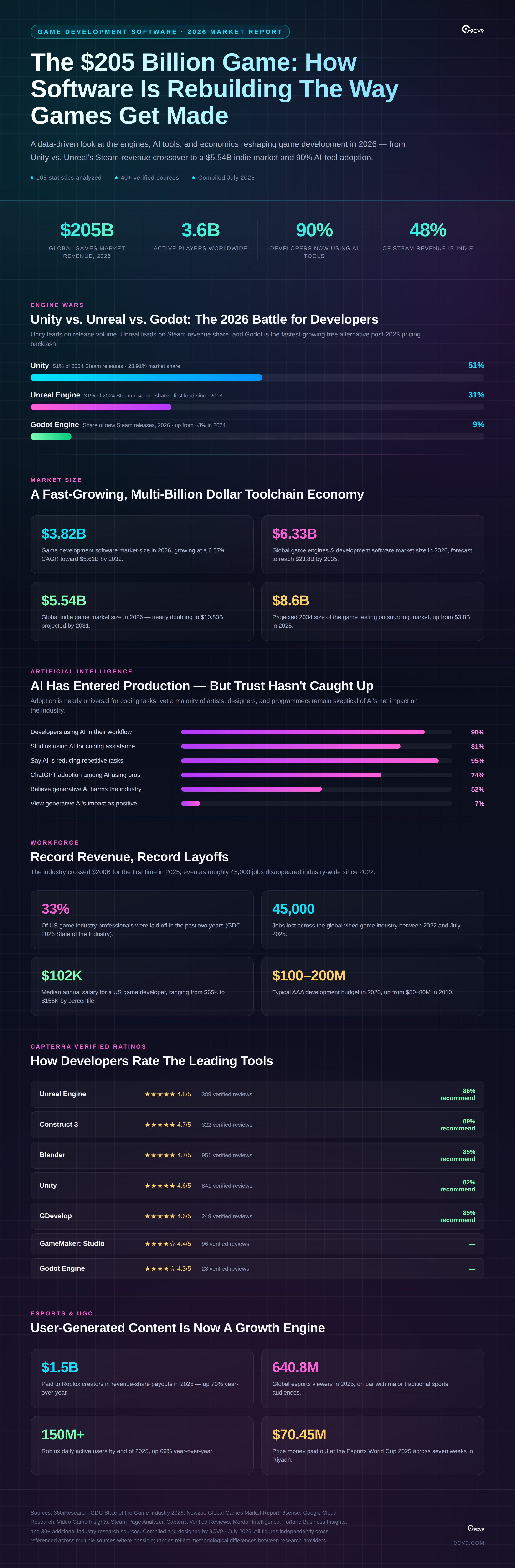
Unity continues to maintain a strong presence among independent developers, mobile game creators, and smaller studios. Data indicates that Unity powered approximately 51% of games released on Steam in 2024, compared with 28% developed using Unreal Engine. However, the 2026 Game Developers Conference (GDC) State of the Game Industry survey found that Unreal Engine was the primary development engine for 42% of surveyed developers, compared with 30% for Unity.
These findings highlight an increasingly competitive game engine landscape in which developers evaluate platforms based on performance, graphical capabilities, licensing costs, cross-platform compatibility, and long-term business sustainability. Open-source alternatives such as Godot are also gaining attention as developers seek greater flexibility and independence from proprietary software ecosystems.
Another major trend reshaping game development is the integration of artificial intelligence and generative AI into game creation workflows.
AI-powered development tools are increasingly being used for programming assistance, procedural content generation, automated quality assurance, character behavior, asset creation, and game optimization. Research cited in industry reports suggests that AI adoption is becoming widespread, with one 2025 Google Cloud study reporting that 90% of surveyed game developers were already using some form of AI in their workflows.
Nevertheless, AI adoption remains a complex issue. The GDC 2026 survey found that 52% of developers believed generative AI was negatively affecting the gaming industry, reflecting concerns about employment, intellectual property, creative authenticity, and the long-term implications of automated content production.
This contrast between increasing AI adoption and growing developer skepticism illustrates one of the defining challenges facing game development software providers in 2026: delivering meaningful productivity improvements while protecting creative quality and supporting sustainable employment.
Independent game development is experiencing equally important changes.
The availability of accessible development engines, affordable asset creation tools, digital distribution platforms, and AI-assisted workflows has lowered many traditional barriers to game production. However, increased accessibility has also intensified competition.
Steam recorded approximately 19,468 game releases in 2025, highlighting the growing volume of content competing for consumer attention. Although independent games have achieved notable commercial successes, industry estimates suggest that only a relatively small percentage of releases generate substantial revenue.
For independent developers, these statistics reinforce the importance of selecting suitable game development software, managing production costs, optimizing development workflows, and implementing effective marketing and distribution strategies.
At the same time, mobile game development, cloud gaming, VR, and AR technologies are expanding the capabilities and commercial applications of game development platforms. Mobile gaming continues to account for a substantial proportion of global gaming revenue, while immersive technologies are creating new opportunities for interactive entertainment, education, simulation, and enterprise applications.
Game development software is also becoming increasingly important for live-service gaming, multiplayer infrastructure, user-generated content, and ongoing player engagement. Platforms such as Roblox demonstrate how development ecosystems can support large creator communities and new monetization models beyond traditional game publishing.
However, technological innovation is occurring alongside considerable workforce challenges. The GDC 2026 survey reported that 28% of respondents had experienced layoffs during the preceding two years, underscoring the financial pressures, restructuring, and employment uncertainty affecting game development professionals.
These challenges are encouraging studios to reconsider development budgets, adopt more efficient production tools, explore outsourcing arrangements, and invest in automation where it can deliver measurable operational benefits.
For businesses operating within the gaming technology ecosystem, understanding these developments is essential for identifying market opportunities, evaluating software investments, benchmarking competitors, and preparing for future changes in the industry.
This comprehensive guide to the Top 105 Game Development Software Statistics, Data & Trends in 2026 examines the latest available figures across game development software market growth, Unity and Unreal Engine adoption, AI-powered development tools, indie game economics, gaming industry revenue, developer employment, mobile gaming, cloud gaming, esports, user-generated content, and game development software ratings.
By analyzing these 105 statistics, developers, publishers, software vendors, technology investors, and industry professionals can gain a clearer understanding of the forces shaping game development in 2026 and the opportunities and challenges likely to influence the next generation of interactive entertainment.
Whether evaluating the best game development engines, exploring AI-assisted production, assessing market growth potential, or researching emerging gaming technologies, these statistics provide a data-driven foundation for understanding where the game development software industry stands in 2026 and where it may be heading next.
Before we venture further into this article, we would like to share who we are and what we do.
About 9cv9
9cv9 is a business tech startup based in Singapore and Asia, with a strong presence all over the world.
With over ten years of startup and business experience, and being highly involved in connecting with thousands of companies and startups, the 9cv9 team has listed some of the top and best companies/tools in this review.
If you like to get your company listed in our top B2B software reviews, check out our world-class 9cv9 Media and PR service and pricing plans here.
Top 105 Game Development Software Statistics, Data & Trends in 2026
Market Size & Growth
- The game development software market was estimated at $3.59 billion in 2025 and is expected to reach $3.82 billion in 2026. This steady 2025-to-2026 uptick signals continued enterprise and studio investment in integrated toolchains rather than a slowdown after the post-pandemic boom.
- The game development software market is forecast to grow at a 6.57% CAGR, reaching $5.61 billion by 2032. A mid-single-digit CAGR over a seven-year window points to durable, non-cyclical demand rather than a short-lived spike.
- An alternative market model values the broader game development software space at $53.2 billion in 2026, projected to hit $66.47 billion by 2032. The wide gap between this figure and narrower estimates reflects how differently research firms define “game development software” (some include engines only, others include the full creative-tools stack).
- The game engines and development software market is projected at $4.04 billion in 2026, up from $3.70 billion in 2025. This narrower, engine-focused segment is growing faster than the broader software category, underlining engines as the core value driver.
- The game engines and development software market is forecast to grow at a CAGR of 9.20% through 2030. Near-double-digit growth reflects rising adoption of real-time 3D engines outside pure gaming, including film, automotive, and architecture.
- Technavio projects the game development software market will grow by $71.17 billion between 2026 and 2030, at a 5.5% CAGR. This is one of the largest absolute-dollar growth forecasts among major analyst firms, reflecting the scale of enterprise tooling spend.
- The game development market (software, hardware, and services combined) is valued at $2.07 billion in 2026 and expected to reach $3.87 billion by 2031, a 13.31% CAGR. The double-digit growth rate here is driven heavily by cloud gaming and mobile-first development in emerging markets.
- The global game engines and development software market is projected at $6.33 billion in 2026, reaching $23.8 billion by 2035 at a 15.9% CAGR. This is among the most aggressive long-range forecasts in the industry, underscoring analyst confidence in real-time engine expansion into non-gaming sectors.
- North America accounted for $1.22 billion (35.60%) of the global game engine market in 2025, expected to reach $1.35 billion in 2026. North America’s leadership reflects its concentration of major studios, including EA, Activision Blizzard, and Epic Games.
- 3D game engines are projected to hold a 64.82% share of the global game engine market in 2026. This dominance illustrates how far the industry has moved from 2D tooling as immersive, real-time 3D content becomes the default expectation.
- The Game Development Service Market is valued at $0.69 billion in 2026, expected to expand to $2.18 billion by 2035 at a 13.67% CAGR. This category — covering outsourced coding, art, and testing services — is growing faster than software licensing alone, reflecting studios’ preference to rent expertise rather than build it in-house.
Game Engines: Unity, Unreal Engine & Godot
- Unity holds a 23.91% market share in the game development category as of 2026, down from 25.13% in June 2025. The modest decline follows lingering trust issues from Unity’s 2023 pricing controversy, even after the company reversed course.
- Unity counts approximately 11,483 customers in game development compared to Unreal Engine’s 7,673 — about 1.5 times as many. Unity’s larger customer base reflects its continued dominance among small studios, students, and mobile-first developers.
- Unreal Engine earned 31% of Steam game revenue in 2024 versus Unity’s 26%, the first time Unreal has outearned Unity on the platform since 2018. This revenue crossover shows that while Unity ships more titles, Unreal-built games tend to command higher price points and sales volume.
- Unity powered 51% of all 2024 Steam game releases, compared to Unreal Engine’s 28%. Unity’s release-volume lead confirms its role as the default engine for indie and small-team developers publishing on Steam.
- Stack Overflow’s 2024 Developer Survey found 5.9% of all surveyed developers used Unity, versus 3.0% for Unreal Engine. Because this survey spans all developers (not just game-industry professionals), it highlights Unity’s broader footprint outside dedicated studios.
- The GDC 2026 State of the Game Industry survey found Unreal Engine is the primary engine for 42% of developers, ahead of Unity at 30%. This marks a shift among professional studios toward Unreal as the default AAA and AA production engine.
- Unreal Engine adoption reaches 59% among AA studios and 47% among AAA studios, per GDC 2026 data. Larger studios increasingly standardize on Unreal for its rendering fidelity and out-of-the-box production tooling.
- 53.9% of developers say they “want to use” Unreal Engine, compared to 46% for Unity. This aspiration gap suggests Unreal’s reputation for visual quality continues to outpace Unity’s despite Unity’s larger active install base.
- The global game engines market reached $3.2 billion in 2024 and is forecast to hit $13.8 billion by 2034. A more than fourfold increase over a decade reflects engines’ expanding role well beyond traditional game titles.
- Unity retains roughly 48% market share in mobile game development and powers around 70% of top-grossing mobile titles in 2026. Unity’s lightweight build pipeline and mature mobile SDKs keep it the go-to engine for free-to-play and hyper-casual studios.
- Godot’s share of new Steam releases climbed to 8–10% in 2026, up from roughly 3% in early 2024. This rapid growth for a free, open-source engine reflects developer migration following Unity’s 2023 pricing backlash.
- Unity canceled its controversial per-install runtime fee in September 2024 after industry-wide backlash. The reversal came too late to fully repair trust, as reflected in Unity’s continued gradual share erosion into 2026.
- Discord (30.12%), Unreal Engine (15.98%), and Blender (14.80%) are the top competitor tools tracked alongside Unity in the game development category. Discord’s inclusion as a “competitor” reflects how broadly analytics firms define the game-development tool stack to include communication platforms.
Global Games Industry Revenue
- Global gaming revenue reached $188.8 billion in 2025 and is projected to hit $205 billion in 2026, a 4.6% year-over-year increase (Newzoo). This places the games industry ahead of the global film and recorded-music industries combined in annual revenue.
- The global player base reached 3.6 billion active gamers in 2025, representing 61.5% of the world’s online population. No other entertainment medium reaches a comparable share of internet users worldwide.
- Mobile gaming generated approximately $103–107 billion in 2025–2026, representing 52–55% of total industry revenue. Mobile’s continued dominance underscores why most new engine features and dev-tool investment prioritize mobile-first workflows.
- Console gaming generated $45.9 billion in 2025, positioned as the fastest-growing platform at roughly a 5.5% CAGR. Major premium releases and next-gen hardware launches are driving console’s above-average growth rate relative to mobile and PC.
- PC gaming generated approximately $39.9–40 billion in 2025, with Steam holding roughly 74% of digital PC distribution. Steam’s near-monopoly on PC distribution makes its release and revenue data the most-cited benchmark for indie and mid-tier developer success.
- In-game purchases generated $74.4 billion in 2025, up 4.6% from $71.1 billion in 2024. Continued growth in microtransactions confirms live-service monetization remains the dominant business model across genres.
- Asia-Pacific is the largest gaming region, generating $87.6 billion in 2025 — about 46% of global spend. The region’s mobile-first gaming culture and large population base keep it the priority market for global publisher expansion.
- Gaming subscription services generated $11–13.1 billion in consumer spending in 2025, with over 120 million subscribers globally. Subscription models like Xbox Game Pass are steadily becoming a meaningful third monetization pillar alongside purchases and in-game spend.
- Steam surpassed 40 million concurrent users in early 2025, its highest level on record. Record concurrency confirms PC gaming’s continued health even as mobile captures a larger revenue share.
- Female players represent 46% of the global gaming population as of 2025. Near gender parity in the player base continues to shape how studios approach character design, marketing, and monetization strategy.
- Global consumer game spending rose from $148.8 billion in 2019 to approximately $205 billion projected for 2026. This roughly 38% increase over seven years illustrates the industry’s resilience despite a flat period between 2022 and 2024.
AI in Game Development
- 38.2% of US game developers reported using generative AI for game or media creation in 2024. Early-stage adoption at this scale shows AI tools moved from novelty to mainstream production use within a single year.
- 90% of game developers report already using some form of AI in their workflows, per Google Cloud’s 2025 research. This figure suggests AI tool usage has become nearly universal, even if usage intensity and application vary widely.
- 95% of developers say AI is reducing repetitive tasks in their workflow. This productivity gain is consistently cited as the clearest, least controversial benefit of AI adoption across game studios.
- 94% of developers say generative AI is already driving innovation in how games are produced. Despite mixed sentiment on quality impact, developers broadly agree AI is changing production methodology.
- ChatGPT leads AI tool adoption among game industry professionals at 74%, followed by Google Gemini at 37% and Microsoft Copilot at 22% (GDC 2026). General-purpose AI assistants, not game-specific tools, remain the primary entry point for AI adoption in studios.
- 62% of game developers report using AI in their workflow in 2026 data compilations. This figure, while lower than Google Cloud’s 90% estimate, reflects methodological differences in how “use” is defined across surveys.
- 81% of studios apply AI specifically for coding assistance. Code generation and debugging remain the most trusted and widely adopted AI use case, ahead of creative or player-facing applications.
- 36% of industry professionals reported using AI tools in their work, per the GDC 2026 State of the Industry survey. The gap between this figure and Google Cloud’s higher estimate highlights how survey population and question framing significantly shift reported AI adoption rates.
- AI adoption is highest among business roles (58%) and lowest among game-studio production staff (30%), per GDC 2026. This split shows AI has penetrated market-facing and administrative functions faster than core creative and engineering roles.
- 52% of developers believe generative AI is having a negative impact on the industry, up sharply from 30% the year prior. Sentiment has worsened even as adoption has grown, revealing a split between AI’s practical utility and developers’ concerns about job security and creative quality.
- Only 7% of developers view generative AI’s impact on the industry as positive. This low figure stands in stark contrast to productivity-focused surveys, illustrating deep skepticism about AI’s long-term effect on craft and employment.
- 64% of visual and technical artists hold unfavorable views of AI tools, the highest of any discipline surveyed. Artists report the most direct competitive exposure to generative image and asset tools, explaining their elevated concern.
- 63% of designers and narrative professionals, and 59% of programmers, hold unfavorable views of generative AI (GDC 2026). Even technically-oriented programmers — who benefit most from AI coding assistants — report majority skepticism about the technology’s broader industry impact.
- Developers using AI agents report top applications of content optimization (44%), dynamic balancing (38%), procedural world generation (37%), and automated content moderation (37%). These figures show AI agents are being trusted primarily for systemic and back-end tasks rather than direct creative authorship.
- 29% of developers believe AI can help level the playing field for smaller, independent studios against larger competitors. This minority-but-significant view frames AI as a democratizing force for teams lacking AAA-scale resources.
- NPCs and digital humans represent approximately 28.6% market share of the AI-in-gaming market in 2026, per Persistence Market Research. This makes intelligent non-player characters the single largest application category for AI within game development specifically.
- AI-driven NPC dialogue adoption rose to 62% among relevant studios in 2026, up sharply from prior years as tools enabling persistent-memory, unscripted NPC conversation matured.
Indie Game Development Economics
- Indie games generated 48% of all full-game revenue on Steam as of September 30, 2024, up from 24% in 2018. This doubling of indie revenue share in six years marks one of the most significant structural shifts in PC gaming economics.
- The global indie game market is projected to reach $5.54 billion in 2026, growing toward $10.83 billion by 2031. Roughly doubling over five years, this trajectory confirms indie development has become a durable market segment rather than a niche.
- The median Steam indie game grosses between $5,000 and $15,000 in lifetime gross revenue. This modest median underscores the power-law nature of indie success — a handful of hits, and a long tail of commercially marginal releases.
- The top 5% of indie games earn over $1 million in lifetime revenue. The concentration of earnings among a small fraction of releases illustrates why discoverability and marketing matter as much as game quality.
- 19,468 games launched on Steam in 2025, a new annual record, up from 18,556 in 2024. Steadily rising release volume continues to intensify competition for player attention and storefront visibility.
- Of the roughly 20,000 games released on Steam annually, only around 300 titles earn more than $1 million. Fewer than 2% of releases clear the $1 million threshold, reinforcing how difficult sustainable indie careers remain.
- Indie PC revenues grew approximately 22% annually from 2018 to 2024, compared to roughly 8% annual growth for AA/AAA titles. Indie developers are outpacing traditional studios in revenue growth rate, even if not in absolute dollar terms.
- 56% of surveyed developers report self-funding their games, nearly double the next-largest funding source (GDC 2025). Bootstrapped development remains the dominant funding model, ahead of publisher deals, crowdfunding, or investment.
- The share of developers working as solo developers grew from 18% in 2024 to 21% in 2025 (GDC survey data). This increase suggests lower barriers to entry, partly enabled by more accessible engines and AI-assisted tooling.
- Video game Kickstarter campaigns raised approximately $26 million in 2024 across 441–463 successful projects. Crowdfunding remains a modest but meaningful supplemental funding channel for indie teams unable or unwilling to self-fund.
- Mobile accounted for 51.42% of global indie game sales in 2025, more than PC and console combined. This mobile-majority split shows indie development has followed the broader industry’s shift toward mobile-first release strategy.
- The top five new indie games of 2025 earned over $500 million combined, led by Schedule I at roughly $151 million. These breakout hits demonstrate that indie titles can still achieve blockbuster-scale commercial success without AAA budgets.
Jobs, Layoffs & Compensation
- 28% of GDC 2026 survey respondents experienced a layoff in the past two years, rising to 33% among US-based respondents. The elevated US figure reflects concentrated studio consolidation and restructuring activity in North America specifically.
- Half of GDC 2026 respondents said their current or most recent employer conducted layoffs within the past 12 months. This figure suggests layoffs have become a near-universal experience across the industry rather than isolated to a few troubled studios.
- 17% of game industry professionals reported being laid off within the 12 months prior to the GDC 2026 survey. This annual layoff rate, while lower than the two-year cumulative figure, still represents a historically elevated churn level for the sector.
- Approximately 45,000 jobs were lost across the video game industry between 2022 and July 2025. This scale of job loss marks one of the most severe multi-year contractions the industry has experienced.
- The median annual salary for a US game developer is approximately $102,000, ranging from $65,000 (10th percentile) to $155,000 (90th percentile). This wide salary band reflects significant variance by discipline, seniority, and studio tier.
- Game designers were the profession most affected by layoffs, accounting for 20% of all cuts (GDC 2026). Design roles’ disproportionate exposure may reflect studios prioritizing engineering and live-ops retention during downsizing.
- The most commonly cited layoff reasons were restructuring (43%), budget cuts (38%), and market conditions (38%). These overlapping factors show layoffs are typically driven by combined financial and organizational pressures rather than any single cause.
- PC was used for 83% of developers’ most recent projects, followed by PS5 (47%), Xbox Series S|X (40%), and Steam Deck (28%). PC’s continued lead as the primary development target reflects its lower certification barriers and broader reach across indie and AA studios.
- AAA game development budgets now typically range from $100–200 million, up from $50–80 million in 2010. This roughly threefold increase in top-tier budgets over 15 years explains rising publisher risk-aversion and the corresponding pivot toward live-service, sequel-driven portfolios.
Mobile, VR/AR & Cloud Gaming
- The VR and AR gaming market is projected at $38.44 billion. This figure spans headset-based and mobile-AR experiences, positioning immersive gaming as a fast-growing but still-niche segment relative to mobile and console.
- The AR and VR Game Developing Service Market is set to grow from $62.2 billion in 2026 to $286.7 billion by 2035, an 18.5% CAGR. This nearly fivefold growth forecast reflects rising demand for outsourced immersive-content development as headset adoption expands.
- The Augmented Reality Gaming market reached $18.43 billion in 2025 and is projected to hit $66.9 billion by 2030, a 29.4% CAGR. AR gaming’s near-30% growth rate outpaces almost every other gaming subsegment, driven largely by smartphone-based experiences.
- The global Mobile Gaming market reached $165.37 billion in 2025 and is expected to grow to $392.06 billion by 2030 at an 18.9% CAGR. This forecast, broader than Newzoo’s software-only figures, includes hardware and services tied to the mobile gaming ecosystem.
- Global cloud gaming revenue is estimated at $23.79 billion, with US subscribers reaching 12.5 million. Cloud gaming remains a relatively small share of total industry revenue but continues attracting infrastructure investment from major platform holders.
- Mobile cloud gaming users were projected to reach 295 million by 2025. This user base signals cloud streaming is gaining meaningful traction on mobile despite ongoing latency and data-cost challenges in emerging markets.
- The average mobile game churn rate is approximately 95% within 30 days of install. This extremely high churn rate underscores why retention-focused design and live-ops tooling are central priorities in mobile game development.
- Players spend an average of 52 minutes per day in mobile games. Despite high churn, engaged mobile players show substantial daily time investment, supporting continued ad and IAP monetization.
- Day-7 retention for top-performing mobile games sits around 12%. Even best-in-class titles retain only a small fraction of new users after one week, illustrating the competitiveness of mobile game discovery and onboarding.
- AR-enabled mobile games show 18% longer average session lengths compared to standard 2D mobile games. Location-based and camera-integrated gameplay appears to meaningfully increase per-session engagement.
- The global in-game advertising market is estimated at $131.03 billion, with programmatic ad spend growing at a 12.02% CAGR. In-game advertising has become a substantial secondary monetization channel, particularly for free-to-play and hyper-casual titles.
Esports & User-Generated Content (UGC)
- Global esports industry revenue was revised to $5.34 billion for 2026, according to SQ Magazine’s compiled research. This upward revision reflects growing recognition of esports as a maturing, diversified revenue business rather than a niche subculture.
- Global esports viewership reached approximately 640.8 million in 2025. This figure rivals the reach of major traditional sports broadcasts, reinforcing esports’ position as a mainstream entertainment category.
- The Esports World Cup 2025 paid out $70.45 million in prize money across seven weeks in Riyadh. This single event’s prize pool exceeded the combined total of every esports tournament held globally in 2019, reflecting massive investment growth.
- Esports sponsorship revenue reached $1.06 billion in 2025, projected to grow to $1.11 billion in 2026. Sponsorship remains the single largest esports revenue category, ahead of media rights and merchandise combined.
- Mobile accounts for a majority share of esports viewership and revenue in several regional breakdowns, ranging from 52–56%. Mobile esports’ growing dominance mirrors the broader gaming industry’s mobile-first revenue shift.
- Roblox creators earned over $1.5 billion in revenue-share payouts in 2025, up 70% year-over-year. This dramatic increase highlights UGC platforms’ growing role as a legitimate income source for independent creators, not just hobbyists.
- Roblox averaged over 150 million daily active users by the end of 2025, up 69% year-over-year. This user growth rate significantly outpaces most traditional gaming platforms, reflecting the platform’s expanding reach beyond its historical younger-audience base.
- Roblox generated 13 billion average monthly engagement hours in 2025, up from 3 billion hours in 2020. This more than fourfold increase in engagement hours positions Roblox as approaching Netflix-level engagement scale within gaming.
- Roblox alone captured 4.5% of all non-China consumer gaming spend and 60% of the industry’s net growth since 2021. These figures make Roblox’s UGC-driven model one of the single largest contributors to industry-wide growth in recent years.
- Epic Games Store paid out $2.4 billion to indie developers in 2023 via its 88/12 revenue-share model, supporting 15,000 titles. This favorable revenue split compared to standard 70/30 models has been a key differentiator in Epic’s efforts to attract indie developers.
Capterra Game Development Software Ratings (2026)
- Unreal Engine holds a 4.8 out of 5 rating on Capterra across 389 reviews, with 86% of reviewers recommending the product. Unreal’s high satisfaction score aligns with its reputation for visual fidelity, even amid complaints about its steeper learning curve.
- Unity holds a 4.6 out of 5 rating on Capterra across 841 reviews, with 82% of reviewers recommending the product. Unity’s larger review volume reflects its broader installed base, though its slightly lower recommend rate echoes lingering trust concerns from its 2023 pricing controversy.
- Construct 3 holds a 4.7 out of 5 rating on Capterra across 322 reviews, with an 89% recommend rate — the highest among major listed engines. Construct 3’s no-code, browser-based approach appears to drive stronger user satisfaction among educators, hobbyists, and early-career developers.
- Blender holds a 4.7 out of 5 rating on Capterra across 951 reviews, with 85% of reviewers recommending the product. As a free, open-source 3D creation tool, Blender’s high review volume and rating reflect its widespread adoption for asset creation across the game development pipeline.
- GDevelop holds a 4.6 out of 5 rating on Capterra across 249 reviews, with 85% of users recommending the product. GDevelop’s positive reception among reviewers frequently cites its accessibility as an alternative to more complex engines like Unity and Unreal.
- GameMaker: Studio holds a 4.4 out of 5 rating on Capterra across 96 reviews. GameMaker continues to be favored by reviewers specifically for lightweight 2D indie projects and game-jam-scale development.
- Godot Engine holds a 4.3 out of 5 rating on Capterra across 28 reviews. Godot’s relatively small Capterra review count, despite its rapid Steam release-share growth, suggests its adoption is concentrated among developers who engage less with traditional review platforms.
- Microsoft Visual Studio holds a 4.6 out of 5 rating on Capterra across 3,006 reviews — the most-reviewed IDE relevant to game development workflows. Visual Studio’s ubiquity as a coding environment for Unity and Unreal C++/C# development explains its outsized review volume relative to dedicated game engines.
- Adobe AIR holds the highest rating among listed Capterra game development tools at 4.9 out of 5, across 68 reviews. Despite its smaller review base, Adobe AIR’s near-perfect score reflects strong satisfaction among its niche cross-platform developer audience.
- Capterra’s Game Development Software directory lists 45 distinct products as of its most recent June 2026 update. This relatively contained directory size, compared to broader categories like project management software, reflects game development’s specialized tooling requirements.
Game Testing, QA & Outsourcing
- The global game testing outsourcing market was valued at $3.8 billion in 2025 and is projected to reach $8.6 billion by 2034, a 9.5% CAGR. More than doubling over nine years, this growth reflects rising game complexity and the difficulty of maintaining in-house QA teams at scale. Additionally, the broader game outsourcing service market was valued at $9.18 billion in 2025 and is projected to reach $25.1 billion by 2034 at an 11.8% CAGR, and the game testing service market specifically is valued at $1.4 billion in 2026, projected to expand to $3.82 billion by 2035 at an 11.80% CAGR — together confirming that outsourced development and QA services are becoming a structural, not supplemental, part of the industry’s production pipeline.
Conclusion
The Top 105 Game Development Software Statistics, Data & Trends in 2026 reveal an industry experiencing significant technological transformation, expanding commercial opportunities, and increasing competition. From the growing adoption of artificial intelligence and advanced game engines to the continued expansion of mobile gaming, independent development, and immersive technologies, game development software remains central to the evolution of the global gaming ecosystem.
With the global game development software market projected to reach approximately $3.82 billion in 2026 and expand to $5.61 billion by 2032, the industry’s long-term outlook remains positive. This anticipated growth reflects sustained demand for sophisticated development platforms, real-time rendering technologies, cross-platform development capabilities, automated testing solutions, and increasingly accessible game creation tools.
One of the most important findings from the 2026 game development software statistics is the evolving competitive landscape among major game engines. Unity continues to demonstrate considerable strength in mobile and independent game development, while Unreal Engine is gaining prominence among professional studios seeking advanced graphical capabilities and production tools. Meanwhile, open-source alternatives such as Godot are creating additional opportunities for developers who prioritize flexibility, affordability, and greater control over their development environments.
Artificial intelligence is another defining force shaping the future of game development. AI-powered coding assistants, procedural content generation, automated quality assurance, intelligent NPC systems, and workflow optimization tools are changing how games are designed, developed, tested, and maintained. However, industry survey findings also highlight growing concerns surrounding job displacement, intellectual property, creative authenticity, and the broader implications of generative AI.
These contrasting trends suggest that successful game development software providers will need to balance automation and efficiency with developer trust, creative control, and responsible technology adoption.
The independent gaming sector presents equally significant opportunities and challenges. With approximately 19,468 games released on Steam in 2025, competition for player attention has intensified considerably. Although accessible game engines and digital distribution platforms have lowered barriers to entry, commercial success increasingly depends on effective production planning, distinctive gameplay experiences, audience engagement, and strategic marketing.
For independent developers and smaller studios, choosing the right game development software is therefore not simply a technical decision. It is a strategic investment that can influence development costs, production efficiency, scalability, platform compatibility, and long-term profitability.
Meanwhile, the continued expansion of mobile gaming, cloud gaming, virtual reality, augmented reality, and user-generated content platforms is creating new requirements for game development technologies. Developers must increasingly consider cross-platform optimization, real-time multiplayer capabilities, scalable infrastructure, immersive interactions, and ongoing content delivery when selecting their software development tools.
The rise of creator-driven gaming ecosystems also demonstrates how the industry is evolving beyond traditional development and publishing models. Platforms supporting user-generated content, community participation, and creator monetization are introducing new opportunities for independent developers, software vendors, and digital entrepreneurs.
Nevertheless, the gaming industry faces persistent operational and workforce challenges. The GDC 2026 survey found that 28% of respondents had experienced layoffs within the previous two years, highlighting the importance of financial sustainability, efficient resource allocation, and adaptable development strategies. Rising production complexity and competitive pressures are also encouraging studios to explore outsourced development services, automated testing, and more flexible production models.
For game development companies, software providers, investors, and technology professionals, several broader conclusions emerge from these statistics.
The future of game development software will increasingly be shaped by the ability to deliver high-quality gaming experiences while reducing development complexity, improving production efficiency, and supporting sustainable business models. Software solutions that combine powerful development capabilities with accessible interfaces, AI-assisted workflows, flexible licensing, and comprehensive cross-platform support may be particularly well-positioned to benefit from evolving industry requirements.
At the same time, developers and studios must remain adaptable as technological capabilities, consumer preferences, platform ecosystems, and monetization strategies continue to change.
Ultimately, the 105 game development software statistics and trends for 2026 demonstrate that the industry is not merely expanding in market size. It is undergoing a fundamental transformation in how games are created, distributed, monetized, and experienced.
As artificial intelligence becomes more deeply integrated into production workflows, real-time game engines become increasingly sophisticated, and new gaming platforms emerge, the demand for innovative, reliable, and cost-effective development software is likely to remain an important driver of industry growth.
Looking ahead to 2027 and beyond, organizations that prioritize technological adaptability, development efficiency, creative innovation, and player-centered experiences will be better positioned to navigate the challenges and opportunities of an increasingly competitive global gaming market.
For developers, publishers, investors, and software companies alike, staying informed about the latest game development software market statistics, industry trends, AI adoption rates, game engine market share, and emerging gaming technologies will remain essential for making informed decisions and building sustainable competitive advantages in the years ahead.
If you find this article useful, why not share it with your hiring manager and C-level suite friends and also leave a nice comment below?
We, at the 9cv9 Research Team, strive to bring the latest and most meaningful data, guides, and statistics to your doorstep.
To get access to top-quality guides, click over to 9cv9 Blog.
To hire top talents using our modern AI-powered recruitment agency, find out more at 9cv9 Modern AI-Powered Recruitment Agency.
People Also Ask
What is game development software?
Game development software includes tools used to design, build, test, and publish video games. Popular examples include Unity, Unreal Engine, Godot, GameMaker, and Construct 3, which support 2D, 3D, mobile, PC, and console game development.
How big is the global game development software market in 2026?
The global game development software market is estimated to reach $3.82 billion in 2026, up from $3.59 billion in 2025. Market growth is supported by demand for game engines, AI development tools, and cross-platform gaming technologies.
What is the projected growth rate of the game development software market?
The game development software market is forecast to grow at a compound annual growth rate (CAGR) of 6.57%, reaching approximately $5.61 billion by 2032, according to market research estimates.
What are the biggest game development software trends in 2026?
Major trends include generative AI integration, real-time 3D rendering, cross-platform development, open-source game engines, automated game testing, cloud gaming, and increasing adoption of VR and AR technologies.
Which game engine is most popular in 2026?
Unity and Unreal Engine remain leading game engines. The GDC 2026 survey found that 42% of surveyed developers primarily used Unreal Engine, compared with 30% using Unity, although adoption varies by developer segment.
What is Unity’s market share in game development in 2026?
Unity holds approximately 23.91% market share in one game development software category dataset for 2026. Its popularity remains particularly strong among independent developers, mobile game studios, and educational institutions.
What is Unreal Engine’s market share in 2026?
According to the GDC 2026 State of the Game Industry survey, Unreal Engine is the primary development engine for 42% of surveyed developers. Its adoption is especially strong among AA and AAA game studios.
Is Unity or Unreal Engine better for game development in 2026?
Unity is widely used for mobile games, 2D projects, and independent development. Unreal Engine is particularly popular for graphically demanding 3D games and larger productions. The best choice depends on project requirements.
Is Godot becoming more popular in 2026?
Yes. Industry estimates suggest Godot’s share of new Steam releases reached approximately 8–10% in 2026, compared with roughly 3% in early 2024. Its open-source licensing and flexibility appeal to independent developers.
How is artificial intelligence changing game development in 2026?
AI helps developers generate code, create assets, automate testing, optimize gameplay, and develop intelligent NPCs. These capabilities can reduce repetitive work and support faster development, although concerns about creative quality remain.
What percentage of game developers use AI in 2026?
AI adoption varies by survey. Google Cloud’s 2025 research reported 90% adoption among surveyed game developers, while the GDC 2026 survey found that 36% of industry professionals used AI tools in their work.
What are the most popular AI tools for game developers?
The GDC 2026 survey identified ChatGPT as a leading AI tool among game industry professionals, with 74% reported adoption, followed by Google Gemini at 37% and Microsoft Copilot at 22%.
Will AI replace game developers in the future?
AI is increasingly automating repetitive development tasks, but human expertise remains essential for game design, programming, storytelling, and creative direction. The long-term impact on game development employment remains uncertain.
What percentage of game developers oppose generative AI?
According to the GDC 2026 survey, 52% of developers believe generative AI negatively affects the gaming industry, while only 7% view its impact positively. Concerns include employment, creativity, and intellectual property.
How much revenue does the global gaming industry generate in 2026?
Industry estimates project approximately $205 billion in global gaming revenue for 2026. Revenue comes from mobile, PC, console, subscriptions, and in-game purchases, although estimates vary by research methodology.
How many gamers are there worldwide in 2026?
The global gaming population reached an estimated 3.6 billion active players in 2025. This substantial audience supports continued investment in game development software, publishing platforms, and gaming infrastructure.
What percentage of gaming revenue comes from mobile games?
Mobile gaming accounts for approximately 52–55% of global gaming revenue, according to industry estimates covering 2025–2026. Its market dominance makes mobile optimization essential for many game development studios.
How many games were released on Steam in 2025?
Approximately 19,468 games launched on Steam in 2025, compared with 18,556 in 2024. Increasing release volumes highlight growing competition among independent developers and established publishers.
How profitable is indie game development in 2026?
Indie game profitability varies significantly. Industry estimates suggest median lifetime gross revenue of approximately $5,000–$15,000 per Steam indie game, while a small percentage of successful titles generate more than $1 million.
What percentage of indie games earn over $1 million?
Industry estimates suggest fewer than 2% of approximately 20,000 annual Steam releases generate more than $1 million. Commercial success depends on game quality, discoverability, marketing, audience demand, and pricing.
How much does it cost to develop a AAA video game?
AAA game development budgets commonly range from $100 million to $200 million, according to industry estimates. Actual costs vary considerably depending on production scale, development duration, staffing, technology, and marketing.
What is the average game developer salary in 2026?
The median annual salary for a US game developer is estimated at approximately $102,000. Compensation varies by specialization, experience, location, and employer, with reported estimates ranging from $65,000 to $155,000.
How many game developers have experienced layoffs?
The GDC 2026 survey found that 28% of respondents experienced layoffs during the preceding two years. Among US-based respondents, the figure reached 33%, reflecting ongoing employment challenges in the gaming industry.
What are the best game development software tools in 2026?
Popular game development tools include Unity, Unreal Engine, Godot, Construct 3, GameMaker, GDevelop, and Blender. Each offers different capabilities for programming, 2D development, 3D graphics, animation, and asset creation.
What is the highest-rated game development software on Capterra?
The supplied 2026 Capterra data lists Adobe AIR at 4.9 out of 5, Unreal Engine at 4.8, and Construct 3 at 4.7. Ratings reflect user reviews and may change as additional feedback is submitted.
How fast is the VR and AR gaming market growing?
One market forecast projects the AR and VR game development services market will grow from $62.2 billion in 2026 to $286.7 billion by 2035, representing an estimated 18.5% CAGR.
What is the future of cloud gaming in 2026?
Cloud gaming is expanding opportunities to stream games without powerful local hardware. Industry estimates indicate growing investment in streaming infrastructure, mobile cloud gaming, and subscription-based gaming services.
How important is game testing software in 2026?
Game testing software helps developers identify bugs, evaluate performance, and improve player experiences. The global game testing outsourcing market is projected to grow from $3.8 billion in 2025 to $8.6 billion by 2034.
How is user-generated content influencing game development?
User-generated content platforms enable players to create, publish, and monetize interactive experiences. Roblox reported substantial creator payouts and user engagement, highlighting growing opportunities for community-driven game development.
What is the future outlook for game development software beyond 2026?
Game development software is expected to evolve through AI-assisted workflows, advanced rendering, cloud infrastructure, open-source engines, and immersive technologies. Market forecasts indicate continued growth, alongside increasing competition and development complexity.
Sources
- 360iResearch
- Verified Market Reports
- Data Bridge Market Research
- Mordor Intelligence
- Technavio
- Business Research Insights
- Fortune Business Insights
- Rec0ded88
- 6sense
- Phantom Cave
- StraySpark Studio
- GameGen
- Team of Keys
- FOSS Post
- inStreamly
- The Global Statistics
- Axis Intelligence
- STG Research
- Icon Era
- 16Best
- WifiTalents
- AI Buzz
- Google Cloud
- Game Developers Conference (GDC)
- GameDev Reports
- Variety
- Luminate Data
- Game Developer
- One Hour Digital
- Tech Insider
- Gitnux
- Random Game Generator
- Steam Page Analyzer
- Video Game Insights
- VoxBooster
- SQ Magazine
- The Business Research Company
- Coherent Lab
- Algoryte
- Cubix
- Udonis
- EsportStats
- Tradeit
- Taylor Wessing
- Capterra
- Spherical Insights
- DataIntelo
- MarkWide Research
- Coherent Market Insights