




























Key Takeaways
- Financial Risk Management Software Market Growth: The global financial risk management software market is projected to reach USD 4.79 billion in 2026 and grow to USD 13.31 billion by 2034, driven by increasing demand for advanced risk analytics, regulatory compliance, and cloud-based solutions.
- AI and Cloud Adoption Transform Financial Risk Management: Cloud-based platforms are expected to capture 71.02% of the market in 2026, while 82% of financial firms have reportedly deployed AI-powered risk management software to improve fraud detection, credit risk assessment, and operational efficiency.
- Rising Financial Fraud and Cybersecurity Risks Drive Software Demand: With global financial fraud losses estimated at USD 442 billion in 2025 and average data breach costs reaching USD 4.44 million, organizations are prioritizing automated compliance, predictive risk analytics, and integrated governance, risk, and compliance (GRC) solutions.
Financial risk management software is transforming how businesses manage financial risks in 2026. The global market is projected to reach USD 4.79 billion, with cloud-based solutions capturing 71.02% of market share. Key trends include AI-powered fraud detection, predictive risk analytics, automated regulatory compliance, and growing investment in cybersecurity and enterprise risk management platforms.
The financial risk management software industry is undergoing a significant transformation in 2026, driven by the rapid adoption of artificial intelligence (AI), cloud computing, real-time risk analytics, and increasingly complex regulatory requirements. As financial institutions and enterprises face growing exposure to credit risks, market volatility, cybersecurity threats, and financial fraud, investing in advanced financial risk management solutions has become essential for maintaining operational resilience, regulatory compliance, and long-term financial stability.
Also, read our article on the Top 10 Financial Risk Management Software.
According to industry projections, the global financial risk management software market is expected to reach USD 4.79 billion in 2026, with forecasts suggesting growth to USD 13.31 billion by 2034 at a compound annual growth rate (CAGR) of 13.60%. Cloud-based solutions are projected to account for 71.02% of the market in 2026, highlighting the accelerating transition from traditional on-premises systems to scalable, integrated risk management platforms. Meanwhile, North America continues to dominate the industry, supported by substantial investments in financial technology, regulatory compliance, and enterprise risk management infrastructure.
Artificial intelligence and automation are also reshaping how organizations identify, assess, and mitigate financial risks. Research highlighted in this report indicates that 82% of financial firms have deployed AI-powered risk management software, while approximately 72% of financial institutions use AI for fraud detection. Furthermore, AI-driven credit risk models have demonstrated improvements of 15% to 25% in default prediction accuracy compared with traditional approaches. These developments illustrate the growing importance of predictive analytics, machine learning, automated compliance monitoring, and intelligent decision-making in modern financial risk management.
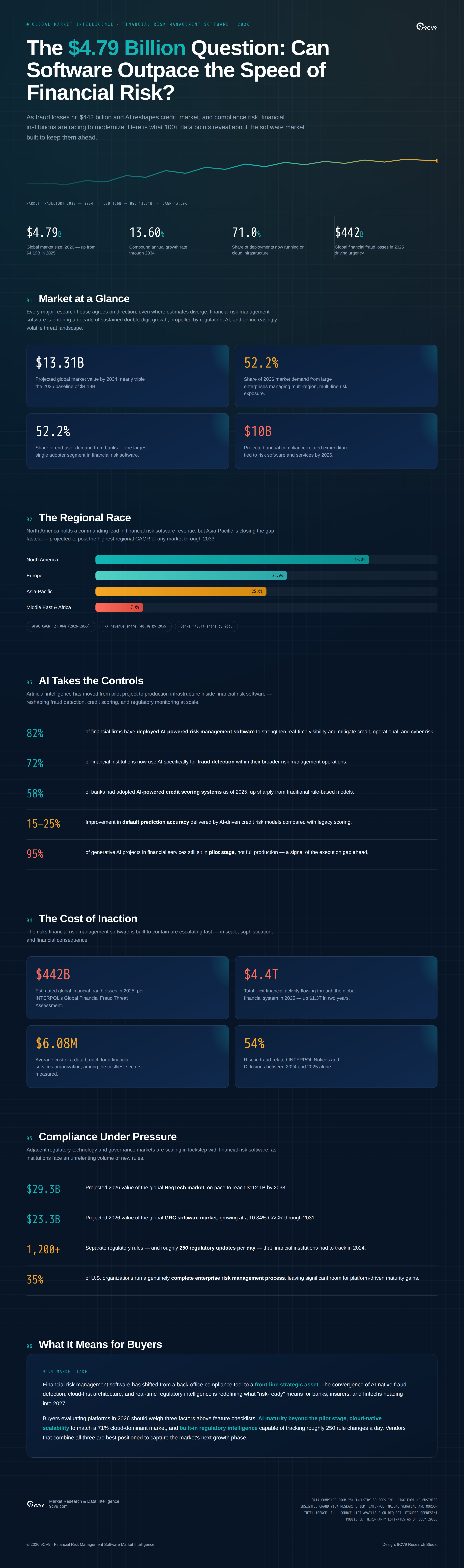
However, the increasing sophistication of financial threats presents substantial challenges. Global financial fraud losses were estimated at USD 442 billion in 2025, while the average cost of a data breach reached USD 4.44 million. Organizations must also navigate evolving financial regulations, legacy system integration difficulties, data security concerns, and shortages of skilled risk management professionals. Consequently, demand for comprehensive governance, risk, and compliance (GRC) platforms, regulatory technology (RegTech), and automated financial risk assessment tools continues to expand across banking, insurance, investment management, and other industries.
Understanding the latest financial risk management software statistics, market trends, adoption rates, and industry forecasts for 2026 is crucial for business leaders, financial executives, risk management professionals, technology providers, and investors seeking to make informed strategic decisions. From market growth and regional adoption patterns to AI-powered risk analytics, cloud deployment, regulatory compliance, and cybersecurity, the financial risk management landscape is evolving rapidly.
This comprehensive guide to the Top 105 Financial Risk Management Software Statistics, Data & Trends in 2026 examines the key figures and emerging developments shaping the industry. It provides valuable insights into financial risk management software market size, growth opportunities, enterprise adoption, technological innovation, implementation challenges, and future industry projections, helping organizations better understand the technologies and strategies influencing the future of financial risk management.
Before we venture further into this article, we would like to share who we are and what we do.
About 9cv9
9cv9 is a business tech startup based in Singapore and Asia, with a strong presence all over the world.
With over ten years of startup and business experience, and being highly involved in connecting with thousands of companies and startups, the 9cv9 team has listed some of the top and best companies/tools in this review.
If you like to get your company listed in our top B2B software reviews, check out our world-class 9cv9 Media and PR service and pricing plans here.
Top 105 Financial Risk Management Software Statistics, Data & Trends in 2026
Market Size & Growth Trajectory
1. The global financial risk management software market is projected to reach USD 4.79 billion in 2026, signaling strong enterprise confidence in dedicated risk technology investment this year.
2. Market forecasts show financial risk management software climbing from USD 4.19 billion in 2025 to USD 13.31 billion by 2034, reflecting a robust 13.60% compound annual growth rate.
3. North America commanded a dominant 35.60% share of the global financial risk management software market in 2025, reinforcing the region’s leadership in enterprise risk technology adoption.
4. Cloud-based deployment is expected to capture 71.02% of the financial risk management software market in 2026, underscoring the decisive shift away from legacy on-premises risk systems.
5. Large enterprises are projected to hold a 52.22% share of the financial risk management software market in 2026, driven by their need to manage risk across multiple regions and business lines.
6. Banks are forecast to account for 52.22% of end-user demand in the financial risk management software market in 2026, cementing their role as the primary adopters of risk technology.
7. An alternate market model places 2026 financial risk management software revenue at USD 2,360.4 million, projected to reach USD 4,231.1 million by 2035 at a 6.7% CAGR.
8. More than 45% of financial risk management software demand is currently driven by financial institutions prioritizing integrated, single-platform risk solutions.
9. Roughly 30% of financial risk management software adoption is now linked to advanced analytics and AI-enabled risk assessment modules.
10. AI-enabled risk assessment modules are improving decision accuracy by more than 20% across large enterprises using financial risk management software.
11. Real-time risk analytics account for 40% of the demand growth drivers behind financial risk management software adoption.
12. Cloud adoption represents 25% of the key growth drivers propelling the financial risk management software market forward.
13. AI-powered fraud detection capabilities contribute 20% of the demand growth drivers within financial risk management software platforms.
14. Around 30% of vendors in the financial risk management software space are integrating AI modules as a leading 2026 product trend.
15. Blockchain integration is present in 18% of financial risk management software platforms, reflecting rising interest in tamper-proof risk and transaction records.
16. Mobile-friendly risk dashboards are rising in demand, featuring in 15% of financial risk management software product roadmaps.
17. Regionally, North America holds a 40% share of the financial risk management software market, with Europe at 28%, Asia-Pacific at 25%, and the Middle East & Africa at 7%.
18. Legacy system integration challenges affect 30% of organizations deploying financial risk management software, representing the leading adoption hurdle.
19. A shortage of trained risk analysts is slowing financial risk management software implementation for 12% of organizations.
20. Organizations deploying financial risk management software report 25% efficiency gains, directly boosting institutional resilience.
21. Financial risk management software is helping institutions achieve 15% faster compliance reporting cycles.
22. Customizable compliance modules now account for 20% of new financial risk management software deployments as firms adapt to shifting regulations.
23. Cross-border transactions among enterprises using financial risk management software have grown by 30%, driving demand for multi-currency exposure tools.
24. Nearly 35% of financial firms in the U.S. are modernizing legacy risk systems for seamless integration with trading platforms.
25. Small and midsize businesses represent 18% of new user growth in the financial risk management software market as they invest in cash-flow and credit-default tools.
26. Cloud-based deployment represents 55% of new financial risk management software installations, driven by lower upfront costs and scalability.
27. About 32% of companies are integrating machine learning algorithms into financial risk management software for enhanced scenario modeling and stress testing.
28. Real-time reporting capabilities account for 25% of new feature enhancements being added to financial risk management software in 2026.
29. Roughly 20% of financial firms are combining financial risk management software with big data analytics to strengthen fraud detection.
30. Automated regulatory reporting modules now make up 18% of new financial risk management software upgrades.
31. A separate market projection places the financial risk management software industry at USD 4.51 billion in 2026, en route to USD 14.74 billion by 2035 at a 13.9% CAGR.
32. North America’s financial risk management software market is projected to command approximately 48.1% revenue share by 2035.
33. The banks segment is set to dominate over 40.1% of the financial risk management software market share by 2035.
34. Another industry estimate values the financial risk management software market at USD 12.7 billion in 2025, forecast to reach USD 26.37 billion by 2033 at a 9.56% CAGR.
35. A further market model pegs 2025E financial risk management software value at USD 4.24 billion, rising to USD 12.91 billion by 2033 at a 15.01% CAGR.
36. The U.S. financial risk management software market alone is valued at USD 1.36 billion in 2025E, projected to reach USD 4.05 billion by 2033.
37. As much as 82% of financial firms have already deployed AI-powered risk management software to strengthen real-time visibility and mitigate credit, operational, and cyber risk.
38. Asia-Pacific is expected to grow at the fastest CAGR of about 21.06% through 2033 in the financial risk management software market, fueled by rapid digital transformation in banking.
39. A sixth market estimate forecasts the financial risk management software sector at USD 2,452.67 million in 2026, reaching USD 4,495.9 million by 2035.
40. As of a 2023 baseline, roughly 60% of new financial risk management software deployments had already shifted to cloud infrastructure.
41. AI and ML integration accounted for 35% of financial risk management software solutions as of 2023, a share that continues to expand.
42. Over 70% of financial firms report prioritizing investment in operational-resilience-focused risk management tools.
43. Compliance-related expenditures tied to financial risk software and services are expected to reach USD 10 billion annually by 2026.
Enterprise & Integrated Risk Management (ERM)
44. Nearly 76% of large enterprises now deploy comprehensive enterprise risk management frameworks.
45. About 68% of large enterprises integrate AI-driven risk analytics into their enterprise risk management programs.
46. Roughly 63% of financial institutions utilize automated compliance tracking within their enterprise risk management stack.
47. The global enterprise risk management market is projected to grow from USD 5.94 billion in 2025 to USD 6.33 billion in 2026, reaching USD 11.21 billion by 2035.
48. North America accounts for 38% of the global enterprise risk management market, followed by Europe at 29%, Asia-Pacific at 23%, and the Middle East & Africa at 10%.
49. More than 71% of enterprises in developed economies now deploy integrated enterprise risk management platforms.
50. Emerging markets are reporting 49% adoption growth in digital risk analytics tools as enterprise risk management matures globally.
51. Digital risk monitoring tools account for over 58% of enterprise risk management software deployments.
52. Only 35% of U.S. organizations run a genuinely complete enterprise risk management process, according to a 2025 AICPA and NC State survey.
53. Just 11% of organizations view risk management as a competitive advantage rather than a compliance cost center.
54. A Gartner analysis found that only 18% of risk owners supply consistently high-quality data into their risk management platforms.
55. Roughly 59% of organizations still rely on spreadsheets for enterprise risk management, exposing a major automation gap.
56. Only 21% of organizations have implemented dedicated GRC platforms for enterprise-wide risk oversight.
57. About 65% of general counsel and compliance officers rank changes in the regulatory environment as their top corporate risk in 2026.
58. Roughly 35% of company directors want to make better use of AI tools for real-time risk data and analysis at the board level.
AI, Machine Learning & Automation in Risk
59. Around 72% of financial institutions now use AI specifically for fraud detection within their risk management operations.
60. As much as 95% of generative AI projects in financial services remain stuck in pilot stage rather than full production deployment.
61. Only 4 of the top 50 global banks currently report enterprise-wide AI return on investment across risk functions.
62. Generative-AI-enabled fraud losses in the U.S. are projected to reach USD 40 billion by 2027.
63. About 89% of financial services firms report that AI has helped increase annual revenue or decrease operating costs.
64. Roughly 70% of commercial banks have adopted AI in at least one core banking or risk function.
65. Approximately 78% of banks investing in AI-driven risk tools have seen a positive return on investment within 18 months.
66. Process automation is the leading AI use case in financial services risk operations, used by 79% of firms at pilot stage or beyond.
67. Data visualization ranks as a top AI application in financial risk workflows, adopted by 75% of surveyed firms.
68. About 58% of banks had adopted AI-powered credit scoring systems as of 2025, reflecting widespread AI use in credit risk assessment.
69. AI-driven credit models improve default prediction accuracy by 15% to 25% compared with traditional scoring methods.
70. One large-scale AI credit scoring rollout increased loan approval rates by 89.3% while simultaneously cutting default rates by 19.6%.
71. The global AI-in-banking market, valued at approximately USD 19.87 billion in 2023, is projected to reach USD 143.56 billion by 2030 at a 31.8% CAGR.
RegTech & Compliance Automation
72. The global RegTech market was valued at USD 24.3 billion in 2025 and is projected to reach USD 29.3 billion in 2026, en route to USD 112.1 billion by 2033.
73. North America holds the largest RegTech market share at 40.8% as of 2025, driven by stringent financial regulation.
74. Cloud-based deployment dominates RegTech, commanding a 65.0% share of the market in 2025.
75. The risk and compliance management segment holds the largest share of the RegTech market, reflecting its centrality to institutional risk strategy.
76. A separate RegTech projection places 2025 market value at USD 17.12 billion, growing to USD 99.07 billion by 2034 at a 21.5% CAGR.
77. U.S. consumers reported fraud losses exceeding USD 12.5 billion in 2024, a 25% year-over-year increase that is accelerating RegTech adoption.
78. RegTech software is projected to hold 68.4% market share in 2026, as banks and insurers favor licensed compliance platforms over manual checks.
79. Anti-money-laundering screening is expected to represent 34.8% of RegTech market share in 2026.
Governance, Risk & Compliance (GRC) Platforms
80. The GRC software market, valued at USD 23.32 billion in 2026, is projected to reach USD 39.01 billion by 2031 at a 10.84% CAGR.
81. Cloud deployment captured 62.90% of the GRC software market in 2025.
82. Large enterprises controlled 69.60% of GRC software revenue in 2025, though SME adoption is accelerating fastest.
83. The BFSI (banking, financial services, insurance) sector commands 24.60% of GRC software revenue, the largest of any vertical.
84. The broader enterprise governance, risk, and compliance (eGRC) market was valued at USD 72.42 billion in 2025, projected to hit USD 203.65 billion by 2033.
85. Financial institutions grappled with more than 1,200 separate regulatory rules and roughly 250 regulatory updates every single day in 2024.
86. Over 75% of large enterprises now deploy at least one centralized GRC platform to monitor risk exposure.
87. Approximately 62% of enterprises integrate their GRC systems directly with ERP or cybersecurity tooling.
88. More than 48% of global organizations now conduct quarterly risk assessments using dedicated software-based solutions.
89. Around 82% of publicly traded U.S. companies use digital GRC platforms to comply with SOX Section 404 requirements.
90. The U.S. financial services sector uses automated compliance monitoring in 74% of institutions.
Financial Fraud, Cybercrime & Data Breach Risk
91. Global financial fraud losses reached an estimated USD 442 billion in 2025, according to INTERPOL’s 2026 Global Financial Fraud Threat Assessment.
92. Financial fraud-related INTERPOL Notices and Diffusions rose 54% between 2024 and 2025 alone.
93. AI-enhanced financial fraud schemes are now 4.5 times more profitable than traditional fraud methods.
94. Illicit financial activity surged to an estimated USD 4.4 trillion globally in 2025, up USD 1.3 trillion in just two years.
95. Combined fraud scams and bank fraud schemes led to USD 579.4 billion in global losses, per Nasdaq Verafin’s 2026 Global Financial Crime Report.
96. Scam losses specifically reached USD 62 billion, growing at a compound annual growth rate of 19.3% over the past two years.
97. As many as 90% of financial crime professionals surveyed reported an increase in AI-driven attacks on their institution over the past two years.
98. About 75% of financial institutions plan to increase their use of AI specifically for financial crime detection.
99. The world’s largest banks plan to increase AI investment for financial crime prevention by 20% over the next year.
100. The average global cost of a data breach fell to USD 4.44 million in 2025, a 9% year-over-year decrease driven by faster detection.
101. Financial services ranks among the costliest breach sectors, with average incident costs estimated between USD 5.56 million and USD 6.08 million depending on methodology.
102. Breaches that take longer than 200 days to contain cost organizations roughly USD 1.14 million more than faster-contained incidents.
103. Organizations using AI and automation extensively in security operations save an average of USD 1.9 million per breach.
104. Stolen or compromised credentials remain the most common breach vector, implicated in 16% of all data breaches.
105. Business Email Compromise losses totaled USD 2.77 billion in 2024 alone, accumulating to USD 8.5 billion across the 2022–2024 period.
Conclusion
The Top 105 Financial Risk Management Software Statistics, Data & Trends in 2026 highlight an industry experiencing substantial growth, technological innovation, and increasing demand for sophisticated financial risk management solutions. As financial institutions and businesses navigate economic uncertainty, evolving regulatory requirements, cybersecurity threats, and complex financial markets, adopting advanced risk management software has become a strategic priority for maintaining financial stability, operational efficiency, and long-term competitiveness.
Industry forecasts underscore the significant growth potential of the global financial risk management software market, which is projected to reach USD 4.79 billion in 2026 and expand to USD 13.31 billion by 2034, representing a compound annual growth rate (CAGR) of 13.60%. Although market estimates vary across research providers, the overall outlook points toward sustained investment in cloud-based risk management platforms, artificial intelligence, predictive analytics, and automated regulatory compliance solutions. With cloud deployment expected to account for 71.02% of the market in 2026, organizations are increasingly prioritizing scalable, flexible, and integrated financial risk management technologies.
One of the most influential financial risk management software trends in 2026 is the growing integration of artificial intelligence and machine learning. The statistics examined in this report indicate that 82% of financial firms have deployed AI-powered risk management software, while approximately 72% of financial institutions use AI for fraud detection. Additionally, AI-driven credit risk models have demonstrated improvements of 15% to 25% in default prediction accuracy compared with traditional methods. These developments demonstrate how intelligent automation, real-time risk monitoring, and predictive modeling are transforming financial decision-making and strengthening organizational resilience.
At the same time, the rising financial impact of fraud, cybercrime, and regulatory complexity reinforces the importance of comprehensive risk management strategies. With estimated global financial fraud losses reaching USD 442 billion in 2025 and the average cost of a data breach standing at USD 4.44 million, businesses face increasing pressure to implement effective fraud prevention, cybersecurity monitoring, and regulatory compliance systems. The continued expansion of governance, risk, and compliance (GRC) software and regulatory technology (RegTech) further reflects the growing demand for centralized platforms capable of managing multiple financial and operational risks.
Despite these advancements, challenges remain. Legacy system integration, implementation costs, data quality limitations, and shortages of skilled risk management professionals can hinder successful software adoption. Organizations must therefore evaluate financial risk management solutions based on their scalability, security capabilities, regulatory compatibility, integration flexibility, and ability to deliver measurable business value.
Looking ahead, the future of financial risk management software beyond 2026 will likely be shaped by deeper AI integration, increasingly sophisticated predictive risk analytics, cloud-native infrastructure, automated compliance reporting, and stronger cybersecurity capabilities. Financial institutions that successfully combine these technologies with effective governance frameworks and skilled risk management teams will be better positioned to anticipate emerging threats, improve operational efficiency, and respond proactively to changing market conditions.
Ultimately, these 105 financial risk management software statistics, data points, and industry trends for 2026 demonstrate that financial risk management technology is evolving from a primarily compliance-focused function into an essential component of enterprise strategy and digital transformation. For financial executives, risk management professionals, technology providers, and business leaders, understanding these developments is critical to making informed investment decisions, strengthening organizational resilience, and building sustainable competitive advantages in an increasingly complex global financial environment.
If you find this article useful, why not share it with your hiring manager and C-level suite friends and also leave a nice comment below?
We, at the 9cv9 Research Team, strive to bring the latest and most meaningful data, guides, and statistics to your doorstep.
To get access to top-quality guides, click over to 9cv9 Blog.
To hire top talents using our modern AI-powered recruitment agency, find out more at 9cv9 Modern AI-Powered Recruitment Agency.
People Also Ask
What is financial risk management software?
Financial risk management software helps organizations identify, assess, monitor, and mitigate financial risks, including credit risk, market volatility, operational threats, fraud, and regulatory compliance challenges.
What is the global financial risk management software market size in 2026?
The global financial risk management software market is projected to reach USD 4.79 billion in 2026, driven by growing demand for AI-powered analytics, automated compliance, and cloud-based risk management solutions.
How fast is the financial risk management software market growing?
The financial risk management software market is projected to grow at a compound annual growth rate (CAGR) of 13.60%, increasing from USD 4.19 billion in 2025 to approximately USD 13.31 billion by 2034.
What are the biggest financial risk management software trends in 2026?
Major trends include AI-powered risk analytics, cloud-based deployment, real-time monitoring, predictive modeling, automated regulatory reporting, cybersecurity integration, and advanced fraud detection technologies.
What percentage of financial risk management software is cloud-based in 2026?
Cloud-based financial risk management software is projected to capture 71.02% of the global market in 2026, reflecting growing demand for scalable, cost-effective, and accessible risk management platforms.
Which region dominates the financial risk management software market?
North America leads the global financial risk management software market, accounting for approximately 35.60% of market share in 2025, supported by strong financial technology adoption and regulatory requirements.
Which region has the fastest-growing financial risk management software market?
Asia-Pacific is projected to experience the fastest growth, with an estimated CAGR of 21.06% through 2033, driven by banking digitalization, financial technology investment, and expanding regulatory compliance requirements.
How is artificial intelligence transforming financial risk management software?
Artificial intelligence improves financial risk management through predictive analytics, automated fraud detection, credit scoring, real-time monitoring, and faster risk assessment, helping institutions make more informed decisions.
What percentage of financial institutions use AI for fraud detection?
Approximately 72% of financial institutions reportedly use artificial intelligence for fraud detection, highlighting the growing importance of machine learning and automated monitoring in financial crime prevention.
How many financial firms use AI-powered risk management software?
Research cited in the industry statistics indicates that approximately 82% of financial firms have deployed AI-powered risk management software to improve visibility into credit, operational, cybersecurity, and financial risks.
What are the benefits of cloud-based financial risk management software?
Cloud-based financial risk management software offers scalability, lower infrastructure costs, centralized data access, real-time analytics, easier system integration, and improved collaboration across financial departments.
What industries use financial risk management software the most?
Banking, financial services, and insurance are major users of financial risk management software. Banks are projected to account for approximately 52.22% of end-user demand in 2026.
What is enterprise risk management software?
Enterprise risk management (ERM) software provides centralized tools for identifying, assessing, monitoring, and managing organizational risks, including financial, operational, strategic, regulatory, and cybersecurity threats.
What is the enterprise risk management market size in 2026?
The global enterprise risk management market is projected to reach USD 6.33 billion in 2026, increasing from USD 5.94 billion in 2025, with forecasts suggesting continued expansion to USD 11.21 billion by 2035.
How many enterprises use integrated risk management platforms?
More than 71% of enterprises in developed economies reportedly deploy integrated enterprise risk management platforms, reflecting growing demand for centralized risk oversight and automated monitoring.
What is the role of machine learning in financial risk management?
Machine learning analyzes historical and real-time financial data to identify unusual patterns, predict defaults, detect fraudulent transactions, improve stress testing, and support more accurate risk assessments.
How accurate are AI-powered credit risk assessment models?
AI-driven credit risk models have demonstrated improvements of approximately 15% to 25% in default prediction accuracy compared with traditional credit scoring methods, according to research cited in the report.
What percentage of banks use AI-powered credit scoring?
Approximately 58% of banks had adopted AI-powered credit scoring systems by 2025, demonstrating the increasing use of machine learning and predictive analytics in lending decisions and credit risk management.
What is the RegTech market size in 2026?
The global regulatory technology (RegTech) market is projected to reach USD 29.3 billion in 2026, compared with USD 24.3 billion in 2025, driven by demand for automated compliance and regulatory monitoring.
What is governance, risk, and compliance (GRC) software?
Governance, risk, and compliance software helps organizations manage corporate governance, regulatory obligations, internal controls, audits, cybersecurity risks, and enterprise-wide compliance activities through centralized platforms.
How large is the GRC software market in 2026?
The global governance, risk, and compliance software market is valued at approximately USD 23.32 billion in 2026 and is projected to reach USD 39.01 billion by 2031, representing a CAGR of 10.84%.
What are the biggest challenges in financial risk management software adoption?
Major challenges include legacy system integration, implementation costs, data quality issues, cybersecurity concerns, regulatory complexity, and shortages of skilled risk management professionals.
How does financial risk management software improve regulatory compliance?
Financial risk management software automates compliance monitoring, regulatory reporting, audit documentation, and risk assessments. Organizations using these solutions have reported approximately 15% faster compliance reporting cycles.
How much money is lost to financial fraud globally?
Global financial fraud losses were estimated at USD 442 billion in 2025, according to figures attributed to INTERPOL’s 2026 Global Financial Fraud Threat Assessment, highlighting the need for advanced fraud prevention systems.
How much does a financial data breach cost in 2026?
The latest figures cited in the report show that the average global data breach cost was USD 4.44 million in 2025. Financial services breaches were particularly expensive, averaging approximately USD 5.56 million to USD 6.08 million.
How does financial risk management software help prevent fraud?
Financial risk management software uses transaction monitoring, anomaly detection, machine learning, predictive analytics, and automated alerts to identify suspicious activities and support faster fraud investigations.
What percentage of businesses use automated compliance monitoring?
Approximately 63% of financial institutions reportedly use automated compliance tracking within their enterprise risk management systems, while 74% of U.S. financial services institutions use automated compliance monitoring.
How does financial risk management software improve business efficiency?
Organizations implementing financial risk management software have reported efficiency improvements of approximately 25%, supported by automated workflows, centralized risk data, faster reporting, and improved decision-making.
Why is real-time risk analytics important for financial institutions?
Real-time risk analytics helps financial institutions identify emerging threats, monitor market exposure, detect suspicious transactions, assess credit risks, and respond quickly to changing financial conditions.
What is the future of financial risk management software beyond 2026?
Financial risk management software is expected to evolve through greater AI adoption, predictive analytics, cloud-native platforms, automated compliance, and advanced cybersecurity, with market forecasts indicating continued growth through 2034 and beyond.
Sources
Available upon request