





























Key Takeaways
- File Sync Software Market Growth: The global enterprise file synchronization and sharing (EFSS) market is projected to grow from $11.96 billion in 2026 to $20.33 billion by 2031, at an 11.2% CAGR, driven by cloud adoption and digital transformation.
- Cloud Storage Adoption and Hybrid Work: Cloud-based solutions account for approximately 65% of the EFSS market, while growing demand for remote collaboration, cross-device synchronization, and AI-powered file management is reshaping business productivity.
- Cybersecurity and File Management Trends: With the average global data breach costing $4.44 million in 2025, businesses are prioritizing secure file synchronization, encryption, document version control, and automated data governance to reduce risks and improve operational efficiency.
File sync software statistics in 2026 reveal a global enterprise file synchronization and sharing (EFSS) market worth $11.96 billion, projected to reach $20.33 billion by 2031 at an 11.2% CAGR. Explore 105 key statistics covering cloud storage adoption, market growth, cybersecurity, hybrid work, AI-powered synchronization, and workplace productivity trends.
File synchronization software has become an essential component of modern business operations, enabling organizations to securely access, share, update, and collaborate on files across multiple devices, locations, and cloud environments. As remote work, hybrid workplaces, cloud computing, and digital transformation continue to reshape business operations, the demand for reliable and secure file sync software is accelerating in 2026.
Also, read our article on the Top 10 File Sync Software To Know.
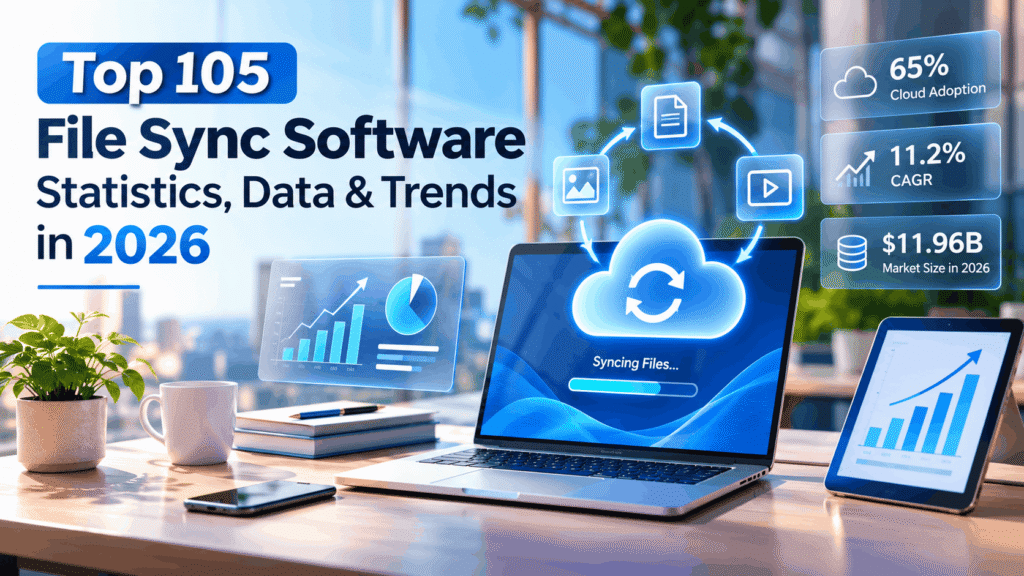
The global enterprise file synchronization and sharing (EFSS) market is estimated to reach $11.96 billion in 2026, with projections indicating growth to $20.33 billion by 2031, representing a compound annual growth rate (CAGR) of approximately 11.2%. Cloud-based deployment models account for roughly 65% of the EFSS market, highlighting the increasing preference for scalable, accessible, and cost-effective file synchronization solutions over traditional on-premises infrastructure.
Leading file sync platforms such as Google Drive, Dropbox, Microsoft OneDrive, Apple iCloud, Box, and Egnyte continue to shape the competitive landscape. According to the research data compiled for this report, Google Drive is used by approximately 94.44% of surveyed cloud storage users, followed by Dropbox at 66.20% and Microsoft OneDrive at 39.35%. These figures demonstrate the widespread adoption of cloud-based file synchronization tools across personal and professional environments, although platform usage percentages may overlap because users can adopt multiple services.
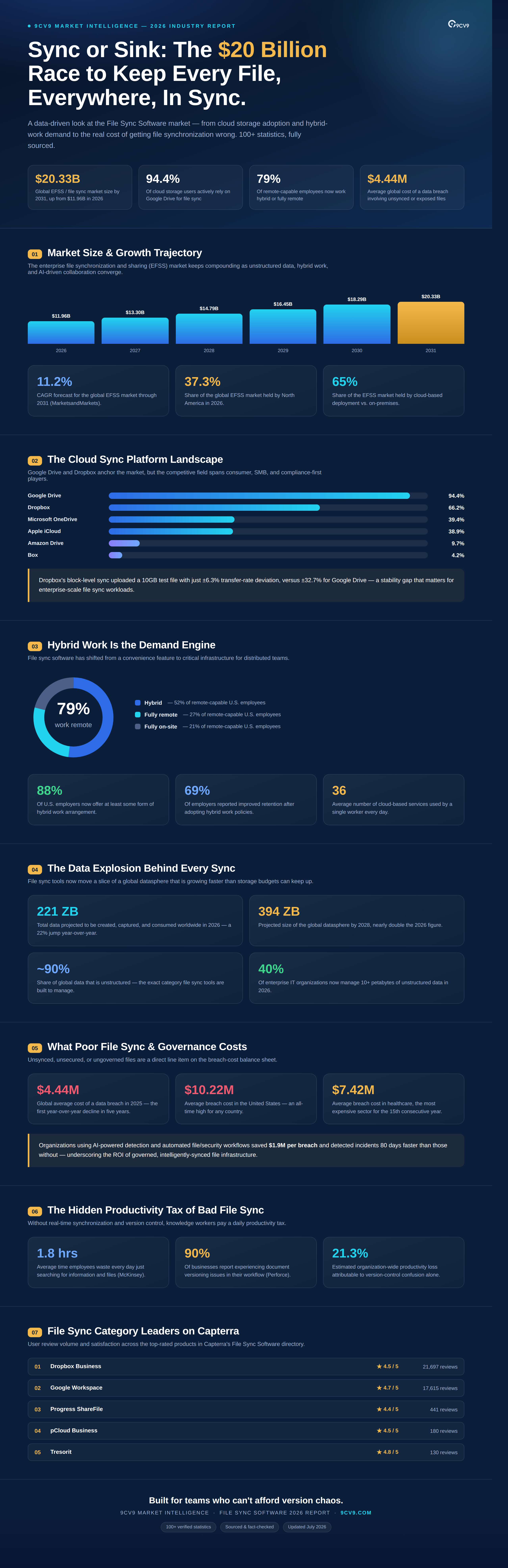
Meanwhile, evolving workplace arrangements are creating additional demand for seamless file synchronization and collaboration. Research indicates that 52% of remote-capable U.S. employees work in hybrid arrangements, while another 27% work fully remotely. With employees increasingly accessing documents across laptops, smartphones, tablets, and distributed office networks, businesses are prioritizing real-time synchronization, automated backups, document version control, and secure file-sharing capabilities.
However, the rapid adoption of file synchronization technology also introduces significant challenges surrounding cybersecurity, data governance, software integration, and operational efficiency. The global average cost of a data breach reached $4.44 million in 2025, emphasizing the financial consequences of inadequate information security. At the same time, employees reportedly spend an average of 1.8 hours per day searching for information and files, illustrating the productivity challenges that effective file management and synchronization systems aim to address.
Emerging technologies, particularly artificial intelligence (AI), intelligent search, automated workflows, and advanced cloud security, are also influencing the future of file sync software. As organizations manage growing volumes of unstructured data and increasingly complex SaaS ecosystems, file synchronization platforms are evolving beyond basic file transfers into comprehensive digital collaboration, content management, and information governance solutions.
Understanding these developments is essential for business owners, IT professionals, software vendors, technology investors, and decision-makers evaluating file synchronization solutions in an increasingly competitive digital economy.
This comprehensive guide explores the top 105 file sync software statistics, data, and trends in 2026, covering global market size, industry growth forecasts, cloud storage adoption, leading software providers, remote work trends, cybersecurity risks, data storage demands, SaaS adoption, and document management productivity.
By examining these key file synchronization software statistics and industry insights, businesses can better understand the current market landscape, identify emerging opportunities, compare technology adoption trends, and make more informed decisions about their file sync software investments in 2026 and beyond.
Before we venture further into this article, we would like to share who we are and what we do.
About 9cv9
9cv9 is a business tech startup based in Singapore and Asia, with a strong presence all over the world.
With over ten years of startup and business experience, and being highly involved in connecting with thousands of companies and startups, the 9cv9 team has listed some of the top and best companies/tools in this review.
If you like to get your company listed in our top B2B software reviews, check out our world-class 9cv9 Media and PR service and pricing plans here.
Top 105 File Sync Software Statistics, Data & Trends in 2026
Market Size & Growth
- The global enterprise file synchronization and sharing (EFSS) market is valued at $11.96 billion in 2026 and is projected to reach $20.33 billion by 2031.
- The EFSS market is expanding at an 11.2% compound annual growth rate (CAGR) between 2026 and 2031, reflecting steady enterprise investment in file sync infrastructure.
- North America holds the largest regional share of the EFSS market, accounting for an estimated 37.34% of global revenue in 2026.
- Cloud-based deployment models command roughly 65% of the EFSS market, confirming that businesses increasingly favor cloud-native file sync over on-premises systems.
- Large enterprises represent approximately 64% of EFSS market share, driven by complex multi-regional collaboration and data governance needs.
- Small and medium enterprises (SMEs) are the fastest-growing EFSS customer segment, thanks to cost-effective, easy-to-deploy cloud sync plans.
- Healthcare is emerging as the fastest-growing EFSS vertical, fueled by real-time clinical collaboration and mobile care coordination needs.
- Sales and marketing teams represent the largest functional adopters of EFSS platforms, using them to manage collateral, proposals, and customer files.
- Some market forecasts place the broader EFSS sector as high as $18.7–$19.3 billion in 2026, underscoring how differing methodologies still agree on strong double-digit growth.
- Longer-range forecasts suggest the EFSS platform market could approach $145 billion by 2035 if AI-driven collaboration tools keep accelerating adoption.
- The narrower “file sync software” market segment alone was valued at $7.29 billion in 2023 and is projected to reach $17.48 billion by 2031.
- Key vendors shaping the competitive landscape include Box, Citrix, Dropbox, Microsoft, Google, Egnyte, IBM, BlackBerry, OpenText, and VMware.
Cloud Storage & Platform Landscape
- Google Drive is the most widely used cloud sync platform, with 94.44% of surveyed cloud storage users actively relying on it.
- Dropbox ranks second in platform usage at 66.20%, remaining the benchmark for pure file-sync reliability.
- Microsoft OneDrive holds 39.35% usage share, benefiting from its bundling with Microsoft 365 subscriptions.
- Apple iCloud reaches 38.89% usage, driven largely by seamless integration across Apple’s device ecosystem.
- Amazon Drive, MEGA, Box, IDrive, and pCloud collectively make up the long tail of the market, each holding under 10% usage share.
- Google Drive supports more than 1 billion registered users, while Dropbox has surpassed 700 million registered users worldwide.
- Dropbox closed fiscal 2025 with approximately $2.52 billion in revenue and roughly 18 million paying customers.
- Google Workspace, which includes Drive, has captured an estimated 50.34% share of the productivity software market versus 45.46% for Microsoft 365.
- In a 2026 sync-speed benchmark, Dropbox uploaded a large test file in 21 minutes versus 31 minutes for Google Drive — roughly 45% faster.
- The same benchmark found Dropbox’s transfer-rate deviation on 10GB transfers was just ±6.3%, compared with ±32.7% for Google Drive, indicating far more consistent sync performance.
- Dropbox allows uploads up to 2TB per transfer, while Google Drive imposes a 750GB rolling 24-hour upload cap.
- Google Drive offers 15GB of free storage compared to Dropbox’s 2GB, making free-tier value a key differentiator for individual users.
- Google Drive supports individual file uploads up to 5TB for paid users, among the highest ceilings in the consumer cloud sync category.
- Dropbox Business Standard plans start at $18 per user/month for 5TB of shared team storage, versus $6 per user/month for Google Workspace Business Starter’s 30GB.
- Dropbox Dash, a universal AI search tool spanning Dropbox, Google Drive, OneDrive, Slack, and more, launched an add-on priced between $10–$14 per user/month.
- The consumer cloud storage market alone reached $14.9 billion in 2025, growing at a 21.3% CAGR.
- Major cloud storage downtime incidents cost enterprises an estimated $9,000 per minute on average in 2025, highlighting the business risk of sync outages.
- Public cloud storage now accounts for roughly 65% of total enterprise storage workloads.
Capterra File Sync Category (Category-Specific Data)
- Dropbox Business leads the Capterra File Sync Software directory by review volume, with 21,697 verified reviews and a 4.5/5 rating.
- Google Workspace holds the highest average rating among top-reviewed products in the category at 4.7/5 across 17,615 reviews.
- Progress ShareFile ranks third by review count in the File Sync category, with 441 reviews and a 4.4/5 rating.
- Tresorit, an end-to-end encrypted file sync platform, earns one of the highest satisfaction scores in the category at 4.8/5.
- pCloud Business combines a 4.5/5 rating with 180 reviews, reflecting strong satisfaction among SMB users seeking simple cloud sync.
- SyncBackPro and Cerberus FTP Server both achieve 4.8/5 ratings, showing that specialized Windows-based sync and transfer tools retain a loyal user base.
- Egnyte, positioned as a data governance and compliance-focused file sync platform, holds a 4.5/5 rating across 105 reviews.
- GoodSync, built for enterprise-grade backup and synchronization across systems, holds a 4.4/5 rating with 98 reviews.
- idgard, a GDPR-compliant European file sync and data room provider, serves more than 200,000 users across 1,200+ organizations.
- FreeFileSync, a free open-source sync tool, maintains a 4.7/5 rating across 47 reviews, illustrating continued demand for no-cost sync utilities.
- Resilio Sync differentiates itself with peer-to-peer sync technology that claims to improve transfer speeds by 2–10x over traditional cloud sync.
- The Capterra File Sync Software directory lists dozens of vetted vendors, spanning consumer-grade, SMB, and enterprise-compliance use cases.
Remote & Hybrid Work Driving Sync Demand
- Among remote-capable U.S. employees, 52% now work hybrid, 27% work fully remote, and only 21% work fully on-site, according to Gallup’s 2026 data.
- Roughly 79% of remote-capable employees work outside the office at least part of the week, directly fueling demand for reliable cross-device file sync.
- 88% of U.S. employers now offer at least some form of hybrid work arrangement, up sharply from pre-2022 levels.
- 69% of employers report improved employee retention after introducing hybrid work policies, with the single biggest gains at companies requiring only one office day per week.
- Companies offering just one mandatory office day per week saw retention improve by an average of 41%.
- If hybrid or remote flexibility were eliminated, 40% of workers say they would begin job hunting immediately.
- The average worker uses 36 different cloud-based services daily, reflecting the fragmented, sync-dependent nature of modern digital work.
- The average enterprise now relies on approximately 1,295 distinct cloud services across its operations.
- The number of people using personal cloud storage services has more than doubled from 1.1 billion in 2014 to roughly 2.3 billion today.
- 83% of global employees say they prefer a hybrid work setup that blends remote and in-office days.
- Three days in the office is now the most common hybrid schedule, followed by 39% of hybrid workers in 2025.
- Global office building utilization reached 53% in 2025, the highest level since March 2020, signaling a stabilized (not disappearing) hybrid model.
- 40% of all office interactions now involve at least one remote participant, increasing reliance on shared, synced files during meetings.
- 76% of cybersecurity professionals say their organization has become more vulnerable to cyberattacks specifically because of remote work.
- 73% of remote employees admit to using personal devices for work, increasing the surface area that file sync and access-governance tools must secure.
Data Volume & Unstructured Data Growth
- The global datasphere — all data created, captured, copied, and consumed worldwide — is projected to reach roughly 221 zettabytes in 2026, a 22% year-over-year increase.
- The global datasphere is forecast to nearly double again, reaching approximately 394 zettabytes by 2028.
- Around 90% of the world’s data is unstructured — the exact category (documents, media, project files) that file sync software is built to manage.
- Unstructured data is growing roughly three times faster than structured data, intensifying pressure on sync and storage infrastructure.
- 40% of enterprise IT organizations now manage 10 petabytes or more of unstructured data as of 2026.
- Enterprise content such as documents and emails accounts for roughly half of all unstructured data generated by organizations.
- NAND flash memory prices are forecast to rise as much as 234% in 2026 amid AI-driven demand, pushing up the cost of high-performance primary storage tied to active sync workloads.
- Between 60–70% of enterprise NAS data has not been accessed in over 90 days, highlighting the opportunity for smarter, tiered file sync and archiving strategies.
- The unstructured data segment of global storage is forecast to grow from 5.5 zettabytes in 2024 to 10.5 zettabytes by 2028, a 16% CAGR.
- A single one-hour virtual/AR collaboration session can generate as much data as 17,000 songs, illustrating how new work formats strain sync bandwidth.
Security, Data Breach & Ransomware Risk
- The global average cost of a data breach fell 9% year-over-year to $4.44 million in 2025 — the first decline in five years.
- The average U.S. data breach cost reached an all-time high of $10.22 million in 2025, more than double the global average.
- Detection and escalation costs make up $1.47 million of the average breach bill, the largest single cost component.
- Lost business and downtime account for another $1.47 million of the average breach cost, reflecting the operational impact of compromised or unsynced files.
- Post-breach response adds roughly $1.11 million to the average breach cost, covering legal work, credit monitoring, and remediation.
- Regulatory notification costs average $0.39 million per breach, a smaller but still material share of total breach expense.
- Healthcare remains the most expensive industry for data breaches for the 15th consecutive year, averaging $7.42 million per incident in 2025.
- Financial services breaches average $5.56 million, driven by strict regulatory requirements and the direct monetary value of financial data.
- Breaches identified in under 200 days cost organizations $3.61 million on average, versus $5.49 million for breaches that take longer to detect.
- Organizations using AI and automation extensively in security operations paid $3.62 million per breach versus $5.52 million for those without — a 34% reduction.
- AI-equipped security teams detect breaches roughly 51–80 days faster than teams without automated tooling.
- Ransomware was present in 44–48% of all breaches in the most recent reporting period, up from 32% a year earlier.
- The median ransomware payment stood at $139,875, while 63–69% of ransomware victims refused to pay at all.
- Customer personally identifiable information (PII) was the most frequently compromised data type, involved in 53% of all breaches.
- Stolen or compromised credentials remain the most common breach entry point, appearing in 29% of incidents.
- 82% of breaches involve a human element, such as phishing, credential theft, or misconfigured access permissions.
- Ransomware was involved in 88% of breaches at small and mid-sized businesses, compared with 39% at large enterprises.
- Nearly one in five small businesses that suffer a cyberattack ultimately files for bankruptcy or closes permanently.
SaaS Ecosystem & Software Sprawl
- The average organization now uses between 106 and 342 SaaS applications, depending on methodology, reflecting how fragmented modern software stacks — including file sync tools — have become.
- Companies with fewer than 200 employees use an average of 42 SaaS applications, while organizations with 5,000+ employees use an average of 158.
- The global SaaS market is projected to reach $465–$466 billion in 2026, growing at roughly 19% year-over-year.
- Median annual SaaS spend across organizations sits at $20.6 million, while large enterprises can spend $123.5–$375.5 million annually.
- Nearly 44–50% of SaaS licenses across the average organization go unused for 90 days or more, representing significant wasted software spend.
- 55% of employees admit to adopting SaaS applications — including file-sharing tools — without formal security team involvement, a key shadow IT risk.
- 30–40% of IT spending at large organizations is estimated to be “shadow IT,” including unsanctioned file sync and storage tools.
Document Version Control & Productivity
- Employees waste an average of 1.8 hours per day, nearly a quarter of the workweek, simply searching for information and files.
- 90% of businesses report experiencing document versioning issues in their day-to-day workflow.
- 59% of knowledge workers say they must wait for a colleague to finish editing a document before they can access the current version.
- 47% of employees have unknowingly worked on the wrong or an outdated version of a document.
- Version control confusion is estimated to cause a 21.3% organization-wide productivity loss — equivalent to losing 21 full-time employees in a 100-person company.
- 96% of employees, according to workplace surveys, struggle to locate the most recent version of a file.
- 83% of workers have been forced to recreate a document from scratch because they could not locate the existing file.
- 79% of employees now use document management systems with built-in collaborative and version-control features to reduce these losses.
- 62% of workers use company-sanctioned file-sharing apps on personal devices to access business documents, reinforcing the need for secure, cross-device sync.
- Document-related issues account for more than 21% of daily productivity loss across professional services teams.
- Only 3% of knowledge workers report being fully satisfied with their company’s current document handling process.
- 46% of small businesses say they waste time daily due to paper-intensive, non-synced processes.
- Well-implemented change tracking and version control can reduce document-related errors by as much as 46%.
Conclusion
The latest file sync software statistics, data, and trends in 2026 highlight the growing importance of secure, efficient, and scalable file synchronization solutions in an increasingly digital and interconnected business environment. As organizations continue adopting cloud computing, hybrid work arrangements, and collaborative technologies, file synchronization software has evolved from a basic file-sharing utility into a critical component of enterprise productivity, data management, and cybersecurity infrastructure.
With the global enterprise file synchronization and sharing (EFSS) market valued at approximately $11.96 billion in 2026 and projected to reach $20.33 billion by 2031, the industry is positioned for sustained expansion at an estimated 11.2% compound annual growth rate (CAGR). Cloud-based solutions already account for approximately 65% of the EFSS market, demonstrating the increasing preference for flexible, accessible, and cost-effective synchronization platforms that support distributed workforces and complex business operations.
Major file synchronization providers, including Google Drive, Dropbox, Microsoft OneDrive, Box, and Egnyte, continue to compete through enhanced collaboration capabilities, stronger security features, improved synchronization performance, and artificial intelligence integrations. With Google Drive reportedly used by 94.44% of surveyed cloud storage users and Dropbox by 66.20%, the market reflects substantial adoption of established cloud storage ecosystems. These usage figures also illustrate how individuals and organizations increasingly rely on multiple platforms to meet different storage, synchronization, and collaboration requirements.
Beyond market expansion, workplace transformation remains a significant driver of file sync software adoption. Research indicating that 52% of remote-capable U.S. employees work in hybrid arrangements and 27% work fully remotely reinforces the importance of seamless cross-device access, real-time document synchronization, and secure collaboration. As businesses operate across multiple locations and time zones, dependable file synchronization capabilities are becoming essential for maintaining operational continuity and employee productivity.
However, the industry’s growth also introduces important challenges. Cybersecurity threats, ransomware attacks, unauthorized file access, data breaches, and document versioning issues continue to affect organizations of all sizes. With the global average data breach cost reaching $4.44 million in 2025, businesses must increasingly evaluate file sync software based on security, encryption, access controls, compliance capabilities, and recovery features rather than convenience alone.
Productivity remains another important consideration. Research suggesting that employees spend approximately 1.8 hours daily searching for information and files highlights the potential value of centralized document management, intelligent search, automated synchronization, and effective version control. Organizations that improve file accessibility and reduce document duplication may be better positioned to streamline workflows, minimize operational inefficiencies, and support more effective collaboration.
Looking ahead, the future of file sync software beyond 2026 will likely be shaped by artificial intelligence, cloud-native infrastructure, zero-trust security frameworks, automated data governance, and deeper integrations with enterprise productivity platforms. As global data volumes continue expanding and businesses manage increasingly fragmented SaaS ecosystems, demand for intelligent synchronization solutions capable of balancing accessibility, performance, security, and cost efficiency is expected to remain strong.
For software vendors, these developments present opportunities to differentiate through advanced security, AI-powered file discovery, simplified administration, and industry-specific solutions. For businesses and IT decision-makers, selecting the right file synchronization software will require careful consideration of scalability, integration compatibility, data protection, user experience, and long-term operational costs.
Ultimately, the 105 file sync software statistics and trends presented in this guide demonstrate that file synchronization technology is becoming increasingly important to modern digital infrastructure. Organizations that strategically invest in reliable, secure, and adaptable file sync solutions will be better equipped to support distributed teams, protect sensitive information, improve workplace productivity, and navigate the evolving demands of digital transformation in 2026 and beyond.
If you find this article useful, why not share it with your hiring manager and C-level suite friends and also leave a nice comment below?
We, at the 9cv9 Research Team, strive to bring the latest and most meaningful data, guides, and statistics to your doorstep.
To get access to top-quality guides, click over to 9cv9 Blog.
To hire top talents using our modern AI-powered recruitment agency, find out more at 9cv9 Modern AI-Powered Recruitment Agency.
People Also Ask
What is file sync software?
File sync software automatically updates and synchronizes files across multiple devices, cloud platforms, and locations. It ensures users can access the latest versions of documents while supporting collaboration, data security, and productivity.
What is the global file sync software market size in 2026?
The global enterprise file synchronization and sharing (EFSS) market is estimated at $11.96 billion in 2026, driven by cloud computing adoption, hybrid work arrangements, and increasing demand for secure file collaboration.
How fast is the file sync software market growing?
The global EFSS market is projected to grow at an 11.2% compound annual growth rate (CAGR) between 2026 and 2031, reaching approximately $20.33 billion by 2031.
What are the major file sync software trends in 2026?
Major trends include cloud-native synchronization, AI-powered file search, automated document version control, zero-trust security, hybrid work collaboration, cross-device accessibility, and enterprise data governance.
Which file sync software platforms are most popular in 2026?
Google Drive, Dropbox, Microsoft OneDrive, Apple iCloud, Box, and Egnyte are among the leading file synchronization platforms, offering cloud storage, real-time collaboration, secure sharing, and enterprise file management capabilities.
What percentage of cloud storage users use Google Drive?
According to the research data, approximately 94.44% of surveyed cloud storage users rely on Google Drive, making it the most widely used platform within the surveyed group. Users may subscribe to multiple cloud storage services.
How popular is Dropbox in the file sync software market?
Dropbox is used by approximately 66.20% of surveyed cloud storage users. Its synchronization capabilities, cross-platform compatibility, and business collaboration features contribute to its popularity.
What is Microsoft OneDrive’s market adoption rate?
Microsoft OneDrive records approximately 39.35% usage among surveyed cloud storage users. Its integration with Microsoft 365 makes it a common choice for organizations using Microsoft productivity applications.
What percentage of the EFSS market uses cloud-based deployment?
Cloud-based deployment models account for approximately 65% of the enterprise file synchronization and sharing market, reflecting growing demand for scalable storage, remote accessibility, and simplified IT infrastructure.
Which region dominates the global file sync software market?
North America holds the largest regional share of the global EFSS market, accounting for approximately 37.34% of revenue in 2026, supported by enterprise cloud adoption and established technology infrastructure.
Which industries use file sync software the most?
File sync software serves healthcare, financial services, technology, education, professional services, and retail. Healthcare is identified as a particularly fast-growing EFSS segment due to secure clinical collaboration requirements.
How does hybrid work influence file sync software adoption?
Hybrid work increases demand for secure file access across locations and devices. Research indicates that 52% of remote-capable U.S. employees work hybrid schedules, making reliable synchronization essential for distributed collaboration.
What percentage of employees work remotely in 2026?
Among remote-capable U.S. employees, approximately 27% work fully remotely, 52% follow hybrid arrangements, and 21% work entirely on-site, according to the research data.
Why is file synchronization important for businesses?
File synchronization helps businesses maintain updated documents, reduce duplication, support remote collaboration, improve data accessibility, and minimize version conflicts across teams and devices.
What are the main benefits of enterprise file sync software?
Enterprise file sync software provides centralized file access, automatic synchronization, secure sharing, document version control, permission management, collaboration tools, and integration with existing business applications.
What is the difference between file sync software and cloud storage?
Cloud storage primarily stores files on remote servers, while file sync software automatically keeps file versions consistent across devices and locations. Many modern cloud storage platforms combine both capabilities.
How does AI improve file sync software in 2026?
AI-powered file sync solutions can improve document discovery, automate file organization, identify sensitive information, enhance security monitoring, and simplify collaboration across connected business applications.
What are the biggest cybersecurity risks associated with file sync software?
Major risks include unauthorized access, stolen credentials, ransomware, accidental data exposure, insecure sharing permissions, and shadow IT. Strong encryption, access controls, and monitoring help reduce these threats.
What is the average cost of a data breach in 2025?
The global average cost of a data breach reached $4.44 million in 2025, while the U.S. average climbed to $10.22 million, highlighting the financial importance of enterprise data security.
How can file sync software protect against ransomware?
Secure file sync platforms can support ransomware resilience through file version history, recovery capabilities, access restrictions, encryption, and suspicious activity detection. However, synchronization alone cannot replace independent backups.
What is document version control in file sync software?
Document version control tracks file changes and preserves previous versions, helping users recover earlier documents, prevent accidental overwrites, and maintain consistent information across collaborative workflows.
How much time do employees waste searching for files?
Research cited in the report suggests employees spend approximately 1.8 hours daily searching for information and documents. Centralized file management and intelligent search tools can help reduce this inefficiency.
How common are document versioning problems in businesses?
According to the compiled research, approximately 90% of businesses experience document versioning issues, while 47% of employees have unknowingly worked on outdated or incorrect document versions.
What is the role of file sync software in SaaS environments?
File sync software connects cloud applications, supports document accessibility, and simplifies collaboration. It can also help organizations manage files across fragmented SaaS ecosystems and reduce information silos.
How many SaaS applications does the average organization use?
Research estimates that organizations use between 106 and 342 SaaS applications on average, depending on methodology. This software fragmentation increases demand for integrated file synchronization and centralized data governance.
What is the best file sync software for small businesses?
Popular options include Google Drive, Dropbox Business, Microsoft OneDrive, pCloud, and Sync.com. The best choice depends on storage requirements, pricing, security features, collaboration needs, and existing software integrations.
What is the best file sync software for enterprises?
Enterprise file synchronization solutions include Microsoft OneDrive, Box, Egnyte, Dropbox Business, and Google Workspace. Organizations should compare security, compliance, scalability, administrative controls, and integration capabilities.
Is free file sync software suitable for business use?
Free file sync software can support basic synchronization and small-team collaboration. However, businesses handling sensitive information may require paid plans with advanced encryption, compliance controls, audit logs, and administrative features.
What factors should businesses consider when choosing file sync software?
Businesses should evaluate synchronization reliability, storage capacity, encryption, access controls, pricing, scalability, platform compatibility, version history, backup capabilities, and integration with existing business systems.
What is the future of file sync software beyond 2026?
The future of file sync software will likely involve AI-powered automation, intelligent file discovery, zero-trust security, cloud-native collaboration, automated compliance, and improved management of growing enterprise data volumes.
Sources
- MarketsandMarkets
- Research and Markets
- Research Nester
- Verified Market Research
- Verified Market Reports
- Market Research Intellect
- World Wide Market Reports
- Data Insights Market
- Capterra India
- SQ Magazine
- XtendedView
- Tech Insider
- Connectbit
- SelectHub
- Toolradar
- Unstar
- Spacelift
- SurveyMonkey
- Robert Half
- Chanty
- Neat
- KORE1
- Makerstations
- OfficeRnD
- UseCarly
- ArchieApp
- Yomly
- IBM
- Ponemon Institute
- DeepStrike
- StationX
- CNIC Solutions
- ComplianceDocs
- Axis Intelligence
- DataBreachCost
- DemandSage
- Komprise
- Statista
- Grepsr
- ZipDo
- Rivery
- Wasabi
- BetterCloud
- SellersCommerce
- Zylo
- CloudZero
- Backlinko
- Semrush
- SaaSUltra
- GrowthNavigate
- TrulyCritic
- Colorlib
- FileCenter
- ProProfsKB
- Pyraman
- Paperwise
- Medium
- Docsvault
- SuiteFiles
- AgilityPortal
- Docsie
- CFlow Apps