




























Key Takeaways
- The dermatology EMR software market is expanding rapidly, with one forecast projecting growth from $512.3 million in 2024 to nearly $1.39 billion by 2033 at an 11.6% CAGR.
- Cloud adoption, AI and teledermatology are reshaping dermatology software, with over 60% of platforms cloud-based and approximately 35% already featuring AI-enhanced image analysis.
- Dermatology EMR adoption is becoming mainstream, with more than 86% of dermatologists using or having used EHR systems as practices prioritize integrated clinical, billing, imaging and patient-engagement workflows.
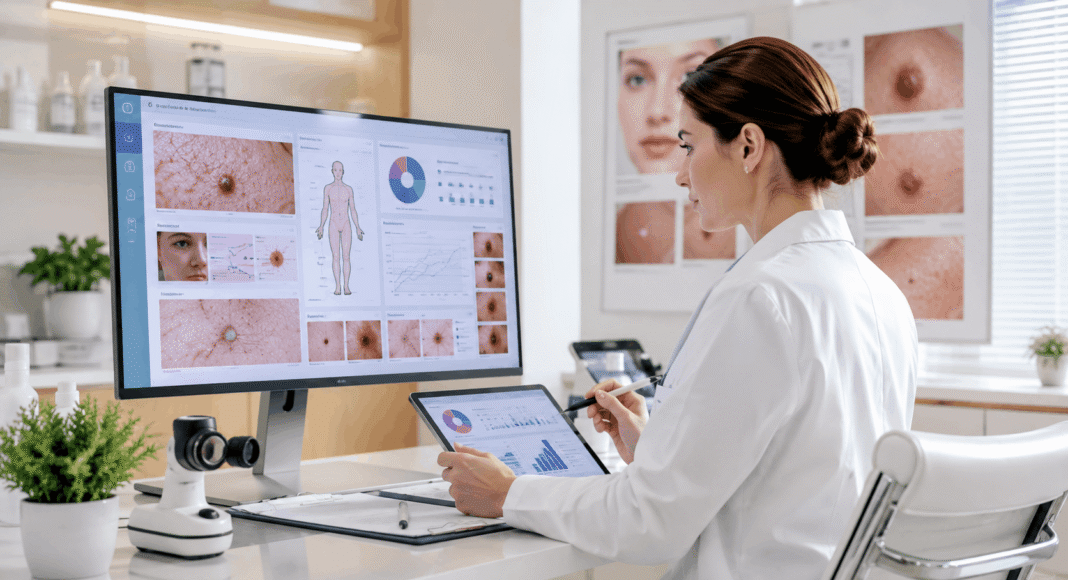
Dermatology EMR software transforms how dermatology practices manage patient records, clinical imaging, billing, scheduling, teledermatology, and digital workflows in 2026. The market is expanding as cloud adoption accelerates, AI-powered image analysis grows, and dermatologists increasingly rely on integrated platforms to improve clinical efficiency, patient engagement, and practice operations.
Dermatology practices are becoming increasingly digital, and electronic medical record (EMR) software is at the center of this transformation. From clinical documentation and medical imaging to billing, patient portals, teledermatology, and AI-assisted workflows, modern dermatology EMR platforms are evolving into comprehensive technology ecosystems for managing both medical and cosmetic dermatology practices.
Also, read our article on the Top 10 Best Dermatology Software.
The numbers highlight how quickly the market is developing. One estimate valued the global dermatology EMR software market at $512.3 million in 2024 and projects it to reach nearly $1.39 billion by 2033, representing an 11.6% compound annual growth rate. Other market forecasts are more conservative, placing expected growth in the 6% to 10% range depending on how the dermatology software market is defined. Despite differences between research methodologies, the overall direction is consistent: demand for specialized dermatology technology continues to expand.
Adoption is already substantial. More than 55% of dermatology practices reportedly use software systems to manage appointments, patient records, and treatment plans, while more than 86% of dermatologists use or have previously used an EHR system. Cloud deployment is also becoming increasingly important, with more than 60% of dermatology software platforms now estimated to be cloud-based.
Artificial intelligence is emerging as another major Dermatology EMR Software trend in 2026. Approximately 35% of dermatology software platforms now incorporate AI-enhanced image analysis capabilities, while purpose-built systems are increasingly using automation to improve documentation, coding, billing, and clinical workflows. One dermatology clinic case study reported a 30% reduction in charting time and a 22% improvement in billing accuracy within 60 days of adopting a specialty-specific EHR.
Teledermatology is adding further momentum. Estimates place the global teledermatology market in the billions of dollars, with several forecasts predicting double-digit annual growth through the next decade. Store-and-forward consultations, high-resolution medical imaging, virtual appointments, patient portals, and AI-assisted triage are consequently becoming increasingly relevant capabilities for dermatology EMR platforms.
Underlying these technology trends is an enormous clinical need. Around 50 million Americans experience acne, approximately 31.6 million are affected by eczema, and global dermatitis prevalence reached an estimated 241 million cases in 2021. As dermatologists manage growing volumes of chronic skin conditions, images, biopsies, prescriptions, cosmetic treatments, insurance claims, and longitudinal patient records, efficient digital infrastructure becomes increasingly important.
This guide to the Top 104 Dermatology EMR Software Statistics, Data & Trends in 2026 brings together key figures covering market size, growth forecasts, EHR adoption, cloud deployment, teledermatology, artificial intelligence, skin disease burden, regional markets, operational efficiency, competitive dynamics, and emerging technologies. Together, these statistics provide a data-driven view of where the dermatology EMR software industry stands in 2026 and the forces likely to shape its next phase of growth.
Before we venture further into this article, we would like to share who we are and what we do.
About 9cv9
9cv9 is a business tech startup based in Singapore and Asia, with a strong presence all over the world.
With over ten years of startup and business experience, and being highly involved in connecting with thousands of companies and startups, the 9cv9 team has listed some important and crucial software tools in this review.
If you like to get your company listed in our top B2B software reviews, check out our world-class 9cv9 Media and PR service and pricing plans here.
Top 104 Dermatology EMR Software Statistics, Data & Trends in 2026
🏪 MARKET SIZE & VALUATION
- $512.3M — Global dermatology EMR software market size reached USD 512.3 million in 2024, driven by accelerating digital health adoption and rising skin disease prevalence worldwide. (Growth Market Reports, 2025)
- $362.6M — The broader dermatology software market was valued at USD 362.63 million in 2025, with the EMR segment as its dominant component, signalling robust sector-wide investment. (Reanin Market Research, 2026)
- $200.8M — A second estimate pegs the dermatology EMR-specific segment at USD 200.8 million in 2025, with differences across reports reflecting varying scope definitions in this fragmented market. (Data Insights Market, 2026)
- $204.7M — Zion Market Research valued the global dermatology software market at approximately USD 204.69 million in 2023, providing a credible near-term baseline for compound growth analysis. (Zion Market Research, 2024)
- $188M — Verified Market Research placed the dermatology EMR market at USD 188 million in 2023, establishing a firm anchor point from which the market is forecast to grow 52% by 2030. (Verified Market Research, 2024)
- $189M — Verified Market Reports separately valued dermatology EMR at USD 189 million in 2023, with convergent estimates across multiple independent firms reinforcing data credibility. (Verified Market Reports, 2024)
- $182.9M — The global dermatology EMR market was worth USD 182.9 million in 2021, and has since nearly tripled to USD 512.3 million by 2024 — an extraordinary pace of post-pandemic digital acceleration. (Business Research Insights)
- $285M — The dermatology EMR market is projected to reach USD 285 million by 2030 at a CAGR of 6.2%, reflecting sustained structural demand even under conservative growth estimates. (Verified Market Research, 2024)
- $286M — An independent forecast from Verified Market Reports projects the market will reach USD 286 million by end-2030 at a CAGR of 6.3%, closely aligned with parallel research. (Verified Market Reports, 2024)
- $291.3M — Business Research Insights forecast the global dermatology EMR market to reach USD 291.3 million by 2028, projecting a 6.4% CAGR — consistent with mid-range industry expectations. (Business Research Insights)
- $354.7M — Zion Market Research forecasts the broader dermatology software market will reach USD 354.73 million by 2032, reflecting the growing role of practice management and patient engagement modules. (Zion Market Research, 2024)
- $734.1M — The dermatology software market is forecast to reach USD 734.10 million by 2032 at a CAGR of 10.6%, with EMR remaining the dominant segment, more than doubling the 2025 valuation. (Reanin Market Research, 2026)
- $1.39B — Growth Market Reports projects the dermatology EMR market will reach USD 1,389.7 million by 2033 at a CAGR of 11.6% — crossing the billion-dollar threshold is a watershed milestone. (Growth Market Reports, 2025)
- $1.5B — Strategic Revenue Insights projects an even higher ceiling of approximately USD 1.5 billion by 2033 at a CAGR of 10.2%, reflecting diverse scenario modelling across the analyst community. (Strategic Revenue Insights, 2025)
📈 CAGR & GROWTH RATES
- 11.6% CAGR — The dermatology EMR software market is forecast to grow at a robust 11.6% CAGR from 2025 to 2033, placing it among the fastest-growing sub-segments of healthcare IT. (Growth Market Reports, 2025)
- 10.6% CAGR — Reanin’s broader dermatology software market report projects a 10.6% CAGR through 2032, signalling above-market compound expansion driven by AI and cloud platform upgrades. (Reanin Market Research, 2026)
- 10.2% CAGR — Strategic Revenue Insights projects a CAGR of 10.2% from 2025–2033, underscoring confidence that specialty-specific EMR adoption will outpace general healthcare IT growth. (Strategic Revenue Insights, 2025)
- 6.4% CAGR — Data Insights Market models a more conservative 6.4% CAGR (2025–2033), suggesting the lower-bound scenario still delivers sustained double-digit value creation over the decade. (Data Insights Market, 2026)
- 6.3% CAGR — Zion Market Research and Verified Market Reports both cite a 6.3% CAGR, with consensus across independent analysts confirming the market’s mid-single-digit-to-double-digit growth corridor. (Zion / Verified Market Reports, 2024)
- 6.2% CAGR — Simbo AI and Verified Market Research cite a 6.2% CAGR for the US dermatology EMR market from 2024–2030, aligning with regulatory-driven adoption and clinical workflow demands. (Simbo AI / Verified Market Research, 2024–2025)
- 6–7% YoY — Broader EMR market solutions grew 6–7% year-over-year in 2025, with dermatology as one of the fastest-adopting specialties amid a wider push for interoperability and digital transformation. (EMRSystems.net, Jan 2026)
🏥 ADOPTION & PRACTICE USAGE
- >55% — Over 55% of dermatology practices now rely on software systems to manage appointments, patient records, and treatment plans, signifying a decisive majority shift from paper-based methods. (Reanin Market Research, 2026)
- 86%+ dermatologists — More than 86% of dermatologists use or have used an EHR system, matching or surpassing the national average for all office-based healthcare providers. (CDC via Unity Connect, 2025)
- 86% providers — The CDC found that nearly 86% of office-based healthcare providers use some form of EMR or EHR, confirming that digital record-keeping has become the industry standard. (CDC via Unity Connect, 2025)
- 30% fewer cancellations — Practices using dedicated EMR systems report up to a 30% reduction in appointment cancellations, directly improving revenue generation and patient continuity of care. (pmarketresearch.com, 2024)
- 6–8 weeks — Implementing a new dermatology EMR system typically takes 6–8 weeks, requiring a dedicated implementation manager and structured staff training across scheduling, billing, and clinical modules. (MedicalRecords.com, 2024)
- 35% market share (Epic) — Epic Systems captured over 35% of the broader EMR market in 2025, particularly among large multispecialty organisations, exerting competitive pressure on specialty EMR vendors. (EMRSystems.net, Jan 2026)
- 60 days ROI — A mid-sized Florida dermatology clinic demonstrated measurable return on investment within 60 days of switching to a purpose-built EHR, reporting both efficiency and revenue gains. (Legend EHR, 2025)
☁️ CLOUD & DEPLOYMENT
- >60% cloud-based — Over 60% of dermatology software platforms are now cloud-based, offering enhanced mobility, data security, and the scalability needed for multi-location dermatology practices. (Reanin Market Research, 2026)
- ~40% on-premise — Approximately 40% of dermatology EMR deployments remain on-premise, primarily favoured by larger hospital systems seeking greater data control and customisation capabilities. (Business Research Insights)
- 35% AI-enhanced — Approximately 35% of dermatology software platforms now feature AI-enhanced image analysis tools, assisting dermatologists in identifying skin cancer and other conditions more accurately. (Reanin Market Research, 2026)
- 48 hours — A cloud-based, purpose-built dermatology EHR can enable teledermatology launch within 48 hours using built-in features, demonstrating the agility of modern SaaS clinical platforms. (Legend EHR, 2025)
- Cloud = biggest share — During the forecast period, cloud-based deployments are expected to hold the largest segment share, with offline data loss risk elimination being the primary adoption driver. (Business Research Insights)
- Single system — Integrated EHR and practice management in a single system significantly boosts workflow efficiency, allowing staff to manage patient data, scheduling, and billing without switching platforms. (MedicalRecords.com, 2024)
📡 TELEDERMATOLOGY INTEGRATION
- $9.03B (2024) — The global teledermatology market was valued at USD 9.03 billion in 2024 per Market.us, projected to nearly quadruple to USD 36.85 billion by 2034 at a CAGR of 15.1%. (Market.us, 2025)
- $14.99B (2024) — Grand View Research estimates the teledermatology market at USD 14.99 billion in 2024, forecast to grow at a 17.9% CAGR through 2030 — directly driving EMR telehealth module upgrades. (Grand View Research, 2024)
- $15.76B (2024) — Newstrail/IMARC estimates a USD 15.76 billion 2024 teledermatology market, soaring to USD 63.18 billion by 2032 at an 18.96% CAGR — nearly a 4× expansion in eight years. (Newstrail, Nov 2025)
- $16.3B (2025) — Expert Market Research values global teledermatology at USD 16.30 billion in 2025, expected to reach USD 60.96 billion by 2035, reinforcing why EMR platforms are rapidly integrating virtual consultation tools. (Expert Market Research, 2025)
- $13.96B (2025) — OMR Global estimates the teledermatology market at USD 13.96 billion in 2025, with a more modest but still substantial CAGR of 12.8% through 2035. (OMR Global, 2025)
- $16.71B (2025) — Straits Research pegs the 2025 global teledermatology market at USD 16.71 billion, forecasting growth to USD 66.91 billion by 2034 at a 16.72% CAGR. (Straits Research, 2025)
- $18.69B (2024) — SkyQuestt estimates the teledermatology market grew to USD 18.69 billion in 2024, with the most aggressive growth forecast of 20.6% CAGR through 2032. (SkyQuestt, 2025)
- $60.96B by 2035 — The global teledermatology market is projected to reach USD 60.96 billion by 2035, a testament to how remote skin care consultation is being fundamentally legitimised as a mainstream healthcare channel. (Expert Market Research, 2025)
- +70% pandemic surge — Teledermatology services surged over 70% during the COVID-19 pandemic, permanently altering expectations around remote dermatological care and EMR telehealth module requirements. (pmarketresearch.com, 2024)
- 38.7% NA share — North America held 38.7% of the global teledermatology market in 2024 with USD 3.49 billion in revenues, confirming regional leadership in virtual dermatological care delivery. (Market.us, 2025)
- 38.5% NA share (2026) — North America is forecast to retain approximately 38.5% of the teledermatology market through 2026, supported by strong reimbursement policies and high digital health literacy. (Coherent Market Insights, 2025)
- $5.09B (US, 2024) — The United States alone generated USD 5.09 billion in teledermatology revenues in 2024, growing to USD 5.93 billion in 2025, reflecting the world’s most mature market for virtual dermatology services. (Straits Research, 2025)
- 39.1% store-and-forward — The store-and-forward segment dominated teledermatology in 2025 with a 39.07% revenue share, driven by seamless integration with EMR systems for asynchronous specialist referral workflows. (Straits Research, 2025)
- 17.9% CAGR — Grand View Research’s CAGR estimate of 17.9% for teledermatology (2025–2030) is the highest among major forecasters, reflecting exceptionally bullish expectations for AI-augmented virtual skin consultations. (Grand View Research, 2024)
- ~2,000 conditions — Around 90% of approximately 2,000 known dermatological conditions are treatable using digital dermatology tools (British Skin Foundation), justifying the massive investment in teledermatology-integrated EMR systems. (Newstrail via British Skin Foundation, Nov 2025)
🩺 SKIN DISEASE BURDEN
- 50M Americans (acne) — Approximately 50 million Americans suffer from acne alone (American Academy of Dermatology), generating massive patient volume that necessitates purpose-built EMR workflow automation. (AAD via pmarketresearch.com, 2024)
- 85M Americans (skin disorders) — The NIH estimates 85 million Americans are affected by skin disorders, with skin cancer accounting for approximately 20% of all cancer diagnoses in the country. (NIH via Verified Market Reports, 2024)
- 31.6M Americans (eczema) — Eczema affects 31.6 million Americans, underscoring the scale of chronic condition management that dermatology EMR systems must support with longitudinal care tracking. (Newstrail via British Skin Foundation, 2025)
- 241M global dermatitis cases (2021) — Global dermatitis cases reached 241 million in 2021 — a 38.8% increase since 1990 — with projections indicating continued upward pressure driving demand for specialist EMR systems. (GBD 2021, Frontiers in Medicine, 2026)
- 405M incident dermatitis cases — In 2021, global incident cases of dermatitis reached 405 million (95% UI: 356M–467M), with incidence peaking in the 5–9 year age group globally. (GBD 2021, Frontiers in Medicine, 2026)
- 129M (atopic dermatitis) — Global atopic dermatitis prevalence reached 129 million in 2021, a 20.02% increase from 1990, creating an outsized demand for paediatric-capable dermatology EMR platforms. (PMC NCBI, 2025)
- 253M (contact dermatitis) — Contact dermatitis recorded 253 million new cases in 2021 — the highest incidence of any allergic skin disease — intensifying the case for automated clinical documentation in EMR systems. (PMC NCBI, 2025)
- 1.79% of global DALYs — Skin conditions contributed 1.79% of total global disease burden in 2013 (measured in DALYs), ranking them as the 4th leading cause of non-fatal disease burden across 306 conditions. (GBD Study, PMC/NCBI)
- 9.3M DALYs (dermatitis) — Dermatitis alone cost 9.3 million disability-adjusted life years globally, representing the single largest burden among all skin disease categories evaluated in the GBD study. (GBD Study, PMC/NCBI)
- 5,459/100K prevalence rate — Dermatitis had the highest age-standardised prevalence rate at 5,459.07 per 100,000 population globally in GBD 2021, cementing its status as the most prevalent skin disease requiring routine EMR management. (PMC NCBI, 2024)
- 38.8% dermatitis increase — The 38.8% increase in global dermatitis cases from 1990 to 2021 represents one of the most significant chronic disease growth trends driving investment in specialty dermatology IT solutions. (Frontiers in Medicine / GBD 2021, 2026)
🌍 REGIONAL MARKET DATA
- $224.7M (North America, 2024) — North America held the largest regional share of the dermatology EMR market at USD 224.7 million in 2024, anchored by advanced infrastructure and dominant vendor presence. (Growth Market Reports, 2025)
- $143.4M (Europe, 2024) — Europe ranked second with USD 143.4 million in dermatology EMR market value in 2024, supported by strong regulatory frameworks including GDPR and national eHealth initiatives. (Growth Market Reports, 2025)
- Fastest growth: Asia Pacific — The Asia Pacific region is the fastest-growing dermatology EMR market globally, driven by expanding patient populations, increasing healthcare IT investments, and rising digital health awareness. (Growth Market Reports, 2025)
- 70% EU healthcare providers — Over 70% of European healthcare providers plan to invest in digital health solutions in the coming years (European Commission survey), directly accelerating EMR adoption across EU dermatology practices. (European Commission via pmarketresearch.com, 2024)
- 38.5% NA teledermatology share (2026) — North America is forecast to hold approximately 38.5% of the global teledermatology market in 2026, maintaining regional dominance through continuous investment in virtual care infrastructure. (Coherent Market Insights, 2025)
- <1 dermatologist/million (Sub-Saharan Africa) — Many Sub-Saharan African nations have fewer than one dermatologist per million people, making teledermatology-enabled EMR platforms critically important for bridging the specialist access gap. (Straits Research, 2025)
- KwaZulu-Natal telemedicine — In South Africa, established tele-health networks in rural provinces like KwaZulu-Natal demonstrate the proven model for teledermatology-integrated EMRs to reduce patient travel and improve care access. (Straits Research, 2025)
- Middle East digital push — The Middle East teledermatology market is expanding rapidly as governments and private players ramp up healthcare digitalisation, with EMR interoperability forming the backbone of regional strategies. (Data Insights Market, 2026)
🤖 AI & TECHNOLOGY
- $19.27B AI healthcare (2023) — The global AI in healthcare market was valued at USD 19.27 billion in 2023 and is forecast to grow at a 38.5% CAGR through 2030, directly accelerating AI module integration in dermatology EMR platforms. (Netguru, 2025)
- $48.2B AI telemedicine (2033) — The US AI in telemedicine market is forecast to expand from USD 6.7 billion in 2024 to USD 48.2 billion by 2033, with dermatology AI diagnostics as one of the key growth verticals. (Netguru, 2025)
- 38.5% AI healthcare CAGR — The 38.5% CAGR for AI in healthcare (2024–2030) is among the highest growth rates of any technology sector, with dermatology benefiting disproportionately from AI image analysis capabilities. (Netguru, 2025)
- 35% platforms with AI — Approximately 35% of dermatology software platforms now include AI-enhanced image analysis tools for lesion identification and skin cancer screening — a figure expected to rise sharply by 2028. (Reanin Market Research, 2026)
- 30% charting reduction — A Florida-based dermatology clinic reduced charting time by 30% within 60 days of switching to a purpose-built EHR, demonstrating AI-assisted documentation’s measurable impact on clinical efficiency. (Legend EHR, 2025)
- 22% billing improvement — The same clinic improved billing accuracy by 22% within 60 days using a specialty-specific EHR, showing that AI-powered coding tools deliver rapid and quantifiable financial benefits. (Legend EHR, 2025)
- 968 physicians with ambient AI — 968 physicians had enabled ambient AI scribes for at least 100 patient encounters each by 2025, with one physician using it for 1,210 encounters — signalling strong real-world AI adoption in clinical settings. (Netguru, 2025)
- 96.3% sensitivity — AI-driven screening for diabetic retinopathy achieves 96.3% sensitivity in optimal implementations — a benchmark AI dermatology diagnostic tools are rapidly approaching for melanoma and lesion classification. (Netguru, 2025)
- $200K Miiskin grant — In September 2025, Miiskin received a USD 200,000 grant to enhance its digital dermatology platform with generative AI, aiming to automate non-clinical tasks and reduce administrative burden for providers. (OMR Global, 2025)
- Blockchain for interoperability — Blockchain technology is emerging as a key driver for data security and interoperability in teledermatology platforms, addressing one of the most persistent challenges in multi-system EMR integration. (Expert Market Research, 2025)
⚡ OPERATIONAL EFFICIENCY & CLINICAL OUTCOMES
- Single platform benefit — Dermatology practices operating on a single integrated EHR + practice management platform significantly reduce administrative burden, eliminating redundant data entry and minimising human error. (MedicalRecords.com, 2024)
- One-click retrieval — EMR systems in dermatology enable one-click retrieval of patient history, X-rays, investigation reports, and medical bills — a feature that directly accelerates consultation workflows for high-volume practices. (Zion Market Research / Coherent Market Insights)
- Automated reminders — Automated patient reminders dispatched via multiple channels through EMR-linked portals directly reduce missed appointments and improve patient engagement across all demographics. (MedicalRecords.com, 2024)
- Revenue cycle management — Revenue cycle management modules within dermatology EMR platforms streamline billing, insurance claims, and payment collections, addressing the financial complexity unique to cosmetic + medical dermatology practices. (Reanin Market Research, 2026)
- HIPAA-compliant portals — Dermatology EMR platforms provide secure, HIPAA-compliant patient portals for data sharing and communication, a baseline compliance requirement that cloud-based systems are better positioned to maintain and update. (MedicalRecords.com, 2024)
- CBIR image search — Content-Based Image Retrieval (CBIR) in dermatology software enables visual search across patient image libraries, significantly accelerating diagnostic comparison and longitudinal condition monitoring. (Zion Market Research, 2024)
- CPT code simplification — 2021 CPT code changes simplified Evaluation & Management coding for dermatologists, and EMR platforms with auto-coding capabilities are enabling compliance with these revised standards at scale. (Unity Connect, 2025)
🏆 COMPETITIVE LANDSCAPE
- 18+ vendors — More than 18 major vendors currently serve the dermatology EMR market, including Modernizing Medicine, Nextech, AdvancedMD, eClinicalWorks, athenahealth, DrChrono, Kareo, Compulink, CureMD, and Greenway Health. (Verified Market Reports, 2024)
- 2024 Best in KLAS (Nextech) — Nextech was named 2024 Best in KLAS for Ambulatory Specialty EHR and holds the AAD’s only DataDerm Gold Recognition, representing the highest third-party validation of specialty-specific dermatology EMR quality. (Nextech, 2024)
- Moderate market concentration — The dermatology EMR market features moderate concentration, with no single vendor holding a dominant position — creating fertile ground for innovation-led competition and new market entrants. (Data Insights Market, 2026)
- M&A activity — Mergers and acquisitions are shaping the competitive landscape, with major deals like Allscripts’ acquisition of Practice Fusion in 2018 marking a trend toward consolidation among EMR vendors. (Coherent Market Insights)
- $100/month per physician — Practice Fusion’s shift from free to USD 100/month per physician following its 2018 acquisition illustrates the evolving and often contentious pricing dynamics in the dermatology EMR segment. (Coherent Market Insights)
- Lohmann & Rauscher (L&R) acquisition — In February 2025, L&R acquired OnlineDoctor AG, marking a major medical device company’s first entry into digital dermatology — signalling growing convergence between device manufacturers and EMR-adjacent platforms. (Market.us, 2025)
- Medtech + DermEngine — In September 2025, Medtech Global integrated with DermEngine to deliver skin care services within its software, improving diagnostic workflow and real-time monitoring capabilities for dermatology providers. (OMR Global, 2025)
📐 KEY DRIVERS & MARKET CONTEXT
- HITECH Act incentives — The US Health Information Technology for Economic and Clinical Health (HITECH) Act provided financial incentives for healthcare providers to adopt EMR systems, historically accelerating dermatology digital transformation. (Verified Market Reports, 2024)
- Value-based care — The shift toward value-based care reimbursement models is driving demand for data analytics and outcome reporting within dermatology EMR systems — aligning practice operations with payer expectations. (Data Insights Market, 2026)
- Interoperability demand — Interoperability — the ability to seamlessly exchange data between dermatology EMRs, lab systems, and primary care platforms — is now a primary procurement criterion for dermatology practices evaluating new software. (pmarketresearch.com, 2024)
- Cosmetic + medical duality — Dermatology is unique in combining medical and cosmetic billing workflows, requiring EMR platforms to manage packages, gift cards, and cosmetic inventory alongside standard clinical documentation and insurance billing. (Nextech, 2024)
- Dubai Salama EMR — In November 2017, the Dubai Health Authority completed the third phase of its unified Salama EMR system across five major hospitals, reflecting a global regulatory push for integrated dermatology-inclusive EMR infrastructure. (Coherent Market Insights)
- Mobile EHR (EMA) — Modernizing Medicine introduced EMA, a mobile EHR system with touch-and-swipe technology including Electronic Medical Assistant, electronic prior authorisation, and real-time prescription benefits — illustrating the mobile-first direction of dermatology EMR design. (Coherent Market Insights)
- Teledermatology pipeline — Key players including Teladoc Health and DermatologistOnCall are expanding offerings to include real-time video consultations, store-and-forward imaging, and AI-assisted triage services, with direct implications for EMR integration requirements. (Coherent Market Insights, 2025)
- 5G connectivity — The emergence of 5G connectivity is enabling richer teledermatology-EMR integrations, supporting real-time high-resolution image transmission for remote lesion analysis without clinical quality degradation. (Expert Market Research, 2025)
- Patient portal engagement — Dermatology EMR patient portals drive measurable improvements in patient engagement, with telehealth session frequency rising from 2.3 per user/year in 2019 to 8.7 per user/year in 2022. (Netguru, 2025)
- 62% improved care perception — 62% of patients reported improved care quality due to AI tools integrated with telehealth-linked EMR platforms, underscoring the downstream patient satisfaction benefits of advanced dermatology EMR features. (Netguru, 2025)
- Psoriasis upward trend — Psoriasis is the only major immune-related skin disease showing a statistically significant upward EAPC trend (+0.24) in global burden — making longitudinal EMR tracking of psoriasis patients increasingly critical. (PMC NCBI, 2024)
- Dermatopathology integration — Integration between dermatology EMR systems and dermatopathology laboratories streamlines biopsy reporting, reduces turnaround time, and eliminates redundant data entry — a key differentiator among premium platforms. (Growth Market Reports, 2025)
Conclusion
The dermatology EMR software statistics for 2026 point to an industry moving beyond basic electronic record-keeping toward more integrated, intelligent, and cloud-based clinical platforms. Dermatology practices increasingly expect their software to support clinical documentation, medical imaging, scheduling, billing, patient engagement, teledermatology, interoperability, and AI-assisted workflows within a unified system.
Market forecasts reinforce this growth trajectory. One estimate valued the global dermatology EMR software market at $512.3 million in 2024 and projects it to reach approximately $1.39 billion by 2033 at an 11.6% CAGR. Although other research firms provide more conservative estimates, forecasts consistently indicate continued expansion as healthcare organizations invest further in digital infrastructure and specialty-specific technology.
Adoption trends show that this transformation is already underway. More than 55% of dermatology practices reportedly use software to manage appointments, patient records, and treatment plans, while more than 86% of dermatologists use or have used an EHR system. Cloud technology is strengthening this transition, with more than 60% of dermatology software platforms estimated to be cloud-based.
AI could become one of the most important dermatology EMR software trends over the coming years. Around 35% of dermatology software platforms already feature AI-enhanced image analysis tools, while emerging applications include automated documentation, clinical image analysis, coding assistance, workflow automation, and AI-supported telehealth. Evidence cited in the research also shows how specialty-specific EHR technology can deliver practical operational gains, including a reported 30% reduction in charting time and 22% improvement in billing accuracy at one dermatology clinic.
Teledermatology represents another major growth catalyst. Multiple forecasts expect the global teledermatology market to expand at double-digit annual rates, increasing the importance of virtual consultations, store-and-forward imaging, patient portals, remote monitoring, and seamless EMR integration. As these capabilities mature, the distinction between traditional dermatology EMRs and broader digital dermatology platforms may continue to narrow.
At the same time, the enormous global burden of skin disease ensures that improving dermatology workflows is more than a technology issue. The research highlights approximately 50 million Americans affected by acne, 31.6 million Americans with eczema, 129 million people globally with atopic dermatitis in 2021, and 241 million global dermatitis cases in the same year. Managing these patient populations efficiently requires systems capable of supporting long-term records, images, pathology results, prescriptions, treatment histories, billing, and patient communication.
Ultimately, the 104 Dermatology EMR Software Statistics, Data & Trends for 2026 reveal a market being reshaped by cloud adoption, AI, teledermatology, interoperability, mobile technology, patient engagement, and increasingly integrated practice management. For dermatology practices, healthcare organizations, software vendors, investors, and digital health professionals, the key question is no longer whether dermatology will become more digital, but which technologies and platforms will define the next generation of dermatological care.
If you find this article useful, why not share it with your hiring manager and C-level suite friends and also leave a nice comment below?
We, at the 9cv9 Research Team, strive to bring the latest and most meaningful data, guides, and statistics to your doorstep.
To get access to top-quality guides, click over to 9cv9 Blog.
To hire top talents using our modern AI-powered recruitment agency, find out more at 9cv9 Modern AI-Powered Recruitment Agency.
People Also Ask
What is dermatology EMR software?
Dermatology EMR software is a specialized electronic medical record system designed to manage dermatology patient records, clinical documentation, images, scheduling, billing, prescriptions, treatment plans, and practice workflows.
How big is the dermatology EMR software market in 2026?
Published estimates vary by methodology. One study valued the global dermatology EMR market at $512.3 million in 2024 and forecasts it to reach nearly $1.39 billion by 2033.
How fast is the dermatology EMR software market growing?
Growth forecasts range from roughly 6% to 12% annually. One market estimate projects an 11.6% CAGR from 2025 to 2033, while more conservative forecasts place growth near 6.2%–6.4%.
What is the dermatology EMR software market forecast for 2033?
One forecast projects the global dermatology EMR market will reach approximately $1.39 billion by 2033, while another estimates around $1.5 billion, highlighting strong long-term growth expectations.
What percentage of dermatologists use EHR systems?
More than 86% of dermatologists reportedly use or have used an EHR system, indicating that electronic health records have become a mainstream part of modern dermatology practice.
What percentage of dermatology practices use software?
More than 55% of dermatology practices reportedly rely on software systems for functions such as patient records, appointment scheduling, treatment planning, and practice administration.
How common is cloud-based dermatology software?
More than 60% of dermatology software platforms are estimated to be cloud-based, reflecting growing demand for mobility, scalability, remote access, and easier technology management.
Why are dermatology practices moving to cloud-based EMR software?
Cloud dermatology EMRs offer remote access, scalability, mobility, centralized data management, and support for multi-location practices while reducing dependence on locally maintained infrastructure.
How is AI changing dermatology EMR software?
AI is expanding dermatology EMR capabilities through image analysis, documentation assistance, workflow automation, coding support, clinical decision support, and integration with digital dermatology services.
What percentage of dermatology software platforms use AI?
Approximately 35% of dermatology software platforms reportedly feature AI-enhanced image analysis tools designed to assist with lesion identification, skin cancer screening, and related workflows.
Can dermatology EMR software reduce charting time?
Yes. One Florida dermatology clinic reported a 30% reduction in charting time within 60 days after switching to a purpose-built dermatology EHR.
Can dermatology EMR software improve billing accuracy?
One dermatology clinic reported a 22% improvement in billing accuracy within 60 days of implementing a specialty-specific EHR, demonstrating potential financial benefits from optimized workflows.
How long does dermatology EMR implementation take?
Implementing a new dermatology EMR typically takes around six to eight weeks, although the actual timeline can vary depending on practice size, data migration, integrations, customization, and staff training.
What is teledermatology?
Teledermatology delivers dermatological care remotely through technologies such as video consultations, digital imaging, store-and-forward communication, patient portals, and online clinical workflows.
How large is the teledermatology market?
Estimates vary significantly. One source valued the global teledermatology market at $9.03 billion in 2024, while other studies produced estimates between roughly $15 billion and $19 billion.
How fast is the teledermatology market growing?
Several forecasts expect double-digit growth, with estimates ranging from approximately 12.8% to 20.6% CAGR depending on the research methodology and forecast period.
Why is teledermatology important for EMR software?
Teledermatology creates demand for EMRs that integrate virtual consultations, clinical images, asynchronous communication, patient records, remote workflows, and secure data exchange within one platform.
What is store-and-forward teledermatology?
Store-and-forward teledermatology allows clinical information and skin images to be captured and securely sent to a specialist for later review instead of requiring a live consultation.
Which region leads the dermatology EMR software market?
North America held the largest regional dermatology EMR market share in the cited research, reaching an estimated $224.7 million in market value in 2024.
Which region has the fastest-growing dermatology EMR market?
Asia Pacific is identified as the fastest-growing dermatology EMR market, supported by expanding healthcare IT investment, large patient populations, and increasing digital health adoption.
How large is the European dermatology EMR market?
Europe’s dermatology EMR market was estimated at $143.4 million in 2024, making it the second-largest regional market in the cited research.
What features should dermatology EMR software include?
Important capabilities include dermatology-specific charting, clinical imaging, scheduling, billing, patient portals, prescriptions, teledermatology, pathology integration, interoperability, and practice management.
Why is interoperability important in dermatology EMR software?
Interoperability enables dermatology practices to exchange patient information with laboratories, primary care providers, hospitals, pharmacies, and other healthcare systems more efficiently.
How does dermatology EMR software improve patient engagement?
Modern platforms can provide patient portals, automated appointment reminders, telehealth access, secure communication, online information sharing, and other digital tools that simplify patient interactions.
How does dermatology EMR software help reduce appointment cancellations?
Dedicated EMR systems have been associated with reductions in appointment cancellations of up to 30%, with automated reminders and improved patient communication supporting better attendance.
Why does dermatology need specialty-specific EMR software?
Dermatology combines clinical documentation, visual imaging, pathology, prescriptions, procedures, medical billing, and cosmetic services, creating workflows that general-purpose EMRs may not fully address.
How many major dermatology EMR vendors are there?
The research identifies more than 18 major vendors serving the dermatology EMR market, indicating a competitive landscape with both specialty-focused and broader healthcare software providers.
What is driving dermatology EMR software market growth?
Major growth drivers include cloud adoption, AI, teledermatology, rising skin disease prevalence, interoperability requirements, digital health investment, patient engagement, and demand for workflow automation.
How does skin disease prevalence affect dermatology EMR demand?
High patient volumes increase demand for efficient digital workflows. The research cites 50 million Americans with acne and 31.6 million with eczema, alongside substantial global dermatitis prevalence.
What are the biggest dermatology EMR software trends in 2026?
Key 2026 trends include cloud deployment, AI-assisted workflows, teledermatology integration, mobile access, interoperability, automated documentation, digital imaging, patient portals, and integrated practice management.
Sources
Growth Market Reports Reanin Market Research Data Insights Market Verified Market Research Verified Market Reports Zion Market Research Business Research Insights Strategic Revenue Insights Simbo AI EMRSystems MedicalRecords Legend EHR Nextech Unity Connect Market.us Grand View Research Straits Research Expert Market Research SkyQuestt OMR Global Newstrail Coherent Market Insights PMC NCBI Frontiers in Medicine GBD 2021 Netguru PW Consulting