



























Key Takeaways
- The Customer Journey Mapping software market is expanding rapidly, with forecasts projecting growth from $16.8 billion in 2025 to $76.2 billion by 2035, driven by AI, omnichannel customer experiences, and enterprise digital transformation initiatives.
- AI-powered Customer Journey Mapping tools are delivering measurable business results, helping organizations increase customer retention, improve customer satisfaction, reduce churn, boost marketing ROI, and generate faster revenue growth through predictive analytics and personalization.
- Enterprise adoption continues to accelerate across industries, as businesses invest in Customer Journey Mapping software, Customer Journey Analytics platforms, and journey orchestration solutions to create seamless customer experiences and gain a lasting competitive advantage.
Customer Journey Mapping software helps organizations understand, analyze, and optimize every customer interaction across digital and offline channels. The latest 2026 statistics reveal rapid market growth, increasing AI adoption, stronger enterprise investment, and measurable improvements in customer experience, retention, operational efficiency, and revenue performance.
Customer journey mapping has evolved from a simple visualization exercise into one of the most strategic disciplines shaping modern customer experience (CX), digital transformation, and business growth. In 2026, organizations are no longer satisfied with understanding isolated customer interactions. Instead, they are investing heavily in sophisticated Customer Journey Mapping (CJM) software that enables them to analyze every touchpoint, predict customer behavior, personalize experiences, and orchestrate seamless omnichannel journeys in real time. As customer expectations continue to rise across every industry, businesses are increasingly recognizing that exceptional customer experiences are no longer optional—they have become one of the strongest competitive differentiators available.

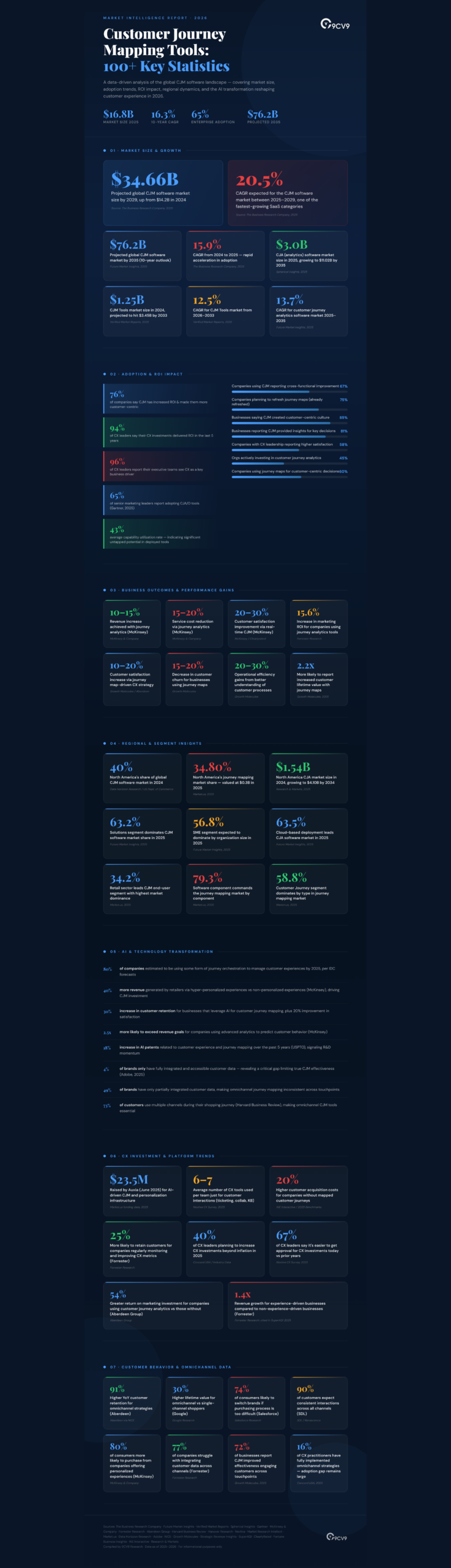
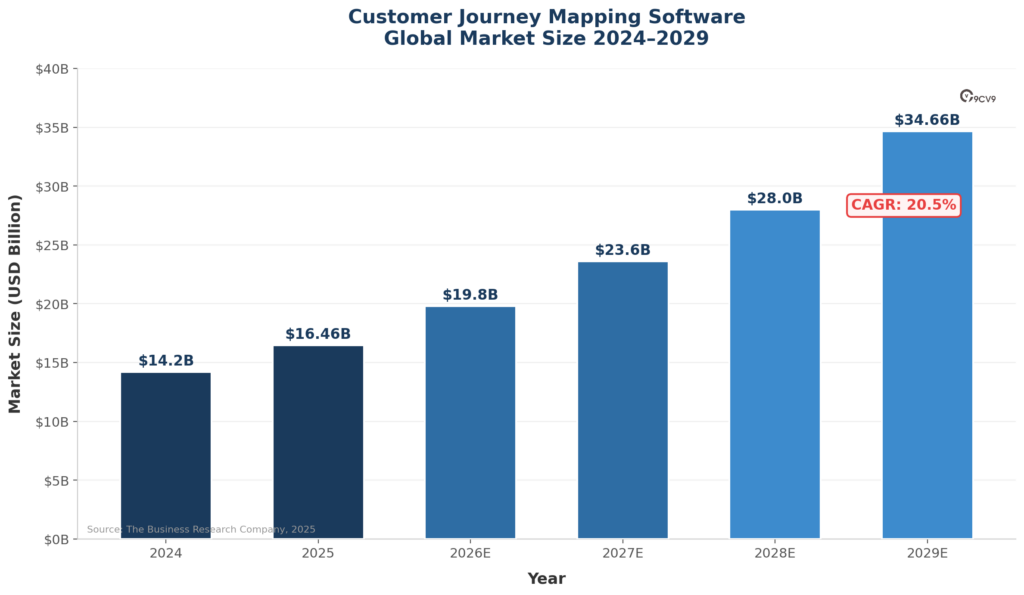
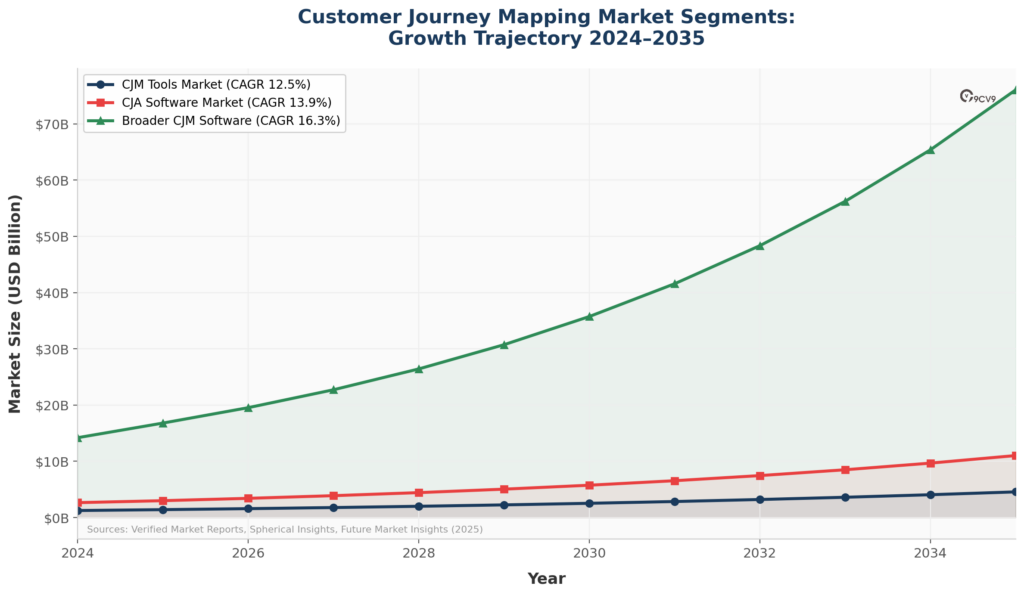
The numbers clearly illustrate this transformation. The global Customer Journey Mapping software market reached an estimated $16.8 billion in 2025 and is projected to surge to an extraordinary $76.2 billion by 2035, representing a robust compound annual growth rate (CAGR) of 16.3%. Other market forecasts reinforce this momentum, with estimates projecting the industry to exceed $34.66 billion by 2029 while maintaining growth rates exceeding 20% annually during the second half of the decade. Even specialized Customer Journey Analytics (CJA) software, which focuses on predictive insights rather than simple visualization, is expected to expand from approximately $3 billion in 2025 to more than $11 billion over the next decade. These figures demonstrate that customer journey technologies have firmly established themselves as one of the fastest-growing segments within the broader enterprise software ecosystem.
This remarkable growth is fueled by a fundamental shift in how organizations compete. Traditional business strategies often revolved around products, pricing, and distribution channels. Today’s market leaders increasingly compete on customer experience. Organizations across retail, banking, healthcare, telecommunications, manufacturing, travel, SaaS, and financial services are prioritizing customer journey intelligence to improve engagement, reduce friction, increase retention, and maximize customer lifetime value. Rather than reacting to customer problems after they occur, modern enterprises use journey mapping platforms to anticipate customer needs, proactively resolve pain points, and create highly personalized experiences throughout every stage of the customer lifecycle.
Artificial intelligence has accelerated this transformation even further. Modern Customer Journey Mapping platforms no longer function as static flowcharts created during occasional strategy workshops. Instead, AI-powered journey mapping tools continuously collect behavioral signals, analyze customer interactions across dozens of digital and offline channels, identify bottlenecks, predict future actions, recommend next-best actions, and automatically trigger personalized engagement campaigns. The integration of machine learning, predictive analytics, customer data platforms (CDPs), and real-time orchestration capabilities is fundamentally redefining what journey mapping software can accomplish.
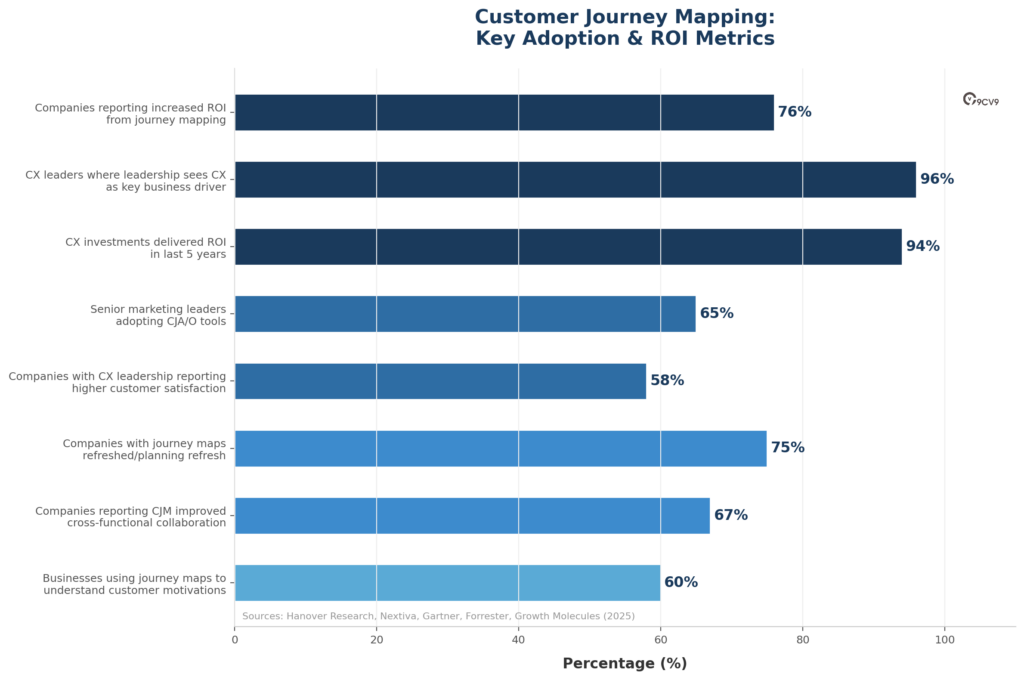
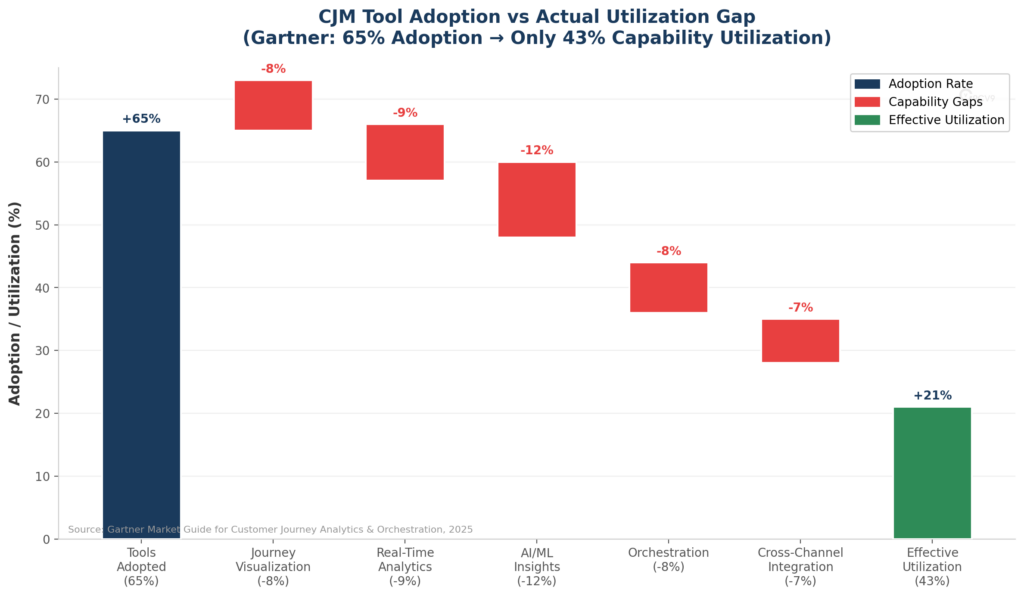
Enterprise adoption statistics highlight how mainstream these technologies have become. Around 65% of companies have already implemented customer journey mapping practices, while approximately 80% are expected to utilize some form of journey orchestration technology by 2025. Even more significantly, executive leadership increasingly views customer experience as a core driver of business performance, with 96% of CX leaders reporting strong executive support for customer experience initiatives. This widespread executive buy-in reflects growing confidence that investments in journey mapping deliver measurable returns rather than serving as purely operational improvements.
Businesses are also discovering that customer journey mapping directly impacts financial performance. Research consistently shows that organizations leveraging advanced journey analytics achieve higher marketing ROI, increased customer satisfaction, improved customer retention, lower service costs, stronger operational efficiency, and accelerated revenue growth. Companies implementing sophisticated journey analytics have reported revenue increases ranging from 10% to 15%, operational cost reductions of 15% to 20%, customer satisfaction improvements reaching 30%, and significant reductions in customer churn. Experience-driven organizations also consistently outperform competitors in both revenue growth and profitability, demonstrating that customer experience investments increasingly translate into measurable shareholder value rather than intangible brand benefits.
The rapid expansion of omnichannel commerce has made customer journey mapping more essential than ever before. Today’s consumers rarely interact with businesses through a single channel. Instead, they move seamlessly between websites, mobile apps, social media platforms, physical stores, customer support teams, messaging platforms, email campaigns, marketplaces, and connected devices before making purchasing decisions. Studies indicate that approximately 73% of customers use multiple channels during their buying journey, while 90% expect consistent experiences regardless of where interactions occur. Without comprehensive journey mapping software, organizations struggle to understand these increasingly fragmented customer paths, resulting in inconsistent experiences, higher acquisition costs, lower conversion rates, and increased customer churn.
The evolution of customer journey software also reflects broader technological changes occurring across enterprise IT. Cloud computing now dominates software deployment, accounting for over 63% of Customer Journey Analytics implementations, while software solutions represent more than 63% of the overall market compared to consulting-led services. This cloud-first approach enables businesses of every size—from startups and small businesses to multinational enterprises—to adopt enterprise-grade customer journey capabilities without significant infrastructure investments. Small and medium-sized enterprises now represent one of the fastest-growing customer segments as subscription-based SaaS pricing continues to lower adoption barriers.
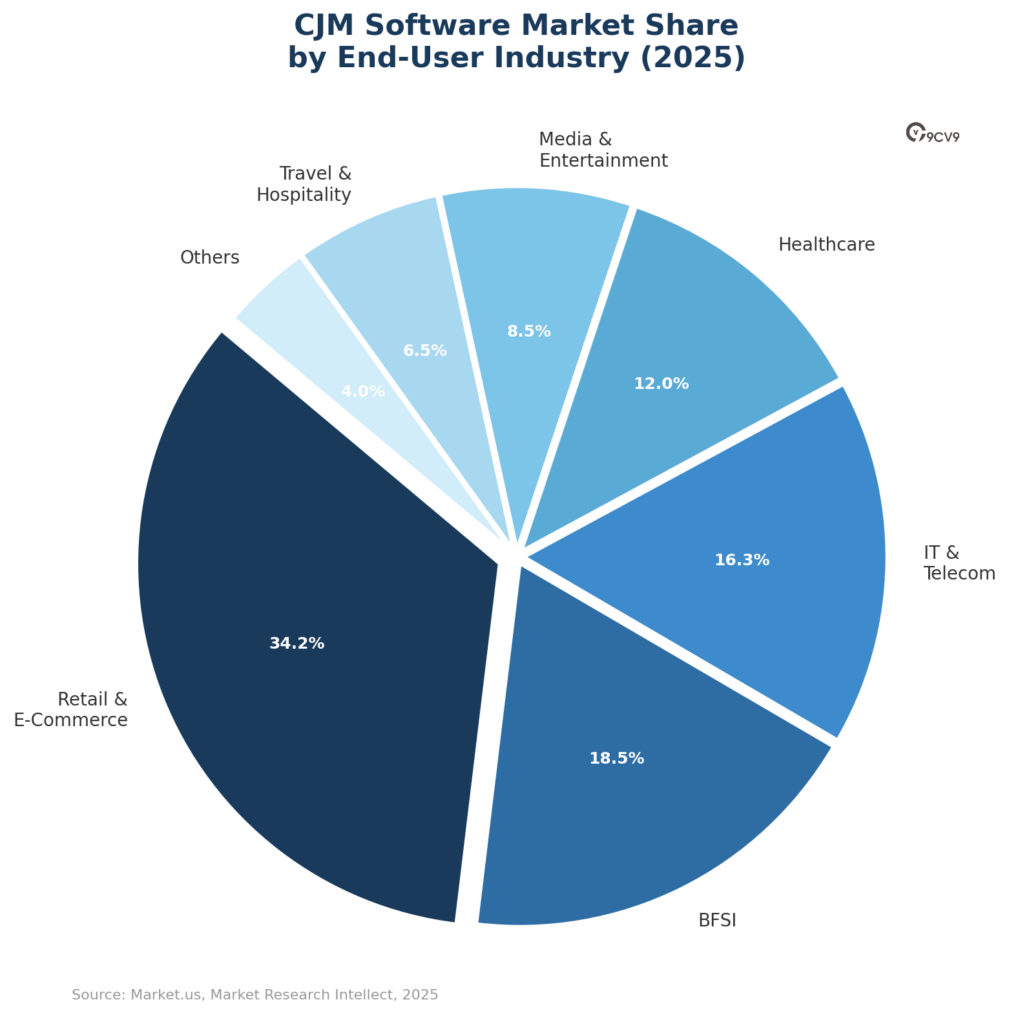
Regional markets further demonstrate the global significance of this technology. North America continues to lead worldwide adoption, accounting for approximately 40% of the global Customer Journey Mapping software market due to its mature digital economy, advanced enterprise technology landscape, and presence of major software vendors. However, Asia-Pacific, Europe, Latin America, and the Middle East are rapidly increasing investments in customer experience platforms as organizations modernize digital infrastructure and compete on customer-centric business models. Industry-specific adoption is also expanding rapidly, with retail remaining the largest end-user segment, followed closely by telecommunications, financial services, healthcare, and technology companies that depend heavily on customer loyalty and recurring revenue.
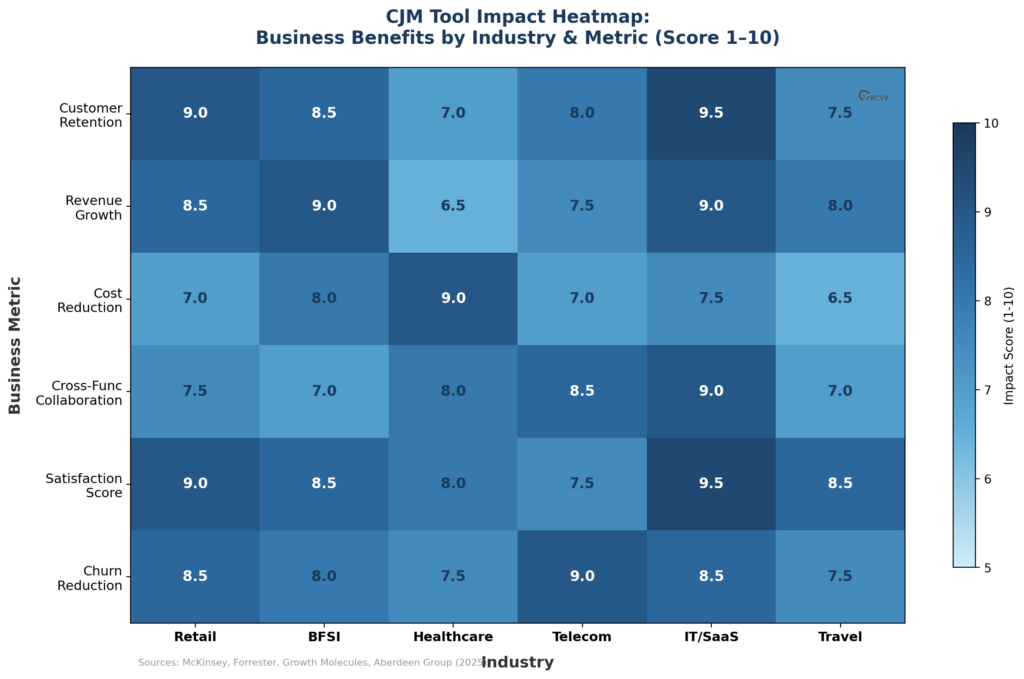
Artificial intelligence represents perhaps the most transformative force shaping Customer Journey Mapping software in 2026. Approximately 80% of companies are already using or planning to use AI to improve customer experience initiatives. AI-powered journey mapping enables businesses to identify hidden behavioral patterns, automate segmentation, personalize customer interactions, optimize engagement timing, predict customer churn, recommend retention strategies, and continuously improve customer journeys without requiring constant manual intervention. Companies deploying AI-enhanced journey mapping have reported measurable improvements in customer retention, satisfaction, and revenue growth, while predictive analytics allows organizations to shift from reactive customer service toward proactive experience management.
Despite impressive progress, significant challenges remain. Only a small percentage of organizations have achieved fully integrated customer data environments, with most businesses still operating across fragmented systems that limit their ability to build comprehensive customer journeys. Data integration, cross-functional collaboration, organizational silos, privacy regulations, and inconsistent analytics capabilities continue to present obstacles for many enterprises. These challenges have created enormous opportunities for next-generation Customer Journey Mapping platforms that combine customer data platforms, AI, automation, analytics, and orchestration into unified ecosystems capable of delivering actionable insights across every customer touchpoint.
Investment trends further underscore the maturity of the market. Customer experience budgets continue to expand as organizations recognize the strategic importance of customer-centric operations. Many CX leaders plan to increase investment beyond inflation, while venture capital firms continue funding AI-powered journey analytics startups developing next-generation capabilities. Enterprises increasingly measure customer journey initiatives using tangible business outcomes such as customer lifetime value, net revenue retention, operational efficiency, marketing ROI, acquisition cost reduction, expansion revenue, referral growth, and profitability rather than relying solely on customer satisfaction metrics. This evolution demonstrates that Customer Journey Mapping software has become an essential business intelligence platform rather than merely a visualization tool.
The growing complexity of modern customer behavior ensures that Customer Journey Mapping software will remain a cornerstone of digital business strategy for years to come. As organizations continue embracing artificial intelligence, predictive analytics, omnichannel engagement, hyper-personalization, and real-time decision-making, demand for sophisticated journey mapping platforms will likely accelerate even further. Businesses that effectively understand and optimize customer journeys will be better positioned to build lasting customer relationships, increase loyalty, improve operational efficiency, and generate sustainable long-term growth in increasingly competitive global markets.
This comprehensive guide presents the Top 104 Customer Journey Mapping Tools Statistics, Data & Trends in 2026, bringing together the latest market research, enterprise adoption figures, customer experience benchmarks, AI developments, investment patterns, financial performance metrics, regional insights, and emerging industry trends shaping the future of customer journey management. Whether you are a CX executive, digital transformation leader, SaaS founder, marketing strategist, product manager, customer success professional, investor, consultant, or technology decision-maker, these carefully curated statistics provide valuable insights into one of the fastest-growing enterprise software categories and reveal why Customer Journey Mapping has become a mission-critical capability for organizations seeking to compete and thrive in today’s experience-driven economy.
Before we venture further into this article, we would like to share who we are and what we do.
About 9cv9
9cv9 is a business tech startup based in Singapore and Asia, with a strong presence all over the world.
With over ten years of startup and business experience, and being highly involved in connecting with thousands of companies and startups, the 9cv9 team has listed some important and crucial software tools in this review.
If you like to get your company listed in our top B2B software reviews, check out our world-class 9cv9 Media and PR service and pricing plans here.
Top 104 Customer Journey Mapping Tools Statistics, Data & Trends in 2026
🏦 SECTION 1: Market Size & Growth
1. $16.8 billion — The global CJM software market size in 2025.
The CJM software space has crossed the $16B threshold, establishing itself as a mainstream enterprise technology category rather than a niche CX tool.
2. $76.2 billion — Projected global CJM software market size by 2035.
A near-5x growth over a decade reflects how central customer journey intelligence is becoming to every industry’s operating model.
3. 16.3% — CAGR of the CJM software market from 2025 to 2035.
Sustaining double-digit CAGR over a 10-year horizon signals structural, not cyclical, demand for journey orchestration platforms.
4. $14.2 billion — CJM software market value in 2024.
Starting from a sizable base, the market’s 2024-to-2025 jump of $2.6B underscores the accelerating pace of enterprise adoption.
5. $34.66 billion — Projected CJM software market size by 2029.
Reaching $34B in just five years places CJM software among the fastest-scaling segments in the enterprise SaaS landscape.
6. 20.5% — CAGR for the CJM software market between 2025 and 2029.
This near-21% growth rate outpaces most enterprise software categories, driven by AI integration and omnichannel demand.
7. 15.9% — CAGR observed from 2024 to 2025 in CJM software.
Even the short-term growth rate is impressive, suggesting that demand acceleration has been immediate and broad-based.
8. $1.25 billion — CJM Tools market size in 2024 (dedicated tools segment).
The narrower CJM tools category (excluding broader CEM platforms) already crossed the billion-dollar mark in 2024.
9. $3.45 billion — Projected CJM Tools market by 2033.
Nearly tripling in under a decade, dedicated CJM tools are gaining share as organizations mature their CX tech stacks.
10. 12.5% — CAGR for the CJM Tools market from 2026–2033.
Even the more conservative tools-only segment is growing at 12.5%, cementing its status as a durable, non-discretionary spend category.
11. $3.0 billion — Customer Journey Analytics (CJA) software market in 2025.
Analytics-first journey tools are gaining ground, as companies move beyond visualization toward predictive intelligence.
12. $11.02 billion — Projected CJA software market by 2035 (CAGR 13.9%).
The analytics segment will more than triple in size, driven by AI/ML enhancements to traditional journey visualization platforms.
13. 13.9% — CAGR for customer journey analytics software (2025–2035, Spherical Insights).
Analytics capabilities are growing slightly faster than pure mapping tools, reflecting the shift from diagrams to real-time intelligence.
14. $3.5 billion — Projected CJM software market size by 2031 in IT & Telecom category.
The IT/Telecom vertical alone is expected to reach $3.5B, making it one of the top three industries driving adoption.
15. 15.4% — CAGR for CJM software market in IT & Telecom from 2025 to 2031.
Telecom’s churn-sensitive business model makes journey analytics a core operational investment, not just a marketing tool.
16. $4.5 billion — Broader CJM software market value in 2023 (per Data Horizzon Research).
Different segmentation methodologies yield different totals, but all converge on one fact: this is already a multi-billion dollar market.
17. $12.2 billion — Broader CJM software market projection by 2033.
At a 10.4% CAGR, even conservative estimates confirm sustained double-digit growth across the coming decade.
18. 10.4% — CAGR for customer journey analytics market from 2025 to 2032 (Fortune Business Insights).
A lower-bound estimate that still implies a near-doubling of market size in seven years across all categories.
19. $4.96 billion — CJA market in 2025, projected to reach $9.95 billion by 2032.
The analytics market is on track to double in seven years, per Fortune Business Insights data.
20. 16.5% — CAGR of the global CJM software market projected 2025–2033 (Strategic Revenue Insights).
Cross-source agreement on mid-to-high teens CAGR validates these forecasts as structurally sound, not promotional.
🎯 SECTION 2: Enterprise Adoption
21. 65% — of senior marketing leaders report adopting CJA/O tools (Gartner, 2025).
While adoption is above the majority threshold, the 35% non-adopter pool still represents a massive greenfield opportunity.
22. 43% — Average capability utilization rate among CJA/O tool adopters (Gartner, 2025).
Businesses are buying the right tools but realizing only 43 cents of every dollar’s worth of capability — a serious deployment gap.
23. 45% — of organizations are actively investing in customer journey analytics.
Nearly half of all enterprises are deploying capital toward journey analytics, signaling broad mainstream acceptance.
24. 65% — of companies have undertaken customer journey mapping as a business practice.
Two-thirds of companies now use some form of journey mapping, making it a baseline competitive requirement.
25. 75% — of companies with journey maps have previously refreshed their maps and plan to do so again.
Journey mapping is no longer a one-time workshop; it is an ongoing, iterative intelligence process for most adopters.
26. 80% — of companies estimated to be using journey orchestration by 2025 (IDC).
When orchestration is included alongside mapping, the adoption rate expands dramatically beyond pure visualization tools.
27. 57% — of companies have integrated journey map insights into customer success strategies.
Just over half of journey mapping users are fully operationalizing those insights — the rest are leaving retention gains on the table.
28. 96% — of CX leaders say their leadership team sees CX as a key driver of business outcomes.
Near-universal buy-in at the executive level means CJM tools are increasingly shielded from budget cuts.
29. 94% — of respondents saw CX investments deliver ROI in the last five years (Nextiva, 2025).
Almost universal ROI proof confirms that CX and CJM investments are among the most defensible spend categories in the enterprise.
30. 67% — of CX leaders say it is easier to get approval for CX investments today vs. prior years.
The C-suite has become more receptive to CX spending, reducing friction in CJM tool procurement cycles.
💰 SECTION 3: ROI & Business Impact
31. 76% — of companies say CJM has increased their ROI and made them more customer-centric (Hanover Research).
Three-quarters of organizations directly attribute ROI gains to journey mapping, making the business case nearly incontrovertible.
32. 10–15% — Revenue increase achieved by companies leveraging journey analytics (McKinsey).
A double-digit top-line lift for businesses that rigorously apply analytics to the customer journey underscores the commercial stakes.
33. 15–20% — Service cost reduction achieved via journey analytics (McKinsey).
Cost efficiency gains compound with revenue growth, making journey analytics one of the highest-return enterprise software investments.
34. 20–30% — Customer satisfaction improvement from real-time CJM applications (McKinsey).
Satisfaction improvements of this magnitude translate directly into NPS gains, reduced churn, and higher referral rates.
35. 15.6% — Increase in marketing ROI for companies using advanced journey analytics tools (Forrester).
A 15.6% marketing ROI uplift from journey intelligence justifies significant tool investment within a single budget cycle.
36. 54% — Greater return on marketing investment for CJA-using companies vs. those without (Aberdeen Group).
Aberdeen’s landmark finding demonstrates that the ROI advantage of journey analytics is not marginal but transformational.
37. 1.4x — Revenue growth for experience-driven vs. non-experience-driven businesses (Forrester).
The revenue multiplier effect of prioritizing customer experience compounds over time, creating durable competitive moats.
38. 1.5x — Higher revenue growth and 1.8x higher profitability for companies with strong CX strategy.
The dual impact on both revenue and profitability makes CX investment one of the highest-leverage strategic bets available.
39. 2.2x — More likely to report increased customer lifetime value for companies using journey maps.
LTV gains from journey mapping validate the long-term financial rationale for ongoing CJM investment.
40. 10–20% — Customer satisfaction increase for businesses using journey map-driven CX strategies.
Operationalizing journey insights creates measurable satisfaction improvements that appear in CSAT and NPS data within quarters.
41. 15–20% — Decrease in customer churn for businesses using journey maps.
Churn reduction of this scale directly protects recurring revenue, making CJM tools especially valuable for SaaS and subscription businesses.
42. 20–30% — Operational efficiency gains from CJM-driven understanding of customer processes.
Operational wins compound with customer-facing gains, meaning the total financial impact of CJM far exceeds most initial projections.
43. 15–20% — Reduction in customer complaints and negative feedback using journey mapping.
Complaint reduction has compounding effects: lower support costs, higher NPS, and improved employee satisfaction in service roles.
44. 15% — Reduction in customer churn from proactive customer service strategies (Forrester).
Proactive engagement, enabled by journey analytics, is one of the highest-value uses of CJM technology in recurring revenue businesses.
45. 25% — More likely to retain customers for companies regularly monitoring and improving CX metrics (Forrester).
Consistent measurement and iteration — not one-time mapping — is what drives sustainable retention gains.
46. 20% — More likely to experience revenue growth for companies that regularly improve CX metrics (Forrester).
The data is clear: CX improvement is a revenue growth strategy, not just a satisfaction exercise.
47. $1 billion — Revenue increase for a large company from improving CX by just one point (Forrester).
At scale, even incremental CX improvements — mapped and measured via journey tools — translate to material P&L impact.
48. 40% — More revenue generated by McKinsey personalization leaders versus average competitors.
Companies that use journey mapping to enable personalization gain a structural revenue advantage over less data-driven peers.
49. 25% — Reduction in customer satisfaction (CSAT) from implementing journey-based proactive success programs.
Inversion of satisfaction metrics post-implementation highlights the critical importance of thoughtful rollout and change management.
50. 4–8% — Faster revenue growth for companies excelling at customer experience (McKinsey).
Revenue growth premium from CX excellence highlights journey mapping as a strategic — not just tactical — investment.
🌍 SECTION 4: Regional & Segment Data
51. 40% — North America’s share of the global CJM software market in 2024.
North America’s dominance reflects mature digital infrastructure, high CX investment levels, and the presence of leading vendors like Salesforce, Adobe, and Oracle.
52. $1.54 billion — North America CJA market size in 2024, growing to $4.10B by 2034.
The North American analytics sub-market alone will nearly triple, reflecting deepening analytical sophistication among U.S. and Canadian enterprises.
53. 10.3% — CAGR for the North America CJA market from 2025 to 2034.
Even the most mature regional market is growing at double digits, indicating ongoing appetite for platform upgrades and new use cases.
54. 34.80% — North America’s journey mapping market share in 2025, valued at $0.3B (Market.us).
The narrower tools segment sees North America maintaining leadership while Asia Pacific closes the gap rapidly.
55. 63.2% — Solutions segment share of the CJM software market in 2025.
Software solutions dominate over services, reflecting enterprise preference for self-serve and AI-automated platforms over consulting-heavy deployments.
56. 56.8% — SME segment’s expected share of the CJM software market in 2025.
Small and medium enterprises have become the primary growth engine, as cloud-based, subscription-priced tools democratize access.
57. 63.5% — Cloud-based deployment’s share of the CJA software market in 2025.
Cloud dominance reflects the scalability, collaboration, and cost advantages that on-premise simply cannot match for most buyers.
58. 34.2% — Retail sector’s share of the CJM end-user market — the largest single industry.
Retail’s complex omnichannel environment and intense competitive pressure make journey mapping a survival tool, not a luxury.
59. 79.3% — Software component’s share of the journey mapping market by component.
The software-first nature of this market means platform decisions drive most of the value — services are secondary.
60. 58.8% — Customer Journey segment’s dominance in the journey mapping market by type.
External customer journey mapping far outpaces internal employee journey mapping in investment and platform capability.
61. 58.7% — Large enterprises’ expected share of the CJA software market in 2025.
Despite SME growth in CJM tools broadly, analytics-heavy CJA platforms remain predominantly an enterprise-grade purchase.
62. 15% — Average annual rate of cloud adoption growth in businesses (FCC data).
Accelerating cloud adoption directly expands the addressable market for cloud-based CJM and CJA platforms.
63. 18% — Increase in AI patents related to customer experience and journey mapping over 5 years (USPTO).
Patent activity is the leading indicator of commercial product launches, signaling a wave of AI-enhanced CJM capabilities ahead.
🤖 SECTION 5: AI, Technology & Data Integration
64. 80% — of companies using or planning to use AI to improve customer experience by 2025.
With four out of five organizations investing in AI-driven CX, the competitive pressure to adopt AI-enabled journey tools is intense.
65. 4% — of brands with fully integrated and accessible customer data (Adobe 2025 State of CX).
A staggeringly low data integration rate reveals why most journey mapping efforts remain surface-level and inconsistent.
66. 49% — of brands with only partially integrated customer data.
Even the majority of “digitally mature” companies are operating with fragmented data, hobbling their journey mapping effectiveness.
67. 30% — Increase in customer retention for businesses using AI for journey mapping.
AI-driven journey tools do not just improve the maps — they improve the outcomes, delivering measurable retention uplift.
68. 20% — Improvement in customer satisfaction for businesses using AI for journey mapping.
Satisfaction gains from AI-enhanced mapping come faster and at greater scale than traditional manual methods.
69. 2.5x — More likely to exceed revenue goals for companies using advanced analytics to predict customer behavior (McKinsey).
Predictive capability transforms journey maps from retrospective documents into forward-looking revenue tools.
70. 20% — Reduction in churn in retail and telecom via real-time CJM interventions (Forrester).
Real-time analytics converts journey insights from lagging to leading indicators, enabling timely retention actions.
71. 25% — Increase in customer satisfaction post-AI journey orchestration implementation (SuperAGI case data).
First-party case data from AI orchestration implementers validates the quantitative impact of AI on CX outcomes.
72. 48% — of respondents using data analysis, ML, or AI tools to address data quality issues (O’Reilly, 2022).
Data quality remains the foundational challenge that CJM platforms must address before analytics can deliver full value.
73. 70% — of companies consider a unified customer data platform (CDP) critical to their CX strategy (Forrester).
CDP adoption is the prerequisite for effective journey mapping — and this majority view accelerates CJM-CDP integration.
👥 SECTION 6: Customer Behavior & Omnichannel
74. 73% — of customers use multiple channels during their shopping journey (Harvard Business Review).
Multi-channel behavior is the norm, not the exception, making omnichannel journey mapping non-negotiable for competitive brands.
75. 91% — Higher year-over-year customer retention rate for businesses with omnichannel strategies (Aberdeen).
The retention premium from omnichannel coherence — enabled by journey tools — is one of the most cited CX statistics in the industry.
76. 30% — Higher customer lifetime value for omnichannel vs. single-channel shoppers (Google).
LTV premiums from omnichannel shoppers create a direct financial incentive for businesses to invest in journey mapping tools.
77. 90% — of customers expect consistent interactions across all channels (SDL).
Customer expectations have standardized at near-universal consistency, raising the bar for brands not yet using cross-channel CJM tools.
78. 74% — of consumers likely to switch brands if the purchasing process is too difficult (Salesforce).
Journey mapping that identifies and removes friction points directly protects brand revenue against competitor defection.
79. 80% — of consumers more likely to purchase from companies offering personalized experiences (McKinsey).
Personalization, enabled by journey analytics, is now the primary purchase driver — not product quality alone.
80. 77% — of companies struggle with integrating customer data across different channels and systems (Forrester).
The data integration challenge remains the #1 barrier to effective journey mapping and is the key battleground for CJM vendors.
81. 72% — of businesses report CJM improved effectiveness engaging customers across multiple touchpoints.
Touchpoint engagement gains from CJM tool adoption are nearly universal among deployers, validating the platform category.
82. 16% — of CX practitioners who have fully implemented omnichannel strategies.
Despite near-universal aspiration for omnichannel CX, less than 1 in 5 practitioners has actually achieved full implementation.
📈 SECTION 7: CX Investment & Platform Trends
83. 40% — of CX leaders plan to increase CX investments beyond inflation in 2025.
Counter-cyclical investment behavior by CX leaders signals confidence that CX spending delivers recession-resistant returns.
84. 27% — of respondents named five or more teams as essential to delivering great CX (Nextiva, 2025).
Cross-functional CX complexity validates the need for shared journey mapping platforms that break down departmental silos.
85. 6–7 — Average number of tools used by CX teams just for customer interactions (Nextiva, 2025).
Tool proliferation creates integration complexity that next-generation unified CJM platforms are positioned to solve.
86. 20% — Higher customer acquisition costs for companies without mapped customer journeys.
The hidden cost of unmapped journeys — in the form of wasted acquisition spend — is a compelling argument for CJM adoption.
87. $23.5 million — Raised by Auxia in June 2025 for AI-driven CJM and personalization infrastructure.
Continued VC investment into CJM-adjacent startups confirms that the market opportunity is attracting smart capital.
88. 97% — of organizations say their teams are being asked to become more efficient (Adobe 2025 CX Report).
Efficiency pressure is making the ROI case for journey optimization tools stronger year over year.
89. 93% — of organizations are expected to directly contribute to sales and pipelines via CX (Adobe 2025).
The elevation of CX into a revenue-generating function reshapes how CJM tools are bought, deployed, and measured.
90. 4–6 weeks — Typical time to implement a basic CJM in systems like HubSpot (WE Interactive, 2026).
Rapid implementation timelines lower the barrier for SME adoption and accelerate time-to-value for new deployments.
91. 90 days — Implementation time for large enterprises with complex, multi-touchpoint lifecycles.
Enterprise complexity adds time, but even 90-day deployment cycles are reasonable for technology with decade-long strategic payoffs.
🔑 SECTION 8: CJM Outcomes & Organizational Impact
92. 85% — of companies using CJM say it helped create a more customer-centric culture.
Culture change — beyond tool usage — is the highest-order outcome of effective journey mapping implementation.
93. 81% — of businesses say CJM provided valuable insights that informed vital business decisions.
Decision-grade insights from journey mapping have moved the function from marketing utility to boardroom intelligence.
94. 67% — of organizations report that CJM improved cross-functional collaboration and customer understanding.
Cross-silo collaboration gains are among the most underappreciated organizational benefits of a shared CJM practice.
95. 60% — of companies using journey maps are more likely to understand customer motivations and behaviors.
Deeper behavioral understanding translates into better product design, more relevant marketing, and lower churn.
96. 57% — of companies have integrated CJM insights into customer success strategies (TSIA).
Successful integration into CS workflows correlates with measurable improvements in renewal and expansion rates.
97. 3% renewal lift and 9% expansion lift from operationalizing customer journey maps (TSIA).
These compounding gains in retention and expansion directly impact net revenue retention (NRR), the key SaaS health metric.
98. 200% — Greater employee engagement for businesses using journey maps operationally (McorpCX).
Employee engagement gains often accompany CJM adoption because clearer customer understanding makes frontline work more purposeful.
99. 350% — More revenue from customer referrals for journey map-driven organizations (McorpCX).
Referral revenue multipliers of this scale confirm that journey mapping catalyzes advocacy, not just satisfaction.
100. 77% — of customers view brands more favorably if they proactively invite and act on customer feedback (Microsoft).
Proactive feedback integration — a key use case for CJM tools — creates brand equity advantages that are hard to replicate.
101. 70% — of customers say they are more loyal to companies that listen to their feedback (Medallia).
Loyalty driven by listening is a direct output of CJM-enabled feedback loops, linking tool investment to revenue retention.
102. 15% — Increase in customer retention for companies that regularly ask for and act on customer feedback (Gartner).
Systematic feedback integration into the journey map is one of the highest-ROI practices available to CX teams.
103. 25% — Reduction in churn for companies that focus on customer feedback and implement changes (Forrester).
Churn reduction of a quarter from feedback-driven CJM updates is achievable within 12–18 months for most deployers.
104. 20% — Increase in revenue growth for companies with AI-enhanced CJM (Forrester via Renascence).
AI amplifies the ROI of journey mapping beyond what manual analysis alone could achieve.
Conclusion
The statistics presented throughout this report leave little doubt that Customer Journey Mapping (CJM) software has become one of the most influential technologies shaping the future of customer experience, digital transformation, and enterprise growth. What was once considered a visualization tool for marketing teams has rapidly evolved into an intelligent, AI-powered business platform that enables organizations to understand customer behavior, predict future actions, personalize experiences, optimize operations, and generate measurable financial returns. As businesses continue navigating increasingly competitive markets, rising customer expectations, and expanding digital ecosystems, Customer Journey Mapping tools are no longer optional—they have become an essential component of modern business strategy.
The market itself reflects this dramatic evolution. With the global Customer Journey Mapping software industry valued at approximately $16.8 billion in 2025 and projected to reach more than $76 billion by 2035, the sector is experiencing sustained double-digit growth that few enterprise software categories can match. Multiple independent research firms forecast annual growth rates ranging from approximately 10% to over 20%, demonstrating widespread confidence that customer journey technologies will continue expanding for many years. Whether examining broader Customer Journey Management platforms, Customer Journey Analytics software, or specialized journey mapping tools, every segment points toward sustained long-term investment and innovation.
One of the strongest themes emerging from these statistics is that customer experience has become a board-level business priority rather than simply a marketing initiative. Executive teams increasingly recognize that understanding customer journeys directly influences revenue growth, profitability, customer retention, operational efficiency, and long-term competitive positioning. Nearly all CX leaders report strong executive support for customer experience investments, while most organizations have already demonstrated positive returns from their customer experience initiatives. This growing executive confidence ensures that Customer Journey Mapping software will continue receiving strategic investment even during periods of economic uncertainty.
Enterprise adoption rates further reinforce the maturity of the market. Around two-thirds of organizations now conduct customer journey mapping, while journey orchestration technologies are becoming increasingly widespread across industries. However, the statistics also reveal significant room for future expansion. Many organizations currently utilize only a fraction of their platforms’ available capabilities, leaving substantial opportunities for deeper adoption, improved integration, enhanced analytics, and broader organizational collaboration. As companies continue maturing their customer experience strategies, the value derived from existing investments is likely to increase alongside new software purchases.
Artificial intelligence represents another defining force that will shape the next generation of Customer Journey Mapping platforms. AI is transforming static journey diagrams into dynamic decision-making engines capable of predicting customer intent, identifying behavioral patterns, recommending next-best actions, automating personalization, and orchestrating real-time customer engagement across multiple channels. Organizations increasingly recognize that AI-driven journey intelligence delivers measurable improvements in customer retention, customer satisfaction, operational efficiency, and revenue generation. As generative AI, predictive analytics, and machine learning continue advancing, future Customer Journey Mapping platforms will become even more autonomous, intelligent, and capable of driving business outcomes at scale.
The financial benefits documented throughout these statistics further strengthen the business case for Customer Journey Mapping investments. Organizations implementing journey analytics consistently report higher marketing returns, increased customer lifetime value, lower customer acquisition costs, improved operational efficiency, reduced service expenses, lower churn rates, stronger profitability, and faster revenue growth. These improvements extend well beyond marketing departments, benefiting sales, customer success, product development, operations, support, and executive leadership alike. Customer Journey Mapping has evolved into a company-wide capability that influences virtually every stage of the customer lifecycle.
Customer behavior trends also reinforce the urgency of investing in journey intelligence. Modern consumers interact with businesses across websites, mobile applications, social media platforms, messaging services, physical locations, marketplaces, contact centers, and emerging digital channels before making purchasing decisions. Most customers now expect consistent, personalized, and frictionless experiences regardless of where interactions occur. Organizations unable to deliver seamless omnichannel experiences risk losing customers to competitors that better understand and optimize these increasingly complex journeys. Customer Journey Mapping software provides the visibility necessary to identify friction points, eliminate bottlenecks, improve consistency, and create memorable customer experiences across every touchpoint.
Cloud computing and software-as-a-service delivery models have further accelerated market expansion by making sophisticated Customer Journey Mapping capabilities accessible to businesses of every size. While large enterprises continue representing a significant portion of the market, small and medium-sized businesses are increasingly adopting cloud-native platforms that provide enterprise-grade functionality without requiring major infrastructure investments. This democratization of journey intelligence is expanding the total addressable market while encouraging vendors to develop increasingly scalable, affordable, and user-friendly solutions.
Regional trends indicate that Customer Journey Mapping adoption has become a truly global phenomenon. Although North America continues leading overall market share due to its mature technology ecosystem and concentration of leading software providers, strong growth across Asia-Pacific, Europe, Latin America, and other emerging markets demonstrates that customer experience optimization has become a worldwide business priority. Industries ranging from retail and telecommunications to banking, healthcare, manufacturing, travel, hospitality, and software-as-a-service are rapidly increasing investments in journey analytics as digital transformation initiatives accelerate.
Despite impressive progress, the statistics also reveal important challenges that organizations must address moving forward. Fragmented customer data remains one of the most significant barriers to effective journey mapping, with relatively few businesses achieving fully unified customer data environments. Cross-functional collaboration, system integration, organizational alignment, governance, privacy compliance, and data quality continue limiting the effectiveness of many customer experience initiatives. Businesses that successfully overcome these challenges by integrating Customer Journey Mapping with Customer Data Platforms (CDPs), CRM systems, marketing automation platforms, and AI-powered analytics will likely gain substantial competitive advantages over slower-moving competitors.
Another important takeaway is that Customer Journey Mapping should no longer be viewed as a one-time strategic exercise. The most successful organizations continuously update, analyze, optimize, and operationalize their customer journeys as customer expectations, technologies, and market conditions evolve. Organizations treating journey mapping as an ongoing business discipline consistently outperform those relying on outdated customer journey documentation created years earlier. Continuous measurement, experimentation, and optimization will increasingly define successful customer experience programs throughout the remainder of this decade.
Looking ahead, the Customer Journey Mapping software landscape is expected to become even more intelligent, predictive, and integrated. Future platforms will likely combine conversational AI, generative AI, predictive customer modeling, real-time decision engines, behavioral analytics, sentiment analysis, voice-of-customer programs, and advanced automation into unified customer intelligence ecosystems. Rather than simply documenting customer interactions, these platforms will actively guide business decisions, automate customer engagement, predict customer needs before they emerge, and optimize every interaction throughout the customer lifecycle.
For software vendors, technology investors, CX professionals, marketing leaders, digital transformation executives, customer success teams, and business decision-makers, the data presented throughout this report provides a clear roadmap for understanding where the industry is heading. The sustained market growth, expanding enterprise adoption, accelerating AI innovation, measurable financial returns, increasing executive support, and widespread customer demand for personalized omnichannel experiences all point toward a future in which Customer Journey Mapping software becomes one of the foundational technologies supporting customer-centric organizations.
Ultimately, the Top 104 Customer Journey Mapping Tools Statistics, Data & Trends in 2026 demonstrate that customer experience is no longer merely a competitive advantage—it has become a fundamental driver of business success. Organizations that invest in understanding, measuring, and continuously improving their customer journeys will be better positioned to increase customer loyalty, strengthen brand reputation, improve operational performance, reduce churn, accelerate revenue growth, and adapt to rapidly changing customer expectations. As artificial intelligence, cloud technologies, predictive analytics, and real-time personalization continue reshaping customer engagement, Customer Journey Mapping software will remain at the center of modern business strategy, helping organizations transform customer insights into sustainable long-term growth and lasting competitive advantage.
If you find this article useful, why not share it with your hiring manager and C-level suite friends and also leave a nice comment below?
We, at the 9cv9 Research Team, strive to bring the latest and most meaningful data, guides, and statistics to your doorstep.
To get access to top-quality guides, click over to 9cv9 Blog.
To hire top talents using our modern AI-powered recruitment agency, find out more at 9cv9 Modern AI-Powered Recruitment Agency.
People Also Ask
What are Customer Journey Mapping tools?
Customer Journey Mapping tools help businesses visualize, analyze, and optimize every customer interaction across online and offline touchpoints. They improve customer experiences, increase retention, and identify friction points using analytics and AI.
Why are Customer Journey Mapping statistics important in 2026?
Customer Journey Mapping statistics reveal market growth, technology adoption, customer behavior trends, AI innovation, and business ROI, helping organizations make informed CX investment decisions.
How large is the Customer Journey Mapping software market?
The global Customer Journey Mapping software market is experiencing strong double-digit growth, with forecasts projecting significant expansion through 2035 as businesses prioritize customer experience.
What is driving the growth of Customer Journey Mapping software?
Growth is fueled by AI adoption, digital transformation, omnichannel customer engagement, cloud computing, increasing customer expectations, and rising enterprise investment in CX technologies.
How is AI transforming Customer Journey Mapping?
AI automates customer journey analysis, predicts customer behavior, personalizes experiences, identifies pain points, and recommends next-best actions to improve customer satisfaction and revenue.
Which industries use Customer Journey Mapping tools the most?
Retail, banking, healthcare, telecommunications, SaaS, travel, insurance, manufacturing, and e-commerce are among the leading industries investing in Customer Journey Mapping software.
What are Customer Journey Analytics platforms?
Customer Journey Analytics platforms collect and analyze customer interactions across multiple channels to uncover insights, optimize experiences, and support data-driven business decisions.
How do Customer Journey Mapping tools improve customer experience?
They identify customer pain points, eliminate friction, personalize interactions, improve service quality, and create seamless experiences across every customer touchpoint.
What are the biggest Customer Journey Mapping trends in 2026?
Key trends include AI-powered analytics, predictive journey mapping, omnichannel orchestration, real-time personalization, cloud deployment, and integrated customer data platforms.
How do Customer Journey Mapping tools increase customer retention?
By identifying customer frustrations early, businesses can resolve issues faster, personalize communications, improve engagement, and reduce customer churn.
What role does omnichannel experience play in Customer Journey Mapping?
Omnichannel journey mapping ensures customers receive consistent, connected experiences across websites, mobile apps, social media, stores, contact centers, and email.
What is Customer Journey Orchestration?
Customer Journey Orchestration coordinates customer interactions across channels in real time, ensuring every engagement is personalized and aligned with customer needs.
How does Customer Journey Mapping support digital transformation?
It connects customer insights with business processes, enabling organizations to optimize operations, improve experiences, and accelerate digital transformation initiatives.
Are Customer Journey Mapping tools suitable for small businesses?
Yes. Many cloud-based Customer Journey Mapping platforms offer affordable solutions that help small businesses improve customer experiences without major infrastructure investments.
What business benefits do Customer Journey Mapping tools provide?
Organizations often achieve higher customer satisfaction, improved loyalty, increased marketing ROI, lower churn, better operational efficiency, and stronger revenue growth.
What is the difference between Customer Journey Mapping and Customer Journey Analytics?
Journey Mapping visualizes customer experiences, while Journey Analytics continuously analyzes customer data to identify trends, predict behavior, and optimize journeys.
How does predictive analytics improve Customer Journey Mapping?
Predictive analytics forecasts future customer actions, helping businesses personalize experiences, prevent churn, and improve customer lifetime value.
Why are enterprises investing more in Customer Journey Mapping software?
Organizations recognize that customer experience directly impacts revenue, retention, brand loyalty, operational efficiency, and long-term competitive advantage.
What challenges do businesses face with Customer Journey Mapping?
Common challenges include fragmented customer data, integration issues, organizational silos, limited analytics capabilities, and maintaining accurate real-time customer insights.
How does cloud technology benefit Customer Journey Mapping platforms?
Cloud deployment improves scalability, reduces implementation costs, enables remote collaboration, and delivers continuous software updates with minimal infrastructure requirements.
What is the future of Customer Journey Mapping software?
Future platforms will leverage AI, machine learning, predictive analytics, automation, and real-time customer intelligence to deliver increasingly personalized experiences.
How does Customer Journey Mapping improve marketing performance?
Marketers gain deeper customer insights, optimize campaigns, personalize messaging, improve conversions, and maximize return on marketing investment.
Can Customer Journey Mapping reduce customer churn?
Yes. By identifying friction points and improving customer experiences, businesses can strengthen loyalty and significantly reduce customer attrition.
Why is customer personalization important in 2026?
Customers increasingly expect relevant, personalized experiences. Journey Mapping tools enable businesses to deliver tailored interactions that improve satisfaction and loyalty.
How do Customer Journey Mapping tools support customer service teams?
They provide complete customer context, helping support teams resolve issues faster, improve first-contact resolution, and deliver more personalized assistance.
What are the most important Customer Journey Mapping KPIs?
Organizations commonly track customer satisfaction, Net Promoter Score (NPS), customer retention, conversion rate, churn rate, customer lifetime value, and journey completion rates.
How does Customer Journey Mapping improve decision-making?
It provides data-driven insights into customer behavior, enabling leaders to prioritize improvements, allocate resources effectively, and optimize customer-facing strategies.
What should businesses consider when choosing a Customer Journey Mapping tool?
Evaluate AI capabilities, analytics features, integrations, scalability, ease of use, reporting, security, cloud deployment, and overall alignment with business objectives.
How are Customer Data Platforms related to Customer Journey Mapping?
Customer Data Platforms unify customer information from multiple sources, providing Journey Mapping tools with complete, accurate customer profiles for better analysis.
What can readers learn from the Top 104 Customer Journey Mapping Tools Statistics, Data & Trends in 2026?
Readers will discover the latest market forecasts, AI adoption trends, enterprise investment patterns, customer behavior insights, ROI benchmarks, and emerging technologies shaping the future of Customer Journey Mapping.
Sources
The Business Research Company Future Market Insights Verified Market Reports Spherical Insights Market Research Intellect PR Newswire Gartner CSG Insights Hanover Research Nextiva Growth Molecules McKinsey & Company ClearlyRated Forrester Research Adobe Fortune Business Insights Data Horizzon Research Market.us Strategic Revenue Insights NICE Renascence SuperAGI Aberdeen AJER TSIA McorpCX WE Interactive Research & Markets CX Dive Concord USA TechFunnel Open PR