




























Key Takeaways
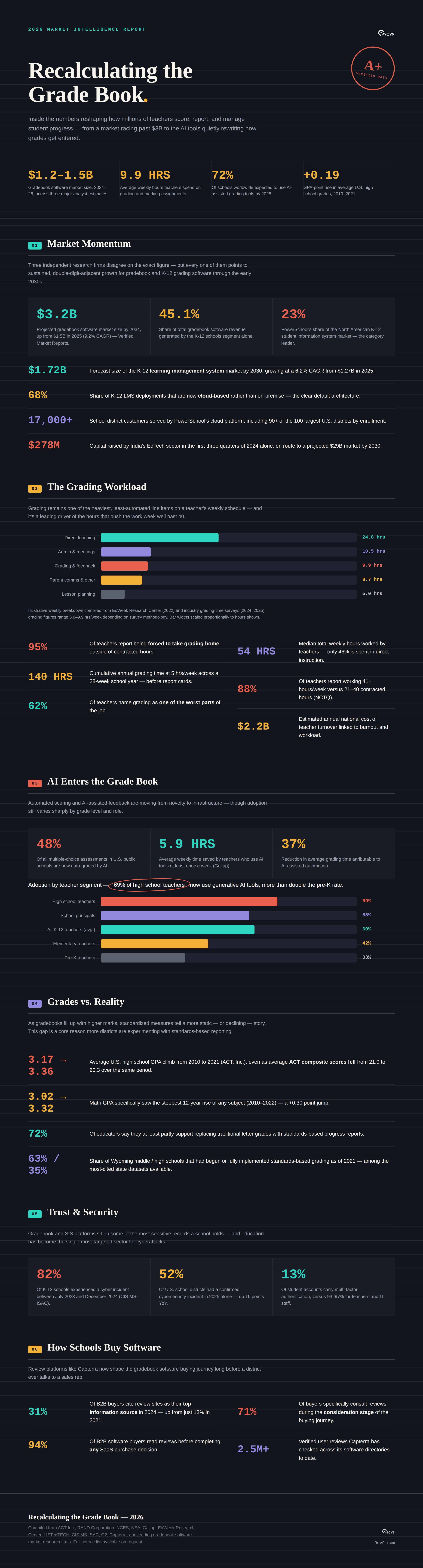
- Strong Gradebook Software Market Growth: The global gradebook software market is projected to grow from $1.5 billion in 2025 to $3.2 billion by 2034, driven by increasing digital education adoption and demand for automated academic management.
- AI-Powered Grading and Teacher Productivity: Artificial intelligence and automated grading tools are transforming educational workflows, with teachers using AI weekly reporting average time savings of 5.9 hours across professional activities.
- Cloud Adoption and Cybersecurity Priorities: Cloud-based platforms account for an estimated 68% of K-12 LMS implementations, highlighting the growing importance of integrated gradebook software, student data protection, academic analytics, and secure educational infrastructure.
Gradebook software streamlines academic assessment through automated grading, real-time student performance tracking, and digital reporting. In 2026, key industry trends include artificial intelligence, cloud adoption, teacher productivity, and student data security, with global market projections of $3.2 billion by 2034, representing an estimated annual growth rate of 9.2%.
The global education industry is experiencing a significant digital transformation in 2026, with gradebook software emerging as an essential component of modern academic management, student assessment, and educational technology infrastructure. As schools, universities, colleges, and online learning institutions increasingly embrace digital solutions, traditional paper-based gradebooks and manual spreadsheets are gradually being replaced by intelligent, cloud-based, and automated grading platforms.
Also, read our article on the Top 10 Best Gradebook Software To Try.
Gradebook software enables educators to record student grades, automate assessment calculations, monitor academic performance, generate detailed reports, and communicate learning outcomes with students, parents, and school administrators. Beyond conventional grade recording, modern digital gradebook systems increasingly incorporate artificial intelligence (AI), predictive analytics, personalised feedback, standards-based assessment, and seamless integration with learning management systems (LMS) and student information systems (SIS).
The growing demand for efficient academic management solutions is reflected in the substantial expansion of the global gradebook software market. One industry estimate valued the global gradebook software market at approximately $1.5 billion in 2025, with projections indicating growth to $3.2 billion by 2034, representing a compound annual growth rate (CAGR) of 9.2%. A separate market analysis projects the industry to reach approximately $3.35 billion by 2032, growing at an estimated CAGR of 12.5%.
These market forecasts highlight the increasing commercial significance of digital grading technologies and the growing opportunities available to educational software developers, EdTech companies, investors, and technology solution providers.
The K-12 education sector remains a particularly important contributor to gradebook software adoption, accounting for an estimated 45.1% of total category revenue. Meanwhile, the broader K-12 educational technology market is projected to expand from $18 billion in 2024 to $55.4 billion by 2030, representing a CAGR of 20.6%.
As educational institutions continue investing in digital infrastructure, gradebook software is becoming increasingly important in supporting academic efficiency, assessment consistency, institutional transparency, and data-driven educational decision-making.
The Growing Importance of Gradebook Software in Modern Education
One of the most significant factors driving gradebook software adoption in 2026 is the growing need to reduce teacher workloads and improve administrative productivity.
Educators worldwide face substantial responsibilities beyond classroom instruction, including assignment grading, assessment preparation, academic documentation, performance monitoring, report card generation, and communication with parents. These responsibilities frequently extend beyond contracted working hours, contributing to professional stress and teacher burnout.
Research conducted by the EdWeek Research Center found that K-12 teachers spend approximately five hours per week grading assignments and providing feedback. A separate industry survey estimated that teachers spend an average of 9.9 hours per week on grading activities, with 95% of surveyed educators reporting that they take grading work home outside their contracted working hours.
Furthermore, 62% of surveyed teachers identified grading as one of the worst aspects of their profession, while 34% reported feeling exhausted by grading responsibilities and 26% described the workload as overwhelming.
These statistics demonstrate the growing need for automated grading software and digital academic management solutions capable of reducing repetitive administrative responsibilities.
Modern gradebook software helps educational institutions address numerous operational and academic challenges, including:
- Excessive teacher workloads and administrative responsibilities.
- Time-consuming manual grade calculations and assessment processing.
- Inconsistent grading methodologies across classrooms and departments.
- Delayed academic feedback and student performance reporting.
- Limited parental visibility into student academic progress.
- Fragmented educational data across multiple software platforms.
- Human errors in academic records and grade calculations.
- Difficulties identifying academically at-risk students.
- Growing demand for personalised learning and equitable assessment.
- Increasing requirements for student data privacy and cybersecurity.
- Limited scalability of traditional paper-based grading systems.
- Inefficient academic reporting and institutional performance monitoring.
By automating routine grading processes and centralising academic information, digital gradebook platforms can help educators dedicate more time to classroom instruction, curriculum development, student engagement, and personalised academic support.
Artificial Intelligence and Automated Grading Are Transforming Education
Artificial intelligence represents one of the most influential technological developments shaping the gradebook software industry in 2026.
AI-powered grading software is increasingly capable of supporting automated assessment scoring, rubric-based evaluations, personalised feedback generation, academic performance analysis, and the identification of learning difficulties.
According to Gallup research, approximately 60% of U.S. K-12 public school teachers used artificial intelligence tools during the 2024–2025 academic year. Teachers who used AI tools weekly reported average time savings of 5.9 hours per week across their professional activities, demonstrating the considerable productivity potential of intelligent educational technologies.
Additionally, industry survey findings indicate that 75% of teachers would be open to adopting AI-powered grading tools if these technologies could reduce their grading workload by half.
The increasing integration of artificial intelligence into gradebook software is creating opportunities for educational institutions to improve assessment efficiency, deliver more timely feedback, and develop more personalised learning experiences.
However, the expansion of AI-powered grading also introduces important considerations surrounding algorithmic bias, assessment accuracy, academic integrity, transparency, and student data protection. Educational institutions must ensure that automated assessment technologies complement professional teacher judgement rather than replace essential human oversight.
As AI capabilities continue to advance, the future of gradebook software will increasingly involve intelligent automation combined with educator expertise, enabling more efficient and responsive academic assessment processes.
Cloud-Based Gradebook Software Is Accelerating Digital Education Adoption
Cloud computing continues to reshape the global educational technology landscape, providing schools and academic institutions with more accessible, scalable, and interconnected software solutions.
Cloud-based deployment accounts for an estimated 68% of K-12 learning management system implementations. Multiple industry analyses also suggest that approximately 61% to 69% of K-12 institutions have adopted at least one cloud-based learning or grading platform during 2025–2026.
The growing adoption of cloud-based gradebook software reflects the increasing demand for flexible academic management systems that support traditional classroom instruction, remote education, hybrid learning, and multi-campus operations.
Unlike conventional desktop-based grading applications, cloud-based gradebooks enable authorised users to access academic information from multiple devices and locations. Teachers can update grades, administrators can monitor institutional performance, and parents can review student progress through connected digital platforms.
Furthermore, the integration of gradebook software with learning management systems, student information systems, school enterprise resource planning platforms, and parent communication portals is creating more comprehensive educational technology ecosystems.
The broader school management software market was valued at approximately $12.4 billion in 2025 and is projected to reach $29.8 billion by 2034, reflecting the increasing demand for integrated educational administration solutions.
As educational institutions continue consolidating their digital infrastructure, interoperability, scalability, accessibility, and real-time data synchronisation are expected to become increasingly important competitive differentiators within the gradebook software market.
Gradebook Software Is Supporting More Data-Driven Academic Assessment
Modern educational institutions are increasingly recognising the importance of using academic data to improve teaching effectiveness, monitor student achievement, and identify opportunities for targeted learning interventions.
Digital gradebook software provides educators and administrators with greater visibility into student performance through historical grade records, assessment analytics, academic progress dashboards, and detailed reporting capabilities.
The growing interest in standards-based grading and equitable assessment practices is also influencing the development of modern gradebook platforms.
A nationally representative EdWeek Research Center survey found that 72% of educators at least partly supported replacing traditional letter grades with standards-based progress reports. This finding highlights the increasing interest in assessment methodologies that evaluate student achievement against specific learning objectives and competencies.
Concerns surrounding grade inflation further demonstrate the importance of consistent and transparent academic assessment practices. ACT research analysing more than 4.3 million high school seniors found that average grade point averages increased from 3.17 in 2010 to 3.36 in 2021, while average ACT composite scores declined from 21.0 to 20.3 over the same period.
These findings illustrate the value of academic performance analytics, historical grade comparisons, consistent assessment criteria, and transparent grading methodologies.
Although gradebook software alone cannot eliminate grade inflation or guarantee improved academic outcomes, effective digital assessment systems can provide educational institutions with the information necessary to identify inconsistencies and make more informed academic decisions.
Parent Engagement and Real-Time Academic Reporting Are Becoming Increasingly Important
Another significant trend influencing the gradebook software industry in 2026 is the growing demand for improved communication between educational institutions and families.
Traditional academic reporting methods frequently rely on periodic report cards, scheduled parent-teacher conferences, and manual communication processes. Digital gradebook software enables parents and guardians to access more timely information regarding student grades, assignment results, assessment feedback, and overall academic progress.
Educational research has identified associations between parent-portal usage and lower odds of ninth-grade course failure. Separate experimental research has also found that encouraging greater parental engagement with digital academic portals can positively influence student grades.
These findings highlight the potential value of integrating gradebook software with parent communication platforms and real-time academic reporting systems.
By providing families with greater visibility into student performance, educational institutions can facilitate earlier academic interventions, strengthen collaboration between parents and educators, and encourage more active participation in student learning.
Cybersecurity and Student Data Privacy Are Critical Industry Priorities
As educational institutions increasingly rely on cloud-based gradebook software and interconnected digital platforms, cybersecurity and student data privacy have become essential considerations.
Gradebook software frequently processes sensitive information, including student identities, academic records, assessment results, attendance information, and confidential educational documentation.
According to the Center for Internet Security, approximately 82% of K-12 schools experienced a cybersecurity incident between July 2023 and December 2024. During the same study period, approximately 14,000 security events and 9,300 confirmed cybersecurity incidents were recorded across more than 5,000 K-12 organisations.
Furthermore, third-party vendor breaches accounted for approximately 32% of reported K-12 security incidents in 2025, compared with just 4% in 2023.
These statistics demonstrate the increasing importance of secure gradebook software, responsible vendor management, robust authentication mechanisms, and comprehensive student data protection strategies.
Educational institutions evaluating gradebook software must increasingly consider data encryption, role-based access controls, multi-factor authentication, secure cloud infrastructure, audit logging, disaster recovery capabilities, and compliance with applicable educational data privacy regulations.
Software providers that successfully combine innovative grading functionality with reliable cybersecurity infrastructure and transparent data governance are likely to be better positioned to establish long-term trust within the education sector.
Why Gradebook Software Statistics, Data and Trends Matter in 2026
Understanding the latest gradebook software statistics is essential for educational institutions, school administrators, teachers, EdTech entrepreneurs, software developers, investors, and technology procurement professionals seeking to navigate the rapidly evolving digital education landscape.
Comprehensive industry data provides valuable insights into market growth, software adoption, technological innovation, teacher productivity, academic assessment practices, cybersecurity risks, and educational software purchasing behaviour.
This comprehensive guide to the Top 103 Gradebook Software Statistics, Data & Trends in 2026 examines the most important developments shaping the global gradebook software industry, including:
- Global gradebook software market size, revenue, and growth forecasts.
- Gradebook software adoption rates and educational platform market shares.
- Teacher grading workloads and administrative productivity statistics.
- Artificial intelligence and automated assessment trends.
- Cloud-based gradebook software and educational technology adoption.
- Standards-based grading and equitable assessment practices.
- Grade inflation and academic performance statistics.
- Parent engagement and digital academic reporting trends.
- Educational cybersecurity and student data privacy statistics.
- Teacher burnout, workforce retention, and operational challenges.
- Formative assessment and student feedback effectiveness.
- K-12 education infrastructure and workforce demographics.
- Educational software pricing and B2B purchasing behaviour.
- Emerging opportunities within the global EdTech software market.
The statistics presented throughout this guide combine gradebook-specific market research with relevant findings from the broader educational technology, learning management system, student information system, and academic assessment sectors. They incorporate historical research, recent survey findings, industry estimates, and long-term market projections to provide a comprehensive perspective on the educational software landscape in 2026.
Because market research organisations use different methodologies, geographical coverage, and category definitions, individual market valuations and growth forecasts may vary. Broader educational technology statistics should also be interpreted as indicators of the surrounding industry rather than direct measurements of gradebook software adoption or effectiveness.
Whether a school is evaluating the best gradebook software to improve academic administration, an EdTech company is identifying emerging product development opportunities, or an investor is assessing the long-term commercial potential of educational software, these 103 statistics offer valuable insights into the changing digital education ecosystem.
As artificial intelligence, cloud computing, automated assessment, predictive analytics, and integrated educational management technologies continue to evolve, gradebook software is positioned to become an increasingly important foundation for teacher productivity, academic transparency, personalised learning, student engagement, and data-driven educational management in 2026 and beyond.
Before we venture further into this article, we would like to share who we are and what we do.
About 9cv9
9cv9 is a business tech startup based in Singapore and Asia, with a strong presence all over the world.
With over ten years of startup and business experience, and being highly involved in connecting with thousands of companies and startups, the 9cv9 team has listed some of the top and best companies/tools in this review.
If you like to get your company listed in our top B2B software reviews, check out our world-class 9cv9 Media and PR service and pricing plans here.
Top 103 Gradebook Software Statistics, Data & Trends in 2026
Market Size & Growth
1. The global gradebook software market is valued at roughly $1.5 billion in 2025 and is projected to reach $3.2 billion by 2034, reflecting an estimated 9.2% CAGR — a clear signal that schools are steadily shifting budget from manual grade tracking to dedicated platforms.
2. A separate market analysis puts 2024 gradebook software revenue at $1.2 billion, forecasting growth to $2.5 billion by 2033 at a 9.5% CAGR, reinforcing the category’s consistent upward trajectory.
3. A third industry estimate values the 2024 gradebook software market at $1,325.75 million, projecting expansion to $3,347.60 million by 2032 at a 12.5% CAGR — the most bullish of the major analyst forecasts.
4. Within that same forecast, North America is expected to remain the fastest-growing region for gradebook software at a 36.4% share, with the United States alone commanding roughly 22.8% of global demand.
5. K-12 schools represent the single largest end-user segment for gradebook software, accounting for an estimated 45.1% of total category revenue.
6. The broader K-12 learning management systems (LMS) market, which frequently bundles gradebook functionality, is valued at $1.27 billion in 2025 and is expected to climb to $1.35 billion in 2026, a 6.7% year-over-year increase.
7. That same K-12 LMS market is forecast to reach $1.72 billion by 2030, growing at a 6.2% CAGR as districts continue layering analytics and grading tools onto core platforms.
8. A competing K-12 LMS market study estimates a much steeper 19% CAGR, with North America already holding more than a 36% share and $1.98 billion in 2024 revenue.
9. The wider K-12 EdTech market — the umbrella category gradebook software sits within — is estimated at $18 billion in 2024 and is projected to reach $55.4 billion by 2030, a 20.6% CAGR.
10. On an even broader scale, the global K-12 education market is projected to expand from $172.03 billion in 2025 to $732.94 billion by 2034, growing at a 17.47% CAGR.
11. The school management software market — which typically includes gradebook and SIS modules — is valued at $12.4 billion in 2025 and is expected to reach $29.8 billion by 2034 at a 10.2% CAGR.
12. A parallel school management system market report values 2025 revenue at $22.3 billion, rising to $25.83 billion in 2026 (15.8% CAGR) and reaching $42.66 billion by 2030.
13. The global education ERP market, which frequently houses grading tools alongside admissions and finance modules, was worth $12.7 billion in 2021 and was forecast to reach $25.2 billion by 2026 at a 14.7% CAGR.
14. K-12 cross-platform LMS software — spanning grading, attendance, and communication — was projected to reach $30.92 billion by 2025, growing at an 18.4% CAGR through 2033.
15. India’s EdTech sector raised $278 million between January and September 2024 despite broader funding headwinds, underscoring continued investor confidence in the region’s digital education tools, including gradebook and school-management software.
Platform Adoption & Market Share
16. PowerSchool leads the North American K-12 student information system category with a 23% market share as of October 2023, followed by FACTS SIS at 13% and Infinite Campus at 9%.
17. PowerSchool’s cloud platform serves more than 17,000 institutional customers, including over 90 of the 100 largest school districts by enrollment in the United States.
18. PowerSchool maintains more than 30 state-, province-, or territory-wide contracts across North America and sells its solutions in over 90 countries globally.
19. In the K-12 LMS space, Schoology commands roughly 17% market share among small-to-mid-sized districts and 14% among large districts serving more than 6,500 students.
20. Cloud-based deployment now accounts for an estimated 68% of K-12 LMS implementations, well ahead of on-premise alternatives.
21. Multiple market analyses converge around 61%–69% of K-12 institutions having adopted at least one cloud-based learning or grading platform as of 2025–2026.
22. In India specifically, Fedena is estimated to command 12%–15% of the school ERP market, with particular strength among mid-tier private institutions.
23. Since 2018, LISTedTECH has tracked SIS data across more than 17,000 U.S. and Canadian school districts, illustrating just how fragmented — and data-rich — the gradebook/SIS vendor landscape has become.
Teacher Time & Grading Workload
24. A nationally representative EdWeek Research Center survey found K-12 teachers spend approximately 5 hours per week grading and giving feedback — roughly matching the time spent on lesson planning.
25. A separate industry survey puts the average teacher grading workload considerably higher, at 9.9 hours per week — more than a full workday devoted solely to marking assignments.
26. In that same survey, 95% of teachers reported being forced to take grading work home with them outside contracted hours.
27. 62% of surveyed teachers identified grading as one of the worst aspects of the job, ahead of many other classroom stressors.
28. A typical U.S. teacher works a median of 54 hours per week, yet only 46% of that time in the school building is spent actively teaching.
29. At 5 hours of grading per week across a 28-week school year, teachers collectively spend an estimated 140 hours annually on grading alone — before report-card season even begins.
30. 34% of teachers report that grading responsibilities leave them feeling exhausted, and 26% describe the workload as overwhelming.
31. Research from NCTQ found 88% of teachers report working 41 or more hours per week — often far exceeding the 21–40 contracted hours specified in their agreements.
32. According to RAND’s 2025 State of the American Teacher survey, teachers work an average of 49 hours per week, roughly 10 hours above their formally contracted time.
33. OECD TALIS data shows teachers spend, on average, only about half of a 38-hour work week — roughly 19 hours — on direct classroom teaching, with the remainder consumed by grading, planning, and administration.
34. NCES data indicates elementary school teachers work an average of 40 hours per week during the school year, compared to about 37 hours for middle school teachers and 36 hours for high school teachers.
35. An American Federation of Teachers survey found nearly 20% of teachers work more than 60 hours per week during the school year.
AI & Automation in Grading
36. An estimated 72% of schools worldwide were expected to use some form of AI-assisted grading by 2025, marking a rapid shift from manual assessment workflows.
37. AI grading tools now automatically score an estimated 48% of multiple-choice assessments in U.S. public schools.
38. Essay-scoring AI platforms are reportedly in use at 63% of universities, typically paired with human instructor oversight rather than fully automated scoring.
39. Average grading time for instructors using AI-assisted automation has decreased by an estimated 37%, freeing up hours for direct instruction and feedback.
40. Bias-detection algorithms embedded in some AI grading systems have been credited with reducing essay-scoring disparities by roughly 19% among diverse student groups.
41. A Gallup survey found 60% of U.S. K-12 public school teachers used AI tools of some kind during the 2024–2025 school year.
42. Among teachers who used AI tools weekly, Gallup found an average time savings of 5.9 hours per week — equivalent to roughly six additional weeks reclaimed over a school year.
43. RAND’s spring-2024 survey found only 25% of K-12 teachers reported using AI tools for instructional planning or teaching, showing meaningfully slower classroom adoption than headline AI-in-education figures suggest.
44. That same RAND study found nearly 60% of school principals reported using AI tools in their own administrative work — outpacing teacher-level adoption.
45. 75% of teachers say they would be open to adopting an AI-powered grading tool if it could cut their grading workload in half.
46. An EdWeek survey found 59% of teachers said AI tools had enabled more personalized instruction in their classrooms.
47. High school teachers are the most active generative-AI adopters in K-12, with 69% reporting usage, compared to 42% of elementary teachers and just 33% of pre-K teachers.
Standards-Based & Equitable Grading
48. A 2021 statewide Wyoming survey found that over 63% of middle schools and 35% of high schools had either begun or fully implemented standards-based grading.
49. Within that same Wyoming data, only 10% of middle schools and 5% of high schools had reached full implementation of standards-based grading, highlighting how partial rollout remains the norm even in leading states.
50. A nationally representative EdWeek Research Center survey found 72% of educators at least partly support replacing traditional letter grades with standards-based progress reports.
51. Roughly two-fifths of middle school teachers report their school or district has adopted “no zeros,” eliminated late penalties, or allowed unlimited retakes as part of equitable grading reforms.
52. Despite openness to reform, 58% of teachers say having clear, schoolwide grading policies is more important than individual teacher judgment in ensuring fairness.
Grade Inflation & Academic Rigor
53. ACT research analyzing more than 4.3 million high school seniors found average GPAs rose from 3.17 in 2010 to 3.36 in 2021 — a 0.19-point increase.
54. The same ACT study found grade inflation accelerated sharply between 2018 and 2021, growing by 0.1 grade points in just three years — more than the entire prior eight-year period combined.
55. While GPAs climbed, average ACT composite scores fell from 21.0 in 2010 to 20.3 in 2021, widening the gap between reported grades and standardized measures of achievement.
56. NAEP data shows average high school GPA rose from 2.68 in 1990 to 3.00 in 2009 and 3.11 in 2019 — a multi-decade upward trend independent of any single testing body.
57. A follow-up ACT study covering 2010–2022 found math GPAs saw the steepest grade inflation of any subject, rising from 3.02 to 3.32 — a 0.30-point increase.
58. Across all core subjects analyzed by ACT from 2010–2022, the share of students earning A grades rose while the share earning B’s and C’s declined, even as standardized achievement scores did not improve correspondingly.
Parent & Family Engagement
59. Peer-reviewed research (Mac Iver et al., 2020) found parent-portal usage was associated with lower odds of 9th-grade course failure, even after controlling for prior failing grades.
60. A separate randomized study (Bergman, 2019) found that nudging parents to increase portal usage had a measurable positive effect on student grades.
61. Approximately 4.7 million students were enrolled in U.S. private schools during the 2021–22 school year, representing about 8% of all K-12 students nationwide — a meaningful segment for gradebook and parent-portal vendors.
62. Private-school engagement research indicates parents who log into grade portals at least twice weekly report meaningfully lower dissatisfaction during parent-teacher conferences.
Cybersecurity & Data Privacy in EdTech
63. Education was identified as the most-attacked sector globally in 2025, facing an average of 4,388 weekly cyberattacks per school.
64. 82% of K-12 schools experienced a cybersecurity incident between July 2023 and December 2024, according to the Center for Internet Security’s MS-ISAC report.
65. That same CIS report logged approximately 14,000 security events and 9,300 confirmed cybersecurity incidents across more than 5,000 K-12 organizations during the 18-month study window.
66. Globally, ransomware gangs claimed 251 attacks against educational institutions in 2025, of which 94 were officially confirmed by the targeted organizations.
67. Confirmed 2025 ransomware incidents in education exposed an estimated 3.96 million records worldwide.
68. The average ransom demand in the education sector fell 33% year-over-year, from roughly $694,000 in 2024 to $464,000 in 2025.
69. 52% of U.S. school districts experienced a cybersecurity incident in 2025 — a 16-percentage-point increase over the prior year, according to Clever’s Cybersecure report.
70. Third-party vendor breaches accounted for just 4% of reported K-12 security incidents in 2023 but jumped to 32% by 2025, reflecting growing exposure through shared SaaS and gradebook platforms.
71. Multi-factor authentication coverage sits at 93% for teachers and 97% for IT staff, yet only about 13% for students — one of the largest identity-security gaps in K-12 technology stacks.
Teacher Burnout & Retention
72. RAND’s 2025 survey found 62% of teachers reported frequent job-related stress, compared to just 33% of similarly situated working adults.
73. 53% of teachers reported feeling burned out in the 2025 survey cycle, a decline from 60% the year prior but still historically elevated.
74. The share of teachers intending to leave the profession fell to 16% in 2025, down six points from 22% in 2024, suggesting a modest stabilization after several turbulent years.
75. The Learning Policy Institute estimates the cost of replacing a single teacher ranges from $11,860 in small districts to $24,930 in large districts, with national teacher turnover costing school systems an estimated $2.2 billion annually.
76. A 2025 University of Missouri survey of 500 public school teachers found 78% cited limited administrative support — a category that includes grading and reporting burdens — as a major contributor to burnout.
77. A 2025 Walton Family Foundation–Gallup survey found 57% of educators reported feeling burnt out during the current school year, with growing workloads cited as a top stressor.
Formative Assessment & Feedback Research
78. Black and Wiliam’s landmark 1998 meta-analysis of roughly 250 studies found formative assessment produces effect sizes on student achievement ranging from 0.4 to 0.7 — among the largest instructional levers identified in education research.
79. John Hattie’s synthesis of 138 factors influencing student achievement ranked teachers’ formative evaluation practices third overall, with an effect size of 0.9.
80. A recent empirical study found each one-unit increase in feedback timeliness corresponded to a 0.170-unit increase in measured academic achievement.
81. The same study found feedback clarity had an even stronger relationship, with each one-unit increase in clarity linked to a 0.230-unit gain in academic achievement.
82. A meta-analysis by Fuchs and Fuchs (1986) covering 21 studies of students with learning disabilities found frequent formative feedback delivered a mean effect size of 0.70 — reinforcing that consistent, well-organized gradebook feedback disproportionately benefits struggling learners.
83. Graham et al. (2015) found that feedback delivered by adults on student writing performance produced an effect size of 0.87, notably higher than feedback from peers (0.58) or computers alone (0.38).
K-12 Scale & Workforce Demographics (U.S. Context)
84. The U.S. is estimated to employ 3,232,905 K-12 classroom teachers in the 2025–26 school year, a 1.9% increase over the prior year.
85. Public schools employed an estimated 3,863,325 total instructional staff in 2025–26, a 4.3% year-over-year increase.
86. The national average instructional staff salary for 2025–26 is estimated at $78,702, while the average classroom teacher salary specifically stands at $76,552.
87. NCES data shows 77% of U.S. teachers are female and 23% male, with the gender split varying significantly by grade level.
88. In public elementary schools, 89% of teachers are female compared to just 11% male; that gap narrows to roughly 60%/40% at the high school level.
89. The U.S. student-to-teacher ratio is projected to reach approximately 15.5:1 by 2029 across public schools nationally.
90. 92% of U.S. public schools had high-speed broadband (100+ Mbps) as of 2023, up sharply from 77% in 2019 — infrastructure growth that directly enables cloud-based gradebook adoption.
91. Roughly 7.5 million U.S. students were enrolled in online school programs in 2024, a cohort that relies almost entirely on cloud-based grading and LMS platforms.
B2B Software Buying Behavior (Capterra-Relevant Insights)
92. Public product review sites like Capterra have become the single most-consulted information source for B2B software buyers, cited by 31% of buyers in 2024 — up sharply from just 13% in 2021.
93. 94% of B2B software buyers report using online reviews to help inform a purchase decision before contacting a vendor.
94. 71% of B2B buyers specifically consult reviews during the consideration stage of the software buying journey, more than any other funnel stage.
95. Buyers who see genuine reviews are reportedly up to 92% more likely to purchase a product, according to G2 and Heinz Marketing research.
96. Research from Northwestern’s Spiegel Research Institute found that displaying reviews on higher-priced products can lift conversion rates by up to 380%.
97. The average B2B SaaS product — a category that includes gradebook software — rates 4.52 stars across G2 and Capterra, with 61% of all tools clustering tightly between 4.3 and 4.6 stars.
98. In a major industry consolidation, G2 announced in January 2026 that it would acquire Capterra, Software Advice, and GetApp from Gartner in a deal worth approximately $110 million, closing in February 2026.
99. That combined G2–Capterra network now reaches more than 200 million annual software buyers and houses roughly 6 million verified customer reviews spanning every software category, including gradebook and school-management tools.
100. Capterra alone has verified more than 2.5 million user reviews across its software directories to date, underpinning the credibility buyers place in its category rankings.
101. Most B2B software buyers now research review platforms two to four weeks before ever engaging a vendor’s sales team, reflecting how self-directed the gradebook software evaluation process has become for school administrators.
102. Capterra-listed gradebook and SIS products such as Gradelink report pricing starting near $121/month for schools with up to 50 students, illustrating the accessible entry point of the category for smaller institutions.
103. Reviewer data for Capterra-listed gradebook/SIS products shows the buyer base skews heavily toward small institutions, with 97% of reviewers for one leading product identifying as small businesses and 82% from the Education Management sector specifically.
Conclusion
The Top 103 Gradebook Software Statistics, Data & Trends in 2026 highlight a rapidly evolving educational technology landscape characterised by digital transformation, artificial intelligence, automated assessment, cloud computing, and increasing demand for efficient academic management solutions. As educational institutions worldwide continue modernising their administrative and instructional processes, gradebook software is becoming an increasingly important foundation for teacher productivity, student performance management, academic transparency, and institutional efficiency.
The substantial growth projections for the global gradebook software market demonstrate the increasing commercial importance of digital grading technologies. With one industry estimate valuing the market at approximately $1.5 billion in 2025 and projecting growth to $3.2 billion by 2034 at a compound annual growth rate of 9.2%, the industry presents considerable opportunities for educational technology companies, software developers, investors, and academic institutions.
Alternative market forecasts projecting annual growth rates of up to 12.5% further reinforce expectations of sustained industry expansion. Although market valuations vary across research organisations, the overall direction suggests increasing demand for automated, scalable, and interconnected academic management solutions.
The K-12 education sector, which accounts for an estimated 45.1% of gradebook software revenue, remains a particularly important driver of industry growth. Furthermore, the projected expansion of the broader K-12 EdTech market from $18 billion in 2024 to $55.4 billion by 2030 demonstrates the growing importance of digital technologies across primary and secondary education.
These developments indicate that gradebook software is evolving beyond traditional grade recording into a comprehensive academic performance management solution that supports educators, administrators, students, and families.
Gradebook Software Is Becoming Essential for Teacher Productivity and Operational Efficiency
One of the most significant findings from the latest gradebook software statistics is the considerable amount of time educators dedicate to grading, assessment management, and administrative responsibilities.
Research indicates that teachers spend approximately five to 9.9 hours per week grading assignments and providing academic feedback, depending on the survey. Furthermore, 95% of respondents in one industry survey reported taking grading work home outside their contracted working hours, while 62% identified grading as one of the worst aspects of their profession.
These statistics highlight the growing need for educational technologies that reduce repetitive administrative tasks and allow teachers to concentrate on more meaningful instructional activities.
Modern gradebook software can help educational institutions address these challenges through automated grade calculations, centralised academic records, digital assessment management, streamlined reporting, and real-time student performance monitoring.
The potential long-term benefits of implementing effective gradebook software include:
- Reduced teacher workloads and repetitive administrative responsibilities.
- Improved accuracy and consistency in academic grading.
- Faster assessment processing and student feedback delivery.
- More efficient report card generation and academic documentation.
- Enhanced visibility into individual and institutional academic performance.
- Improved communication between educators, students, and parents.
- Greater support for personalised learning and targeted academic interventions.
- Reduced dependence on manual spreadsheets and paper-based grading systems.
- Improved accessibility and organisation of educational records.
- Greater operational efficiency across schools and academic institutions.
Teacher productivity is particularly important given the continuing challenges surrounding educator burnout and workforce retention. RAND’s 2025 survey found that 62% of teachers experienced frequent job-related stress, while 53% reported feeling burned out.
With the estimated cost of replacing a single teacher ranging from $11,860 in small districts to $24,930 in large districts, educational institutions have both operational and financial incentives to improve working conditions and reduce unnecessary administrative burdens.
Although gradebook software alone cannot resolve teacher burnout or workforce shortages, effective academic management technologies can contribute to more efficient and sustainable educational environments.
Artificial Intelligence and Automated Grading Will Continue to Transform Academic Assessment
Artificial intelligence represents one of the most influential technological developments shaping the gradebook software industry in 2026 and beyond.
The increasing adoption of AI-powered educational tools demonstrates the potential for intelligent automation to improve assessment workflows, reduce administrative responsibilities, and support more personalised educational experiences.
Gallup research found that approximately 60% of U.S. K-12 public school teachers used artificial intelligence tools during the 2024–2025 academic year. Teachers who used AI tools weekly reported average time savings of 5.9 hours per week across their professional activities.
Furthermore, survey findings indicate that 75% of teachers would be open to adopting AI-powered grading tools if these technologies could reduce their grading workload by half.
These findings suggest considerable opportunities for gradebook software developers to incorporate intelligent automation into their educational platforms.
AI-powered gradebook software is increasingly capable of supporting automated multiple-choice assessment scoring, rubric-based evaluation, personalised feedback generation, academic performance analysis, and the identification of students requiring additional educational support.
However, the successful implementation of artificial intelligence in academic assessment will require educational institutions to maintain appropriate human oversight and responsible technology governance.
Algorithmic bias, assessment accuracy, transparency, academic integrity, student data protection, and the limitations of automated evaluation must remain central considerations when implementing AI-powered grading systems.
The most effective AI-enabled gradebook software solutions will complement professional educator expertise rather than attempt to replace essential human judgement.
As artificial intelligence continues advancing, educational institutions that successfully balance automation with responsible academic oversight may be better positioned to improve assessment efficiency while maintaining educational quality and fairness.
Cloud-Based Gradebook Software Will Drive Greater Educational Connectivity
Cloud computing continues to play a central role in the development of the global gradebook software market.
With cloud-based deployment accounting for an estimated 68% of K-12 learning management system implementations, educational institutions are increasingly recognising the benefits of accessible, scalable, and interconnected digital platforms.
Multiple industry analyses also suggest that approximately 61% to 69% of K-12 institutions have adopted at least one cloud-based learning or grading platform during 2025–2026.
These adoption trends reflect the growing demand for educational software that supports traditional classroom instruction, remote learning, hybrid education, and multi-campus academic operations.
Cloud-based gradebook software enables authorised teachers, administrators, students, and parents to access relevant academic information across multiple devices and locations. This accessibility can improve communication, facilitate timely reporting, and reduce the operational limitations associated with conventional desktop-based grading applications.
Furthermore, integration with learning management systems, student information systems, school enterprise resource planning platforms, and parent communication portals is becoming increasingly important.
The broader school management software market, valued at approximately $12.4 billion in 2025, is projected to reach $29.8 billion by 2034. This expansion highlights the increasing demand for integrated educational administration technologies.
As educational institutions continue consolidating their digital infrastructure, gradebook software providers that prioritise interoperability, accessibility, scalability, real-time data synchronisation, and intuitive user experiences may be better positioned to compete within the evolving educational technology market.
Data-Driven Gradebook Software Will Support More Transparent Academic Assessment
The growing emphasis on academic transparency, equitable grading, and evidence-based educational decision-making is another important factor influencing the future of gradebook software.
Modern digital gradebooks enable educational institutions to monitor historical academic performance, evaluate assessment outcomes, identify learning difficulties, and analyse student achievement across different subjects, classrooms, and academic periods.
The increasing interest in standards-based grading further demonstrates the evolving requirements of educational assessment.
A nationally representative EdWeek Research Center survey found that 72% of educators at least partly supported replacing traditional letter grades with standards-based progress reports.
This finding highlights opportunities for gradebook software providers to develop flexible assessment systems that accommodate competency-based learning, customisable grading rubrics, standards-based evaluations, and alternative academic reporting methodologies.
Concerns surrounding grade inflation also reinforce the importance of transparent and consistent academic assessment practices.
ACT research involving more than 4.3 million high school seniors found that average grade point averages increased from 3.17 in 2010 to 3.36 in 2021. During the same period, average ACT composite scores declined from 21.0 to 20.3.
Although these findings do not establish that gradebook software can eliminate grade inflation, they demonstrate the importance of historical performance comparisons, consistent assessment criteria, academic analytics, and transparent grading methodologies.
Educational institutions that effectively utilise gradebook analytics may be better equipped to identify grading inconsistencies, monitor academic trends, and implement appropriate interventions.
Digital Gradebooks Will Strengthen Student Feedback and Parent Engagement
The future of gradebook software extends beyond administrative efficiency to include improved communication, academic feedback, and collaboration between educational stakeholders.
Research examining formative assessment has consistently highlighted the educational value of timely and meaningful student feedback.
Black and Wiliam’s landmark research, covering approximately 250 studies, identified formative assessment effect sizes ranging from 0.4 to 0.7. Separate research examining student writing performance found that feedback delivered by adults produced an effect size of 0.87, compared with 0.38 for computer-delivered feedback alone.
These findings reinforce the importance of combining digital assessment technologies with meaningful educator involvement.
Gradebook software can support formative assessment by organising academic records, facilitating timely feedback, tracking learning progress, and helping teachers identify areas where students require additional support.
Parent engagement is another important area where digital gradebooks can deliver value.
Educational research has identified associations between parent-portal usage and lower odds of ninth-grade course failure. Separate experimental research has also found that encouraging greater parental engagement with academic portals can positively influence student grades.
By providing families with more timely access to academic performance information, digital gradebook software can facilitate earlier educational interventions, strengthen parent-teacher communication, and encourage greater involvement in student learning.
The most effective gradebook platforms will therefore increasingly combine academic reporting, student performance analytics, personalised feedback, and stakeholder communication capabilities within integrated educational environments.
Cybersecurity and Student Data Privacy Will Remain Critical Priorities
Despite the numerous advantages associated with digital gradebook software, the increasing digitisation of academic records introduces substantial cybersecurity and data privacy challenges.
Educational institutions manage considerable volumes of sensitive information, including student identities, assessment results, academic histories, attendance records, and confidential educational documentation.
According to the Center for Internet Security, approximately 82% of K-12 schools experienced a cybersecurity incident between July 2023 and December 2024.
During the same study period, approximately 14,000 security events and 9,300 confirmed cybersecurity incidents were recorded across more than 5,000 K-12 organisations.
Furthermore, third-party vendor breaches accounted for approximately 32% of reported K-12 security incidents in 2025, compared with just 4% in 2023.
These statistics highlight the growing risks associated with interconnected educational software ecosystems and the importance of selecting trustworthy technology providers.
Educational institutions evaluating gradebook software should prioritise security capabilities such as data encryption, multi-factor authentication, role-based access controls, secure cloud infrastructure, audit logging, reliable backup mechanisms, disaster recovery capabilities, and compliance with applicable student data protection regulations.
The increasing integration of artificial intelligence into educational platforms will also require greater attention to responsible data usage, algorithmic transparency, and the protection of confidential student information.
Gradebook software providers that successfully combine innovative academic management capabilities with comprehensive cybersecurity infrastructure and transparent data governance may be better positioned to establish long-term trust within the education sector.
Gradebook Software Purchasing Decisions Will Become More Data-Driven
The evolving behaviour of B2B software buyers is also influencing how educational institutions evaluate and purchase gradebook software.
Research indicates that 94% of B2B software buyers use online reviews to inform purchasing decisions before contacting vendors, while 71% consult reviews during the consideration stage of the software buying journey.
Public software review platforms have also become increasingly influential, with 31% of B2B buyers identifying them as a consulted information source in 2024, compared with 13% in 2021.
These broader B2B software purchasing statistics suggest that gradebook software providers must increasingly demonstrate measurable product value, customer satisfaction, reliability, usability, and transparent pricing.
For educational institutions, selecting the best gradebook software in 2026 requires a comprehensive evaluation of academic functionality, institutional requirements, implementation costs, integration capabilities, cybersecurity features, scalability, customer support, and verified user experiences.
Purchasing decisions should extend beyond initial subscription costs to consider the potential long-term return on investment associated with administrative time savings, reduced manual processes, improved reporting accuracy, and greater academic visibility.
The Future of Gradebook Software Beyond 2026
The future of gradebook software is expected to extend significantly beyond traditional digital grade recording and academic reporting.
As educational technology continues to advance, gradebook platforms are positioned to become more intelligent, interconnected, accessible, personalised, and strategically important within educational institutions.
Several emerging developments are likely to shape the gradebook software industry beyond 2026:
- Greater adoption of AI-powered grading and automated assessment technologies.
- Expansion of predictive analytics for identifying academically at-risk students.
- Increased implementation of standards-based and competency-based grading systems.
- More sophisticated personalised feedback and academic intervention capabilities.
- Deeper integration with learning management systems and student information systems.
- Increased adoption of mobile-accessible academic management applications.
- Enhanced parent engagement through real-time academic performance portals.
- Greater emphasis on equitable grading practices and assessment transparency.
- Stronger cybersecurity infrastructure and student data protection measures.
- Growing demand for scalable and cloud-based gradebook software solutions.
- Increased utilisation of academic performance dashboards and institutional analytics.
- Greater emphasis on software interoperability and accessibility.
- Increased demand for responsible artificial intelligence and human oversight.
- More data-driven software purchasing decisions and return-on-investment evaluations.
- Continued expansion of integrated educational technology ecosystems.
For educational institutions, these developments highlight the importance of selecting gradebook software that addresses immediate operational requirements while remaining adaptable to future technological advancements.
For EdTech companies and software developers, the expanding market presents opportunities to differentiate through intelligent automation, intuitive user experiences, flexible assessment methodologies, system interoperability, affordability, and robust cybersecurity.
For investors, the continued growth of the gradebook software market and related educational technology sectors signals potential long-term commercial opportunities, although differences in market definitions, research methodologies, and growth projections should be carefully considered.
Final Thoughts
The 103 gradebook software statistics, data points, and industry trends presented in this comprehensive guide demonstrate that digital grading technology is becoming an increasingly important component of modern educational infrastructure.
From the projected multibillion-dollar expansion of the global gradebook software market to the increasing adoption of artificial intelligence, cloud computing, automated assessments, and academic performance analytics, the industry is undergoing substantial technological and operational transformation.
At the same time, persistent challenges surrounding teacher workloads, professional burnout, grading consistency, academic transparency, cybersecurity, and student data privacy reinforce the importance of implementing educational technologies responsibly.
The statistics examined throughout this guide encompass gradebook-specific market research, broader educational technology industry estimates, historical academic research, teacher surveys, and B2B software purchasing trends. Although these findings cover different research periods, geographical markets, and software categories, they collectively provide valuable insights into the forces shaping digital academic management in 2026.
Educational institutions should approach gradebook software adoption as a strategic investment rather than simply a replacement for traditional grading methods. The most effective solutions will be those that successfully balance operational efficiency, academic quality, technological innovation, accessibility, affordability, and data security.
Ultimately, the long-term success of gradebook software will depend on its ability to support educators, improve assessment workflows, facilitate meaningful student feedback, strengthen academic transparency, and encourage collaboration between schools, students, and families.
As the global education sector continues its digital transformation, gradebook software is positioned to play an increasingly pivotal role in reducing administrative inefficiencies, improving teacher productivity, supporting equitable academic assessment, strengthening student engagement, and building more intelligent, secure, and data-driven educational environments in 2026 and beyond.
If you find this article useful, why not share it with your hiring manager and C-level suite friends and also leave a nice comment below?
We, at the 9cv9 Research Team, strive to bring the latest and most meaningful data, guides, and statistics to your doorstep.
To get access to top-quality guides, click over to 9cv9 Blog.
To hire top talents using our modern AI-powered recruitment agency, find out more at 9cv9 Modern AI-Powered Recruitment Agency.
People Also Ask
What is gradebook software?
Gradebook software is a digital educational tool that helps teachers record grades, calculate scores, track student performance, manage assessments, and generate academic reports efficiently.
What is the global gradebook software market size in 2026?
The global gradebook software market was estimated at $1.5 billion in 2025 and is projected to reach $3.2 billion by 2034, reflecting growing demand for digital academic management solutions.
How fast is the gradebook software market growing?
Industry forecasts estimate that the gradebook software market will grow at a compound annual growth rate of approximately 9.2% to 12.5%, driven by cloud adoption, automation, and educational digitalisation.
What are the biggest gradebook software trends in 2026?
Major trends include AI-powered grading, automated assessments, cloud-based platforms, predictive analytics, personalised feedback, standards-based grading, mobile accessibility, and enhanced student data security.
Which region leads the global gradebook software market?
North America is a leading regional market, accounting for an estimated 36.4% share in one industry forecast, supported by established educational technology infrastructure and digital adoption.
Which educational sector uses gradebook software the most?
K-12 schools represent the largest estimated end-user segment, accounting for approximately 45.1% of gradebook software revenue due to widespread demand for academic tracking and assessment management.
What are the main benefits of gradebook software?
Gradebook software reduces administrative workloads, automates grade calculations, improves reporting accuracy, strengthens parent communication, centralises academic records, and supports data-driven educational decisions.
How much time do teachers spend grading assignments?
Research indicates that teachers spend approximately five to 9.9 hours per week grading assignments and providing feedback, depending on the survey, educational setting, and assessment requirements.
How does gradebook software reduce teacher workloads?
Gradebook software automates grade calculations, assessment scoring, academic reporting, and performance tracking, reducing repetitive administrative tasks and allowing teachers to focus more on instruction.
How is artificial intelligence transforming gradebook software?
Artificial intelligence supports automated scoring, personalised feedback, academic performance analysis, and early identification of struggling students while reducing repetitive grading responsibilities.
What percentage of teachers use AI tools in education?
Gallup research found that approximately 60% of U.S. K-12 public school teachers used AI tools during the 2024–2025 academic year, including applications for planning, instruction, and assessment.
How much time can AI-powered educational tools save teachers?
Teachers who use AI tools weekly report average time savings of 5.9 hours per week across professional activities, including lesson preparation, administrative tasks, and assessment-related workflows.
What is cloud-based gradebook software?
Cloud-based gradebook software stores academic records on remotely hosted infrastructure, allowing authorised teachers, administrators, students, and parents to access information through internet-connected devices.
How popular are cloud-based educational platforms in 2026?
Cloud-based deployment accounts for an estimated 68% of K-12 learning management system implementations, reflecting growing institutional demand for accessible and scalable educational technology.
What is the difference between gradebook software and a learning management system?
Gradebook software primarily manages grades, assessments, and academic performance records, while a learning management system provides broader functionality, including course delivery, learning materials, and student engagement.
What is the difference between gradebook software and student information systems?
Gradebook software focuses on academic grading and assessment, while student information systems manage broader institutional records, including enrolment, attendance, demographics, scheduling, and academic history.
What features should the best gradebook software include?
Essential features include automated grade calculations, customisable grading scales, assessment management, performance analytics, parent portals, mobile accessibility, system integrations, and secure data management.
How much does gradebook software cost in 2026?
Gradebook software pricing varies by institution size, features, deployment model, and vendor. Some integrated gradebook and school management platforms offer entry-level plans starting at approximately $121 per month.
Is gradebook software suitable for small schools?
Yes. Gradebook software helps small schools simplify academic administration, reduce manual data entry, improve reporting accuracy, and provide affordable access to digital student performance management tools.
How does gradebook software improve student performance?
Gradebook software supports student performance by providing timely feedback, identifying learning difficulties, tracking academic progress, and enabling educators to implement targeted interventions.
How does gradebook software improve parent engagement?
Digital gradebooks provide parents with convenient access to grades, assignment results, academic progress, and teacher feedback, improving communication and supporting earlier educational interventions.
What is standards-based gradebook software?
Standards-based gradebook software evaluates student achievement against specific learning objectives and competencies rather than relying exclusively on traditional letter grades or numerical scores.
How popular is standards-based grading?
An EdWeek Research Center survey found that 72% of educators at least partly supported replacing traditional letter grades with standards-based progress reports, indicating substantial interest in alternative assessment methods.
Can gradebook software help address grade inflation?
Gradebook software can help identify grade inflation through consistent assessment criteria, historical performance comparisons, standardised grading rubrics, and academic analytics. However, software alone cannot eliminate grade inflation.
What are the cybersecurity risks associated with gradebook software?
Common risks include unauthorised access, ransomware, phishing, student data breaches, insecure third-party integrations, weak authentication, and inadequate protection of confidential academic records.
How common are cybersecurity incidents in educational institutions?
According to the Center for Internet Security, approximately 82% of K-12 schools experienced a cybersecurity incident between July 2023 and December 2024, highlighting the importance of secure educational software.
How can schools protect student data in gradebook software?
Schools can protect student data through encryption, multi-factor authentication, role-based access controls, regular security audits, secure backups, staff training, and compliance with applicable data privacy regulations.
What is the role of gradebook software in formative assessment?
Gradebook software supports formative assessment by recording ongoing learning progress, organising assessment results, facilitating timely feedback, and helping teachers adjust instruction according to student needs.
How should schools choose the best gradebook software in 2026?
Schools should evaluate functionality, pricing, ease of use, grading flexibility, integration capabilities, cybersecurity, customer support, scalability, accessibility, and verified user reviews before selecting gradebook software.
What is the future of gradebook software beyond 2026?
The future of gradebook software is expected to feature greater AI integration, automated assessment, predictive academic analytics, personalised feedback, interconnected educational platforms, and stronger student data protection.
Sources
- Verified Market Reports
- Future Market Report
- Market.us
- Education Week
- Learnosity
- RAND Corporation