


























Key Takeaways
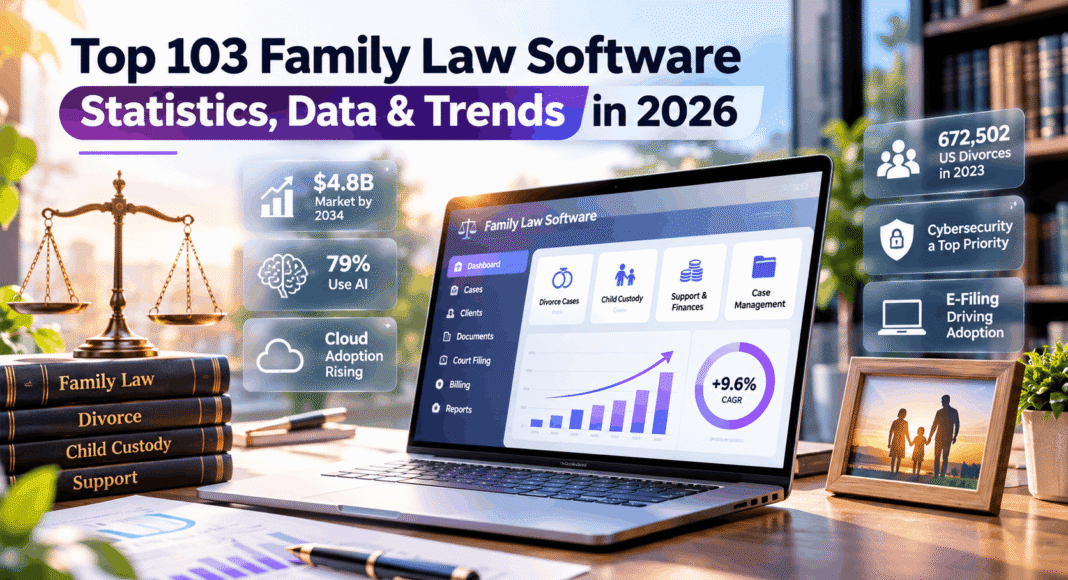
- Family Law Software Market Growth: The global family law software market is projected to grow from $2.1 billion in 2025 to $4.8 billion by 2034, driven by increasing demand for cloud-based legal practice management, digital case management, and automated legal workflows.
- AI Adoption and Legal Technology Trends: With 79% of legal professionals using AI in 2025, artificial intelligence, document automation, and intelligent case management are transforming family law practices, improving operational efficiency and client service delivery.
- Cybersecurity and Digital Transformation: Rising demand for secure client portals, electronic court filing, child custody management, and data protection is accelerating family law software adoption, making cybersecurity, regulatory compliance, and cloud technology essential priorities in 2026.
Family law software is transforming legal practice in 2026 through AI automation, cloud-based case management, and secure digital workflows. The global market is projected to reach $4.8 billion by 2034, growing at a 9.6% CAGR. Explore 103 key statistics covering market growth, AI adoption, cybersecurity, divorce trends, and legal technology innovations.
The family law software industry is undergoing a significant transformation in 2026, driven by increasing demand for digital case management, artificial intelligence (AI), cloud-based legal technology, and automated legal workflows. As law firms navigate complex divorce proceedings, child custody disputes, financial settlements, and evolving regulatory requirements, family law software has become an increasingly important tool for improving operational efficiency, strengthening client communication, and managing sensitive legal information.
Also, read our article on the Top 10 Family Law Software To Know.
According to industry estimates, the global family law software market was valued at approximately $2.1 billion in 2025 and is projected to reach $4.8 billion by 2034, representing a compound annual growth rate (CAGR) of 9.6%. Meanwhile, the Asia-Pacific region is forecast to experience particularly strong growth, with a projected CAGR of 12.4% between 2026 and 2034. These projections highlight expanding opportunities for family law software providers as legal professionals increasingly adopt specialized technology solutions.
The growing complexity of family law cases is another important factor influencing software adoption. In the United States, approximately 672,502 divorces were recorded in 2023, while family law matters account for millions of cases handled by state courts annually. Furthermore, research indicates that between 60% and 90% of family law cases involve at least one self-represented litigant, underscoring the demand for accessible legal technology, automated document preparation, and simplified court filing solutions.
Artificial intelligence is also reshaping the family law technology landscape. Industry research indicates that 79% of legal professionals reported using AI in some capacity in 2025, while 69% reported using generative AI tools for work. AI-powered document automation, intelligent case management, legal research assistance, and predictive analytics are creating opportunities for law firms to reduce administrative workloads and improve service delivery. However, concerns surrounding AI accuracy, client confidentiality, cybersecurity, and regulatory compliance remain critical considerations for legal technology adoption.
Beyond artificial intelligence, cloud-based family law practice management software, secure client portals, electronic filing systems, automated billing platforms, and digital custody management tools are becoming increasingly relevant to modern legal practices. With family law firms handling highly confidential financial records, personal information, and sensitive details involving children, cybersecurity and data protection have emerged as essential factors in software selection.
Understanding these developments is crucial for family law attorneys, legal technology companies, law firm administrators, software developers, and investors seeking to evaluate the industry’s direction and identify emerging opportunities.
This comprehensive guide to the Top 103 Family Law Software Statistics, Data & Trends in 2026 examines the latest available industry research, market forecasts, technology adoption patterns, divorce and child custody statistics, AI developments, cybersecurity challenges, and court digitization trends.
By exploring these 103 family law software statistics, readers can gain valuable insights into the factors shaping the global legal technology market, understand how digital transformation is influencing family law practices, and identify the software capabilities likely to become increasingly important throughout 2026 and beyond.
Before we venture further into this article, we would like to share who we are and what we do.
About 9cv9
9cv9 is a business tech startup based in Singapore and Asia, with a strong presence all over the world.
With over ten years of startup and business experience, and being highly involved in connecting with thousands of companies and startups, the 9cv9 team has listed some of the top and best companies/tools in this review.
If you like to get your company listed in our top B2B software reviews, check out our world-class 9cv9 Media and PR service and pricing plans here.
Top 103 Family Law Software Statistics, Data & Trends in 2026
Market Size & Growth
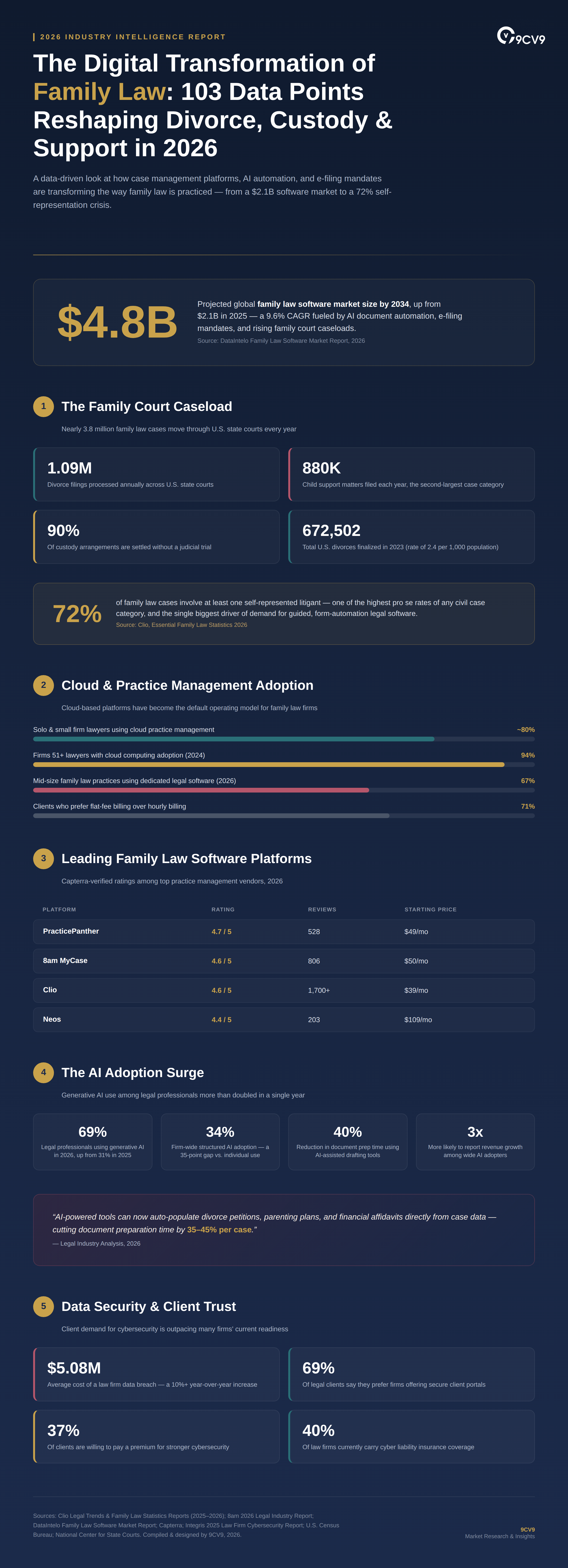
- The global family law software market was valued at $2.1 billion in 2025 and is projected to reach $4.8 billion by 2034. This 9.6% CAGR growth trajectory signals sustained enterprise and solo-practitioner investment in purpose-built legal case management tools through the next decade.
- The broader family law software segment stood at approximately USD 1.2 billion in 2024, with some forecasts placing 2033 valuations at USD 2.5 billion. Divergent analyst estimates reflect varying market-scope definitions but consistently point toward high single-digit to low double-digit annual growth.
- Asia Pacific is projected to be the fastest-growing regional market for family law software, advancing at a 12.4% CAGR between 2026 and 2034. Rapid urbanization and rising divorce rates across China, India, Australia, and South Korea are fueling this regional acceleration.
- As of 2026, an estimated 67% of mid-size family law practices in North America have deployed at least one dedicated legal software platform, up from roughly 49% in 2022. This jump illustrates how quickly digital case management has become a practice-management standard rather than a competitive differentiator.
- Europe’s family law software market is growing at a 9.1% CAGR, partly driven by EU Digital Decade policy commitments requiring public-service digitization, including court administration, by 2030. Regulatory mandates are functioning as a structural tailwind independent of firm-level purchasing decisions.
- The legal case management software market overall (which includes family law modules) reached approximately $849 million in 2025 and is projected to hit $916 million in 2026, a 7.9% growth rate. This narrower software-only figure offers a more conservative, product-level view than broader “market report” estimates.
- Family law software vendors are increasingly targeted by private equity-backed consolidation, creating more comprehensive, integrated platforms for enterprise-level law firms. Consolidation trends suggest buyers should evaluate long-term product roadmaps, not just current feature sets, before committing to a vendor.
- UK-based LEAP Legal Software has established a meaningful European family law footprint, serving thousands of practitioners across England, Wales, and Ireland. Its growth illustrates the internationalization of family law-specific practice management tools beyond the historically dominant North American vendor base.
- Government e-filing mandates across the US, UK, Australia, and Canada are functioning as a “non-discretionary demand driver” accelerating family law software adoption. Firms delaying investment increasingly find themselves compelled to adopt compliant e-filing-capable software rather than choosing to do so voluntarily.
- Legal tech venture capital investment totaled $4.98 billion in 2024, up 47% year-over-year, with a growing share directed at niche practice-area tools including family law. This capital influx is expanding the pool of specialized, AI-augmented options available to family law practitioners.
Divorce, Marriage & Family Structure Trends
- 672,502 divorces took place in the US in 2023, translating to a divorce rate of 2.4 per 1,000 people. This continues a multi-year decline in the raw divorce rate, even as absolute family court caseloads remain substantial.
- Of the roughly 66 million cases handled by US state courts annually, nearly 3.8 million are family law matters. This scale — larger than most other civil case categories combined — underscores why purpose-built software, rather than generic practice management tools, has become essential for firms in this space.
- Family law caseloads break down into approximately 1.09 million divorces, 880,000 child support matters, 380,000 paternity cases, 330,000 child abuse/neglect cases, 290,000 guardianship cases, and 100,000 adoptions annually. This case-type diversity explains why modern family law platforms increasingly bundle modules for custody calculators, support worksheets, and adoption-specific document templates.
- Only 47% of US households were married-couple households in 2025, down from 66% fifty years earlier. This long-term demographic shift is reshaping the client base family law practices serve, including more cohabitation-related and non-marital custody disputes.
- The median age for first marriages climbed to 30.8 years for men and 28.4 years for women in 2025, up from 23.5 and 21.1 respectively in 1975. Later marriages often correlate with more complex asset structures at the time of divorce, increasing demand for financial-modeling features in family law software.
- The share of currently divorced adults aged 65 or older has tripled since 1990, reflecting the well-documented “gray divorce” trend. Later-life divorces frequently involve intricate retirement-asset division and healthcare planning considerations that specialized software modules are increasingly designed to handle.
- Women initiate approximately 69% of heterosexual divorces in the United States. This consistent pattern has implications for how family law firms structure client intake and communication workflows within case management software.
- In nearly 50% of married-couple families, both spouses are employed, and in 29% of marriages both spouses earn roughly comparable incomes. Dual-income and near-equal-income households add complexity to spousal support and asset division calculations that modern family law software financial modules are built to address.
- 34% of US adults aged 15 and over had never been married as of 2024, yet 69% of unmarried Americans aged 18–34 still express a desire to marry someday. This suggests family law demand will remain structurally durable even as marriage timing continues to shift later in life.
- About 40% of US births now occur outside of marriage, according to CDC data. This trend is expanding the population of paternity, custody, and support cases that fall outside traditional divorce proceedings, a growing use case for family law platforms.
- Nevada, Idaho, and Wyoming report some of the highest state-level divorce rates in the US, while Louisiana and Illinois report some of the lowest. Firms operating in high-divorce-rate states may see a stronger return on investment from dedicated family law software due to higher case volume.
- 328,947 children were living in the US foster care system in 2024, with 46,935 children adopted from foster care that year. Adoption-specific document automation is an increasingly requested feature among family law software buyers serving this population.
- Among same-sex households with children, 72.8% include biological children, 6% include adopted children, and 21.2% include both. Family law software vendors are gradually expanding form libraries and terminology to better reflect this range of family structures.
Child Custody & Child Support
- Approximately 78% of custodial parents are mothers and 22% are fathers, according to 2022 Census Bureau data published in 2025. The share of custodial fathers has risen steadily, from 16% in 1994 to 21.8% by 2022, a trend family law software custody-tracking modules increasingly account for.
- About 90% of custody arrangements are settled without judicial intervention, among roughly 12.9 million custodial parents nationwide. This high settlement rate highlights the value of software features that support negotiation, document drafting, and mediation tracking over pure litigation tools.
- Only about 4% of custody cases require a judge’s final decision, while roughly 11% require mediation. The low court-intervention rate suggests family law software ROI is increasingly tied to efficient settlement workflows rather than trial-preparation features alone.
- In 51% of custody cases, both parents mutually agree that the mother should retain primary custodial care. Consensus-based outcomes remain the norm, reinforcing demand for collaborative case-management and e-signature tools over adversarial litigation modules.
- Custodial parents are collectively owed roughly $30 billion in child support, of which only about 62% is actually collected. This persistent enforcement gap is a key driver behind the growing adoption of automated child-support calculation and tracking software.
- Only 46% of custodial parents receive their full court-ordered child support amount. Family law software with built-in payment tracking and automated reminder features is increasingly marketed as a partial solution to this enforcement shortfall.
- Custodial fathers face a 38% likelihood of receiving no support payments, compared to 29% for custodial mothers. This gender disparity in non-payment rates is prompting some vendors to build more granular enforcement-tracking dashboards.
- The average custodial parent receives approximately $3,431 annually in child support. This modest average payment underscores the financial precarity that motivates many parents to pursue mediation or settlement rather than costly litigation.
- 40% of US states now actively pursue policies aimed at equal custody time between parents. This legislative trend toward shared-parenting presumptions is prompting software vendors to refine parenting-time calculators and shared-custody scheduling tools.
- 22% of Republican-leaning states, 40% of Democratic-leaning states, and 59% of “swing” states currently award equal custody time in typical cases. Political geography measurably affects custody outcomes, a nuance family law practitioners increasingly track using jurisdiction-specific software templates.
- 51.4% of custodial mothers were employed full-time year-round as of the most recent available data, compared to 74% of custodial fathers. Employment status differentials factor directly into automated child support and spousal maintenance calculations within modern family law platforms.
- About 27% of households with a custodial mother live in poverty, compared to roughly 11% of households with a custodial father. This economic disparity is a key reason many family law firms offer flat-fee and payment-plan billing structures supported natively within practice management software.
- 17% to 25% of custodial parents relocate within two years of finalizing their divorce. Post-divorce relocation frequently triggers custody modification filings, a growing category of repeat business tracked through case management software renewal workflows.
- Nearly 10% of child custody and visitation cases require extended legal intervention or court-mandated mediation. This subset of higher-complexity cases benefits disproportionately from software features like automated deadline tracking and document version control.
- 70% of non-custodial parents maintain court-ordered visitation schedules, though scheduling conflicts remain a common friction point. Shared digital calendaring features within family law client portals are increasingly used to reduce visitation-related disputes.
- In FY2022, 108,877 children were waiting for adoption in the US foster care system, with a median age of 7.0 years. Adoption case tracking remains a smaller but steadily growing module within comprehensive family law software suites.
Self-Represented Litigants (Pro Se)
- 72% of family law cases in recent US data involved at least one self-represented petitioner or respondent. This extraordinarily high pro se rate is one of the strongest arguments for guided-interview and form-automation features within family law software.
- National data indicates that 60% to 90% of family law cases involve at least one self-represented litigant, compared to just 5% or fewer in general civil dockets. Family law stands out as uniquely underserved by traditional legal representation, creating both a challenge for courts and an opportunity for self-help software tools.
- In California, roughly 70% of divorce cases involve at least one self-represented litigant at filing, rising to 80% by the time of judgment. This escalation over the life of a case suggests early-stage document-automation tools could meaningfully reduce downstream self-representation rates.
- The person filing for divorce is more likely to have legal representation than the respondent (42% versus 23%). This representation asymmetry has prompted growing interest in affordable, guided-software options aimed specifically at respondents.
- 61.9% of uncontested divorces in recent data lacked legal representation for either party. Uncontested proceedings represent the segment most likely to be handled entirely through self-service legal software rather than traditional attorney engagement.
- In Utah, 49% of divorce petitioners and 81% of respondents are self-represented. State-by-state variation this wide illustrates why jurisdiction-specific document templates are a critical feature differentiator among family law software vendors.
- The average family law attorney in California charges over $300 per hour and typically requires a retainer of approximately $5,000. Given that median hourly earnings sit far below this rate, cost remains the dominant driver pushing litigants toward self-representation and low-cost software alternatives.
- Some Wisconsin counties report that as many as 70% of family cases involve at least one self-represented litigant, up from 43% in 1996. This multi-decade upward trend reinforces that self-representation is a structural, not temporary, feature of the family law landscape.
- The National Center for State Courts’ 2025 trends report describes AI-guided interviews as one of the most promising tools for helping self-represented litigants complete pleadings. Courts themselves are beginning to validate the role of technology-assisted, plain-language legal document generation.
Software & Technology Adoption in Family Law Practice
- Approximately four out of every five solo and small-firm lawyers use cloud-based legal practice management software. Cloud adoption has effectively become the default operating model for smaller family law practices rather than an emerging trend.
- Cloud computing adoption among all law firms rose from 60% in 2021 to 94% by 2024 among firms with more than 50 lawyers, per the ABA Legal Technology Survey. Larger firms have essentially completed their cloud migration, while solo practitioners (around 65% adoption) still lag behind.
- 87% of attorneys report preferring to work at firms that invest in modern technology tools. This preference is shaping recruitment and retention strategies at family law firms competing for legal talent.
- Growing law firms have nearly doubled their revenues over the past four years while increasing client counts by only about 50%, according to Clio’s Legal Trends Report. The gap between revenue growth and client growth is largely attributed to deeper technology adoption rather than simple business expansion.
- Firms with wide technology and AI adoption are nearly 3x more likely to report revenue growth compared to firms that have not adopted these tools. This correlation is one of the clearest quantitative arguments for family law practices to prioritize software investment.
- 64% of mid-sized law firms now offer flat-fee billing models, a structure increasingly supported natively within family law practice management software. Flat-fee billing aligns well with the transparent, predictable pricing that 71% of family law clients say they prefer.
- 71% of family law clients express a preference for flat-fee billing structures over traditional hourly billing. Software that supports flexible billing models is becoming a competitive differentiator rather than a “nice-to-have” feature.
- Growing firms are 18% more likely to adopt key digital workflows such as electronic payments, online scheduling, and automated client communications. This adoption gap between growing and stable/shrinking firms illustrates technology’s measurable role in practice-level business outcomes.
- PracticePanther holds a Capterra rating of 4.7 out of 5 stars across 528 reviews, with 92% of reviewers rating it above 4 stars. Strong user satisfaction scores among practice management vendors reflect a maturing, competitive product category rather than a niche or underdeveloped software segment.
- 8am MyCase holds a Capterra rating of 4.6 out of 5 stars across 806 verified reviews, also with 92% of reviewers rating it above 4 stars. Comparable satisfaction levels across leading vendors suggest buyers should weigh feature fit and pricing structure as heavily as headline star ratings.
- Clio has been ranked #1 out of 1,319 legal software products on G2’s 2026 Best Software list and has held the #1 Market Presence position in Legal Practice Management since 2018. Sustained multi-year leadership indicates durable product-market fit rather than a short-term ranking spike.
- A five-attorney family law firm can expect to pay approximately $13,000–$15,000 per year for Clio with typical add-ons, versus roughly $5,500–$7,500 per year for MyCase or PracticePanther. Total cost of ownership varies substantially once add-on modules are factored in, making line-item pricing comparisons essential during vendor evaluation.
- PracticePanther’s entry pricing starts at $49 per user per month, positioned as a value-oriented alternative among full-featured legal practice management platforms. Budget-conscious solo and small family law practices frequently cite pricing as the deciding factor in vendor selection.
- Migrating between legal case management platforms realistically takes 2–6 months, factoring in setup, parallel operation, and staff retraining. Firms should budget for this transition period rather than expecting immediate efficiency gains post-migration.
- Cloud-based deployment accounts for roughly 60% of new family law software installations, compared to approximately 40% for on-premises systems. This split shows on-premises solutions retain a meaningful, if shrinking, niche among firms with specific data-residency or compliance requirements.
- Approximately 55% of family law firms prioritize case-and-document workflow features when evaluating new software, while 48% prioritize billing automation. Feature prioritization data can help smaller firms focus evaluation criteria rather than being overwhelmed by vendor feature-comparison sheets.
- Around 48% of family law practices cite robust encryption and secure client portals as a requirement, given the sensitivity of family law case data. Data security features are increasingly treated as a baseline requirement rather than a premium add-on in this practice area.
- Approximately 42% of family law practices report concern over meeting privacy compliance standards when selecting software vendors. This concern reflects the heightened sensitivity of family law case data, which often includes financial records, medical information, and details about minors.
Artificial Intelligence in Family Law Practice
- 79% of legal professionals report using AI in some capacity in 2025, unchanged from 2024, according to Clio’s Legal Trends Report. AI use has plateaued at a high level after several years of rapid growth, suggesting the technology has moved from novelty to standard practice.
- 69% of legal professionals now use generative AI tools for work, more than double the 31% adoption rate recorded just one year earlier. This inflection point, reported in the 8am 2026 Legal Industry Report, marks one of the fastest technology adoption curves the legal profession has seen.
- Firms with wide AI adoption are nearly 3x more likely to report revenue growth than firms that have not adopted AI. This finding reinforces a broader pattern linking deliberate technology investment to measurable financial performance in legal practice.
- 36% of legal professionals report AI has had a positive influence on revenue, a figure that rises to 69% among “wide adopters.” The gap between light and heavy AI users suggests depth of integration matters more than mere tool access.
- 77% of firms that increased revenue through AI attributed the gain to improved operations such as document generation, workflow automation, and client communication. These administrative efficiency gains are particularly relevant to document-heavy family law practice areas like custody agreements and financial affidavits.
- AI-powered tools can now auto-populate divorce petitions, parenting plans, financial affidavits, and settlement agreements, reducing document preparation time by 35% to 45% per case. This time savings directly addresses one of the most repetitive, template-driven aspects of family law practice.
- Family law is cited as one of the top practice areas represented in AI-adoption surveys, at roughly 14% of respondents in the 2026 Legal Industry Report sample. This visibility confirms family law practitioners are actively engaging with, and shaping, the broader legal AI adoption conversation.
- However, firm-wide structured AI adoption sits at only about 34%, even though 69% of individual lawyers report personal generative AI use. This 35-point gap between individual and institutional adoption represents one of the more significant governance risks in legal technology today.
- 54% of law firms provide no formal AI training, and 43% have no AI use policy in place, with no plans to create one. This governance gap raises real concerns around client confidentiality, accuracy verification, and ethical compliance in family law matters involving sensitive personal data.
- Only 9% of law firms have a written AI policy that is actively enforced. The disparity between policy existence and policy enforcement suggests many firms are exposed to AI-related risk despite believing they have adequate safeguards.
- 28% of Millennial lawyers use AI regularly, compared to just 5% of Baby Boomer lawyers. This generational adoption gap has direct implications for firm-wide training strategies and technology rollout planning.
- More than half of legal professionals using AI report improved work quality (65%) and improved client responsiveness (63%). These self-reported benefits align with vendor claims but should be weighed alongside documented accuracy limitations.
- Leading legal AI research tools were found to be wrong 17% to 34% of the time in Stanford’s 2024 testing, with general-purpose chatbots performing worse. This meaningful error rate underscores why the American Bar Association requires human verification of all AI-generated legal output before filing.
- Courts recorded 487 AI-related error incidents in 2025 — roughly ten times the 2024 total. This sharp rise in documented AI mistakes in legal filings highlights the real-world stakes of inadequate AI governance in law practice.
- More than half of consumers say they have used, or would consider using, AI to answer a legal question before contacting an attorney. This shift in consumer behavior is changing how family law clients arrive at their first consultation — often with pre-formed expectations shaped by AI-generated information.
- Of consumers who used AI for a legal question, 28% were subsequently directed to contact a lawyer. This data point suggests AI tools are functioning as a referral funnel into traditional legal services rather than a full substitute for them.
- 41% of law firms do not disclose their AI use on client billing statements, according to a Bloomberg Law survey. This transparency gap is increasingly scrutinized by regulators and by clients who expect to know how their matter is being handled.
- Solo practitioners lag in AI adoption relative to larger firms, with only 17.7% reporting active AI use compared to 47.8% at firms with 500+ attorneys, per ABA data. Resource constraints appear to be a larger barrier to AI adoption than practice-area-specific hesitancy.
Cybersecurity & Data Privacy in Family Law Software
- The average cost of a data breach for law firms reached $5.08 million in a recent reporting period, a more than 10% year-over-year increase. Given that family law case files routinely contain financial records, medical details, and information about minors, this cost figure carries particular weight for the practice area.
- In a survey of 500 US law firms, 20% reported being targeted by a cyberattack in the past year, and 8% lost or exposed sensitive data. These figures illustrate that cyber risk in legal practice has moved from a hypothetical concern to a documented, recurring operational threat.
- Of law firms that suffered a data breach, 56% lost sensitive client information. Client information loss at this rate represents a direct threat to attorney-client privilege and professional liability exposure.
- Only 40% of law firms currently carry cyber liability insurance, down from 46% in the previous reporting period. This declining insurance coverage rate, even as breach frequency rises, represents a growing risk gap for family law practices.
- 65% of surveyed law firms report being unfamiliar with their legal obligations following a data breach. This knowledge gap suggests software vendors offering built-in compliance guidance and breach-notification workflows provide meaningful added value.
- 37% of legal clients say they are willing to pay a premium for law firms that demonstrate stronger cybersecurity measures. This willingness-to-pay data point positions robust data security as a genuine revenue opportunity, not merely a cost center, for family law practices.
- 69% of legal clients say they prefer working with firms that offer secure client portals. Given the sensitive, often emotionally charged nature of family law matters, secure digital communication channels are increasingly viewed by clients as a baseline expectation.
- Nearly 40% of legal clients say they would fire, or seriously consider firing, a law firm that experienced a data breach. This statistic underscores the direct client-retention stakes tied to a firm’s cybersecurity posture.
- 80% of law firms report using spam filters as their primary cybersecurity defense mechanism. The continued reliance on this relatively basic tool suggests meaningful room remains for firms to adopt more comprehensive, layered security strategies.
- Stolen credentials were used in 53% of all data breaches across industries in 2025, per the Verizon Data Breach Investigations Report. This finding reinforces why multi-factor authentication has become a baseline requirement for family law software platforms handling sensitive client portals.
- Only 34% of law firms had a formal incident response plan in place as of a recent ABA survey, despite 80% carrying at least one technology insurance policy. This gap between insurance coverage and operational readiness leaves many firms structurally unprepared for the practical aftermath of a breach.
Court Digitization & E-Filing
- Over 42 US states had implemented mandatory e-filing for at least some categories of family law cases by the end of 2025. This near-universal shift toward mandatory electronic filing is compelling remaining practitioners to adopt e-filing-compatible legal software rather than delay indefinitely.
- The UK’s HM Courts and Tribunals Service Reform Programme carries a budget exceeding GBP 1 billion through 2026, dedicated in part to digitizing family courts. Government-scale investment of this magnitude signals long-term institutional commitment to digital-first family court processes.
- Effective January 2025, e-filing became mandatory for attorneys handling civil, family, and probate cases in jurisdictions such as Solano County, California. Localized mandates like this one illustrate how e-filing requirements are rolling out incrementally, county by county, rather than through a single nationwide switch.
- Self-represented litigants remain largely exempt from mandatory e-filing rules in most jurisdictions, though they are generally encouraged to participate voluntarily. This exemption gap creates an opening for simplified, consumer-facing e-filing tools tailored specifically to pro se family law litigants.
- The federal PACER system and various state-level e-filing portals require legal software capable of generating properly formatted electronic documents. Compliance with these formatting standards is becoming a baseline technical requirement rather than an optional feature for any credible family law software platform.
- Machine learning-driven document assembly tools from vendors such as Clio, Smokeball, and Filevine are reportedly reducing case preparation time by up to 40%. This efficiency gain is particularly valuable in family law, where petitions, financial affidavits, and parenting plans follow highly structured, repeatable formats.
- Clio’s generative AI assistant, Clio Duo, launched in February 2026, exemplifies the growing integration of AI directly into family law-specific practice management workflows. Native AI integration within existing case management platforms is becoming a key competitive battleground among leading vendors.
- Firms adopting AI-augmented family law platforms report an average 22% increase in billable hours, attributed to reduced non-billable administrative time. This figure suggests software-driven efficiency gains can convert directly into firm revenue rather than merely reducing headcount needs.
Conclusion
The Top 103 Family Law Software Statistics, Data & Trends in 2026 reveal an industry undergoing rapid digital transformation, driven by growing demand for efficient legal case management, artificial intelligence, cloud-based platforms, cybersecurity solutions, and automated legal workflows. As family law practices face increasingly complex client requirements and evolving regulatory environments, technology is becoming an essential component of delivering accessible, efficient, and secure legal services.
With the global family law software market projected to grow from approximately $2.1 billion in 2025 to $4.8 billion by 2034, at a compound annual growth rate (CAGR) of 9.6%, the industry presents substantial opportunities for software developers, legal technology providers, law firms, and investors. The Asia-Pacific region is expected to experience particularly strong expansion, with projected annual growth of 12.4%, highlighting the increasing international demand for specialized family law technology solutions.
One of the most significant findings is the accelerating adoption of artificial intelligence across the legal profession. With 79% of legal professionals reporting AI usage in 2025 and 69% using generative AI tools for work, intelligent automation is increasingly influencing legal research, document preparation, client communication, and case management. However, the statistics also highlight important challenges involving AI accuracy, professional accountability, data privacy, and the need for comprehensive technology governance.
The growing prevalence of self-represented litigants further emphasizes the importance of accessible family law software. Research indicating that 60% to 90% of family law cases involve at least one self-represented party demonstrates the potential demand for affordable document automation, guided legal workflows, electronic filing solutions, and digital self-service platforms. These technologies can help simplify administrative processes and improve access to legal information, although they cannot fully replace professional legal advice.
Cybersecurity and data protection will also remain central to the future of family law practice management software. As legal professionals manage sensitive financial information, custody arrangements, personal records, and confidential client communications, secure cloud infrastructure, encryption, multi-factor authentication, and robust access controls are becoming increasingly important software selection criteria.
Looking ahead, several developments are likely to shape the family law software market beyond 2026:
- AI-powered legal automation: Greater integration of generative AI, intelligent document drafting, legal research assistance, and automated administrative workflows.
- Cloud-based practice management: Continued demand for accessible, scalable platforms that support remote collaboration, centralized case records, and secure document storage.
- Digital client experiences: Increasing emphasis on secure client portals, online scheduling, electronic payments, and transparent case communication.
- Court digitization and electronic filing: Expanding adoption of digital court processes and jurisdiction-specific filing integrations.
- Cybersecurity and regulatory compliance: Stronger expectations surrounding data protection, confidentiality, AI governance, and secure information management.
- Specialized family law functionality: Growing importance of child custody scheduling, support calculations, financial disclosure management, and automated family law document preparation.
For family law firms, selecting the best family law software in 2026 requires more than comparing subscription prices or individual features. Decision-makers should evaluate workflow compatibility, jurisdiction-specific requirements, data security, AI capabilities, integration options, scalability, and total cost of ownership to identify solutions that deliver sustainable operational improvements.
For legal technology companies and software providers, the findings highlight opportunities to develop specialized, user-friendly platforms that address the distinct challenges of divorce proceedings, child custody disputes, financial settlements, and family court administration.
Ultimately, these 103 family law software statistics and trends demonstrate that the future of family law technology will be shaped by the convergence of artificial intelligence, cloud computing, automation, cybersecurity, and increasingly digital legal services. Organizations that strategically adopt reliable, secure, and adaptable software solutions will be better positioned to improve productivity, enhance client experiences, manage operational complexity, and remain competitive in the evolving legal technology landscape throughout 2026 and beyond.
If you find this article useful, why not share it with your hiring manager and C-level suite friends and also leave a nice comment below?
We, at the 9cv9 Research Team, strive to bring the latest and most meaningful data, guides, and statistics to your doorstep.
To get access to top-quality guides, click over to 9cv9 Blog.
To hire top talents using our modern AI-powered recruitment agency, find out more at 9cv9 Modern AI-Powered Recruitment Agency.
People Also Ask
What is family law software?
Family law software is a specialized legal technology solution that helps attorneys manage divorce cases, child custody disputes, legal documents, billing, client communications, and court filings through centralized digital platforms.
How big is the global family law software market in 2026?
The global family law software market was estimated at $2.1 billion in 2025, with projections suggesting continued growth throughout 2026. Market estimates vary depending on the software categories and services included.
What is the projected growth rate of the family law software market?
The global family law software market is projected to grow at a compound annual growth rate (CAGR) of 9.6% between 2025 and 2034, potentially reaching approximately $4.8 billion by the end of the forecast period.
What are the biggest family law software trends in 2026?
Major family law software trends in 2026 include artificial intelligence adoption, cloud-based case management, automated legal document preparation, secure client portals, electronic court filing, and enhanced cybersecurity.
Why is demand for family law software increasing?
Demand is increasing because law firms need efficient solutions for managing complex divorce proceedings, child custody arrangements, financial settlements, legal documentation, and growing administrative workloads.
Which region has the fastest-growing family law software market?
Asia-Pacific is projected to be the fastest-growing regional market, with an estimated 12.4% CAGR between 2026 and 2034, supported by legal digitalization and increasing demand for specialized practice management technology.
How is artificial intelligence transforming family law software?
Artificial intelligence helps family law professionals automate document drafting, organize case information, conduct legal research, manage administrative tasks, and improve client communication while maintaining human oversight.
What percentage of legal professionals use AI in 2026?
According to industry research cited in the 2026 statistics, approximately 79% of legal professionals reported using artificial intelligence in some capacity in 2025, reflecting widespread adoption across the legal industry.
How many legal professionals use generative AI tools?
Approximately 69% of legal professionals reported using generative AI for work, more than double the 31% adoption rate recorded in the previous reporting period.
Can AI-powered family law software reduce document preparation time?
AI-powered family law software is reported to reduce document preparation time by approximately 35% to 45% through automated drafting, template generation, data extraction, and document assembly.
What are the benefits of cloud-based family law software?
Cloud-based family law software enables remote case access, centralized document storage, secure client communication, automated updates, collaborative workflows, and improved operational flexibility for legal professionals.
How widely adopted is cloud-based legal practice management software?
Approximately four out of five solo and small-firm lawyers use cloud-based legal practice management software, demonstrating the importance of cloud technology in modern legal operations.
What features should the best family law software include?
Essential features include case management, document automation, custody scheduling, financial calculations, time tracking, billing, secure client portals, electronic signatures, court filing integrations, and data protection.
How much does family law software cost in 2026?
Family law software pricing varies by provider, features, and subscription structure. Some platforms start around $49 per user monthly, while larger firms may spend thousands annually on advanced software and integrations.
What is the best family law software for small law firms?
The best family law software for small firms depends on budget, case volume, and required features. Clio, MyCase, PracticePanther, and LEAP are established options offering legal practice management capabilities.
How does family law software improve divorce case management?
Family law software simplifies divorce case management by organizing financial disclosures, tracking deadlines, automating legal documents, managing client communications, and centralizing case records.
How many divorces occur annually in the United States?
The United States recorded approximately 672,502 divorces in 2023, representing a divorce rate of 2.4 per 1,000 people, according to the statistics included in the industry research.
How many family law cases are handled by US courts annually?
US state courts handle approximately 3.8 million family law matters annually, including divorce, child support, paternity, guardianship, adoption, and child protection proceedings.
How does family law software help with child custody cases?
Child custody software supports parenting schedules, visitation tracking, custody agreements, shared calendars, legal document preparation, and communication between parties involved in custody arrangements.
What percentage of child custody cases are settled without going to court?
Approximately 90% of custody arrangements are reportedly settled without judicial intervention, highlighting the importance of mediation, negotiation, and collaborative legal technology.
How does family law software support child support calculations?
Family law software can automate child support calculations using jurisdiction-specific guidelines, income information, custody arrangements, and financial records while supporting payment tracking and documentation.
What percentage of family law cases involve self-represented litigants?
Research estimates that 60% to 90% of family law cases involve at least one self-represented litigant, creating demand for affordable legal document automation and guided self-service platforms.
Can individuals use family law software without hiring an attorney?
Some family law software platforms offer self-service document preparation, guided legal forms, and filing assistance. However, complex divorce, custody, and financial disputes may require professional legal advice.
How important is cybersecurity in family law software?
Cybersecurity is essential because family law platforms store sensitive financial information, personal records, custody agreements, and confidential communications that require encryption, secure access, and privacy safeguards.
What percentage of law firms experience cyberattacks?
A survey of 500 US law firms found that approximately 20% experienced cyberattack targeting within the previous year, while 8% reported losing or exposing sensitive information.
Why are secure client portals important for family law firms?
Secure client portals protect confidential communications, simplify document sharing, improve case transparency, and provide convenient access to legal information. Research indicates that 69% of legal clients prefer firms offering them.
What is electronic filing in family law software?
Electronic filing, or e-filing, allows legal professionals to submit court documents digitally through authorized systems, reducing paper-based processes and helping firms comply with jurisdiction-specific filing requirements.
How long does it take to implement family law software?
Migrating to a new legal case management platform can take approximately two to six months, depending on firm size, data migration requirements, software configuration, staff training, and workflow complexity.
How does family law software improve law firm productivity?
Family law software improves productivity through automated document preparation, centralized case management, streamlined billing, digital scheduling, and reduced administrative workloads, allowing attorneys to focus on client matters.
What is the future of family law software beyond 2026?
The future of family law software will likely involve greater AI integration, advanced workflow automation, cloud-based collaboration, stronger cybersecurity, digital court connectivity, and specialized tools for divorce and child custody management.