

























Key Takeaways
- Rapid Market Growth: The global employee monitoring software market is projected to reach $4.59 billion in 2026, driven by remote work adoption, workforce analytics, and increasing demand for productivity monitoring solutions.
- AI-Powered Monitoring Adoption: Artificial intelligence is transforming employee monitoring software through automated productivity tracking, behavioral analytics, insider threat detection, and real-time workforce performance insights.
- Employee Privacy and Workplace Trust: Growing employee surveillance raises concerns about privacy, stress, and retention, making transparent monitoring policies, regulatory compliance, and ethical workforce management essential in 2026.
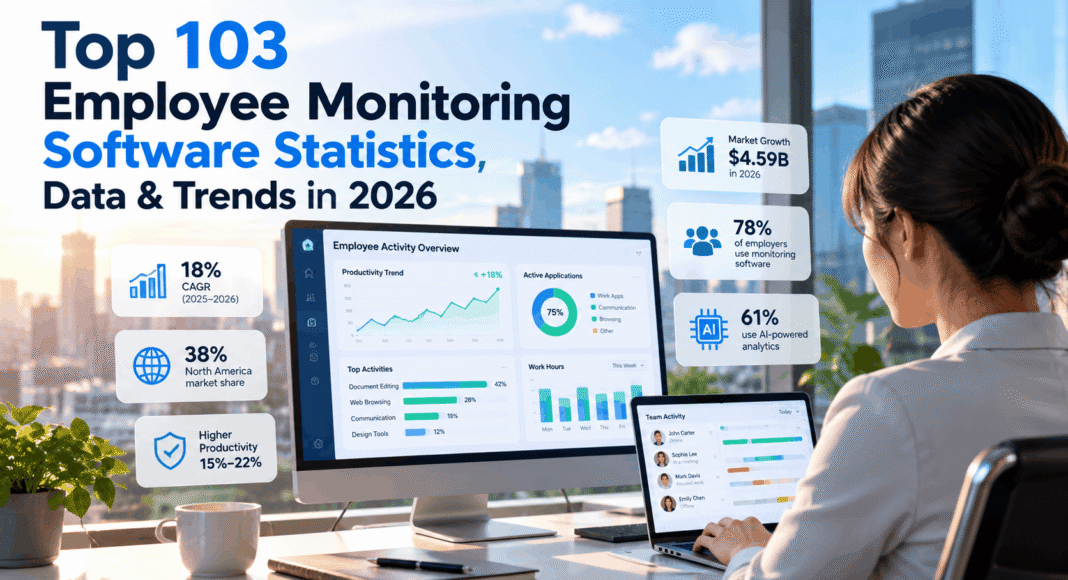
Employee monitoring software is a growing workforce management technology market, projected to reach $4.59 billion globally in 2026, with approximately 18% annual growth. The top 103 employee monitoring software statistics for 2026 highlight AI-powered monitoring, employee productivity, remote work tracking, cybersecurity, privacy concerns, and emerging workplace surveillance trends.
Employee monitoring software has become an increasingly important component of modern workforce management as businesses seek greater visibility into employee productivity, operational efficiency, cybersecurity, and regulatory compliance. With remote and hybrid work arrangements reshaping traditional workplaces, organizations are investing in digital monitoring solutions to track work hours, analyze employee activity, protect sensitive information, and optimize workforce performance.
Also, read our article on the Top 10 Employee Monitoring Software.
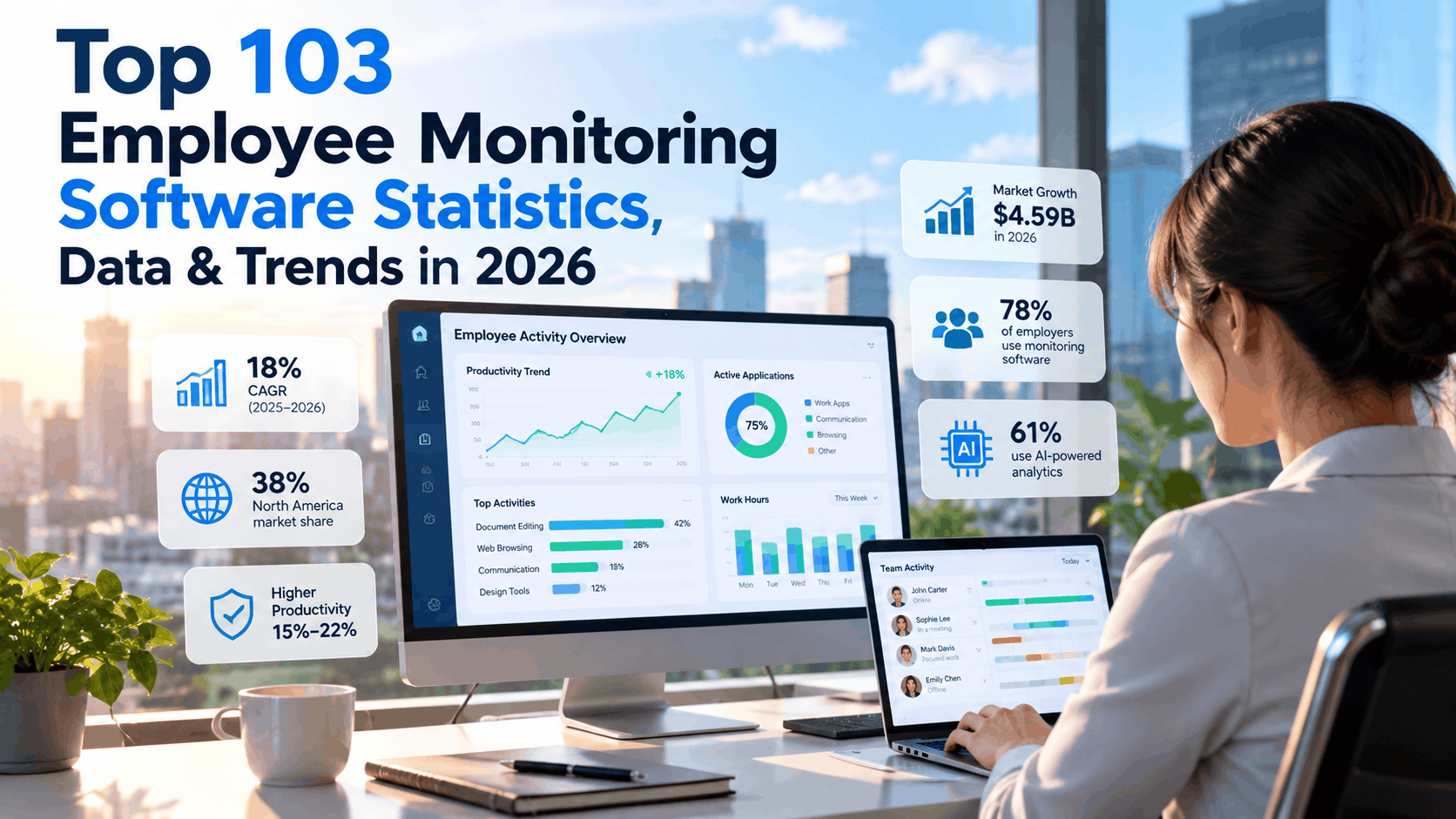
The global employee monitoring software market is experiencing significant growth. According to industry estimates, the market reached approximately $3.89 billion in 2025 and is projected to grow to $4.59 billion in 2026, representing an annual growth rate of approximately 18%. Longer-term forecasts suggest the market could reach $8.29 billion by 2030, driven by increasing enterprise adoption, artificial intelligence integration, and growing demand for workforce analytics.
Employee monitoring software adoption is also expanding across industries and business sizes. Survey findings compiled in this report indicate that 74% of US employers use online employee tracking tools, while 73% of companies monitor remote or hybrid workers. Monitoring technologies now extend beyond traditional time tracking to include screen activity recording, website usage analysis, productivity scoring, behavioral analytics, insider threat detection, and automated compliance reporting.
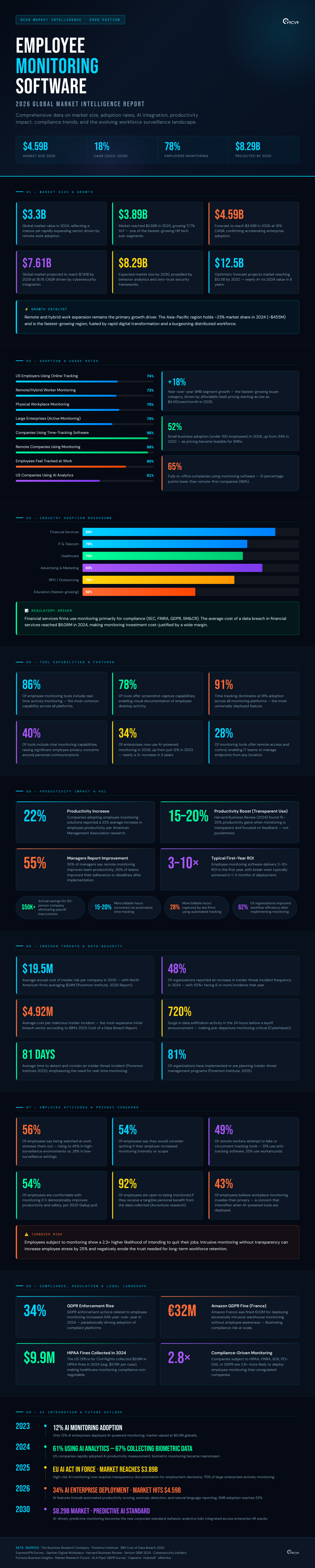
Artificial intelligence is emerging as another major force transforming the employee monitoring software industry in 2026. AI-powered monitoring platforms can analyze workplace activity, identify unusual behavior, generate productivity insights, and support predictive workforce management. Research estimates suggest that 61% of US companies use AI-powered analytics to evaluate employee productivity or behavior, highlighting the growing role of intelligent automation in workforce oversight.
However, the rapid adoption of workplace monitoring technology introduces important challenges involving employee privacy, trust, transparency, and organizational culture. Survey findings indicate that 56% of employees report stress associated with workplace surveillance, while 54% would consider leaving their jobs if employers increased monitoring intensity. These findings underscore the importance of balancing business performance objectives with ethical monitoring practices, employee consent, and responsible data management.
Cybersecurity and regulatory compliance are also influencing employee monitoring software trends. As organizations confront insider threats, data breaches, and increasingly complex privacy regulations, monitoring solutions are evolving into broader workforce security platforms. Features such as user behavior analytics, anomaly detection, access monitoring, and automated risk alerts are becoming increasingly relevant to organizations operating in regulated industries.
This comprehensive guide explores the top 103 employee monitoring software statistics, data, and trends in 2026, covering global market size, industry growth forecasts, employee monitoring adoption rates, AI-powered surveillance, productivity improvements, software pricing, employee sentiment, cybersecurity risks, and regulatory developments.
Whether you are an HR professional, business owner, IT manager, cybersecurity specialist, software vendor, or industry researcher, these employee monitoring software statistics provide valuable insights into how workplace monitoring technologies are evolving, what drives adoption, and the opportunities and challenges shaping the future of employee monitoring in 2026 and beyond.
Before we venture further into this article, we would like to share who we are and what we do.
About 9cv9
9cv9 is a business tech startup based in Singapore and Asia, with a strong presence all over the world.
With over ten years of startup and business experience, and being highly involved in connecting with thousands of companies and startups, the 9cv9 team has listed some of the top and best companies/tools in this review.
If you like to get your company listed in our top B2B software reviews, check out our world-class 9cv9 Media and PR service and pricing plans here.
Top 103 Employee Monitoring Software Statistics, Data & Trends in 2026
📊 MARKET SIZE & GROWTH
- $3.14 billion — The global employee monitoring software market was valued at $3.14B in 2023, establishing a strong baseline for the sector’s rapid expansion. (SkyQuestT)
- $3.30 billion — Market size climbed to $3.30B in 2024, reflecting sustained post-pandemic demand for workforce visibility tools. (The Business Research Company)
- $3.89 billion — By 2025, the market reached $3.89B, growing at 17.7% YoY — one of the fastest growth rates in the HR tech sector. (The Business Research Company)
- $4.59 billion — The market is forecast to hit $4.59B in 2026 at an 18% CAGR, as enterprise adoption accelerates across regulated industries. (Research and Markets)
- 18% CAGR — The compound annual growth rate between 2025 and 2026 reflects the urgency with which organizations are investing in workforce surveillance technology. (Research and Markets)
- $7.61 billion — Global market is projected to reach $7.61B by 2029 at an 18.1% CAGR, driven by cybersecurity integration and behavior analytics demand. (The Business Research Company)
- $8.29 billion — By 2030, the market is expected to reach $8.29B — more than doubling its 2025 size in just five years. (Research and Markets)
- $12.5 billion — An optimistic forecast projects the market reaching $12.5B by 2032, driven by AI-powered monitoring and predictive workforce analytics. (Market Research Future)
- 15.2% CAGR (2025–2033) — The market is projected to grow at 15.2% CAGR from 2025 to 2033, reaching $6.11B — signaling durable long-term demand. (Growth Market Reports)
- $20.11 billion — The broader employee surveillance and monitoring software market (including hardware-integrated systems) is projected to reach $20.11B by 2034. (Market Research Future)
🌍 REGIONAL BREAKDOWN
- 38% North America share — North America dominates the global employee monitoring market, accounting for 38% of revenue, driven by enterprise technology adoption and regulatory frameworks. (Grand View Research / eMonitor)
- $2.81 billion — North American market was valued at $2.81B in 2023, reflecting high enterprise concentration and early remote work adoption. (Market Research Future)
- ~23% Asia-Pacific share — The Asia-Pacific region held approximately 23% of the global market in 2024 (~$455M), making it the fastest-growing region. (Growth Market Reports)
- Fastest-growing region: APAC — Rapid digital transformation, expanding IT infrastructure, and a burgeoning remote workforce are key drivers of market expansion in China, India, Japan, and Southeast Asia. (Growth Market Reports)
- Europe ranks second — Europe follows North America in market share, driven by increasing data privacy compliance requirements under GDPR and the EU AI Act. (Growth Market Reports)
👁️ ADOPTION & USAGE RATES
- 74% of US employers use online tracking tools as of early 2025, including real-time screen tracking (59%) and web browsing logs (62%), making digital surveillance a standard management practice. (ExpressVPN Survey, Feb 2025)
- 78% of employers now use some form of employee monitoring, up from 60% pre-pandemic — a 30-percentage-point surge in just five years. (Digital.com / eMonitor)
- 75% of employers monitor physical workplaces using video surveillance, badge systems, and biometric access controls, nearly matching digital monitoring rates. (ExpressVPN Survey)
- 73% of companies monitor remote or hybrid workers — compared to 65% for fully in-office companies, confirming remote work as the primary driver of adoption. (ExpressVPN Survey / eMonitor)
- 70% of large enterprises now actively monitor their staff, up from a predicted 60% in 2022, with Gartner estimating 71% of employees are digitally monitored. (Gartner / Apploye)
- 96% of remote companies use monitoring software, compared to 65% of fully in-office companies — a 31-point gap reflecting the oversight challenges of distributed work. (eMonitor)
- 96% of companies use some form of time-tracking software, making it the most universally deployed form of workforce monitoring. (MeraMonitor)
- 73% of companies that adopted monitoring during COVID-19 have kept it permanently, signaling that emergency-era surveillance tools have become embedded in standard operations. (eMonitor)
- 60% of large enterprises (1,000+ employees) use advanced monitoring with screen capture, representing a major shift toward granular digital oversight at scale. (eMonitor)
- 52% small business adoption — Small businesses (under 100 employees) adoption rose from 34% in 2022 to 52% in 2026, driven by SaaS pricing falling to as low as $4.50/user/month. (employee-monitoring.net)
🤖 AI-POWERED MONITORING
- 61% of US companies now use AI-powered analytics to measure employee productivity or behavior, marking a decisive shift from manual tracking to algorithm-driven performance evaluation. (High5test / ExpressVPN)
- 34% AI enterprise deployment — 34% of enterprises use AI-powered monitoring in 2026, up from just 12% in 2023 — nearly a threefold increase in three years. (eMonitor)
- 67% collect biometric data — 67% of US employers collect biometric data including fingerprints or facial recognition, raising significant privacy and data-security concerns. (High5test)
- AI features include automated productivity scoring, anomaly detection, and natural language report generation — transforming monitoring from passive recording to active intelligence. (eMonitor)
- 68% of employees oppose AI-powered surveillance, citing concerns about algorithmic bias, unfair scoring, and opaque decision-making processes. (Apploye)
- EU AI Act (Aug 2025) — Effective August 2025, the EU AI Act requires transparency documentation for any AI-powered monitoring system that influences employment decisions, reshaping how enterprises deploy AI tools. (employee-monitoring.net)
🛠️ TOOL CAPABILITIES & FEATURES
- 86% real-time activity monitoring — Real-time activity tracking is the most common monitoring feature, found in 86% of employee monitoring tools on the market. (StandOutCV / Hubstaff)
- 91% time tracking — Time tracking dominates at 91% feature adoption across all monitoring platforms, solving the most universal business need regardless of industry. (employee-monitoring.net)
- 78% screenshot capture — Nearly 4 in 5 monitoring tools offer screenshot capture, enabling visual documentation of employee desktop activity for compliance and performance review. (StandOutCV)
- 40% chat monitoring — 40% of tools include chat monitoring capabilities, raising significant employee concerns around the surveillance of personal and professional communications. (StandOutCV)
- 28% remote access — Just over a quarter of monitoring tools offer remote access and control, enabling IT and security teams to manage endpoints without physical presence. (StandOutCV)
- Productivity monitoring dominates — The productivity monitoring segment dominated the market in 2024, driven by growing organizational fear of losing employee output in remote and hybrid settings. (Fortune Business Insights)
- Insider threat detection fastest-growing — The insider threat detection and prevention segment is expected to grow with the highest CAGR during 2025–2032, reflecting rising data exfiltration risks. (Fortune Business Insights)
📈 PRODUCTIVITY IMPACT & ROI
- 22% productivity increase — Companies adopting employee monitoring solutions reported an average 22% increase in employee productivity, per American Management Association research. (Fortune Business Insights)
- 15–20% productivity gains — A 2024 Harvard Business Review study found 15–20% productivity gains when monitoring tools are used transparently and focused on feedback rather than punishment. (Remotly.tech)
- 55% of managers say remote monitoring improves team productivity, while 30% of teams improved their adherence to deadlines following tool implementation. (MeraMonitor)
- 3–10× ROI in year one — Employee monitoring software delivers 3–10× return on investment in the first year, with break-even typically achieved within 1–3 months of deployment. (eMonitor)
- $50,000+ annual savings for a 50-person company from eliminating payroll inaccuracies alone — a concrete ROI driver independent of productivity gains. (eMonitor)
- 15–20% more billable hours recovered by service businesses after implementing automated time tracking, directly boosting revenue. (eMonitor)
- 28% more billable hours captured by law firms using automated time tracking compared to those relying on manual methods. (eMonitor)
- 62% of organizations improved workflow efficiency after implementing monitoring software, extending value beyond simple productivity metrics. (MeraMonitor)
- 89% of employers say monitoring tools improve productivity overall — though the figure drops sharply when employee sentiment data is factored into the assessment. (Remotly.tech)
- 30% deadline adherence improvement — Nearly one-third of monitored teams showed measurable improvement in meeting deadlines after monitoring software was introduced. (MeraMonitor)
😟 EMPLOYEE SENTIMENT & TRUST
- 80% of employees feel tracked at work to at least a moderate degree — 56.8% to a moderate degree and 23.5% to a high degree, per Raconteur research. (Hubstaff)
- 56% report stress from being watched at work — rising to 45% stress levels in high-surveillance environments versus 28% in less-monitored settings. (High5test)
- 54% would consider quitting if their employer increased surveillance intensity, making transparency and proportionality critical to retention outcomes. (Apploye)
- 43% believe monitoring invades their privacy — nearly half of the workforce views workplace surveillance as a violation of personal boundaries, regardless of business justification. (Apploye)
- 49% fake being online — Nearly half of remote workers attempt to circumvent tracking tools; 31% use anti-tracking software and 25% use technical workarounds to mask activity. (Apploye)
- 2.3× higher quit intention — Employees subject to monitoring show a 2.3× higher likelihood of intending to resign their jobs, representing a significant hidden cost of intrusive monitoring. (Remotly.tech)
- 25% stress increase — Intrusive monitoring without transparent communication leads to a 25% increase in employee stress levels, negating productivity gains. (Remotly.tech)
- 54% are comfortable with monitoring — 54% of employees are acceptable with monitoring if it demonstrably improves productivity and safety, per a 2025 Gallup poll. (Remotly.tech)
- 92% accept monitoring for personal benefit — 92% of employees are open to being monitored if they receive some form of tangible benefit from the data collected (Accenture / Capterra). (Capterra Buyers Guide)
- 42% of UK managers oppose monitoring — A 2025 CMI survey found 42% of UK managers opposed employee monitoring, citing concerns that it undermines trust and invades privacy. (Wikipedia / CMI Survey)
- 37% of employers have used call recordings to fire employees, creating fear among workers that any captured activity could be used against them. (Apploye)
🏭 INDUSTRY-SPECIFIC DATA
- 89% financial services adoption — Financial services firms have the highest monitoring adoption of any industry, driven by SEC, FINRA, GDPR, and SM&CR regulatory mandates. (eMonitor)
- 83% advertising & marketing adoption — The ad and marketing sector leads unexpectedly high adoption at 83%, reflecting project-based work accountability requirements. (MeraMonitor)
- 76% IT & telecom adoption — IT and telecom companies adopt monitoring at 76%, primarily to shield sensitive IP and manage globally distributed development teams. (Fortune Business Insights)
- 74% healthcare adoption — 74% of healthcare organizations monitor employees who access patient records, driven specifically by HIPAA compliance rather than productivity concerns. (eMonitor)
- 70%+ BPO adoption — Business process outsourcing companies maintain 70%+ adoption rates to manage remote and global workforce performance across time zones. (MeraMonitor)
- 52% education adoption — Educational institutions represent the fastest-growing sector with 31% year-over-year adoption growth, as schools digitize operations and secure student data. (eMonitor)
- $6.08 million average data breach cost in financial services in 2024, making monitoring investment a clearly cost-justified security measure for banks and insurers. (IBM Cost of a Data Breach / employee-monitoring.net)
🔐 INSIDER THREATS & SECURITY
- $19.5 million — The average annual cost of insider risk per company reached $19.5M in 2025, with North American firms averaging $24M (Ponemon Institute / DTEX, 2026 Report). (Swif.ai)
- $4.92 million — Malicious insider attacks remain the most expensive initial breach vector at $4.92M per incident per the IBM 2025 Cost of a Data Breach Report. (Deepstrike.io)
- 81 days — It takes an average of 81 days to detect and contain an insider threat incident, underscoring the need for real-time behavioral monitoring. (Ponemon Institute 2025 / Syteca)
- 48% increase in frequency — 48% of organizations reported an increase in insider threat incidents in 2024, with more than half facing six or more incidents during the year. (Cybersecurity Insiders 2024)
- 83% reported zero incidents in 2023 vs. only 17% in 2024 — The share of organizations reporting zero insider incidents dropped from 40% to just 17% in one year — a stark deterioration. (Cybersecurity Insiders)
- 720% exfiltration surge pre-layoff — Organizations see a 720% surge in data exfiltration activity in the 24 hours before a layoff announcement, making pre-departure monitoring critical. (Cyberhaven / Swif.ai)
- 91% of executives believe insider attacks have increased due to remote work, validating monitoring investment as a direct response to distributed work security risks. (Station X)
- 53% of incidents from negligence — Negligent employees caused 53% of insider incidents in 2025; malicious insiders accounted for 27% and credential theft made up 20%. (Ponemon / Swif.ai)
- 60% of breaches involve the human element — The Verizon 2025 DBIR found that 60% of breaches still involve human factors, confirming behavioral monitoring as a core security layer. (Verizon DBIR 2025)
- 81% implementing insider threat programs — 81% of organizations have already implemented or are planning to implement a formal insider threat management program. (Ponemon Institute 2025)
- $670,000 additional breach cost — IBM’s 2025 report found that breaches involving shadow AI (unauthorized employee AI tool use) cost organizations an average of $670K more than standard breaches. (IBM / Deepstrike.io)
- 22.7% via personal cloud storage — Personal cloud storage accounts for 22.7% of all insider exfiltration incidents, followed by removable media at 15.6% and generative AI tools at 13.1%. (Cyberhaven / Swif.ai)
⚖️ COMPLIANCE & REGULATION
- 34% GDPR enforcement rise — GDPR enforcement actions related to employee monitoring increased 34% year-over-year in 2024, paradoxically accelerating adoption of compliant, privacy-first platforms. (DLA Piper GDPR Survey / employee-monitoring.net)
- €32 million fine (Amazon France) — Amazon France was fined €32M by France’s data protection authority for deploying excessively intrusive warehouse monitoring without adequate employee disclosure. (WorkTime / eMonitor)
- $9.9 million HIPAA fines in 2024 — The US Office for Civil Rights collected $9.9M in HIPAA fines in 2024, averaging $579,003 per case, making healthcare monitoring compliance financially essential. (WorkTime / eMonitor)
- 2.8× more likely to monitor — Companies subject to HIPAA, FINRA, SOX, PCI-DSS, or GDPR are 2.8× more likely to deploy monitoring systems than companies without sector-specific mandates. (Gartner 2025 / employee-monitoring.net)
- 3.2× adoption with 40%+ remote workforce — Organizations where more than 40% of the workforce is remote adopt monitoring at 3.2× the rate of fully in-office organizations. (Gartner 2025)
- India Privacy Bill 2024 — India’s DPDPA 2023 requires employers to obtain explicit consent before monitoring employees, limiting passive tracking without notice. (Remotly.tech)
- New York mandate — New York State mandates explicit written disclosure when employers monitor employees’ digital activity — setting a precedent other US states are following. (MeraMonitor)
- $1.7 million GDPR compliance cost — GDPR compliance costs for monitoring systems range from $1.7M, making investment in purpose-built, compliant monitoring platforms cost-efficient by comparison. (WorkTime)
💰 PRICING & MARKET ECONOMICS
- $5–$10/user/month — The average cost of mid-range employee monitoring software in 2026, down significantly from the $15–$25/user/month price point of five years ago. (eMonitor)
- $4.50/user/month — The lowest-tier comprehensive monitoring platforms now start at $4.50/user/month in 2026, opening the market to small and mid-sized businesses for the first time. (employee-monitoring.net)
- 1–3 month break-even — Most organizations achieve break-even on their monitoring software investment within 1–3 months, primarily through payroll accuracy improvements and productivity recovery. (eMonitor)
- 18% YoY SMB growth — The SMB segment is the fastest-growing buyer category in employee monitoring, growing 18% year-over-year as pricing barriers have been eliminated by SaaS models. (eMonitor)
🔮 FUTURE TRENDS & OUTLOOK
- 50% knowledge workers hybrid by 2026 — Gartner research forecasts that over 50% of knowledge workers will operate in a hybrid or fully remote capacity by 2026, sustaining monitoring demand. (CurrentWare / Gartner)
- 40% would change jobs without hybrid options — Owl Labs’ 2025 State of Hybrid Work Report reveals 40% of employees would look for another job if hybrid or remote options were withdrawn. (CurrentWare / Owl Labs 2025)
- 7 in 10 large employers by 2025 — Gartner predicted that 7 out of 10 large employers would adopt monitoring tools as the new corporate standard, a target that was met by 2025. (MeraMonitor)
- AI predicting turnover — By 2025, AI monitoring tools are capable of predicting employee turnover and productivity patterns, shifting monitoring from reactive to proactive workforce management. (Apploye)
- 47% compliance monitoring growth — Continuous compliance monitoring adoption rose by 47% year-over-year as enterprises strive for real-time visibility into regulatory adherence. (DataStackHub)
- Behavior analytics highest growth segment — Increasing demand for behavior analytics is identified as the top growth driver for the monitoring market in the 2025–2030 forecast period. (Research and Markets)
- Zero-trust security integration — Expansion of zero-trust security frameworks is a key forecast-period growth driver, with monitoring tools embedded as a core layer of the zero-trust architecture. (Research and Markets)
- Contractor monitoring at 79% — Organizations that rely on contract workers for more than 20% of their labor force adopt monitoring at 79%, compared to 64% for organizations with primarily full-time workforces. (employee-monitoring.net)
- $6.1M saved via PAM — Privileged access management — a monitoring-adjacent tool — can save an average of $6.1M per organization, while user behavior analytics saves an average of $5.1M. (Swif.ai / Ponemon)
- 65% pre-empted breaches — 65% of organizations with an insider risk management program said it was the only security strategy that allowed them to pre-empt a breach by detecting risk early. (Swif.ai / Ponemon)
- Only 12% have mature predictive models — Only 12% of organizations have mature predictive insider risk models, revealing a major gap between monitoring investment and analytical maturity. (Cybersecurity Insiders 2025)
- 79% contractor monitoring rate — Organizations with high contractor workforce reliance adopt monitoring at significantly higher rates than those employing primarily full-time staff. (employee-monitoring.net)
- $180 billion retention risk — US companies risk $180B annually in employee retention costs at organizations perceived as unempathetic — highlighting that over-surveillance, if mismanaged, carries massive hidden costs. (Businessolver, 2025)
Conclusion
The top 103 employee monitoring software statistics, data, and trends in 2026 reveal an industry undergoing significant transformation as organizations increasingly prioritize workforce productivity, operational transparency, cybersecurity, and regulatory compliance. What began as basic employee time tracking has evolved into a sophisticated ecosystem of AI-powered monitoring platforms, behavioral analytics, automated productivity reporting, and insider threat detection solutions.
With the global employee monitoring software market projected to reach $4.59 billion in 2026 and potentially $8.29 billion by 2030, the industry is positioned for continued expansion. Growing adoption among businesses of all sizes, particularly those managing remote and hybrid workforces, demonstrates the increasing importance of digital workforce management solutions.
Artificial intelligence is expected to play a central role in shaping the future of employee monitoring technology. AI-powered productivity analytics, automated anomaly detection, predictive workforce insights, and intelligent security monitoring are enabling organizations to move beyond basic activity tracking toward more proactive, data-driven workforce management. As these capabilities mature, businesses will have greater opportunities to identify operational inefficiencies, strengthen cybersecurity defenses, and improve resource allocation.
However, the employee monitoring software statistics also highlight a critical challenge: balancing organizational oversight with employee privacy, trust, and workplace satisfaction. Research findings showing that 56% of employees experience stress related to workplace surveillance and 54% would consider leaving their jobs if monitoring intensified demonstrate the potential consequences of excessively intrusive monitoring practices.
Organizations that prioritize transparent monitoring policies, clear communication, proportionate data collection, and responsible use of employee information will be better positioned to maintain workforce trust while benefiting from monitoring technology.
Cybersecurity and compliance will remain important growth drivers. Rising insider threats, data protection requirements, and increasingly sophisticated cyberattacks are encouraging businesses to integrate employee monitoring software with broader security frameworks. Solutions incorporating behavioral analytics, access controls, automated alerts, and privacy-conscious monitoring practices are likely to attract greater enterprise interest.
Looking ahead, several developments are expected to influence the employee monitoring software market beyond 2026, including greater AI integration, increasing demand for real-time workforce analytics, stronger privacy protections, more sophisticated insider risk management, and wider adoption among small and medium-sized businesses.
For HR leaders, business owners, IT professionals, and software providers, the key takeaway is that successful employee monitoring is not simply about tracking employee activity but about using workforce data responsibly to improve business outcomes.
Ultimately, the future of employee monitoring software will depend on how effectively organizations combine technological innovation with ethical workforce management. Businesses that adopt transparent, security-focused, and employee-conscious monitoring strategies will be better equipped to improve operational efficiency, protect sensitive information, maintain employee engagement, and navigate the evolving digital workplace.
As the employee monitoring software industry continues to expand, understanding these 103 employee monitoring software statistics and trends for 2026 will help organizations make more informed technology investments, evaluate emerging workforce management solutions, and develop sustainable monitoring strategies that support both business performance and employee well-being.
If you find this article useful, why not share it with your hiring manager and C-level suite friends and also leave a nice comment below?
We, at the 9cv9 Research Team, strive to bring the latest and most meaningful data, guides, and statistics to your doorstep.
To get access to top-quality guides, click over to 9cv9 Blog.
To hire top talents using our modern AI-powered recruitment agency, find out more at 9cv9 Modern AI-Powered Recruitment Agency.
People Also Ask
What is employee monitoring software?
Employee monitoring software is a digital tool that tracks employee activities, working hours, productivity, application usage, and online behavior. Businesses use it to improve workforce management, strengthen cybersecurity, and monitor remote or hybrid employees.
How big is the global employee monitoring software market in 2026?
The global employee monitoring software market is projected to reach $4.59 billion in 2026, up from approximately $3.89 billion in 2025. Growth is driven by remote work, AI-powered analytics, cybersecurity requirements, and workforce productivity management.
What is the projected growth rate of the employee monitoring software market?
The employee monitoring software market is projected to grow at approximately 18% annually in 2026. Longer-term forecasts suggest continued expansion as organizations adopt AI-driven monitoring, behavioral analytics, and workforce security technologies.
How much will the employee monitoring software market be worth by 2030?
The global employee monitoring software market is forecast to reach approximately $8.29 billion by 2030. Increasing enterprise adoption, AI integration, remote workforce management, and cybersecurity investments are expected to support market expansion.
What percentage of companies use employee monitoring software in 2026?
Industry estimates suggest approximately 78% of employers use some form of employee monitoring technology. Adoption varies by industry, company size, geographic location, and whether employees work remotely, in hybrid arrangements, or on-site.
How many US employers monitor their employees?
Survey findings indicate that approximately 74% of US employers use online employee tracking tools. Common monitoring activities include website usage tracking, screen monitoring, time tracking, application usage analysis, and employee productivity reporting.
What percentage of companies monitor remote employees?
Industry data suggests approximately 73% of companies monitor remote or hybrid employees. Monitoring solutions help organizations track working hours, project progress, application usage, productivity indicators, and cybersecurity risks across distributed teams.
Why is employee monitoring software becoming more popular?
Employee monitoring software adoption is increasing because businesses need better workforce visibility, productivity insights, cybersecurity protection, and compliance reporting. Remote work expansion and AI-powered monitoring capabilities are additional growth drivers.
What are the most common features of employee monitoring software?
Common features include time tracking, real-time activity monitoring, screenshot capture, application usage tracking, website monitoring, productivity reporting, and behavioral analytics. Some platforms also provide insider threat detection and automated compliance alerts.
What percentage of employee monitoring tools offer time tracking?
Approximately 91% of employee monitoring platforms include time-tracking capabilities, making it one of the most widely available features. Businesses use time tracking to manage attendance, payroll accuracy, project billing, and workforce productivity.
How many employee monitoring software platforms offer screenshot monitoring?
Industry estimates indicate that approximately 78% of employee monitoring tools provide screenshot capture capabilities. These features help businesses document desktop activity, although organizations must consider employee privacy and data protection requirements.
How is artificial intelligence transforming employee monitoring software?
AI-powered employee monitoring software uses machine learning and behavioral analytics to identify productivity patterns, detect unusual activities, automate reporting, and support workforce planning. AI also enables predictive insights and cybersecurity risk detection.
What percentage of companies use AI-powered employee monitoring?
Research estimates suggest approximately 61% of US companies use AI-powered analytics to evaluate employee productivity or behavior. Adoption reflects growing demand for automated workforce insights, real-time performance monitoring, and intelligent security systems.
What are the benefits of AI-powered employee monitoring software?
AI-powered monitoring can automate activity analysis, identify workflow inefficiencies, detect suspicious behavior, and generate productivity insights. These capabilities help organizations improve operational visibility while reducing manual reporting requirements.
Does employee monitoring software improve productivity?
Some industry reports associate employee monitoring software with productivity improvements of approximately 15% to 22%. However, results depend on implementation, management practices, employee trust, and whether monitoring supports constructive feedback.
What is the average ROI of employee monitoring software?
Some industry estimates suggest employee monitoring software can generate a 3–10 times return on investment during the first year. Potential benefits include improved payroll accuracy, recovered billable hours, operational efficiency, and reduced security risks.
How long does employee monitoring software take to deliver ROI?
Industry estimates suggest some organizations achieve break-even within one to three months of implementation. Actual returns depend on software costs, workforce size, existing inefficiencies, employee adoption, and measurable operational improvements.
How much does employee monitoring software cost in 2026?
Mid-range employee monitoring software typically costs approximately $5–$10 per user per month in 2026. Entry-level plans may start around $4.50 per user monthly, while advanced enterprise platforms can cost more depending on features and deployment requirements.
Is employee monitoring software suitable for small businesses?
Yes. Small businesses can use employee monitoring software for time tracking, attendance management, project billing, and productivity analysis. Cloud-based subscription models make monitoring tools more accessible without requiring extensive IT infrastructure.
What industries use employee monitoring software the most?
Employee monitoring software is widely used in financial services, advertising, marketing, IT, telecommunications, healthcare, and business process outsourcing. Adoption is often driven by cybersecurity, compliance, productivity, and workforce accountability requirements.
How does employee monitoring software affect employee privacy?
Employee monitoring software can raise privacy concerns when organizations collect excessive personal information or monitor activities without transparency. Clear policies, limited data collection, secure storage, and compliance with applicable privacy laws are essential.
What percentage of employees feel stressed by workplace monitoring?
Survey findings suggest approximately 56% of employees experience stress associated with workplace monitoring. Excessive surveillance, unclear policies, and intrusive tracking practices can negatively affect employee trust, satisfaction, and workplace morale.
Can employee monitoring software increase employee turnover?
Yes. Survey findings suggest approximately 54% of employees would consider leaving their jobs if workplace surveillance increased. Excessively intrusive monitoring can damage employee trust, increase stress, and contribute to retention challenges.
Do employees support workplace monitoring?
Employee attitudes vary depending on monitoring methods and perceived benefits. Some research suggests 54% of employees are comfortable with monitoring when it improves productivity or safety, while intrusive surveillance often generates opposition.
Is employee monitoring software legal in 2026?
Employee monitoring software can be legal when employers comply with applicable labor, privacy, and data protection laws. Requirements vary by jurisdiction and may include employee notification, lawful data processing, transparency, and restrictions on intrusive monitoring.
How does GDPR affect employee monitoring software?
GDPR requires organizations processing employee personal data to establish a lawful basis, provide transparency, minimize unnecessary collection, and protect personal information. Employers must also consider proportionality and employee rights when deploying monitoring systems.
How does employee monitoring software improve cybersecurity?
Employee monitoring software can help detect suspicious activity, unauthorized access, unusual file transfers, and potential insider threats. Security-focused platforms use behavioral analytics and automated alerts to support incident detection and data protection.
What is the relationship between employee monitoring and insider threats?
Employee monitoring can support insider threat detection by identifying unusual user behavior, unauthorized data transfers, and suspicious access patterns. Industry estimates place the average annual organizational cost of insider risk at approximately $19.5 million.
What are the biggest employee monitoring software trends in 2026?
Major trends include AI-powered productivity analytics, behavioral monitoring, insider threat detection, cloud-based workforce management, privacy-focused monitoring, automated compliance reporting, and integration with zero-trust cybersecurity frameworks.
What is the future of employee monitoring software beyond 2026?
Employee monitoring software is expected to evolve toward AI-driven analytics, predictive workforce insights, stronger cybersecurity integration, and privacy-conscious monitoring. Future adoption will increasingly depend on balancing operational efficiency with employee trust and regulatory compliance.
Sources
SkyQuestT
The Business Research Company
Research and Markets
Market Research Future
Growth Market Reports
Fortune Business Insights
High5test
Hubstaff
MeraMonitor
Apploye
eMonitor
Remotly
WorkTime
Ponemon Institute
Swif.ai
IBM
Verizon
Cybersecurity Insiders
Cyberhaven
Capterra
CurrentWare
DataStackHub
Businessolver
Gartner
Owl Labs
DLA Piper