




















Key Takeaways
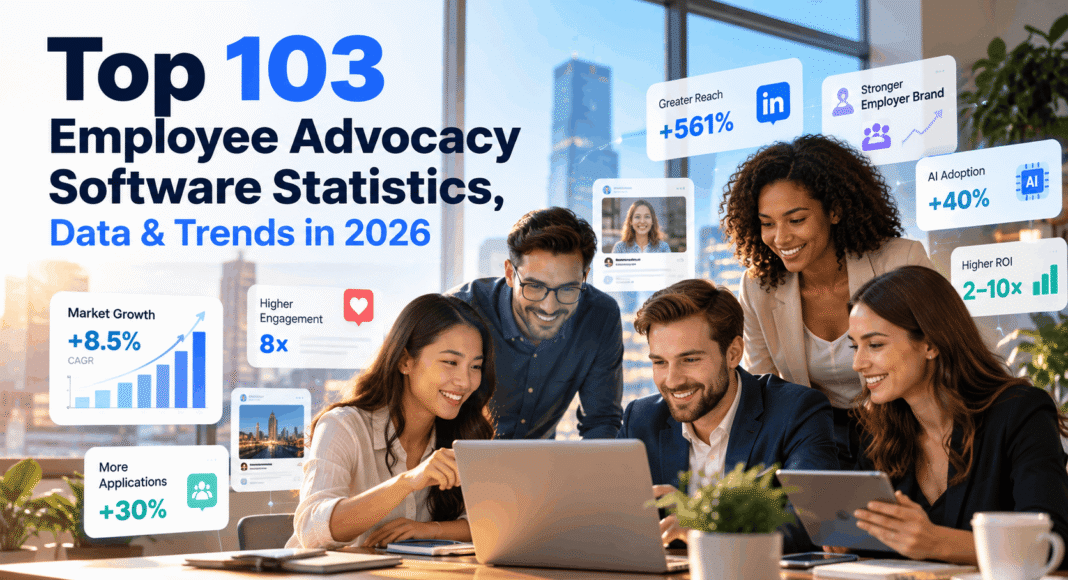
- Employee Advocacy Software Market Growth: The global employee advocacy software market is projected to grow from USD 523.7 million in 2025 to USD 1.18 billion by 2035, driven by increasing adoption of employee-driven marketing strategies.
- Social Media Engagement and Employer Branding: Employee-shared content generates up to 8 times more engagement than corporate posts, while employee-shared job openings can attract 30% more applicants, strengthening brand visibility and recruitment outcomes.
- AI and Employee Advocacy Software Trends: AI-powered content curation exceeds 40% adoption across employee advocacy platforms, while advanced analytics, gamification, and CRM integrations are transforming employee engagement, campaign performance, and ROI measurement.
Employee advocacy software helps businesses increase brand visibility, employee engagement, and recruitment performance. In 2026, the global market is growing, with projections reaching USD 1.18 billion by 2035. Employee-shared content generates up to eight times more engagement than corporate posts, while AI-powered tools improve content distribution, social selling, and campaign measurement.
Employee advocacy software is transforming how businesses build brand awareness, strengthen employee engagement, attract top talent, and generate qualified leads. As organisations increasingly recognise the power of authentic employee voices, employee advocacy platforms have become essential tools for amplifying corporate content, improving social media reach, and strengthening employer branding. In 2026, the growing adoption of artificial intelligence (AI), social selling technologies, and employee-generated content is accelerating the evolution of the global employee advocacy software market.
Also, read our article on the Top 10 Employee Advocacy Software.
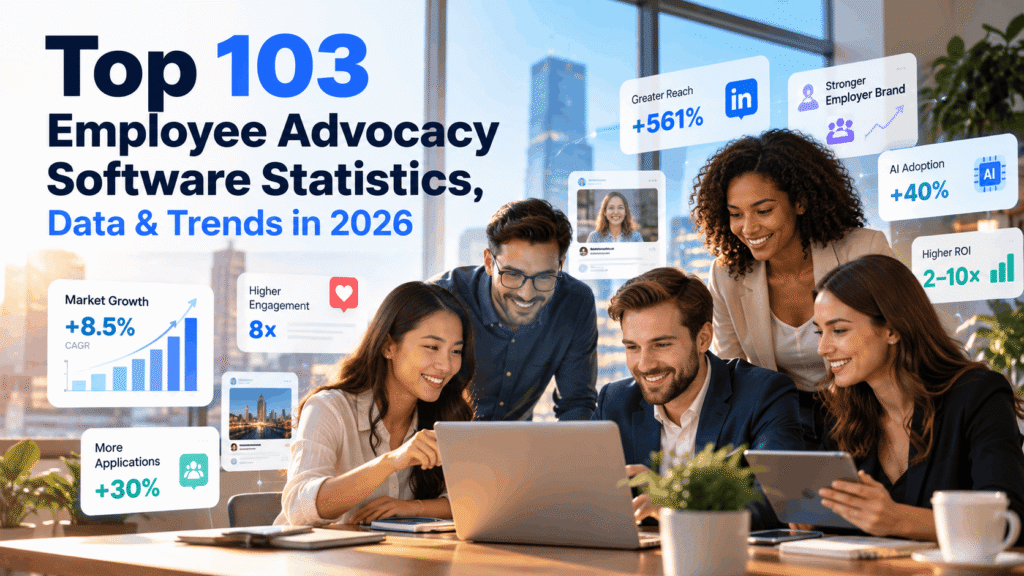
The latest employee advocacy software statistics highlight significant growth opportunities. According to Future Market Insights, the global employee advocacy software market was valued at approximately USD 523.7 million in 2025 and is projected to reach USD 1.18 billion by 2035, representing a compound annual growth rate (CAGR) of 8.5%. Meanwhile, broader market estimates suggest even faster expansion as businesses integrate employee advocacy with digital marketing, recruitment, customer engagement, and social selling strategies.
One of the most compelling employee advocacy trends in 2026 is the growing influence of employee-shared content compared with traditional corporate social media communications. Research cited by Oktopost indicates that content shared by employees generates up to eight times more engagement than content published through official brand channels. Additionally, LinkedIn posts from personal profiles can achieve 561% greater reach than company page posts, demonstrating the potential value of employee networks in expanding organic visibility and building audience trust.

Beyond marketing performance, employee advocacy software is increasingly influencing recruitment and employer branding strategies. Research highlighted in the industry data suggests that job openings shared by employees can attract 30% more applicants, while organisations with strong employer brands may reduce their cost-per-hire by as much as 50%. These findings illustrate why human resources professionals, recruitment teams, and talent acquisition leaders are investing in employee advocacy programmes to communicate company culture, improve candidate engagement, and strengthen their competitive positioning in the labour market.
Technology innovation is also reshaping the employee advocacy software landscape. AI-powered content recommendations, automated social media publishing, advanced analytics, gamification, and mobile-first employee advocacy applications are becoming increasingly important capabilities. Industry estimates indicate that AI-driven content curation has surpassed 40% adoption across employee advocacy platforms, while analytics integration exceeds 50%. These developments are helping organisations simplify content distribution, encourage employee participation, and measure the business impact of advocacy initiatives more effectively.
However, successful employee advocacy programmes require more than technology alone. Employee participation, leadership support, content authenticity, data privacy, regulatory compliance, and measurable return on investment remain important considerations. Businesses must balance automation with genuine employee engagement while ensuring that advocacy activities align with corporate communication policies and individual employee preferences.
In this comprehensive guide, Top 103 Employee Advocacy Software Statistics, Data & Trends in 2026, we explore the latest market size estimates, industry growth forecasts, employee advocacy adoption rates, social media engagement benchmarks, employer branding statistics, AI technology trends, and business performance insights. Whether you are a marketing executive, HR professional, recruitment specialist, business owner, or software provider, these 103 employee advocacy software statistics offer valuable insights into how employee advocacy is evolving and what organisations should consider when developing effective, data-driven advocacy strategies in 2026 and beyond.
Before we venture further into this article, we would like to share who we are and what we do.
About 9cv9
9cv9 is a business tech startup based in Singapore and Asia, with a strong presence all over the world.
With over ten years of startup and business experience, and being highly involved in connecting with thousands of companies and startups, the 9cv9 team has listed some of the top and best companies/tools in this review.
If you like to get your company listed in our top B2B software reviews, check out our world-class 9cv9 Media and PR service and pricing plans here.
Top 103 Employee Advocacy Software Statistics, Data & Trends in 2026
Market Size & Growth
1. The global employee advocacy software market was valued at USD 523.7 million in 2025 and is projected to reach USD 1.18 billion by 2035, growing at a compound annual growth rate (CAGR) of 8.5%. This growth reflects increasing enterprise investment in employee-driven brand promotion and digital marketing.
2. The employee advocacy software market exceeded USD 485.57 million in 2024 and is projected to surpass USD 1.45 billion by 2037, registering a CAGR of more than 8.8% between 2025 and 2037. This forecast indicates sustained demand for workforce-driven marketing technologies.
3. The global employee advocacy software industry was estimated to reach USD 556.34 million in 2025, reflecting continued growth as organisations formalise employee advocacy programmes and invest in digital engagement platforms.
4. The broader employee advocacy tool market was estimated at USD 1.8 billion in 2025 and is expected to reach USD 7.49 billion by 2032, representing a CAGR of 22.6%. This broader market includes employee advocacy, social selling, and integrated engagement technologies.
5. Another market forecast valued employee advocacy software at USD 928.3 million in 2023, with projections reaching USD 2.61 billion by 2030, representing a CAGR of 16.4%. Differences between market estimates reflect variations in software category definitions and research methodologies.
6. The employee advocacy software market is projected to expand from USD 480 million in 2024 to USD 1.2 billion by 2034, growing at approximately 9.5% annually. Increasing demand for authentic employee-generated content is a major contributor to this expansion.
7. North America is projected to account for 38.5% of the global employee advocacy software market, with the United States representing approximately 21.7% of worldwide market share. Strong technology investment and established digital marketing infrastructure support regional demand.
8. Another industry estimate places North America’s employee advocacy software market share at 45%, making it the largest regional market. High enterprise technology adoption and mature digital marketing practices contribute to its leadership.
9. Europe accounts for approximately 30% of the employee advocacy software market, supported by growing adoption in the United Kingdom, Germany, and France. Organisations increasingly prioritise employee engagement and compliant digital communications.
10. Europe’s employee advocacy platforms market is projected to grow from USD 460 million in 2024 to USD 790 million by 2033, reflecting increasing investment in employee communication and brand advocacy technologies.
11. The Asia-Pacific employee advocacy platforms market is projected to expand from USD 290 million in 2024 to USD 510 million by 2033. Rapid digital transformation, cloud adoption, and expanding professional social networks are supporting regional growth.
12. More than 50% of enterprise employee advocacy software deployments in the United States are cloud-based, reflecting growing demand for flexible solutions supporting distributed, remote, and hybrid workforces.
13. Small and medium-sized enterprises are projected to account for 57.3% of the employee advocacy software market’s application segment. Affordable cloud-based platforms are making employee advocacy technology increasingly accessible to smaller organisations.
14. One market segmentation estimate assigns 45% of the employee advocacy software market to large enterprises, followed by SMEs at 35% and startups at 20%. These figures illustrate the adoption of employee advocacy technology across different organisational sizes.
15. An additional market estimate valued employee advocacy software at USD 587 million in 2025, with projections reaching USD 1.33 billion by 2035. This forecast reinforces expectations of continued industry expansion.
Content Performance & Organic Reach
16. Content shared by employees generates eight times more engagement than content distributed through official corporate social media channels. Employee advocacy programmes can therefore significantly improve organic content performance and audience interaction.
17. LinkedIn posts published through personal profiles can generate 561% greater reach than company page posts. This difference highlights the potential of employee networks to amplify brand messages beyond traditional corporate audiences.
18. Employee-shared corporate content can be reshared 25 times more frequently than content distributed directly by company accounts. This increased sharing activity expands potential audience reach without requiring equivalent increases in advertising expenditure.
19. Median LinkedIn engagement rates for personal-profile content are approximately 4.7%, compared with 1% to 2% for company pages. Personal accounts often benefit from stronger professional relationships and more direct audience interactions.
20. Employee advocacy benchmarking for 2024 reported 894,290 average monthly LinkedIn impressions, compared with 85,343 on X and 28,977 on Facebook. These findings position LinkedIn as a leading platform for professional employee advocacy campaigns.
21. Employee advocacy programmes achieved reported engagement rates of 13.99% on X and 14.74% on Facebook in 2024, substantially exceeding typical engagement benchmarks of approximately 0.15% on those platforms.
22. Research suggests that just 3% of employees actively sharing company content can generate approximately 30% of total engagement. This demonstrates how a relatively small group of committed employee advocates can significantly influence social media performance.
23. Employee-shared content can achieve five to ten times greater organic reach and engagement than traditional brand posts. This performance advantage makes employee advocacy an attractive approach for organisations seeking to improve marketing efficiency.
24. Organic reach for LinkedIn company pages reportedly declined by approximately 60% to 66% between 2024 and early 2026. This trend has increased interest in employee-led content distribution as an alternative way to maintain brand visibility.
25. LinkedIn company page posts reportedly receive initial distribution to only 2% to 5% of followers, while personal-profile content can benefit from stronger engagement signals and professional network interactions.
26. LinkedIn posts receiving three or more comments within their first 60 minutes can achieve approximately 5.2 times greater reach. Early audience interaction is therefore an important consideration when developing employee advocacy content strategies.
27. L’Oréal’s global employee advocacy programme reportedly generated 33 million organic impressions and a fourfold return on investment within 18 months. The initiative illustrates the potential commercial impact of structured employee advocacy campaigns.
28. Companies reported a 44.9% increase in inbound website traffic from employee-shared content in 2023, alongside a 32.4% improvement in SEO rankings. These findings suggest that employee advocacy can support broader digital marketing objectives.
29. Approximately 96% of surveyed respondents reported measurable benefits from employees engaging on social media. This indicates strong perceived value among organisations using employee advocacy as part of their marketing activities.
Trust, B2B Buying & Social Selling
30. Approximately 92% of B2B buyers trust recommendations from people they know more than traditional advertising. Employee advocacy can help businesses communicate through personal relationships and trusted professional networks.
31. Leads generated through employee-shared messages have been reported to be seven times more likely to convert than leads from other sources. This highlights the potential importance of trusted employee communications in B2B lead generation.
32. Approximately 78% of consumers report that employee-shared content influences their purchasing decisions. Authentic employee perspectives can therefore contribute to customer confidence and brand consideration.
33. Companies operating active employee advocacy programmes have been associated with 20% higher revenue growth and 400% greater social selling success rates than organisations without structured advocacy initiatives.
34. Employee advocacy-supported social selling strategies have been associated with 20% to 30% shorter sales cycles. By building relationships and sharing relevant expertise, employee advocates may help prospects progress through purchasing decisions more efficiently.
35. Approximately 80% of B2B social media leads originate from LinkedIn, reinforcing its importance for employee advocacy programmes focused on professional networking, business development, and pipeline generation.
36. Referral-sourced and socially influenced leads can convert at three to five times the rate of cold outbound leads. Employee advocacy can contribute to this performance by connecting businesses with prospects through trusted professional relationships.
37. Approximately 75% of business decision-makers and C-suite executives report that thought leadership content has encouraged them to research a product or service they had not previously considered. Employee advocacy can help distribute such content to relevant audiences.
38. Around 54% of C-suite executives spend at least one hour each week reading thought leadership content. This creates opportunities for executives and employees to build professional credibility through educational and industry-focused content.
39. Approximately 23% of organisations reportedly achieve a cost-per-click below USD 1 through employee-shared content, compared with estimated LinkedIn advertising costs of USD 5 to USD 15 per click.
40. Gartner previously predicted that 90% of B2B social media marketing strategies would incorporate scaled employee advocacy programmes by the end of 2023. This historical forecast illustrates expectations surrounding employee advocacy’s growing role in enterprise marketing.
Employer Branding & Talent Acquisition
41. Job openings shared by employees can generate 30% more applicants than equivalent job advertisements distributed through official corporate recruitment channels. Employee advocacy can therefore support talent acquisition by extending recruitment messages through personal networks.
42. Strong employer branding initiatives supported by employee advocacy can reduce cost-per-hire by as much as 50%. Conversely, a negative employer reputation may increase recruitment expenses by up to 10%.
43. Companies with employee advocacy programmes are reportedly 58% more likely to attract top talent. Employee-generated workplace content can strengthen employer credibility and improve visibility among prospective candidates.
44. Organisations with successful employee advocacy programmes have been associated with a 50% greater likelihood of attracting new employees and a 20% greater likelihood of retaining them.
45. Approximately 75% of active job seekers are more likely to apply for positions at organisations that actively manage their employer brand. Employee advocacy can support these efforts by communicating authentic workplace experiences.
46. Companies with socially engaged employees are reportedly 58% more likely to attract and 20% more likely to retain top talent. These findings suggest that employee participation in corporate communications can support recruitment and retention objectives.
47. Employees are perceived as three times more credible than CEOs when discussing workplace conditions. Authentic employee experiences can therefore play an important role in building trust with prospective job candidates.
48. Organisations investing in employer branding have been associated with 50% lower cost-per-hire and 11.6% higher shareholder returns compared with companies maintaining weaker employer brands.
49. Approximately 62% of job seekers research companies on social media before applying for employment opportunities. Employee-generated content can influence how candidates evaluate organisational culture, reputation, and workplace experiences.
50. Around 98% of in-house recruitment and employer branding teams use social media as part of their strategies, while 65% maintain dedicated employer branding accounts.
51. The proportion of talent leaders identifying social media as an effective employer branding channel reportedly reached 54% in 2025. This reflects growing recognition of social platforms as important tools for attracting and engaging prospective employees.
Programme Benchmarks & Participation
52. Nearly 75% of employee advocacy programme managers identified leadership involvement and executive support as major priorities for scaling advocacy initiatives in 2025. Management participation can influence programme credibility, employee engagement, and organisational adoption.
53. Employee advocacy programme practitioners are concentrated in the technology industry at 32%, followed by professional services at 10%, advertising and marketing at 9%, finance at 6%, and manufacturing at 6%.
54. Approximately 64% of employee advocacy programme managers work in marketing roles, while 17% work in HR and employer branding, 4% in public relations, and 2% in finance.
55. Around 45% of respondents in the 2025 DSMN8 Employee Advocacy Benchmark Study held senior managerial or managerial positions. This suggests that employee advocacy programmes increasingly involve strategic leadership responsibilities.
56. More than 61% of enterprise organisations reportedly operated at least one employee advocacy programme in 2024. This indicates that employee-driven brand promotion has become an established practice among many large businesses.
57. Approximately 87% of organisations recognise employees as trusted content sources, while around 61% have implemented formal employee advocacy programmes. This difference suggests opportunities for businesses to formalise existing employee communication activities.
58. More than 72% of marketing leaders reportedly integrate employee advocacy into their core marketing strategies. This reflects increasing recognition of employee networks as valuable channels for distributing corporate content.
59. Organisations operating structured, company-wide employee advocacy programmes have reported employee engagement with LinkedIn posts reaching 84%. Coordinated content distribution and active employee participation can contribute to stronger campaign engagement.
60. Organisations with 50 active employee brand ambassadors sharing content on LinkedIn can achieve estimated cost-per-thousand-impressions savings of up to 72% and cost-per-click savings of up to 96% compared with conventional paid advertising benchmarks.
Technology, Features & AI
61. AI-powered content curation has reportedly achieved more than 40% adoption across employee advocacy platforms. Artificial intelligence enables businesses to personalise content recommendations and simplify content discovery for employee advocates.
62. Analytics integration has reportedly surpassed 50% adoption across employee advocacy software platforms. Businesses increasingly expect campaign measurement capabilities that connect social media engagement with broader marketing and sales objectives.
63. Gamification features have achieved more than 35% adoption across employee advocacy platforms. Leaderboards, recognition systems, achievement badges, and participation incentives are commonly used to encourage employee engagement.
64. Mobile-first employee advocacy applications have reportedly achieved more than 50% adoption among younger employees. Mobile accessibility enables advocates to discover, review, and share approved company content from different locations.
65. In 2023, Hootsuite reportedly enhanced its employee advocacy capabilities with AI-driven analytics that improved engagement tracking accuracy by approximately 20%.
66. In 2023, Sociabble reportedly expanded its global employee advocacy deployments to more than 80 countries, supported by multilingual capabilities designed for international organisations.
67. In 2024, EveryoneSocial reportedly introduced mobile advocacy capabilities associated with an approximately 25% increase in user engagement rates. Mobile-first design can reduce participation barriers for employees.
68. In 2024, GaggleAMP reportedly introduced advanced gamification capabilities that increased employee advocacy participation by more than 15%. Recognition and reward mechanisms can encourage more consistent employee involvement.
69. In 2025, PostBeyond reportedly integrated CRM analytics capabilities supporting unified campaign tracking across multiple platforms. Such integrations can help businesses connect employee advocacy activities with sales and marketing performance.
70. In January 2025, EveryoneSocial introduced a free-forever employee advocacy software plan designed to make employee-driven content distribution more accessible to organisations.
71. In December 2024, Influitive acquired PostBeyond, expanding its capabilities across employee advocacy and customer advocacy software. The acquisition reflected increasing interest in integrated advocacy and engagement platforms.
72. Approximately 61% of broader advocacy software platforms reportedly offer AI-based analytics, while 58% prioritise mobile optimisation. These capabilities reflect growing investment in intelligent reporting and accessible user experiences.
73. SaaS-based employee advocacy platforms reportedly account for more than 60% market penetration, supported by scalable deployment, real-time content updates, and integrations with social media platforms.
74. On-premises employee advocacy software was projected to account for 41.8% of the market in 2025. Regulated industries may favour these deployment models because of data governance, privacy, and compliance requirements.
75. Cloud-based employee advocacy tools are projected to experience annual growth of approximately 7% to 13%, supported by AI-powered personalisation, gamification, automated compliance workflows, and increasing demand for scalable software solutions.
Regional & Industry Dynamics
76. North America was projected to represent more than 35% of the global employee advocacy tool market in 2025. High social media penetration and substantial enterprise digital marketing investment contribute to regional demand.
77. North America reportedly accounts for 42% of the broader advocacy software market, which includes nonprofit, political, and employee engagement applications.
78. Europe represents approximately 28% of the broader advocacy software market, supported by demand for digital engagement platforms and growing emphasis on regulatory compliance.
79. Asia-Pacific accounts for approximately 18% of the broader advocacy software market. Expanding digital infrastructure, e-commerce activity, and mobile-first business practices are contributing to regional growth.
80. The banking, financial services, and insurance industry is increasingly adopting employee advocacy platforms to support personalised financial communication, employee-led LinkedIn campaigns, and digital client engagement.
81. Healthcare employee advocacy software adoption is projected to grow by approximately 7% to 12% annually. Healthcare organisations increasingly require platforms supporting approved content distribution, professional communication, and regulatory compliance.
82. Salesforce has been identified as an organisation using employee advocacy technologies to support communication across distributed and remote teams. Employee networks can help amplify company messages and strengthen digital engagement.
Employee Engagement & Programme Design
83. Approximately 78% of internet users research brands through social media before making purchasing decisions. Employee advocacy can help businesses provide authentic information and professional perspectives during the customer research process.
84. Around 76% of consumers regularly read online reviews when researching local businesses. Authentic employee perspectives and workplace experiences can complement other sources of information that influence brand reputation.
85. Approximately 59% of recruiting leaders worldwide are increasing investment in employer branding. Employee advocacy provides opportunities to communicate workplace culture, company values, and employee experiences to prospective candidates.
86. Employees reportedly generate 37.5% of interactions on senior leadership social media posts. Internal engagement can therefore play a significant role in amplifying executive thought leadership and corporate communications.
87. Employees are reportedly 14 times more likely to share existing company content than to create original content themselves. Well-organised content libraries and accessible sharing tools can therefore support employee advocacy participation.
88. The motivational benefits of employee advocacy gamification can decline after three to six months without additional incentives or meaningful participation goals. Sustainable programmes often require professional development opportunities, recognition, and authentic employee engagement.
89. Employee advocacy programmes have been associated with returns of two to ten times programme costs and approximately 25% higher website traffic from social media. Actual results depend on programme design, employee participation, and campaign measurement.
Platform & Channel Insights
90. LinkedIn was identified as the leading social media platform for employee advocacy in 2024, reflecting its professional audience, business networking capabilities, and relevance to employer branding and B2B marketing.
91. Approximately 51% of social media users report watching a short video lasting less than ten minutes within the previous week. This viewing behaviour creates opportunities for employee advocates to distribute educational and workplace-related video content.
92. Around 91% of businesses used video as part of their marketing strategies in 2024. Employee-generated videos can complement corporate video marketing by providing authentic perspectives on products, services, and workplace culture.
93. In November 2024, LinkedIn removed its My Company tab, reducing access to certain built-in employee engagement and advocacy features. This development increased the relevance of dedicated employee advocacy platforms for organisations seeking structured programmes.
94. Employee-shared LinkedIn posts can generate approximately twice the click-through rate of content published through official company pages. Personal-profile distribution can therefore improve traffic generation and audience engagement.
Challenges & Barriers
95. Approximately 63% of enterprises identify software integration challenges as a barrier to advocacy platform adoption, while 55% report concerns about data privacy and regulatory compliance.
96. Privacy concerns reportedly influence 30% to 35% of employee advocacy software implementation decisions, while employee participation challenges affect approximately 25% and content fatigue affects 20%.
97. Nearly 15% of organisations identify regulatory compliance as a direct barrier to employee advocacy software adoption. Businesses operating in regulated industries often require content approval workflows, communication policies, and secure data management.
98. Increasing concerns about data security and privacy are encouraging employee advocacy software providers to strengthen GDPR compliance capabilities, access controls, content governance, and secure platform integrations.
Business Outcomes & Impact
99. Broader digital advocacy programmes using automated and personalised engagement tools have reportedly achieved 61% improvements in campaign efficiency and 53% increases in supporter conversion rates. These results illustrate the potential benefits of advocacy automation.
100. Organisations with strong employee advocacy programmes have been associated with 20% higher employee retention and four times greater social media reach. These outcomes suggest that employee advocacy can support both workforce engagement and marketing performance.
101. Companies actively investing in employer branding have been associated with 11.6% higher shareholder returns than organisations with weaker employer brands. This finding suggests a relationship between workforce reputation and broader business performance.
102. A network of 50 committed employee brand ambassadors can significantly amplify organisational content reach. Coordinated participation can extend corporate messaging through multiple professional networks without requiring equivalent paid advertising investment.
103. Employee-shared content can generate eight times more engagement than employer-published content, while approximately 78% of consumers report that employee-shared information influences their purchasing decisions. These findings highlight the potential value of authentic employee communication in modern marketing strategies.
Conclusion
The Top 103 Employee Advocacy Software Statistics, Data & Trends in 2026 highlight the growing importance of employee advocacy as a strategic component of modern digital marketing, employer branding, recruitment, and business development. As organisations increasingly recognise the value of authentic employee voices, employee advocacy software is evolving from a supplementary social media management tool into an integrated platform for strengthening brand visibility, employee engagement, and customer trust.
The global employee advocacy software market demonstrates considerable growth potential. According to industry estimates, the market was valued at approximately USD 523.7 million in 2025 and is projected to reach USD 1.18 billion by 2035, representing a compound annual growth rate (CAGR) of 8.5%. Although market forecasts vary depending on research methodologies and software category definitions, the overall outlook indicates sustained demand for employee advocacy platforms across businesses of different sizes and industries.
One of the most significant findings from the employee advocacy statistics is the effectiveness of employee-generated and employee-shared content. Research suggests that employee-shared content can generate eight times more engagement than corporate social media posts, while personal LinkedIn profiles can achieve substantially greater organic reach than company pages. These performance differences reinforce the importance of authentic, people-driven communication in an increasingly competitive digital environment.
Employee advocacy also offers meaningful opportunities for human resources and talent acquisition teams. Statistics indicate that job opportunities shared through employee networks can attract 30% more applicants, while strong employer branding initiatives may help organisations reduce recruitment costs by as much as 50%. By empowering employees to share workplace experiences, company achievements, and career opportunities, businesses can strengthen their employer reputation and build more effective talent acquisition strategies.
Meanwhile, artificial intelligence, automation, advanced analytics, and gamification are shaping the future of employee advocacy software. Industry data suggests that AI-powered content curation has exceeded 40% adoption across employee advocacy platforms, while analytics integration has surpassed 50%. These technologies are enabling businesses to personalise content recommendations, streamline employee participation, monitor campaign performance, and connect advocacy activities with measurable business outcomes.
Nevertheless, organisations must address several challenges to maximise the effectiveness of employee advocacy programmes. Data privacy concerns, software integration difficulties, employee participation barriers, and content fatigue can undermine long-term success. Leadership involvement, voluntary employee participation, consistent content quality, and transparent performance measurement are therefore essential for building sustainable advocacy initiatives.
Looking ahead, employee advocacy software trends in 2026 and beyond point towards greater integration with customer relationship management (CRM) systems, AI-powered marketing platforms, employee engagement solutions, and social selling technologies. Businesses that successfully combine these capabilities with authentic employee communication will be better positioned to strengthen customer relationships, improve recruitment outcomes, and expand their digital presence.
Ultimately, the 103 employee advocacy software statistics presented in this report demonstrate that employee advocacy is becoming an increasingly important element of modern business strategy. For marketing leaders, HR professionals, recruitment agencies, and business owners, the key takeaway is clear: investing in the right employee advocacy software, encouraging genuine employee participation, and continuously measuring performance can help organisations unlock the full potential of their workforce as trusted brand advocates. As competition for customer attention and skilled talent intensifies, organisations that prioritise employee-driven communication will be better equipped to achieve sustainable brand growth and long-term business success.
If you find this article useful, why not share it with your hiring manager and C-level suite friends and also leave a nice comment below?
We, at the 9cv9 Research Team, strive to bring the latest and most meaningful data, guides, and statistics to your doorstep.
To get access to top-quality guides, click over to 9cv9 Blog.
To hire top talents using our modern AI-powered recruitment agency, find out more at 9cv9 Modern AI-Powered Recruitment Agency.
People Also Ask
What is employee advocacy software?
Employee advocacy software helps businesses encourage employees to share company content, promote employer branding, and increase social media visibility through their personal networks.
How big is the employee advocacy software market in 2026?
The global employee advocacy software market was valued at approximately USD 523.7 million in 2025 and is projected to reach USD 1.18 billion by 2035, reflecting sustained industry growth.
What is the projected growth rate of the employee advocacy software market?
The employee advocacy software market is projected to grow at a compound annual growth rate (CAGR) of approximately 8.5% between 2025 and 2035, according to Future Market Insights.
Why is employee advocacy software important in 2026?
Employee advocacy software helps businesses expand organic social media reach, build customer trust, improve employer branding, and generate qualified leads through authentic employee-generated content.
How effective is employee advocacy compared to corporate social media?
Employee-shared content can generate eight times more engagement than content published through official corporate social media channels, making employee advocacy an effective organic marketing strategy.
What are the biggest employee advocacy software trends in 2026?
Major trends include AI-powered content recommendations, automated social sharing, advanced analytics, gamification, mobile-first platforms, CRM integrations, and employee-driven employer branding.
How does employee advocacy software improve employee engagement?
Employee advocacy platforms encourage participation through personalised content feeds, recognition programmes, gamification, and opportunities for employees to develop their professional brands.
What percentage of companies use employee advocacy programmes?
Industry research cited in the report suggests that more than 61% of enterprise organisations had at least one employee advocacy programme in 2024, indicating widespread adoption among larger businesses.
How does employee advocacy software improve employer branding?
Employee advocacy software enables employees to share authentic workplace experiences, company achievements, and career opportunities, helping organisations strengthen their reputation among potential candidates.
Can employee advocacy software reduce recruitment costs?
Strong employer branding supported by employee advocacy can help organisations reduce cost-per-hire by as much as 50%, according to industry research, although actual savings depend on recruitment strategies.
How does employee advocacy affect job applications?
Job openings shared through employee networks can attract approximately 30% more applicants than equivalent postings distributed through official company recruitment channels.
What is the ROI of employee advocacy software?
Industry benchmarks suggest employee advocacy programmes can generate returns of two to ten times programme costs, depending on employee participation, content performance, marketing objectives, and measurement methods.
How does employee advocacy software generate B2B leads?
Employee advocacy software enables employees to distribute relevant content through trusted professional networks, helping businesses attract prospects, strengthen relationships, and support social selling.
Which social media platform is best for employee advocacy?
LinkedIn is a leading platform for B2B employee advocacy because of its professional audience, networking capabilities, thought leadership opportunities, and potential for generating qualified business leads.
How much more reach do employee LinkedIn posts generate?
Research cited by Oktopost suggests LinkedIn posts from personal profiles can generate 561% more reach than company page posts, highlighting the distribution potential of employee networks.
How does AI improve employee advocacy software?
AI-powered employee advocacy software can recommend relevant content, personalise employee feeds, streamline publishing, analyse engagement, and help businesses optimise their advocacy campaigns.
What percentage of employee advocacy platforms use AI?
Industry estimates suggest AI-driven content curation has surpassed 40% adoption across employee advocacy platforms, reflecting growing demand for intelligent content management and automation.
What features should businesses look for in employee advocacy software?
Important features include content libraries, social media integrations, AI recommendations, analytics dashboards, employee engagement tracking, gamification, mobile accessibility, and compliance controls.
How does employee advocacy software support social selling?
Employee advocacy platforms help sales professionals share valuable industry content, establish credibility, engage potential customers, and develop trusted relationships throughout the B2B buying journey.
Can employee advocacy software increase website traffic?
Yes. Employee-shared content can direct additional visitors to company websites. Industry benchmarks cited in the report suggest advocacy programmes may increase website traffic from social channels by 25%.
What industries benefit most from employee advocacy software?
Technology, professional services, marketing, finance, manufacturing, healthcare, and recruitment can benefit from employee advocacy software through stronger brand visibility and employee-driven communication.
Which region dominates the employee advocacy software market?
North America leads the global employee advocacy software market, with industry estimates placing its market share between approximately 35% and 45%, depending on the research methodology.
How does gamification improve employee advocacy participation?
Gamification encourages employees to participate through leaderboards, badges, recognition, and rewards. Industry estimates suggest gamification features have achieved adoption levels exceeding 35% across advocacy platforms.
What are the biggest challenges facing employee advocacy software adoption?
Major challenges include employee participation, software integration, data privacy, regulatory compliance, content fatigue, and difficulties measuring campaign performance and return on investment.
How does employee advocacy software measure campaign performance?
Employee advocacy platforms track metrics such as content shares, impressions, engagement rates, website clicks, employee participation, lead generation, conversions, and campaign ROI.
What percentage of employee advocacy platforms offer analytics integration?
Industry estimates indicate analytics integration exceeds 50% across employee advocacy platforms, reflecting increasing demand for measurable campaign performance and CRM-connected attribution.
Is employee advocacy software suitable for small businesses?
Yes. Small businesses can use employee advocacy software to expand brand awareness, strengthen customer relationships, and promote job opportunities without relying entirely on expensive advertising campaigns.
How does employee advocacy software support remote and hybrid teams?
Cloud-based employee advocacy platforms enable remote and hybrid employees to access approved content, participate in campaigns, and share company updates from different locations and devices.
How does employee advocacy software improve customer trust?
Employee advocacy software helps employees share authentic insights, professional expertise, and company experiences. These personal communications can strengthen credibility and build trust with prospective customers.
What is the future of employee advocacy software beyond 2026?
Employee advocacy software is expected to evolve through AI-powered personalisation, advanced analytics, CRM integrations, mobile-first experiences, and stronger compliance capabilities as businesses prioritise authentic employee-driven marketing.
Sources
Future Market Insights
Research Nester
Credence Research
Coherent Market Insights
Verified Market Reports
Global Insight Services
Business Research Insights
Consa Insights
Industry Research Biz
Future Market Report
DSMN8
Sociabble
Oktopost
SocialPubli
PRWeb
TeamOut
GaggleAMP
PostBeyond
Apostle Social
Guideflow
Sociuu
Meet-Lea
Ordinal
ConnectSafely
Sprinklr
Business Wire
Vouch
Research and Markets
Global Growth Insights
HubSpot
Hootsuite